Toilet Training Readiness Scale for 0–5-Year-Old Children: A New Measurement Tool Based on a Child-Centred Approach

 , , , ,
Abstract
1. Introduction
- (a)
- Personal factors: sex and age of the child or the age and educational status of the parents and the psychological status of the child;
- (b)
- Socio-demographic factors: the family and environment where the child lives, the place of residence, and the socioeconomic status of the family;
- (c)
- Educators/caregivers: family or non-family members at home or nursery school; how much information the educator has about toilet training; and the attitude of the parents during toilet training;
- (d)
- Methods and tools: the style of the toilet, i.e., Western (also named as sitting or flush toilet) versus Oriental (also known as squat); location of the toilet: inside or outside the house; and the methods and tools used in toilet training.
2. Materials and Methods
2.1. Study Type, Place, and Time
2.2. Sampling
2.3. Ethics
2.4. Questionnaire Form
2.5. Toilet Training Readiness Scale (TTRS)
Content Validity
- Creating an Item Pool:
- Content Validity (Expert Opinion)
- Calculation of Content Validity Ratio (CVR) and Content Validity Index (CVI)
2.6. Statistical Analyses
3. Findings
4. Discussion
5. Conclusions
Author Contributions
Funding
Institutional Review Board Statement
Informed Consent Statement
Data Availability Statement
Conflicts of Interest
References
- Luxem, M.; Christophersen, E. Behavioral toilet training in early childhood: Research, practice, and implications. J. Dev. Behav. Pediatr. 1994, 15, 370–378. [Google Scholar] [CrossRef]
- Mota, D.M.; Barros, A.J.D. Toilet training: Methods, parental expectations and associated dysfunctions. J. De Pediatr. 2008, 84, 9–17. [Google Scholar] [CrossRef] [PubMed]
- Clifford, T.; Gorodzinsky, F.P. Toilet learning: Anticipatory guidance with a child-oriented approach. Paediatr. Child Health 2000, 5, 333–335. [Google Scholar] [CrossRef][Green Version]
- Stadtler, A.C.; Gorski, P.A.; Brazelton, T.B. Toilet Training Methods, Clinical Interventions, and Recommendations. Pediatrics 1999, 103, 1359–1361. [Google Scholar] [CrossRef] [PubMed]
- Brazelton, T.B. A child-oriented approach to toilet training. Pediatrics 1962, 29, 121–128. [Google Scholar] [CrossRef] [PubMed]
- Kaerts, N.; Van Hal, G.; Vermandel, A.; Wyndaele, J. Readiness signs used to define the proper moment to start toilet training: A review of the literature. Neurourol. Urodyn. 2012, 31, 437–440. [Google Scholar] [CrossRef]
- Wilson, D. Family-Centered Care of The Young Child. In Wong’s Nursing Care of Infants and Children; Hockenberry, M.J., Wilson, D., Eds.; Mosby: St. Louis, MI, USA, 2011; pp. 564–567. [Google Scholar]
- Martin, J.A.; King, D.R.; Maccoby, E.E.; Jacklin, C.N. Secular trends and individual differences in toilet-training progress. J. Pediatr. Psychol. 1984, 9, 457–468. [Google Scholar] [CrossRef] [PubMed]
- Tarhan, H.; Çakmak, Ö.; Akarken, İ.; Ekin, R.G.; Ün, S.; Uzelli, D.; Helvacı, M.; Aksu, N.; Yavaşcan, Ö.; Mutlubaş Özsan, F. Toilet training age and influencing factors: A multicenter study. Turk. J. Pediatr. 2015, 57, 172–176. [Google Scholar]
- Colaco, M.; Johnson, K.; Schneider, D.; Barone, J. Toilet Training Method Is Not Related to Dysfunctional Voiding. Clin. Pediatr. 2013, 52, 49–53. [Google Scholar] [CrossRef]
- Stendler, C.B. Sixty years of child training practices; revolution in the nursery. J. Pediatr. 1950, 36, 122–134. [Google Scholar] [CrossRef]
- de Carvalho Mrad, F.C.; da Silva, M.E.; Moreira Lima, E.; Bessa, A.L.; de Bessa Junior, J.; Netto, J.M.B.; de Almeida Vasconcelos, M.M. Toilet training methods in children with normal neuropsychomotor development: A systematic review. J. Pediatr. Urol. 2021, 17, 635–643. [Google Scholar] [CrossRef] [PubMed]
- Taubman, B.; Blum, N.J.; Nemeth, N. Stool toileting refusal: A prospective intervention targeting parental behavior. Arch. Pediatr. Adolesc. Med. 2003, 157, 1193–1196. [Google Scholar] [CrossRef] [PubMed][Green Version]
- Koc, I.; Camurdan, A.D.; Beyazova, U.; Ilhan, M.N.; Sahin, F. Toilet training in Turkey: The factors that affect timing and duration in different sociocultural groups. Child Care Health Dev. 2008, 34, 475–481. [Google Scholar] [CrossRef] [PubMed]
- Frauman, A.C.; Brandon, D.H. Toilet training for the child with chronic illness. Pediatr. Nurs. 1996, 22, 469–472. [Google Scholar]
- Gorski, P.A. Toilet Training Guidelines: Parents-The Role of the Parents in Toilet Training. Pediatrics 1999, 103 (Suppl. S3), 1362–1363. [Google Scholar]
- American Academy of Family Physicians. Toilet Training: Information from Your Family Doctor. 2019. Available online: https://pubmed.ncbi.nlm.nih.gov/31613579/ (accessed on 7 July 2024).
- Büyüköztürk, Ş. Sosyal Bilimler Için Veri Analizi El Kitabı, 31st ed.; Pegem Akademi: Ankara, Turkey, 2024; Available online: www.pegem.net (accessed on 7 July 2024).
- Wilson, F.R.; Pan, W.; Schumsky, D.A. Recalculation of the Critical Values for Lawshe’s Content Validity Ratio. Meas. Eval. Couns. Dev. 2012, 45, 197–210. [Google Scholar] [CrossRef]
- Ayre, C.; Scally, A.J. Critical Values for Lawshe’s Content Validity Ratio. Meas. Eval. Couns. Dev. 2014, 47, 79–86. [Google Scholar] [CrossRef]
- Lawshe, C.H. A quantitative approach to content validity. Pers. Psychol. 1975, 28, 563–575. [Google Scholar] [CrossRef]
- DeVon, H.A.; Block, M.E.; Moyle-Wright, P.; Ernst, D.M.; Hayden, S.J.; Lazzara, D.J.; Savoy, S.M.; Kostas-Polston, E. A Psychometric Toolbox for Testing Validity and Reliability. J. Nurs. Scholarsh. 2007, 39, 155–164. [Google Scholar] [CrossRef]
- Jamovi 2.3. 2023. Available online: https://www.jamovi.org (accessed on 25 July 2023).
- Van Aggelpoel, T.; De Wachter, S.; Van Hal, G.; Van der Cruyssen, K.; Neels, H.; Vermandel, A. Parents’ views on toilet training: A cross-sectional study in Flanders. Nurs. Child. Young People 2018, 30, 30–35. [Google Scholar] [CrossRef]
- Netto, J.M.B.; de Paula, J.C.; Bastos, C.R.; Soares, D.G.; de Castro, N.C.T.; Sousa, K.K.D.V.; do Carmo, A.V.; de Miranda, R.L.; Mrad, F.C.C.; de Bessa, J., Jr. Personal and familial factors associated with toilet training. Int. Braz. J. Urol. Off. J. Braz. Soc. Urol. 2021, 47, 169. [Google Scholar] [CrossRef] [PubMed]
- Önen, S.; Aksoy, I.; Taşar, M.A.; Bilge, Y.D. Factors that affect toilet training in children. Med. J. Bakirkoy 2012, 8, 111–115. [Google Scholar] [CrossRef]
- Mrad, F.C.C.; Figueiredo, A.A.; Bessa, J., Jr.; Bastos Netto, J.M. Prolonged toilet training in children with Down syndrome: A case-control study. J. Pediatr. 2018, 94, 286–292. [Google Scholar] [CrossRef]
- Mota, D.M.; Barros, A.J.D. Toilet training: Situation at 2 years of age in a birth cohort. J. Pediatr. 2008, 84, 455–462. [Google Scholar] [CrossRef]
- Kural, B.; Köse, S. Factors Affecting Toilet Training in Children: A 10 Year Experience. J. Child 2022, 22, 178–184. [Google Scholar]
- Blum, N.J.; Taubman, B.; Nemeth, N. Why is toilet training occurring at older ages? A study of factors associated with later training. J. Pediatr. 2004, 145, 107–111. [Google Scholar] [CrossRef]
- Vermandel, A.; Van Kampen, M.; Van Gorp, C.; Wyndaele, J.J. How to toilet train healthy children? A review of the literature. Neurourol. Urodyn. 2008, 27, 162–166. [Google Scholar] [CrossRef]
- Howell, D.M.; Wysocki, K.; Steiner, M.J. Toilet training. Pediatr. Rev. 2010, 31, 262–263. [Google Scholar] [CrossRef] [PubMed]
- Choby, B.A.; George, S.; Jacinto, S. Toilet Training. Am. Fam. Physician 2008, 78, 1059–1064. [Google Scholar]
- Simon, M.; Wilkes-Gillan, S.; Chen, Y.-W.R.; Cordier, R.; Cantrill, A.; Parsons, L.; Phua, J.J. Toilet training interventions for children with autism spectrum disorder: A systematic review. Res. Autism Spectr. Disord. 2022, 99, 102049. [Google Scholar] [CrossRef]
- Cagliani, R.R.; Snyder, S.K.; White, E.N. Classroom Based Intensive Toilet Training for Children with Autism Spectrum Disorder. J. Autism Dev. Disord. 2021, 51, 4436–4446. [Google Scholar] [CrossRef] [PubMed]


| Yes | No | |
|---|---|---|
| My child may imitate other people’s behaviour or actions | ||
| My child can stand or walk unaided | ||
| My child has enough language skills to explain that he/she needs to go to the toilet | ||
| My child can say “no” as a sign of independence | ||
| My child can understand and follow up simple commands | ||
| My child can pick up things on his/her own and put them back where they belong | ||
| My child has a tendency to and interested in using the toilet | ||
| My child gives a favourite object to a favourite person | ||
| My child can dress or undress on his/her own | ||
| My child feels uncomfortable after wetting/pooping him/herself or his/her nappy |
| Features | Mean ± S.D. | Median (Min–Max) |
|---|---|---|
| Age of mother (years) | 33.14 ± 6.07 | 33 (21–54) |
| Age of the child (months) | 44.69 ± 13.07 | 48 (4–60) |
| Number of children in the family | 2.22 ± 0.98 | 2 (1–7) |
| Age at toilet training initiation (months) | 26.86 ± 7.74 | 24 (2–54) |
| n (%) | ||
| Sex | Female | 207 (50.6) |
| Male | 200 (48.9) | |
| Educational diploma of the mother | Illiterate | 18 (4.4) |
| Literate | 18 (4.4) | |
| Primary education | 84 (20.5) | |
| Secondary Education | 137 (33.5) | |
| Higher Education | 151 (36.9) | |
| Employment status of the mother | Working | 166 (40.6) |
| Not working | 239 (58.4) | |
| Monthly income of the household | Under the minimum wage | 58 (14.2) |
| Equal or above the minimum wage | 347 (84.8) | |
| Social security | Present | 363 (88.8) |
| Absent | 43 (10.5) | |
| Place of residence | Province | 309 (75.6) |
| District | 74 (18.1) | |
| Village | 21 (5.1) | |
| Family type | Nuclear | 349 (85.3) |
| Extended | 54 (13.2) |
| n | % | ||
|---|---|---|---|
| Which reason was most influential in your decision to start toilet training? | I started because I wanted to | 104 | 25.4 |
| I started because I thought my child was ready | 273 | 66.7 | |
| I started at the suggestion/request of relatives | 23 | 5.6 | |
| Influence of press and media organs | 4 | 1.0 | |
| Which one did you start your child’s toilet training with? | Urine (pee) | 178 | 43.5 |
| Faeces (poop) | 18 | 4.4 | |
| Both of them | 213 | 52.1 | |
| How long did your child’s toilet training last? | 2–7 days | 100 | 24.4 |
| 8–15 days | 114 | 27.9 | |
| 16–30 days | 80 | 19.6 | |
| 31 days and longer | 74 | 18.1 | |
| I don’t remember | 17 | 4.2 | |
| Still continues | 24 | 5.9 | |
| How often did you take your child to the toilet during toilet training? | Every hour on the hour | 130 | 31.8 |
| Every 2 h | 97 | 23.7 | |
| According to the needs of the child | 182 | 44.5 | |
| How long did you keep your child in the toilet during toilet training? | Shorter than 5 min | 188 | 46.0 |
| 5–10 min | 124 | 30.3 | |
| Longer than 10 min | 38 | 9.3 | |
| Until he/she finished | 58 | 14.2 | |
| How did your child react after the first attempt at toilet training? | He/she was enthusiastic and strived for it | 262 | 64.1 |
| He/she was not very enthusiastic and doing it through my efforts | 115 | 28.1 | |
| He/she indicated by his/her actions, behaviour and/or verbally that he/she did not want to do this at that moment | 29 | 7.1 | |
| Which type of toilet did you use for the toilet training of your child? | Western style (sitting or flush toilet) | 113 | 27.6 |
| Oriental style (also known as squat) | 138 | 33.7 | |
| Toilet pot | 126 | 30.8 | |
| Adapter over normal adult toilet | 32 | 7.8 | |
| Did you restrict your child from drinking liquids after you started toilet training? | Yes | 65 | 15.9 |
| No | 344 | 84.1 | |
| Has your child’s toilet training been interrupted for any reason? | Yes | 57 | 13.9 |
| No | 351 | 85.8 | |
| Did you have any difficulties during your child’s toilet training? | Stubbornness | 58 | 14.2 |
| Fear of the toilet | 81 | 19.8 | |
| Constipation | 41 | 10.0 | |
| Other (Specify) | 18 | 4.4 | |
| I didn’t have any difficulties | 223 | 54.5 | |
| Did you use punishment when toilet training your child? | Hurting him/her slightly | 9 | 2.2 |
| Keeping at the toilet until he/she peeped/pooped | 37 | 9.0 | |
| Scaring | 10 | 2.4 | |
| Reprimanding | 19 | 4.6 | |
| Other | 7 | 1.7 | |
| No punishment | 327 | 80.0 | |
| Have you ever felt that you put pressure on your child during toilet training? | Sulking and not talking | 26 | 6.4 |
| Physical violence | 7 | 1.7 | |
| Depriving him/her of his/her favourite food | 4 | 1.0 | |
| Depriving him/her of his/her favourite game/toy | 18 | 4.4 | |
| Other | 11 | 2.7 | |
| No pressure | 341 | 83.4 | |
| Did you use a reward method when toilet training your child? | Caressing/praising | 186 | 45.5 |
| Giving a favourite food | 94 | 23.0 | |
| Buying toys | 86 | 21.0 | |
| Other | 6 | 1.5 | |
| No reward | 114 | 27.9 | |
| How often did you put nappies under your child during toilet training? | A nappy was always tied | 35 | 8.6 |
| A nappy was tied only at night | 207 | 50.6 | |
| No nappy day and night | 141 | 34.5 | |
| Other | 26 | 6.4 | |
| Did you use facilitating methods when toilet training your child? | Baby doll wetting the bed | 31 | 7.6 |
| Toilet training themed book reading | 51 | 12.5 | |
| Singing/listening a song | 100 | 24.4 | |
| Toilet equipment that will interest him/her | 43 | 10.5 | |
| Other | 11 | 2.7 | |
| No method was used | 210 | 51.3 | |
| Did you consider the seasonal conditions when you started toilet training your child? | Yes | 100 | 24.4 |
| No | 307 | 75.1 | |
| Where does your child go to the toilet after toilet training? | Toilet | 347 | 84.8 |
| The potty, in his/her own room | 20 | 4.9 | |
| The potty, in any corner of the house | 19 | 4.6 | |
| Other | 17 | 4.2 | |
| Was there anyone who supported your child during toilet training? | No support | 182 | 44.5 |
| My mate | 141 | 34.5 | |
| My carer | 22 | 5.4 | |
| My relatives | 59 | 14.4 | |
| Other | 22 | 5.4 | |
| Which of sources of information did you use about toilet training for your child? | Relatives | 113 | 27.6 |
| Neighbours | 39 | 9.5 | |
| Books | 71 | 17.4 | |
| Media | 29 | 7.1 | |
| Internet | 120 | 29.3 | |
| Other | 11 | 2.7 | |
| No information received | 150 | 36.7 | |
| Have you received any information from a health institution about your child’s toilet training? | Yes | 30 | 7.3 |
| No | 375 | 91.7 |
| B | p | O.R. | 95% C.I. for O.R. | ||
|---|---|---|---|---|---|
| Lower | Upper | ||||
| TTRS score | 0.269 | 0.002 | 1.30 | 1.104 | 1.552 |
| Mother’s employment status (ref: Not working) | 0.993 | <0.001 | 2.69 | 1.530 | 4.763 |
| Family type (ref: Extended family) | 0.737 | 0.044 | 2.09 | 1.020 | 4.283 |
| How did your child react after the first attempt at toilet training? (ref: He/She did not want to do) | |||||
| Enthusiastic and strived for it | 1.026 | 0.038 | 2.79 | 1.057 | 7.360 |
| Not enthusiastic but with the effort of the mother | 0.163 | 0.752 | 1.17 | 0.429 | 3.230 |
| Which toilet did you use when toilet training your child? (ref: Adapter over normal adult toilet) | |||||
| Western style | 1.931 | <0.001 | 6.89 | 2.378 | 20.003 |
| Oriental style | 1.305 | 0.015 | 3.68 | 1.288 | 10.561 |
| Toilet pot | 1.352 | 0.009 | 3.86 | 1.400 | 10.673 |
| Has your child’s toilet training been interrupted for any reason? (ref: Yes) | 1.441 | <0.001 | 4.22 | 1.895 | 9.414 |
| Constant | −2.926 | <0.001 | |||
| Scheme | Toilet Training Duration | Age of Mother | Number of Children in the Family | Child’s Age | Age at Toilet Training Initiation | ||
|---|---|---|---|---|---|---|---|
| Score | r | 1.000 | −0.239 | 0.019 | −0.155 | 0.074 | 0.202 |
| p | 0.000 | 0.364 | 0.002 | 0.088 | 0.000 | ||
| Toilet training duration | r | 1.000 | 0.000 | 0.108 | 0.012 | 0.051 | |
| p | 0.497 | 0.023 | 0.411 | 0.169 | |||
| Age of mother | r | 1.000 | 0.145 | 0.163 | 0.039 | ||
| p | 0.004 | 0.001 | 0.243 | ||||
| Number of children | r | 1.000 | 0.122 | −0.094 | |||
| p | 0.012 | 0.041 | |||||
| Child’s age | r | 1.000 | 0.150 | ||||
| p | 0.003 | ||||||
| Age at toilet training initiation | r | 1.000 | |||||
| p | |||||||
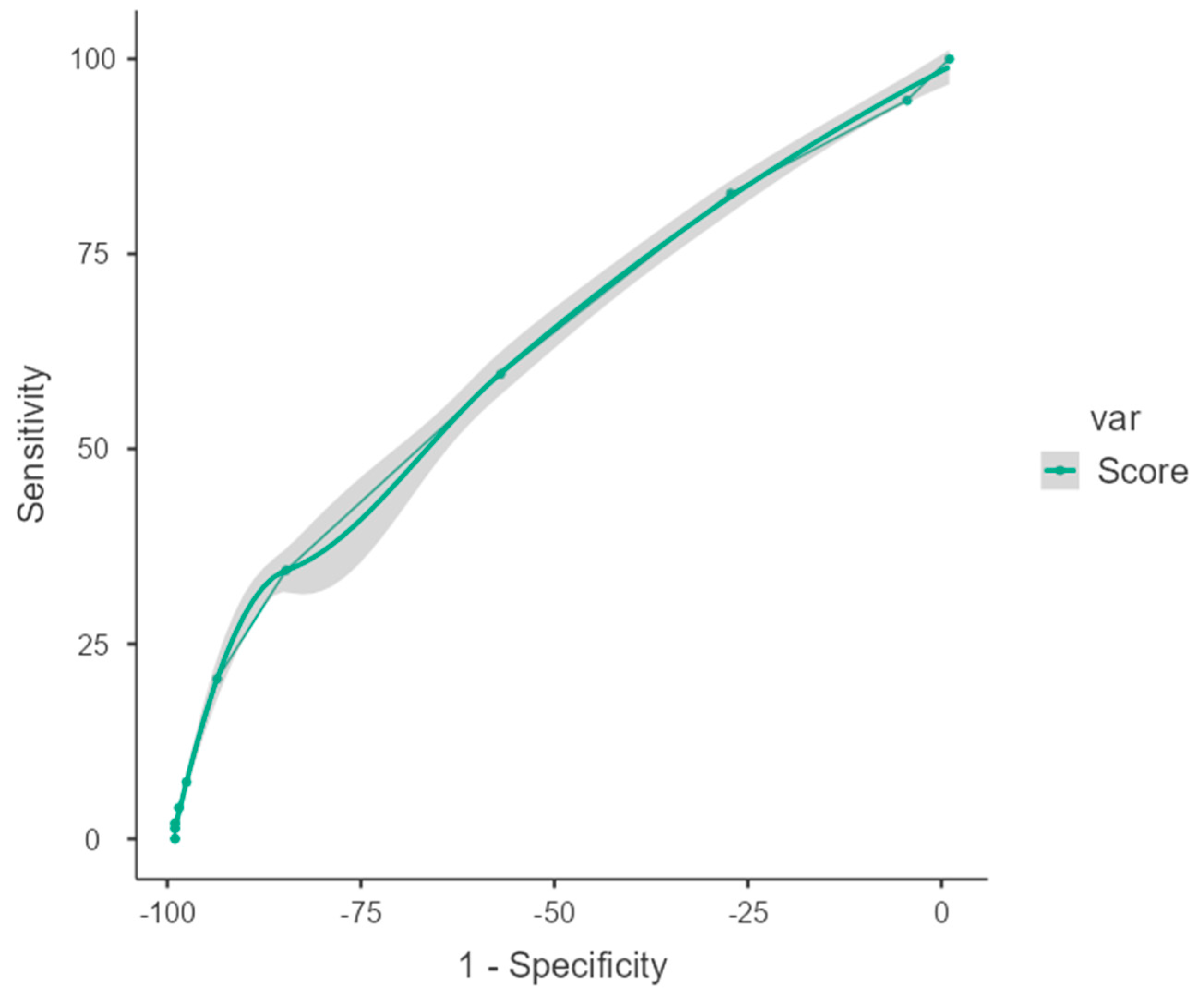
| Cut-Off | Sensitivity (%) | Specificity (%) | PPV (%) | NPV (%) | Youden’s Index | AUC | Metric Score |
|---|---|---|---|---|---|---|---|
| 0 | 1.32 | 100.00 | 100.00 | 57.55 | 0.01325 | 0.628 | 1.01 |
| 1 | 1.99 | 100.00 | 100.00 | 57.70 | 0.01987 | 0.628 | 1.02 |
| 3 | 3.97 | 99.50 | 85.71 | 58.09 | 0.03478 | 0.628 | 1.03 |
| 4 | 7.28 | 98.51 | 78.57 | 58.70 | 0.05800 | 0.628 | 1.06 |
| 5 | 20.53 | 94.55 | 73.81 | 61.41 | 0.15084 | 0.628 | 1.15 |
| 6 | 34.44 | 85.64 | 64.20 | 63.60 | 0.20081 | 0.628 | 1.20 |
| 7 | 59.60 | 57.92 | 51.43 | 65.73 | 0.17523 | 0.628 | 1.18 |
| 8 | 82.78 | 28.22 | 46.30 | 68.67 | 0.10999 | 0.628 | 1.11 |
| 9 | 94.70 | 5.45 | 42.81 | 57.89 | 0.00148 | 0.628 | 1.00 |
| 10 | 100.00 | 0 | 42.78 | N/A | 0.00000 | 0.628 | 1.00 |
| Toilet Training Time | B | p | O.R. | 95% Confidence Interval for O.R. | ||
|---|---|---|---|---|---|---|
| Lower Bound | Upper Bound | |||||
| 8–15 days | Intercept | 0.157 | 0.278 | |||
| [score < 6] | −0.340 | 0.585 | 0.712 | 0.210 | 2.413 | |
| [score ≥ 6] | 0 | |||||
| 16–30 days | Intercept | −0.288 | 0.077 | |||
| [score < 6] | 0.894 | 0.094 | 2.444 | 0.860 | 6.948 | |
| [score ≥ 6] | 0 | |||||
| 31 days and longer | Intercept | −0.488 | 0.005 | |||
| [score < 6] | 1.692 | 0.001 | 5.432 | 2.053 | 14.375 | |
| [score ≥ 6] | 0 | |||||
Disclaimer/Publisher’s Note: The statements, opinions and data contained in all publications are solely those of the individual author(s) and contributor(s) and not of MDPI and/or the editor(s). MDPI and/or the editor(s) disclaim responsibility for any injury to people or property resulting from any ideas, methods, instructions or products referred to in the content. |
© 2024 by the authors. Licensee MDPI, Basel, Switzerland. This article is an open access article distributed under the terms and conditions of the Creative Commons Attribution (CC BY) license (https://creativecommons.org/licenses/by/4.0/).
Share and Cite
Barutçu, A.; Mete, B.; Demirhindi, H.; Barutçu, S.; Kıdı, A.; Evliyaoğlu, N. Toilet Training Readiness Scale for 0–5-Year-Old Children: A New Measurement Tool Based on a Child-Centred Approach. Children 2024, 11, 1149. https://doi.org/10.3390/children11091149
Barutçu A, Mete B, Demirhindi H, Barutçu S, Kıdı A, Evliyaoğlu N. Toilet Training Readiness Scale for 0–5-Year-Old Children: A New Measurement Tool Based on a Child-Centred Approach. Children. 2024; 11(9):1149. https://doi.org/10.3390/children11091149
Chicago/Turabian StyleBarutçu, Adnan, Burak Mete, Hakan Demirhindi, Saliha Barutçu, Aliye Kıdı, and Nurdan Evliyaoğlu. 2024. "Toilet Training Readiness Scale for 0–5-Year-Old Children: A New Measurement Tool Based on a Child-Centred Approach" Children 11, no. 9: 1149. https://doi.org/10.3390/children11091149
APA StyleBarutçu, A., Mete, B., Demirhindi, H., Barutçu, S., Kıdı, A., & Evliyaoğlu, N. (2024). Toilet Training Readiness Scale for 0–5-Year-Old Children: A New Measurement Tool Based on a Child-Centred Approach. Children, 11(9), 1149. https://doi.org/10.3390/children11091149