

Validation of the Particle-Based Multi-Analyte Technology for Detection of Anti-PhosphatidylSerine/Prothrombin Antibodies





Abstract
1. Introduction
2. Experimental Section
2.1. Patients
- (1)
- fulfilled the diagnosis of primary APS (pAPS), defined as per Sydney criteria [1];
- (2)
- fulfilled the diagnosis of secondary APS (sAPS), defined as per Sydney criteria [1];
- (3)
- tested persistently positive for aPL, with no clinical manifestations of APS (“aPL carriers”). The study was performed in compliance with the Declaration of Helsinki. Patients gave informed consent and approval was obtained from the Ethical Committee (protocol n° 0092056). Clinical and laboratory characteristics were retrospectively collected.
2.2. Criteria Autoantibody Detection
2.3. aPS/PT Detection
2.4. Statistical Analysis
3. Results
4. Discussion
5. Conclusions
Author Contributions
Funding
Conflicts of Interest
References
- Miyakis, S.; Lockshin, M.D.; Atsumi, T.; Branch, D.W.; Brey, R.L.; Cervera, R.H.W.M.; Derksen, R.H.W.M.; De Groot, P.G.; Koike, T.; Meroni, P.L.; et al. International consensus statement on an update of the classification criteria for definite antiphospholipid syndrome (APS). J. Thromb. Haemost. 2006, 4, 295–306. [Google Scholar] [CrossRef]
- Negrini, S.; Pappalardo, F.; Murdaca, G.; Indiveri, F.; Puppo, F. The antiphospholipid syndrome: From pathophysiology to treatment. In Clinical and Experimental Medicine; Springer Italia s.r.l.: Milan, Italy, 2017; Volume 17, pp. 257–267. [Google Scholar]
- Sciascia, S.; Amigo, M.; Roccatello, D.; Khamashta, M. Diagnosing antiphospholipid. Nat. Rev. Rheumatol. 2017, 13, 548–560. [Google Scholar] [CrossRef]
- Vikerfors, A.; Johansson, A.-B.; Gustafsson, J.T.; Jönsen, A.; Leonard, D.; Zickert, A.; Nordmark, G.; Sturfelt, G.; Bengtsson, A.; Rönnblom, L.; et al. Clinical manifestations and anti-phospholipid antibodies in 712 patients with systemic lupus erythematosus: Evaluation of two diagnostic assays. Rheumatology 2013, 52, 501–509. [Google Scholar] [CrossRef]
- Pengo, V.; Biasiolo, A.; Bison, E.; Chantarangkul, V.; Tripodi, A. Italian Federation of Anticoagulation Clinics (FCSA). Antiphospholipid antibody ELISAs: Survey on the performance of clinical laboratories assessed by using lyophilized affinity-purified IgG with anticardiolipin and anti-beta2-Glycoprotein I activity. Thromb. Res. 2007, 120, 127–133. [Google Scholar] [CrossRef]
- Parkpian, V.; Verasertniyom, O.; Vanichapuntu, M.; Totemchokchyakarn, K.; Nantiruj, K.; Pisitkul, P.; Angchaisuksiri, P.; Archararit, N.; Rachakom, B.; Ayurachai, K.; et al. Specificity and sensitivity of anti-beta2-glycoprotein I as compared with anticardiolipin antibody and lupus anticoagulant in Thai systemic lupus erythematosus patients with clinical features of antiphospholipid syndrome. Clin. Rheumatol. 2007, 26, 1663–1670. [Google Scholar] [CrossRef]
- Rodríguez-García, V.; Ioannou, Y.; Fernández-Nebro, A.; Isenberg, D.A.; Giles, I.P. Examining the prevalence of non-criteria anti-phospholipid antibodies in patients with anti-phospholipid syndrome: A systematic review. Rheumatology 2015, 54, 2042–2050. [Google Scholar] [CrossRef]
- Nayfe, R.; Uthman, I.; Aoun, J.; Saad Aldin, E.; Merashli, M.; Khamashta, M.A. Seronegative antiphospholipid syndrome. Rheumatology 2013, 52, 1358–1367. [Google Scholar] [CrossRef]
- Sciascia, S.; Sanna, G.; Murru, V.; Roccatello, D.; Khamashta, M.A.; Bertolaccini, M.L. GAPSS: The Global Anti-Phospholipid Syndrome Score. Rheumatology 2013, 52, 1397–1403. [Google Scholar] [CrossRef]
- Sciascia, S.; Radin, M.; Cecchi, I.; Rubini, E.; Scotta, A.; Rolla, R.; Montaruli, B.; Pergolini, P.; Mengozzi, G.; Muccini, E.; et al. Reliability of Lupus Anticoagulant and Anti-phosphatidylserine/prothrombin Autoantibodies in Antiphospholipid Syndrome: A Multicenter Study. Front. Immunol. 2019, 10, 376. [Google Scholar] [CrossRef]
- Willis, R.; Pierangeli, S.S.; Jaskowski, T.D.; Malmberg, E.; Guerra, M.; Salmon, J.E.; Petri, M.; Branch, D.W.; Tebo, A.E. Performance Characteristics of Commercial Immunoassays for the Detection of IgG and IgM Antibodies to β2 Glycoprotein I and an Initial Assessment of Newly Developed Reference Materials for Assay Calibration. Am. J. Clin. Pathol. 2016, 145, 796–805. [Google Scholar] [CrossRef]
- Sciascia, S.; Willis, R.; Pengo, V.; Krilis, S.; Andrade, D.; Tektonidou, M.G.; Ugarte, A.; Chighizola, C.; Branch, D.W.; Levy, R.A.; et al. The comparison of real world and core laboratory antiphospholipid antibody ELISA results from antiphospholipid syndrome alliance for clinical trials & international networking (APS ACTION) clinical database and repository analysis. Thromb. Res. 2019, 175, 32–36. [Google Scholar]
- Savino, S.; Massimo, R.; Carlos, R.; Andrea, S.; Chelsea, B.; Silva, C.; Irene, C.; Elena, R.; Grazietta, F.S.; Simone, B.; et al. Evaluation of novel assays for the detection of autoantibodies in antiphospholipid syndrome. Autoimmun. Rev. 2020, 102641. [Google Scholar] [CrossRef]
- Richards, M.; García-De La Torre, I.; González-Bello, Y.C.; Vázquez-Del Mercado, M.; Andrade-Ortega, L.; Medrano-Ramírez, G.; Navarro-Zarza, J.E.; Maradiaga-Ceceña, M.; Loyo, E.; Rojo-Mejía, A.; et al. Autoantibodies to Mi-2 alpha and Mi-2 beta in patients with idiopathic inflammatory myopathy. Rheumatology 2019, 58, 1655–1661. [Google Scholar] [CrossRef]
- Villalta, D.; Seaman, A.; Tiongson, M.; Warren, C.; Bentow, C.; Bizzaro, N.; Alessio, M.G.; Porcelli, B.; Norman, G.L.; Mahler, M. Evaluation of a novel extended automated particle-based multi-analyte assay for the detection of autoantibodies in the diagnosis of primary biliary cholangitis. Clin. Chem. Lab. Med. 2020, 58, 1499–1507. [Google Scholar] [CrossRef]
- Cavazzana, I.; Richards, M.; Bentow, C.; Seaman, A.; Fredi, M.; Giudizi, M.G.; Palterer, B.; Pratesi, F.; Migliorini, P.; Franceschini, F.; et al. Evaluation of a novel particle-based assay for detection of autoantibodies in idiopathic inflammatory myopathies. J. Immunol. Methods 2019, 474, 112661. [Google Scholar] [CrossRef]
- Brandt, J.T.; Triplett, D.A.; Alving, B.; Scharrer, I. Criteria for the diagnosis of lupus anticoagulants: An update. On behalf of the Subcommittee on Lupus Anticoagulant/Antiphospholipid Antibody of the Scientific and Standardisation Committee of the ISTH. Thromb. Haemost. 1995, 74, 1185–1190. [Google Scholar] [CrossRef]
- Pengo, V.; Tripodi, A.; Reber, G.; Rand, J.H.; Ortel, T.L.; Galli, M.; De Groot, P.G. Update of the guidelines for lupus anticoagulant detection. J. Thromb. Haemost. 2009, 7, 1737–1740. [Google Scholar] [CrossRef]
- Monogioudi, E.; Martos, G.; Hutu, D.P.; Schimmel, H.; Meroni, P.L.; Sheldon, J.; Zegers, I. Standardization of autoimmune testing—Is it feasible? Clin. Chem. Lab. Med. 2018, 56, 1734–1742. [Google Scholar] [CrossRef]
- Van Blerk, M.; Van Campenhout, C.; Bossuyt, X.; Duchateau, J.; Humbel, R.; Servais, G.; Tomasi, J.P.; Albert, A.; Coucke, W.; Libeer, J.C. Current practices in antinuclear antibody testing: Results from the Belgian External Quality Assessment Scheme. Clin. Chem. Lab. Med. 2009, 47, 102–108. [Google Scholar] [CrossRef]
- Schimmel, H.; Zegers, I.; Emons, H. Standardization of protein biomarker measurements: Is it feasible? Scand. J. Clin. Lab. Investig. 2010, 70 (Suppl. 242), 27–33. [Google Scholar] [CrossRef]
- Bertolaccini, M.L.; Sanna, G. The Clinical Relevance of Noncriteria Antiphospholipid Antibodies. Semin. Thromb. Hemost. 2017, 44, 453–457. [Google Scholar]
- Sciascia, S.; Sanna, G.; Murru, V.; Roccatello, D.; Khamashta, M.A.; Bertolaccini, M.L. Anti-prothrombin (aPT) and anti-phosphatidylserine/prothrombin (aPS/PT) antibodies and the risk of thrombosis in the antiphospholipid syndrome a systematic review. Thromb. Haemost. 2013, 111, 354. [Google Scholar] [CrossRef]
- Sciascia, S.; Sanna, G.; Murru, V.; Khamashta, M.A.; Bertolaccini, M.L. Validation of a commercially available kit to detect anti- phosphatidylserine/prothrombin antibodies in a cohort of systemic lupus erythematosus patients. Thromb. Res. 2014, 133, 451–454. [Google Scholar] [CrossRef]
- Elbagir, S.; Mohammed, N.A.; Kaihola, H.; Svenungsson, E.; Gunnarsson, I.; Manivel, V.A.; Pertsinidou, E.; Elagib, E.M.; Nur, M.A.M.; Elussein, E.A.; et al. Elevated IgA antiphospholipid antibodies in healthy pregnant women in Sudan but not Sweden, without corresponding increase in IgA anti-β2 glycoprotein I domain 1 antibodies. Lupus 2020, 29, 463–473. [Google Scholar] [CrossRef]
- Devreese, K.M.J. Antiphospholipid antibody testing and standardization. Int. J. Lab. Hematol. 2014, 36, 352–363. [Google Scholar] [CrossRef]
- Hughes, G.R.V.; Khamashta, M.A. Seronegative antiphospholipid syndrome. Ann. Rheum. Dis. 2003, 62, 1127. [Google Scholar] [CrossRef]
- Liu, T.; Gu, J.; Wan, L.; Hu, Q.; Teng, J.; Liu, H.; Cheng, X.; Ye, J.; Su, Y.; Sun, Y.; et al. “Non-criteria” antiphospholipid antibodies add value to antiphospholipid syndrome diagnoses in a large Chinese cohort. Arthritis Res. Ther. 2020, 22, 33. [Google Scholar] [CrossRef]
- Wilson, A.J.; Sant, H.; Van Duser, P.K.; Wentz, M. Enzyme-Based Methods for IgM Serology: Standard Indirect ELISA vs Antibody-Capture ELISA. Lab. Med. 1992, 23, 259–263. [Google Scholar] [CrossRef]
- Gabriel, M.; Adomeh, D.I.; Ehimuan, J.; Oyakhilome, J.; Omomoh, E.O.; Ighodalo, Y.; Olokor, T.; Bonney, K.; Pahlmann, M.; Emmerich, P.; et al. Development and evaluation of antibody-capture immunoassays for detection of Lassa virus nucleoprotein-specific immunoglobulin M and G. PLoS Negl. Trop. Dis. 2018, 12, e0006361. [Google Scholar] [CrossRef]
- Kelchtermans, H.; Pelkmans, L.; de Laat, B.; Devreese, K.M. IgG/IgM antiphospholipid antibodies present in the classification criteria for the antiphospholipid syndrome: A critical review of their association with thrombosis. J. Thromb. Haemost. 2016, 14, 1530–1548. [Google Scholar] [CrossRef]
- Galli, M.; Luciani, D.; Bertolini, G.; Barbui, T. Lupus anticoagulants are stronger risk factors for thrombosis than anticardiolipin antibodies in the antiphospholipid syndrome: A systematic review of the literature. Blood 2003, 101, 1827–1832. [Google Scholar] [CrossRef]
- Galli, M.; Luciani, D.; Bertolini, G.; Barbui, T. Anti-β2-glycoprotein I, antiprothrombin antibodies, and the risk of thrombosis in the antiphospholipid syndrome. Blood 2003, 102, 2717–2723. [Google Scholar] [CrossRef]
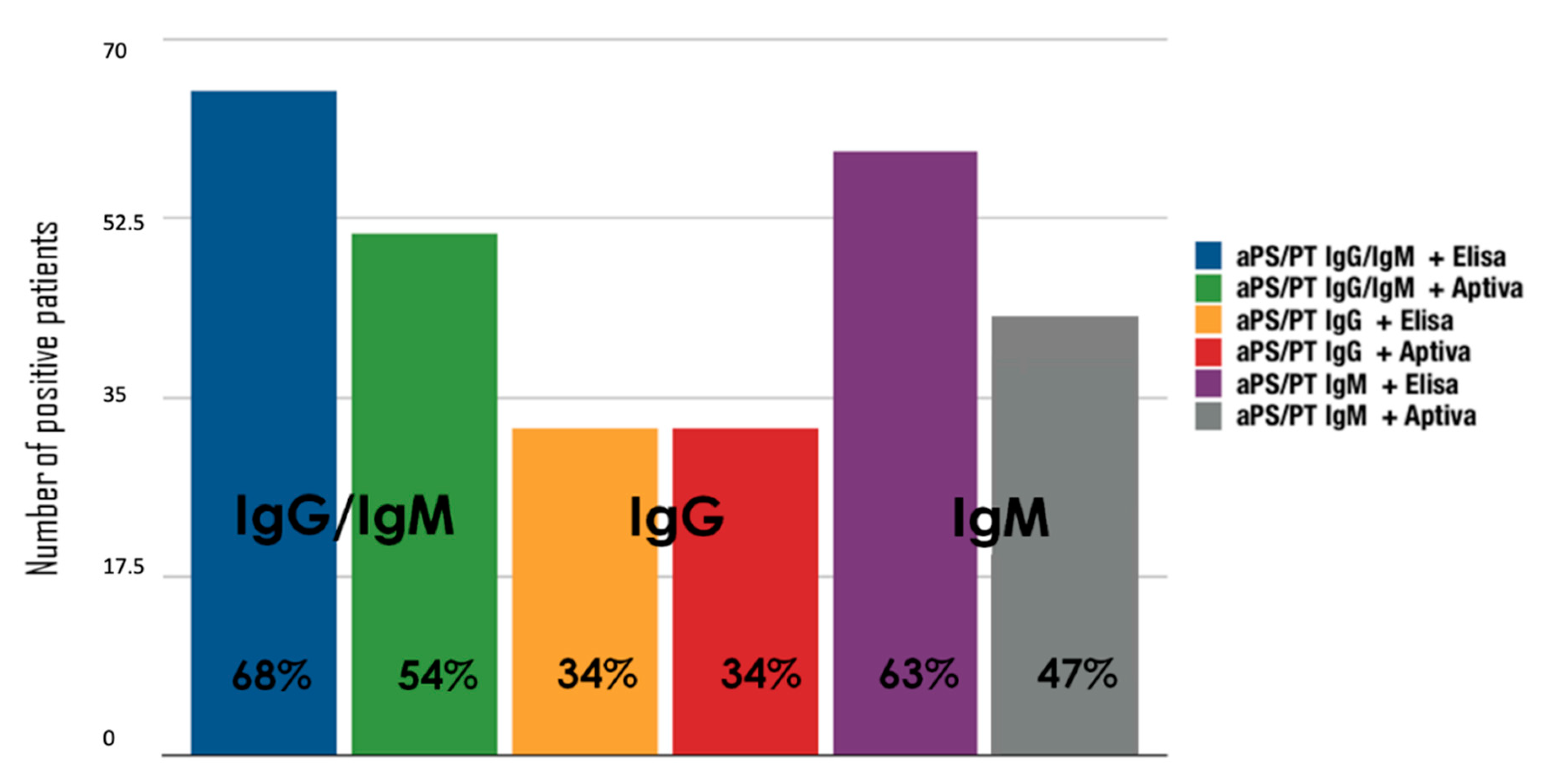
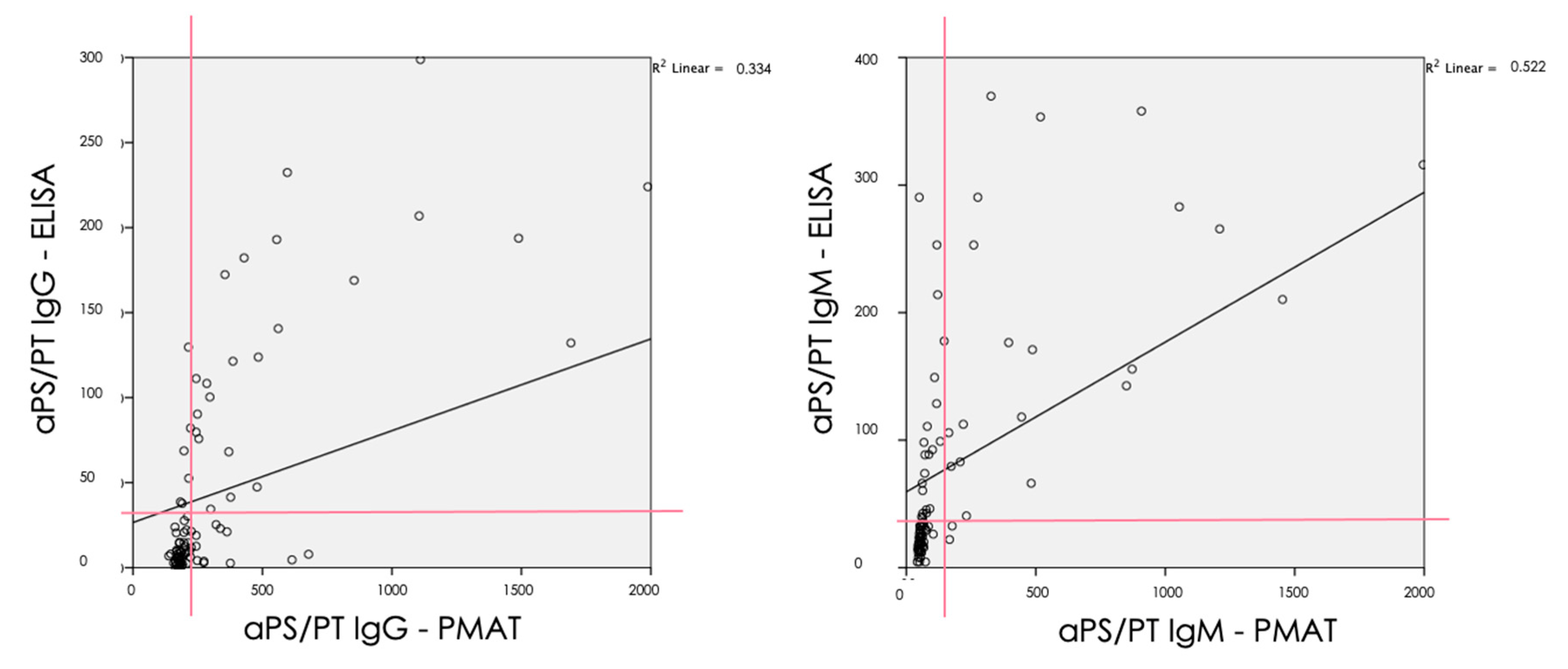
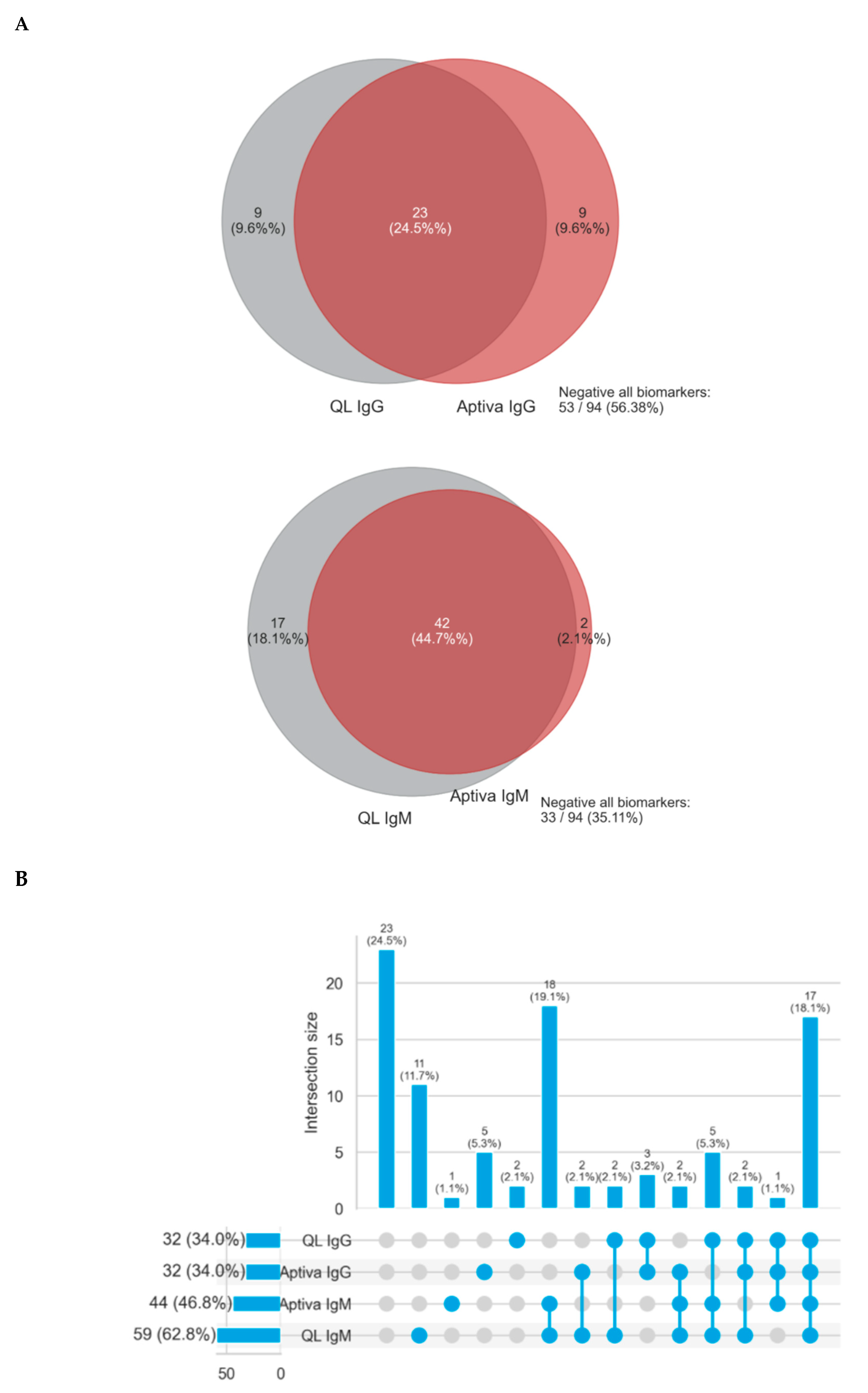
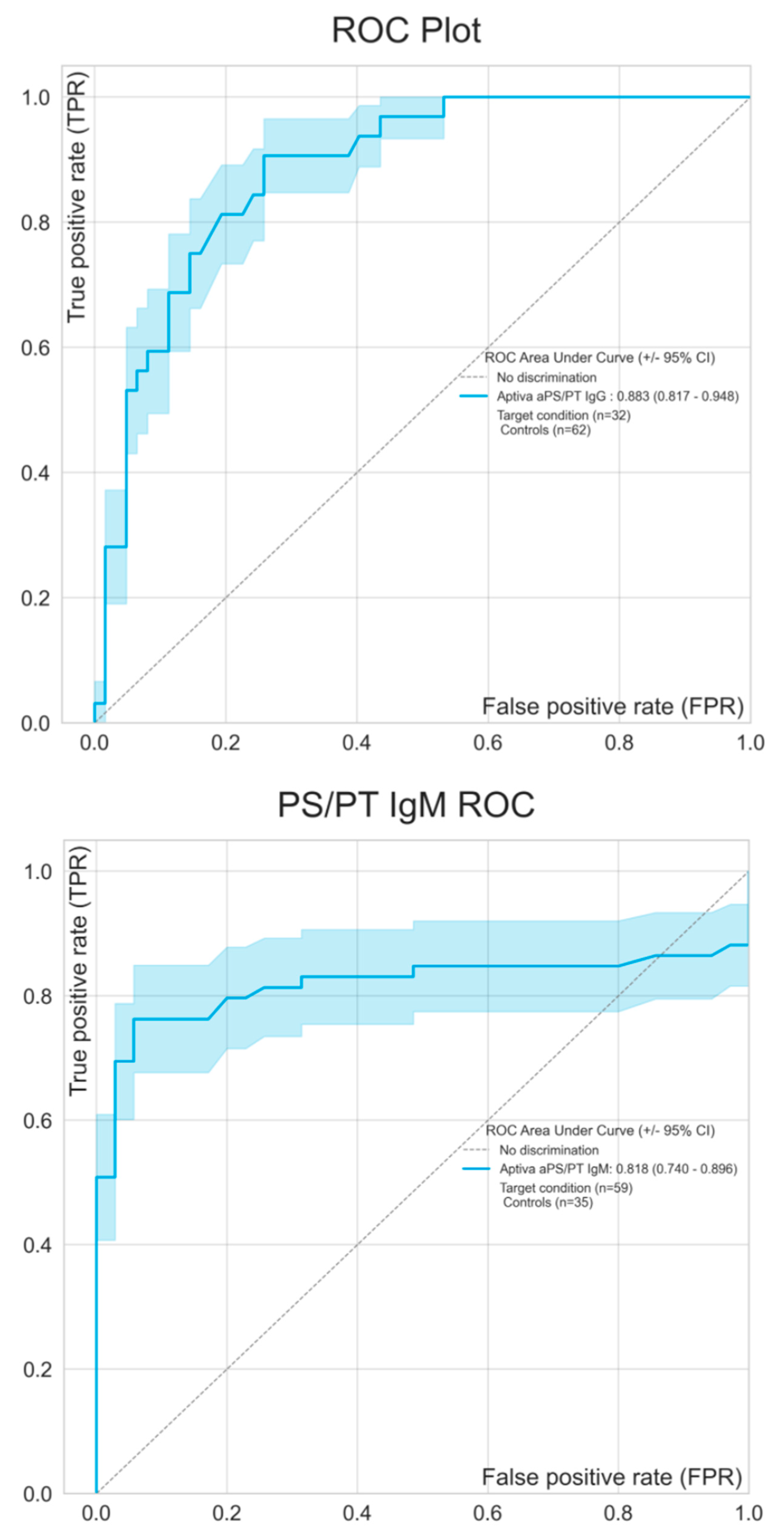

| pAPS (n = 38) | sAPS (n = 33) | aPL+ (n = 23) | |
|---|---|---|---|
| Demographics and Diagnosis | |||
| Age at study inclusion; years (±SD) | 50.2 (±13.7) | 49.1 (±12.2) | 48.8 (±12.8) |
| Females; n, (%) | 24 (63) | 18 (55) | 17 (74) |
| Systemic Lupus Erythematosus; n, (%) | 0 | 25 (76) | 18 (78) |
| Other Autoimmune diseases * | 0 | 8 (24) | 5 (22) |
| Clinical Characteristics | |||
| Thrombosis; n, (%) | 31 (82) | 31 (94) | 0 |
| Arterial; n, (%) | 21 (55) | 16 (52) | 0 |
| Venous; n, (%) | 15 (39) | 17 (52) | 0 |
| Pregnancy Morbidity; n, (%) | 8 (21) | 4 (12) | 0 |
| Laboratory Profile | |||
| LA; n, (%) | 32 (84) | 28 (85) | 21 (91) |
| aCL (IgG/M); n, (%) | 25 (66) | 23 (70) | 15 (65) |
| aβ2GPI (IgG/M); n, (%) | 26 (68) | 24 (73) | 15 (65) |
| Triple aPL (IgG/M); n, (%) | 23 (61) | 20 (61) | 13 (57) |
| Cardiovascular Risk Factors | |||
| Arterial hypertension; n, (%) | 15 (39) | 14 (45) | 5 (22) |
| Hyperlipidaemia; n, (%) | 14 (37) | 11 (35) | 2 (9) |
| Smoking habit; n, (%) | 4 (11) | 7 (23) | 2 (9) |
| Diabetes mellitus; n, (%) | 4 (11) | 2 (6) | 1 (4) |
| Method Comparison | Aptiva PS/PT IgM | Percent Agreement (95% Confidence) | |||
| Negative | Positive | Total | |||
| QUANTA Lite IgM kappa 0.60 (0.45–0.75) | Negative | 33 | 2 | 35 | NPA = 71.2% (58.6–81.2%) |
| Positive | 17 | 42 | 59 | PPA = 94.3% (81.4–98.4%) | |
| Total | 50 | 44 | 94 | TPA = xx% (xxx%) | |
| Method Comparison | Aptiva PS/PT IgG | Percent Agreement (95% Confidence) | |||
| Negative | Positive | Total | |||
| QUANTA Lite IgG kappa 0.57 (0.40–0.75) | Negative | 53 | 9 | 62 | NPA = 71.9% (55.6–84.4%) |
| Positive | 9 | 23 | 32 | PPA = 85.5% (74.7–92.2%) | |
| Total | 62 | 32 | 94 | TPA = xx% (xxx%) | |
Publisher’s Note: MDPI stays neutral with regard to jurisdictional claims in published maps and institutional affiliations. |
© 2020 by the authors. Licensee MDPI, Basel, Switzerland. This article is an open access article distributed under the terms and conditions of the Creative Commons Attribution (CC BY) license (http://creativecommons.org/licenses/by/4.0/).
Share and Cite
Radin, M.; Cecchi, I.; Foddai, S.G.; Rubini, E.; Barinotti, A.; Ramirez, C.; Seaman, A.; Roccatello, D.; Mahler, M.; Sciascia, S. Validation of the Particle-Based Multi-Analyte Technology for Detection of Anti-PhosphatidylSerine/Prothrombin Antibodies. Biomedicines 2020, 8, 622. https://doi.org/10.3390/biomedicines8120622
Radin M, Cecchi I, Foddai SG, Rubini E, Barinotti A, Ramirez C, Seaman A, Roccatello D, Mahler M, Sciascia S. Validation of the Particle-Based Multi-Analyte Technology for Detection of Anti-PhosphatidylSerine/Prothrombin Antibodies. Biomedicines. 2020; 8(12):622. https://doi.org/10.3390/biomedicines8120622
Chicago/Turabian StyleRadin, Massimo, Irene Cecchi, Silvia Grazietta Foddai, Elena Rubini, Alice Barinotti, Carlos Ramirez, Andrea Seaman, Dario Roccatello, Michael Mahler, and Savino Sciascia. 2020. "Validation of the Particle-Based Multi-Analyte Technology for Detection of Anti-PhosphatidylSerine/Prothrombin Antibodies" Biomedicines 8, no. 12: 622. https://doi.org/10.3390/biomedicines8120622
APA StyleRadin, M., Cecchi, I., Foddai, S. G., Rubini, E., Barinotti, A., Ramirez, C., Seaman, A., Roccatello, D., Mahler, M., & Sciascia, S. (2020). Validation of the Particle-Based Multi-Analyte Technology for Detection of Anti-PhosphatidylSerine/Prothrombin Antibodies. Biomedicines, 8(12), 622. https://doi.org/10.3390/biomedicines8120622

