1. Introduction
Digestive system malignancies account for a substantial share of global cancer incidence and mortality. Global Cancer Statistics 2024 estimated that colorectal cancer represented 9.9% of new cancers worldwide, while stomach and liver cancers remained major causes of cancer death. These site-level statistics also show marked geographic heterogeneity, particularly for liver and gallbladder cancers, and caution against treating the digestive tract as one epidemiological entity. This review, therefore, focuses on the following six clinically distinct groups: esophageal cancer, gastric and gastroesophageal junction cancer, colorectal cancer, hepatocellular carcinoma, biliary tract and gallbladder cancer, and pancreatic ductal adenocarcinoma [
1].
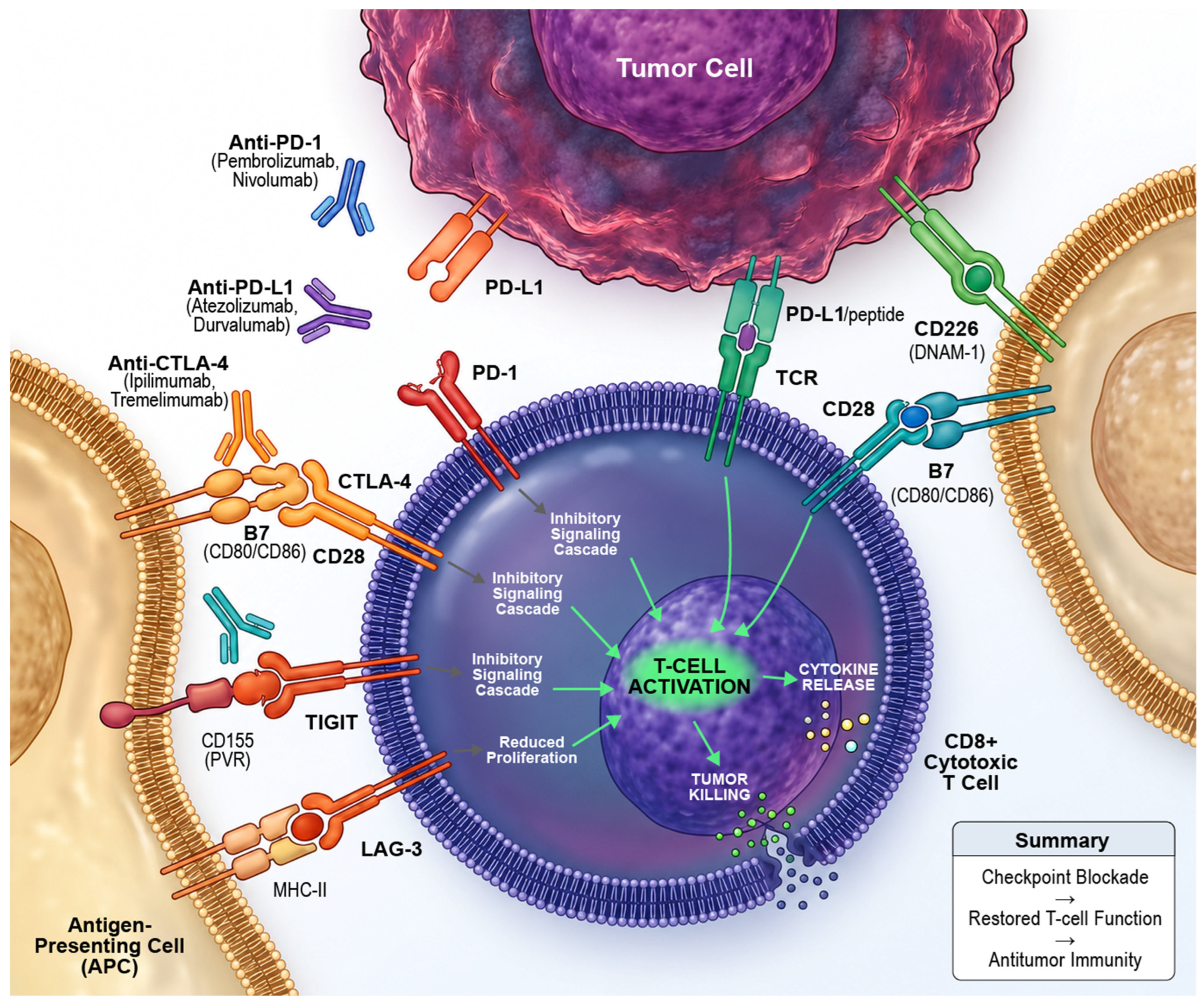
Immune checkpoint inhibitors restore antitumor immunity by interrupting inhibitory pathways such as PD-1/PD-L1 and CTLA-4 (
Figure 1), but response depends on tumor antigenicity, immune-cell composition, spatial organization, stromal exclusion, and treatment context. The contrast is clearest between mismatch repair-deficient or microsatellite instability-high tumors, which can be highly sensitive to PD-1 blockade, and most microsatellite-stable colorectal and pancreatic cancers, in which low immunogenicity and immune exclusion limit activity [
2,
3,
4].
Figure 1.
Immune checkpoint pathways and therapeutic blockade. PD-1–PD-L1 interactions can occur between tumor or antigen-presenting cells and activated T cells, whereas CTLA-4 competes with CD28 for B7 ligands primarily during T-cell priming. TIGIT binds CD155/CD112, and LAG-3 recognizes MHC class II and other ligands. Blocking these nonidentical inhibitory pathways can restore antitumor effector function but can also break peripheral tolerance and cause immune-related adverse events. The diagram is conceptual and not drawn to scale. Abbreviations: APC, antigen-presenting cell; CTLA-4, cytotoxic T-lymphocyte-associated protein 4; LAG-3, lymphocyte-activation gene 3; MHC, major histocompatibility complex; PD-1, programmed cell death protein 1; PD-L1, programmed death-ligand 1; TIGIT, T-cell immunoreceptor with immunoglobulin and ITIM domains.
Figure 1.
Immune checkpoint pathways and therapeutic blockade. PD-1–PD-L1 interactions can occur between tumor or antigen-presenting cells and activated T cells, whereas CTLA-4 competes with CD28 for B7 ligands primarily during T-cell priming. TIGIT binds CD155/CD112, and LAG-3 recognizes MHC class II and other ligands. Blocking these nonidentical inhibitory pathways can restore antitumor effector function but can also break peripheral tolerance and cause immune-related adverse events. The diagram is conceptual and not drawn to scale. Abbreviations: APC, antigen-presenting cell; CTLA-4, cytotoxic T-lymphocyte-associated protein 4; LAG-3, lymphocyte-activation gene 3; MHC, major histocompatibility complex; PD-1, programmed cell death protein 1; PD-L1, programmed death-ligand 1; TIGIT, T-cell immunoreceptor with immunoglobulin and ITIM domains.
Immunotherapy refers mainly to immune checkpoint blockade, cancer vaccines, cellular therapy, and immune-modulating combinations. Zolbetuximab, a CLDN18.2-directed antibody with immune-effector functions, is also discussed, but it is considered separately from checkpoint inhibitors wherever the two strategies differ. Our emphasis is on practice-changing evidence and clinically relevant negative trials, together with emerging biomarker, perioperative, and translational strategies that may shape the next cycle of trials.
2. Literature Search and Review Scope
PubMed was searched through 4 August 2026 using combinations of disease terms for esophageal, gastric or gastroesophageal junction, colorectal, hepatocellular, biliary tract or gallbladder, and pancreatic cancers with intervention terms covering immune checkpoint inhibitors, PD-1, PD-L1, CTLA-4, TIGIT, cancer vaccines, CAR-T cells, perioperative therapy, biomarkers, adverse events, artificial intelligence, radiomics, spatial profiling, and multi-omics. The full PubMed strategy and the date of the final update are provided in
Supplementary Table S1. Reference lists of pivotal trials and current clinical practice guidelines were checked to identify primary reports and mature follow-up analyses.
Evidence was selected for its ability to define current practice, alter interpretation of a major trial, or illustrate a clinically relevant limitation. Priority was given to peer-reviewed randomized trials, prospective clinical studies, mature follow-up reports, original translational analyses, patient-reported outcome studies, and authoritative guidelines. Meeting abstracts were used only when no peer-reviewed full report was available and are explicitly labeled. Case reports and very small case series were not used to support treatment recommendations. Preclinical studies were included only to explain mechanisms or to describe strategies that remain preclinical. Because the objective was comparative interpretation rather than exhaustive study identification or quantitative synthesis, no exhaustive study-selection flow diagram, pooled effect estimate, formal risk-of-bias instrument, or claim of comprehensive study inclusion is presented.
3. Esophageal Cancer
3.1. First-Line Treatment for Advanced Disease
KEYNOTE-590 established pembrolizumab plus platinum-fluoropyrimidine chemotherapy as a first-line option for advanced esophageal and gastroesophageal junction cancer (
Table 1). In the peer-reviewed five-year update, 749 patients had been randomized. At a median follow-up of 58.8 months, median overall survival in the intention-to-treat population was 12.3 months with pembrolizumab plus chemotherapy and 9.8 months with placebo plus chemotherapy (HR 0.72, 95% CI 0.62–0.84); five-year overall survival rates were 10.6% and 3.0%, respectively. In the original analysis, median overall survival was 13.5 versus 9.4 months in the overall PD-L1 CPS at least 10 population and 13.9 versus 8.8 months in the ESCC subgroup with CPS at least 10, two populations that should not be conflated [
5,
6].
CheckMate-648 addressed a different population and used tumor-cell PD-L1 rather than CPS. The global phase III trial randomized 970 patients with previously untreated advanced esophageal squamous-cell carcinoma to nivolumab plus chemotherapy, nivolumab plus ipilimumab, or chemotherapy. In patients with tumor-cell PD-L1 expression of at least 1%, median overall survival was 15.4 versus 9.1 months with nivolumab plus chemotherapy (HR 0.54) and 13.7 versus 9.1 months with nivolumab plus ipilimumab (HR 0.64). Both regimens also improved overall survival in the overall population. Progression-free survival, however, was significantly improved only by nivolumab plus chemotherapy, not by the chemotherapy-free dual-checkpoint regimen. This distinction is relevant when balancing chemotherapy avoidance against early disease control and immune-related toxicity [
7].
RATIONALE-306 should be considered separately rather than used as support for CheckMate-648. In 649 patients with advanced or unresectable esophageal squamous-cell carcinoma, tislelizumab plus chemotherapy prolonged median overall survival to 17.2 months versus 10.6 months with placebo plus chemotherapy (HR 0.66, 95% CI 0.54–0.80). Together, these trials support multiple first-line checkpoint-based regimens, but their PD-L1 assays, chemotherapy backbones, populations, and hierarchical testing strategies are not interchangeable [
8].
3.2. Perioperative Therapy
Perioperative checkpoint blockade has produced high pathological response rates, although survival maturity varies. Keystone-001 was a prospective, single-arm phase II study in which 47 patients received neoadjuvant pembrolizumab plus chemotherapy and 46 were evaluable for efficacy. Major pathological response and pathological complete response occurred in 72% and 41%, respectively; two-year overall and disease-free survival estimates were encouraging but rely on a nonrandomized cohort and historical comparisons [
9].
ESCORT-NEO provided randomized phase III evidence that adding camrelizumab can improve pathological response. Among 391 patients, pathological complete response rates were 28.0% with camrelizumab plus nab-paclitaxel/cisplatin, 15.4% with camrelizumab plus paclitaxel/cisplatin, and 4.7% with chemotherapy alone. Event-free survival, a co-primary end point, was not mature at publication. The appropriate conclusion is, therefore, that chemoimmunotherapy improved pathological response, not that it had already established a survival advantage [
10].
3.3. Biomarkers and Emerging Checkpoints
PD-L1 remains the most clinically implemented biomarker in esophageal cancer, but assay type, scoring method, cutoff, histology, and regimen materially affect interpretation. TMB and MSI-H can identify highly immunogenic tumors across cancer types, yet disease-specific prospective validation is limited and MSI-H is uncommon in esophageal cancer. These considerations favor reporting the exact assay and threshold used in each trial rather than treating PD-L1 positivity as a universal binary category [
11,
12].
The TIGIT blockade illustrates the gap between biological rationale and clinical validation. In the interim phase Ib/II MORPHEUS-EC analysis, the cohorts were unequal, as follows: chemotherapy, n = 24; atezolizumab plus chemotherapy, n = 65; and tiragolumab plus atezolizumab plus chemotherapy, n = 63. The three-drug regimen yielded a higher objective response rate than atezolizumab plus chemotherapy (67.7% vs. 53.8%) and a progression-free survival HR of 0.66 (95% CI 0.44–0.99). Median overall survival was 16.0 versus 13.1 months, but the HR was 0.80 (95% CI 0.49–1.30). These small, interim data are hypothesis-generating and do not establish incremental survival benefit [
13].
Table 1.
Selected immunotherapy trials in esophageal cancer.
Table 1.
Selected immunotherapy trials in esophageal cancer.
| Trial | Design and Population | Experimental Treatment | Comparator | Key Result | Evidence Boundary | Source |
|---|
| KEYNOTE-590 | Phase III; n = 749; untreated advanced esophageal/GEJ cancer | Pembrolizumab plus chemotherapy | Placebo plus chemotherapy | ITT OS 12.3 vs. 9.8 months; HR 0.72; 5-year OS 10.6% vs. 3.0% | Peer-reviewed 5-year update | [5,6] |
| CheckMate-648 | Phase III; n = 970; untreated advanced ESCC | Nivolumab plus chemotherapy or nivolumab plus ipilimumab | Chemotherapy | PD-L1 at least 1% OS: 15.4 and 13.7 vs. 9.1 months; PFS significant only for nivolumab plus chemotherapy | Global main trial; tumor-cell PD-L1 assay | [7] |
| RATIONALE-306 | Phase III; n = 649; advanced ESCC | Tislelizumab plus chemotherapy | Placebo plus chemotherapy | OS 17.2 vs. 10.6 months; HR 0.66 | Independent tislelizumab trial | [8] |
| ESCORT-NEO | Phase III; n = 391; resectable ESCC | Two camrelizumab–chemo regimens | Chemotherapy | pCR 28.0%, 15.4%, and 4.7% | EFS immature at publication | [10] |
| Keystone-001 | Single-arm phase II; n = 47 treated, n = 46 efficacy evaluable | Pembrolizumab plus chemotherapy | None | MPR 72%; pCR 41% | Historical comparison; no randomized survival inference | [9] |
| MORPHEUS-EC | Phase Ib/II interim analysis; unequal cohorts, n = 24/65/63 | Tiragolumab plus atezolizumab plus chemotherapy | Atezolizumab plus chemotherapy and chemotherapy | ORR 67.7% vs. 53.8%; OS HR 0.80 (95% CI 0.49–1.30) vs. atezolizumab plus chemotherapy | Meeting abstract; hypothesis-generating | [13] |
4. Gastric and Gastroesophageal Junction Cancer
4.1. First-Line Checkpoint Blockade
CheckMate 649 established nivolumab plus chemotherapy for HER2-negative advanced gastric, gastroesophageal junction, or esophageal adenocarcinoma, with the clearest evidence in PD-L1 CPS at least 5 (
Table 2). At a minimum follow-up of 36.2 months, the overall survival HR was 0.70 (95% CI 0.61–0.81) in the CPS at least 5 population, and three-year overall survival was 21% versus 10%. A separate four-year Q-TWiST analysis addressed quality-adjusted time without symptoms or toxicity and should not be treated as an independent primary efficacy trial [
14,
15].
KEYNOTE-859 randomized 1579 patients and was positive in the intention-to-treat population: median overall survival was 12.9 versus 11.5 months (HR 0.78), median progression-free survival was 6.9 versus 5.6 months (HR 0.76), and objective response rates were 51.3% versus 42.0% with pembrolizumab plus chemotherapy and placebo plus chemotherapy, respectively. The magnitude of the benefit increased with PD-L1 expression. In the exploratory CPS below 1 subgroup, the overall survival HR was 0.929 (95% CI 0.732–1.177), so the results do not justify the statement that all patients benefit equally irrespective of PD-L1 [
16].
KEYNOTE-062 provides an important negative and biomarker-qualified counterpoint. In the overall PD-L1 CPS at least 1 population, pembrolizumab monotherapy was noninferior but not superior to chemotherapy, and pembrolizumab plus chemotherapy did not meet the prespecified superiority end points. In the small exploratory MSI-H subgroup, median overall survival was not reached with pembrolizumab monotherapy versus 8.5 months with chemotherapy (HR 0.29, 95% CI 0.11–0.81), based on approximately 14 and 19 patients. The signal is biologically consistent with MSI-H sensitivity but is too small to establish a universal preference for monotherapy by itself [
17].
Table 2.
Selected immunotherapy and biomarker-directed trials in gastric and gastroesophageal junction cancer.
Table 2.
Selected immunotherapy and biomarker-directed trials in gastric and gastroesophageal junction cancer.
| Trial | Design and Population | Experimental Treatment | Comparator | Key Result | Clinical Interpretation | Source |
|---|
| CheckMate 649 | Phase III; n = 2031; HER2-negative advanced disease | Nivolumab plus chemotherapy | Chemotherapy | CPS at least 5 OS HR 0.70; 3-year OS 21% vs. 10% | Established first-line option; benefit enriched by PD-L1 | [14] |
| KEYNOTE-859 | Phase III; n = 1579; HER2-negative advanced disease | Pembrolizumab plus chemotherapy | Placebo plus chemotherapy | ITT OS 12.9 vs. 11.5 months; HR 0.78; ORR 51.3% vs. 42.0% | CPS below 1 HR 0.929; equal benefit across PD-L1 levels not established | [16] |
| KEYNOTE-062 | Phase III; n = 763; CPS at least 1 advanced disease | Pembrolizumab with or without chemotherapy | Chemotherapy | Monotherapy noninferior but not superior overall; MSI-H exploratory OS HR 0.29 | Small MSI-H subgroup; combination did not meet superiority | [17] |
| ASTRUM-006 | Phase III; n = 588; resectable CPS at least 5 disease | Perioperative serplulimab plus SOX then serplulimab | Perioperative SOX | ITT EFS HR 0.73; CPS at least 10 EFS HR 0.65 | OS immature; all randomized patients recruited in China | [18] |
| SPOTLIGHT | Phase III; n = 565; CLDN18.2-positive, HER2-negative advanced disease | Zolbetuximab plus mFOLFOX6 | Placebo plus mFOLFOX6 | PFS 10.61 vs. 8.67 months; OS 18.23 vs. 15.54 months; both HR 0.75 | CLDN18.2-directed targeted antibody | [19] |
| GLOW | Phase III; n = 507; CLDN18.2-positive, HER2-negative advanced disease | Zolbetuximab plus CAPOX | Placebo plus CAPOX | PFS HR 0.687; OS HR 0.771 | Independent validation of CLDN18.2 targeting | [20] |
4.2. Perioperative Immunotherapy
Perioperative development is rapidly changing. In the 2026 ASTRUM-006 phase III trial, 588 patients with PD-L1 CPS at least 5 resectable gastric or gastroesophageal junction adenocarcinoma were randomized to neoadjuvant serplulimab plus SOX followed by adjuvant serplulimab or perioperative SOX. Event-free survival improved both in the CPS at least 10 population (HR 0.65, 95% CI 0.47–0.90) and in the intention-to-treat population (HR 0.73, 95% CI 0.56–0.94). Overall survival remains immature, and all randomized patients were recruited in China, so broader generalizability and the contribution of the chemotherapy-sparing adjuvant component require further follow-up [
18].
4.3. CLDN18.2 and Molecular Stratification
Zolbetuximab is a CLDN18.2-directed antibody rather than an immune checkpoint inhibitor. In SPOTLIGHT, zolbetuximab plus mFOLFOX6 improved median progression-free survival to 10.61 versus 8.67 months and median overall survival to 18.23 versus 15.54 months, with HRs of 0.75 for both outcomes. In GLOW, zolbetuximab plus CAPOX improved median progression-free survival to 8.21 versus 6.80 months (HR 0.687) and median overall survival to 14.39 versus 12.16 months (HR 0.771). These trials establish CLDN18.2 as a treatment-selection biomarker for targeted antibody therapy, not as a validated predictor of checkpoint inhibition [
19,
20].
MSI-H, EBV positivity, TMB, stromal programs, and spatial immune organization may refine response prediction. Exploratory CheckMate 649 analyses associated hypermutation and, to a lesser extent, EBV-positive disease with greater relative benefit from nivolumab-containing treatment, while low stromal signatures also appeared favorable. Because only a subset of randomized patients had evaluable sequencing and the analyses were post hoc, these signatures require prospective validation and should not replace established MSI/MMR, HER2, PD-L1, or CLDN18.2 testing [
21].
5. Colorectal Cancer
5.1. Metastatic MSI-H/dMMR Disease
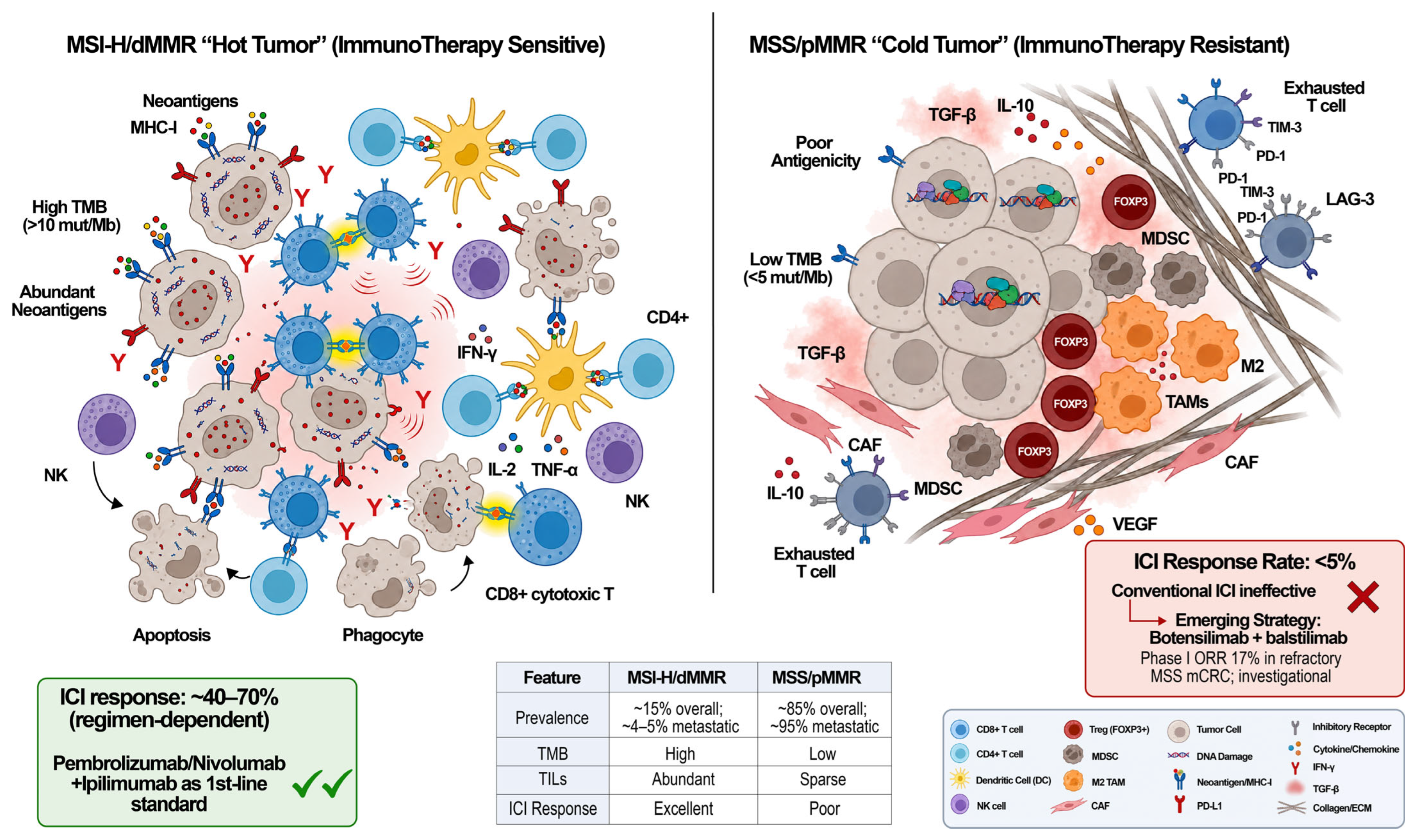
KEYNOTE-177 established first-line pembrolizumab in MSI-H/dMMR metastatic colorectal cancer (
Figure 2 and
Table 3). In the five-year update, 307 patients had been randomized and the effective crossover rate from chemotherapy to PD-1/PD-L1 blockade was 62%. Median overall survival was 77.5 months with pembrolizumab versus 36.7 months with chemotherapy (HR 0.73, 95% CI 0.53–0.99), median progression-free survival was 16.5 versus 8.2 months (HR 0.60, 95% CI 0.45–0.79), and five-year overall survival was 54.8% versus 44.2%. Grade 3–5 adverse events were less frequent with pembrolizumab than with chemotherapy [
3,
22].
Figure 2.
Immune contexture and treatment evidence in MSI-H/dMMR and MSS/pMMR colorectal cancer. MSI-H/dMMR tumors have higher neoantigen load and more frequent lymphocytic infiltration than most MSS/pMMR tumors. In metastatic disease, MSI-H/dMMR represents approximately 4–5% of cases and is associated with substantial activity from PD-1-based therapy; response varies by regimen and treatment line. Most MSS/pMMR tumors remain resistant because of low immunogenicity, stromal exclusion, suppressive myeloid cells, and TGF-β-associated programs. Botensilimab plus balstilimab achieved a 17% confirmed response rate in a phase I MSS metastatic colorectal cancer cohort and remains investigational. The figure separates validated treatment from exploratory strategies. Abbreviations: CAF, cancer-associated fibroblast; dMMR, deficient mismatch repair; ICI, immune checkpoint inhibitor; MDSC, myeloid-derived suppressor cell; MSI-H, microsatellite instability-high; MSS, microsatellite stable; pMMR, proficient mismatch repair; TMB, tumor mutational burden.
Figure 2.
Immune contexture and treatment evidence in MSI-H/dMMR and MSS/pMMR colorectal cancer. MSI-H/dMMR tumors have higher neoantigen load and more frequent lymphocytic infiltration than most MSS/pMMR tumors. In metastatic disease, MSI-H/dMMR represents approximately 4–5% of cases and is associated with substantial activity from PD-1-based therapy; response varies by regimen and treatment line. Most MSS/pMMR tumors remain resistant because of low immunogenicity, stromal exclusion, suppressive myeloid cells, and TGF-β-associated programs. Botensilimab plus balstilimab achieved a 17% confirmed response rate in a phase I MSS metastatic colorectal cancer cohort and remains investigational. The figure separates validated treatment from exploratory strategies. Abbreviations: CAF, cancer-associated fibroblast; dMMR, deficient mismatch repair; ICI, immune checkpoint inhibitor; MDSC, myeloid-derived suppressor cell; MSI-H, microsatellite instability-high; MSS, microsatellite stable; pMMR, proficient mismatch repair; TMB, tumor mutational burden.

The original KEYNOTE-177 analysis reported progressive disease as the best RECIST response in 29.4% of pembrolizumab-treated patients. A separate retrospective cohort of 123 patients found pseudoprogression in 10% of the entire cohort and in 52% of early primary radiographic progressions, all within the first three months. These data do not show that half of KEYNOTE-177 progressions were pseudoprogression. They instead support repeat imaging under immune-response criteria only for clinically stable patients with early unconfirmed progression [
23].
CheckMate 8HW evaluated two distinct randomized comparisons. In previously untreated, centrally confirmed MSI-H/dMMR metastatic colorectal cancer, nivolumab plus ipilimumab improved 24-month progression-free survival to 72% versus 14% with chemotherapy (HR 0.21, 97.91% CI 0.13–0.35). Across all treatment lines, nivolumab plus ipilimumab improved progression-free survival versus nivolumab monotherapy (median not reached vs. 39.3 months; HR 0.62, 95% CI 0.48–0.81) and increased objective response from 58% to 71%; complete response rates were 28% and 30%, respectively. The two comparisons require separate interpretation because the controls and analysis populations differ [
24,
25].
5.2. Localized dMMR Colon and Rectal Cancer
Neoadjuvant treatment has produced exceptionally high pathological response rates in localized dMMR colon cancer. NICHE-2 enrolled 115 patients, 111 of whom were included in the efficacy analysis. Pathological response occurred in 98%, including major pathological response in 95% and pathological complete response in 68%. At the peer-reviewed publication cutoff, no recurrence had occurred after a median follow-up of 26 months. A subsequent ESMO 2024 late-breaking update reported 100% three-year disease-free survival after a median postoperative follow-up of 36.5 months; this is a meeting update and should not be attributed to the original paper [
26,
27].
NICHE-3 extended neoadjuvant investigation to nivolumab plus relatlimab. In this single-arm phase II study, 57 of 59 patients had a pathological response (97%), 54 had a major pathological response (92%), and 40 had a pathological complete response (68%). These results support further evaluation but do not establish superiority over the short-course nivolumab–ipilimumab strategy [
28].
For locally advanced dMMR rectal cancer, a small prospective study showed that dostarlimab could produce sustained clinical complete responses and allow for nonoperative management during the reported follow-up. This organ-preservation strategy is promising, but long-term local control, salvageability, functional outcomes, and applicability outside highly selected centers remain central questions [
29].
The 2026 ATOMIC trial moved immunotherapy into randomized adjuvant treatment. Among 712 patients with resected stage III dMMR colon cancer, atezolizumab plus mFOLFOX6 improved three-year disease-free survival to 86.3% versus 76.2% with mFOLFOX6 alone (HR 0.50, 95% CI 0.35–0.73). Grade 3 or 4 adverse events occurred in 84.1% and 71.9%, respectively. The result is practice relevant but should be interpreted alongside the added year of treatment and higher toxicity burden [
30].
5.3. MSS/pMMR Disease and Immune Exclusion
Most metastatic colorectal cancers are MSS/pMMR and remain resistant to conventional checkpoint blockade. The phase III IMblaze370 trial found no overall survival advantage for atezolizumab plus cobimetinib or atezolizumab alone over regorafenib. The randomized BACCI study similarly showed that adding atezolizumab to capecitabine and bevacizumab did not establish a transformative benefit. These failures demonstrate that mechanistic plausibility and early activity do not substitute for randomized validation [
31,
32].
Botensilimab, an Fc-engineered anti-CTLA-4 antibody, has shown an early activity signal in refractory MSS disease but remains investigational. In the published phase I study, 148 patients received botensilimab plus balstilimab and 101 were response evaluable with at least six months of follow-up. The confirmed objective response rate was 17%, the disease control rate was 61%, and median progression-free survival was 3.5 months. In an exploratory analysis, the objective response was 22% among 77 patients without active liver metastases and 0% among 24 patients with active liver metastases. Disease burden, aggressive tumor biology, cohort enrichment, and selection bias prevent causal attribution to hepatic metastasis itself [
33].
Early NEST data provide proof of concept for neoadjuvant botensilimab plus balstilimab in resectable pMMR/MSS colorectal cancer, but the evidence consists of very small meeting-abstract cohorts with changing treatment durations and evaluable denominators. These versions should not be merged into one sample size or response rate [
34].
Table 3.
Selected immunotherapy trials in colorectal cancer.
Table 3.
Selected immunotherapy trials in colorectal cancer.
| Trial | Setting and Design | Treatment | Comparator | Key Result | Evidence Boundary | Source |
|---|
| KEYNOTE-177 | Phase III; n = 307; first-line MSI-H/dMMR mCRC | Pembrolizumab | Chemotherapy | PFS 16.5 vs. 8.2 months; HR 0.60; 5-year OS 54.8% vs. 44.2% | 62% effective crossover; pseudoprogression data derive from another cohort | [3,22] |
| CheckMate 8HW: combination vs. chemotherapy | Phase III; n = 303 randomized; first-line MSI-H/dMMR mCRC | Nivolumab plus ipilimumab | Chemotherapy | 24-month PFS 72% vs. 14%; HR 0.21 | Centrally confirmed primary population n = 255 | [24] |
| CheckMate 8HW: combination vs. nivolumab | Phase III; n = 707 randomized; all treatment lines | Nivolumab plus ipilimumab | Nivolumab | PFS HR 0.62; ORR 71% vs. 58%; CR 30% vs. 28% | Different comparator and population from chemotherapy analysis | [25] |
| NICHE-2 | Single-arm phase II; n = 115 enrolled, n = 111 efficacy evaluable; localized dMMR colon cancer | Short-course nivolumab plus ipilimumab | None | Pathological response 98%; MPR 95%; pCR 68%; no recurrence at median 26 months | 3-year DFS 100% derives from a meeting update | [26,27] |
| NICHE-3 | Single-arm phase II; n = 59; localized dMMR colon cancer | Nivolumab plus relatlimab | None | Pathological response 97%; MPR 92%; pCR 68% | Promising nonrandomized evidence | [28] |
| ATOMIC | Phase III; n = 712; resected stage III dMMR colon cancer | Atezolizumab plus mFOLFOX6 | mFOLFOX6 | 3-year DFS 86.3% vs. 76.2%; HR 0.50 | Grade 3–4 AEs 84.1% vs. 71.9% | [30] |
| IMblaze370 | Phase III; n = 363; previously treated, predominantly MSS mCRC | Atezolizumab with or without cobimetinib | Regorafenib | No OS improvement; combination HR 1.00 | Randomized negative trial | [31] |
| Botensilimab plus balstilimab | Phase I; n = 148 treated, n = 101 response evaluable; refractory MSS mCRC | Fc-engineered CTLA-4 plus PD-1 blockade | None | ORR 17%; DCR 61%; PFS 3.5 months | Liver-metastasis subgroup exploratory and nonrandomized | [33] |
6. Hepatocellular Carcinoma
6.1. Global Burden and First-Line Standards
In 2024, liver cancer, defined at the site level as ICD-10 C22 and, therefore, including intrahepatic bile duct cancer, accounted for an estimated 843,045 new cases and 732,489 deaths worldwide. These values should not be described as HCC-specific counts, although HCC constitutes the predominant primary liver cancer histology [
1].
IMbrave150 established atezolizumab plus bevacizumab for systemic-treatment-naive unresectable HCC (
Table 4). In 501 patients, the median overall survival was 19.2 versus 13.4 months with sorafenib (HR 0.66, 95% CI 0.52–0.85), and the median progression-free survival was 6.9 versus 4.3 months (HR 0.65, 95% CI 0.53–0.81). Grade 3–4 treatment-related adverse events occurred in 43% and 46%, respectively. The regimen requires attention to bleeding risk, varices, hypertension, proteinuria, and liver function in addition to immune-related toxicity [
35,
36].
HIMALAYA established the STRIDE regimen of a single priming dose of tremelimumab plus regular-interval durvalumab. Among 1171 randomized patients, STRIDE improved overall survival over sorafenib. At the five-year exploratory update, the overall survival HR was 0.76 (95% CI 0.65–0.89), and the 60-month survival was 19.6% versus 9.4%. No new late-onset treatment-related serious adverse-event signal was reported [
37,
38].
Not every rational combination succeeds. LEAP-002 did not cross its prespecified multiplicity-adjusted significance boundaries for overall or progression-free survival with lenvatinib plus pembrolizumab compared with lenvatinib alone. In the 2026 randomized phase II component of TRIPLET-HCC, adding low-dose ipilimumab to atezolizumab plus bevacizumab did not meet the response threshold required to proceed to phase III and increased treatment-related mortality. These studies caution against assuming that adding a third immune or targeted agent will improve net benefit [
39,
40].
6.2. Perioperative Immunotherapy
IMbrave050 initially reported a recurrence-free survival signal for adjuvant atezolizumab plus bevacizumab after high-risk resection or ablation. Longer follow-up changed the interpretation. At a median follow-up of 35.1 months, median recurrence-free survival was 33.2 versus 36.0 months (HR 0.90, 95% CI 0.72–1.12), and overall survival remained immature (HR 1.26, 95% CI 0.85–1.87). The updated benefit–risk profile does not support routine adjuvant use in an unselected high-risk population [
41,
42].
6.3. Biomarkers and Cellular Therapy
Exploratory translational analyses of atezolizumab–bevacizumab associated higher CD274 expression, T-effector signatures, and CD8 T-cell density with more favorable outcomes, whereas other stromal or oncofetal programs were associated with less benefit. No biomarker, including PD-L1, has been prospectively validated to select patients with HCC for first-line immunotherapy [
43].
GPC3-directed CAR-T cells remain in an early phase. Two first-in-human phase I studies included only 13 patients with GPC3-positive advanced HCC and produced two partial responses. Cytokine-release syndrome occurred in 9 of 13 patients, including one grade 5 event. The findings indicate preliminary activity, not established efficacy or a definitive safety profile [
44].
Table 4.
Selected immunotherapy trials in hepatocellular carcinoma.
Table 4.
Selected immunotherapy trials in hepatocellular carcinoma.
| Trial | Design and Setting | Experimental Treatment | Comparator | Key Result | Safety or Limitation | Source |
|---|
| IMbrave150 | Phase III; n = 501; first-line unresectable HCC | Atezolizumab plus bevacizumab | Sorafenib | OS 19.2 vs. 13.4 months; HR 0.66; PFS HR 0.65 | Requires bleeding-risk and anti-VEGF assessment | [35,36] |
| HIMALAYA | Phase III; n = 1171; first-line unresectable HCC | STRIDE | Sorafenib | 5-year OS 19.6% vs. 9.4%; HR 0.76 | Long-term exploratory update; no new late serious toxicity signal | [37,38] |
| LEAP-002 | Phase III; n = 794; first-line advanced HCC | Lenvatinib plus pembrolizumab | Lenvatinib | OS HR 0.84; PFS HR 0.87 | Did not cross prespecified multiplicity-adjusted significance boundaries | [39] |
| TRIPLET-HCC | Randomized phase II; n = 226 treated | Atezolizumab, bevacizumab, and ipilimumab | Atezolizumab plus bevacizumab | 24-week ORR 30% vs. 27%; phase III threshold not met | Treatment-related death 5% vs. 0% | [40] |
| IMbrave050 updated | Phase III; n = 668; adjuvant high-risk HCC | Atezolizumab plus bevacizumab | Active surveillance | Updated RFS HR 0.90; OS HR 1.26, immature | Initial RFS advantage not sustained | [42] |
| GPC3 CAR-T | Two phase I studies; n = 13; advanced GPC3-positive HCC | GPC3-directed CAR-T | None | Two partial responses | CRS in 9/13, including one grade 5 event | [44] |
7. Biliary Tract and Gallbladder Cancer
7.1. Disease Scope and First-Line Chemoimmunotherapy
Gallbladder cancer should not be treated as synonymous with the broader BTC population (
Table 5). Global Cancer Statistics 2024 estimated approximately 126,000 new gallbladder cancer cases and 92,000 deaths, with a substantially greater burden among women. By contrast, pivotal systemic-treatment trials pooled intrahepatic, extrahepatic, and gallbladder primary sites [
1].
TOPAZ-1 established durvalumab plus gemcitabine and cisplatin as a first-line option for advanced BTC. In the latest four-year post hoc analysis, the median overall survival was 13.0 versus 11.4 months (HR 0.75, 95% CI 0.64–0.88), and the 48-month survival was 11.8% versus 4.3%. The primary trial enrolled 685 patients, including 171 with gallbladder cancer. In the primary analysis, the gallbladder subgroup overall survival HR was 0.94 (95% CI 0.65–1.37); the subgroup was not powered for a definitive site-specific comparison. The correct conclusion is, therefore, a BTC-level standard that included gallbladder cancer, not separately proven gallbladder-specific efficacy [
45,
46,
47].
KEYNOTE-966, likewise, established pembrolizumab plus gemcitabine and cisplatin at the BTC level. Among 1069 patients, the median overall survival was 12.7 versus 10.9 months (HR 0.83, 95% CI 0.72–0.95). The gallbladder subgroup included 233 patients and had an overall survival HR of 0.96 (95% CI 0.73–1.26). Response rates were 29% in both randomized groups, although the response duration was longer with pembrolizumab. These results reinforce the need to distinguish the overall-trial benefit from uncertain anatomic-subgroup effects [
48].
7.2. Perioperative and Later-Line Evidence
The randomized phase II ACCORD trial enrolled 93 patients with resected extrahepatic cholangiocarcinoma or gallbladder cancer, only 22 of whom had gallbladder cancer. Camrelizumab plus chemoradiotherapy improved overall and recurrence-free survival compared with observation, but the inactive comparator, small and imbalanced gallbladder subgroup, and multimodality intervention prevent attributing benefit specifically to camrelizumab or generalizing the pooled result to gallbladder cancer [
49].
Dual-checkpoint blockade has generated a signal in small later-line cohorts. The SWOG S1609 cohort 48 included 19 previously treated patients with advanced gallbladder cancer; nivolumab plus ipilimumab produced a confirmed objective response rate of 16% and a median response duration of 14.8 months. A 2026 phase II MoST-CIRCUIT cohort enrolled 60 patients with intrahepatic cholangiocarcinoma or gallbladder cancer and reported an overall objective response rate of 12%, with exploratory rates of 3% and 26% in the two anatomic groups; severe immune-related adverse events occurred in 20%. These nonrandomized data do not establish a standard but support site-aware investigation [
50,
51].
7.3. PD-L1, Methylation, and Candidate Biomarkers
PD-L1 expression should not be presented as a validated BTC treatment-selection marker. TOPAZ-1 and KEYNOTE-966 did not show a clear, prospectively validated threshold that identified patients who did or did not benefit from adding immunotherapy. A 47-case gallbladder pathology series detected PD-L1 in 46 tumors (98%) and PD-1-positive tumor-infiltrating lymphocytes in 37 cases (78.7%); the original manuscript reversed these quantities. The small, retrospective, assay-specific study describes prevalence rather than predictive validity [
52].
An integrative methylome study of 105 BTC tumors, including 48 gallbladder cancers, associated fewer common methylation changes with longer survival, an inflamed immune microenvironment, CD8 infiltration, and PD-L1 expression. Because response to checkpoint blockade was not evaluated, this signature is prognostic and hypothesis-generating rather than a validated predictive biomarker [
53].
Table 5.
Selected immunotherapy trials in biliary tract and gallbladder cancer.
Table 5.
Selected immunotherapy trials in biliary tract and gallbladder cancer.
| Trial | Design and Population | Treatment | Comparator | Key Result | Gallbladder-Specific Boundary | Source |
|---|
| TOPAZ-1 | Phase III; n = 685; untreated advanced BTC | Durvalumab plus gemcitabine/cisplatin | Placebo plus gemcitabine/cisplatin | Primary OS HR 0.80; 4-year post hoc OS HR 0.75 | GBC, n = 171; primary subgroup OS HR 0.94 (95% CI 0.65–1.37) | [45,47] |
| KEYNOTE-966 | Phase III; n = 1069; untreated advanced BTC | Pembrolizumab plus gemcitabine/cisplatin | Placebo plus gemcitabine/cisplatin | OS 12.7 vs. 10.9 months; HR 0.83 | GBC, n = 233; subgroup OS HR 0.96 (95% CI 0.73–1.26) | [48] |
| ACCORD | Randomized phase II; n = 93; resected extrahepatic CCA or GBC | Camrelizumab plus chemoradiotherapy | Observation | OS HR 0.43; RFS HR 0.46 | Only 22 GBC; inactive comparator; multimodality effect | [49] |
| SWOG S1609 cohort 48 | Nonrandomized phase II; n = 19; pretreated advanced GBC | Nivolumab plus ipilimumab | None | Confirmed ORR 16%; median response duration 14.8 months | Signal only; one possibly treatment-related death | [50] |
| MoST-CIRCUIT | Single-arm phase II; n = 60; iCCA or GBC | Nivolumab plus ipilimumab | None | Overall ORR 12%; exploratory GBC ORR 26% | GBC, n = 23; severe irAEs 20% overall | [51] |
| Methylome study | Integrative cohort; n = 105 BTC plus TCGA-CHOL | Not an intervention | Not applicable | Low methylation-change phenotype associated with survival and inflamed TIME | No ICI-treated validation cohort; not predictive | [53] |
8. Pancreatic Ductal Adenocarcinoma
8.1. Why Conventional Checkpoint Blockade Usually Fails
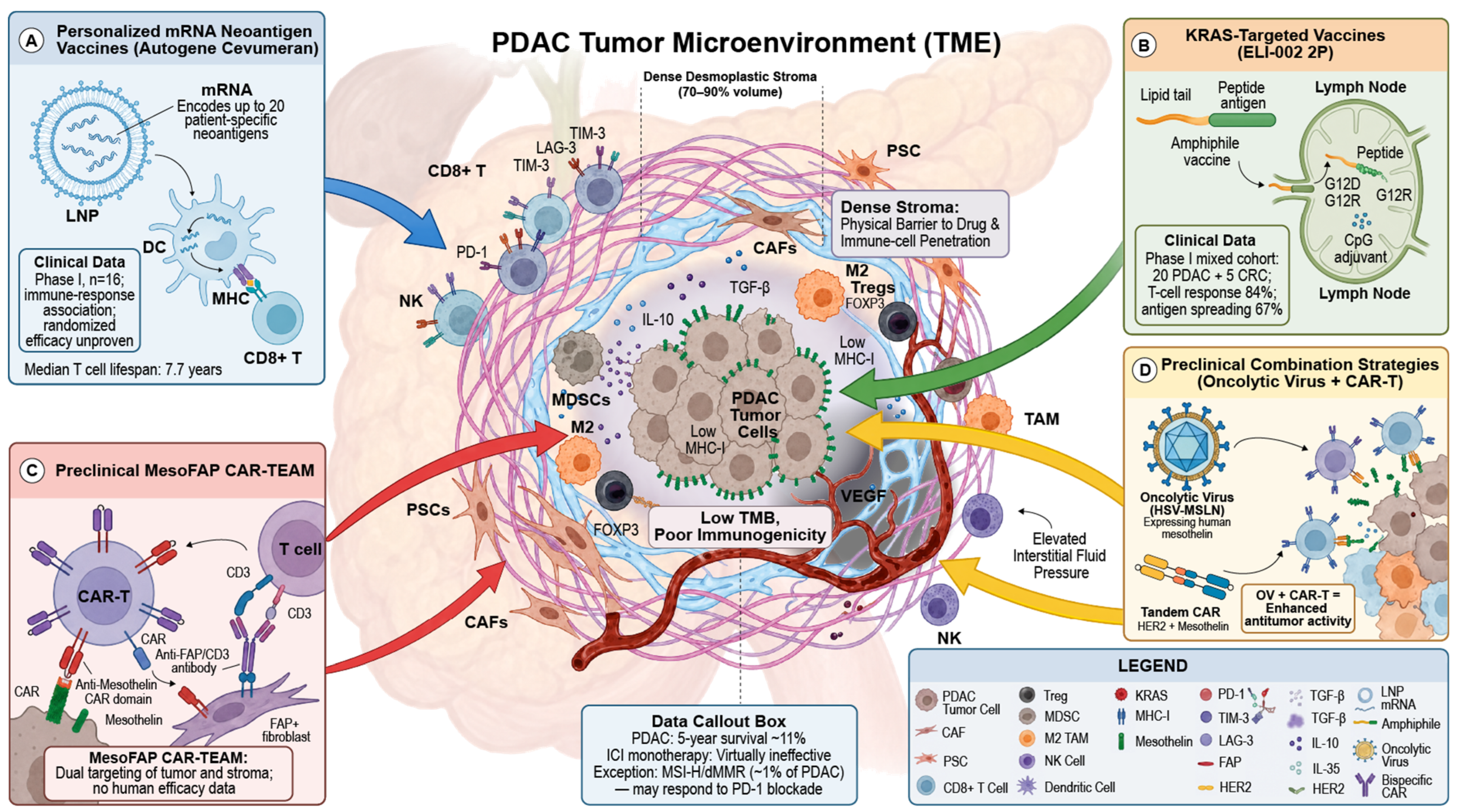
PDAC is characterized by low baseline immunogenicity in most patients, dense desmoplastic stroma, suppressive myeloid and fibroblast programs, and limited effector T-cell access (
Figure 3 and
Table 6). These features help explain why responses to checkpoint monotherapy are rare outside the small MSI-H/dMMR subset. The relevant exception is PD-1 blockade, not a generic claim about PD-L1 inhibitors [
2,
54].
Figure 3.
Pancreatic ductal adenocarcinoma immune exclusion and emerging strategies. Dense desmoplastic stroma, suppressive myeloid and fibroblast programs, low baseline immunogenicity, and limited effector T-cell access contribute to checkpoint resistance in most PDAC. PD-1 blockade is clinically relevant mainly for the rare MSI-H/dMMR subset. Autogene cevumeran and ELI-002 have shown immunogenicity in small, nonrandomized cohorts; outcome associations do not establish efficacy. Transient mesothelin CAR-T cells have produced stable disease in an early six-patient clinical study, while dual tumor–stroma CAR-T and oncolytic-virus combinations remain preclinical. GPC3 is not presented as a PDAC target. Abbreviations: CAF, cancer-associated fibroblast; CAR-T, chimeric antigen receptor T cell; dMMR, deficient mismatch repair; MDSC, myeloid-derived suppressor cell; MSI-H, microsatellite instability-high; PDAC, pancreatic ductal adenocarcinoma; TME, tumor microenvironment; VEGF, vascular endothelial growth factor.
Figure 3.
Pancreatic ductal adenocarcinoma immune exclusion and emerging strategies. Dense desmoplastic stroma, suppressive myeloid and fibroblast programs, low baseline immunogenicity, and limited effector T-cell access contribute to checkpoint resistance in most PDAC. PD-1 blockade is clinically relevant mainly for the rare MSI-H/dMMR subset. Autogene cevumeran and ELI-002 have shown immunogenicity in small, nonrandomized cohorts; outcome associations do not establish efficacy. Transient mesothelin CAR-T cells have produced stable disease in an early six-patient clinical study, while dual tumor–stroma CAR-T and oncolytic-virus combinations remain preclinical. GPC3 is not presented as a PDAC target. Abbreviations: CAF, cancer-associated fibroblast; CAR-T, chimeric antigen receptor T cell; dMMR, deficient mismatch repair; MDSC, myeloid-derived suppressor cell; MSI-H, microsatellite instability-high; PDAC, pancreatic ductal adenocarcinoma; TME, tumor microenvironment; VEGF, vascular endothelial growth factor.

Randomized evidence remains negative for unselected disease. In PA.7, 180 patients with untreated metastatic PDAC were randomized to gemcitabine and nab-paclitaxel with or without durvalumab and tremelimumab. Median overall survival was 9.8 versus 8.8 months (
p = 0.72), and the addition of dual-checkpoint blockade did not improve clinical outcomes. A 2026 phase I platform study reported encouraging response signals in two 15-patient chemoimmunotherapy cohorts, but the nonrandomized design, small samples, toxicity, and lack of expansion preclude a change in standard treatment [
55,
56].
8.2. Therapeutic Vaccines
Autogene cevumeran has demonstrated immunogenicity in a small adjuvant phase I study. Eight of sixteen vaccinated patients generated high-magnitude neoantigen-specific T-cell responses. At a median follow-up of 3.2 years, median recurrence-free survival was not reached in immune responders versus 13.4 months in nonresponders (
p = 0.007), and vaccine-induced CD8 T-cell clones remained detectable. The 2025 report is an extended follow-up of the same 16-patient cohort, not independent validation. Because the outcome was compared by an on-treatment immune response in a nonrandomized sample, the study does not establish vaccine efficacy; randomized evaluation is ongoing [
57,
58].
AMPLIFY-201 evaluated ELI-002 2P in 25 patients with molecular residual disease, including 20 with PDAC and 5 with colorectal cancer. Mutant KRAS-specific T-cell responses occurred in 21 of 25 patients (84%), and antigen spreading occurred in 67% of evaluable patients. Stronger on-treatment responses were associated with longer radiographic recurrence-free and overall survival, but the single-arm, mixed-tumor design and response-defined analyses preclude causal claims of efficacy in PDAC [
59,
60].
8.3. Cellular and Microenvironment-Directed Approaches
Clinical evidence for CAR-T therapy in PDAC is limited. In a six-patient phase I study of transient mesothelin-directed CAR-T cells, no dose-limiting toxicity, cytokine-release syndrome, or neurotoxicity was observed, but the best RECIST outcome was stable disease. Dual tumor–stroma targeting with MesoFAP CAR-TEAM and oncolytic-virus-assisted mesothelin targeting have improved activity in patient-derived models and mice, but both remain preclinical. They should not be presented as established therapeutic options [
61,
62,
63].
The distinction between immune activation and net clinical benefit is especially important in PDAC. Degrading stroma or adding checkpoint agents can alter immune markers without improving survival, and aggressive stromal depletion may have context-dependent effects. Future studies need prospectively defined biomarkers, pharmacodynamic evidence, randomized controls, and feasibility measures that include manufacturing time and treatment-window attrition.
Table 6.
Selected immunotherapy evidence in pancreatic ductal adenocarcinoma.
Table 6.
Selected immunotherapy evidence in pancreatic ductal adenocarcinoma.
| Strategy | Study and Design | Population | Key Result | Evidence Level | Main Limitation | Source |
|---|
| Dual ICI plus chemotherapy | PA.7 randomized phase II; n = 180 | Untreated metastatic PDAC | OS 9.8 vs. 8.8 months; p = 0.72 | Randomized negative | No benefit in unselected disease | [55] |
| PD-1 blockade | Mismatch-repair-deficient tumor study | Rare MSI-H/dMMR PDAC subset | Responses observed across dMMR tumors | Biomarker-defined clinical evidence | Very low prevalence in PDAC | [2] |
| Autogene cevumeran | Adjuvant phase I; n = 16; extended follow-up of same cohort | Resected PDAC | 8/16 immune responders; RFS association maintained at 3.2 years | Early nonrandomized | Response-defined comparison does not establish efficacy | [57,58] |
| ELI-002 2P | AMPLIFY-201 single-arm phase I; n = 25 | 20 PDAC and 5 CRC with molecular residual disease | KRAS-specific T-cell response 84%; antigen spreading 67% | Early mixed tumor | On-treatment response association; no control | [60] |
| Mesothelin CAR-T | Phase I; n = 6 | Chemotherapy-refractory metastatic PDAC | Best RECIST outcome: stable disease | Early clinical feasibility | Very small sample; no objective response | [61] |
| MesoFAP CAR-TEAM | Preclinical | PDAC models | Dual tumor–stroma activity | Preclinical | No human efficacy or safety data | [62] |
| HSV-MSLN plus mesothelin CAR-T | Preclinical | Cell and mouse PDAC models | Enhanced antigen expression and antitumor activity | Preclinical | No human data | [63] |
9. Comparative Biomarkers and Precision Stratification
Biomarkers in digestive cancer immunotherapy answer different questions and should not be placed in a single undifferentiated category. MSI-H/dMMR is both a biological subtype and a validated treatment-selection marker for PD-1-based therapy in colorectal cancer and several other advanced solid tumors. PD-L1 is a regimen- and assay-dependent enrichment marker in esophageal and gastric cancers, but it has not provided a validated selection threshold in HCC or BTC. TMB has tumor-agnostic regulatory relevance at specific thresholds, yet disease-specific prevalence, sequencing platforms, and overlap with MSI limit direct transfer across cancers [
2,
11].
CLDN18.2 is a validated treatment-selection biomarker for zolbetuximab in HER2-negative gastric and gastroesophageal junction adenocarcinoma, but it is not a checkpoint-response biomarker (
Table 7). EBV positivity, T-effector signatures, spatial immune-cell arrangements, stromal programs, methylation phenotypes, and post-treatment immune responses are promising stratification variables, yet most remain exploratory. A clinically useful table must, therefore, specify whether a marker is predictive, prognostic, diagnostic, or a direct treatment target and must state the assay, threshold, disease, treatment, and validation level.
Table 7.
Comparative biomarker framework across digestive system cancers.
Table 7.
Comparative biomarker framework across digestive system cancers.
| Biomarker | Cancer and Treatment Context | Clinical Role | Assay or Threshold | Evidence Maturity | Key Limitation | Source |
|---|
| MSI-H/dMMR | CRC; gastric; tumor-agnostic advanced disease | Validated predictor of PD-1-based therapy | IHC, PCR, or validated NGS | High in metastatic CRC; expanding perioperative evidence | Low prevalence in PDAC, esophageal cancer, and most BTC | [2,3] |
| PD-L1 | Esophageal and gastric checkpoint regimens | Regimen-specific enrichment marker | CPS, TPS, or tumor-cell score as prespecified | Prospective phase III but assay dependent | Thresholds and scoring systems are not interchangeable | [7,16] |
| PD-L1 | HCC and BTC/GBC | Exploratory association | Assay specific | Not validated for treatment selection | Large trials do not establish a clinical threshold | [43,48] |
| TMB-high | Tumor-agnostic pembrolizumab context | Regulatory and enrichment biomarker | At least 10 mutations/Mb in the qualifying assay | Prospective basket evidence | Platform, tumor type, and overlap with MSI matter | [11] |
| CLDN18.2 | HER2-negative gastric/GEJ adenocarcinoma | Direct treatment-selection target for zolbetuximab | Trial-validated IHC threshold | Two randomized phase III trials | Not a checkpoint-response biomarker | [19,20] |
| EBV | Gastric cancer | Candidate immune-sensitive subtype | EBER or validated molecular assay | Exploratory subgroup evidence | Low prevalence and limited prospective validation | [21] |
| Spatial immune signature | Gastric cancer | Candidate response enrichment | Multiplex IHC and spatial analysis | Single-center retrospective | Platform dependence and no prospective external validation | [64] |
| Methylation phenotype | BTC/GBC | Prognostic and immune-context association | Research methylome signature | Retrospective integrative study | No ICI-treated validation cohort | [53] |
| On-treatment vaccine immune response | PDAC and mixed PDAC/CRC vaccine cohorts | Pharmacodynamic association | Study-specific T-cell assays | Early single-arm evidence | Post-treatment definition cannot serve as pretreatment selection test | [58,60] |
10. Immune-Related Adverse Events and Patient-Centered Considerations
10.1. Recognition and Management of Immune-Related Adverse Events
Immune-related adverse events should be treated as a longitudinal management problem rather than as a binary safety label. Baseline assessment should document autoimmune disease, organ function, concomitant medication, and pre-existing symptoms. Surveillance must continue during therapy and after discontinuation because toxicities may be delayed, and some endocrinopathies can be permanent. Combination regimens also require attribution: cytopenias and neuropathy may arise from chemotherapy, bleeding and hypertension from anti-VEGF therapy, and hepatitis, colitis, pneumonitis, myocarditis, or endocrine dysfunction from immune activation [
65,
66,
67].
General management principles are grade and organ specific. Grade 1 toxicities can often be monitored without interruption, except when cardiac, neurologic, hematologic, or selected ocular involvement creates disproportionate risk. Most grade 2 events warrant temporary interruption and consideration of prednisone 0.5–1 mg/kg/day or equivalent. Grade 3 events generally require treatment suspension, urgent specialist input, and prednisone or methylprednisolone 1–2 mg/kg/day, followed by a slow taper of at least four to six weeks once improvement occurs. Steroid-refractory disease requires organ-specific immunosuppression. Grade 4 toxicities usually lead to permanent discontinuation, with controlled endocrinopathies as a common exception. Immune checkpoint inhibitors are interrupted or discontinued rather than dose reduced [
65,
66].
Absolute toxicity should accompany efficacy. In CheckMate 649, grade 3–4 treatment-related adverse events occurred in 59% of patients receiving nivolumab plus chemotherapy and 44% receiving chemotherapy, with treatment-related death in 2% and 1%, respectively. In KEYNOTE-177, severe adverse events were substantially less frequent with pembrolizumab than with chemotherapy. In contrast, dual-checkpoint strategies can reduce chemotherapy-associated toxicity while introducing colitis, hepatitis, endocrine, and other immune toxicities. The relevant comparison is, therefore, regimen specific, not simply immunotherapy versus no immunotherapy [
22,
68].
10.2. Negative Trials and Treatment Burden
Several randomized failures define the limits of current strategies. Pembrolizumab plus chemotherapy did not meet superiority end points in KEYNOTE-062, atezolizumab with or without cobimetinib failed to improve survival over regorafenib in IMblaze370, dual-checkpoint blockade did not improve survival in unselected PDAC in PA.7, and lenvatinib plus pembrolizumab did not cross the prespecified significance boundaries in LEAP-002. Updated IMbrave050 results further show that an early recurrence-free survival signal can disappear with longer follow-up. These examples justify requiring mature, multiplicity-controlled randomized evidence before early response, pathological response, or translational signals are called practice changing [
17,
31,
39,
42,
55].
10.3. Quality of Life, Cost, and Access
Patient-reported outcomes add information that adverse-event tables cannot provide. In CheckMate 649, nivolumab plus chemotherapy maintained or improved several on-treatment health-related quality-of-life measures, although the analyses were exploratory and vulnerable to open-label and attrition bias. In TOPAZ-1, adding durvalumab did not worsen global health status or quality of life, but it did not produce a statistically clear improvement in time to deterioration; non-detriment should not be described as quality-of-life superiority [
69,
70].
Cost-effectiveness estimates vary with jurisdiction, drug price, duration, utility assumptions, and willingness-to-pay threshold. Models based on CheckMate 649 and TOPAZ-1 have shown strong sensitivity to checkpoint-inhibitor acquisition cost and should not be generalized globally or indefinitely. Access also depends on biomarker testing, tissue availability, infusion capacity, multidisciplinary toxicity management, and the ability to deliver urgent specialist care. Personalized vaccines and cell therapies add sequencing, bespoke manufacturing, cold-chain, lymphodepletion, hospitalization, and treatment-window constraints. These factors are components of clinical translatability rather than peripheral implementation issues [
71,
72].
11. Artificial Intelligence, Multi-Omics, and Spatial Biology
Artificial intelligence and multi-omics can extend biomarker resolution beyond single analytes, but current studies occupy different levels of readiness. A histology-based deep-learning model for MSI achieved a patient-level area under the curve of 0.81 in a gastric TCGA test set but only 0.69 in an independent Japanese cohort, illustrating domain shift across populations and specimen workflows. Such systems may support prescreening or quality control but cannot replace validated IHC, PCR, or sequencing-based MSI/MMR testing without prospective clinical-utility studies [
73].
Spatial profiling can capture immune-cell density and neighborhood relationships that bulk measurements lose. In a single-center study of 80 gastric cancers, including 60 immunotherapy-treated patients, a multiplex-immunohistochemistry signature combining cellular abundance and spatial organization was associated with response and survival. The study demonstrates biological value but remains limited by sample size, retrospective design, platform dependence, and the absence of prospective external validation [
64].
Analyses embedded in randomized trials provide stronger clinical context but remain exploratory. In CheckMate 649, only subsets of the randomized population had evaluable whole-exome or RNA sequencing. Hypermutation, MSI, low stromal expression, and other immune programs were associated with differential benefit, but the analyses were post hoc and not multiplicity confirmed. They support prospective biomarker hypotheses rather than new companion diagnostics [
21].
Recent multimodal models show both promise and fragility. A model integrating radiology, pathology, and clinical data predicted response to anti-HER2 therapy or anti-HER2 plus immunotherapy in HER2-positive gastric cancer, while an interpretable radiomics model predicted pathological complete response after neoadjuvant immunotherapy in dMMR/MSI-H colorectal cancer. The latter independent validation cohort contained only 22 patients. Before clinical adoption, models require locked algorithms, external multicenter validation, calibration, decision-curve analysis, prospective evaluation, transparent handling of missing data, and testing against existing clinical biomarkers [
74,
75].
The most credible near-term role for these technologies is layered enrichment: validated clinical assays define the eligible population, while spatial, radiomic, or multi-omic features refine prognosis or trial selection. Replacing standard testing is a higher evidentiary bar that requires demonstration of analytical validity, clinical validity, clinical utility, reproducibility, and equitable performance across sites and populations.
12. Cross-Cancer Synthesis and Future Directions
The therapeutic maturity of digestive cancer immunotherapy follows a gradient (
Table 8). Advanced esophageal, gastric, HCC, and BTC settings contain phase III standards, although the benefit depends on histology, PD-L1 definition, bleeding risk, liver function, and anatomic site. MSI-H/dMMR colorectal cancer represents the strongest biomarker-defined paradigm and now spans metastatic, neoadjuvant, organ-preservation, and adjuvant settings. By contrast, MSS colorectal cancer and unselected PDAC remain areas in which early immune activation rarely translates into validated survival benefit.
Table 8.
Cross-cancer comparison of therapeutic maturity, biomarkers, and current challenges.
Table 8.
Cross-cancer comparison of therapeutic maturity, biomarkers, and current challenges.
| Cancer and Setting | Established or Leading Strategy | Selection Biomarker | Efficacy Anchor | KEY Toxicity or Burden | Current Challenge | Source |
|---|
| Advanced esophageal cancer | PD-1 inhibitor plus chemotherapy; selected dual ICI | Trial-specific PD-L1 score | KEYNOTE-590 5-year OS 10.6% vs. 3.0%; CheckMate-648 OS benefit | Chemotherapy toxicity or dual-ICI irAEs | Assay harmonization and perioperative survival maturity | [6,7] |
| Advanced gastric/GEJ cancer | PD-1 inhibitor plus chemotherapy | PD-L1 CPS; MSI-H | CheckMate 649 CPS at least 5 OS HR 0.70 | Prolonged combination therapy | Defining benefit at low PD-L1 and integrating HER2/CLDN18.2 | [14] |
| CLDN18.2-positive gastric/GEJ cancer | Zolbetuximab plus chemotherapy | CLDN18.2 IHC | SPOTLIGHT and GLOW PFS/OS benefit | Nausea, vomiting, infusion burden | Sequencing with checkpoint and HER2 strategies | [19,20] |
| MSI-H/dMMR metastatic CRC | Pembrolizumab or nivolumab plus ipilimumab | MSI-H/dMMR | KEYNOTE-177 PFS HR 0.60; CheckMate 8HW 24-month PFS 72% vs. 14% | Immune toxicity; early progression in a subset | Optimal monotherapy vs. combination selection | [22,24] |
| Localized dMMR colon cancer | Neoadjuvant ICI; adjuvant atezolizumab plus mFOLFOX6 | dMMR | NICHE-2 pCR 68%; ATOMIC 3-year DFS 86.3% vs. 76.2% | Longer treatment and added toxicity in adjuvant therapy | Organ preservation, duration, and long-term survival | [26,30] |
| MSS/pMMR CRC | No established conventional ICI strategy | No validated marker | Botensilimab phase I ORR 17% | Investigational immune toxicity | Overcoming stromal exclusion and validating liver-metastasis associations | [33] |
| Unresectable HCC | Atezolizumab–bevacizumab or STRIDE | No validated selection biomarker | IMbrave150 OS HR 0.66; STRIDE 5-year OS 19.6% | Bleeding/vascular risk or dual-ICI irAEs | Liver-function heterogeneity and perioperative failure | [36,38] |
| Advanced BTC including GBC | Durvalumab or pembrolizumab plus gemcitabine/cisplatin | No validated PD-L1 threshold | TOPAZ-1 OS HR 0.80; KEYNOTE-966 OS HR 0.83 | Chemotherapy toxicity and prolonged treatment | Anatomic-subgroup heterogeneity and modest absolute benefit | [45,48] |
| Unselected PDAC | No established ICI strategy | MSI-H/dMMR for rare exception | PA.7 negative; early vaccine immunogenicity only | Manufacturing, timing, and combination toxicity | Converting immune exclusion into randomized clinical benefit | [55,58] |
Future progress requires fewer but more informative trials. Randomized comparisons should use biomarker-enriched populations, mature time-to-event end points, patient-reported outcomes, and prespecified analyses of organ involvement and resistance. Perioperative studies should distinguish pathological response from event-free and overall survival and should measure whether treatment enables safe organ preservation. Early-phase vaccine and cellular studies should report manufacturing failures, treatment-window attrition, dose-limiting toxicities, persistence, and feasibility in addition to immune response.
Biomarker development should move from association to clinical utility. PD-L1, MSI/MMR, HER2, and CLDN18.2 illustrate that assay, threshold, treatment, and disease context must be specified. New spatial, methylation, radiomic, and transcriptional signatures require independent validation and proof that using the test improves a patient-level decision. Similarly, subgroup observations such as the poorer activity of botensilimab in active liver metastasis should motivate prospective stratification, not causal claims.
Finally, therapeutic benefit must be evaluated as a composite of survival, toxicity, function, quality of life, affordability, and access. A regimen that improves a relative hazard while adding prolonged treatment, high-grade toxicity, or specialized manufacturing may still be appropriate, but those costs should be explicit. Precision immunotherapy will mature when evidence hierarchy, biological selection, and patient-centered feasibility are evaluated together.
Author Contributions
Conceptualization, K.S., H.L. (Hengrui Liu) and J.N.; validation, H.C., H.L. (Hengrui Liu) and J.N.; formal analysis, H.L. (Hongru Li); investigation, Y.S. and Y.N.; writing—original draft preparation, Y.S., H.C., Y.N., K.S. and H.L. (Hongru Li); writing—review and editing, H.L. (Hengrui Liu)and J.N.; supervision, H.L. (Hengrui Liu) and J.N. All authors have read and agreed to the published version of the manuscript.
Funding
This research is supported by the Postdoctoral Fellowship Program (Grade C) of China Postdoctoral Science Foundation under Grant Number GZC20261217.
Institutional Review Board Statement
Not applicable.
Informed Consent Statement
Not applicable.
Data Availability Statement
The literature search strategy used for the final update is provided in
Supplementary Table S1. No new patient-level dataset was generated for this narrative review.
Acknowledgments
The authors used digital illustration and generative image-assistance tools to prepare and refine the figures. All labels, numerical values, evidence classifications, and legends were manually checked and finalized by the authors, who take responsibility for the content of this publication.
Conflicts of Interest
The authors declare no conflicts of interest.
Abbreviations
AE, adverse event; AI, artificial intelligence; BTC, biliary tract cancer; CAF, cancer-associated fibroblast; CAPOX, capecitabine plus oxaliplatin; CAR-T, chimeric antigen receptor T cell; CI, confidence interval; CPS, combined positive score; CRC, colorectal cancer; CTLA-4, cytotoxic T-lymphocyte-associated protein 4; DFS, disease-free survival; dMMR, deficient mismatch repair; EBV, Epstein–Barr virus; EFS, event-free survival; GBC, gallbladder cancer; GEJ, gastroesophageal junction; HCC, hepatocellular carcinoma; HER2, human epidermal growth factor receptor 2; HR, hazard ratio; HRQoL, health-related quality of life; ICI, immune checkpoint inhibitor; irAE, immune-related adverse event; MHC, major histocompatibility complex; MPR, major pathological response; MSI-H, microsatellite instability-high; MSS, microsatellite stable; ORR, objective response rate; OS, overall survival; PD-1, programmed cell death protein 1; PD-L1, programmed death-ligand 1; PDAC, pancreatic ductal adenocarcinoma; pCR, pathological complete response; PFS, progression-free survival; pMMR, proficient mismatch repair; PRO, patient-reported outcome; QoL, quality of life; RFS, recurrence-free survival; TIL, tumor-infiltrating lymphocyte; TMB, tumor mutational burden; TME, tumor microenvironment.
References
- Sung, H.; Filho, A.M.; Laversanne, M.; Ferlay, J.; Siegel, R.L.; Soerjomataram, I.; Jemal, A.; Bray, F. Global cancer statistics 2024: GLOBOCAN estimates of incidence and mortality worldwide for 34 cancers in 186 countries. CA Cancer J. Clin. 2026, 76, e70090. [Google Scholar] [CrossRef] [Scilit] [PubMed]
- Le, D.T.; Uram, J.N.; Wang, H.; Bartlett, B.R.; Kemberling, H.; Eyring, A.D.; Skora, A.D.; Luber, B.S.; Azad, N.S.; Laheru, D.; et al. PD-1 Blockade in Tumors with Mismatch-Repair Deficiency. N. Engl. J. Med. 2015, 372, 2509–2520. [Google Scholar] [CrossRef] [Scilit] [PubMed]
- André, T.; Shiu, K.-K.; Kim, T.W.; Jensen, B.V.; Jensen, L.H.; Punt, C.; Smith, D.; Garcia-Carbonero, R.; Benavides, M.; Gibbs, P.; et al. Pembrolizumab in Microsatellite-Instability–High Advanced Colorectal Cancer. N. Engl. J. Med. 2020, 383, 2207–2218. [Google Scholar] [CrossRef] [Scilit] [PubMed]
- Tauriello, D.V.F.; Palomo-Ponce, S.; Stork, D.; Berenguer-Llergo, A.; Badia-Ramentol, J.; Iglesias, M.; Sevillano, M.; Ibiza, S.; Cañellas, A.; Hernando-Momblona, X.; et al. TGFβ drives immune evasion in genetically reconstituted colon cancer metastasis. Nature 2018, 554, 538–543. [Google Scholar] [CrossRef] [Scilit] [PubMed]
- Sun, J.-M.; Shen, L.; Shah, M.A.; Enzinger, P.; Adenis, A.; Doi, T.; Kojima, T.; Metges, J.-P.; Li, Z.; Kim, S.-B.; et al. Pembrolizumab plus chemotherapy versus chemotherapy alone for first-line treatment of advanced oesophageal cancer (KEYNOTE-590): A randomised, placebo-controlled, phase 3 study. Lancet 2021, 398, 759–771. [Google Scholar] [CrossRef] [Scilit]
- Metges, J.-P.; Kato, K.; Sun, J.-M.; Shen, L.; Enzinger, P.C.; Adenis, A.; Doi, T.; Kojima, T.; Li, Z.; Kim, S.-B.; et al. Pembrolizumab plus chemotherapy versus chemotherapy for advanced esophageal cancer: 5-year extended follow-up for the randomized phase III KEYNOTE-590 study. ESMO Open 2025, 10, 105854. [Google Scholar] [CrossRef] [Scilit]
- Doki, Y.; Ajani, J.A.; Kato, K.; Xu, J.; Wyrwicz, L.; Motoyama, S.; Ogata, T.; Kawakami, H.; Hsu, C.-H.; Adenis, A.; et al. Nivolumab Combination Therapy in Advanced Esophageal Squamous-Cell Carcinoma. N. Engl. J. Med. 2022, 386, 449–462. [Google Scholar] [CrossRef] [Scilit]
- Xu, J.; Kato, K.; Raymond, E.; Hubner, R.A.; Shu, Y.; Pan, Y.; Park, S.R.; Ping, L.; Jiang, Y.; Zhang, J.; et al. Tislelizumab plus chemotherapy versus placebo plus chemotherapy as first-line treatment for advanced or metastatic oesophageal squamous cell carcinoma (RATIONALE-306): A global, randomised, placebo-controlled, phase 3 study. Lancet Oncol. 2023, 24, 483–495. [Google Scholar] [CrossRef] [Scilit]
- Shang, X.; Xie, Y.; Yu, J.; Zhang, C.; Zhao, G.; Liang, F.; Liu, L.; Zhang, W.; Li, R.; Yu, W.; et al. A prospective study of neoadjuvant pembrolizumab plus chemotherapy for resectable esophageal squamous cell carcinoma: The Keystone-001 trial. Cancer Cell 2024, 42, 1747–1763.e7. [Google Scholar] [CrossRef] [Scilit]
- Qin, J.; Xue, L.; Hao, A.; Guo, X.; Jiang, T.; Ni, Y.; Liu, S.; Chen, Y.; Jiang, H.; Zhang, C.; et al. Neoadjuvant chemotherapy with or without camrelizumab in resectable esophageal squamous cell carcinoma: The randomized phase 3 ESCORT-NEO/NCCES01 trial. Nat. Med. 2024, 30, 2549–2557. [Google Scholar] [CrossRef] [Scilit]
- Marabelle, A.; Fakih, M.; Lopez, J.; Shah, M.; Shapira-Frommer, R.; Nakagawa, K.; Chung, H.C.; Kindler, H.L.; Lopez-Martin, J.A.; Miller, W.H.; et al. Association of tumour mutational burden with outcomes in patients with advanced solid tumours treated with pembrolizumab: Prospective biomarker analysis of the multicohort, open-label, phase 2 KEYNOTE-158 study. Lancet Oncol. 2020, 21, 1353–1365. [Google Scholar] [CrossRef] [Scilit]
- Li, S.; Yu, Y.; Xu, Y.; Zhou, Y.; Huang, J.; Jia, J. Clinicopathological characteristics and the relationship of PD-L1 status, tumor mutation burden, and microsatellite instability in patients with esophageal carcinoma. BMC Cancer 2025, 25, 576. [Google Scholar] [CrossRef] [Scilit]
- Sun, J.-M.; Chao, Y.; Kim, S.-B.; Rha, S.Y.; Evans, T.R.J.; Strickland, A.; Wainberg, Z.A.; Chau, I.; Pelles-Avraham, S.; Ajani, J.A.; et al. MORPHEUS-EC: A phase Ib/II open-label, randomized study of first-line tiragolumab (tira) + atezolizumab (atezo) + chemotherapy (CT) in patients (pts) with esophageal cancer (EC). J. Clin. Oncol. 2024, 42, 324. [Google Scholar] [CrossRef] [Scilit]
- Janjigian, Y.Y.; Ajani, J.A.; Moehler, M.; Shen, L.; Garrido, M.; Gallardo, C.; Wyrwicz, L.; Yamaguchi, K.; Cleary, J.M.; Elimova, E.; et al. First-Line Nivolumab Plus Chemotherapy for Advanced Gastric, Gastroesophageal Junction, and Esophageal Adenocarcinoma: 3-Year Follow-Up of the Phase III CheckMate 649 Trial. J. Clin. Oncol. 2024, 42, 2012–2020. [Google Scholar] [CrossRef] [Scilit]
- Lin, D.; Quan, W.; Garretson, M.; Chirikov, V.; Chen, C.; Singh, P.; Davis, C.; Sugarman, R. Q-TWiST analysis of first-line nivolumab plus chemotherapy versus chemotherapy in patients with advanced gastric cancer, gastroesophageal junction cancer, or esophageal adenocarcinoma from CheckMate 649: 4-year follow-up results. Gastric Cancer 2025, 28, 935–944. [Google Scholar] [CrossRef] [Scilit]
- Rha, S.Y.; Oh, D.-Y.; Yañez, P.; Bai, Y.; Ryu, M.-H.; Lee, J.; Rivera, F.; Alves, G.V.; Garrido, M.; Shiu, K.-K.; et al. Pembrolizumab plus chemotherapy versus placebo plus chemotherapy for HER2-negative advanced gastric cancer (KEYNOTE-859): A multicentre, randomised, double-blind, phase 3 trial. Lancet Oncol. 2023, 24, 1181–1195. [Google Scholar] [CrossRef] [Scilit]
- Shitara, K.; Van Cutsem, E.; Bang, Y.-J.; Fuchs, C.; Wyrwicz, L.; Lee, K.-W.; Kudaba, I.; Garrido, M.; Chung, H.C.; Lee, J.; et al. Efficacy and Safety of Pembrolizumab or Pembrolizumab Plus Chemotherapy vs Chemotherapy Alone for Patients with First-line, Advanced Gastric Cancer. JAMA Oncol. 2020, 6, 1571. [Google Scholar] [CrossRef] [Scilit]
- Shen, L.; Zhang, X.; Ji, K.; Lu, L.; Wang, Q.; Guan, Q.; Yan, S.; Zhou, Y.; Yang, Y.; Huo, Z.; et al. Perioperative serplulimab with neoadjuvant chemotherapy versus perioperative chemotherapy in PD-L1-positive gastric cancer (ASTRUM-006): A randomised, double-blind, multicentre, phase 3 study. Lancet 2026, 407, 2542–2553. [Google Scholar] [CrossRef] [Scilit]
- Shitara, K.; Lordick, F.; Bang, Y.-J.; Enzinger, P.; Ilson, D.; Shah, M.A.; Van Cutsem, E.; Xu, R.-H.; Aprile, G.; Xu, J.; et al. Zolbetuximab plus mFOLFOX6 in patients with CLDN18.2-positive, HER2-negative, untreated, locally advanced unresectable or metastatic gastric or gastro-oesophageal junction adenocarcinoma (SPOTLIGHT): A multicentre, randomised, double-blind, phase 3 trial. Lancet 2023, 401, 1655–1668. [Google Scholar] [CrossRef] [Scilit]
- Shah, M.A.; Shitara, K.; Ajani, J.A.; Bang, Y.-J.; Enzinger, P.; Ilson, D.; Lordick, F.; Van Cutsem, E.; Gallego Plazas, J.; Huang, J.; et al. Zolbetuximab plus CAPOX in CLDN18.2-positive gastric or gastroesophageal junction adenocarcinoma: The randomized, phase 3 GLOW trial. Nat. Med. 2023, 29, 2133–2141. [Google Scholar] [CrossRef] [Scilit]
- Shitara, K.; Janjigian, Y.Y.; Ajani, J.; Moehler, M.; Yao, J.; Wang, X.; Chhibber, A.; Pandya, D.; Shen, L.; Garrido, M.; et al. Nivolumab plus chemotherapy or ipilimumab in gastroesophageal cancer: Exploratory biomarker analyses of a randomized phase 3 trial. Nat. Med. 2025, 31, 1519–1530. [Google Scholar] [CrossRef] [Scilit]
- André, T.; Shiu, K.-K.; Kim, T.W.; Jensen, B.V.; Jensen, L.H.; Punt, C.J.A.; Smith, D.; Garcia-Carbonero, R.; Alcaide-Garcia, J.; Gibbs, P.; et al. Pembrolizumab versus chemotherapy in microsatellite instability-high or mismatch repair-deficient metastatic colorectal cancer: 5-year follow-up from the randomized phase III KEYNOTE-177 study. Ann. Oncol. 2025, 36, 277–284. [Google Scholar] [CrossRef] [Scilit]
- Colle, R.; Radzik, A.; Cohen, R.; Pellat, A.; Lopez-Tabada, D.; Cachanado, M.; Duval, A.; Svrcek, M.; Menu, Y.; André, T. Pseudoprogression in patients treated with immune checkpoint inhibitors for microsatellite instability-high/mismatch repair-deficient metastatic colorectal cancer. Eur. J. Cancer 2021, 144, 9–16. [Google Scholar] [CrossRef] [Scilit]
- André, T.; Elez, E.; Van Cutsem, E.; Jensen, L.H.; Bennouna, J.; Mendez, G.; Schenker, M.; De La Fouchardiere, C.; Limon, M.L.; Yoshino, T.; et al. Nivolumab plus Ipilimumab in Microsatellite-Instability–High Metastatic Colorectal Cancer. N. Engl. J. Med. 2024, 391, 2014–2026. [Google Scholar] [CrossRef] [Scilit]
- André, T.; Elez, E.; Lenz, H.-J.; Jensen, L.H.; Touchefeu, Y.; Van Cutsem, E.; Garcia-Carbonero, R.; Tougeron, D.; Mendez, G.A.; Schenker, M.; et al. Nivolumab plus ipilimumab versus nivolumab in microsatellite instability-high metastatic colorectal cancer (CheckMate 8HW): A randomised, open-label, phase 3 trial. Lancet 2025, 405, 383–395. [Google Scholar] [CrossRef] [Scilit]
- Chalabi, M.; Verschoor, Y.L.; Tan, P.B.; Balduzzi, S.; Van Lent, A.U.; Grootscholten, C.; Dokter, S.; Büller, N.V.; Grotenhuis, B.A.; Kuhlmann, K.; et al. Neoadjuvant Immunotherapy in Locally Advanced Mismatch Repair–Deficient Colon Cancer. N. Engl. J. Med. 2024, 390, 1949–1958. [Google Scholar] [CrossRef] [Scilit]
- Chalabi, M.; van den Dungen, L.D.W.; Verschoor, Y.L.; Balduzzi, S.; de Gooyer, P.G.M.; Kok, N.; Kerver, E.; Grootscholten, C.; Voest, E.E.; Burger, J.W.A.; et al. LBA24 Neoadjuvant immunotherapy in locally advanced MMR-deficient colon cancer: 3-year disease-free survival from NICHE-2. Ann. Oncol. 2024, 35, S1217–S1218. [Google Scholar] [CrossRef] [Scilit]
- De Gooyer, P.G.M.; Verschoor, Y.L.; Van Den Dungen, L.D.W.; Balduzzi, S.; Marsman, H.A.; Geukes Foppen, M.H.; Grootscholten, C.; Dokter, S.; Den Hartog, A.G.; Verbeek, W.H.M.; et al. Neoadjuvant nivolumab and relatlimab in locally advanced MMR-deficient colon cancer: A phase 2 trial. Nat. Med. 2024, 30, 3284–3290. [Google Scholar] [CrossRef] [Scilit]
- Cercek, A.; Lumish, M.; Sinopoli, J.; Weiss, J.; Shia, J.; Lamendola-Essel, M.; El Dika, I.H.; Segal, N.; Shcherba, M.; Sugarman, R.; et al. PD-1 Blockade in Mismatch Repair–Deficient, Locally Advanced Rectal Cancer. N. Engl. J. Med. 2022, 386, 2363–2376. [Google Scholar] [CrossRef] [Scilit]
- Sinicrope, F.A.; Ou, F.-S.; Arnold, D.; Peters, W.R.; Behrens, R.J.; Lieu, C.H.; Matin, K.; Cohen, D.J.; Potter, S.L.; Nixon, A.B.; et al. Atezolizumab plus FOLFOX for Stage III Mismatch Repair–Deficient Colon Cancer. N. Engl. J. Med. 2026, 394, 1155–1166. [Google Scholar] [CrossRef] [Scilit]
- Eng, C.; Kim, T.W.; Bendell, J.; Argilés, G.; Tebbutt, N.C.; Di Bartolomeo, M.; Falcone, A.; Fakih, M.; Kozloff, M.; Segal, N.H.; et al. Atezolizumab with or without cobimetinib versus regorafenib in previously treated metastatic colorectal cancer (IMblaze370): A multicentre, open-label, phase 3, randomised, controlled trial. Lancet Oncol. 2019, 20, 849–861. [Google Scholar] [CrossRef] [Scilit]
- Mettu, N.B.; Ou, F.-S.; Zemla, T.J.; Halfdanarson, T.R.; Lenz, H.-J.; Breakstone, R.A.; Boland, P.M.; Crysler, O.V.; Wu, C.; Nixon, A.B.; et al. Assessment of Capecitabine and Bevacizumab with or Without Atezolizumab for the Treatment of Refractory Metastatic Colorectal Cancer: A Randomized Clinical Trial. JAMA Netw. Open 2022, 5, e2149040. [Google Scholar] [CrossRef] [Scilit]
- Bullock, A.J.; Schlechter, B.L.; Fakih, M.G.; Tsimberidou, A.M.; Grossman, J.E.; Gordon, M.S.; Wilky, B.A.; Pimentel, A.; Mahadevan, D.; Balmanoukian, A.S.; et al. Botensilimab plus balstilimab in relapsed/refractory microsatellite stable metastatic colorectal cancer: A phase 1 trial. Nat. Med. 2024, 30, 2558–2567. [Google Scholar] [CrossRef] [Scilit]
- Kasi, P.M.; Jafari, M.D.; Yeo, H.; Lowenfeld, L.; Khan, U.; Nguyen, A.; Siolas, D.; Swed, B.; Khan, S.; Wood, M.; et al. Neoadjuvant botensilimab plus balstilimab in resectable mismatch repair proficient and deficient colorectal cancer: NEST-1 clinical trial. J. Clin. Oncol. 2024, 42, 117. [Google Scholar] [CrossRef] [Scilit]
- Finn, R.S.; Qin, S.; Ikeda, M.; Galle, P.R.; Ducreux, M.; Kim, T.-Y.; Kudo, M.; Breder, V.; Merle, P.; Kaseb, A.O.; et al. Atezolizumab plus Bevacizumab in Unresectable Hepatocellular Carcinoma. N. Engl. J. Med. 2020, 382, 1894–1905. [Google Scholar] [CrossRef] [Scilit] [PubMed]
- Cheng, A.-L.; Qin, S.; Ikeda, M.; Galle, P.R.; Ducreux, M.; Kim, T.-Y.; Lim, H.Y.; Kudo, M.; Breder, V.; Merle, P.; et al. Updated efficacy and safety data from IMbrave150: Atezolizumab plus bevacizumab vs. sorafenib for unresectable hepatocellular carcinoma. J. Hepatol. 2022, 76, 862–873. [Google Scholar] [CrossRef] [Scilit] [PubMed]
- Abou-Alfa, G.K.; Lau, G.; Kudo, M.; Chan, S.L.; Kelley, R.K.; Furuse, J.; Sukeepaisarnjaroen, W.; Kang, Y.-K.; Van Dao, T.; De Toni, E.N.; et al. Tremelimumab plus Durvalumab in Unresectable Hepatocellular Carcinoma. NEJM Evid. 2022, 1, EVIDoa2100070. [Google Scholar] [CrossRef] [Scilit] [PubMed]
- Rimassa, L.; Chan, S.L.; Sangro, B.; Lau, G.; Kudo, M.; Reig, M.; Breder, V.; Ryu, M.-H.; Ostapenko, Y.; Sukeepaisarnjaroen, W.; et al. Five-year overall survival update from the HIMALAYA study of tremelimumab plus durvalumab in unresectable HCC. J. Hepatol. 2025, 83, 899–908. [Google Scholar] [CrossRef] [Scilit]
- Llovet, J.M.; Kudo, M.; Merle, P.; Meyer, T.; Qin, S.; Ikeda, M.; Xu, R.; Edeline, J.; Ryoo, B.-Y.; Ren, Z.; et al. Lenvatinib plus pembrolizumab versus lenvatinib plus placebo for advanced hepatocellular carcinoma (LEAP-002): A randomised, double-blind, phase 3 trial. Lancet Oncol. 2023, 24, 1399–1410. [Google Scholar] [CrossRef] [Scilit] [PubMed]
- Merle, P.; Blanc, J.-F.; Le Malicot, K.; Peron, J.-M.; Bourgeois, V.; Bouattour, M.; Touchefeu, Y.; Vitellius, C.; Akouz, F.K.; Heurgué, A.; et al. Addition of ipilimumab to atezolizumab plus bevacizumab in advanced hepatocellular carcinoma (PRODIGE 81-FFCD 2101-TRIPLET HCC): Phase 2 results from a randomised, multicentre, open-label, phase 2–3 trial. Lancet Gastroenterol. Amp Hepatol. 2026, 11, 700–712. [Google Scholar] [CrossRef] [Scilit]
- Qin, S.; Chen, M.; Cheng, A.-L.; Kaseb, A.O.; Kudo, M.; Lee, H.C.; Yopp, A.C.; Zhou, J.; Wang, L.; Wen, X.; et al. Atezolizumab plus bevacizumab versus active surveillance in patients with resected or ablated high-risk hepatocellular carcinoma (IMbrave050): A randomised, open-label, multicentre, phase 3 trial. Lancet 2023, 402, 1835–1847. [Google Scholar] [CrossRef] [Scilit]
- Yopp, A.; Chen, M.; Cheng, A.-L.; Kaseb, A.; Kudo, M.; Lee, H.C.; Cha, E.; Hack, S.P.; Lian, Q.; Spahn, J.; et al. Updated data from IMbrave050: Adjuvant atezolizumab plus bevacizumab for high-risk hepatocellular carcinoma. J. Hepatol. 2026, 84, 1102–1111. [Google Scholar] [CrossRef] [Scilit]
- Zhu, A.X.; Abbas, A.R.; de Galarreta, M.R.; Guan, Y.; Lu, S.; Koeppen, H.; Zhang, W.; Hsu, C.-H.; He, A.R.; Ryoo, B.-Y.; et al. Molecular correlates of clinical response and resistance to atezolizumab in combination with bevacizumab in advanced hepatocellular carcinoma. Nat. Med. 2022, 28, 1599–1611. [Google Scholar] [CrossRef] [Scilit]
- Shi, D.; Shi, Y.; Kaseb, A.O.; Qi, X.; Zhang, Y.; Chi, J.; Lu, Q.; Gao, H.; Jiang, H.; Wang, H.; et al. Chimeric Antigen Receptor-Glypican-3 T-Cell Therapy for Advanced Hepatocellular Carcinoma: Results of Phase I Trials. Clin. Cancer Res. 2020, 26, 3979–3989. [Google Scholar] [CrossRef] [Scilit] [PubMed]
- Oh, D.-Y.; Ruth He, A.; Qin, S.; Chen, L.-T.; Okusaka, T.; Vogel, A.; Kim, J.W.; Suksombooncharoen, T.; Ah Lee, M.; Kitano, M.; et al. Durvalumab plus Gemcitabine and Cisplatin in Advanced Biliary Tract Cancer. NEJM Evid. 2022, 1, EVIDoa2200015. [Google Scholar] [CrossRef] [Scilit] [PubMed]
- Oh, D.-Y.; He, A.R.; Qin, S.; Chen, L.-T.; Okusaka, T.; Kim, J.W.; Suksombooncharoen, T.; Lee, M.A.; Kitano, M.; Burris, H.A.; et al. Durvalumab plus chemotherapy in advanced biliary tract cancer: 3-year overall survival update from the phase III TOPAZ-1 study. J. Hepatol. 2025, 83, 1092–1101. [Google Scholar] [CrossRef] [Scilit] [PubMed]
- Oh, D.-Y.; He, A.R.; Qin, S.; Chen, L.-T.; Okusaka, T.; Griffin, R.; Wang, J.; Xynos, I.; Vogel, A.; Valle, J.W. Durvalumab Plus Chemotherapy for Advanced Biliary Tract Cancer. JAMA Oncol. 2026. [Google Scholar] [CrossRef] [Scilit]
- Kelley, R.K.; Ueno, M.; Yoo, C.; Finn, R.S.; Furuse, J.; Ren, Z.; Yau, T.; Klümpen, H.-J.; Chan, S.L.; Ozaka, M.; et al. Pembrolizumab in combination with gemcitabine and cisplatin compared with gemcitabine and cisplatin alone for patients with advanced biliary tract cancer (KEYNOTE-966): A randomised, double-blind, placebo-controlled, phase 3 trial. Lancet Lond. Engl. 2023, 401, 1853–1865. [Google Scholar] [CrossRef] [Scilit]
- Xiao, H.; Ji, J.; Li, S.; Lai, J.; Wei, G.; Wu, J.; Chen, W.; Xie, W.; Wang, S.; Qiao, L.; et al. Adjuvant Chemoradiation and Immunotherapy for Extrahepatic Cholangiocarcinoma and Gallbladder Cancer: A Randomized Clinical Trial. JAMA Oncol. 2025, 11, 1021–1029. [Google Scholar] [CrossRef] [Scilit]
- Patel, S.P.; Guadarrama, E.; Chae, Y.K.; Dennis, M.J.; Powers, B.C.; Liao, C.-Y.; Ferri, W.A.; George, T.J.; Sharon, E.; Ryan, C.W.; et al. SWOG 1609 cohort 48: Anti-CTLA-4 and anti-PD-1 for advanced gallbladder cancer. Cancer 2024, 130, 2918–2927. [Google Scholar] [CrossRef] [Scilit]
- Nagrial, A.; Carlino, M.S.; Gunjur, A.; Brown, M.P.; Harris, S.; Underhill, C.; Zielinski, R.; Kee, D.; Lam, W.-S.; Chan, H.; et al. Nivolumab and Ipilimumab Combination Treatment in Patients with Advanced Intrahepatic Cholangiocarcinoma and Gallbladder Cancer: Results from the Phase II MoST-CIRCUIT Trial. Clin. Cancer Res. 2026, 32, 3203–3212. [Google Scholar] [CrossRef] [Scilit]
- Patil, P.A.; Lombardo, K.; Cao, W. Immune Microenvironment in Gallbladder Adenocarcinomas. Appl. Immunohistochem. Mol. Morphol. AIMM 2021, 29, 557–563. [Google Scholar] [CrossRef] [Scilit]
- Qiu, Z.; Ji, J.; Xu, Y.; Zhu, Y.; Gao, C.; Wang, G.; Li, C.; Zhang, Y.; Zhao, J.; Wang, C.; et al. Common DNA methylation changes in biliary tract cancers identify subtypes with different immune characteristics and clinical outcomes. BMC Med. 2022, 20, 64. [Google Scholar] [CrossRef] [Scilit]
- Hartupee, C.; Nagalo, B.M.; Chabu, C.Y.; Tesfay, M.Z.; Coleman-Barnett, J.; West, J.T.; Moaven, O. Pancreatic cancer tumor microenvironment is a major therapeutic barrier and target. Front. Immunol. 2024, 15, 1287459. [Google Scholar] [CrossRef] [Scilit]
- Renouf, D.J.; Loree, J.M.; Knox, J.J.; Topham, J.T.; Kavan, P.; Jonker, D.; Welch, S.; Couture, F.; Lemay, F.; Tehfe, M.; et al. The CCTG PA.7 phase II trial of gemcitabine and nab-paclitaxel with or without durvalumab and tremelimumab as initial therapy in metastatic pancreatic ductal adenocarcinoma. Nat. Commun. 2022, 13, 5020. [Google Scholar] [CrossRef] [Scilit]
- O’Reilly, E.M.; Cabanski, C.R.; Lyman, J.P.; Wainberg, Z.A.; Fisher, G.A.; Wolff, R.A.; Ko, A.H.; O’Hara, M.H.; Spencer, C.N.; Yu, J.X.; et al. Clinical and translational results from a phase 1 trial of gemcitabine/nab-paclitaxel with nivolumab/ipilimumab or hydroxychloroquine/ipilimumab in untreated metastatic pancreatic adenocarcinoma. J. Immunother. Cancer 2026, 14, e012864. [Google Scholar] [CrossRef] [Scilit]
- Rojas, L.A.; Sethna, Z.; Soares, K.C.; Olcese, C.; Pang, N.; Patterson, E.; Lihm, J.; Ceglia, N.; Guasp, P.; Chu, A.; et al. Personalized RNA neoantigen vaccines stimulate T cells in pancreatic cancer. Nature 2023, 618, 144–150. [Google Scholar] [CrossRef] [Scilit]
- Sethna, Z.; Guasp, P.; Reiche, C.; Milighetti, M.; Ceglia, N.; Patterson, E.; Lihm, J.; Payne, G.; Lyudovyk, O.; Rojas, L.A.; et al. RNA neoantigen vaccines prime long-lived CD8+ T cells in pancreatic cancer. Nature 2025, 639, 1042–1051. [Google Scholar] [CrossRef] [Scilit]
- Pant, S.; Wainberg, Z.A.; Weekes, C.D.; Furqan, M.; Kasi, P.M.; Devoe, C.E.; Leal, A.D.; Chung, V.; Basturk, O.; VanWyk, H.; et al. Lymph-node-targeted, mKRAS-specific amphiphile vaccine in pancreatic and colorectal cancer: The phase 1 AMPLIFY-201 trial. Nat. Med. 2024, 30, 531–542. [Google Scholar] [CrossRef] [Scilit]
- Wainberg, Z.A.; Weekes, C.D.; Furqan, M.; Kasi, P.M.; Devoe, C.E.; Leal, A.D.; Chung, V.; Perry, J.R.; Kheoh, T.; McNeil, L.K.; et al. Lymph node-targeted, mKRAS-specific amphiphile vaccine in pancreatic and colorectal cancer: Phase 1 AMPLIFY-201 trial final results. Nat. Med. 2025, 31, 3648–3653. [Google Scholar] [CrossRef] [Scilit]
- Beatty, G.L.; O’Hara, M.H.; Lacey, S.F.; Torigian, D.A.; Nazimuddin, F.; Chen, F.; Kulikovskaya, I.M.; Soulen, M.C.; McGarvey, M.; Nelson, A.M.; et al. Activity of Mesothelin-Specific Chimeric Antigen Receptor T Cells Against Pancreatic Carcinoma Metastases in a Phase 1 Trial. Gastroenterology 2018, 155, 29–32. [Google Scholar] [CrossRef] [Scilit]
- Wehrli, M.; Guinn, S.; Birocchi, F.; Kuo, A.; Sun, Y.; Larson, R.C.; Almazan, A.J.; Scarfò, I.; Bouffard, A.A.; Bailey, S.R.; et al. Mesothelin CAR T Cells Secreting Anti-FAP/Anti-CD3 Molecules Efficiently Target Pancreatic Adenocarcinoma and its Stroma. Clin. Cancer Res. 2024, 30, 1859–1877. [Google Scholar] [CrossRef] [Scilit] [PubMed]
- Aboalela, M.A.; Abdelmoneim, M.; Matsumura, S.; Eissa, I.R.; Bustos-Villalobos, I.; Sibal, P.A.; Orikono, Y.; Takido, Y.; Naoe, Y.; Kasuya, H. Enhancing mesothelin CAR T cell therapy for pancreatic cancer with an oncolytic herpes virus boosting CAR target antigen expression. Cancer Immunol. Immunother. 2025, 74, 202. [Google Scholar] [CrossRef] [Scilit]
- Chen, Y.; Jia, K.; Sun, Y.; Zhang, C.; Li, Y.; Zhang, L.; Chen, Z.; Zhang, J.; Hu, Y.; Yuan, J.; et al. Predicting response to immunotherapy in gastric cancer via multi-dimensional analyses of the tumour immune microenvironment. Nat. Commun. 2022, 13, 4851. [Google Scholar] [CrossRef] [Scilit]
- Schneider, B.J.; Naidoo, J.; Santomasso, B.D.; Lacchetti, C.; Adkins, S.; Anadkat, M.; Atkins, M.B.; Brassil, K.J.; Caterino, J.M.; Chau, I.; et al. Management of Immune-Related Adverse Events in Patients Treated with Immune Checkpoint Inhibitor Therapy: ASCO Guideline Update. J. Clin. Oncol. 2021, 39, 4073–4126. [Google Scholar] [CrossRef] [Scilit]
- Brahmer, J.R.; Abu-Sbeih, H.; Ascierto, P.A.; Brufsky, J.; Cappelli, L.C.; Cortazar, F.B.; Gerber, D.E.; Hamad, L.; Hansen, E.; Johnson, D.B.; et al. Society for Immunotherapy of Cancer (SITC) clinical practice guideline on immune checkpoint inhibitor-related adverse events. J. Immunother. Cancer 2021, 9, e002435. [Google Scholar] [CrossRef] [Scilit]
- Haanen, J.; Obeid, M.; Spain, L.; Carbonnel, F.; Wang, Y.; Robert, C.; Lyon, A.R.; Wick, W.; Kostine, M.; Peters, S.; et al. Management of toxicities from immunotherapy: ESMO Clinical Practice Guideline for diagnosis, treatment and follow-up. Ann. Oncol. 2022, 33, 1217–1238. [Google Scholar] [CrossRef] [Scilit]
- Janjigian, Y.Y.; Shitara, K.; Moehler, M.; Garrido, M.; Salman, P.; Shen, L.; Wyrwicz, L.; Yamaguchi, K.; Skoczylas, T.; Campos Bragagnoli, A.; et al. First-line nivolumab plus chemotherapy versus chemotherapy alone for advanced gastric, gastro-oesophageal junction, and oesophageal adenocarcinoma (CheckMate 649): A randomised, open-label, phase 3 trial. Lancet 2021, 398, 27–40. [Google Scholar] [CrossRef] [Scilit]
- Moehler, M.; Xiao, H.; Blum, S.I.; Elimova, E.; Cella, D.; Shitara, K.; Ajani, J.A.; Janjigian, Y.Y.; Garrido, M.; Shen, L.; et al. Health-Related Quality of Life with Nivolumab Plus Chemotherapy Versus Chemotherapy in Patients with Advanced Gastric/Gastroesophageal Junction Cancer or Esophageal Adenocarcinoma From CheckMate 649. J. Clin. Oncol. 2023, 41, 5388–5399. [Google Scholar] [CrossRef] [Scilit]
- Burris, H.A.; Okusaka, T.; Vogel, A.; Lee, M.A.; Takahashi, H.; Breder, V.; Blanc, J.-F.; Li, J.; Bachini, M.; Żotkiewicz, M.; et al. Durvalumab plus gemcitabine and cisplatin in advanced biliary tract cancer (TOPAZ-1): Patient-reported outcomes from a randomised, double-blind, placebo-controlled, phase 3 trial. Lancet Oncol. 2024, 25, 626–635. [Google Scholar] [CrossRef] [Scilit]
- Shu, Y.; Ding, Y.; Zhang, Q. Cost-Effectiveness of Nivolumab Plus Chemotherapy vs. Chemotherapy as First-Line Treatment for Advanced Gastric Cancer/Gastroesophageal Junction Cancer/Esophagel Adenocarcinoma in China. Front. Oncol. 2022, 12, 851522. [Google Scholar] [CrossRef] [Scilit]
- Zhao, Q.; Xie, R.; Zhong, W.; Liu, W.; Chen, T.; Qiu, X.; Yang, L. Cost-effectiveness analysis of adding durvalumab to chemotherapy as first-line treatment for advanced biliary tract cancer based on the TOPAZ-1 trial. Cost Eff. Resour. Alloc. 2023, 21, 19. [Google Scholar] [CrossRef] [Scilit]
- Kather, J.N.; Pearson, A.T.; Halama, N.; Jäger, D.; Krause, J.; Loosen, S.H.; Marx, A.; Boor, P.; Tacke, F.; Neumann, U.P.; et al. Deep learning can predict microsatellite instability directly from histology in gastrointestinal cancer. Nat. Med. 2019, 25, 1054–1056. [Google Scholar] [CrossRef] [Scilit] [PubMed]
- Chen, Z.; Chen, Y.; Sun, Y.; Tang, L.; Zhang, L.; Hu, Y.; He, M.; Li, Z.; Cheng, S.; Yuan, J.; et al. Predicting gastric cancer response to anti-HER2 therapy or anti-HER2 combined immunotherapy based on multi-modal data. Signal Transduct. Target. Ther. 2024, 9, 222. [Google Scholar] [CrossRef] [Scilit]
- Zhang, Y.; Zhang, X.; Zhong, X.; Huang, L.; Jiang, W.; Zhang, C.; Liu, L.; You, R.; Li, Y.; Yi, X.; et al. Immunophenotype-guided interpretable radiomics model for predicting neoadjuvant anti-PD-1 response in stage III–IV d-MMR/MSI-H colorectal cancer. J. Immunother. Cancer 2025, 13, e011569. [Google Scholar] [CrossRef] [Scilit]
| Disclaimer/Publisher’s Note: The statements, opinions and data contained in all publications are solely those of the individual author(s) and contributor(s) and not of MDPI and/or the editor(s). MDPI and/or the editor(s) disclaim responsibility for any injury to people or property resulting from any ideas, methods, instructions or products referred to in the content. |



 ,
,