Lynch Syndrome: An Update of Underlying Molecular Mechanisms, Phenotypes and Methods to Classify Variants of Uncertain Significance



Abstract
1. Introduction
1.1. Early-Onset Colorectal Cancer
1.2. Scope and Objectives of This Review
2. Materials and Methods
3. Lynch Syndrome
3.1. A Few Historical Milestones
3.2. Lynch Syndrome Versus HNPCC
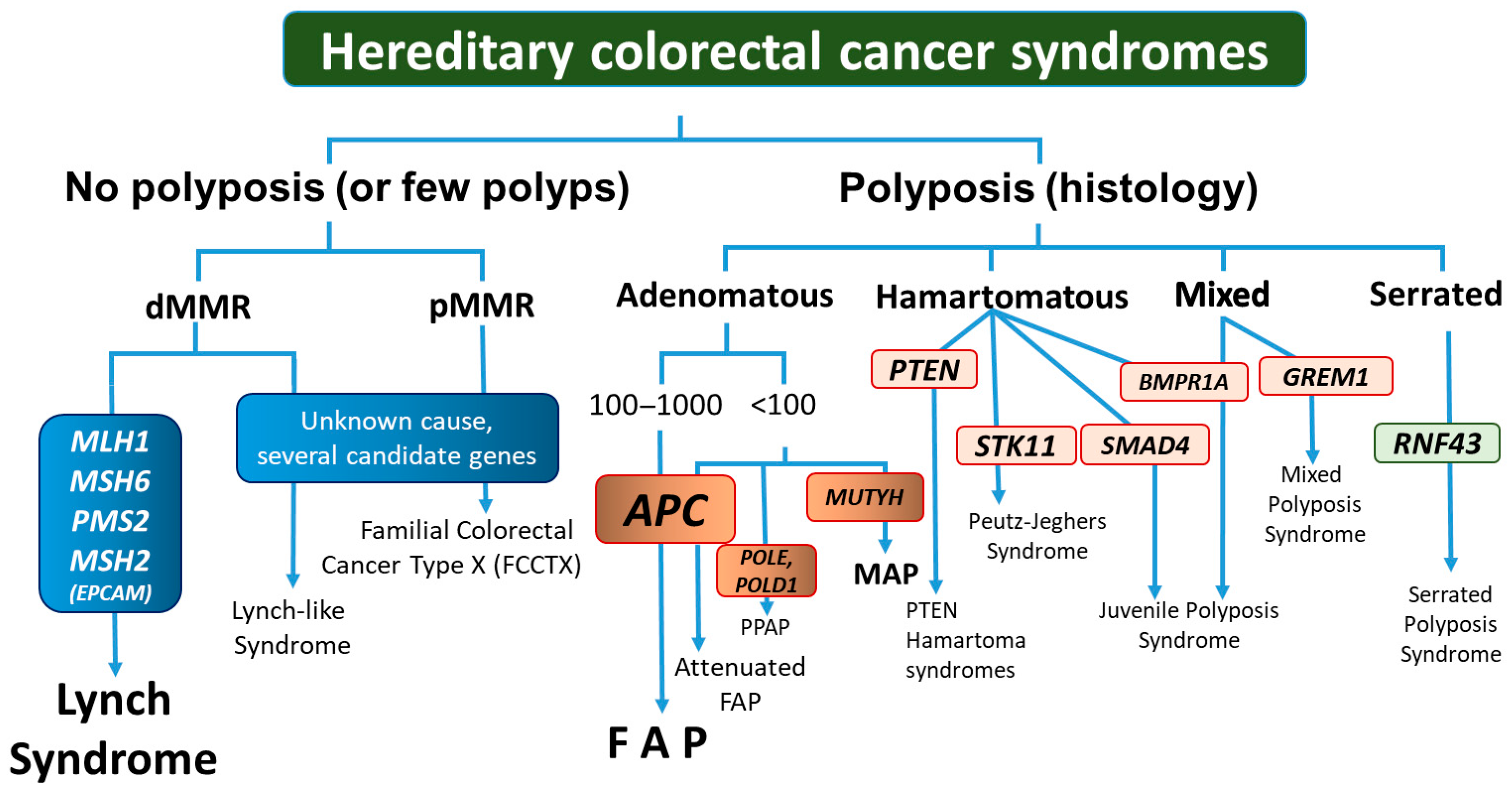
3.3. LS Phenotypic Variability and Related Phenotypes
4. Molecular Genetics of Lynch Syndrome
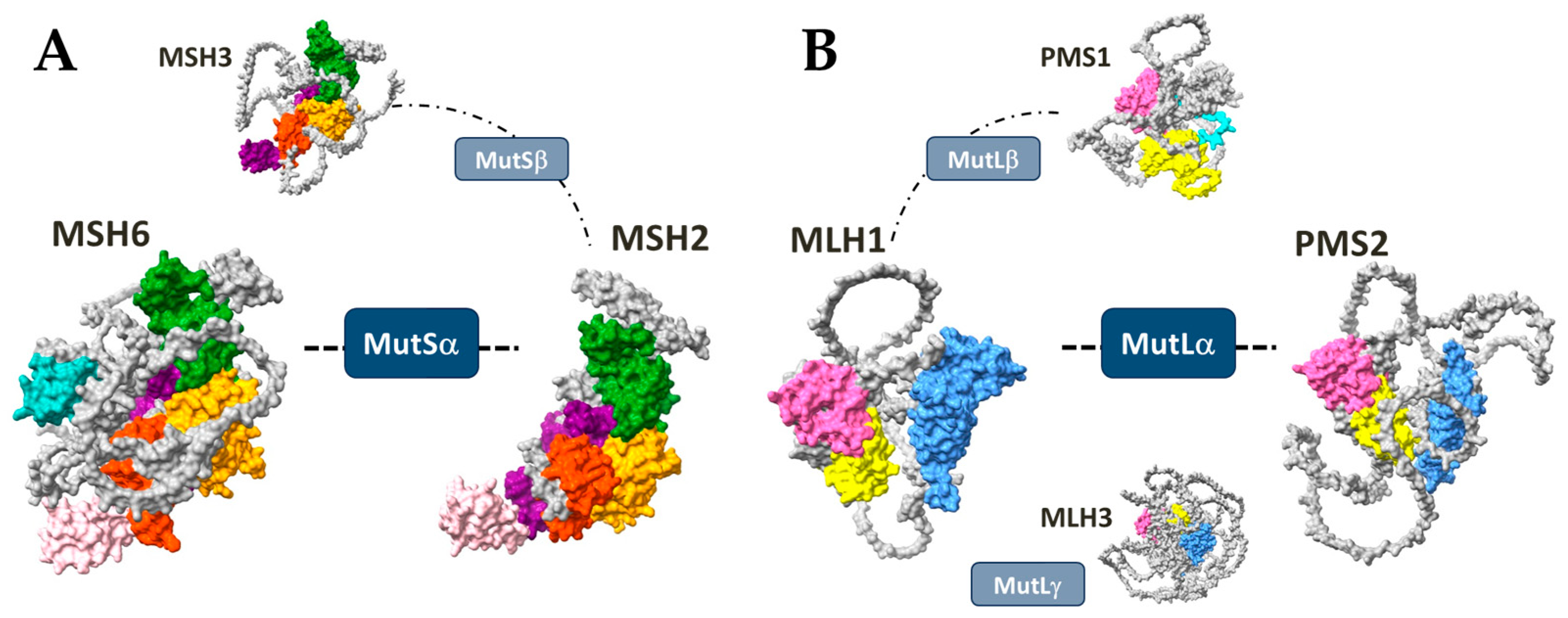
4.1. DNA Mismatch Repair
4.2. Prevalence of Pathogenic LS Variants in MMR Genes
4.3. Cumulative Cancer Risk
4.4. Is There Room for More in LS Classification?
4.5. Somatic Event—The Second Hit
4.6. Molecular Pathways of Oncogenesis in LS
5. Guidelines for Molecular Screening and Clinical Management of LS
5.1. Guidelines to Identify LS Patients and Families for Genetic Testing
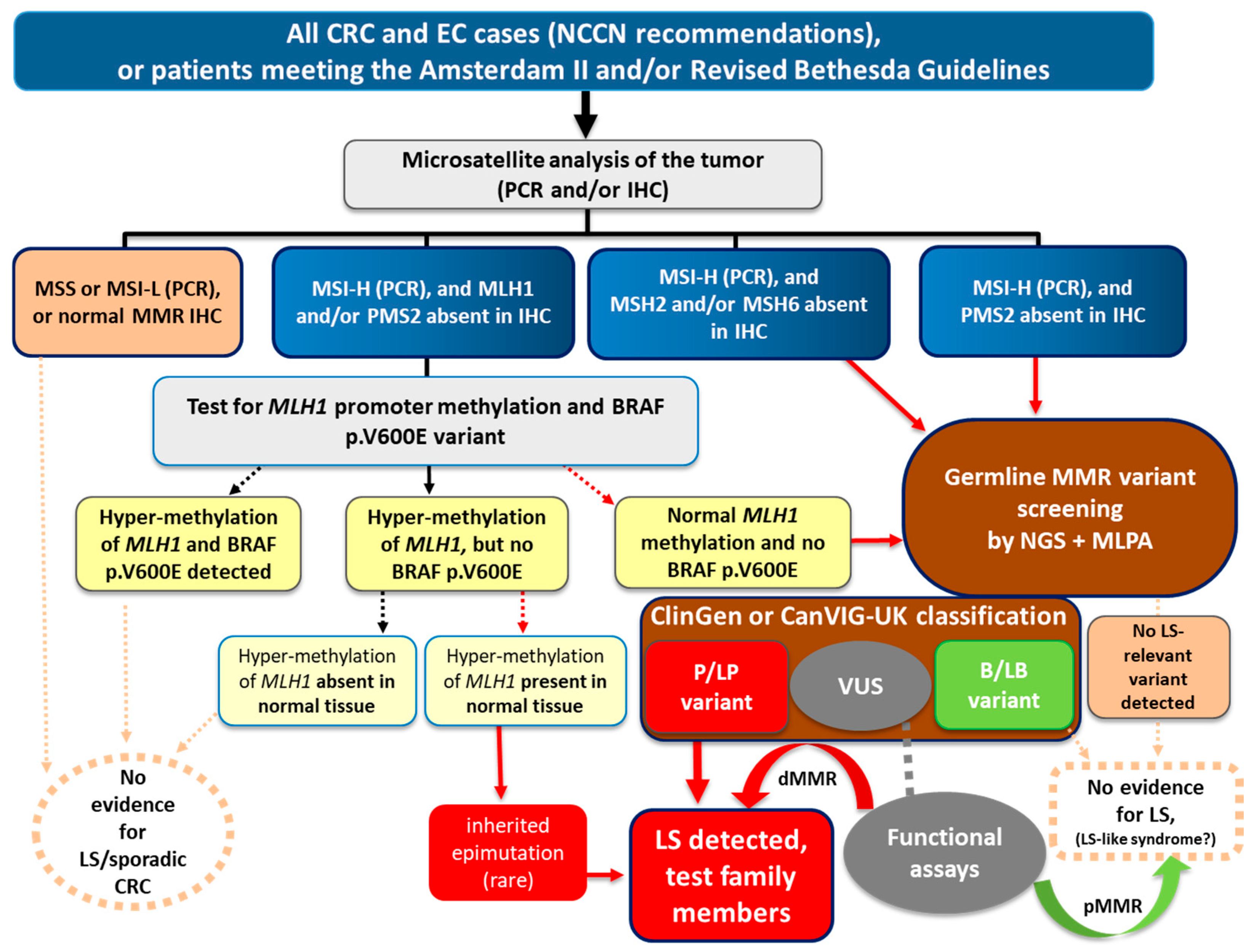
5.2. Molecular Diagnosis of LS
- (a)
- Microsatellite Instability evaluation
- (b)
- BRAF V600E and MLH1 promotor hypermethylation
- (c)
- Multigene Panel Testing (NGS), MLPA and Sanger sequencing
5.3. MMR Gene Variant Classification Guidelines
5.4. Prevalence and Type of Mismatch Repair Gene Variants
5.5. Founder Variants
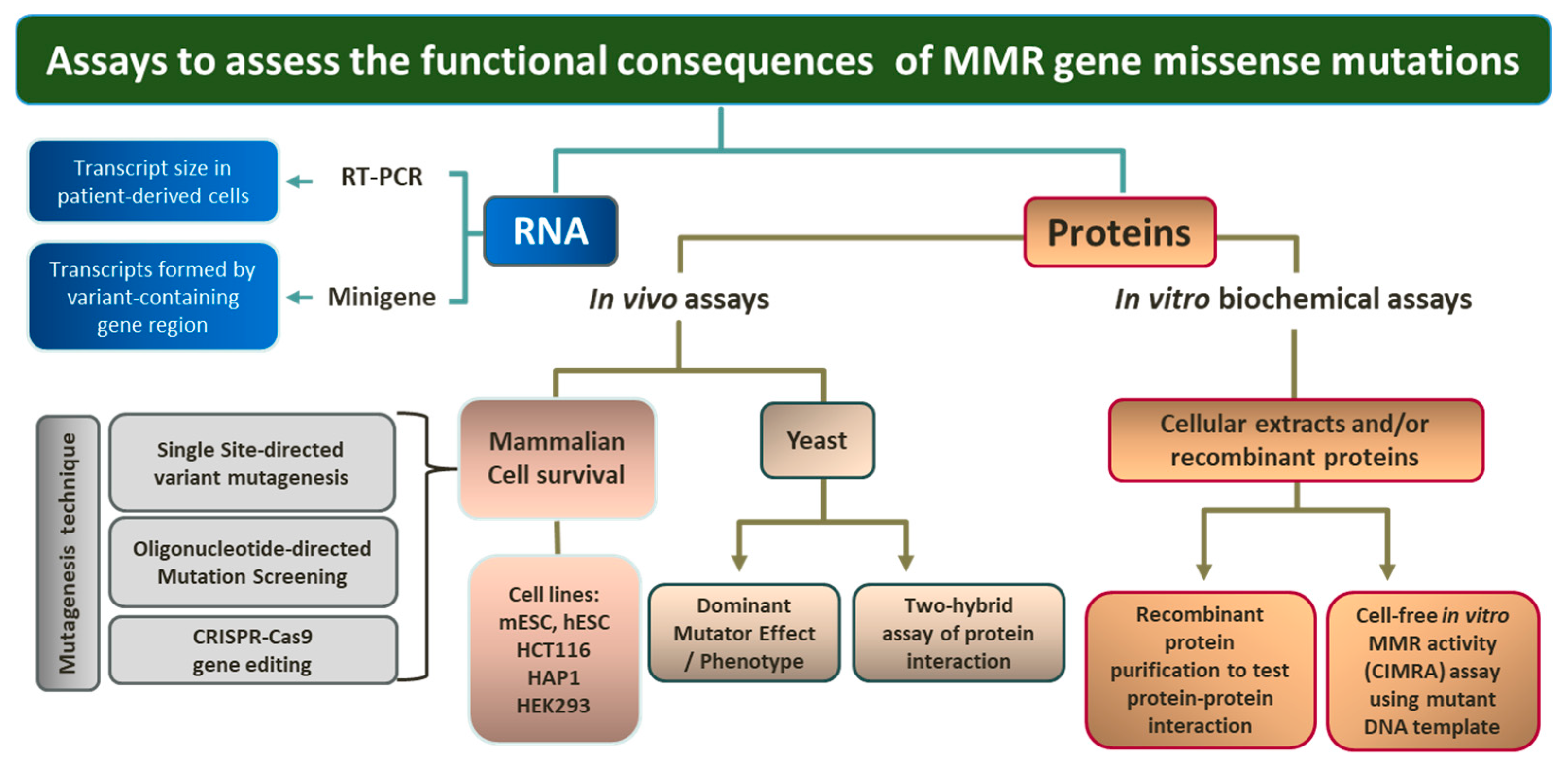
6. Functional Assays to Classify VUS in Mismatch Repair Genes
6.1. Variant Effect at Messenger RNA Level
6.2. Variant Effect at Protein Level
6.2.1. Cell-Free In Vitro MMR Activity (CIMRA) Assay
6.2.2. Yeast In Vivo Assays
6.2.3. Yeast—Dominant Mutator Effect/Phenotype
6.2.4. Yeast Two-Hybrid Assay
6.2.5. In Vivo Assays in Mammalian Cells Based on 6-Thioguanine (6-TG) Resistance
6.2.6. Methylation Tolerance (MT)-Based Functional Assays
6.3. High-Throughput Studies Using Multiplexed Assays of Variant Effect (MAVE)
7. Conclusions and Future Perspectives
Limitations of the Presented Review
Supplementary Materials
Author Contributions
Funding
Informed Consent Statement
Data Availability Statement
Acknowledgments
Conflicts of Interest
Abbreviations
| CIMRA | Cell-free in vitro MMR activity |
| CNV | Copy number variant |
| CRC | Colorectal cancer |
| EC | Endometrial cancer |
| LLS | Lynch-like syndrome |
| LoF | Loss of function |
| LS | Lynch syndrome |
| MMR | Mismatch repair |
| MSI | Microsatellite instability |
| VUS | Variant of uncertain significance |
| s-dm | Site-directed mutagenesis |
| MAVE | Multiplexed assays of variant effect |
References
- Bray, F.; Laversanne, M.; Sung, H.; Ferlay, J.; Siegel, R.L.; Soerjomataram, I.; Jemal, A. Global Cancer Statistics 2022: GLOBOCAN Estimates of Incidence and Mortality Worldwide for 36 Cancers in 185 Countries. CA Cancer J. Clin. 2024, 74, 229–263. [Google Scholar] [CrossRef]
- Filho, A.M.; Laversanne, M.; Ferlay, J.; Colombet, M.; Piñeros, M.; Znaor, A.; Parkin, D.M.; Soerjomataram, I.; Bray, F. The GLOBOCAN 2022 Cancer Estimates: Data Sources, Methods, and a Snapshot of the Cancer Burden Worldwide. Int. J. Cancer 2025, 156, 1336–1346. [Google Scholar] [CrossRef] [PubMed]
- Kanth, P.; Grimmett, J.; Champine, M.; Burt, R.; Samadder, J.N. Hereditary Colorectal Polyposis and Cancer Syndromes: A Primer on Diagnosis and Management. Am. J. Gastroenterol. 2017, 112, 1509–1525. [Google Scholar] [CrossRef]
- Keum, N.; Giovannucci, E. Global Burden of Colorectal Cancer: Emerging Trends, Risk Factors and Prevention Strategies. Nat. Rev. Gastroenterol. Hepatol. 2019, 16, 713–732. [Google Scholar] [CrossRef]
- Shaukat, A.; Kahi, C.J.; Burke, C.A.; Rabeneck, L.; Sauer, B.G.; Rex, D.K. ACG Clinical Guidelines: Colorectal Cancer Screening 2021. Am. J. Gastroenterol. 2021, 116, 458–479. [Google Scholar] [CrossRef]
- Dunne, P.D.; Arends, M.J. Molecular Pathological Classification of Colorectal Cancer—An Update. Virchows Arch. 2024, 484, 273–285, Correction in Virchows Arch. 2024, 484, 287. [Google Scholar] [CrossRef] [PubMed]
- Crockett, S.D.; Nagtegaal, I.D. Terminology, Molecular Features, Epidemiology, and Management of Serrated Colorectal Neoplasia. Gastroenterology 2019, 157, 949–966.e4. [Google Scholar] [CrossRef]
- Monahan, K.J.; Bradshaw, N.; Dolwani, S.; Desouza, B.; Dunlop, M.G.; East, J.E.; Ilyas, M.; Kaur, A.; Lalloo, F.; Latchford, A.; et al. Guidelines for the Management of Hereditary Colorectal Cancer from the British Society of Gastroenterology (BSG)/Association of Coloproctology of Great Britain and Ireland (ACPGBI)/United Kingdom Cancer Genetics Group (UKCGG). Gut 2020, 69, 411–444. [Google Scholar] [CrossRef] [PubMed]
- Hegde, M.; Ferber, M.; Mao, R.; Samowitz, W.; Ganguly, A. ACMG Technical Standards and Guidelines for Genetic Testing for Inherited Colorectal Cancer (Lynch Syndrome, Familial Adenomatous Polyposis, and MYH-Associated Polyposis). Genet. Med. 2014, 16, 101–116. [Google Scholar] [CrossRef] [PubMed]
- Li, Q.; Geng, S.; Luo, H.; Wang, W.; Mo, Y.-Q.; Luo, Q.; Wang, L.; Song, G.-B.; Sheng, J.-P.; Xu, B. Signaling Pathways Involved in Colorectal Cancer: Pathogenesis and Targeted Therapy. Signal Transduct. Target. Ther. 2024, 9, 266. [Google Scholar] [CrossRef]
- Jasperson, K.W.; Tuohy, T.M.; Neklason, D.W.; Burt, R.W. Hereditary and Familial Colon Cancer. Gastroenterology 2010, 138, 2044–2058. [Google Scholar] [CrossRef]
- Migliore, L.; Migheli, F.; Spisni, R.; Coppedè, F. Genetics, Cytogenetics, and Epigenetics of Colorectal Cancer. BioMed Res. Int. 2011, 2011, 792362. [Google Scholar] [CrossRef]
- Moreira, L.; Balaguer, F.; Lindor, N.; De La Chapelle, A.; Hampel, H.; Aaltonen, L.A.; Hopper, J.L.; Le Marchand, L.; Gallinger, S.; Newcomb, P.A.; et al. Identification of Lynch Syndrome Among Patients With Colorectal Cancer. JAMA 2012, 308, 1555. [Google Scholar] [CrossRef]
- Peltomäki, P.; Nyström, M.; Mecklin, J.-P.; Seppälä, T.T. Lynch Syndrome Genetics and Clinical Implications. Gastroenterology 2023, 164, 783–799. [Google Scholar] [CrossRef]
- Kalady, M.F.; Nancy You, Y. Molecular Basis of Colorectal Cancer and Overview of Inherited Colorectal Cancer Syndromes. In The ASCRS Manual of Colon and Rectal Surgery; Steele, S.R., Hull, T.L., Hyman, N., Maykel, J.A., Read, T.E., Whitlow, C.B., Eds.; Springer International Publishing: Cham, Switzerland, 2019; pp. 301–326. ISBN 978-3-030-01164-2. [Google Scholar]
- Stoffel, E.M.; Mangu, P.B.; Gruber, S.B.; Hamilton, S.R.; Kalady, M.F.; Lau, M.W.Y.; Lu, K.H.; Roach, N.; Limburg, P.J. Hereditary Colorectal Cancer Syndromes: American Society of Clinical Oncology Clinical Practice Guideline Endorsement of the Familial Risk-Colorectal Cancer: European Society for Medical Oncology Clinical Practice Guidelines. J. Clin. Oncol. 2015, 33, 209–217. [Google Scholar] [CrossRef]
- Fleming, M.; Ravula, S.; Tatishchev, S.F.; Wang, H.L. Colorectal Carcinoma: Pathologic Aspects. J. Gastrointest. Oncol. 2012, 3, 153. [Google Scholar] [CrossRef]
- Torchiaro, E.; Petti, C.; Arena, S.; Sassi, F.; Migliardi, G.; Mellano, A.; Porporato, R.; Basiricò, M.; Gammaitoni, L.; Berrino, E.; et al. Case Report: Preclinical Efficacy of NEDD8 and Proteasome Inhibitors in Patient-Derived Models of Signet Ring High-Grade Mucinous Colorectal Cancer from a Lynch Syndrome Patient. Front. Oncol. 2023, 13, 1130852. [Google Scholar] [CrossRef]
- Dubansky, B.; Lewis, S.; Telgenhoff, D. Classification and Histological Characteristics of Colorectal Cancer. Clin. Lab. Sci. 2023, 36, 50–54. [Google Scholar] [CrossRef]
- Sung, H.; Siegel, R.L.; Laversanne, M.; Jiang, C.; Morgan, E.; Zahwe, M.; Cao, Y.; Bray, F.; Jemal, A. Colorectal Cancer Incidence Trends in Younger versus Older Adults: An Analysis of Population-Based Cancer Registry Data. Lancet Oncol. 2024, 26, 51–63. [Google Scholar] [CrossRef] [PubMed]
- Siegel, R.L.; Jemal, A.; Ward, E.M. Increase in Incidence of Colorectal Cancer among Young Men and Women in the United States. Cancer Epidemiol. Biomark. Prev. 2009, 18, 1695–1698. [Google Scholar] [CrossRef] [PubMed]
- Vuik, F.E.; Nieuwenburg, S.A.; Bardou, M.; Lansdorp-Vogelaar, I.; Dinis-Ribeiro, M.; Bento, M.J.; Zadnik, V.; Pellisé, M.; Esteban, L.; Kaminski, M.F.; et al. Increasing Incidence of Colorectal Cancer in Young Adults in Europe over the Last 25 Years. Gut 2019, 68, 1820–1826. [Google Scholar] [CrossRef]
- Siegel, R.L.; Torre, L.A.; Soerjomataram, I.; Hayes, R.B.; Bray, F.; Weber, T.K.; Jemal, A. Global Patterns and Trends in Colorectal Cancer Incidence in Young Adults. Gut 2019, 68, 2179–2185. [Google Scholar] [CrossRef] [PubMed]
- Patel, S.G.; Karlitz, J.J.; Yen, T.; Lieu, C.H.; Boland, C.R. The Rising Tide of Early-Onset Colorectal Cancer: A Comprehensive Review of Epidemiology, Clinical Features, Biology, Risk Factors, Prevention, and Early Detection. Lancet Gastroenterol. Hepatol. 2022, 7, 262–274. [Google Scholar] [CrossRef]
- Díaz-Gay, M.; Dos Santos, W.; Moody, S.; Kazachkova, M.; Abbasi, A.; Steele, C.D.; Vangara, R.; Senkin, S.; Wang, J.; Fitzgerald, S.; et al. Geographic and Age Variations in Mutational Processes in Colorectal Cancer. Nature 2025, 643, 230–240. [Google Scholar] [CrossRef]
- Stern, M.C.; Sanchez Mendez, J.; Kim, A.E.; Obón-Santacana, M.; Moratalla-Navarro, F.; Martín, V.; Moreno, V.; Lin, Y.; Bien, S.A.; Qu, C.; et al. Genome-Wide Gene–Environment Interaction Analyses to Understand the Relationship between Red Meat and Processed Meat Intake and Colorectal Cancer Risk. Cancer Epidemiol. Biomark. Prev. 2024, 33, 400–410. [Google Scholar] [CrossRef]
- Gurjao, C.; Zhong, R.; Haruki, K.; Li, Y.Y.; Spurr, L.F.; Lee-Six, H.; Reardon, B.; Ugai, T.; Zhang, X.; Cherniack, A.D.; et al. Discovery and Features of an Alkylating Signature in Colorectal Cancer. Cancer Discov. 2021, 11, 2446–2455. [Google Scholar] [CrossRef] [PubMed]
- Laskar, R.S.; Qu, C.; Huyghe, J.R.; Harrison, T.; Hayes, R.B.; Cao, Y.; Campbell, P.T.; Steinfelder, R.; Talukdar, F.R.; Brenner, H.; et al. Genome-Wide Association Studies and Mendelian Randomization Analyses Provide Insights into the Causes of Early-Onset Colorectal Cancer. Ann. Oncol. 2024, 35, 523–536. [Google Scholar] [CrossRef]
- Warthin, A.S. Heredity with Reference to Carcinoma As Shown By the Study of the Cases Examined in the Pathological Laboratory Of the University of Michigan, 1895–1913. CA J. Clin. 1985, 35, 348–359. [Google Scholar] [CrossRef]
- Lynch, H.T.; Snyder, C.L.; Shaw, T.G.; Heinen, C.D.; Hitchins, M.P. Milestones of Lynch Syndrome: 1895–2015. Nat. Rev. Cancer 2015, 15, 181–194. [Google Scholar] [CrossRef]
- Lynch, H.T.; Shaw, M.W.; Magnuson, C.W.; Larsen, A.L.; Krush, A.J. Hereditary Factors in Cancer. Study of Two Large Midwestern Kindreds. Arch. Intern. Med. 1966, 117, 206–212. [Google Scholar] [CrossRef] [PubMed]
- Peltomäki, P.; Aaltonen, L.A.; Sistonen, P.; Pylkkänen, L.; Mecklin, J.-P.; Järvinen, H.; Green, J.S.; Jass, J.R.; Weber, J.L.; Leach, F.S.; et al. Genetic Mapping of a Locus Predisposing to Human Colorectal Cancer. Science 1993, 260, 810–812. [Google Scholar] [CrossRef] [PubMed]
- Leach, F.S.; Nicolaides, N.C.; Papadopoulos, N.; Liu, B.; Jen, J.; Parsons, R.; Peltomäki, P.; Sistonen, P.; Aaltonen, L.A.; Nyström-Lahti, M.; et al. Mutations of a mutS Homolog in Hereditary Nonpolyposis Colorectal Cancer. Cell 1993, 75, 1215–1225. [Google Scholar] [CrossRef]
- Fishel, R.; Lescoe, M.K.; Rao, M.R.; Copeland, N.G.; Jenkins, N.A.; Garber, J.; Kane, M.; Kolodner, R. The Human Mutator Gene Homolog MSH2 and Its Association with Hereditary Nonpolyposis Colon Cancer. Cell 1993, 75, 1027–1038, Erratum in Cell 1994, 77, 1. [Google Scholar] [CrossRef]
- Aaltonen, L.A.; Peltomäki, P.; Leach, F.S.; Sistonen, P.; Pylkkänen, L.; Mecklin, J.-P.; Järvinen, H.; Powell, S.M.; Jen, J.; Hamilton, S.R.; et al. Clues to the Pathogenesis of Familial Colorectal Cancer. Science 1993, 260, 812–816. [Google Scholar] [CrossRef] [PubMed]
- Bronner, C.E.; Baker, S.M.; Morrison, P.T.; Warren, G.; Smith, L.G.; Lescoe, M.K.; Kane, M.; Earabino, C.; Lipford, J.; Lindblom, A. Mutation in the DNA Mismatch Repair Gene Homologue hMLH1 Is Associated with Hereditary Non-Polyposis Colon Cancer. Nature 1994, 368, 258–261. [Google Scholar] [CrossRef]
- Papadopoulos, N.; Nicolaides, N.C.; Wei, Y.-F.; Ruben, S.M.; Carter, K.C.; Rosen, C.A.; Haseltine, W.A.; Fleischmann, R.D.; Fraser, C.M.; Adams, M.D.; et al. Mutation of a mutL Homolog in Hereditary Colon Cancer. Science 1994, 263, 1625–1629. [Google Scholar] [CrossRef]
- Nicolaides, N.C.; Papadopoulos, N.; Liu, B.; Weit, Y.-F.; Carter, K.C.; Ruben, S.M.; Rosen, C.A.; Haseltine, W.A.; Fleischmann, R.D.; Fraser, C.M.; et al. Mutations of Two P/WS Homologues in Hereditary Nonpolyposis Colon Cancer. Nature 1994, 371, 75–80. [Google Scholar] [CrossRef]
- Miyaki, M.; Konishi, M.; Tanaka, K.; Kikuchi-Yanoshita, R.; Muraoka, M.; Yasuno, M.; Igari, T.; Koike, M.; Chiba, M.; Mori, T. Germline Mutation of MSH6 as the Cause of Hereditary Nonpolyposis Colorectal Cancer. Nat. Genet. 1997, 17, 271–272. [Google Scholar] [CrossRef]
- Van Der Klift, H.; Wijnen, J.; Wagner, A.; Verkuilen, P.; Tops, C.; Otway, R.; Kohonen-Corish, M.; Vasen, H.; Oliani, C.; Barana, D.; et al. Molecular Characterization of the Spectrum of Genomic Deletions in the Mismatch Repair Genes MSH2, MLH1, MSH6 and PMS2 Responsible for Hereditary Nonpolyposis Colorectal Cancer (HNPCC). Genes Chromosome Cancer 2005, 44, 123–138. [Google Scholar] [CrossRef] [PubMed]
- Cerretelli, G.; Ager, A.; Arends, M.J.; Frayling, I.M. Molecular Pathology of Lynch Syndrome. J. Pathol. 2020, 250, 518–531. [Google Scholar] [CrossRef]
- Ligtenberg, M.J.L.; Kuiper, R.P.; Geurts van Kessel, A.; Hoogerbrugge, N. EPCAM Deletion Carriers Constitute a Unique Subgroup of Lynch Syndrome Patients. Fam. Cancer 2013, 12, 169–174. [Google Scholar] [CrossRef]
- Ligtenberg, M.J.L.; Kuiper, R.P.; Chan, T.L.; Goossens, M.; Hebeda, K.M.; Voorendt, M.; Lee, T.Y.H.; Bodmer, D.; Hoenselaar, E.; Hendriks-Cornelissen, S.J.B.; et al. Heritable Somatic Methylation and Inactivation of MSH2 in Families with Lynch Syndrome Due to Deletion of the 3′ Exons of TACSTD1. Nat. Genet. 2009, 41, 112–117. [Google Scholar] [CrossRef] [PubMed]
- Nejadtaghi, M.; Jafari, H.; Farrokhi, E.; Samani, K.G. Familial Colorectal Cancer Type X (FCCTX) and the Correlation with Various Genes-A Systematic Review. Curr. Probl. Cancer 2017, 41, 388–397. [Google Scholar] [CrossRef] [PubMed]
- Martínez-Roca, A.; Giner-Calabuig, M.; Murcia, O.; Castillejo, A.; Soto, J.L.; García-Heredia, A.; Jover, R. Lynch-like Syndrome: Potential Mechanisms and Management. Cancers 2022, 14, 1115. [Google Scholar] [CrossRef]
- Golubicki, M.; Bonjoch, L.; Acuña-Ochoa, J.G.; Díaz-Gay, M.; Muñoz, J.; Cuatrecasas, M.; Ocaña, T.; Iseas, S.; Mendez, G.; Cisterna, D.; et al. Germline Biallelic Mcm8 Variants Are Associated with Early-Onset Lynch-like Syndrome. JCI Insight 2020, 5, e140698. [Google Scholar] [CrossRef]
- Muir, E.G.; Bell, A.J.Y.; Barlow, K.A. Multiple Primary Carcinomata of the Colon, Duodenum, and Larynx Associated with Kerato-Acanthomata of the Face. Br. J. Surg. 1967, 54, 191–195. [Google Scholar] [CrossRef]
- Torre, D. Multiple Sebaceous Tumors. Arch. Dermatol. 1968, 98, 549–551. [Google Scholar] [CrossRef] [PubMed]
- Lynch, H.T.; Shaw, T.G. Practical Genetics of Colorectal Cancer. Chin. Clin. Oncol. 2013, 2, 12. [Google Scholar] [CrossRef]
- Mangold, E. A Genotype-Phenotype Correlation in HNPCC: Strong Predominance of Msh2 Mutations in 41 Patients with Muir-Torre Syndrome. J. Med. Genet. 2004, 41, 567–572. [Google Scholar] [CrossRef]
- Bapat, B.; Xia, L.; Madlensky, L.; Mitri, A.; Tonin, P.; Narod, S.A.; Gallinger, S. The Genetic Basis of Muir-Torre Syndrome Includes the hMLH1 Locus. Am. J. Hum. Genet. 1996, 59, 736–739. [Google Scholar]
- Le, S.; Ansari, U.; Mumtaz, A.; Malik, K.; Patel, P.; Doyle, A.; Khachemoune, A. Lynch Syndrome and Muir-Torre Syndrome: An Update and Review on the Genetics, Epidemiology, and Management of Two Related Disorders. Dermatol. Online J. 2017, 23, 2. [Google Scholar] [CrossRef]
- Turcot, J.; Després, J.-P.; Pierre, F.S. Malignant Tumors of the Central Nervous System Associated with Familial Polyposis of the Colon. Dis. Colon Rectum 1959, 2, 465–468. [Google Scholar] [CrossRef]
- Colas, C.; Guerrini-Rousseau, L.; Suerink, M.; Gallon, R.; Kratz, C.P.; Ayuso, É.; ERN GENTURIS CMMRD Guideline Group; Andreiuolo, F.; Azizi, A.A.; Beccaria, K.; et al. ERN GENTURIS Guidelines on Constitutional Mismatch Repair Deficiency Diagnosis, Genetic Counselling, Surveillance, Quality of Life, and Clinical Management. Eur. J. Hum. Genet. 2024, 32, 1526–1541. [Google Scholar] [CrossRef]
- OMIM. # 276300 Mismatch Repair Cancer Syndrome 1. Available online: https://omim.org/entry/276300 (accessed on 20 April 2026).
- Ercan, A.B.; Aronson, M.; Fernandez, N.R.; Chang, Y.; Levine, A.; Liu, Z.A.; Negm, L.; Edwards, M.; Bianchi, V.; Stengs, L.; et al. Clinical and Biological Landscape of Constitutional Mismatch-Repair Deficiency Syndrome: An International Replication Repair Deficiency Consortium Cohort Study. Lancet Oncol. 2024, 25, 668–682. [Google Scholar] [CrossRef] [PubMed]
- Wang, Q.; Lasset, C.; Desseigne, F.; Frappaz, D.; Bergeron, C.; Navarro, C.; Ruano, E.; Puisieux, A. Neurofibromatosis and Early Onset of Cancers in hMLH1-Deficient Children. Cancer Res. 1999, 59, 294–297. [Google Scholar] [PubMed]
- Li, G.-M. Mechanisms and Functions of DNA Mismatch Repair. Cell Res. 2008, 18, 85–98. [Google Scholar] [CrossRef]
- Valle, L. Lynch Syndrome: A Single Hereditary Cancer Syndrome or Multiple Syndromes Defined by Different Mismatch Repair Genes? Gastroenterology 2023, 165, 20–23. [Google Scholar] [CrossRef]
- Thompson, B.A.; Spurdle, A.B.; Plazzer, J.-P.; Greenblatt, M.S.; Akagi, K.; Al-Mulla, F.; Bapat, B.; Bernstein, I.; Capellá, G.; Den Dunnen, J.T.; et al. Application of a 5-Tiered Scheme for Standardized Classification of 2,360 Unique Mismatch Repair Gene Variants in the InSiGHT Locus-Specific Database. Nat. Genet. 2014, 46, 107–115. [Google Scholar] [CrossRef] [PubMed]
- Kelley, M.R.; Fishel, M.L. Overview of DNA Repair Pathways, Current Targets, and Clinical Trials Bench to Clinic. In DNA Repair in Cancer Therapy; Elsevier: Amsterdam, The Netherlands, 2016; pp. 1–54. ISBN 978-0-12-803582-5. [Google Scholar]
- Leung, W.K.; Kim, J.J.; Wu, L.; Sepulveda, J.L.; Sepulveda, A.R. Identification of a Second MutL DNA Mismatch Repair Complex (hPMS1 and hMLH1) in Human Epithelial Cells. J. Biol. Chem. 2000, 275, 15728–15732. [Google Scholar] [CrossRef]
- Martin, S.A.; Lord, C.J.; Ashworth, A. Therapeutic Targeting of the DNA Mismatch Repair Pathway. Clin. Cancer Res. 2010, 16, 5107–5113. [Google Scholar] [CrossRef]
- Olave, M.C.; Graham, R.P. Mismatch Repair Deficiency: The What, How and Why It Is Important. Genes Chromosome Cancer 2022, 61, 314–321. [Google Scholar] [CrossRef]
- Helderman, N.C.; Terlouw, D.; Bonjoch, L.; Golubicki, M.; Antelo, M.; Morreau, H.; van Wezel, T.; Castellví-Bel, S.; Goldberg, Y.; Nielsen, M. Molecular Functions of MCM8 and MCM9 and Their Associated Pathologies. iScience 2023, 26, 106737. [Google Scholar] [CrossRef]
- Traver, S.; Coulombe, P.; Peiffer, I.; Hutchins, J.R.A.; Kitzmann, M.; Latreille, D.; Méchali, M. MCM9 Is Required for Mammalian DNA Mismatch Repair. Mol. Cell 2015, 59, 831–839. [Google Scholar] [CrossRef]
- Incorvaia, L.; Bazan Russo, T.D.; Gristina, V.; Perez, A.; Brando, C.; Mujacic, C.; Di Giovanni, E.; Bono, M.; Contino, S.; Ferrante Bannera, C.; et al. The Intersection of Homologous Recombination (HR) and Mismatch Repair (MMR) Pathways in DNA Repair-Defective Tumors. npj Precis. Oncol. 2024, 8, 190. [Google Scholar] [CrossRef] [PubMed]
- Win, A.K.; Jenkins, M.A.; Buchanan, D.D.; Clendenning, M.; Young, J.P.; Giles, G.G.; Goldblatt, J.; Leggett, B.A.; Hopper, J.L.; Thibodeau, S.N.; et al. Determining the Frequency of de Novo Germline Mutations in DNA Mismatch Repair Genes. J. Med. Genet. 2011, 48, 530–534. [Google Scholar] [CrossRef]
- Li, X.; Liu, G.; Wu, W. Recent Advances in Lynch Syndrome. Exp. Hematol. Oncol. 2021, 10, 37. [Google Scholar] [CrossRef]
- The Prospective Lynch Syndromes Database (PLSD), Version 5. Available online: https://plsd.eu/ (accessed on 20 April 2026).
- Win, A.K.; Jenkins, M.A.; Dowty, J.G.; Antoniou, A.C.; Lee, A.; Giles, G.G.; Buchanan, D.D.; Clendenning, M.; Rosty, C.; Ahnen, D.J.; et al. Prevalence and Penetrance of Major Genes and Polygenes for Colorectal Cancer. Cancer Epidemiol. Biomark. Prev. 2017, 26, 404–412. [Google Scholar] [CrossRef]
- Haraldsdottir, S.; Rafnar, T.; Frankel, W.L.; Einarsdottir, S.; Sigurdsson, A.; Hampel, H.; Snaebjornsson, P.; Masson, G.; Weng, D.; Arngrimsson, R.; et al. Comprehensive Population-Wide Analysis of Lynch Syndrome in Iceland Reveals Founder Mutations in MSH6 and PMS2. Nat. Commun. 2017, 8, 14755. [Google Scholar] [CrossRef] [PubMed]
- Andini, K.D.; Nielsen, M.; Suerink, M.; Helderman, N.C.; Koornstra, J.J.; Ahadova, A.; Kloor, M.; Mourits, M.J.E.; Kok, K.; Sijmons, R.H.; et al. PMS2-Associated Lynch Syndrome: Past, Present and Future. Front. Oncol. 2023, 13, 1127329. [Google Scholar] [CrossRef]
- Dominguez-Valentin, M.; Sampson, J.R.; Seppälä, T.T.; Ten Broeke, S.W.; Plazzer, J.-P.; Nakken, S.; Engel, C.; Aretz, S.; Jenkins, M.A.; Sunde, L.; et al. Cancer Risks by Gene, Age, and Gender in 6350 Carriers of Pathogenic Mismatch Repair Variants: Findings from the Prospective Lynch Syndrome Database. Genet. Med. 2020, 22, 15–25, Erratum in Genet. Med. 2020, 22, 1569. [Google Scholar] [CrossRef] [PubMed]
- Engel, C.; Ahadova, A.; Seppälä, T.T.; Aretz, S.; Bigirwamungu-Bargeman, M.; Bläker, H.; Bucksch, K.; Büttner, R.; De Vos Tot Nederveen Cappel, W.T.; Endris, V.; et al. Associations of Pathogenic Variants in MLH1, MSH2, and MSH6 With Risk of Colorectal Adenomas and Tumors and With Somatic Mutations in Patients With Lynch Syndrome. Gastroenterology 2020, 158, 1326–1333. [Google Scholar] [CrossRef]
- Dominguez-Valentin, M.; Haupt, S.; Seppälä, T.T.; Sampson, J.R.; Sunde, L.; Bernstein, I.; Jenkins, M.A.; Engel, C.; Aretz, S.; Nielsen, M.; et al. Mortality by Age, Gene and Gender in Carriers of Pathogenic Mismatch Repair Gene Variants Receiving Surveillance for Early Cancer Diagnosis and Treatment: A Report from the Prospective Lynch Syndrome Database. eClinicalMedicine 2023, 58, 101909. [Google Scholar] [CrossRef] [PubMed]
- Møller, P.; Seppälä, T.T.; Bernstein, I.; Holinski-Feder, E.; Sala, P.; Gareth Evans, D.; Lindblom, A.; Macrae, F.; Blanco, I.; Sijmons, R.H.; et al. Cancer Risk and Survival in path_MMR Carriers by Gene and Gender up to 75 Years of Age: A Report from the Prospective Lynch Syndrome Database. Gut 2018, 67, 1306–1316, Correction in Gut 2020, 69, e4. [Google Scholar] [CrossRef]
- Møller, P.; Seppälä, T.T.; Ahadova, A.; Crosbie, E.J.; Holinski-Feder, E.; Scott, R.; Haupt, S.; Möslein, G.; Winship, I.; Broeke, S.W.B.-T.; et al. Dominantly Inherited Micro-Satellite Instable Cancer—The Four Lynch Syndromes—An EHTG, PLSD Position Statement. Hered. Cancer Clin. Pract. 2023, 21, 19. [Google Scholar] [CrossRef] [PubMed]
- Møller, P.; Ahadova, A.; Kloor, M.; Seppälä, T.T.; Burn, J.; Haupt, S.; Macrae, F.; Dominguez-Valentin, M.; Möslein, G.; Lindblom, A.; et al. Colorectal Carcinogenesis in the Lynch Syndromes and Familial Adenomatous Polyposis: Trigger Events and Downstream Consequences. Hered. Cancer Clin. Pract. 2025, 23, 3. [Google Scholar] [CrossRef]
- Valeri, N.; Gasparini, P.; Braconi, C.; Paone, A.; Lovat, F.; Fabbri, M.; Sumani, K.M.; Alder, H.; Amadori, D.; Patel, T.; et al. MicroRNA-21 Induces Resistance to 5-Fluorouracil by down-Regulating Human DNA MutS Homolog 2 (hMSH2). Proc. Natl. Acad. Sci. USA 2010, 107, 21098–21103. [Google Scholar] [CrossRef]
- Abildgaard, A.B.; Nielsen, S.V.; Bernstein, I.; Stein, A.; Lindorff-Larsen, K.; Hartmann-Petersen, R. Lynch Syndrome, Molecular Mechanisms and Variant Classification. Br. J. Cancer 2023, 128, 726–734. [Google Scholar] [CrossRef]
- Knudson, A.G. Mutation and Cancer: Statistical Study of Retinoblastoma. Proc. Natl. Acad. Sci. USA 1971, 68, 820–823. [Google Scholar] [CrossRef] [PubMed]
- Wang, Q. Cancer Predisposition Genes: Molecular Mechanisms and Clinical Impact on Personalized Cancer Care: Examples of Lynch and HBOC Syndromes. Acta Pharmacol. Sin. 2016, 37, 143–149. [Google Scholar] [CrossRef]
- Lao, V.V.; Grady, W.M. Epigenetics and Colorectal Cancer. Nat. Rev. Gastroenterol. Hepatol. 2011, 8, 686–700. [Google Scholar] [CrossRef]
- Zhang, S.; Lloyd, R.; Bowden, G.; Glickman, B.W.; De Boer, J.G. Msh2 Deficiency Increases the Mutation Frequency in All Parts of the Mouse Colon. Environ. Mol. Mutagen. 2002, 40, 243–250. [Google Scholar] [CrossRef]
- Shrestha, K.S.; Aska, E.-M.; Tuominen, M.M.; Kauppi, L. Tissue-Specific Reduction in MLH1 Expression Induces Microsatellite Instability in Intestine of Mlh1 Mice. DNA Repair 2021, 106, 103178. [Google Scholar] [CrossRef]
- Seth, S.; Ager, A.; Arends, M.J.; Frayling, I.M. Lynch Syndrome—Cancer Pathways, Heterogeneity and Immune Escape. J. Pathol. 2018, 246, 129–133. [Google Scholar] [CrossRef]
- Poulin, E.J.; Shen, J.; Gierut, J.J.; Haigis, K.M. Pathology and Molecular Pathology of Colorectal Cancer. In Pathology and Epidemiology of Cancer; Loda, M., Mucci, L.A., Mittelstadt, M.L., Van Hemelrijck, M., Cotter, M.B., Eds.; Springer International Publishing: Cham, Switzerland, 2017; pp. 409–446. ISBN 978-3-319-35151-3. [Google Scholar]
- Kloor, M.; Huth, C.; Voigt, A.Y.; Benner, A.; Schirmacher, P.; Von Knebel Doeberitz, M.; Bläker, H. Prevalence of Mismatch Repair-Deficient Crypt Foci in Lynch Syndrome: A Pathological Study. Lancet Oncol. 2012, 13, 598–606. [Google Scholar] [CrossRef]
- Simons, B.D.; Clevers, H. Stem Cell Self-Renewal in Intestinal Crypt. Exp. Cell Res. 2011, 317, 2719–2724. [Google Scholar] [CrossRef] [PubMed]
- Ahadova, A.; Gallon, R.; Gebert, J.; Ballhausen, A.; Endris, V.; Kirchner, M.; Stenzinger, A.; Burn, J.; Von Knebel Doeberitz, M.; Bläker, H.; et al. Three Molecular Pathways Model Colorectal Carcinogenesis in L Ynch Syndrome. Int. J. Cancer 2018, 143, 139–150. [Google Scholar] [CrossRef] [PubMed]
- Ahadova, A.; Stenzinger, A.; Seppälä, T.; Hüneburg, R.; Kloor, M.; Bläker, H.; Wittemann, J.-N.; Endris, V.; Gerling, L.; Bertram, V.; et al. A “Two-in-One Hit” Model of Shortcut Carcinogenesis in MLH1 Lynch Syndrome Carriers. Gastroenterology 2023, 165, 267–270.e4. [Google Scholar] [CrossRef]
- Ahadova, A.; Von Knebel Doeberitz, M.; Bläker, H.; Kloor, M. CTNNB1-Mutant Colorectal Carcinomas with Immediate Invasive Growth: A Model of Interval Cancers in Lynch Syndrome. Fam. Cancer 2016, 15, 579–586. [Google Scholar] [CrossRef]
- Ten Broeke, S.W.; Van Bavel, T.C.; Jansen, A.M.L.; Gómez-García, E.; Hes, F.J.; Van Hest, L.P.; Letteboer, T.G.W.; Olderode-Berends, M.J.W.; Ruano, D.; Spruijt, L.; et al. Molecular Background of Colorectal Tumors From Patients With Lynch Syndrome Associated With Germline Variants in PMS2. Gastroenterology 2018, 155, 844–851. [Google Scholar] [CrossRef]
- Ougolkov, A.; Zhang, B.; Yamashita, K.; Bilim, V.; Mai, M.; Fuchs, S.Y.; Minamoto, T. Associations Among β-TrCP, an E3 Ubiquitin Ligase Receptor, β-Catenin, and NF-κB in Colorectal Cancer. J. Natl. Cancer Inst. 2004, 96, 1161–1170. [Google Scholar] [CrossRef] [PubMed]
- Sadot, E.; Conacci-Sorrell, M.; Zhurinsky, J.; Shnizer, D.; Lando, Z.; Zharhary, D.; Kam, Z.; Ben-Ze’ev, A.; Geiger, B. Regulation of S33/S37 Phosphorylated β-Catenin in Normal and Transformed Cells. J. Cell Sci. 2002, 115, 2771–2780. [Google Scholar] [CrossRef]
- Parsons, M.J.; Tammela, T.; Dow, L.E. WNT as a Driver and Dependency in Cancer. Cancer Discov. 2021, 11, 2413–2429. [Google Scholar] [CrossRef]
- Maher, M.T.; Mo, R.; Flozak, A.S.; Peled, O.N.; Gottardi, C.J. β-Catenin Phosphorylated at Serine 45 Is Spatially Uncoupled from β-Catenin Phosphorylated in the GSK3 Domain: Implications for Signaling. PLoS ONE 2010, 5, e10184. [Google Scholar] [CrossRef]
- National Comprehensive Cancer Network (NCCN). Guidelines Colorectal Cancer Screening, Version 2. 2026. Available online: https://www.nccn.org/professionals/physician_gls/pdf/colorectal_screening.pdf (accessed on 20 April 2026).
- Lynch, H.; Lynch, P.; Lanspa, S.; Snyder, C.; Lynch, J.; Boland, C. Review of the Lynch Syndrome: History, Molecular Genetics, Screening, Differential Diagnosis, and Medicolegal Ramifications. Clin. Genet. 2009, 76, 1–18. [Google Scholar] [CrossRef] [PubMed]
- Mao, R.; Krautscheid, P.; Graham, R.P.; Ganguly, A.; Shankar, S.; Ferber, M.; Hegde, M. Genetic Testing for Inherited Colorectal Cancer and Polyposis, 2021 Revision: A Technical Standard of the American College of Medical Genetics and Genomics (ACMG). Genet. Med. 2021, 23, 1807–1817. [Google Scholar] [CrossRef]
- Vasen, H.F.A.; Mecklin, J.-P.; Meera Khan, P.; Lynch, H.T. The International Collaborative Group on Hereditary Non-Polyposis Colorectal Cancer (ICG-HNPCC). Dis. Colon Rectum 1991, 34, 424–425. [Google Scholar] [CrossRef]
- Vasen, H.; Watson, P.; Mecklin, J.; Lynch, H. New Clinical Criteria for Hereditary Nonpolyposis Colorectal Cancer (HNPCC, Lynch Syndrome) Proposed by the International Collaborative Group on HNPCC. Gastroenterology 1999, 116, 1453–1456. [Google Scholar] [CrossRef]
- Vasen, H.F.A.; Moslein, G.; Alonso, A.; Bernstein, I.; Bertario, L.; Blanco, I.; Burn, J.; Capella, G.; Engel, C.; Frayling, I.; et al. Guidelines for the Clinical Management of Lynch Syndrome (Hereditary Non-Polyposis Cancer). J. Med. Genet. 2007, 44, 353–362. [Google Scholar] [CrossRef]
- Gómez-Molina, R.; Martínez, R.; Suárez, M.; Peña-Cabia, A.; Calderón, M.C.; Mateo, J. Lynch Syndrome and Colorectal Cancer: A Review of Current Perspectives in Molecular Genetics and Clinical Strategies. Oncol. Res. 2025, 33, 1531–1545. [Google Scholar] [CrossRef] [PubMed]
- Rodriguez-Bigas, M.A.; Boland, C.R.; Hamilton, S.R.; Henson, D.E.; Srivastava, S.; Jass, J.R.; Khan, P.M.; Lynch, H.; Smyrk, T.; Perucho, M.; et al. A National Cancer Institute Workshop on Hereditary Nonpolyposis Colorectal Cancer Syndrome: Meeting Highlights and Bethesda Guidelines. J. Natl. Cancer Inst. 1997, 89, 1758–1762. [Google Scholar] [CrossRef] [PubMed]
- Umar, A.; Boland, C.R.; Terdiman, J.P.; Syngal, S.; Chapelle, A.D.L.; Ruschoff, J.; Fishel, R.; Lindor, N.M.; Burgart, L.J.; Hamelin, R.; et al. Revised Bethesda Guidelines for Hereditary Nonpolyposis Colorectal Cancer (Lynch Syndrome) and Microsatellite Instability. J. Natl. Cancer Inst. 2004, 96, 261–268. [Google Scholar] [CrossRef]
- Fanale, D.; Corsini, L.R.; Brando, C.; Dimino, A.; Filorizzo, C.; Magrin, L.; Sciacchitano, R.; Fiorino, A.; Bazan Russo, T.D.; Calò, V.; et al. Impact of Different Selection Approaches for Identifying Lynch Syndrome-Related Colorectal Cancer Patients: Unity Is Strength. Front. Oncol. 2022, 12, 827822. [Google Scholar] [CrossRef]
- Stjepanovic, N.; Moreira, L.; Carneiro, F.; Balaguer, F.; Cervantes, A.; Balmaña, J.; Martinelli, E. Hereditary Gastrointestinal Cancers: ESMO Clinical Practice Guidelines for Diagnosis, Treatment and Follow-Up. Ann. Oncol. 2019, 30, 1558–1571. [Google Scholar] [CrossRef]
- Fanale, D.; Corsini, L.R.; Scalia, R.; Brando, C.; Cucinella, A.; Madonia, G.; Dimino, A.; Filorizzo, C.; Barraco, N.; Bono, M.; et al. Can the Tumor-Agnostic Evaluation of MSI/MMR Status Be the Common Denominator for the Immunotherapy Treatment of Patients with Several Solid Tumors? Crit. Rev. Oncol./Hematol. 2022, 170, 103597. [Google Scholar] [CrossRef]
- Hodan, R.; Gupta, S.; Weiss, J.M.; Axell, L.; Burke, C.A.; Chen, L.-M.; Chung, D.C.; Clayback, K.M.; Felder, S.; Foda, Z.; et al. Genetic/Familial High-Risk Assessment: Colorectal, Endometrial, and Gastric, Version 3.2024, NCCN Clinical Practice Guidelines In Oncology. J. Natl. Compr. Cancer Netw. 2024, 22, 695–711. [Google Scholar] [CrossRef]
- Rubenstein, J.H.; Enns, R.; Heidelbaugh, J.; Barkun, A.; Adams, M.A.; Dorn, S.D.; Dudley-Brown, S.L.; Flamm, S.L.; Gellad, Z.F.; Gruss, C.B.; et al. American Gastroenterological Association Institute Guideline on the Diagnosis and Management of Lynch Syndrome. Gastroenterology 2015, 149, 777–782. [Google Scholar] [CrossRef] [PubMed]
- Crosbie, E.J.; Ryan, N.A.J.; Arends, M.J.; Bosse, T.; Burn, J.; Cornes, J.M.; Crawford, R.; Eccles, D.; Frayling, I.M.; Ghaem-Maghami, S.; et al. The Manchester International Consensus Group Recommendations for the Management of Gynecological Cancers in Lynch Syndrome. Genet. Med. 2019, 21, 2390–2400. [Google Scholar] [CrossRef] [PubMed]
- Boland, C.R.; Thibodeau, S.N.; Hamilton, S.R.; Sidransky, D.; Eshleman, J.R.; Burt, R.W.; Meltzer, S.J.; Rodriguez-Bigas, M.A.; Fodde, R.; Ranzani, G.N.; et al. A National Cancer Institute Workshop on Microsatellite Instability for Cancer Detection and Familial Predisposition: Development of International Criteria for the Determination of Microsatellite Instability in Colorectal Cancer. Cancer Res. 1998, 58, 5248–5257. [Google Scholar]
- Boland, C.R.; Goel, A. Microsatellite Instability in Colorectal Cancer. Gastroenterology 2010, 138, 2073–2087.e3. [Google Scholar] [CrossRef]
- Pearlman, R.; Frankel, W.L.; Swanson, B.J.; Jones, D.; Zhao, W.; Yilmaz, A.; Miller, K.; Bacher, J.; Bigley, C.; Nelsen, L.; et al. Prospective Statewide Study of Universal Screening for Hereditary Colorectal Cancer: The Ohio Colorectal Cancer Prevention Initiative. JCO Precis. Oncol. 2021, 5, 779–791. [Google Scholar] [CrossRef]
- Trabucco, S.E.; Gowen, K.; Maund, S.L.; Sanford, E.; Fabrizio, D.A.; Hall, M.J.; Yakirevich, E.; Gregg, J.P.; Stephens, P.J.; Frampton, G.M.; et al. A Novel Next-Generation Sequencing Approach to Detecting Microsatellite Instability and Pan-Tumor Characterization of 1000 Microsatellite Instability–High Cases in 67,000 Patient Samples. J. Mol. Diagn. 2019, 21, 1053–1066. [Google Scholar] [CrossRef] [PubMed]
- Nowak, J.A.; Yurgelun, M.B.; Bruce, J.L.; Rojas-Rudilla, V.; Hall, D.L.; Shivdasani, P.; Garcia, E.P.; Agoston, A.T.; Srivastava, A.; Ogino, S.; et al. Detection of Mismatch Repair Deficiency and Microsatellite Instability in Colorectal Adenocarcinoma by Targeted Next-Generation Sequencing. J. Mol. Diagn. 2017, 19, 84–91. [Google Scholar] [CrossRef]
- Papke, D.J.; Nowak, J.A.; Yurgelun, M.B.; Frieden, A.; Srivastava, A.; Lindeman, N.I.; Sholl, L.M.; MacConaill, L.E.; Dong, F. Validation of a Targeted Next-Generation Sequencing Approach to Detect Mismatch Repair Deficiency in Colorectal Adenocarcinoma. Mod. Pathol. 2018, 31, 1882–1890. [Google Scholar] [CrossRef]
- NCCN. Clinical Practice Guidelines in Oncology Genetic/Familial High-Risk Assessment: Colorectal, Endometrial, and Gastric, Version 1. 2025. Available online: https://www.nccn.org/guidelines/guidelines-detail?category=2&id=1544 (accessed on 20 April 2026).
- Syngal, S. Sensitivity and Specificity of Clinical Criteria for Hereditary Non-Polyposis Colorectal Cancer Associated Mutations in MSH2 and MLH1. J. Med. Genet. 2000, 37, 641–645. [Google Scholar] [CrossRef]
- Deng, G.; Bell, I.; Crawley, S.; Gum, J.; Terdiman, J.P.; Allen, B.A.; Truta, B.; Sleisenger, M.H.; Kim, Y.S. BRAF Mutation Is Frequently Present in Sporadic Colorectal Cancer with Methylated hMLH1, but Not in Hereditary Nonpolyposis Colorectal Cancer. Clin. Cancer Res. 2004, 10, 191–195. [Google Scholar] [CrossRef] [PubMed]
- Parsons, M.T.; Buchanan, D.D.; Thompson, B.; Young, J.P.; Spurdle, A.B. Correlation of Tumour BRAF Mutations and MLH1 Methylation with Germline Mismatch Repair (MMR) Gene Mutation Status: A Literature Review Assessing Utility of Tumour Features for MMR Variant Classification. J. Med. Genet. 2012, 49, 151–157. [Google Scholar] [CrossRef] [PubMed]
- Bläker, H.; Haupt, S.; Morak, M.; Holinski-Feder, E.; Arnold, A.; Horst, D.; Sieber-Frank, J.; Seidler, F.; Von Winterfeld, M.; Alwers, E.; et al. Age-dependent Performance of BRAF Mutation Testing in Lynch Syndrome Diagnostics. Int. J. Cancer 2020, 147, 2801–2810. [Google Scholar] [CrossRef] [PubMed]
- Rahner, N.; Friedrichs, N.; Steinke, V.; Aretz, S.; Friedl, W.; Buettner, R.; Mangold, E.; Propping, P.; Walldorf, C. Coexisting Somatic Promoter Hypermethylation and Pathogenic MLH1 Germline Mutation in Lynch Syndrome. J. Pathol. 2008, 214, 10–16. [Google Scholar] [CrossRef]
- Ward, R.L.; Dobbins, T.; Lindor, N.M.; Rapkins, R.W.; Hitchins, M.P. Identification of Constitutional MLH1 Epimutations and Promoter Variants in Colorectal Cancer Patients from the Colon Cancer Family Registry. Genet. Med. 2013, 15, 25–35. [Google Scholar] [CrossRef]
- Niessen, R.C.; Hofstra, R.M.W.; Westers, H.; Ligtenberg, M.J.L.; Kooi, K.; Jager, P.O.J.; de Groote, M.L.; Dijkhuizen, T.; Olderode-Berends, M.J.W.; Hollema, H.; et al. Germline Hypermethylation of MLH1 and EPCAM Deletions Are a Frequent Cause of Lynch Syndrome. Genes. Chromosome Cancer 2009, 48, 737–744. [Google Scholar] [CrossRef]
- Tomita, N. (Ed.) Lynch Syndrome: Molecular Mechanism and Current Clinical Practice; Springer: Singapore, 2020; ISBN 978-981-15-6890-9. [Google Scholar]
- Povysil, G.; Tzika, A.; Vogt, J.; Haunschmid, V.; Messiaen, L.; Zschocke, J.; Klambauer, G.; Hochreiter, S.; Wimmer, K. Panelcn.MOPS: Copy-Number Detection in Targeted NGS Panel Data for Clinical Diagnostics. Hum. Mutat. 2017, 38, 889–897. [Google Scholar] [CrossRef]
- Moreno-Cabrera, J.M.; Del Valle, J.; Feliubadaló, L.; Pineda, M.; González, S.; Campos, O.; Cuesta, R.; Brunet, J.; Serra, E.; Capellà, G.; et al. Screening of CNVs Using NGS Data Improves Mutation Detection Yield and Decreases Costs in Genetic Testing for Hereditary Cancer. J. Med. Genet. 2022, 59, 75–78. [Google Scholar] [CrossRef] [PubMed]
- Roca, I.; González-Castro, L.; Fernández, H.; Couce, M.L.; Fernández-Marmiesse, A. Free-Access Copy-Number Variant Detection Tools for Targeted next-Generation Sequencing Data. Mutat. Res. 2019, 779, 114–125. [Google Scholar] [CrossRef] [PubMed]
- Lepkes, L.; Kayali, M.; Blümcke, B.; Weber, J.; Suszynska, M.; Schmidt, S.; Borde, J.; Klonowska, K.; Wappenschmidt, B.; Hauke, J.; et al. Performance of In Silico Prediction Tools for the Detection of Germline Copy Number Variations in Cancer Predisposition Genes in 4208 Female Index Patients with Familial Breast and Ovarian Cancer. Cancers 2021, 13, 118. [Google Scholar] [CrossRef]
- Williams, M.H.; Hadjinicolaou, A.V.; Norton, B.C.; Kader, R.; Lovat, L.B. Lynch Syndrome: From Detection to Treatment. Front. Oncol. 2023, 13, 1166238. [Google Scholar] [CrossRef] [PubMed]
- Tavtigian, S.V.; Harrison, S.M.; Boucher, K.M.; Biesecker, L.G. Fitting a Naturally Scaled Point System to the ACMG/AMP Variant Classification Guidelines. Hum. Mutat. 2020, 41, 1734–1737. [Google Scholar] [CrossRef]
- ClinGen—InSiGHT MMR Guidelines v1.0.0. ClinGene-InSiGHT Hereditary Colorectal Cancer/Polyposis Expert Panel Specifications to the ACMG/AMP Variant Interpretation Guidelines Version 1.0.0. 2025. Available online: https://cspec.genome.network/cspec/ui/svi/ (accessed on 20 April 2026).
- CanVIG-UK Recommendations: MMR. Available online: https://www.cangene-canvaruk.org/_files/ugd/3af4c1_73bd99f316c047e6a6c371766c209df1.pdf (accessed on 20 April 2026).
- CanVIG-UK Consensus Specification for Cancer Susceptibility Genes. Available online: https://060633f9-3751-414a-94b5-69cfb74f02dd.filesusr.com/ugd/ed948a_b1a6ed913cea4769b5181cdca688b652.pdf (accessed on 20 April 2026).
- Alkan, C.; Coe, B.P.; Eichler, E.E. Genome Structural Variation Discovery and Genotyping. Nat. Rev. Genet. 2011, 12, 363–376. [Google Scholar] [CrossRef]
- Riggs, E.R.; Andersen, E.F.; Cherry, A.M.; Kantarci, S.; Kearney, H.; Patel, A.; Raca, G.; Ritter, D.I.; South, S.T.; Thorland, E.C.; et al. Technical Standards for the Interpretation and Reporting of Constitutional Copy-Number Variants: A Joint Consensus Recommendation of the American College of Medical Genetics and Genomics (ACMG) and the Clinical Genome Resource (ClinGen). Genet. Med. 2020, 22, 245–257, Erratum in Genet. Med. 2021, 23, 2230. [Google Scholar] [CrossRef]
- ACGS. Best Practice Guidelines for Variant Classification in Rare Disease. Available online: https://www.acgs.uk.com/media/12533/_media_12533_uk-practice-guidelines-for-variant-classification-v12-2024.pdf (accessed on 20 April 2026).
- ClinVar Database. Available online: http://www.ncbi.nlm.nih.gov/clinvar (accessed on 20 April 2026).
- Leiden Open Variation Database. Available online: https://www.lovd.nl (accessed on 20 April 2026).
- InSiGHT Database—International Society for Gastrointestinal Hereditary Cancer 2025. Available online: https://www.insight-database.org/classifications/ (accessed on 20 April 2026).
- Morak, M.; Pineda, M.; Martins, A.; Gaildrat, P.; Tubeuf, H.; Drouet, A.; Gómez, C.; Dámaso, E.; Schaefer, K.; Steinke-Lange, V.; et al. Splicing Analyses for Variants in MMR Genes: Best Practice Recommendations from the European Mismatch Repair Working Group. Eur. J. Hum. Genet. 2022, 30, 1051–1059. [Google Scholar] [CrossRef]
- Van Der Klift, H.M.; Jansen, A.M.L.; Van Der Steenstraten, N.; Bik, E.C.; Tops, C.M.J.; Devilee, P.; Wijnen, J.T. Splicing Analysis for Exonic and Intronic Mismatch Repair Gene Variants Associated with Lynch Syndrome Confirms High Concordance between Minigene Assays and Patient RNA Analyses. Mol. Genet. Genom. Med. 2015, 3, 327–345. [Google Scholar] [CrossRef]
- Cartegni, L.; Chew, S.L.; Krainer, A.R. Listening to Silence and Understanding Nonsense: Exonic Mutations That Affect Splicing. Nat. Rev. Genet. 2002, 3, 285–298. [Google Scholar] [CrossRef]
- Jaganathan, K.; Kyriazopoulou Panagiotopoulou, S.; McRae, J.F.; Darbandi, S.F.; Knowles, D.; Li, Y.I.; Kosmicki, J.A.; Arbelaez, J.; Cui, W.; Schwartz, G.B.; et al. Predicting Splicing from Primary Sequence with Deep Learning. Cell 2019, 176, 535–548.e24. [Google Scholar] [CrossRef] [PubMed]
- Walker, L.C.; Hoya, M.D.L.; Wiggins, G.A.R.; Lindy, A.; Vincent, L.M.; Parsons, M.T.; Canson, D.M.; Bis-Brewer, D.; Cass, A.; Tchourbanov, A.; et al. Using the ACMG/AMP Framework to Capture Evidence Related to Predicted and Observed Impact on Splicing: Recommendations from the ClinGen SVI Splicing Subgroup. Am. J. Hum. Genet. 2023, 110, 1046–1067. [Google Scholar] [CrossRef]
- Ponti, G.; Castellsagué, E.; Ruini, C.; Percesepe, A.; Tomasi, A. Mismatch Repair Genes Founder Mutations and Cancer Susceptibility in Lynch Syndrome. Clin. Genet. 2015, 87, 507–516. [Google Scholar] [CrossRef]
- Tomsic, J.; Senter, L.; Liyanarachchi, S.; Clendenning, M.; Vaughn, C.P.; Jenkins, M.A.; Hopper, J.L.; Young, J.; Samowitz, W.; De La Chapelle, A. Recurrent and Founder Mutations in the PMS2 Gene. Clin. Genet. 2013, 83, 238–243. [Google Scholar] [CrossRef]
- Sjursen, W.; Hyldebrandt, H.K.; Lavik, L.A.S.; Haukanes, B.I.; Ariansen, S.; Briskemyr, S.; Sylvander, A.E.; Haavind, M.T.; Olsen, M.F.; Røyset, E.S.; et al. PMS2 Mutation Spectra in Norway and Risk of Cancer for Carriers of Pathogenic Variants. Hered. Cancer Clin. Pract. 2024, 22, 20. [Google Scholar] [CrossRef] [PubMed]
- Gaildrat, P.; Killian, A.; Martins, A.; Tournier, I.; Frébourg, T.; Tosi, M. Use of Splicing Reporter Minigene Assay to Evaluate the Effect on Splicing of Unclassified Genetic Variants. Methods Mol. Biol. 2010, 653, 249–257. [Google Scholar] [CrossRef]
- Clarke, L.A.; Veiga, I.; Isidro, G.; Jordan, P.; Ramos, J.S.; Castedo, S.; Boavida, M.G. Pathological Exon Skipping in an HNPCC Proband with MLH1 Splice Acceptor Site Mutation. Genes Chromosome Cancer 2000, 29, 367–370. [Google Scholar] [CrossRef]
- Heinen, C.D.; Rasmussen, L. Determining the Functional Significance of Mismatch Repair Gene Missense Variants Using Biochemical and Cellular Assays. Hered. Cancer Clin. Pract. 2012, 10, 9. [Google Scholar] [CrossRef]
- Cooper, T.A. Use of Minigene Systems to Dissect Alternative Splicing Elements. Methods 2005, 37, 331–340. [Google Scholar] [CrossRef] [PubMed]
- Tournier, I.; Vezain, M.; Martins, A.; Charbonnier, F.; Baert-Desurmont, S.; Olschwang, S.; Wang, Q.; Buisine, M.P.; Soret, J.; Tazi, J.; et al. A Large Fraction of Unclassified Variants of the Mismatch Repair Genes MLH1 and MSH2 Is Associated with Splicing Defects. Hum. Mutat. 2008, 29, 1412–1424. [Google Scholar] [CrossRef] [PubMed]
- Guerrette, S.; Acharya, S.; Fishel, R. The Interaction of the Human MutL Homologues in Hereditary Nonpolyposis Colon Cancer. J. Biol. Chem. 1999, 274, 6336–6341. [Google Scholar] [CrossRef]
- Drost, M.; Tiersma, Y.; Thompson, B.A.; Frederiksen, J.H.; Keijzers, G.; Glubb, D.; Kathe, S.; Osinga, J.; Westers, H.; Pappas, L.; et al. A Functional Assay–Based Procedure to Classify Mismatch Repair Gene Variants in Lynch Syndrome. Genet. Med. 2019, 21, 1486–1496. [Google Scholar] [CrossRef]
- Drost, M.; Zonneveld, J.e.B.M.; van Dijk, L.; Morreau, H.; Tops, C.M.; Vasen, H.F.A.; Wijnen, J.T.; de Wind, N. A Cell-Free Assay for the Functional Analysis of Variants of the Mismatch Repair Protein MLH1. Hum. Mutat. 2010, 31, 247–253. [Google Scholar] [CrossRef]
- Drost, M.; Zonneveld, J.B.M.; van Hees, S.; Rasmussen, L.J.; Hofstra, R.M.W.; de Wind, N. A Rapid and Cell-Free Assay to Test the Activity of Lynch Syndrome-Associated MSH2 and MSH6 Missense Variants. Hum. Mutat. 2012, 33, 488–494. [Google Scholar] [CrossRef] [PubMed]
- Drost, M.; Tiersma, Y.; Glubb, D.; Kathe, S.; van Hees, S.; Calléja, F.; Zonneveld, J.B.M.; Boucher, K.M.; Ramlal, R.P.E.; Thompson, B.A.; et al. Two Integrated and Highly Predictive Functional Analysis-Based Procedures for the Classification of MSH6 Variants in Lynch Syndrome. Genet. Med. 2020, 22, 847–856. [Google Scholar] [CrossRef]
- Drost, M.; Koppejan, H.; de Wind, N. Inactivation of DNA Mismatch Repair by Variants of Uncertain Significance in the PMS2 Gene. Hum. Mutat. 2013, 34, 1477–1480. [Google Scholar] [CrossRef]
- Rayner, E.; Tiersma, Y.; Fortuno, C.; van Hees-Stuivenberg, S.; Drost, M.; Thompson, B.; Spurdle, A.B.; de Wind, N. Predictive Functional Assay-Based Classification of PMS2 Variants in Lynch Syndrome. Hum. Mutat. 2022, 43, 1249–1258. [Google Scholar] [CrossRef]
- Frederiksen, J.H.; Jensen, S.B.; Tümer, Z.; Hansen, T.V.O. Classification of MSH6 Variants of Uncertain Significance Using Functional Assays. Int. J. Mol. Sci. 2021, 22, 8627. [Google Scholar] [CrossRef]
- Geng, H.; Sakato, M.; DeRocco, V.; Yamane, K.; Du, C.; Erie, D.A.; Hingorani, M.; Hsieh, P. Biochemical Analysis of the Human Mismatch Repair Proteins hMutSα MSH2G674A-MSH6 and MSH2-MSH6T1219D. J. Biol. Chem. 2012, 287, 9777–9791. [Google Scholar] [CrossRef] [PubMed]
- Kariola, R.; Raevaara, T.E.; Lönnqvist, K.E.; Nyström-Lahti, M. Functional Analysis of MSH6 Mutations Linked to Kindreds with Putative Hereditary Non-Polyposis Colorectal Cancer Syndrome. Hum. Mol. Genet. 2002, 11, 1303–1310. [Google Scholar] [CrossRef] [PubMed]
- Raevaara, T.E.; Korhonen, M.K.; Lohi, H.; Hampel, H.; Lynch, E.; Lönnqvist, K.E.; Holinski-Feder, E.; Sutter, C.; McKinnon, W.; Duraisamy, S.; et al. Functional Significance and Clinical Phenotype of Nontruncating Mismatch Repair Variants of MLH1. Gastroenterology 2005, 129, 537–549. [Google Scholar] [CrossRef]
- González-Acosta, M.; Hinrichsen, I.; Fernández, A.; Lázaro, C.; Pineda, M.; Plotz, G.; Capellá, G. Validation of an in Vitro Mismatch Repair Assay Used in the Functional Characterization of Mismatch Repair Variants. J. Mol. Diagn. 2020, 22, 376–385. [Google Scholar] [CrossRef]
- Takahashi, M.; Shimodaira, H.; Andreutti-Zaugg, C.; Iggo, R.; Kolodner, R.D.; Ishioka, C. Functional Analysis of Human MLH1 Variants Using Yeast and In Vitro Mismatch Repair Assays. Cancer Res. 2007, 67, 4595–4604. [Google Scholar] [CrossRef]
- Cervelli, T.; Lodovichi, S.; Bellè, F.; Galli, A. Yeast-Based Assays for the Functional Characterization of Cancer-Associated Variants of Human DNA Repair Genes. Microb. Cell 2020, 7, 162–174. [Google Scholar] [CrossRef]
- Shimodaira, H.; Filosi, N.; Shibata, H.; Suzuki, T.; Radice, P.; Kanamaru, R.; Friend, S.H.; Kolodner, R.D.; Ishioka, C. Functional Analysis of Human MLH1 Mutations in Saccharomyces cerevisiae. Nat. Genet. 1998, 19, 384–389, Erratum in Nat. Genet. 1999, 21, 241. [Google Scholar] [CrossRef]
- Gammie, A.E.; Erdeniz, N.; Beaver, J.; Devlin, B.; Nanji, A.; Rose, M.D. Functional Characterization of Pathogenic Human MSH2 Missense Mutations in Saccharomyces cerevisiae. Genetics 2007, 177, 707–721. [Google Scholar] [CrossRef] [PubMed]
- Shcherbakova, P.V.; Kunkel, T.A. Mutator Phenotypes Conferred by MLH1 Overexpression and by Heterozygosity for Mlh1 Mutations. Mol. Cell. Biol. 1999, 19, 3177–3183. [Google Scholar] [CrossRef] [PubMed]
- Vogelsang, M.; Comino, A.; Zupanec, N.; Hudler, P.; Komel, R. Assessing Pathogenicity of MLH1 Variants by Co-Expression of Human MLH1 and PMS2genes in Yeast. BMC Cancer 2009, 9, 382. [Google Scholar] [CrossRef]
- Drotschmann, K.; Clark, A.B.; Tran, H.T.; Resnick, M.A.; Gordenin, D.A.; Kunkel, T.A. Mutator Phenotypes of Yeast Strains Heterozygous for Mutations in the MSH 2 Gene. Proc. Natl. Acad. Sci. USA 1999, 96, 2970–2975. [Google Scholar] [CrossRef] [PubMed]
- Wanat, J.J.; Singh, N.; Alani, E. The Effect of Genetic Background on the Function of Saccharomyces cerevisiae Mlh1 Alleles That Correspond to HNPCC Missense Mutations. Hum. Mol. Genet. 2007, 16, 445–452. [Google Scholar] [CrossRef]
- Hardt, K.; Heick, S.B.; Betz, B.; Goecke, T.; Yazdanparast, H.; Küppers, R.; Servan, K.; Steinke, V.; Rahner, N.; Morak, M.; et al. Missense Variants in hMLH1 Identified in Patients from the German HNPCC Consortium and Functional Studies. Fam. Cancer 2011, 10, 273–284. [Google Scholar] [CrossRef]
- Kondo, E.; Suzuki, H.; Horii, A.; Fukushige, S. A Yeast Two-Hybrid Assay Provides a Simple Way to Evaluate the Vast Majority of hMLH1 Germ-Line Mutations. Cancer Res. 2003, 63, 3302–3308. [Google Scholar]
- Houlleberghs, H.; Dekker, M.; Lusseveld, J.; Pieters, W.; Van Ravesteyn, T.; Verhoef, S.; Hofstra, R.M.W.; Te Riele, H. Three-Step Site-Directed Mutagenesis Screen Identifies Pathogenic MLH1 Variants Associated with Lynch Syndrome. J. Med. Genet. 2020, 57, 308–315. [Google Scholar] [CrossRef]
- Bouvet, D.; Bodo, S.; Munier, A.; Guillerm, E.; Bertrand, R.; Colas, C.; Duval, A.; Coulet, F.; Muleris, M. Methylation Tolerance-Based Functional Assay to Assess Variants of Unknown Significance in the MLH1 and MSH2 Genes and Identify Patients with Lynch Syndrome. Gastroenterology 2019, 157, 421–431. [Google Scholar] [CrossRef] [PubMed]
- Rath, A.; Radecki, A.A.; Rahman, K.; Gilmore, R.B.; Hudson, J.R.; Cenci, M.; Tavtigian, S.V.; Grady, J.P.; Heinen, C.D. A Calibrated Cell-based Functional Assay to Aid Classification of MLH1 DNA Mismatch Repair Gene Variants. Hum. Mutat. 2022, 43, 2295–2307. [Google Scholar] [CrossRef] [PubMed]
- Fields, S.; Song, O. A Novel Genetic System to Detect Protein-Protein Interactions. Nature 1989, 340, 245–246. [Google Scholar] [CrossRef]
- Arlow, T.; Kim, J.; Haye-Bertolozzi, J.E.; Martínez, C.B.; Fay, C.; Zorensky, E.; Rose, M.D.; Gammie, A.E. MutSα Mismatch Repair Protein Stability Is Governed by Subunit Interaction, Acetylation, and Ubiquitination. G3 Genes Genomes Genet. 2021, 11, jkaa065. [Google Scholar] [CrossRef] [PubMed]
- Hayes, A.P.; Sevi, L.A.; Feldt, M.C.; Rose, M.D.; Gammie, A.E. Reciprocal Regulation of Nuclear Import of the Yeast MutSα DNA Mismatch Repair Proteins Msh2 and Msh6. DNA Repair 2009, 8, 739–751. [Google Scholar] [CrossRef]
- Swann, P.F.; Waters, T.R.; Moulton, D.C.; Xu, Y.Z.; Zheng, Q.; Edwards, M.; Mace, R. Role of Postreplicative DNA Mismatch Repair in the Cytotoxic Action of Thioguanine. Science 1996, 273, 1109–1111. [Google Scholar] [CrossRef]
- Yan, T.; Berry, S.E.; Desai, A.B.; Kinsella, T.J. DNA Mismatch Repair (MMR) Mediates 6-Thioguanine Genotoxicity by Introducing Single-Strand Breaks to Signal a G2-M Arrest in MMR-Proficient RKO Cells. Clin. Cancer Res. 2003, 9, 2327–2334. [Google Scholar]
- Wielders, E.A.L.; Dekker, R.J.; Holt, I.; Morris, G.E.; te Riele, H. Characterization of MSH2 Variants by Endogenous Gene Modification in Mouse Embryonic Stem Cells. Hum. Mutat. 2011, 32, 389–396. [Google Scholar] [CrossRef]
- Wielders, E.A.L.; Houlleberghs, H.; Isik, G.; te Riele, H. Functional Analysis in Mouse Embryonic Stem Cells Reveals Wild-Type Activity for Three MSH6 Variants Found in Suspected Lynch Syndrome Patients. PLoS ONE 2013, 8, e74766. [Google Scholar] [CrossRef]
- Houlleberghs, H.; Goverde, A.; Lusseveld, J.; Dekker, M.; Bruno, M.J.; Menko, F.H.; Mensenkamp, A.R.; Spaander, M.C.W.; Wagner, A.; Hofstra, R.M.W.; et al. Suspected Lynch Syndrome Associated MSH6 Variants: A Functional Assay to Determine Their Pathogenicity. PLoS Genet. 2017, 13, e1006765. [Google Scholar] [CrossRef]
- Dekker, M. Targeted Gene Modification in Mismatch-Repair-Deficient Embryonic Stem Cells by Single-Stranded DNA Oligonucleotides. Nucl. Acid. Res. 2003, 31, 27e. [Google Scholar] [CrossRef] [PubMed]
- Aarts, M.; Dekker, M.; De Vries, S.; Van Der Wal, A.; Te Riele, H. Generation of a Mouse Mutant by Oligonucleotide-Mediated Gene Modification in ES Cells. Nucl. Acid. Res. 2006, 34, e147. [Google Scholar] [CrossRef]
- Aarts, M.; Te Riele, H. Progress and Prospects: Oligonucleotide-Directed Gene Modification in Mouse Embryonic Stem Cells: A Route to Therapeutic Application. Gene Ther. 2011, 18, 213–219. [Google Scholar] [CrossRef]
- Zhou, H.; Ye, P.; Xiong, W.; Duan, X.; Jing, S.; He, Y.; Zeng, Z.; Wei, Y.; Ye, Q. Genome-Scale CRISPR-Cas9 Screening in Stem Cells: Theories, Applications and Challenges. Stem Cell Res. Ther. 2024, 15, 218. [Google Scholar] [CrossRef] [PubMed]
- Rath, A.; Mishra, A.; Ferreira, V.D.; Hu, C.; Omerza, G.; Kelly, K.; Hesse, A.; Reddi, H.V.; Grady, J.P.; Heinen, C.D. Functional Interrogation of Lynch Syndrome-associated MSH2 Missense Variants via CRISPR-Cas9 Gene Editing in Human Embryonic Stem Cells. Hum. Mutat. 2019, 40, 2044–2056. [Google Scholar] [CrossRef]
- Lotfi, M.; Morshedi Rad, D.; Mashhadi, S.S.; Ashouri, A.; Mojarrad, M.; Mozaffari-Jovin, S.; Farrokhi, S.; Hashemi, M.; Lotfi, M.; Ebrahimi Warkiani, M.; et al. Recent Advances in CRISPR/Cas9 Delivery Approaches for Therapeutic Gene Editing of Stem Cells. Stem Cell Rev. Rep. 2023, 19, 2576–2596. [Google Scholar] [CrossRef] [PubMed]
- Weile, J.; Roth, F.P. Multiplexed Assays of Variant Effects Contribute to a Growing Genotype-Phenotype Atlas. Hum. Genet. 2018, 137, 665–678. [Google Scholar] [CrossRef]
- Tabet, D.; Parikh, V.; Mali, P.; Roth, F.P.; Claussnitzer, M. Scalable Functional Assays for the Interpretation of Human Genetic Variation. Annu. Rev. Genet. 2022, 56, 441–465. [Google Scholar] [CrossRef]
- Hietpas, R.T.; Jensen, J.D.; Bolon, D.N.A. Experimental Illumination of a Fitness Landscape. Proc. Natl. Acad. Sci. USA 2011, 108, 7896–7901. [Google Scholar] [CrossRef]
- Jain, P.C.; Varadarajan, R. A Rapid, Efficient, and Economical Inverse Polymerase Chain Reaction-Based Method for Generating a Site Saturation Mutant Library. Anal. Biochem. 2014, 449, 90–98. [Google Scholar] [CrossRef]
- Kitzman, J.O.; Starita, L.M.; Lo, R.S.; Fields, S.; Shendure, J. Massively Parallel Single-Amino-Acid Mutagenesis. Nat. Methods 2015, 12, 203–206, Correction in Nat. Methods 2017, 14, 540. [Google Scholar] [CrossRef]
- Herger, M.; Kajba, C.M.; Buckley, M.; Cunha, A.; Strom, M.; Findlay, G.M. High-Throughput Screening of Human Genetic Variants by Pooled Prime Editing. Cell Genom. 2025, 5, 100814. [Google Scholar] [CrossRef] [PubMed]
- Ernst, A.; Gfeller, D.; Kan, Z.; Seshagiri, S.; Kim, P.M.; Bader, G.D.; Sidhu, S.S. Coevolution of PDZ Domain–Ligand Interactions Analyzed by High-Throughput Phage Display and Deep Sequencing. Mol. BioSyst. 2010, 6, 1782. [Google Scholar] [CrossRef]
- Fowler, D.M.; Araya, C.L.; Fleishman, S.J.; Kellogg, E.H.; Stephany, J.J.; Baker, D.; Fields, S. High-Resolution Mapping of Protein Sequence-Function Relationships. Nat. Methods 2010, 7, 741–746. [Google Scholar] [CrossRef]
- Ollodart, A.R.; Yeh, C.-L.C.; Miller, A.W.; Shirts, B.H.; Gordon, A.S.; Dunham, M.J. Multiplexing Mutation Rate Assessment: Determining Pathogenicity of Msh2 Variants in Saccharomyces cerevisiae. Genetics 2021, 218, iyab058. [Google Scholar] [CrossRef] [PubMed]
- Jia, X.; Burugula, B.B.; Chen, V.; Lemons, R.M.; Jayakody, S.; Maksutova, M.; Kitzman, J.O. Massively Parallel Functional Testing of MSH2 Missense Variants Conferring Lynch Syndrome Risk. Am. J. Hum. Genet. 2021, 108, 163–175. [Google Scholar] [CrossRef]
- Anzalone, A.V.; Randolph, P.B.; Davis, J.R.; Sousa, A.A.; Koblan, L.W.; Levy, J.M.; Chen, P.J.; Wilson, C.; Newby, G.A.; Raguram, A.; et al. Search-and-Replace Genome Editing without Double-Strand Breaks or Donor DNA. Nature 2019, 576, 149–157. [Google Scholar] [CrossRef] [PubMed]
- Stewart, B.W.; Wild, C.P. (Eds.) World Cancer Report 2014; International Agency for Research on Cancer: Lyon, France, 2014; ISBN 978-92-832-0429-9. [Google Scholar]
- Goldberg, Y.; Halpern, N.; Hubert, A.; Adler, S.N.; Cohen, S.; Plesser-Duvdevani, M.; Pappo, O.; Shaag, A.; Meiner, V. Mutated MCM9 Is Associated with Predisposition to Hereditary Mixed Polyposis and Colorectal Cancer in Addition to Primary Ovarian Failure. Cancer Genet. 2015, 208, 621–624. [Google Scholar] [CrossRef]
- Yuan, Y.; Bao, J.; Chen, Z.; Villanueva, A.D.; Wen, W.; Wang, F.; Zhao, D.; Fu, X.; Cai, Q.; Long, J.; et al. Multi-Omics Analysis to Identify Susceptibility Genes for Colorectal Cancer. Hum. Mol. Genet. 2021, 30, 321–330. [Google Scholar] [CrossRef]
- Fernandez-Rozadilla, C.; Timofeeva, M.; Chen, Z.; Law, P.; Thomas, M.; Schmit, S.; Díez-Obrero, V.; Hsu, L.; Fernandez-Tajes, J.; Palles, C.; et al. Deciphering Colorectal Cancer Genetics through Multi-Omic Analysis of 100,204 Cases and 154,587 Controls of European and East Asian Ancestries. Nat. Genet. 2023, 55, 89–99, Erratum in Nat. Genet. 2023, 55, 519–520. [Google Scholar] [CrossRef]
- Helfand, T.Y.; Wei, J.; Mulford, A.J.; Tran, H.; Shi, Z.; Wang, C.-H.; Rifkin, A.S.; Ashworth, A.; Zheng, S.L.; Helfand, B.T.; et al. Polygenic Score Complements Family History and Lynch Syndrome Genes for Predicting Colorectal Cancer Risk. JCO Precis. Oncol. 2025, 9, e2500081. [Google Scholar] [CrossRef]
- Bodmer, W.; Bonilla, C. Common and Rare Variants in Multifactorial Susceptibility to Common Diseases. Nat. Genet. 2008, 40, 695–701. [Google Scholar] [CrossRef]
- Starita, L.M.; Ahituv, N.; Dunham, M.J.; Kitzman, J.O.; Roth, F.P.; Seelig, G.; Shendure, J.; Fowler, D.M. Variant Interpretation: Functional Assays to the Rescue. Am. J. Hum. Genet. 2017, 101, 315–325. [Google Scholar] [CrossRef] [PubMed]
- Findlay, G.M.; Daza, R.M.; Martin, B.; Zhang, M.D.; Leith, A.P.; Gasperini, M.; Janizek, J.D.; Huang, X.; Starita, L.M.; Shendure, J. Accurate Classification of BRCA1 Variants with Saturation Genome Editing. Nature 2018, 562, 217–222. [Google Scholar] [CrossRef]
- Atlas of Variant Effects Alliance. Available online: https://www.varianteffect.org (accessed on 20 April 2026).
- Gelman, H.; Dines, J.N.; Berg, J.; Berger, A.H.; Brnich, S.; Hisama, F.M.; James, R.G.; Rubin, A.F.; Shendure, J.; Shirts, B.; et al. Recommendations for the Collection and Use of Multiplexed Functional Data for Clinical Variant Interpretation. Genome Med. 2019, 11, 85. [Google Scholar] [CrossRef] [PubMed]
- Chen, Y.; Butler-Laporte, G.; Liang, K.Y.H.; Ilboudo, Y.; Yasmeen, S.; Sasako, T.; Langenberg, C.; Greenwood, C.M.T.; Richards, J.B. The Performance of AlphaMissense to Identify Genes Influencing Disease. HGG Adv. 2024, 5, 100344. [Google Scholar] [CrossRef] [PubMed]
- Jumper, J.; Evans, R.; Pritzel, A.; Green, T.; Figurnov, M.; Ronneberger, O.; Tunyasuvunakool, K.; Bates, R.; Žídek, A.; Potapenko, A.; et al. Highly Accurate Protein Structure Prediction with AlphaFold. Nature 2021, 596, 583–589. [Google Scholar] [CrossRef]
- AlphaFold Protein Structure Database. Available online: https://www.alphafold.ebi.ac.uk/ (accessed on 20 April 2026).



| Functional Studies | ClinGen InSiGHT and CanVIG-UK Classification | ||||||||||||||||
|---|---|---|---|---|---|---|---|---|---|---|---|---|---|---|---|---|---|
| Missense Variants Analyzed by Takahashi et al, 2007 [169] | Yeast-Based Assays | In Vitro MMR Assays | hCRC/ mESC Assays | ||||||||||||||
| Domain (aa) | Missense | MMR Activity (%) | [171] | [176] | [174] | [178] | [177] | [159] | [158] | [167] | [168] | [179] | [180] | [181] | Spl AI | HCI ppp | Class |
| ATPase (26–139) | P28L (c.83C>T) | 9.2 | P | ||||||||||||||
| N38D (c.112A>G) | 0 | LP | |||||||||||||||
| G54E (c.161G>A) | 47.9 | VUS | |||||||||||||||
| N64S (c.191A>G) | 36.6 | VUS | |||||||||||||||
| C77Y (c.230G>A) | 11.2 | P | |||||||||||||||
| F80V (c.238T>G) | 23.7 | VUS | |||||||||||||||
| T82I (c.245C>T) | 27.2 | P | |||||||||||||||
| K84E (c.250A>G) | 22.5 | P | |||||||||||||||
| R100P (c.299G>C) | 0 | LP | |||||||||||||||
| T117M (c.350C>T) | 34.8 | P | |||||||||||||||
| CTD (216–335) | R217C (c.649C>T) | 64.8 | B | ||||||||||||||
| I219V (c.655A>G) | 60.7 | B | |||||||||||||||
| R226L (c.677G>T) | 39.2 | P | |||||||||||||||
| R265C (c.793C>T) | 55 | P | |||||||||||||||
| E268G (c.803A>G) | 78.9 | VUS | |||||||||||||||
| K286Q (c.856A>C) | 78.6 | VUS | |||||||||||||||
| S295G (c.883A>G) | 75.5 | P | |||||||||||||||
| D304V (c.911A>T) | 0 | LP | |||||||||||||||
| H329P (c.986A>C) | 25.7 | P | |||||||||||||||
| - | A492T (c.1474G>A) | 65.3 | VUS | ||||||||||||||
| MMR MLH1-CTD (502–756) | V506A (c.1517T>C) | 67.6 | VUS | ||||||||||||||
| N551T (c.1652A>C) | 78.9 | VUS | |||||||||||||||
| E578G (c.1733A>G) | 51.2 | LB | |||||||||||||||
| L588P (c.1763T>C) | 68.3 | VUS | |||||||||||||||
| L622H (c.1865T>A) | 69.2 | P | |||||||||||||||
| R659Q (c.1976G>A) | 79.7 | LP | |||||||||||||||
| T662P (c.1984A>C) | 64 | LP | |||||||||||||||
| E663D (c.1989G>T) | 68.5 | P | |||||||||||||||
| A681T (c.2041G>A) | 69.8 | P | |||||||||||||||
| V716M (c.2146G>A) | 75.1 | B | |||||||||||||||
| H718Y (c.2152C>T) | 84.5 | B | |||||||||||||||
Disclaimer/Publisher’s Note: The statements, opinions and data contained in all publications are solely those of the individual author(s) and contributor(s) and not of MDPI and/or the editor(s). MDPI and/or the editor(s) disclaim responsibility for any injury to people or property resulting from any ideas, methods, instructions or products referred to in the content. |
© 2026 by the authors. Licensee MDPI, Basel, Switzerland. This article is an open access article distributed under the terms and conditions of the Creative Commons Attribution (CC BY) license.
Share and Cite
Rodrigues, P.; Matos, P.; Gonçalves, J.; Jordan, P. Lynch Syndrome: An Update of Underlying Molecular Mechanisms, Phenotypes and Methods to Classify Variants of Uncertain Significance. Biomedicines 2026, 14, 1312. https://doi.org/10.3390/biomedicines14061312
Rodrigues P, Matos P, Gonçalves J, Jordan P. Lynch Syndrome: An Update of Underlying Molecular Mechanisms, Phenotypes and Methods to Classify Variants of Uncertain Significance. Biomedicines. 2026; 14(6):1312. https://doi.org/10.3390/biomedicines14061312
Chicago/Turabian StyleRodrigues, Pedro, Paulo Matos, João Gonçalves, and Peter Jordan. 2026. "Lynch Syndrome: An Update of Underlying Molecular Mechanisms, Phenotypes and Methods to Classify Variants of Uncertain Significance" Biomedicines 14, no. 6: 1312. https://doi.org/10.3390/biomedicines14061312
APA StyleRodrigues, P., Matos, P., Gonçalves, J., & Jordan, P. (2026). Lynch Syndrome: An Update of Underlying Molecular Mechanisms, Phenotypes and Methods to Classify Variants of Uncertain Significance. Biomedicines, 14(6), 1312. https://doi.org/10.3390/biomedicines14061312