This is an early access version, the complete PDF, HTML, and XML versions will be available soon.
Article

High-Content Analysis of 3D Chondrogenic Pellets Derived from Primary Cells In Vitro

1
Department of Clinical Biochemistry, Faculty of Pharmacy, University of Ljubljana, Aškerčeva 7, 1000 Ljubljana, Slovenia
2
Department of Biochemistry, Faculty of Chemistry and Chemical Technology, University of Ljubljana, Večna pot 113, 1000 Ljubljana, Slovenia
3
Institute of Pharmacy, Faculty of Pharmacy, University of Ljubljana, Aškerčeva 7, 1000 Ljubljana, Slovenia
4
Department of Perinatology, Division of Gynecology and Obstetrics, University Medical Centre Ljubljana, Šlajmerjeva 4, 1000 Ljubljana, Slovenia
5
Faculty of Medicine, University of Ljubljana, Vrazov trg 2, 1000 Ljubljana, Slovenia
*
Author to whom correspondence should be addressed.
Biomedicines 2026, 14(7), 1496; https://doi.org/10.3390/biomedicines14071496

Submission received: 20 April 2026 / Revised: 22 June 2026 / Accepted: 28 June 2026 / Published: 1 July 2026
(This article belongs to the Special Issue Stem Cell Therapy: Traps and Tricks)

Abstract

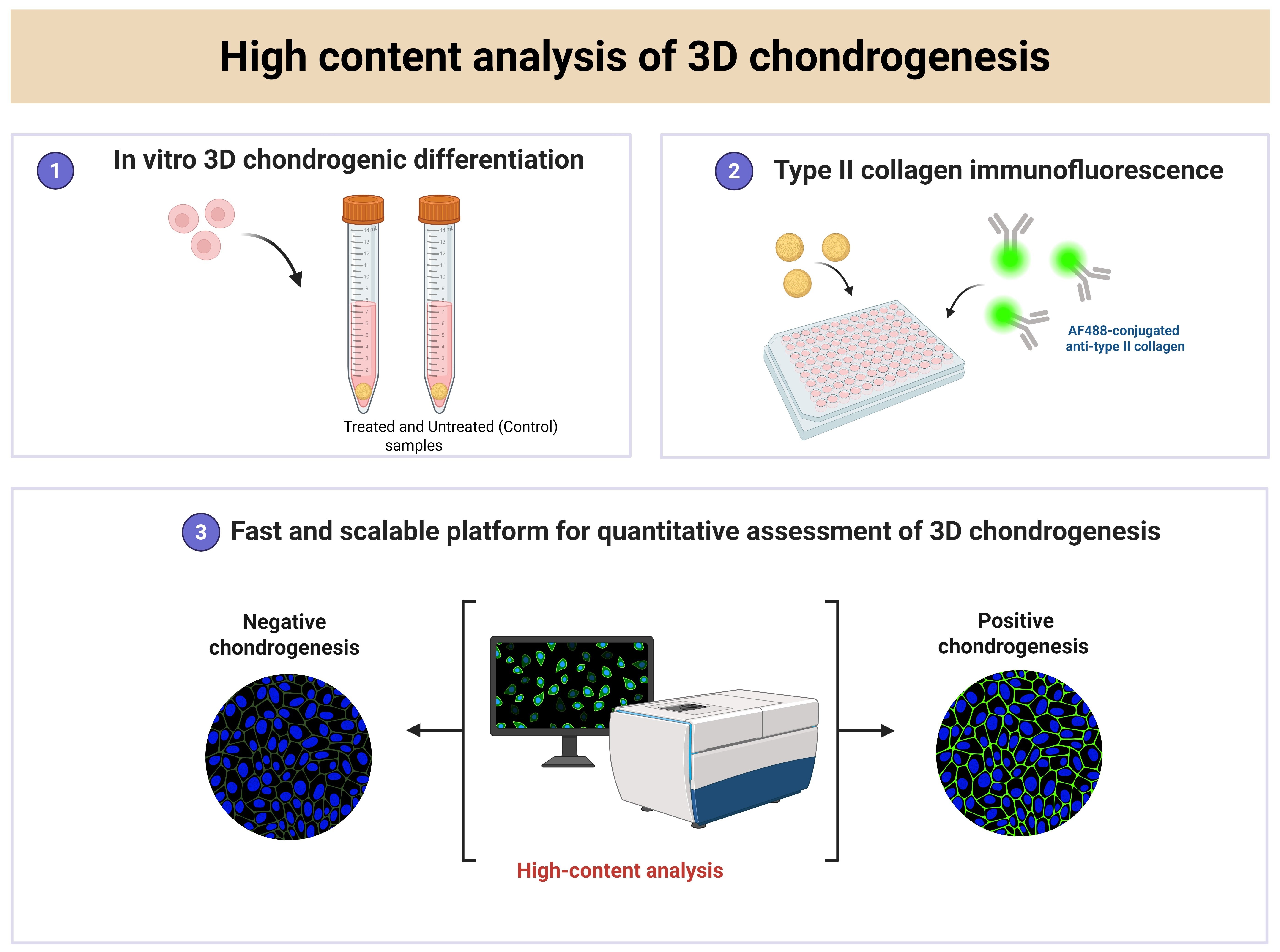
Background: Primary cells derived from connective tissues contain mesenchymal stem/stromal cell (MSC)–like progenitors with chondrogenic potential relevant for cartilage repair. However, donor- and tissue-specific variability and the lack of robust, high-content analytical methods limit their translational use. Objectives: This study aimed to develop and optimize a high-content imaging workflow for quantitative evaluation of chondrogenesis in three-dimensional (3D) pellets derived from primary cells. Methods: Primary human cells isolated from cartilage were chondrogenically differentiated in vitro. A systematic optimization of immunofluorescence staining parameters was performed, including staining platform, enzymatic matrix digestion, non-specific site blocking, membrane permeabilization, and nuclear counterstaining. Type II collagen was detected using an Alexa Fluor 488–conjugated antibody, and pellets were analyzed using high-content non-confocal imaging. Fluorescence intensities were adjusted to the pellet area to account for size-dependent effects. Results: Staining directly in imaging plates enabled streamlined high-content analysis. Controlled pepsin-mediated matrix digestion markedly enhanced antibody penetration, while excessive digestion compromised pellet integrity. Extended bovine serum albumin blocking improved type II collagen signal intensity and homogeneity. Triton X-100 permeabilization increased detection sensitivity but occasionally induced structural disruption in weakly organized control pellets. The optimized protocol enabled clear discrimination between chondrogenic pellets and controls, with approximately threefold higher type II collagen signal in chondrogenic samples. Conclusions: This study establishes a high-content imaging–based workflow for quantitative assessment of 3D chondrogenesis from primary cells. The approach provides a rapid, scalable platform with direct relevance for in vitro screening, potency testing, and quality control in cartilage-oriented advanced therapy development.
Keywords: primary MSCs; 3D chondrogenesis; pellets; high-content analysis; type II collagen; immunofluorescence primary MSCs; 3D chondrogenesis; pellets; high-content analysis; type II collagen; immunofluorescence
Graphical Abstract