Relative Contributions of Functional Capacity and Inflammatory Activity to Quality of Life in Heart Failure with Preserved Ejection Fraction

 , , ,
, , ,
Abstract
1. Introduction
2. Materials and Methods
2.1. Study Design and Population
- presence of signs (e.g., elevated jugular venous pressure, pulmonary crackles, and peripheral edema) and/or symptoms (e.g., breathlessness, ankle swelling, and fatigue) of heart failure;
- left ventricular ejection fraction ≥ 50%; and
- objective evidence of structural and/or functional cardiac abnormalities consistent with left ventricular diastolic dysfunction or elevated filling pressures, including elevated natriuretic peptide levels.
- Age ≥ 18 years;
- Confirmed diagnosis of HFpEF;
- Clinically stable disease, defined as at least four weeks without:
- (i)
- hospitalization for heart failure decompensation;
- (ii)
- urgent specialist evaluation requiring treatment escalation for heart failure;
- (iii)
- unscheduled outpatient visit due to worsening heart failure symptoms;
- (iv)
- self-initiated increase in diuretic dose.
- Refusal to participate;
- Modification of cardiovascular therapy within four weeks prior to assessment;
- Absence of guideline-directed medical therapy (GDMT) during the four weeks preceding evaluation, mostly implying sodium–glucose cotransporter-2 inhibitors and symptomatic diuretic therapy if needed;
- Acute or recent infection within four weeks;
- Acute coronary syndrome within three months;
- Cerebrovascular event within three months;
- Systemic connective tissue disease;
- Neurological or psychiatric disorders;
- Inflammatory bowel disease;
- Infiltrative cardiomyopathies (e.g., sarcoidosis, amyloidosis), primary hypertrophic cardiomyopathy, arrhythmogenic right ventricular cardiomyopathy, Takotsubo cardiomyopathy, or active myocarditis;
- Severe pulmonary dysfunction (forced vital capacity < 60% of predicted within the preceding year);
- Severe anemia (hemoglobin < 80 g/L);
- Terminal malignancy;
- End-stage renal disease (estimated creatinine clearance < 15 mL/min/1.73 m2);
- Severe aortic and/or mitral valve stenosis or regurgitation.
2.2. Variables
2.2.1. Clinical and Laboratory Assessment
- Sociodemographic characteristics and comorbidities were obtained through structured interviews and review of medical records.
- Laboratory analyses were performed according to institutional standards and included complete blood count, coagulation parameters, routine biochemical profile, inflammatory markers, and cardiac biomarkers. In the present analysis, selected biomarkers with established pathophysiological relevance to HFpEF and quality of life were analyzed and reported: CRP, IL-6, and NT-proBNP. Renal function was assessed using estimated glomerular filtration rate (eGFR).
- Clinical assessment included physical examination with quantification of pretibial edema using the pitting scale, assessment of symptom duration and frequency. Functional classification was performed according to the New York Heart Association (NYHA), as follows: (I) No limitation of physical activity. Ordinary physical activity does not cause undue breathlessness, fatigue, or palpitations. (II) Slight limitation of physical activity. Comfortable at rest, but ordinary physical activity results in undue breathlessness, fatigue, or palpitations. (III) Marked limitation of physical activity. Comfortable at rest, but less than ordinary activity results undue breathlessness, fatigue, or palpitations. (IV) Unable to carry on any physical activity without discomfort. Symptoms at rest can be present. If any physical activity is undertaken, discomfort is increased.
2.2.2. Assessment of Functional Capacity
2.2.3. Assessment of Health-Related Quality of Life
2.3. Statistical Analysis
2.4. Multivariable Modeling Strategy
3. Results
3.1. Baseline Characteristics
3.2. Functional Capacity and Quality of Life
3.3. Univariable Associations with Quality of Life
3.4. Quality of Life Predictors
4. Discussion
5. Conclusions
Supplementary Materials
Author Contributions
Funding
Institutional Review Board Statement
Informed Consent Statement
Data Availability Statement
Acknowledgments
Conflicts of Interest
Abbreviations
| 6MWT | Six-minute walk test |
| CCI | Charlson Comorbidity Index |
| CRP | C-reactive protein |
| GDMT | Guideline-directed medical therapy |
| eGFR | estimated Glomerular Filtration Rate |
| HFpEF | Heart Failure with preserved Ejection Fraction |
| HFrEF | Heart Failure with reduced Ejection Fraction |
| IL-6 | Interleukin-6 |
| IQR | Interquartile Range |
| NT-proBNP | N-terminal pro-B-type natriuretic peptide |
| NYHA | New York Heart Association |
| QoL | Quality of Life |
| VAS | Visual Analog Scale |
References
- Formiga, F.; Nuñez, J.; Castillo Moraga, M.J.; Cobo Marcos, M.; Egocheaga, M.I.; García-Prieto, C.F.; Trueba-Sáiz, A.; Matalí Gilarranz, A.; Fernández Rodriguez, J.M. Diagnosis of heart failure with preserved ejection fraction: A systematic narrative review of the evidence. Heart Fail. Rev. 2024, 29, 179–189. [Google Scholar] [CrossRef] [PubMed]
- Shah, S.J.; Borlaug, B.A.; Kitzman, D.W.; McCulloch, A.D.; Blaxall, B.C.; Agarwal, R.; Chirinos, J.A.; Collins, S.; Deo, R.C.; Gladwin, M.T.; et al. Research priorities for heart failure with preserved ejection fraction: National Heart, Lung, and Blood Institute Working Group summary. Circulation 2020, 141, 1001–1026. [Google Scholar]
- Campbell, P.; Rutten, F.H.; Lee, M.M.; Hawkins, N.M.; Petrie, M.C. Heart failure with preserved ejection fraction: Everything the clinician needs to know. Lancet 2024, 403, 1083–1092. [Google Scholar] [CrossRef]
- Kapelios, C.J.; Shahim, B.; Lund, L.H.; Savarese, G. Epidemiology, clinical characteristics and cause-specific outcomes in heart failure with preserved ejection fraction. Card. Fail. Rev. 2023, 9, e14. [Google Scholar] [CrossRef]
- Reddy, Y.N.V.; Rikhi, A.; Obokata, M.; Shah, S.J.; Lewis, G.D.; AbouEzzedine, O.F.; Dunlay, S.; McNulty, S.; Chakraborty, H.; Stevenson, L.W.; et al. Quality of life in heart failure with preserved ejection fraction: Importance of obesity, functional capacity, and physical inactivity. Eur. J. Heart Fail. 2020, 22, 1009–1018. [Google Scholar] [CrossRef]
- Ferreira, J.P.; Shah, A.M.; Claggett, B.L.; Pitt, B.; Lewis, E.F.; Solomon, S.D.; Zannad, F. Cardiac structure and function and quality of life associations in HFpEF: An analysis from TOPCAT-Americas. Int. J. Cardiol. 2022, 352, 78–83. [Google Scholar] [CrossRef]
- Kato, N.; Kinugawa, K.; Seki, S.; Shiga, T.; Hatano, M.; Yao, A.; Hirata, Y.; Kazuma, K.; Nagai, R. Quality of life as an independent predictor for cardiac events and death in patients with heart failure. Circ. J. 2011, 75, 1661–1669. [Google Scholar] [CrossRef] [PubMed]
- Kao, G.; Xu, G.; Zhang, Y.; Li, C.; Xiao, J. Predictive value of quality of life as measured by KCCQ in heart failure patients: A meta-analysis. Eur. J. Clin. Investig. 2024, 54, e14233. [Google Scholar] [CrossRef] [PubMed]
- Xu, J.; Sun, Y.; Gong, D.; Fan, Y. Association between disease-specific health-related quality of life and all-cause mortality in patients with heart failure: A meta-analysis. Curr. Probl. Cardiol. 2023, 48, 101592. [Google Scholar] [CrossRef]
- Sepehrvand, N.; Savu, A.; Spertus, J.A.; Dyck, J.R.B.; Anderson, T.; Howlett, J.; Paterson, I.; Oudit, G.Y.; Kaul, P.; McAlister, F.A.; et al. Change of health-related quality of life over time and its association with patient outcomes in patients with heart failure. J. Am. Heart Assoc. 2020, 9, e017278. [Google Scholar] [CrossRef]
- Raphael, C.; Briscoe, C.; Davies, J.; Whinnett, Z.I.; Manisty, C.; Sutton, R.; Mayet, J.; Francis, D.P. Limitations of the New York Heart Association functional classification system and self-reported walking distances in chronic heart failure. Heart 2007, 93, 476–482. [Google Scholar] [CrossRef]
- Pfeffer, M.A.; Shah, A.M.; Borlaug, B.A. Heart failure with preserved ejection fraction in perspective. Circ. Res. 2019, 124, 1598–1617. [Google Scholar] [CrossRef]
- Stoicescu, L.; Crişan, D.; Morgovan, C.; Avram, L.; Ghibu, S. Heart failure with preserved ejection fraction: The pathophysiological mechanisms behind the clinical phenotypes and the therapeutic approach. Int. J. Mol. Sci. 2024, 25, 794. [Google Scholar] [CrossRef] [PubMed]
- Fraser, A.G. What limits functional capacity in heart failure with preserved ejection fraction? Unravelling the knots of an enigma. JACC Heart Fail. 2018, 6, 127–129. [Google Scholar] [CrossRef]
- Scrutinio, D.; Guida, P.; Passantino, A. Functional limitation predicts mortality in heart failure with preserved ejection fraction. Eur. J. Intern. Med. 2024, 130, 79–85. [Google Scholar] [CrossRef] [PubMed]
- Borlaug, B.A. The pathophysiology of heart failure with preserved ejection fraction. Nat. Rev. Cardiol. 2014, 11, 507–515. [Google Scholar] [CrossRef]
- Cavero-Redondo, I.; Saz-Lara, A.; Bizzozero-Peroni, B.; Núñez-Martínez, L.; Díaz-Goñi, V.; Calero-Paniagua, I.; Matínez-García, I.; Pascual-Morena, C. Accuracy of the 6-minute walk test for assessing functional capacity in patients with heart failure with preserved ejection fraction and other chronic cardiac pathologies. Sports Med. Open 2024, 10, 74. [Google Scholar] [CrossRef]
- Pepera, G.; Antoniou, V.; Karagianni, E.; Batalik, L.; Su, J.J. Validity and reliability of the six-minute walking test compared to cardiopulmonary exercise test in individuals with heart failure: Systematic review and meta-analysis. J. Clin. Med. 2025, 14, 8303. [Google Scholar] [CrossRef] [PubMed]
- Mesquita, T.; Lin, Y.N.; Ibrahim, A. Chronic low-grade inflammation in heart failure with preserved ejection fraction. Aging Cell 2021, 20, e13453. [Google Scholar] [CrossRef]
- Paulus, W.J.; Tschöpe, C. A novel paradigm for heart failure with preserved ejection fraction: Comorbidities drive myocardial dysfunction and remodeling through coronary microvascular endothelial inflammation. J. Am. Coll. Cardiol. 2013, 62, 263–271. [Google Scholar]
- Sanders-van Wijk, S.; Tromp, J.; Beussink-Nelson, L.; Hage, C.; Svedlund, S.; Saraste, A.; Swat, S.A.; Sanchez, C.; Njoroge, J.; Tan, R.S.; et al. Proteomic evaluation of the comorbidity-inflammation paradigm in heart failure with preserved ejection fraction. Circulation 2020, 142, 2029–2044. [Google Scholar] [CrossRef]
- Van Linthout, S.; Tschöpe, C. Inflammation—Cause or consequence of heart failure or both? Curr. Heart Fail. Rep. 2017, 14, 251–265. [Google Scholar] [CrossRef]
- Cornuault, L.; Rouault, P.; Duplàa, C.; Couffinhal, T.; Renault, M.A. Endothelial dysfunction in heart failure with preserved ejection fraction: What are the experimental proofs? Front. Physiol. 2022, 13, 906272. [Google Scholar] [CrossRef]
- Murphy, S.P.; Kakkar, R.; McCarthy, C.P.; Januzzi, J.L., Jr. Inflammation in heart failure: JACC state-of-the-art review. J. Am. Coll. Cardiol. 2020, 75, 1324–1340. [Google Scholar] [CrossRef] [PubMed]
- Alogna, A.; Koepp, K.E.; Sabbah, M.; Espindola Netto, J.M.; Jensen, M.D.; Kirkland, J.L.; Lam, C.S.P.; Obokata, M.; Petrie, M.C.; Ridker, P.M.; et al. Interleukin-6 in patients with heart failure and preserved ejection fraction. JACC Heart Fail. 2023, 11, 1549–1561. [Google Scholar] [CrossRef]
- Berger, M.; März, W.; Niessner, A.; Delgado, G.; Kleber, M.; Scharnagl, H.; Marx, N.; Schuett, K. IL-6 and hsCRP predict cardiovascular mortality in patients with heart failure with preserved ejection fraction. ESC Heart Fail. 2024, 11, 3607–3615. [Google Scholar] [CrossRef]
- Markousis-Mavrogenis, G.; Tromp, J.; Ouwerkerk, W.; Devalaraja, M.; Anker, S.D.; Cleland, J.G.; Dickstein, K.; Filippatos, G.S.; van der Harst, P.; Lang, C.C.; et al. The clinical significance of interleukin-6 in heart failure: Results from the BIOSTAT-CHF study. Eur. J. Heart Fail. 2019, 21, 965–973. [Google Scholar] [CrossRef]
- Koller, L.; Kleber, M.; Goliasch, G.; Sulzgruber, P.; Scharnagl, H.; Silbernagel, G.; Grammer, T.; Delgado, G.; Tomaschitz, A.; Pilz, S.; et al. C-reactive protein predicts mortality in patients referred for coronary angiography and symptoms of heart failure with preserved ejection fraction. Eur. J. Heart Fail. 2014, 16, 758–766. [Google Scholar] [CrossRef]
- Mooney, L.; Jackson, C.E.; Adamson, C.; McConnachie, A.; Welsh, P.; Myles, R.C.; McMurray, J.J.V.; Jhund, P.S.; Petrie, M.C.; Lang, N.N. Adverse outcomes associated with interleukin-6 in patients recently hospitalized for heart failure with preserved ejection fraction. Circ. Heart Fail. 2023, 16, e010051. [Google Scholar] [CrossRef] [PubMed]
- Albar, Z.; Albakri, M.; Hajjari, J.; Karnib, M.; Janus, S.E.; Al-Kindi, S.G. Inflammatory markers and risk of heart failure with reduced to preserved ejection fraction. Am. J. Cardiol. 2022, 167, 68–75. [Google Scholar] [CrossRef] [PubMed]
- Chia, Y.C.; Kieneker, L.M.; van Hassel, G.; Binnenmars, S.H.; Nolte, I.M.; van Zanden, J.J.; van der Meer, P.; Navis, G.; Voors, A.A.; Bakker, S.J.L.; et al. Interleukin-6 and development of heart failure with preserved ejection fraction in the general population. J. Am. Heart Assoc. 2021, 10, e018549. [Google Scholar] [CrossRef]
- Pugliese, N.R.; Pellicori, P.; Filidei, F.; De Biase, N.; Maffia, P.; Guzik, T.J.; Masi, S.; Taddei, S.; Cleland, J.G.F. Inflammatory pathways in heart failure with preserved left ventricular ejection fraction: Implications for future interventions. Cardiovasc. Res. 2023, 118, 3536–3555. [Google Scholar] [CrossRef]
- McDonagh, T.A.; Metra, M.; Adamo, M.; Gardner, R.S.; Baumbach, A.; Böhm, M.; Burri, H.; Butler, J.; Čelutkienė, J.; Chioncel, O.; et al. 2023 focused update of the 2021 ESC guidelines for the diagnosis and treatment of acute and chronic heart failure. Eur. J. Heart Fail. 2024, 26, 5–17. [Google Scholar] [CrossRef]
- ATS Committee on Proficiency Standards for Clinical Pulmonary Function Laboratories. ATS statement: Guidelines for the six-minute walk test. Am. J. Respir. Crit. Care Med. 2002, 166, 111–117. [Google Scholar] [CrossRef] [PubMed]
- Johnson, M.J.; Close, L.; Gillon, S.C.; Molassiotis, A.; Lee, P.H.; Farquhar, M.C. Use of the modified Borg scale and numerical rating scale to measure chronic breathlessness: A pooled data analysis. Eur. Respir. J. 2016, 47, 1861–1864. [Google Scholar] [CrossRef]
- Devlin, N.J.; Shah, K.K.; Feng, Y.; Mulhern, B.; van Hout, B. Valuing health-related quality of life: An EQ-5D-5L value set for England. Health Econ. 2018, 27, 7–22. [Google Scholar] [CrossRef]
- Green, S.B. How Many Subjects Does It Take To Do A Regression Analysis. Multivar. Behav. Res. 1991, 26, 499–510. [Google Scholar] [CrossRef] [PubMed]
- Solomon, S.D.; McMurray, J.J.V.; Anand, I.S.; Ge, J.; Lam, C.S.P.; Maggioni, A.P.; Martinez, F.; Packer, M.; Pfeffer, M.A.; Pieske, B.; et al. Angiotensin-neprilysin inhibition in heart failure with preserved ejection fraction. N. Engl. J. Med. 2019, 381, 1609–1620. [Google Scholar] [CrossRef] [PubMed]
- Pitt, B.; Pfeffer, M.A.; Assmann, S.F.; Boineau, R.; Anand, I.S.; Claggett, B.; Clausell, N.; Desai, A.S.; Diaz, R.; Fleg, J.L.; et al. Spironolactone for heart failure with preserved ejection fraction. N. Engl. J. Med. 2014, 370, 1383–1392. [Google Scholar] [CrossRef]
- Shah, A.M.; Solomon, S.D. Phenotypic and pathophysiological heterogeneity in heart failure with preserved ejection fraction. Eur. Heart J. 2012, 33, 1716–1717. [Google Scholar] [CrossRef]
- Kapłon-Cieślicka, A.; Lund, L.H. Do we need a definition of acute heart failure with preserved ejection fraction? Ann. Med. 2021, 53, 1470–1475. [Google Scholar] [CrossRef] [PubMed]
- Kapłon-Cieślicka, A.; Laroche, C.; Crespo-Leiro, M.G.; Coats, A.J.S.; Anker, S.D.; Filippatos, G.; Maggioni, A.P.; Hage, C.; Lara-Padrón, A.; Fucili, A.; et al. Is heart failure misdiagnosed in hospitalized patients with preserved ejection fraction? ESC Heart Fail. 2020, 7, 2098–2112. [Google Scholar] [CrossRef]
- Palazzuoli, A.; Caravita, S.; Paolillo, S.; Ghio, S.; Tocchetti, C.G.; Ruocco, G.; Correale, M.; Ambrosio, G.; Perrone Filardi, P.; Senni, M. Current gaps in HFpEF trials: Time to reconsider patients’ selection and to target phenotypes. Prog. Cardiovasc. Dis. 2021, 67, 89–97. [Google Scholar] [CrossRef] [PubMed]
- Pieske, B.; Tschöpe, C.; de Boer, R.A.; Fraser, A.G.; Anker, S.D.; Donal, E.; Edelmann, F.; Fu, M.; Guazzi, M.; Lam, C.S.P.; et al. How to diagnose heart failure with preserved ejection fraction: The HFA–PEFF diagnostic algorithm: A consensus recommendation from the Heart Failure Association (HFA) of the European Society of Cardiology (ESC). Eur. Heart J. 2019, 40, 3297–3317. [Google Scholar] [CrossRef]
- Migas, S.; Ellis, M.L.; Wrona, B.; Rivero Sanz, E.; Brownrigg, J.; Strauss, O.; Ahmed, F.Z. Missed opportunities in heart failure diagnosis and management: Study of an urban UK population. ESC Heart Fail. 2024, 11, 2200–2213. [Google Scholar] [CrossRef]
- Seo, M.; Watanabe, T.; Yamada, T.; Yano, M.; Hayashi, T.; Nakagawa, A.; Nakagawa, Y.; Tamaki, S.; Yasumura, Y.; Sotomi, Y.; et al. The clinical relevance of quality of life in heart failure patients with preserved ejection fraction. ESC Heart Fail. 2023, 10, 995–1002. [Google Scholar] [CrossRef]
- Yang, M.; Kondo, T.; Talebi, A.; Jhund, P.S.; Docherty, K.F.; Claggett, B.L.; Vaduganathan, M.; Bachus, E.; Hernandez, A.F.; Lam, C.S.P.; et al. EuroQol 5-dimension questionnaire in heart failure with reduced, mildly reduced, and preserved ejection fraction: A patient-level analysis of DAPA-HF and DELIVER. JACC Heart Fail. 2025, 13, 277–292. [Google Scholar] [CrossRef]
- Thomas, M.; Jones, P.G.; Cohen, D.J.; Suzanne, A.V.; Magnuson, E.A.; Wang, K.; Thourani, V.H.; Fonarow, G.C.; Sandhu, A.T.; Spertus, J.A. Predicting the EQ-5D utilities from the Kansas City Cardiomyopathy Questionnaire in patients with heart failure. Eur. Heart J. Qual. Care Clin. Outcomes 2021, 7, 388–396. [Google Scholar] [CrossRef]
- Berg, J.; Lindgren, P.; Mejhert, M.; Edner, M.; Dahlström, U.; Kahan, T. Determinants of Utility Based on the EuroQol Five-Dimensional Questionnaire in Patients with Chronic Heart Failure and Their Change Over Time: Results from the Swedish Heart Failure Registry. Value Health 2015, 18, 439–448. [Google Scholar] [CrossRef] [PubMed]
- Pandey, A.; Khera, R.; Park, B.; Haykowsky, M.; Borlaug, B.A.; Lewis, G.D.; Kitzman, D.W.; Butler, J.; Berry, J.D. Relative impairments in hemodynamic exercise reserve parameters in heart failure with preserved ejection fraction: A study-level pooled analysis. JACC Heart Fail. 2018, 6, 117–126. [Google Scholar] [CrossRef]
- D’Amario, D.; Migliaro, S.; Borovac, J.A.; Restivo, A.; Vergallo, R.; Galli, M.; Leone, A.M.; Montone, R.A.; Niccoli, G.; Aspromonte, N.; et al. Microvascular dysfunction in heart failure with preserved ejection fraction. Front. Physiol. 2019, 10, 1347. [Google Scholar] [CrossRef]
- Kalogeropoulos, A.; Georgiopoulou, V.; Psaty, B.M.; Rodondi, N.; Smith, A.L.; Harrison, D.G.; Liu, Y.; Hoffmann, U.; Bauer, D.C.; Newman, A.B.; et al. Inflammatory markers and incident heart failure risk in older adults: The Health ABC study. J. Am. Coll. Cardiol. 2010, 55, 2129–2137. [Google Scholar] [CrossRef]
- Meijers, W.C.; Hoekstra, T.; Jaarsma, T.; van Veldhuisen, D.J.; de Boer, R.A. Patients with heart failure with preserved ejection fraction and low levels of natriuretic peptides. Neth. Heart J. 2016, 24, 287–295. [Google Scholar] [CrossRef]
- Kristensen, S.L.; Mogensen, U.M.; Jhund, P.S.; Rørth, R.; Anand, I.S.; Carson, P.E.; Desai, A.S.; Pitt, B.; Pfeffer, M.A.; Solomon, S.D.; et al. N-terminal pro-B-type natriuretic peptide levels for risk prediction in patients with heart failure and preserved ejection fraction according to atrial fibrillation status. Circ. Heart Fail. 2019, 12, e005766. [Google Scholar] [CrossRef]
- Li, J.; Lei, L.; Wang, W.; Li, Y.; Yu, Y.; Pu, B.; Peng, Y.; Huo, X.; Zhang, L. Patient-reported health status vs. N-terminal pro-B-type natriuretic peptide levels in patients with acute heart failure. Chin. Med. J. 2025, 138, 2955–2962. [Google Scholar] [CrossRef]
- Teramoto, K.; Nochioka, K.; Sakata, Y.; Nishimura, K.; Shimokawa, H.; Yasuda, S. Heart failure with preserved ejection fraction and lower natriuretic peptide: Clinical characteristics and change in natriuretic peptide levels. J. Am. Heart Assoc. 2025, 14, e041208. [Google Scholar] [CrossRef]
- Bayes-Genis, A.; Cediel, G.; Domingo, M.; Codina, P.; Santiago, E.; Lupón, J. Biomarkers in heart failure with preserved ejection fraction. Card. Fail. Rev. 2022, 8, e20. [Google Scholar] [CrossRef]
- Tanase, D.M.; Radu, S.; Al Shurbaji, S.; Baroi, G.L.; Florida Costea, C.; Turliuc, M.D.; Ouatu, A.; Floria, M. Natriuretic peptides in heart failure with preserved left ventricular ejection fraction: From molecular evidences to clinical implications. Int. J. Mol. Sci. 2019, 20, 2629. [Google Scholar] [CrossRef]


| VARIABLE | Percentage (Number of Case) or Median (IQR) | |
|---|---|---|
| SOCIO-DEMOGRAPHIC CHARACTERISTICS | ||
| Sex | Male | 47.3% (n = 52) |
| Female | 52.7% (n = 58) | |
| Age [years] | 72.0 (68.0–76.0) | |
| COMORBIDITIES | ||
| Arterial hypertension | 94.5% (n = 104) | |
| Hyperlipidemia | 72.7% (n = 80) | |
| Diabetes | 45.5% (n = 50) | |
| Atrial fibrillation | 41.8% (n = 46) | |
| Chronic kidney disease (eGFR < 60 mL/min/1.73 m2) | 37.3% (n = 41) | |
| Anemia | 26.4% (n = 29) | |
| Body mass index | <25 kg/m2 | 20.0% (n = 22) |
| 25.00–29.99 kg/m2 | 24.5% (n = 27) | |
| >30.00 kg/m2 | 55.5% (n = 61) | |
| Charlson comorbidity index | 4.0 (3.0–5.0) | |
| CLINICAL CHARACTERISTICS | ||
| Duration of symptoms to diagnosis [months] | 12.0 (8.0–20.0) | |
| Duration of symptoms to enrolment [months] | 15.0 (9.0–21.2) | |
| NYHA class | NYHA II | 73.6% (n = 81) |
| NYHA III | 26.4% (n = 29) | |
| Peripheral edema | 80.0% (n = 88) | |
| SELECTED LABORATORY MEASUREMENTS | ||
| CRP [mg/L] | 5.1 (1.7–6.8) | |
| IL-6 [pg/mL] | 5.4 (3.0–7.7) | |
| NT-proBNP [pg/mL] | 566.0 (272.0–1370.0) | |
| eGFR [mL/min/1.73 m2] | 65.5 (49.5–82.2) | |
| VARIABLE | Percentage (Number of Case) or Median (IQR) | |
|---|---|---|
| 6-MINUTE WALK TEST | ||
| Distance covered [meters] | 340.0 (280.0–392.2) | |
| Percentage of calculated distance covered [percentage] | 75.9 (62.7–83.8) | |
| Borg scale | 3.5 (3.0–5.0) | |
| Borg scale categories | 0–4 | 65.5% (n = 72) |
| 5–10 | 34.5% (n = 38) | |
| QUALITY OF LIFE MEASUREMENTS | ||
| EQ-5D utility index [index] | 0.76 (0.67–0.88) | |
| EQ-5D-5L VAS [percentage] | 60.0 (50.0–61.2) | |
| Mobility domain | “no problems” | 15.5% (n = 17) |
| “slight problems” | 43.6% (n = 48) | |
| “moderate problems” | 34.5% (n = 38) | |
| “severe problems” | 6.4% (n = 7) | |
| “inability to walk” | 0.0% (n = 0) | |
| VARIABLE | EQ-5D-5L Index Median (IQR) or Spearman’s Coefficient | p | |
|---|---|---|---|
| Sex | Male | 0.80 (0.74–0.88) | 0.002 |
| Female | 0.73 (0.56–0.82) | ||
| Age [years] | −0.245 | 0.001 | |
| Atrial fibrillation | Yes | 0.73 (0.54–0.81) | 0.008 |
| No | 0.78 (0.70–0.89) | ||
| BMI ≥ 30 kg/m2 | Yes | 0.75 (0.70–0.88) | 0.766 |
| No | 0.76 (0.67–0.87) | ||
| CCI | −0.308 | 0.001 | |
| NYHA | II | 0.81 (0.74–0.82) | <0.001 |
| III | 0.53 (0.46–0.70) | ||
| Peripheral edema | Yes | 0.74 (0.65–0.82) | 0.001 |
| No | 0.87 (0.76–0.93) | ||
| Percentage of calculated distance covered | 0.496 | <0.001 | |
| Borg scale | −0.596 | <0.001 | |
| eGFR [mL/min/1.73 m2] | 0.357 | <0.001 | |
| CRP [mg/L] | −0.369 | <0.001 | |
| IL-6 [pg/mL] | −0.441 | <0.001 | |
| NT-proBNP [pg/mL] | −0.426 | <0.001 | |
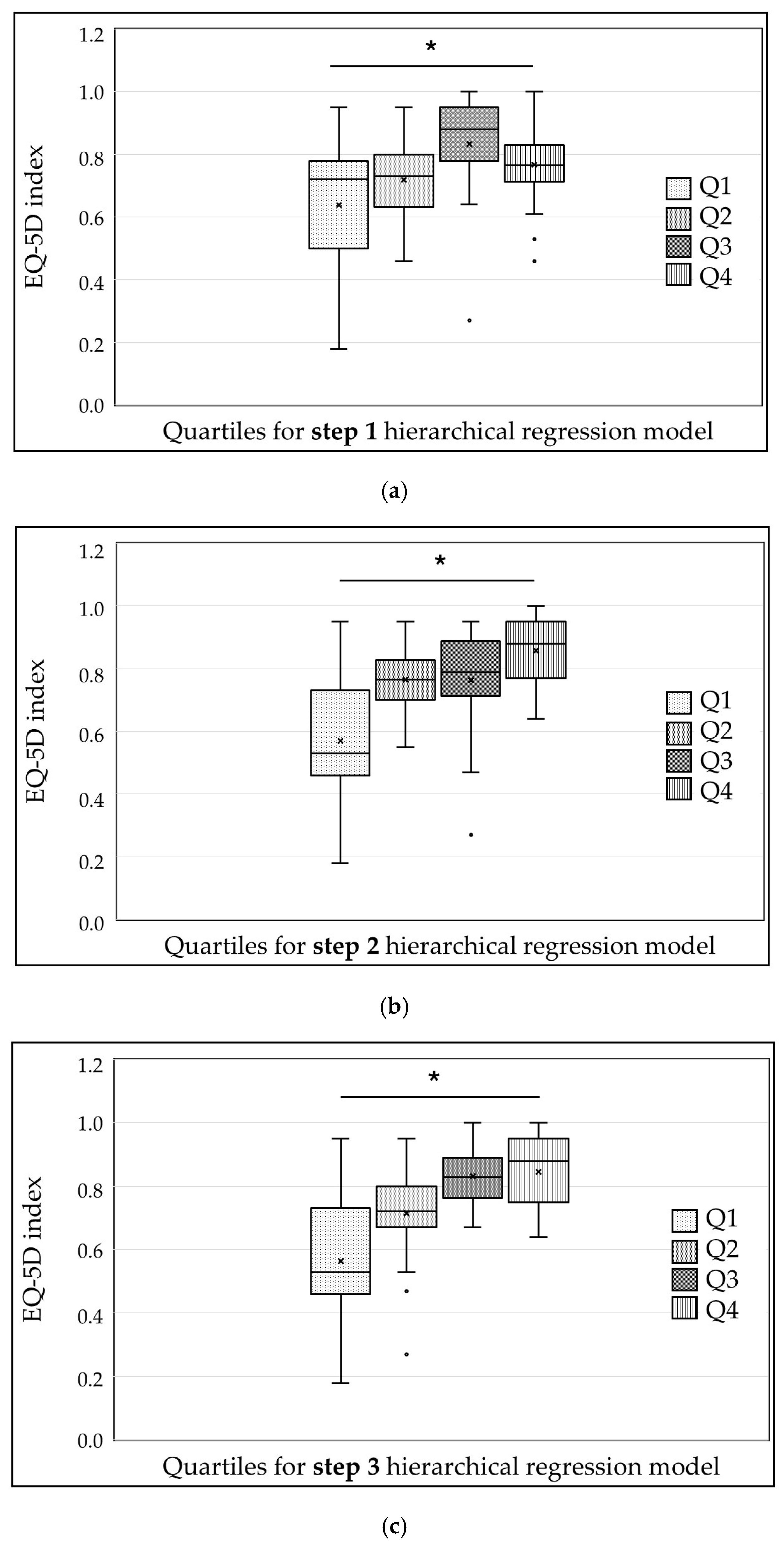
| Independent Variable | Model 1 | Model 2 | Model 3 | |
|---|---|---|---|---|
| B | B | β | B (95% CI) | |
| Step 1: demographics and comorbidities | ||||
| Age | −0.039 | −0.060 | −0.068 | −0.002 (−0.006–0.002) |
| Female sex | −0.253 ** | −0.282 *** | −0.283 *** | −0.097 (−0.146–−0.047) |
| Atrial fibrillation | 0.237 ** | 0.114 | 0.103 | 0.036 (−0.020–0.091) |
| eGFR | 0.271 ** | 0.263 ** | 0.243 ** | 0.002 (0.001–0.003) |
| R2 | 0.235 | / | ||
| Step 2: addition of functional capacity (6MWT) | ||||
| % of predicted 6MWT distance | / | 0.483 *** | 0.376 *** | +0.004 (0.002–0.006) |
| R2 | / | 0.452 | ||
| ΔR2 | / | +0.217 | ||
| Step 3: addition of cardiac and inflammatory biomarkers | ||||
| NT-proBNP ^ | / | / | −0.046 | −0.006 (−0.032–+0.020) |
| IL-6 ^ | / | / | −0.185 * | −0.046 (−0.087–−0.006) |
| R2 | / | / | 0.468 | |
| ΔR2 | / | / | +0.042 | |
Disclaimer/Publisher’s Note: The statements, opinions and data contained in all publications are solely those of the individual author(s) and contributor(s) and not of MDPI and/or the editor(s). MDPI and/or the editor(s) disclaim responsibility for any injury to people or property resulting from any ideas, methods, instructions or products referred to in the content. |
© 2026 by the authors. Licensee MDPI, Basel, Switzerland. This article is an open access article distributed under the terms and conditions of the Creative Commons Attribution (CC BY) license.
Share and Cite
Zdravković, V.; Stevanović, Đ.; Davidović, G.; Simić, I.; Stanojević-Pirković, M.; Ivošević, Ž.; Uraković, N.; Stojanović, L.; Stanković, I.; Ćićarić, N.; et al. Relative Contributions of Functional Capacity and Inflammatory Activity to Quality of Life in Heart Failure with Preserved Ejection Fraction. Biomedicines 2026, 14, 1270. https://doi.org/10.3390/biomedicines14061270
Zdravković V, Stevanović Đ, Davidović G, Simić I, Stanojević-Pirković M, Ivošević Ž, Uraković N, Stojanović L, Stanković I, Ćićarić N, et al. Relative Contributions of Functional Capacity and Inflammatory Activity to Quality of Life in Heart Failure with Preserved Ejection Fraction. Biomedicines. 2026; 14(6):1270. https://doi.org/10.3390/biomedicines14061270
Chicago/Turabian StyleZdravković, Vladimir, Đorđe Stevanović, Goran Davidović, Ivan Simić, Marijana Stanojević-Pirković, Željko Ivošević, Nina Uraković, Lidija Stojanović, Isidora Stanković, Neda Ćićarić, and et al. 2026. "Relative Contributions of Functional Capacity and Inflammatory Activity to Quality of Life in Heart Failure with Preserved Ejection Fraction" Biomedicines 14, no. 6: 1270. https://doi.org/10.3390/biomedicines14061270
APA StyleZdravković, V., Stevanović, Đ., Davidović, G., Simić, I., Stanojević-Pirković, M., Ivošević, Ž., Uraković, N., Stojanović, L., Stanković, I., Ćićarić, N., Milojević, S., Maksić, M., Radojević, K., & Popović, M. (2026). Relative Contributions of Functional Capacity and Inflammatory Activity to Quality of Life in Heart Failure with Preserved Ejection Fraction. Biomedicines, 14(6), 1270. https://doi.org/10.3390/biomedicines14061270