Clinical and Radiological Characteristics of Symptomatic Emphysema Patients with PRISm and Pre-COPD Phenotypes: Possible Effects of Smoking Status
 , , ,
, , ,  , , ,
, , ,
Abstract
1. Introduction
2. Materials and Methods
2.1. Definition of Pre-COPD and PRISm Phenotypes
2.2. Exclusion of Other Causes of Dyspnea
2.3. Radiological Image Evaluation
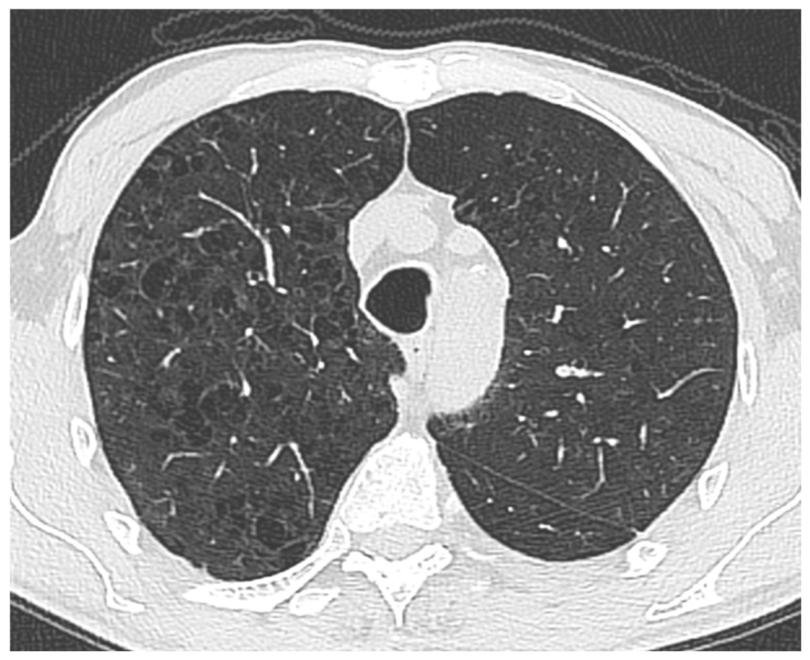
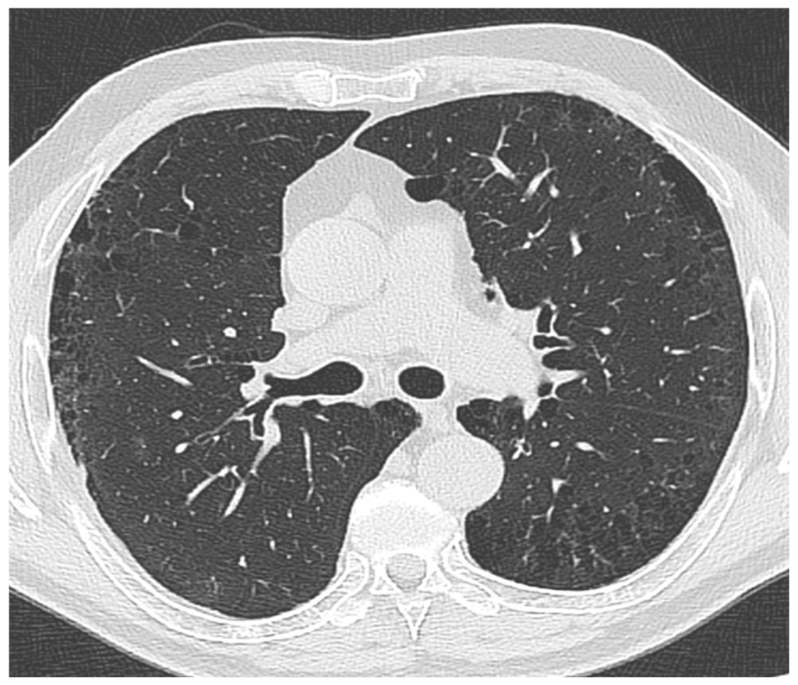
2.4. Classification of Emphysema Types
2.4.1. Centrilobular Emphysema
2.4.2. Panacinar (Panlobuler) Emphysema
2.4.3. Paraseptal Emphysema
2.5. Assessment of Body Mass Index
2.6. Assessment of Dyspnea Severity
2.7. Assessment of Spirometry Quality
2.8. Inclusion Criteria
- Patients aged between 20 and 50 years;
- Patients in whom the diagnosis of emphysema was established by a radiologist using HRCT;
- Patients presenting to the chest diseases outpatient clinic with complaints of dyspnea, cough, and/or sputum production;
- Patients classified as having pre-COPD or PRISm phenotype on pulmonary function testing;
- Patients with acceptable and reproducible pulmonary function tests;
- Patients without airflow obstruction on pulmonary function testing.
2.9. Exclusion Criteria
- Asymptomatic patients who did not report respiratory symptoms (dyspnea, cough, and/or sputum) at presentation;
- Individuals who underwent HRCT solely for other indications (e.g., screening, nodule follow-up, or malignancy surveillance);
- Patients for whom PFT data were unavailable;
- Patients with unacceptable PFT quality;
- Patients with airflow obstruction on pulmonary function testing;
- Patients with a history of asthma;
- Patients with radiological findings suggestive of interstitial lung disease;
- Patients with a diagnosis of lung malignancy or with radiologically suspicious pulmonary masses;
- Patients with any parenchymal lung disease;
- Patients younger than 20 years;
- Patients older than 50 years.
2.10. Ethical Approval
2.11. Statistical Analysis
3. Results
4. Discussion
5. Conclusions
Author Contributions
Funding
Institutional Review Board Statement
Informed Consent Statement
Data Availability Statement
Conflicts of Interest
References
- Al Wachami, N.; Guennouni, M.; Iderdar, Y.; Boumendil, K.; Arraji, M.; Mourajid, Y.; Bouchachi, F.Z.; Barkaoui, M.; Louerdi, M.L.; Hilali, A.; et al. Estimating the global prevalence of chronic obstructive pulmonary disease (COPD): A systematic review and meta-analysis. BMC Public Health 2024, 24, 297. [Google Scholar] [CrossRef] [PubMed]
- Petrache, I. Unraveling the Distal Lung Destruction in Emphysema. Am. J. Respir. Crit. Care Med. 2023, 208, 357–358. [Google Scholar] [CrossRef] [PubMed]
- Dunican, E.M.; Elicker, B.M.; Henry, T.; Gierada, D.S.; Schiebler, M.L.; Anderson, W.; Barjaktarevic, I.; Barr, R.G.; Bleecker, E.R.; Boucher, R.C.; et al. Mucus Plugs and Emphysema in the Pathophysiology of Airflow Obstruction and Hypoxemia in Smokers. Am. J. Respir. Crit. Care Med. 2021, 203, 957–968. [Google Scholar] [CrossRef] [PubMed]
- Venkatesan, P. GOLD report: 2022 update. Lancet Respir. Med. 2022, 10, e20. [Google Scholar] [CrossRef]
- Han, M.K.; Agusti, A.; Celli, B.R.; Criner, G.J.; Halpin, D.M.G.; Roche, N.; Papi, A.; Stockley, R.A.; Wedzicha, J.; Vogelmeier, C.F. From GOLD 0 to Pre-COPD. Am. J. Respir. Crit. Care Med. 2021, 203, 414–423. [Google Scholar] [CrossRef] [PubMed]
- Adibi, A.; Sadatsafavi, M. Looking at the COPD spectrum through “PRISm”. Eur. Respir. J. 2020, 55, 1902217. [Google Scholar] [CrossRef]
- Jin, Q.; Zhang, Z.; Zhou, T.; Zhou, X.; Jiang, X.; Xia, Y.; Guan, Y.; Liu, S.; Fan, L. Preserved ratio impaired spirometry: Clinical, imaging and artificial intelligence perspective. J. Thorac. Dis. 2025, 17, 450–460. [Google Scholar] [CrossRef]
- Melén, E.; Faner, R.; Allinson, J.P.; Bui, D.; Bush, A.; Custovic, A.; Garcia-Aymerich, J.; Guerra, S.; Breyer-Kohansal, R.; Hallberg, J.; et al. Lung-function trajectories: Relevance and implementation in clinical practice. Lancet 2024, 403, 1494–1503. [Google Scholar] [CrossRef]
- Stanojevic, S.; Kaminsky, D.A.; Miller, M.R.; Thompson, B.; Aliverti, A.; Barjaktarevic, I.; Cooper, B.G.; Culver, B.; Derom, E.; Hall, G.L.; et al. ERS/ATS technical standard on interpretive strategies for routine lung function tests. Eur. Respir. J. 2022, 60, 2101499. [Google Scholar] [CrossRef]
- Lynch, D.A.; Austin, J.H.; Hogg, J.C.; Grenier, P.A.; Kauczor, H.U.; Bankier, A.A.; Barr, R.G.; Colby, T.V.; Galvin, J.R.; Gevenois, P.A.; et al. CT-Definable Subtypes of Chronic Obstructive Pulmonary Disease: A Statement of the Fleischner Society. Radiology 2015, 277, 192–205. [Google Scholar] [CrossRef]
- Sunjaya, A.; Poulos, L.; Reddel, H.; Jenkins, C. Qualitative validation of the modified Medical Research Council (mMRC) dyspnoea scale as a patient-reported measure of breathlessness severity. Respir. Med. 2022, 203, 106984. [Google Scholar] [CrossRef]
- Cobb, K.; Kenyon, J.; Lu, J.; Krieger, B.; Perelas, A.; Nana-Sinkam, P.; Kim, Y.; Rodriguez-Miguelez, P. COPD is associated with increased cardiovascular disease risk independent of phenotype. Respirology 2024, 29, 1047–1057. [Google Scholar] [CrossRef]
- Ter Haar, E.A.M.D.; Slebos, D.J.; Klooster, K.; Pouwels, S.D.; Hartman, J.E. Comorbidities reduce survival and quality of life in COPD with severe lung hyperinflation. ERJ Open Res. 2024, 10, 00268-2024. [Google Scholar] [CrossRef] [PubMed]
- Robertson, N.M.; Centner, C.S.; Tejwani, V.; Hossen, S.; Karmali, D.; Liu, S.; Siddharthan, T. Preserved Ratio Impaired Spirometry Prevalence, Risk Factors, and Outcomes: A Systematic Review and Meta-Analysis. Chest 2025, 167, 1591–1614. [Google Scholar] [CrossRef]
- Lei, J.; Huang, K.; Wu, S.; Xu, J.; Xu, Y.; Zhao, J.; Zhang, X.; Bai, C.; Song, Y.; Kang, J.; et al. Heterogeneities and impact profiles of early chronic obstructive pulmonary disease status: Findings from the China Pulmonary Health Study. Lancet Reg. Health West. Pac. 2024, 45, 101021. [Google Scholar] [CrossRef]
- Wan, E.S.; Balte, P.; Schwartz, J.E.; Bhatt, S.P.; Cassano, P.A.; Couper, D.; Daviglus, M.L.; Dransfield, M.T.; Gharib, S.A.; Jacobs, D.R., Jr.; et al. Association Between Preserved Ratio Impaired Spirometry and Clinical Outcomes in US Adults. JAMA 2021, 326, 2287–2298. [Google Scholar] [CrossRef]
- Higbee, D.H.; Granell, R.; Davey Smith, G.; Dodd, J.W. Prevalence, risk factors, and clinical implications of preserved ratio impaired spirometry: A UK Biobank cohort analysis. Lancet Respir. Med. 2022, 10, 149–157. [Google Scholar] [CrossRef] [PubMed]
- Wijnant, S.R.A.; De Roos, E.; Kavousi, M.; Stricker, B.H.; Terzikhan, N.; Lahousse, L.; Brusselle, G.G. Trajectory and mortality of preserved ratio impaired spirometry: The Rotterdam Study. Eur. Respir. J. 2020, 55, 1901217. [Google Scholar] [CrossRef]
- Agustí, A.; Hughes, R.; Rapsomaki, E.; Make, B.; Del Olmo, R.; Papi, A.; Price, D.; Benton, L.; Franzen, S.; Vestbo, J.; et al. The many faces of COPD in real life: A longitudinal analysis of the NOVELTY cohort. ERJ Open Res. 2024, 10, 00895-2023. [Google Scholar] [CrossRef] [PubMed]
- Evans, A.; Tarabichi, Y.; Pace, W.D.; Make, B.; Bushell, N.; Carter, V.; Chang, K.L.; Fox, C.; Han, M.K.; Kaplan, A.; et al. Preserved Ratio Impaired Spirometry in US Primary Care Patients Diagnosed with Chronic Obstructive Pulmonary Disease. Pragmat. Obs. Res. 2024, 15, 221–232. [Google Scholar] [CrossRef]
- Yumrukuz Senel, M.; Akcali, S.D.; Dilli, A.; Kurt, B. Correlation of the Radiological Emphysema Score of Chronic Obstructive Pulmonary Disease Patients with Clinic Parameters. J. Coll. Physicians Surg. Pak. 2021, 31, 506–510. [Google Scholar] [CrossRef] [PubMed]
- Kahnert, K.; Jobst, B.; Biertz, F.; Biederer, J.; Watz, H.; Huber, R.M.; Behr, J.; Grenier, P.A.; Alter, P.; Vogelmeier, C.F.; et al. Relationship of spirometric, body plethysmographic, and diffusing capacity parameters to emphysema scores derived from CT scans. Chron. Respir. Dis. 2019, 16, 1479972318775423. [Google Scholar] [CrossRef] [PubMed]
- Diaz, A.A. Paraseptal Emphysema: From the Periphery of the Lobule to the Center of the Stage. Am. J. Respir. Crit. Care Med. 2020, 202, 783–784. [Google Scholar] [CrossRef] [PubMed]



| Variable | All Patients |
|---|---|
| n | 232 |
| Age, years | 43 (38–48) |
| Male sex | 195 (84.1%) |
| Smoking history | |
| Never smoker | 70 (30.2%) |
| Former smoker | 30 (12.9%) |
| ≤10 pack-years | 88 (37.9%) |
| 10–20 pack-years | 21 (9.1%) |
| ≥20 pack-years | 23 (9.9%) |
| Patients with pre-COPD | 159 (68.5%) |
| Patients with PRISm | 73 (31.5%) |
| Comorbidity | 62 (26.7%) |
| Cardiovascular disease | 13 (5.6%) |
| Hypertension | 11 (4.7%) |
| Diabetes mellitus | 10 (4.3%) |
| Obstructive sleep apnea syndrome (OSAS) | 4 (1.7%) |
| History of pneumothorax | 28 (12.1%) |
| Variable | All Patients |
|---|---|
| n | 232 |
| Type of emphysema | |
| Centrilobular emphysema | 94 (40.5%) |
| Paraseptal emphysema | 103 (44.4%) |
| Panacinar emphysema | 7 (3.0%) |
| Centrilobular and paraseptal | 26 (11.2%) |
| Bullous lung disease | 2 (0.9%) |
| Extent of emphysema (%) | |
| Total lung emphysema area | 18 (13–22) |
| Right lung emphysema area | 17 (14–23) |
| Left lung emphysema area | 18 (13–23) |
| PFT parameters | |
| FEV1 (L) | 3.19 (2.98–3.83) |
| FEV1 (% predicted) | 86 (77–96) |
| FVC (L) | 3.93 (3.59–4.43) |
| FVC (% predicted) | 84 (78–95) |
| FEV1/FVC | 82 (77–87) |
| MEF 25–75 (% predicted) | 81 (68–100) |
| Variable | Emphysema ≤ 18% | Emphysema > 18% | p Value |
|---|---|---|---|
| n | 131 (56.5%) | 101 (43.5%) | |
| Age, years | 44 (38–49) | 43 (37–48) | 0.423 |
| Smoking history | 0.230 | ||
| Never smoker | 31 (23.7%) | 39 (38.6%) | |
| Former smoker | 16 (12.2%) | 14 (13.9%) | |
| ≤10 pack-years | 55 (42.0%) | 33 (32.7%) | |
| 10–20 pack-years | 12 (9.2%) | 9 (8.9%) | |
| ≥20 pack-years | 17 (13.0%) | 6 (5.9%) | |
| Male sex | 107 (81.7%) | 88 (87.1%) | 0.262 |
| Body mass index (kg/m2) | 0.001 | ||
| Underweight (<18.5) | 28 (21.4%) | 38 (37.6%) | |
| Normal weight (18.5–24.9) | 86 (65.6%) | 59 (58.4%) | |
| Overweight (25.0–29.9) | 14 (10.7%) | 2 (2.0%) | |
| Obese (≥30.0) | 3 (2.3%) | 2 (2.0%) | |
| mMRC score | 0.007 | ||
| 0 | 57 (43.5%) | 32 (31.7%) | |
| 1 | 67 (51.1%) | 50 (49.5%) | |
| 2 | 7 (5.3%) | 19 (18.8%) | |
| Presence of comorbidity | 40 (30.5%) | 22 (21.8%) | 0.136 |
| FEV1 (L) | 3.39 (2.97–4.01) | 3.13 (3.02–3.67) | 0.023 |
| FEV1 (% predicted) | 86 (77–97) | 84 (77–96) | 0.950 |
| FVC (L) | 3.93 (3.50–4.44) | 3.93 (3.59–4.43) | 0.818 |
| FVC (% predicted) | 85 (77–95) | 84 (78–94) | 0.703 |
| FEV1/FVC | 82 (77–88) | 82 (78–87) | 0.623 |
| Variable | PRISm Patients | Pre-COPD Patients | p Value |
|---|---|---|---|
| n | 73 (31.5%) | 159 (68.5%) | |
| Age, years | 44 (38–48) | 43 (37–48) | 0.542 |
| Smoking history | 0.349 | ||
| Never smoker | 27 (37.0%) | 43 (27.0%) | |
| Former smoker | 9 (12.3%) | 21 (13.2%) | |
| ≤10 pack-years | 23 (31.5%) | 65 (40.9%) | |
| 10–20 pack-years | 3 (4.1%) | 18 (11.3%) | |
| ≥20 pack-years | 11 (15.1%) | 12 (7.5%) | |
| Male sex | 59 (80.8%) | 136 (85.5%) | 0.364 |
| Body mass index | 0.869 | ||
| Underweight | 22 (30.1%) | 44 (27.7%) | |
| Normal weight | 42 (57.5%) | 103 (64.8%) | |
| Overweight | 7 (9.6%) | 9 (5.7%) | |
| Obese | 2 (2.7%) | 3 (1.9%) | |
| mMRC score | <0.001 | ||
| 0 | 10 (13.7%) | 79 (49.7%) | |
| 1 | 46 (63.0%) | 71 (44.7%) | |
| 2 | 17 (23.3%) | 9 (5.7%) | |
| Presence of comorbidity | 20 (27.4%) | 42 (26.4%) | 0.876 |
| Extent of emphysema | 0.429 | ||
| ≤18% | 44 (60.3%) | 87 (54.7%) | |
| >18% | 29 (39.7%) | 72 (45.3%) |
| Variable | Ever-Smokers | Never-Smokers | p Value |
|---|---|---|---|
| n | 162 (69.8%) | 70 (30.2%) | |
| Age, years | 44 (39–48) | 43 (36–48) | 0.306 |
| Male sex | 140 (86.4%) | 55 (78.6%) | 0.135 |
| Body mass index | 0.734 * | ||
| Underweight | 46 (28.4%) | 20 (28.6%) | |
| Normal weight | 100 (61.7%) | 45 (64.3%) | |
| Overweight | 13 (8.0%) | 3 (4.3%) | |
| Obese | 3 (1.9%) | 2 (2.9%) | |
| mMRC score | 0.026 | ||
| 0 | 55(34%) | 34 (48.6%) | |
| 1 | 86 (53.1%) | 31 (44.3%) | |
| 2 | 21 (13%) | 5 (7.1%) | |
| Presence of comorbidity | 44 (27.7%) | 18 (25.7%) | 0.820 |
| Type of emphysema | 0.051 * | ||
| Centrilobular emphysema | 64 (39.5%) | 30 (42.8%) | |
| Paraseptal emphysema | 77 (47.5%) | 26 (37.1%) | |
| Panacinar emphysema | 4 (2.5%) | 3 (4.3%) | |
| Centrilobular and paraseptal | 22 (13.6%) | 4 (5.7%) | |
| Bullous lung disease | 2 (1.2%) | 0 | |
| Extent of emphysema | 0.014 | ||
| ≤18% | 100 (61.7%) | 31 (44.3%) | |
| >18% | 62 (38.3%) | 39 (55.7%) | |
| PFT Parameters | |||
| FEV1 (L) | 3.14 (2.95–3.70) | 3.51 (3.04–4.13) | 0.002 |
| FEV1 (% predicted) | 86 (79–97) | 85 (77–96) | 0.414 |
| FVC (L) | 3.93 (3.59–4.45) | 3.93 (3.63–4.34) | 0.761 |
| FVC (% predicted) | 85 (78–96) | 83 (77–94) | 0.352 |
| FEV1/FVC | 83 (77–87) | 81 (77–85) | 0.389 |
| History of pneumothorax | 21 (13%) | 7 (10%) | 0.066 |
Disclaimer/Publisher’s Note: The statements, opinions and data contained in all publications are solely those of the individual author(s) and contributor(s) and not of MDPI and/or the editor(s). MDPI and/or the editor(s) disclaim responsibility for any injury to people or property resulting from any ideas, methods, instructions or products referred to in the content. |
© 2026 by the authors. Licensee MDPI, Basel, Switzerland. This article is an open access article distributed under the terms and conditions of the Creative Commons Attribution (CC BY) license.
Share and Cite
Ari, M.; Ari, E.; Çinar, E.; Ertürk, H.; Çelik, D.; Yildiz, M.; Özdemir, T.; Kayadelen, M.; Tüten Özdemir, D.; Dolmuş, T.; et al. Clinical and Radiological Characteristics of Symptomatic Emphysema Patients with PRISm and Pre-COPD Phenotypes: Possible Effects of Smoking Status. Biomedicines 2026, 14, 1245. https://doi.org/10.3390/biomedicines14061245
Ari M, Ari E, Çinar E, Ertürk H, Çelik D, Yildiz M, Özdemir T, Kayadelen M, Tüten Özdemir D, Dolmuş T, et al. Clinical and Radiological Characteristics of Symptomatic Emphysema Patients with PRISm and Pre-COPD Phenotypes: Possible Effects of Smoking Status. Biomedicines. 2026; 14(6):1245. https://doi.org/10.3390/biomedicines14061245
Chicago/Turabian StyleAri, Maşide, Emrah Ari, Eray Çinar, Hakan Ertürk, Deniz Çelik, Murat Yildiz, Tarkan Özdemir, Mehmet Kayadelen, Derya Tüten Özdemir, Tunahan Dolmuş, and et al. 2026. "Clinical and Radiological Characteristics of Symptomatic Emphysema Patients with PRISm and Pre-COPD Phenotypes: Possible Effects of Smoking Status" Biomedicines 14, no. 6: 1245. https://doi.org/10.3390/biomedicines14061245
APA StyleAri, M., Ari, E., Çinar, E., Ertürk, H., Çelik, D., Yildiz, M., Özdemir, T., Kayadelen, M., Tüten Özdemir, D., Dolmuş, T., İbiş, H., Dolmuş, E., & Tüten, Ö. F. (2026). Clinical and Radiological Characteristics of Symptomatic Emphysema Patients with PRISm and Pre-COPD Phenotypes: Possible Effects of Smoking Status. Biomedicines, 14(6), 1245. https://doi.org/10.3390/biomedicines14061245