This is an early access version, the complete PDF, HTML, and XML versions will be available soon.
Review

The Role of and Therapeutic Strategies for Eosinophils in Atopic Dermatitis

1
Shanghai Skin Disease Hospital, Institute of Dermatology, School of Medicine, Tongji University, Shanghai 200443, China
2
Department of Dermatology, Yueyang Hospital of Integrated Traditional Chinese and Western Medicine, Institute of Dermatology, Shanghai University of Traditional Chinese Medicine, Shanghai 200437, China
*
Authors to whom correspondence should be addressed.
These authors contributed equally to this work.
Biomedicines 2026, 14(6), 1212; https://doi.org/10.3390/biomedicines14061212

Submission received: 26 February 2026 / Revised: 7 May 2026 / Accepted: 16 May 2026 / Published: 27 May 2026

Abstract

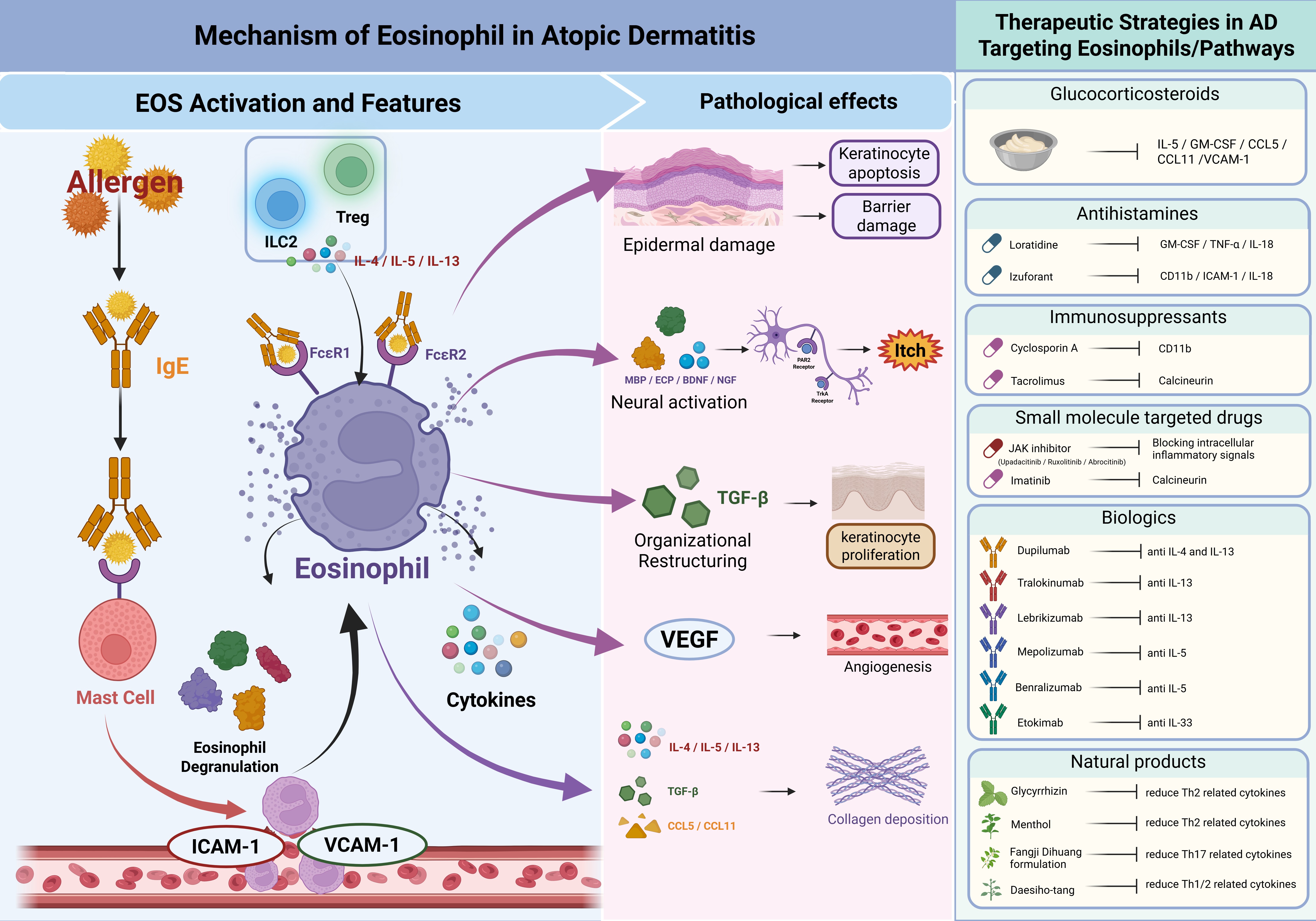
Atopic dermatitis (AD) is a chronic inflammatory skin disease driven by immune dysregulation and epidermal barrier dysfunction, in which eosinophils act as key effector cells contributing to tissue damage and persistent inflammation. This comprehensive review elucidates the multifaceted contributions of eosinophils to the progression of AD. Driven by key type 2 cytokines (notably IL-4, IL-5, and IL-13) and specific chemokines, eosinophils infiltrate lesional skin and undergo IgE-mediated degranulation. The subsequent release of cytotoxic granule proteins, including major basic protein (MBP), eosinophil cationic protein (ECP), eosinophil-derived neurotoxin (EDN), and eosinophil peroxidase (EPX), directly induces keratinocyte apoptosis, exacerbates tissue remodeling, and sustains the local inflammatory cascade. Furthermore, we explore the intricate crosstalk between eosinophils and sensory neurons, which, alongside cytokines like IL-31, profoundly aggravates chronic pruritus. Consequently, modulating eosinophil activation and recruitment has emerged as a vital therapeutic approach. We systematically evaluate current and emerging pharmacological interventions, ranging from conventional topical corticosteroids to advanced targeted therapies. Particular emphasis is placed on the mechanistic impact of novel biologics and small-molecule Janus kinase (JAK) inhibitors, demonstrating how they attenuate eosinophilic inflammation. By identifying current gaps in this field, this review provides valuable insights for future research and clinical practice in the field of AD.
Keywords: atopic dermatitis; eosinophils; inflammation; interleukin; chemoattractant cytokine ligand atopic dermatitis; eosinophils; inflammation; interleukin; chemoattractant cytokine ligand
Graphical Abstract