Genetic Determinants of Telomere Length and Their Role in Human Disease: Molecular Mechanisms and Underrepresented Populations’ Perspectives
 , , , ,
  and
and
Abstract
1. Introduction
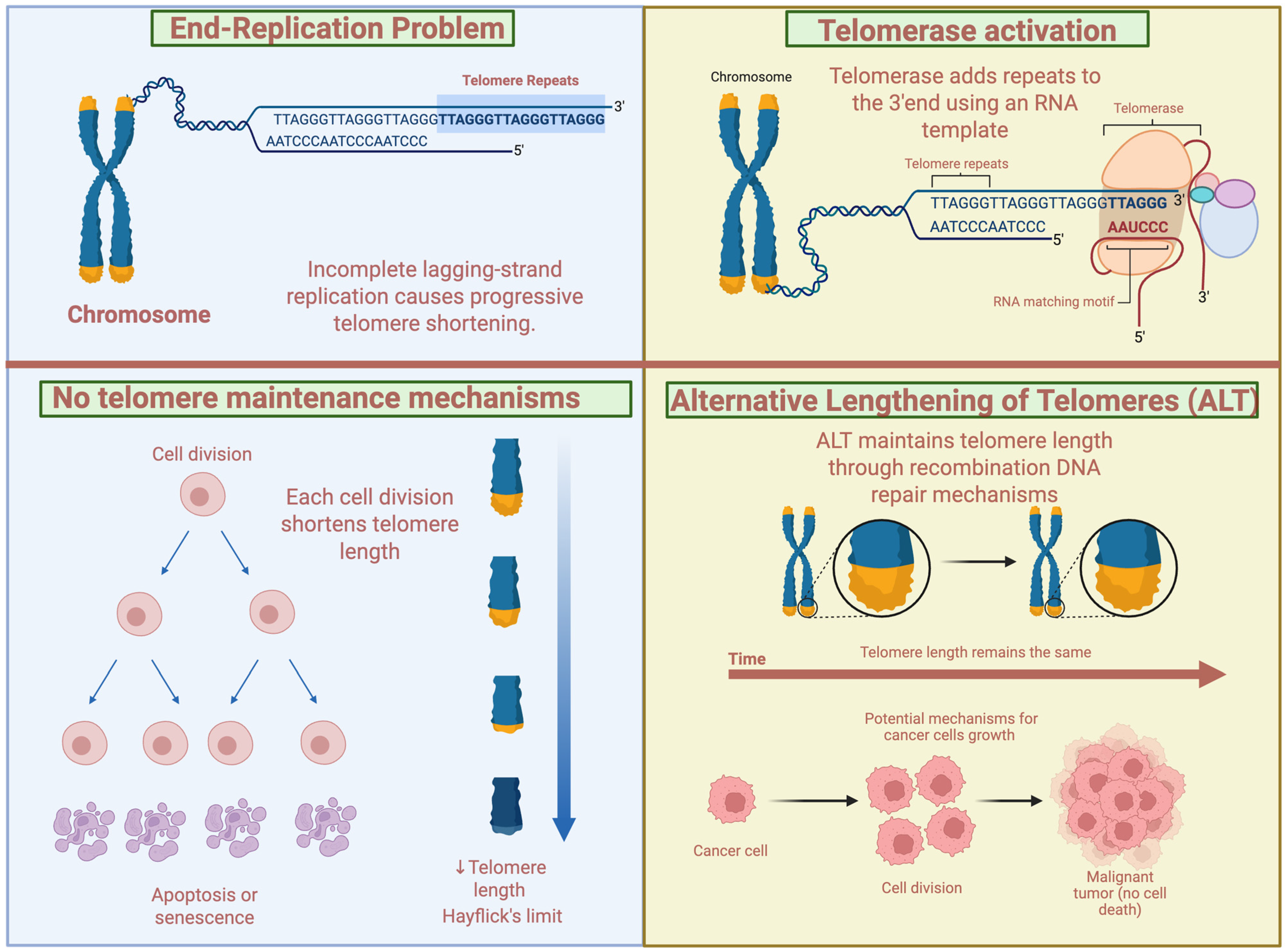
2. The Telomere—Telomerase Maintenance System
3. Methods for Telomere Length Measurement
3.1. Terminal Restriction Fragment (TRF) Analysis
3.2. Quantitative Polymerase Chain Reaction (qPCR)
3.3. Fluorescence In Situ Hybridization (FISH)-Based
3.4. Single Telomere Length Analysis (STELA), Universal STELA, and TeSLA
3.5. Sequencing-Based Bioinformatic Approaches
4. Telomere Length and Human Disease Risk
4.1. Cancer
4.2. Cardiovascular and Metabolic Diseases
4.3. Neurodegenerative Disorders
4.4. Telomere Biology Disorders
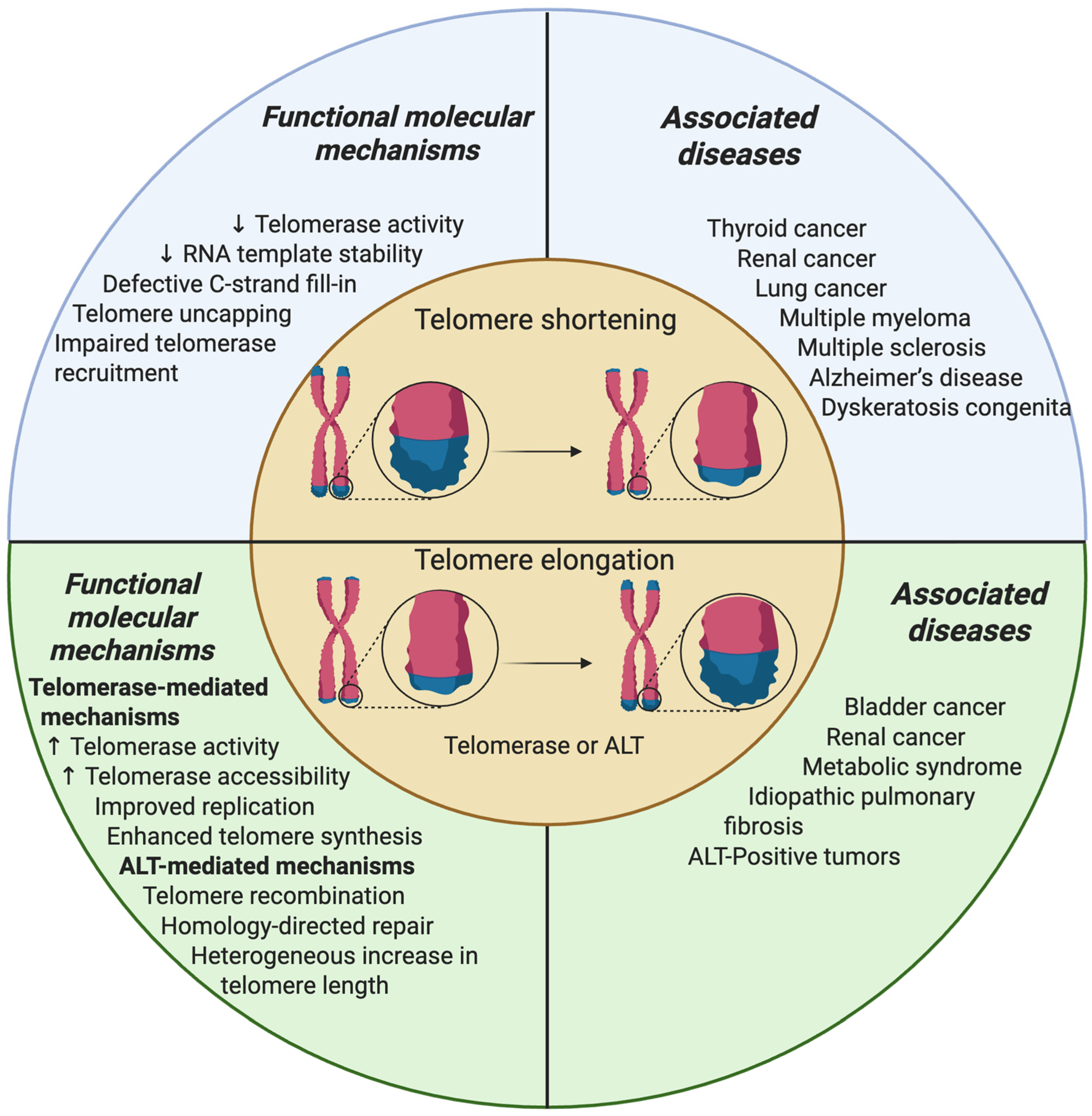
5. Genetic Variants Determining Telomere Length
5.1. Genetic Variants Associated with Telomere Shortening

| Telomere Effect | Gene | Variant ID | Variant Type | Functional Category | Proposed Mechanism | AMCG/AMP Classification | Global MAF | Latin American MAF | References |
|---|---|---|---|---|---|---|---|---|---|
| Telomere length shortening | TERT | rs199422294 | Missense | Telomerase catalytic subunit | Reduced telomerase activity | Pathogenic | <0.01% | Not reported | [3,40,69,110,151,152,153] |
| rs770066110 | Missense | Telomerase catalytic subunit | Impaired telomerase function | Pathogenic | <0.01% | Not reported | [3,40,69,151,152,153] | ||
| rs1554038048 | Missense | Telomerase catalytic subunit | Telomerase instability | Likely pathogenic | Not reported | Not reported | [3,40,69,151,152,153] | ||
| rs121918661 | Missense | Telomerase catalytic subunit | Reduced enzymatic activity | Likely benign | <0.01% | 0.2% | [40,69,111,112,151,152,153] | ||
| rs2853677 | Intronic regulatory | Telomerase expression | Reduced TERT transcription | Benign | ~59% | ~65% | [40,69,113,114,151,152,153] | ||
| rs114616103 | Intronic regulatory | Telomerase expression | Altered telomerase regulation | Benign | ~2.9% | ~1.3% | [40,69,151,152,153] | ||
| rs34052286 | Intronic regulatory | Telomerase expression | Regulatory effect on telomerase | Benign | ~0.5% | ~1.5% | [40,69,151,152,153] | ||
| rs2735940 | Regulatory | Telomerase catalytic subunit | TERT promoter regulation | Benign | ~49% | ~57% | [40,69,108,115,151,152,153] | ||
| rs2736100 | Regulatory | Telomerase catalytic subunit | Telomerase activity modulation | Benign | ~50% | ~56.5% | [40,69,116,117,151,152,153] | ||
| TERC | rs1553915617 | Rare variant | Telomerase catalytic subunit | Potential telomerase dysfunction | Likely pathogenic | Not reported | Not reported | [40,69,110,143,144,151,152,153] | |
| rs12638862 | Intronic | Telomerase catalytic subunit | Transcriptional regulation | Benign | 26.4% | 33% | [40,69,110,151,152,153] | ||
| RTEL1 | rs41309367 | Regulatory | Telomerase helicase | Altered telomerase replication | Benign | 68.8% | 69% | [40,69,110,145,151,152,153] | |
| rs3787089 | Regulatory | Telomerase helicase | Replication-associated telomere instability | Benign | 69.9% | 70.5% | [40,69,110,118,119,151,152,153] | ||
| POT1 | rs113394869 | Rare variant | Shelterin complex | Potential telomerase instability | Benign | 16% | Not reported | [40,69,110,151,152,153] | |
| rs587777475 | Rare variant | Shelterin complex | Telomerase dysfunction | VUS | <0.01% | Not reported | [40,69,110,120,121,122,151,152,153] | ||
| rs143635917 | Rare variant | Shelterin complex | Telomere shortening | VUS | 0.05% | N/A | [40,69,110,121,151,152,153] | ||
| rs947005337 | Rare variant | Shelterin complex | Telomerase dysfunction | Likely pathogenic | <0.01% | N/A | [40,69,110,111,123,124,151,152,153] | ||
| rs1385542313 | Rare variant | Shelterin complex | Telomere instability | VUS | <0.01% | N/A | [40,69,110,111,151,152,153] | ||
| DKC1 | rs146700772 | Rare variant | Telomerase RNA stabilization complex | Reduced telomerase activity | Benign | 0.03% | 0.01% | [40,69,110,125,126,127,151,152,153] | |
| rs1557264102 | Rare variant | Telomerase RNA stabilization complex | Telomere shortening | Pathogenic | Not reported | Not reported | [3,40,69,110,128,151,152,153] | ||
| NOP10 | rs121908092 | Missense | Telomerase RNA stabilization complex | Telomerase deficiency | VUS | <0.01% | Not reported | [37,40,69,151,152,153] | |
| CTC1 | rs3027234 | Intronic | CST complex | Telomere replication instability | Benign | 19% | 12% | [40,69,146,147,148,151,152,153] | |
| STN1 | rs10883948 | Regulatory | CST complex | Altered telomerase expression | Benign | 35% | Not reported | [40,69,151,152,153] | |
| rs9420907 | Intronic | CST complex regulator | Regulation of telomere replication and C-strand synthesis | Benign | 82% | 82% | [40,69,131,148,149,150,151,152,153] |
5.2. Genetic Variants Associated with Telomere Elongation
| Telomere Effect | Gene | Variant ID | Variant Type | Functional Category | Proposed Mechanism | AMCG/AMP Classification | Global MAF | Latin American MAF | References |
|---|---|---|---|---|---|---|---|---|---|
| Telomere length elongation | TERT | rs7705526 | Intronic regulatory | Telomerase catalytic subunit | Increased telomerase activity and telomere elongation | VUS | <0.01% | Not reported | [40,69,118,151,152,153,155,156] |
| rs2736100 | Intronic regulatory | Telomerase catalytic subunit | Modulation of telomerase activity | VUS | <0.01% | Not reported | [40,69,107,131,151,152,153] | ||
| rs6897196 | Intronic regulatory | Telomerase catalytic subunit | Regulation of TERT expression | Benign | 43.7% | 33.5% | [40,69,151,152,153] | ||
| rs192999400 | Rare variant | Telomerase catalytic subunit | Potential telomerase activity alteration | Benign | 0.7% | 0.35% | [40,69,151,152,153] | ||
| TERC | rs12638862 | Intronic regulatory | Telomerase RNA component | Transcriptional regulation | Benign | 26.4% | 33% | [40,69,130,143,144,151,152,153] | |
| rs2293607 | Intronic regulatory | Telomerase RNA component | Increased telomerase RNA stability | VUS | Not reported | Not reported | [40,69,151,152,153,157,158,159] | ||
| RTEL1 | rs61753459 | Rare variant | Telomerase helicase | Potential telomerase functional alteration | VUS | Not reported | Not reported | [40,69,151,152,153,160] | |
| POT1 | rs202187871 | Rare variant | Shelterin complex | Telomere elongation via altered telomerase activity | VUS | <0.01% | Not reported | [40,69,107,111,121,151,152,153,161] | |
| rs750470470 | Rare variant | Shelterin complex | Potential regulatory effect on telomerase | Pathogenic | <0.01% | Not reported | [40,69,121,151,152,153,154] | ||
| STN1 | rs9420907 | Intronic regulatory | CST complex regulator | Increased telomere replication efficiency | VUS | Not reported | Not reported | [40,69,151,152,153,162,163] | |
| rs1265164 | Intronic regulatory | CST complex regulator | Regulation of telomere length via transcriptional mechanisms | Benign | ~84% | ~80% | [40,69,151,152,153,164] | ||
| rs111447985 | Intronic regulatory | CST complex regulator | Improved telomere replication stability | VUS | Not reported | Not reported | [40,69,151,152,153] |
6. Research Gaps and Future Directions
Author Contributions
Funding
Institutional Review Board Statement
Informed Consent Statement
Data Availability Statement
Acknowledgments
Conflicts of Interest
References
- Chakravarti, D.; LaBella, K.A.; DePinho, R.A. Telomeres: History, Health, and Hallmarks of Aging. Cell 2021, 184, 306–322. [Google Scholar] [CrossRef]
- Srinivas, N.; Rachakonda, S.; Kumar, R. Telomeres and Telomere Length: A General Overview. Cancers 2020, 12, 558. [Google Scholar] [CrossRef] [PubMed]
- Norberg, A.; Rosén, A.; Raaschou-Jensen, K.; Kjeldsen, L.; Moilanen, J.S.; Paulsson-Karlsson, Y.; Baliakas, P.; Lohi, O.; Ahmed, A.; Kittang, A.O.; et al. Novel Variants in Nordic Patients Referred for Genetic Testing of Telomere-Related Disorders. Eur. J. Hum. Genet. 2018, 26, 858–867. [Google Scholar] [CrossRef] [PubMed]
- Skowronska-Krawczyk, D. Hallmarks of Aging: Causes and Consequences. Aging Biol. 2023, 1, 20230011. [Google Scholar] [CrossRef] [PubMed]
- Muthamil, S.; Kim, H.Y.; Jang, H.J.; Lyu, J.H.; Shin, U.C.; Go, Y.; Park, S.H.; Lee, H.G.; Park, J.H. Biomarkers of Cellular Senescence and Aging: Current State-of-the-Art, Challenges and Future Perspectives. Adv. Biol. 2024, 8, 2400079. [Google Scholar] [CrossRef]
- Bojesen, S.E. Telomeres and Human Health. J. Intern. Med. 2013, 274, 399–413. [Google Scholar] [CrossRef]
- Kahl, V.F.S.; da Silva, J. Telomere Length and Its Relation to Human Health. In Telomere—A Complex End of a Chromosome; InTech: Hamilton, NJ, USA, 2016. [Google Scholar] [CrossRef]
- Lee, J.; Pellegrini, M.V. Biochemistry, Telomere And Telomerase. In StatPearls; StatPearls Publishing: Treasure Island, FL, USA, 2022. [Google Scholar]
- Lim, C.J.; Cech, T.R. Shaping Human Telomeres: From Shelterin and CST Complexes to Telomeric Chromatin Organization. Nat. Rev. Mol. Cell Biol. 2021, 22, 283–298, Erratum in Nat. Rev. Mol. Cell Biol. 2021, 22, 299. https://doi.org/10.1038/s41580-021-00353-x. [Google Scholar] [CrossRef]
- Eppard, M.; Passos, J.F.; Victorelli, S. Telomeres, Cellular Senescence, and Aging: Past and Future. Biogerontology 2023, 25, 329–339. [Google Scholar] [CrossRef]
- Mori, J.O.; Keegan, J.; Flynn, R.L.; Heaphy, C.M. Alternative Lengthening of Telomeres: Mechanism and the Pathogenesis of Cancer. J. Clin. Pathol. 2024, 77, 82–86. [Google Scholar] [CrossRef]
- Schrumpfová, P.P.; Fajkus, J. Composition and Function of Telomerase—A Polymerase Associated with the Origin of Eukaryotes. Biomolecules 2020, 10, 1425. [Google Scholar] [CrossRef]
- Tucker, L.A.; Bates, C.J.; Tucker, L.A.; Bates, C.J. Telomere Length and Biological Aging: The Role of Strength Training in 4814 US Men and Women. Biology 2024, 13, 883. [Google Scholar] [CrossRef]
- Groten, J.; Venkatraman, A.; Mertelsmann, R. Modeling and Simulating Carcinogenesis. In Precision Medicine: Tools and Quantitative Approaches; Academic Press: Cambridge, MA, USA, 2018; pp. 277–295. [Google Scholar] [CrossRef]
- Kailashiya, C.; Sharma, H.B.; Kailashiya, J. Telomerase Based Anticancer Immunotherapy and Vaccines Approaches. Vaccine 2017, 35, 5768–5775. [Google Scholar] [CrossRef]
- Gaspar, T.B.; Sá, A.; Lopes, J.M.; Sobrinho-Simões, M.; Soares, P.; Vinagre, J. Telomere Maintenance Mechanisms in Cancer. Genes 2018, 9, 241. [Google Scholar] [CrossRef]
- Jones-Weinert, C.; Mainz, L.; Karlseder, J. Telomere Function and Regulation from Mouse Models to Human Ageing and Disease. Nat. Rev. Mol. Cell Biol. 2024, 26, 297–313. [Google Scholar] [CrossRef] [PubMed]
- Stanley, S.E.; Armanios, M. The Short and Long Telomere Syndromes: Paired Paradigms for Molecular Medicine. Curr. Opin. Genet. Dev. 2015, 33, 1. [Google Scholar] [CrossRef]
- McNally, E.J.; Luncsford, P.J.; Armanios, M. Long Telomeres and Cancer Risk: The Price of Cellular Immortality. J. Clin. Investig. 2019, 129, 3474–3481. [Google Scholar] [CrossRef]
- Mangaonkar, A.A.; Patnaik, M.M. Short Telomere Syndromes In Clinical Practice—Bridging Bench and Bedside. Mayo Clin. Proc. 2018, 93, 904. [Google Scholar] [CrossRef] [PubMed]
- Jeon, H.-J.; Levine, M.T.; Lampson, M.A. A Parent-of-Origin Effect on Embryonic Telomere Elongation Determines Telomere Length Inheritance. bioRxiv 2025, 35, 5081–5089.e3. [Google Scholar] [CrossRef] [PubMed]
- Lister-Shimauchi, E.H.; McCarthy, B.; Lippincott, M.; Ahmed, S. Genetic and Epigenetic Inheritance at Telomeres. Epigenomes 2022, 6, 9. [Google Scholar] [CrossRef]
- Zhang, C.; Doherty, J.A.; Burgess, S.; Hung, R.J.; Lindström, S.; Kraft, P.; Gong, J.; Amos, C.I.; Sellers, T.A.; Monteiro, A.N.A.; et al. Genetic Determinants of Telomere Length and Risk of Common Cancers: A Mendelian Randomization Study. Hum. Mol. Genet. 2015, 24, 5356. [Google Scholar] [CrossRef] [PubMed]
- Zeiger, A.M.; White, M.J.; Eng, C.; Oh, S.S.; Witonsky, J.; Goddard, P.C.; Contreras, M.G.; Elhawary, J.R.; Hu, D.; Mak, A.C.Y.; et al. Genetic Determinants of Telomere Length in African American Youth. Sci. Rep. 2018, 8, 13265. [Google Scholar] [CrossRef]
- Savage, S.A.; Bertuch, A.A. The Genetics and Clinical Manifestations of Telomere Biology Disorders. Genet. Med. 2010, 12, 753–764. [Google Scholar] [CrossRef] [PubMed]
- Aviv, A.; Shay, J.W. Reflections on Telomere Dynamics and Ageing-Related Diseases in Humans. Philos. Trans. R. Soc. B Biol. Sci. 2018, 373, 20160436. [Google Scholar] [CrossRef]
- Hansen, M.E.B.; Hunt, S.C.; Stone, R.C.; Horvath, K.; Herbig, U.; Ranciaro, A.; Hirbo, J.; Beggs, W.; Reiner, A.P.; Wilson, J.G.; et al. Shorter Telomere Length in Europeans than in Africans Due to Polygenetic Adaptation. Hum. Mol. Genet. 2016, 25, 2324. [Google Scholar] [CrossRef]
- Zambrano, A.K.; Gaviria, A.; Cobos-Navarrete, S.; Gruezo, C.; Rodríguez-Pollit, C.; Armendáriz-Castillo, I.; García-Cárdenas, J.M.; Guerrero, S.; López-Cortés, A.; Leone, P.E.; et al. The Three-Hybrid Genetic Composition of an Ecuadorian Population Using AIMs-InDels Compared with Autosomes, Mitochondrial DNA and Y Chromosome Data. Sci. Rep. 2019, 9, 9247. [Google Scholar] [CrossRef] [PubMed]
- Schneider, C.V.; Schneider, K.M.; Teumer, A.; Rudolph, K.L.; Hartmann, D.; Rader, D.J.; Strnad, P. Association of Telomere Length With Risk of Disease and Mortality. JAMA Intern. Med. 2022, 182, 291–300. [Google Scholar] [CrossRef]
- Huang, X.; Huang, L.; Lu, J.; Cheng, L.; Wu, D.; Li, L.; Zhang, S.; Lai, X.; Xu, L. The Relationship between Telomere Length and Aging-Related Diseases. Clin. Exp. Med. 2025, 25, 72. [Google Scholar] [CrossRef]
- Liu, B.; He, Y.; Wang, Y.; Song, H.; Zhou, Z.H.; Feigon, J. Structure of Active Human Telomerase with Telomere Shelterin Protein TPP1. Nature 2022, 604, 578–583. [Google Scholar] [CrossRef]
- Boccardi, V.; Marano, L. Aging, Cancer, and Inflammation: The Telomerase Connection. Int. J. Mol. Sci. 2024, 25, 8542. [Google Scholar] [CrossRef]
- Hoang, S.M.; O’Sullivan, R.J. Alternative Lengthening of Telomeres: Building Bridges To Connect Chromosome Ends. Trends Cancer 2020, 6, 247–260. [Google Scholar] [CrossRef] [PubMed]
- Hou, K.; Yu, Y.; Li, D.; Zhang, Y.; Zhang, K.; Tong, J.; Yang, K.; Jia, S. Alternative Lengthening of Telomeres and Mediated Telomere Synthesis. Cancers 2022, 14, 2194. [Google Scholar] [CrossRef] [PubMed]
- Ghosh, S.; Nguyen, M.T.; Choi, H.E.; Stahl, M.; Kühn, A.L.; Van der Auwera, S.; Grabe, H.J.; Völzke, H.; Homuth, G.; Myers, S.A.; et al. RIOK2 Transcriptionally Regulates TRiC and Dyskerin Complexes to Prevent Telomere Shortening. Nat. Commun. 2024, 15, 7138. [Google Scholar] [CrossRef] [PubMed]
- Garus, A.; Autexier, C. Dyskerin: An Essential Pseudouridine Synthase with Multifaceted Roles in Ribosome Biogenesis, Splicing, and Telomere Maintenance. RNA 2021, 27, 1441. [Google Scholar] [CrossRef]
- Fong, Y.W.; Ho, J.J.; Inouye, C.; Tjian, R. The Dyskerin Ribonucleoprotein Complex as an OCT4/SOX2 Coactivator in Embryonic Stem Cells. eLife 2014, 3, e03573. [Google Scholar] [CrossRef] [PubMed]
- Tummala, H.; Walne, A.; Dokal, I. The Biology and Management of Dyskeratosis Congenita and Related Disorders of Telomeres. Expert Rev. Hematol. 2022, 15, 685–696. [Google Scholar] [CrossRef]
- Ibáñez-Cabellos, J.S.; Seco-Cervera, M.; Picher-Latorre, C.; Pérez-Machado, G.; García-Giménez, J.L.; Pallardó, F.V. Acute Depletion of Telomerase Components DKC1 and NOP10 Induces Oxidative Stress and Disrupts Ribosomal Biogenesis via NPM1 and Activation of the P53 Pathway. Biochim. Biophys. Acta BBA-Mol. Cell Res. 2020, 1867, 118845. [Google Scholar] [CrossRef]
- Amberger, J.S.; Bocchini, C.A.; Schiettecatte, F.; Scott, A.F.; Hamosh, A. OMIM.Org: Online Mendelian Inheritance in Man (OMIM®), an Online Catalog of Human Genes and Genetic Disorders. Nucleic Acids Res. 2015, 43, D789–D798. [Google Scholar] [CrossRef]
- Ghilain, C.; Gilson, E.; Giraud-Panis, M.-J.; Bierhoff, H.; Kalyuzhny, A.E. Multifunctionality of the Telomere-Capping Shelterin Complex Explained by Variations in Its Protein Composition. Cells 2021, 10, 1753. [Google Scholar] [CrossRef]
- Aramburu, T.; Plucinsky, S.; Skordalakes, E. POT1-TPP1 Telomere Length Regulation and Disease. Comput. Struct. Biotechnol. J. 2020, 18, 1939–1946. [Google Scholar] [CrossRef]
- Aramburu, T.; Kelich, J.; Rice, C.; Skordalakes, E. POT1-TPP1 Binding Stabilizes POT1, Promoting Efficient Telomere Maintenance. Comput. Struct. Biotechnol. J. 2022, 20, 675. [Google Scholar] [CrossRef]
- Schmiester, M.; Demuth, I. SNM1B/Apollo in the DNA Damage Response and Telomere Maintenance. Oncotarget 2017, 8, 48398. [Google Scholar] [CrossRef]
- Kermasson, L.; Churikov, D.; Awad, A.; Smoom, R.; Lainey, E.; Touzot, F.; Audebert-Bellanger, S.; Haro, S.; Roger, L.; Costa, E.; et al. Inherited Human Apollo Deficiency Causes Severe Bone Marrow Failure and Developmental Defects. Blood 2022, 139, 2427. [Google Scholar] [CrossRef]
- Lyu, X.; Sang, P.B.; Chai, W. CST in Maintaining Genome Stability: Beyond Telomeres. DNA Repair 2021, 102, 103104. [Google Scholar] [CrossRef]
- Wang, Y.; Chai, W. Pathogenic CTC1 Mutations Cause Global Genome Instabilities under Replication Stress. Nucleic Acids Res. 2018, 46, 3981–3992. [Google Scholar] [CrossRef]
- Choudhury, A.; Mohammad, T.; Samarth, N.; Hussain, A.; Rehman, M.T.; Islam, A.; Alajmi, M.F.; Singh, S.; Hassan, M.I. Structural Genomics Approach to Investigate Deleterious Impact of NsSNPs in Conserved Telomere Maintenance Component 1. Sci. Rep. 2021, 11, 10202. [Google Scholar] [CrossRef] [PubMed]
- Amir, M.; Khan, P.; Queen, A.; Dohare, R.; Alajmi, M.F.; Hussain, A.; Islam, A.; Ahmad, F.; Hassan, I. Structural Features of Nucleoprotein CST/Shelterin Complex Involved in the Telomere Maintenance and Its Association with Disease Mutations. Cells 2020, 9, 359. [Google Scholar] [CrossRef] [PubMed]
- Hourvitz, N.; Awad, A.; Tzfati, Y. The Many Faces of the Helicase RTEL1 at Telomeres and Beyond. Trends Cell Biol. 2024, 34, 109–121. [Google Scholar] [CrossRef] [PubMed]
- Thompson, A.S.; Niewisch, M.R.; Giri, N.; McReynolds, L.J.; Savage, S.A. Germline RTEL1 Variants in Telomere Biology Disorders. Am. J. Med. Genet. A 2025, 197, e63882. [Google Scholar] [CrossRef]
- Wu, G.; Taylor, E.; Youmans, D.T.; Arnoult, N.; Cech, T.R. Rapid Dynamics Allow the Low-Abundance RTEL1 Helicase to Promote Telomere Replication. Nucleic Acids Res. 2025, 53, 177. [Google Scholar] [CrossRef]
- Wei, J.; Jiao, F.; Wang, X.; Qiao, Y.; Yuan, Z.; Liu, F.; Fang, Y.; Pan, Y. High Expression of ZNF208 Predicts Better Prognosis and Suppresses the Tumorigenesis of Breast Cancer. Clin. Med. Insights Oncol. 2024, 18, 11795549241301340. [Google Scholar] [CrossRef]
- Wang, S.; Wen, X.; Zhao, R.; Bai, Y. Genetic Variation in the ZNF208 Gene at Rs8103163 and Rs7248488 Is Associated With Laryngeal Cancer in the Northwestern Chinese Han Male. Front. Genet. 2022, 13, 813823. [Google Scholar] [CrossRef] [PubMed]
- Ding, Y.; Zhou, X.; Wu, C.; Li, Q.; Sun, J.; Niu, H.; Lin, D.; Sun, D.; Xie, P.; Wu, D.; et al. Telomere Length, ZNF208 Genetic Variants and Risk of Chronic Obstructive Pulmonary Disease in the Hainan Li Population. J. Gene Med. 2018, 20, e3061. [Google Scholar] [CrossRef]
- Mangino, M.; Christiansen, L.; Stone, R.; Hunt, S.C.; Horvath, K.; Eisenberg, D.T.A.; Kimura, M.; Petersen, I.; Kark, J.D.; Herbig, U.; et al. DCAF4, a Novel Gene Associated with Leucocyte Telomere Length. J. Med. Genet. 2015, 52, 157–162. [Google Scholar] [CrossRef]
- Touzot, F.; Callebaut, I.; Soulier, J.; Gaillard, L.; Azerrad, C.; Durandy, A.; Fischer, A.; De Villartay, J.P.; Revy, P. Function of Apollo (SNM1B) at Telomere Highlighted by a Splice Variant Identified in a Patient with Hoyeraal-Hreidarsson Syndrome. Proc. Natl. Acad. Sci. USA 2010, 107, 10097–10102. [Google Scholar] [CrossRef]
- Alder, J.K.; Hanumanthu, V.S.; Strong, M.A.; DeZern, A.E.; Stanley, S.E.; Takemoto, C.M.; Danilova, L.; Applegate, C.D.; Bolton, S.G.; Mohr, D.W.; et al. Diagnostic Utility of Telomere Length Testing in a Hospital-Based Setting. Proc. Natl. Acad. Sci. USA 2018, 115, E2358–E2365. [Google Scholar] [CrossRef] [PubMed]
- Henriques, C.M.; Ferreira, M.G. Telomere Length Is an Epigenetic Trait—Implications for the Use of Telomerase-Deficient Organisms to Model Human Disease. Dis. Model. Mech. 2024, 17, dmm050581. [Google Scholar] [CrossRef]
- Barragán, R.; Ortega-Azorín, C.; Sorlí, J.V.; Asensio, E.M.; Coltell, O.; St-Onge, M.P.; Portolés, O.; Corella, D. Effect of Physical Activity, Smoking, and Sleep on Telomere Length: A Systematic Review of Observational and Intervention Studies. J. Clin. Med. 2021, 11, 76. [Google Scholar] [CrossRef] [PubMed]
- Galiè, S.; Canudas, S.; Muralidharan, J.; García-Gavilán, J.; Bulló, M.; Salas-Salvadó, J. Impact of Nutrition on Telomere Health: Systematic Review of Observational Cohort Studies and Randomized Clinical Trials. Adv. Nutr. 2019, 11, 576. [Google Scholar] [CrossRef]
- Vaiserman, A.; Krasnienkov, D. Telomere Length as a Marker of Biological Age: State-of-the-Art, Open Issues, and Future Perspectives. Front. Genet. 2021, 11, 630186. [Google Scholar] [CrossRef]
- Yu, H.J.; Hwan Byun, Y.; Park, C.-K. Mini-Review Techniques for Assessing Telomere Length: A Methodological Review. Comput. Struct. Biotechnol. J. 2024, 23, 1489–1498. [Google Scholar] [CrossRef]
- Montpetit, A.J.; Alhareeri, A.A.; Montpetit, M.; Starkweather, A.R.; Elmore, L.W.; Filler, K.; Mohanraj, L.; Burton, C.W.; Menzies, V.S.; Lyon, D.E.; et al. Telomere Length: A Review of Methods for Measurement. Nurs. Res. 2014, 63, 289. [Google Scholar] [CrossRef]
- Makarova, J.A.; Belova, U.D.; Zvereva, M.I.; Shkurnikov, M.Y.; Tonevitsky, A.G. Methods for Telomere Length Measurement: An Update on Current Technologies and Emerging Approaches. Front. Mol. Biosci. 2025, 12, 1725112. [Google Scholar] [CrossRef]
- Mirabello, L.; Yu, K.; Kraft, P.; De Vivo, I.; Hunter, D.J.; Prescott, J.; Wong, J.Y.Y.; Chatterjee, N.; Hayes, R.B.; Savage, S.A. The Association of Telomere Length and Genetic Variation in Telomere Biology Genes. Hum. Mutat. 2010, 31, 1050–1058. [Google Scholar] [CrossRef]
- Carvalho, V.S.; Gomes, W.R.; Calado, R.T. Recent Advances in Understanding Telomere Diseases. Fac. Rev. 2022, 11, 31. [Google Scholar] [CrossRef]
- Niewisch, M.R.; Beier, F.; Savage, S.A. Clinical Manifestations of Telomere Biology Disorders in Adults. Hematology 2023, 2023, 563–572. [Google Scholar] [CrossRef] [PubMed]
- Taub, M.A.; Conomos, M.P.; Keener, R.; Iyer, K.R.; Weinstock, J.S.; Yanek, L.R.; Lane, J.; Miller-Fleming, T.W.; Brody, J.A.; Raffield, L.M.; et al. Genetic Determinants of Telomere Length from 109,122 Ancestrally Diverse Whole-Genome Sequences in TOPMed. Cell Genom. 2022, 2, 100084. [Google Scholar] [CrossRef] [PubMed]
- Lv, J.; Zhao, X.; Zhao, L.; Gong, C.; Zheng, W.; Guo, L.; Wang, J.; Liang, T. The Notable Role of Telomere Length Maintenance in Complex Diseases. Biomedicines 2024, 12, 2611. [Google Scholar] [CrossRef]
- Gong, Y.; Stock, A.J.; Liu, Y. The Enigma of Excessively Long Telomeres in Cancer: Lessons Learned from Rare Human POT1 Variants. Curr. Opin. Genet. Dev. 2020, 60, 48. [Google Scholar] [CrossRef] [PubMed]
- Chen, X.; Huang, Y.; Zhao, C.; Huang, M. Association between Leukocyte Telomere Length and Neurodegenerative Diseases: A Prospective Cohort in the UK Biobank. J. Neurol. 2026, 273, 137. [Google Scholar] [CrossRef]
- Haycock, P.C.; Burgess, S.; Nounu, A.; Zheng, J.; Okoli, G.N.; Bowden, J.; Wade, K.H.; Timpson, N.J.; Evans, D.M.; Willeit, P.; et al. Association Between Telomere Length and Risk of Cancer and Non-Neoplastic Diseases: A Mendelian Randomization Study. JAMA Oncol. 2017, 3, 636–651. [Google Scholar] [CrossRef]
- Lee, S.H.; Song, D.S.; Kim, U.C.; Jee, S.H.; Lee, K. The Causal Relationship between Telomere Length and Cancer Risk: A Two-Sample Mendelian Randomization. Cancer Epidemiol. Biomark. Prev. 2025, 34, 737–743. [Google Scholar] [CrossRef]
- Sanchez-Espiridion, B.; Chen, M.; Chang, J.Y.; Lu, C.; Chang, D.W.; Roth, J.A.; Wu, X.; Gu, J. Telomere Length in Peripheral Blood Leukocytes and Lung Cancer Risk: A Large Case-Control Study in Caucasians. Cancer Res. 2014, 74, 2476. [Google Scholar] [CrossRef] [PubMed]
- Giaccherini, M.; Macauda, A.; Orciuolo, E.; Rymko, M.; Gruenpeter, K.; Dumontet, C.; Raźny, M.; Moreno, V.; Buda, G.; Beider, K.; et al. Genetically Determined Telomere Length and Multiple Myeloma Risk and Outcome. Blood Cancer J. 2021, 11, 74. [Google Scholar] [CrossRef]
- Zheng, X.; Wezel, F.; Azoitei, A.; Meessen, S.; Wang, W.; Najjar, G.; Wang, X.; Kraus, J.M.; Kestler, H.A.; John, A.; et al. Shorter Leukocyte Telomere Length Is Associated with Worse Survival of Patients with Bladder Cancer and Renal Cell Carcinoma. Cancers 2021, 13, 3774. [Google Scholar] [CrossRef]
- Barthel, F.P.; Wei, W.; Tang, M.; Martinez-Ledesma, E.; Hu, X.; Amin, S.B.; Akdemir, K.C.; Seth, S.; Song, X.; Wang, Q.; et al. Systematic Analysis of Telomere Length and Somatic Alterations in 31 Cancer Types. Nat. Genet. 2017, 49, 349. [Google Scholar] [CrossRef]
- O’sullivan, R.J.; Greenberg, R.A. Mechanisms of Alternative Lengthening of Telomeres. Cold Spring Harb. Perspect. Biol. 2025, 17, a041690. [Google Scholar] [CrossRef] [PubMed]
- Hakobyan, M.; Binder, H.; Arakelyan, A. Pan-Cancer Analysis of Telomere Maintenance Mechanisms. J. Biol. Chem. 2024, 300, 107392, Erratum in J. Biol. Chem. 2026, 302, 111130. https://doi.org/10.1016/j.jbc.2025.111130. [Google Scholar] [CrossRef]
- Amorim, J.P.; Santos, G.; Vinagre, J.; Soares, P. The Role of ATRX in the Alternative Lengthening of Telomeres (ALT) Phenotype. Genes 2016, 7, 66. [Google Scholar] [CrossRef]
- Matsumoto, R.; Takahashi, Y.; Matsumoto, R.; Takahashi, Y. Telomeres and Cellular Senescence in Metabolic and Endocrine Diseases. In Telomere—A Complex End of a Chromosome; InTech: Hamilton, NJ, USA, 2016. [Google Scholar] [CrossRef]
- Xiong, L.; Yang, G.; Guo, T.; Zeng, Z.; Liao, T.; Li, Y.; Li, Y.; Chen, F.; Yang, S.; Kang, L.; et al. 17-Year Follow-up of Association between Telomere Length and All-Cause Mortality, Cardiovascular Mortality in Individuals with Metabolic Syndrome: Results from the NHANES Database Prospective Cohort Study. Diabetol. Metab. Syndr. 2023, 15, 247. [Google Scholar] [CrossRef] [PubMed]
- Rehkopf, D.H.; Needham, B.L.; Lin, J.; Blackburn, E.H.; Zota, A.R.; Wojcicki, J.M.; Epel, E.S. Leukocyte Telomere Length in Relation to 17 Biomarkers of Cardiovascular Disease Risk: A Cross-Sectional Study of US Adults. PLoS Med. 2016, 13, e1002188. [Google Scholar] [CrossRef]
- Osadnik, T.; Banach, M.; Goc, A.; Boniewska-Bernacka, E.; Pańczyszyn, A.; Goławski, M.; Fronczek, M.; Strzelczyk, J.K.; Lejawa, M.; Gierlotka, M.; et al. Association Between Metabolic Syndrome Components, Clinical Characteristics, and Telomere Length: Factor Analysis of Mixed Data Based Cluster Analysis of LIPIDOGEN2015 Cross-Sectional Study. High Blood Press. Cardiovasc. Prev. 2025, 33, 67–81. [Google Scholar] [CrossRef]
- Loh, N.Y.; Noordam, R.; Christodoulides, C. Telomere Length and Metabolic Syndrome Traits: A Mendelian Randomisation Study. Aging Cell 2021, 20, e13445. [Google Scholar] [CrossRef]
- Qiao, J.; Wang, Q.; Zhao, Y.; Chang, M.; Sun, S.; Zhang, P.; Yao, K.; Chen, M.; Zheng, L.; Xing, X.; et al. Contribution of Leukocyte Telomere Length to Cardiovascular Disease Onset from Genome-Wide Cross-Trait Analysis. Nat. Commun. 2025, 16, 8677. [Google Scholar] [CrossRef]
- Brandt, M.; Dörschmann, H.; Khraisat, S.; Knopp, T.; Ringen, J.; Kalinovic, S.; Garlapati, V.; Siemer, S.; Molitor, M.; Göbel, S.; et al. Telomere Shortening in Hypertensive Heart Disease Depends on Oxidative DNA Damage and Predicts Impaired Recovery of Cardiac Function in Heart Failure. Hypertension 2022, 79, 2173–2184. [Google Scholar] [CrossRef]
- Bloom, S.I.; Liu, Y.; Tucker, J.R.; Islam, M.T.; Machin, D.R.; Abdeahad, H.; Thomas, T.G.; Bramwell, R.C.; Lesniewski, L.A.; Donato, A.J. Endothelial Cell Telomere Dysfunction Induces Senescence and Results in Vascular and Metabolic Impairments. Aging Cell 2023, 22, e13875. [Google Scholar] [CrossRef]
- Gordon, C.A.; Madamanchi, N.R.; Runge, M.S.; Jarstfer, M.B. Effect of Oxidative Stress on Telomere Maintenance in Aortic Smooth Muscle Cells. Biochim. Biophys. Acta BBA-Mol. Basis Dis. 2022, 1868, 166397. [Google Scholar] [CrossRef]
- Yu, X.; Liu, M.M.; Zheng, C.Y.; Liu, Y.T.; Wang, Z.; Wang, Z.Y. Telomerase Reverse Transcriptase and Neurodegenerative Diseases. Front. Immunol. 2023, 14, 1165632. [Google Scholar] [CrossRef]
- Yu, H.-J.; Koh, S.-H. Is Telomere Length Shortening a Risk Factor for Neurodegenerative Disorders? Dement. Neurocogn. Disord. 2022, 21, 83. [Google Scholar] [CrossRef]
- Rodríguez-Fernández, B.; Gispert, J.D.; Guigo, R.; Navarro, A.; Vilor-Tejedor, N.; Crous-Bou, M. Genetically Predicted Telomere Length and Its Relationship with Neurodegenerative Diseases and Life Expectancy. Comput. Struct. Biotechnol. J. 2022, 20, 4251–4256. [Google Scholar] [CrossRef]
- Crocco, P.; De Rango, F.; Dato, S.; La Grotta, R.; Maletta, R.; Bruni, A.C.; Passarino, G.; Rose, G. The Shortening of Leukocyte Telomere Length Contributes to Alzheimer’s Disease: Further Evidence from Late-Onset Familial and Sporadic Cases. Biology 2023, 12, 1286. [Google Scholar] [CrossRef]
- Singh, A.; Kukreti, R.; Saso, L.; Kukreti, S. Oxidative Stress: A Key Modulator in Neurodegenerative Diseases. Molecules 2019, 24, 1583. [Google Scholar] [CrossRef]
- Chiurchiù, V.; Orlacchio, A.; Maccarrone, M. Is Modulation of Oxidative Stress an Answer? The State of the Art of Redox Therapeutic Actions in Neurodegenerative Diseases. Oxid. Med. Cell. Longev. 2015, 2016, 7909380. [Google Scholar] [CrossRef]
- Kam, M.L.W.; Nguyen, T.T.T.; Ngeow, J.Y.Y. Telomere Biology Disorders. npj Genom. Med. 2021, 6, 36. [Google Scholar] [CrossRef] [PubMed]
- Batista, L.F.; Dokal, I.; Parker, R. Telomere Biology Disorders: Time for Moving towards the Clinic? Trends Mol. Med. 2022, 28, 882. [Google Scholar] [CrossRef]
- Gramatges, M.M.; Bertuch, A.A. Short Telomeres: From Dyskeratosis Congenita to Sporadic Aplastic Anemia and Malignancy. Transl. Res. 2013, 162, 353–363. [Google Scholar] [CrossRef]
- Savage, S.A. Dyskeratosis Congenita and Telomere Biology Disorders. Hematology 2022, 2022, 637–648. [Google Scholar] [CrossRef]
- Southern, B.D.; Gadre, S.K. Telomeropathies in Interstitial Lung Disease and Lung Transplant Recipients. J. Clin. Med. 2025, 14, 1496. [Google Scholar] [CrossRef]
- Mazurek, M.; Młynarski, W.; Madzio, J. Dyskeratosis Congenita as a Multifaceted Bone Marrow Disorder. Acta Haematol. Pol. 2023, 54, 285–294. [Google Scholar] [CrossRef]
- Pirzada, S.A.; Aleyadeh, W.; Fathma, S.; Koh, C.; Plessier, A.; Kleiner, D.E.; Heller, T. Telomere Biology Disorders and Hepatic Disease. Semin. Hematol. 2026, in press. [Google Scholar] [CrossRef]
- Alder, J.K.; Parry, E.M.; Yegnasubramanian, S.; Wagner, C.L.; Lieblich, L.M.; Auerbach, R.; Auerbach, A.D.; Wheelan, S.J.; Armanios, M. Telomere Phenotypes in Females with Heterozygous Mutations in the Dyskeratosis Congenita 1 (DKC1) Gene. Hum. Mutat. 2013, 34, 1481. [Google Scholar] [CrossRef] [PubMed]
- Gu, B.W.; Apicella, M.; Mills, J.; Fan, J.M.; Reeves, D.A.; French, D.; Podsakoff, G.M.; Bessler, M.; Mason, P.J. Impaired Telomere Maintenance and Decreased Canonical WNT Signaling but Normal Ribosome Biogenesis in Induced Pluripotent Stem Cells from X-Linked Dyskeratosis Congenita Patients. PLoS ONE 2015, 10, e0127414. [Google Scholar] [CrossRef]
- Tesolato, S.; Vicente-Valor, J.; Jarabo, J.R.; Calatayud, J.; Sáiz-Pardo, M.; Nieto, A.; Álvaro-Álvarez, D.; Linares, M.J.; Fraile, C.A.; Hernándo, F.; et al. Role of Telomere Length in Survival of Patients with Idiopathic Pulmonary Fibrosis and Other Interstitial Lung Diseases. Biomedicines 2023, 11, 3257. [Google Scholar] [CrossRef]
- Ojha, J.; Codd, V.; Nelson, C.P.; Samani, N.J.; Smirnov, I.V.; Madsen, N.R.; Hansen, H.M.; De Smith, A.J.; Bracci, P.M.; Wiencke, J.K.; et al. Genetic Variation Associated with Longer Telomere Length Increases Risk of Chronic Lymphocytic Leukemia. Cancer Epidemiol. Biomark. Prev. 2016, 25, 1043–1049. [Google Scholar] [CrossRef] [PubMed]
- Zee, R.Y.L.; Ridker, P.M.; Chasman, D.I. Genetic Variants in Eleven Telomere-Associated Genes and the Risk of Incident Cardio/Cerebrovascular Disease: The Women’s Genome Health Study. Clin. Chim. Acta 2010, 412, 199. [Google Scholar] [CrossRef]
- Burren, O.S.; Dhindsa, R.S.; Deevi, S.V.V.; Wen, S.; Nag, A.; Mitchell, J.; Hu, F.; Loesch, D.P.; Smith, K.R.; Razdan, N.; et al. Genetic Architecture of Telomere Length in 462,666 UK Biobank Whole-Genome Sequences. Nat. Genet. 2024, 56, 1832–1840. [Google Scholar] [CrossRef]
- Diaz de Leon, A.; Cronkhite, J.T.; Katzenstein, A.L.A.; Godwin, J.D.; Raghu, G.; Glazer, C.S.; Rosenblatt, R.L.; Girod, C.E.; Garrity, E.R.; Xing, C.; et al. Telomere Lengths, Pulmonary Fibrosis and Telomerase (TERT) Mutations. PLoS ONE 2010, 5, e10680. [Google Scholar] [CrossRef]
- Goldstein, A.M.; Qin, R.; Chu, E.Y.; Elder, D.E.; Massi, D.; Adams, D.J.; Harms, P.W.; Robles-Espinoza, C.D.; Newton-Bishop, J.A.; Bishop, D.T.; et al. Association of Germline Variants in Telomere Maintenance Genes (POT1, TERF2IP, ACD, and TERT) with Spitzoid Morphology in Familial Melanoma: A Multi-Center Case Series. JAAD Int. 2023, 11, 43–51. [Google Scholar] [CrossRef]
- Gurnari, C.; Wahida, A.; Pagliuca, S.; Durmaz, A.; Zawit, M.; Haferlach, T.; Maciejewski, J.P.; Visconte, V. A Study of Telomerase Reverse Transcriptase Rare Variants in Myeloid Neoplasia. Hematol. Oncol. 2022, 40, 812–817. [Google Scholar] [CrossRef] [PubMed]
- Bhat, G.R.; Bhat, A.; Verma, S.; Sethi, I.; Shah, R.; Sharma, V.; Dar, K.A.; Abrol, D.; Kaneez, S.; Kaul, S.; et al. Association of Newly Identified Genetic Variant Rs2853677 of TERT with Non-Small Cell Lung Cancer and Leukemia in Population of Jammu and Kashmir, India. BMC Cancer 2019, 19, 493. [Google Scholar] [CrossRef] [PubMed]
- Li, X.; Xu, X.; Fang, J.; Wang, L.; Mu, Y.; Zhang, P.; Yao, Z.; Ma, Z.; Liu, Z. Rs2853677 Modulates Snail1 Binding to the TERT Enhancer and Affects Lung Adenocarcinoma Susceptibility. Oncotarget 2016, 7, 37825–37838. [Google Scholar] [CrossRef]
- Matsubara, Y.; Murata, M.; Watanabe, K.; Saito, I.; Miyaki, K.; Omae, K.; Ishikawa, M.; Matsushita, K.; Iwanaga, S.; Ogawa, S.; et al. Coronary Artery Disease and a Functional Polymorphism of HTERT. Biochem. Biophys. Res. Commun. 2006, 348, 669–672. [Google Scholar] [CrossRef]
- Seif Eldin, W.R.; Saad, E.A.; Monier, A.; Elshazli, R.M. Association of TERT (Rs2736098 and Rs2736100) Genetic Variants with Elevated Risk of Hepatocellular Carcinoma: A Retrospective Case–Control Study. Sci. Rep. 2023, 13, 18382. [Google Scholar] [CrossRef]
- Lawi, Z.K.; Alkhammas, A.H.; Elerouri, M.; Ben, A.I.; Al-Shuhaib, M.B.S. Two Co-Inherited SNPs of the Telomerase Reverse Transcriptase (TERT) Gene Are Associated with Iraqi Patients with Lung Cancer. J. Med. Biochem. 2023, 42, 694–705. [Google Scholar] [CrossRef] [PubMed]
- Allaire, P.; He, J.; Mayer, J.; Moat, L.; Gerstenberger, P.; Wilhorn, R.; Strutz, S.; Kim, D.S.L.; Zeng, C.; Cox, N.; et al. Genetic and Clinical Determinants of Telomere Length. Hum. Genet. Genom. Adv. 2023, 4, 100201. [Google Scholar] [CrossRef] [PubMed]
- Namgoong, S.; Cheong, H.S.; Kim, J.H.; Kim, L.H.; Seo, J.Y.; Kang, S.G.; Yoon, S.J.; Kim, S.H.; Chang, J.H.; Shin, H.D. Association Analysis of RTEL1 Variants with Risk of Adult Gliomas in a Korean Population. PLoS ONE 2018, 13, e0207660. [Google Scholar] [CrossRef] [PubMed]
- Calvete, O.; Martinez, P.; Garcia-Pavia, P.; Benitez-Buelga, C.; Paumard-Hernández, B.; Fernandez, V.; Dominguez, F.; Salas, C.; Romero-Laorden, N.; Garcia-Donas, J.; et al. A Mutation in the POT1 Gene Is Responsible for Cardiac Angiosarcoma in TP53-Negative Li-Fraumeni-like Families. Nat. Commun. 2015, 6, 8383. [Google Scholar] [CrossRef] [PubMed]
- Speedy, H.E.; Kinnersley, B.; Chubb, D.; Broderick, P.; Law, P.J.; Litchfield, K.; Jayne, S.; Dyer, M.J.S.; Dearden, C.; Follows, G.A.; et al. Germ Line Mutations in Shelterin Complex Genes Are Associated with Familial Chronic Lymphocytic Leukemia. Blood 2016, 128, 2319–2326. [Google Scholar] [CrossRef]
- Read, J.; Wadt, K.A.W.; Hayward, N.K. Melanoma Genetics. J. Med. Genet. 2016, 53, 1–14. [Google Scholar] [CrossRef]
- Wong, K.; Robles-Espinoza, C.D.; Rodriguez, D.; Rudat, S.S.; Puig, S.; Potrony, M.; Wong, C.C.; Hewinson, J.; Aguilera, P.; Puig-Butille, J.A.; et al. Association of the POT1 Germline Missense Variant p.I78T With Familial Melanoma. JAMA Dermatol. 2019, 155, 604–609. [Google Scholar] [CrossRef]
- Abu Shtaya, A.; Kedar, I.; Bazak, L.; Basel-Salmon, L.; Barhom, S.F.; Naftali, M.; Eskin-Schwartz, M.; Birk, O.S.; Polager-Modan, S.; Keidar, N.; et al. A POT1 Founder Variant Associated with Early Onset Recurrent Melanoma and Various Solid Malignancies. Genes 2024, 15, 355. [Google Scholar] [CrossRef]
- Ley, B.; Torgerson, D.G.; Oldham, J.M.; Adegunsoye, A.; Liu, S.; Li, J.; Elicker, B.M.; Henry, T.S.; Golden, J.A.; Jones, K.D.; et al. Rare Protein-Altering Telomere-Related Gene Variants in Patients with Chronic Hypersensitivity Pneumonitis. Am. J. Respir. Crit. Care Med. 2019, 200, 1154–1163. [Google Scholar] [CrossRef]
- Perdigones, N.; Perin, J.C.; Schiano, I.; Nicholas, P.; Biegel, J.A.; Mason, P.J.; Babushok, D.V.; Bessler, M. Clonal Hematopoiesis in Patients with Dyskeratosis Congenita. Am. J. Hematol. 2016, 91, 1227–1233. [Google Scholar] [CrossRef] [PubMed]
- Knight, S.W.; Vulliamy, T.J.; Morgan, B.; Devriendt, K.; Mason, P.J.; Dokal, I. Identification of Novel DKC1 Mutations in Patients with Dyskeratosis Congenita: Implications for Pathophysiology and Diagnosis. Hum. Genet. 2001, 108, 299–303. [Google Scholar] [CrossRef]
- Carrillo, J.; Martínez, P.; Solera, J.; Moratilla, C.; González, A.; Manguán-García, C.; Aymerich, M.; Canal, L.; del Campo, M.; Dapena, J.L.; et al. High Resolution Melting Analysis for the Identification of Novel Mutations in DKC1 and TERT Genes in Patients with Dyskeratosis Congenita. Blood Cells Mol. Dis. 2012, 49, 140–146. [Google Scholar] [CrossRef]
- Cortez Cardoso Penha, R.; Smith-Byrne, K.; Atkins, J.R.; Haycock, P.C.; Kar, S.; Codd, V.; Samani, N.J.; Nelson, C.; Milojevic, M.; Gabriel, A.A.G.; et al. Common Genetic Variations in Telomere Length Genes and Lung Cancer: A Mendelian Randomisation Study and Its Novel Application in Lung Tumour Transcriptome. eLife 2023, 12, e83118. [Google Scholar] [CrossRef]
- Chen, L.; Ling, K.T.M.; Gong, M.; Chong, M.F.F.; Tan, K.H.; Chong, Y.S.; Meaney, M.J.; Gluckman, P.D.; Eriksson, J.G.; Karnani, N. Variability in Newborn Telomere Length Is Explained by Inheritance and Intrauterine Environment. BMC Med. 2022, 20, 20. [Google Scholar] [CrossRef]
- Machiela, M.J.; Hofmann, J.N.; Carreras-Torres, R.; Brown, K.M.; Johansson, M.; Wang, Z.; Foll, M.; Li, P.; Rothman, N.; Savage, S.A.; et al. Genetic Variants Related to Longer Telomere Length Are Associated with Increased Risk of Renal Cell Carcinoma. Eur. Urol. 2017, 72, 747–754, Erratum in Eur. Urol. 2018, 74, e85–e86. https://doi.org/10.1016/j.eururo.2018.05.017. [Google Scholar] [CrossRef] [PubMed]
- Walsh, K.M.; Whitehead, T.P.; de Smith, A.J.; Smirnov, I.V.; Park, M.; Endicott, A.A.; Francis, S.S.; Codd, V.; Samani, N.J.; Metayer, C.; et al. Common Genetic Variants Associated with Telomere Length Confer Risk for Neuroblastoma and Other Childhood Cancers. Carcinogenesis 2016, 37, 576–582. [Google Scholar] [CrossRef]
- Monroe, T.O. Genetic Risk in Telomere Biology Disorders: It Adds Up. J. Clin. Investig. 2025, 135, e195921. [Google Scholar] [CrossRef]
- Carlund, O.; Norberg, A.; Osterman, P.; Landfors, M.; Degerman, S.; Hultdin, M. DNA Methylation Variations and Epigenetic Aging in Telomere Biology Disorders. Sci. Rep. 2023, 13, 7955. [Google Scholar] [CrossRef] [PubMed]
- Richards, S.; Aziz, N.; Bale, S.; Bick, D.; Das, S.; Gastier-Foster, J.; Grody, W.W.; Hegde, M.; Lyon, E.; Spector, E.; et al. Standards and Guidelines for the Interpretation of Sequence Variants: A Joint Consensus Recommendation of the American College of Medical Genetics and Genomics and the Association for Molecular Pathology. Genet. Med. 2015, 17, 405–424. [Google Scholar] [CrossRef]
- Heyne, H.O.; Karjalainen, J.; Karczewski, K.J.; Lemmelä, S.M.; Zhou, W.; Havulinna, A.S.; Kurki, M.; Rehm, H.L.; Palotie, A.; Daly, M.J. Mono- and Biallelic Variant Effects on Disease at Biobank Scale. Nature 2023, 613, 519–525. [Google Scholar] [CrossRef]
- Li, C.; Stoma, S.; Lotta, L.A.; Warner, S.; Albrecht, E.; Allione, A.; Arp, P.P.; Broer, L.; Buxton, J.L.; Da Silva Couto Alves, A.; et al. Genome-Wide Association Analysis in Humans Links Nucleotide Metabolism to Leukocyte Telomere Length. Am. J. Hum. Genet. 2020, 106, 389–404. [Google Scholar] [CrossRef]
- Benfield, N.; Thami, P.K.; Ware, J.; Collopy, L. GWAS Reveals Common SLX4 Variants Associated with Telomere Length and Hypertension in Individuals of African Ancestry. Genes Genom. 2026, 48, 673–682. [Google Scholar] [CrossRef]
- Weng, Q.; Du, J.; Yu, F.; Huang, T.; Chen, M.; Lv, H.; Ma, H.; Hu, Z.; Jin, G.; Hu, Y.; et al. The Known Genetic Loci for Telomere Length May Be Involved in the Modification of Telomeres Length after Birth. Sci. Rep. 2016, 6, 38729. [Google Scholar] [CrossRef]
- Prescott, J.; Wentzensen, I.M.; Savage, S.A.; De Vivo, I. Epidemiologic Evidence for a Role of Telomere Dysfunction in Cancer Etiology. Mutat. Res. Fundam. Mol. Mech. Mutagen. 2012, 730, 75–84. [Google Scholar] [CrossRef] [PubMed]
- Andreu-Sánchez, S.; Aubert, G.; Ripoll-Cladellas, A.; Henkelman, S.; Zhernakova, D.V.; Sinha, T.; Kurilshikov, A.; Cenit, M.C.; Jan Bonder, M.; Franke, L.; et al. Genetic, Parental and Lifestyle Factors Influence Telomere Length. Commun. Biol. 2022, 5, 565. [Google Scholar] [CrossRef]
- Revy, P.; Kannengiesser, C.; Bertuch, A.A. Genetics of Human Telomere Biology Disorders. Nat. Rev. Genet. 2022, 24, 86–108. [Google Scholar] [CrossRef] [PubMed]
- Law, P.J.; Sud, A.; Mitchell, J.S.; Henrion, M.; Orlando, G.; Lenive, O.; Broderick, P.; Speedy, H.E.; Johnson, D.C.; Kaiser, M.; et al. Genome-Wide Association Analysis of Chronic Lymphocytic Leukaemia, Hodgkin Lymphoma and Multiple Myeloma Identifies Pleiotropic Risk Loci. Sci. Rep. 2017, 7, 41071. [Google Scholar] [CrossRef] [PubMed]
- Wu, Y.H.; Graff, R.E.; Passarelli, M.N.; Hoffman, J.D.; Ziv, E.; Hoffmann, T.J.; Witte, J.S. Identification of Pleiotropic Cancer Susceptibility Variants from Genome-Wide Association Studies Reveals Functional Characteristics. Cancer Epidemiol. Biomark. Prev. 2017, 27, 75. [Google Scholar] [CrossRef]
- Dorajoo, R.; Chang, X.; Gurung, R.L.; Li, Z.; Wang, L.; Wang, R.; Beckman, K.B.; Adams-Haduch, J.; M, Y.; Liu, S.; et al. Loci for Human Leukocyte Telomere Length in the Singaporean Chinese Population and Trans-Ethnic Genetic Studies. Nat. Commun. 2019, 10, 2491. [Google Scholar] [CrossRef]
- Duseikaite, M.; Vilkeviciute, A.; Kunceviciene, E.; Gedvilaite, G.; Kriauciuniene, L.; Liutkeviciene, R. Associations between ZNF676, CTC 1 Gene Polymorphisms and Relative Leukocyte Telomere Length with Myopia and Its Degree. Biomedicines 2024, 12, 538. [Google Scholar] [CrossRef]
- Gedvilaite, G.; Kriauciuniene, L.; Tamasauskas, A.; Liutkeviciene, R. The Influence of Telomere-Related Gene Variants, Serum Levels, and Relative Leukocyte Telomere Length in Pituitary Adenoma Occurrence and Recurrence. Cancers 2024, 16, 643. [Google Scholar] [CrossRef]
- Campa, D.; Matarazzi, M.; Greenhalf, W.; Bijlsma, M.; Saum, K.U.; Pasquali, C.; van Laarhoven, H.; Szentesi, A.; Federici, F.; Vodicka, P.; et al. Genetic Determinants of Telomere Length and Risk of Pancreatic Cancer: A PANDoRA Study. Int. J. Cancer 2019, 144, 1275–1283. [Google Scholar] [CrossRef]
- Wang, S.; Chang, E.; Byanyima, P.; Huang, P.; Sanyu, I.; Musisi, E.; Sessolo, A.; Davis, J.L.; Worodria, W.; Huang, L.; et al. Association between Common Telomere Length Genetic Variants and Telomere Length in an African Population and Impacts of HIV and TB. J. Hum. Genet. 2019, 64, 1033–1040. [Google Scholar] [CrossRef]
- Li, C.; Zhao, Z.; Zhou, J.; Liu, Y.; Wang, H.; Zhao, X. Relationship between the TERT, TNIP1 and OBFC1 Genetic Polymorphisms and Susceptibility to Colorectal Cancer in Chinese Han Population. Oncotarget 2017, 8, 56932–56941. [Google Scholar] [CrossRef]
- Genoox Franklin by Genoox V86.3. Available online: https://franklin.genoox.com/clinical-db/home (accessed on 8 July 2025).
- Phan, L.; Jin, Y.; Zhang, H.; Qiang, W.; Shekhtman, E.; Shao, D.; Revoe, D.; Villamarin, R.; Ivanchenko, E.; Kimura, M.; et al. ALFA: Allele Frequency Aggregator; National Center for Biotechnology Information, U.S. National Library of Medicine: Bethesda, MD, USA, 2020; pp. 2–5. [Google Scholar]
- Chen, S.; Francioli, L.C.; Goodrich, J.K.; Collins, R.L.; Kanai, M.; Wang, Q.; Alföldi, J.; Watts, N.A.; Vittal, C.; Gauthier, L.D.; et al. A Genomic Mutational Constraint Map Using Variation in 76,156 Human Genomes. Nature 2024, 625, 92–100, Erratum in Nature 2024, 626, E1. https://doi.org/10.1038/s41586-024-07050-7. [Google Scholar] [CrossRef]
- DeBoy, E.A.; Nicosia, A.M.; Liyanarachchi, S.; Iyer, S.S.; Shah, M.H.; Ringel, M.D.; Brock, P.; Armanios, M. Telomere-Lengthening Germline Variants Predispose to a Syndromic Papillary Thyroid Cancer Subtype. Am. J. Hum. Genet. 2024, 111, 1114–1124. [Google Scholar] [CrossRef]
- Opstad, T.B.; Solheim, S.; Pettersen, A.Å.R.; Kalstad, A.A.; Arnesen, H.; Seljeflot, I. TERT and TET2 Genetic Variants Affect Leukocyte Telomere Length and Clinical Outcome in Coronary Artery Disease Patients-A Possible Link to Clonal Hematopoiesis. Biomedicines 2022, 10, 2027. [Google Scholar] [CrossRef]
- Wiik, M.U.; Evans, T.J.; Belhadj, S.; Bolton, K.A.; Dymerska, D.; Jagmohan-Changur, S.; Capellá, G.; Kurzawski, G.; Wijnen, J.T.; Valle, L.; et al. A Genetic Variant in Telomerase Reverse Transcriptase (TERT) Modifies Cancer Risk in Lynch Syndrome Patients Harbouring Pathogenic MSH2 Variants. Sci. Rep. 2021, 11, 11401. [Google Scholar] [CrossRef]
- Jones, A.M.; Beggs, A.D.; Carvajal-Carmona, L.; Farrington, S.; Tenesa, A.; Walker, M.; Howarth, K.; Ballereau, S.; Hodgson, S.V.; Zauber, A.; et al. TERC Polymorphisms Are Associated Both with Susceptibility to Colorectal Cancer and with Longer Telomeres. Gut 2012, 61, 248–254. [Google Scholar] [CrossRef] [PubMed]
- Polat, F.; Yilmaz, M.; Diler, S.B. The Association of MYNN and TERC Gene Polymorphisms and Bladder Cancer in a Turkish Population. Urol. J. 2019, 16, 50–55. [Google Scholar] [CrossRef]
- Perez-Rivera, J.A.; Pabon-Osuna, P.; Cieza-Borrella, C.; Lugo-Godoy, C.; Martin-Herrero, F.; Gonzalez-Porras, J.R.; Sanchez-Fernandez, P.L.; Gonzalez-Sarmiento, R. The Role of the TERC-63G>A and TERT-1327C>T Telomerase Polymorphisms in the Study of Men with Acute Coronary Syndrome. Minerva Cardioangiol. 2015, 63, 467–474. [Google Scholar]
- van der Spek, A.; Warner, S.C.; Broer, L.; Nelson, C.P.; Vojinovic, D.; Ahmad, S.; Arp, P.P.; Brouwer, R.W.W.; Denniff, M.; van den Hout, M.C.G.N.; et al. Exome Sequencing Analysis Identifies Rare Variants in ATM and RPL8 That Are Associated with Shorter Telomere Length. Front. Genet. 2020, 11, 337. [Google Scholar] [CrossRef]
- McMaster, M.L.; Sun, C.; Landi, M.T.; Savage, S.A.; Rotunno, M.; Yang, X.R.; Jones, K.; Vogt, A.; Hutchinson, A.; Zhu, B.; et al. Germline Mutations in Protection of Telomeres 1 in Two Families with Hodgkin Lymphoma. Br. J. Haematol. 2018, 181, 372–377. [Google Scholar] [CrossRef]
- Giaccherini, M.; Macauda, A.; Sgherza, N.; Sainz, J.; Gemignani, F.; Maldonado, J.M.S.; Jurado, M.; Tavano, F.; Mazur, G.; Jerez, A.; et al. Genetic Polymorphisms Associated with Telomere Length and Risk of Developing Myeloproliferative Neoplasms. Blood Cancer J. 2020, 10, 89. [Google Scholar] [CrossRef]
- Gentiluomo, M.; Capurso, G.; Morelli, L.; Ermini, S.; Pasquali, C.; Latiano, A.; Tavano, F.; Greenhalf, W.; Milanetto, A.C.; Landi, S.; et al. Genetically Determined Telomere Length Is Associated with Pancreatic Neuroendocrine Neoplasms Onset. Neuroendocrinology 2022, 112, 1168–1176. [Google Scholar] [CrossRef] [PubMed]
- Välimäki, N.; Kuisma, H.; Pasanen, A.; Heikinheimo, O.; Sjöberg, J.; Bützow, R.; Sarvilinna, N.; Heinonen, H.R.; Tolvanen, J.; Bramante, S.; et al. Genetic Predisposition to Uterine Leiomyoma Is Determined by Loci for Genitourinary Development and Genome Stability. eLife 2018, 7, e37110. [Google Scholar] [CrossRef]
- Rao, H.; Weiss, M.C.; Moon, J.Y.; Perreira, K.M.; Daviglus, M.L.; Kaplan, R.; North, K.E.; Argos, M.; Fernández-Rhodes, L.; Sofer, T. Advancements in Genetic Research by the Hispanic Community Health Study/Study of Latinos: A 10-Year Retrospective Review. Hum. Genet. Genom. Adv. 2025, 6, 100376. [Google Scholar] [CrossRef] [PubMed]
- Bien, S.A.; Wojcik, G.L.; Hodonsky, C.J.; Gignoux, C.R.; Cheng, I.; Matise, T.C.; Peters, U.; Kenny, E.E.; North, K.E. The Future of Genomic Studies Must Be Globally Representative: Perspectives from PAGE. Annu. Rev. Genom. Hum. Genet. 2019, 20, 181–200. [Google Scholar] [CrossRef]
- Poeschla, M.; Arora, U.; Walne, A.; McReynods, L.; Niewisch, M.; Giri, N.; Zeigler, L.; Gusev, A.; Machiela, M.; Savage, S.; et al. Polygenic Modifiers Impact Penetrance and Expressivity in Telomere Biology Disorders. J. Clin. Investig. 2025, 135, e191107. [Google Scholar] [CrossRef] [PubMed]


Disclaimer/Publisher’s Note: The statements, opinions and data contained in all publications are solely those of the individual author(s) and contributor(s) and not of MDPI and/or the editor(s). MDPI and/or the editor(s) disclaim responsibility for any injury to people or property resulting from any ideas, methods, instructions or products referred to in the content. |
© 2026 by the authors. Licensee MDPI, Basel, Switzerland. This article is an open access article distributed under the terms and conditions of the Creative Commons Attribution (CC BY) license.
Share and Cite
Ruiz-Pozo, V.A.; Cadena-Ullauri, S.; Tamayo-Trujillo, R.; Guevara-Ramírez, P.; Paz-Cruz, E.; Cabrera-Andrade, A.; Zambrano, A.K. Genetic Determinants of Telomere Length and Their Role in Human Disease: Molecular Mechanisms and Underrepresented Populations’ Perspectives. Biomedicines 2026, 14, 1211. https://doi.org/10.3390/biomedicines14061211
Ruiz-Pozo VA, Cadena-Ullauri S, Tamayo-Trujillo R, Guevara-Ramírez P, Paz-Cruz E, Cabrera-Andrade A, Zambrano AK. Genetic Determinants of Telomere Length and Their Role in Human Disease: Molecular Mechanisms and Underrepresented Populations’ Perspectives. Biomedicines. 2026; 14(6):1211. https://doi.org/10.3390/biomedicines14061211
Chicago/Turabian StyleRuiz-Pozo, Viviana A., Santiago Cadena-Ullauri, Rafael Tamayo-Trujillo, Patricia Guevara-Ramírez, Elius Paz-Cruz, Alejandro Cabrera-Andrade, and Ana Karina Zambrano. 2026. "Genetic Determinants of Telomere Length and Their Role in Human Disease: Molecular Mechanisms and Underrepresented Populations’ Perspectives" Biomedicines 14, no. 6: 1211. https://doi.org/10.3390/biomedicines14061211
APA StyleRuiz-Pozo, V. A., Cadena-Ullauri, S., Tamayo-Trujillo, R., Guevara-Ramírez, P., Paz-Cruz, E., Cabrera-Andrade, A., & Zambrano, A. K. (2026). Genetic Determinants of Telomere Length and Their Role in Human Disease: Molecular Mechanisms and Underrepresented Populations’ Perspectives. Biomedicines, 14(6), 1211. https://doi.org/10.3390/biomedicines14061211