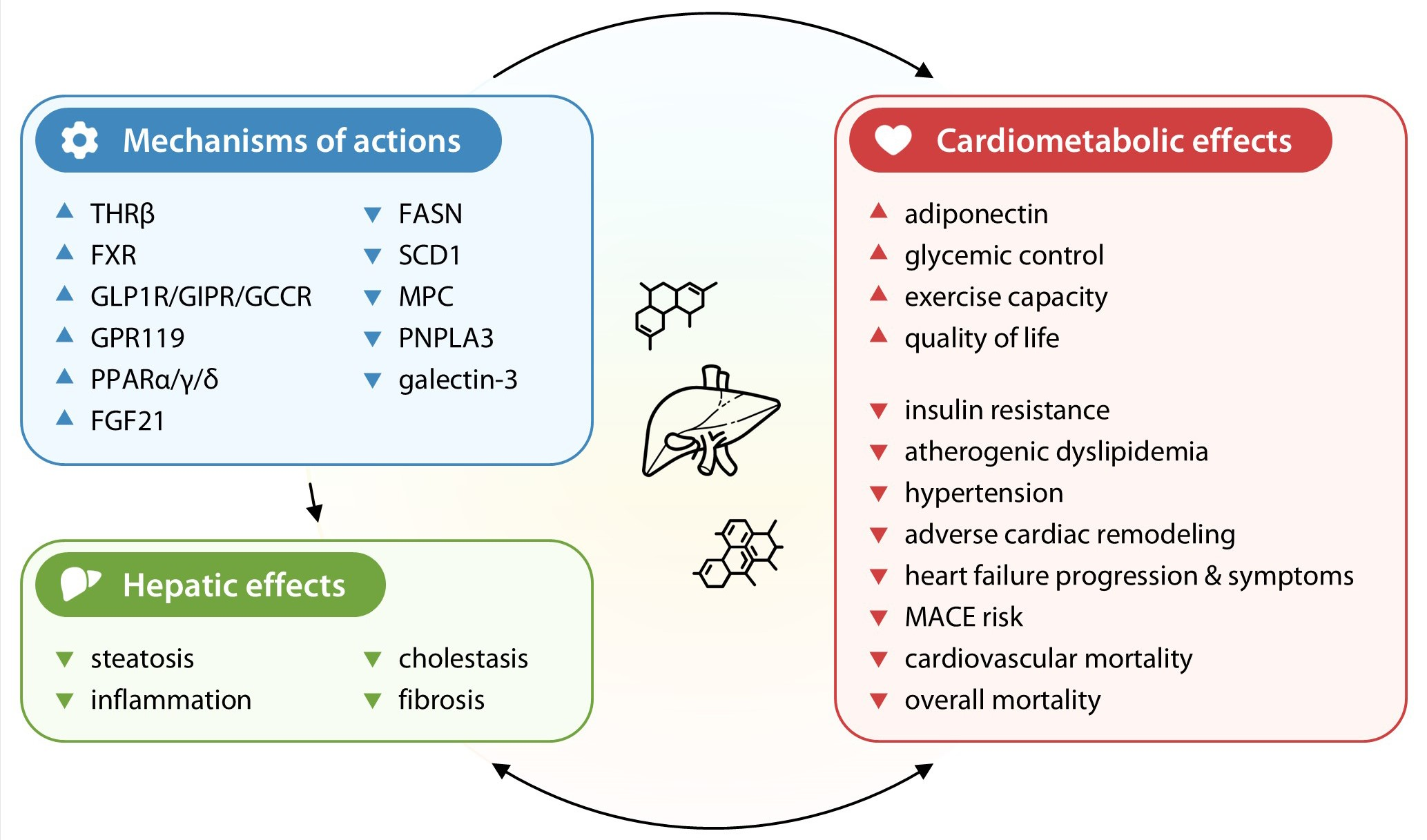
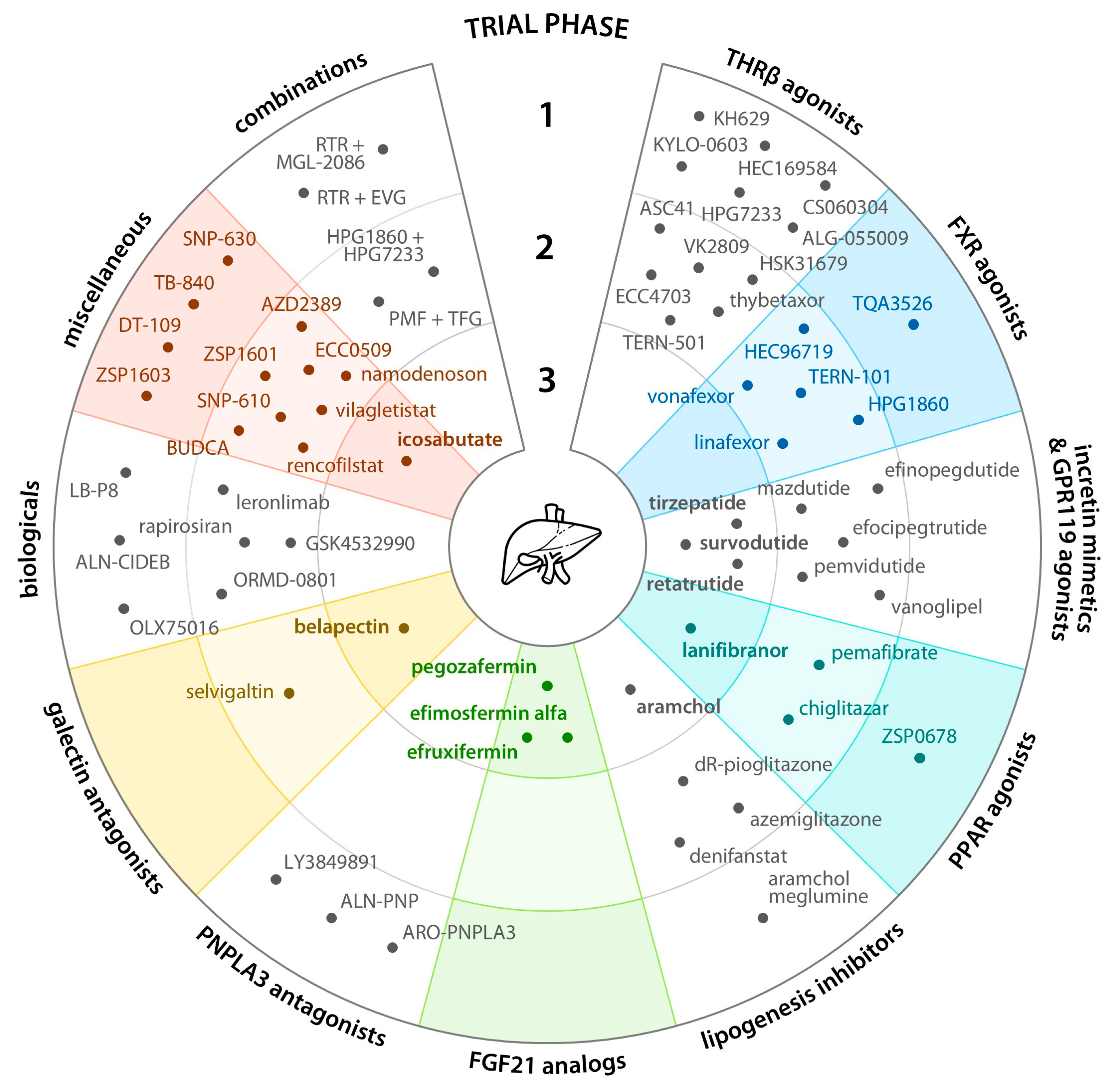
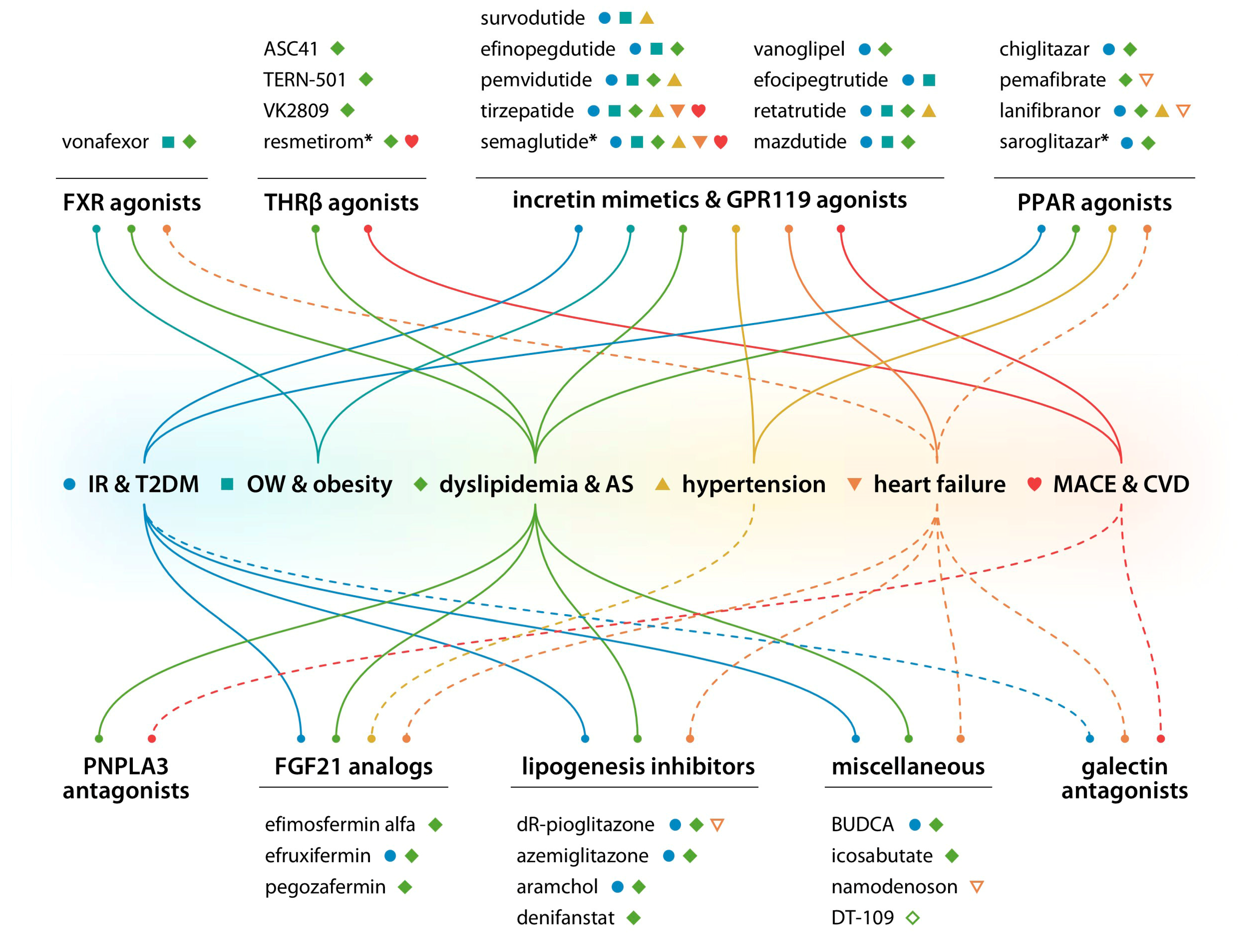
Current Drug Development Pipeline for MASLD and MASH: Focusing on Cardiovascular Comorbidities


Abstract
1. Introduction
2. Methods
3. THRβ Agonists
4. Incretin Mimetics
4.1. GLP1R Agonists
4.2. Dual GLP1R/GIPR Agonists
4.3. Dual GLP1R/GCGR Agonists
4.4. Triple GLP1R/GIPR/GCGR Agonists
4.5. GPR119 Agonists
5. FXR Agonists
6. PPAR Agonists
6.1. PPARα Modulators
6.2. Dual Agonists
6.3. Triple PPAR Agonists
7. Lipogenesis Inhibitors
7.1. Enzyme Inhibitors
7.2. MPC Inhibitors
8. FGF21 Analogs
9. PNPLA3 Antagonists
10. Galectin Antagonists
11. Miscellaneous
12. Conclusions and Future Perspectives
Author Contributions
Funding
Institutional Review Board Statement
Informed Consent Statement
Data Availability Statement
Conflicts of Interest
Abbreviations
| A3AR | A3 adenosine receptor |
| ACC | Acetyl-coenzyme A carboxylase |
| Apo | Apolipoprotein |
| BID | Twice daily |
| BUDCA | Berberine ursodeoxycholate |
| CCR | CC-motif chemokine receptor |
| CoA | Coenzyme A |
| CVD | Cardiovascular disease |
| DGAT | Acylcoenzyme A:diacylglycerol acyltransferase |
| FASN | Fatty acid synthase |
| FDA | US Food & Drug Administration |
| FFAR | Free fatty acid receptor |
| FGF | Fibroblast growth factor |
| FXR | Farnesoid X receptor |
| GCGR | Glucagon receptor |
| GIP | Glucose-dependent insulinotropic peptide |
| GIPR | Glucose-dependent insulinotropic peptide receptor |
| GLP1 | Glucagon-like peptide-1 |
| GLP1R | Glucagon-like peptide-1 receptor |
| GLP1RA | Glucagon-like peptide-1 receptor agonist |
| GPR119 | G protein-coupled receptor 119 |
| HbA1C | Glycated hemoglobin |
| HDL-C | High-density lipoprotein cholesterol |
| HF | Heart failure |
| HFpEF | Heart failure with preserved ejection fraction |
| HOMA-IR | Homeostatic model assessment for insulin resistance |
| Lp(a) | Lipoprotein(a) |
| MACE | Major adverse cardiovascular events |
| MASH | Metabolic dysfunction-associated steatohepatitis |
| MASLD | Metabolic dysfunction-associated steatotic liver disease |
| MPC | Mitochondrial pyruvate carrier |
| mRNA | Messenger ribonucleic acid |
| NLRP3 | NLR family pyrin domain-containing 3 |
| PBC | Primary biliary cholangitis |
| PNPLA3 | Patatin-like phospholipase domain-containing protein 3 |
| PPAR | Peroxisome proliferator-activated receptor |
| PUFA | Polyunsaturated fatty acid |
| QD | Once daily |
| QW | Once weekly |
| RNA | Ribonucleic acid |
| RORα | Retinoid-related orphan receptor α |
| SCD1 | Stearoyl-coenzyme A desaturase 1 |
| SGLT2 | Sodium/glucose cotransporter 2 |
| siRNA | Small interfering ribonucleic acid |
| SPPARMα | Selective peroxisome proliferator-activated receptor α modulator |
| SSAO | Semicarbazide-sensitive amine oxidase |
| T2DM | Type 2 diabetes mellitus |
| TC | Total cholesterol |
| TG | Triglyceride |
| TGFβ1 | Transforming growth factor β1 |
| THRβ | Thyroid hormone receptor β |
| UDCA | Ursodeoxycholic acid |
| VLDL-C | Very low-density lipoprotein cholesterol |
References
- Younossi, Z.M.; Golabi, P.; Paik, J.M.; Henry, A.; Van Dongen, C.; Henry, L. The Global Epidemiology of Nonalcoholic Fatty Liver Disease (NAFLD) and Nonalcoholic Steatohepatitis (NASH): A Systematic Review. Hepatology 2023, 77, 1335–1347. [Google Scholar] [CrossRef] [PubMed]
- Paik, J.M.; Kabbara, K.; Eberly, K.E.; Younossi, Y.; Henry, L.; Younossi, Z.M. Global Burden of NAFLD and Chronic Liver Disease among Adolescents and Young Adults. Hepatology 2022, 75, 1204–1217. [Google Scholar] [CrossRef]
- Younossi, Z.M.; Kalligeros, M.; Henry, L. Epidemiology of Metabolic Dysfunction-Associated Steatotic Liver Disease. Clin. Mol. Hepatol. 2025, 31, S32–S50. [Google Scholar] [CrossRef] [PubMed]
- European Association for the Study of the Liver (EASL); European Association for the Study of Diabetes (EASD); European Association for the Study of Obesity (EASO). EASL–EASD–EASO Clinical Practice Guidelines on the Management of Metabolic Dysfunction-Associated Steatotic Liver Disease (MASLD). J. Hepatol. 2024, 81, 492–542. [Google Scholar] [CrossRef]
- Rinella, M.E.; Lazarus, J.V.; Ratziu, V.; Francque, S.M.; Sanyal, A.J.; Kanwal, F.; Romero, D.; Abdelmalek, M.F.; Anstee, Q.M.; Arab, J.P.; et al. A Multisociety Delphi Consensus Statement on New Fatty Liver Disease Nomenclature. Hepatology 2023, 78, 1966–1986. [Google Scholar] [CrossRef]
- Tilg, H.; Moschen, A.R. Evolution of Inflammation in Nonalcoholic Fatty Liver Disease: The Multiple Parallel Hits Hypothesis. Hepatology 2010, 52, 1836–1846. [Google Scholar] [CrossRef]
- Tilg, H.; Adolph, T.E.; Moschen, A.R. Multiple Parallel Hits Hypothesis in Nonalcoholic Fatty Liver Disease: Revisited After a Decade. Hepatology 2021, 73, 833–842. [Google Scholar] [CrossRef] [PubMed]
- Gou, C.; Zhang, W.; Xu, H.; Zhang, H.; Ding, R.; Zhang, X. Pathogenesis of Metabolic Dysfunction-Associated Steatotic Liver Disease and Donor Liver Damage. ILIVER 2025, 4, 100195. [Google Scholar] [CrossRef] [PubMed]
- Mantovani, A.; Scorletti, E.; Mosca, A.; Alisi, A.; Byrne, C.D.; Targher, G. Complications, Morbidity and Mortality of Nonalcoholic Fatty Liver Disease. Metabolism 2020, 111, 154170. [Google Scholar] [CrossRef]
- Mollace, R.; Longo, S.; Nardin, M.; Tavernese, A.; Musolino, V.; Cardamone, A.; Federici, M. Role of MASLD in CVD: A Review of Emerging Treatment Options. Diabetes Res. Clin. Pract. 2024, 217, 111891. [Google Scholar] [CrossRef]
- Zhou, X.-D.; Lazarus, J.V.; Krittanawong, C.; Targher, G.; Byrne, C.D.; Younossi, Z.M.; Tacke, F.; Chen, Q.-F.; Mantzoros, C.S.; Tilg, H.; et al. Pharmacotherapy for Metabolic Dysfunction-Associated Steatohepatitis: Heart–Liver Co-Management. Lancet Gastroenterol. Hepatol. 2026; Online ahead of print. [CrossRef]
- Drugs@FDA: FDA-Approved Drugs. Available online: https://www.accessdata.fda.gov/scripts/cder/daf/index.cfm (accessed on 27 February 2026).
- Karim, G.; Bansal, M.B. Resmetirom: An Orally Administered, Small-Molecule, Liver-Directed, β-Selective THR Agonist for the Treatment of Non-Alcoholic Fatty Liver Disease and Non-Alcoholic Steatohepatitis. Eur. Endocrinol. 2023, 19, 60. [Google Scholar] [CrossRef]
- Li, J.; Chen, R.; Zhang, J.; He, J.; Wang, Y.; Li, Y. Targeting THR-β for MASLD Treatment: Current Progression and Emerging Prospects. J. Med. Chem. 2026, 69, 823–844. [Google Scholar] [CrossRef]
- Ratziu, V.; Scanlan, T.S.; Bruinstroop, E. Thyroid Hormone Receptor-β Analogues for the Treatment of Metabolic Dysfunction-Associated Steatohepatitis (MASH). J. Hepatol. 2025, 82, 375–387. [Google Scholar] [CrossRef] [PubMed]
- Kommu, S.; Sharma, P.; Shah, M.; Alaoua, M.; Soodi, D.; Berg, R. Abstract 4140504: Effect of Resmetirom on Lipid Panel: Meta-Analysis of Randomized Controlled Trials. Circulation 2024, 150, A4140504. [Google Scholar] [CrossRef]
- Simental-Mendía, L.E.; Simental-Mendía, M.; Barragán-Zúñiga, L.J.; Navarro-Tinoco, L. Effect of Resmetirom on Lipid Profile and Adiponectin Levels. Eur. J. Intern. Med. 2025, 141, 106440. [Google Scholar] [CrossRef] [PubMed]
- Pennisi, G.; Di Maria, G.; Enea, M.; Vaccaro, M.; Celsa, C.; Antonucci, M.; Ciancimino, G.; Ciccioli, C.; Infantino, G.; La Mantia, C.; et al. A Markov Model Unveiling the Impact of Resmetirom on the Natural History of MASLD Patients: A Sistematic Review and Meta-Analysis. Liver Int. 2025, 45, e70056. [Google Scholar] [CrossRef]
- Albuni, M.K.; Khan, F.; Abu-Rumaileh, M.; Rabeeah, S.; Alsabbagh, M.; Abbarh, S.; Sawaf, B.; Hallak, Y.O.; Hijazi, M.; Ghazaleh, S. S2923 Resmetirom Significantly Reduces Mortality and Complications in MASLD: A Matched Cohort Study. Am. J. Gastroenterol. 2025, 120, S628. [Google Scholar] [CrossRef]
- Ogieuhi, I.J.; Olatunji, G.; Kokori, E.; Adeniran, O.; Awosan, W.; Kwentoh, I.; Samuel, O.; Ajimotokan, O.I.; Victoria, O.O.; Moradeyo, A.; et al. Resmetirom in the Management of Metabolic Associated Steatohepatitis (MASH): A Review of Efficacy and Safety Data from Clinical Trials. Egypt. J. Intern. Med. 2025, 37, 78. [Google Scholar] [CrossRef]
- Kudaravalli, P.; Andrews, M.B.; Adler, D.G. An Analysis of Safety Data from the First Year of Resmetirom. Gastroenterol. Rep. 2025, 13, goaf097. [Google Scholar] [CrossRef]
- Noureddin, M.; Alkhouri, N.; Lawitz, E.J.; Kowdley, K.V.; Loomba, R.; Lee, L.; Jones, C.; Schlegel, A.; Marmon, T.; Anderson, K.; et al. TERN-501 Monotherapy and Combination Therapy with TERN-101 in Metabolic Dysfunction-Associated Steatohepatitis: The Randomized Phase 2a DUET Trial. Nat. Med. 2025, 31, 2297–2305. [Google Scholar] [CrossRef]
- Lian, B.; Loomba, R.; Rodriguez, M. Results from the 52 week phase 2b VOYAGE trial of VK2809 in patients with biopsy-confirmed non-alcoholic steato-hepatitis and fibrosis: A randomized, placebo-controlled trial. Gastroenterol. Hepatol. 2024, 20, 13–14. [Google Scholar]
- ClinicalTrials.gov. Available online: https://clinicaltrials.gov/ (accessed on 27 February 2026).
- Ascletis Pharma Inc. Gannex Announces Positive Interim Results from 52-Week Phase II Clinical Trial of Once-Daily ASC41 Tablet in Patients with Biopsy-Confirmed Non-Alcoholic Steatohepatitis. Available online: https://www.prnewswire.com/news-releases/gannex-announces-positive-interim-results-from-52-week-phase-ii-clinical-trial-of-once-daily-asc41-tablet-in-patients-with-biopsy-confirmed-non-alcoholic-steatohepatitis-302024444.html (accessed on 27 February 2026).
- Lu, X.; Wang, S.; Du, Y.; Xie, B.; Chen, Q.; Lin, J.; Chen, B.; Cui, K. KYLO-0603, a Novel Liver-Targeting, Thyroid Hormone Receptor-β Agonist for the Inhibition of MASH Progression. PLoS ONE 2025, 20, e0331768. [Google Scholar] [CrossRef]
- Zhou, J.; Xu, J.; Sun, X. 2183-LB: Metabolic Effects of ECC4703, a Liver Targeting Full THRb Agonist, in Combination with Semaglutide and Tirzepatide in Diet-Induced Obese Mice. Diabetes 2025, 74, 2183-LB. [Google Scholar] [CrossRef]
- Avogaro, A.; Fadini, G.P. Incretins and the Cardiovascular System: Bridging Digestion with Metabolism. Lancet Diabetes Endocrinol. 2025, 13, 790–802. [Google Scholar] [CrossRef] [PubMed]
- Wen, J.; Nadora, D.; Truong, A.; Bernstein, E.; How-Volkman, C.; Razick, A.; Razick, D.; Karabala, M.; Frezza, E. Next Generation Dual GLP-1/GIP, GLP-1/Glucagon, and Triple GLP-1/GIP/Glucagon Agonists: A Literature Review. Nutr. Metab. Cardiovasc. Dis. 2025, 35, 104213. [Google Scholar] [CrossRef] [PubMed]
- Wang, T.-Y.; Yang, Q.; Cheng, X.-Y.; Ding, J.-C.; Hu, P.-F. Beyond Weight Loss: The Potential of Glucagon-like Peptide-1 Receptor Agonists for Treating Heart Failure with Preserved Ejection Fraction. Heart Fail. Rev. 2024, 30, 17–38. [Google Scholar] [CrossRef]
- Nauck, M.A.; Tuttle, K.R.; Tschöp, M.H.; Blüher, M. Glucagon-like Receptor Agonists and next-Generation Incretin-Based Medications: Metabolic, Cardiovascular, and Renal Benefits. Lancet 2026, 407, 892–908. [Google Scholar] [CrossRef]
- Njei, B.; Al-Ajlouni, Y.; Lemos, S.Y.; Ugwendum, D.; Ameyaw, P.; Njei, L.-P.; Boateng, S. Efficacy and Safety of GLP-1 Receptor Agonists in Patients with Metabolic Dysfunction-Associated Steatotic Liver Disease: A Systematic Review and Meta-Analysis of Randomized Controlled Trials. Cureus 2024, 16, e71366. [Google Scholar] [CrossRef]
- Siranart, N.; Thompson, C.C.; Jirapinyo, P. Effect of Glucagon-like Peptide-1 Receptor Agonists on Histologic MASH: A Meta-Analysis of Randomized Controlled Trials. Hepatol. Commun. 2026, 10, e0871. [Google Scholar] [CrossRef] [PubMed]
- Dos Santos Borges, R.; Abreu, E.S.; Gosch Berton, G.; Haikal De Paula, L.; Conegundes, A.F.; Borges Martins, J.M.; Albuquerque Barbosa Martins, M.; Dahbour, A.S.; Vanzin Fernandes, M.; Abdelmalek, M.F. Efficacy and Safety of GLP-1 Receptor Agonists in MASH with Fibrosis: A Systematic Review and Meta-Analysis. JHEP Rep. 2025, 8, 101708. [Google Scholar] [CrossRef]
- Gu, Y.; Sun, L.; He, Y.; Yang, L.; Deng, C.; Zhou, R.; Kong, T.; Zhang, W.; Chen, Y.; Li, J.; et al. Comparative Efficacy of Glucagon-like Peptide 1 (GLP-1) Receptor Agonists, Pioglitazone and Vitamin E for Liver Histology among Patients with Nonalcoholic Fatty Liver Disease: Systematic Review and Pilot Network Meta-Analysis of Randomized Controlled Trials. Expert Rev. Gastroenterol. Hepatol. 2023, 17, 273–282. [Google Scholar] [CrossRef] [PubMed]
- Kosiborod, M.N.; Deanfield, J.; Pratley, R.; Borlaug, B.A.; Butler, J.; Davies, M.J.; Emerson, S.S.; Kahn, S.E.; Kitzman, D.W.; Lingvay, I.; et al. Semaglutide versus Placebo in Patients with Heart Failure and Mildly Reduced or Preserved Ejection Fraction: A Pooled Analysis of the SELECT, FLOW, STEP-HFpEF, and STEP-HFpEF DM Randomised Trials. Lancet 2024, 404, 949–961. [Google Scholar] [CrossRef]
- Kosiborod, M.N.; Abildstrøm, S.Z.; Borlaug, B.A.; Butler, J.; Rasmussen, S.; Davies, M.; Hovingh, G.K.; Kitzman, D.W.; Lindegaard, M.L.; Møller, D.V.; et al. Semaglutide in Patients with Heart Failure with Preserved Ejection Fraction and Obesity. N. Engl. J. Med. 2023, 389, 1069–1084. [Google Scholar] [CrossRef]
- Solomon, S.D.; Ostrominski, J.W.; Wang, X.; Shah, S.J.; Borlaug, B.A.; Butler, J.; Davies, M.J.; Kitzman, D.W.; Verma, S.; Abildstrøm, S.Z.; et al. Effect of Semaglutide on Cardiac Structure and Function in Patients with Obesity-Related Heart Failure. J. Am. Coll. Cardiol. 2024, 84, 1587–1602. [Google Scholar] [CrossRef]
- Kosiborod, M.N.; Petrie, M.C.; Borlaug, B.A.; Butler, J.; Davies, M.J.; Hovingh, G.K.; Kitzman, D.W.; Møller, D.V.; Treppendahl, M.B.; Verma, S.; et al. Semaglutide in Patients with Obesity-Related Heart Failure and Type 2 Diabetes. N. Engl. J. Med. 2024, 390, 1394–1407. [Google Scholar] [CrossRef] [PubMed]
- Butler, J.; Shah, S.J.; Petrie, M.C.; Borlaug, B.A.; Abildstrøm, S.Z.; Davies, M.J.; Hovingh, G.K.; Kitzman, D.W.; Møller, D.V.; Verma, S.; et al. Semaglutide versus Placebo in People with Obesity-Related Heart Failure with Preserved Ejection Fraction: A Pooled Analysis of the STEP-HFpEF and STEP-HFpEF DM Randomised Trials. Lancet 2024, 403, 1635–1648. [Google Scholar] [CrossRef] [PubMed]
- Deanfield, J.; Verma, S.; Scirica, B.M.; Kahn, S.E.; Emerson, S.S.; Ryan, D.; Lingvay, I.; Colhoun, H.M.; Plutzky, J.; Kosiborod, M.N.; et al. Semaglutide and Cardiovascular Outcomes in Patients with Obesity and Prevalent Heart Failure: A Prespecified Analysis of the SELECT Trial. Lancet 2024, 404, 773–786. [Google Scholar] [CrossRef] [PubMed]
- Pratley, R.E.; Tuttle, K.R.; Rossing, P.; Rasmussen, S.; Perkovic, V.; Nielsen, O.W.; Mann, J.F.E.; MacIsaac, R.J.; Kosiborod, M.N.; Kamenov, Z.; et al. Effects of Semaglutide on Heart Failure Outcomes in Diabetes and Chronic Kidney Disease in the FLOW Trial. J. Am. Coll. Cardiol. 2024, 84, 1615–1628. [Google Scholar] [CrossRef]
- Verma, S.; Butler, J.; Borlaug, B.A.; Davies, M.J.; Kitzman, D.W.; Petrie, M.C.; Shah, S.J.; Jensen, T.J.; Rasmussen, S.; Rönnbäck, C.; et al. Atrial Fibrillation and Semaglutide Effects in Obesity-Related Heart Failure with Preserved Ejection Fraction. J. Am. Coll. Cardiol. 2024, 84, 1603–1614. [Google Scholar] [CrossRef]
- Shah, S.J.; Sharma, K.; Borlaug, B.A.; Butler, J.; Davies, M.; Kitzman, D.W.; Petrie, M.C.; Verma, S.; Patel, S.; Chinnakondepalli, K.M.; et al. Semaglutide and Diuretic Use in Obesity-Related Heart Failure with Preserved Ejection Fraction: A Pooled Analysis of the STEP-HFpEF and STEP-HFpEF-DM Trials. Eur. Heart J. 2024, 45, 3254–3269. [Google Scholar] [CrossRef]
- Miranda, S.; Choudhari, J.; Chauhan, N.; Parmar, M.S. Impact of Semaglutide on Lipid Profiles in Overweight and Obese Non-Diabetic Adults: A Systematic Review and Meta-Analysis of Randomized Controlled Trials. Eur. J. Pharmacol. 2025, 1003, 177953. [Google Scholar] [CrossRef] [PubMed]
- Kennedy, C.; Hayes, P.; Salama, S.; Hennessy, M.; Fogacci, F. The Effect of Semaglutide on Blood Pressure in Patients without Diabetes: A Systematic Review and Meta-Analysis. J. Clin. Med. 2023, 12, 772. [Google Scholar] [CrossRef] [PubMed]
- Cleto, A.S.; Schirlo, J.M.; Beltrame, M.; Gomes, V.H.O.; Acras, I.H.; Neiverth, G.S.; Silva, B.B.; Juliatto, B.M.S.; Machozeki, J.; Martins, C.M. Semaglutide Effects on Safety and Cardiovascular Outcomes in Patients with Overweight or Obesity: A Systematic Review and Meta-Analysis. Int. J. Obes. 2025, 49, 21–30. [Google Scholar] [CrossRef]
- Cruz Akabane, M.A.; Mazetto, R.; Ribeiro, I.; Cavalcante, D.; Barbosa, I. Abstract 4145254: Effects of Semaglutide on Safety Outcomes in Patients with Type 2 Diabetes Mellitus And High Cardiovascular Risk: A Meta-Analysis Of Randomized Controlled Trials And Systematic Review. Circulation 2024, 150, A4145254. [Google Scholar] [CrossRef]
- Armstrong, M.J.; Gaunt, P.; Aithal, G.P.; Barton, D.; Hull, D.; Parker, R.; Hazlehurst, J.M.; Guo, K.; Abouda, G.; Aldersley, M.A.; et al. Liraglutide Safety and Efficacy in Patients with Non-Alcoholic Steatohepatitis (LEAN): A Multicentre, Double-Blind, Randomised, Placebo-Controlled Phase 2 Study. Lancet 2016, 387, 679–690. [Google Scholar] [CrossRef]
- Dufour, J.-F.; Caussy, C.; Loomba, R. Combination Therapy for Non-Alcoholic Steatohepatitis: Rationale, Opportunities and Challenges. Gut 2020, 69, 1877–1884. [Google Scholar] [CrossRef] [PubMed]
- Wu, J.-Y.; Hsu, W.-H.; Kuo, C.-C.; Tsai, Y.-W.; Liu, T.-H.; Huang, P.-Y.; Chuang, M.-H.; Hung, K.-C.; Yu, T.; Lai, C.-C. A Retrospective Analysis of Combination Therapy with GLP-1 Receptor Agonists and SGLT2 Inhibitors versus SGLT2 Inhibitor Monotherapy in Patients with MASLD. Nat. Commun. 2025, 16, 7459. [Google Scholar] [CrossRef]
- Loomba, R.; Hartman, M.L.; Lawitz, E.J.; Vuppalanchi, R.; Boursier, J.; Bugianesi, E.; Yoneda, M.; Behling, C.; Cummings, O.W.; Tang, Y.; et al. Tirzepatide for Metabolic Dysfunction–Associated Steatohepatitis with Liver Fibrosis. N. Engl. J. Med. 2024, 391, 299–310. [Google Scholar] [CrossRef] [PubMed]
- Lv, X.; Wang, H.; Chen, C.; Zhao, Y.; Li, K.; Wang, Y.; Wang, L.; Fu, S.; Liu, J. The Effect of Tirzepatide on Weight, Lipid Metabolism and Blood Pressure in Overweight/Obese Patients with Type 2 Diabetes Mellitus: A Systematic Review and Meta-Analysis. Diabetes Metab. Syndr. Obes. 2024, 17, 701–714. [Google Scholar] [CrossRef]
- Sumithran, P.; Russell, A.W.; Zoungas, S. Cardiovascular Effects of Tirzepatide. J. Endocrinol. 2025, 264, e240259. [Google Scholar] [CrossRef]
- Nicholls, S.J.; Pavo, I.; Bhatt, D.L.; Buse, J.B.; Del Prato, S.; Kahn, S.E.; Lincoff, A.M.; McGuire, D.K.; Miller, D.; Nauck, M.A.; et al. Cardiovascular Outcomes with Tirzepatide versus Dulaglutide in Type 2 Diabetes. N. Engl. J. Med. 2025, 393, 2409–2420. [Google Scholar] [CrossRef]
- Packer, M.; Zile, M.R.; Kramer, C.M.; Baum, S.J.; Litwin, S.E.; Menon, V.; Ge, J.; Weerakkody, G.J.; Ou, Y.; Bunck, M.C.; et al. Tirzepatide for Heart Failure with Preserved Ejection Fraction and Obesity. N. Engl. J. Med. 2025, 392, 427–437. [Google Scholar] [CrossRef] [PubMed]
- Romero-Gómez, M.; Lawitz, E.; Shankar, R.R.; Chaudhri, E.; Liu, J.; Lam, R.L.H.; Kaufman, K.D.; Engel, S.S.; Bruzone, S.O.; Coronel, M.J.; et al. A Phase IIa Active-Comparator-Controlled Study to Evaluate the Efficacy and Safety of Efinopegdutide in Patients with Non-Alcoholic Fatty Liver Disease. J. Hepatol. 2023, 79, 888–897. [Google Scholar] [CrossRef] [PubMed]
- Winther, J.B.; Holst, J.J. Glucagon Agonism in the Treatment of Metabolic Diseases Including Type 2 Diabetes Mellitus and Obesity. Diabetes Obes. Metab. 2024, 26, 3501–3512. [Google Scholar] [CrossRef]
- Browne, S.K.; Suschak, J.J.; Tomah, S.; Gutierrez, J.A.; Yang, J.; Georges, B.; Roberts, M.S.; Harris, M.S. Safety and Efficacy of 24 Weeks of Pemvidutide in Metabolic Dysfunction-Associated Steatotic Liver Disease: A Randomized, Controlled Clinical Trial. JHEP Rep. 2025, 7, 101483. [Google Scholar] [CrossRef]
- Noureddin, M.; Harrison, S.A.; Loomba, R.; Alkhouri, N.; Chalasani, N.; Sheikh, M.Y.; Tomah, S.; Gutierrez, J.A.; Urbina, S.; Suschak, J.J.; et al. Safety and Efficacy of Weekly Pemvidutide versus Placebo for Metabolic Dysfunction-Associated Steatohepatitis (IMPACT): 24-Week Results from a Multicentre, Randomised, Double-Blind, Phase 2b Study. Lancet 2025, 406, 2644–2655. [Google Scholar] [CrossRef]
- Plutzky, J.; Harris, M.S.S.; Alonso, C.; Suschak, J.; Noor, M.; Ortiz, P.; Georges, B.; Rader, D.J.; Roberts, S.S.; Browne, S.K. Abstract 13440: Effect of Pemvidutide (ALT-801), a Novel GLP-1/Glucagon Dual Receptor Agonist, on Pathogenic Lipid Mediators. Circulation 2022, 146, A13440. [Google Scholar] [CrossRef]
- Sanyal, A.J.; Bedossa, P.; Fraessdorf, M.; Neff, G.W.; Lawitz, E.; Bugianesi, E.; Anstee, Q.M.; Hussain, S.A.; Newsome, P.N.; Ratziu, V.; et al. A Phase 2 Randomized Trial of Survodutide in MASH and Fibrosis. N. Engl. J. Med. 2024, 391, 311–319. [Google Scholar] [CrossRef] [PubMed]
- Le Roux, C.W.; Steen, O.; Lucas, K.J.; Startseva, E.; Unseld, A.; Hennige, A.M. Glucagon and GLP-1 Receptor Dual Agonist Survodutide for Obesity: A Randomised, Double-Blind, Placebo-Controlled, Dose-Finding Phase 2 Trial. Lancet Diabetes Endocrinol. 2024, 12, 162–173. [Google Scholar] [CrossRef] [PubMed]
- Jastreboff, A.M.; Kaplan, L.M.; Frías, J.P.; Wu, Q.; Du, Y.; Gurbuz, S.; Coskun, T.; Haupt, A.; Milicevic, Z.; Hartman, M.L. Triple–Hormone-Receptor Agonist Retatrutide for Obesity—A Phase 2 Trial. N. Engl. J. Med. 2023, 389, 514–526. [Google Scholar] [CrossRef]
- Sanyal, A.J.; Kaplan, L.M.; Frias, J.P.; Brouwers, B.; Wu, Q.; Thomas, M.K.; Harris, C.; Schloot, N.C.; Du, Y.; Mather, K.J.; et al. Triple Hormone Receptor Agonist Retatrutide for Metabolic Dysfunction-Associated Steatotic Liver Disease: A Randomized Phase 2a Trial. Nat. Med. 2024, 30, 2037–2048. [Google Scholar] [CrossRef] [PubMed]
- Abdelmalek, M.; Choi, J.; Kim, Y.; Seo, K.; Hompesch, M.; Baek, S. HM15211, a Novel GLP-1/GIP/Glucagon Triple-Receptor Co-Agonist Significantly Reduces Liver Fat and Body Weight in Obese Subjects with Non-Alcoholic Fatty Liver Disease: A Phase 1b/2a, Multi-Center, Randomized, Placebo-Controlled Trial. J. Hepatol. 2020, 73, S124. [Google Scholar] [CrossRef]
- Yang, J.W.; Kim, H.S.; Im, J.H.; Kim, J.W.; Jun, D.W.; Lim, S.C.; Lee, K.; Choi, J.M.; Kim, S.K.; Kang, K.W. GPR119: A Promising Target for Nonalcoholic Fatty Liver Disease. FASEB J. 2016, 30, 324–335. [Google Scholar] [CrossRef]
- Kim, M.-K.; Loomba, R.; Kim, H.H.; Chae, Y.; Homolka, R.; Lee, J.E.; Lee, K.; Fang, C.; Yoo, B.; Kim, S.-J. LBP-005 DA-1241, a GPR119 Agonist, Demonstrates Hepatoprotective and Glucose-Regulating Effects in a 16-Week Randomized Placebocontrolled Trial in Presumed Metabolic Dysfunction-Associated Steatohepatitis (MASH) Patients. J. Hepatol. 2025, 82, S72. [Google Scholar] [CrossRef]
- Lewinska, M.; Nielsen, M.H.; Pors, S.; Hansen, H.B.; Jung, I.H.; Kim, H.H.; Feigh, M.; Kim, M.-K. THU-232 Additive Hepatoprotective Effects of DA-1241, a Novel GPR119 Agonist, in Combination with Semaglutide in the GAN Diet-Induced Obese and Biopsy-Confirmed Mouse Model of MASH. J. Hepatol. 2024, 80, S576. [Google Scholar] [CrossRef]
- Chae, Y.; Kim, T.-H.; Lee, S.J.; Jung, I.-H.; Kim, M.-K.; Kim, H.H. 2158-LB: Additive Hepatoprotective Effects of DA-1241, a GPR119 Agonist, in Combination with Efruxifermin in a Diet-Induced Obese and Biopsy-Confirmed Mouse Model of MASH. Diabetes 2025, 74, 2158-LB. [Google Scholar] [CrossRef]
- Jiao, Y.; Lu, Y.; Li, X. Farnesoid X Receptor: A Master Regulator of Hepatic Triglyceride and Glucose Homeostasis. Acta Pharmacol. Sin. 2015, 36, 44–50. [Google Scholar] [CrossRef]
- Almeqdadi, M.; Gordon, F.D. Farnesoid X Receptor Agonists: A Promising Therapeutic Strategy for Gastrointestinal Diseases. Gastro Hep Adv. 2024, 3, 344–352. [Google Scholar] [CrossRef]
- Ratziu, V.; Harrison, S.A.; Loustaud-Ratti, V.; Bureau, C.; Lawitz, E.; Abdelmalek, M.; Alkhouri, N.; Francque, S.; Girma, H.; Darteil, R.; et al. Hepatic and Renal Improvements with FXR Agonist Vonafexor in Individuals with Suspected Fibrotic NASH. J. Hepatol. 2023, 78, 479–492. [Google Scholar] [CrossRef]
- Alkhouri, N.; Liu, Y.; Liang, N.; Zhai, P.; Wu, S.; Zhou, X.; Xu, M.; Liu, Q.; Harrison, S. HPG1860 in Patients with NASH: A Phase II Double-Blind, Placebo-Controlled, Dose-Ranging Study. J. Hepatol. 2023, 78, S812. [Google Scholar] [CrossRef]
- Kumar, J.; Hasan, M.; Mohsin, S.; Alzaher, M.H.; Nagar, T.; Jamil, A.; Ahmed, A.; Lavu, V.K.; Kumar, S. Assessing the Efficacy of Farnesoid X Receptor Agonists in the Management of Metabolic Dysfunction-Associated Steatotic Liver Disease: A Systematic Review and Meta-Analysis. Clin. Res. Hepatol. Gastroenterol. 2025, 49, 102530. [Google Scholar] [CrossRef]
- Xia, Y.; Zhang, F.; Zhao, S.; Li, Y.; Chen, X.; Gao, E.; Xu, X.; Xiong, Z.; Zhang, X.; Zhang, J.; et al. Adiponectin Determines Farnesoid X Receptor Agonism-Mediated Cardioprotection against Post-Infarction Remodelling and Dysfunction. Cardiovasc. Res. 2018, 114, 1335–1349. [Google Scholar] [CrossRef]
- Han, S.Y.; Song, H.K.; Cha, J.J.; Han, J.Y.; Kang, Y.S.; Cha, D.R. Farnesoid X Receptor (FXR) Agonist Ameliorates Systemic Insulin Resistance, Dysregulation of Lipid Metabolism, and Alterations of Various Organs in a Type 2 Diabetic Kidney Animal Model. Acta Diabetol. 2021, 58, 495–503. [Google Scholar] [CrossRef]
- Cao, S.; Yang, X.; Zhang, Z.; Wu, J.; Chi, B.; Chen, H.; Yu, J.; Feng, S.; Xu, Y.; Li, J.; et al. Discovery of a Tricyclic Farnesoid X Receptor Agonist HEC96719, a Clinical Candidate for Treatment of Non-Alcoholic Steatohepatitis. Eur. J. Med. Chem. 2022, 230, 114089. [Google Scholar] [CrossRef]
- Vignozzi, L.; Morelli, A.; Cellai, I.; Filippi, S.; Comeglio, P.; Sarchielli, E.; Maneschi, E.; Vannelli, G.B.; Adorini, L.; Maggi, M. Cardiopulmonary Protective Effects of the Selective FXR Agonist Obeticholic Acid in the Rat Model of Monocrotaline-Induced Pulmonary Hypertension. J. Steroid Biochem. Mol. Biol. 2017, 165, 277–292. [Google Scholar] [CrossRef] [PubMed]
- Hambruch, E.; Miyazaki-Anzai, S.; Hahn, U.; Matysik, S.; Boettcher, A.; Perović-Ottstadt, S.; Schlüter, T.; Kinzel, O.; Krol, H.D.; Deuschle, U.; et al. Synthetic Farnesoid X Receptor Agonists Induce High-Density Lipoprotein-Mediated Transhepatic Cholesterol Efflux in Mice and Monkeys and Prevent Atherosclerosis in Cholesteryl Ester Transfer Protein Transgenic Low-Density Lipoprotein Receptor (−/−) Mice. J. Pharmacol. Exp. Ther. 2012, 343, 556–567. [Google Scholar] [CrossRef] [PubMed]
- Ji, L.; Song, W.; Fang, H.; Li, W.; Geng, J.; Wang, Y.; Guo, L.; Cai, H.; Yang, T.; Li, H.; et al. Efficacy and Safety of Chiglitazar, a Novel Peroxisome Proliferator-Activated Receptor Pan-Agonist, in Patients with Type 2 Diabetes: A Randomized, Double-Blind, Placebo-Controlled, Phase 3 Trial (CMAP). Sci. Bull. 2021, 66, 1571–1580. [Google Scholar] [CrossRef] [PubMed]
- Fruchart, J.-C.; Santos, R.D.; Aguilar-Salinas, C.; Aikawa, M.; Al Rasadi, K.; Amarenco, P.; Barter, P.J.; Ceska, R.; Corsini, A.; Després, J.-P.; et al. The Selective Peroxisome Proliferator-Activated Receptor Alpha Modulator (SPPARMα) Paradigm: Conceptual Framework and Therapeutic Potential: A Consensus Statement from the International Atherosclerosis Society (IAS) and the Residual Risk Reduction Initiative (R3i) Foundation. Cardiovasc. Diabetol. 2019, 18, 71. [Google Scholar] [CrossRef]
- Ono, H.; Atsukawa, M.; Tsubota, A.; Arai, T.; Suzuki, K.; Higashi, T.; Kitamura, M.; Shioda-Koyano, K.; Kawano, T.; Yoshida, Y.; et al. Impact of Pemafibrate in Patients with Metabolic Dysfunction-associated Steatotic Liver Disease Complicated by Dyslipidemia: A Single-arm Prospective Study. JGH Open 2024, 8, e13057. [Google Scholar] [CrossRef]
- Das Pradhan, A.; Glynn, R.J.; Fruchart, J.-C.; MacFadyen, J.G.; Zaharris, E.S.; Everett, B.M.; Campbell, S.E.; Oshima, R.; Amarenco, P.; Blom, D.J.; et al. Triglyceride Lowering with Pemafibrate to Reduce Cardiovascular Risk. N. Engl. J. Med. 2022, 387, 1923–1934. [Google Scholar] [CrossRef]
- Hida, Y.; Imamura, T.; Kinugawa, K. Pemafibrate and Cardiac Reverse Remodeling in Patients with Systolic Heart Failure Receiving Guideline-Directed Medical Therapy. J. Cardiol. Cases 2025, 31, 42–45. [Google Scholar] [CrossRef] [PubMed]
- Yamamoto, K.; Ohta, Y.; Taguchi, A.; Akiyama, M.; Nakabayashi, H.; Nagao, Y.; Ryoko, H.; Wada, Y.; Yamamoto, T.; Yano, M.; et al. Effects of Pemafibrate on Left Ventricular Diastolic Function in Patients with Type 2 Diabetes Mellitus: A Pilot Study. Diabetol. Int. 2023, 14, 434–439. [Google Scholar] [CrossRef] [PubMed]
- Katakami, N.; Mita, T.; Masuda, T.; Sato, Y.; Watada, H.; Shimomura, I. Effect of Tofogliflozin on Obesity-Related Health Problems in Patients with Type 2 Diabetes and Overweight or Obesity—A Post-Hoc Sub-Analysis of the UTOPIA Study. Diabetol. Int. 2025, 16, 756–769. [Google Scholar] [CrossRef] [PubMed]
- Uchinuma, H.; Matsushita, M.; Tanahashi, M.; Suganami, H.; Utsunomiya, K.; Kaku, K.; Tsuchiya, K. Post-hoc Analysis of the Tofogliflozin Post-marketing Surveillance Study (J- STEP/LT): Tofogliflozin Improves Liver Function in Type 2 Diabetes Patients Regardless of BMI. J. Diabetes Investig. 2025, 16, 615–628. [Google Scholar] [CrossRef]
- Zhang, J.; Li, Y.; Yang, L.; Ma, N.; Qian, S.; Chen, Y.; Duan, Y.; Xiang, X.; He, Y. New Advances in Drug Development for Metabolic Dysfunction-Associated Diseases and Alcohol-Associated Liver Disease. Cell Biosci. 2024, 14, 90. [Google Scholar] [CrossRef]
- Gawrieh, S.; Noureddin, M.; Loo, N.; Mohseni, R.; Awasty, V.; Cusi, K.; Kowdley, K.V.; Lai, M.; Schiff, E.; Parmar, D.; et al. Saroglitazar, a PPAR-α/γ Agonist, for Treatment of NAFLD: A Randomized Controlled Double-Blind Phase 2 Trial. Hepatology 2021, 74, 1809–1824. [Google Scholar] [CrossRef]
- Menezes Junior, A.D.S.; Oliveira, V.M.R.; Oliveira, I.C.; De Sousa, A.M.; Santana, A.J.P.; Carvalho, D.P.C.; Paro Piai, R.F.; Matos, F.H.; De Paiva, A.M.; Reis, G.B.B. Dual PPRαϒ Agonists for the Management of Dyslipidemia: A Systematic Review and Meta-Analysis of Randomized Clinical Trials. J. Clin. Med. 2023, 12, 5674. [Google Scholar] [CrossRef]
- Lincoff, A.M.; Tardif, J.-C.; Schwartz, G.G.; Nicholls, S.J.; Rydén, L.; Neal, B.; Malmberg, K.; Wedel, H.; Buse, J.B.; Henry, R.R.; et al. Effect of Aleglitazar on Cardiovascular Outcomes After Acute Coronary Syndrome in Patients with Type 2 Diabetes Mellitus: The AleCardio Randomized Clinical Trial. JAMA 2014, 311, 1515. [Google Scholar] [CrossRef]
- Goyal, N.P.; Mencin, A.; Newton, K.P.; Durelle, J.; Carrier, C.; Ugalde-Nicalo, P.; Noel, B.; Mouton, J.; Vargas, D.; Magrez, D.; et al. An Open Label, Randomized, Multicenter Study of Elafibranor in Children with Nonalcoholic Steatohepatitis. J. Pediatr. Gastroenterol. Nutr. 2023, 77, 160–165. [Google Scholar] [CrossRef]
- Salamat Ali, J.; Salamat Ali, T.; Hasibuzzaman, A. Latest FDA Approved Drug Elafibranor (Iqirvo): A Novel Prospect for Treatment of Primary Biliary Cholangitis. Ann. Med. Surg. 2025, 87, 30–32. [Google Scholar] [CrossRef]
- Briand, F.; Maupoint, J.; Brousseau, E.; Breyner, N.; Bouchet, M.; Costard, C.; Leste-Lasserre, T.; Petitjean, M.; Chen, L.; Chabrat, A.; et al. Elafibranor Improves Diet-Induced Nonalcoholic Steatohepatitis Associated with Heart Failure with Preserved Ejection Fraction in Golden Syrian Hamsters. Metabolism 2021, 117, 154707. [Google Scholar] [CrossRef] [PubMed]
- Van Den Hoek, A.M.; Verschuren, L.; Caspers, M.P.M.; Worms, N.; Menke, A.L.; Princen, H.M.G. Beneficial Effects of Elafibranor on NASH in E3L.CETP Mice and Differences between Mice and Men. Sci. Rep. 2021, 11, 5050. [Google Scholar] [CrossRef] [PubMed]
- Cooreman, M.P.; Butler, J.; Giugliano, R.P.; Zannad, F.; Dzen, L.; Huot-Marchand, P.; Baudin, M.; Beard, D.R.; Junien, J.-L.; Broqua, P.; et al. The Pan-PPAR Agonist Lanifibranor Improves Cardiometabolic Health in Patients with Metabolic Dysfunction-Associated Steatohepatitis. Nat. Commun. 2024, 15, 3962. [Google Scholar] [CrossRef] [PubMed]
- Francque, S.M.; Bedossa, P.; Ratziu, V.; Anstee, Q.M.; Bugianesi, E.; Sanyal, A.J.; Loomba, R.; Harrison, S.A.; Balabanska, R.; Mateva, L.; et al. A Randomized, Controlled Trial of the Pan-PPAR Agonist Lanifibranor in NASH. N. Engl. J. Med. 2021, 385, 1547–1558. [Google Scholar] [CrossRef]
- Briand, F.; Dubroca, C.; Wettstein, G.; Grasset, E.; Breyner, N.; Bigot, C.; Assaly, R.; Broqua, P.; Sulpice, T. Lanifibranor and Semaglutide Demonstrate Multiple Metabolic Benefits in Free-Choice Diet Induced Obese Hamster Models of MASH and MetALD. Eur. J. Pharmacol. 2025, 1003, 177945. [Google Scholar] [CrossRef]
- Derrett-Smith, E.; Clark, K.E.N.; Shiwen, X.; Abraham, D.J.; Hoyles, R.K.; Lacombe, O.; Broqua, P.; Junien, J.L.; Konstantinova, I.; Ong, V.H.; et al. The Pan-PPAR Agonist Lanifibranor Reduces Development of Lung Fibrosis and Attenuates Cardiorespiratory Manifestations in a Transgenic Mouse Model of Systemic Sclerosis. Arthritis Res. Ther. 2021, 23, 234. [Google Scholar] [CrossRef]
- Heldens, A.; Casteleyn, C.; Onghena, L.; Antwi, M.; Neyt, S.; Descamps, B.; Vanhove, C.; Verhelst, X.; Raevens, S.; Van Vlierberghe, H.; et al. The Pan-PPAR Agonist Lanifibranor Reduces Portal Pressure Independent of Fibrosis Reduction through the Splanchnic Vasculature. Biomed. Pharmacother. 2025, 183, 117826. [Google Scholar] [CrossRef]
- Lyu, X.; Gao, Y.; Zhu, L.; Yan, G.; Wang, C.; Luo, Z. Efficacy and safety of chiglitazar in type 2 diabetes: A multi-center, randomized, double-blind, and parallel group clinical trial. Chin. J. Diabetes Mellit. 2019, 11, 334–340. [Google Scholar]
- Gao, L.; Ji, L.; Yan, X.; Cheng, Z.; Zhang, X.; Sun, W.; Ma, J.; Song, W.; Liu, Y.; Lin, X.; et al. Efficacy and Safety of Chiglitazar Add-on to Metformin in Type 2 Diabetes Mellitus (RECAM Study). Diabetes Obes. Metab. 2025, 27, 6243–6253. [Google Scholar] [CrossRef]
- Li, M.H.; Chen, W.; Wang, L.L.; Sun, J.L.; Zhou, L.; Shi, Y.C.; Wang, C.H.; Zhong, B.H.; Shi, W.G.; Guo, Z.W. RLA8—A New and Highly Effective Quadruple PPAR-α/γ/δ and GPR40 Agonist to Reverse Nonalcoholic Steatohepatitis and Fibrosis. J. Pharmacol. Exp. Ther. 2019, 369, 67–77. [Google Scholar] [CrossRef]
- Zhou, Z.; Ren, Q.; Jiao, S.; Cai, Z.; Geng, X.; Deng, L.; Wang, B.; Hu, L.; Zhang, L.; Yang, Y.; et al. Discovery of New and Highly Effective Quadruple FFA1 and PPARα/γ/δ Agonists as Potential Anti-Fatty Liver Agents. Eur. J. Med. Chem. 2022, 229, 114061. [Google Scholar] [CrossRef] [PubMed]
- Liskiewicz, D.; Novikoff, A.; Khalil, A.; Campbell, J.; Serrano, C.; Douros, J.; Kusminski, C.; Wean, J.; Scherer, P.; Seeley, R.; et al. An unimolecular GLP-1R/GIPR/Pan-PPAR quintuple agonist eliminates obesity and insulin resistance in mice. Diabetologia 2025, 68, S1–S391. [Google Scholar]
- Longo, M.; Paolini, E.; Di Benedetto, P.; Tomassini, E.; Meroni, M.; Dongiovanni, P. DGAT1 and DGAT2 Inhibitors for Metabolic Dysfunction-Associated Steatotic Liver Disease (MASLD) Management: Benefits for Their Single or Combined Application. Int. J. Mol. Sci. 2024, 25, 9074. [Google Scholar] [CrossRef]
- Mateo-Marín, M.A.; Alves-Bezerra, M. Targeting acetyl-CoA carboxylases for the treatment of MASLD. J Lipid Res. 2024, 65, 100676. [Google Scholar] [CrossRef]
- Rauckhorst, A.J.; Sheldon, R.D.; Pape, D.J.; Ahmed, A.; Falls-Hubert, K.C.; Merrill, R.A.; Brown, R.F.; Deshmukh, K.; Vallim, T.A.; Deja, S.; et al. A Hierarchical Hepatic de Novo Lipogenesis Substrate Supply Network Utilizing Pyruvate, Acetate, and Ketones. Cell Metab. 2025, 37, 255–273.e6. [Google Scholar] [CrossRef]
- Loomba, R.; Bedossa, P.; Grimmer, K.; Kemble, G.; Bruno Martins, E.; McCulloch, W.; O’Farrell, M.; Tsai, W.-W.; Cobiella, J.; Lawitz, E.; et al. Denifanstat for the Treatment of Metabolic Dysfunction-Associated Steatohepatitis: A Multicentre, Double-Blind, Randomised, Placebo-Controlled, Phase 2b Trial. Lancet Gastroenterol. Hepatol. 2024, 9, 1090–1100. [Google Scholar] [CrossRef] [PubMed]
- Wong, V.W.-S.; Amin, N.B.; Takahashi, H.; Darekar, A.; Tacke, F.; Kiszko, J.; Rodriguez, H.; Nakajima, A.; Alkhouri, N.; Charlton, M.; et al. Efficacy and Safety of Ervogastat Alone and in Combination with Clesacostat in Patients with Biopsy-Confirmed Metabolic Dysfunction-Associated Steatohepatitis and F2–F3 Fibrosis (MIRNA): Results from a Phase 2, Randomised, Double-Blind, Double-Dummy Study. Lancet Gastroenterol. Hepatol. 2025, 10, 924–940. [Google Scholar] [CrossRef]
- Madrigal Pharmaceuticals Inc. Madrigal Expands Its MASH Pipeline with Exclusive Global License Agreement for Ervogastat, a Phase 2 Oral DGAT-2 Inhibitor. Available online: https://www.globenewswire.com/news-release/2026/01/09/3216039/0/en/Madrigal-Expands-its-MASH-Pipeline-with-Exclusive-Global-License-Agreement-for-Ervogastat-a-Phase-2-Oral-DGAT-2-Inhibitor.html (accessed on 27 February 2026).
- Alkhouri, N.; Herring, R.; Kabler, H.; Kayali, Z.; Hassanein, T.; Kohli, A.; Huss, R.S.; Zhu, Y.; Billin, A.N.; Damgaard, L.H.; et al. Safety and Efficacy of Combination Therapy with Semaglutide, Cilofexor and Firsocostat in Patients with Non-Alcoholic Steatohepatitis: A Randomised, Open-Label Phase II Trial. J. Hepatol. 2022, 77, 607–618. [Google Scholar] [CrossRef]
- Loomba, R.; Morgan, E.; Yousefi, K.; Li, D.; Geary, R.; Bhanot, S.; Alkhouri, N. Antisense Oligonucleotide DGAT-2 Inhibitor, ION224, for Metabolic Dysfunction-Associated Steatohepatitis (ION224-CS2): Results of a 51-Week, Multicentre, Randomised, Double-Blind, Placebo-Controlled, Phase 2 Trial. Lancet 2025, 406, 821–831. [Google Scholar] [CrossRef] [PubMed]
- Ratziu, V.; De Guevara, L.; Safadi, R.; Poordad, F.; Fuster, F.; Flores-Figueroa, J.; Arrese, M.; Fracanzani, A.L.; Ben Bashat, D.; Lackner, K.; et al. Aramchol in Patients with Nonalcoholic Steatohepatitis: A Randomized, Double-Blind, Placebo-Controlled Phase 2b Trial. Nat. Med. 2021, 27, 1825–1835. [Google Scholar] [CrossRef] [PubMed]
- Ratziu, V.; Yilmaz, Y.; Lazas, D.; Friedman, S.L.; Lackner, C.; Behling, C.; Cummings, O.W.; Chen, L.; Petitjean, M.; Gilgun-Sherki, Y.; et al. Aramchol Improves Hepatic Fibrosis in Metabolic Dysfunction–Associated Steatohepatitis: Results of Multimodality Assessment Using Both Conventional and Digital Pathology. Hepatology 2025, 81, 932–946. [Google Scholar] [CrossRef]
- Abu-Farha, M.; Abubaker, J.; Almulla, F.; Abdul-Ghani, M.; Norton, L.; Defronzo, R.A.; Colca, J.R.; Mccommis, K.S. 1982-LB: MPC-Directed Insulin Sensitizer MSDC-0602K Combines with Tirzepatide to Maintain Muscle Mass/Function and Restructure Adipose Tissue. Diabetes 2025, 74, 1982-LB. [Google Scholar] [CrossRef]
- Harrison, S.A.; Alkhouri, N.; Davison, B.A.; Sanyal, A.; Edwards, C.; Colca, J.R.; Lee, B.H.; Loomba, R.; Cusi, K.; Kolterman, O.; et al. Insulin Sensitizer MSDC-0602K in Non-Alcoholic Steatohepatitis: A Randomized, Double-Blind, Placebo-Controlled Phase IIb Study. J. Hepatol. 2020, 72, 613–626. [Google Scholar] [CrossRef]
- Colca, J.; Pyles, K.; McCommis, K. LBP-010 Azemiglitazone in combination with GLP1 agonists increases benefit and could preserve lean body mass. J. Hepatol. 2024, 80, S78–S836. [Google Scholar] [CrossRef]
- Silva Júnior, W.S.; Sposito, A.C.; Godoy-Matos, A. Should the New EASL–EASD–EASO Clinical Practice Guidelines on MASLD Recommend Pioglitazone as a MASH-Targeted Pharmacotherapy? J. Hepatol. 2025, 82, e21–e22. [Google Scholar] [CrossRef] [PubMed]
- Harrison, S.A.; Thang, C.; Bolze, S.; Dewitt, S.; Hallakou-Bozec, S.; Dubourg, J.; Bedossa, P.; Cusi, K.; Ratziu, V.; Grouin, J.-M.; et al. Evaluation of PXL065—Deuterium-Stabilized (R)-Pioglitazone in Patients with NASH: A Phase II Randomized Placebo-Controlled Trial (DESTINY-1). J. Hepatol. 2023, 78, 914–925. [Google Scholar] [CrossRef] [PubMed]
- Pfaller, A.T.; Raj Murthi, S.; Veneziano, C.; Graber, M.; Konschake, M.; Santamaria, G.; Spielmann, N.; Schmitt, J.; Holfeld, J.; Ewert, P.; et al. Therapeutic Potential of Pxl065 (Deuterium-Stabilized r-Enantiomer of Pioglitazone) in Hypertrophic Cardiomyopathy. Eur. Heart J. 2025, 46, ehaf784.4780. [Google Scholar] [CrossRef]
- Falamarzi, K.; Malekpour, M.; Tafti, M.F.; Azarpira, N.; Behboodi, M.; Zarei, M. The Role of FGF21 and Its Analogs on Liver Associated Diseases. Front. Med. 2022, 9, 967375. [Google Scholar] [CrossRef]
- Bailey, N.N.; Peterson, S.J.; Parikh, M.A.; Jackson, K.A.; Frishman, W.H. Pegozafermin Is a Potential Master Therapeutic Regulator in Metabolic Disorders: A Review. Cardiol. Rev. 2025, 33, 402–406. [Google Scholar] [CrossRef] [PubMed]
- Ong, K.L.; Hui, N.; Januszewski, A.S.; Kaakoush, N.O.; Xu, A.; Fayyad, R.; DeMicco, D.A.; Jenkins, A.J.; Keech, A.C.; Waters, D.D.; et al. High Plasma FGF21 Levels Predicts Major Cardiovascular Events in Patients Treated with Atorvastatin (from the Treating to New Targets [TNT] Study). Metabolism 2019, 93, 93–99. [Google Scholar] [CrossRef]
- Chow, W.S.; Xu, A.; Woo, Y.C.; Tso, A.W.K.; Cheung, S.C.W.; Fong, C.H.Y.; Tse, H.F.; Chau, M.T.; Cheung, B.M.Y.; Lam, K.S.L. Serum Fibroblast Growth Factor-21 Levels Are Associated with Carotid Atherosclerosis Independent of Established Cardiovascular Risk Factors. Arter. Thromb. Vasc. Biol. 2013, 33, 2454–2459. [Google Scholar] [CrossRef] [PubMed]
- Joki, Y.; Ohashi, K.; Yuasa, D.; Shibata, R.; Ito, M.; Matsuo, K.; Kambara, T.; Uemura, Y.; Hayakawa, S.; Hiramatsu-Ito, M.; et al. FGF21 Attenuates Pathological Myocardial Remodeling Following Myocardial Infarction through the Adiponectin-Dependent Mechanism. Biochem. Biophys. Res. Commun. 2015, 459, 124–130. [Google Scholar] [CrossRef]
- Liu, C.; Schönke, M.; Zhou, E.; Li, Z.; Kooijman, S.; Boon, M.R.; Larsson, M.; Wallenius, K.; Dekker, N.; Barlind, L.; et al. Pharmacological Treatment with FGF21 Strongly Improves Plasma Cholesterol Metabolism to Reduce Atherosclerosis. Cardiovasc. Res. 2022, 118, 489–502. [Google Scholar] [CrossRef]
- Peng, Z.; Gao, L.; Zhang, L.; Yao, R.; Li, X.; Deng, L.; Fan, J.; Ying, L.; Wang, Y. Development of FGF21 Mutant with Potent Cardioprotective Effects in T2D Mice via FGFR1–AMPK-Mediated Inhibition of Oxidative Stress. Int. J. Mol. Sci. 2025, 26, 6577. [Google Scholar] [CrossRef]
- Zhang, Y.; Liu, D.; Long, X.-X.; Fang, Q.-C.; Jia, W.-P.; Li, H.-T. The Role of FGF21 in the Pathogenesis of Cardiovascular Disease. Chin. Med. J. 2021, 134, 2931–2943. [Google Scholar] [CrossRef] [PubMed]
- Abdelmalek, M.F.; Sanyal, A.J.; Nakajima, A.; Neuschwander-Tetri, B.A.; Goodman, Z.D.; Lawitz, E.J.; Harrison, S.A.; Jacobson, I.M.; Imajo, K.; Gunn, N.; et al. Pegbelfermin in Patients with Nonalcoholic Steatohepatitis and Compensated Cirrhosis (FALCON 2): A Randomized Phase 2b Study. Clin. Gastroenterol. Hepatol. 2024, 22, 113–123.e9. [Google Scholar] [CrossRef] [PubMed]
- Loomba, R.; Sanyal, A.J.; Nakajima, A.; Neuschwander-Tetri, B.A.; Goodman, Z.D.; Harrison, S.A.; Lawitz, E.J.; Gunn, N.; Imajo, K.; Ravendhran, N.; et al. Pegbelfermin in Patients with Nonalcoholic Steatohepatitis and Stage 3 Fibrosis (FALCON 1): A Randomized Phase 2b Study. Clin. Gastroenterol. Hepatol. 2024, 22, 102–112.e9. [Google Scholar] [CrossRef]
- Yoshida, K.; Poon, V.; Dash, A.; Kunder, R.; Chinn, L.; Kågedal, M. Simulation-based Evaluation of Personalized Dosing Approaches for anti-FGFR/KLB Bispecific Antibody Fazpilodemab. CPT Pharmacom. Syst. Pharmacol. 2024, 13, 544–550. [Google Scholar] [CrossRef]
- Raji, A.; Gantz, I.; Crutchlow, M.; Flynn, H.; Xu, L.; Rodgers, A.J.; Krishnan, R.; Rizk, M.L.; Hu, S.; Kaufman, K.D.; et al. Clinical Trial: A Phase 2b Study to Evaluate the Efficacy and Safety of MK-3655 in Individuals with Pre-Cirrhotic MASH. Aliment. Pharmacol. Ther. 2025, 61, 1152–1162. [Google Scholar] [CrossRef]
- Alazawi, W.; Sanyal, A.J.; Schattenberg, J.; Feng, S.; Gottwald, M.D.; Mansbach, H.; Margalit, M.; Hartsfield, C.; Loomba, R. P5 Pegozafermin Treatment Demonstrates Long-Term Benefit in Subjects with Metabolic Dysfunction-Associated Steatohepatitis and Fibrosis: Results from the Phase 2b ENLIVEN Clinical Trial. Gut 2025, 74, A17–A18. [Google Scholar]
- Kamrul-Hasan, A.B.M.; Borozan, S.; Jena, S.; Nagendra, L.; Dutta, D.; Bhattacharya, S.; Islam, M.S.; Pappachan, J.M. Safety and Efficacy of Efruxifermin in Metabolic Dysfunction-Associated Steatohepatitis: A Systematic Review. World J. Gastrointest. Pharmacol. Ther. 2025, 16, 110709. [Google Scholar] [CrossRef]
- Loomba, R.; Kowdley, K.V.; Rodriguez, J.; Kim, N.J.; Alvarez, A.M.; Morrow, L.; Jeglinski, B.; Clawson, A.; Chowdhury, S.; Bain, G.; et al. Efimosfermin Alfa (BOS-580), a Long-Acting FGF21 Analogue, in Participants with Phenotypic Metabolic Dysfunction-Associated Steatohepatitis: A Multicentre, Randomised, Double-Blind, Placebo-Controlled, Phase 2a Trial. Lancet Gastroenterol. Hepatol. 2025, 10, 734–745. [Google Scholar] [CrossRef]
- Noureddin, M.; Kowdley, K.V.; Kutch, K.; Jeglinski, B.; Koziel, M.J.; Loomba, R. Once-Monthly Efimosfermin Alfa for Up to 48 Weeks in MASH with F2/F3 Fibrosis: Results from a Phase 2, Open-Label Extension Study. Gastroenterol. Hepatol. 2025, 21, 7–9. [Google Scholar]
- Abdeljawad, M.M.; Hasan, M.T.; Fareed, A.; Abouelmagd, K.; Abdelkader Saed, S.A.; Ali, S.; Keshk, M.; Khan, M.; Taha, N.A.; Taha, A.M. Efficacy and Safety of Fibroblast Growth Factor 21 Analogs in Metabolic Dysfunction–Associated Steatotic Liver Disease and Metabolic Dysfunction–Associated Steatohepatitis: A Systematic Review and Network Meta-Analysis. J. Pharmacol. Exp. Ther. 2026, 393, 103786. [Google Scholar] [CrossRef] [PubMed]
- Wang, Y.; Hong, S.; Hudson, H.; Kory, N.; Kinch, L.N.; Kozlitina, J.; Cohen, J.C.; Hobbs, H.H. PNPLA3(148M) Is a Gain-of-Function Mutation That Promotes Hepatic Steatosis by Inhibiting ATGL-Mediated Triglyceride Hydrolysis. J. Hepatol. 2025, 82, 871–881. [Google Scholar] [CrossRef] [PubMed]
- Lindén, D.; Tesz, G.; Loomba, R. Targeting PNPLA3 to Treat MASH and MASH Related Fibrosis and Cirrhosis. Liver Int. 2025, 45, e16186. [Google Scholar] [CrossRef] [PubMed]
- Zhang, G.; Jiang, W.; He, F.; Fu, J.; Xu, X.; Luo, X.; Cao, Z. LDL-C and TC Mediate the Risk of PNPLA3 Inhibition in Cardiovascular Diseases. J. Clin. Endocrinol. Metab. 2025, 110, e231–e238. [Google Scholar] [CrossRef]
- Armisen, J.; Rauschecker, M.; Sarv, J.; Liljeblad, M.; Wernevik, L.; Niazi, M.; Knöchel, J.; Eklund, O.; Sandell, T.; Sherwood, J.; et al. AZD2693, a PNPLA3 Antisense Oligonucleotide, for the Treatment of MASH in 148M Homozygous Participants: Two Randomized Phase I Trials. J. Hepatol. 2025, 83, 31–42. [Google Scholar] [CrossRef]
- AstraZeneca. Clinical Trials Appendix: 3Q 2025 Results Update. Available online: https://www.astrazeneca.com/content/dam/az/PDF/2025/9m-q3/9M-and-Q3-2025-results-clinical-trials-appendix.pdf (accessed on 27 February 2026).
- Fabbrini, E.; Rady, B.; Koshkina, A.; Jeon, J.Y.; Ayyar, V.S.; Gargano, C.; DiProspero, N.; Wendel, S.; Hegge, J.; Hamilton, H.; et al. Phase 1 Trials of PNPLA3 siRNA in I148M Homozygous Patients with MAFLD. N. Engl. J. Med. 2024, 391, 475–476. [Google Scholar] [CrossRef]
- Kram, M. Galectin-3 Inhibition as a Potential Therapeutic Target in Non-Alcoholic Steatohepatitis Liver Fibrosis. World J. Hepatol. 2023, 15, 201–207. [Google Scholar] [CrossRef]
- Liu, H.; Hwang, S.-Y.; Lee, S.S. Role of Galectin in Cardiovascular Conditions Including Cirrhotic Cardiomyopathy. Pharmaceuticals 2023, 16, 978. [Google Scholar] [CrossRef]
- Sharma, U.C.; Pokharel, S.; Van Brakel, T.J.; Van Berlo, J.H.; Cleutjens, J.P.M.; Schroen, B.; André, S.; Crijns, H.J.G.M.; Gabius, H.-J.; Maessen, J.; et al. Galectin-3 Marks Activated Macrophages in Failure-Prone Hypertrophied Hearts and Contributes to Cardiac Dysfunction. Circulation 2004, 110, 3121–3128. [Google Scholar] [CrossRef]
- Jagodzinski, A.; Havulinna, A.S.; Appelbaum, S.; Zeller, T.; Jousilahti, P.; Skytte-Johanssen, S.; Hughes, M.F.; Blankenberg, S.; Salomaa, V. Predictive Value of Galectin-3 for Incident Cardiovascular Disease and Heart Failure in the Population-Based FINRISK 1997 Cohort. Int. J. Cardiol. 2015, 192, 33–39. [Google Scholar] [CrossRef]
- Aguilar, D.; Sun, C.; Hoogeveen, R.C.; Nambi, V.; Selvin, E.; Matsushita, K.; Saeed, A.; McEvoy, J.W.; Shah, A.M.; Solomon, S.D.; et al. Levels and Change in Galectin-3 and Association with Cardiovascular Events: The ARIC Study. J. Am. Heart Assoc. 2020, 9, e015405. [Google Scholar] [CrossRef] [PubMed]
- Chalasani, N.; Abdelmalek, M.F.; Garcia-Tsao, G.; Vuppalanchi, R.; Alkhouri, N.; Rinella, M.; Noureddin, M.; Pyko, M.; Shiffman, M.; Sanyal, A.; et al. Effects of Belapectin, an Inhibitor of Galectin-3, in Patients with Nonalcoholic Steatohepatitis with Cirrhosis and Portal Hypertension. Gastroenterology 2020, 158, 1334–1345.e5. [Google Scholar] [CrossRef] [PubMed]
- Comeglio, P.; Guarnieri, G.; Filippi, S.; Cellai, I.; Acciai, G.; Holyer, I.; Zetterberg, F.; Leffler, H.; Kahl-Knutson, B.; Sarchielli, E.; et al. The Galectin-3 Inhibitor Selvigaltin Reduces Liver Inflammation and Fibrosis in a High Fat Diet Rabbit Model of Metabolic-Associated Steatohepatitis. Front. Pharmacol. 2024, 15, 1430109. [Google Scholar] [CrossRef] [PubMed]
- Vuppalanchi, R.; Alkhouri, N.; Noureddin, M.; Jamil, K.; Zuckerman, S.; Chalasani, N. Belapectin reduces liver stiffness progression and prevents varices at 18 months in MASH cirrhosis: Results: From the NAVIGATE trial. Hepatology 2025, 82, S127–S128. [Google Scholar]
- Aslanis, V.; Gray, M.; Slack, R.J.; Zetterberg, F.R.; Tonev, D.; Phung, D.; Smith, B.; Jacoby, B.; Schambye, H.; Krastev, Z.; et al. Single-Dose Pharmacokinetics and Safety of the Oral Galectin-3 Inhibitor, Selvigaltin (GB1211), in Participants with Hepatic Impairment. Clin. Drug Investig. 2024, 44, 773–787. [Google Scholar] [CrossRef]
- Mo, D.; Tian, W.; Zhang, H.-N.; Feng, Y.-D.; Sun, Y.; Quan, W.; Hao, X.-W.; Wang, X.-Y.; Liu, X.-X.; Li, C.; et al. Cardioprotective Effects of Galectin-3 Inhibition against Ischemia/Reperfusion Injury. Eur. J. Pharmacol. 2019, 863, 172701. [Google Scholar] [CrossRef]
- Wang, X.; Gaur, M.; Mounzih, K.; Rodriguez, H.J.; Qiu, H.; Chen, M.; Yan, L.; Cooper, B.A.; Narayan, S.; Derakhshandeh, R.; et al. Inhibition of Galectin-3 Post-Infarction Impedes Progressive Fibrosis by Regulating Inflammatory Profibrotic Cascades. Cardiovasc. Res. 2023, 119, 2536–2549. [Google Scholar] [CrossRef]
- MacKinnon, A.C.; Liu, X.; Hadoke, P.W.; Miller, M.R.; Newby, D.E.; Sethi, T. Inhibition of Galectin-3 Reduces Atherosclerosis in Apolipoprotein E-Deficient Mice. Glycobiology 2013, 23, 654–663. [Google Scholar] [CrossRef]
- Ikegami, T.; Matsuzaki, Y. Ursodeoxycholic Acid: Mechanism of Action and Novel Clinical Applications. Hepatol. Res. 2008, 38, 123–131. [Google Scholar] [CrossRef]
- Ji, L.; Ma, J.; Ma, Y.; Cheng, Z.; Gan, S.; Yuan, G.; Liu, D.; Li, S.; Liu, Y.; Xue, X.; et al. Berberine Ursodeoxycholate for the Treatment of Type 2 Diabetes: A Randomized Clinical Trial. JAMA Netw. Open 2025, 8, e2462185. [Google Scholar] [CrossRef]
- Jia, D.; Zhang, X.; Guo, Q.; Yang, R.; Yu, H.; Zhao, M.; Shi, L.; Liu, M.; Wu, A.; Zhang, D. Efficacy and Underlying Mechanism of Berberine Against Atherosclerosis: A Meta-Analysis in Preclinical Animal Studies. J. Cardiovasc. Pharmacol. 2022, 80, 476–488. [Google Scholar] [CrossRef]
- Chung, J.; Kim, K.H.; Lee, S.C.; An, S.H.; Kwon, K. Ursodeoxycholic Acid (UDCA) Exerts Anti-Atherogenic Effects by Inhibiting Endoplasmic Reticulum (ER) Stress Induced by Disturbed Flow. Mol. Cells 2015, 38, 851–858. [Google Scholar] [CrossRef]
- Chung, J.; An, S.H.; Kang, S.W.; Kwon, K. Ursodeoxycholic Acid (UDCA) Exerts Anti-Atherogenic Effects by Inhibiting RAGE Signaling in Diabetic Atherosclerosis. PLoS ONE 2016, 11, e0147839. [Google Scholar] [CrossRef] [PubMed]
- Harrison, S.A.; Gunn, N.; Neff, G.W.; Kohli, A.; Liu, L.; Flyer, A.; Goldkind, L.; Di Bisceglie, A.M. A Phase 2, Proof of Concept, Randomised Controlled Trial of Berberine Ursodeoxycholate in Patients with Presumed Non-Alcoholic Steatohepatitis and Type 2 Diabetes. Nat. Commun. 2021, 12, 5503. [Google Scholar] [CrossRef]
- Di Bisceglie, A.M.; Watts, G.F.; Lavin, P.; Yu, M.; Bai, R.; Liu, L. Pharmacokinetics and Pharmacodynamics of HTD1801 (Berberine Ursodeoxycholate, BUDCA) in Patients with Hyperlipidemia. Lipids Health Dis. 2020, 19, 239. [Google Scholar] [CrossRef] [PubMed]
- Martsevich, S.I.; Kutishenko, N.P.; Drozdova, L.I.; Lerman, O.V.; Nevzorova, V.A.; Reznik, I.I.; Shavkuta, G.V.; Iakhontov, D.A. Ursodeoxycholic Acid-Enhanced Efficiency and Safety of Statin Therapy in Patients with Liver, Gallbladder, and/or Biliary Tract Diseases: The RACURS Study. Ter. Arkhiv 2014, 86, 48. [Google Scholar] [CrossRef] [PubMed]
- Etzion, O.; Bareket-Samish, A.; Yardeni, D.; Fishman, P. Namodenoson at the Crossroad of Metabolic Dysfunction-Associated Steatohepatitis and Hepatocellular Carcinoma. Biomedicines 2024, 12, 848. [Google Scholar] [CrossRef]
- Safadi, R.; Braun, M.; Francis, A.; Milgrom, Y.; Massarwa, M.; Hakimian, D.; Hazou, W.; Issachar, A.; Harpaz, Z.; Farbstein, M.; et al. Randomised Clinical Trial: A Phase 2 Double-blind Study of Namodenoson in Non-alcoholic Fatty Liver Disease and Steatohepatitis. Aliment. Pharmacol. Ther. 2021, 54, 1405–1415. [Google Scholar] [CrossRef] [PubMed]
- Etzion, O.; Samish, A.; Yardeni, D.; Fishman, P. The Neuro- Cardio- and Hepato- Protective Effects of Namodenoson Are Mediated by Adiponectin. Med Res. Arch. 2025, 13, 1–12. [Google Scholar] [CrossRef]
- Harrison, S.A.; Alkhouri, N.; Ortiz-Lasanta, G.; Rudraraju, M.; Tai, D.; Wack, K.; Shah, A.; Besuyen, R.; Steineger, H.H.; Fraser, D.A.; et al. A Phase IIb Randomised-Controlled Trial of the FFAR1/FFAR4 Agonist Icosabutate in MASH. J. Hepatol. 2025, 83, 293–303. [Google Scholar] [CrossRef]
- Khan, S.U.; Lone, A.N.; Khan, M.S.; Virani, S.S.; Blumenthal, R.S.; Nasir, K.; Miller, M.; Michos, E.D.; Ballantyne, C.M.; Boden, W.E.; et al. Effect of Omega-3 Fatty Acids on Cardiovascular Outcomes: A Systematic Review and Meta-Analysis. eClinicalMedicine 2021, 38, 100997. [Google Scholar] [CrossRef]
- Rizos, E.C.; Ntzani, E.E.; Bika, E.; Kostapanos, M.S.; Elisaf, M.S. Association Between Omega-3 Fatty Acid Supplementation and Risk of Major Cardiovascular Disease Events: A Systematic Review and Meta-Analysis. JAMA 2012, 308, 1024. [Google Scholar] [CrossRef]
- Qi, X.; Zhu, H.; Ya, R.; Huang, H. Omega-3 Polyunsaturated Fatty Acids Supplements and Cardiovascular Disease Outcome: A Systematic Review and Meta-Analysis on Randomized Controlled Trials. Rev. Cardiovasc. Med. 2023, 24, 24. [Google Scholar] [CrossRef]
- Kastelein, J.J.P.; Hallén, J.; Vige, R.; Fraser, D.A.; Zhou, R.; Hustvedt, S.O.; Orloff, D.G.; Bays, H.E. Icosabutate, a Structurally Engineered Fatty Acid, Improves the Cardiovascular Risk Profile in Statin-Treated Patients with Residual Hypertriglyceridemia. Cardiology 2016, 135, 3–12. [Google Scholar] [CrossRef]
- Bays, H.E.; Hallén, J.; Vige, R.; Fraser, D.; Zhou, R.; Hustvedt, S.O.; Orloff, D.G.; Kastelein, J.J.P. Icosabutate for the Treatment of Very High Triglycerides: A Placebo-Controlled, Randomized, Double-Blind, 12-Week Clinical Trial. J. Clin. Lipidol. 2016, 10, 181–191.e2. [Google Scholar] [CrossRef] [PubMed]
- Harrison, S.; Montilla, A.; Alonso, C.; Jeannin, S.; Steineger, H.; Skjæret, T.; Fraser, D. ICONA Study Investigators. Decreased serum concentrations of pro-inflammatory oxylipins in MASH patients treated with icosabutate (ICONA study). In Proceedings of the AASLD The Liver Meeting, Washington, DC, USA, 7–11 November 2025. [Google Scholar]
- Jurado-Fasoli, L.; Di, X.; Kohler, I.; Osuna-Prieto, F.J.; Hankemeier, T.; Krekels, E.; Harms, A.C.; Yang, W.; Garcia-Lario, J.V.; Fernández-Veledo, S.; et al. Omega-6 and Omega-3 Oxylipins as Potential Markers of Cardiometabolic Risk in Young Adults. Obesity 2022, 30, 50–61. [Google Scholar] [CrossRef] [PubMed]
- Chen, D.-W.; Zhao, R.-M.; Jin, Y.; Zhang, J.; Han, C.; Jiang, S.-Q.; Zheng, H.-F.; Wang, J.-C. Plasma Soluble Vascular Adhesion Protein-1 Concentration Correlates with Arterial Stiffness: A Cross-Sectional Study. Arch. Gerontol. Geriatr. 2015, 61, 67–71. [Google Scholar] [CrossRef] [PubMed]
- Li, H.; Du, S.; Niu, P.; Gu, X.; Wang, J.; Zhao, Y. Vascular Adhesion Protein-1 (VAP-1)/Semicarbazide-Sensitive Amine Oxidase (SSAO): A Potential Therapeutic Target for Atherosclerotic Cardiovascular Diseases. Front. Pharmacol. 2021, 12, 679707. [Google Scholar] [CrossRef] [PubMed]
- Wang, S.-H.; Yu, T.-Y.; Hung, C.-S.; Yang, C.-Y.; Lin, M.-S.; Su, C.-Y.; Chen, Y.-L.; Kao, H.-L.; Chuang, L.-M.; Tsai, F.-C.; et al. Inhibition of Semicarbazide-Sensitive Amine Oxidase Reduces Atherosclerosis in Cholesterol-Fed New Zealand White Rabbits. Sci. Rep. 2018, 8, 9249. [Google Scholar] [CrossRef]
- Wang, S.-H.; Yu, T.-Y.; Tsai, F.-C.; Weston, C.J.; Lin, M.-S.; Hung, C.-S.; Kao, H.-L.; Li, Y.-I.; Solé, M.; Unzeta, M.; et al. Inhibition of Semicarbazide-Sensitive Amine Oxidase Reduces Atherosclerosis in Apolipoprotein E-Deficient Mice. Transl. Res. 2018, 197, 12–31. [Google Scholar] [CrossRef]
- Vakal, S.; Jalkanen, S.; Dahlström, K.M.; Salminen, T.A. Human Copper-Containing Amine Oxidases in Drug Design and Development. Molecules 2020, 25, 1293. [Google Scholar] [CrossRef]
- Zhang, J.; Xue, C.; Zhu, T.; Vivekanandan, A.; Pennathur, S.; Ma, Z.A.; Chen, Y.E. A Tripeptide Diapin Effectively Lowers Blood Glucose Levels in Male Type 2 Diabetes Mice by Increasing Blood Levels of Insulin and GLP-1. PLoS ONE 2013, 8, e83509. [Google Scholar] [CrossRef]
- Rom, O.; Liu, Y.; Liu, Z.; Zhao, Y.; Wu, J.; Ghrayeb, A.; Villacorta, L.; Fan, Y.; Chang, L.; Wang, L.; et al. Glycine-Based Treatment Ameliorates NAFLD by Modulating Fatty Acid Oxidation, Glutathione Synthesis, and the Gut Microbiome. Sci. Transl. Med. 2020, 12, eaaz2841. [Google Scholar] [CrossRef]
- Rom, O.; Liu, Y.; Finney, A.C.; Ghrayeb, A.; Zhao, Y.; Shukha, Y.; Wang, L.; Rajanayake, K.K.; Das, S.; Rashdan, N.A.; et al. Induction of Glutathione Biosynthesis by Glycine-Based Treatment Mitigates Atherosclerosis. Redox Biol. 2022, 52, 102313. [Google Scholar] [CrossRef]
- Francisci, D.; Pirro, M.; Schiaroli, E.; Mannarino, M.R.; Cipriani, S.; Bianconi, V.; Alunno, A.; Bagaglia, F.; Bistoni, O.; Falcinelli, E.; et al. Maraviroc Intensification Modulates Atherosclerotic Progression in HIV-Suppressed Patients at High Cardiovascular Risk. A Randomized, Crossover Pilot Study. Open Forum Infect. Dis. 2019, 6, ofz112. [Google Scholar] [CrossRef] [PubMed]
- Ratziu, V.; Sanyal, A.; Harrison, S.A.; Wong, V.W.; Francque, S.; Goodman, Z.; Aithal, G.P.; Kowdley, K.V.; Seyedkazemi, S.; Fischer, L.; et al. Cenicriviroc Treatment for Adults with Nonalcoholic Steatohepatitis and Fibrosis: Final Analysis of the Phase 2b CENTAUR Study. Hepatology 2020, 72, 892–905. [Google Scholar] [CrossRef]
- Anstee, Q.M.; Neuschwander-Tetri, B.A.; Wai-Sun Wong, V.; Abdelmalek, M.F.; Rodriguez-Araujo, G.; Landgren, H.; Park, G.S.; Bedossa, P.; Alkhouri, N.; Tacke, F.; et al. Cenicriviroc Lacked Efficacy to Treat Liver Fibrosis in Nonalcoholic Steatohepatitis: AURORA Phase III Randomized Study. Clin. Gastroenterol. Hepatol. 2024, 22, 124–134.e1. [Google Scholar] [CrossRef] [PubMed]
- Hwang, I.; Lee, S.-R.; Kim, H.J.; Kim, Y.; Lee, S.W. Safety, Pharmacokinetics, and Food Effect of the RORα Agonist TB-840, a Novel Candidate for Metabolic Dysfunction-Associated Steatohepatitis (MASH): A Randomized First-in-Human Study in Healthy Volunteers. Life 2025, 15, 1410. [Google Scholar] [CrossRef] [PubMed]
- Chen, Y.; Zhang, S.-P.; Gong, W.-W.; Zheng, Y.-Y.; Shen, J.-R.; Liu, X.; Gu, Y.-H.; Shi, J.-H.; Meng, G.-L. Novel Therapeutic Potential of Retinoid-Related Orphan Receptor α in Cardiovascular Diseases. Int. J. Mol. Sci. 2023, 24, 3462. [Google Scholar] [CrossRef]
- Harrison, S.A.; Bashir, M.R.; Guy, C.D.; Zhou, R.; Moylan, C.A.; Frias, J.P.; Alkhouri, N.; Bansal, M.B.; Baum, S.; Neuschwander-Tetri, B.A.; et al. Resmetirom (MGL-3196) for the Treatment of Non-Alcoholic Steatohepatitis: A Multicentre, Randomised, Double-Blind, Placebo-Controlled, Phase 2 Trial. Lancet 2019, 394, 2012–2024. [Google Scholar] [CrossRef] [PubMed]
- Harrison, S.A.; Taub, R.; Neff, G.W.; Lucas, K.J.; Labriola, D.; Moussa, S.E.; Alkhouri, N.; Bashir, M.R. Resmetirom for Nonalcoholic Fatty Liver Disease: A Randomized, Double-Blind, Placebo-Controlled Phase 3 Trial. Nat. Med. 2023, 29, 2919–2928. [Google Scholar] [CrossRef]
- Harrison, S.A.; Bedossa, P.; Guy, C.D.; Schattenberg, J.M.; Loomba, R.; Taub, R.; Labriola, D.; Moussa, S.E.; Neff, G.W.; Rinella, M.E.; et al. A Phase 3, Randomized, Controlled Trial of Resmetirom in NASH with Liver Fibrosis. N. Engl. J. Med. 2024, 390, 497–509. [Google Scholar] [CrossRef] [PubMed]
- Wu, W.; Tong, H.-M.; Li, Y.-S.; Cui, J. The Effect of Semaglutide on Blood Pressure in Patients with Type-2 Diabetes: A Systematic Review and Meta-Analysis. Endocrine 2024, 83, 571–584. [Google Scholar] [CrossRef]
- Harrison, S.A.; Ruane, P.J.; Freilich, B.L.; Neff, G.; Patil, R.; Behling, C.A.; Hu, C.; Fong, E.; de Temple, B.; Tillman, E.J.; et al. Efruxifermin in Non-Alcoholic Steatohepatitis: A Randomized, Double-Blind, Placebo-Controlled, Phase 2a Trial. Nat. Med. 2021, 27, 1262–1271. [Google Scholar] [CrossRef]
- Harrison, S.A.; Frias, J.P.; Neff, G.; Abrams, G.A.; Lucas, K.J.; Sanchez, W.; Gogia, S.; Sheikh, M.Y.; Behling, C.; Bedossa, P.; et al. Safety and Efficacy of Once-Weekly Efruxifermin versus Placebo in Non-Alcoholic Steatohepatitis (HARMONY): A Multicentre, Randomised, Double-Blind, Placebo-Controlled, Phase 2b Trial. Lancet Gastroenterol. Hepatol. 2023, 8, 1080–1093. [Google Scholar] [CrossRef]
- Harrison, S.A.; Frias, J.P.; Lucas, K.J.; Reiss, G.; Neff, G.; Bollepalli, S.; Su, Y.; Chan, D.; Tillman, E.J.; Moulton, A.; et al. Safety and Efficacy of Efruxifermin in Combination with a GLP-1 Receptor Agonist in Patients with NASH/MASH and Type 2 Diabetes in a Randomized Phase 2 Study. Clin. Gastroenterol. Hepatol. 2025, 23, 103–113. [Google Scholar] [CrossRef]
- Noureddin, M.; Rinella, M.E.; Chalasani, N.P.; Neff, G.W.; Lucas, K.J.; Rodriguez, M.E.; Rudraraju, M.; Patil, R.; Behling, C.; Burch, M.; et al. Efruxifermin in Compensated Liver Cirrhosis Caused by MASH. N. Engl. J. Med. 2025, 392, 2413–2424. [Google Scholar] [CrossRef]
- Kalliora, C.; Drosatos, K. The Glitazars Paradox: Cardiotoxicity of the Metabolically Beneficial Dual PPARα and PPARγ Activation. J. Cardiovasc. Pharmacol. 2020, 76, 514–526. [Google Scholar] [CrossRef]
- Xi, Y.; Zhang, Y.; Zhu, S.; Luo, Y.; Xu, P.; Huang, Z. PPAR-Mediated Toxicology and Applied Pharmacology. Cells 2020, 9, 352. [Google Scholar] [CrossRef]
- Merćep, I.; Vujević, A.; Strikić, D.; Radman, I.; Pećin, I.; Reiner, Ž. Present and Future of Dyslipidaemia Treatment-A Review. J. Clin. Med. 2023, 12, 5839. [Google Scholar] [CrossRef] [PubMed]
- Vatri, M.; Faggiano, A.; Angelino, E.; Ambrosetti, M.; Faggiano, P.M.; Fattirolli, F. Therapeutic Inertia in Lipid-Lowering Treatment: A Narrative Review. J. Clin. Med. 2026, 15, 1075. [Google Scholar] [CrossRef] [PubMed]
- Harrison, S.A.; Allen, A.M.; Dubourg, J.; Noureddin, M.; Alkhouri, N. Challenges and Opportunities in NASH Drug Development. Nat. Med. 2023, 29, 562–573. [Google Scholar] [CrossRef]
- Rinella, M.E.; Sookoian, S. Therapeutic Targets for Metabolic Dysfunction-Associated Steatohepatitis: A Personalized Approach to Disease Management. Nat. Rev. Gastroenterol. Hepatol. 2026; Online ahead of print. [CrossRef]
- Caddeo, A.; Romeo, S. Precision Medicine and Nucleotide-Based Therapeutics to Treat Steatotic Liver Disease. Clin. Mol. Hepatol. 2025, 31, S76–S93. [Google Scholar] [CrossRef] [PubMed]



| Class | Mechanism of Action | Compounds | Key Clinical Trials * | Cardiovascular Effects |
|---|---|---|---|---|
| THRβ agonists | Selective hepatic THRβ activation increases fatty acid oxidation and lipid turnover, reduces steatosis, promotes mitophagy, and alleviates mitochondrial dysfunction | Resmetirom ** | Phase 2b: 1 RCT (n = 125) [190] Phase 3: 2 RCT (n = 972, n = 966) [191,192] 1 matched cohort trial (n = 2380) [19] 2 meta-analyses: 4 RCT (n = 2183) [16]; 5 RCT (n = 1959) [17] | ↓ TG, LDL-C, Lp(a), Apo-B, Apo-C3, small dense low-density lipoproteins, large very low-density lipoproteins, chylomicrons ↑ Adiponectin ↓ MACE risk, all-cause mortality |
| TERN-501 | Phase 2a: 1 RCT (n = 162) [22] | ↓ TG, VLDL-C, Lp(a) | ||
| VK2809 | Phase 2b: 1 RCT (n = 248) [23] | ↓ TG, LDL-C, Lp(a), Apo-B, Apo-C3 | ||
| ASC41 | Phase 2: 1 RCT *** [24,25] | ↓ TG, TC, LDL-C | ||
| Incretin mimetics | GLP1R/GIPR/GCCR activation enhances insulin secretion, inhibits gluconeogenesis and lipogenesis, promotes lipolysis and fatty acid oxidation, ameliorates endothelial dysfunction, reduces vascular resistance, optimizes myocardial energy metabolism, reduces systemic inflammation and cardiac oxidative stress | Semaglutide ** | Phase 3: 1 RCT in overweight/obesity and atherosclerotic CVD (n = 17,604) [41]; 1 RCT in T2DM and CKD (3533) [42]; 1 RCT in obesity and HFpEF (n = 529) [37,38]; 1 RCT in obesity, T2DM and HFpEF (n = 617) [39] 3 pooled post hoc analyses: 2 RCT in obesity and HFpEF (n = 1146) [40]; 2 RCT in obesity and HFpEF [44]; 4 RCT in obesity and/or T2DM (n = 22,283) [36] 3 meta-analyses: 4 RCT in overweight/obesity (n = 3051) [45]; 6 RCT in overweight/obesity (n = 4744) [46]; 29 RCT in T2DM (n = 26,985) [193] | ↓ TG, TC, LDL-C, VLDL-C ↑ HDL-C ↓ SBP, DBP, HF symptoms ↑ Exercise capacity ↓ Cardiac remodeling ↓ Loop diuretic use and dose ↓ Time to 1st HF event, time to CV death, time to composite of 1st HF event or CV death ↓ Risk of worsening HF events, risk of composite of CV death or HF events, MACE risk |
| Tirzepatide | Phase 3: 1 RCT in T2DM and atherosclerotic CVD (n = 13,299) [55]; 1 RCT in obesity and HFpEF (n = 731) [56] 1 meta-analysis: 8 RCT in T2DM (n = 7491) [53]; | ↓ TG, TC, LDL-C, VLDL-C, Apo-B, Apo-C3 ↑ HDL-C ↓ SBP, DBP, HF symptoms ↓ Risks of worsening HF, myocardial infarction, stroke, CV death | ||
| Pemvidutide | Phase 1: 1 RCT (n = 64) [59] Phase 2b: 1 RCT *** (n = 212) [60] 1 post hoc analysis: 1 RCT (n = 34) [61] | ↓ TG ↑ Plasma lipidomics profile ↓ SBP | ||
| Efinopegdutide | Phase 2a: 1 RCT (n = 145) [57] | ↓ TG, TC, LDL-C | ||
| Survodutide | Phase 2: 1 RCT in obesity (n = 387) [63] | ↓ SBP, DBP | ||
| Retatrutide | Phase 2a: 1 RCT in obesity (n = 338) [64] | ↓ TG, TC, LDL-C, VLDL-C ↓ SBP, DBP | ||
| GPR119 agonists | GPR119 activation promotes insulin secretion from pancreatic β-cells, GLP1 secretion from enteroendocrine cells, and attenuates steatosis, inflammation, and fibrogenesis in the liver | Vanoglipel | Phase 2a: 1 RCT (n = 109) [68] | ↓ TG ↑ Plasma lipidomics profile |
| FXR agonists | Hepatic FXR activation downregulates bile acid synthesis, suppresses de novo lipogenesis via SREBP-1c repression, promotes fatty acid oxidation and lipolysis via PPARα activation | Vonafexor | Phase 2a: 1 RCT (n = 120) [73] | ↓ TG, TC, LDL-C, VLDL-C, Apo-B |
| PPAR agonists | PPARα activation promotes fatty acid β-oxidation, lipolysis, and ketogenesis; PPARβ/δ and PPARγ activation improves insulin sensitivity, promotes lipid uptake and utilization, facilitates glucose uptake by adipocytes, enhances adiponectin secretion, and upregulates FGF21 | Pemafibrate | Pilot: 1 non-randomized uncontrolled trial in T2DM and hypertriglyceridemia (n = 17) [86] Phase 3: 1 RCT in T2DM and hypertriglyceridemia (n = 10,497) [84] | ↓ TG, VLDL-C, remnant cholesterol, Apo-C3 ↑ Diastolic function |
| Lanifibranor | 1 post hoc analysis: 1 RCT (n = 247) [97] | ↓ TG, TC, VLDL-C, Apo-B, Apo-B/Apo-A1 ratio, high-sensitivity C-reactive protein ↓ DBP ↑ HDL-C ↓ cardiovascular risk | ||
| Chiglitazar | Phase 2: 1 RCT in T2DM (n = 200) [102] Phase 3: 1 RCT in T2DM (n = 533) [103] | ↓ TG, TC, free fatty acids ↑ HDL-C | ||
| Lipogenesis inhibitors | Inhibition of hepatic de novo lipogenesis and TG synthesis reduces steatosis, oxidative stress, lipotoxicity-driven inflammation, and fibrogenesis | Denifanstat | Phase 2b: 1 RCT (n = 168) [110] | ↓ LDL-C, saturated TG |
| PXL065 | Phase 2: 1 RCT (n = 117) [121] | ↑ Adiponectin | ||
| FGF21 analogs | Activation of FGF21 receptors enhances insulin sensitivity, facilitates glucose utilization and fatty acid oxidation, suppresses de novo lipogenesis, and increases energy expenditure | Pegozafermin | Phase 2b: 1 RCT (n = 222) [135] 1 network meta-analysis: 8 RCT (n = 963) [139] | ↑ Serum lipid profile |
| Efruxifermin | Phase 2a: 1 RCT (n = 80) [194] Phase 2b: 3 RCT (n =128, n = 31, n = 181) [195,196,197] 2 meta-analyses: 4 RCT (n = 450) [136]; 8 RCT (n = 963) [139] | ↓ TG, TC, LDL-C, Apo-B, Apo-C3 ↑ HDL-C, adiponectin | ||
| Efimosfermin alfa | Phase 2: 1 RCT + open-label extension (n = 65) [138] 1 network meta-analysis: 8 RCT (n = 963) [139] | ↓ TG, TC, LDL-C ↑ HDL-C, adiponectin |
Disclaimer/Publisher’s Note: The statements, opinions and data contained in all publications are solely those of the individual author(s) and contributor(s) and not of MDPI and/or the editor(s). MDPI and/or the editor(s) disclaim responsibility for any injury to people or property resulting from any ideas, methods, instructions or products referred to in the content. |
© 2026 by the authors. Licensee MDPI, Basel, Switzerland. This article is an open access article distributed under the terms and conditions of the Creative Commons Attribution (CC BY) license.
Share and Cite
Prikhodko, V.A.; Okovityi, S.V. Current Drug Development Pipeline for MASLD and MASH: Focusing on Cardiovascular Comorbidities. Biomedicines 2026, 14, 909. https://doi.org/10.3390/biomedicines14040909
Prikhodko VA, Okovityi SV. Current Drug Development Pipeline for MASLD and MASH: Focusing on Cardiovascular Comorbidities. Biomedicines. 2026; 14(4):909. https://doi.org/10.3390/biomedicines14040909
Chicago/Turabian StylePrikhodko, Veronika A., and Sergey V. Okovityi. 2026. "Current Drug Development Pipeline for MASLD and MASH: Focusing on Cardiovascular Comorbidities" Biomedicines 14, no. 4: 909. https://doi.org/10.3390/biomedicines14040909
APA StylePrikhodko, V. A., & Okovityi, S. V. (2026). Current Drug Development Pipeline for MASLD and MASH: Focusing on Cardiovascular Comorbidities. Biomedicines, 14(4), 909. https://doi.org/10.3390/biomedicines14040909