Angiopoietin-2 and Growth Differentiation Factor-15 as Predictors of Device-Detected Atrial Fibrillation Burden

 , , , , , , ,
Abstract
1. Introduction
2. Materials and Methods
2.1. Study Cohort
2.2. Biomarker Measurement
2.3. DDAF
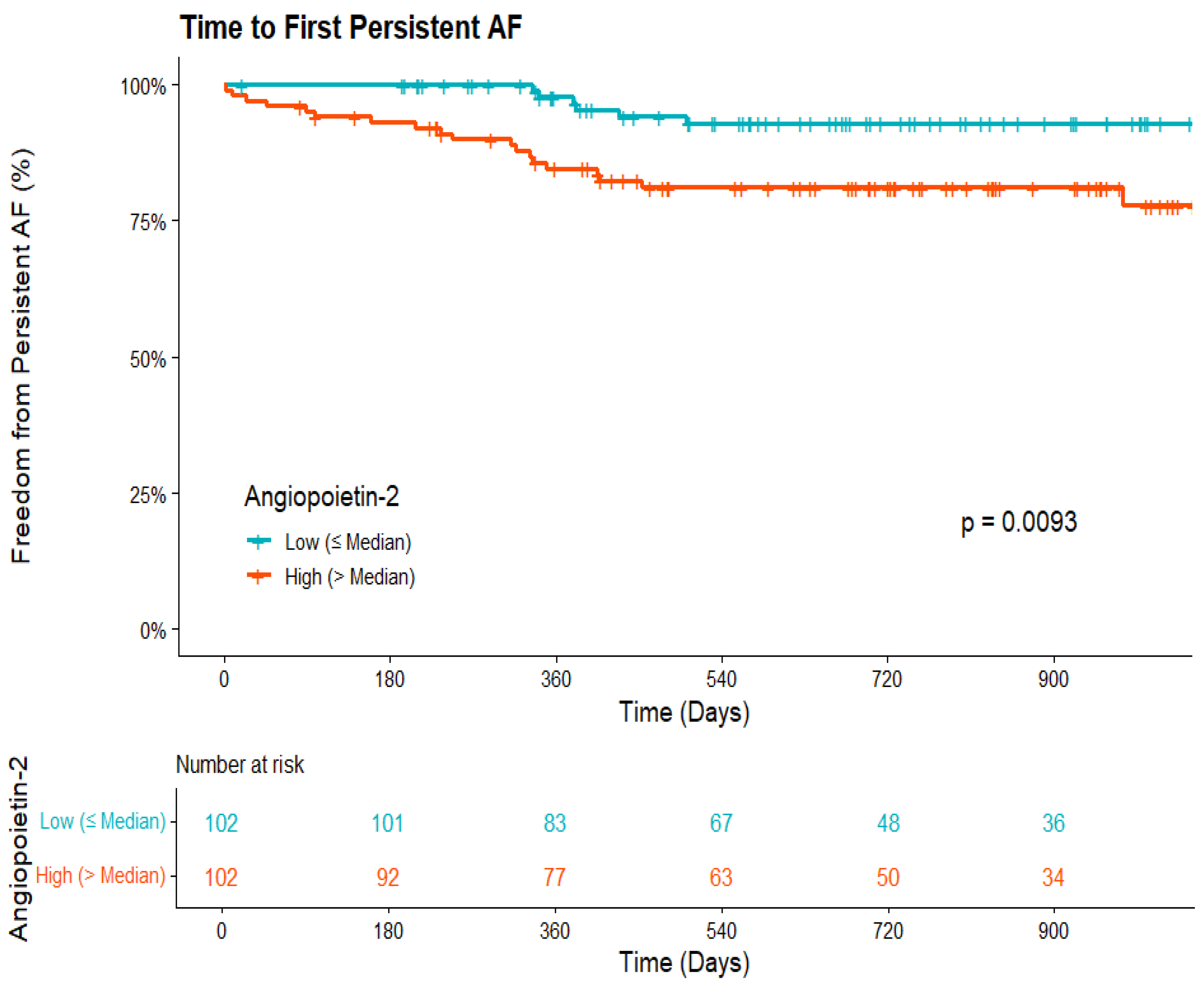
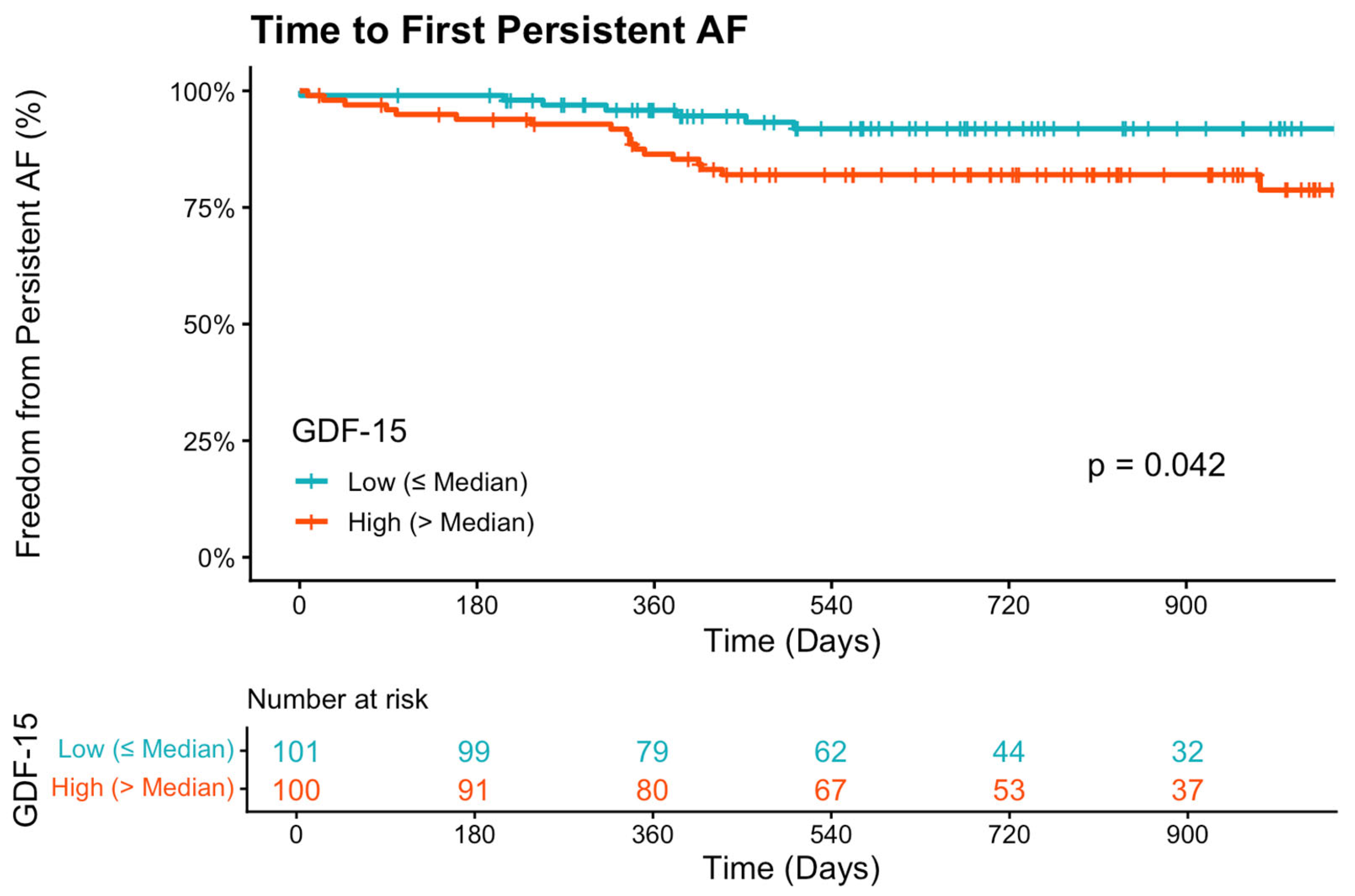
- Progression to Persistent AF: A time-to-event endpoint defined as the first occurrence of ≥7 consecutive days with a daily AF burden > 99%. Patients who met this criterion during the 30-day blanking period were considered to have prevalent persistent AF and were excluded from the survival analysis.
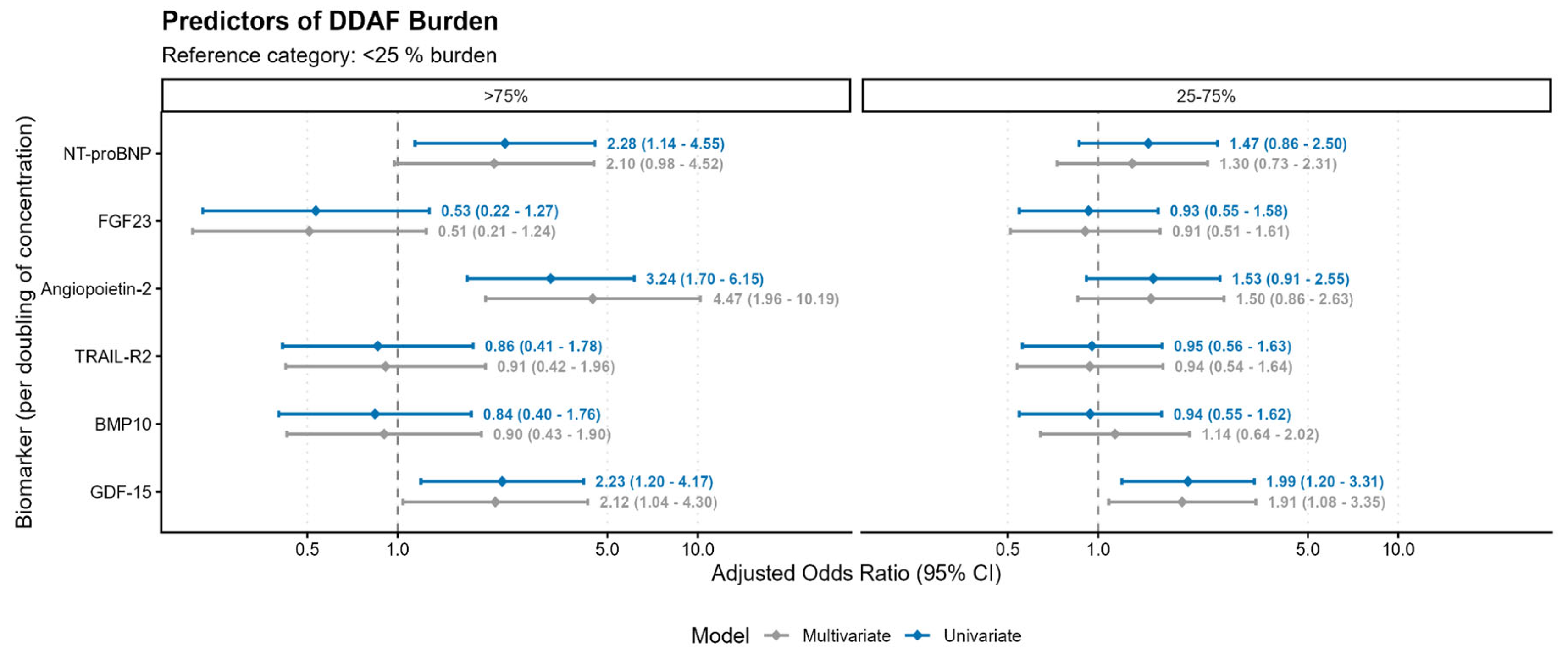
- DDAF Burden: A categorical endpoint reflecting the cumulative time in AF over the entire monitoring period. For each patient, the total duration of AF was normalized by the number of monitored days. Burden was categorized based on the interquartile range: <25% (low), 25–75% (medium), and >75% (high).
2.4. Statistical Analysis
3. Results
3.1. Study Population
3.2. Biomarker Results
3.3. Model 1: Time to First Persistent AF
3.4. Model 2: DDAF Burden
4. Discussion
Strengths and Limitations
5. Conclusions
Author Contributions
Funding
Institutional Review Board Statement
Informed Consent Statement
Data Availability Statement
Acknowledgments
Conflicts of Interest
Abbreviations
| DDAF | Device detected atrial fibrillation |
| AF | Atrial fibrillation |
| ANGPT2 | Angiopoietin-2 |
| BMP10 | Bone Morphogenetic Protein 10 |
| ELISA | Enzyme-Linked Immunosorbent Assay |
| FGF-23 | Fibroblast Growth Factor 23 |
| GDF-15 | Growth Differentiation Factor 15 |
| NT-proBNP | N-terminal pro-B-type Natriuretic Peptide |
| TRAIL-R2 | Tumor Necrosis Factor-Related Apoptosis-Inducing Ligand Receptor 2 |
References
- Van Gelder, I.C.; Rienstra, M.; Bunting, K.V.; Casado-Arroyo, R.; Caso, V.; Crijns, H.J.G.M.; De Potter, T.J.R.; Dwight, J.; Guasti, L.; Hanke, T.; et al. 2024 ESC Guidelines for the management of atrial fibrillation developed in collaboration with the European Association for Cardio-Thoracic Surgery (EACTS). Eur. Heart J. 2024, 45, 3314–3414. [Google Scholar] [CrossRef] [PubMed]
- Chew, D.S.; Li, Z.; Steinberg, B.A.; O’Brien, E.C.; Pritchard, J.; Bunch, T.J.; Mark, D.B.; Patel, M.R.; Nabutovsky, Y.; Greiner, M.A.; et al. Arrhythmic Burden and the Risk of Cardiovascular Outcomes in Patients with Paroxysmal Atrial Fibrillation and Cardiac Implanted Electronic Devices. Circ. Arrhythmia Electrophysiol. 2022, 15, e010304. [Google Scholar] [CrossRef] [PubMed]
- Becher, N.; Metzner, A.; Toennis, T.; Kirchhof, P.; Schnabel, R.B. Atrial fibrillation burden: A new outcome predictor and therapeutic target. Eur. Heart J. 2024, 45, 2824–2838. [Google Scholar] [CrossRef] [PubMed]
- Doehner, W.; Boriani, G.; Potpara, T.; Blomstrom-Lundqvist, C.; Passman, R.; Sposato, L.A.; Dobrev, D.; Freedman, B.; Van Gelder, I.C.; Glotzer, T.V.; et al. Atrial fibrillation burden in clinical practice, research, and technology development: A clinical consensus statement of the European Society of Cardiology Council on Stroke and the European Heart Rhythm Association. Europace 2025, 27, euaf019. [Google Scholar] [CrossRef] [PubMed]
- Staerk, L.; Preis, S.R.; Lin, H.; Lubitz, S.A.; Ellinor, P.T.; Levy, D.; Benjamin, E.J.; Trinquart, L. Protein Biomarkers and Risk of Atrial Fibrillation: The FHS. Circ. Arrhythmia Electrophysiol. 2020, 13, e007607. [Google Scholar] [CrossRef] [PubMed]
- Schnabel, R.B.; Larson, M.G.; Yamamoto, J.F.; Sullivan, L.M.; Pencina, M.J.; Meigs, J.B.; Tofler, G.H.; Selhub, J.; Jacques, P.F.; Wolf, P.A.; et al. Relations of biomarkers of distinct pathophysiological pathways and atrial fibrillation incidence in the community. Circulation 2010, 121, 200–207. [Google Scholar] [CrossRef] [PubMed]
- Sinner, M.F.; Stepas, K.A.; Moser, C.B.; Krijthe, B.P.; Aspelund, T.; Sotoodehnia, N.; Fontes, J.D.; Janssens, A.C.J.; Kronmal, R.A.; Magnani, J.W.; et al. B-type natriuretic peptide and C-reactive protein in the prediction of atrial fibrillation risk: The CHARGE-AF Consortium of community-based cohort studies. Europace 2014, 16, 1426–1433. [Google Scholar] [CrossRef] [PubMed]
- Wang, T.J.; Larson, M.G.; Levy, D.; Benjamin, E.J.; Leip, E.P.; Omland, T.; Wolf, P.A.; Vasan, R.S. Plasma natriuretic peptide levels and the risk of cardiovascular events and death. N. Engl. J. Med. 2004, 350, 655–663. [Google Scholar] [CrossRef] [PubMed]
- Chong, A.Y.; Caine, G.J.; Freestone, B.; Blann, A.D.; Lip, G.Y. Plasma angiopoietin-1, angiopoietin-2, and angiopoietin receptor tie-2 levels in congestive heart failure. J. Am. Coll. Cardiol. 2004, 43, 423–428. [Google Scholar] [CrossRef] [PubMed]
- Wallentin, L.; Hijazi, Z.; Andersson, U.; Alexander, J.H.; De Caterina, R.; Hanna, M.; Horowitz, J.D.; Hylek, E.M.; Lopes, R.D.; Åsberg, S.; et al. Growth differentiation factor 15, a marker of oxidative stress and inflammation, for risk assessment in patients with atrial fibrillation: Insights from the Apixaban for Reduction in Stroke and Other Thromboembolic Events in Atrial Fibrillation (ARISTOTLE) trial. Circulation 2014, 130, 1847–1858. [Google Scholar] [CrossRef] [PubMed]
- Sharma, A.; Hijazi, Z.; Andersson, U.; Al-Khatib, S.M.; Lopes, R.D.; Alexander, J.H.; Held, C.; Hylek, E.M.; Leonardi, S.; Hanna, M.; et al. Use of Biomarkers to Predict Specific Causes of Death in Patients With Atrial Fibrillation. Circulation 2018, 138, 1666–1676. [Google Scholar] [CrossRef] [PubMed]
- Hu, X.F.; Zhan, R.; Xu, S.; Wang, J.; Wu, J.; Liu, X.; Li, Y.; Chen, L. Growth differentiation factor 15 is associated with left atrial/left atrial appendage thrombus in patients with nonvalvular atrial fibrillation. Clin. Cardiol. 2018, 41, 34–38. [Google Scholar] [CrossRef] [PubMed]
- Hijazi, Z.; Lindbäck, J.; Alexander, J.H.; Hanna, M.; Held, C.; Hylek, E.M.; Lopes, R.D.; Oldgren, J.; Siegbahn, A.; Stewart, R.A.; et al. The ABC (age, biomarkers, clinical history) stroke risk score: A biomarker-based risk score for predicting stroke in atrial fibrillation. Eur. Heart J. 2016, 37, 1582–1590. [Google Scholar] [CrossRef] [PubMed]
- Chua, W.; Khashaba, A.; Canagarajah, H.; Nielsen, J.C.; di Biase, L.; Haeusler, K.G.; Hindricks, G.; Mont, L.; Piccini, J.; Schnabel, R.B.; et al. Disturbed atrial metabolism, shear stress, and cardiac load contribute to atrial fibrillation after ablation: AXAFA biomolecule study. Europace 2024, 26, euae028. [Google Scholar] [CrossRef] [PubMed]
- Fabritz, L.; Al-Taie, C.; Borof, K.; Breithardt, G.; Camm, A.J.; Crijns, H.J.G.M.; Cardoso, V.R.; Chua, W.; van Elferen, S.; Eckardt, L.; et al. Biomarker-based prediction of sinus rhythm in atrial fibrillation patients: The EAST-AFNET 4 biomolecule study. Eur. Heart J. 2024, 45, 5002–5019. [Google Scholar] [CrossRef] [PubMed]
- Fiedler, U.; Reiss, Y.; Scharpfenecker, M.; Grunow, V.; Koidl, S.; Thurston, G.; Gale, N.W.; Witzenrath, M.; Rosseau, S.; Suttorp, N.; et al. Angiopoietin-2 sensitizes endothelial cells to TNF-alpha and has a crucial role in the induction of inflammation. Nat. Med. 2006, 12, 235–239. [Google Scholar] [CrossRef] [PubMed]
- Gragnano, F.; van Klaveren, D.; Heg, D.; Räber, L.; Krucoff, M.W.; Raposeiras-Roubín, S.; Berg, J.M.T.; Leonardi, S.; Kimura, T.; Corpataux, N.; et al. Derivation and Validation of the PRECISE-HBR Score to Predict Bleeding After Percutaneous Coronary Intervention. Circulation 2025, 151, 343–355. [Google Scholar] [CrossRef] [PubMed]



| Characteristic | Median (IQR) or No. (%) |
|---|---|
| Age, years | 75.0 [68.0–80.0] |
| Female sex, n (%) | 83 (37.2%) |
| Body mass index, kg/m2 | 25.8 [22.7–28.4] |
| Pacing Indication | |
| Sick Sinus Syndrome | 112 (50.2%) |
| AVB II (Wenckebach) | 7 (3.1%) |
| AVB II (Mobitz) | 32 (14.4%) |
| AVB III | 58 (26.0%) |
| Comorbidities | |
| Arterial hypertension | 145 (65.0%) |
| Diabetes mellitus | 51 (22.9%) |
| Atrial fibrillation | 90 (40.4%) |
| Heart failure | 22 (9.9%) |
| Coronary artery disease | 81 (36.3%) |
| Previous Myocardial Infarction | 22 (9.9%) |
| Medication | |
| Beta blocker | 63 (28.3%) |
| Statin | 129 (57.8%) |
| ACE inhibitor or ARB | 114 (51.1%) |
| Aspirin | 75 (33.6%) |
| NOAC | 74 (33.2%) |
| Loop-Diuretics | 17 (7.6%) |
| Cardiac Data | |
| LVEF, % | 58.0 [53.6–63.2] |
| Left atrial volume index (mL/m2) | 32.5 [25.6–41.0] |
| LDL cholesterol (mg/dL) | 85.0 [62.0–120.5] |
| Biomarkers (Raw Values) | |
| NT-proBNP (pg/mL) | 325.0 [130.0–718.0] |
| Angiopoietin-2 (pg/mL) | 2874.5 [2102.0–3930.4] |
| GDF-15 (pg/mL) | 1073.8 [747.9–1656.4] |
| FGF-23 (pg/mL) | 0.6 [0.3–41.5] |
| TRAIL-R2 (ng/mL) | 2.5 [2.5–3.2] |
| BMP10 (pg/mL) | 0.2 [0.2–0.7] |
| Biomarker | N | Univariate HR (95% CI) | p-Value | Multivariable HR (95% CI) | p-Value |
|---|---|---|---|---|---|
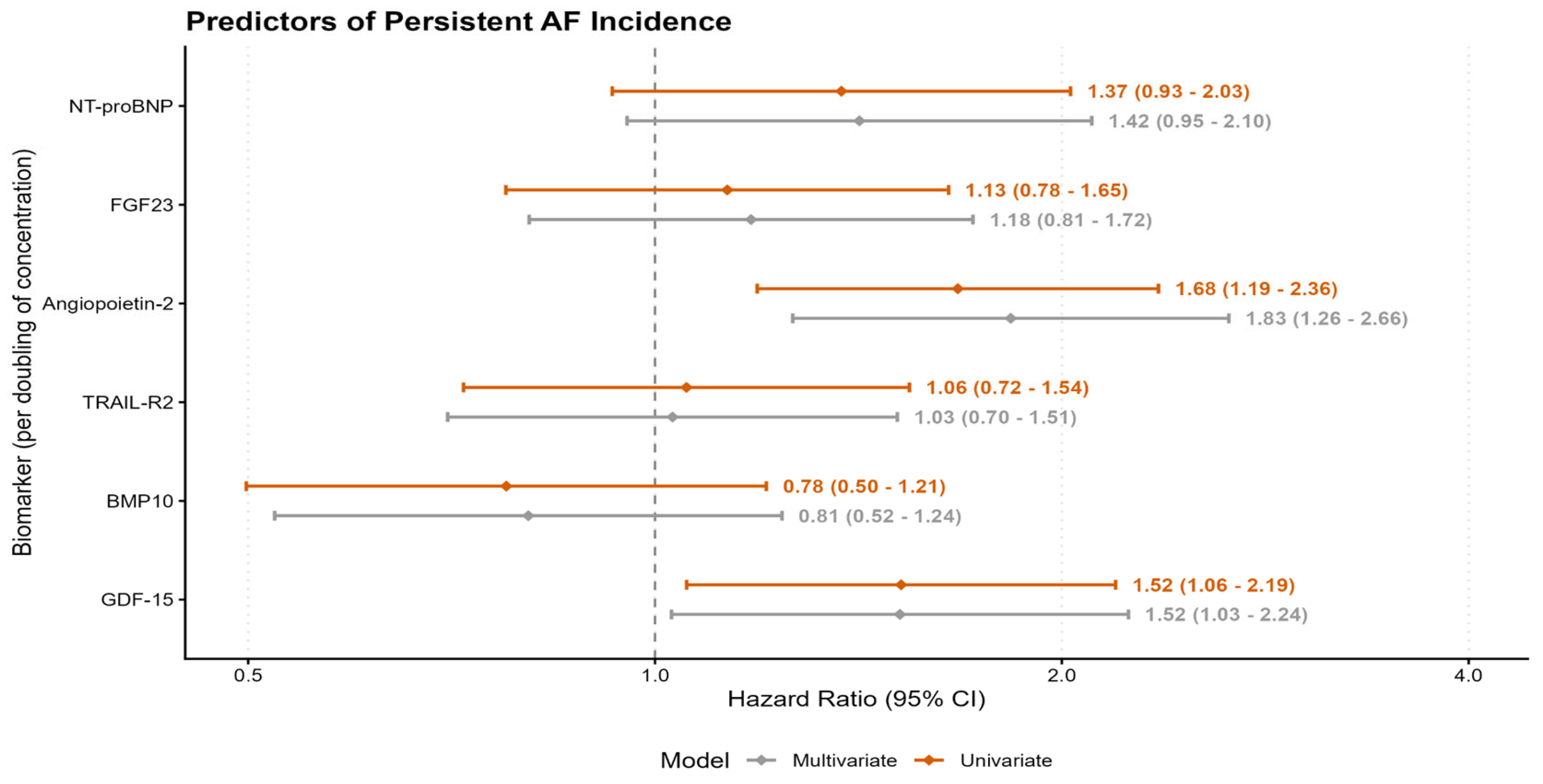
| Angiopoietin-2 | 217 | 1.68 (1.19–2.36) | 0.003 | 1.83 (1.27–2.66) | 0.001 |
| GDF-15 | 217 | 1.52 (1.06–2.19) | 0.025 | 1.52 (1.03–2.24) | 0.036 |
| NT-proBNP | 207 | 1.37 (0.93–2.03) | 0.111 | 1.42 (0.95–2.11) | 0.085 |
| FGF-23 | 217 | 1.13 (0.78–1.65) | 0.522 | 1.18 (0.81–1.72) | 0.396 |
| TRAIL-R2 | 217 | 1.06 (0.72–1.54) | 0.782 | 1.03 (0.70–1.51) | 0.878 |
| BMP10 | 215 | 0.78 (0.50–1.21) | 0.262 | 0.81 (0.52–1.24) | 0.328 |
| Biomarker | Comparison (vs. <25%) | Univariate OR (95% CI) | p-Value | Multivariate OR (95% CI) | p-Value |
|---|---|---|---|---|---|
| Angiopoietin-2 | 25–75% | 1.86 (0.91–3.79) | 0.091 | 1.77 (0.81–3.85) | 0.151 |
| >75% | 5.26 (2.14–12.93) | <0.001 | 8.31 (2.63–26.26) | <0.001 | |
| GDF-15 | 25–75% | 2.17 (1.24–3.81) | 0.007 | 2.05 (1.10–3.83) | 0.025 |
| >75% | 2.46 (1.23–4.90) | 0.011 | 2.32 (1.05–5.09) | 0.037 | |
| NT-proBNP | 25–75% | 1.24 (0.94–1.64) | 0.135 | 1.15 (0.85–1.56) | 0.361 |
| >75% | 1.57 (1.09–2.26) | 0.016 | 1.49 (0.99–2.23) | 0.055 | |
| BMP10 | 25–75% | 0.98 (0.74–1.28) | 0.851 | 1.07 (0.80–1.42) | 0.658 |
| >75% | 0.92 (0.64–1.33) | 0.662 | 0.95 (0.66–1.38) | 0.787 | |
| FGF-23 | 25–75% | 0.98 (0.87–1.12) | 0.799 | 0.98 (0.86–1.12) | 0.743 |
| >75% | 0.86 (0.71–1.06) | 0.161 | 0.85 (0.69–1.05) | 0.141 | |
| TRAIL-R2 | 25–75% | 0.94 (0.53–1.67) | 0.835 | 0.93 (0.52–1.69) | 0.823 |
| >75% | 0.84 (0.39–1.83) | 0.663 | 0.90 (0.40–2.04) | 0.802 |
Disclaimer/Publisher’s Note: The statements, opinions and data contained in all publications are solely those of the individual author(s) and contributor(s) and not of MDPI and/or the editor(s). MDPI and/or the editor(s) disclaim responsibility for any injury to people or property resulting from any ideas, methods, instructions or products referred to in the content. |
© 2026 by the authors. Licensee MDPI, Basel, Switzerland. This article is an open access article distributed under the terms and conditions of the Creative Commons Attribution (CC BY) license.
Share and Cite
Bilgeri, V.; Spitaler, P.; Gavranovic-Novakovic, J.; Dolejsi, T.; Rockenschaub, P.; Messner, M.; Zaruba, M.M.; Barbieri, F.; Adukauskaite, A.; Stühlinger, M.; et al. Angiopoietin-2 and Growth Differentiation Factor-15 as Predictors of Device-Detected Atrial Fibrillation Burden. Biomedicines 2026, 14, 902. https://doi.org/10.3390/biomedicines14040902
Bilgeri V, Spitaler P, Gavranovic-Novakovic J, Dolejsi T, Rockenschaub P, Messner M, Zaruba MM, Barbieri F, Adukauskaite A, Stühlinger M, et al. Angiopoietin-2 and Growth Differentiation Factor-15 as Predictors of Device-Detected Atrial Fibrillation Burden. Biomedicines. 2026; 14(4):902. https://doi.org/10.3390/biomedicines14040902
Chicago/Turabian StyleBilgeri, Valentin, Philipp Spitaler, Jasmina Gavranovic-Novakovic, Theresa Dolejsi, Patrick Rockenschaub, Moritz Messner, Marc Michael Zaruba, Fabian Barbieri, Agne Adukauskaite, Markus Stühlinger, and et al. 2026. "Angiopoietin-2 and Growth Differentiation Factor-15 as Predictors of Device-Detected Atrial Fibrillation Burden" Biomedicines 14, no. 4: 902. https://doi.org/10.3390/biomedicines14040902
APA StyleBilgeri, V., Spitaler, P., Gavranovic-Novakovic, J., Dolejsi, T., Rockenschaub, P., Messner, M., Zaruba, M. M., Barbieri, F., Adukauskaite, A., Stühlinger, M., Pfeifer, B. E., Lacaita, P., Feuchtner, G., Willeit, P., Bauer, A., & Dichtl, W. (2026). Angiopoietin-2 and Growth Differentiation Factor-15 as Predictors of Device-Detected Atrial Fibrillation Burden. Biomedicines, 14(4), 902. https://doi.org/10.3390/biomedicines14040902