Collecting Eggs, Not Killing Chickens: Why Stem Cell Secretome and Exosomes Are Redefining Regenerative Medicine for Healthspan Extension


Abstract
1. Regenerative Medicine as a Longevity Tool: Challenges and Opportunities
2. Conceptual Framework: From Longevity to Regenerative Precision Medicine
3. Biological Foundations: MSCs, Secretome and Exosomes
3.1. Why Mesenchymal Stem Cells Are Preferred Secretome Sources
3.2. Wharton’s Jelly MSCs in the Context of Longevity
4. Comparative Analysis: Cell Therapy vs. Secretome vs. Exosomes
4.1. Mechanistic Considerations
4.2. Scalability, Manufacturing and Cost
4.3. Cellular Aging, Passage Number and Master Cell Banks
4.4. Safety and Tolerability
4.5. Standardization of Secretome and Exosome Production
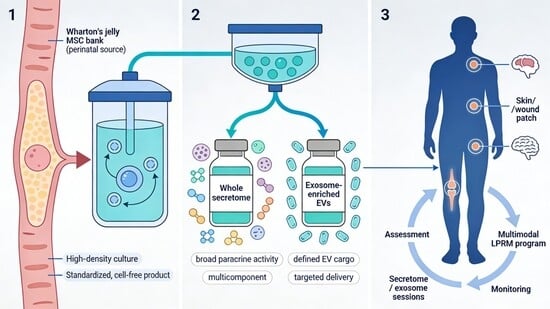
4.6. Secretome Versus Exosome-Enriched Formulations
4.7. Practical Aspects of Administration
4.8. Central Nervous System and Blood–Brain Barrier Considerations
4.9. Clinical and Preclinical Outcomes in Longevity-Relevant Conditions
5. Clinical and Translational Evidence in Longevity-Relevant Conditions
5.1. Osteoarthritis and Degenerative Joint Disease
5.2. Chronic Wounds and Diabetic Foot Ulcers
5.3. Type 2 Diabetes Mellitus and Metabolic Dysfunction
5.4. Neurodegenerative and CNS Indications
5.5. Cardiometabolic and Systematic Indications
6. Regulatory and Regional Perspectives with a Southeast Asian Focus
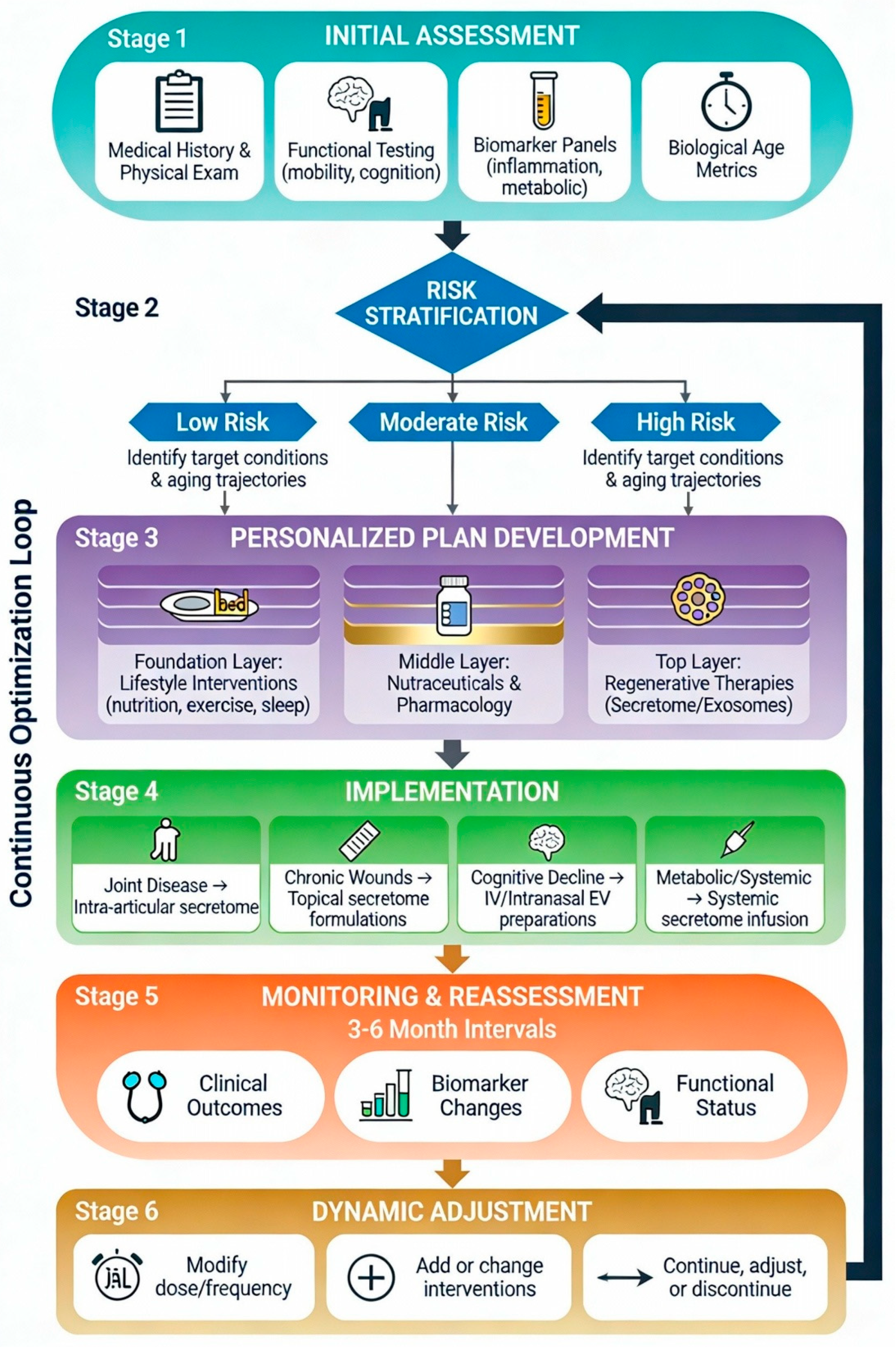
7. The Preventive Longevity Patient Journey
8. Future Directions and Research Gaps
9. Longevity, Prevention and Medical Insurance
10. Conclusions
Author Contributions
Funding
Data Availability Statement
Acknowledgments
Conflicts of Interest
Abbreviations
| MSC | Mesenchymal stem cell. |
| MSCs | Mesenchymal stem cells. |
| EVs | Extracellular vesicles. |
| UC | Umbilical cord. |
| WJ | Wharton’s jelly. |
| WJMSCs | Wharton’s jelly-derived mesenchymal stem cells. |
| GMP | Good Manufacturing Practice. |
| IL-6 | Interleukin 6. |
| IL-8 | Interleukin 8. |
| MCP-1 | Monocyte chemoattractant protein 1. |
| VEGF | Vascular endothelial growth factor. |
| FGF | Fibroblast growth factor(s). |
| TGF-β | Transforming growth factor beta. |
| TIMPs | Tissue inhibitors of metalloproteinases. |
| CNS | Central nervous system. |
| BBB | Blood–brain barrier. |
| PRP | Platelet-rich plasma. |
| OA | Osteoarthritis. |
| T2DM | Type 2 diabetes mellitus. |
| STZ | Streptozotocin. |
| hUCMSC | Human umbilical cord mesenchymal stem cells. |
| IRS-1 | Insulin receptor substrate 1. |
| HOMA-IR | Homeostasis Model Assessment—Insulin Resistance. |
| UC-MSCs | Umbilical cord mesenchymal stem cells. |
| ATMP | Advanced therapy medicinal product. |
| LPRM | Longevity-oriented precision regenerative medicine. |
| VBID | Value-based insurance design. |
| ADAS | Alzheimer’s Disease Assessment Scale. |
| MoCA | Montreal Cognitive Assessment. |
References
- Beard, J.R.; Officer, A.; de Carvalho, I.A.; Sadana, R.; Pot, A.M.; Michel, J.-P.; Lloyd-Sherlock, P.; Epping-Jordan, J.E.; Peeters, G.M.E.E.G.; Mahanani, W.R.; et al. The World Report on Ageing and Health: A Policy Framework for Healthy Ageing. Lancet 2016, 387, 2145–2154. [Google Scholar] [CrossRef]
- World Health Organisation. Noncommunicable Diseases. Available online: https://www.who.int/news-room/fact-sheets/detail/noncommunicable-diseases (accessed on 22 January 2026).
- Waldman, S.A.; Terzic, A. Health Care Evolves from Reactive to Proactive. Clin. Pharmacol. Ther. 2019, 105, 10–13. [Google Scholar] [CrossRef]
- Bischof, E.; Scheibye-Knudsen, M.; Siow, R.; Moskalev, A. Longevity Medicine: Upskilling the Physicians of Tomorrow. Lancet Healthy Longev. 2021, 2, e187–e188. [Google Scholar] [CrossRef] [PubMed]
- Friebe, M.; Mittler-Matica, R.; Niestroj, B. Investors’ Perspective on Healthspan in 2025. Qeios, 2025; preprint. [CrossRef]
- Mironov, S.; Borysova, O.; Morgunov, I.; Zhou, Z.; Moskalev, A. A Framework for an Effective Healthy Longevity Clinic. Aging Dis. 2024, 16, 1971–1986. [Google Scholar] [CrossRef] [PubMed]
- Scott, L.J. Darvadstrocel: A Review in Treatment-Refractory Complex Perianal Fistulas in Crohn’s Disease. BioDrugs 2018, 32, 627–634. [Google Scholar] [CrossRef]
- Fernández-Garza, L.E.; Barrera-Barrera, S.A.; Barrera-Saldaña, H.A. Mesenchymal Stem Cell Therapies Approved by Regulatory Agencies around the World. Pharmaceuticals 2023, 16, 1334. [Google Scholar] [CrossRef]
- US Federal Drug Association. FDA Approves Remestemcel-L-Rknd for Steroid-Refractory Acute Graft Versus Host Disease in Pediatric Patients. Available online: https://www.fda.gov/drugs/resources-information-approved-drugs/fda-approves-remestemcel-l-rknd-steroid-refractory-acute-graft-versus-host-disease-pediatric (accessed on 22 January 2026).
- Hodgson-Garms, M.; Moore, M.J.; Martino, M.M.; Kelly, K.; Frith, J.E. Proteomic Profiling of iPSC and Tissue-Derived MSC Secretomes Reveal a Global Signature of Inflammatory Licensing. Npj Regen. Med. 2025, 10, 7. [Google Scholar] [CrossRef]
- Kehl, D.; Generali, M.; Mallone, A.; Heller, M.; Uldry, A.-C.; Cheng, P.; Gantenbein, B.; Hoerstrup, S.P.; Weber, B. Proteomic Analysis of Human Mesenchymal Stromal Cell Secretomes: A Systematic Comparison of the Angiogenic Potential. Npj Regen. Med. 2019, 4, 8. [Google Scholar] [CrossRef]
- Lalu, M.M.; McIntyre, L.; Pugliese, C.; Fergusson, D.; Winston, B.W.; Marshall, J.C.; Granton, J.; Stewart, D.J. Canadian Critical Care Trials Group Safety of Cell Therapy with Mesenchymal Stromal Cells (SafeCell): A Systematic Review and Meta-Analysis of Clinical Trials. PLoS ONE 2012, 7, e47559. [Google Scholar] [CrossRef]
- Baranovskii, D.S.; Klabukov, I.D.; Arguchinskaya, N.V.; Yakimova, A.O.; Kisel, A.A.; Yatsenko, E.M.; Ivanov, S.A.; Shegay, P.V.; Kaprin, A.D. Adverse Events, Side Effects and Complications in Mesenchymal Stromal Cell-Based Therapies. Stem Cell Investig. 2022, 9, 7. [Google Scholar] [CrossRef]
- Vulliet, P.R.; Greeley, M.; Halloran, S.M.; MacDonald, K.A.; Kittleson, M.D. Intra-Coronary Arterial Injection of Mesenchymal Stromal Cells and Microinfarction in Dogs. Lancet 2004, 363, 783–784. [Google Scholar] [CrossRef] [PubMed]
- Volarevic, V.; Markovic, B.S.; Gazdic, M.; Volarevic, A.; Jovicic, N.; Arsenijevic, N.; Armstrong, L.; Djonov, V.; Lako, M.; Stojkovic, M. Ethical and Safety Issues of Stem Cell-Based Therapy. Int. J. Med. Sci. 2018, 15, 36–45. [Google Scholar] [CrossRef] [PubMed]
- Hwang, W.Y.K.; Bari, S.; Kawamata, S.; Choi, B.; Koaykul, C.; Huang, H.; Gupta, P. Cell and Gene Therapy Approvals in Asia: Regulatory Landscape, Access and Affordability. Cytotherapy 2025, 27, 1363–1374. [Google Scholar] [CrossRef]
- Jeppesen, D.K.; Zhang, Q.; Franklin, J.L.; Coffey, R.J. Extracellular Vesicles and Nanoparticles: Emerging Complexities. Trends Cell Biol. 2023, 33, 667–681. [Google Scholar] [CrossRef] [PubMed]
- Vizoso, F.J.; Eiro, N.; Cid, S.; Schneider, J.; Perez-Fernandez, R. Mesenchymal Stem Cell Secretome: Toward Cell-Free Therapeutic Strategies in Regenerative Medicine. Int. J. Mol. Sci. 2017, 18, 1852. [Google Scholar] [CrossRef]
- Meiliana, A.; Dewi, N.M.; Wijaya, A. Mesenchymal Stem Cell Secretome: Cell-Free Therapeutic Strategy in Regenerative Medicine. Indones. Biomed. J. 2019, 11, 113–124. [Google Scholar] [CrossRef]
- Kupcova Skalnikova, H. Proteomic Techniques for Characterisation of Mesenchymal Stem Cell Secretome. Biochimie 2013, 95, 2196–2211. [Google Scholar] [CrossRef]
- Maguire, G. Stem Cell Therapy without the Cells. Commun. Integr. Biol. 2013, 6, e26631. [Google Scholar] [CrossRef]
- Li, X.; Xiao, H.; Wang, Z.; Tang, X.; Yu, X.; Pan, Y. Platelet Concentrates Preconditioning of Mesenchymal Stem Cells and Combined Therapies: Integrating Regenerative Strategies for Enhanced Clinical Applications. Cell Transplant. 2024, 33, 09636897241235460. [Google Scholar] [CrossRef]
- Trigo, C.M.; Rodrigues, J.S.; Camões, S.P.; Solá, S.; Miranda, J.P. Mesenchymal Stem Cell Secretome for Regenerative Medicine: Where Do We Stand? J. Adv. Res. 2024, 70, 103–124. [Google Scholar] [CrossRef] [PubMed]
- Chin, J.S.; Tan, M.L.L.; Lim, P.L.K.; Sharma, B.; Yeo, A.; Aw, Y.B.; Ng, Y.Z.; Bonnard, C.; Becker, D.L.; Mok, P. Secretome from Prolonged High-density Human Wharton’s Jelly Stem Cell Culture Accelerates Wound Healing in Both in Vitro and in Vivo Models. Int. Wound J. 2025, 22, e70033. [Google Scholar] [CrossRef]
- Fong, C.; Tam, K.; Cheyyatraivendran, S.; Gan, S.; Gauthaman, K.; Armugam, A.; Jeyaseelan, K.; Choolani, M.; Biswas, A.; Bongso, A. Human Wharton’s Jelly Stem Cells and Its Conditioned Medium Enhance Healing of Excisional and Diabetic Wounds. J. Cell. Biochem. 2014, 115, 290–302, Erratum in J. Cell. Biochem. 2017, 118, 3016. https://doi.org/10.1002/jcb.26081. [Google Scholar] [CrossRef]
- Bakhtyar, N.; Jeschke, M.G.; Mainville, L.; Herer, E.; Amini-Nik, S. Acellular Gelatinous Material of Human Umbilical Cord Enhances Wound Healing: A Candidate Remedy for Deficient Wound Healing. Front. Physiol. 2017, 8, 200. [Google Scholar] [CrossRef]
- Aw, Y.B.; Chen, S.; Yeo, A.; Dangerfield, J.A.; Mok, P. Development and Functional Testing of a Novel in Vitro Delayed Scratch Closure Assay. Histochem. Cell Biol. 2024, 162, 245–255. [Google Scholar] [CrossRef]
- Prado-Yupanqui, J.W.; Ramírez-Orrego, L.; Cortez, D.; Vera-Ponce, V.J.; Chenet, S.M.; Tejedo, J.R.; Tapia-Limonchi, R. The Hidden Power of the Secretome: Therapeutic Potential on Wound Healing and Cell-Free Regenerative Medicine-A Systematic Review. Int. J. Mol. Sci. 2025, 26, 1926. [Google Scholar] [CrossRef]
- Théry, C.; Witwer, K.W.; Aikawa, E.; Alcaraz, M.J.; Anderson, J.D.; Andriantsitohaina, R.; Antoniou, A.; Arab, T.; Archer, F.; Atkin-Smith, G.K.; et al. Minimal Information for Studies of Extracellular Vesicles 2018 (MISEV2018): A Position Statement of the International Society for Extracellular Vesicles and Update of the MISEV2014 Guidelines. J. Extracell. Vesicles 2018, 7, 1535750. [Google Scholar] [CrossRef]
- Witwer, K.W.; Soekmadji, C.; Hill, A.F.; Wauben, M.H.; Buzás, E.I.; Di Vizio, D.; Falcon-Perez, J.M.; Gardiner, C.; Hochberg, F.; Kurochkin, I.V.; et al. Updating the MISEV Minimal Requirements for Extracellular Vesicle Studies: Building Bridges to Reproducibility. J. Extracell. Vesicles 2017, 6, 1396823. [Google Scholar] [CrossRef]
- Velasco, R.P.; Chaikledkaew, U.; Myint, C.Y.; Khampang, R.; Tantivess, S.; Teerawattananon, Y. Advanced Health Biotechnologies in Thailand: Redefining Policy Directions. J. Transl. Med. 2013, 11, 1. [Google Scholar] [CrossRef]
- Grand View Research Thailand Medical Tourism Market Size: Industry Report 2030. Available online: https://www.grandviewresearch.com/industry-analysis/thailand-medical-tourism-market-report (accessed on 23 January 2026).
- Hade, M.D.; Suire, C.N.; Suo, Z. Mesenchymal Stem Cell-Derived Exosomes: Applications in Regenerative Medicine. Cells 2021, 10, 1959. [Google Scholar] [CrossRef]
- Chouaib, B.; Haack-Sørensen, M.; Chaubron, F.; Cuisinier, F.; Collart-Dutilleul, P.-Y. Towards the Standardization of Mesenchymal Stem Cell Secretome-Derived Product Manufacturing for Tissue Regeneration. Int. J. Mol. Sci. 2023, 24, 12594. [Google Scholar] [CrossRef]
- Collins, H.; Calvo, S.; Greenberg, K.; Forman Neall, L.; Morrison, S. Information Needs in the Precision Medicine Era: How Genetics Home Reference Can Help. Interact. J. Med. Res. 2016, 5, e13. [Google Scholar] [CrossRef]
- Shen, X.; Wang, C.; Zhou, X.; Zhou, W.; Hornburg, D.; Wu, S.; Snyder, M.P. Nonlinear Dynamics of Multi-Omics Profiles during Human Aging. Nat. Aging 2024, 4, 1619–1634. [Google Scholar] [CrossRef]
- Bland, J.S. Functional Medicine Past, Present, and Future. Integr. Med. 2022, 21, 22–26. [Google Scholar]
- Morgan, A.A.; Mooney, S.D.; Aronow, B.J.; Brenner, S.E. Precision Medicine: Data and Discovery for Improved Health and Therapy. Pac. Symp. Biocomput. 2016, 21, 243–248. [Google Scholar]
- Park, Y.; Ha, C.; Lee, C.; Yoon, Y.C.; Park, Y. Cartilage Regeneration in Osteoarthritic Patients by a Composite of Allogeneic Umbilical Cord Blood-Derived Mesenchymal Stem Cells and Hyaluronate Hydrogel: Results from a Clinical Trial for Safety and Proof-of-Concept with 7 Years of Extended Follow-Up. Stem Cells Transl. Med. 2017, 6, 613–621. [Google Scholar] [CrossRef]
- Lee, E.C.; Ha, T.W.; Lee, D.-H.; Hong, D.-Y.; Park, S.-W.; Lee, J.Y.; Lee, M.R.; Oh, J.S. Utility of Exosomes in Ischemic and Hemorrhagic Stroke Diagnosis and Treatment. Int. J. Mol. Sci. 2022, 23, 8367. [Google Scholar] [CrossRef]
- Bang, O.Y.; Kim, E.H. Mesenchymal Stem Cell-Derived Extracellular Vesicle Therapy for Stroke: Challenges and Progress. Front. Neurol. 2019, 10, 211. [Google Scholar] [CrossRef]
- Cortes-Galvez, D.; Dangerfield, J.A.; Metzner, C. Extracellular Vesicles and Their Membranes: Exosomes vs. Virus-Related Particles. Membranes 2023, 13, 397. [Google Scholar] [CrossRef]
- Infante, A.; Rodríguez, C.I. Cell and Cell-Free Therapies to Counteract Human Premature and Physiological Aging: MSCs Come to Light. J. Pers. Med. 2021, 11, 1043. [Google Scholar] [CrossRef]
- Fong, C.Y.; Richards, M.; Manasi, N.; Biswas, A.; Bongso, A. Comparative Growth Behaviour and Characterization of Stem Cells from Human Wharton’s Jelly. Reprod. Biomed. Online 2007, 15, 708–718. [Google Scholar] [CrossRef]
- Witwer, K.W.; Théry, C. Extracellular Vesicles or Exosomes? On Primacy, Precision, and Popularity Influencing a Choice of Nomenclature. J. Extracell. Vesicles 2019, 8, 1648167. [Google Scholar] [CrossRef]
- Harrell, C.R.; Fellabaum, C.; Jovicic, N.; Djonov, V.; Arsenijevic, N.; Volarevic, V. Molecular Mechanisms Responsible for Therapeutic Potential of Mesenchymal Stem Cell-Derived Secretome. Cells 2019, 8, 467. [Google Scholar] [CrossRef]
- Chen, P.; Wang, F.; Ling, B.; Zhu, Y.; Lin, H.; Huang, J.; Wang, X. Mesenchymal Stem Cell-Derived Extracellular Vesicles: Emerging Therapies for Neurodegenerative Diseases. Int. J. Nanomed. 2025, 20, 8547–8565. [Google Scholar] [CrossRef]
- Keshtkar, S.; Azarpira, N.; Ghahremani, M.H. Mesenchymal Stem Cell-Derived Extracellular Vesicles: Novel Frontiers in Regenerative Medicine. Stem Cell Res. Ther. 2018, 9, 63. [Google Scholar] [CrossRef]
- Kou, M.; Huang, L.; Yang, J.; Chiang, Z.; Chen, S.; Liu, J.; Guo, L.; Zhang, X.; Zhou, X.; Xu, X.; et al. Mesenchymal Stem Cell-Derived Extracellular Vesicles for Immunomodulation and Regeneration: A next Generation Therapeutic Tool? Cell Death Dis. 2022, 13, 580. [Google Scholar] [CrossRef]
- Birtwistle, L.; Chen, X.-M.; Pollock, C. Mesenchymal Stem Cell-Derived Extracellular Vesicles to the Rescue of Renal Injury. Int. J. Mol. Sci. 2021, 22, 6596. [Google Scholar] [CrossRef]
- Ma, Z.-J.; Yang, J.-J.; Lu, Y.-B.; Liu, Z.-Y.; Wang, X.-X. Mesenchymal Stem Cell-Derived Exosomes: Toward Cell-Free Therapeutic Strategies in Regenerative Medicine. World J. Stem Cells 2020, 12, 814–840. [Google Scholar] [CrossRef]
- Casati, S.; Giannasi, C.; Niada, S.; Della Morte, E.; Orioli, M.; Brini, A.T. Lipidomics of Cell Secretome Combined with the Study of Selected Bioactive Lipids in an In Vitro Model of Osteoarthritis. Stem Cells Transl. Med. 2022, 11, 959–970. [Google Scholar] [CrossRef]
- Goodarzi, P.; Alavi-Moghadam, S.; Payab, M.; Larijani, B.; Rahim, F.; Gilany, K.; Bana, N.; Tayanloo-Beik, A.; Foroughi Heravani, N.; Hadavandkhani, M.; et al. Metabolomics Analysis of Mesenchymal Stem Cells. Int. J. Mol. Cell. Med. 2019, 8, 30–40. [Google Scholar] [CrossRef]
- Song, N.; Scholtemeijer, M.; Shah, K. Mesenchymal Stem Cell Immunomodulation: Mechanisms and Therapeutic Potential. Trends Pharmacol. Sci. 2020, 41, 653–664. [Google Scholar] [CrossRef]
- Allouh, M.Z.; Rizvi, S.F.A.; Alamri, A.; Jimoh, Y.; Aouda, S.; Ouda, Z.H.; Hamad, M.I.K.; Perez-Cruet, M.; Chaudhry, G.R. Mesenchymal Stromal/Stem Cells from Perinatal Sources: Biological Facts, Molecular Biomarkers, and Therapeutic Promises. Stem Cell Res. Ther. 2025, 16, 127. [Google Scholar] [CrossRef]
- Chang, C.; Yan, J.; Yao, Z.; Zhang, C.; Li, X.; Mao, H.-Q. Effects of Mesenchymal Stem Cell-Derived Paracrine Signals and Their Delivery Strategies. Adv. Healthc. Mater. 2021, 10, e2001689. [Google Scholar] [CrossRef] [PubMed]
- Maacha, S.; Sidahmed, H.; Jacob, S.; Gentilcore, G.; Calzone, R.; Grivel, J.-C.; Cugno, C. Paracrine Mechanisms of Mesenchymal Stromal Cells in Angiogenesis. Stem Cells Int. 2020, 2020, 4356359. [Google Scholar] [CrossRef] [PubMed]
- Burns, A.B.; Doris, C.; Vehar, K.; Saxena, V.; Bardliving, C.; Shamlou, P.A.; Phillips, M.I. Novel Low Shear 3D Bioreactor for High Purity Mesenchymal Stem Cell Production. PLoS ONE 2021, 16, e0252575. [Google Scholar] [CrossRef]
- Sidhom, K.; Obi, P.O.; Saleem, A. A Review of Exosomal Isolation Methods: Is Size Exclusion Chromatography the Best Option? Int. J. Mol. Sci. 2020, 21, 6466. [Google Scholar] [CrossRef]
- Casorati, B.; Zafferri, I.; Castiglioni, S.; Maier, J.A. Replicative Senescence in Mesenchymal Stem Cells: An In Vitro Study on Mitochondrial Dynamics and Metabolic Alterations. Antioxidants 2025, 14, 446. [Google Scholar] [CrossRef]
- Sears, V.; Ghosh, G. Harnessing Mesenchymal Stem Cell Secretome: Effect of Extracellular Matrices on Proangiogenic Signaling. Biotechnol. Bioeng. 2020, 117, 1159–1171. [Google Scholar] [CrossRef]
- Shabbir, A.; Cox, A.; Rodriguez-Menocal, L.; Salgado, M.; Badiavas, E.V. Mesenchymal Stem Cell Exosomes Induce Proliferation and Migration of Normal and Chronic Wound Fibroblasts, and Enhance Angiogenesis In Vitro. Stem Cells Dev. 2015, 24, 1635–1647. [Google Scholar] [CrossRef]
- Surowiecka, A.; Strużyna, J. Adipose-Derived Stem Cells for Facial Rejuvenation. J. Pers. Med. 2022, 12, 117. [Google Scholar] [CrossRef]
- Alam, M.; Hughart, R.; Champlain, A.; Geisler, A.; Paghdal, K.; Whiting, D.; Hammel, J.A.; Maisel, A.; Rapcan, M.J.; West, D.P.; et al. Effect of Platelet-Rich Plasma Injection for Rejuvenation of Photoaged Facial Skin. JAMA Dermatol. 2018, 154, 1447–1452. [Google Scholar] [CrossRef]
- Li, C.-H.; Zhao, J.; Zhang, H.-Y.; Wang, B. Banking of Perinatal Mesenchymal Stem/Stromal Cells for Stem Cell-Based Personalized Medicine over Lifetime: Matters Arising. World J. Stem Cells 2023, 15, 105–119. [Google Scholar] [CrossRef] [PubMed]
- Butler, M.G.; Menitove, J.E. Umbilical Cord Blood Banking: An Update. J. Assist. Reprod. Genet. 2011, 28, 669–676. [Google Scholar] [CrossRef] [PubMed]
- Ardani, Y.; Indonesia University. Mesenchymal Stromal/Stem Cells-Derived Exosomes (MSC-Exos) Therapy for Type 2 Diabetes Mellitus Patients. 2025. Available online: https://clinicaltrials.gov/study/NCT07144241 (accessed on 18 February 2026).
- Xie, X.; Song, Q.; Dai, C.; Cui, S.; Tang, R.; Li, S.; Chang, J.; Li, P.; Wang, J.; Li, J.; et al. Clinical Safety and Efficacy of Allogenic Human Adipose Mesenchymal Stromal Cells-Derived Exosomes in Patients with Mild to Moderate Alzheimer’s Disease: A Phase I/II Clinical Trial. Gen. Psychiatry 2023, 36, e101143. [Google Scholar] [CrossRef] [PubMed]
- Haraszti, R.A.; Miller, R.; Stoppato, M.; Sere, Y.Y.; Coles, A.; Didiot, M.-C.; Wollacott, R.; Sapp, E.; Dubuke, M.L.; Li, X.; et al. Exosomes Produced from 3D Cultures of MSCs by Tangential Flow Filtration Show Higher Yield and Improved Activity. Mol. Ther. 2018, 26, 2838–2847. [Google Scholar] [CrossRef]
- Kapoor, K.S.; Harris, K.; Arian, K.A.; Ma, L.; Schueng Zancanela, B.; Church, K.A.; McAndrews, K.M.; Kalluri, R. High Throughput and Rapid Isolation of Extracellular Vesicles and Exosomes with Purity Using Size Exclusion Liquid Chromatography. Bioact. Mater. 2024, 40, 683–695. [Google Scholar] [CrossRef]
- Gámez-Valero, A.; Monguió-Tortajada, M.; Carreras-Planella, L.; Franquesa, M.; Beyer, K.; Borràs, F.E. Size-Exclusion Chromatography-Based Isolation Minimally Alters Extracellular Vesicles’ Characteristics Compared to Precipitating Agents. Sci. Rep. 2016, 6, 33641. [Google Scholar] [CrossRef]
- Bari, E.; Perteghella, S.; Di Silvestre, D.; Sorlini, M.; Catenacci, L.; Sorrenti, M.; Marrubini, G.; Rossi, R.; Tripodo, G.; Mauri, P.; et al. Pilot Production of Mesenchymal Stem/Stromal Freeze-Dried Secretome for Cell-Free Regenerative Nanomedicine: A Validated GMP-Compliant Process. Cells 2018, 7, 190. [Google Scholar] [CrossRef]
- Widowati, W.; Faried, A.; Gunanegara, R.F.; Rahardja, F.; Zahiroh, F.H.; Sutendi, A.F.; Nindya, F.S.; Azis, R.; Ekajaya, R.K.; Hadiprasetyo, D.S. Wound Healing Potent of Lyophilized-Secretome Gel from Human Wharton’s Jelly Mesenchymal Stem Cells. Trends Sci. 2024, 21, 8028. [Google Scholar] [CrossRef]
- Sun, Y.; Liu, G.; Zhang, K.; Cao, Q.; Liu, T.; Li, J. Mesenchymal Stem Cells-Derived Exosomes for Drug Delivery. Stem Cell Res. Ther. 2021, 12, 561. [Google Scholar] [CrossRef]
- Aabling, R.R.; Alstrup, T.; Kjær, E.M.; Poulsen, K.J.; Pedersen, J.O.; Revenfeld, A.L.; Møller, B.K.; Eijken, M. Reconstitution and Post-Thaw Storage of Cryopreserved Human Mesenchymal Stromal Cells: Pitfalls and Optimizations for Clinically Compatible Formulants. Regen. Ther. 2023, 23, 67–75. [Google Scholar] [CrossRef] [PubMed]
- Nguyen, T.T.-H.; Phan, K.T.; Le, P.T.-B.; Pham, P.V.; Vu, B.N. What Is the Optimal Timing and Solution for the Intravenous Infusion of Thawed Cryopreserved Mesenchymal Stem Cells? Biomed. Res. Ther. 2024, 11, 6730–6736. [Google Scholar] [CrossRef]
- Kearney, C.M.; Khatab, S.; van Buul, G.M.; Plomp, S.G.M.; Korthagen, N.M.; Labberté, M.C.; Goodrich, L.R.; Kisiday, J.D.; Van Weeren, P.R.; van Osch, G.J.V.M.; et al. Treatment Effects of Intra-Articular Allogenic Mesenchymal Stem Cell Secretome in an Equine Model of Joint Inflammation. Front. Vet. Sci. 2022, 9, 907616. [Google Scholar] [CrossRef] [PubMed]
- Mocchi, M.; Bari, E.; Marrubini, G.; Bonda, A.F.; Perteghella, S.; Tartara, F.; Cofano, F.; Perna, G.d.; Giovannelli, L.; Mandracchia, D.; et al. Freeze-Dried Mesenchymal Stem Cell-Secretome Pharmaceuticalization: Optimization of Formulation and Manufacturing Process Robustness. Pharmaceutics 2021, 13, 1129. [Google Scholar] [CrossRef]
- Terstappen, G.C.; Meyer, A.H.; Bell, R.D.; Zhang, W. Strategies for Delivering Therapeutics across the Blood-Brain Barrier. Nat. Rev. Drug Discov. 2021, 20, 362–383. [Google Scholar] [CrossRef]
- Achar, A.; Myers, R.; Ghosh, C. Drug Delivery Challenges in Brain Disorders across the Blood–Brain Barrier: Novel Methods and Future Considerations for Improved Therapy. Biomedicines 2021, 9, 1834. [Google Scholar] [CrossRef]
- Gugliandolo, A.; Bramanti, P.; Mazzon, E. Mesenchymal Stem Cells in Multiple Sclerosis: Recent Evidence from Pre-Clinical to Clinical Studies. Int. J. Mol. Sci. 2020, 21, 8662. [Google Scholar] [CrossRef]
- Jo, C.H.; Lee, Y.G.; Shin, W.H.; Kim, H.; Chai, J.W.; Jeong, E.C.; Kim, J.E.; Shim, H.; Shin, J.S.; Shin, I.S.; et al. Intra-Articular Injection of Mesenchymal Stem Cells for the Treatment of Osteoarthritis of the Knee: A Proof-of-Concept Clinical Trial. Stem Cells 2014, 32, 1254–1266. [Google Scholar] [CrossRef]
- Sadyah, N.A.C.; Heri-Nugroho, N.; Putra, A.; Riwanto, I. Secretome of Human MSC Gel Improves DFU Healing through NF-kB P50 and CD163 mRNA Expression. Pak. J. Biol. Sci. PJBS 2025, 28, 151–161. [Google Scholar] [CrossRef]
- Suhandi, C.; Wilar, G.; Elamin, K.M.; Dewayani, A.R.; Ghaliya, S.; Abdullah, A.; Wathoni, N. The Effect of Stem Cell Secretome on the Improvement of Diabetic Wound Recovery: A Systematic Review and Meta-Analysis of In Vivo Studies. Curr. Ther. Res. Clin. Exp. 2025, 102, 100778. [Google Scholar] [CrossRef]
- Li, L.; Chen, X.; Wang, W.E.; Zeng, C. How to Improve the Survival of Transplanted Mesenchymal Stem Cell in Ischemic Heart? Stem Cells Int. 2016, 2016, 9682757. [Google Scholar] [CrossRef]
- Sylakowski, K.; Bradshaw, A.; Wells, A. Mesenchymal Stem Cell/Multipotent Stromal Cell Augmentation of Wound Healing. Am. J. Pathol. 2020, 190, 1370–1381. [Google Scholar] [CrossRef]
- Prasai, A.; Jay, J.W.; Jupiter, D.; Wolf, S.E.; El Ayadi, A. Role of Exosomes in Dermal Wound Healing: A Systematic Review. J. Investig. Dermatol. 2022, 142, 662–678.e8. [Google Scholar] [CrossRef] [PubMed]
- Qin, X.; He, J.; Wang, X.; Wang, J.; Yang, R.; Chen, X. The Functions and Clinical Application Potential of Exosomes Derived from Mesenchymal Stem Cells on Wound Repair: A Review of Recent Research Advances. Front. Immunol. 2023, 14, 1256687. [Google Scholar] [CrossRef] [PubMed]
- Zhao, H.; Li, Z.; Wang, Y.; Zhou, K.; Li, H.; Bi, S.; Wang, Y.; Wu, W.; Huang, Y.; Peng, B.; et al. Bioengineered MSC-Derived Exosomes in Skin Wound Repair and Regeneration. Front. Cell Dev. Biol. 2023, 11, 1029671. [Google Scholar] [CrossRef] [PubMed]
- ElSayed, N.A.; Aleppo, G.; Aroda, V.R.; Bannuru, R.R.; Brown, F.M.; Bruemmer, D.; Collins, B.S.; Hilliard, M.E.; Isaacs, D.; Johnson, E.L.; et al. Classification and Diagnosis of Diabetes: Standards of Care in Diabetes-2023. Diabetes Care 2023, 46, S19–S40. [Google Scholar] [CrossRef] [PubMed]
- Skyler, J.S.; Fonseca, V.A.; Segal, K.R.; Rosenstock, J.; MSB-DM003 Investigators. Allogeneic Mesenchymal Precursor Cells in Type 2 Diabetes: A Randomized, Placebo-Controlled, Dose-Escalation Safety and Tolerability Pilot Study. Diabetes Care 2015, 38, 1742–1749. [Google Scholar] [CrossRef]
- Sun, Y.; Shi, H.; Yin, S.; Ji, C.; Zhang, X.; Zhang, B.; Wu, P.; Shi, Y.; Mao, F.; Yan, Y.; et al. Human Mesenchymal Stem Cell Derived Exosomes Alleviate Type 2 Diabetes Mellitus by Reversing Peripheral Insulin Resistance and Relieving β-Cell Destruction. ACS Nano 2018, 12, 7613–7628. [Google Scholar] [CrossRef]
- Jiao, Y.-R.; Chen, K.-X.; Tang, X.; Tang, Y.-L.; Yang, H.-L.; Yin, Y.-L.; Li, C.-J. Exosomes Derived from Mesenchymal Stem Cells in Diabetes and Diabetic Complications. Cell Death Dis. 2024, 15, 271. [Google Scholar] [CrossRef]
- Mahdipour, E.; Salmasi, Z.; Sabeti, N. Potential of Stem Cell-Derived Exosomes to Regenerate β Islets through Pdx-1 Dependent Mechanism in a Rat Model of Type 1 Diabetes. J. Cell. Physiol. 2019, 234, 20310–20321. [Google Scholar] [CrossRef]
- Li, L.; Li, J.; Guan, H.; Oishi, H.; Takahashi, S.; Zhang, C. Human Umbilical Cord Mesenchymal Stem Cells in Diabetes Mellitus and Its Complications: Applications and Research Advances. Int. J. Med. Sci. 2023, 20, 1492–1507. [Google Scholar] [CrossRef] [PubMed]
- Li, F.-X.-Z.; Lin, X.; Xu, F.; Shan, S.-K.; Guo, B.; Lei, L.-M.; Zheng, M.-H.; Wang, Y.; Xu, Q.-S.; Yuan, L.-Q. The Role of Mesenchymal Stromal Cells-Derived Small Extracellular Vesicles in Diabetes and Its Chronic Complications. Front. Endocrinol. 2021, 12, 780974. [Google Scholar] [CrossRef] [PubMed]
- Zang, L.; Hao, H.; Liu, J.; Li, Y.; Han, W.; Mu, Y. Mesenchymal Stem Cell Therapy in Type 2 Diabetes Mellitus. Diabetol. Metab. Syndr. 2017, 9, 36. [Google Scholar] [CrossRef] [PubMed]
- Wang, Y.; Chen, H.; Li, Y.; Hao, H.; Liu, J.; Chen, Y.; Meng, J.; Zhang, S.; Gu, W.; Lyu, Z.; et al. Predictive Factors That Influence the Clinical Efficacy of Umbilical Cord-Derived Mesenchymal Stromal Cells in the Treatment of Type 2 Diabetes Mellitus. Cytotherapy 2024, 26, 311–316. [Google Scholar] [CrossRef]
- Widyaningsih, W.; Putra, A.; Priyantini, S.; Muhar, A.M.; Sumarawati, T.; Trisnadi, S.; Amalina, N.D.; Alif, I.; Prasetio, A.; Irawan, R.C.S. Secretome of Hypoxia-Preconditioned Mesenchymal Stem Cells Ameliorates Hyperglycemia in Type 2 Diabetes Mellitus Rats. Trends Sci. 2024, 21, 7278. [Google Scholar] [CrossRef]
- Ruijin Hospital Open-Label, Single-Center, Phase I/II Clinical Trial to Evaluate the Safety and the Efficacy of Exosomes Derived from Allogenic Adipose Mesenchymal Stem Cells in Patients with Mild to Moderate Dementia Due to Alzheimer’s Disease; clinicaltrials.gov. 2021. Available online: https://clinicaltrials.gov/study/NCT04388982 (accessed on 18 February 2026).
- Phelps, J.; Orr, A.; Elvira, K.S.; Willerth, S.M. Extracellular Vesicles for the Treatment of Alzheimer’s Disease: A Systematic Review. J. Extracell. Biol. 2025, 4, e70077. [Google Scholar] [CrossRef]
- Santamaria, G.; Brandi, E.; Vitola, P.L.; Grandi, F.; Ferrara, G.; Pischiutta, F.; Vegliante, G.; Zanier, E.R.; Re, F.; Uccelli, A.; et al. Intranasal Delivery of Mesenchymal Stem Cell Secretome Repairs the Brain of Alzheimer’s Mice. Cell Death Differ. 2021, 28, 203–218. [Google Scholar] [CrossRef]
- Hua, Z.; Zhou, N.; Zhou, Z.; Fu, Z.; Guo, R.; Akogo, H.Y.; Yang, J.; Yu, M.; Jiang, Y.; Lan, S.; et al. Intranasal Administration of Stem Cell Derivatives for the Treatment of AD Animal Models: A Systematic Review and Meta-Analysis. Stem Cell Res. Ther. 2025, 16, 409. [Google Scholar] [CrossRef]
- Gopalan, N.; Mohamed Noor, S.N.; Salim Mohamed, M. The Pro-Medical Tourism Stance of Malaysia and How It Affects Stem Cell Tourism Industry. Sage Open 2021, 11, 21582440211016837. [Google Scholar] [CrossRef]
- Welsh, J.A.; Goberdhan, D.C.I.; O’Driscoll, L.; Buzas, E.I.; Blenkiron, C.; Bussolati, B.; Cai, H.; Di Vizio, D.; Driedonks, T.A.P.; Erdbrügger, U.; et al. Minimal Information for Studies of Extracellular Vesicles (MISEV2023): From Basic to Advanced Approaches. J. Extracell. Vesicles 2024, 13, e12404. [Google Scholar] [CrossRef]
- Moqri, M.; Herzog, C.; Poganik, J.R.; Justice, J.; Belsky, D.; Higgins-Chen, A.; Moskalev, A.; Fuellen, G.; Cohen, A.A.; Bautmans, I.; et al. Biomarkers of Aging for the Identification and Evaluation of Longevity Interventions. Cell 2023, 186, 3758–3775. [Google Scholar] [CrossRef]
- World Economic Forum. Longevity Economy Principles: The Foundation for a Financially Resilient Future. Available online: https://www3.weforum.org/docs/WEF_Longevity_Economy_Principles_2024.pdf (accessed on 18 February 2026).
- Capgemini Research Institute. World Life Insurance Report 2023: The Aging Well Opportunity. Available online: https://www.capgemini.com/wp-content/uploads/2023/10/WLIR_2023_web.pdf (accessed on 18 February 2026).
- UN Environment Programme. Finance Initiative Principles for Sustainable Insurance: Health Is Our Greatest Wealth. Available online: https://www.unepfi.org/wordpress/wp-content/uploads/2023/06/Health-is-Our-Greatest-Wealth_-How-life-health-insurers-can-drive-better-health-outcomes-and-address-the-protection-gap.pdf (accessed on 18 February 2026).
- Fendrick, M.A. Value-Based Insurance Design: Aligning Patient and Provider Incentives to Increase Use of Highvalue Care, Enhance Equity, and Eliminate Low Value Services. 2024. Available online: https://vbidcenter.org/wp-content/uploads/2024/01/VBID2024.pdf (accessed on 18 February 2026).



| MSC Source | Advantages of Exosomes | Limitations of Exosomes | Example Indications or Contexts |
|---|---|---|---|
| Bone marrow | Well-characterized clinical track record; exosomes carry robust immunomodulatory and pro-angiogenic cargo; extensive preclinical data in cardiac, renal, and neurological models | Invasive harvest; donor age-related decline in MSC function and EV quality; more heterogeneity in donors with comorbidities | Cardiac and vascular repair, ischemic injury, graft-versus-host disease and immune modulation where adult donor material is acceptable |
| Adipose derived | Abundant tissue source; relatively easy collection by lipoaspiration; exosomes enriched for pro-angiogenic and matrix-modulating factors; attractive for musculoskeletal and dermal applications | Donor metabolic status (obesity, insulin resistance) may alter EV cargo; variability in collection and processing methods | Orthopedic/orthobiologic uses (osteoarthritis, tendon injuries), dermal and soft-tissue repair, aesthetic/dermatologic indications |
| Wharton’s jelly | Non-invasive collection from discarded perinatal tissue; young donor age; high proliferative capacity; exosomes and secretome often show stronger pro-regenerative and cytoprotective effects than adult MSC sources in wound-healing and skin models | Requires perinatal tissue banking/logistics; less long-term clinical follow-up than adult MSCs in some indications | LPRM programs, wound healing, skin and soft-tissue regeneration, allogeneic off-the-shelf products where scalability and low immunogenicity are priorities |
| Other perinatal sources (cord blood/lining, placenta, amniotic fluid, etc.) | Very low immunogenicity; rich developmental signaling profile; promising data for neuroprotection and organ protection in preclinical models | More complex tissue processing; heterogeneity between cell subsets; fewer standardized manufacturing platforms | Neuroprotection, neonatal/pediatric indications, organ protection in ischemia–reperfusion or inflammation-driven injury models |
| Dimension | Live MSCs | Exosome-Enriched Fraction | Whole Secretome |
|---|---|---|---|
| Primary mechanism of action | Paracrine signaling (plus very limited engraftment and differentiation in some cases) | Paracrine signaling via small EV cargo (proteins, lipids, RNAs) | Broad paracrine signaling via soluble factors and extracellular vesicles |
| Composition | Viable, heterogeneous cell population (surface markers and secretome vary) | More defined subset of small EVs with selected cargo; highly reduced non-vesicular milieu | Complex mixture of proteins, lipids, nucleic acids, EVs and matrix fragments |
| Dose definition | Cell number (e.g., cells/kg); live cell number (with additional bioassays) | Particle count, protein load or EV-associated marker content per dose | Total protein/particle content; defined concentration per infusion/application |
| Potency determination | Technically challenging; high costs associated | Simple in vitro bioassay | Simple in vitro bioassay |
| Manufacturing complexity | High: cell sourcing, expansion, banking, viability and release testing | High: secretome production plus additional EV isolation and purification steps | Moderate: repeated harvests from stable MSC cultures; focus on secretome quality |
| Scalability and productivity | Limited by cell yield per donor and per passage | Moderate: inherits secretome scalability but extra processing can reduce yield | High: MSCs act as renewable “biofactories,” enabling multiple batches per bank |
| Storage and logistics | Cryopreserved cell products; strict cold chain and handling to preserve viability | Frozen EV preparations; stable but more sensitive to process and storage variables | Typically frozen or lyophilized; off-the-shelf reconstitution possible |
| Dosing predictability | Variable, influenced by in vivo viability, distribution and microenvironment | Higher: defined EV dose; functional output still depends on cargo consistency | Higher: defined ex vivo composition and dose; less dependent on in vivo cell fate |
| Safety considerations | Risks include microvascular obstruction, emboli, ectopic engraftment, immunogenicity and theoretical tumor support | Similarly to secretome; lower total protein load, but nanoscale biodistribution must be characterized | No viable cells; risks relate to bioactivity of cargo and residual impurities |
| Regulatory classification (typical) | Advanced therapy medicinal product/cell therapy product | Biologic/nanomedicine; emerging EV-specific regulatory guidance | Complex biologic; may be regulated as a biological drug or multi-API product |
| Fit for iterative outpatient LPRM use | Limited by long infusions, monitoring needs and cost per dose | Well suited but with higher cost of goods; best matched to high-value indications | Well suited: shorter infusions or local/topical use; amenable to maintenance regimens |
| CNS and blood–brain barrier access | Limited after intravenous delivery; invasive routes needed for direct CNS access | Strongest evidence for BBB interaction and CNS delivery among MSC-derived products | Can act indirectly via systemic immune-vascular modulation; some EV-mediated BBB interaction |
| Example indications (current/near-term focus) | Severe or refractory disease in controlled trials (e.g., GVHD, complex fistulae) | Neurodegenerative disease, stroke and TBI, targeted organ protection, diabetes | Chronic and acute wounds, osteoarthritis, early CNS and cardiometabolic prototypes |
Disclaimer/Publisher’s Note: The statements, opinions and data contained in all publications are solely those of the individual author(s) and contributor(s) and not of MDPI and/or the editor(s). MDPI and/or the editor(s) disclaim responsibility for any injury to people or property resulting from any ideas, methods, instructions or products referred to in the content. |
© 2026 by the authors. Licensee MDPI, Basel, Switzerland. This article is an open access article distributed under the terms and conditions of the Creative Commons Attribution (CC BY) license.
Share and Cite
Dangerfield, J.A.; Metzner, C. Collecting Eggs, Not Killing Chickens: Why Stem Cell Secretome and Exosomes Are Redefining Regenerative Medicine for Healthspan Extension. Biomedicines 2026, 14, 854. https://doi.org/10.3390/biomedicines14040854
Dangerfield JA, Metzner C. Collecting Eggs, Not Killing Chickens: Why Stem Cell Secretome and Exosomes Are Redefining Regenerative Medicine for Healthspan Extension. Biomedicines. 2026; 14(4):854. https://doi.org/10.3390/biomedicines14040854
Chicago/Turabian StyleDangerfield, John A., and Christoph Metzner. 2026. "Collecting Eggs, Not Killing Chickens: Why Stem Cell Secretome and Exosomes Are Redefining Regenerative Medicine for Healthspan Extension" Biomedicines 14, no. 4: 854. https://doi.org/10.3390/biomedicines14040854
APA StyleDangerfield, J. A., & Metzner, C. (2026). Collecting Eggs, Not Killing Chickens: Why Stem Cell Secretome and Exosomes Are Redefining Regenerative Medicine for Healthspan Extension. Biomedicines, 14(4), 854. https://doi.org/10.3390/biomedicines14040854