Article

Prevalence and Clinical Correlates of Iron Deficiency in Vietnamese Patients with Chronic Heart Failure


Department of Biochemistry, Cho Ray Hospital, Ho Chi Minh City 700000, Vietnam
*
Author to whom correspondence should be addressed.
Biomedicines 2026, 14(4), 821; https://doi.org/10.3390/biomedicines14040821

Submission received: 27 February 2026 / Revised: 26 March 2026 / Accepted: 2 April 2026 / Published: 3 April 2026
(This article belongs to the Section Molecular and Translational Medicine)

Abstract

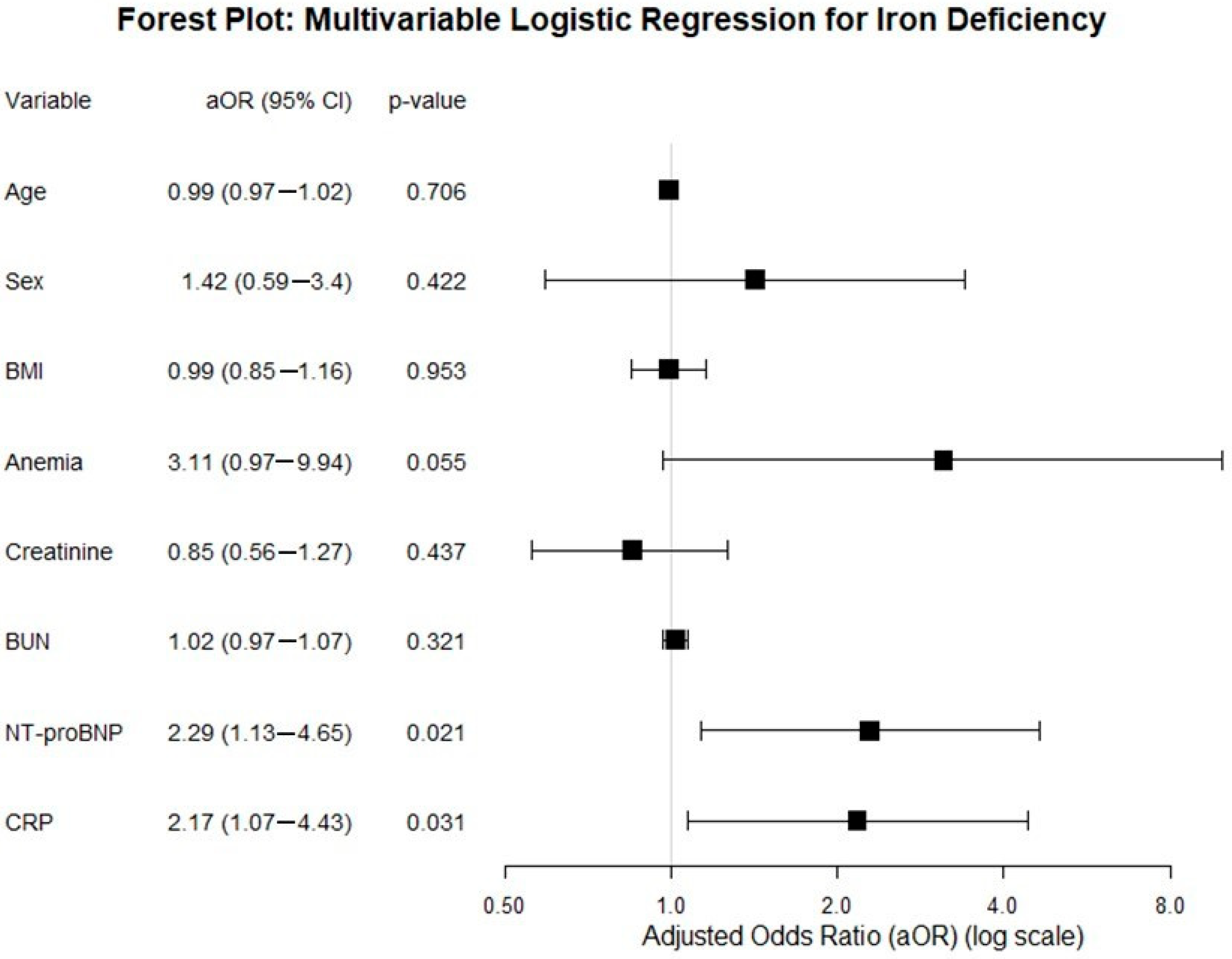
Background/Objectives: Iron deficiency (ID) is a critical comorbidity in chronic heart failure (CHF) that impairs myocardial energy metabolism and clinical outcomes. Despite its significance, data regarding ID prevalence in Southeast Asian CHF populations remain insufficient. This study aimed to determine the prevalence of ID and identify its independent clinical correlates among CHF patients at a leading tertiary hospital in Vietnam using high-precision automated diagnostic platforms. Methods: A descriptive cross-sectional study was conducted on 138 adult CHF patients. Serum iron and ferritin were quantified using photometric and electrochemiluminescence immunoassay (ECLIA) methods on cobas c702 and e602 systems. ID was defined according to 2021 ESC guidelines (ferritin < 100 ng/mL or ferritin 100–299 ng/mL with TSAT < 20%). Multivariable logistic regression identified independent factors associated with ID. Results: The overall ID prevalence was 75.4%, consisting of functional (39.9%) and absolute ID (35.5%). A significant gender disparity was observed (p = 0.0326): absolute ID was more prevalent in females (44.4%), while functional ID predominated in males (47.4%). Multivariable analysis revealed that NT-proBNP (aOR = 2.29; 95% CI: 1.13–4.66; p = 0.021) and C-reactive protein (aOR = 2.17; 95% CI: 1.07–4.43; p = 0.031) were independent correlates of ID status. The association with anemia was borderline non-significant (p = 0.055). Conclusions: ID is nearly ubiquitous among Vietnamese CHF patients in this tertiary setting, driven by hemodynamic severity and systemic inflammation. These findings advocate for integrating routine iron status screening into the standard diagnostic workup for all CHF patients, regardless of hemoglobin levels.
Keywords: chronic heart failure; iron deficiency; ferritin; NT-proBNP; C-reactive protein; Vietnam chronic heart failure; iron deficiency; ferritin; NT-proBNP; C-reactive protein; Vietnam