Article

Unveiling Donor-Derived BKPyV DNAemia Through Analysis of Contralateral Kidney Transplant Recipients

by
Wouter T. Moest
1,*,
A. Lianne Messchendorp
2,
Helma Dolmans
3,
Cynthia Konijn-Janssen
4,
Stan van den Eijnden
4,
Milou van Bruchem
5,
Ineke Tieken
5,
Maarten H. L. Christiaans
6,
Arjan D. van Zuilen
3,
Marcia M. L. Kho
7,
Irma Stijnman
8,
Frederike J. Bemelman
8,
Jan-Stephan S. Sanders
9,
Mariet C. W. Feltkamp
10,
Aiko P. J. de Vries
1 and
Joris I. Rotmans
1
1
Department of Internal Medicine, Leiden University Medical Center (LUMC), 2333 ZA Leiden, The Netherlands
2
Department of Medical Microbiology and Infection Prevention, University Medical Center Groningen (UMCG), 9713 GZ Groningen, The Netherlands
3
Department of Nephrology, University Medical Center Utrecht (UMCU), 3584 CX Utrecht, The Netherlands
4
Nederlandse Transplantatie Stichting (NTS), 2332 KG Leiden, The Netherlands
5
EuroTransplant, 2332 KG Leiden, The Netherlands
6
Department of Internal Medicine, Division of Nephrology, Maastricht University Medical Center (MUMC), 6229 HX Maastricht, The Netherlands
7
Department of Internal Medicine, Section of Nephrology & Transplantation, Erasmus Medical Center (EMC), 3015 GD Rotterdam, The Netherlands
8
Department of Internal Medicine, Amsterdam University Medical Center (AUMC), 1105 AZ Amsterdam, The Netherlands
9
Department of Internal Medicine, Division of Nephrology, University Medical Center Groningen (UMCG), 9713 GZ Groningen, The Netherlands
10
Department of Medical Microbiology & Infection Prevention, Leiden University Center of Infectious Diseases, Leiden University Medical Center (LUMC), 2333 ZA Leiden, The Netherlands
*
Author to whom correspondence should be addressed.
Biomedicines 2026, 14(4), 820; https://doi.org/10.3390/biomedicines14040820

Submission received: 12 March 2026 / Revised: 30 March 2026 / Accepted: 1 April 2026 / Published: 3 April 2026
(This article belongs to the Special Issue BK Polyomavirus: Immunopathology and Therapeutic Approaches)

Abstract

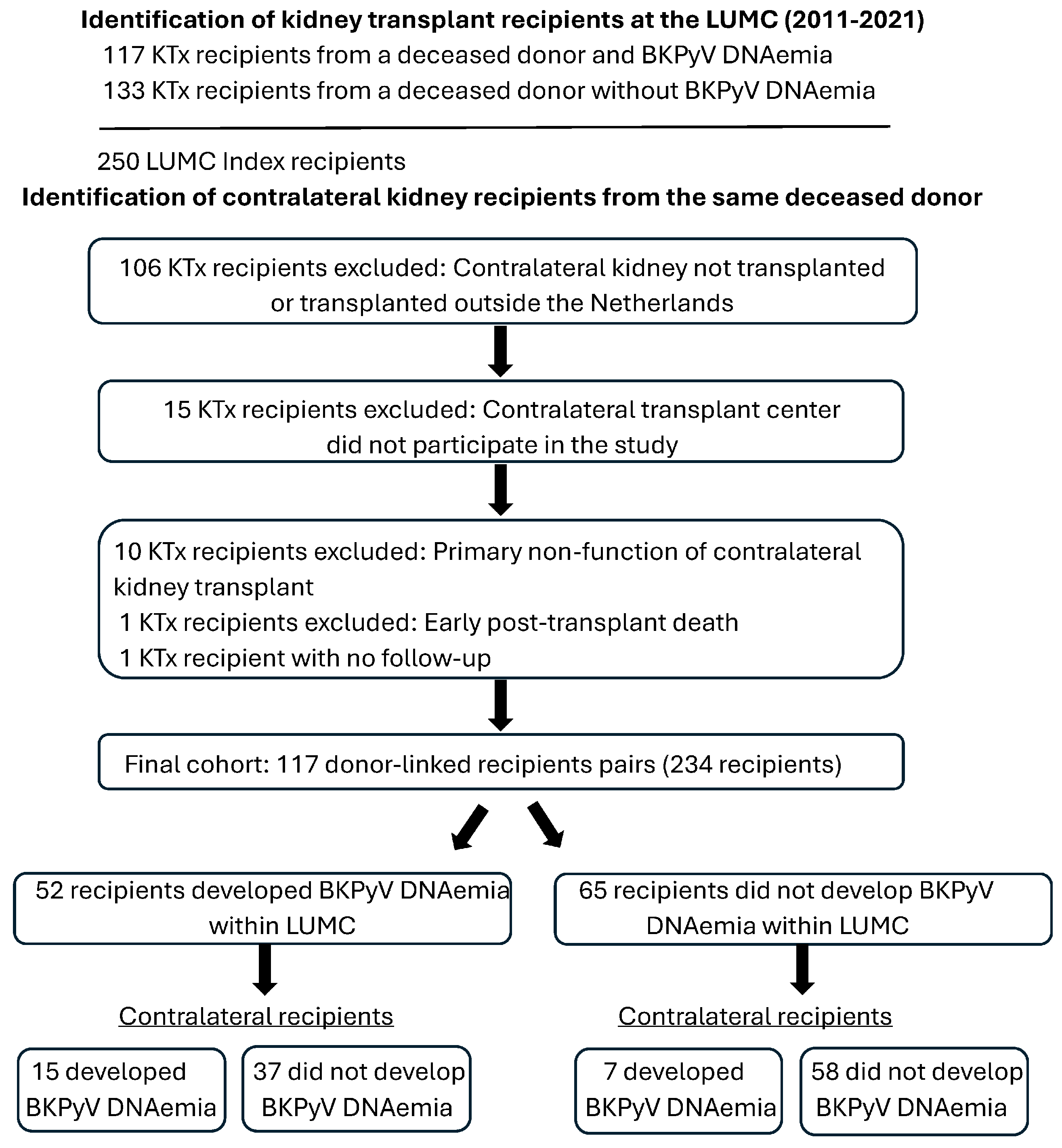
Background: BK polyomavirus (BKPyV) infection is of notable concern in kidney transplant recipients, as it can cause BKPyV-associated nephropathy (BKPyVAN). Currently, there is no effective treatment for BKPyV infection, underscoring the need for preventive strategies. There is emerging evidence that donor-derived BKPyV plays a role in the development of BKPyV DNAemia. To further explore this hypothesis, we conducted a retrospective, multi-center cohort study to evaluate the risk of developing BKPyV DNAemia in kidney recipient pairs sharing the same donor. Methods: At the Leiden University Medical Center (LUMC), deceased donor kidney transplant recipients (2011–2021) were identified and classified according to the occurrence of BKPyV DNAemia within the first year post-transplantation. For each recipient, the contralateral kidney recipient from the same donor was identified through national transplant registries. Cox regression was used to assess whether BKPyV DNAemia in the LUMC recipient was associated with an increased risk of BKPyV DNAemia in the contralateral recipient. Results: Among 117 recipient pairs, BKPyV DNAemia was more frequent when the contralateral recipient was affected (28.8% [15/52]), compared with pairs in which the contralateral recipient remained unaffected (10.8% [7/65], p = 0.013). Multivariable Cox regression analysis confirmed this increased risk (HR 4.9, 95% CI: 1.8–13.6; p = 0.002). Conclusions: This study shows a significantly increased risk of BKPyV DNAemia in recipients of deceased donor kidneys when the contralateral kidney recipient develops BKPyV DNAemia. These findings highlight the influence of donor-derived factors in BKPyV transmission in kidney transplantation.
Keywords: BK polyomavirus; kidney transplantation; donor-derived infection; viral transmission BK polyomavirus; kidney transplantation; donor-derived infection; viral transmission