1. Introduction
Rheumatoid arthritis (RA) is a long-standing autoimmune condition characterized by persistent synovial inflammation, chronic joint deterioration, and lasting disability [
1,
2]. In recent years, there has been increasing recognition that RA is not confined to the joints but also confers a markedly elevated risk of cardiovascular disease (CVD), which now represents a major cause of morbidity and mortality in affected individuals [
3,
4,
5]. Epidemiological studies indicate that patients with RA have up to a 50% higher risk of developing CVD events compared to the general population, even after adjustment for traditional cardiovascular risk factors such as hypertension, diabetes mellitus, and smoking [
6,
7,
8].
The mechanisms underlying the increased cardiovascular risk in RA are multifactorial, involving traditional risk factors, persistent systemic inflammation, disease activity, and the impact of disease-modifying antirheumatic drugs (DMARDs) [
8,
9,
10]. Chronic inflammation in RA has been linked to atherosclerosis changes through endothelial dysfunction, oxidative stress, and alterations in lipid metabolism, which together may contribute to subclinical vascular changes [
4,
11,
12].
Intima–media thickness (IMT) and plaque detection via carotid Doppler ultrasonography are validated, non-invasive markers of subclinical atherosclerosis, indicating the presence of vascular involvement and linked to increased cardiovascular risk [
5,
10,
13]. Several studies have shown increased IMT and a higher number of plaques in RA populations compared to controls, although there remains debate over the extent to which these changes are attributable to RA itself versus conventional cardiovascular risk factors [
7,
14,
15,
16].
Given the increased cardiovascular risk and potential for early atherosclerotic changes in RA, there is a clear need for early identification and intervention to mitigate long-term vascular complications [
2,
17,
18]. However, there is a lack of local data regarding subclinical atherosclerosis in RA populations.
This study aims to explore the prevalence of subclinical carotid atherosclerosis, as assessed by Doppler ultrasonography, in patients with RA compared to healthy controls. Furthermore, the study seeks to identify the associations between traditional cardiovascular risk factors, RA-related variables, and ultrasound-based markers of atherosclerosis.
4. Results
A total of 73 patients with rheumatoid arthritis (RA) and 78 healthy controls were included in this study. The demographic and clinical characteristics of the participants are summarized in
Table 1. The RA group comprised 58 females (79.45%) and 15 males (20.55%), whereas the control group included 35 females (44.87%) and 43 males (55.13%). The median age was significantly lower in the RA group (55 years, IQR: 43–63) compared with controls (61 years, IQR: 51–68;
p = 0.012). Median height was also significantly lower among RA patients (157 cm, IQR: 153–161.25) compared with controls (164.5 cm, IQR: 157–170.25;
p < 0.001). In addition, smoking prevalence was significantly lower in the RA group (2.74%) than in controls (12.82%;
p = 0.032). No significant differences were observed between groups in weight (
p = 0.192) or BMI (
p = 0.862). Within the RA cohort, the median disease duration was 72 months (IQR: 24.5–168). The prevalence of diabetes mellitus (DM) was 31.51%, hypertension (HTN) 28.77%, stroke 4.17%, and ischemic heart disease (IHD) 6.94% (
Table 1). Laboratory parameters are detailed in
Table 1, including a median CRP of 4.85 mg/L and ESR of 22 mm/h. Rheumatoid factor (RF) positivity was observed in 53.85% of patients, and anti-CCP antibodies in 39.29%.
Analysis of carotid intima–media thickness (IMT) and the presence of carotid intima–media thickness (IMT) measurements are presented in
Table 2. No statistically significant differences were observed in median right CCA IMT between RA patients (0.07 mm, IQR: 0.06–0.0805) and controls (0.068 mm, IQR: 0.05–0.07625;
p = 0.619). Similarly, left CCA IMT did not differ significantly between groups (0.065 mm in both groups;
p = 0.701).
Multivariable linear regression models adjusting for age, sex, and smoking did not initially demonstrate a significant independent association between RA status and carotid IMT. However, regression diagnostics indicated heteroskedasticity and non-normal residuals, which may violate assumptions of standard regression models. Therefore, robust regression using MM-estimation was applied to provide more reliable estimates under these conditions. In these models, RA status showed a modest association with right CCA IMT and mean IMT. This discrepancy between standard and robust models suggests that the observed association is sensitive to model assumptions and should be interpreted cautiously. To avoid selective emphasis, both conventional and robust regression results are presented, with primary emphasis placed on the overall consistency of findings and the between-group comparisons, which did not demonstrate significant differences in IMT. Accordingly, these findings are considered exploratory rather than confirmatory (
Table 3).
4.1. IMT and Regression Diagnostics
Assessment of normality demonstrated significant deviation for left CCA IMT (
Supplementary Materials Table S1). Regression diagnostics confirmed heteroskedasticity and non-normal residuals, justifying the use of robust MM-estimation (
Supplementary Materials Table S2). In robust multivariable regression models (
Table 3), RA status was independently associated with right CCA IMT and mean IMT after adjustment for age, sex, and smoking. Age remained significantly associated with right CCA IMT.
The prevalence of carotid narrowing is summarized in
Table 4. Right CCA narrowing was present in 15.07% of RA patients and 11.54% of controls (
p = 0.633). Left CCA narrowing occurred in 4.11% of RA patients and 2.56% of controls (
p = 0.673). When considering either side, narrowing was observed in 16.44% of RA patients and 12.82% of controls (
p = 0.646). These differences were not statistically significant.
Multivariable logistic regression adjusting for age, gender, and smoking (
Table 5) confirmed that RA status was not independently associated with carotid narrowing (right side OR = 1.689,
p = 0.335; left side OR = 1.505,
p = 0.684; combined OR = 0.631,
p = 0.374). Age was significantly associated with right-sided narrowing (OR = 1.049,
p = 0.018).
4.2. Carotid Narrowing and Model Stability
The prevalence of carotid narrowing did not differ significantly between RA patients and controls (
Table 4). Due to limited narrowing events and low EPV ratios (
Supplementary Materials Table S3), Firth’s penalized logistic regression was applied. In adjusted models (
Table 5), RA status was not independently associated with carotid narrowing. Age demonstrated a significant association with right-sided narrowing. Given the sparse event distribution, these findings should be interpreted cautiously.
Correlations between continuous variables and IMT within the RA group are presented in
Table 6. Age showed a significant positive correlation with right CCA IMT (Spearman’s rho = 0.375,
p = 0.001). No other continuous variables, including weight, BMI, laboratory markers, or RA duration, were significantly correlated with IMT.
Associations between categorical variables and IMT are shown in
Table 7. No significant associations were found for gender, smoking, DM, HTN, stroke, IHD, RF, or anti-CCP status. However, the association between anti-CCP status and left CCA IMT approached statistical significance (
p = 0.054).
Associations between categorical variables and narrowing are presented in
Table 8. DM was significantly associated with right CCA narrowing (34.78% in diabetics vs. 6% in non-diabetics;
p = 0.003) and combined narrowing (
p = 0.007). No other categorical variables showed significant associations.
Comparisons of continuous variables between patients with and without narrowing are summarized in
Table 9,
Table 10 and
Table 11. For right CCA narrowing (
Table 9), patients with narrowing were significantly older (median 63 years vs. 55 years;
p = 0.038). No significant associations were observed with BMI, RA duration, or laboratory markers. For left CCA narrowing (
Table 10), no significant associations were identified. When considering narrowing on either side (
Table 11), age showed a borderline association (
p = 0.054).
5. Discussion
The aim of this cross-sectional study was to assess subclinical carotid atherosclerosis in patients with rheumatoid arthritis compared to healthy controls. To ensure balanced interpretation, the findings from both conventional and robust regression models are considered together, and greater emphasis is placed on results that are consistent across analytical approaches. The results did not demonstrate a statistically significant difference in carotid IMT or in the prevalence of carotid narrowing between RA patients and controls (
Table 2 and
Table 3). These results suggest that the presence of RA status was not independently associated with a greater burden of subclinical carotid atherosclerosis when controlling for conventional cardiovascular risk factors, which is in line with recent studies highlighting the importance of traditional risk factors such as age and diabetes mellitus. Conventional regression models did not demonstrate a significant association between RA status and carotid IMT. However, robust regression analysis identified a modest association with right CCA IMT and mean IMT after adjustment for confounders. These findings should be interpreted cautiously, given the exploratory nature of the analysis as well as the lack of independent association with carotid narrowing; further support for this observation can be found in
Table 3 and
Table 5.
The discrepancy between standard and robust regression findings highlights the importance of model selection and underlying assumptions in observational analyses. Robust regression was applied to address violations of normality and heteroskedasticity; however, such methods may yield different effect estimates compared to conventional approaches. Therefore, these results should not be interpreted as definitive evidence of an independent effect of RA, but rather as hypothesis-generating findings that warrant confirmation in larger and more rigorously controlled studies.
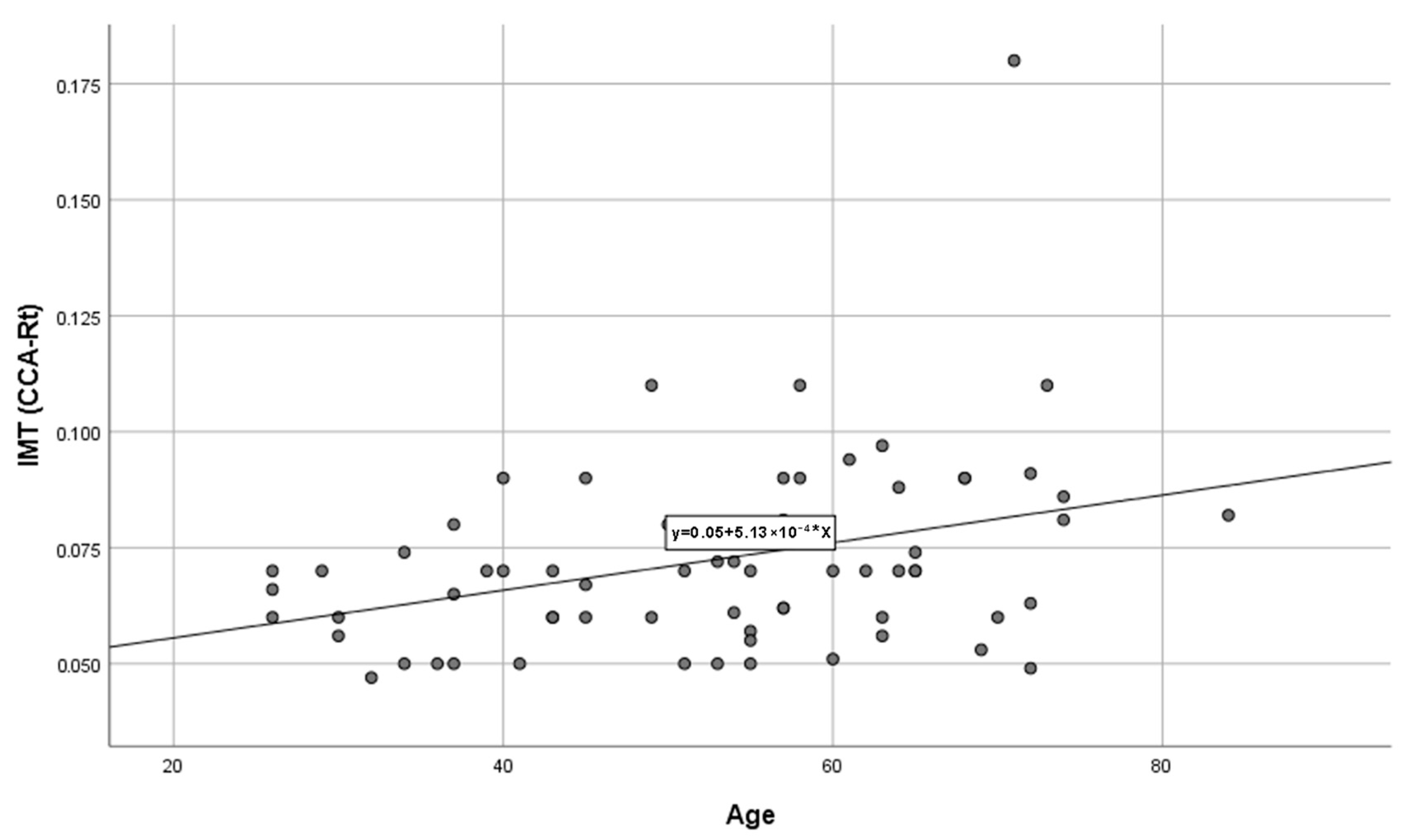
Age emerged as the only continuous variable independently associated with higher right CCA IMT in RA patients, a finding consistent with previous research demonstrating the importance of age as a determinant of early atherosclerotic changes both in the general population and among individuals with RA [
4,
5]. The observed positive correlation between age and IMT (
Table 6,
Figure 1) reinforces the need to account for age-related vascular changes when evaluating cardiovascular risk in this population.
Diabetes mellitus was found to be a significant determinant of carotid narrowing in RA patients, with diabetic individuals showing a markedly higher prevalence of right CCA narrowing (
Table 8). Additional subgroup analysis demonstrated that patients with right CCA narrowing were significantly older than those without narrowing (
Table 9), and age showed a borderline association when narrowing on either side was considered (
Table 11). This association is consistent with previous studies identifying diabetes as a critical risk factor for the development of atherosclerotic vascular changes in both RA and non-RA cohorts [
7,
8]. The current findings further emphasize that, while systemic inflammation and disease activity in RA may contribute to cardiovascular risk, the impact of metabolic comorbidities such as diabetes is substantial and appears to have a greater association than RA characteristics.
Although earlier reports have suggested an increased prevalence of subclinical atherosclerosis in RA patients attributed to chronic systemic inflammation and immune dysregulation [
2,
12] the lack of a statistically significant difference in IMT and carotid narrowing between groups in this study (
Table 2 and
Table 4) supports recent evidence that traditional cardiovascular risk factors remain the most reliable predictors of subclinical atherosclerosis in RA. The association between anti-CCP antibody status and left CCA IMT approached statistical significance (
Table 7), which is consistent with the hypothesis that RA seropositivity may be linked to vascular pathology, though this requires confirmation in studies with larger sample sizes.
Several limitations should be acknowledged. First, the cross-sectional design of the study precludes causal inferences regarding the relationships between rheumatoid arthritis (RA), cardiovascular risk factors, and subclinical atherosclerosis. In addition, the single-center nature of the study and the demographic characteristics of the sample may limit the generalizability of the findings.
Another limitation relates to the incomplete assessment of certain cardiovascular risk factors. Although several conventional risk factors, such as diabetes mellitus, hypertension, smoking status, age, and sex, were included in the analysis, additional determinants, including lipid profile, physical activity, family history of cardiovascular disease, and the use of medications such as statins or antihypertensive agents, were not systematically evaluated. Furthermore, information regarding the duration and level of control of diabetes or hypertension was not available. The absence of these variables may introduce residual confounding and limit the ability to fully distinguish the relative contributions of traditional cardiovascular risk factors versus RA-related mechanisms in the development of subclinical atherosclerosis.
Inflammatory burden was evaluated using routine laboratory markers (CRP and ESR); however, standardized RA disease activity indices (e.g., DAS28), cumulative corticosteroid exposure, and cytokine profiling (e.g., TNF-α, IL-6, IL-1β) were not measured. Therefore, the mechanistic evaluation of inflammation-driven vascular changes was limited. Although disease duration and selected laboratory markers were analyzed within the RA cohort, comprehensive inflammatory characterization was not available, and RA was primarily evaluated as a binary exposure in between-group comparisons rather than being stratified by disease activity. Given the heterogeneity of RA and its potential influence on cardiovascular risk, this may limit the depth of RA-specific characterization.
The primary vascular outcomes assessed in this study were carotid intima–media thickness (IMT) and the presence of carotid narrowing. Resistance index (RI) measurements and ankle-brachial index (ABI) assessments were not included in the ultrasound protocol. Although carotid IMT and narrowing are validated markers of subclinical atherosclerosis, the inclusion of additional vascular indices could provide complementary information regarding systemic vascular involvement.
RA patients were managed according to routine clinical practice rather than a standardized research protocol, resulting in variability in treatment regimens depending on disease activity and physician discretion. Treatment-related variables, including biologic therapy exposure, were not systematically incorporated into adjusted models and may therefore represent a source of residual confounding.
The relatively small number of carotid narrowing events, particularly for left-sided narrowing, may have limited statistical power and affected model stability despite the use of Firth’s penalized logistic regression. Although events-per-variable (EPV) ratios were calculated and penalized methods were applied to mitigate small-sample bias, some models may still have been underpowered and prone to both type I and type II errors. Accordingly, effect estimates—particularly those with wide confidence intervals—should be interpreted with caution.
In addition, the RA and control groups were not formally matched for age and sex, resulting in baseline imbalance. Although multivariable adjustment was performed, analytical correction does not fully substitute for matched design or propensity score adjustment. Therefore, residual confounding cannot be excluded, particularly given the recruitment of controls from hospital staff and community volunteers, the absence of detailed cardiovascular variables (e.g., lipid profile, medication use, physical activity), and the lack of comprehensive RA-specific measures such as disease activity indices and treatment exposure. These factors may influence both vascular outcomes and group comparisons, and therefore, the findings should be interpreted within the context of these limitations.




 ,
,