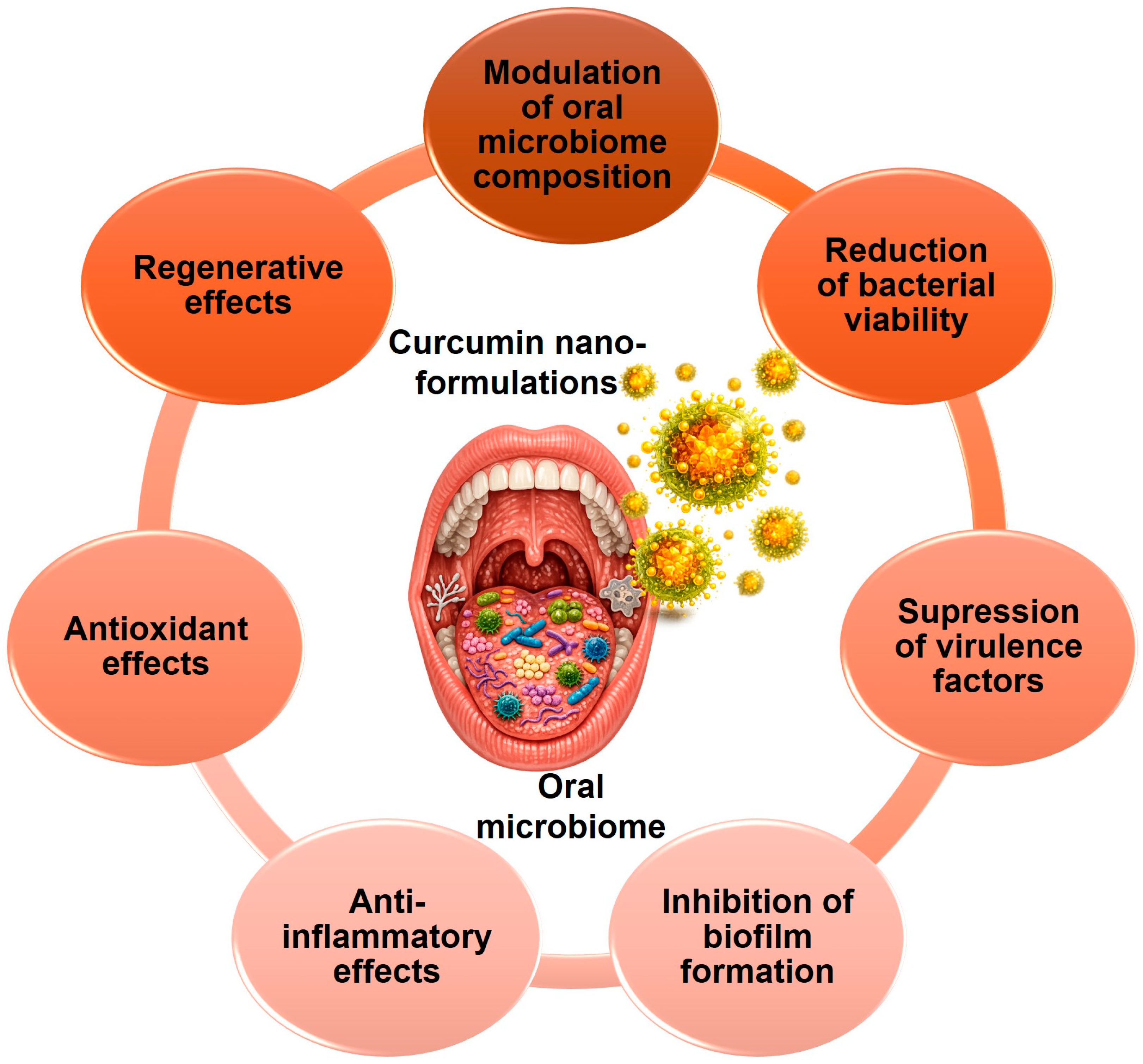
Curcumin-Based Nanoformulations for Oral Health: Mechanistic Insights, Antimicrobial Efficacy, and Future Clinical Perspectives

 , ,
, ,  , , and
Abstract
1. Introduction
2. Types of Nanoformulations for Curcumin Delivery
2.1. Polymeric Nanoparticles
2.1.1. Advantages and Practical Implications of Using Polymeric Nanoparticles
- Solubility and systemic exposure
- Stability and loading capacity
- Controlled and sustained release
- Nanoparticle surface physics and implications of the protein corona
2.1.2. Mechanistic Considerations of Polymeric Nanoparticles Regarding Penetration into Oral Biofilm
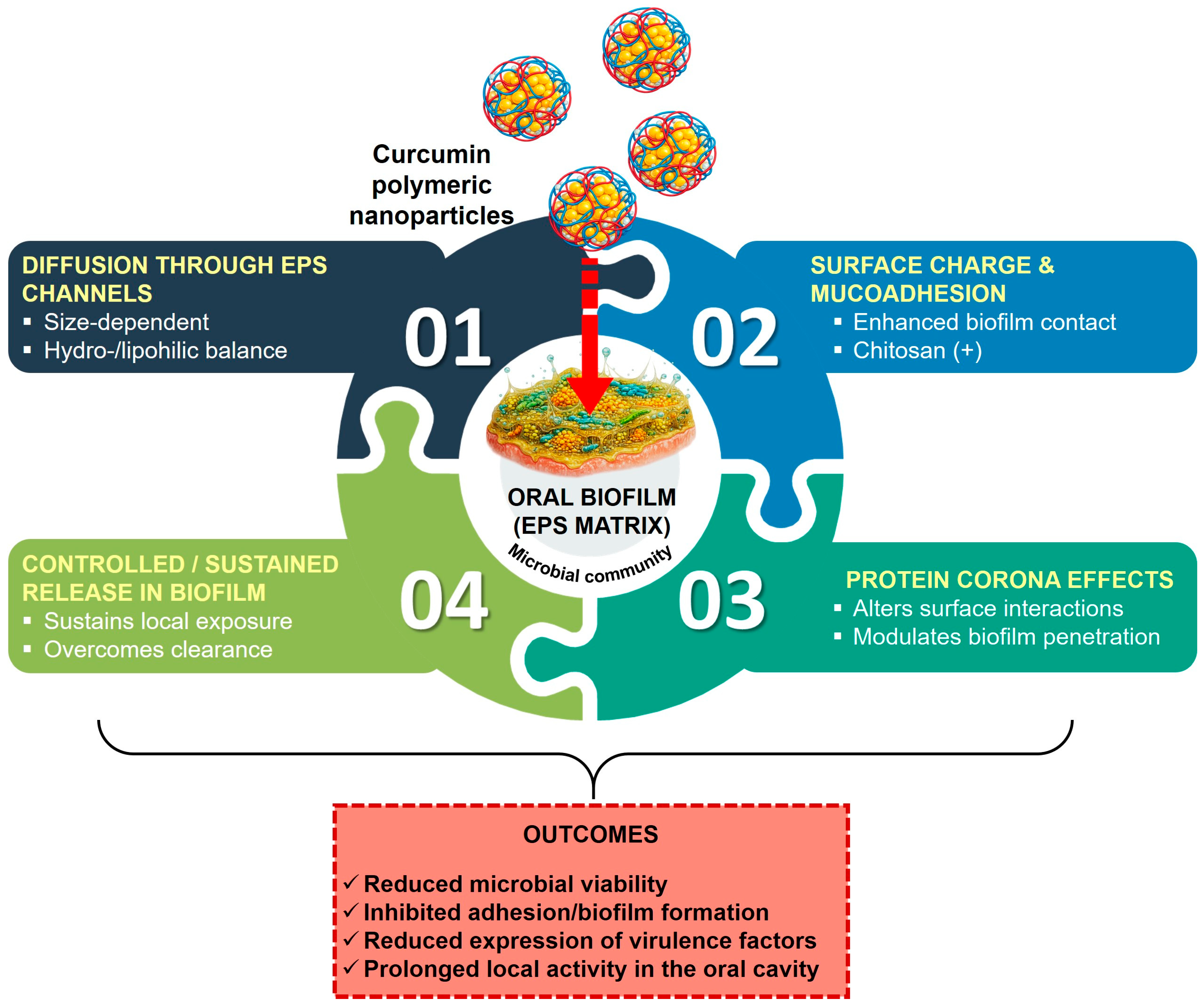
- Surface charge and interactions with the biofilm matrix modify residence time within the biofilm; positively charged or mucoadhesive surfaces (e.g., chitosan-containing systems) may favor initial contact and retention in the biofilm, increasing local exposure to curcumin [56];
- Protein corona effects modulate biofilm interactions and uptake pathways; corona-modified surfaces may alter binding to extracellular components, influence diffusion through biofilm layers, and affect microbial uptake of the nanoformulation [57];
2.1.3. Challenges and Perspectives for Future Research
2.2. Nanomicelles and Nanoemulsions
2.2.1. Advantages and Practical Implications of Using Nanomicelles and Nanoemulsions
2.2.2. Mechanistic Considerations of Nanomicelles and Nanoemulsions
2.2.3. Challenges and Perspectives for Future Research
2.3. Solid Lipid Nanoparticles (SLN) and Nanostructured Lipid Carriers (NLC)
2.3.1. Advantages and Practical Implications of Using SLNs and NLCs
2.3.2. Mechanism of Curcumin Action Relevant to Oral Tissues and How Nanoformulations Modulate Activity
2.3.3. Challenges and Perspectives for Future Research
2.4. Nanogels, Hydrogels, and Mucoadhesive Films
2.4.1. Mucoadhesive Films and Patches for the Oral Cavity
2.4.2. Mucoadhesive Patches Loaded with Multiple Agents
2.4.3. Practical Considerations and Mechanism of Action of Oral Patches with Curcumin Nanoformulations
2.4.4. Conclusions and Future Research Directions
2.5. Metallic or Hybrid Systems
2.5.1. Representative Nanoformulations and Their Characteristics
2.5.2. Mechanisms Underlying Synergy and Superior Antibacterial Activity
2.5.3. Potential Risks and Safety Considerations: Cytotoxicity and Systemic Accumulation
2.6. Comparative Advantages and Limitations of Representative Types of Nanoformulations for Curcumin Delivery
3. Molecular Mechanisms of Action in Oral Health
3.1. Anti-Inflammatory Activity
3.2. Antioxidant Activity
3.3. Effects on Tissue Regeneration
3.4. Interaction with Oral Biofilms and Bacterial Cellular Structure
3.5. Modulation of the Local Immune Response in the Oral Cavity
3.6. Potential Discrepancies Regarding the Effects of Curcumin-Based Nanoformulations
4. Antimicrobial Activity of Curcumin-Based Nanoformulations
4.1. Antimicrobial Spectrum of Curcumin-Based Nanoformulations Against Major Oral Pathogens
4.2. Inhibition of Biofilm Formation
4.3. Synergy of Nanoformulations with Other Antimicrobials and Implications for Cytotoxicity
4.4. Comparison of Antimicrobial Activity Among Different Nanoformulations
- Impact of particle size, surface charge, and stability at oral pH
4.5. Oral Safety and Cytotoxicity Considerations
5. Limitations, Challenges, and Future Research Directions
5.1. Stability of Nanoformulations in the Oral Environment
5.2. Bioavailability Issues and Mucosal Retention
5.3. Standardization of Production and Regulatory Barriers
5.4. The Need for Controlled Clinical Studies
5.5. Perspectives for Next-Generation Nanotechnologies
5.6. Future Directions and Convergent Opportunities
6. Conclusions
Author Contributions
Funding
Institutional Review Board Statement
Informed Consent Statement
Data Availability Statement
Conflicts of Interest
Abbreviations
| WHO | World Health Organization |
| CHX | Chlorhexidine |
| COX-2 | Cyclooxygenase 2 |
| NAFLD | non-alcoholic fatty liver disease |
| iNOS | inducible nitric oxide |
| PLGA | poly(lactic-co-glycolic) acid |
| PCL | poly-ε-caprolactone |
| PLA | polylactic acid |
| PEG | polyethylene glycol |
| EPS | extracellular polymeric substances (matrices) |
| SLN | solid–lipid nanoparticles |
| NLC | nanostructured lipid carriers |
| ROS | reactive oxygen species |
| AgNPs | silver nanoparticles |
| CuNPs | copper nanoparticles |
| ADN | deoxyribonucleic acid |
| DSC | differential scanning calorimetry |
| PDT | photodynamic therapy |
| LPS | lipopolysaccharide |
References
- Goodwin, M.; Henshaw, M.; Borrelli, B. Inequities and oral health: A behavioural sciences perspective. Community Dent. Oral Epidemiol. 2023, 51, 108–115. [Google Scholar] [CrossRef]
- Kassebaum, N.J.; Smith, A.G.C.; Bernabé, E.; Fleming, T.D.; Reynolds, A.E.; Vos, T.; Murray, C.J.L.; Marcenes, W. GBD 2015 Oral Health Collaborators. Global, Regional, and National Prevalence, Incidence, and Disability-Adjusted Life Years for Oral Conditions for 195 Countries, 1990–2015: A Systematic Analysis for the Global Burden of Diseases, Injuries, and Risk Factors. J. Dent. Res. 2017, 96, 380–387. [Google Scholar]
- Marcenes, W.; Kassebaum, N.J.; Bernabé, E.; Flaxman, A.; Naghavi, M.; Lopez, A.; Murray, C.J. Global burden of oral conditions in 1990-2010: A systematic analysis. J. Dent. Res. 2013, 92, 592–597. [Google Scholar] [CrossRef] [PubMed]
- Jin, H.; Deng, A.P.; Tian, H.; Ran, M.S. The association between solid fuel use and oral health: The mediating effect of depressive symptom. Front. Oral Health 2025, 6, 1583685. [Google Scholar] [CrossRef] [PubMed]
- GBD 2017 Oral Disorders Collaborators; Bernabe, E.; Marcenes, W.; Hernandez, C.R.; Bailey, J.; Abreu, L.G.; Alipour, V.; Amini, S.; Arabloo, J.; Arefi, Z.; et al. Global, Regional, and National Levels and Trends in Burden of Oral Conditions from 1990 to 2017: A Systematic Analysis for the Global Burden of Disease 2017 Study. J. Dent. Res. 2020, 99, 362–373. [Google Scholar] [CrossRef]
- Petersen, P.E.; Ogawa, H. The global burden of periodontal disease: Towards integration with chronic disease prevention and control. Periodontol. 2000 2012, 60, 15–39. [Google Scholar] [CrossRef]
- Chen, M.X.; Zhong, Y.J.; Dong, Q.Q.; Wong, H.M.; Wen, Y.F. Global, regional, and national burden of severe periodontitis, 1990-2019: An analysis of the Global Burden of Disease Study 2019. J. Clin. Periodontol. 2021, 48, 1165–1188. [Google Scholar] [CrossRef] [PubMed]
- Hugo, F.N.; Kassebaum, N.J.; Marcenes, W.; Bernabé, E. Role of Dentistry in Global Health: Challenges and Research Priorities. J. Dent. Res. 2021, 100, 681–685. [Google Scholar] [CrossRef]
- Jahangiry, L.; Bagheri, R.; Darabi, F.; Sarbakhsh, P.; Sistani, M.M.N.; Ponnet, K. Oral health status and associated lifestyle behaviors in a sample of Iranian adults: An exploratory household survey. BMC Oral Health 2020, 20, 82. [Google Scholar] [CrossRef]
- Hamonari, N.H. Salivary Markers of Oxidative Stress and Their Relation to Periodontal and Dental Status Among Children With Down Syndrome. Cureus 2024, 16, e73852. [Google Scholar] [CrossRef]
- Seni, A.-G.; Sălcudean, A.; Popovici, R.-A.; Cîmpian, D.-M.; Olariu, T.; Olariu, I.; Păcurar, M.; Kiș, A.M.; Bădoiu, S.-C.; Jinga, V.; et al. Associations Between Diet, Oral Health, and General Development in Romanian School-Age Children. Nutrients 2025, 17, 2832. [Google Scholar] [CrossRef] [PubMed]
- Dumitru, A.I.; Kis, A.M.; Badea, M.-A.; Lacatusu, A.; Boia, M. Health-Related Quality of Life and Internalising Symptoms in Romanian Children with Congenital Cardiac Malformations: A Single-Centre Cross-Sectional Analysis. Healthcare 2025, 13, 1882. [Google Scholar] [CrossRef]
- Neal, T.W.; Schlieve, T. Complications of Severe Odontogenic Infections: A Review. Biology 2022, 11, 1784. [Google Scholar] [CrossRef]
- Mancl, K.A.; Kirsner, R.S.; Ajdic, D. Wound biofilms: Lessons learned from oral biofilms. Wound Repair Regen. 2013, 21, 352–362. [Google Scholar] [CrossRef] [PubMed]
- Jhajharia, K.; Parolia, A.; Shetty, K.V.; Mehta, L.K. Biofilm in endodontics: A review. J. Int. Soc. Prev. Community Dent. 2015, 5, 1–12. [Google Scholar] [CrossRef] [PubMed]
- Chapple, I.L.C.; Mealey, B.L.; Van Dyke, T.E.; Bartold, P.M.; Dommisch, H.; Eickholz, P.; Geisinger, M.L.; Genco, R.J.; Glogauer, M.; Goldstein, M.; et al. Periodontal health and gingival diseases and conditions on an intact and a reduced periodontium: Consensus report of workgroup 1 of the 2017 World Workshop on the Classification of Periodontal and Peri-Implant Diseases and Conditions. J. Clin. Periodontol. 2018, 45, S68–S77. [Google Scholar] [CrossRef]
- Benn, A.M.L.; Heng, N.C.K.; Thomson, W.M.; Broadbent, J.M. Plaque and Dental Caries Risk in Midlife. Caries Res. 2022, 56, 464–476. [Google Scholar] [CrossRef]
- Mashima, I.; Nakazawa, F. The interaction between Streptococcus spp. and Veillonella tobetsuensis in the early stages of oral biofilm formation. J. Bacteriol. 2015, 197, 2104–2111. [Google Scholar] [CrossRef]
- Seni, A.-G.; Sălcudean, A.; Popovici, R.A.; Olariu, I.; Cincu, M.-G.; Jinga, V.; Trusculescu, L.-M.; Pitic, D.E.; Cosoroabă, R.M.; Kis, A.; et al. The Prevalence of Dental Caries Among Children Aged 6–11: A Cross-Sectional Study from Mureș County, Romania. Medicina 2025, 61, 1648. [Google Scholar] [CrossRef]
- Seni, A.-G.; Todor, L.; Kis, A.M.; Cincu, M.-G.; Popovici, R.A.; Porumb, A.; Olariu, I.; Tarcea, M. Assessment of Oral Hygiene Practices and Dental Health Conditions in School-Aged Children of 7–10 Years. Children 2025, 12, 1288. [Google Scholar] [CrossRef]
- Scannapieco, F.A.; Yu, J.; Raghavendran, K.; Vacanti, A.; Owens, S.I.; Wood, K.; Mylotte, J.M. A randomized trial of chlorhexidine gluconate on oral bacterial pathogens in mechanically ventilated patients. Crit. Care 2009, 13, R117. [Google Scholar] [CrossRef]
- Pleszczyńska, M.; Wiater, A.; Bachanek, T.; Szczodrak, J. Enzymes in therapy of biofilm-related oral diseases. Biotechnol. Appl. Biochem. 2017, 64, 337–346. [Google Scholar] [CrossRef] [PubMed]
- Qu, S.; Ma, X.; Yu, S.; Wang, R. Chitosan as a biomaterial for the prevention and treatment of dental caries: Antibacterial effect, biomimetic mineralization, and drug delivery. Front. Bioeng. Biotechnol. 2023, 11, 1234758. [Google Scholar] [CrossRef]
- Farzinnia, G.; Anvari, Y.; Siqueira, M.F. Antimicrobial Resistance in Oral Healthcare: A Growing Concern in Dentistry. Dent. J. 2025, 13, 391. [Google Scholar] [CrossRef]
- Wang, B.Y.; Chi, B.; Kuramitsu, H.K. Genetic exchange between Treponema denticola and Streptococcus gordonii in biofilms. Oral Microbiol. Immunol. 2002, 17, 108–112. [Google Scholar] [CrossRef]
- Macartney, R.A.; Fricker, A.T.R.; Smith, A.M.; Fedele, S.; Roy, I.; Knowles, J.C. A RP-HPLC-UV method for the dual detection of fluconazole and clobetasol propionate and application to a model dual drug delivery hydrogel. Anal. Methods 2025, 17, 3694–3704. [Google Scholar] [CrossRef]
- Ramsundar, K.; Jain, R.K.; Pitchaipillai, S.G. Inhibition of Quorum Sensing Controlled Virulence Factors and Biofilm Formation of Streptococcus mutans Isolated from Orthodontic Subjects by 4-Hydroxycinnamic Acid. Cureus 2023, 15, e47490. [Google Scholar] [CrossRef]
- Łasica, A.; Golec, P.; Laskus, A.; Zalewska, M.; Gędaj, M.; Popowska, M. Periodontitis: Etiology, conventional treatments, and emerging bacteriophage and predatory bacteria therapies. Front. Microbiol. 2024, 15, 1469414. [Google Scholar] [CrossRef] [PubMed]
- Twetman, S.; Belstrøm, D. Effect of Synbiotic and Postbiotic Supplements on Dental Caries and Periodontal Diseases-A Comprehensive Review. Int. J. Environ. Res. Public Health 2025, 22, 72. [Google Scholar] [CrossRef] [PubMed]
- Ibrahim, S.S.; Ragy, N.I.; Nagy, N.A.; El-Kammar, H.; Elbakry, A.M.; Ezzatt, O.M. Evaluation of muco-adhesive tacrolimus patch on caspase-3 induced apoptosis in oral lichen planus: A randomized clinical trial. BMC Oral Health 2023, 23, 99. [Google Scholar] [CrossRef]
- Yeruva, T.; Yang, S.; Doski, S.; Duncan, G.A. Hydrogels for Mucosal Drug Delivery. ACS Appl. Bio Mater. 2023, 6, 1684–1700. [Google Scholar] [CrossRef]
- Trusculescu, L.-M.; Pitic, D.E.; Sălcudean, A.; Popovici, R.A.; Forna, N.; Badoiu, S.C.; Enache, A.; Enasoni, S.; Kiș, A.; Cosoroabă, R.M.; et al. Virtual Reality as a Non-Pharmacological Aid for Reducing Anxiety in Pediatric Dental Procedures. Children 2025, 12, 930. [Google Scholar] [CrossRef]
- Hewlings, S.J.; Kalman, D.S. Curcumin: A Review of Its Effects on Human Health. Foods 2017, 6, 92. [Google Scholar] [CrossRef] [PubMed]
- Anand, P.; Kunnumakkara, A.B.; Newman, R.A.; Aggarwal, B.B. Bioavailability of curcumin: Problems and promises. Mol. Pharm. 2007, 4, 807–818. [Google Scholar] [CrossRef]
- Prasad, S.; Tyagi, A.K.; Aggarwal, B.B. Recent developments in delivery, bioavailability, absorption and metabolism of curcumin: The golden pigment from golden spice. Cancer Res. Treat. 2014, 46, 2–18. [Google Scholar] [CrossRef] [PubMed]
- Shakeri, A.; Panahi, Y.; Johnston, T.P.; Sahebkar, A. Biological properties of metal complexes of curcumin. Biofactors 2019, 45, 304–317. [Google Scholar] [CrossRef]
- Inchingolo, F.; Inchingolo, A.D.; Latini, G.; Trilli, I.; Ferrante, L.; Nardelli, P.; Malcangi, G.; Inchingolo, A.M.; Mancini, A.; Palermo, A.; et al. The Role of Curcumin in Oral Health and Diseases: A Systematic Review. Antioxidants 2024, 13, 660. [Google Scholar] [CrossRef]
- Lopresti, A.L. The Problem of Curcumin and Its Bioavailability: Could Its Gastrointestinal Influence Contribute to Its Overall Health-Enhancing Effects? Adv. Nutr. 2018, 9, 41–50. [Google Scholar] [CrossRef]
- Harada, T.; Pham, D.T.; Lincoln, S.F.; Kee, T.W. The capture and stabilization of curcumin using hydrophobically modified polyacrylate aggregates and hydrogels. J. Phys. Chem. B 2014, 118, 9515–9523. [Google Scholar] [CrossRef]
- Gbolahan, O.B.; O’Neil, B.H.; McRee, A.J.; Sanoff, H.K.; Fallon, J.K.; Smith, P.C.; Ivanova, A.; Moore, D.T.; Dumond, J.; Asher, G.N. A phase I evaluation of the effect of curcumin on dose-limiting toxicity and pharmacokinetics of irinotecan in participants with solid tumors. Clin. Transl. Sci. 2022, 15, 1304–1315. [Google Scholar] [CrossRef] [PubMed]
- Dhillon, N.; Aggarwal, B.B.; Newman, R.A.; Wolff, R.A.; Kunnumakkara, A.B.; Abbruzzese, J.L.; Ng, C.S.; Badmaev, V.; Kurzrock, R. Phase II trial of curcumin in patients with advanced pancreatic cancer. Clin. Cancer Res. 2008, 14, 4491–4499. [Google Scholar] [CrossRef] [PubMed]
- Silvestre, F.; Santos, C.; Silva, V.; Ombredane, A.; Pinheiro, W.; Andrade, L.; Garcia, M.; Pacheco, T.; Joanitti, G.; Luz, G.; et al. Pharmacokinetics of Curcumin Delivered by Nanoparticles and the Relationship with Antitumor Efficacy: A Systematic Review. Pharmaceuticals 2023, 16, 943. [Google Scholar] [CrossRef]
- Arozal, W.; Ramadanty, W.T.; Louisa, M.; Satyana, R.P.U.; Hartono, G.; Fatrin, S.; Purbadi, S.; Estuningtyas, A.; Instiaty, I. Pharmacokinetic Profile of Curcumin and Nanocurcumin in Plasma, Ovary, and Other Tissues. Drug Res. 2019, 69, 559–564. [Google Scholar] [CrossRef]
- Peng, S.; Zou, L.; Liu, W.; Liu, C.; McClements, D.J. Fabrication and Characterization of Curcumin-Loaded Liposomes Formed from Sunflower Lecithin: Impact of Composition and Environmental Stress. J. Agric. Food Chem. 2018, 66, 12421–12430. [Google Scholar] [CrossRef]
- Babaei, E.; Sadeghizadeh, M.; Hassan, Z.M.; Feizi, M.A.; Najafi, F.; Hashemi, S.M. Dendrosomal curcumin significantly suppresses cancer cell proliferation in vitro and in vivo. Int. Immunopharmacol. 2012, 12, 226–234. [Google Scholar] [CrossRef]
- Ucisik, M.H.; Küpcü, S.; Schuster, B.; Sleytr, U.B. Characterization of CurcuEmulsomes: Nanoformulation for enhanced solubility and delivery of curcumin. J. Nanobiotechnol. 2013, 11, 37. [Google Scholar] [CrossRef] [PubMed]
- Ma, Z.; Haddadi, A.; Molavi, O.; Lavasanifar, A.; Lai, R.; Samuel, J. Micelles of poly(ethylene oxide)-b-poly(epsilon-caprolactone) as vehicles for the solubilization, stabilization, and controlled delivery of curcumin. J. Biomed. Mater. Res. A 2008, 86, 300–310. [Google Scholar] [CrossRef]
- Wong, K.E.; Ngai, S.C.; Chan, K.G.; Lee, L.H.; Goh, B.H.; Chuah, L.H. Curcumin Nanoformulations for Colorectal Cancer: A Review. Front. Pharmacol. 2019, 10, 152. [Google Scholar] [CrossRef]
- Yu, H.; Huang, Q. Improving the oral bioavailability of curcumin using novel organogel-based nanoemulsions. J. Agric. Food Chem. 2012, 60, 5373–5379. [Google Scholar] [CrossRef]
- De Leo, V.; Milano, F.; Mancini, E.; Comparelli, R.; Giotta, L.; Nacci, A.; Longobardi, F.; Garbetta, A.; Agostiano, A.; Catucci, L. Encapsulation of Curcumin-Loaded Liposomes for Colonic Drug Delivery in a pH-Responsive Polymer Cluster Using a pH-Driven and Organic Solvent-Free Process. Molecules 2018, 23, 739. [Google Scholar] [CrossRef] [PubMed]
- Yallapu, M.M.; Nagesh, P.K.; Jaggi, M.; Chauhan, S.C. Therapeutic Applications of Curcumin Nanoformulations. AAPS J. 2015, 17, 1341–1356. [Google Scholar] [CrossRef]
- Yallapu, M.M.; Ebeling, M.C.; Jaggi, M.; Chauhan, S.C. Plasma proteins interaction with curcumin nanoparticles: Implications in cancer therapeutics. Curr. Drug Metab. 2013, 14, 504–515. [Google Scholar] [CrossRef] [PubMed]
- Ranjan, A.P.; Mukerjee, A.; Helson, L.; Vishwanatha, J.K. Scale up, optimization and stability analysis of Curcumin C3 complex-loaded nanoparticles for cancer therapy. J. Nanobiotechnol. 2012, 10, 38. [Google Scholar] [CrossRef] [PubMed]
- Kanai, M.; Imaizumi, A.; Otsuka, Y.; Sasaki, H.; Hashiguchi, M.; Tsujiko, K.; Matsumoto, S.; Ishiguro, H.; Chiba, T. Dose-escalation and pharmacokinetic study of nanoparticle curcumin, a potential anticancer agent with improved bioavailability, in healthy human volunteers. Cancer Chemother. Pharmacol. 2012, 69, 65–70. [Google Scholar] [CrossRef] [PubMed]
- Lao, C.D.; Ruffin, M.T.; Normolle, D.; Heath, D.D.; Murray, S.I.; Bailey, J.M.; Boggs, M.E.; Crowell, J.; Rock, C.L.; Brenner, D.E. Dose escalation of a curcuminoid formulation. BMC Complement. Altern. Med. 2006, 6, 10. [Google Scholar] [CrossRef]
- Ma, F.; Luo, S.; Lu, C.; Jiang, X.; Chen, K.; Deng, J.; Ma, S.; Li, Z. The role of Nrf2 in periodontal disease by regulating lipid peroxidation, inflammation and apoptosis. Front. Endocrinol. 2022, 13, 963451. [Google Scholar] [CrossRef]
- Ndumiso, M.; Buchtová, N.; Husselmann, L.; Mohamed, G.; Klein, A.; Aucamp, M.; Canevet, D.; D’Souza, S.; Maphasa, R.E.; Boury, F.; et al. Comparative whole corona fingerprinting and protein adsorption thermodynamics of PLGA and PCL nanoparticles in human serum. Colloids Surf. B Biointerfaces 2020, 188, 110816. [Google Scholar] [CrossRef]
- Agrahari, V.; Agrahari, V.; Hung, W.T.; Christenson, L.K.; Mitra, A.K. Composite Nanoformulation Therapeutics for Long-Term Ocular Delivery of Macromolecules. Mol. Pharm. 2016, 13, 2912–2922. [Google Scholar] [CrossRef]
- Lombardo, D.; Kiselev, M.A.; Caccamo, M.T. Smart Nanoparticles for Drug Delivery Application: Development of Versatile Nanocarrier Platforms in Biotechnology and Nanomedicine. J. Nanomater. 2019, 2019, 3702518. [Google Scholar] [CrossRef]
- Cabral, H.; Miyata, K.; Osada, K.; Kataoka, K. Block Copolymer Micelles in Nanomedicine Applications. Chem. Rev. 2018, 118, 6844–6892. [Google Scholar] [CrossRef]
- Grilc, N.K.; Sova, M.; Kristl, J. Drug Delivery Strategies for Curcumin and Other Natural Nrf2 Modulators of Oxidative Stress-Related Diseases. Pharmaceutics 2021, 13, 2137. [Google Scholar] [CrossRef]
- Jazayeri-Tehrani, S.A.; Rezayat, S.M.; Mansouri, S.; Qorbani, M.; Alavian, S.M.; Daneshi-Maskooni, M.; Hosseinzadeh-Attar, M.J. Nano-curcumin improves glucose indices, lipids, inflammation, and Nesfatin in overweight and obese patients with non-alcoholic fatty liver disease (NAFLD): A double-blind randomized placebo-controlled clinical trial. Nutr. Metab. 2019, 16, 8. [Google Scholar] [CrossRef]
- Umerska, A.; Gaucher, C.; Oyarzun-Ampuero, F.; Fries-Raeth, I.; Colin, F.; Villamizar-Sarmiento, M.G.; Maincent, P.; Sapin-Minet, A. Polymeric Nanoparticles for Increasing Oral Bioavailability of Curcumin. Antioxidants 2018, 7, 46. [Google Scholar] [CrossRef]
- Jacob, C. Inspired by Nature: Antioxidants and Nanotechnology. Antioxidants 2018, 7, 101. [Google Scholar] [CrossRef]
- Pan, C.J.; Shao, Z.Y.; Tang, J.J.; Wang, J.; Huang, N. In vitro studies of platelet adhesion, activation, and protein adsorption on curcumin-eluting biodegradable stent materials. J. Biomed. Mater. Res. A 2007, 82, 740–746. [Google Scholar] [CrossRef] [PubMed]
- Mahmoud, M.Y.; Sapare, S.; Curry, K.C.; Demuth, D.R.; Steinbach-Rankins, J.M. Rapid Release Polymeric Fibers for Inhibition of Porphyromonas gingivalis Adherence to Streptococcus gordonii. Front. Chem. 2020, 7, 926. [Google Scholar] [CrossRef] [PubMed]
- Mahmoud, M.Y.; Steinbach-Rankins, J.M.; Demuth, D.R. Functional assessment of peptide-modified PLGA nanoparticles against oral biofilms in a murine model of periodontitis. J. Control. Release 2019, 297, 3–13. [Google Scholar] [CrossRef]
- Chen, W.; Zhou, S.; Ge, L.; Wu, W.; Jiang, X. Translatable High Drug Loading Drug Delivery Systems Based on Biocompatible Polymer Nanocarriers. Biomacromolecules 2018, 19, 1732–1745. [Google Scholar] [CrossRef] [PubMed]
- Gutjahr, A.; Phelip, C.; Coolen, A.-L.; Monge, C.; Boisgard, A.-S.; Paul, S.; Verrier, B. Biodegradable Polymeric Nanoparticles-Based Vaccine Adjuvants for Lymph Nodes Targeting. Vaccines 2016, 4, 34. [Google Scholar] [CrossRef]
- Stohs, S.J.; Chen, O.; Ray, S.D.; Ji, J.; Bucci, L.R.; Preuss, H.G. Highly Bioavailable Forms of Curcumin and Promising Avenues for Curcumin-Based Research and Application: A Review. Molecules 2020, 25, 1397. [Google Scholar] [CrossRef]
- Jäger, R.; Lowery, R.P.; Calvanese, A.V.; Joy, J.M.; Purpura, M.; Wilson, J.M. Comparative absorption of curcumin formulations. Nutr. J. 2014, 13, 11. [Google Scholar] [CrossRef] [PubMed]
- Ng, T.P.; Nyunt, M.S.Z.; Gao, Q.; Gwee, X.; Chua, D.Q.L.; Yap, K.B. Curcumin-Rich Curry Consumption and Neurocognitive Function from 4.5-Year Follow-Up of Community-Dwelling Older Adults (Singapore Longitudinal Ageing Study). Nutrients 2022, 14, 1189. [Google Scholar] [CrossRef] [PubMed]
- Preeti Sambhakar, S.; Malik, R.; Bhatia, S.; Al Harrasi, A.; Rani, C.; Saharan, R.; Kumar, S.; Geeta Sehrawat, R. Nanoemulsion: An Emerging Novel Technology for Improving the Bioavailability of Drugs. Scientifica 2023, 2023, 6640103. [Google Scholar] [CrossRef] [PubMed]
- Tavares, T.M.B.; Almeida, H.M.D.e.S.; Lage, M.V.M.; de Carvalho Feitosa, R.; da Silva Júnior, A.A. Nanoemulsions: A Promising Strategy in the Fight against Bacterial Infections. Med. Sci. Forum 2024, 24, 18. [Google Scholar]
- Narang, J.K.; Narang, R.S. Emerging role of nanoemulsions in oral health management. Int. J. Pharm. Investig. 2017, 7, 1–3. [Google Scholar] [CrossRef]
- Haq, N.; Shahid, M.; Alaofi, A.L.; Ahmad, Z.H.; Alrayyes, Y.F.; Alsarra, I.A.; Shakeel, F. Evaluation of the Physicochemical and Antimicrobial Properties of Nanoemulsion-Based Polyherbal Mouthwash. ACS Omega 2023, 8, 41755–41764. [Google Scholar] [CrossRef]
- Al Ayoub, Y.; Gopalan, R.C.; Najafzadeh, M.; Mohammad, M.A.; Anderson, D.; Paradkar, A.; Assi, K.H. Development and evaluation of nanoemulsion and microsuspension formulations of curcuminoids for lung delivery with a novel approach to understanding the aerosol performance of nanoparticles. Int. J. Pharm. 2019, 557, 254–263. [Google Scholar] [CrossRef]
- Li, B.; Li, X.; Lin, H.; Zhou, Y. Curcumin as a Promising Antibacterial Agent: Effects on Metabolism and Biofilm Formation in S. mutans. BioMed Res. Int. 2018, 2018, 4508709. [Google Scholar] [CrossRef]
- Amuti, A.; Wang, X.; Zan, M.; Lv, S.; Wang, Z. Formulation and characterization of curcumin-loaded microemulsions: Evaluation of antioxidant stability and in vitro release. J. Mol. Liq. 2021, 336, 116881. [Google Scholar] [CrossRef]
- Al-Maweri, S.A.; Alhajj, M.N.; Deshisha, E.A.; Alshafei, A.K.; Ahmed, A.I.; Almudayfi, N.O.; Alshammari, S.A.; Alsharif, A.; Kassim, S. Curcumin mouthwashes versus chlorhexidine in controlling plaque and gingivitis: A systematic review and meta-analysis. Int. J. Dent. Hyg. 2022, 20, 53–61. [Google Scholar] [CrossRef]
- Cho, M.Y.; Lee, E.S.; Jung, H.I.; Kim, B.I. Anti-biofilm activity of a novel nanoemulsion containing Curcuma xanthorrhiza oil. J. Dent. 2023, 137, 104647. [Google Scholar] [CrossRef]
- Sahlan, M.; Permatadietha Ardiellaputri, A.; Hermasnyah, H.; Wijanarko, A.; Darwita, R.R. Anti oral biofilm mouthwash nanoemulsion containing extract propolis and curcumin. AIP Conf. Proc. 2018, 2024, 020059. [Google Scholar] [CrossRef]
- Batista, D.G.; Sganzerla, W.G.; da Silva, L.R.; Vieira, Y.G.S.; Almeida, A.R.; Dominguini, D.; Ceretta, L.; Pinheiro, A.C.; Bertoldi, F.C.; Becker, D.; et al. Antimicrobial and Cytotoxic Potential of Eucalyptus Essential Oil-Based Nanoemulsions for Mouthwashes Application. Antibiotics 2024, 13, 942. [Google Scholar] [CrossRef]
- Winarti, C.; Hamaisa, A.; Lesmayati, S.; Misgiyarta, M.; Gusmaini, G. Emulsifier ratio and shock treatment effect on the characteristics of eucalyptus–peppermint oil-based mouthwash nanoemulsion. J. Appl. Pharm. Sci. 2024, 14, 083–089. [Google Scholar] [CrossRef]
- Gonçalves, R.F.S.; Martins, J.T.; Abrunhosa, L.; Vicente, A.A.; Pinheiro, A.C. Nanoemulsions for Enhancement of Curcumin Bioavailability and Their Safety Evaluation: Effect of Emulsifier Type. Nanomaterials 2021, 11, 815. [Google Scholar] [CrossRef] [PubMed]
- Panda, S.K.; Parachur, S.V.A.; Mohanty, N.; Swain, T.; Sahu, S. A comparative pharmacokinetic evaluation of a bioavailable curcumin formulation curene® with curcumin formulation containing turmeric volatile oil and standard curcuminoids 95% in healthy human subjects. Funct. Foods Health Dis. 2019, 9, 134. [Google Scholar] [CrossRef]
- Stohs, S.J.; Ji, J.; Bucci, L.R.; Preuss, H.G. A Comparative Pharmacokinetic Assessment of a Novel Highly Bioavailable Curcumin Formulation with 95% Curcumin: A Randomized, Double-Blind, Crossover Study. J. Am. Coll. Nutr. 2018, 37, 51–59. [Google Scholar] [CrossRef]
- Mimica, B.; Bučević Popović, V.; Banjari, I.; Jeličić Kadić, A.; Puljak, L. Methods Used for Enhancing the Bioavailability of Oral Curcumin in Randomized Controlled Trials: A Meta-Research Study. Pharmaceuticals 2022, 15, 939. [Google Scholar] [CrossRef] [PubMed]
- Omidian, H.; Wilson, R.L.; Chowdhury, S.D. Enhancing Therapeutic Efficacy of Curcumin: Advances in Delivery Systems and Clinical Applications. Gels 2023, 9, 596. [Google Scholar] [CrossRef] [PubMed]
- Patel, S.; Shah, J.; Bhairy, S.; Hirlekar, R. Development of curcumin-loaded nanostructured lipid carriers: Preparation, characterization and in-vitro evaluation of anti-cancer activity against A-549 human lung cancer cell line. J. Cancer Tumor Int. 2021, 11, 66–88. [Google Scholar] [CrossRef]
- Chu, Y.; Li, D.; Luo, Y.-F.; He, X.-J.; Jiang, M.-Y. Preparation and In Vitro Evaluation of Glycyrrhetinic Acid-Modified Curcumin-Loaded Nanostructured Lipid Carriers. Molecules 2014, 19, 2445–2457. [Google Scholar] [CrossRef]
- Scomoroscenco, C.; Teodorescu, M.; Raducan, A.; Stan, M.; Voicu, S.N.; Trica, B.; Ninciuleanu, C.M.; Nistor, C.L.; Mihaescu, C.I.; Petcu, C.; et al. Novel Gel Microemulsion as Topical Drug Delivery System for Curcumin in Dermatocosmetics. Pharmaceutics 2021, 13, 505. [Google Scholar] [CrossRef]
- Wang, J.; Sun, H.; Liu, X. Microfluidisation trends in the development of nanodelivery systems: Characterisation and release study of resveratrol-loaded nanostructured lipid carrier prepared with high-pressure microfluidisation. Micro Nano Lett. 2020, 15, 697–702. [Google Scholar] [CrossRef]
- Li, M.; Zahi, M.R.; Yuan, Q.; Tian, F.; Liang, H. Preparation and stability of astaxanthin solid lipid nanoparticles based on stearic acid. Eur. J. Lipid Sci. Technol. 2016, 118, 592–602. [Google Scholar] [CrossRef]
- Irukulla, V.K.; Sarepally, G.; Chatharasi, K.R.; Veeravalli, J.J.; Sriram, R. Management of Radicular Cysts Through Enucleation with Curcuma Oral Gel and Absorbable Gelatin Sponge Application. Cureus 2025, 17, e84297. [Google Scholar] [CrossRef]
- Chime, S.A. Application of Cyperus esculentus oil in the development of sustained-release diclofenac sodium-loaded nanostructured lipid carrier. J. Curr. Biomed. Res. 2022, 2, 145–159. [Google Scholar] [CrossRef]
- Liu, J.; Chen, S.; Lv, L.; Song, L.; Guo, S.; Huang, S. Recent progress in studying curcumin and its nano-preparations for cancer therapy. Curr. Pharm. Des. 2013, 19, 1974–1993. [Google Scholar] [PubMed]
- Ali, A.; Madni, A.; Shah, H.; Jamshaid, T.; Jan, N.; Khan, S.; Muzamil Khan, M.; Mahmood, M.A. Solid lipid-based nanoparticulate system for sustained release and enhanced in-vitro cytotoxic effect of 5-fluorouracil on skin Melanoma and squamous cell carcinoma. PLoS ONE 2023, 18, e0281004. [Google Scholar] [CrossRef]
- Patlolla, R.R.; Chougule, M.; Patel, A.R.; Jackson, T.; Tata, P.N.; Singh, M. Formulation, characterization and pulmonary deposition of nebulized celecoxib encapsulated nanostructured lipid carriers. J. Control. Release 2010, 144, 233–241. [Google Scholar] [CrossRef]
- Calderon-Jacinto, R.; Matricardi, P.; Gueguen, V.; Pavon-Djavid, G.; Pauthe, E.; Rodriguez-Ruiz, V. Dual Nanostructured Lipid Carriers/Hydrogel System for Delivery of Curcumin for Topical Skin Applications. Biomolecules 2022, 12, 780. [Google Scholar] [CrossRef]
- Udeni Gunathilake, T.M.S.; Ching, Y.C.; Chuah, C.H. Enhancement of Curcumin Bioavailability Using Nanocellulose Reinforced Chitosan Hydrogel. Polymers 2017, 9, 64. [Google Scholar] [CrossRef] [PubMed]
- Delavarian, Z.; Pakfetrat, A.; Ghazi, A.; Jaafari, M.R.; Homaei Shandiz, F.; Dalirsani, Z.; Mohammadpour, A.H.; Rahimi, H.R. Oral administration of nanomicelle curcumin in the prevention of radiotherapy-induced mucositis in head and neck cancers. Spec. Care Dentist. 2019, 39, 166–172. [Google Scholar] [CrossRef] [PubMed]
- Sideek, S.A.; El-Nassan, H.B.; Fares, A.R.; ElMeshad, A.N.; Elkasabgy, N.A. Different Curcumin-Loaded Delivery Systems for Wound Healing Applications: A Comprehensive Review. Pharmaceutics 2022, 15, 38. [Google Scholar] [CrossRef] [PubMed]
- Holpuch, A.S.; Hummel, G.J.; Tong, M.; Seghi, G.A.; Pei, P.; Ma, P.; Mumper, R.J.; Mallery, S.R. Nanoparticles for local drug delivery to the oral mucosa: Proof of principle studies. Pharm. Res. 2010, 27, 1224–1236. [Google Scholar] [CrossRef]
- Desai, K.G.; Mallery, S.R.; Holpuch, A.S.; Schwendeman, S.P. Development and in vitro-in vivo evaluation of fenretinide-loaded oral mucoadhesive patches for site-specific chemoprevention of oral cancer. Pharm. Res. 2011, 28, 2599–2609. [Google Scholar] [CrossRef]
- Di Prima, G.; Conigliaro, A.; De Caro, V. Mucoadhesive Polymeric Films to Enhance Barbaloin Penetration into Buccal Mucosa: A Novel Approach to Chemoprevention. AAPS PharmSciTech 2019, 20, 18. [Google Scholar] [CrossRef]
- Rohani Shirvan, A.; Hemmatinejad, N.; Bahrami, S.H.; Bashari, A. Fabrication of multifunctional mucoadhesive buccal patch for drug delivery applications. J. Biomed. Mater. Res. A 2021, 109, 2640–2656. [Google Scholar] [CrossRef] [PubMed]
- Popovici, V.; Matei, E.; Cozaru, G.C.; Bucur, L.; Gîrd, C.E.; Schröder, V.; Ozon, E.A.; Mitu, M.A.; Musuc, A.M.; Petrescu, S.; et al. Design, Characterization, and Anticancer and Antimicrobial Activities of Mucoadhesive Oral Patches Loaded with Usnea barbata (L.) F. H. Wigg Ethanol Extract F-UBE-HPMC. Antioxidants 2022, 11, 1801. [Google Scholar] [CrossRef]
- Santocildes-Romero, M.E.; Hadley, L.; Clitherow, K.H.; Hansen, J.; Murdoch, C.; Colley, H.E.; Thornhill, M.H.; Hatton, P.V. Fabrication of Electrospun Mucoadhesive Membranes for Therapeutic Applications in Oral Medicine. ACS Appl. Mater. Interfaces 2017, 9, 11557–11567. [Google Scholar] [CrossRef]
- Chiaoprakobkij, N.; Suwanmajo, T.; Sanchavanakit, N.; Phisalaphong, M. Curcumin-Loaded Bacterial Cellulose/Alginate/Gelatin as A Multifunctional Biopolymer Composite Film. Molecules 2020, 25, 3800. [Google Scholar] [CrossRef]
- Subtaweesin, C.; Woraharn, W.; Taokaew, S.; Chiaoprakobkij, N.; Sereemaspun, A.; Phisalaphong, M. Characteristics of Curcumin-Loaded Bacterial Cellulose Films and Anticancer Properties against Malignant Melanoma Skin Cancer Cells. Appl. Sci. 2018, 8, 1188. [Google Scholar] [CrossRef]
- Kiș, A.M.; Buzatu, R.; Chisavu, L.; Poenaru, M.; Borza, C.; Iftode, A.; Sarau, O.S.; Dehelean, C.A.; Ardelean, S. Time-to-Treatment Delays and Their Prognostic Implications in Pharyngeal Cancer-An Exploratory Analysis in Western Romania. Clin. Pract. 2024, 14, 1270–1284. [Google Scholar] [CrossRef]
- Kis, A.M.; Watz, C.G.; Motofelea, A.C.; Chiriac, S.; Poenaru, M.; Dehelean, C.A.; Borza, C.; Ionita, I. Challenges of Pharyngeal Cancer Screening in Lower-Income Countries during Economic and Social Transitions: A Population-Based Analysis. Eur. J. Investig. Health Psychol. Educ. 2023, 13, 2226–2237. [Google Scholar] [CrossRef]
- Cardoso-Daodu, I.M.; Ilomuanya, M.O.; Azubuike, C.P. Development of curcumin-loaded liposomes in lysine–collagen hydrogel for surgical wound healing. Beni-Suef Univ. J. Basic Appl. Sci. 2022, 11, 100. [Google Scholar] [CrossRef]
- Farias, S.; Boateng, J.S. In vitro, ex vivo and in vivo evaluation of taste-masked low-dose acetylsalicylic acid-loaded composite wafers as platforms for buccal administration in geriatric patients with dysphagia. Int. J. Pharm. 2020, 589, 119807. [Google Scholar] [CrossRef] [PubMed]
- Khan, M.J.; Shameli, K.; Sazili, A.Q.; Selamat, J.; Kumari, S. Rapid Green Synthesis and Characterization of Silver Nanoparticles Arbitrated by Curcumin in an Alkaline Medium. Molecules 2019, 24, 719. [Google Scholar] [CrossRef] [PubMed]
- Loo, C.Y.; Rohanizadeh, R.; Young, P.M.; Traini, D.; Cavaliere, R.; Whitchurch, C.B.; Lee, W.H. Combination of Silver Nanoparticles and Curcumin Nanoparticles for Enhanced Anti-biofilm Activities. J. Agric. Food Chem. 2015, 64, 2513–2522. [Google Scholar] [CrossRef]
- Huang, F.; Gao, Y.; Zhang, Y.; Cheng, T.; Ou, H.; Yang, L.; Liu, J.; Shi, L.; Liu, J. Silver-Decorated Polymeric Micelles Combined with Curcumin for Enhanced Antibacterial Activity. ACS Appl. Mater. Interfaces 2017, 9, 16880–16889. [Google Scholar] [CrossRef]
- Wang, Q.; Liu, S.; Lu, W.; Zhang, P. Fabrication of Curcumin@Ag Loaded Core/Shell Nanofiber Membrane and its Synergistic Antibacterial Properties. Front. Chem. 2022, 10, 870666. [Google Scholar] [CrossRef]
- Targhi, A.A.; Mousavi-Niri, N.; Jaberi Ansari, F.; Mansoorian, H.J. The antibacterial effects of curcumin-silver nanoparticle and curcumin-copper nanoparticle loaded niosomes. Med. Mater. Sci. Health Dev. J. 2022, 11, 1–8. [Google Scholar]
- Beyene, A.M.; Moniruzzaman, M.; Karthikeyan, A.; Min, T. Curcumin Nanoformulations with Metal Oxide Nanomaterials for Biomedical Applications. Nanomaterials 2021, 11, 460. [Google Scholar] [CrossRef]
- Khalil, A.M.; Rabie, S.T. Antimicrobial behavior and photostability of polyvinyl chloride/1-vinylimidazole nanocomposites loaded with silver or copper nanoparticles. J. Vinyl Addit. Technol. 2016, 23, E25–E33. [Google Scholar] [CrossRef]
- Barros, C.H.N.; Devlin, H.; Hiebner, D.W.; Vitale, S.; Quinn, L.; Casey, E. Enhancing curcumin’s solubility and antibiofilm activity via silica surface modification. Nanoscale Adv. 2020, 2, 1694–1708. [Google Scholar] [CrossRef]
- Liu, Y.; Yin, R.; Tian, Y.; Xu, S.; Meng, X. Curcumin nanopreparations: Recent advances in preparation and application. Biomed. Mater. 2024, 19, 052009. [Google Scholar] [CrossRef]
- Xu, Q.; Lian, H.; Zhou, R.; Gu, Z.; Wu, J.; Wu, Y.; Li, Z. Curcumin and multiple health outcomes: Critical umbrella review of intervention meta-analyses. Front. Pharmacol. 2025, 16, 1601204. [Google Scholar] [CrossRef] [PubMed]
- Soto-Quintero, A.; Guarrotxena, N.; García, O.; Quijada-Garrido, I. Curcumin to Promote the Synthesis of Silver NPs and their Self-Assembly with a Thermoresponsive Polymer in Core-Shell Nanohybrids. Sci. Rep. 2019, 9, 18187. [Google Scholar] [CrossRef] [PubMed]
- Singh, D.K.; Jagannathan, R.; Khandelwal, P.; Abraham, P.M.; Poddar, P. In situ synthesis and surface functionalization of gold nanoparticles with curcumin and their antioxidant properties: An experimental and density functional theory investigation. Nanoscale 2013, 5, 1882–1893. [Google Scholar] [CrossRef]
- Kim, T.; Braun, G.B.; She, Z.G.; Hussain, S.; Ruoslahti, E.; Sailor, M.J. Composite Porous Silicon-Silver Nanoparticles as Theranostic Antibacterial Agents. ACS Appl. Mater. Interfaces 2016, 8, 30449–30457. [Google Scholar] [CrossRef]
- Yallapu, M.M.; Jaggi, M.; Chauhan, S.C. Curcumin nanoformulations: A future nanomedicine for cancer. Drug Discov. Today 2012, 17, 71–80. [Google Scholar] [CrossRef]
- Jacob, S.; Kather, F.S.; Morsy, M.A.; Boddu, S.H.S.; Attimarad, M.; Shah, J.; Shinu, P.; Nair, A.B. Advances in Nanocarrier Systems for Overcoming Formulation Challenges of Curcumin: Current Insights. Nanomaterials 2024, 14, 672. [Google Scholar] [CrossRef] [PubMed]
- Lu, P.S.; Inbaraj, B.S.; Chen, B.H. Determination of oral bioavailability of curcuminoid dispersions and nanoemulsions prepared from Curcuma longa Linnaeus. J. Sci. Food Agric. 2018, 98, 51–63. [Google Scholar] [CrossRef]
- Ali, H.H.; Michaux, F.; Bouelet Ntsama, I.S.; Durand, P.; Jasniewski, J.; Linder, M. Shea butter solid nanoparticles for curcumin encapsulation: Influence of nanoparticles size on drug loading. Eur. J. Lipid Sci. Technol. 2015, 118, 1168–1178. [Google Scholar] [CrossRef]
- Sharma, J.B.; Bhatt, S.; Saini, V.; Kumar, M. Pharmacokinetics and Pharmacodynamics of Curcumin-Loaded Solid Lipid Nanoparticles in the Management of Streptozotocin-Induced Diabetes Mellitus: Application of Central Composite Design. Assay Drug Dev. Technol. 2021, 19, 262–279. [Google Scholar] [CrossRef]
- Jourghanian, P.; Ghaffari, S.; Ardjmand, M.; Haghighat, S.; Mohammadnejad, M. Sustained release Curcumin loaded Solid Lipid Nanoparticles. Adv. Pharm. Bull. 2016, 6, 17–21. [Google Scholar] [CrossRef]
- Song, W.; Muthana, M.; Mukherjee, J.; Falconer, R.J.; Biggs, C.A.; Zhao, X. Magnetic-Silk Core-Shell Nanoparticles as Potential Carriers for Targeted Delivery of Curcumin into Human Breast Cancer Cells. ACS Biomater. Sci. Eng. 2017, 3, 1027–1038. [Google Scholar] [CrossRef] [PubMed]
- Chen, Y.; Tan, X.; Zhang, W.; Li, Y.; Deng, X.; Zeng, J.; Huang, L.; Ma, X. Natural products targeting macroautophagy signaling in hepatocellular carcinoma therapy: Recent evidence and perspectives. Phytother. Res. 2024, 38, 1623–1650. [Google Scholar] [CrossRef] [PubMed]
- Xia, Y.; Xu, R.; Ye, S.; Yan, J.; Kumar, P.; Zhang, P.; Zhao, X. Microfluidic Formulation of Curcumin-Loaded Multiresponsive Gelatin Nanoparticles for Anticancer Therapy. ACS Biomater. Sci. Eng. 2023, 9, 3402–3413. [Google Scholar] [CrossRef]
- Bisht, S.; Feldmann, G.; Soni, S.; Ravi, R.; Karikar, C.; Maitra, A.; Maitra, A. Polymeric nanoparticle-encapsulated curcumin (“nanocurcumin”): A novel strategy for human cancer therapy. J. Nanobiotechnol. 2007, 5, 3. [Google Scholar] [CrossRef]
- Takahashi, M.; Uechi, S.; Takara, K.; Asikin, Y.; Wada, K. Evaluation of an oral carrier system in rats: Bioavailability and antioxidant properties of liposome-encapsulated curcumin. J. Agric. Food Chem. 2009, 57, 9141–9146. [Google Scholar] [CrossRef] [PubMed]
- Li, L.; Braiteh, F.S.; Kurzrock, R. Liposome-encapsulated curcumin: In vitro and in vivo effects on proliferation, apoptosis, signaling, and angiogenesis. Cancer 2005, 104, 1322–1331. [Google Scholar] [CrossRef]
- Gonçalves, C.; Pereira, P.; Schellenberg, P.; Coutinho, P.J.; Gama, F.M. Self-Assembled Dextrin Nanogel as Curcumin Delivery System. J. Biomater. Nanobiotechnol. 2012, 3, 178–184. [Google Scholar] [CrossRef]
- Dhumal, D.M.; Kothari, P.R.; Kalhapure, R.S.; Akamanchi, K.G. Self-microemulsifying drug delivery system of curcumin with enhanced solubility and bioavailability using a new semi-synthetic bicephalous heterolipid: In vitro and in vivo evaluation. RCS Adv. 2015, 5, 90295–90306. [Google Scholar] [CrossRef]
- Shome, S.; Talukdar, A.D.; Choudhury, M.D.; Bhattacharya, M.K.; Upadhyaya, H. Curcumin as potential therapeutic natural product: A nanobiotechnological perspective. J. Pharm. Pharmacol. 2016, 68, 1481–1500. [Google Scholar] [CrossRef]
- Chirio, D.; Peira, E.; Dianzani, C.; Muntoni, E.; Gigliotti, C.L.; Ferrara, B.; Sapino, S.; Chindamo, G.; Gallarate, M. Development of Solid Lipid Nanoparticles by Cold Dilution of Microemulsions: Curcumin Loading, Preliminary In Vitro Studies, and Biodistribution. Nanomaterials 2019, 9, 230. [Google Scholar] [CrossRef]
- Moideen, M.M.J.; Karuppaiyan, K.; Kandhasamy, R.; Seetharaman, S. Skimmed milk powder and pectin decorated solid lipid nanoparticle containing soluble curcumin used for the treatment of colorectal cancer. J. Food Process Eng. 2019, 43, e13246. [Google Scholar] [CrossRef]
- Muhammad Ridho, F.; Julyanto Syachputra, A.; Dias Nur’aini, A.; Ulfah, K.; Faqih, M.; Nurhuda, A. Pre-clinical and clinical efficacy of curcumin as an anti-inflammatory agent for periodontitis. A systematic review. Rev. Cient. Odontol. 2024, 12, e222. [Google Scholar] [CrossRef]
- Bajpai, V.K.; Alam, M.B.; Quan, K.T.; Ju, M.K.; Majumder, R.; Shukla, S.; Huh, Y.S.; Na, M.K.; Lee, S.H.; Han, Y.K. Attenuation of inflammatory responses by (+)-syringaresinol via MAP-Kinase-mediated suppression of NF-κB signaling in vitro and in vivo. Sci. Rep. 2018, 8, 9216. [Google Scholar] [CrossRef]
- Kwon, S.H.; Ma, S.X.; Ko, Y.H.; Seo, J.Y.; Lee, B.R.; Lee, T.H.; Kim, S.Y.; Lee, S.Y.; Jang, C.G. Vaccinium bracteatum Thunb. Exerts Anti-Inflammatory Activity by Inhibiting NF-κB Activation in BV-2 Microglial Cells. Biomol. Ther. 2016, 24, 543–551. [Google Scholar] [CrossRef] [PubMed]
- Cha, J.H.; Kim, W.K.; Ha, A.W.; Kim, M.H.; Chang, M.J. Anti-inflammatory effect of lycopene in SW480 human colorectal cancer cells. Nutr. Res. Pract. 2017, 11, 90–96. [Google Scholar] [CrossRef]
- Chung, Y.C.; Lee, A.; Ryuk, J.A.; Hwang, Y.H. Isodorsmanin A Prevents Inflammatory Response in LPS-Stimulated Macrophages by Inhibiting the JNK and NF-κB Signaling Pathways. Curr. Issues Mol. Biol. 2023, 45, 1601–1612. [Google Scholar] [CrossRef] [PubMed]
- Ma, X.; Wang, R.; Yu, S.; Lu, G.; Yu, Y.; Jiang, C. Anti-Inflammatory Activity of Oligomeric Proanthocyanidins via Inhibition of NF-κB and MAPK in LPS-Stimulated MAC-T Cells. J. Microbiol. Biotechnol. 2020, 30, 1458–1466. [Google Scholar] [CrossRef]
- Xiong, G.; Ji, W.; Wang, F.; Zhang, F.; Xue, P.; Cheng, M.; Sun, Y.; Wang, X.; Zhang, T. Quercetin Inhibits Inflammatory Response Induced by LPS from Porphyromonas gingivalis in Human Gingival Fibroblasts via Suppressing NF-κB Signaling Pathway. BioMed Res. Int. 2019, 2019, 6282635. [Google Scholar] [CrossRef] [PubMed]
- Park, J.; Kwak, C.H.; Ha, S.H.; Kwon, K.M.; Abekura, F.; Cho, S.H.; Chang, Y.C.; Lee, Y.C.; Ha, K.T.; Chung, T.W.; et al. Ganglioside GM3 suppresses lipopolysaccharide-induced inflammatory responses in rAW 264.7 macrophage cells through NF-κB, AP-1, and MAPKs signaling. J. Cell. Biochem. 2018, 119, 1173–1182. [Google Scholar] [CrossRef]
- Chen, T.; Chen, C.; Ji, X.; Zhu, Y. Gomisin A inhibits hypoxia/reoxygenation-induced myocardial cell injury by modulating TLR4 NF κB pathway. Trop. J. Pharm. Res. 2023, 22, 477–483. [Google Scholar] [CrossRef]
- Wang, Y.S.; Li, Y.X.; Zhao, P.; Wang, H.B.; Zhou, R.; Hao, Y.J.; Wang, J.; Wang, S.J.; Du, J.; Ma, L.; et al. Anti-inflammation Effects of Oxysophoridine on Cerebral Ischemia-Reperfusion Injury in Mice. Inflammation 2015, 38, 2259–2268. [Google Scholar] [CrossRef] [PubMed]
- Kang, B.; Kim, J.H.; Kim, C.Y.; Hong, J.; Choi, H.S. Dibenzoylmethane, a Component of Licorice, Suppresses Monocyte-to-Macrophage Differentiation and Inflammatory Responses in Human Monocytes and Mouse Macrophages. Biol. Pharm. Bull. 2018, 41, 1228–1236. [Google Scholar] [CrossRef] [PubMed]
- Chauhan, N.; Qasam, I.; Purohit, A.; Nawaz, S.; Kumar, C.; Yadav, G. Anti-Inflammatory Activity of Novel Dehydrozingerone-6 (DHZ-6) Through Modulation of iNOS, COX-2, and NF-κB/p65 in LPS-Stimulated Macrophages and In Vivo Acute Lung Injury Murine Model. J. Appl. Toxicol. 2026, 46, 992–1006. [Google Scholar] [CrossRef]
- Huo, X.; Zhang, L.; Gao, L.; Guo, Y.; Zhang, L.; Li, L.; Si, J.; Cao, L. Antiinflammatory and Analgesic Activities of Ethanol Extract and Isolated Compounds from Millettia pulchra. Biol. Pharm. Bull. 2015, 38, 1328–1336. [Google Scholar] [CrossRef]
- Wang, Q.S.; Xiang, Y.; Cui, Y.L.; Lin, K.M.; Zhang, X.F. Dietary blue pigments derived from genipin, attenuate inflammation by inhibiting LPS-induced iNOS and COX-2 expression via the NF-κB inactivation. PLoS ONE 2012, 7, e34122. [Google Scholar] [CrossRef] [PubMed]
- Ownby, S.L.; Fortuno, L.V.; Au, A.Y.; Grzanna, M.W.; Rashmir-Raven, A.M.; Frondoza, C.G. Expression of pro-inflammatory mediators is inhibited by an avocado/soybean unsaponifiables and epigallocatechin gallate combination. J. Inflamm. 2014, 11, 8. [Google Scholar] [CrossRef] [PubMed]
- Nan, L.; Nam, H.H.; Choo, B.K.; Park, J.C.; Kim, D.G.; Lee, J.H.; Moon, K.H. An Ethanolic Extract of Allium hookeri Root Alleviates Reflux Esophagitis and Modulates NF-κB Signaling. Evid. Based Complement. Altern. Med. 2018, 2018, 1834681. [Google Scholar] [CrossRef]
- Seo, H.J.; Huh, J.E.; Han, J.H.; Jeong, S.J.; Jang, J.; Lee, E.O.; Lee, H.J.; Lee, H.J.; Ahn, K.S.; Kim, S.H. Polygoni Rhizoma inhibits inflammatory response through inactivation of nuclear factor-kappaB and mitogen-activated protein kinase signaling pathways in RAW264.7 mouse macrophage cells. Phytother. Res. 2012, 26, 239–245. [Google Scholar] [CrossRef]
- Kim, K.W.; Lee, Y.S.; Yoon, D.; Kim, G.S.; Lee, D.Y. The ethanolic extract of Curcuma longa grown in Korea exhibits anti-neuroinflammatory effects by activating of nuclear transcription factor erythroid-2-related factor 2/heme oxygenase-1 signaling pathway. BMC Complement. Med. Ther. 2022, 22, 343. [Google Scholar] [CrossRef]
- Simu, S.Y.; Alam, M.B.; Kim, S.Y. The Activation of Nrf2/HO-1 by 8-Epi-7-deoxyloganic Acid Attenuates Inflammatory Symptoms Through the Suppression of the MAPK/NF-κB Signaling Cascade in In Vitro and In Vivo Models. Antioxidants 2022, 11, 1765. [Google Scholar] [CrossRef]
- Althumairy, D.A. Green-Synthesized Silver Nanoparticles from Garlic Peel Target NF-κB and Redox Imbalance: A Novel Therapeutic Strategy Against Pyrogallol-Induced Hepatotoxicity in Rats. Nanomaterials 2025, 15, 1610. [Google Scholar] [CrossRef]
- Yoo, S.R.; Kim, Y.; Lee, M.Y.; Kim, O.S.; Seo, C.S.; Shin, H.K.; Jeong, S.J. Gyeji-tang water extract exerts anti-inflammatory activity through inhibition of ERK and NF-κB pathways in lipopolysaccharide-stimulated RAW 264.7 cells. BMC Complement. Altern. Med. 2016, 16, 390. [Google Scholar] [CrossRef] [PubMed]
- Araújo, A.A.; Morais, H.B.; Medeiros, C.A.C.X.; Brito, G.A.C.; Guedes, P.M.M.; Hiyari, S.; Pirih, F.Q.; Araújo Júnior, R.F. Gliclazide reduced oxidative stress, inflammation, and bone loss in an experimental periodontal disease model. J. Appl. Oral Sci. 2019, 27, e20180211. [Google Scholar] [CrossRef] [PubMed]
- Kim, K.J.; Kyung, S.; Jin, H.; Im, M.; Kim, J.W.; Kim, H.S.; Jang, S.E. Lactic Acid Bacteria Isolated from Human Breast Milk Improve Colitis Induced by 2,4,6-Trinitrobenzene Sulfonic Acid by Inhibiting NF-κB Signaling in Mice. J. Microbiol. Biotechnol. 2023, 33, 1057–1065. [Google Scholar] [CrossRef] [PubMed]
- Bozkurt, S.B.; Hakki, S.S.; Kantarci, A. Differential effects of resolvin D1 and resolvin E1 on cementoblast function. J. Periodontol. 2023, 94, 1351–1362. [Google Scholar] [CrossRef]
- Rod-in, W.; Kim, M.; Jang, A.-y.; Nam, Y.S.; Yoo, T.Y.; Park, W.J. Immunostimulatory Activity of a Mixture of Platycodon grandiflorum, Pyrus serotine, Chaenomeles sinensis, and Raphanus sativus in RAW264.7 Macrophages. Int. J. Mol. Sci. 2024, 25, 10660. [Google Scholar] [CrossRef]
- Hu, Z.C.; Xie, Z.J.; Tang, Q.; Li, X.B.; Fu, X.; Feng, Z.H.; Xuan, J.W.; Ni, W.F.; Wu, A.M. Hydroxysafflor yellow A (HSYA) targets the NF-κB and MAPK pathways and ameliorates the development of osteoarthritis. Food Funct. 2018, 9, 4443–4456. [Google Scholar] [CrossRef]
- Shen, H.; Hu, X.; Szymusiak, M.; Wang, Z.J.; Liu, Y. Orally administered nanocurcumin to attenuate morphine tolerance: Comparison between negatively charged PLGA and partially and fully PEGylated nanoparticles. Mol. Pharm. 2013, 10, 4546–4551. [Google Scholar] [CrossRef]
- Hosseini, A.; Nejadsattari, T.; Zargar, M. In Vitro Anti-Biofilm Activity of Curcumin Nanoparticles in Acinetobacter baumannii: A Culture-Based and Molecular Approach. Arch. Clin. Infect. Dis. 2019, 14, e83263. [Google Scholar] [CrossRef]
- Dhivya, S.; Rajalakshmi, A.N. Curcumin Nano Drug Delivery Systems: A Review on its Type and Therapeutic Application. PharmaTutor 2017, 5, 30. [Google Scholar] [CrossRef]
- Reina, B.D.; Santezi, C.; Malheiros, S.S.; Calixto, G.; Rodero, C.; Victorelli, F.D.; Chorilli, M.; Dovigo, L.N. Liquid crystal precursor system as a vehicle for curcumin-mediated photodynamic inactivation of oral biofilms. J. Biophotonics 2023, 16, e202200040. [Google Scholar] [CrossRef]
- Habibi, P.; Yazdi, F.T.; Mortazavi, S.A.; Farajollahi, M.M. The Effect of Free and Nanoliposomal Curcumin on the Viability and Acid Production of Single-Species (Streptococcus mutans) and Polymicrobial Biofilms. Clin. Exp. Dent. Res. 2026, 12, e70290. [Google Scholar] [CrossRef]
- Kubizna, M.; Dawiec, G.; Wiench, R. Efficacy of Curcumin-Mediated Antimicrobial Photodynamic Therapy on Candida spp.-A Systematic Review. Int. J. Mol. Sci. 2024, 25, 8136. [Google Scholar] [CrossRef]
- Azevedo, A.; Teixeira-Santos, R.; Gomes, L.C.; Duarte, S.O.D.; Monteiro, G.A.; Mergulhão, F.J. Engineering Escherichia coli Biofilms for Curcumin Production. Molecules 2025, 30, 2031. [Google Scholar] [CrossRef] [PubMed]
- Zambrano, L.M.G.; Brandao, D.A.; Rocha, F.R.G.; Marsiglio, R.P.; Longo, I.B.; Primo, F.L.; Tedesco, A.C.; Guimaraes-Stabili, M.R.; Rossa Junior, C. Local administration of curcumin-loaded nanoparticles effectively inhibits inflammation and bone resorption associated with experimental periodontal disease. Sci. Rep. 2018, 8, 6652. [Google Scholar] [CrossRef] [PubMed]
- Sharma, K.; Pandey, S.; Sekar, H.; Alan, T.; Gundabala, V. Microfluidics-Based Generation of Curcumin-Loaded Microfibrous Mat against Staphylococcus aureus Biofilm by Photodynamic Therapy. ACS Appl. Bio Mater. 2023, 6, 1092–1104. [Google Scholar] [CrossRef] [PubMed]
- Guimarães, M.R.; de Aquino, S.G.; Coimbra, L.S.; Spolidorio, L.C.; Kirkwood, K.L.; Rossa, C., Jr. Curcumin modulates the immune response associated with LPS-induced periodontal disease in rats. Innate Immun. 2012, 18, 155–163. [Google Scholar] [CrossRef]
- de Lima, R.V.; de Oliveira, B.P.; Guimarães, F.E.G.; Blanco, K.C.; Bagnato, V.S. Curcumin Internalization in Streptococcus mutans Biofilms: A Confocal Microscopy Analysis. J. Biophotonics 2025, 18, e202500357. [Google Scholar] [CrossRef] [PubMed]
- Dou, F.; Huang, K.; Nitin, N. Targeted Photodynamic Treatment of Bacterial Biofilms Using Curcumin Encapsulated in Cells and Cell Wall Particles. ACS Appl. Bio Mater. 2021, 4, 514–522. [Google Scholar] [CrossRef]
- Xiao, C.J.; Yu, X.J.; Xie, J.L.; Liu, S.; Li, S. Protective effect and related mechanisms of curcumin in rat experimental periodontitis. Head Face Med. 2018, 14, 12. [Google Scholar] [CrossRef]
- Duan, C.; Wang, H.; Jiao, D.; Geng, Y.; Wu, Q.; Yan, H.; Li, C. Curcumin Restrains Oxidative Stress of After Intracerebral Hemorrhage in Rat by Activating the Nrf2/HO-1 Pathway. Front. Pharmacol. 2022, 13, 889226. [Google Scholar] [CrossRef]
- Ahrari, F.; Nazifi, M.; Mazhari, F.; Ghazvini, K.; Menbari, S.; Fekrazad, R.; Babaei, K.; Banihashemrad, A. Photoinactivation Effects of Curcumin, Nano-curcumin, and Erythrosine on Planktonic and Biofilm Cultures of Streptococcus mutans. J. Lasers Med. Sci. 2024, 15, e7. [Google Scholar] [CrossRef] [PubMed]
- Rajasekar, V.; Darne, P.; Prabhune, A.; Kao, R.Y.T.; Solomon, A.P.; Ramage, G.; Samaranayake, L.; Neelakantan, P. A curcumin-sophorolipid nanocomplex inhibits Candida albicans filamentation and biofilm development. Colloids Surf. B Biointerfaces 2021, 200, 111617. [Google Scholar] [CrossRef]
- Shahzad, M.; Millhouse, E.; Culshaw, S.; Edwards, C.A.; Ramage, G.; Combet, E. Selected dietary (poly)phenols inhibit periodontal pathogen growth and biofilm formation. Food Funct. 2015, 6, 719–729. [Google Scholar] [CrossRef]
- Picco, D.C.R.; Cavalcante, L.L.R.; Trevisan, R.L.B.; Souza-Gabriel, A.E.; Borsatto, M.C.; Corona, S.A.M. Effect of curcumin-mediated photodynamic therapy on Streptococcus mutans and Candida albicans: A systematic review of in vitro studies. Photodiagn. Photodyn. Ther. 2019, 27, 455–461. [Google Scholar] [CrossRef]
- Dai, C.; Lin, J.; Li, H.; Shen, Z.; Wang, Y.; Velkov, T.; Shen, J. The Natural Product Curcumin as an Antibacterial Agent: Current Achievements and Problems. Antioxidants 2022, 11, 459. [Google Scholar] [CrossRef] [PubMed]
- Park, J.Y.; Sohn, H.Y.; Koh, Y.H.; Jo, C. Curcumin activates Nrf2 through PKCδ-mediated p62 phosphorylation at Ser351. Sci. Rep. 2021, 11, 8430. [Google Scholar] [CrossRef]
- Kim, J.S.; Oh, J.M.; Choi, H.; Kim, S.W.; Kim, S.W.; Kim, B.G.; Cho, J.H.; Lee, J.; Lee, D.C. Activation of the Nrf2/HO-1 pathway by curcumin inhibits oxidative stress in human nasal fibroblasts exposed to urban particulate matter. BMC Complement. Med. Ther. 2020, 20, 101. [Google Scholar] [CrossRef]
- Shahcheraghi, S.H.; Salemi, F.; Peirovi, N.; Ayatollahi, J.; Alam, W.; Khan, H.; Saso, L. Nrf2 Regulation by Curcumin: Molecular Aspects for Therapeutic Prospects. Molecules 2021, 27, 167. [Google Scholar] [CrossRef]
- Pathak, J.L.; Fang, Y.; Chen, Y.; Ye, Z.; Guo, X.; Yan, Y.; Zha, J.; Liang, D.; Ke, X.; Yang, L.; et al. Downregulation of Macrophage-Specific Act-1 Intensifies Periodontitis and Alveolar Bone Loss Possibly via TNF/NF-κB Signaling. Front. Cell Dev. Biol. 2021, 9, 628139. [Google Scholar] [CrossRef]
- Wang, Y.; Li, C.; Wan, Y.; Qi, M.; Chen, Q.; Sun, Y.; Sun, X.; Fang, J.; Fu, L.; Xu, L.; et al. Quercetin-Loaded Ceria Nanocomposite Potentiate Dual-Directional Immunoregulation via Macrophage Polarization against Periodontal Inflammation. Small 2021, 17, e2101505. [Google Scholar] [CrossRef]
- Sun, X.; Gao, J.; Meng, X.; Lu, X.; Zhang, L.; Chen, R. Polarized Macrophages in Periodontitis: Characteristics, Function, and Molecular Signaling. Front. Immunol. 2021, 12, 763334. [Google Scholar] [CrossRef]
- Ballini, A.; Dipalma, G.; Isacco, C.G.; Boccellino, M.; Di Domenico, M.; Santacroce, L.; Nguyễn, K.C.D.; Scacco, S.; Calvani, M.; Boddi, A.; et al. Oral Microbiota and Immune System Crosstalk: A Translational Research. Biology 2020, 9, 131. [Google Scholar] [CrossRef]
- Kuntzel, T.; Bagnard, D. Manipulating Macrophage/Microglia Polarization to Treat Glioblastoma or Multiple Sclerosis. Pharmaceutics 2022, 14, 344. [Google Scholar] [CrossRef] [PubMed]
- Wang, P.; Li, Z.; Song, Y.; Zhang, B.; Fan, C. Resveratrol-driven macrophage polarization: Unveiling mechanisms and therapeutic potential. Front. Pharmacol. 2025, 15, 1516609. [Google Scholar] [CrossRef] [PubMed]
- Lin, X.; Bai, D.; Wei, Z.; Zhang, Y.; Huang, Y.; Deng, H.; Huang, X. Curcumin attenuates oxidative stress in RAW264.7 cells by increasing the activity of antioxidant enzymes and activating the Nrf2-Keap1 pathway. PLoS ONE 2019, 14, e0216711. [Google Scholar] [CrossRef]
- Qi, L.; Jiang, J.; Zhang, J.; Zhang, L.; Wang, T. Curcumin Protects Human Trophoblast HTR8/SVneo Cells from H2O2-Induced Oxidative Stress by Activating Nrf2 Signaling Pathway. Antioxidants 2020, 9, 121. [Google Scholar] [CrossRef]
- Song, X.; Ji, M.; Shu, X.; Zou, L. Drug delivery systems loaded with plant-derived natural products for dental caries prevention and treatment. J. Mater. Chem. B 2025, 13, 1920–1934. [Google Scholar] [CrossRef]
- Li, X.; Yin, L.; Ramage, G.; Li, B.; Tao, Y.; Zhi, Q.; Lin, H.; Zhou, Y. Assessing the impact of curcumin on dual-species biofilms formed by Streptococcus mutans and Candida albicans. Microbiologyopen 2019, 8, e937. [Google Scholar] [CrossRef]
- Talapko, J.; Juzbašić, M.; Matijević, T.; Pustijanac, E.; Bekić, S.; Kotris, I.; Škrlec, I. Candida albicans—The Virulence Factors and Clinical Manifestations of Infection. J. Fungi 2021, 7, 79. [Google Scholar] [CrossRef]
- Pereira, O.R.; Santos, G.; Sousa, M.J. Hop By-Products: Pharmacological Activities and Potential Application as Cosmetics. Cosmetics 2022, 9, 139. [Google Scholar] [CrossRef]
- Elsayed, E.M.; Farghali, A.A.; Zanaty, M.I.; Abdel-Fattah, M.; Alkhalifah, D.H.M.; Hozzein, W.N.; Mahmoud, A.M. Poly-Gamma-Glutamic Acid Nanopolymer Effect against Bacterial Biofilms: In Vitro and In Vivo Study. Biomedicines 2024, 12, 251. [Google Scholar] [CrossRef]
- Di Salle, A.; Viscusi, G.; Di Cristo, F.; Valentino, A.; Gorrasi, G.; Lamberti, E.; Vittoria, V.; Calarco, A.; Peluso, G. Antimicrobial and Antibiofilm Activity of Curcumin-Loaded Electrospun Nanofibers for the Prevention of the Biofilm-Associated Infections. Molecules 2021, 26, 4866. [Google Scholar] [CrossRef]
- Nittayananta, W.; Wongwitthayakool, P.; Srichana, T.; Setthanurakkul, C.; Yampuen, P.; Terachinda, P.; Deebunjerd, T.; Tachapiriyakun, J. α-Mangostin and lawsone methyl ether in tooth gel synergistically increase its antimicrobial and antibiofilm formation effects in vitro. BMC Oral Health 2023, 23, 840. [Google Scholar] [CrossRef] [PubMed]
- Di Lodovico, S.; Dotta, T.C.; Cellini, L.; Iezzi, G.; D’Ercole, S.; Petrini, M. The Antibacterial and Antifungal Capacity of Eight Commercially Available Types of Mouthwash against Oral Microorganisms: An In Vitro Study. Antibiotics 2023, 12, 675. [Google Scholar] [CrossRef] [PubMed]
- Wang, G.; Zhou, Y.; He, X.; Tang, X.; Lin, Z.; Wang, X.; Zhang, Y.; Hu, X.; Liang, K.; Zhang, J.; et al. Bioactive wet adhesive materials for oral health: Strategies and applications. J. Mater. Chem. B 2025, 13, 14494–14534. [Google Scholar] [CrossRef]
- Klein, M.; Al-Ahmad, A.; Follo, M.; Hellwig, E.; Vach, K.; Chrubasik-Hausmann, S. In Vitro Eradication of Planktonic, Saliva and Biofilm Bacteria Using Lingonberry Extract as a Photosensitizer for Visible Light Plus Water-Filtered Infrared-A Irradiation. Nutrients 2023, 15, 4988. [Google Scholar] [CrossRef]
- Hamzah, H.; Nuryastuti, T.; Rahmah, W.; Chabib, L.; Syamsul, E.S.; Lestari, D.; Jabbar, A.; Tunjung Pratiwi, S.U. Molecular Docking Study of the C-10 Massoia Lactone Compound as an Antimicrobial and Antibiofilm Agent Against Candida tropicalis. Sci. World J. 2023, 2023, 6697124. [Google Scholar] [CrossRef]
- Lu, Y.; Lei, L.; Deng, Y.; Zhang, H.; Xia, M.; Wei, X.; Yang, Y.; Hu, T. RNase III coding genes modulate the cross-kingdom biofilm of Streptococcus mutans and Candida albicans. Front. Microbiol. 2022, 13, 957879. [Google Scholar] [CrossRef]
- Butrungrod, W.; Chaiyasut, C.; Makhamrueang, N.; Peerajan, S.; Chaiyana, W.; Sirilun, S. Postbiotic Metabolite of Lactiplantibacillus plantarum PD18 against Periodontal Pathogens and Their Virulence Markers in Biofilm Formation. Pharmaceutics 2023, 15, 1419. [Google Scholar] [CrossRef]
- Hwang, G. In it together: Candida-bacterial oral biofilms and therapeutic strategies. Environ. Microbiol. Rep. 2022, 14, 183–196. [Google Scholar] [CrossRef]
- Yu, F.; Luo, H.; Wang, Y.; Wei, Z.; Li, B.; Zhao, Y.; Wu, P.; Wang, J.; Yang, H.; Gao, J.; et al. Preparation of curcumin-loaded chitosan/lecithin nanoparticles with increased anti-oxidant activity and in vivo bioavailability. Int. J. Biol. Macromol. 2024, 281, 136659. [Google Scholar] [CrossRef] [PubMed]
- Ma, S.; Moser, D.; Han, F.; Leonhard, M.; Schneider-Stickler, B.; Tan, Y. Preparation and antibiofilm studies of curcumin-loaded chitosan nanoparticles against polymicrobial biofilms of Candida albicans and Staphylococcus aureus. Carbohydr. Polym. 2020, 241, 116254. [Google Scholar] [CrossRef]
- Nizami, M.Z.I.; Yin, I.X.; Lung, C.Y.K.; Niu, J.Y.; Mei, M.L.; Chu, C.H. In Vitro Studies of Graphene for Management of Dental Caries and Periodontal Disease: A Concise Review. Pharmaceutics 2022, 14, 1997. [Google Scholar] [CrossRef] [PubMed]
- Montoya-Hinojosa, E.I.; Salazar-Sesatty, H.A.; Alvizo-Baez, C.A.; Terrazas-Armendariz, L.D.; Luna-Cruz, I.E.; Alcocer-González, J.M.; Villarreal-Treviño, L.; Flores-Treviño, S. Antibiofilm and antimicrobial activity of curcumin-chitosan nanocomplexes and trimethoprim-sulfamethoxazole on Achromobacter, Burkholderia, and Stenotrophomonas isolates. Expert Rev. Anti Infect. Ther. 2023, 21, 213–223. [Google Scholar] [CrossRef]
- Minhaco, V.M.T.R.; Maquera Huacho, P.M.; Mancim Imbriani, M.J.; Tonon, C.C.; Chorilli, M.; Rastelli, A.N.S.; Spolidorio, D.M.P. Improving antimicrobial activity against endodontic biofilm after exposure to blue light-activated novel curcumin nanoparticle. Photodiagnosis Photodyn. Ther. 2023, 42, 103322. [Google Scholar] [CrossRef] [PubMed]
- Roshan, Z.; Haddadi-Asl, V.; Ahmadi, H.; Moussaei, M. Curcumin-Encapsulated Poly(lactic-co-glycolic acid) Nanoparticles: A Comparison of Drug Release Kinetics from Particles Prepared via Electrospray and Nanoprecipitation. Macromol. Mater. Eng. 2024, 309, 2400040. [Google Scholar] [CrossRef]
- Moradi, M.; Fazlyab, M.; Pourhajibagher, M.; Chiniforush, N. Antimicrobial action of photodynamic therapy on Enterococcus faecalis biofilm using curing light, curcumin and riboflavin. Aust. Endod. J. 2022, 48, 274–282. [Google Scholar] [CrossRef] [PubMed]
- Gholami, M.; Zeighami, H.; Bikas, R.; Heidari, A.; Rafiee, F.; Haghi, F. Inhibitory activity of metal-curcumin complexes on quorum-sensing-related virulence factors of Pseudomonas aeruginosa PAO1. AMB Express 2020, 10, 111. [Google Scholar] [CrossRef] [PubMed]
- Sharma, J.; Bhushan, J.; Mehta, M.; Sidhu, K.; Jhamb, S.; Panwar, D.; Kakkar, V.; Kumari, P. Comparative evaluation of the antibacterial activity of curcumin-coated gutta-percha versus nanocurcumin-coated gutta-percha against Escherichia coli: An in vitro study. J. Conserv. Dent. Endod. 2024, 27, 383–387. [Google Scholar] [CrossRef]
- Denison, H.J.; Schwikkard, S.L.; Khoder, M.; Kelly, A.F. Review: The Chemistry, Toxicity and Antibacterial Activity of Curcumin and Its Analogues. Planta Med. 2023, 90, 47–62. [Google Scholar] [CrossRef]
- Zakrzewski, W.; Dobrzynski, M.; Dobrzynski, W.; Zawadzka-Knefel, A.; Janecki, M.; Kurek, K.; Lubojanski, A.; Szymonowicz, M.; Rybak, Z.; Wiglusz, R.J. Nanomaterials Application in Orthodontics. Nanomaterials 2021, 11, 337. [Google Scholar] [CrossRef]
- Chakraborti, S.; Joshi, P.; Chakravarty, D.; Shanker, V.; Ansari, Z.A.; Singh, S.P.; Chakrabarti, P. Interaction of polyethyleneimine-functionalized ZnO nanoparticles with bovine serum albumin. Langmuir 2012, 28, 11142–11152. [Google Scholar] [CrossRef]
- Mezarina Mendoza, J.P.I.; Trelles Ubillús, B.P.; Salcedo Bolívar, G.T.; Castañeda Palacios, R.D.P.; Herrera Lopez, P.S.G.; Padilla Rodríguez, D.A.; Uchima Koecklin, K.H. Antiviral effect of mouthwashes against SARS-COV-2: A systematic review. Saudi Dent. J. 2022, 34, 167–193. [Google Scholar] [CrossRef] [PubMed]
- Jenabi, N.; Sadeghian, S.; Karimzadeh, F.; Pour, M.S.; Rakhshan, V. Antibacterial activity and shear bond strength of fiber-reinforced composites and bonding agents containing 0.5%, 1%, 2.5%, and 5% silver nanoparticles. Dent. Res. J. 2023, 20, 23. [Google Scholar] [CrossRef]
- Tahvilian, M.; Tahvilian, A.; Karimi, M.; Mahmoudi, E.; Izadi, Z.; Malvajerd, S.S. Recent Advances in Curcumin Drug Delivery Systems Based on Nano Compounds and Their Therapeutic Application. Adv. Ther. 2026, 9, e00414. [Google Scholar] [CrossRef]
- Alshammari, E.M. Curcumin-based biocompatible nanocarriers: A contemporary perspective in functional foods and biomedical applications. Discov. Nano 2025, 20, 226. [Google Scholar] [CrossRef] [PubMed]
- Kaur, G.; Dogra, K.; Sunil, N.S.; Kurl, S. Harnessing Nanocarriers to Overcome Bioavailability Barriers of Herbal Actives: A Comprehensive Review. Pharm. Nanotechnol. 2026, 14, 1–14. [Google Scholar] [CrossRef] [PubMed]
- Mandal, M.; Jaiswal, P.; Mishra, A. Role of curcumin and its nanoformulations in neurotherapeutics: A comprehensive review. J. Biochem. Mol. Toxicol. 2020, 34, e22478. [Google Scholar] [CrossRef]
- Cianciulli, A.; Calvello, R.; Ruggiero, M.; Panaro, M.A. Inflammaging and Brain: Curcumin and Its Beneficial Potential as Regulator of Microglia Activation. Molecules 2022, 27, 341. [Google Scholar] [CrossRef]
- Teow, S.Y.; Liew, K.; Ali, S.A.; Khoo, A.S.; Peh, S.C. Antibacterial Action of Curcumin against Staphylococcus aureus: A Brief Review. J. Trop. Med. 2016, 2016, 2853045. [Google Scholar] [CrossRef]
- Bertoncini-Silva, C.; Vlad, A.; Ricciarelli, R.; Giacomo Fassini, P.; Suen, V.M.M.; Zingg, J.-M. Enhancing the Bioavailability and Bioactivity of Curcumin for Disease Prevention and Treatment. Antioxidants 2024, 13, 331. [Google Scholar] [CrossRef]
- Mohammadzadeh, R.; Fathi, M.; Pourseif, M.M.; Omidi, Y.; Farhang, S.; Barzegar Jalali, M.; Valizadeh, H.; Nakhlband, A.; Adibkia, K. Curcumin and nano-curcumin applications in psychiatric disorders. Phytother. Res. 2024, 38, 4240–4260. [Google Scholar] [CrossRef]
- Yakubu, J.; Pandey, A.V. Innovative Delivery Systems for Curcumin: Exploring Nanosized and Conventional Formulations. Pharmaceutics 2024, 16, 637. [Google Scholar] [CrossRef]
- Govers, S.K.; Dutré, P.; Aertsen, A. In vivo disassembly and reassembly of protein aggregates in Escherichia coli. J. Bacteriol. 2014, 196, 2325–2332. [Google Scholar] [CrossRef]
- Liu, Z.; Huang, P.; Law, S.; Tian, H.; Leung, W.; Xu, C. Preventive Effect of Curcumin Against Chemotherapy-Induced Side-Effects. Front. Pharmacol. 2018, 9, 1374. [Google Scholar] [CrossRef]
- Karthikeyan, A.; Senthil, N.; Min, T. Nanocurcumin: A Promising Candidate for Therapeutic Applications. Front. Pharmacol. 2020, 11, 487. [Google Scholar] [CrossRef] [PubMed]
- Yallapu, M.M.; Jaggi, M.; Chauhan, S.C. Curcumin nanomedicine: A road to cancer therapeutics. Curr. Pharm. Des. 2013, 19, 1994–2010. [Google Scholar] [PubMed]
- Paul, P.; Chacko, L.; Dua, T.K.; Chakraborty, P.; Paul, U.; Phulchand, V.V.; Jha, N.K.; Jha, S.K.; Kandimalla, R.; Dewanjee, S. Nanomedicines for the management of diabetic nephropathy: Present progress and prospects. Front. Endocrinol. 2023, 14, 1236686. [Google Scholar] [CrossRef] [PubMed]
- Wang, T.Y.; Chen, J.X. Effects of Curcumin on Vessel Formation Insight into the Pro- and Antiangiogenesis of Curcumin. Evid. Based Complement. Altern. Med. 2019, 2019, 1390795. [Google Scholar]
- Klippstein, R.; Wang, J.T.; El-Gogary, R.I.; Bai, J.; Mustafa, F.; Rubio, N.; Bansal, S.; Al-Jamal, W.T.; Al-Jamal, K.T. Passively Targeted Curcumin-Loaded PEGylated PLGA Nanocapsules for Colon Cancer Therapy In Vivo. Small 2015, 11, 4704–4722. [Google Scholar] [CrossRef]
- Mosa, I.F.; Abd, H.H.; Abuzreda, A.; Yousif, A.B.; Assaf, N. Chitosan and Curcumin Nanoformulations against Potential Cardiac Risks Associated with Hydroxyapatite Nanoparticles in Wistar Male Rats. Int. J. Biomater. 2021, 2021, 3394348. [Google Scholar] [CrossRef]
- Li, Z. Curcumin in Periodontitis Management: Mechanistic Insights and Emerging Therapeutic Applications. In Advances in Gingival Diseases and Conditions; Sufaru, I.G., Solomon, S.M., Eds.; IntechOpen: Rijeka, Croatia, 2024. [Google Scholar] [CrossRef]
- Kroon, M.A.G.M.; Laarhoven, H.W.M.; Swart, E.L.; Kemper, E.M.; van Tellingen, O. A validated HPLC-MS/MS method for simultaneously analyzing curcumin, demethoxycurcumin, bisdemethoxycurcumin, tetra-hydrocurcumin and piperine in human plasma, urine or feces. Heliyon 2023, 9, e15540. [Google Scholar] [CrossRef]
- Hegde, M.; Girisa, S.; Bharathwaj Chetty, B.; Vishwa, R.; Kunnumakkara, A.B. Curcumin Formulations for Better Bioavailability: What We Learned from Clinical Trials Thus Far? ACS Omega 2023, 8, 10713–10746. [Google Scholar] [CrossRef]
- NovaSOL®. Available online: https://novasolcurcumin.com/ (accessed on 27 March 2026).
- Theracurcumin®. Available online: https://theravalues.com/our-products/theracurmin/ (accessed on 27 March 2026).
- Verdure Science®. Available online: https://vs-corp.com/botanicals/longvida/ (accessed on 27 March 2026).
- Meriva® Curcumin—Indena Phytosome®. Available online: https://www.indena.com/product/meriva/ (accessed on 27 March 2026).
- European Medicines Agency Science Medicines Health. Curcumae Longa Rhizoma—Herbal Medicinal Product. Available online: https://www.ema.europa.eu/en/medicines/herbal/curcumae-longae-rhizoma (accessed on 27 March 2026).
- Devi, L.S.; Krishnan, R.; Begum, S.; Nath, D.; Mohanty, A.; Misra, M.; Kumar, S. Curcumin as Bioactive Agent in Active and Intelligent Food Packaging Systems: A Comprehensive Review. Compr. Rev. Food Sci. Food Saf. 2025, 24, e70228. [Google Scholar] [CrossRef]
- Madhubala, D.; Patra, A.; Khan, M.R.; Mukherjee, A.K. Phytomedicine for neurodegenerative diseases: The road ahead. Phytother. Res. 2024, 38, 2993–3019. [Google Scholar] [CrossRef]
- Hussain, H.; Ahmad, S.; Shah, S.W.A.; Ullah, A.; Rahman, S.U.; Ahmad, M.; Almehmadi, M.; Abdulaziz, O.; Allahyani, M.; Alsaiari, A.A.; et al. Synthetic Mono-Carbonyl Curcumin Analogues Attenuate Oxidative Stress in Mouse Models. Biomedicines 2022, 10, 2597. [Google Scholar] [CrossRef] [PubMed]
- Hussain, H.; Ahmad, S.; Shah, S.W.A.; Ghias, M.; Ullah, A.; Rahman, S.U.; Kamal, Z.; Khan, F.A.; Khan, N.M.; Muhammad, J.; et al. Neuroprotective Potential of Synthetic Mono-Carbonyl Curcumin Analogs Assessed by Molecular Docking Studies. Molecules 2021, 26, 7168. [Google Scholar] [CrossRef] [PubMed]
- Kaur, K.; Al-Khazaleh, A.K.; Bhuyan, D.J.; Li, F.; Li, C.G. A Review of Recent Curcumin Analogues and Their Antioxidant, Anti-Inflammatory, and Anticancer Activities. Antioxidants 2024, 13, 1092. [Google Scholar] [CrossRef] [PubMed]
- Noureddin, S.A.; El-Shishtawy, R.M.; Al-Footy, K.O. Curcumin analogues and their hybrid molecules as multifunctional drugs. Eur. J. Med. Chem. 2019, 182, 111631. [Google Scholar] [CrossRef]



| Ref. | Nanoformulation Type | Advantages | Limitations |
|---|---|---|---|
| [51,53,129,131,138,143] | Polymeric nanoparticles | • Enhanced stability and protection: polymeric encapsulation may protect curcumin from hydrolytic/enzymatic degradation and may improve its chemical stability, thereby enabling more favorable pharmacokinetics and therapeutic performance. • Sustained and controlled release with targeting potential: polymeric matrices allow modulation of release kinetics and, through surface modification, active targeting (e.g., ligand-assisted uptake). • Improved cellular uptake and bioactivity compared with free curcumin: in vitro studies have demonstrated superior activity in cancer models compared with free curcumin, consistent with improved transport and intracellular retention. The anticancer and anti-inflammatory potential of polymeric curcumin systems and related nanocarriers has also been emphasized. • Technological maturity and scalability: polymeric systems have demonstrated proof of concept for scale-up, including scalable bottom–up processes for PLGA-based curcumin nanoparticles, as well as documented efforts related to production scale-up and stability assessment, thereby supporting translational potential and collectively illustrating the feasibility of moving from laboratory-scale to pilot-scale production. | • Complexity and reproducibility: polymer synthesis, surface functionalization, and batch-to-batch variability may complicate production consistency and regulatory approval. • Data on antimicrobial activity: while nanocurcumin and related polymeric systems often show improved anticancer activity and general therapeutic potential, the antimicrobial performance of curcumin-loaded polymeric nanoparticles has been reported less consistently; thus, their antimicrobial advantages remain less well defined relative to their gains in solubility and bioavailability. • Cost and scalability: although explicit evidence exists for the scalable production of polymeric nanoparticles (particularly PLGA-based systems), total manufacturing costs and industrial-scale processes depend on polymer selection, payload, and surface chemistry; scale-up remains carrier- and process-specific. |
| [51,129,142,143] | Nanocells and nanoemulsions | • Superior solubility and rapid action: nanomicelles and nanoemulsions are highly effective in solubilizing curcumin in aqueous media, thereby facilitating improved oral and parenteral bioavailability as well as rapid tissue absorption. • Relative simplicity and formulation versatility: these soft self-assembled systems can be prepared by relatively simple methods and may be tailored in terms of release and stability, contributing to broader translational potential. • Permeability and absorption benefits: by improving drug solubility and enabling intimate contact with mucosal/epithelial surfaces, these carriers may enhance permeability and systemic exposure compared with native curcumin. | • Challenges related to physical stability and dilution: nanomicelles, in particular, may undergo dilution-induced disassembly and loss of active substance (the critical micelle concentration phenomenon), which may compromise in vivo performance and shelf life under certain conditions. • Scalability and long-term stability: although scalable, micellar systems and nanoemulsions require robust stabilization strategies to preserve integrity during storage and administration. • Data on antimicrobial efficacy: comparative data regarding the specific antimicrobial performance of nanomicellar/nanoemulsion curcumin formulations are not reported uniformly; antimicrobial potential remains an area of ongoing research, with broader discussions focusing on the therapeutic scope of curcumin in nanoformulations. |
| [53,130,132,133,134,136,138,139,143,144,145] | Solid–lipid nanoparticles and nanostructured lipid carriers (SLN/NLC) | • Improved stability and protection through the lipid matrix: SLNs protect curcumin from degradation and enable controlled/prolonged release while maintaining biocompatibility. • Improved bioavailability and loading efficiency: lipophilic curcumin benefits from the lipid matrix, resulting in improved oral absorption and systemic exposure compared with free curcumin. • Scalability and manufacturability: SLN-based formulations have high potential for scalable manufacturing using heat- or solvent-assisted processes and relatively simple lipid excipients, thereby supporting industrial translation. • The NLC concept for addressing SLN limitations: nanostructured lipid carriers are designed to overcome crystallinity-related drug expulsion and to provide higher drug loading and more flexible release, thereby addressing some of the limitations observed with purely crystalline SLNs. | • Effects of crystallinity and polymorphism: the crystalline state of lipids in SLNs may influence drug loading and release; DSC and polymorphic transitions are commonly analyzed to optimize performance, highlighting a key aspect of SLN stability that may affect reproducibility and release kinetics. • Potential for limited drug loading compared with NLCs: although SLNs provide protection and controlled release, their drug-loading capacity may be more limited than that of certain NLC formulations; the NLC approach explicitly aims to expand loading capacity and tailor release behavior. • Scale-up considerations: although scalable, lipid-based production still requires careful control of lipid crystallinity, phase behavior, and process parameters to ensure consistent particle size and drug loading across batches. • Data on antimicrobial efficacy: the antimicrobial performance of curcumin-loaded SLNs/NLCs is not reported uniformly; the emphasis remains on solubility, bioavailability, and anticancer potential, while antimicrobial outcomes require additional comparative data. |
| [51,129,137,141] | Nanogels, hydrogels, and mucoadhesive films | • High loading capacity, tunable release, and mucosal targeting: nanogels and hydrogels provide versatile matrices for curcumin encapsulation with controlled release; mucoadhesive films enable prolonged residence time at mucosal surfaces and facilitate noninvasive administration routes (e.g., buccal, ocular, vaginal). • Sustained and stimuli-responsive release: several studies demonstrate sustained release from dextrin-based nanogels and gelatin-based nanogels, with release profiles determined by network properties and, in some cases, by external stimuli (e.g., magnetic guidance, photothermal triggers in gelatin-based systems). • Biocompatibility and potential for localized delivery: hydrogel/nanogel platforms frequently use biocompatible polymers and naturally derived components, supporting their potential translational use for localized cancer therapy or mucosal delivery. • Production and scalability: hydrogels and nanogels are compatible with scalable formulation strategies in many cases, and microfluidic or controlled-assembly approaches are being explored to improve reproducibility and manufacturing feasibility. | • Diffusion and release control: gel networks may impose diffusion barriers, potentially complicating the achievement of rapid therapeutic exposure when desired; release kinetics must be carefully tailored to match the intended application. • Mechanical and swelling behavior: hydrogels and nanogels are sensitive to swelling, ionic strength, and pH, all of which may affect stability and in vivo performance. • Maturity and translational gaps: although nanogels/hydrogels are well established in research, their translation into commercial products often lags behind lipid and polymeric nanoparticle systems because of manufacturing, sterilization, and regulatory considerations. |
| [129,135,136,143] | Metal or hybrid nanosystems | • Multimodal capabilities and targeted delivery: inorganic or hybrid nanosystems (e.g., mesoporous silica nanoparticles, magnetically guided cores, or metal oxide/hybrid composites) provide opportunities for multimodal therapy, imaging, and externally guided targeting; examples include curcumin-loaded mesoporous silica nanoparticles for targeted delivery and improved stability, as well as magnetic core systems for magnetically guided uptake into cancer cells. • Antimicrobial and imaging potential: inorganic and hybrid systems may confer antimicrobial activity or enable imaging modalities that complement the pharmacology of curcumin. • Mature concepts in specific niches: some metallic/hybrid systems have advanced to preclinical demonstrations of targeted delivery or combination therapy (e.g., magnetic nanoparticles with a silk fibroin core and shell) and exhibit advantages related to sustained release and localization in cell cultures or animal models. • Production and scalability considerations: inorganic/metallic systems often require more complex and specialized synthesis and purification steps, which may translate into higher production costs and more stringent qualification requirements for industrial-scale manufacturing. | • Biocompatibility, safety, and regulatory obstacles: inorganic materials may raise long-term concerns regarding biocompatibility or clearance, and regulatory pathways for inorganic/hybrid nanocarriers are often more demanding than those for polymeric or lipid-based systems. • Stability and reproducibility: the synthesis of inorganic nanostructures with uniform size, shape, and surface chemistry may be technically challenging, affecting batch-to-batch consistency and scale-up. • Antimicrobial efficacy and niche applications: although metallic/hybrid systems may exhibit antimicrobial effects or enable imaging, robust direct antimicrobial comparisons among nanoformulations are rare; antimicrobial performance tends to be context-dependent and application-specific. |
| Nanoformulation Type | Target Pathogen(s) | Experimental Model | Main Antimicrobial/Antibiofilm Effect | Quantitative Parameter (MIC/IC50/MBIC or Equivalent) | Ref. |
|---|---|---|---|---|---|
| Curcumin-containing mouthwash nanoemulsion | Streptococcus mutans | In vitro saliva-conditioned pellicle biofilm model, with S. mutans inocula of 104 and 106 CFU/mL and treatment for 24 h or 48 h | Inhibited S. mutans biofilm formation in a concentration-dependent manner; the 10% formulation showed the best activity, but overall efficacy was lower and declined after 48 h | MIC of biofilm formation = 10% v/v; biofilm inhibition at 24 h: ~39% (5%) and 45% (10%) at 104 CFU/mL, and ~24% (5%) and 35% (10%) at 106 CFU/mL | [82] |
| Curcumin-loaded bacterial cellulose/alginate/gelatin composite films (BCAGG-C1 to BCAGG-C4) | Escherichia coli, Staphylococcus aureus | In vitro antibacterial surface assay with 48 h incubation and agar plate colony counting | Curcumin-loaded films showed concentration-dependent antibacterial activity against both pathogens; BCAGG-C3 had activity comparable to commercial Bactigras® after 48 h; greater inhibition against S. aureus than E. coli | Viable bacterial counts after 48 h (log CFU/mL): E. coli: ~2.1 (BCAGG-C1), ~1.4 (BCAGG-C2), ~1.1 (BCAGG-C3), ~0.6 (Bactigras®); S. aureus: ~0.8 (BCAGG-C1), ~0.1 (BCAGG-C2), ~0.1 (BCAGG-C3), ~0.1 (Bactigras®) | [110] |
| Combination of silver nanoparticles and curcumin nanoparticles (Cur-SNPs) | Pseudomonas aeruginosa, Staphylococcus aureus | In vitro biofilm formation inhibition and preformed-biofilm eradication assays, and CFU analysis | Cur-SNPs showed stronger antibiofilm activity than Cur-NPs or AgNPs alone, both in preventing biofilm formation and in removing established biofilms | Established biofilms: 50% disruption at 100 μg/mL Cur-SNPs, while 500 μg/mL Cur-NPs alone was needed for the same effect; Biofilm formation: S. aureus: 85% inhibition at 20 μg/mL Cur + 2.5 μg/mL Ag and 100% inhibition at 30 μg/mL Cur + 3.75 μg/mL Ag; P. aeruginosa: complete inhibition at 40 μg/mL Cur + 5 μg/mL Ag; Mature biofilm biomass: ~70% reduction for both pathogens at 400 μg/mL Cur + 50 μg/mL Ag; P. aeruginosa CFU decreased from 9.5 × 10⁸ to 2.5 × 10³ CFU/cm2 after Cur-SNP treatment | [117] |
| Silver-decorated curcumin-loaded polymeric micelles (PM-Ag-Cur) | Pseudomonas aeruginosa, Staphylococcus aureus | In vitro OD600 bacterial viability assay after 12 h, plus PI membrane-damage staining after 4 h | PM-Ag-Cur showed the strongest concentration-dependent antibacterial activity against both pathogens, exceeding PM-Ag and PM-Cur; membrane-damaging bacterial killing confirmed | Bacterial viability at 500 μg/mL ~18% for P. aeruginosa and ~27–28% for S. aureus with PM-Ag-Cur | [118] |
| Curcumin-conjugated silica nanoparticles (curc-NPs) | Pseudomonas putida | In vitro 24 h planktonic growth assay plus developing and mature biofilm assays | Showed little antibacterial activity against planktonic cells but significantly enhanced antibiofilm activity vs. free curcumin, reducing both developing and mature biofilms and lowering sessile-cell viability | Biofilm formation was inhibited by up to 50%, and mature biofilms were disrupted by up to 54% at 2.5 mg/mL; sessile-cell viability reduced to ~55% of control in developing biofilms | [123] |
| Curcumin-loaded self-microemulsifying drug delivery system (Curcumin-E1E_SMEDDS5e) | Escherichia coli, Staphylococcus aureus | In vitro antibacterial testing | The optimized curcumin-loaded SMEDDS showed antibacterial activity against E. coli and S. aureus; no antibiofilm assay reported | MIC = 48.62 μg/mL (E. coli) and 97.65 μg/mL (S. aureus) | [142] |
| Nanoliposomal curcumin | Streptococcus mutans, polymicrobial salivary biofilm | In vitro MIC/MBC testing and AAA biofilm model with single-species and polymicrobial oral biofilms | Nanoliposomal curcumin showed stronger antibacterial and antibiofilm activity than free curcumin, with lower MIC/MBC values and greater reduction in CFU counts in both single-species and polymicrobial biofilms | S. mutans—MIC 250 μg/mL (free curcumin) vs. 222 μg/mL (nanoliposomal curcumin); MBC 2 mg/mL vs. 1 mg/mL; in polymicrobial biofilm, nanoliposomal curcumin at 0.500 mg/mL caused ~1-log CFU reduction compared with control; single-species biofilm CFU reduction was also greatest at 0.500 mg/mL | [176] |
| Nano-curcumin (nanomicellar curcumin formulation; SinaCurcumin®) | Streptococcus mutans | In vitro planktonic and preformed dentin-slab biofilm model; CFU counting after treatment with nano-curcumin ± blue LED-mediated PDT | Nano-curcumin-mediated PDT significantly reduced S. mutans viability, less effective than free curcumin- or erythrosine-mediated PDT; antimicrobial activity was greater in planktonic than biofilm cultures | Nano-curcumin 3 g/L—40.0% reduction (planktonic) and 16.2% reduction (biofilm) without light; 82.3% reduction (planktonic) and 54.9% reduction (biofilm) with PDT | [186] |
| Curcumin–sophorolipid nanocomplex (CU-SL) | Candida albicans | In vitro planktonic susceptibility, pre- and post-adhesion biofilm inhibition assays | Sub-MIC CU-SL significantly inhibited fungal adhesion, biofilm development/maturation, and filamentation; free curcumin showed no biofilm inhibition at sub-MIC concentrations | 9.37 µg/mL (sub-MIC) significantly inhibited adhesion and biofilm development, reduced attached cells/mm2 (p < 0.05), and abolished filamentation | [187] |
| Curcumin-loaded nanoformulation | S. mutans + Candida albicans | Mono- and dual-species biofilms | Reduced viability and biomass; altered EPS content and biofilm architecture; downregulation of virulence-related genes | MBEC50 = 0.5 mM | [203] |
| Curcumin-loaded electrospun polymeric membrane | Pseudomonas aeruginosa, S. mutans | Biofilm formation assay on electrospun membranes | Inhibited biofilm formation without noticeable inhibition of planktonic bacterial growth | Biofilm inhibition: 38 ± 3% (P. aeruginosa) and 47 ± 3% (S. mutans) | [207] |
| Curcumin-loaded chitosan nanoparticles (CSNP-Cur) | Candida albicans, Staphylococcus aureus, Polymicrobial biofilm of C. albicans + S. aureus | In vitro MIC assay, biofilm formation inhibition, mature biofilm disruption, CFU assay, CLSM/SEM on silicone | Antibacterial, antifungal, and antibiofilm activity; almost complete inhibition of biofilm formation at 200 μg/mL; stronger disruption of preformed mono- and polymicrobial biofilms than free curcumin | MIC: 200 μg/mL (free curcumin) and 400 μg/mL (CSNP-Cur) for both S. aureus and C. albicans; preformed biofilm reduction at 400 μg/mL: 88.48% (S. aureus), 91.38% (C. albicans), 84.36% (polymicrobial biofilm); CFU reduction in polymicrobial biofilm: 83.56% (S. aureus), 86.54% (C. albicans) | [217] |
| Curcumin–chitosan nanocomplexes with sodium tripolyphosphate in magnetic nanoparticles (Cur-Chi-TPP-MNP) | Achromobacter xylosoxidans, Burkholderia cepacia complex, Stenotrophomonas maltophilia | Biofilm inhibition and eradication assays, tested in combination with trimethoprim–sulfamethoxazole (TMP-SXT) | Inhibited biofilm formation in all three non-fermenting Gram-negative pathogens and showed lower activity against established biofilms | Biofilm inhibition: 37.5 µg/mL (A. xylosoxidans), 18.75 µg/mL (B. cepacia complex), 4.69–18.75 µg/mL (S. maltophilia); Biofilm eradication—150–300 µg/mL for all three strains | [219] |
| PLGA-loaded curcumin polymeric nanoparticles (NP + Cur) | Enterococcus faecalis Streptococcus oralis Actinomyces viscosus | In vitro MIC/MBC testing and antibiofilm evaluation in single- and multispecies preformed endodontic biofilms | Photoactivated curcumin-loaded PLGA nanoparticles showed antibacterial activity and significantly reduced the viability of preformed single- and multispecies endodontic biofilms | 325 μg/mL of photoactivated NP + Cur produced the greatest reduction in bacterial viability | [220] |
| Curcumin-encapsulated PLGA nanoparticles (nanoprecipitated NPC-5 and electrosprayed EPC-5) | Streptococcus mutans | In vitro viable cell count assay with CFU/mL, reduction percentage, and log reduction after 6 h and 24 h | Both nanoparticles showed strong antibacterial and antibiofilm activities; and reduced biofilm biomass/thickness | Efficacy against S. mutans: 99.9% reduction (3-log reduction) at 24 h for both nanoparticles | [221] |
| Metal–curcumin complexes (Cu-CUR, Zn-CUR, Fe-CUR) | Pseudomonas aeruginosa | In vitro MIC, cell-growth, and biofilm-formation assays, with anti-quorum-sensing/virulence evaluation | Greater antimicrobial activity than free curcumin and significantly inhibited P. aeruginosa biofilm formation; Cu-CUR was the most active complex | MIC = 62.5 µg/mL for metal–curcumin complexes vs. 125 µg/mL for free curcumin; biofilm inhibition = 45–90% overall; Cu-CUR at 1/4 MIC reduced biofilm formation by 90%; growth at 1× MIC was reduced to 1.5–3.3% depending on the complex | [223] |
| Nanocurcumin-coated gutta-percha cones | Escherichia coli | In vitro agar diffusion antibacterial assay | Nanocurcumin-coated gutta-percha showed greater antibacterial activity than curcumin-coated gutta-percha, while uncoated gutta-percha showed no antibacterial effect | Mean inhibition-zone values: 0.45 (uncoated gutta-percha), 0.97 (curcumin-coated gutta-percha), 1.55 (nanocurcumin-coated gutta-percha); F = 6056, p < 0.00001 | [224] |
Disclaimer/Publisher’s Note: The statements, opinions and data contained in all publications are solely those of the individual author(s) and contributor(s) and not of MDPI and/or the editor(s). MDPI and/or the editor(s) disclaim responsibility for any injury to people or property resulting from any ideas, methods, instructions or products referred to in the content. |
© 2026 by the authors. Licensee MDPI, Basel, Switzerland. This article is an open access article distributed under the terms and conditions of the Creative Commons Attribution (CC BY) license.
Share and Cite
Pitic, D.-E.; Popovici, R.-A.; Ille, C.-E.; Talpoş-Niculescu, I.-C.; Chevereşan, A.; Pop, D.; Dănilă, A.-I.; Muntean, E.D.; Boantă, I.D.; Kis, A.; et al. Curcumin-Based Nanoformulations for Oral Health: Mechanistic Insights, Antimicrobial Efficacy, and Future Clinical Perspectives. Biomedicines 2026, 14, 815. https://doi.org/10.3390/biomedicines14040815
Pitic D-E, Popovici R-A, Ille C-E, Talpoş-Niculescu I-C, Chevereşan A, Pop D, Dănilă A-I, Muntean ED, Boantă ID, Kis A, et al. Curcumin-Based Nanoformulations for Oral Health: Mechanistic Insights, Antimicrobial Efficacy, and Future Clinical Perspectives. Biomedicines. 2026; 14(4):815. https://doi.org/10.3390/biomedicines14040815
Chicago/Turabian StylePitic (Coţ), Dana-Emanuela, Ramona-Amina Popovici, Codruţa-Eliza Ille, Ioana-Cristina Talpoş-Niculescu, Adelina Chevereşan, Daniel Pop, Alexandra-Ioana Dănilă, Emilia Daliana Muntean, Iasmina Denisa Boantă, Andreea Kis, and et al. 2026. "Curcumin-Based Nanoformulations for Oral Health: Mechanistic Insights, Antimicrobial Efficacy, and Future Clinical Perspectives" Biomedicines 14, no. 4: 815. https://doi.org/10.3390/biomedicines14040815
APA StylePitic, D.-E., Popovici, R.-A., Ille, C.-E., Talpoş-Niculescu, I.-C., Chevereşan, A., Pop, D., Dănilă, A.-I., Muntean, E. D., Boantă, I. D., Kis, A., & Stroia, C. (2026). Curcumin-Based Nanoformulations for Oral Health: Mechanistic Insights, Antimicrobial Efficacy, and Future Clinical Perspectives. Biomedicines, 14(4), 815. https://doi.org/10.3390/biomedicines14040815