Mesenchymal Stromal/Stem Cells in Chronic Incomplete Traumatic Spinal Cord Injury: A Phase I/II Double-Blind Placebo-Controlled Multicentre Trial

 , , , , , and
Abstract
1. Introduction
2. Materials and Methods
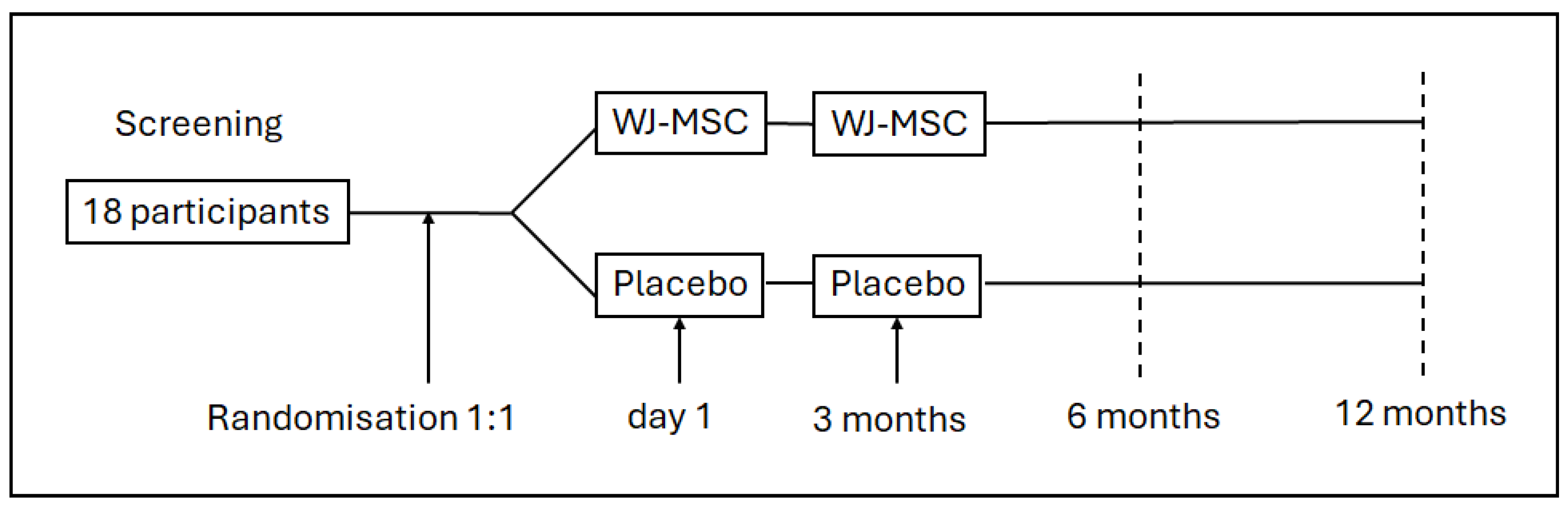
2.1. Study Design and Participants
2.2. Study Protocol
2.3. Interventions
2.4. WJ-MSC Collection, Preparation, and Administration
2.5. Immunopotency Assay
2.6. Clinical Evaluation
2.7. Neurophysiological Assessment
2.8. Safety Indicators and Efficacy Endpoints
2.9. Statistical Analysis
3. Results
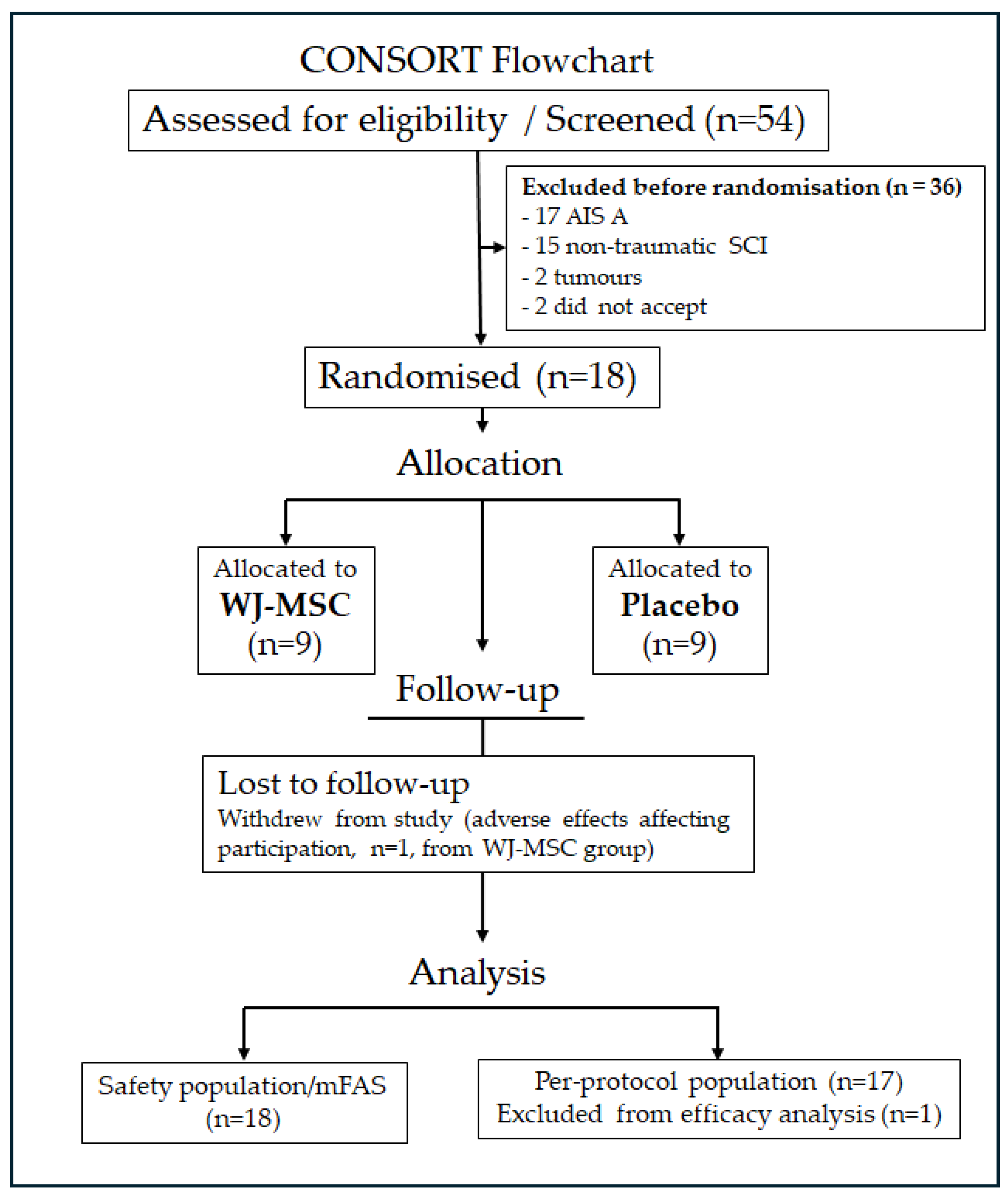
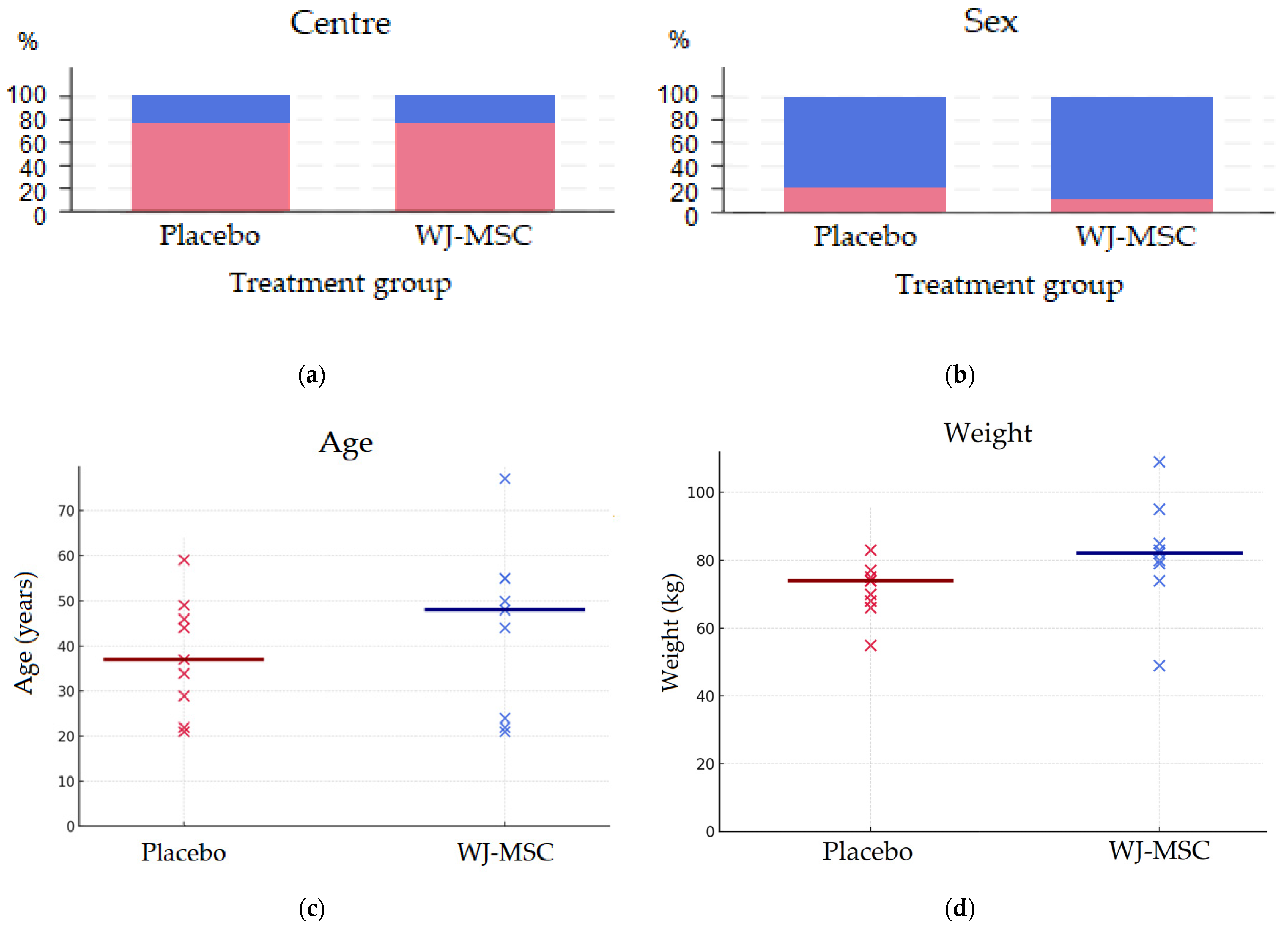
3.1. Study Population
3.2. Safety Outcomes
3.3. Neurological Outcomes
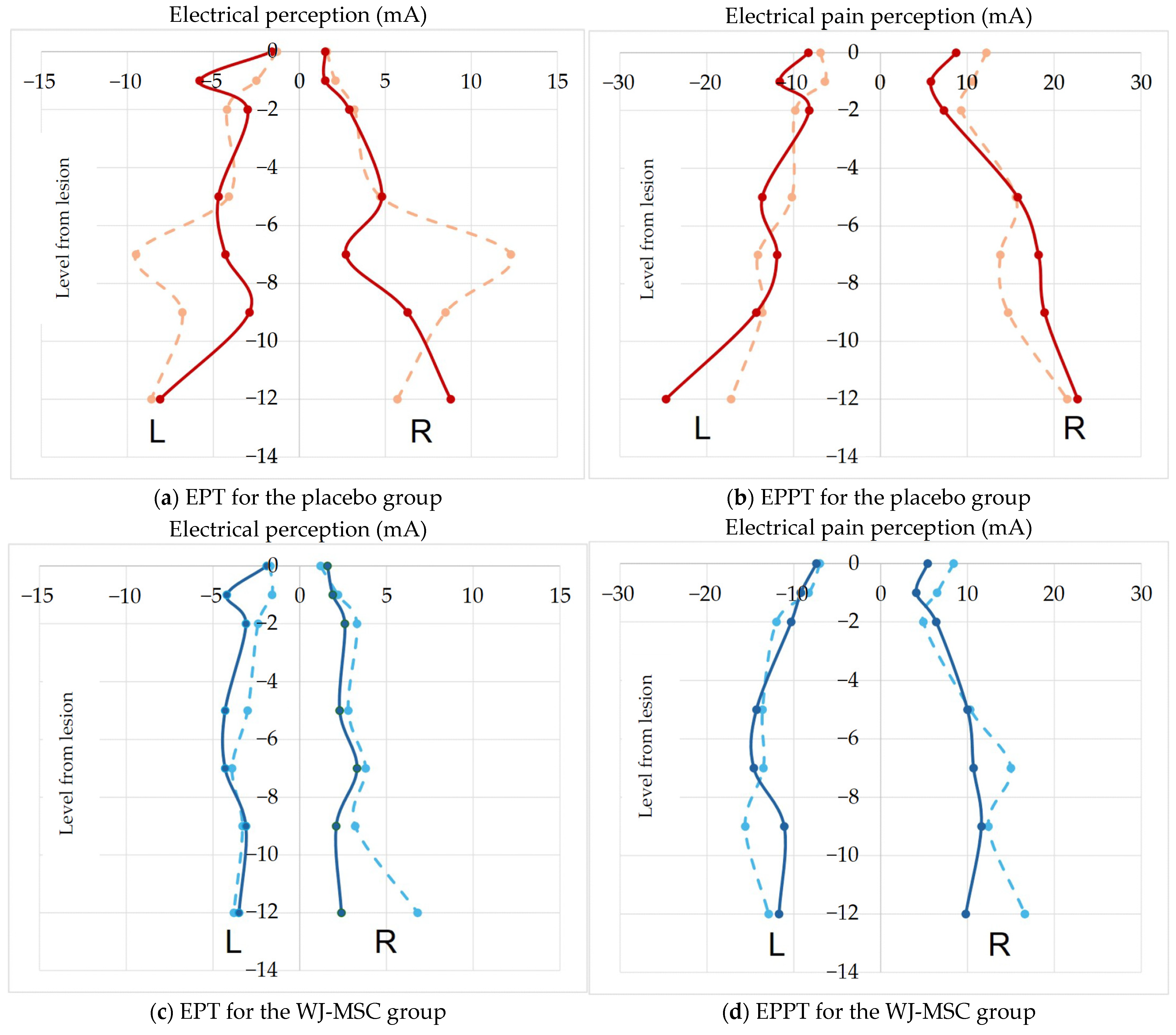
3.4. Electrophysiological Outcomes
3.5. Functional Measures
3.6. Patient-Reported Outcomes
4. Discussion
4.1. Safety Profile
4.2. Efficacy Outcomes
4.3. Limitations
4.4. Implications for Future Research
5. Conclusions
Supplementary Materials
Author Contributions
Funding
Institutional Review Board Statement
Informed Consent Statement
Data Availability Statement
Acknowledgments
Conflicts of Interest
Abbreviations
| ADM | Abductor digiti minimi |
| AEMPS | Spanish Agency of Medicines and Medical Devices |
| AH | Abductor hallucis |
| AIS | ASIA Impairment Scale |
| ASIA | American Spinal Injury Association |
| CBC | Complete Blood Count |
| CFSE | Carboxy-fluorescein diacetate succinimidyl ester |
| CI | Confidence interval |
| CIQ-IG | Community Integration Questionnaire—Institut Guttmann Version |
| CSF | Cerebrospinal fluid |
| DMEM | Dulbecco’s modified Eagle medium |
| DP | Drug product |
| EMG | Electromyography |
| EP | Evoked potential |
| EPPT | Electrical pain perception threshold |
| EPT | Electrical perception threshold |
| EudraCT | European Union Drug Regulating Authorities Clinical Trials Database |
| Fmax/Mmax ratio | Maximum F-wave to maximum M-wave ratio |
| FP | Final product |
| GMP | Good Manufacturing Practice |
| H/M ratio | H-reflex to M-wave ratio |
| HADS | Hospital Anxiety and Depression Scale |
| HLA | Human leukocyte antigen |
| H-reflex | Hoffmann reflex |
| IQR | Interquartile range |
| ISNCSCI | International Standards for Neurological Classification of Spinal Cord Injury |
| IT | Intrathecal |
| MAS | Modified Ashworth Scale |
| MCB | Master cell bank |
| MedDRA | Medical Dictionary for Regulatory Activities |
| MEP(s) | Motor evoked potential(s) |
| miRNA | microRNA |
| MRI | Magnetic resonance imaging |
| MSC(s) | Mesenchymal stromal/stem cells |
| NRS | Numerical rating scale |
| PBMC | Peripheral blood mononuclear cells |
| PWI | Personal Well-Being Index |
| QST | Quantitative sensory testing |
| RCT | Randomised controlled trial |
| SCI | Spinal cord injury |
| SCIM III | Spinal Cord Independence Measure, Version III |
| SD | Standard deviation |
| SOC | System organ class |
| SSEP(s) | Somatosensory evoked potential(s) |
| TA | Tibialis anterior |
| TMS | Transcranial magnetic stimulation |
| WISCI II | Walking Index for Spinal Cord Injury, Version II |
| WJ-MSC(s) | Wharton’s jelly-derived mesenchymal stromal/stem cell(s) |
| WHOQOL-BREF | World Health Organization Quality of Life—BREF |
References
- Jazayeri, S.B.; Maroufi, S.F.; Mohammadi, E.; Ohadi, M.A.D.; Hagen, E.-M.; Chalangari, M.; Jazayeri, S.B.; Safdarian, M.; Zadegan, S.A.; Ghodsi, Z.; et al. Incidence of traumatic spinal cord injury worldwide: A systematic review, data integration, and update. World Neurosurg. X 2023, 18, 100171. [Google Scholar] [CrossRef] [PubMed] [PubMed Central]
- Van Den Hauwe, L.; Sundgren, P.C.; Flanders, A.E. Spinal Trauma and Spinal Cord Injury (SCI). In Diseases of the Brain, Head and Neck, Spine 2020–2023 [Internet]; Hodler, J., Kubik-Huch, R.A., Von Schulthess, G.K., Eds.; IDKD Springer Series; Springer International Publishing: Cham, Switzerland, 2020; pp. 231–240. Available online: http://link.springer.com/10.1007/978-3-030-38490-6_19 (accessed on 27 November 2025).
- Fallah, N.; Noonan, V.K.; Sharwood, L.N. Editorial: Epidemiology, evidence-based care, and outcomes in spinal cord injury. Front. Neurol. 2024, 15, 1383757. [Google Scholar] [CrossRef]
- Hu, X.; Xu, W.; Ren, Y.; Wang, Z.; He, X.; Huang, R.; Ma, B.; Zhao, J.; Zhu, R.; Cheng, L. Spinal cord injury: Molecular mechanisms and therapeutic interventions. Signal Transduct. Target. Ther. 2023, 8, 245. [Google Scholar] [CrossRef] [PubMed] [PubMed Central]
- Hassan, O.I.; Takamiya, S.; Asgarihafshejani, A.; Fehlings, M.G. Bridging the gap: A translational perspective in spinal cord injury. Exp. Biol. Med. 2024, 249, 10266. [Google Scholar] [CrossRef] [PubMed] [PubMed Central]
- Montoto-Marqués, A.; Benito-Penalva, J.; Ferreiro-Velasco, M.E.; Wright, M.A.; la Barrera, S.S.-D.; Kumru, H.; Gaitán-Pérez, N.; Hernández-Navarro, A.; Rodríguez-Sotillo, A.; Braga, F.M.; et al. Advances and New Therapies in Traumatic Spinal Cord Injury. J. Clin. Med. 2025, 14, 2203. [Google Scholar] [CrossRef]
- Vives, J.; Hernández, J.; Mirabel, C.; Puigdomenech-Poch, M.; Romeo-Guitart, D.; Marmolejo-Martínez-Artesero, S.; Cabrera-Pérez, R.; Jaramillo, J.; Kumru, H.; García-López, J.; et al. Preclinical Development of a Therapy for Chronic Traumatic Spinal Cord Injury in Rats Using Human Wharton’s Jelly Mesenchymal Stromal Cells: Proof of Concept and Regulatory Compliance. Cells 2022, 11, 2153. [Google Scholar] [CrossRef] [PubMed]
- Assinck, P.; Duncan, G.J.; Hilton, B.J.; Plemel, J.R.; Tetzlaff, W. Cell transplantation therapy for spinal cord injury. Nat. Neurosci. 2017, 20, 637–647. [Google Scholar] [CrossRef] [PubMed]
- Khan, S.I.; Ahmed, N.; Ahsan, K.; Abbasi, M.; Maugeri, R.; Chowdhury, D.; Bonosi, L.; Brunasso, L.; Costanzo, R.; Iacopino, D.G.; et al. An Insight into the Prospects and Drawbacks of Stem Cell Therapy for Spinal Cord Injuries: Ongoing Trials and Future Directions. Brain Sci. 2023, 13, 1697. [Google Scholar] [CrossRef]
- Vismara, I.; Papa, S.; Rossi, F.; Forloni, G.; Veglianese, P. Current Options for Cell Therapy in Spinal Cord Injury. Trends Mol. Med. 2017, 23, 831–849. [Google Scholar] [CrossRef] [PubMed]
- Martinez, A.B.; de Almeida, F.; Marques, S.; dos Santos, A.R.; Prins, C.; Cardoso, F.d.S.; Heringer, L.d.S.; Mendonça, H. Molecular approaches for spinal cord injury treatment. Neural Regen. Res. 2023, 18, 23–30. [Google Scholar] [CrossRef] [PubMed]
- Cao, T.; Chen, H.; Huang, W.; Xu, S.; Liu, P.; Zou, W.; Pang, M.; Xu, Y.; Bai, X.; Liu, B.; et al. hUC-MSC-mediated recovery of subacute spinal cord injury through enhancing the pivotal subunits β3 and γ2 of the GABAA receptor. Theranostics 2022, 12, 3057–3078. [Google Scholar] [CrossRef] [PubMed]
- Liu, B.; Rong, L.-M.; Li, M.-M.; Cao, T.-T.; Chen, H.; Pang, M.; Xu, S.-S.; Wen, H.-Q. Dose optimization of intrathecal administration of human umbilical cord mesenchymal stem cells for the treatment of subacute incomplete spinal cord injury. Neural Regen. Res. 2022, 17, 1785–1794. [Google Scholar] [CrossRef]
- Agosti, E.; Zeppieri, M.; Pagnoni, A.; Fontanella, M.M.; Fiorindi, A.; Ius, T.; Panciani, P.P. Current status and future perspectives on stem cell transplantation for spinal cord injury. World J. Transplant. 2024, 14, 89674. [Google Scholar] [CrossRef] [PubMed]
- Kaplan, N.; Kabatas, S.; Civelek, E.; Savrunlu, E.C.; Akkoc, T.; Boyalı, O.; Öztürk, E.; Can, H.; Genc, A.; Karaöz, E. Multiroute administration of Wharton’s jelly mesenchymal stem cells in chronic complete spinal cord injury: A phase I safety and feasibility study. World J. Stem Cells 2025, 17, 101675. [Google Scholar] [CrossRef] [PubMed]
- Shen, R.; Lu, Y.; Cai, C.; Wang, Z.; Zhao, J.; Wu, Y.; Zhang, Y.; Yang, Y. Research progress and prospects of benefit-risk assessment methods for umbilical cord mesenchymal stem cell transplantation in the clinical treatment of spinal cord injury. Stem Cell Res. Ther. 2024, 15, 196. [Google Scholar] [CrossRef]
- Albu, S.; Kumru, H.; Coll, R.; Vives, J.; Vallés, M.; Benito-Penalva, J.; Rodríguez, L.; Codinach, M.; Hernández, J.; Navarro, X.; et al. Clinical effects of intrathecal administration of expanded Wharton jelly mesenchymal stromal cells in patients with chronic complete spinal cord injury: A randomized controlled study. Cytotherapy 2021, 23, 146–156. [Google Scholar] [CrossRef]
- Cheng, H.; Liu, X.; Hua, R.; Dai, G.; Wang, X.; Gao, J.; An, Y. Clinical observation of umbilical cord mesenchymal stem cell transplantation in treatment for sequelae of thoracolumbar spinal cord injury. J. Transl. Med. 2014, 12, 253. [Google Scholar] [CrossRef]
- Satti, H.S.; Waheed, A.; Ahmed, P.; Ahmed, K.; Akram, Z.; Aziz, T.; Satti, T.M.; Shahbaz, N.; Khan, M.A.; Malik, S.A. Autologous mesenchymal stromal cell transplantation for spinal cord injury: A Phase I pilot study. Cytotherapy 2016, 18, 518–522. [Google Scholar] [CrossRef] [PubMed]
- Oliver-Vila, I.; Coca, M.I.; Grau-Vorster, M.; Pujals-Fonts, N.; Caminal, M.; Casamayor-Genescà, A.; Ortega, I.; Reales, L.; Pla, A.; Blanco, M.; et al. Evaluation of a cell-banking strategy for the production of clinical grade mesenchymal stromal cells from Wharton’s jelly. Cytotherapy 2016, 18, 25–35. [Google Scholar] [CrossRef]
- Grau-Vorster, M.; Rodríguez, L.; del Mazo-Barbara, A.; Mirabel, C.; Blanco, M.; Codinach, M.; Gómez, S.G.; Querol, S.; García-López, J.; Vives, J. Compliance with Good Manufacturing Practice in the Assessment of Immunomodulation Potential of Clinical Grade Multipotent Mesenchymal Stromal Cells Derived from Wharton’s Jelly. Cells 2019, 8, 484. [Google Scholar] [CrossRef] [PubMed] [PubMed Central]
- Torrents, S.; Del Moral, A.E.; Codinach, M.; Rodríguez, L.; Querol, S.; Vives, J. Optimized reagents for immunopotency assays on mesenchymal stromal cells for clinical use. Immunol. Res. 2023, 71, 725–734. [Google Scholar] [CrossRef] [PubMed]
- Rupp, R.; Biering-Sørensen, F.; Burns, S.P.; Graves, D.E.; Guest, J.; Jones, L.; Read, M.S.; Rodriguez, G.M.; Schuld, C.; Tansey-Md, K.E.; et al. International Standards for Neurological Classification of Spinal Cord Injury. Top. Spinal Cord Inj. Rehabil. 2021, 27, 1–22. [Google Scholar] [CrossRef]
- The SCIREResearch Team; Hsieh, J.T.C.; Wolfe, D.L.; Miller, W.C.; Curt, A. Spasticity outcome measures in spinal cord injury: Psychometric properties and clinical utility. Spinal Cord 2008, 46, 86–95. [Google Scholar] [CrossRef] [PubMed]
- Chauny, J.M.; Paquet, J.; Lavigne, G.; Marquis, M.; Daoust, R. Evaluating acute pain intensity relief: Challenges when using an 11-point numerical rating scale. Pain 2016, 157, 355–360. [Google Scholar] [CrossRef]
- Zarco-Periñan, M.J.; Barrera-Chacón, M.J.; García-Obrero, I.; Mendez-Ferrer, J.B.; Alarcon, L.E.; Echevarria-Ruiz de Vargas, C. Development of the Spanish version of the Spinal Cord Independence Measure version III: Cross-cultural adaptation and reliability and validity study. Disabil. Rehabil. 2014, 36, 1644–1651. [Google Scholar] [CrossRef] [PubMed]
- Ditunno, J.F.; Ditunno, P.L.; Scivoletto, G.; Patrick, M.; Dijkers, M.; Barbeau, H.; Burns, A.S.; Marino, R.J.; Schmidt-Read, M. The Walking Index for Spinal Cord Injury (WISCI/WISCI II): Nature, metric properties, use and misuse. Spinal Cord 2013, 51, 346–355. [Google Scholar] [CrossRef] [PubMed]
- La Barrera, S.S.-D.; Mora-Boga, R.; Ferreiro-Velasco, M.E.; Seoane-Pillado, T.; Montoto-Marqués, A.; Rodríguez-Sotillo, A.; Díaz, S.P. A validity study of the Spanish—World Health Organization Quality of Life short version instrument in persons with traumatic spinal cord injury. Spinal Cord 2018, 56, 971–979. [Google Scholar] [CrossRef]
- Quintana, J.M.; Padierna, A.; Esteban, C.; Arostegui, I.; Bilbao, A.; Ruiz, I. Evaluation of the psychometric characteristics of the Spanish version of the Hospital Anxiety and Depression Scale. Acta Psychiatr. Scand. 2003, 107, 216–221. [Google Scholar] [CrossRef]
- Badia, X.; Gutiérrez, F.; Wiklund, I.; Alonso, J. Validity and reliability of the Spanish Version of the Psychological General Well-Being Index. Qual. Life Res. 1996, 5, 101–108. [Google Scholar] [CrossRef]
- García-Rudolph, A.; Cusso, H.; Carbonell, C.; Lopez, S.; Pla, L.; Sabaté, M.; Vazquez, P.; Opisso, E.; Hervas, A. Community integration after spinal cord injury rehabilitation: Predictors and causal mediators. J. Spinal Cord Med. 2025, 48, 682–693. [Google Scholar] [CrossRef] [PubMed]
- Cuatrecasas, G.; Kumru, H.; Coves, M.J.; Vidal, J. GH deficiency in patients with spinal cord injury: Efficacy/safety of GH replacement, a pilot study. Endocr. Connect. 2018, 7, 1031–1039. [Google Scholar] [CrossRef]
- Vaquero, J.; Zurita, M.; Rico, M.A.; Aguayo, C.; Bonilla, C.; Marin, E.; Tapiador, N.; Sevilla, M.; Vazquez, D.; Carballido, J.; et al. Intrathecal administration of autologous mesenchymal stromal cells for spinal cord injury: Safety and efficacy of the 100/3 guideline. Cytotherapy 2018, 20, 806–819. [Google Scholar] [CrossRef] [PubMed]
- de Araújo, L.T.; Macêdo, C.T.; Damasceno, P.K.F.; das Neves, Í.G.C.; de Lima, C.S.; Santos, G.C.; de Santana, T.A.; Sampaio, G.L.d.A.; Silva, D.N.; Villarreal, C.F.; et al. Clinical Trials Using Mesenchymal Stem Cells for Spinal Cord Injury: Challenges in Generating Evidence. Cells 2022, 11, 1019. [Google Scholar] [CrossRef] [PubMed]
- Awidi, A.; Al Shudifat, A.; El Adwan, N.; Alqudah, M.; Jamali, F.; Nazer, F.; Sroji, H.; Ahmad, H.; Al-Quzaa, N.; Jafar, H. Safety and potential efficacy of expanded mesenchymal stromal cells of bone marrow and umbilical cord origins in patients with chronic spinal cord injuries: A phase I/II study. Cytotherapy 2024, 26, 825–831. [Google Scholar] [CrossRef] [PubMed]
- Jamali, F.; Alqudah, M.; Rahmeh, R.; Bawaneh, H.; Al-Shudifat, A.; Samara, O.; Awidi, A. Safe Reversal of Motor and Sensory Deficits by Repeated High Doses of Mesenchymal Stem Cells in a Patient with Chronic Complete Spinal Cord Injury. Am. J. Case Rep. 2023, 24, e938576. [Google Scholar] [CrossRef] [PubMed] [PubMed Central]
- Bydon, M.; Qu, W.; Moinuddin, F.M.; Hunt, C.L.; Garlanger, K.L.; Reeves, R.K.; Windebank, A.J.; Zhao, K.D.; Jarrah, R.; Trammell, B.C.; et al. Intrathecal delivery of adipose-derived mesenchymal stem cells in traumatic spinal cord injury: Phase I trial. Nat. Commun. 2024, 15, 2201. [Google Scholar] [CrossRef]
- Dai, G.; Liu, X.; Zhang, Z.; Yang, Z.; Dai, Y.; Xu, R. Transplantation of autologous bone marrow mesenchymal stem cells in the treatment of complete and chronic cervical spinal cord injury. Brain Res. 2013, 1533, 73–79. [Google Scholar] [CrossRef] [PubMed]
- El-Kheir, W.A.; Gabr, H.; Awad, M.R.; Ghannam, O.; Barakat, Y.; Farghali, H.A.M.A.; El Maadawi, Z.M.; Ewes, I.; Sabaawy, H.E. Autologous Bone Marrow-Derived Cell Therapy Combined with Physical Therapy Induces Functional Improvement in Chronic Spinal Cord Injury Patients. Cell Transpl. 2014, 23, 729–745. [Google Scholar] [CrossRef]
- Zhao, Y.; Tang, F.; Xiao, Z.; Han, G.; Wang, N.; Yin, N.; Chen, B.; Jiang, X.; Yun, C.; Han, W.; et al. Clinical Study of NeuroRegen Scaffold Combined with Human Mesenchymal Stem Cells for the Repair of Chronic Complete Spinal Cord Injury. Cell Transpl. 2017, 26, 891–900. [Google Scholar] [CrossRef] [PubMed] [PubMed Central]
- Hopewell, S.; Chan, A.W.; Collins, G.S.; Hróbjartsson, A.; Moher, D.; Schulz, K.F.; Tunn, R.; Aggarwal, R.; Berkwits, M.; Berlin, J.A.; et al. CONSORT 2025 Statement: Updated guideline for reporting randomised trials. BMJ 2025, 388, e081123. [Google Scholar] [CrossRef]



| Inclusion criteria |
| Traumatic spinal cord injury involving cervical segments C1–T1, confirmed by MRI |
| Incomplete injury (ASIA Impairment Scale grade B, C, or D) |
| Time since injury 1–5 years |
| Age 18 to 70 years |
| Participant residing close to the study centre and able to attend follow-up visits |
| Written informed consent and ability to understand study requirements |
| Exclusion criteria |
| Dependence on mechanical ventilation |
| Pregnancy or breastfeeding |
| Women of childbearing potential without effective contraception |
| Planned spinal surgery within 12 months of enrolment |
| Neurodegenerative disease or recent (<5 years) or active malignancy |
| Significant laboratory abnormalities that contraindicate participation |
| Communication barriers that preclude assessment |
| Recent (<30 days) experimental treatment that could interfere with results |
| Prior treatment with an advanced therapy medicinal product (e.g., cell therapy) |
| Contraindication to lumbar puncture or to participation in a rehabilitation programme |
| Other conditions or circumstances that may compromise study participation |
| Procedure | Baseline | V1 (t = 0) | V2 (1 w) | V3 (1 mo) | V4 (3 mo) | V5 (V4 + 1w) | V6 (4 mo) | V7 (6 mo) | V8 (9 mo) | V9 (12 mo) |
|---|---|---|---|---|---|---|---|---|---|---|
| ASIA neurological examination | X | X | X | X | X | X | ||||
| Physical examination | X | X | X | X | ||||||
| Vital signs check | X | X | X | X | ||||||
| Blood tests (CBC, biochemistry) | X | X | ||||||||
| IT infusion (WJ-MSCs or PL) | X | X | ||||||||
| SCIM III | X | X | X | |||||||
| MAS (spasticity) | X | X | X | |||||||
| NRS (neuropathic pain) | X | X | X | |||||||
| EPT, EPPT | X | X | ||||||||
| Neurophysiological testing | X | X | ||||||||
| Quality of life test (WHOQOL-BREF) | X | X | X | |||||||
| WISCI II Test | X | X | X | |||||||
| Hand muscle strength (dynamometer) | X | X | X | |||||||
| Psychological assessment (PWI, HADS) | X | X | ||||||||
| Social worker survey (CIQ-IG) | X | X | ||||||||
| Blood sample for patient HLA typing | X | |||||||||
| CSF sample (anti-HLA antibodies) | X | X 3 | X | X 3 | X 3 | X | X 2 | X 2 | ||
| CSF sample (donor cells) | X | X | X 3 | X 3 | X | X 3 | X 2 | X 2 | ||
| miRNA biomarkers (blood/CSF) 1 | X | X | X | X | X | X | X | X 2 | X 2 | |
| Rehabilitation programme | X | X | X | X | X | X | X | |||
| Concomitant medication | X | X | X | X | X | X | X | X | X | X |
| Adverse events | X | X | X | X | X | X | X | X | X | X |
| Attribute | Acceptance Criterion | Average | Standard Deviation |
|---|---|---|---|
| Dose (viable cells/mL) | 1 × 10⁶ ± 30% | 1.06 × 10⁶ | 0.06 × 10⁶ |
| Cell viability (%) | ≥70 | 91.2 | 4.7 |
| Final volume (mL) | 4 ± 1 | 3.7 | 0.4 |
| CD45−/CD105+ (%) | ≥95 | 99.0 | 0.0 |
| CD31−/CD173+ (%) | ≥95 | 99.7 | 0.0 |
| CD90+ (%) | ≥95 | 99.9 | 0.0 |
| Sterility 1 | Negative | Negative | N/A |
| Endotoxins (EU/mL) 2 | ≤1.00 | <1.00 | N/A |
| Patient # | Sex | Age, Years | Weight, kg | Time Since SCI, Years | Neurologic Level | AIS Classification | Randomisation |
|---|---|---|---|---|---|---|---|
| 1 | F | 59 | 70 | 2.1 | C4 | C | Placebo |
| 2 | M | 77 | 82 | 3.8 | C6 | C | WJ-MSCs |
| 3 | M | 46 | 77 | 1.1 | C5 | C | Placebo |
| 4 | F | 24 | 49 | 4.3 | C8 | B | WJ-MSCs |
| 5 | M | 29 | 83 | 1.5 | C6 | D | Placebo |
| 6 | M | 22 | 83 | 4.0 | C7 | C | WJ-MSCs |
| 7 | M | 22 | 75 | 3.3 | C7 | B | Placebo |
| 8 | M | 48 | 85 | 1.9 | C4 | C | WJ-MSCs |
| 9 | M | 44 | 66 | 3.3 | C8 | C | Placebo |
| 10 | M | 55 | 74 | 2.7 | C4 | D | WJ-MSCs |
| 11 | M | 37 | 109 | 3.2 | C2 | D | Placebo |
| 12 | M | 21 | 75 | 1.3 | C6 | B | WJ-MSCs |
| 13 | M | 21 | 74 | 2.6 | C5 | B | Placebo |
| 14 | M | 50 | 80 | 1.7 | C4 | D | WJ-MSCs |
| 15 | M | 34 | 68 | 1.1 | C4 | B | Placebo |
| 16 | M | 44 | 95 | 4.2 | C4 | C | WJ-MSCs |
| 17 | F | 49 | 55 | 2.9 | C4 | B | Placebo |
| 18 | M | 55 | 79 | 1.11 | C5 | D | WJ-MSCs |
| Patient # | At Baseline | At 12 Months | Randomisation | Completed Study | ||||||||
|---|---|---|---|---|---|---|---|---|---|---|---|---|
| Motor Score (R/L) | LT Score (R/L) | PP Score (R/L) | Neurologic Level | AIS | Motor Score (R/L) | LT Score (R/L) | PP Score (R/L) | Neurologic Level | AIS | |||
| 1 | 34/27 | 33/31 | 33/33 | C4 | C | 43/31 | 42/48 | 34/38 | C4 | D | Placebo | Yes |
| 3 | 9/18 | 14/18 | 14/17 | C5 | C | 15/28 | 18/19 | 16/17 | C5 | C | Yes | |
| 5 | 28/40 | 36/56 | 36/36 | C6 | D | 37/45 | 35/56 | 35/56 | C6 | D | Yes | |
| 7 | 16/14 | 25/14 | 12/12 | C7 | B | 18/14 | 25/14 | 12/12 | C7 | B | Yes | |
| 9 | 29/29 | 35/35 | 35/35 | C8 | C | 39/38 | 40/42 | 38/38 | C5 | C | Yes | |
| 11 | 42/47 | 29/30 | 29/29 | C2 | D | 50/49 | 56/55 | 56/44 | C4 | D | Yes | |
| 13 | 16/22 | 15/14 | 14/14 | C5 | B | 16/22 | 15/14 | 14/14 | C5 | B | Yes | |
| 15 | 4/6 | 16/22 | 7/6 | C4 | B | 4/7 | 14/17 | 7/6 | C4 | B | Yes | |
| 17 | 8/7 | 31/30 | 9/8 | C4 | B | 8/8 | 30/32 | 8/6 | C4 | B | Yes | |
| Hedges’ g = 1.07 (95% CI 0.25–1.86)/Hedges’ g = 0.90 (95% CI 0.12–1.64) | Hedges’ g = 0.47 (95% CI −0.20–1.12)/Hedges’ g = 0.51 (95% CI −0.17–1.17) | Hedges’ g = 0.37 (95% CI −0.29–1.00)/Hedges’ g = 0.56 (95% CI −0.13–1.23) | ||||||||||
| 2 | 25/20 | 28/28 | 28/28 | C6 | C | - | - | - | - | - | WJ-MSCs | No |
| 4 | 24/24 | 35/35 | 35/35 | C8 | B | 25/25 | 39/39 | 35/35 | C8 | B | Yes | |
| 6 | 16/28 | 37/35 | 36/35 | C7 | C | 16/29 | 43/41 | 36/35 | C7 | C | Yes | |
| 8 | 10/26 | 31/31 | 31/31 | C4 | C | 25/35 | 41/33 | 31/33 | C4 | C | Yes | |
| 10 | 26/50 | 31/31 | 31/31 | C4 | D | 39/48 | 32/56 | 32/56 | C5 | D | Yes | |
| 12 | 10/10 | 34/34 | 10/10 | C6 | B | 10/10 | 34/34 | 10/10 | C5 | B | Yes | |
| 14 | 24/38 | 46/50 | 46/46 | C4 | D | 33/39 | 56/56 | 32/32 | C5 | D | Yes | |
| 16 | 11/23 | 33/32 | 7/9 | C4 | C | 14/26 | 32/31 | 6/9 | C4 | C | Yes | |
| 18 | 32/30 | 51/45 | 36/19 | C5 | D | 31/32 | 39/45 | 28/18 | C4 | D | Yes | |
| Hedges’ g = 0.74 (95% CI −0.04–1.48)/Hedges’ g = 0.55 (95% CI −0.18–1.25) | Hedges’ g = 0.30 (95% CI −0.39–0.96)/Hedges’ g = 0.59 (95% CI −0.15–1.29) | Hedges’ g = 0.49 (95% CI −0.23–1.17)/Hedges’ g = 0.13 (95% CI −0.53–0.79) | ||||||||||
| Participant | Group | Adverse Events (AEs) | |
|---|---|---|---|
| Events | Completed Trial | ||
| 1 | Placebo | No significant AEs | Yes |
| 2 | WJ-MSCs | After motor evoked potentials: headache. After the 1st infusion: muscle spasms, pain in lower limbs, back pain, insomnia | No, left study after first infusion due to intolerance of neurophysiological tests. Non-compliance with inclusion criteria (age > 70 years). |
| 3 | Placebo | No significant AEs | Yes |
| 4 | WJ-MSCs | Post-dural puncture headache requiring hospital admission, autonomic dysreflexia, nausea, urinary tract infection | Yes |
| 5 | Placebo | No significant AEs | Yes |
| 6 | WJ-MSCs | Post-dural puncture headache, urinary retention with autonomic dysreflexia | Yes |
| 7 | Placebo | Post-dural puncture headache | Yes |
| 8 | WJ-MSCs | Post-dural puncture headache, urinary retention with autonomic dysreflexia | Yes |
| 9 | Placebo | Post-dural puncture headache | Yes |
| 10 | WJ-MSCs | No significant AEs | Yes |
| 11 | Placebo | Post-dural puncture headache | Yes |
| 12 | WJ-MSCs | Post-dural puncture headache, urinary retention, and autonomic dysreflexia | Yes |
| 13 | Placebo | Post-dural puncture headache | Yes |
| 14 | WJ-MSCs | Post-dural puncture headache | Yes |
| 15 | Placebo | Post-dural puncture headache upon rising 5 days after 1st infusion. Headache at 2 days after 2nd infusion | Yes |
| 16 | WJ-MSCs | Post-dural puncture headache after 1st infusion. Headache and general malaise after 2nd infusion | Yes |
| 17 | Placebo | None after 1st infusion. Post-dural puncture headache after 2nd infusion | Yes |
| 18 | WJ-MSCs | Post-dural puncture headache and low-grade fever for 2 days. Mild low back pain after 1st infusion. Headache after 2nd infusion | Yes |
| Outcome | Group | Baseline Total (Mean ± SD) [Median (Q1–Q3)] | 12-Month Total (Mean ± SD) [Median (Q1–Q3)] | p-Value † |
|---|---|---|---|---|
| Motor | Placebo (n = 9) | 44.0 ± 25.0 [38 (21–64.5)] | 52.4 ± 29.6 [43 (24–79.5)] | 0.009 |
| WJ-MSCs (n = 8) | 47.8 ± 17.0 [46 (35–62)] | 54.6 ± 19.3 [55 (42.5–67.5)] | 0.048 | |
| Light touch | Placebo (n = 9) | 54.6 ± 19.3 [55 (42.5–67.5)] | 63.6 ± 29.1 [62 (34–90.5)] | 0.152 |
| WJ-MSCs (n = 8) | 71.9 ± 13.6 [68 (62–84)] | 81.4 ± 14 [81 (71–86)] | 0.116 | |
| Pin prick | Placebo (n = 9) | 42.1 ± 22.7 [31 (20.5–68)] | 50.1 ± 32.4 [33 (19–83.5)] | 0.132 |
| WJ-MSCs (n = 8) | 56.0 ± 24.2 [62 (37.5–70.5)] | 54.8 ± 24.1 [64 (33–70.5)] | 0.818 |
Disclaimer/Publisher’s Note: The statements, opinions and data contained in all publications are solely those of the individual author(s) and contributor(s) and not of MDPI and/or the editor(s). MDPI and/or the editor(s) disclaim responsibility for any injury to people or property resulting from any ideas, methods, instructions or products referred to in the content. |
© 2026 by the authors. Licensee MDPI, Basel, Switzerland. This article is an open access article distributed under the terms and conditions of the Creative Commons Attribution (CC BY) license.
Share and Cite
Martins Braga, F.; Kumru, H.; Benito-Penalva, J.; Vives, J.; Bonet, R.C.; Ge, W.; Rodríguez, L.; Codinach, M.; de la Iglesia-López, A.; Gómez-Rodríguez, A.; et al. Mesenchymal Stromal/Stem Cells in Chronic Incomplete Traumatic Spinal Cord Injury: A Phase I/II Double-Blind Placebo-Controlled Multicentre Trial. Biomedicines 2026, 14, 762. https://doi.org/10.3390/biomedicines14040762
Martins Braga F, Kumru H, Benito-Penalva J, Vives J, Bonet RC, Ge W, Rodríguez L, Codinach M, de la Iglesia-López A, Gómez-Rodríguez A, et al. Mesenchymal Stromal/Stem Cells in Chronic Incomplete Traumatic Spinal Cord Injury: A Phase I/II Double-Blind Placebo-Controlled Multicentre Trial. Biomedicines. 2026; 14(4):762. https://doi.org/10.3390/biomedicines14040762
Chicago/Turabian StyleMartins Braga, Fernando, Hatice Kumru, Jesús Benito-Penalva, Joaquim Vives, Ruth Coll Bonet, Wanbao Ge, Luciano Rodríguez, Margarita Codinach, Aurora de la Iglesia-López, Antonio Gómez-Rodríguez, and et al. 2026. "Mesenchymal Stromal/Stem Cells in Chronic Incomplete Traumatic Spinal Cord Injury: A Phase I/II Double-Blind Placebo-Controlled Multicentre Trial" Biomedicines 14, no. 4: 762. https://doi.org/10.3390/biomedicines14040762
APA StyleMartins Braga, F., Kumru, H., Benito-Penalva, J., Vives, J., Bonet, R. C., Ge, W., Rodríguez, L., Codinach, M., de la Iglesia-López, A., Gómez-Rodríguez, A., Cid-Fernández, J. J., Montoto-Marqués, A., & Vidal Samsó, J. (2026). Mesenchymal Stromal/Stem Cells in Chronic Incomplete Traumatic Spinal Cord Injury: A Phase I/II Double-Blind Placebo-Controlled Multicentre Trial. Biomedicines, 14(4), 762. https://doi.org/10.3390/biomedicines14040762