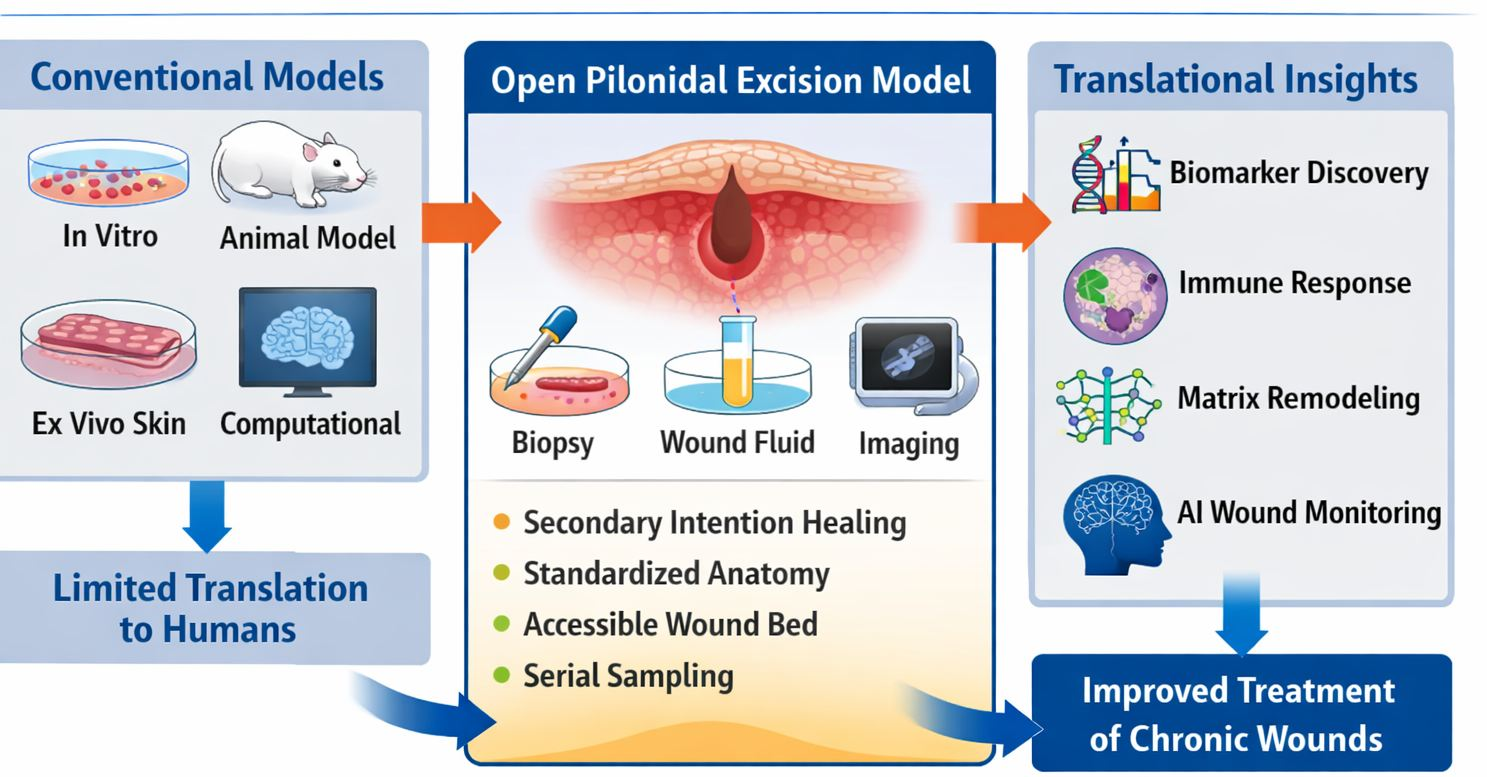
Open Pilonidal Excision as a Translational Human Model for Wound Healing and Skin Regeneration Research



Abstract
1. Introduction
2. Methods of the Narrative Review
3. Physiology of Wound Healing
3.1. Hemostasis
3.2. Inflammation
3.3. Proliferation and Tissue Repair
3.4. Remodeling and Maturation
4. Non-Surgical Wound-Healing Models and Their Comparative Evaluation
5. Surgical Wounds as Research Platform
6. Clinical and Surgical Background of Pilonidal Excision
6.1. Epidemiology and Surgical Context
6.2. Operative Steps of Open Excision for Pilonidal Disease
6.3. Standardized Wound Characteristics
7. Translational Applications
8. Ethical and Practical Considerations
9. Future Directions
10. Conclusions
Author Contributions
Funding
Institutional Review Board Statement
Data Availability Statement
Conflicts of Interest
References
- Pastar, I.; Wong, L.L.; Egger, A.N.; Tomic-Canic, M. Descriptive vs Mechanistic Scientific Approach to Study Wound Healing and Its Inhibition: Is There a Value of Translational Research Involving Human Subjects? Exp. Dermatol. 2018, 27, 551–562. [Google Scholar] [CrossRef] [PubMed]
- Sorg, H.; Sorg, C.G.G. Skin Wound Healing: Of Players, Patterns, and Processes. Eur. Surg. Res. 2023, 64, 141–157. [Google Scholar] [CrossRef]
- Werner, S.; Grose, R. Regulation of Wound Healing by Growth Factors and Cytokines. Physiol. Rev. 2003, 83, 835–870. [Google Scholar] [CrossRef] [PubMed]
- Li, J.; Chen, J.; Kirsner, R. Pathophysiology of Acute Wound Healing. Clin. Dermatol. 2007, 25, 9–18. [Google Scholar] [CrossRef]
- Garoufalia, Z.; Papadopetraki, A.; Karatza, E.; Vardakostas, D.; Philippou, A.; Kouraklis, G.; Mantas, D. Insulin-like Growth Factor-I and Wound Healing, a Potential Answer to Non-Healing Wounds: A Systematic Review of the Literature and Future Perspectives. Biomed. Rep. 2021, 15, 66. [Google Scholar] [CrossRef]
- Diegelmann, R.F.; Evans, M.C. Wound Healing: An Overview of Acute, Fibrotic and Delayed Healing. Front. Biosci. 2004, 9, 283. [Google Scholar] [CrossRef]
- Cioce, A.; Cavani, A.; Cattani, C.; Scopelliti, F. Role of the Skin Immune System in Wound Healing. Cells 2024, 13, 624. [Google Scholar] [CrossRef]
- Hesketh, M.; Sahin, K.B.; West, Z.E.; Murray, R.Z. Macrophage Phenotypes Regulate Scar Formation and Chronic Wound Healing. Int. J. Mol. Sci. 2017, 18, 1545. [Google Scholar] [CrossRef]
- Zheng, H.; Cheng, X.; Jin, L.; Shan, S.; Yang, J.; Zhou, J. Recent Advances in Strategies to Target the Behavior of Macrophages in Wound Healing. Biomed. Pharmacother. 2023, 165, 115199. [Google Scholar] [CrossRef] [PubMed]
- Eming, S.A.; Wynn, T.A.; Martin, P. Inflammation and Metabolism in Tissue Repair and Regeneration. Science 2017, 356, 1026–1030. [Google Scholar] [CrossRef]
- Lin, P.; Zhang, G.; Li, H. The Role of Extracellular Matrix in Wound Healing. Dermatol. Surg. 2023, 49, S41–S48. [Google Scholar] [CrossRef]
- Takeo, M.; Lee, W.; Ito, M. Wound Healing and Skin Regeneration. Cold Spring Harb. Perspect. Med. 2015, 5, a023267. [Google Scholar] [CrossRef]
- Midwood, K.S.; Williams, L.V.; Schwarzbauer, J.E. Tissue Repair and the Dynamics of the Extracellular Matrix. Int. J. Biochem. Cell Biol. 2004, 36, 1031–1037. [Google Scholar] [CrossRef]
- Eckes, B.; Zigrino, P.; Kessler, D.; Holtkötter, O.; Shephard, P.; Mauch, C.; Krieg, T. Fibroblast-Matrix Interactions in Wound Healing and Fibrosis. Matrix Biol. 2000, 19, 325–332. [Google Scholar] [CrossRef]
- Gardeazabal, L.; Izeta, A. Elastin and Collagen Fibres in Cutaneous Wound Healing. Exp. Dermatol. 2024, 33, e15052. [Google Scholar] [CrossRef] [PubMed]
- Gosain, A.; DiPietro, L.A. Aging and Wound Healing. World J. Surg. 2004, 28, 321–326. [Google Scholar] [CrossRef] [PubMed]
- Sorg, H.; Tilkorn, D.J.; Mirastschijski, U.; Hauser, J.; Kraemer, R. Panta Rhei: Neovascularization, Angiogenesis and Nutritive Perfusion in Wound Healing. Eur. Surg. Res. 2018, 59, 232–241. [Google Scholar] [CrossRef]
- Boyko, T.V.; Longaker, M.T.; Yang, G.P. Laboratory Models for the Study of Normal and Pathologic Wound Healing. Plast. Reconstr. Surg. 2017, 139, 654–662. [Google Scholar] [CrossRef]
- Hofmann, E.; Fink, J.; Pignet, A.-L.; Schwarz, A.; Schellnegger, M.; Nischwitz, S.P.; Holzer-Geissler, J.C.J.; Kamolz, L.-P.; Kotzbeck, P. Human In Vitro Skin Models for Wound Healing and Wound Healing Disorders. Biomedicines 2023, 11, 1056. [Google Scholar] [CrossRef] [PubMed]
- Pastar, I.; Stojadinovic, O.; Yin, N.C.; Ramirez, H.; Nusbaum, A.G.; Sawaya, A.; Patel, S.B.; Khalid, L.; Isseroff, R.R.; Tomic-Canic, M. Epithelialization in Wound Healing: A Comprehensive Review. Adv. Wound Care 2014, 3, 445–464. [Google Scholar] [CrossRef]
- Ud-Din, S.; Bayat, A. Non-animal Models of Wound Healing in Cutaneous Repair: In Silico, In Vitro, Ex Vivo, and In Vivo Models of Wounds and Scars in Human Skin. Wound Repair. Regen. 2017, 25, 164–176. [Google Scholar] [CrossRef]
- Bogadi, S.; Uddin, M.E.; Rahman, M.H.; Satyanarayana Reddy Karri, V.V.; Begum, R.; Udeabor, S.E. Wound Healing in the Modern Era: Emerging Research, Biomedical Advances, and Transformative Clinical Approaches. J. Drug Deliv. Sci. Technol. 2025, 110, 107058. [Google Scholar] [CrossRef]
- Zomer, H.D.; Trentin, A.G. Skin Wound Healing in Humans and Mice: Challenges in Translational Research. J. Dermatol. Sci. 2018, 90, 3–12. [Google Scholar] [CrossRef] [PubMed]
- Seaton, M.; Hocking, A.; Gibran, N.S. Porcine Models of Cutaneous Wound Healing. ILAR J. 2015, 56, 127–138. [Google Scholar] [CrossRef]
- Goutchtat, R.; Béguier, A.; Kasal-Hoc, N.; Guerreschi, P.; Fayoux, P.; Rancan, L.; Pattou, F.; Hubert, T. Pig Models in Translational Surgery. Eur. Surg. Res. 2025, 66, 50–58. [Google Scholar] [CrossRef] [PubMed]
- Jorgensen, S.N.; Sanders, J.R. Mathematical Models of Wound Healing and Closure: A Comprehensive Review. Med. Biol. Eng. Comput. 2016, 54, 1297–1316. [Google Scholar] [CrossRef]
- Grambow, E.; Sorg, H.; Sorg, C.G.G.; Strüder, D. Experimental Models to Study Skin Wound Healing with a Focus on Angiogenesis. Med. Sci. 2021, 9, 55. [Google Scholar] [CrossRef]
- Nuutila, K.; Katayama, S.; Vuola, J.; Kankuri, E. Human Wound-Healing Research: Issues and Perspectives for Studies Using Wide-Scale Analytic Platforms. Adv. Wound Care 2014, 3, 264–271. [Google Scholar] [CrossRef]
- Olson, E.M.; Lin, N.U.; Krop, I.E.; Winer, E.P. The Ethical Use of Mandatory Research Biopsies. Nat. Rev. Clin. Oncol. 2011, 8, 620–625. [Google Scholar] [CrossRef]
- Wilhelm, K.-P.; Wilhelm, D.; Bielfeldt, S. Models of Wound Healing: An Emphasis on Clinical Studies. Skin. Res. Technol. 2017, 23, 3–12. [Google Scholar] [CrossRef] [PubMed]
- Chen, J.; Qin, S.; Liu, S.; Zhong, K.; Jing, Y.; Wu, X.; Peng, F.; Li, D.; Peng, C. Targeting Matrix Metalloproteases in Diabetic Wound Healing. Front. Immunol. 2023, 14, 1089001, Correction in Front. Immunol. 2023, 14, 1287048. [Google Scholar] [CrossRef]
- Xue, M.; Thompson, P.; Kelso, I.; Jackson, C. Activated Protein C Stimulates Proliferation, Migration and Wound Closure, Inhibits Apoptosis and Upregulates MMP-2 Activity in Cultured Human Keratinocytes. Exp. Cell Res. 2004, 299, 119–127. [Google Scholar] [CrossRef]
- Mansurov, N.; Chen, W.C.W.; Awada, H.; Huard, J.; Wang, Y.; Saparov, A. A Controlled Release System for Simultaneous Delivery of Three Human Perivascular Stem Cell-derived Factors for Tissue Repair and Regeneration. J. Tissue Eng. Regen. Med. 2018, 12, e1164–e1172. [Google Scholar] [CrossRef] [PubMed]
- Mirza, R.E.; Koh, T.J. Contributions of Cell Subsets to Cytokine Production during Normal and Impaired Wound Healing. Cytokine 2015, 71, 409–412. [Google Scholar] [CrossRef] [PubMed]
- McFarland-Mancini, M.M.; Funk, H.M.; Paluch, A.M.; Zhou, M.; Giridhar, P.V.; Mercer, C.A.; Kozma, S.C.; Drew, A.F. Differences in Wound Healing in Mice with Deficiency of IL-6 versus IL-6 Receptor. J. Immunol. 2010, 184, 7219–7228. [Google Scholar] [CrossRef] [PubMed]
- Qian, L.; Fourcaudot, A.B.; Yamane, K.; You, T.; Chan, R.K.; Leung, K.P. Exacerbated and Prolonged Inflammation Impairs Wound Healing and Increases Scarring. Wound Repair. Regen. 2016, 24, 26–34. [Google Scholar] [CrossRef]
- Baker, E.A.; Leaper, D.J. Proteinases, Their Inhibitors, and Cytokine Profiles in Acute Wound Fluid. Wound Repair. Regen. 2000, 8, 392–398. [Google Scholar] [CrossRef]
- Grimstad, Ø.; Sandanger, Ø.; Ryan, L.; Otterdal, K.; Damaas, J.K.; Pukstad, B.; Espevik, T. Cellular Sources and Inducers of Cytokines Present in Acute Wound Fluid. Wound Repair. Regen. 2011, 19, 337–347. [Google Scholar] [CrossRef]
- Pajulo, O.T.; Pulkki, K.J.; Alanen, M.S.; Reunanen, M.S.; Lertola, K.K.; Mattila-Vuori, A.I.; Viljanto, J.A. Correlation between Interleukin-6 and Matrix Metalloproteinase-9 in Early Wound Healing in Children. Wound Repair. Regen. 1999, 7, 453–457. [Google Scholar] [CrossRef]
- Nuutila, K.; Siltanen, A.; Peura, M.; Bizik, J.; Kaartinen, I.; Kuokkanen, H.; Nieminen, T.; Harjula, A.; Aarnio, P.; Vuola, J.; et al. Human Skin Transcriptome during Superficial Cutaneous Wound Healing. Wound Repair. Regen. 2012, 20, 830–839. [Google Scholar] [CrossRef]
- Samakidou, G.; Eleftheriadou, I.; Anastasiou, I.A.; Kosta, O.; Tentolouris, A.; Evangelou, K.; Tentolouris, N. A Single Center, Randomized Controlled Trial on the Efficacy of Topical Application of ReGenerating Tissue Agents (RGTA) Technology in Diabetic Foot Ulcers. Int. J. Low. Extrem. Wounds, 2024; online ahead of print. [Google Scholar] [CrossRef]
- Banasiewicz, T.; Bobkiewicz, A.; Borejsza-Wysocki, M.; Biczysko, M.; Ratajczak, A.; Malinger, S.; Drews, M. Portable VAC Therapy Improve the Results of the Treatment of the Pilonidal Sinus--Randomized Prospective Study. Pol. Prz. Chir. 2013, 85, 371–376. [Google Scholar] [CrossRef]
- Ågren, M.S.; Ostenfeld, U.; Kallehave, F.; Gong, Y.; Raffn, K.; Crawford, M.E.; Kiss, K.; Friis-Møller, A.; Gluud, C.; Jorgensen, L.N. A Randomized, Double-blind, Placebo-controlled Multicenter Trial Evaluating Topical Zinc Oxide for Acute Open Wounds Following Pilonidal Disease Excision. Wound Repair. Regen. 2006, 14, 526–535. [Google Scholar] [CrossRef]
- Gohar, M.M.; Ali, R.F.; Ismail, K.A.; Ismail, T.A.; Nosair, N.A. Assessment of the Effect of Platelet Rich Plasma on the Healing of Operated Sacrococcygeal Pilonidal Sinus by Lay-Open Technique: A Randomized Clinical Trial. BMC Surg. 2020, 20, 212. [Google Scholar] [CrossRef]
- Boyce, D.E.; Jones, W.D.; Ruge, F.; Harding, K.G.; Moore, K. The Role of Lymphocytes in Human Dermal Wound Healing. Br. J. Dermatol. 2000, 143, 59–65. [Google Scholar] [CrossRef] [PubMed]
- Garoufalia, Z.; Papadopetraki, A.; Vardakostas, D.; Karatza, E.; Philippou, A.; Tsourouflis, G.; Kouraklis, G.; Mantas, D. Alterations in the Expression of IGF-I Isoforms and Binding Proteins during the Wound Healing Process. World Acad. Sci. J. 2022, 4, 13. [Google Scholar] [CrossRef]
- Vardakostas, D.; Moustogiannis, A.; Garoufalia, Z.; Karatza, E.; Philippou, A.; Kouraklis, G.; Koutsilieris, M.; Mantas, D. Expression of Tissue Remodeling- and Inflammation-Related Factors During the Wound-Healing Process in Humans. J. Pers. Med. 2025, 15, 14. [Google Scholar] [CrossRef]
- Vartanian, E.; Daniel, J.G.; Lee, S.W.; Patel, K. Pilonidal Disease: Classic and Contemporary Concepts for Surgical Management. Ann. Plast. Surg. 2018, 81, e12–e19. [Google Scholar] [CrossRef] [PubMed]
- Tam, A.; Steen, C.J.; Chua, J.; Yap, R.J. Pilonidal Sinus: An Overview of Historical and Current Management Modalities. Updates Surg. 2024, 76, 803–810. [Google Scholar] [CrossRef] [PubMed]
- Darnis, B.; Tedeschi, L.; Blanchet, M.-C.; Frering, V.; Crozet, J.; Gignoux, B.; Duchamp, C. Management of Pilonidal Sinus and Recurrences in 2025. J. Visc. Surg. 2025, 162, 117–127. [Google Scholar] [CrossRef]
- Singh, S.; Desai, K.; Gillern, S. Management of Pilonidal Disease and Hidradenitis Suppurativa. Surg. Clin. N. Am. 2024, 104, 503–515. [Google Scholar] [CrossRef]
- Tellez, C.; Pera, M. Surgery for Uncomplicated Pilonidal Disease: Simpler Is Better. Semin. Colon. Rectal Surg. 2022, 33, 100912. [Google Scholar] [CrossRef]
- Tyrväinen, E.; Nuutinen, H.; Savikkomaa, E.; Myllykangas, H.-M. Comparison of Laser Ablation, Simple Excision, and Flap Reconstruction in the Treatment of Pilonidal Sinus Disease. Lasers Med. Sci. 2024, 39, 52. [Google Scholar] [CrossRef]
- Gojayev, A.; Erkent, M.; Aydin, H.O.; Aydoğan, C.; Avci, T.; Tırnova, İ.; Doğan, P.; Gündoğdu, R.; Yıldırım, S. Comparative Outcomes of Surgical Techniques for Pilonidal Sinus: A Turkish Retrospective Study. Med. Sci. Monit. 2025, 31, e947466. [Google Scholar] [CrossRef]
- Stauffer, V.K.; Luedi, M.M.; Kauf, P.; Schmid, M.; Diekmann, M.; Wieferich, K.; Schnüriger, B.; Doll, D. Common Surgical Procedures in Pilonidal Sinus Disease: A Meta-Analysis, Merged Data Analysis, and Comprehensive Study on Recurrence. Sci. Rep. 2018, 8, 3058. [Google Scholar] [CrossRef]
- Bi, S.; Sun, K.; Chen, S.; Gu, J. Surgical Procedures in the Pilonidal Sinus Disease: A Systematic Review and Network Meta-Analysis. Sci. Rep. 2020, 10, 13720. [Google Scholar] [CrossRef]
- Berthier, C.; Bérard, E.; Meresse, T.; Grolleau, J.-L.; Herlin, C.; Chaput, B. A Comparison of Flap Reconstruction vs the Laying Open Technique or Excision and Direct Suture for Pilonidal Sinus Disease: A Meta-Analysis of Randomised Studies. Int. Wound J. 2019, 16, 1119–1135. [Google Scholar] [CrossRef] [PubMed]
- Hemmingsson, O.; Binnermark, F.; Odensten, C.; Rutegård, M.; Franklin, K.A.; Haapamäki, M.M. Excision and Suture in the Midline versus Karydakis Flap Surgery for Pilonidal Sinus: Randomized Clinical Trial. BJS Open 2022, 6, zrac007. [Google Scholar] [CrossRef] [PubMed]
- Parente, G.; Ruspi, F.; Thomas, E.; Di Mitri, M.; Cravano, S.M.; D’Antonio, S.; Gargano, T.; Lima, M. Endoscopic Pilonidal Sinus Treatment: Preliminary Results, Learning Curve and Comparison with Standard Open Approach. Children 2023, 10, 1063. [Google Scholar] [CrossRef] [PubMed]
- Garg, P. Laying Open (Deroofing) and Curettage under Local Anesthesia for Pilonidal Disease: An Outpatient Procedure. World J. Gastrointest. Surg. 2015, 7, 214. [Google Scholar] [CrossRef]
- Elgohary, H.; Oraby, E. Pilonidal Sinus: Minimal Excision and Primary Closure under Local Anesthesia. Egypt. J. Surg. 2015, 34, 287. [Google Scholar] [CrossRef]
- Priyadarshi, S.; Nagare, K.; Rana, K.V.S.; Sunkara, R.; Kandari, A.; Dogra, B. A Comparative Study of Open Technique and Z-Plasty in Management of Pilonidal Sinus. Med. J. Dr. D.Y. Patil Univ. 2014, 7, 574. [Google Scholar] [CrossRef]
- Ambrozova, N.; Ulrichova, J.; Galandakova, A. Models for the Study of Skin Wound Healing. The Role of Nrf2 and NF-κB. Biomed. Pap. Med. Fac. Univ. Palacky Olomouc Czech Repub. 2017, 161, 1–13. [Google Scholar] [CrossRef] [PubMed]
- Danne, J.; Gwini, S.; McKenzie, D.; Danne, P. A Retrospective Study of Pilonidal Sinus Healing by Secondary Intention Using Negative Pressure Wound Therapy Versus Alginate or Gauze Dressings. Ostomy Wound Manag. 2017, 63, 47–53. [Google Scholar]
- Al-Khamis, A.; McCallum, I.; King, P.M.; Bruce, J. Healing by Primary versus Secondary Intention after Surgical Treatment for Pilonidal Sinus. Cochrane Database Syst. Rev. 2010, 2010, CD006213. [Google Scholar] [CrossRef]
- Boztug, C.Y.; Karaagac Akyol, T.; Benlice, C.; Koc, M.A.; Doganay Erdogan, B.; Ozcebe, O.I.; Kuzu, M.A.; Akyol, C. Platelet-Rich Plasma Treatment Improves Postoperative Recovery in Patients with Pilonidal Sinus Disease: A Randomized Controlled Clinical Trial. BMC Surg. 2021, 21, 373. [Google Scholar] [CrossRef]
- Hodgkin, W. Pilonidal Sinus Disease. J. Wound Care 1998, 7, 481–483. [Google Scholar] [CrossRef]
- Søndenaa, K.; Andersen, E.; Nesvik, I.; Søreide, J.A. Patient Characteristics and Symptoms in Chronic Pilonidal Sinus Disease. Int. J. Color. Dis. 1995, 10, 39–42. [Google Scholar] [CrossRef]
- Adjei, N.N.; Yung, N.; Towers, G.; Caty, M.; Solomon, D.; Vash-Margita, A. Establishing an Association between Polycystic Ovarian Syndrome and Pilonidal Disease in Adolescent Females. J. Pediatr. Adolesc. Gynecol. 2023, 36, 39–44. [Google Scholar] [CrossRef]
- Khalaf, A.A.; Hassanen, E.I.; Zaki, A.R.; Tohamy, A.F.; Ibrahim, M.A. Histopathological, Immunohistochemical, and Molecular Studies for Determination of Wound Age and Vitality in Rats. Int. Wound J. 2019, 16, 1416–1425. [Google Scholar] [CrossRef] [PubMed]
- Chen, M.-Y. Progress in the Application of Artificial Intelligence in Skin Wound Assessment and Prediction of Healing Time. Am. J. Transl. Res. 2024, 16, 2765–2776. [Google Scholar] [CrossRef] [PubMed]
- Fazeli, M.S.; Adel, M.G.; Lebaschi, A.H. Comparison of Outcomes in Z-Plasty and Delayed Healing by Secondary Intention of the Wound After Excision of the Sacral Pilonidal Sinus: Results of a Randomized, Clinical Trial. Dis. Colon. Rectum 2006, 49, 1831–1836. [Google Scholar] [CrossRef] [PubMed]

| Cell Type | Role in Wound Healing | Key Mediators |
|---|---|---|
| Platelets | Initiate hemostasis and release Growth Factors | PDGF, TGF-β, VEGF |
| Neutrophils | Early inflammatory response, microbial clearance | ROS, proteases |
| Macrophages | Phagocytosis, cytokine signaling, tissue repair regulation | IL-1, TNF-α, TGF-β |
| Mast cells | Modulate inflammation, angiogenesis, fibroblast activation | Histamine, tryptase, cytokines |
| Fibroblasts | Extracellular matrix synthesis, granulation tissue formation | Collagen III, fibronectin |
| Myofibroblasts | Wound contraction, matrix remodeling | α- SMA, collagen I |
| Endothelial cells | Angiogenesis | VEGF |
| Keratinocytes | Re-epithelialization | EGF, KGF |
| Model Type | Advantages | Limitations | Translational Value |
|---|---|---|---|
| In Vitro Models | Controlled conditions, reproducible, low cost | Lack vascularization, immune interactions, systemic factors | Low |
| Ex Vivo Human Skin | Preserves native skin architecture | Limited viability, no systemic immune responses | Moderate |
| Animal Models | Whole-organism physiology, genetic manipulation possible | Species differences in healing mechanisms | Moderate |
| Computational Models | Predictive simulations | Dependent on Empirical Data | Variable |
| Surgical Wounds | Human physiology | Ethical, practical, heterogeneity | Moderate—High |
| Open Pilonidal Excision | Human physiology, accessible wound, serial sampling | Patient variability, Limited to acute healing | High |
Disclaimer/Publisher’s Note: The statements, opinions and data contained in all publications are solely those of the individual author(s) and contributor(s) and not of MDPI and/or the editor(s). MDPI and/or the editor(s) disclaim responsibility for any injury to people or property resulting from any ideas, methods, instructions or products referred to in the content. |
© 2026 by the authors. Licensee MDPI, Basel, Switzerland. This article is an open access article distributed under the terms and conditions of the Creative Commons Attribution (CC BY) license.
Share and Cite
Vardakostas, D.; Garoufalia, Z.; Philippou, A.; Mantas, D. Open Pilonidal Excision as a Translational Human Model for Wound Healing and Skin Regeneration Research. Biomedicines 2026, 14, 751. https://doi.org/10.3390/biomedicines14040751
Vardakostas D, Garoufalia Z, Philippou A, Mantas D. Open Pilonidal Excision as a Translational Human Model for Wound Healing and Skin Regeneration Research. Biomedicines. 2026; 14(4):751. https://doi.org/10.3390/biomedicines14040751
Chicago/Turabian StyleVardakostas, Dimitrios, Zoe Garoufalia, Anastassios Philippou, and Dimitrios Mantas. 2026. "Open Pilonidal Excision as a Translational Human Model for Wound Healing and Skin Regeneration Research" Biomedicines 14, no. 4: 751. https://doi.org/10.3390/biomedicines14040751
APA StyleVardakostas, D., Garoufalia, Z., Philippou, A., & Mantas, D. (2026). Open Pilonidal Excision as a Translational Human Model for Wound Healing and Skin Regeneration Research. Biomedicines, 14(4), 751. https://doi.org/10.3390/biomedicines14040751