Pre-Clinical Models of Traumatic Brain Injury—A Narrative Review Towards “Animal Neuro-ICUs”
 , , ,
, , ,
Abstract
1. Introduction
2. Translational Research in TBI
3. Critical Care Animal Models for TBI
4. Induction Methods in Experimental TBI
4.1. Blast Injury Models
4.2. Weight-Drop Models
4.3. Fluid Percussion Injury (FPI)
4.4. Controlled Cortical Impact (CCI)
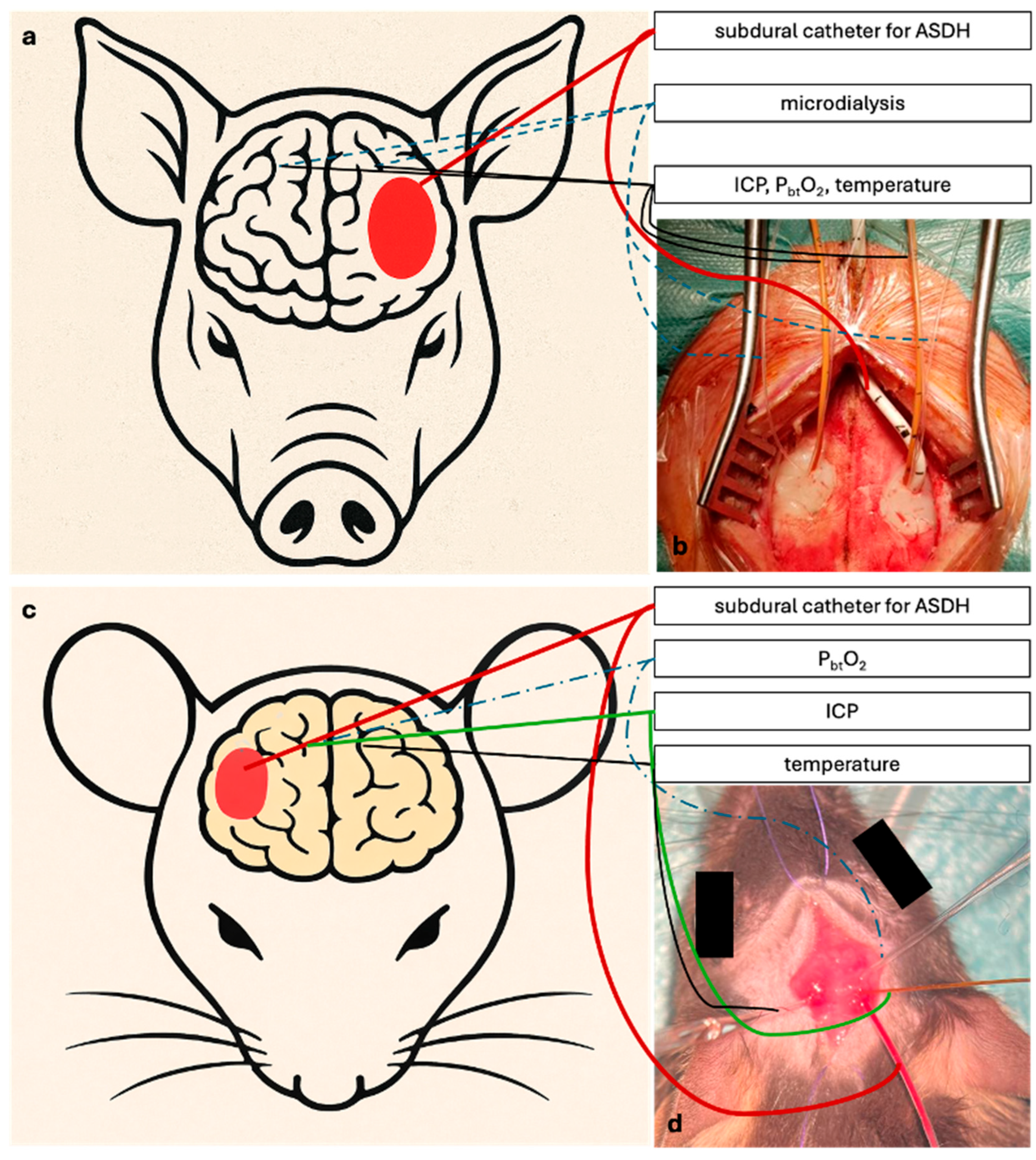
4.5. Acute Subdural Hematoma
4.6. Reproducibility and Translational Relevance of TBI Induction Models
5. Length of Stay at the ICU After TBI
6. Influence of Comorbidities, Age and Sex
6.1. Comorbidities and Age
6.2. Sex
7. Neuro-ICU for Animal Models
8. Conclusions
Author Contributions
Funding
Institutional Review Board Statement
Informed Consent Statement
Data Availability Statement
Acknowledgments
Conflicts of Interest
Abbreviations
| ASDH | Acute subdural hematoma |
| CCI | Controlled cortical impact |
| CPP | Cerebral perfusion pressure |
| CSF | Cerebrospinal fluid |
| CT | Computed tomography |
| EEG | Electroencephalography |
| FPI | Fluid percussion injury |
| GFAP | Glial fibrillary acidic protein |
| ICP | Intracranial pressure |
| ICU | Intensive care unit |
| MAP | Mean arterial pressure |
| MGCS | Modified glasgow coma scale |
| MRI | Magnetic resonance imaging |
| PaCO2 | Arterial partial pressure of carbon dioxide |
| PbtO2 | Brain tissue oxygenation |
| TBI | Traumatic brain injury |
| UCH-L1 | Ubiquitin Carboxy-Terminal Hydrolase L1 |
References
- Niemeyer, M.; Jochems, D.; Houwert, R.; Van Es, M.; Leenen, L.; Van Wessem, K. Mortality in Polytrauma Patients with Moderate to Severe TBI on Par with Isolated TBI Patients: TBI as Last Frontier in Polytrauma Patients. Injury 2022, 53, 1443–1448. [Google Scholar] [CrossRef]
- Di Saverio, S.; Gambale, G.; Coccolini, F.; Catena, F.; Giorgini, E.; Ansaloni, L.; Amadori, N.; Coniglio, C.; Giugni, A.; Biscardi, A.; et al. Changes in the Outcomes of Severe Trauma Patients from 15-Year Experience in a Western European Trauma ICU of Emilia Romagna Region (1996–2010). A Population Cross-Sectional Survey Study. Langenbecks Arch. Surg. 2014, 399, 109–126. [Google Scholar] [CrossRef]
- Stocchetti, N.; Zanier, E.R. Chronic Impact of Traumatic Brain Injury on Outcome and Quality of Life: A Narrative Review. Crit. Care 2016, 20, 148. [Google Scholar] [CrossRef]
- Carney, N.; Totten, A.M.; O’Reilly, C.; Ullman, J.S.; Hawryluk, G.W.J.; Bell, M.J.; Bratton, S.L.; Chesnut, R.; Harris, O.A.; Kissoon, N.; et al. Guidelines for the Management of Severe Traumatic Brain Injury, Fourth Edition. Neurosurgery 2017, 80, 6–15. [Google Scholar] [CrossRef]
- Yan, A.; Torpey, A.; Morrisroe, E.; Andraous, W.; Costa, A.; Bergese, S. Clinical Management in Traumatic Brain Injury. Biomedicines 2024, 12, 781. [Google Scholar] [CrossRef] [PubMed]
- Xiong, Y.; Mahmood, A.; Chopp, M. Animal Models of Traumatic Brain Injury. Nat. Rev. Neurosci. 2013, 14, 128–142. [Google Scholar] [CrossRef]
- Pettus, E.H.; Wright, D.W.; Stein, D.G.; Hoffman, S.W. Progesterone Treatment Inhibits the Inflammatory Agents That Accompany Traumatic Brain Injury. Brain Res. 2005, 1049, 112–119. [Google Scholar] [CrossRef]
- He, J.; Hoffman, S.W.; Stein, D.G. Allopregnanolone, a Progesterone Metabolite, Enhances Behavioral Recovery and Decreases Neuronal Loss after Traumatic Brain Injury. Restor. Neurol. Neurosci. 2004, 22, 19–31. [Google Scholar] [CrossRef]
- Wright, D.W.; Kellermann, A.L.; Hertzberg, V.S.; Clark, P.L.; Frankel, M.; Goldstein, F.C.; Salomone, J.P.; Dent, L.L.; Harris, O.A.; Ander, D.S.; et al. ProTECT: A Randomized Clinical Trial of Progesterone for Acute Traumatic Brain Injury. Ann. Emerg. Med. 2007, 49, 391–402.e2. [Google Scholar] [CrossRef] [PubMed]
- Wright, D.W.; Yeatts, S.D.; Silbergleit, R.; Palesch, Y.Y.; Hertzberg, V.S.; Frankel, M.; Goldstein, F.C.; Caveney, A.F.; Howlett-Smith, H.; Bengelink, E.M.; et al. Very Early Administration of Progesterone for Acute Traumatic Brain Injury. N. Engl. J. Med. 2014, 371, 2457–2466. [Google Scholar] [CrossRef] [PubMed]
- Skolnick, B.E.; Maas, A.I.; Narayan, R.K.; Van Der Hoop, R.G.; MacAllister, T.; Ward, J.D.; Nelson, N.R.; Stocchetti, N. A Clinical Trial of Progesterone for Severe Traumatic Brain Injury. N. Engl. J. Med. 2014, 371, 2467–2476. [Google Scholar] [CrossRef]
- Morris, G.F.; Bullock, R.; Marshall, S.B.; Marmarou, A.; Maas, A.; Marshall, L.F. Failure of the Competitive N-Methyl-D-Aspartate Antagonist Selfotel (CGS 19755) in the Treatment of Severe Head Injury: Results of Two Phase III Clinical Trials. The Selfotel Investigators. J. Neurosurg. 1999, 91, 737–743. [Google Scholar] [CrossRef]
- Temkin, N.R.; Anderson, G.D.; Winn, H.R.; Ellenbogen, R.G.; Britz, G.W.; Schuster, J.; Lucas, T.; Newell, D.W.; Mansfield, P.N.; Machamer, J.E.; et al. Magnesium Sulfate for Neuroprotection after Traumatic Brain Injury: A Randomised Controlled Trial. Lancet Neurol. 2007, 6, 29–38. [Google Scholar] [CrossRef]
- Zhang, C.; Zhou, L.; Zhang, K.; Huang, J.; Cao, L.; Lou, Y.; Fan, Y.; Zhang, X.; Wang, Y.; Cui, W.; et al. Brain Tissue Oxygen Pressure Combined with Intracranial Pressure Monitoring May Improve Clinical Outcomes for Patients with Severe Traumatic Brain Injury: A Systemic Review and Meta-Analysis. PeerJ 2024, 12, e18086. [Google Scholar] [CrossRef]
- Hays, L.M.C.; Udy, A.; Adamides, A.A.; Anstey, J.R.; Bailey, M.; Bellapart, J.; Byrne, K.; Cheng, A.; Jamie Cooper, D.; Drummond, K.J.; et al. Effects of Brain Tissue Oxygen (PbtO2) Guided Management on Patient Outcomes Following Severe Traumatic Brain Injury: A Systematic Review and Meta-Analysis. J. Clin. Neurosci. 2022, 99, 349–358. [Google Scholar] [CrossRef] [PubMed]
- Zhao, Q.; Zhang, J.; Li, H.; Li, H.; Xie, F. Models of Traumatic Brain Injury-Highlights and Drawbacks. Front. Neurol. 2023, 14, 1151660. [Google Scholar] [CrossRef] [PubMed]
- Eftekhari, S.; Westgate, C.S.J.; Uldall, M.S.; Jensen, R.H. Preclinical Update on Regulation of Intracranial Pressure in Relation to Idiopathic Intracranial Hypertension. Fluids Barriers CNS 2019, 16, 35. [Google Scholar] [CrossRef] [PubMed]
- Blasiole, B.; Bayır, H.; Vagni, V.A.; Janesko-Feldman, K.; Cheikhi, A.; Wisniewski, S.R.; Long, J.B.; Atkins, J.; Kagan, V.; Kochanek, P.M. Effect of Hyperoxia on Resuscitation of Experimental Combined Traumatic Brain Injury and Hemorrhagic Shock in Mice. Anesthesiology 2013, 118, 649–663. [Google Scholar] [CrossRef]
- Zusman, B.E.; Dixon, C.E.; Jha, R.M.; Vagni, V.A.; Henchir, J.J.; Carlson, S.W.; Janesko-Feldman, K.L.; Bailey, Z.S.; Shear, D.A.; Gilsdorf, J.S.; et al. Choice of Whole Blood versus Lactated Ringer’s Resuscitation Modifies the Relationship between Blood Pressure Target and Functional Outcome after Traumatic Brain Injury plus Hemorrhagic Shock in Mice. J. Neurotrauma 2021, 38, 2907–2917. [Google Scholar] [CrossRef]
- Datzmann, T.; Kapapa, T.; Scheuerle, A.; McCook, O.; Merz, T.; Unmuth, S.; Hoffmann, A.; Mathieu, R.; Mayer, S.; Mauer, U.M.; et al. In-Depth Characterization of a Long-Term, Resuscitated Model of Acute Subdural Hematoma–Induced Brain Injury. J. Neurosurg. 2021, 134, 223–234. [Google Scholar] [CrossRef]
- O’Donnell, J.C.; Browne, K.D.; Kvint, S.; Makaron, L.; Grovola, M.R.; Karandikar, S.; Kilbaugh, T.J.; Cullen, D.K.; Petrov, D. Multimodal Neuromonitoring and Neurocritical Care in Swine to Enhance Translational Relevance in Brain Trauma Research. Biomedicines 2023, 11, 1336. [Google Scholar] [CrossRef] [PubMed]
- Teo, L.; Rosenfeld, J.; Bourne, J. Models of CNS Injury in the Nonhuman Primate: A New Era for Treatment Strategies. Transl. Neurosci. 2012, 3, 181–195. [Google Scholar] [CrossRef]
- Morganti-Kossmann, M.C.; Yan, E.; Bye, N. Animal Models of Traumatic Brain Injury: Is There an Optimal Model to Reproduce Human Brain Injury in the Laboratory? Injury 2010, 41, S10–S13. [Google Scholar] [CrossRef]
- Nyanzu, M.; Siaw-Debrah, F.; Ni, H.; Xu, Z.; Wang, H.; Lin, X.; Zhuge, Q.; Huang, L. Improving on Laboratory Traumatic Brain Injury Models to Achieve Better Results. Int. J. Med. Sci. 2017, 14, 494–505. [Google Scholar] [CrossRef][Green Version]
- Vink, R.; Bullock, M.R. Traumatic Brain Injury: Therapeutic Challenges and New Directions. Neurotherapeutics 2010, 7, 1–2. [Google Scholar] [CrossRef]
- Barrio, J.R.; Small, G.W.; Wong, K.-P.; Huang, S.-C.; Liu, J.; Merrill, D.A.; Giza, C.C.; Fitzsimmons, R.P.; Omalu, B.; Bailes, J.; et al. In Vivo Characterization of Chronic Traumatic Encephalopathy Using [F-18] FDDNP PET Brain Imaging. Proc. Natl. Acad. Sci. USA 2015, 112, E2039–E2047. [Google Scholar] [CrossRef]
- McKee, A.C.; Stein, T.D.; Kiernan, P.T.; Alvarez, V.E. The Neuropathology of Chronic Traumatic Encephalopathy. Brain Pathol. 2015, 25, 350–364. [Google Scholar] [CrossRef]
- McCook, O.; Scheuerle, A.; Denoix, N.; Kapapa, T.; Radermacher, P.; Merz, T. Localization of the Hydrogen Sulfide and Oxytocin Systems at the Depth of the Sulci in a Porcine Model of Acute Subdural Hematoma. Neural Regen. Res. 2021, 16, 2376. [Google Scholar] [CrossRef]
- Vink, R. Large Animal Models of Traumatic Brain Injury. J. Neurosci. Res. 2018, 96, 527–535. [Google Scholar] [CrossRef] [PubMed]
- Muñoz Maniega, S.; Meijboom, R.; Chappell, F.M.; Valdés Hernández, M.D.C.; Starr, J.M.; Bastin, M.E.; Deary, I.J.; Wardlaw, J.M. Spatial Gradient of Microstructural Changes in Normal-Appearing White Matter in Tracts Affected by White Matter Hyperintensities in Older Age. Front. Neurol. 2019, 10, 784. [Google Scholar] [CrossRef] [PubMed]
- Denoix, N.; Merz, T.; Unmuth, S.; Hoffmann, A.; Nespoli, E.; Scheuerle, A.; Huber-Lang, M.; Gündel, H.; Waller, C.; Radermacher, P.; et al. Cerebral Immunohistochemical Characterization of the H2S and the Oxytocin Systems in a Porcine Model of Acute Subdural Hematoma. Front. Neurol. 2020, 11, 649. [Google Scholar] [CrossRef] [PubMed]
- Ahmad, A.S.; Satriotomo, I.; Fazal, J.; Nadeau, S.E.; Doré, S. Considerations for the Optimization of Induced White Matter Injury Preclinical Models. Front. Neurol. 2015, 6, 172. [Google Scholar] [CrossRef]
- Bull, J.W. Tentorium Cerebelli. Proc. R. Soc. Med. 1969, 12, 1301–1310. [Google Scholar] [CrossRef] [PubMed]
- Klintworth, G.K. The Comparative Anatomy and Phylogeny of the Tentorium Cerebelli. Anat. Rec. 1968, 160, 635–642. [Google Scholar] [CrossRef]
- Duhaime, A.-C. Large Animal Models of Traumatic Injury to the Immature Brain. Dev. Neurosci. 2006, 28, 380–387. [Google Scholar] [CrossRef]
- Sorby-Adams, A.J.; Vink, R.; Turner, R.J. Large Animal Models of Stroke and Traumatic Brain Injury as Translational Tools. Am. J. Physiol.-Regul. Integr. Comp. Physiol. 2018, 315, R165–R190. [Google Scholar] [CrossRef]
- Cook, D.J.; Tymianski, M. Nonhuman Primate Models of Stroke for Translational Neuroprotection Research. Neurotherapeutics 2012, 9, 371–379. [Google Scholar] [CrossRef]
- Roth, G.; Dicke, U. Evolution of the Brain and Intelligence. Trends Cogn. Sci. 2005, 9, 250–257. [Google Scholar] [CrossRef]
- Chauhan, P.; Yadav, N.; Wadhwa, K.; Ganesan, S.; Walia, C.; Rathore, G.; Singh, G.; Abomughaid, M.M.; Ahlawat, A.; Alexiou, A.; et al. Animal Models of Traumatic Brain Injury and Their Relevance in Clinical Settings. CNS Neurosci. Ther. 2025, 31, e70362. [Google Scholar] [CrossRef]
- Reneer, D.V.; Hisel, R.D.; Hoffman, J.M.; Kryscio, R.J.; Lusk, B.T.; Geddes, J.W. A Multi-Mode Shock Tube for Investigation of Blast-Induced Traumatic Brain Injury. J. Neurotrauma 2011, 28, 95–104. [Google Scholar] [CrossRef] [PubMed]
- Cernak, I.; Noble-Haeusslein, L.J. Traumatic Brain Injury: An Overview of Pathobiology with Emphasis on Military Populations. J. Cereb. Blood Flow Metab. 2010, 30, 255–266. [Google Scholar] [CrossRef]
- Garman, R.H.; Jenkins, L.W.; Switzer, R.C.; Bauman, R.A.; Tong, L.C.; Swauger, P.V.; Parks, S.A.; Ritzel, D.V.; Dixon, C.E.; Clark, R.S.B.; et al. Blast Exposure in Rats with Body Shielding Is Characterized Primarily by Diffuse Axonal Injury. J. Neurotrauma 2011, 28, 947–959. [Google Scholar] [CrossRef]
- Rubovitch, V.; Ten-Bosch, M.; Zohar, O.; Harrison, C.R.; Tempel-Brami, C.; Stein, E.; Hoffer, B.J.; Balaban, C.D.; Schreiber, S.; Chiu, W.-T.; et al. A Mouse Model of Blast-Induced Mild Traumatic Brain Injury. Exp. Neurol. 2011, 232, 280–289. [Google Scholar] [CrossRef] [PubMed]
- Marmarou, A.; Foda, M.A.A.-E.; van den Brink, W.; Campbell, J.; Kita, H.; Demetriadou, K. A New Model of Diffuse Brain Injury in Rats: Part I: Pathophysiology and Biomechanics. J. Neurosurg. 1994, 80, 291–300. [Google Scholar] [CrossRef]
- Foda, M.A.A.-E.; Marmarou, A. A New Model of Diffuse Brain Injury in Rats Part II: Morphological Characterization. J. Neurosurg. 1994, 80, 301–313. [Google Scholar] [CrossRef] [PubMed]
- Zohar, O.; Schreiber, S.; Getslev, V.; Schwartz, J.P.; Mullins, P.G.; Pick, C.G. Closed-Head Minimal Traumatic Brain Injury Produces Long-Term Cognitive Deficits in Mice. Neuroscience 2003, 118, 949–955. [Google Scholar] [CrossRef]
- Kilbourne, M.; Kuehn, R.; Tosun, C.; Caridi, J.; Keledjian, K.; Bochicchio, G.; Scalea, T.; Gerzanich, V.; Simard, J.M. Novel Model of Frontal Impact Closed Head Injury in the Rat. J. Neurotrauma 2009, 26, 2233–2243. [Google Scholar] [CrossRef] [PubMed]
- Albert-Weißenberger, C.; Várrallyay, C.; Raslan, F.; Kleinschnitz, C.; Sirén, A.-L. An Experimental Protocol for Mimicking Pathomechanisms of Traumatic Brain Injury in Mice. Exp. Transl. Stroke Med. 2012, 4, 1. [Google Scholar] [CrossRef]
- Lifshitz, J. Fluid Percussion Injury. In Animal Models of Acute Neurological Injuries; The Humana Press Inc.: Totowa, NJ, USA, 2008. [Google Scholar]
- Lifshitz, J.; Rowe, R.K.; Griffiths, D.R.; Evilsizor, M.N.; Thomas, T.C.; Adelson, P.D.; McIntosh, T.K. Clinical Relevance of Midline Fluid Percussion Brain Injury: Acute Deficits, Chronic Morbidities and the Utility of Biomarkers. Brain Inj. 2016, 30, 1293–1301. [Google Scholar] [CrossRef]
- McIntosh, T.K.; Vink, R.; Noble, L.; Yamakami, I.; Fernyak, S.; Soares, H.; Faden, A.L. Traumatic Brain Injury in the Rat: Characterization of a Lateral Fluid-Percussion Model. Neuroscience 1989, 28, 233–244. [Google Scholar] [CrossRef]
- McIntosh, T.; Noble, L.; Andrews, B.; Faden, A. Traumatic Brain Injury in the Rat: Characterization of a Midline Fluid-Percussion Model. Cent. Nerv. Syst. Trauma 1987, 4, 119–134. [Google Scholar] [CrossRef] [PubMed]
- Dixon, C.E.; Lyeth, B.G.; Povlishock, J.T.; Findling, R.L.; Hamm, R.J.; Marmarou, A.; Young, H.F.; Hayes, R.L. A Fluid Percussion Model of Experimental Brain Injury in the Rat. J. Neurosurg. 1987, 67, 110–119. [Google Scholar] [CrossRef]
- Thompson, H.J.; Lifshitz, J.; Marklund, N.; Grady, M.S.; Graham, D.I.; Hovda, D.A.; McIntosh, T.K. Lateral Fluid Percussion Brain Injury: A 15-Year Review and Evaluation. J. Neurotrauma 2005, 22, 42–75. [Google Scholar] [CrossRef]
- D’Ambrosio, R. Post-Traumatic Epilepsy Following Fluid Percussion Injury in the Rat. Brain 2004, 127, 304–314. [Google Scholar] [CrossRef]
- Pitkänen, A.; Mcintosh, T.K. Animal Models of Post-Traumatic Epilepsy. J Neurotrauma 2006, 23, 241–261. [Google Scholar] [CrossRef]
- Vink, R.; Mullins, P.G.; Temple, M.D.; Bao, W.; Faden, A.I. Small Shifts in Craniotomy Position in the Lateral Fluid Percussion Injury Model Are Associated with Differential Lesion Development. J. Neurotrauma 2001, 18, 839–847. [Google Scholar] [CrossRef]
- Manley, G.T.; Rosenthal, G.; Lam, M.; Morabito, D.; Yan, D.; Derugin, N.; Bollen, A.; Knudson, M.M.; Panter, S.S. Controlled Cortical Impact in Swine: Pathophysiology and Biomechanics. J. Neurotrauma 2006, 23, 128–139. [Google Scholar] [CrossRef]
- Edward Dixon, C.; Clifton, G.L.; Lighthall, J.W.; Yaghmai, A.A.; Hayes, R.L. A Controlled Cortical Impact Model of Traumatic Brain Injury in the Rat. J. Neurosci. Methods 1991, 39, 253–262. [Google Scholar] [CrossRef]
- Atkins, C.M.; Cepero, M.L.; Kang, Y.; Liebl, D.J.; Dietrich, W.D. Effects of Early Rolipram Treatment on Histopathological Outcome after Controlled Cortical Impact Injury in Mice. Neurosci. Lett. 2013, 532, 1–6. [Google Scholar] [CrossRef] [PubMed]
- Singleton, R.H.; Yan, H.Q.; Fellows-Mayle, W.; Dixon, C.E. Resveratrol Attenuates Behavioral Impairments and Reduces Cortical and Hippocampal Loss in a Rat Controlled Cortical Impact Model of Traumatic Brain Injury. J. Neurotrauma 2010, 27, 1091–1099. [Google Scholar] [CrossRef] [PubMed]
- Dhillon, H.; Donaldson, D.; Dempsey, R.; Pradad, M. Regional Levels of Free Fatty Acids and Evans Blue Extravasation after Experimental Brain Injury. J. Neurotrauma 1994, 11, 405–415. [Google Scholar] [CrossRef]
- Kochanek, P.; Marion, D.; Zhang, W.; Schiding, J.; White, M.; Palmer, A.; Clark, R.; O‘Malley, M.; Styren, S.; Ho, C. Severe Controlled Cortical Impact in Rats: Assessment of Cerebral Edema, Blood Flow, and Contusion Volume. J. Neurotrauma 1995, 12, 1015–1025. [Google Scholar] [CrossRef]
- Acosta, S.A.; Tajiri, N.; Shinozuka, K.; Ishikawa, H.; Grimmig, B.; Diamond, D.; Sanberg, P.R.; Bickford, P.C.; Kaneko, Y.; Borlongan, C.V. Long-Term Upregulation of Inflammation and Suppression of Cell Proliferation in the Brain of Adult Rats Exposed to Traumatic Brain Injury Using the Controlled Cortical Impact Model. PLoS ONE 2013, 8, e53376. [Google Scholar] [CrossRef]
- Kochanek, P.M.; Hendrich, K.S.; Dixon, C.E.; Schiding, J.K.; Williams, D.S.; Ho, C. Cerebral Blood Flow at One Year after Controlled Cortical Impact in Rats: Assessment by Magnetic Resonance Imaging. J. Neurotrauma 2002, 19, 1029–1037. [Google Scholar] [CrossRef] [PubMed]
- Fox, G.; Fan, L.; Levasseur, R.; Faden, A. Sustained Sensory/Motor and Cognitive Deficits with Neuronal Apoptosis Following Controlled Cortical Impact Brain Injury in the Mouse. J. Neurotrauma 1998, 15, 599–614. [Google Scholar] [CrossRef] [PubMed]
- Osier, N.D.; Korpon, J.R.; Dixon, C.E. Controlled Cortical Impact Model. In Brain Neurotrauma: Molecular, Neuropsychological, and Rehabilitation Aspects; CRC Press/Taylor & Francis: Boca Raton, FL, USA, 2015. [Google Scholar]
- Cole, J.T.; Yarnell, A.; Kean, W.S.; Gold, E.; Lewis, B.; Ren, M.; McMullen, D.C.; Jacobowitz, D.M.; Pollard, H.B.; O’Neill, J.T.; et al. Craniotomy: True Sham for Traumatic Brain Injury, or a Sham of a Sham? J. Neurotrauma 2011, 28, 359–369. [Google Scholar] [CrossRef]
- Miller, J.D.; Bullock, R.; Graham, D.I.; Chen, M.H.; Graham, M.T. Ischemic Brain Damage in a Model of Acute Subdural Hematoma. Neurosurgery 1990, 27, 433–439. [Google Scholar] [CrossRef]
- Meissner, A.; Timaru-Kast, R.; Heimann, A.; Hoelper, B.; Kempski, O.; Alessandri, B. Effects of a Small Acute Subdural Hematoma Following Traumatic Brain Injury on Neuromonitoring, Brain Swelling and Histology in Pigs. Eur. Surg. Res. 2011, 47, 141–153. [Google Scholar] [CrossRef] [PubMed]
- Zwetnow, N.N.; Orlin, J.R.; Wu, W.H.; Tajsic, N. Studies on Supratentorial Subdural Bleeding Using a Porcine Model. Acta Neurochir. 1993, 121, 58–67. [Google Scholar] [CrossRef]
- Timaru-Kast, R.; Meissner, A.; Heimann, A.; Hoelper, B.; Kempski, O.; Allesandri, B. Acute Subdural Hematoma in Pigs: Role of Volume on Multiparametric Neuromonitoring and Histology. J. Neurotrauma 2008, 25, 1107–1119. [Google Scholar] [CrossRef]
- Sasaki, M.; Dunn, L. A Model Of Acute Subdural Hematoma In The Mouse. J. Neurotrauma 2001, 18, 1241–1246. [Google Scholar] [CrossRef]
- Xian, L.; Wang, C.; Wang, W.; Wei, L.; Zhang, Y.; Chen, W.; Wang, S. The Construction of an Improved Model of Acute Subdural Hematoma in Rats. J. Neurosci. Methods 2021, 351, 109075. [Google Scholar] [CrossRef]
- Lazaridis, C.; Yang, M.; DeSantis, S.M.; Luo, S.T.; Robertson, C.S. Predictors of Intensive Care Unit Length of Stay and Intracranial Pressure in Severe Traumatic Brain Injury. J. Crit. Care 2015, 30, 1258–1262. [Google Scholar] [CrossRef]
- Jin, G.; Ho, J.W.; Keeney-Bonthrone, T.P.; Pai, M.P.; Wen, B.; Ober, R.A.; Dimonte, D.; Chtraklin, K.; Joaquin, T.A.; Latif, Z.; et al. Prolonging the Therapeutic Window for Valproic Acid Treatment in a Swine Model of Traumatic Brain Injury and Hemorrhagic Shock. J. Trauma Acute Care Surg. 2023, 95, 657–663. [Google Scholar] [CrossRef] [PubMed]
- Martinez-Ramirez, L.; Slate, A.; Price, G.D.; Duhaime, A.-C.; Staley, K.J.; Costine-Bartell, B.A. Robust, Long-Term Video EEG Monitoring in a Porcine Model of Post-Traumatic Epilepsy. eNeuro 2022, 9, ENEURO.0025-22.2022. [Google Scholar] [CrossRef] [PubMed]
- Wakam, G.K.; Biesterveld, B.E.; Pai, M.P.; Kemp, M.T.; O’Connell, R.L.; Rajanayake, K.K.; Chtraklin, K.; Vercruysse, C.A.; Alam, H.B. A Single Dose of Valproic Acid Improves Neurologic Recovery and Decreases Brain Lesion Size in Swine Subjected to an Isolated Traumatic Brain Injury. J. Trauma Acute Care Surg. 2021, 91, 867–871. [Google Scholar] [CrossRef]
- Bambakidis, T.; Dekker, S.E.; Williams, A.M.; Biesterveld, B.E.; Bhatti, U.F.; Liu, B.; Li, Y.; Pickell, Z.; Buller, B.; Alam, H.B. Early Treatment With a Single Dose of Mesenchymal Stem Cell Derived Extracellular Vesicles Modulates the Brain Transcriptome to Create Neuroprotective Changes in a Porcine Model of Traumatic Brain Injury and Hemorrhagic Shock. Shock 2022, 57, 281–290. [Google Scholar] [CrossRef] [PubMed]
- Arnaud, F.G.; Haque, L.A.; Barkei, M.E.; Morris, M.E.; Hubbell, J.N.; Coschigano, N.; Gosztyla, L.C.; Malone, C.D.L.; Scultetus, A.H. Effects of Sequential Aeromedical Evacuations Following Traumatic Brain Injury in Swine. Injury 2022, 53, 3596–3604. [Google Scholar] [CrossRef]
- Forti, R.M.; Hobson, L.J.; Benson, E.J.; Ko, T.S.; Ranieri, N.R.; Laurent, G.; Weeks, M.K.; Widmann, N.J.; Morton, S.; Davis, A.M.; et al. Non-Invasive Diffuse Optical Monitoring of Cerebral Physiology in an Adult Swine-Model of Impact Traumatic Brain Injury. Biomed. Opt. Express 2023, 14, 2432. [Google Scholar] [CrossRef]
- Datzmann, T.; Messerer, D.A.C.; Münz, F.; Hoffmann, A.; Gröger, M.; Mathieu, R.; Mayer, S.; Gässler, H.; Zink, F.; McCook, O.; et al. The Effect of Targeted Hyperoxemia in a Randomized Controlled Trial Employing a Long-Term Resuscitated, Model of Combined Acute Subdural Hematoma and Hemorrhagic Shock in Swine with Coronary Artery Disease: An Exploratory, Hypothesis-Generating Study. Front. Med. 2022, 9, 971882. [Google Scholar] [CrossRef]
- Datzmann, T.; Münz, F.; Hoffmann, A.; Moehrke, E.; Binzenhöfer, M.; Gröger, M.; Kapapa, T.; Mathieu, R.; Mayer, S.; Zink, F.; et al. An Exploratory Study Investigating the Effect of Targeted Hyperoxemia in a Randomized Controlled Trial in a Long-Term Resuscitated Model of Combined Acute Subdural Hematoma and Hemorrhagic Shock in Cardiovascular Healthy Pigs. Front. Immunol. 2023, 14, 1123196. [Google Scholar] [CrossRef]
- Münz, F.; Datzmann, T.; Hoffmann, A.; Gröger, M.; Mathieu, R.; Mayer, S.; Zink, F.; Gässler, H.; Wolfschmitt, E.-M.; Hogg, M.; et al. The Effect of Targeted Hyperoxemia on Brain Immunohistochemistry after Long-Term, Resuscitated Porcine Acute Subdural Hematoma and Hemorrhagic Shock. Int. J. Mol. Sci. 2024, 25, 6574. [Google Scholar] [CrossRef]
- Angus, D.C.; Van Der Poll, T. Severe Sepsis and Septic Shock. N. Engl. J. Med. 2013, 369, 840–851. [Google Scholar] [CrossRef]
- Roozenbeck, B.; Mass, A.I.R.; Menon, D.K. Changing Patterns in the Epidemiology of Traumatic Brain Injury. Nat. Rev. Neurol. 2013, 9, 231–236. [Google Scholar] [CrossRef] [PubMed]
- Steyerberg, E.W.; Wiegers, E.; Sewalt, C.; Buki, A.; Citerio, G.; De Keyser, V.; Ercole, A.; Kunzmann, K.; Lanyon, L.; Lecky, F.; et al. Case-Mix, Care Pathways, and Outcomes in Patients with Traumatic Brain Injury in CENTER-TBI: A European Prospective, Multicentre, Longitudinal, Cohort Study. Lancet Neurol. 2019, 18, 923–934. [Google Scholar] [CrossRef]
- Skaansar, O.; Tverdal, C.; Rønning, P.A.; Skogen, K.; Brommeland, T.; Røise, O.; Aarhus, M.; Andelic, N.; Helseth, E. Traumatic Brain Injury—The Effects of Patient Age on Treatment Intensity and Mortality. BMC Neurol. 2020, 20, 376. [Google Scholar] [CrossRef] [PubMed]
- Dell, K.C.; Grossner, E.C.; Staph, J.; Schatz, P.; Hillary, F.G. A Population-Based Study of Pre-Existing Health Conditions in Traumatic Brain Injury. Neurotrauma Rep. 2021, 2, 255–269. [Google Scholar] [CrossRef]
- Sharma, N.; Chen, A.; Heinen, L.; Liu, R.; Dwivedi, D.J.; Zhou, J.; Lalu, M.M.; Mendelson, A.A.; McDonald, B.; Kretz, C.A.; et al. Impact of Age on the Host Response to Sepsis in a Murine Model of Fecal-Induced Peritonitis. Intensive Care Med. Exp. 2024, 12, 28. [Google Scholar] [CrossRef]
- Biegon, A. Considering Biological Sex in Traumatic Brain Injury. Front. Neurol. 2021, 12, 576366. [Google Scholar] [CrossRef]
- Yan, J.; Wang, C.; Sun, B. Global, Regional, and National Burdens of Traumatic Brain Injury from 1990 to 2021. Front. Public Health 2025, 13, 1556147. [Google Scholar] [CrossRef] [PubMed]
- Gupte, R.P.; Brooks, W.M.; Vukas, R.R.; Pierce, J.D.; Harris, J.L. Sex Differences in Traumatic Brain Injury: What We Know and What We Should Know. J. Neurotrauma 2019, 36, 3063–3091. [Google Scholar] [CrossRef]
- Späni, C.B.; Braun, D.J.; Van Eldik, L.J. Sex-Related Responses after Traumatic Brain Injury: Considerations for Preclinical Modeling. Front. Neuroendocrinol. 2018, 50, 52–66. [Google Scholar] [CrossRef] [PubMed]
- Rubin, T.G.; Lipton, M.L. Sex Differences in Animal Models of Traumatic Brain Injury. J. Exp. Neurosci. 2019, 13, 1179069519844020. [Google Scholar] [CrossRef]
- O’Connor, C.A.; Cernak, I.; Vink, R. Both Estrogen and Progesterone Attenuate Edema Formation Following Diffuse Traumatic Brain Injury in Rats. Brain Res. 2005, 1062, 171–174. [Google Scholar] [CrossRef]
- Annoni, F.; Peluso, L.; Hirai, L.A.; Babini, G.; Khaldi, A.; Herpain, A.; Pitisci, L.; Ferlini, L.; Garcia, B.; Taccone, F.S.; et al. A Comprehensive Neuromonitoring Approach in a Large Animal Model of Cardiac Arrest. Anim. Models Exp. Med. 2022, 5, 56–60. [Google Scholar] [CrossRef]
- Dennis, A.M.; Haselkorn, M.L.; Vagni, V.A.; Garman, R.H.; Janesko-Feldman, K.; Bayır, H.; Clark, R.S.B.; Jenkins, L.W.; Dixon, C.E.; Kochanek, P.M. Hemorrhagic Shock after Experimental Traumatic Brain Injury in Mice: Effect on Neuronal Death. J. Neurotrauma 2009, 26, 889–899. [Google Scholar] [CrossRef]
- Foley, L.M.; O’Meara, A.M.I.; Wisniewski, S.R.; Hitchens, T.K.; Melick, J.A.; Ho, C.; Jenkins, L.W.; Kochanek, P.M. Mri Assessment of Cerebral Blood Flow after Experimental Traumatic Brain Injury Combined with Hemorrhagic Shock in Mice. J. Cereb. Blood Flow Metab. 2013, 33, 129–136. [Google Scholar] [CrossRef] [PubMed]
- Exo, J.L.; Shellington, D.K.; Bayır, H.; Vagni, V.A.; Janesco-Feldman, K.; Ma, L.; Hsia, C.J.; Clark, R.S.B.; Jenkins, L.W.; Dixon, C.E.; et al. Resuscitation of Traumatic Brain Injury and Hemorrhagic Shock with Polynitroxylated Albumin, Hextend, Hypertonic Saline, and Lactated Ringer’s: Effects on Acute Hemodynamics, Survival, and Neuronal Death in Mice. J. Neurotrauma 2009, 26, 2403–2408. [Google Scholar] [CrossRef] [PubMed]
- Brockman, E.C.; Bayir, H.; Blasiole, B.; Shein, S.L.; Fink, E.L.; Dixon, C.E.; Clark, R.S.; Vagni, V.A.; Ma, L.; Hsia, C.J.; et al. Polynitroxylated-Pegylated Hemoglobin Attenuates Fluid Requirements and Brain Edema in Combined Traumatic Brain Injury Plus Hemorrhagic Shock in Mice. J. Cereb. Blood Flow Metab. 2013, 33, 1457–1464. [Google Scholar] [CrossRef]
- Brockman, E.C.; Jackson, T.C.; Dixon, C.E.; Bayɪr, H.; Clark, R.S.B.; Vagni, V.; Feldman, K.; Byrd, C.; Ma, L.; Hsia, C.; et al. Polynitroxylated Pegylated Hemoglobin—A Novel, Small Volume Therapeutic for Traumatic Brain Injury Resuscitation: Comparison to Whole Blood and Dose Response Evaluation. J. Neurotrauma 2017, 34, 1337–1350. [Google Scholar] [CrossRef]
- Kinder, H.A.; Baker, E.W.; West, F.D. The Pig as a Preclinical Traumatic Brain Injury Model: Current Models, Functional Outcome Measures, and Translational Detection Strategies. Neural Regen. Res. 2019, 14, 413. [Google Scholar] [CrossRef] [PubMed]



| Research Objective | Preferred Model | Rationale |
|---|---|---|
| Molecular and cellular mechanisms | Rodent models | Genetic tools and molecular techniques |
| Genetic pathways | Rodent models | Availability of transgenic models |
| Pharmacological screening | Rodent models | Efficient high-throughput testing |
| Systemic physiological responses | Large-animal models | Greater similarity to human physiology |
| Neurocritical care monitoring and interventions | Large-animal models | Enables ICU-level monitoring and support |
| Translational validation before clinical trials | Large-animal models | Higher anatomical and physiological comparability |
| Model | Reproducibility | Translational Value | Compatibility with ICU-like Monitoring |
|---|---|---|---|
| Blast injury model | Limited due to inter-laboratory variability in injury parameters | Constrained by methodological heterogeneity and limited overlap with common civilian TBI phenotypes | Limited |
| Weight-drop model (Marmarou) | Variable due to limited control of biomechanical parameters | Limited translational applicability and poor scalability to large-animal brains | Limited |
| Fluid percussion injury (FPI) | Moderate–high reproducibility depending on model calibration | Moderate translational value; mixed focal and diffuse injury patterns | Limited in rodents |
| Controlled cortical impact (CCI) | High reproducibility and precise biomechanical control | Moderate translational relevance; primarily models focal contusions | Feasible in large animals |
| Acute subdural hematoma (ASDH) | Highly reproducible | Strong translational alignment with clinical neurotrauma | Highly compatible with multimodal neuromonitoring |
| Authors, Year | Title | Duration of ICU-like Monitoring | Sex | Age/Weight |
|---|---|---|---|---|
| Wakam et al., 2021 [78] | “A single dose of valproic acid improves neurologic recovery and decreases brain lesion size in swine subjected to an isolated traumatic brain injury” | 1 h | ♀ | 12–16 weeks, 36–46 kg |
| Bambakidis et al., 2022 [79] | “Early Treatment With a Single Dose of Mesenchymal Stem Cell Derived Extracellular Vesicles Modulates the Brain Transcriptome to Create Neuroprotective Changes in a Porcine Model of Traumatic Brain Injury and Hemorrhagic Shock” | 5 h | ♀ | 12–15 weeks, 40–45 kg |
| Arnaud et al., 2022 [80] | “Effects of sequential aeromedical evacuations following traumatic brain injury in swine” | 1.5 h | ♂ | 10–12 weeks, 28–40 kg |
| Jin et al., 2023 [76] | “Prolonging the therapeutic window for valproic acid treatment in a swine model of traumatic brain injury and hemorrhagic shock” | - | ♀ | 12–15 weeks, 40–45 kg |
| Forti et al., 2023 [81] | “Non-invasive diffuse optical monitoring of cerebral physiology in an adult swine-model of impact traumatic brain injury” | 5 h | ? | “Adult” |
| Martinez-Ramirez et al., 2022 [77] | “Robust, Long-Term Video EEG Monitoring in a Porcine Model of Post-Traumatic Epilepsy” | - | ♂ (castrated) | 20–26 weeks, 18–25 kg |
| O’Donnell et al., 2023 [21] | “Multimodal Neuromonitoring and Neurocritical Care in Swine to Enhance Translational Relevance in Brain Trauma Research” | 36 h | ♂ | 10–12 weeks, 25–30 kg |
| Datzmann et al., 2021 [20] | “In-depth characterization of a long-term, resuscitated model of acute subdural hematoma–induced brain injury” | 54 h | ♀/♂ | 9–18 months, 56–71 kg |
| Datzmann et al., 2022 [82] | “The effect of targeted hyperoxemia in a randomized controlled trial employing a long-term resuscitated, model of combined acute subdural hematoma and hemorrhagic shock in swine with coronary artery disease: An exploratory, hypothesis-generating study” | 48 h | ♀/♂ (castrated) | 36–41 months, 56–71 kg |
| Datzmann et al., 2023 [83] | “An exploratory study investigating the effect of targeted hyperoxemia in a randomized controlled trial in a long-term resuscitated model of combined acute subdural hematoma and hemorrhagic shock in cardiovascular healthy pigs” | 48 h | ♀/♂ (castrated) | 36–41 months, 56–71 kg |
Disclaimer/Publisher’s Note: The statements, opinions and data contained in all publications are solely those of the individual author(s) and contributor(s) and not of MDPI and/or the editor(s). MDPI and/or the editor(s) disclaim responsibility for any injury to people or property resulting from any ideas, methods, instructions or products referred to in the content. |
© 2026 by the authors. Licensee MDPI, Basel, Switzerland. This article is an open access article distributed under the terms and conditions of the Creative Commons Attribution (CC BY) license.
Share and Cite
Münz, F.; Hoffmann, A.; Gröger, M.; Sharon, O.; Scheer, M.; Kress, S.; Feth, M.; Radermacher, P.; Kapapa, T. Pre-Clinical Models of Traumatic Brain Injury—A Narrative Review Towards “Animal Neuro-ICUs”. Biomedicines 2026, 14, 688. https://doi.org/10.3390/biomedicines14030688
Münz F, Hoffmann A, Gröger M, Sharon O, Scheer M, Kress S, Feth M, Radermacher P, Kapapa T. Pre-Clinical Models of Traumatic Brain Injury—A Narrative Review Towards “Animal Neuro-ICUs”. Biomedicines. 2026; 14(3):688. https://doi.org/10.3390/biomedicines14030688
Chicago/Turabian StyleMünz, Franziska, Andrea Hoffmann, Michael Gröger, Ohad Sharon, Magnus Scheer, Sandra Kress, Maximilian Feth, Peter Radermacher, and Thomas Kapapa. 2026. "Pre-Clinical Models of Traumatic Brain Injury—A Narrative Review Towards “Animal Neuro-ICUs”" Biomedicines 14, no. 3: 688. https://doi.org/10.3390/biomedicines14030688
APA StyleMünz, F., Hoffmann, A., Gröger, M., Sharon, O., Scheer, M., Kress, S., Feth, M., Radermacher, P., & Kapapa, T. (2026). Pre-Clinical Models of Traumatic Brain Injury—A Narrative Review Towards “Animal Neuro-ICUs”. Biomedicines, 14(3), 688. https://doi.org/10.3390/biomedicines14030688