Prostate-Specific Membrane Antigen (PSMA): A Potential Theranostic Biomarker in Breast Cancer

 , , , , , ,
  , ,
, ,
Abstract
1. Introduction
2. Materials and Methods
2.1. Methods Case Series
2.2. Immunohistochemistry
2.3. Statistical Analysis
3. Results
3.1. Results from Our Study Cohort
3.2. Public Database Data
4. Discussion
5. Conclusions
Supplementary Materials
Author Contributions
Funding
Institutional Review Board Statement
Informed Consent Statement
Data Availability Statement
Acknowledgments
Conflicts of Interest
Abbreviations
| BC | Breast Cancer |
| PSMA | Prostate-Specific Membrane Antigen |
| TN | Triple-Negative |
| TILs | Tumor-infiltrating lymphocytes |
| TNBC | Triple-Negative Breast Cancer |
| ER | Estrogen Receptor |
| PR | Progesterone Receptor |
| HER2 | Human epidermal growth factor receptor 2 |
| LNs | Lymph nodes |
References
- Sung, H.; Ferlay, J.; Siegel, R.L.; Laversanne, M.; Soerjomataram, I.; Jemal, A.; Bray, F. Global Cancer Statistics 2020: GLOBOCAN Estimates of Incidence and Mortality Worldwide for 36 Cancers in 185 Countries. CA Cancer J. Clin. 2021, 71, 209–249. [Google Scholar] [CrossRef]
- Takahashi, A. Management and Observation of Shock Patients at the Emergency Department. Kango Gijutsu 1987, 33, 505–509. [Google Scholar] [PubMed]
- Juanpere, S.; Perez, E.; Huc, O.; Motos, N.; Pont, J.; Pedraza, S. Imaging of Breast Implants-a Pictorial Review. Insights Imaging 2011, 2, 653–670. [Google Scholar] [CrossRef]
- Loibl, S.; André, F.; Bachelot, T.; Barrios, C.H.; Bergh, J.; Burstein, H.J.; Cardoso, M.J.; Carey, L.A.; Dawood, S.; Del Mastro, L.; et al. Early Breast Cancer: ESMO Clinical Practice Guideline for Diagnosis, Treatment and Follow-Up. Ann. Oncol. Off. J. Eur. Soc. Med. Oncol. 2024, 35, 159–182. [Google Scholar] [CrossRef] [PubMed]
- Pedersen, R.N.; Esen, B.Ö.; Mellemkjær, L.; Christiansen, P.; Ejlertsen, B.; Lash, T.L.; Nørgaard, M.; Cronin-Fenton, D. The Incidence of Breast Cancer Recurrence 10-32 Years After Primary Diagnosis. J. Natl. Cancer Inst. 2022, 114, 391–399. [Google Scholar] [CrossRef]
- Bravaccini, S.; Mazza, M.; Maltoni, R. No More Disparities among Regions in Italy: Recent Approval of Genomic Test Reimbursability for Early Breast Cancer Patients in the Country. Breast Cancer Res. Treat. 2023, 201, 1–3. [Google Scholar] [CrossRef]
- Sparano, J.A.; Gray, R.J.; Makower, D.F.; Pritchard, K.I.; Albain, K.S.; Hayes, D.F.; Geyer, C.E.; Dees, E.C.; Perez, E.A.; Olson, J.A.; et al. Prospective Validation of a 21-Gene Expression Assay in Breast Cancer. N. Engl. J. Med. 2015, 373, 2005–2014. [Google Scholar] [CrossRef] [PubMed]
- Parker, J.S.; Mullins, M.; Cheang, M.C.U.; Leung, S.; Voduc, D.; Vickery, T.; Davies, S.; Fauron, C.; He, X.; Hu, Z.; et al. Supervised Risk Predictor of Breast Cancer Based on Intrinsic Subtypes. J. Clin. Oncol. 2009, 27, 1160–1167. [Google Scholar] [CrossRef]
- Gnant, M.; Filipits, M.; Greil, R.; Stoeger, H.; Rudas, M.; Bago-Horvath, Z.; Mlineritsch, B.; Kwasny, W.; Knauer, M.; Singer, C.; et al. Predicting Distant Recurrence in Receptor-Positive Breast Cancer Patients with Limited Clinicopathological Risk: Using the PAM50 Risk of Recurrence Score in 1478 Postmenopausal Patients of the ABCSG-8 Trial Treated with Adjuvant Endocrine Therapy Alone. Ann. Oncol. Off. J. Eur. Soc. Med. Oncol. 2014, 25, 339–345. [Google Scholar] [CrossRef]
- Lopez-Tarruella, S.; Del Monte-Millán, M.; Roche-Molina, M.; Jerez, Y.; Echavarria Diaz-Guardamino, I.; Herrero López, B.; Gamez Casado, S.; Marquez-Rodas, I.; Alvarez, E.; Cebollero, M.; et al. Correlation between Breast Cancer Subtypes Determined by Immunohistochemistry and N-COUNTER PAM50 Assay: A Real-World Study. Breast Cancer Res. Treat. 2024, 203, 163–172. [Google Scholar] [CrossRef]
- Shaath, H.; Elango, R.; Alajez, N.M. Molecular Classification of Breast Cancer Utilizing Long Non-Coding RNA (LncRNA) Transcriptomes Identifies Novel Diagnostic LncRNA Panel for Triple-Negative Breast Cancer. Cancers 2021, 13, 5350. [Google Scholar] [CrossRef]
- Cortesi, M.; Bravaccini, S.; Ravaioli, S.; Petracci, E.; Angeli, D.; Tumedei, M.M.; Balzi, W.; Pirini, F.; Zanoni, M.; Possanzini, P.; et al. HDAC6 as a Prognostic Factor and Druggable Target in HER2-Positive Breast Cancer. Cancers 2024, 16, 3752. [Google Scholar] [CrossRef]
- Palleschi, M.; Maltoni, R.; Ravaioli, S.; Vagheggini, A.; Mannozzi, F.; Fanini, F.; Pirini, F.; Tumedei, M.M.; Barzotti, E.; Cecconetto, L.; et al. Ki67 and PR in Patients Treated with CDK4/6 Inhibitors: A Real-World Experience. Diagnostics 2020, 10, 573. [Google Scholar] [CrossRef]
- Bronte, G.; Rocca, A.; Ravaioli, S.; Scarpi, E.; Bonafè, M.; Puccetti, M.; Maltoni, R.; Andreis, D.; Martinelli, G.; Bravaccini, S. Evaluation of Androgen Receptor in Relation to Estrogen Receptor (AR/ER) and Progesterone Receptor (AR/PgR): A New Must in Breast Cancer? J. Oncol. 2019, 2019, 1393505. [Google Scholar] [CrossRef] [PubMed]
- Rocca, A.; Bravaccini, S.; Scarpi, E.; Mangia, A.; Petroni, S.; Puccetti, M.; Medri, L.; Serra, L.; Ricci, M.; Cerasoli, S.; et al. Benefit from Anthracyclines in Relation to Biological Profiles in Early Breast Cancer. Breast Cancer Res. Treat. 2014, 144, 307–318. [Google Scholar] [CrossRef] [PubMed]
- Fontana, A.; Barbano, R.; Dama, E.; Pasculli, B.; Rendina, M.; Morritti, M.G.; Melocchi, V.; Castelvetere, M.; Valori, V.M.; Ravaioli, S.; et al. Combined Analysis of MiR-200 Family and Its Significance for Breast Cancer. Sci. Rep. 2021, 11, 2980. [Google Scholar] [CrossRef] [PubMed]
- Bronte, G.; Rocca, A.; Ravaioli, S.; Puccetti, M.; Tumedei, M.M.; Scarpi, E.; Andreis, D.; Maltoni, R.; Sarti, S.; Cecconetto, L.; et al. Androgen Receptor in Advanced Breast Cancer: Is It Useful to Predict the Efficacy of Anti-Estrogen Therapy? BMC Cancer 2018, 18, 348. [Google Scholar] [CrossRef]
- Bronte, G.; Bravaccini, S.; Ravaioli, S.; Puccetti, M.; Scarpi, E.; Andreis, D.; Tumedei, M.M.; Sarti, S.; Cecconetto, L.; Pietri, E.; et al. Androgen Receptor Expression in Breast Cancer: What Differences Between Primary Tumor and Metastases? Transl. Oncol. 2018, 11, 950–956. [Google Scholar] [CrossRef]
- Maltoni, R.; Roncadori, A.; Balzi, W.; Mazza, M.; Nicolini, F.; Palleschi, M.; Ulivi, P.; Bravaccini, S. An Italian Real-World Study Highlights the Importance of Some Clinicopathological Characteristics Useful in Identifying Metastatic Breast Cancer Patients Resistant to CDK4/6 Inhibitors and Hormone Therapy. Biomedicines 2024, 12, 498. [Google Scholar] [CrossRef]
- Tolkach, Y.; Gevensleben, H.; Bundschuh, R.; Koyun, A.; Huber, D.; Kehrer, C.; Hecking, T.; Keyver-Paik, M.-D.; Kaiser, C.; Ahmadzadehfar, H.; et al. Prostate-Specific Membrane Antigen in Breast Cancer: A Comprehensive Evaluation of Expression and a Case Report of Radionuclide Therapy. Breast Cancer Res. Treat. 2018, 169, 447–455. [Google Scholar] [CrossRef]
- Tumedei, M.M.; Ravaioli, S.; Matteucci, F.; Celli, M.; De Giorgi, U.; Gunelli, R.; Puccetti, M.; Paganelli, G.; Bravaccini, S. Spotlight on PSMA as a New Theranostic Biomarker for Bladder Cancer. Sci. Rep. 2021, 11, 9777. [Google Scholar] [CrossRef]
- Bravaccini, S.; Puccetti, M.; Bocchini, M.; Ravaioli, S.; Celli, M.; Scarpi, E.; De Giorgi, U.; Tumedei, M.M.; Raulli, G.; Cardinale, L.; et al. PSMA Expression: A Potential Ally for the Pathologist in Prostate Cancer Diagnosis. Sci. Rep. 2018, 8, 4254. [Google Scholar] [CrossRef] [PubMed]
- Kasoha, M.; Unger, C.; Solomayer, E.-F.; Bohle, R.M.; Zaharia, C.; Khreich, F.; Wagenpfeil, S.; Juhasz-Böss, I. Prostate-Specific Membrane Antigen (PSMA) Expression in Breast Cancer and Its Metastases. Clin. Exp. Metastasis 2017, 34, 479–490. [Google Scholar] [CrossRef] [PubMed]
- Wernicke, A.G.; Varma, S.; Greenwood, E.A.; Christos, P.J.; Chao, K.S.C.; Liu, H.; Bander, N.H.; Shin, S.J. Prostate-Specific Membrane Antigen Expression in Tumor-Associated Vasculature of Breast Cancers. APMIS 2014, 122, 482–489. [Google Scholar] [CrossRef] [PubMed]
- Heesch, A.; Florea, A.; Maurer, J.; Habib, P.; Werth, L.S.; Hansen, T.; Stickeler, E.; Sahnoun, S.E.M.; Mottaghy, F.M.; Morgenroth, A. The Prostate-Specific Membrane Antigen Holds Potential as a Vascular Target for Endogenous Radiotherapy with [177Lu]Lu-PSMA-I&T for Triple-Negative Breast Cancer. Breast Cancer Res. 2024, 26, 30. [Google Scholar] [CrossRef]
- Dieci, M.V.; Mathieu, M.C.; Guarneri, V.; Conte, P.; Delaloge, S.; Andre, F.; Goubar, A. Prognostic and Predictive Value of Tumor-Infiltrating Lymphocytes in Two Phase III Randomized Adjuvant Breast Cancer Trials. Ann. Oncol. Off. J. Eur. Soc. Med. Oncol. 2015, 26, 1698–1704. [Google Scholar] [CrossRef]
- Adams, S.; Gray, R.J.; Demaria, S.; Goldstein, L.; Perez, E.A.; Shulman, L.N.; Martino, S.; Wang, M.; Jones, V.E.; Saphner, T.J.; et al. Prognostic Value of Tumor-Infiltrating Lymphocytes in Triple-Negative Breast Cancers from Two Phase III Randomized Adjuvant Breast Cancer Trials: ECOG 2197 and ECOG 1199. J. Clin. Oncol. 2014, 32, 2959–2966. [Google Scholar] [CrossRef]
- Loi, S.; Drubay, D.; Adams, S.; Pruneri, G.; Francis, P.A.; Lacroix-Triki, M.; Joensuu, H.; Dieci, M.V.; Badve, S.; Demaria, S.; et al. Tumor-Infiltrating Lymphocytes and Prognosis: A Pooled Individual Patient Analysis of Early-Stage Triple-Negative Breast Cancers. J. Clin. Oncol. 2019, 37, 559–569. [Google Scholar] [CrossRef]
- Savas, P.; Salgado, R.; Denkert, C.; Sotiriou, C.; Darcy, P.K.; Smyth, M.J.; Loi, S. Clinical Relevance of Host Immunity in Breast Cancer: From TILs to the Clinic. Nat. Rev. Clin. Oncol. 2016, 13, 228–241. [Google Scholar] [CrossRef]
- Luporsi, E.; André, F.; Spyratos, F.; Martin, P.-M.; Jacquemier, J.; Penault-Llorca, F.; Tubiana-Mathieu, N.; Sigal-Zafrani, B.; Arnould, L.; Gompel, A.; et al. Ki-67: Level of Evidence and Methodological Considerations for Its Role in the Clinical Management of Breast Cancer: Analytical and Critical Review. Breast Cancer Res. Treat. 2012, 132, 895–915. [Google Scholar] [CrossRef]
- Xu, M.; Tang, Q.; Li, M.; Liu, Y.; Li, F. An Analysis of Ki-67 Expression in Stage 1 Invasive Ductal Breast Carcinoma Using Apparent Diffusion Coefficient Histograms. Quant. Imaging Med. Surg. 2021, 11, 1518–1531. [Google Scholar] [CrossRef]
- Salgado, R.; Denkert, C.; Demaria, S.; Sirtaine, N.; Klauschen, F.; Pruneri, G.; Wienert, S.; Van den Eynden, G.; Baehner, F.L.; Penault-Llorca, F.; et al. The Evaluation of Tumor-Infiltrating Lymphocytes (TILs) in Breast Cancer: Recommendations by an International TILs Working Group 2014. Ann. Oncol. Off. J. Eur. Soc. Med. Oncol. 2015, 26, 259–271. [Google Scholar] [CrossRef]
- Uhlén, M.; Fagerberg, L.; Hallström, B.M.; Lindskog, C.; Oksvold, P.; Mardinoglu, A.; Sivertsson, Å.; Kampf, C.; Sjöstedt, E.; Asplund, A.; et al. Proteomics. Tissue-Based Map of the Human Proteome. Science 2015, 347, 1260419. [Google Scholar] [CrossRef]
- Posta, M.; Győrffy, B. Pathway-Level Mutational Signatures Predict Breast Cancer Outcomes and Reveal Therapeutic Targets. Br. J. Pharmacol. 2025, 182, 5734–5747. [Google Scholar] [CrossRef]
- Weigelt, B.; Horlings, H.M.; Kreike, B.; Hayes, M.M.; Hauptmann, M.; Wessels, L.F.A.; de Jong, D.; Van de Vijver, M.J.; Van’t Veer, L.J.; Peterse, J.L. Refinement of Breast Cancer Classification by Molecular Characterization of Histological Special Types. J. Pathol. 2008, 216, 141–150. [Google Scholar] [CrossRef]
- Chang, S.S.; Reuter, V.E.; Heston, W.D.; Bander, N.H.; Grauer, L.S.; Gaudin, P.B. Five Different Anti-Prostate-Specific Membrane Antigen (PSMA) Antibodies Confirm PSMA Expression in Tumor-Associated Neovasculature. Cancer Res. 1999, 59, 3192–3198. [Google Scholar] [PubMed]
- Mhawech-Fauceglia, P.; Zhang, S.; Terracciano, L.; Sauter, G.; Chadhuri, A.; Herrmann, F.R.; Penetrante, R. Prostate-Specific Membrane Antigen (PSMA) Protein Expression in Normal and Neoplastic Tissues and Its Sensitivity and Specificity in Prostate Adenocarcinoma: An Immunohistochemical Study Using Mutiple Tumour Tissue Microarray Technique. Histopathology 2007, 50, 472–483. [Google Scholar] [CrossRef]
- Chang, S.S. Overview of Prostate-Specific Membrane Antigen. Rev. Urol. 2004, 6, S13–S18. [Google Scholar] [PubMed]
- Andryszak, N.; Świniuch, D.; Wójcik, E.; Ramlau, R.; Ruchała, M.; Czepczyński, R. Head-to-Head Comparison of [18F]PSMA-1007 and [18F]FDG PET/CT in Patients with Triple-Negative Breast Cancer. Cancers 2024, 16, 667. [Google Scholar] [CrossRef] [PubMed]
- Unger, C.; Bronsert, P.; Michalski, K.; Bicker, A.; Juhasz-Böss, I. Expression of Prostate Specific Membrane Antigen (PSMA) in Breast Cancer. Geburtshilfe Frauenheilkd. 2022, 82, 50–58. [Google Scholar] [CrossRef]
- Hashmi, A.A.; Aijaz, S.; Khan, S.M.; Mahboob, R.; Irfan, M.; Zafar, N.I.; Nisar, M.; Siddiqui, M.; Edhi, M.M.; Faridi, N.; et al. Prognostic Parameters of Luminal A and Luminal B Intrinsic Breast Cancer Subtypes of Pakistani Patients. World J. Surg. Oncol. 2018, 16, 1. [Google Scholar] [CrossRef]
- Höller, A.; Nguyen-Sträuli, B.D.; Frauchiger-Heuer, H.; Ring, A. Diagnostic and Prognostic Biomarkers of Luminal Breast Cancer: Where Are We Now? Breast Cancer (Dove Med. Press) 2023, 15, 525–540. [Google Scholar] [CrossRef]
- Andryszak, N.; Kurzawa, P.; Krzyżaniak, M.; Nowicki, M.; Ruchała, M.; Iżycki, D.; Czepczyński, R. Evaluation of Prostate-Specific Membrane Antigen (PSMA) Immunohistochemical Expression in Early-Stage Breast Cancer Subtypes. Int. J. Mol. Sci. 2024, 25, 6519. [Google Scholar] [CrossRef]
- Brandão, M.; Caparica, R.; Malorni, L.; Prat, A.; Carey, L.A.; Piccart, M. What Is the Real Impact of Estrogen Receptor Status on the Prognosis and Treatment of HER2-Positive Early Breast Cancer? Clin. Cancer Res. 2020, 26, 2783–2788. [Google Scholar] [CrossRef]
- Zidan, J.; Dashkovsky, I.; Stayerman, C.; Basher, W.; Cozacov, C.; Hadary, A. Comparison of HER-2 Overexpression in Primary Breast Cancer and Metastatic Sites and Its Effect on Biological Targeting Therapy of Metastatic Disease. Br. J. Cancer 2005, 93, 552–556. [Google Scholar] [CrossRef] [PubMed]
- Alhuseinalkhudhur, A.; Lubberink, M.; Lindman, H.; Tolmachev, V.; Frejd, F.Y.; Feldwisch, J.; Velikyan, I.; Sörensen, J. Kinetic Analysis of HER2-Binding ABY-025 Affibody Molecule Using Dynamic PET in Patients with Metastatic Breast Cancer. EJNMMI Res. 2020, 10, 21. [Google Scholar] [CrossRef] [PubMed]
- Dias, G.; Able, S.; Skaripa-Koukelli, I.; Anderson, R.; Wilson, G.; Vallis, K.A. Abstract 5038: Evaluation of Anti-Tumor Immunity in Response to [177Lu]Lu-PSMA in a Mouse Model of Prostate Cancer. Cancer Res. 2023, 83. [Google Scholar] [CrossRef]
- Digklia, A.; Boughdad, S.; Homicsko, K.; Dromain, C.; Trimech, M.; Dolcan, A.; Peters, S.; Prior, J.; Schaefer, N. First Communication on the Efficacy of Combined 177Lutetium-PSMA with Immunotherapy Outside Prostate Cancer. J. Immunother. Cancer 2022, 10, e005383. [Google Scholar] [CrossRef] [PubMed]
- El Bairi, K.; Haynes, H.R.; Blackley, E.; Fineberg, S.; Shear, J.; Turner, S.; de Freitas, J.R.; Sur, D.; Amendola, L.C.; Gharib, M.; et al. The Tale of TILs in Breast Cancer: A Report from The International Immuno-Oncology Biomarker Working Group. npj Breast Cancer 2021, 7, 150. [Google Scholar] [CrossRef]
- Yu, N.Y.; Iftimi, A.; Yau, C.; Tobin, N.P.; van’t Veer, L.; Hoadley, K.A.; Benz, C.C.; Nordenskjöld, B.; Fornander, T.; Stål, O.; et al. Assessment of Long-Term Distant Recurrence-Free Survival Associated with Tamoxifen Therapy in Postmenopausal Patients with Luminal A or Luminal B Breast Cancer. JAMA Oncol. 2019, 5, 1304–1309. [Google Scholar] [CrossRef]



| Patient Characteristics | Tumor Subtype | Tot Patients N (%) | |||
|---|---|---|---|---|---|
| Luminal A (n = 22) | Luminal B (n = 47) | HER2+ (n = 9) | TNBC (n = 23) | ||
| Age at diagnosis | |||||
| Median (range) | 69 (45–87) | 64 (29–86) | 59 (53–85) | 64 (35–80) | 66 (25–87) |
| ER | |||||
| 0% | 0 (0.0%) | 0 (0.0%) | 8 (88.9%) | 23 (100.0%) | 31 (30.7%) |
| >0% | 22 (100.0%) | 47 (100.0%) | 1 (11.1%) | 0 (0.0%) | 70 (69.3%) |
| PR | |||||
| 0% | 0 (0.0%) | 6 (12.8%) | 8 (88.9%) | 23 (100.0%) | 37 (36.6%) |
| >0% | 22 (100.0%) | 41 (87.2%) | 1 (11.1%) | 0 (0.0%) | 64 (63.4%) |
| Histotype | |||||
| Ductal | 21 (95.5%) | 41 (87.2%) | 9 (100.0%) | 21 (91.4%) | 92 (91.0%) |
| Ductal/lobular | 1 (4.5%) | 3 (6.4%) | 0 (0.0%) | 0 (0.0%) | 4 (4.0%) |
| Lobular | 0 (0.0%) | 3 (6.4%) | 0 (0.0%) | 1 (4.3%) | 4 (4.0%) |
| Other (medullary, metaplastic) | 0 (0.0%) | 0 (0.0%) | 0 (0.0%) | 1 (4.3%) | 1 (1.0%) |
| Grading | |||||
| G1 | 7 (31.8%) | 2 (4.3%) | 0 (0.0%) | 0 (0.0%) | 9 (8.8%) |
| G2 | 13 (59.1%) | 19 (40.4%) | 0 (0.0%) | 1 (4.3%) | 33 (32.7%) |
| G2/3 | 0 (0.0%) | 3 (6.4%) | 0 (0.0%) | 0 (0.0%) | 3 (3.0%) |
| G3 | 2 (9.1%) | 23 (48.9%) | 9 (100.0%) | 22 (95.7%) | 56 (55.4%) |
| Tumor size | |||||
| <1cm | 5 (23.8%) | 7 (14.9%) | 3 (37.5%) | 5 (25.0%) | 20 (20.8%) |
| 1–1.99 cm | 8 (38.1%) | 21 (44.7%) | 1 (12.5%) | 6 (30.0%) | 36 (37.5%) |
| 2–2.99 cm | 2 (9.5%) | 14 (29.8%) | 0 (0.0%) | 3 (15.0%) | 19 (19.8%) |
| >=3 cm | 6 (28.6%) | 5 (10.6%) | 4 (50.0%) | 6 (30.0%) | 21 (21.9%) |
| Unknown | 1 | 0 | 1 | 3 | 5 |
| Marker | Luminal A Median (iqr) (1) | Luminal B Median (iqr) (2) | HER2+ Median (iqr) (3) | Triple-Negative Median (iqr) (4) | p-Value from Kruskal–Wallis’s Test | Post Hoc Comparison (Dunn’s Test) | |||||
|---|---|---|---|---|---|---|---|---|---|---|---|
| 2 vs. 1 | 3 vs. 1 | 4 vs. 1 | 3 vs. 2 | 4 vs. 2 | 4 vs. 3 | ||||||
| N = 22 | N = 47 | N = 9 | N = 23 | ||||||||
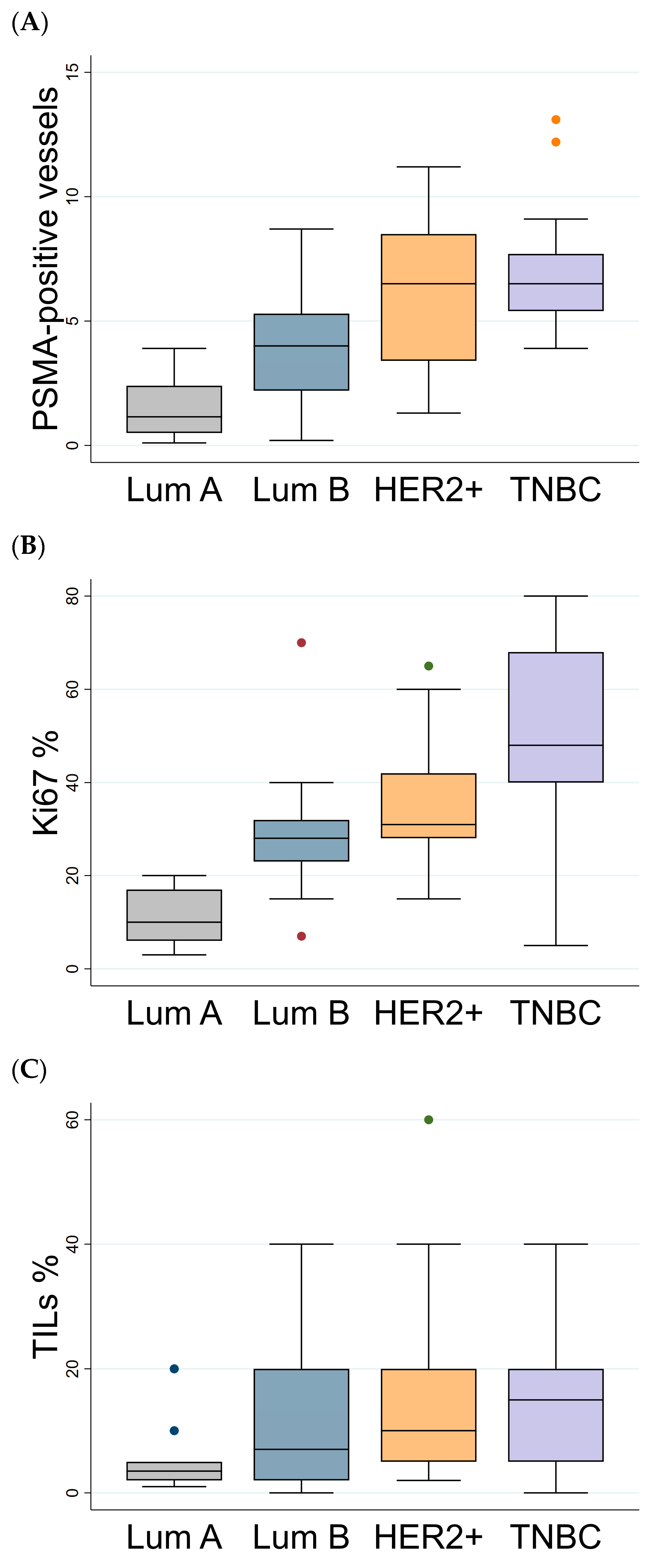
| PSMA | 1.15 (0.5–2.4) | 4.0 (2.2–5.3) | 6.5 (3.4–8.5) | 6.5 (5.4–7.7) | <0.001 | <0.001 | <0.001 | <0.001 | 0.026 | <0.001 | 0.169 |
| Ki67 | 10.0% (6.0–17.0%) | 28.0% (23.0–32.0%) | 31.0% (28.0–42.0%) | 48.0% (40.0–68.0%) | 0.001 | <0.001 | <0.001 | <0.001 | 0.107 | <0.001 | 0.068 |
| TILs | 3.5% (2–5%) | 7.0% (2–20%) | 10.0% (5–20%) | 15.0% (5–20%) | 0.032 | 0.018 | 0.009 | 0.005 | 0.138 | 0.182 | 0.336 |
| Marker | Spearman’s Rho Coefficient (p-Value) | Spearman’s Rho Coefficient (p-Value) for the Different Tumor Subtypes | |||
|---|---|---|---|---|---|
| Luminal A (n = 22) | Luminal B (n = 47) | HER2+ (n = 9) | TNBC (n = 23) | ||
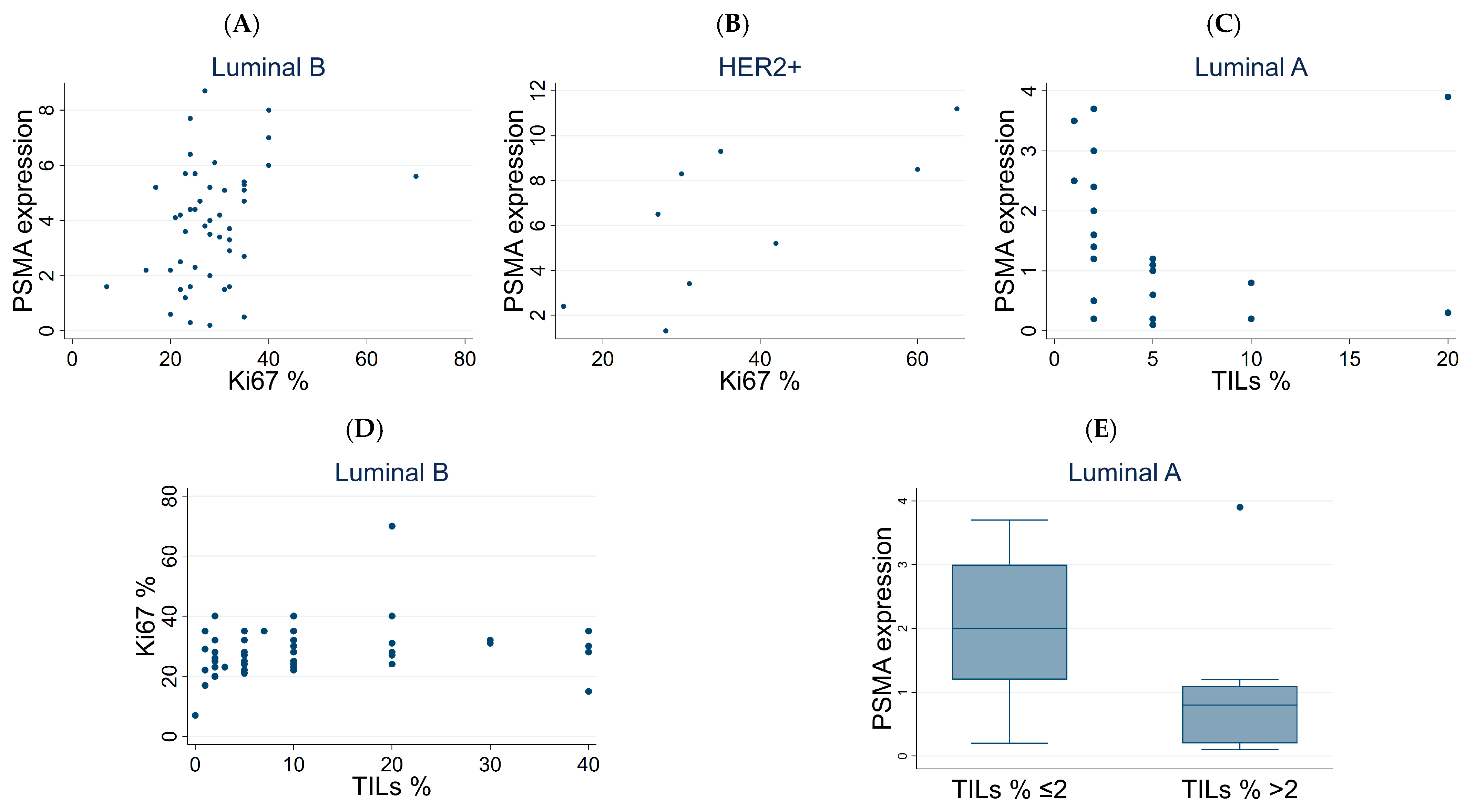
| PSMA vs. Ki67 | 0.695 (<0.001) | 0.291 (0.189) | 0.302 (0.039) | 0.700 (0.035) | −0.076 (0.728) |
| PSMA vs. TILs | 0.286 (0.003) | −0.466 (0.028) | 0.108 (0.468) | 0.591 (0.093) | 0.124 (0.571) |
| KI67 vs. TILs | 0.341 (<0.001) | −0.255 (0.251) | 0.303 (0.038) | 0.118 (0.762) | 0.088 (0.689) |
Disclaimer/Publisher’s Note: The statements, opinions and data contained in all publications are solely those of the individual author(s) and contributor(s) and not of MDPI and/or the editor(s). MDPI and/or the editor(s) disclaim responsibility for any injury to people or property resulting from any ideas, methods, instructions or products referred to in the content. |
© 2026 by the authors. Licensee MDPI, Basel, Switzerland. This article is an open access article distributed under the terms and conditions of the Creative Commons Attribution (CC BY) license.
Share and Cite
Virga, A.; Foca, F.; Cortecchia, S.; Poli, F.; Caroli, P.; Matteucci, F.; Maltoni, R.; Mazza, M.; Nicolini, F.; Ulivi, P.; et al. Prostate-Specific Membrane Antigen (PSMA): A Potential Theranostic Biomarker in Breast Cancer. Biomedicines 2026, 14, 628. https://doi.org/10.3390/biomedicines14030628
Virga A, Foca F, Cortecchia S, Poli F, Caroli P, Matteucci F, Maltoni R, Mazza M, Nicolini F, Ulivi P, et al. Prostate-Specific Membrane Antigen (PSMA): A Potential Theranostic Biomarker in Breast Cancer. Biomedicines. 2026; 14(3):628. https://doi.org/10.3390/biomedicines14030628
Chicago/Turabian StyleVirga, Alessandra, Flavia Foca, Stefania Cortecchia, Francesca Poli, Paola Caroli, Federica Matteucci, Roberta Maltoni, Massimiliano Mazza, Fabio Nicolini, Paola Ulivi, and et al. 2026. "Prostate-Specific Membrane Antigen (PSMA): A Potential Theranostic Biomarker in Breast Cancer" Biomedicines 14, no. 3: 628. https://doi.org/10.3390/biomedicines14030628
APA StyleVirga, A., Foca, F., Cortecchia, S., Poli, F., Caroli, P., Matteucci, F., Maltoni, R., Mazza, M., Nicolini, F., Ulivi, P., Paganelli, G., Puccetti, M., & Bravaccini, S. (2026). Prostate-Specific Membrane Antigen (PSMA): A Potential Theranostic Biomarker in Breast Cancer. Biomedicines, 14(3), 628. https://doi.org/10.3390/biomedicines14030628