Nanotechnology-Based Strategies for Hair Regeneration: Mechanistic Insights and Translational Perspectives for Androgenetic Alopecia


Abstract
1. Introduction
2. Pathophysiology of AGA
3. Nanocarrier-Based Drug Delivery Systems for AGA

| Nanocarrier Class | Example Materials | Therapeutic Mechanism/Drug Delivered | Size (nm) | Zeta Potential (mV) | Application | Key Advantages for AGA | References |
|---|---|---|---|---|---|---|---|
| Polymeric Nanoparticles | Methylcellulose | MXD | 90–300 | NA | In vivo AGA-induced C57BL/6 mouse model | Enhance drug aggregation and expressions of hair-growth factors in hair bulbs No skin stimulation | [86] |
| Chitosan | MXD | 235.5 ± 99.9 | +38.6 ± 6.0 | In vitro porcine ears skin permeation test | Sustained drug release Increased drug permeation into hair follicles | [82] | |
| PLGA | finasteride | 316.5 ± 14.4 | NA | In vitro polydimethylsiloxane membrane permeation test | Encapsulation efficiency 79.49% ± 0.47% | [87] | |
| HA-PLGA | MXD | 243 ± 44.5 | NA | In vitro rat skin permeation test | Higher skin permeability Uptake by hair follicle dermal papillary cells | [80] | |
| Poly-ε-caprolactone | Latanoprost | 97.8 ± 1.2 | −30.1 ± 1.8 | In vitro porcine ears skin permeation test | Stable storage for 90 days Improved drug accumulation into hair follicles | [88] | |
| Methyl-β-cyclodextrin 10% Polyvinyl Pyrrolidone K30 | Rosuvastatin | 218 | NA | In vivo hair loss Albino rat model | Sustained drug release Activation of epithelial stem cells of hair follicle | [89] | |
| Poly-(q-caprolactone)-block-poly(ethyleneglycol) | MXD | 40–130 | NA | In vivo skin retention test | Penetrated mainly via hair follicles routes | [90] | |
| Dipalmotyl (DPPC)-PLGA | Quercetin | 339 ± 1.6 | −32.6 ± 0.51 | In vivo alopecia-induced rat models | Entrapment efficiency 78% ± 5.5% Uptake by hair follicles Inhibit hair follicle cells apoptosis in vivo | [91] | |
| Ethyl cellulose | α-Mangostin | 436.0 ± 11.5 | NA | Therapeutic effect study in 10 acne patients | Sustained release in human synthetic sebum Excellent hair follicle entrapment | [92] | |
| PEG5K-b-oligo (DTO-SA)-b-PEG5K | Adapalene | 64.7–81.6 | NA | In vitro human cadaver and porcine ear skin permeation test | Increased drug accumulation in hair follicles | [93] | |
| Poly(amidoamine) | Adapalene | 256 ± 12 | 19.0 ± 3.1 (0.05%) 27.6 ± 2.3 (0.07%) | In vitro abdominal porcine skin permeation test | Increased drug accumulation in hair follicles and skin. | [94] | |
| Eudragit® L100 | Dexamethasone | 303.1 ± 5.5 | NA | In vitro porcine skin permeation test | pH-sensitive Significant transfollicular penetration | [95] | |
| poly- ε-caprolactone | Adapalene | 107.5 ± 8.19 | −13.1 | In vitro full-thickness human skin permeation and distribution test | Preferential targeting to PSU | [96] | |
| Chitosan HA | Clindamycin | 362 ± 19 417 ± 9 | 27.7 ± 0.9 −30.2 ± 2.7 | In vitro skin penetration test using intact skin porcine, skin with the PSU artificially blocked, and sebaceous skin | Enhanced targeted delivery to pilosebaceous structures | [97] | |
| Delonix polymer | Isotretinoin | 230 ± 10 | −67 ± 3 | In vitro pig ear skin permeation test | Significant follicular targeting Function as follicular drug reservoir | [98] | |
| Polylactic acid (PLA) | Cyclosporin A | 152.2 ± 5 | −16 ± 0.2 | In vitro porcine skin permeation test | Increased skin permeation/hair follicles accumulation | [99] | |
| Poly-(ɛ-caprolactone)-lipid | Dutasteride | 199.0 ± 0.5 | − 13.6 ± 0.6 | In vitro porcine’s ear skin permeation test | Fivefold increase in hair follicles targeting | [100] | |
| D-α-tocopheryl polyethylene glycol succinate diblock copolymer | Adapalene | 4–12 | NA | In vitro full-thickness porcine and human skin permeation test | Preferential accumulation in the follicular orifice | [101] | |
| Pluronic® F127 | Benzoyl peroxide | 24.8–25.9 | −2 to −13 | In vitro porcine skin permeation test | Drug deposition in the follicular pathway | [102] | |
| Clove oil Kolliphor® P188 | MXD | 10 | NA | In vitro follicular drug penetration test | Controlled drug release Twenty-sixfold drug penetrated into hair follicles | [103] | |
| Eucalyptol Oleic Acid | MXD | 29.6 ± 3.1 19.5 ± 1.3 8.0 ± 0.5 12.4 ± 0.1 | NA | In vitro full-thickness excised human skin permeation test | Promoted drug retention in deeper skin layers Greater hair follicle penetration | [104] | |
| Soya lecithin Polyethylene glycol 600 | FIN | 195.2 ± 9.43 | −7.61 ± 1.35 | In vivo AGA-induced Swiss albino mouse model | Increased hair diameter and length Restored the follicle station Be safe and stable for more than 90 days | [105] | |
| Poly (ethylene oxide)-block-poly(ε-caprolactone) Lecithin | Luteolin | 290 | NA | In vivo alopecia-induced C57BL/6 mouse model | Stability for long-term storage Hair growth-promotion activity | [106] | |
| Medium chain oil Span 80 | Cedrol | 14.26 ± 0.16 | NA | In vivo alopecia-induced C57BL/6 mouse model | Improved drug solubility Increased growth rate of hair follicles | [107] | |
| Lipid-based Carriers | Stearic acid Oleic acid | MXD | 281.4 ± 7.4 | −32.9 ± 1.23 | In vitro rat skin permeation test | Drug entrapment efficiency 92.48% ± 0.31% Promoted hair follicles retention | [108] |
| Phospholipid Cholesterol | MXD, Tretinoin | 149.33 ± 1.4 | 7.74 ± 0.22 | In vitro rat skin permeation test | Promoted hair layers retention | [109] | |
| Squalene Precirol® Anti-platelet-derived growth factor | MXD | 236.0 ± 3.3 194.5 ± 4.7 | −43.8 ± 0.9 −45.5 ± 0.6 | In vivo skin permeation test | Ameliorated follicular uptake Promoted proliferation of dermal papilla cells Up regulation of hair regeneration related factor | [110] | |
| Squalene | Diphencyprone | 236.3 ± 3.2 | −52.8 ± 4.7 | In vivo nude mouse dorsal skin permeation test | Improved drug targeting to follicles | [111] | |
| Olive oil Transcutol® Tween 80 | Spironolactone | 215.6 ± 20.4 | −18.7 ± 0.92 | In vitro skin permeation test | Entrapment efficiency 87.36% ± 3.34% Deliver the NLCs within the follicles | [112] | |
| Stearic acid | Dutasteride | 187.6 ± 7.0 | −18 ± 0.9 (uncoated) 25.8 ± 1.1 (coated) | In vitro porcine skin permeation test | Entrapment efficiency 97.8% ± 0.68% Promoted penetration in the hair follicular region | [113] | |
| Lauric acid Chitosan | Dutasteride | 184.2 ± 2.9 | −18 ± 2.3 (uncoated) 24.8 ± 2.1 (coated) | In vitro porcine skin permeation test | Physically stable for 180 days Enhanced cell proliferation of human dermal papilla cells | [114] | |
| Stearic acid Cholesterol Triolein | Cyproterone acetate | 300 | −35 ± 0.5 | In vivo hamsters skin permeation test | Enhanced accumulation in hair follicles Increased drug accumulation in dermis and epidermis | [115] | |
| Palmitostearate Evening primrose Olive Soybean Bitter almond | Melatonin | 683 ± 27.08 307 ± 18.31 307 ± 3.68 303 ± 16.24 | −17. 2 ± 0.53 −15.1 ± 0.22 −6.6 ± 0.14 −14.6 ± 0.78 | Therapeutic effect study in 40 male AGA patients | Increased hair density and thickness | [116] | |
| Precirol® Oleic acid | Arginine | 87.34 | −24.6 | In vivo hamsters skin permeation test | Increased accumulation in the hair follicles Accelerate new hair follicle growth | [117] | |
| Buriti oil Ceramides | 17-α-estradiol | 96 ± 15 | −17 ± 6 | In vivo human skin permeation test | Encapsulation efficiency 99.6% ± 0.3% Physical stability for 42 d Accumulation in the hair follicle | [118] | |
| Glyceryl distearate Glyceryl monostearate Tween 80 or Span 65 | Adapalene | 300.3 ± 1.45 | −21.3 ± 0.07 | Clinical study in 15 acne vulgaris patients | Sustained drug release Improvement in pilosebaceous follicles | [119] | |
| Stearic acid Oeic acid | Clindamycin phosphate | 400 ± 14 | −48.9 ± 0.7 | In vivo skin permeation on porcine skin | Increased accumulation into hair follicles openings | [120] | |
| Precirol ATO-5® Span 80 | Flutamide | 192 ± 13 | NA | In vivo skin permeation and hair growth test | Good stability for two months Higher accumulation in the hair follicles | [121] | |
| Transferosome | FIN Finasteride | Phospholipon 90 G Span 65 | 299.6 ± 45.6 171.0 ± 5.6 197.4 ± 29.1 | NA | In vivo rat skin permeation test | Enhanced drug permeation in skin layer | [122] |
| MXD Caffeine | Polysorbate 20 Polysorbate 80 | NA | NA | In vivo AGA-induced rat model | Enhanced hair length | [123] | |
| Ethosome | Cryptotanshinone | Soybean phosphatidycholine Ethanol | 69.1 ± 1.9 | NA | In vivo anti-acne effect in rabbit model | Increased anti-acne effect | [124] |
| Liquid crystal nanocarrier | MXD | Monoglycerides Phospholipids Poloxamer 407 | 82 ± 1 | −57 ± 3 | In vivo hair regrowth efficacy test on rats | Selective delivery to pilosebaceous follicle | [125] |
| Nanozyme-integrated dissolving microneedles (Ce-MNs) | Core: Ceria nanozymes (CeNZs) modified with DSPE-mPEG2000 Needle matrix: Hyaluronic acid (HA, Mw < 10 kDa) Backing: Polyvinylpyrrolidone (PVP-K90) | Dual-mode regulation of perifollicular microenvironment
Delivered: CeNZs (~8.65 μg Ce per patch) | Hydrophobic CeNZs: ~3 nm (TEM) PEGylated CeNZs: ~10 nm (hydrodynamic diameter) | NA | In vivo AGA-induced C57BL/6 mouse model | Superior treatment efficiency: Faster onset of telogen-to-anagen transition vs. MXD with lower administration frequency (5 applications vs. daily topical) Effective transdermal delivery: Bypasses stratum corneum to deliver CeNZs to 200–300 μm depth (hair follicle residence) High safety profile: Biocompatible with no significant/irreversible skin damage; epidermal thickening is reversible by day 28 Comparable efficacy: Achieves similar hair diameter, density, and coverage as MXD with intact hair scales | [126] |
| Finasteride–peptide nanocomplexes | Peptide with hydrophobic blocks (PepWL, PepW4) coassembled with Finasteride |
| NC-WL: 57.7 ± 7.0 nm NC-W4: 133.5 ± 17.3 nm | NA | In vivo C57BL/6 mouse model |
| [127] |
| Hyaluronic acid liposome (HL) composite |
|
| Hydrated: ~350–520 nm (<500 nm) Dry (TEM): ~200 nm | HL@Mi: −12 mV HL@Mi/NONOate: −24 mV | In vivo AGA-induced C57BL/6 mouse model | Synergistic multimodal therapy: Combines gas molecule (NO) with drug (Mi) for enhanced efficacy Enhanced penetration: NO-induced vasodilation significantly improves transdermal Mi delivery compared to conventional tinctures Prolonged action: Extended drug retention in skin improves bioavailability Microenvironment regulation: Simultaneously addresses vascular insufficiency, inflammation, and stem cell activation Superior biocompatibility: Avoids skin irritation (dryness, peeling, crystallization) caused by ethanol/propylene glycol in commercial MXD formulations Comparable efficacy: Achieves hair regrowth comparable to MXD with reduced side effects and inflammation | [128] |
4. Nanotechnology-Based Microneedle Systems for Transdermal Follicular Delivery
5. Nanotechnology-Based Remodeling of the Hair Follicle Microenvironment
6. Safety, Toxicity, and Regulatory Considerations
7. Clinical Translation and Future Perspectives
| Translational Aspect | Current Status and Challenges | Proposed Future Directions | References |
|---|---|---|---|
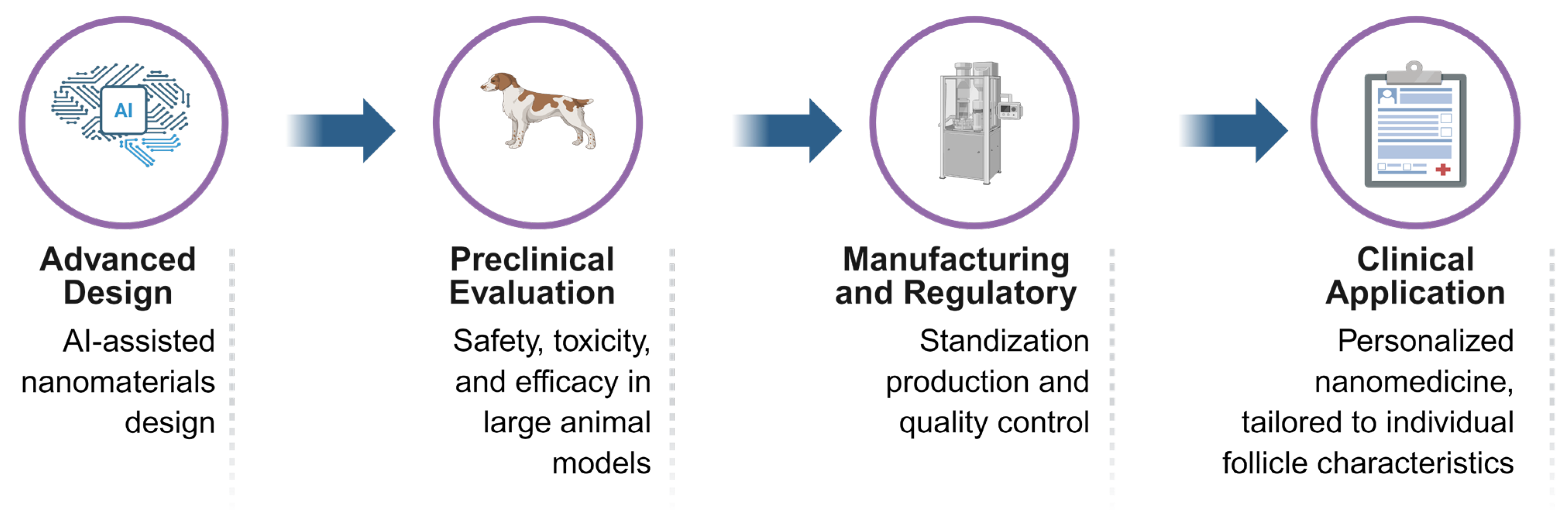
| Safety and Toxicology | Potential for long-term accumulation of non-biodegradable NPs in the skin; limited systemic toxicity data. | Extensive chronic toxicity studies and use of biodegradable, “green” nanomaterials. | [161] |
| Manufacturing Scale-up | Batch-to-batch variability; high cost of specialized equipment for complex nanostructures. | Development of microfluidic-based synthesis and standardized manufacturing protocols (GMP). | [162] |
| Regulatory Hurdles | Lack of specific FDA/EMA guidelines for “nano-cosmeceuticals” and complex delivery systems. | Harmonization of international testing standards; close collaboration with regulatory agencies. | [163] |
| Clinical Validation | Most data derived from rodent models; human scalp skin thickness and follicle density differ. | Use of 3D-printed human skin models and humanized mice for more accurate preclinical screening. | [164] |
| Patient Compliance | High-frequency application for topical nanosystems; cost of microneedle-based therapies. | Designing long-acting (e.g., monthly) delivery platforms and low-cost MN manufacturing techniques. | [165] |
7.1. Patent Landscape for Nanotechnology-Based AGA Therapy
7.2. Clinical Trials Progress of Nanotechnology-Based AGA Therapies
8. Conclusions
Author Contributions
Funding
Data Availability Statement
Acknowledgments
Conflicts of Interest
Abbreviations
| MXD | Minoxidil |
| AGA | Androgenetic alopecia |
| HA | Hyaluronic acid |
| MN | Microneedle |
| Shh | Sonic hedgehog |
| TGF-β | Transforming growth factor-β |
| BMP | Bone morphogenetic protein |
| NO | Nitric oxide |
| ROS | Reactive oxygen species |
| CAT | Catalase |
| POD | peroxidase |
| SOD | Superoxide dismutase |
References
- Geyfman, M.; Plikus, M.V.; Treffeisen, E.; Andersen, B.; Paus, R. Resting no more: Re-defining telogen, the maintenance stage of the hair growth cycle. Biol. Rev. 2015, 90, 1179–1196. [Google Scholar] [CrossRef]
- Al-Nuaimi, Y.; Baier, G.; Watson, R.E.; Chuong, C.M.; Paus, R. The cycling hair follicle as an ideal systems biology research model. Exp. Dermatol. 2010, 19, 707–713. [Google Scholar] [CrossRef]
- Houschyar, K.S.; Borrelli, M.R.; Tapking, C.; Popp, D.; Puladi, B.; Ooms, M.; Chelliah, M.P.; Rein, S.; Pförringer, D.; Thor, D. Molecular mechanisms of hair growth and regeneration: Current understanding and novel paradigms. Dermatology 2020, 236, 271–280. [Google Scholar] [CrossRef]
- O’Sullivan, J.D.; Nicu, C.; Picard, M.; Chéret, J.; Bedogni, B.; Tobin, D.J.; Paus, R. The biology of human hair greying. Biol. Rev. 2021, 96, 107–128. [Google Scholar] [CrossRef]
- Oh, J.W.; Kloepper, J.; Langan, E.A.; Kim, Y.; Yeo, J.; Kim, M.J.; Hsi, T.-C.; Rose, C.; Yoon, G.S.; Lee, S.-J. A guide to studying human hair follicle cycling in vivo. J. Investig. Dermatol. 2016, 136, 34–44. [Google Scholar] [CrossRef] [PubMed]
- Xue, C.; Chu, Q.; Shi, Q.; Zeng, Y.; Lu, J.; Li, L. Wnt signaling pathways in biology and disease: Mechanisms and therapeutic advances. Signal Transduct. Target. Ther. 2025, 10, 106. [Google Scholar] [CrossRef] [PubMed]
- Hwang, S.B.; Park, H.J.; Lee, B.-H. Hair-growth-promoting effects of the fish collagen peptide in human dermal papilla cells and C57BL/6 mice modulating Wnt/β-catenin and BMP signaling pathways. Int. J. Mol. Sci. 2022, 23, 11904. [Google Scholar] [CrossRef] [PubMed]
- Abe, Y.; Tanaka, N. Roles of the hedgehog signaling pathway in epidermal and hair follicle development, homeostasis, and cancer. J. Dev. Biol. 2017, 5, 12. [Google Scholar] [CrossRef]
- Wang, X.; Liu, Y.; He, J.; Wang, J.; Chen, X.; Yang, R. Regulation of signaling pathways in hair follicle stem cells. Burn. Trauma 2022, 10, tkac022. [Google Scholar] [CrossRef]
- Wu, M.; Chen, G.; Li, Y.-P. TGF-β and BMP signaling in osteoblast, skeletal development, and bone formation, homeostasis and disease. Bone Res. 2016, 4, 16009. [Google Scholar] [CrossRef]
- Zhu, S.; Chen, W.; Masson, A.; Li, Y.-P. Cell signaling and transcriptional regulation of osteoblast lineage commitment, differentiation, bone formation, and homeostasis. Cell Discov. 2024, 10, 71. [Google Scholar] [CrossRef]
- Park, S.; Lee, J. Modulation of hair growth promoting effect by natural products. Pharmaceutics 2021, 13, 2163. [Google Scholar] [CrossRef] [PubMed]
- Liu, Y.; Tosti, A.; Wang, E.C.; Heilmann-Heimbach, S.; Aguh, C.; Jimenez, F.; Lin, S.-J.; Kwon, O.; Plikus, M.V. Androgenetic alopecia. Nat. Rev. Dis. Primers 2025, 11, 73. [Google Scholar] [CrossRef] [PubMed]
- Oiwoh, S.O.; Enitan, A.O.; Adegbosin, O.T.; Akinboro, A.O.; Onayemi, E.O. Androgenetic alopecia: A review. Niger. Postgrad. Med. J. 2024, 31, 85–92. [Google Scholar] [CrossRef] [PubMed]
- Ntshingila, S.; Oputu, O.; Arowolo, A.T.; Khumalo, N.P. Androgenetic alopecia: An update. JAAD Int. 2023, 13, 150–158. [Google Scholar] [CrossRef]
- Altendorf, S.; Bertolini, M.; Le Riche, A.; Tosti, A.; Paus, R. Frontiers in the physiology of male pattern androgenetic alopecia: Beyond the androgen horizon. Physiol. Rev. 2026, 106, 121–195. [Google Scholar] [CrossRef]
- Pozo-Pérez, L.; Tornero-Esteban, P.; López-Bran, E. Clinical and preclinical approach in AGA treatment: A review of current and new therapies in the regenerative field. Stem Cell Res. Ther. 2024, 15, 260. [Google Scholar] [CrossRef]
- Abdelkader, A.; Y Abdallah, I.; Abdeen, A.; E Ibrahim, S. Androgenetic alopecia: An overview. Benha J. Appl. Sci. 2024, 9, 37–50. [Google Scholar] [CrossRef]
- Katzer, T.; Leite Junior, A.; Beck, R.; da Silva, C. Physiopathology and current treatments of androgenetic alopecia: Going beyond androgens and anti-androgens. Dermatol. Ther. 2019, 32, e13059. [Google Scholar] [CrossRef]
- Kidangazhiathmana, A.; Santhosh, P. Pathogenesis of androgenetic alopecia. Clin. Dermatol. Rev. 2022, 6, 69–74. [Google Scholar] [CrossRef]
- Ovcharenko, Y.; Khobzei, K.; Lortkipanidze, N. Androgenetic alopecia. In Psychotrichology: Psychiatric and Psychosocial Aspects of Hair Diseases; Springer: Berlin/Heidelberg, Germany, 2025; pp. 137–170. [Google Scholar]
- McElwee, K.J.; Sundberg, J.P. Innovative strategies for the discovery of new drugs against androgenetic alopecia. Expert Opin. Drug Discov. 2025, 20, 517–536. [Google Scholar] [CrossRef] [PubMed]
- Gupta, S.; Goyal, I.; Mahendra, A. Quality of life assessment in patients with androgenetic alopecia. Int. J. Trichology 2019, 11, 147–152. [Google Scholar] [CrossRef] [PubMed]
- Han, S.-H.; Byun, J.-W.; Lee, W.-S.; Kang, H.; Kye, Y.-C.; Kim, K.-H.; Kim, D.-W.; Kim, M.-B.; Kim, S.-J.; Kim, H.-O. Quality of life assessment in male patients with androgenetic alopecia: Result of a prospective, multicenter study. Ann. Dermatol. 2012, 24, 311. [Google Scholar] [CrossRef] [PubMed]
- Huang, C.-H.; Fu, Y.; Chi, C.-C. Health-related quality of life, depression, and self-esteem in patients with androgenetic alopecia: A systematic review and meta-analysis. JAMA Dermatol. 2021, 157, 963–970. [Google Scholar] [CrossRef]
- Tampucci, S.; Paganini, V.; Burgalassi, S.; Chetoni, P.; Monti, D. Nanostructured drug delivery systems for targeting 5-α-reductase inhibitors to the hair follicle. Pharmaceutics 2022, 14, 286. [Google Scholar] [CrossRef]
- Nobari, N.N.; Roohaninasab, M.; Sadeghzadeh-Bazargan, A.; Goodarzi, A.; Behrangi, E.; Nikkhah, F.; Ghassemi, M. A systematic review of clinical trials using single or combination therapy of oral or topical finasteride for women in reproductive age and postmenopausal women with hormonal and nonhormonal androgenetic alopecia. Adv. Clin. Exp. Med. 2023, 32, 813–823. [Google Scholar] [CrossRef]
- Gentile, P.; Garcovich, S. Systematic review of platelet-rich plasma use in androgenetic alopecia compared with Minoxidil®, Finasteride®, and adult stem cell-based therapy. Int. J. Mol. Sci. 2020, 21, 2702. [Google Scholar] [CrossRef]
- Nestor, M.S.; Ablon, G.; Gade, A.; Han, H.; Fischer, D.L. Treatment options for androgenetic alopecia: Efficacy, side effects, compliance, financial considerations, and ethics. J. Cosmet. Dermatol. 2021, 20, 3759–3781. [Google Scholar] [CrossRef]
- Messenger, A.; Rundegren, J. Minoxidil: Mechanisms of action on hair growth. Br. J. Dermatol. 2004, 150, 186–194. [Google Scholar] [CrossRef]
- York, K.; Meah, N.; Bhoyrul, B.; Sinclair, R. A review of the treatment of male pattern hair loss. Expert Opin. Pharmacother. 2020, 21, 603–612. [Google Scholar] [CrossRef]
- Gupta, A.K.; Talukder, M.; Williams, G. Comparison of oral minoxidil, finasteride, and dutasteride for treating androgenetic alopecia. J. Dermatol. Treat. 2022, 33, 2946–2962. [Google Scholar] [CrossRef] [PubMed]
- Kuca, M.; Jaglarz, K.; Cholewa, M.; Wójcik, J.; Szymańska, W.M.; Janeczek, M.; Partyka, M.; Kantor, K.K.; Pamuła, K.W.; Plewniok, J. Risk associated with the use of 5-alpha reductase inhibitors with minoxidil in treatment of male androgenetic alopecia-literature review. J. Pre-Clin. Clin. Res. 2025, 19, 36–41. [Google Scholar] [CrossRef]
- Chen, S.; Li, L.; Ding, W.; Zhu, Y.; Zhou, N. Androgenetic Alopecia: An Update on Pathogenesis and Pharmacological Treatment. Drug Des. Dev. Ther. 2025, 19, 7349–7363. [Google Scholar] [CrossRef] [PubMed]
- Lee, S.W.; Juhasz, M.; Mobasher, P.; Ekelem, C.; Mesinkovska, N.A. A systematic review of topical finasteride in the treatment of androgenetic alopecia in men and women. J. Drugs Dermatol. JDD 2018, 17, 457. [Google Scholar]
- Rane, B.R.; Amkar, A.J.; Pawar, S.S.; Gadekar, P.S.; Keservani, R.K.; Jain, A.S. Follicular Delivery of Nanocarriers to Improve Skin Disease Treatment. In Novel Nanocarriers for Skin Diseases; Apple Academic Press: Oakville, ON, Canada, 2025; pp. 209–237. [Google Scholar]
- Fang, C.-L.; Aljuffali, I.A.; Li, Y.-C.; Fang, J.-Y. Delivery and targeting of nanoparticles into hair follicles. Nanomed. Nanotechnol. Biol. 2014, 5, 991–1006. [Google Scholar] [CrossRef]
- Cevc, G.; Vierl, U. Nanotechnology and the transdermal route: A state of the art review and critical appraisal. J. Control. Release 2010, 141, 277–299. [Google Scholar] [CrossRef]
- Rancan, F.; Afraz, Z.; Combadiere, B.; Blume-Peytavi, U.; Vogt, A. Hair follicle targeting with nanoparticles. In Nanotechnology in Dermatology; Springer: Berlin/Heidelberg, Germany, 2012; pp. 95–107. [Google Scholar]
- Hamblin, M.R.; Avci, P.; Prow, T. Nanoscience in Dermatology; Academic Press: Cambridge, MA, USA, 2016. [Google Scholar]
- Pereira-Silva, M.; Martins, A.M.; Sousa-Oliveira, I.; Ribeiro, H.M.; Veiga, F.; Marto, J.; Paiva-Santos, A.C. Nanomaterials in Hair Care and Treatment: Current Advances and Future Perspectives. SSRN Electron. J. 2022. [Google Scholar] [CrossRef]
- Brito, S.; Baek, M.; Bin, B.-H. Skin structure, physiology, and pathology in topical and transdermal drug delivery. Pharmaceutics 2024, 16, 1403. [Google Scholar] [CrossRef]
- Giradkar, V.; Mhaske, A.; Shukla, R. Nanocrystals: A multifaceted regimen for dermatological ailments. Part. Part. Syst. Charact. 2024, 41, 2300147. [Google Scholar] [CrossRef]
- Liu, L.; Zhao, W.; Ma, Q.; Gao, Y.; Wang, W.; Zhang, X.; Dong, Y.; Zhang, T.; Liang, Y.; Han, S. Functional nano-systems for transdermal drug delivery and skin therapy. Nanoscale Adv. 2023, 5, 1527–1558. [Google Scholar] [CrossRef]
- Ramkar, S.; Sah, A.K.; Bhuwane, N.; Choudhary, I.; Hemnani, N.; Suresh, P.K. Nano-lipidic carriers as a tool for drug targeting to the pilosebaceous units. Curr. Pharm. Des. 2020, 26, 3251–3268. [Google Scholar] [CrossRef]
- Parga, A.; Ray, B. Advances in Nanocarrier Systems for Dermatologic Transdermal Drug Delivery: A Chemical and Molecular Review. Int. J. Nanotechnol. Nanomed. 2025, 10, 1–12. [Google Scholar] [CrossRef]
- Mathes, C. Drug Delivery to the Hair Follicle: Role of Follicular Tight Junctions as a Biological Barrier and the Potential for Targeting Clobetasol Nanocarriers. Ph.D. Thesis, Saarland University, Saarbrücken, Germany, 2015. [Google Scholar]
- Shaikh, Z.S.A.; Patel, B.A.A.; Patil, S.G.; Maniyar, A.R.S. Nanotechnology-based strategies for hair follicle regeneration in androgenetic alopecia. Mater. Proc. 2023, 14, 57. [Google Scholar]
- Kayal, P.; Raghul, R.; Sahoo, U.K.; Jawahar, N. Nanocarrier-based approaches for enhanced management of androgenetic alopecia: Advancements and future prospects. Int. J. App. Pharm. 2025, 17, 13–27. [Google Scholar] [CrossRef]
- Wu, X.; Du, Y.-Z. Nanodrug delivery strategies to signaling pathways in alopecia. Mol. Pharm. 2023, 20, 5396–5415. [Google Scholar] [CrossRef]
- Bambale, P.G.; Lewade, V.; Daundkar, S. Exploring Novel Treatments for Alopecia: Nanoparticles, Iontophoresis, and Cell Therapy. Int. J. Res. Anal. Rev. 2025, 2, 502–517. [Google Scholar]
- Ribeiro, M.D. Nanotechnology-Based Therapeutics Strategies Towards the Topical Treatment of Hair Loss. Master’s Thesis, Universidade de Coimbra, Coimbra, Portugal, 2020. [Google Scholar]
- Diao, R.; Sun, M.; Zhang, N.; Liu, X.; Song, P. Novel Strategies for Androgenetic Alopecia Therapy: Integrating Multifunctional Plant Extracts with Nanotechnology for Advanced Cutaneous Drug Delivery. Pharmaceutics 2025, 17, 1220. [Google Scholar] [CrossRef]
- Xu, S.; Zhou, L.; Zhao, H.; Li, S. Advances in Transdermal Delivery Systems for Treating Androgenetic Alopecia. Pharmaceutics 2025, 17, 984. [Google Scholar] [CrossRef]
- Andrade, J.F.; Verbinnen, A.; Bakst, A.; Cunha-Filho, M.; Gelfuso, G.M.; Gratieri, T. An update on nanocarriers for follicular-targeted drug delivery for androgenetic alopecia topical treatment. Expert Opin. Drug Deliv. 2025, 22, 367–381. [Google Scholar] [CrossRef]
- Yang, W.; Lv, Y.; Wang, B.; Luo, S.; Le, Y.; Tang, M.; Zhao, R.; Li, Y.; Kong, X. Polydopamine synergizes with quercetin nanosystem to reshape the perifollicular microenvironment for accelerating hair regrowth in androgenetic alopecia. Nano Lett. 2024, 24, 6174–6182. [Google Scholar] [CrossRef]
- Khalilzad, M.A.; Mohammadi, J.; Amirsaadat, S.; Najafi, S.; Zare, S.; Nilforoushzadeh, M.A.; Khalilzad, M.; Khaghani, A.; Soltankouhi, M.R.F.; Hajimohammad, A. Elevating Dermatology Beyond Aesthetics: Perinatal-Derived Advancements for Rejuvenation, Alopecia Strategies, Scar Therapies, and Progressive Wound Healing. Stem Cell Rev. Rep. 2025, 21, 709–729. [Google Scholar] [CrossRef]
- Çelik, H.; Bal-Öztürk, A. Tissue Engineering and Nanoparticle-Based Approaches for Hair Follicle Regeneration. BioNanoScience 2025, 15, 300. [Google Scholar] [CrossRef]
- Dong, T.-R.; Li, Y.-J.; Jin, S.-Y.; Yang, F.-L.; Xiong, R.-X.; Dai, Y.-Q.; Song, X.-Z.; Guan, C.-P. Progress on mitochondria and hair follicle development in androgenetic alopecia: Relationships and therapeutic perspectives. Stem Cell Res. Ther. 2025, 16, 44. [Google Scholar] [CrossRef] [PubMed]
- Wang, B.; Tang, M.; Zhang, Y.; Li, X.; Zhou, X.; Zhang, H.; Zhao, R.; Wang, S.; Kong, X. Ni–Cu Bimetallic Nanozyme and Minoxidil Co-Loaded Dissolving Microneedles Reshape Hair Follicle Microenvironment for Androgenic Alopecia Treatment. ACS Appl. Nano Mater. 2025, 8, 9502–9514. [Google Scholar] [CrossRef]
- Stough, D.; Stenn, K.; Haber, R.; Parsley, W.M.; Vogel, J.E.; Whiting, D.A.; Washenik, K. Psychological effect, pathophysiology, and management of androgenetic alopecia in men. In Mayo Clinic Proceedings; Elsevier: Amsterdam, The Netherlands, 2005; pp. 1316–1322. [Google Scholar]
- Lolli, F.; Pallotti, F.; Rossi, A.; Fortuna, M.C.; Caro, G.; Lenzi, A.; Sansone, A.; Lombardo, F. Androgenetic alopecia: A review. Endocrine 2017, 57, 9–17. [Google Scholar] [CrossRef]
- Kaliyadan, F.; Nambiar, A.; Vijayaraghavan, S. Androgenetic alopecia: An update. Indian J. Dermatol. Venereol. Leprol. 2013, 79, 613. [Google Scholar] [CrossRef]
- Kabir, Y.; Goh, C. Androgenetic alopecia: Update on epidemiology, pathophysiology, and treatment. J. Egypt. Women’s Dermatol. Soc. 2013, 10, 107–116. [Google Scholar] [CrossRef]
- Trüeb, R.M. Molecular mechanisms of androgenetic alopecia. Exp. Gerontol. 2002, 37, 981–990. [Google Scholar] [CrossRef]
- Xiao, Y.; Zhang, Y.; Deng, S.; Yang, X.; Yao, X. Immune and Non-immune Interactions in the Pathogenesis of Androgenetic Alopecia. Clin. Rev. Allergy Immunol. 2025, 68, 22. [Google Scholar] [CrossRef]
- Eunmiri, R. Advancements in Bioactive Compounds and Therapeutic Agents for Alopecia: Trends and Future Perspectives. Cosmetics 2025, 12, 287. [Google Scholar] [CrossRef]
- Shi, H.; Wang, X.; Li, X.; Feng, Y. Pathogenic Mechanisms and Mechanism-Directed Therapies for Androgenetic Alopecia: Current Understanding and Future Directions. Dermatol. Ther. 2025, 2025, 9950475. [Google Scholar] [CrossRef]
- Bi, D.; Hu, Y.; Hua, S.; Liu, J.; Guo, S. The regulatory mechanisms of mitophagy and oxidative stress in androgenetic alopecia. Cell. Signal. 2025, 132, 111862. [Google Scholar] [CrossRef] [PubMed]
- Zhou, D.; Liu, Z.-W.; Jie, X.; Zhu, X. Advances in research on concentrated growth factor applications for androgenetic alopecia treatment: A review. Med. Sci. Monit. Int. Med. J. Exp. Clin. Res. 2025, 31, e948054. [Google Scholar] [CrossRef] [PubMed]
- Khairnar, T.D.; Chavan, G.S.; Sayyed, M.M.; Gujarathi, N.A.; Aher, A.A.; Agrawal, Y.O.; Patil, T.S. Recent trends in nanocarrier formulations of actives beyond minoxidil and 5-α reductase inhibitors in androgenetic alopecia management: A systematic review. J. Drug Deliv. Sci. Technol. 2024, 98, 105890. [Google Scholar] [CrossRef]
- Patzelt, A.; Lademann, J. Recent advances in follicular drug delivery of nanoparticles. Expert Opin. Drug Deliv. 2020, 17, 49–60. [Google Scholar] [CrossRef]
- Raut, S.Y.; Fu, K.; Taichun, H.; Gahane, A.; Chaudhari, D.; Kushwah, V.; Managuli, R.S.; Hegde, A.R.; Jain, S.; Kalthur, G. Engineered Nano-carrier systems for the oral targeted delivery of follicle stimulating Hormone: Development, characterization, and, assessment of in vitro and in vivo performance and targetability. Int. J. Pharm. 2023, 637, 122868. [Google Scholar] [CrossRef]
- Qi, F.; Xie, H.; Guo, X.; He, L.; Chen, G.; Ding, R.; Dai, Q.; Kuang, X.; Zhang, Y.; Zhang, Y. Plant Nanovesicles Integrate Bioactivity and Transdermal Finasteride Delivery for Androgenetic Alopecia. ACS Appl. Mater. Interfaces 2025, 17, 66313–66329. [Google Scholar] [CrossRef]
- Santos, A.C.; Pereira-Silva, M.; Guerra, C.; Costa, D.; Peixoto, D.; Pereira, I.; Pita, I.; Ribeiro, A.J.; Veiga, F. Topical minoxidil-loaded nanotechnology strategies for alopecia. Cosmetics 2020, 7, 21. [Google Scholar] [CrossRef]
- Qu, F.; Geng, R.; Liu, Y.; Zhu, J. Advanced nanocarrier-and microneedle-based transdermal drug delivery strategies for skin diseases treatment. Theranostics 2022, 12, 3372. [Google Scholar] [CrossRef]
- Saleem, K.; Siddiqui, B.; Shah, K.U.; Ahmed, N. Minoxidil Nano-hydrogel Based on Chitosan and Hyaluronic Acid for Potential Treatment of Androgenic Alopecia. BioNanoScience 2025, 15, 258. [Google Scholar] [CrossRef]
- Abd, E.; Benson, H.A.; Roberts, M.S.; Grice, J.E. Follicular penetration of caffeine from topically applied nanoemulsion formulations containing penetration enhancers: In vitro human skin studies. Ski. Pharmacol. Physiol. 2018, 31, 252–260. [Google Scholar] [CrossRef]
- Madawi, E.A.; Al Jayoush, A.R.; Rawas-Qalaji, M.; Thu, H.E.; Khan, S.; Sohail, M.; Mahmood, A.; Hussain, Z. Polymeric nanoparticles as tunable nanocarriers for targeted delivery of drugs to skin tissues for treatment of topical skin diseases. Pharmaceutics 2023, 15, 657. [Google Scholar] [CrossRef]
- Jeong, W.Y.; Kim, S.; Lee, S.Y.; Lee, H.; Han, D.W.; Yang, S.Y.; Kim, K.S. Transdermal delivery of Minoxidil using HA-PLGA nanoparticles for the treatment in alopecia. Biomater. Res. 2019, 23, 16. [Google Scholar] [CrossRef] [PubMed]
- Zhang, Z.; Tsai, P.C.; Ramezanli, T.; Michniak-Kohn, B.B. Polymeric nanoparticles-based topical delivery systems for the treatment of dermatological diseases. Wiley Interdiscip. Rev. Nanomed. Nanobiotechnol. 2013, 5, 205–218. [Google Scholar] [CrossRef] [PubMed]
- Matos, B.N.; Reis, T.A.; Gratieri, T.; Gelfuso, G.M. Chitosan nanoparticles for targeting and sustaining minoxidil sulphate delivery to hair follicles. Int. J. Biol. Macromol. 2015, 75, 225–229. [Google Scholar] [CrossRef] [PubMed]
- Kim, H.S.; Kwon, H.-K.; Lee, D.H.; Le, T.N.; Park, H.-J.; Kim, M.I. Poly (γ-glutamic acid)/chitosan hydrogel nanoparticles for effective preservation and delivery of fermented herbal extract for enlarging hair bulb and enhancing hair growth. Int. J. Nanomed. 2019, 14, 8409–8419. [Google Scholar] [CrossRef]
- Lok, K.-H.; Loo, H.L.; Chuah, L.-H. Topical and transdermal lipid-polymer hybrid nanoparticles (LPN): An integration in advancing dermatological treatments. Drug Deliv. Transl. Res. 2025, 15, 4277–4313. [Google Scholar] [CrossRef]
- Gu, Y.; Bian, Q.; Zhou, Y.; Huang, Q.; Gao, J. Hair follicle-targeting drug delivery strategies for the management of hair follicle-associated disorders. Asian J. Pharm. Sci. 2022, 17, 333–352. [Google Scholar] [CrossRef]
- Nagai, N.; Iwai, Y.; Sakamoto, A.; Otake, H.; Oaku, Y.; Abe, A.; Nagahama, T. Drug delivery system based on minoxidil nanoparticles promotes hair growth in C57BL/6 mice. Int. J. Nanomed. 2019, 14, 7921–7931. [Google Scholar] [CrossRef]
- Roque, L.V.; Dias, I.S.; Cruz, N.; Rebelo, A.; Roberto, A.; Rijo, P.; Reis, C.P. Design of finasteride-loaded nanoparticles for potential treatment of alopecia. Ski. Pharmacol. Physiol. 2017, 30, 197–204. [Google Scholar] [CrossRef]
- Oliveira, A.C.S.; Oliveira, P.M.; Cunha-Filho, M.; Gratieri, T.; Gelfuso, G.M. Latanoprost loaded in polymeric nanocapsules for effective topical treatment of alopecia. AAPS PharmSciTech 2020, 21, 305. [Google Scholar] [CrossRef] [PubMed]
- Maged, A.; Mahmoud, A.A.; Salah, S.; Abd-Elmonsif, N.M.; Ghorab, M.M. Spray-dried rosuvastatin nanoparticles for promoting hair growth. AAPS PharmSciTech 2020, 21, 205. [Google Scholar] [CrossRef] [PubMed]
- Shim, J.; Kang, H.S.; Park, W.-S.; Han, S.-H.; Kim, J.; Chang, I.-S. Transdermal delivery of mixnoxidil with block copolymer nanoparticles. J. Control. Release 2004, 97, 477–484. [Google Scholar] [CrossRef] [PubMed]
- Das, L.; Kaurav, M.; Pandey, R.S. Phospholipid–polymer hybrid nanoparticle-mediated transfollicular delivery of quercetin: Prospective implement for the treatment of androgenic alopecia. Drug Dev. Ind. Pharm. 2019, 45, 1654–1663. [Google Scholar] [CrossRef]
- Pan-In, P.; Wongsomboon, A.; Kokpol, C.; Chaichanawongsaroj, N.; Wanichwecharungruang, S. Depositing α-mangostin nanoparticles to sebaceous gland area for acne treatment. J. Pharmacol. Sci. 2015, 129, 226–232. [Google Scholar] [CrossRef]
- Ramezanli, T.; Zhang, Z.; Michniak-Kohn, B.B. Development and characterization of polymeric nanoparticle-based formulation of adapalene for topical acne therapy. Nanomed. Nanotechnol. Biol. Med. 2017, 13, 143–152. [Google Scholar] [CrossRef]
- Gökçe, B.B.; Boran, T.; Emlik Çalık, F.; Özhan, G.; Sanyal, R.; Güngör, S. Dermal delivery and follicular targeting of adapalene using PAMAM dendrimers. Drug Deliv. Transl. Res. 2021, 11, 626–646. [Google Scholar] [CrossRef]
- Dong, P.; Sahle, F.F.; Lohan, S.B.; Saeidpour, S.; Albrecht, S.; Teutloff, C.; Bodmeier, R.; Unbehauen, M.; Wolff, C.; Haag, R. pH-sensitive Eudragit® L 100 nanoparticles promote cutaneous penetration and drug release on the skin. J. Control. Release 2019, 295, 214–222. [Google Scholar] [CrossRef]
- Sallam, M.A.; Boscá, M.T.M. Mechanistic analysis of human skin distribution and follicular targeting of adapalene-loaded biodegradable nanospheres with an insight into hydrogel matrix influence, in vitro skin irritation, and in vivo tolerability. J. Pharm. Sci. 2017, 106, 3140–3149. [Google Scholar] [CrossRef]
- Tolentino, S.; Pereira, M.N.; Cunha-Filho, M.; Gratieri, T.; Gelfuso, G.M. Targeted clindamycin delivery to pilosebaceous units by chitosan or hyaluronic acid nanoparticles for improved topical treatment of acne vulgaris. Carbohydr. Polym. 2021, 253, 117295. [Google Scholar] [CrossRef]
- Ogunjimi, A.T.; Chahud, F.; Lopez, R.F. Isotretinoin-Delonix polymeric nanoparticles: Potentials for skin follicular targeting in acne treatment. Int. J. Pharm. 2021, 610, 121217. [Google Scholar] [CrossRef] [PubMed]
- Fernandes, B.; Matamá, T.; Gomes, A.C.; Cavaco-Paulo, A. Cyclosporin A-loaded poly (d, l-lactide) nanoparticles: A promising tool for treating alopecia. Nanomedicine 2020, 15, 1459–1469. [Google Scholar] [CrossRef] [PubMed]
- Ushirobira, C.Y.; Afiune, L.A.; Pereira, M.N.; Cunha-Filho, M.; Gelfuso, G.M.; Gratieri, T. Dutasteride nanocapsules for hair follicle targeting: Effect of chitosan-coating and physical stimulus. Int. J. Biol. Macromol. 2020, 151, 56–61. [Google Scholar] [CrossRef] [PubMed]
- Kandekar, S.G.; del Río-Sancho, S.; Lapteva, M.; Kalia, Y.N. Selective delivery of adapalene to the human hair follicle under finite dose conditions using polymeric micelle nanocarriers. Nanoscale 2018, 10, 1099–1110. [Google Scholar] [CrossRef]
- Kahraman, E.; Güngör, S. Polymeric micellar nanocarriers of benzoyl peroxide as potential follicular targeting approach for acne treatment. Colloids Surf. B Biointerfaces 2016, 146, 692–699. [Google Scholar] [CrossRef]
- Cardoso, S.A.; Barradas, T.N. Developing formulations for drug follicular targeting: Nanoemulsions loaded with minoxidil and clove oil. J. Drug Deliv. Sci. Technol. 2020, 59, 101908. [Google Scholar] [CrossRef]
- Abd, E.; Benson, H.A.; Roberts, M.S.; Grice, J.E. Minoxidil skin delivery from nanoemulsion formulations containing eucalyptol or oleic acid: Enhanced diffusivity and follicular targeting. Pharmaceutics 2018, 10, 19. [Google Scholar] [CrossRef]
- Upadhyay, D.K.; Sharma, A.; Kaur, N.; Gupta, G.D.; Narang, R.K.; Rai, V.K. Nanoemulgel for efficient topical delivery of finasteride against androgenic alopecia. J. Pharm. Innov. 2021, 16, 735–746. [Google Scholar] [CrossRef]
- Shin, K.; Choi, H.; Song, S.K.; Yu, J.W.; Lee, J.Y.; Choi, E.J.; Lee, D.H.; Do, S.H.; Kim, J.W. Nanoemulsion vehicles as carriers for follicular delivery of luteolin. ACS Biomater. Sci. Eng. 2018, 4, 1723–1729. [Google Scholar] [CrossRef]
- Deng, Y.; Huang, F.; Wang, J.; Zhang, Y.; Zhang, Y.; Su, G.; Zhao, Y. Hair growth promoting activity of cedrol nanoemulsion in C57BL/6 mice and its bioavailability. Molecules 2021, 26, 1795. [Google Scholar] [CrossRef]
- Wang, W.; Chen, L.; Huang, X.; Shao, A. Preparation and characterization of minoxidil loaded nanostructured lipid carriers. AAPS PharmSciTech 2017, 18, 509–516. [Google Scholar] [CrossRef]
- Kochar, P.; Nayak, K.; Thakkar, S.; Polaka, S.; Khunt, D.; Misra, M. Exploring the potential of minoxidil tretinoin liposomal based hydrogel for topical delivery in the treatment of androgenic alopecia. Cutan. Ocul. Toxicol. 2020, 39, 43–53. [Google Scholar] [CrossRef]
- Aljuffali, I.A.; Pan, T.-L.; Sung, C.T.; Chang, S.-H.; Fang, J.-Y. Anti-PDGF receptor β antibody-conjugated squarticles loaded with minoxidil for alopecia treatment by targeting hair follicles and dermal papilla cells. Nanomed. Nanotechnol. Biol. Med. 2015, 11, 1321–1330. [Google Scholar] [CrossRef]
- Lin, Y.-K.; Al-Suwayeh, S.A.; Leu, Y.-L.; Shen, F.-M.; Fang, J.-Y. Squalene-containing nanostructured lipid carriers promote percutaneous absorption and hair follicle targeting of diphencyprone for treating alopecia areata. Pharm. Res. 2013, 30, 435–446. [Google Scholar] [CrossRef] [PubMed]
- Shamma, R.N.; Aburahma, M.H. Follicular delivery of spironolactone via nanostructured lipid carriers for management of alopecia. Int. J. Nanomed. 2014, 9, 5449–5460. [Google Scholar] [CrossRef] [PubMed]
- Noor, N.M.; Sheikh, K.; Somavarapu, S.; Taylor, K.M. Preparation and characterization of dutasteride-loaded nanostructured lipid carriers coated with stearic acid-chitosan oligomer for topical delivery. Eur. J. Pharm. Biopharm. 2017, 117, 372–384. [Google Scholar] [CrossRef] [PubMed]
- Noor, N.M.; Abdul-Aziz, A.; Sheikh, K.; Somavarapu, S.; Taylor, K.M. In vitro performance of dutasteride-nanostructured lipid carriers coated with lauric acid-chitosan oligomer for dermal delivery. Pharmaceutics 2020, 12, 994. [Google Scholar] [CrossRef]
- Ghasemiyeh, P.; Azadi, A.; Daneshamouz, S.; Heidari, R.; Azarpira, N.; Mohammadi-Samani, S. Cyproterone acetate-loaded nanostructured lipid carriers: Effect of particle size on skin penetration and follicular targeting. Pharm. Dev. Technol. 2019, 24, 812–823. [Google Scholar] [CrossRef]
- Hatem, S.; Nasr, M.; Moftah, N.H.; Ragai, M.H.; Geneidi, A.S.; Elkheshen, S.A. Clinical cosmeceutical repurposing of melatonin in androgenic alopecia using nanostructured lipid carriers prepared with antioxidant oils. Expert Opin. Drug Deliv. 2018, 15, 927–935. [Google Scholar] [CrossRef]
- Yazdani-Arazi, S.N.; Ghanbarzadeh, S.; Adibkia, K.; Kouhsoltani, M.; Hamishehkar, H. Histological evaluation of follicular delivery of arginine via nanostructured lipid carriers: A novel potential approach for the treatment of alopecia. Artif. Cells Nanomed. Biotechnol. 2017, 45, 1379–1387. [Google Scholar] [CrossRef]
- Caverzan, J.; Jesus, M.B.d.; Durán, N. Nanostructured lipid carriers loaded with 17-α-estradiol accumulate into hair follicles. J. Braz. Chem. Soc. 2020, 31, 1345–1351. [Google Scholar] [CrossRef]
- Ahmad Nasrollahi, S.; Koohestani, F.; Naeimifar, A.; Samadi, A.; Vatanara, A.; Firooz, A. Preparation and evaluation of adapalene nanostructured lipid carriers for targeted drug delivery in acne. Dermatol. Ther. 2021, 34, e14777. [Google Scholar] [CrossRef] [PubMed]
- Pereira, M.N.; Tolentino, S.; Pires, F.Q.; Anjos, J.L.; Alonso, A.; Gratieri, T.; Cunha-Filho, M.; Gelfuso, G.M. Nanostructured lipid carriers for hair follicle-targeted delivery of clindamycin and rifampicin to hidradenitis suppurativa treatment. Colloids Surf. B Biointerfaces 2021, 197, 111448. [Google Scholar] [CrossRef] [PubMed]
- Wosicka-Frąckowiak, H.; Cal, K.; Stefanowska, J.; Główka, E.; Nowacka, M.; Struck-Lewicka, W.; Govedarica, B.; Pasikowska, M.; Dębowska, R.; Jesionowski, T. Roxithromycin-loaded lipid nanoparticles for follicular targeting. Int. J. Pharm. 2015, 495, 807–815. [Google Scholar] [CrossRef]
- Ahmed, O.A.; Rizq, W.Y. Finasteride nano-transferosomal gel formula for management of androgenetic alopecia: Ex vivo investigational approach. Drug Des. Dev. Ther. 2018, 12, 2259–2265. [Google Scholar] [CrossRef]
- Ramezani, V.; Honarvar, M.; Seyedabadi, M.; Karimollah, A.; Ranjbar, A.M.; Hashemi, M. Formulation and optimization of transfersome containing minoxidil and caffeine. J. Drug Deliv. Sci. Technol. 2018, 44, 129–135. [Google Scholar] [CrossRef]
- Yu, Z.; Lv, H.; Han, G.; Ma, K. Ethosomes loaded with cryptotanshinone for acne treatment through topical gel formulation. PLoS ONE 2016, 11, e0159967. [Google Scholar] [CrossRef]
- Fresta, M.; Mancuso, A.; Cristiano, M.C.; Urbanek, K.; Cilurzo, F.; Cosco, D.; Iannone, M.; Paolino, D. Targeting of the pilosebaceous follicle by liquid crystal nanocarriers: In vitro and in vivo effects of the entrapped minoxidil. Pharmaceutics 2020, 12, 1127. [Google Scholar] [CrossRef]
- Yuan, A.; Xia, F.; Bian, Q.; Wu, H.; Gu, Y.; Wang, T.; Wang, R.; Huang, L.; Huang, Q.; Rao, Y. Ceria nanozyme-integrated microneedles reshape the perifollicular microenvironment for androgenetic alopecia treatment. ACS Nano 2021, 15, 13759–13769. [Google Scholar] [CrossRef]
- Chung, W.Y.; Kim, J.-E.; Lee, J.Y.; Kim, S.; Jeong, W.-J. Topical Carrier-Free Delivery of Finasteride and Peptides for Enhanced Hair Growth. Biomacromolecules 2026, 27, 1300–1309. [Google Scholar] [CrossRef]
- Xing, H.; Peng, H.; Yang, Y.; Lv, K.; Zhou, S.; Pan, X.; Wang, J.; Hu, Y.; Li, G.; Ma, D. Nitric oxide synergizes minoxidil delivered by transdermal hyaluronic acid liposomes for multimodal androgenetic-alopecia therapy. Bioact. Mater. 2024, 32, 190–205, Erratum in Bioact. Mater. 2025, 52, 438–439. [Google Scholar] [CrossRef]
- Kulkarni, D.; Damiri, F.; Rojekar, S.; Zehravi, M.; Ramproshad, S.; Dhoke, D.; Musale, S.; Mulani, A.A.; Modak, P.; Paradhi, R. Recent advancements in microneedle technology for multifaceted biomedical applications. Pharmaceutics 2022, 14, 1097. [Google Scholar] [CrossRef]
- Guillot, A.J.; Martínez-Navarrete, M.; Zinchuk-Mironova, V.; Melero, A. Microneedle-assisted transdermal delivery of nanoparticles: Recent insights and prospects. Wiley Interdiscip. Rev. Nanomed. Nanobiotechnol. 2023, 15, e1884. [Google Scholar] [CrossRef] [PubMed]
- McCrudden, M.T.; McAlister, E.; Courtenay, A.J.; González-Vázquez, P.; Raj Singh, T.R.; Donnelly, R.F. Microneedle applications in improving skin appearance. Exp. Dermatol. 2015, 24, 561–566. [Google Scholar] [CrossRef] [PubMed]
- Pitzanti, G. Lipid Nanocarriers and 3D Printed Hollow Microneedles as Strategies to Promote Drug Delivery Via the Skin. Ph.D. Thesis, Università degli Studi di Cagliari, Cagliari, Italy, 2021. [Google Scholar]
- Zhang, C.; Yu, Y.; Shi, S.; Liang, M.; Yang, D.; Sui, N.; Yu, W.W.; Wang, L.; Zhu, Z. Machine learning guided discovery of superoxide dismutase nanozymes for androgenetic alopecia. Nano Lett. 2022, 22, 8592–8600. [Google Scholar] [CrossRef] [PubMed]
- Pokale, R.; Mukharya, A.; Roy, A.A.; Soman, S.; Kulkarni, S.; Osmani, R.A.; Pandey, A.; Mutalik, S. Focused Review on Metal Nanoparticles in Hair Regeneration and Alopecia: Insights into Mechanisms, Assessment Techniques, Toxicity, Regulatory and Intellectual Property Perspectives: R. Pokale et al. J. Clust. Sci. 2025, 36, 129. [Google Scholar] [CrossRef]
- Xing, H.; Wang, Y.; Huang, S.; Peng, H.; Zhao, Z.; Yang, Y.; Zhu, X.; Li, G.; Ma, D. Near-infrared light-triggered nitric oxide-releasing hyaluronic acid hydrogel for precision transdermal therapy of androgenic alopecia. Int. J. Biol. Macromol. 2025, 304, 140751. [Google Scholar] [CrossRef]
- Kim, S.; Eum, J.; Yang, H.; Jung, H. Transdermal finasteride delivery via powder-carrying microneedles with a diffusion enhancer to treat androgenetic alopecia. J. Control. Release 2019, 316, 1–11. [Google Scholar] [CrossRef]
- Luo, W.; Zhang, X.; Chu, Y.; Chen, T.; Sun, H.; Liu, J.; Zhang, G.; Fan, L.; Xu, H.; Zhang, Y. Incorporation of Finasteride-Loaded Microspheres into Personalized Microneedle for Sustained Transdermal Delivery. Langmuir 2024, 40, 10551–10560. [Google Scholar] [CrossRef]
- Schaffer, S.; Lily, T.; Braeden, K.; Prathmica, C.; Brookie, H.; Cael, A.K.; Jacobs, R.J. A scoping review of exosome delivery applications in hair loss. Cureus 2025, 17, e81152. [Google Scholar] [CrossRef]
- Gupta, A.K.; Wang, T.; Rapaport, J.A. Systematic review of exosome treatment in hair restoration: Preliminary evidence, safety, and future directions. J. Cosmet. Dermatol. 2023, 22, 2424–2433. [Google Scholar] [CrossRef]
- Koumprentziotis, I.-A.; Kroumpouzos, E.; Delavar, S.; Kroumpouzos, G. Microneedling radiofrequency followed by topical exosome application therapy for pattern hair loss: A scoping review and prospective study. Clin. Dermatol. 2025, 43, 742–751. [Google Scholar] [CrossRef] [PubMed]
- Lim, E.-K.; Chung, B.H.; Chung, S.J. Recent advances in pH-sensitive polymeric nanoparticles for smart drug delivery in cancer therapy. Curr. Drug Targets 2018, 19, 300–317. [Google Scholar] [CrossRef] [PubMed]
- Meng, F.; Zhong, Y.; Cheng, R.; Deng, C.; Zhong, Z. pH-sensitive polymeric nanoparticles for tumor-targeting doxorubicin delivery: Concept and recent advances. Nanomedicine 2014, 9, 487–499. [Google Scholar] [CrossRef] [PubMed]
- Cheng, X.; Sun, R.; Yin, L.; Chai, Z.; Shi, H.; Gao, M. Light-triggered assembly of gold nanoparticles for photothermal therapy and photoacoustic imaging of tumors in vivo. Adv. Mater. 2017, 29, 1604894. [Google Scholar] [CrossRef]
- Zhang, H.; Zhao, Y. Polymers with dual light-triggered functions of shape memory and healing using gold nanoparticles. ACS Appl. Mater. Interfaces 2013, 5, 13069–13075. [Google Scholar] [CrossRef]
- Bharti, N.; Kumar, V.; Mukherjee, S.; Das, D.; Das, S.; Kashyap, D.; Shafi, S.; Srivastava, S.; Mishra, M.K.; Singh, A.K. Smart microneedle platforms for skin cancer therapy: A review of stimuli-responsive and targeted drug delivery systems. Pharm. Dev. Technol. 2025, 30, 1449–1475. [Google Scholar] [CrossRef]
- Shahi, F.; Afshar, H.; Dawi, E.A.; Khonakdar, H.A. Smart microneedles in biomedical engineering: Harnessing stimuli-responsive polymers for novel applications. Polym. Adv. Technol. 2024, 35, e70020. [Google Scholar] [CrossRef]
- Chen, C.-L.; Huang, W.-Y.; Wang, E.H.C.; Tai, K.-Y.; Lin, S.-J. Functional complexity of hair follicle stem cell niche and therapeutic targeting of niche dysfunction for hair regeneration. J. Biomed. Sci. 2020, 27, 43. [Google Scholar] [CrossRef]
- Wu, W.; Yang, J.; Tao, H.; Lei, M. Environmental regulation of skin pigmentation and hair regeneration. Stem Cells Dev. 2022, 31, 91–96. [Google Scholar] [CrossRef]
- Ji, S.; Zhu, Z.; Sun, X.; Fu, X. Functional hair follicle regeneration: An updated review. Signal Transduct. Target. Ther. 2021, 6, 66. [Google Scholar] [CrossRef] [PubMed]
- Chueh, S.-C.; Lin, S.-J.; Chen, C.-C.; Lei, M.; Wang, L.M.; Widelitz, R.; Hughes, M.W.; Jiang, T.-X.; Chuong, C.M. Therapeutic strategy for hair regeneration: Hair cycle activation, niche environment modulation, wound-induced follicle neogenesis, and stem cell engineering. Expert Opin. Biol. Ther. 2013, 13, 377–391. [Google Scholar] [CrossRef] [PubMed]
- Nasir, A. Nanotechnology and dermatology: Part II—Risks of nanotechnology. Clin. Dermatol. 2010, 28, 581–588. [Google Scholar] [CrossRef] [PubMed]
- Andrade, S.S.; de Sousa Faria, A.V.; Sousa, A.A.; da Silva Ferreira, R.; Camargo, N.S.; Rodrigues, M.C.; Longo, J.P.F. Hurdles in translating science from lab to market in delivery systems for Cosmetics: An industrial perspective. Adv. Drug Deliv. Rev. 2024, 205, 115156. [Google Scholar] [CrossRef]
- De, R.; Mahata, M.K.; Kim, K.T. Structure-based varieties of polymeric nanocarriers and influences of their physicochemical properties on drug delivery profiles. Adv. Sci. 2022, 9, 2105373. [Google Scholar] [CrossRef]
- Choi, S.-J.; Lee, J.K.; Jeong, J.; Choy, J.-H. Toxicity evaluation of inorganic nanoparticles: Considerations and challenges. Mol. Cell. Toxicol. 2013, 9, 205–210. [Google Scholar] [CrossRef]
- Szebeni, J. Complement activation-related pseudoallergy: A new class of drug-induced acute immune toxicity. Toxicology 2005, 216, 106–121. [Google Scholar] [CrossRef]
- Mohamed, M.; Abu Lila, A.S.; Shimizu, T.; Alaaeldin, E.; Hussein, A.; Sarhan, H.A.; Szebeni, J.; Ishida, T. PEGylated liposomes: Immunological responses. Sci. Technol. Adv. Mater. 2019, 20, 710–724. [Google Scholar] [CrossRef]
- Soares, S.; Sousa, J.; Pais, A.; Vitorino, C. Nanomedicine: Principles, properties, and regulatory issues. Front. Chem. 2018, 6, 360. [Google Scholar] [CrossRef]
- Polak-Witka, K.; Rudnicka, L.; Blume-Peytavi, U.; Vogt, A. The role of the microbiome in scalp hair follicle biology and disease. Exp. Dermatol. 2020, 29, 286–294. [Google Scholar] [CrossRef]
- Lousada, M.; Lachnit, T.; Edelkamp, J.; Rouillé, T.; Ajdic, D.; Uchida, Y.; Di Nardo, A.; Bosch, T.; Paus, R. Exploring the human hair follicle microbiome. Br. J. Dermatol. 2021, 184, 802–815. [Google Scholar] [CrossRef]
- Constantinou, A.; Kanti, V.; Polak-Witka, K.; Blume-Peytavi, U.; Spyrou, G.M.; Vogt, A. The potential relevance of the microbiome to hair physiology and regeneration: The emerging role of metagenomics. Biomedicines 2021, 9, 236. [Google Scholar] [CrossRef]
- Raszewska-Famielec, M.; Flieger, J. Nanoparticles for topical application in the treatment of skin dysfunctions—An overview of dermo-cosmetic and dermatological products. Int. J. Mol. Sci. 2022, 23, 15980. [Google Scholar] [CrossRef]
- Nagchowdhury, P.; Patra, C.R. Nanotechnology in hair growth: Opportunities and challenges. Nanomedicine 2023, 18, 191–196. [Google Scholar] [CrossRef]
- Zhao, T.; Zhen, W.; Chen, X.; Zhang, J. Nanocosmeceuticals for Dermatological and Aesthetic Applications: Bridging Material Innovation with Clinical and Regulatory Translation. ACS Nano Med. 2025. [Google Scholar] [CrossRef]
- Cuevas-Diaz Duran, R.; Martinez-Ledesma, E.; Garcia-Garcia, M.; Bajo Gauzin, D.; Sarro-Ramírez, A.; Gonzalez-Carrillo, C.; Rodríguez-Sardin, D.; Fuentes, A.; Cardenas-Lopez, A. The biology and genomics of human hair follicles: A focus on androgenetic alopecia. Int. J. Mol. Sci. 2024, 25, 2542. [Google Scholar] [CrossRef]
- Xiao, L.; Zhang, F.; Chen, Y.; Tang, Y.; Usman, M.; Zhang, J. Microneedle-mediated therapies in hair loss: Applications, mechanisms, and future directions. Plast. Aesthetic Res. 2025, 12, 25. [Google Scholar] [CrossRef]
- Malik, S.; Muhammad, K.; Waheed, Y. Nanotechnology: A revolution in modern industry. Molecules 2023, 28, 661. [Google Scholar] [CrossRef] [PubMed]


| Publication No. | Title/Focus | Key Nanotechnology-Based Strategy | Main Inventive Concept | Status/Region |
|---|---|---|---|---|
| CN116270562A | Bimetallic nanozyme for oxidative stress-related disorders | Nanozymes (Ni–Cu bimetallic) | Ni–Cu bimetallic nanozyme mimicking endogenous antioxidant enzymes (e.g., SOD/CAT-like activity) to efficiently scavenge ROS and modulate pathological microenvironments relevant to hair follicle degeneration. | CN published |
| CN113274351B | Liposomal carrier for finasteride with follicular targeting | Liposomes/lipid nanocarriers | Rationally designed liposomal system for finasteride to enhance follicular targeting, local drug retention, and bioavailability while minimizing systemic hormonal exposure. | CN granted |
| CN117017849A | Exosome-integrated microneedle delivery system | Exosomes + microneedles | Integration of bioactive exosomes into biodegradable microneedle arrays to overcome exosome instability and poor skin penetration, enabling efficient and localized follicular delivery. | CN pending |
| CN117122552A | Exosome composite microneedle patch for hair regeneration | Exosome-loaded biodegradable microneedle patch | Biodegradable polymer MN embedding exosomes combined with plant-derived bioactives for sustained follicular delivery and hair regeneration. | CN pending |
| CN112153957B | Use of microneedle patch to promote hair growth | Microneedle arrays with bioactive payloads | Microneedle arrays delivering combinations of natural products (including exosome-related components) and small-molecule growth-promoting agents to stimulate hair growth. | CN active |
| CN111329832B | Nano-lipid carrier microneedle for hair loss treatment | Lipid nanocarrier-assisted microneedle | Incorporation of nano lipid carriers into microneedles to improve follicular retention and localized delivery of anti-AGA agents (e.g., finasteride). | CN active |
| US11826461B2 | Anti-hair loss core–shell microneedle patch | Core–shell MN with nanozyme + exosomes | Core–shell microneedle architecture co-loading nanozymes and exosomes to simultaneously modulate oxidative stress and activate hair follicle regeneration. | US issued |
| EP2629782A1/WO2012053976A1 | Use of exosomes to promote hair growth | Exosome-based hair growth compositions | Pharmaceutical compositions comprising stem cell-derived exosomes for promoting or enhancing hair growth and wound healing. | EP/WO published |
| US20210161968A1 | Microneedle patch for hair growth (multi-agent) | MN with exosomes + nano-encapsulated agents | Polymeric microneedle arrays incorporating exosomes and nanoparticle-encapsulated small molecules to enhance delivery efficiency and hair growth outcomes. | US application |
| CN112618572A/CN115252647A | Microneedle-assisted exosome–MXD formulation | Microneedle delivery of exosomes + drug | Microneedle-assisted transdermal delivery of MSC-derived exosomes combined with MXD to enhance lipid metabolism-related hair regeneration. | CN published |
| NCT Number | Phase | Intervention | Nano-Platform/Advanced Strategy | Delivery Method | Study Status |
|---|---|---|---|---|---|
| NCT07373054 | NA | MXD + Electric Microneedling | Nano-/device-assisted follicular delivery | Automated electric microneedle system | Recruiting |
| NCT06697080 | Phase I/II | hUCMSC-derived exosomes | Natural nano-vesicles for niche modulation | Direct scalp injection | Active, not recruiting |
| NCT07112586 | Phase I/II | Plasma-derived exosomes | Cell-free nano-vesicle therapy | Intradermal scalp injection | Not yet recruiting |
| NCT06539273 | Phase III | Exosome Complex (RNA-loaded) | RNA-carrying exosomal nanoplatform | Topical/local administration | Completed |
| NCT06239207 | Phase II | GFC CELL EXO SCALP KIT | Growth-factor-enriched exosomes | Scalp injection | Completed |
| NCT06482541 | Phase I | Exosomes + microneedling | Exosome-based nano-therapy with physical enhancement | Microneedling-assisted delivery | Not yet recruiting |
| NCT06551818 | NA | SesZen-Bio (Liposomal vs. extract) | Liposomal nano-encapsulation | Topical application | Not yet recruiting |
| NCT06556056 | NA | SesZen-Bio Serum vs. MXD | Liposome-based formulation | Topical application | Completed |
Disclaimer/Publisher’s Note: The statements, opinions and data contained in all publications are solely those of the individual author(s) and contributor(s) and not of MDPI and/or the editor(s). MDPI and/or the editor(s) disclaim responsibility for any injury to people or property resulting from any ideas, methods, instructions or products referred to in the content. |
© 2026 by the authors. Licensee MDPI, Basel, Switzerland. This article is an open access article distributed under the terms and conditions of the Creative Commons Attribution (CC BY) license.
Share and Cite
Zhou, W.; Han, R. Nanotechnology-Based Strategies for Hair Regeneration: Mechanistic Insights and Translational Perspectives for Androgenetic Alopecia. Biomedicines 2026, 14, 521. https://doi.org/10.3390/biomedicines14030521
Zhou W, Han R. Nanotechnology-Based Strategies for Hair Regeneration: Mechanistic Insights and Translational Perspectives for Androgenetic Alopecia. Biomedicines. 2026; 14(3):521. https://doi.org/10.3390/biomedicines14030521
Chicago/Turabian StyleZhou, Wenran, and Rongcheng Han. 2026. "Nanotechnology-Based Strategies for Hair Regeneration: Mechanistic Insights and Translational Perspectives for Androgenetic Alopecia" Biomedicines 14, no. 3: 521. https://doi.org/10.3390/biomedicines14030521
APA StyleZhou, W., & Han, R. (2026). Nanotechnology-Based Strategies for Hair Regeneration: Mechanistic Insights and Translational Perspectives for Androgenetic Alopecia. Biomedicines, 14(3), 521. https://doi.org/10.3390/biomedicines14030521