Epigenetic Therapies for Inflammatory and Immune-Mediated Skin Diseases

 ,
,  , ,
, ,  , ,
, ,  ,
,  and
and 
Abstract
1. Introduction
2. Overview of Epigenetic Mechanisms and Interventions
2.1. DNA Methylation
2.2. Histone Modifications
2.3. Non-Coding RNAs (ncRNAs)
3. Epigenetic Interventions in Inflammatory and Immune-Mediated Skin Diseases
3.1. Psoriasis
3.1.1. DNA Methylation
3.1.2. Histone Modifications and ncRNAs
3.2. Atopic Dermatitis (AD)
3.3. Vitiligo
3.4. Systemic Sclerosis (SSc)
3.5. Lupus Erythematosus (LE)
3.6. Lichen Planus (LP)
4. Knowledge Gaps and Future Directions: Toward Precision Epigenetic Therapies
5. Conclusions
Author Contributions
Funding
Institutional Review Board Statement
Informed Consent Statement
Data Availability Statement
Conflicts of Interest
Abbreviations
| 5-Aza-dC | 5-aza-2′-deoxycytidine |
| 5hmC | 5-hydroxymethylcytosine |
| 5mC | 5-methylcytosine |
| AD | Atopic dermatitis |
| APE1 | Apurinic endonuclease 1 |
| BET | Bromodomain and extra- terminal |
| BRD | Bromodomain |
| circRNA | Circular RNA |
| CLP | Cutaneous lichen planus |
| COL1A1 | Collagen type I alpha 1 chain |
| CpG | Cytosine-guanine |
| CXCL13 | C-X-C motif chemokine ligand 13 |
| DEHP | Di-(2-ethylhexyl) phthalate |
| DLL4 | Delta-like ligand 4 |
| DNCB | 2,4-dinitrochlorobenzene |
| DNFB | 2,4-dinitrofluorobenzene |
| DNMT | DNA methyltransferase |
| DZNep | 3-deazaneplanocin |
| EZH2 | Enhancer of zeste homolog 2 |
| FNA | Functional nucleic acid |
| H3K27me3 | H3K27 trimethylation |
| H3K9ac | Histone H3 lysine-9 acetylation |
| HATs | Histone acetyltransferases |
| HDAC | Histone deacetylase |
| HO-1 | Heme-oxygenase 1 |
| IL | Interleukin |
| IMQ | Imiquimod |
| iNOS | Inducible nitric oxide synthase |
| LE | Lupus erythematosus |
| lncRNA | Long non-coding RNA |
| LP | Lichen planus |
| LPS | Lipopolysaccharide |
| miRNA | MicroRNA |
| ncRNA | Non-coding RNA |
| NF-κB | Nuclear factor kappa-light-chain enhancer of activated B cells |
| NK | Natural killer |
| NRF2 | Nuclear factor erythroid 2-related factor 2 |
| OLP | Oral lichen planus |
| PASI | Psoriasis area and severity index |
| PBMCs | Peripheral blood mononuclear cells |
| PRC | Polycomb repressive complex |
| PRF1 | Perforin 1 |
| PTMs | Post-translational modifications |
| RORC | RAR-related orphan receptor C |
| siRNA | Small interfering RNA |
| SIRT1 | Sirtuin 1 |
| SLE | Systemic lupus erythematosus |
| SSc | Systemic sclerosis |
| STAT3 | Suppressing signal transducer and activator of transcription 3 |
| TET | Ten-eleven translocation |
| TGF-β | Transforming growth factor beta |
| Th17 | T helper 17 cells |
| TNF | Tumor necrosis factor |
| TSA | Trichostatin A |
| TubA | Tubastatin A |
| UTRs | Untranslated regions |
| VDR | Vitamin D receptor |
| XRCC1 | X-ray repair cross-complementing protein 1 |
References
- Lai, X.; Huang, J.; Li, H.; Chang, C.; Li, R.; Li, X.; Yan, X.; Dong, L. Epigenetic Regulatory Mechanisms of Autoimmune Skin Diseases: Novel Biomarkers and Therapeutic Prospects. Clin. Epigenetics 2025, 17, 182. [Google Scholar] [CrossRef]
- Gibson, F.; Hanly, A.; Grbic, N.; Grunberg, N.; Wu, M.; Collard, M.; Alani, R.M. Epigenetic Dysregulation in Autoimmune and Inflammatory Skin Diseases. Clin. Rev. Allergy Immunol. 2022, 63, 447–471. [Google Scholar] [CrossRef]
- Möbus, L.; Weidinger, S.; Emmert, H. Epigenetic Factors Involved in the Pathophysiology of Inflammatory Skin Diseases. J. Allergy Clin. Immunol. 2020, 145, 1049–1060. [Google Scholar] [CrossRef]
- Huang, M.Y.; Armstrong, A.W. Janus-Kinase Inhibitors in Dermatology: A Review of Their Use in Psoriasis, Vitiligo, Systemic Lupus Erythematosus, Hidradenitis Suppurativa, Dermatomyositis, Lichen Planus, Lichen Planopilaris, Sarcoidosis and Graft-versus-Host Disease. Indian J. Dermatol. Venereol. Leprol. 2023, 90, 30–40. [Google Scholar] [CrossRef]
- Diotallevi, F.; Offidani, A. Skin, Autoimmunity and Inflammation: A Comprehensive Exploration through Scientific Research. Int. J. Mol. Sci. 2023, 24, 15857. [Google Scholar] [CrossRef] [PubMed]
- Ujiie, H.; Rosmarin, D.; Schön, M.P.; Ständer, S.; Boch, K.; Metz, M.; Maurer, M.; Thaci, D.; Schmidt, E.; Cole, C.; et al. Unmet Medical Needs in Chronic, Non-Communicable Inflammatory Skin Diseases. Front. Med. 2022, 9, 875492. [Google Scholar] [CrossRef]
- Schmidt, A.D.; De Guzman Strong, C. Current Understanding of Epigenetics in Atopic Dermatitis. Exp. Dermatol. 2021, 30, 1150–1155. [Google Scholar] [CrossRef] [PubMed]
- Ponikowska, M.; Vellone, E.; Czapla, M.; Uchmanowicz, I. Challenges Psoriasis and Its Impact on Quality of Life: Challenges in Treatment and Management. Psoriasis Targets Ther. 2025, 15, 175–183. [Google Scholar] [CrossRef] [PubMed]
- Leng, M.; Qi, P.; Li, R.; Gong, F.; Wei, Z. Burden of Immune-Related Skin Diseases Worldwide, 1991–2021: Insights and Prediction from the Global Burden of Disease Study. Front. Immunol. 2025, 16, 1668840. [Google Scholar] [CrossRef]
- Monteleone, G.; Moscardelli, A.; Colella, A.; Marafini, I.; Salvatori, S. Immune-Mediated Inflammatory Diseases: Common and Different Pathogenic and Clinical Features. Autoimmun. Rev. 2023, 22, 103410. [Google Scholar] [CrossRef]
- Langan, S.M.; Irvine, A.D.; Weidinger, S. Atopic Dermatitis. Lancet 2020, 396, 345–360. [Google Scholar] [CrossRef]
- Potestio, L.; Tommasino, N.; D’Agostino, M.; Esposito, V.; Lauletta, G.; Portarapillo, A.; Megna, M. Biologics and Small Molecules for Psoriasis: Current and Future Progress. Drugs Context 2025, 14, 1–30. [Google Scholar] [CrossRef] [PubMed]
- Sutaria, N.; Au, S.-C. Failure Rates and Survival Times of Systemic and Biologic Therapies in Treating Psoriasis: A Retrospective Study. J. Dermatol. Treat. 2021, 32, 617–620. [Google Scholar] [CrossRef]
- Iskandar, I.Y.K.; Warren, R.B.; Lunt, M.; Mason, K.J.; Evans, I.; McElhone, K.; Smith, C.H.; Reynolds, N.J.; Ashcroft, D.M.; Griffiths, C.E.M. Differential Drug Survival of Second-Line Biologic Therapies in Patients with Psoriasis: Observational Cohort Study from the British Association of Dermatologists Biologic Interventions Register (BADBIR). J. Investig. Dermatol. 2018, 138, 775–784. [Google Scholar] [CrossRef] [PubMed]
- Burke, O.M.; Frerichs, V.R.; Garcia, D.F.; Stone, R.C.; Lev-Tov, H.; Czarnowicki, T.; Keane, R.W.; Ojeh, N.; Marjanovic, J.; Pastar, I.; et al. The Impact of Innate Immunity and Epigenetics in the Pathogenesis of Hidradenitis Suppurativa. Front. Immunol. 2025, 16, 1593253. [Google Scholar] [CrossRef]
- Da Silva Duarte, A.J.; Sanabani, S.S. Deciphering Epigenetic Regulations in the Inflammatory Pathways of Atopic Dermatitis. Life Sci. 2024, 348, 122713. [Google Scholar] [CrossRef] [PubMed]
- Klibaner-Schiff, E.; Simonin, E.M.; Akdis, C.A.; Cheong, A.; Johnson, M.M.; Karagas, M.R.; Kirsh, S.; Kline, O.; Mazumdar, M.; Oken, E.; et al. Environmental Exposures Influence Multigenerational Epigenetic Transmission. Clin. Epigenetics 2024, 16, 145. [Google Scholar] [CrossRef]
- Mateu-Arrom, L.; Puig, L. Genetic and Epigenetic Mechanisms of Psoriasis. Genes 2023, 14, 1619. [Google Scholar] [CrossRef]
- Tiffon, C. The Impact of Nutrition and Environmental Epigenetics on Human Health and Disease. Int. J. Mol. Sci. 2018, 19, 3425. [Google Scholar] [CrossRef]
- Sabounchi, S.; Bollyky, J.; Nadeau, K. Review of Environmental Impact on the Epigenetic Regulation of Atopic Diseases. Curr. Allergy Asthma Rep. 2015, 15, 33. [Google Scholar] [CrossRef]
- Dilshat, R.; Vu, H.N.; Steingrímsson, E. Epigenetic Regulation during Melanocyte Development and Homeostasis. Exp. Dermatol. 2021, 30, 1033–1050. [Google Scholar] [CrossRef]
- Leśniak, W. Epigenetic Regulation of Epidermal Differentiation. Epigenomes 2021, 5, 1. [Google Scholar] [CrossRef]
- Stylianides, C.; Hadjigavriel, G.; Theotokis, P.; Vakirlis, E.; Meditskou, S.; Manthou, M.E.; Dermitzakis, I. Epigenetic Mechanisms in Neurofibromatosis Types 1 and 2. Epigenomes 2025, 9, 30. [Google Scholar] [CrossRef]
- Hadjigavriel, G.; Stylianides, C.; Axarloglou, E.; Manthou, M.E.; Vakirlis, E.; Theotokis, P.; Meditskou, S.; Dermitzakis, I. Epigenetic Insights into Tuberous Sclerosis Complex, Von Hippel-Lindau Syndrome, and Ataxia-Telangiectasia. Epigenomes 2025, 9, 20. [Google Scholar] [CrossRef]
- Nardacchione, E.M.; Tricarico, P.M.; Moura, R.; d’Adamo, A.P.; Thasneem, A.; Suleman, M.; Marzano, A.V.; Crovella, S.; Moltrasio, C. Unraveling the Epigenetic Tapestry: Decoding the Impact of Epigenetic Modifications in Hidradenitis Suppurativa Pathogenesis. Genes 2023, 15, 38. [Google Scholar] [CrossRef] [PubMed]
- Ghosh, A.; Himaja, A.; Biswas, S.; Kulkarni, O.; Ghosh, B. Advances in the Delivery and Development of Epigenetic Therapeutics for the Treatment of Cancer. Mol. Pharm. 2023, 20, 5981–6009. [Google Scholar] [CrossRef] [PubMed]
- Yuan, M.; Lee, J.; Taylor, M.; Cho, R.J.; Cheng, J.B. Advancing Precision Medicine in Inflammatory Skin Disease. Am. J. Clin. Dermatol. 2025, 26, 853–861. [Google Scholar] [CrossRef]
- Daccache, J.A.; Naik, S. Inflammatory Memory in Chronic Skin Disease. JID Innov. 2024, 4, 100277. [Google Scholar] [CrossRef]
- Dermitzakis, I.; Chatzi, D.; Kyriakoudi, S.A.; Evangelidis, N.; Vakirlis, E.; Meditskou, S.; Theotokis, P.; Manthou, M.E. Skin Development and Disease: A Molecular Perspective. Curr. Issues Mol. Biol. 2024, 46, 8239–8267. [Google Scholar] [CrossRef] [PubMed]
- Kasprowicz-Furmańczyk, M.; Narbutt, J.; Borzęcki, A.; Owczarczyk-Saczonek, A. Does Molecular Scarring in Psoriasis Exist? A Review of the Literature. Postep. Dermatol. Alergol. 2023, 40, 473–480. [Google Scholar] [CrossRef]
- Sawada, Y.; Gallo, R.L. Role of Epigenetics in the Regulation of Immune Functions of the Skin. J. Investig. Dermatol. 2021, 141, 1157–1166. [Google Scholar] [CrossRef] [PubMed]
- Tsou, P.-S.; Varga, J.; O’Reilly, S. Advances in Epigenetics in Systemic Sclerosis: Molecular Mechanisms and Therapeutic Potential. Nat. Rev. Rheumatol. 2021, 17, 596–607. [Google Scholar] [CrossRef]
- Moltrasio, C.; Romagnuolo, M.; Marzano, A.V. Epigenetic Mechanisms of Epidermal Differentiation. Int. J. Mol. Sci. 2022, 23, 4874. [Google Scholar] [CrossRef]
- Reolid, A.; Muñoz-Aceituno, E.; Abad-Santos, F.; Ovejero-Benito, M.C.; Daudén, E. Epigenetics in Non-Tumor Immune-Mediated Skin Diseases. Mol. Diagn. Ther. 2021, 25, 137–161. [Google Scholar] [CrossRef]
- Venkatesh, S.; Workman, J.L. Histone Exchange, Chromatin Structure and the Regulation of Transcription. Nat. Rev. Mol. Cell Biol. 2015, 16, 178–189. [Google Scholar] [CrossRef]
- Fang, C.; Yu, P.; Li, J.; Chen, X.; Peng, C. Epigenetics of Atopic Dermatitis: Pathogenesis and Therapeutic Prospects. Curr. Opin. Immunol. 2025, 95, 102581. [Google Scholar] [CrossRef]
- Moore, L.D.; Le, T.; Fan, G. DNA Methylation and Its Basic Function. Neuropsychopharmacology 2013, 38, 23–38. [Google Scholar] [CrossRef]
- Angeloni, A.; Bogdanovic, O. Sequence Determinants, Function, and Evolution of CpG Islands. Biochem. Soc. Trans. 2021, 49, 1109–1119. [Google Scholar] [CrossRef]
- Deaton, A.M.; Bird, A. CpG Islands and the Regulation of Transcription. Genes Dev. 2011, 25, 1010–1022. [Google Scholar] [CrossRef] [PubMed]
- Jeltsch, A.; Jurkowska, R.Z. New Concepts in DNA Methylation. Trends Biochem. Sci. 2014, 39, 310–318. [Google Scholar] [CrossRef] [PubMed]
- Del Castillo Falconi, V.M.; Torres-Arciga, K.; Matus-Ortega, G.; Díaz-Chávez, J.; Herrera, L.A. DNA Methyltransferases: From Evolution to Clinical Applications. Int. J. Mol. Sci. 2022, 23, 8994. [Google Scholar] [CrossRef] [PubMed]
- Tajima, S.; Suetake, I.; Takeshita, K.; Nakagawa, A.; Kimura, H.; Song, J. Domain Structure of the Dnmt1, Dnmt3a, and Dnmt3b DNA Methyltransferases. In DNA Methyltransferases—Role and Function; Jeltsch, A., Jurkowska, R.Z., Eds.; Advances in Experimental Medicine and Biology; Springer International Publishing: Cham, Switzerland, 2022; Volume 1389, pp. 45–68. ISBN 978-3-031-11453-3. [Google Scholar]
- Lyko, F. The DNA Methyltransferase Family: A Versatile Toolkit for Epigenetic Regulation. Nat. Rev. Genet. 2018, 19, 81–92. [Google Scholar] [CrossRef]
- Edwards, J.R.; Yarychkivska, O.; Boulard, M.; Bestor, T.H. DNA Methylation and DNA Methyltransferases. Epigenetics Chromatin 2017, 10, 23. [Google Scholar] [CrossRef]
- Ito, S.; D’Alessio, A.C.; Taranova, O.V.; Hong, K.; Zhang, Y. Role of Tet Proteins in 5mC to 5hmC Conversion, ES Cell Self-Renewal, and ICM Specification. Nature 2012, 466, 1129–1133. [Google Scholar] [CrossRef]
- Wu, H.; Zhang, Y. Mechanisms and Functions of Tet Protein-Mediated 5-Methylcytosine Oxidation. Genes Dev. 2011, 25, 2436–2452. [Google Scholar] [CrossRef]
- Alfardan, A.S.; Nadeem, A.; Ahmad, S.F.; Al-Harbi, N.O.; Alqinyah, M.; Attia, S.M.; El-Sherbeeny, A.M.; Al-Harbi, M.M.; Al-Shabanah, O.A.; Ibrahim, K.E.; et al. DNMT Inhibitor, 5-Aza-2′-Deoxycytidine Mitigates Di(2-Ethylhexyl) Phthalate-Induced Aggravation of Psoriasiform Inflammation in Mice via Reduction in Global DNA Methylation in Dermal and Peripheral Compartments. Int. Immunopharmacol. 2024, 137, 112503. [Google Scholar] [CrossRef]
- Christman, J.K. 5-Azacytidine and 5-Aza-2′-Deoxycytidine as Inhibitors of DNA Methylation: Mechanistic Studies and Their Implications for Cancer Therapy. Oncogene 2002, 21, 5483–5495. [Google Scholar] [CrossRef]
- Jackson-Grusby, L.; Laird, P.W.; Magge, S.N.; Moeller, B.J.; Jaenisch, R. Mutagenicity of 5-Aza-2′-Deoxycytidine Is Mediated by the Mammalian DNA Methyltransferase. Proc. Natl. Acad. Sci. USA 1997, 94, 4681–4685. [Google Scholar] [CrossRef] [PubMed]
- Tsou, P.-S. Epigenetic Control of Scleroderma: Current Knowledge and Future Perspectives. Curr. Rheumatol. Rep. 2019, 21, 69. [Google Scholar] [CrossRef] [PubMed]
- Bannister, A.J.; Kouzarides, T. Regulation of Chromatin by Histone Modifications. Cell Res. 2011, 21, 381–395. [Google Scholar] [CrossRef]
- Kouzarides, T. Chromatin Modifications and Their Function. Cell 2007, 128, 693–705. [Google Scholar] [CrossRef]
- Jenuwein, T.; Allis, C.D. Translating the Histone Code. Science 2001, 293, 1074–1080. [Google Scholar] [CrossRef] [PubMed]
- Strahl, B.D.; Allis, C.D. The Language of Covalent Histone Modifications. Nature 2000, 403, 41–45. [Google Scholar] [CrossRef] [PubMed]
- Yi, J.Z.; McGee, J.S. Epigenetic-modifying Therapies: An Emerging Avenue for the Treatment of Inflammatory Skin Diseases. Exp. Dermatol. 2021, 30, 1167–1176. [Google Scholar] [CrossRef]
- Kablan, T.; Biyikli, E.; Bozdemir, N.; Uysal, F. A Narrative Review of the Histone Acetylation and Deacetylation during Mammalian Spermatogenesis. Biochimie 2025, 230, 147–155. [Google Scholar] [CrossRef]
- Milazzo, G.; Mercatelli, D.; Di Muzio, G.; Triboli, L.; De Rosa, P.; Perini, G.; Giorgi, F.M. Histone Deacetylases (HDACs): Evolution, Specificity, Role in Transcriptional Complexes, and Pharmacological Actionability. Genes 2020, 11, 556. [Google Scholar] [CrossRef] [PubMed]
- Gallinari, P.; Marco, S.D.; Jones, P.; Pallaoro, M.; Steinkühler, C. HDACs, Histone Deacetylation and Gene Transcription: From Molecular Biology to Cancer Therapeutics. Cell Res. 2007, 17, 195–211. [Google Scholar] [CrossRef]
- Ghosh, K.; O’Neil, K.; Capell, B.C. Histone Modifiers: Dynamic Regulators of the Cutaneous Transcriptome. J. Dermatol. Sci. 2018, 89, 226–232. [Google Scholar] [CrossRef]
- Verdone, L.; Caserta, M.; Mauro, E.D. Role of Histone Acetylation in the Control of Gene Expression. Biochem. Cell Biol. 2005, 83, 344–353. [Google Scholar] [CrossRef]
- Seto, E.; Yoshida, M. Erasers of Histone Acetylation: The Histone Deacetylase Enzymes. Cold Spring Harb. Perspect. Biol. 2014, 6, a018713. [Google Scholar] [CrossRef]
- Annunziato, A.T.; Hansen, J.C. Role of Histone Acetylation in the Assembly and Modulation of Chromatin Structures. Gene Expr. 2001, 9, 37–61. [Google Scholar] [CrossRef]
- Filippakopoulos, P.; Knapp, S. Targeting Bromodomains: Epigenetic Readers of Lysine Acetylation. Nat. Rev. Drug Discov. 2014, 13, 337–356. [Google Scholar] [CrossRef]
- Jambhekar, A.; Dhall, A.; Shi, Y. Roles and Regulation of Histone Methylation in Animal Development. Nat. Rev. Mol. Cell Biol. 2019, 20, 625–641. [Google Scholar] [CrossRef]
- Michalak, E.M.; Burr, M.L.; Bannister, A.J.; Dawson, M.A. The Roles of DNA, RNA and Histone Methylation in Ageing and Cancer. Nat. Rev. Mol. Cell Biol. 2019, 20, 573–589. [Google Scholar] [CrossRef]
- Di Croce, L.; Helin, K. Transcriptional Regulation by Polycomb Group Proteins. Nat. Struct. Mol. Biol. 2013, 20, 1147–1155. [Google Scholar] [CrossRef]
- Margueron, R.; Reinberg, D. The Polycomb Complex PRC2 and Its Mark in Life. Nature 2011, 469, 343–349. [Google Scholar] [CrossRef]
- Zhang, J.; Jing, L.; Li, M.; He, L.; Guo, Z. Regulation of Histone Arginine Methylation/Demethylation by Methylase and Demethylase (Review). Mol. Med. Rep. 2019, 19, 3963–3971. [Google Scholar] [CrossRef] [PubMed]
- Kim, J.-H.; Lee, J.; Lee, I.-S.; Lee, S.; Cho, K. Histone Lysine Methylation and Neurodevelopmental Disorders. Int. J. Mol. Sci. 2017, 18, 1404. [Google Scholar] [CrossRef] [PubMed]
- Teng, Y.; Zou, M.; Zhou, X.; Wu, J.; Liu, S.; Yuan, Z.; Jia, Y.; Zhang, K.; Li, X.; Ye, J.; et al. Novel Prospects for Scarless Wound Healing: The Roles of Myofibroblasts and Adipocytes. J. Cell. Mol. Med. 2022, 26, 5113–5121. [Google Scholar] [CrossRef] [PubMed]
- Moritz, L.E.; Trievel, R.C. Structure, Mechanism, and Regulation of Polycomb-Repressive Complex 2. J. Biol. Chem. 2018, 293, 13805–13814. [Google Scholar] [CrossRef]
- Schuettengruber, B.; Bourbon, H.-M.; Di Croce, L.; Cavalli, G. Genome Regulation by Polycomb and Trithorax: 70 Years and Counting. Cell 2017, 171, 34–57. [Google Scholar] [CrossRef]
- Cedar, H.; Bergman, Y. Linking DNA Methylation and Histone Modification: Patterns and Paradigms. Nat. Rev. Genet. 2009, 10, 295–304. [Google Scholar] [CrossRef] [PubMed]
- Viré, E.; Brenner, C.; Deplus, R.; Blanchon, L.; Fraga, M.; Didelot, C.; Morey, L.; Van Eynde, A.; Bernard, D.; Vanderwinden, J.-M.; et al. The Polycomb Group Protein EZH2 Directly Controls DNA Methylation. Nature 2006, 439, 871–874. [Google Scholar] [CrossRef]
- Greer, E.L.; Shi, Y. Histone Methylation: A Dynamic Mark in Health, Disease and Inheritance. Nat. Rev. Genet. 2012, 13, 343–357. [Google Scholar] [CrossRef]
- Black, J.C.; Van Rechem, C.; Whetstine, J.R. Histone Lysine Methylation Dynamics: Establishment, Regulation, and Biological Impact. Mol. Cell 2012, 48, 491–507. [Google Scholar] [CrossRef]
- Zeng, J.; Zhang, J.; Sun, Y.; Wang, J.; Ren, C.; Banerjee, S.; Ouyang, L.; Wang, Y. Targeting EZH2 for Cancer Therapy: From Current Progress to Novel Strategies. Eur. J. Med. Chem. 2022, 238, 114419. [Google Scholar] [CrossRef]
- Zhou, C.; Zhao, D.; Wu, C.; Wu, Z.; Zhang, W.; Chen, S.; Zhao, X.; Wu, S. Role of Histone Deacetylase Inhibitors in Non-Neoplastic Diseases. Heliyon 2024, 10, e33997. [Google Scholar] [CrossRef]
- Shi, J.; Vakoc, C.R. The Mechanisms behind the Therapeutic Activity of BET Bromodomain Inhibition. Mol. Cell 2014, 54, 728–736. [Google Scholar] [CrossRef] [PubMed]
- Glaser, K.B. HDAC Inhibitors: Clinical Update and Mechanism-Based Potential. Biochem. Pharmacol. 2007, 74, 659–671. [Google Scholar] [CrossRef]
- Hassell, K.N. Histone Deacetylases and Their Inhibitors in Cancer Epigenetics. Diseases 2019, 7, 57. [Google Scholar] [CrossRef] [PubMed]
- Leus, N.G.J.; Van Der Wouden, P.E.; Van Den Bosch, T.; Hooghiemstra, W.T.R.; Ourailidou, M.E.; Kistemaker, L.E.M.; Bischoff, R.; Gosens, R.; Haisma, H.J.; Dekker, F.J. HDAC 3-Selective Inhibitor RGFP966 Demonstrates Anti-Inflammatory Properties in RAW 264.7 Macrophages and Mouse Precision-Cut Lung Slices by Attenuating NF-κB P65 Transcriptional Activity. Biochem. Pharmacol. 2016, 108, 58–74. [Google Scholar] [CrossRef]
- Jin, L.; Jiang, Q.; Huang, H.; Zhou, X. Topical Histone Deacetylase Inhibitor Remetinostat Improves IMQ-Induced Psoriatic Dermatitis via Suppressing Dendritic Cell Maturation and Keratinocyte Differentiation and Inflammation. Eur. J. Pharmacol. 2024, 983, 177011. [Google Scholar] [CrossRef] [PubMed]
- Kwon, Y.; Choi, Y.; Kim, M.; Jeong, M.S.; Jung, H.S.; Jeoung, D. HDAC6 and CXCL13 Mediate Atopic Dermatitis by Regulating Cellular Interactions and Expression Levels of miR-9 and SIRT1. Front. Pharmacol. 2021, 12, 691279. [Google Scholar] [CrossRef] [PubMed]
- Ghiboub, M.; Elfiky, A.M.I.; De Winther, M.P.J.; Harker, N.R.; Tough, D.F.; De Jonge, W.J. Selective Targeting of Epigenetic Readers and Histone Deacetylases in Autoimmune and Inflammatory Diseases: Recent Advances and Future Perspectives. J. Pers. Med. 2021, 11, 336. [Google Scholar] [CrossRef] [PubMed]
- Eckschlager, T.; Plch, J.; Stiborova, M.; Hrabeta, J. Histone Deacetylase Inhibitors as Anticancer Drugs. Int. J. Mol. Sci. 2017, 18, 1414. [Google Scholar] [CrossRef]
- Falkenberg, K.J.; Johnstone, R.W. Histone Deacetylases and Their Inhibitors in Cancer, Neurological Diseases and Immune Disorders. Nat. Rev. Drug Discov. 2014, 13, 673–691. [Google Scholar] [CrossRef]
- Kim, H.-J.; Bae, S.-C. Histone Deacetylase Inhibitors: Molecular Mechanisms of Action and Clinical Trials as Anti-Cancer Drugs. Am. J. Transl. Res. 2011, 3, 166–179. [Google Scholar]
- Ali, H.A.; Li, Y.; Bilal, A.H.M.; Qin, T.; Yuan, Z.; Zhao, W. A Comprehensive Review of BET Protein Biochemistry, Physiology, and Pathological Roles. Front. Pharmacol. 2022, 13, 818891. [Google Scholar] [CrossRef]
- Nadeem, A.; Al-Harbi, N.O.; Al-Harbi, M.M.; El-Sherbeeny, A.M.; Ahmad, S.F.; Siddiqui, N.; Ansari, M.A.; Zoheir, K.M.A.; Attia, S.M.; Al-Hosaini, K.A.; et al. Imiquimod-Induced Psoriasis-like Skin Inflammation Is Suppressed by BET Bromodomain Inhibitor in Mice through RORC/IL-17A Pathway Modulation. Pharmacol. Res. 2015, 99, 248–257. [Google Scholar] [CrossRef]
- Sato, M.; Kondo, T.; Kohno, Y.; Seto, S. Discovery of Benzo[f]Pyrido[4,3-b][1,4]Oxazepin-10-One Derivatives as Orally Available Bromodomain and Extra-Terminal Domain (BET) Inhibitors with Efficacy in an In Vivo Psoriatic Animal Model. Bioorg. Med. Chem. 2021, 34, 116015. [Google Scholar] [CrossRef]
- Dermitzakis, I.; Kyriakoudi, S.A.; Chatzianagnosti, S.; Chatzi, D.; Vakirlis, E.; Meditskou, S.; Manthou, M.E.; Theotokis, P. Epigenetics in Skin Homeostasis and Ageing. Epigenomes 2025, 9, 3. [Google Scholar] [CrossRef]
- Surace, A.E.A.; Hedrich, C.M. The Role of Epigenetics in Autoimmune/Inflammatory Disease. Front. Immunol. 2019, 10, 1525. [Google Scholar] [CrossRef]
- Bure, I.V.; Nemtsova, M.V.; Kuznetsova, E.B. Histone Modifications and Non-Coding RNAs: Mutual Epigenetic Regulation and Role in Pathogenesis. Int. J. Mol. Sci. 2022, 23, 5801. [Google Scholar] [CrossRef] [PubMed]
- Peschansky, V.J.; Wahlestedt, C. Non-Coding RNAs as Direct and Indirect Modulators of Epigenetic Regulation. Epigenetics 2014, 9, 3–12. [Google Scholar] [CrossRef]
- Bartel, D.P. MicroRNAs: Target Recognition and Regulatory Functions. Cell 2009, 136, 215–233. [Google Scholar] [CrossRef] [PubMed]
- Morales, S.; Monzo, M.; Navarro, A. Epigenetic Regulation Mechanisms of microRNA Expression. Biomol. Concepts 2017, 8, 203–212. [Google Scholar] [CrossRef]
- Yao, Q.; Chen, Y.; Zhou, X. The Roles of microRNAs in Epigenetic Regulation. Curr. Opin. Chem. Biol. 2019, 51, 11–17. [Google Scholar] [CrossRef]
- Statello, L.; Guo, C.-J.; Chen, L.-L.; Huarte, M. Gene Regulation by Long Non-Coding RNAs and Its Biological Functions. Nat. Rev. Mol. Cell Biol. 2021, 22, 96–118. [Google Scholar] [CrossRef]
- Poltronieri, P. Regulatory RNAs: Role as Scaffolds Assembling Protein Complexes and Their Epigenetic Deregulation. Explor. Target. Anti-Tumor Ther. 2024, 5, 841–876. [Google Scholar] [CrossRef] [PubMed]
- Yang, Z.; Xu, F.; Teschendorff, A.E.; Zhao, Y.; Yao, L.; Li, J.; He, Y. Insights into the Role of Long Non-Coding RNAs in DNA Methylation Mediated Transcriptional Regulation. Front. Mol. Biosci. 2022, 9, 1067406. [Google Scholar] [CrossRef]
- Armstrong, A.W.; Blauvelt, A.; Callis Duffin, K.; Huang, Y.-H.; Savage, L.J.; Guo, L.; Merola, J.F. Psoriasis. Nat. Rev. Dis. Primers 2025, 11, 45. [Google Scholar] [CrossRef] [PubMed]
- Wang, L.; Liu, R.; Tang, Y.; Ma, Y.; Wang, G.; Ruan, Q.; Zheng, S.J.; Wang, L.; Liu, R.; Tang, Y.; et al. Advances in Psoriasis Research: Decoding Immune Circuits and Developing Novel Therapies. Int. J. Mol. Sci. 2025, 26, 9233. [Google Scholar] [CrossRef]
- Gudjonsson, J.E.; Krueger, G. A Role for Epigenetics in Psoriasis: Methylated Cytosine–Guanine Sites Differentiate Lesional from Nonlesional Skin and from Normal Skin. J. Investig. Dermatol. 2012, 132, 506–508. [Google Scholar] [CrossRef] [PubMed]
- Pollock, R.A.; Abji, F.; Gladman, D.D. Epigenetics of Psoriatic Disease: A Systematic Review and Critical Appraisal. J. Autoimmun. 2017, 78, 29–38. [Google Scholar] [CrossRef] [PubMed]
- Guo, J.; Zheng, Q.; Peng, Y. BET Proteins: Biological Functions and Therapeutic Interventions. Pharmacol. Ther. 2023, 243, 108354. [Google Scholar] [CrossRef]
- Hall, J.A.; Pokrovskii, M.; Kroehling, L.; Kim, B.-R.; Kim, S.Y.; Wu, L.; Lee, J.-Y.; Littman, D.R. Transcription Factor RORα Enforces Stability of the Th17 Cell Effector Program by Binding to a Rorc Cis-Regulatory Element. Immunity 2022, 55, 2027–2043.e9. [Google Scholar] [CrossRef]
- Wu, X.; Shi, Z.; Hsu, D.K.; Chong, J.; Huynh, M.; Mendoza, L.; Yamada, D.; Hwang, S.T. A Monocyte-Keratinocyte-Derived Co-Culture Assay Accurately Identifies Efficacies of BET Inhibitors as Therapeutic Candidates for Psoriasiform Dermatitis. J. Dermatol. Sci. 2020, 100, 31–38. [Google Scholar] [CrossRef]
- Samuelov, L.; Bochner, R.; Magal, L.; Malovitski, K.; Sagiv, N.; Nousbeck, J.; Keren, A.; Fuchs-Telem, D.; Sarig, O.; Gilhar, A.; et al. Vorinostat, a Histone Deacetylase Inhibitor, as a Potential Novel Treatment for Psoriasis. Exp. Dermatol. 2022, 31, 567–576. [Google Scholar] [CrossRef]
- Jiang, Y.; Lu, S.; Lai, Y.; Wang, L. Topical Histone Deacetylase 1 Inhibitor Entinostat Ameliorates Psoriasiform Dermatitis through Suppression of IL-17A Response. J. Dermatol. Sci. 2023, 110, 89–98. [Google Scholar] [CrossRef]
- Ovejero-Benito, M.C.; Reolid, A.; Sánchez-Jiménez, P.; Saiz-Rodríguez, M.; Muñoz-Aceituno, E.; Llamas-Velasco, M.; Martín-Vilchez, S.; Cabaleiro, T.; Román, M.; Ochoa, D.; et al. Histone Modifications Associated with Biological Drug Response in Moderate-to-Severe Psoriasis. Exp. Dermatol. 2018, 27, 1361–1371. [Google Scholar] [CrossRef]
- Han, Y.; Xi, L.; Leng, F.; Xu, C.; Zheng, Y. Topical Delivery of microRNA-125b by Framework Nucleic Acids for Psoriasis Treatment. Int. J. Nanomed. 2024, 19, 2625–2638. [Google Scholar] [CrossRef]
- Frazier, W.; Bhardwaj, N. Atopic Dermatitis: Diagnosis and Treatment. Am. Fam. Physician 2020, 101, 590–598. [Google Scholar]
- Li, H.; Zhang, Z.; Zhang, H.; Guo, Y.; Yao, Z. Update on the Pathogenesis and Therapy of Atopic Dermatitis. Clin. Rev. Allergy Immunol. 2021, 61, 324–338. [Google Scholar] [CrossRef] [PubMed]
- Martin, M.J.; Estravís, M.; García-Sánchez, A.; Dávila, I.; Isidoro-García, M.; Sanz, C.; Martin, M.J.; Estravís, M.; García-Sánchez, A.; Dávila, I.; et al. Genetics and Epigenetics of Atopic Dermatitis: An Updated Systematic Review. Genes 2020, 11, 442. [Google Scholar] [CrossRef] [PubMed]
- Chen, C.; Zeng, J.; Lu, J. Critical Role of Epigenetic Modification in the Pathogenesis of Atopic Dermatitis. Indian J. Dermatol. Venereol. Leprol. 2023, 89, 700–709. [Google Scholar] [CrossRef] [PubMed]
- Shibata, S. Epigenetic Control of Skin Immunity. Immunol. Med. 2023, 46, 62–68. [Google Scholar] [CrossRef]
- Kim, T.-H.; Jung, J.-A.; Kim, G.-D.; Jang, A.-H.; Cho, J.-J.; Park, Y.S.; Park, C.-S. The Histone Deacetylase Inhibitor, Trichostatin A, Inhibits the Development of 2,4-Dinitrofluorobenzene-Induced Dermatitis in NC/Nga Mice. Int. Immunopharmacol. 2010, 10, 1310–1315. [Google Scholar] [CrossRef]
- Zhou, W.; Zeng, D.; Liu, S.; Huang, Y.; Lv, F.; Zhou, W. Histone Deacetylase 3 Inhibition Alleviates 2,4-Dinitrochlorobenzene-Induced Atopic Dermatitis via Epigenetically Upregulating Nrf2/HO-1 Signaling Pathway. Int. Immunopharmacol. 2024, 126, 111107. [Google Scholar] [CrossRef]
- Speeckaert, R.; Van Caelenberg, E.; Belpaire, A.; Speeckaert, M.M.; van Geel, N. Vitiligo: From Pathogenesis to Treatment. J. Clin. Med. 2024, 13, 5225. [Google Scholar] [CrossRef]
- Bergqvist, C.; Ezzedine, K. Vitiligo: A Focus on Pathogenesis and Its Therapeutic Implications. J. Dermatol. 2021, 48, 252–270. [Google Scholar] [CrossRef]
- Seneschal, J.; Bae, J.M.; Ezzedine, K.; Hamzavi, I.; Harris, J.E.; Bellei, B.; Parsad, D.; Passeron, T.; van Geel, N.; Boniface, K.; et al. Vitiligo. Nat. Rev. Dis. Primers 2025, 11, 85. [Google Scholar] [CrossRef] [PubMed]
- He, H.; Wang, T. Vitiligo and Epigenetics: From Pathogenesis to Clinical Applications. Exp. Dermatol. 2025, 34, e70178. [Google Scholar] [CrossRef]
- Wu, L.; Han, T.; Wang, Y.; Li, S.; Li, C. Epigenetic Regulation in Vitiligo: Mechanisms, Challenges, and Therapeutic Opportunities. Curr. Opin. Immunol. 2025, 95, 102580. [Google Scholar] [CrossRef]
- Deng, Q.; Zou, P.; Du, P.; Shi, Y.; Pi, Z.; Xiao, Y.; Kanekura, T.; Zhang, H.; Zhan, Y.; Qiu, X.; et al. Overexpressed Perforin Contributes to the Melanocyte Destruction via Epigenetic Regulation in Patients with Vitiligo. Int. Immunopharmacol. 2023, 114, 109574. [Google Scholar] [CrossRef]
- Pu, Y.; Chen, X.; Chen, Y.; Zhang, L.; Chen, J.; Zhang, Y.; Shao, X.; Chen, J. Transcriptome and Differential Methylation Integration Analysis Identified Important Differential Methylation Annotation Genes and Functional Epigenetic Modules Related to Vitiligo. Front. Immunol. 2021, 12, 587440. [Google Scholar] [CrossRef]
- Abdallah, H.Y.; Faisal, S.; Tawfik, N.Z.; Soliman, N.H.; Kishk, R.M.; Ellawindy, A. Expression Signature of Immune-Related MicroRNAs in Autoimmune Skin Disease: Psoriasis and Vitiligo Insights. Mol. Diagn. Ther. 2023, 27, 405–423. [Google Scholar] [CrossRef]
- AbdElneam, A.I.; Mohammed, G.F. Non-Coding RNAs (miRNAs–circRNAs–lncRNAs) and Genes Interact with the Regulation of Vitiligo. Arch. Dermatol. Res. 2025, 317, 679. [Google Scholar] [CrossRef]
- Li, L. The Role of MicroRNAs in Vitiligo: Regulators and Therapeutic Targets. Ann. Dermatol. 2020, 32, 441. [Google Scholar] [CrossRef]
- Li, W.; Pang, Y.; He, Q.; Song, Z.; Xie, X.; Zeng, J.; Guo, J. Exosome-Derived microRNAs: Emerging Players in Vitiligo. Front. Immunol. 2024, 15, 1419660. [Google Scholar] [CrossRef] [PubMed]
- Tian, J.; Wang, Y.; Ding, M.; Zhang, Y.; Chi, J.; Wang, T.; Jiao, B.; Jian, Z.; Yi, X.; Huang, Y.; et al. The Formation of Melanocyte Apoptotic Bodies in Vitiligo and the Relocation of Vitiligo Autoantigens under Oxidative Stress. Oxid. Med. Cell. Longev. 2021, 2021, 7617839. [Google Scholar] [CrossRef] [PubMed]
- Herrick, A.L.; Assassi, S.; Denton, C.P. Skin Involvement in Early Diffuse Cutaneous Systemic Sclerosis: An Unmet Clinical Need. Nat. Rev. Rheumatol. 2022, 18, 276–285. [Google Scholar] [CrossRef] [PubMed]
- Ramahi, A.; Altorok, N. Epigenetics and Systemic Sclerosis: An answer to disease onset and evolution? Eur. J. Rheumatol. Rep. 2020, 23, 52. [Google Scholar] [CrossRef]
- Yu, J.; Tang, R.; Ding, K. Epigenetic Modifications in the Pathogenesis of Systemic Sclerosis. Int. J. Gen. Gen. Med. 2022, 15, 3155–3166. [Google Scholar] [CrossRef]
- Dziedzic, R.; Wójcik, K.; Olchawa, M.; Sarna, T.; Pięta, J.; Jakieła, B.; Padjas, A.; Korona, A.; Zaręba, L.; Potaczek, D.P.; et al. Increased Oxidative Stress Response in Circulating Blood of Systemic Sclerosis Patients—Relation to Disease Characteristics and Inflammatory Blood Biomarkers. Semin. Arthritis Rheum. 2023, 62, 152228. [Google Scholar] [CrossRef]
- Son, H.-H.; Moon, S.-J. Pathogenesis of Systemic Sclerosis: An Integrative Review of Recent Advances. J. Rheum. Dis. 2024, 32, 89–104. [Google Scholar] [CrossRef]
- Hemmatazad, H.; Rodrigues, H.M.; Maurer, B.; Brentano, F.; Pileckyte, M.; Distler, J.H.W.; Gay, R.E.; Michel, B.A.; Gay, S.; Huber, L.C.; et al. Histone Deacetylase 7, a Potential Target for the Antifibrotic Treatment of Systemic Sclerosis. Arthritis Rheum. 2009, 60, 1519–1529. [Google Scholar] [CrossRef] [PubMed]
- Tsou, P.-S.; Campbell, P.; Amin, M.A.; Coit, P.; Miller, S.; Fox, D.A.; Khanna, D.; Sawalha, A.H. Inhibition of EZH2 Prevents Fibrosis and Restores Normal Angiogenesis in Scleroderma. Proc. Natl. Acad. Sci. USA 2019, 116, 3695–3702. [Google Scholar] [CrossRef] [PubMed]
- Shin, J.Y.; Beckett, J.D.; Bagirzadeh, R.; Creamer, T.J.; Shah, A.A.; McMahan, Z.; Paik, J.J.; Sampedro, M.M.; MacFarlane, E.G.; Beer, M.A.; et al. Epigenetic Activation and Memory at a TGFB2 Enhancer in Systemic Sclerosis. Sci. Transl. Med. 2019, 11, eaaw0790. [Google Scholar] [CrossRef]
- Ameer, M.A.; Chaudhry, H.; Mushtaq, J.; Khan, O.S.; Babar, M.; Hashim, T.; Zeb, S.; Tariq, M.A.; Patlolla, S.R.; Ali, J.; et al. An Overview of Systemic Lupus Erythematosus (SLE) Pathogenesis, Classification, and Management. Cureus 2022, 14, e30330. [Google Scholar] [CrossRef]
- Jeffries, M.A.; Sawalha, A.H. Epigenetics in Systemic Lupus Erythematosus: Leading the Way for Specific Therapeutic Agents. Int. J. Clin. Rheumtol. 2011, 6, 423–439. [Google Scholar] [CrossRef]
- Xiao, G.; Zuo, X. Epigenetics in Systemic Lupus Erythematosus. Biomed. Rep. 2016, 4, 135–139. [Google Scholar] [CrossRef]
- Adams, D.E.; Shao, W.-H.; Adams, D.E.; Shao, W.-H. Epigenetic Alterations in Immune Cells of Systemic Lupus Erythematosus and Therapeutic Implications. Cells 2022, 11, 506. [Google Scholar] [CrossRef]
- Araki, Y.; Mimura, T. Epigenetic Dysregulation in the Pathogenesis of Systemic Lupus Erythematosus. Int. J. Mol. Sci. 2024, 25, 1019. [Google Scholar] [CrossRef]
- Li, Q.; Jia, C.; Pan, W.; Liu, H.; Tang, C.; Weber, D.; Chen, K.; Long, H.; Byrne-Steele, M.L.; Han, J.; et al. Multi-Omics Study Reveals Different Pathogenesis of the Generation of Skin Lesions in SLE and IDLE Patients. J. Autoimmun. 2024, 146, 103203. [Google Scholar] [CrossRef]
- Reilly, C.M.; Regna, N.; Mishra, N. HDAC Inhibition in Lupus Models. Mol. Med. 2011, 17, 417–425. [Google Scholar] [CrossRef]
- Yang, Y.; Liu, K.; Liu, M.; Zhang, H.; Guo, M. EZH2: Its Regulation and Roles in Immune Disturbance of SLE. Front. Pharmacol. 2022, 13, 1002741. [Google Scholar] [CrossRef]
- Vičić, M.; Hlača, N.; Kastelan, M.; Brajac, I.; Sotošek, V.; Massari, L. Comprehensive Insight into Lichen Planus Immunopathogenesis. Int. J. Mol. Sci. 2023, 24, 3038. [Google Scholar] [CrossRef]
- Tekin, B.; Xie, F.; Lehman, J.S. Lichen Planus: What Is New in Diagnosis and Treatment? Am. J. Clin. Dermatol. 2024, 25, 735–764. [Google Scholar] [CrossRef] [PubMed]
- Bediaga, N.; Marichalar-Mendia, X.; Aguirre-Urizar, J.; Calvo, B.; Echebarria-Goicouria, M.; de Pancorbo, M.; Acha-Sagredo, A. Global DNA Methylation: Uncommon Event in Oral Lichenoid Disease. Oral Dis. 2014, 20, 821–826. [Google Scholar] [CrossRef] [PubMed]
- Gonzaga, A.K.G.; Lopes, M.L.D.d.S.; Squarize, C.H.; Castilho, R.M.; de Medeiros, A.M.C.; Rocha, K.B.F.; da Silveira, É.J.D. Expression Profile of DNA Repair Proteins and Histone H3 Lys-9 Acetylation in Cutaneous and Oral Lichen Planus. Arch. Oral Biol. 2020, 119, 104880. [Google Scholar] [CrossRef] [PubMed]
- Ge, X.; Xie, H.; Wang, L.; Li, R.; Zhang, F.; Xu, J.; Zhao, B.; Du, J. MicroRNA-122 Promotes Apoptosis of Keratinocytes in Oral Lichen Planus through Suppressing VDR Expression. J. Cell. Mol. Med. 2021, 25, 3400–3407. [Google Scholar] [CrossRef]
- Campione, E.; Lanna, C.; Diluvio, L.; Cannizzaro, M.V.; Grelli, S.; Galluzzo, M.; Talamonti, M.; Annicchiarico-Petruzzelli, M.; Mancini, M.; Melino, G.; et al. Skin Immunity and Its Dysregulation in Atopic Dermatitis, Hidradenitis Suppurativa and Vitiligo. Cell Cycle 2020, 19, 257–267. [Google Scholar] [CrossRef]
- Danilenko, D.M. An Overview of the Pathogenesis of Immune-Mediated Skin Injury. Toxicol. Pathol. 2016, 44, 536–544. [Google Scholar] [CrossRef] [PubMed]
- Kim, J.; Detmar, M. Stromal Cells and Epigenetics: Emerging Key Players of Chronic Inflammatory Skin Diseases. BMB Rep. 2024, 57, 465–471. [Google Scholar] [CrossRef] [PubMed]
- Pan, J.; Chen, S.; Chen, X.; Song, Y.; Cheng, H. Histone Modifications and DNA Methylation in Psoriasis: A Cellular Perspective. Clin. Rev. Allergy Immunol. 2025, 68, 6. [Google Scholar] [CrossRef] [PubMed]


| Disease | Design | Experimental Model | Epigenetic Category | Class | Effect | Intervention | Outcome | Ref. |
|---|---|---|---|---|---|---|---|---|
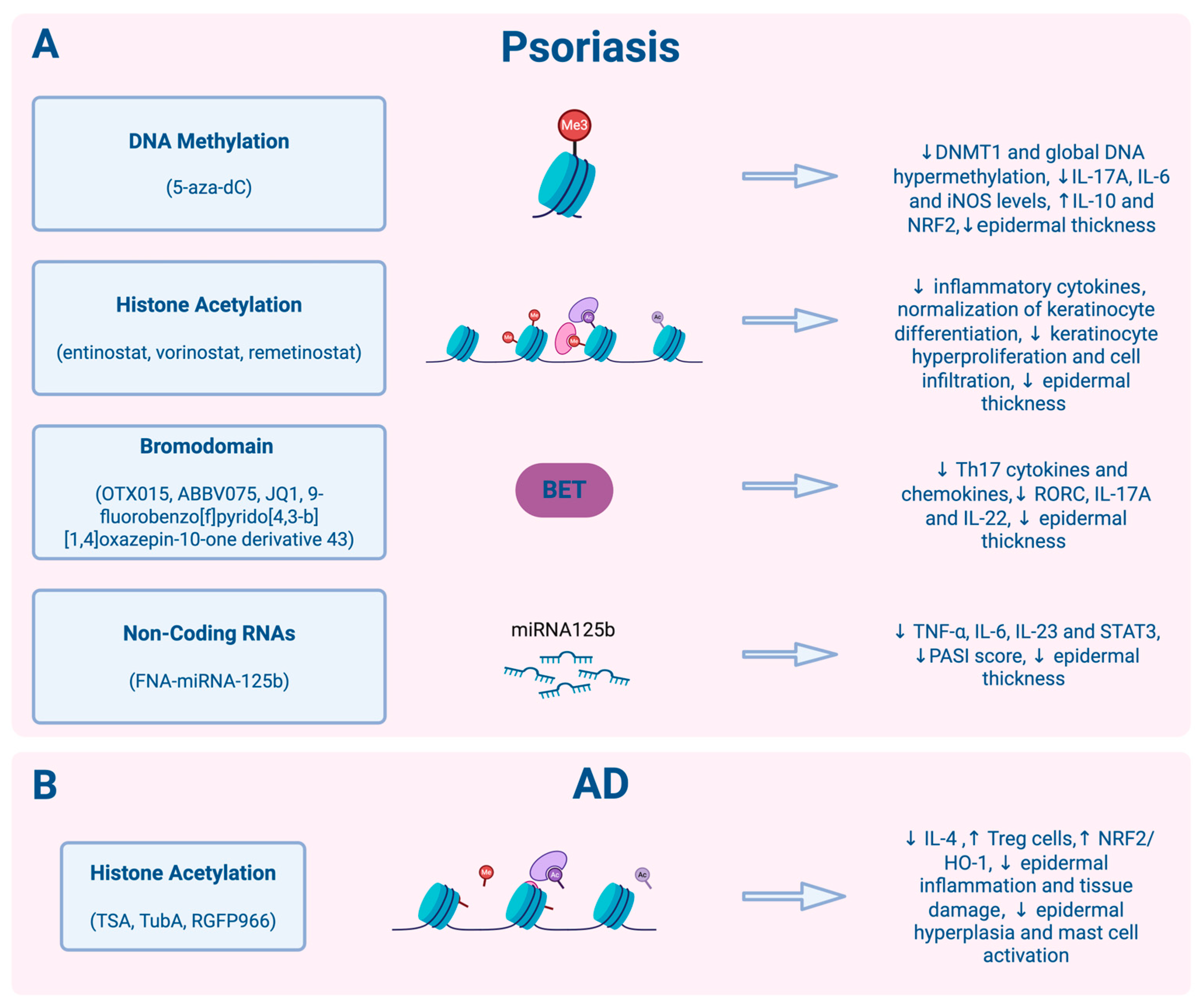
| Psoriasis | In vivo | IMQ mouse model | DNA methylation | DNMTs | ↓ | 5-aza-dC | Decreased DNMT1 expression and global DNA methylation; reversed DEHP-induced epigenetic and inflammatory alterations; downregulated IL-17A, IL-6 and iNOS; upregulated IL-10 and NRF2; reduced epidermal thickness | [47] |
| Psoriasis | In vivo | IMQ mouse model | Histone modifications | BRDs | ↓ | JQ1 | Attenuated Th17 signature cytokines; suppressed RORC, IL-17A, and IL-22; reduced psoriasiform inflammation. | [90] |
| Psoriasis | In vitro; in vivo | HaCaT and U-937; IMQ mouse model | Histone modifications | BRDs | ↓ | OTX015; ABBV075 | Reduced inflammatory gene expression; decreased IMQ-induced psoriasiform dermatitis in vivo. | [108] |
| Psoriasis | In vivo | IMQ mouse model | Histone modifications | BRDs | ↓ | 9-fluorobenzo[f]pyrido [4,3-b][1,4]oxazepin-10-one derivative 43 | Dose-dependent improvement in ear thickness; efficacy in the IMQ-induced psoriasis murine model. | [91] |
| Psoriasis | In vitro; in vivo | Primary human keratinocytes; psoriasis-like human skin xenografts on beige-SCID mice | Histone modifications | HDACs | ↓ | Vorinostat | Reduced keratinocyte hyperproliferation; promoted keratinocyte apoptosis and differentiation; alleviated psoriasiform pathology in the mouse model. | [109] |
| Psoriasis | In vitro; in vivo | Human CD4+ T cell, murine T cells, and NHEK; IMQ mouse model | Histone modifications | HDACs | ↓ | Entinostat | Attenuated psoriatic inflammation; Reduced IL-17A+ γδT cell infiltration; suppressed Th17 cell generation and psoriasis-related inflammatory mediator expression. | [110] |
| Psoriasis | In vitro in vivo | HaCaT and C57BL/6 male bone marrow cells; IMQ mouse model | Histone modifications | HDACs | ↓ | Remetinostat | Improved IMQ-induced psoriasiform dermatitis by suppressing dendritic cell maturation; reduced inflammatory cytokine expression; and normalized keratinocyte differentiation | [83] |
| Psoriasis | In vitro; in vivo | HaCaT IMQ mouse model | Non-coding RNAs | miRNAs | ↑ | FNA-miR-125b | Suppressed proliferation of HaCaT; decreased TNF-α, IL-6, IL-23, and STAT3 expression; reduced epidermal thickness and PASI score. | [112] |
| AD | In vivo | DNFB-induced NC/Nga mice | Histone modifications | HDACs | ↓ | TSA | Inhibited AD-like dermatitis; decreased IL-4 production; expansion of Treg cells. | [118] |
| AD | In vitro; in vivo | TNF-α/IFN-γ-treated HaCaT and Jurkat T cells; DNCB-induced BALB/c mice | Histone modifications | HDACs | ↓ | RGFP966 | Upregulated NRF2/HO-1 signaling pathway; Reduced inflammation, immune dysfunction, and tissue damage. | [119] |
| AD | In vitro; in vivo | DNCB-treated HaCaT, NC/Nga murine dermal fibroblasts, and cutaneous mast cells; DNCB-induced NC/Nga mice; Oxazolone-induced SKH-1 mice | Histone modifications | HDACs | ↓ | TubA | Negative impact on the elevated release of histamine and serum prostaglandin E2 levels; Blocked epithelial hyperplasia and mast cell activation; Improved clinical symptoms. | [84] |
| SSc | In vitro | Normal and SSc human dermal fibroblasts | Histone modifications | HDACs | ↓ | TSA; siRNA | TSA mainly targeted HDAC3 and HDAC7 and suppressed collagen gene expression; selective silencing of HDAC7 by siRNA offers a more targeted antifibrotic strategy. | [137] |
| SSc | In vitro; in vivo | Human dermal fibroblasts and endothelial cells; bleomycin-induced C57BL/6 mice | Histone modifications | EZH2 | ↓ | DZNep | Decreased profibrotic transcripts and cellular migration; restored normal angiogenic responses; attenuated skin thickening. | [138] |
| SSc | In vitro; ex vivo | Control-patient dermal fibroblasts and skin explants | Histone modifications | BRDs | ↓ | JQ1 | Suppressed TGFB2 expression; reversed profibrotic gene expression programs. | [139] |
Disclaimer/Publisher’s Note: The statements, opinions and data contained in all publications are solely those of the individual author(s) and contributor(s) and not of MDPI and/or the editor(s). MDPI and/or the editor(s) disclaim responsibility for any injury to people or property resulting from any ideas, methods, instructions or products referred to in the content. |
© 2026 by the authors. Licensee MDPI, Basel, Switzerland. This article is an open access article distributed under the terms and conditions of the Creative Commons Attribution (CC BY) license.
Share and Cite
Makridou, A.; Elemes, D.I.; Liakou, M.E.; Theotokis, P.; Gargani, S.; Vakirlis, E.; Meditskou, S.; Onoufriadis, A.; Manthou, M.E.; Dermitzakis, I. Epigenetic Therapies for Inflammatory and Immune-Mediated Skin Diseases. Biomedicines 2026, 14, 373. https://doi.org/10.3390/biomedicines14020373
Makridou A, Elemes DI, Liakou ME, Theotokis P, Gargani S, Vakirlis E, Meditskou S, Onoufriadis A, Manthou ME, Dermitzakis I. Epigenetic Therapies for Inflammatory and Immune-Mediated Skin Diseases. Biomedicines. 2026; 14(2):373. https://doi.org/10.3390/biomedicines14020373
Chicago/Turabian StyleMakridou, Anna, Dimitrios Iason Elemes, Maria Elpida Liakou, Paschalis Theotokis, Sofia Gargani, Efstratios Vakirlis, Soultana Meditskou, Alexandros Onoufriadis, Maria Eleni Manthou, and Iasonas Dermitzakis. 2026. "Epigenetic Therapies for Inflammatory and Immune-Mediated Skin Diseases" Biomedicines 14, no. 2: 373. https://doi.org/10.3390/biomedicines14020373
APA StyleMakridou, A., Elemes, D. I., Liakou, M. E., Theotokis, P., Gargani, S., Vakirlis, E., Meditskou, S., Onoufriadis, A., Manthou, M. E., & Dermitzakis, I. (2026). Epigenetic Therapies for Inflammatory and Immune-Mediated Skin Diseases. Biomedicines, 14(2), 373. https://doi.org/10.3390/biomedicines14020373