An Improved Microaneurysms Detection for Diabetic Retinopathy Screening Using YOLO



Abstract
1. Introduction
2. Related Work

| Version | Proposed Year | Architecture/ Key Features | Performance/Strength | Limitations |
|---|---|---|---|---|
| YOLOv1 | 2015 | Divides image into an S × S grid; single-stage detection with 24 convolutional and 2 fully connected layers; trained on ImageNet | Real-time detection capability with simple end-to-end training | Limited accuracy for small and overlapping objects; coarse localisation |
| YOLOv2 | 2016/2017 | Introduced anchor boxes, batch normalisation, residual networks, and fine-tuning with 448 × 448 images | Improved accuracy and speed; better handling of multiple objects | Still struggles with small-scale objects and complex backgrounds |
| YOLOv3 | 2018 | Based on Darknet-53; employs multi-scale detection at three levels using nine anchor boxes | Higher precision and robustness; better detection across object sizes | Computationally heavier; slower than lightweight successors |
| YOLOv4 | 2020 | Uses CSPDarknet53 backbone, spatial pyramid pooling, and cross-stage partial connections | Achieved 43.5% AP on MS COCO; real-time detection at 62 FPS (608 × 608) | Complex training pipeline; large model size |
| YOLOv5 | 2020 | Lightweight PyTorch-based model; supports GIoU loss and binary cross-entropy for class probability | Fast inference, highly customisable, and efficient for deployment | Proprietary at first; lacks official paper and transparency issues |
| YOLOv6 | 2022 | Introduced EfficientRep Backbone, Rep-PAN Neck, and decoupled head; anchor-free training with SimOTA and SIoU loss | Hardware-optimised; enhanced accuracy-speed balance | Less effective for dense object scenarios |
| YOLOv7 | 2022 | Incorporates E-ELAN for efficient gradient flow; optimised for memory and computational efficiency | Strong performance with reduced training time; supports Roboflow dataset integration | Slightly slower than YOLOv8; limited scalability for very large datasets |
| YOLOv8 | 2023 | Anchor-free design; scale-aware training with mosaic augmentation; refined loss (VFL + DFL + CIOU) | Excellent generalisation and multi-class detection; developer-friendly | High memory demand during training; reduced interpretability |
| YOLOv9 | 2024 | Programmable Gradient Information framework; enhanced feature extraction and transformer integration | Outperforms YOLOv5-v8 on MS COCO with higher mAP | Increased architectural complexity; training resource-intensive |
| YOLOv10 | 2024 | Hardware-efficient design with fewer parameters; real-time edge AI optimisation | Lower latency and smaller model size; 46% less latency vs. YOLOv9-C | Limited open-source ecosystem; trade-off between compression and accuracy |
| YOLOv11 | 2024 | Multi-task architecture for detection, segmentation, classification, keypoints, and OBB; modular scaling from YOLOv11n to YOLOv11x | Achieves up to 54.7% mAP on COCO; strong multi-domain capability | Large variants are computationally demanding |
| YOLOv12 | 2025 | Attention-centric real-time architecture; refined backbone for contextual feature learning | Higher mAP and lower latency on COCO; state-of-the-art performance | Recently released-limited empirical validation beyond COCO |
| Author [Ref.] | Type of Detection | YOLO Model Used | YOLO Performance |
|---|---|---|---|
| Sait [3] | Diabetic retinopathy (DR) | YOLOv7 | Achieve 98.0% and 98.4% accuracy with F1-scores of 93.7 and 93.1 on APTOS and EyePACS datasets, respectively; reduced computational complexity with fewer FLOPs and parameters |
| Akella and Kumar [4] | DR | YOLOv3 | Demonstrated high precision and sensitivity with superior accuracy and reduced implementation time compared with prior models |
| Moya-Albor et al. [5] | DR | YOLOv8 | Maintained consistent DR grading accuracy on both original and watermarked fundus images, confirming model robustness and diagnostic reliability |
| Lalitha and Padyana [7] | DR | YOLO-RF (YOLO integrated with Random Forest) | Achieved 99.3% accuracy, precision of 97.2, and recall of 99.1 on Kaggle and IDRiD datasets; outperformed traditional machine learning classifiers |
| Alyoubi et al. [43] | DR and lesions | YOLOv3 (with CNN fusion) | Combined CNN512 and YOLOv3 achieved 89% accuracy, 89% sensitivity, and 97.3% specificity; outperformed existing DR detection systems |
| Kumar and Dhanalakshmi [8] | Cataract, glaucoma, retinal disease, normal | EYE-YOLO (enhanced Tiny YOLOv7) | Attained 30.81% higher mAP and up to 28% higher precision than Tiny YOLOv7; exceeded YOLOv5–v8 variants in all metrics |
| Ramesh et al. [6] | Microaneurysms, haemorrahages, exudates | YOLOv5 | Accuracy improved from 79.5% to 91%, with sensitivity of 100%; effectively identified multiple lesion types using confocal true-colour fundus images |
| Zhang et al. [39] | Microaneurysms | MA-YOLO (YOLOv8 + SwinIR) | Achieved precision 97.98%, recall 88.23%, F1-score 92.85%, and AP 94.62%, surpassed YOLOv5, YOLOv7, YOLOX, SSD, and RetinaNet |
| Santos et al. [40] | Microaneurysms, exudates, haemorrhages | YOLOv5 | Recorded mAP of 0.263 (validation) and 0.154 (test) on DDR dataset; demonstrated improved lesion detection compared with prior studies despite challenges in small-object recognition |
| Akut [44] | Microaneurysms | YOLO-based object detection model | Integrated microaneurysms detection and localisation in a single framework, automating both diagnostic stages for early DR identification |
3. Materials and Methods
3.1. Materials
3.1.1. Datasets
3.1.2. Implementation
3.2. Methods
3.2.1. Image Pre-Processing
3.2.2. Image Processing
3.2.3. Post-Processing
3.2.4. Training
4. Results
5. Discussion
6. Conclusions
Author Contributions
Funding
Institutional Review Board Statement
Informed Consent Statement
Data Availability Statement
Acknowledgments
Conflicts of Interest
References
- Mohd Imtiaz, N. Diabetic Retinopathy—Advancement in Understanding the Pathophysiology and Management Strategies; IntechOpen: London, UK, 2024; pp. 3–29. [Google Scholar]
- Rahim, S.S. Automated Screening and Classification of Diabetic Retinopathy Eye Fundus Images. Ph.D. Thesis, Coventry University, Coventry, UK, 2016. [Google Scholar]
- Sait, A.R. A Lightweight Diabetic Retinopathy Detection Model Using a Deep-Learning Technique. Diagnostics 2023, 13, 3120. [Google Scholar] [CrossRef]
- Akella, P.L.; Kumar, R. An advanced deep learning method to detect and classify diabetic retinopathy based on color fundus images. Graefe’s Arch. Clin. Exp. Ophthalmol. 2024, 262, 231–247. [Google Scholar] [CrossRef]
- Moya-Albor, E.; Gomez-Coronel, S.L.; Brieva, J.; Lopez-Figueroa, A. Bio-Inspired Watermarking Method for Authentication of Fundus Images in Computer-Aided Diagnosis of Retinopathy. Mathematics 2024, 12, 734. [Google Scholar] [CrossRef]
- Ramesh, P.; Ramesh, S.; Subramanian, T.; Ray, P.; Devadas, A.; Ansar, S.; Rajasekaran, R.; Parthasarathi, S. Customised artificial intelligence toolbox for detecting diabetic retinopathy with confocal truecolor fundus images using object detection methods. TNOA J. Ophthalmic Sci. Res. 2023, 61, 57–66. [Google Scholar] [CrossRef]
- Lalitha, R.; Ajith, P. Detection of Diabetic Retinopathy in Retinal Fundus Image Using YOLO-RF Model. In Proceedings of the 2021 Sixth International Conference on Image Information Processing (ICIIP), Shimla, India, 26-28 November 2021. [Google Scholar] [CrossRef]
- Kumar, A.; Dhanalakshmi, R. EYE-YOLO: A multi-spatial pyramid pooling and Focal-EIOU loss inspired tiny YOLOv7 for fundus eye disease detection. Int. J. Intell. Comput. Cybern. 2024, 17, 503–522. [Google Scholar] [CrossRef]
- Neri, G.; Sharma, S.; Ghezzo, B.; Novarese, C.; Olivieri, C.; Tibaldi, D.; Marolo, P.; Russakoff, D.B.; Oakley, J.D.; Reilbaldi, M.; et al. Deep learning model for automatic detection of different types of microaneurysms in diabetic retinopathy. Eye 2025, 39, 570–577. [Google Scholar] [CrossRef] [PubMed]
- Wang, Z.; Li, X.; Yao, M.; Li, J.; Jiang, Q.; Yan, B. A new detection model of microaneurysms based on improved FC-DenseNet. Sci. Rep. 2022, 12, 950. [Google Scholar] [CrossRef]
- Chudzik, P.; Majumdar, S.; Caliva, F.; Al-Diri, B.; Hunter, A. Microaneurysm detection using deep learning and interleaved freezing. Proc. SPIE Med. Imaging Image Process. 2018, 10574, 379–387. [Google Scholar]
- Hatanaka, Y.; Ogohara, K.; Sunayama, W.; Miyashita, M.; Muramatsu, C.; Fujita, H. Automatic microaneurysms detection on retinal images using deep convolution neural network. In Proceedings of the International Workshop on Advanced Image Technology (IWAIT), Chiang Mai, Thailand, 7–9 January 2018; pp. 1–2. [Google Scholar]
- Dai, L.; Fang, R.; Li, H.; Hou, X.; Sheng, B.; Wu, Q.; Jia, W. Clinical report guided retinal microaneurysm detection with multi-sieving deep learning. IEEE Trans. Med. Imaging 2018, 37, 1149–1161. [Google Scholar] [CrossRef] [PubMed]
- Harangi, B.; Toth, J.; Hajdu, A. Fusion of deep convolutional neural networks for microaneurysm detection in color fundus images. In Proceedings of the 40th Annual International Conference of the IEEE Engineering in Medicine and Biology Society (EMBC), Honolulu, HI, USA, 17–21 July 2018. [Google Scholar]
- Shan, J.; Li, L. A deep learning method for microaneurysm detection in fundus images. In Proceedings of the 2016 IEEE First International Conference on Connected Health: Applications, Systems and Engineering Technologies (CHASE), Washington, DC, USA, 27–29 June 2016. [Google Scholar]
- Haloi, M. Improved Microaneurysm Detection Using Deep Neural Network. 2016. Available online: https://arxiv.org/pdf/1505.04424.pdf (accessed on 1 November 2025).
- Mohanty, C.; Mahapatra, S.; Acharya, B.; Kokkoras, F.; Gerogiannis, V.C.; Karamitsos, I.; Kanavos, A. Using Deep Learning Architectures for Detection and Classification of Diabetic Retinopathy. Sensors 2023, 23, 5726. [Google Scholar] [CrossRef]
- Bhulakshmi, D.; Rajput, D.S. A systematic review on diabetic retinopathy detection and classification based on deep learning techniques using fundus images. PeerJ Comput. Sci. 2024, 10, e1947. [Google Scholar] [CrossRef] [PubMed]
- Upreti, K.; Kapoor, A.; Hundekari, S.; Upreti, S.; Kaul, K.; Kapoor, S.; Tiwari, A. Deep Dive Into Diabetic Retinopathy Identification: A Deep Learning Approach with Blood Vessel Segmentation and Lesion Detection. J. Mob. Multimed. 2024, 20, 495–524. [Google Scholar] [CrossRef]
- Siyah, Y.; Minaoui, K.; Biach, F.Z.; Saoudi, S. Early Detection and Classification of Diabetic Retinopathy through Analysis of Retinal Medical Images Using Deep Learning. In Proceedings of the 2024 IEEE 12th International Symposium on Signal, Image, Video and Communications (ISIVC), Marrakech, Morocco, 21–23 May 2024. [Google Scholar] [CrossRef]
- Emmales, M.; Jemili, F.; Korbaa, O.; Kamel, F. A Deep Learning System for Early Detection of Diabetic Retinopathy. In Proceedings of the 2024 IEEE/ACS 21st International Conference on Computer Systems and Applications (AICCSA), Sousse, Tunisia, 22–26 October 2024. [Google Scholar] [CrossRef]
- Shinde, K.D.; Wankhade, N.R. Deep learning-based detection of diabetic retinopathy using retina images. Int. J. Adv. Res. Sci. Commun. Technol. (IJARSCT) 2024, 4, 146–152. [Google Scholar] [CrossRef]
- Tomy, M.C.; Malathy, C. Optimizing Diabetic Retinopathy Detection with Advanced SMOTE-based Data Augmentation. In Proceedings of the 2024 IEEE International Conference on Signal Processing, Informatics, Communication and Energy Systems (SPICES), Kottayam, India, 20–22 September 2024. [Google Scholar] [CrossRef]
- Nigam, P.; Jain, A.; Sharma, S. GAN-based data augmentation with recurrent residual U—Net for exudate segmentation in diabetic retinopathy. In Proceedings of the 3rd International Conference on Disruptive Technologies (ICDT), Greater Noida, India, 7–8 March 2025. [Google Scholar] [CrossRef]
- Khan, M.H.-M.; Mungloo-Dilmohamud, Z.; Jhumka, K.N.; Mungloo, Z.; Peña-Reyes, C. Investigating on Data Augmentation and Generative Adversarial Networks (GANs) for Diabetic Retinopathy. In Proceedings of the 2022 International Conference on Electrical, Computer, Communications and Mechatronics Engineering (ICECCME), Maldives, 16–18 November 2022. [Google Scholar] [CrossRef]
- Beniwal, R.; Dubey, S.; Gupta, S.; Gakhar, S. Early Diabetic Retinopathy Detection using Data Augmentation Techniques and DenseNet—121. In Proceedings of the 2023 5th International Conference on Advances in Computing, Communication Control and Networking (ICAC3N), Greater Noida, India, 15–16 December 2023. [Google Scholar] [CrossRef]
- Rao, B.; Kumar, K.; Penubaka, R.; Reddy, K.; Bandela, H.B.; Supriya, L. Deep Learning for Diabetic Retinopathy: A SqueezeNet-Based Approach with Data Augmentation for Enhanced Detection. In Proceedings of the 2025 International Conference on Visual Analytics and Data Visualization (ICVADV), Tirunelveli, India, 4–6 March 2025. [Google Scholar] [CrossRef]
- Suedumrong, C.; Phongmoo, S.; Akarajaka, T.; Leksakul, K. Diabetic Retinopathy Detection Using Convolutional Neural Networks with Background Removal, and Data Augmentation. Appl. Sci. 2024, 14, 8823. [Google Scholar] [CrossRef]
- Farahat, Z.; Zrira, N.; Souissi, N.; Rahim, S.; Rahim, A.; Belmekki, M.; Ngote, N.; Megdiche, K. Diabetic Retinopathy Detection Through Retinal Vessel Segmentation Using Swin U-Net Model. In Proceedings of the 2024 IEEE Thirteenth International Conference on Image Processing Theory, Tools and Applications (IPTA), Rabat, Morocco, 14–17 October 2024. [Google Scholar] [CrossRef]
- Rahim, S.S.; Palade, V.; Shuttleworth, J.; Jayne, C.; Raja Omar, R.N. Automatic detection of microaneurysms for diabetic retinopathy screening using fuzzy image processing. In Engineering Applications of Neural Networks; Illiadis, L., Jayne, C., Eds.; Communications in Computer and Information Science; Springer: Cham, Switzerland, 2015; Volume 517, pp. 69–79. [Google Scholar]
- Rahim, S.S.; Palade, V.; Almakky, I.; Holzinger, A. Fuzzy image processing and deep learning for microaneurysms detection. In Artificial Intelligence and Machine Learning for Digital Pathology; Holzinger, A., Goebel, R., Mengel, M., Muller, H., Eds.; Springer: Cham, Switzerland, 2020; Volume 12090, pp. 321–339. [Google Scholar]
- Redmon, J.; Divvala, S.; Girshick, R.; Farhadi, A. You Only Look Once: Unified, Real-Time Object Detection. In Proceedings of the 2016 IEEE Conference on Computer Vision and Pattern Recognition (CVPR), Las Vegas, NV, USA, 27–30 June 2016. [Google Scholar] [CrossRef]
- Roboflow. Available online: https://blog.roboflow.com/guide-to-yolo-models/ (accessed on 31 October 2025).
- Zhang, Y.; Zhang, Y.; Li, T.; Shi, M.; Huang, Y. Analysis of a Multimodal Ocular Ultrasound Image Classification Algorithm Based on YOLO and VanillaNet. IEEE Access 2025, 13, 148374–148383. [Google Scholar] [CrossRef]
- Ardelean, A.I.; Ardelean, E.R.; Marginean, A. Can YOLO Detect Retinal Pathologies? A Step Towards Automated OCT Analysis. Diagnostics 2025, 15, 1823. [Google Scholar] [CrossRef]
- Veena, K.M.; Tummala, V.; Sangaraju, Y.S.V.; Reddy, M.S.V.; Kumar, P.; Mayya, V.; Kulkarni, U.; Bhandary, S.; Shailaja, S. FFA-Lens: Lesion detection tool for chronic ocular diseases in Fluorescein angiography images. SoftwareX 2025, 26, 101646. [Google Scholar] [CrossRef]
- Rizzieri, N.; Dall’Asta, L.; Ozoliņš, M. Myopia Detection from Eye Fundus Images: New Screening Method Based on You Only Look Once Version 8. Appl. Sci. 2024, 14, 11926. [Google Scholar] [CrossRef]
- Hussein, Z.J.; Al-Saadi, E.H. The Optic Disc Detection and Segmentation in Retinal Fundus Images Utilizing You Only Look Once (YOLO) Method. Int. J. Comput. Digit. Syst. (Jāmiʻat Al-Baḥrayn. Markaz Al-Nashr Al-ʻIlmī) 2024, 16, 509–528. [Google Scholar] [CrossRef]
- Zhang, B.; Li, J.; Bai, Y.; Jiang, Q.; Yan, B.; Wang, Z. An Improved Microaneurysm Detection Model Based on SwinIR and YOLOv8. Bioengineering 2023, 10, 1405. [Google Scholar] [CrossRef]
- Santos, C.; Aguiar, M.; Welfer, D.; Belloni, B. A New Approach for Detecting Fundus Lesions Using Image Processing and Deep Neural Network Architecture Based on YOLO Model. Sensors 2022, 22, 6441. [Google Scholar] [CrossRef]
- Li, T.; Gao, Y.Q.; Wang, K.; Guo, S.; Liu, H.; Kang, H. Diagnostic Assessment of Deep Learning Algorithms for Diabetic Retinopathy Screening. Inf. Sci. 2019, 501, 511–522. [Google Scholar] [CrossRef]
- Porwal, P.; Samiksha, P.; Ravi, K.; Manesh, K.; Girish, D.; Vivek, S.; Fabrice, M. Indian Diabetic Retinopathy Image Dataset (IDRiD). IEEE Dataport 2018. [Google Scholar] [CrossRef]
- Alyoubi, W.L.; Abulkhair, M.F.; Shalash, W.M. Diabetic Retinopathy Fundus Image Classification and Lesions Localization System Using Deep Learning. Sensors 2021, 21, 3704. [Google Scholar] [CrossRef] [PubMed]
- Akut, R.R. FILM: Finding the location of microaneurysms on the retina. Biomed. Eng. Lett. 2019, 9, 497–506. [Google Scholar] [CrossRef] [PubMed]
- Wang, S.; Xu, G. Deep Learning: From Algorithmic Essence to Industrial Practice; Elsevier Inc.: Amsterdam, The Netherlands, 2025; pp. 100–101. Available online: https://www.perlego.com/book/5199165/deep-learning-from-algorithmic-essence-to-industrial-practice-pdf (accessed on 1 November 2025).
- Yan, W.Q. Computational Methods for Deep Learning: Theory, Algorithms, and Implementations, 2nd ed.; Springer International Publishing: Singapore, 2023; pp. 76–80. [Google Scholar]
- Niemeijer, M.; van Ginnerken, B.; Cree, M.J.; Mizutani, A.; Quellec, G.; Sanchez, C.I.; Zhang, B.; Hornero, R.; Lamard, M.; Muramatsu, C.; et al. Retinopathy Online Challenge: Automatic detection of microaneurysms in digital color fundus photographs. IEEE Trans. Med. Imaging 2010, 29, 185–195. [Google Scholar] [CrossRef]


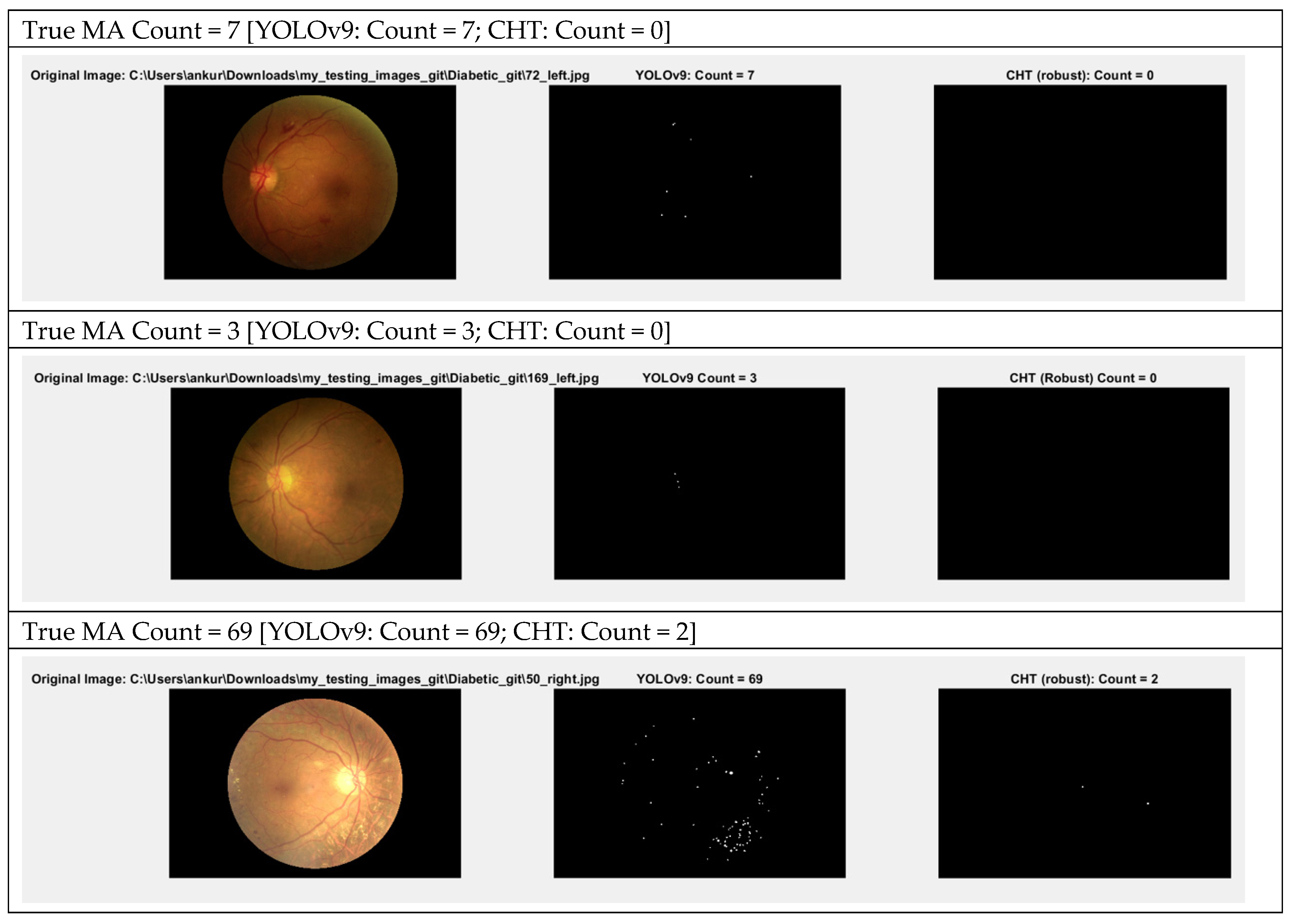
| Criterion/Metric | System I: CHT-Based Pipeline | System II: YOLOv9-Based Pipeline | |
|---|---|---|---|
| Pre-processing | Detection Method | Circular Hough Transform (geometry-based) | CNN-based object detection (YOLOv9) |
| Input Requirement | Preprocessed binary candidate map | Raw or preprocessed retinal image (RGB/tiles) | |
| Image processing | Sensitivity (Recall) | 0.65–0.72 | 0.83–0.88 |
| Specificity (Precision) | 0.60–0.68 | 0.82–0.87 | |
| F1-score | 0.62–0.70 | 0.82–0.87 | |
| Accuracy for 200 images [5% tolerance] | 56% | 91% | |
| Mean Average Precision (mAP) | 45% | 89.55% | |
| Infrastructure | Computation Time | ~2–5 s per image (CPU) | ~50–200 ms per tile (GPU) |
| Object Size Handling | Limited to circular blobs, radius 5–25 px | Detects small, irregular lesions down to ~3–5 px | |
| Post-processing Load | High (masking, thresholding, radius filtering) | Moderate (confidence filtering, NMS) |
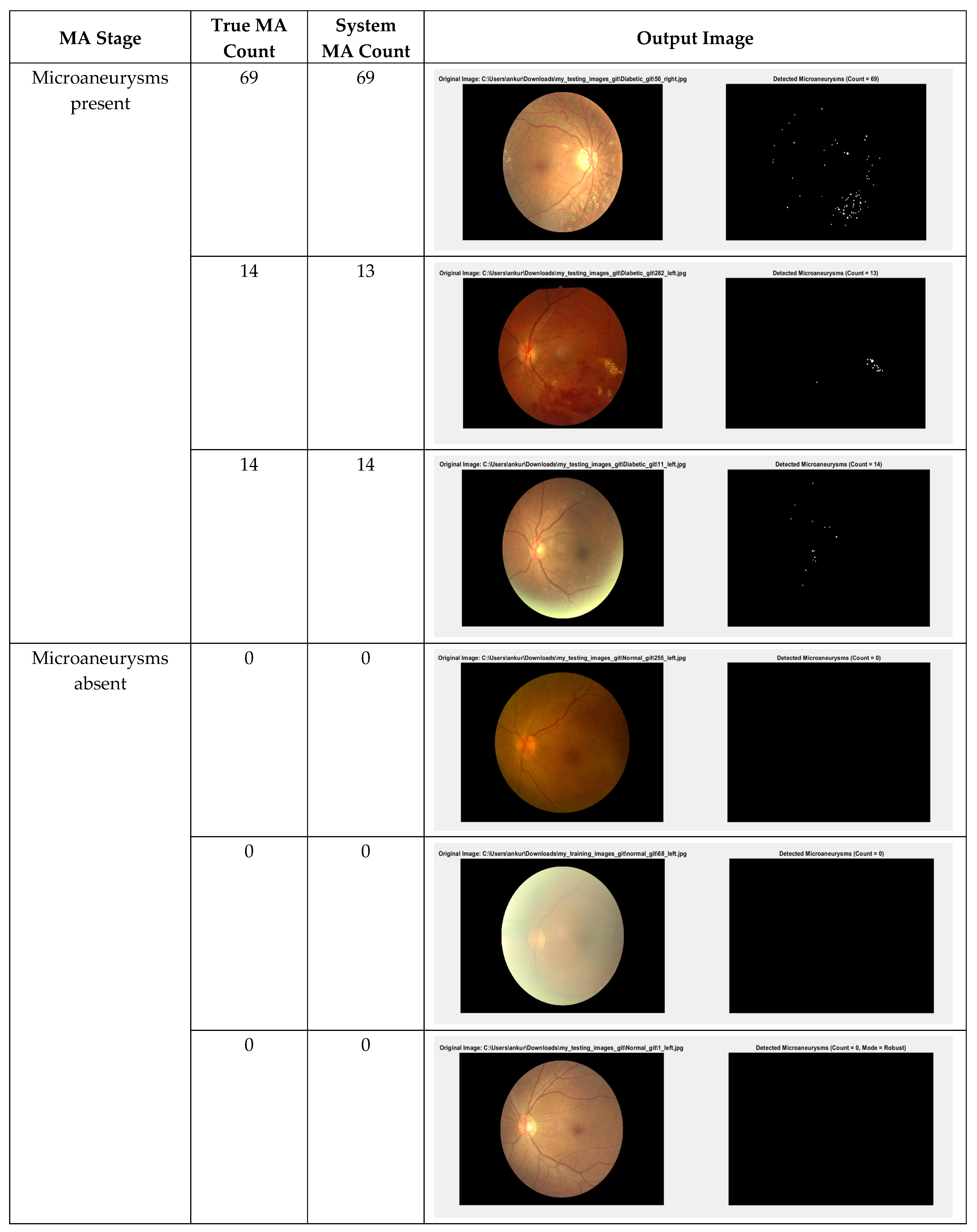
| Image Name (True MA Count) | System I: Detected by CHT | System II: Detected by YOLOv9 |
|---|---|---|
| 45_right (63) | 55 | 62 |
| 51_left (27) | 32 | 27 |
| 52_right (41) | 38 | 41 |
| 53_left (12) | 15 | 12 |
| 54_right (8) | 11 | 8 |
| 55_left (35) | 30 | 34 |
| 56_right (22) | 18 | 22 |
| 57_left (17) | 20 | 17 |
| 58_right (48) | 42 | 48 |
| 59_left (5) | 4 | 5 |
Disclaimer/Publisher’s Note: The statements, opinions and data contained in all publications are solely those of the individual author(s) and contributor(s) and not of MDPI and/or the editor(s). MDPI and/or the editor(s) disclaim responsibility for any injury to people or property resulting from any ideas, methods, instructions or products referred to in the content. |
© 2026 by the authors. Licensee MDPI, Basel, Switzerland. This article is an open access article distributed under the terms and conditions of the Creative Commons Attribution (CC BY) license.
Share and Cite
Rahim, S.S.; Deo, A.; Mumtaz, R.; Palade, V. An Improved Microaneurysms Detection for Diabetic Retinopathy Screening Using YOLO. Biomedicines 2026, 14, 359. https://doi.org/10.3390/biomedicines14020359
Rahim SS, Deo A, Mumtaz R, Palade V. An Improved Microaneurysms Detection for Diabetic Retinopathy Screening Using YOLO. Biomedicines. 2026; 14(2):359. https://doi.org/10.3390/biomedicines14020359
Chicago/Turabian StyleRahim, Sarni Suhaila, Ankur Deo, Rafia Mumtaz, and Vasile Palade. 2026. "An Improved Microaneurysms Detection for Diabetic Retinopathy Screening Using YOLO" Biomedicines 14, no. 2: 359. https://doi.org/10.3390/biomedicines14020359
APA StyleRahim, S. S., Deo, A., Mumtaz, R., & Palade, V. (2026). An Improved Microaneurysms Detection for Diabetic Retinopathy Screening Using YOLO. Biomedicines, 14(2), 359. https://doi.org/10.3390/biomedicines14020359