Radiation-Induced Neurodegeneration


Abstract
1. Introduction
- (1)
- Acute (within six weeks post-treatment);
- (2)
- Subacute (between six weeks and six months);
- (3)
2. Mechanisms of Radiation-Induced Brain Damage
- ‑
- Metabolic Signaling: Microbial-derived short-chain fatty acids (SCFAs) typically maintain the BBB integrity. However, recent models of radiation injury show that specific SCFA treatments may paradoxically aggravate neuroinflammation, suggesting that precise dosing or specific metabolite balances are required for neuroprotection [38,39].
- ‑
- Immune Activation: Dysbiosis activates Toll-like receptors (TLRs) and the NF-κB signaling pathway in the gut, which can trigger systemic inflammation and the subsequent activation of microglia in the brain, leading to cognitive decline.
- ‑
2.1. Vascular Damage
- ‑
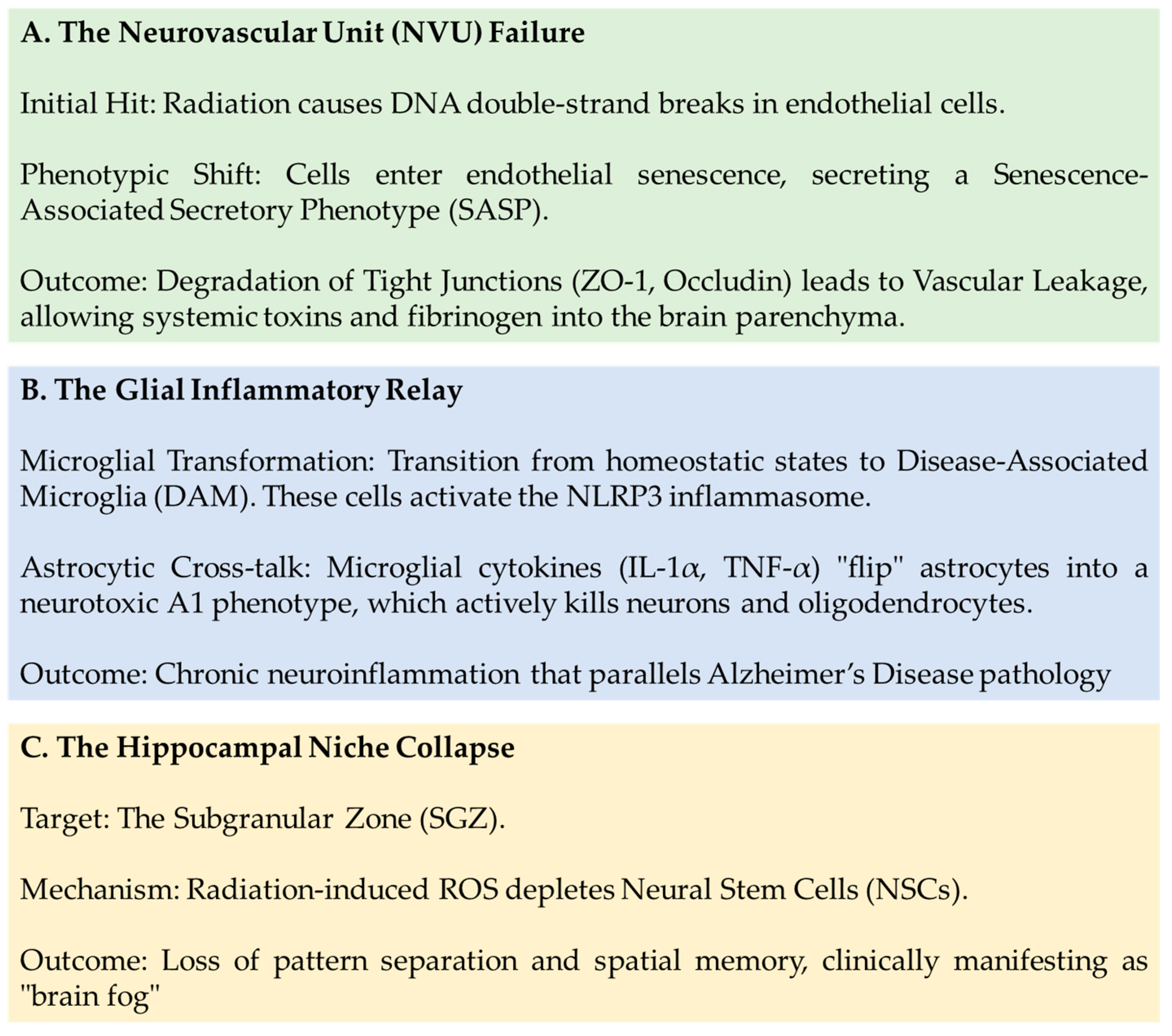
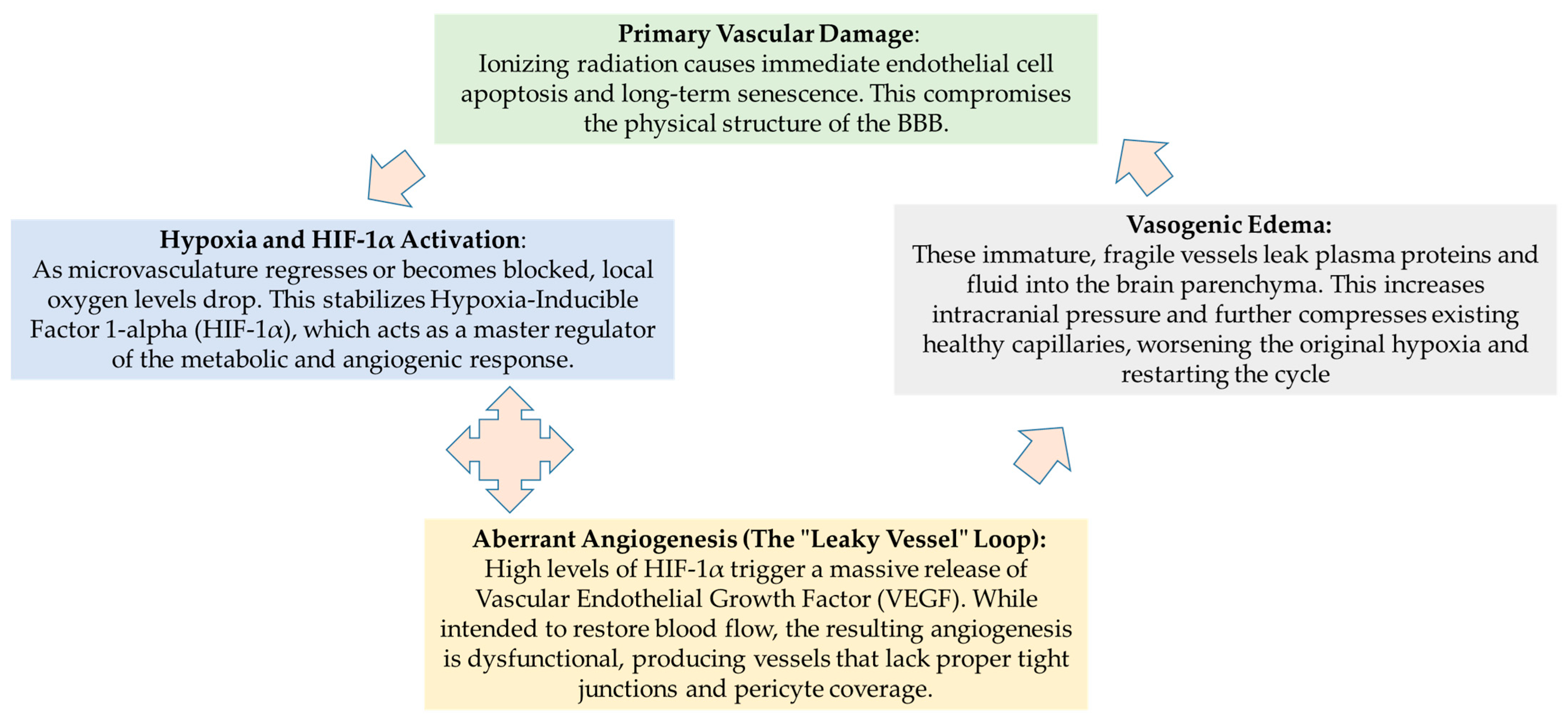
- Acute Phase (<24 h): Radiation triggers immediate endothelial cell apoptosis, particularly in the highly sensitive capillary beds. This creates physical gaps in the BBB, leading to transient leakage.
- ‑
- Late-Delayed Phase (Months to Years): Chronic leakage is driven by endothelial senescence and “sterile inflammation”. Senescent cells remain in the vasculature, secreting a Senescence-Associated Secretory Phenotype (SASP) that continuously degrades tight junction proteins like ZO-1 and VE-cadherin [78,79,80,81].
- ‑
- Radiation-induced oxidative stress damages mitochondrial membranes within endothelial cells and microglia.
- ‑
- Escaped mtDNA activates the cGAS-STING pathway, which triggers a massive type I interferon response.
- ‑
- ‑
- Vasogenic Edema: Plasma proteins extravasate into the brain parenchyma, increasing intracranial pressure and causing white matter necrosis.
- ‑
- Neurotoxic Influx: Leakage allows systemic neurotoxic agents and inflammatory cells (M1 macrophages) to enter the brain, further activating resident microglia.
- ‑
- HIF-1α and Aberrant Angiogenesis: Tissue hypoxia triggers HIF-1α, which stimulates the secretion of VEGF. This results in “fragile” neovascularization—newly formed vessels that are inherently leaky, creating a feedback loop of edema and ischemia.
2.2. Aberrant Activation or Damage of Glial Cells
- Beyond M1/M2: Disease-Associated Microglia (DAM)
- ‑
- Persistent Priming: Radiotherapy induces “innate immune reprogramming,” making microglia more susceptible to secondary systemic challenges long after the initial exposure.
- ‑
- Rod-Shaped Microglia: this specific morphology is a direct response to cortical hyperactivity, where they interact with neuronal dendrites to modulate synaptic inputs—a potentially neuroprotective but fragile state.
- ‑
- 2.
- ‑
- Glycolytic Switch: Upon irradiation, microglia shift from efficient oxidative phosphorylation to rapid aerobic glycolysis. This shift provides the quick energy needed for the production of pro-inflammatory cytokines and reactive oxygen species (ROS) but at the cost of long-term mitochondrial health.
- ‑
- 3.
- Chronic Neuroinflammation and Neurogenesis
- ‑
- Inhibition of Neurogenesis: Chronically activated microglia in the hippocampus release factors that specifically inhibit the maturation of neural progenitor cells, directly linking microglial transformation to the cognitive decline seen in head and neck cancer patients after radiotherapy.
- ‑
- Early Phase: Focuses on Radioprotectors to prevent initial endothelial and glial apoptosis.
- Late Phase: Focuses on Senolytics (drugs that clear senescent cells) and A1-Inhibitors to revert astrocytes to a pro-healing (A2) state.
2.3. Loss of Hippocampal Neurogenesis
2.4. Radiation-Induced Aging
2.5. Neurogenesis Dysfunction
3. Radiation-Induced Neurodegeneration
3.1. Radiation Induced Cognitive Decline
- Neurogenesis:
- ○
- Neurogenesis, the process of generating new neurons, is crucial for maintaining brain function and occurs primarily in the hippocampus and lateral ventricles. Ionizing radiation has been shown to reduce neurogenesis, particularly in the hippocampus. This reduction is thought to result from radiation directing neural progenitors to differentiate into astrocytes instead of neurons, making it difficult for the brain to replace damaged neurons [107,205].
- Oxidative Stress and Neuroinflammation:
- ○
- RT induces oxidative stress characterized by an increased production of ROS, which can overwhelm cellular repair mechanisms. Antioxidants, such as nigella sativa oil and thymoquinone, have been shown to mitigate this oxidative damage following radiation exposure [206].
- ○
- The radiation-induced increase in free radicals can activate inflammatory pathways, leading to neuroinflammation, particularly in the hippocampus, where microglial activation occurs. This inflammation creates a feedback loop that can inhibit neurogenesis and exacerbate cognitive decline [170].
- Dendritic Structure Alterations:
- ○
- Dendrites are critical for synaptic function, and alterations in their structure can significantly affect cognitive abilities. Radiation exposure can lead to changes in dendritic spine density and morphology, affecting synaptic communication. Studies have shown that radiation increases dendritic spine density, which may lead to excitotoxicity through enhanced glutamate signaling [207].
- Vascular Effects:
- ○
- RT can cause vascular damage, including endothelial cell death and thrombus formation, leading to complications such as microangiopathy and ischemia. These vascular changes can result in excitotoxicity due to increased extracellular glutamate levels, further compromising cognitive function [208].
- Stem Cell Therapy:
- ○
- Anti-Inflammatory Agents:
- ○
- Memantine:
- ○
- As a noncompetitive NMDA receptor antagonist, memantine is used to prevent RICD by inhibiting excessive glutamate binding, thus reducing excitotoxicity. Clinical studies have shown that memantine can improve cognitive function in patients receiving whole-brain radiation therapy [212,213,214,215,216].
- Cyclooxygenase-2 (COX-2) Inhibitors and Erythropoietin (EPO):
- ○
- Cognitive Training and Memory Strategies:
- ○
- Cognitive interventions and memory strategies have shown efficacy in improving cognitive function in cancer survivors. Programs focusing on executive function and memory can provide significant benefits, particularly in younger patients [217].
- Proton Therapy:
- ○
- Proton therapy offers a precise radiation treatment option that minimizes damage to surrounding healthy tissue. Studies have suggested that it can prevent cognitive decline associated with traditional radiation therapy [217].
- Vascular-Glial Crosstalk: Damage to the microvasculature (endothelial cells) causes BBB breakdown, allowing peripheral immune cells to infiltrate the brain. This infiltration, combined with the release of cytokines (e.g., IL-1beta, TNF-alpha) from activated microglia, promotes chronic inflammation.
- Neuroinflammation & Structural Damage: Activated microglia/astrocytes (gliosis) and vascular dysfunction work together to inhibit neurogenesis in the hippocampus and destroy white matter. This reduces the brain’s capacity for repair, leading to diminished memory and executive function [220].
- Chronic Oxidative Stress: Both vascular injury and glial dysfunction enhance the production of ROS, causing a sustained, damaging, and inflammatory microenvironment.
- ▪
- Neurofilament Light (NFL) and T-tau: Elevated levels were observed after PCI, indicating neuronal injury. NFL increased by 120% and T-tau by 50% in patients without metastases at 3 months post-PCI.
- ▪
- Amyloid Precursor Proteins: Levels of secreted amyloid precursor proteins (sAPPa and sAPPb) decreased significantly (44% and 46%, respectively) after PCI and continued to decline for a year.
- ▪
- Neuroglial Markers: YKL-40 and glial fibrillary acidic protein (GFAP) levels increased significantly after treatment, suggesting neuroglial activation.
- ▪
- Cognitive Function: Despite detectable neurochemical changes, the MMSE did not indicate cognitive decline, suggesting that more sensitive cognitive assessments are needed.
- ▪
- Age: Older age (>60 years) was consistently linked to higher cognitive decline risk.
- ▪
- PCI Dose: Higher doses (e.g., 36 Gy) correlated with increased cognitive impairment.
- ▪
- Treatment Regimen: Twice-daily PCI was associated with greater cognitive decline.
- ▪
- Timing of Assessment: Neurocognitive function assessments varied widely, leading to inconsistent data quality.
- The Hippocampal Neurogenic Niche Collapse
- ‑
- Acute Depletion: Within 24–48 h of irradiation, there is a massive wave of apoptosis among proliferating neuroblasts.
- ‑
- Microenvironmental Shift: Long-term, the niche transforms from a pro-neurogenic environment to an inflammatory one. Activated microglia release IL-6 and TNF-α, which actively suppress the differentiation of remaining stem cells into functional neurons, forcing them instead toward a gliogenic (astrocyte-forming) fate [211].
- 2.
- Behavioral Manifestations: From Models to Humans
- 3.
- Molecular Link: The VEGF-BDNF Deficit
- ‑
- Because radiation causes vascular leakage (as discussed previously), the delivery of systemic BDNF (Brain-Derived Neurotrophic Factor) and VEGF to the hippocampus is disrupted.
- ‑
- Without these trophic supports, new neurons fail to integrate into existing circuits (synaptogenesis), leading to the “shrunken” hippocampal volume frequently seen on high-resolution 7T MRI in post-radiation patients [225].
- 4.
- Therapeutic Interventions
- ‑
- Physical Exercise & Environmental Enrichment: Current protocols emphasize aerobic exercise, which is proven to upregulate endogenous BDNF, partially restoring neurogenesis even after moderate radiation doses [225].
- ‑
- Pharmacological Rescuers: Trials are currently evaluating PPARδ agonists to mitigate the microglial inflammation that halts neurogenesis, aiming to preserve spatial memory during cranial radiotherapy.
3.2. Role of Ionizing Radiation in Alzheimer’s Disease
- The “Dual-Hit” Hypothesis: Amyloid and Tau
- ‑
- Seeding of Amyloid-β (Aβ): Radiation-induced vascular leakage impairs the glymphatic system and the BBB, reducing the clearance of Aβ. This leads to accelerated plaque deposition. In fact, radiation-induced damage to the Glymphatic System reduces Aβ clearance by 40% within six months of treatment [66].
- ‑
- Tau Phosphorylation: The chronic oxidative stress following irradiation activates kinases (such as GSK-3β) that drive the hyperphosphorylation of tau proteins. “Radiation-Induced Tauopathy” has been identified as a distinct phenomenon where glia-driven inflammation spreads misfolded tau across distal brain regions [240].
- 2.
- Microglial Priming and AD Progression
- ‑
- Loss of Homeostasis: Radiation forces microglia into a Disease-Associated Microglia (DAM) phenotype prematurely. These cells lose their ability to phagocytize (clear) Aβ plaques, instead releasing pro-inflammatory cytokines like IL-1β and TNF-α.
- ‑
- Inflammasome Activation: Radiation triggers the NLRP3 inflammasome in microglia. This not only causes direct neuronal damage but also acts as a “scaffold” that promotes the aggregation of Aβ, effectively bridging the gap between radiation injury and Alzheimer’s progression.
- 3.
- Astrocyte Transformation and White Matter Loss
- 4.
- Vascular “Double-Jeopardy”
- ‑
- Cerebral Amyloid Angiopathy (CAA): Radiation-damaged vessels are more susceptible to Aβ deposition. This weakens the vessel walls further, leading to microhemorrhages and localized ischemia, which are hallmark features of both advanced AD and late-stage radiation necrosis.
- ‑
- Reduced Neurogenic Reserve: The inflammation in the hippocampal niche post-radiation destroys the progenitor cells required for memory formation, leaving the brain with zero “reserve” to combat the cognitive decline caused by AD-related atrophy.
- 5.
- Clinical Implications
- ‑
- Pre-Symptomatic Screening: Patients undergoing cranial irradiation are now being screened for p-tau217 and other blood-based AD biomarkers to identify those at high risk for accelerated neurodegeneration.
- ‑
- Targeted Anti-Inflammatories: Trials are investigating whether senolytic therapies (e.g., Dasatinib + Quercetin) can clear the senescent glia that drive both radiation damage and Alzheimer’s, potentially slowing the transition from cancer treatment to dementia [70].
3.3. Role of Ionizing Radiation in Amyotrophic Lateral Sclerosis
3.4. Role of Ionizing Radiation in Parkinson’s Disease
3.5. Preventive Strategies Related to Neurodegeneration
- Technical and Dosimetric Challenges
- ‑
- Dose Fall-off Constraints: To effectively spare the subgranular zone, the dose must drop significantly over a few millimeters. In patients with tumors proximal to the temporal lobes, maintaining the therapeutic dose to the tumor while keeping the hippocampal dose below the 2026 safety threshold (typically D100% < 9 Gy) is often mathematically impossible.
- ‑
- Contouring Variability: Even with AI-auto-segmentation tools, the hippocampus is a small, complex structure. Variability in manual or semi-automated contouring can lead to “geographic miss,” where the most sensitive neurogenic regions are inadvertently irradiated.
- 2.
- Patient-Specific Biological Factors
- ‑
- The “Seed and Soil” Risk: There is a persistent clinical fear of peri-hippocampal recurrence. In 2025, approximately 5–8% of patients receiving HA-WBRT showed brain metastases within the 5 mm “avoidance zone,” raising concerns that sparing the “soil” (hippocampus) also spares the “seeds” (cancer cells).
- ‑
- Baseline Cognitive Reserve: Patients with pre-existing vascular disease or early stage Alzheimer’s (confirmed via 2026 p-tau217 blood tests) may not benefit from HA. If the neurogenic niche is already compromised by age or systemic inflammation, the “sparing” of the hippocampus yields negligible cognitive gains [276].
- 3.
- Anatomical Limitations
- ‑
- Brain Shift and Deformation: Throughout a 3-week course of radiation, the brain’s anatomy can change due to tumor shrinkage or steroid-induced changes in edema. Standard rigid masks may not account for these sub-millimeter shifts, potentially moving the hippocampus back into the high-dose zone [277].
- ‑
- Surgical Cavities: If a patient has had a prior resection of a tumor near the hippocampus, the anatomical distortion makes precise sparing technically unreliable [278].
- ‑
- Adaptive Radiotherapy (ART): Utilizing daily Online-CT or MR-Linac imaging to re-plan the dose distribution in real-time, accounting for daily anatomical shifts.
- ‑
- Proton Therapy: Increasing use of Proton Beam Therapy to leverage the Bragg Peak, allowing for a near-zero “exit dose” through the hippocampus compared to traditional X-rays.
- Pharmacological Niche Stabilizers
- ‑
- PPAR-δ Agonists (e.g., GW501516): Phase II trials in 2025 are evaluating these agents for their ability to suppress microglial activation specifically within the subgranular zone, thereby preventing the “gliogenic shift” where stem cells erroneously turn into astrocytes instead of neurons [279].
- ‑
- Senolytics (D + Q Therapy): A major multi-center trial is testing the combination of Dasatinib and Quercetin to clear senescent endothelial cells and glia from the hippocampal niche immediately following radiotherapy. The goal is to prevent the “Senescence-Associated Secretory Phenotype” (SASP) from poisoning the local environment for new neurons [280].
- 2.
- Regenerative Medicine and “Niche Seeding”
- ‑
- Exosome-Based Therapies: Preclinical studies are using stem-cell-derived extracellular vesicles (EVs). These EVs are delivered intranasally to bypass the BBB, providing neurotrophic factors like BDNF and GDNF directly to the hippocampus to “jumpstart” neurogenesis [281].
- ‑
- Human Neural Stem Cell (hNSC) Transplantation: While still in early-phase safety trials, researchers are investigating the transplantation of hNSCs into the hippocampal fimbria. In models, these cells have shown the ability to migrate into the irradiated dentate gyrus and restore spatial memory.
- 3.
- Neuromodulation and Behavioral Synergy [282]
- ‑
- Non-Invasive Brain Stimulation (NIBS): Trials using Transcurrent Magnetic Stimulation (TMS) focused on the hippocampal-cortical network are being used alongside HA-WBRT. The goal is to provide “electrical enrichment” that encourages newly formed neurons to survive and wire into functional circuits.
- ‑
- Digital Therapeutics: Integrated protocols now combine radiation with “Cognitive Priming” apps, which use specific spatial-navigation tasks to stimulate the Vascular-Neurogenic Niche during the window of highest plasticity.
- ‑
- Physical Sparing (Hippocampal Avoidance);
- ‑
- Chemical Shielding (PPAR-δ or Senolytics);
- ‑
- Active Recovery (Exercise and BDNF-mimetics).
- ‑
- Metabolic Modulators: Drugs like Metformin or Idebenone are being tested to force microglia back into an oxidative phosphorylation state, thereby restoring their homeostatic, neuroprotective functions.
- ‑
- TREM2 Modulation: Since TREM2 is central to the transition into a protective phagocytic state, agonists are being investigated to enhance the clearance of radiation-induced cellular debris without triggering a cytokine storm.
- ‑
- Anti-VEGF Therapy: Bevacizumab remains a primary treatment for radiation necrosis by reducing vessel fenestrations and permeability.
- ‑
- STING Inhibitors: New nanodrugs (e.g., Pep-Cu5.4O@H151) target the cGAS-STING pathway to block the inflammatory cascade at the source of mtDNA leakage.
- ‑
- Mitochondrial Protectants: Pre-treatment with agents like Idebenone has shown promise in 2025–2026 models for maintaining endothelial health and preventing barrier compromise.
- Fecal Microbiota Transplantation (FMT): clinical and preclinical trials have shown that FMT can significantly restore gut permeability and improve cognitive performance following cranial radiotherapy.
- Engineered Probiotics: New efforts involve genetically modifying strains like E. coli Nissle 1917 to produce barrier-enhancing metabolites like succinate, specifically to minimize radiation-induced syndrome and secondary neurodegeneration.
- Dietary and Prebiotic Interventions: High-fiber diets and specific prebiotics are being studied for their ability to promote “radioprotective” species like Lachnospiraceae, which produce anti-inflammatory metabolites that mitigate the gut-liver-brain axis inflammatory response.
- Depletion Strategies: Interestingly, some studies suggest that temporary depletion of gut flora (via antibiotics) immediately after irradiation may act as a “protective modulator,” suppressing the production of pro-inflammatory factors that drive brain injury.
4. IR as Treatment for Neurodegenerative Diseases
5. Conclusions
Author Contributions
Funding
Institutional Review Board Statement
Informed Consent Statement
Data Availability Statement
Conflicts of Interest
References
- Vogelbaum, M.A.; Brown, P.D.; Messersmith, H.; Brastianos, P.K.; Burri, S.; Cahill, D.; Dunn, I.F.; Gaspar, L.E.; Gatson, N.T.N.; Gondi, V.; et al. Treatment for Brain Metastases: ASCO-SNO-ASTRO Guideline. J. Clin. Oncol. 2022, 40, 492–516. [Google Scholar] [CrossRef] [PubMed]
- Sun, M.Z.; Oh, T.; Ivan, M.E.; Clark, A.J.; Safaee, M.; Sayegh, E.T.; Kaur, G.; Parsa, A.T.; Bloch, O. Survival impact of time to initiation of chemoradiotherapy after resection of newly diagnosed glioblastoma. J. Neurosurg. 2015, 122, 1144–1150. [Google Scholar] [CrossRef]
- Zhang, K.; Zhang, T.; Guo, Z.; Zhao, F.; Li, J.; Li, Y.; Li, Y.; Wu, X.; Chen, X.; Zhang, W.; et al. Adding simultaneous integrated boost to whole brain radiation therapy improved intracranial tumour control and minimize radiation-induced brain injury risk for the treatment of brain metastases. BMC Cancer 2023, 23, 1240. [Google Scholar] [CrossRef] [PubMed]
- Gaebe, K.; Li, A.Y.; Park, A.; Parmar, A.; Lok, B.H.; Sahgal, A.; Chan, K.K.W.; Erickson, A.W.; Das, S. Stereotactic radiosurgery versus whole brain radiotherapy in patients with intracranial metastatic disease and small-cell lung cancer: A systematic review and meta-analysis. Lancet Oncol. 2022, 23, 931–939. [Google Scholar] [CrossRef]
- Gondi, V.; Bauman, G.; Bradfield, L.; Burri, S.H.; Cabrera, A.R.; Cunningham, D.A.; Eaton, B.R.; Hattangadi-Gluth, J.A.; Kim, M.M.; Kotecha, R.; et al. Radiation Therapy for Brain Metastases: An ASTRO Clinical Practice Guideline. Pract. Radiat. Oncol. 2022, 12, 265–282. [Google Scholar] [CrossRef] [PubMed]
- Li, Z.; Shen, D.; Zhang, J.; Zhang, J.; Yang, F.; Kong, D.; Kong, J.; Zhang, A. Relationship between WBRT total dose, intracranial tumor control, and overall survival in NSCLC patients with brain metastases—A single-center retrospective analysis. BMC Cancer 2019, 19, 1104. [Google Scholar] [CrossRef]
- Li, J.; Bentzen, S.M.; Renschler, M.; Mehta, M.P. Regression after whole-brain radiation therapy for brain metastases correlates with survival and improved neurocognitive function. J. Clin. Oncol. 2007, 25, 1260–1266. [Google Scholar] [CrossRef]
- Soffietti, R.; Abacioglu, U.; Baumert, B.; Combs, S.E.; Kinhult, S.; Kros, J.M.; Marosi, C.; Metellus, P.; Radbruch, A.; Villa Freixa, S.S.; et al. Diagnosis and treatment of brain metastases from solid tumors: Guidelines from the European Association of Neuro-Oncology (EANO). Neuro-Oncology 2017, 19, 162–174. [Google Scholar] [CrossRef]
- Crossen, J.R.; Garwood, D.; Glatstein, E.; Neuwelt, E.A. Neurobehavioral sequelae of cranial irradiation in adults: A review of radiation-induced encephalopathy. J. Clin. Oncol. 1994, 12, 627–642. [Google Scholar] [CrossRef]
- Dropcho, E.J. Neurotoxicity of radiation therapy. Neurol. Clin. 2010, 28, 217–234. [Google Scholar] [CrossRef]
- Mantovani, C.; Gastino, A.; Cerrato, M.; Badellino, S.; Ricardi, U.; Levis, M. Modern Radiation Therapy for the Management of Brain Metastases from Non-Small Cell Lung Cancer: Current Approaches and Future Directions. Front. Oncol. 2021, 11, 772789. [Google Scholar] [CrossRef]
- Goetz, P.; Ebinu, J.O.; Roberge, D.; Zadeh, G. Current standards in the management of cerebral metastases. Int. J. Surg. Oncol. 2012, 2012, 493426. [Google Scholar] [CrossRef][Green Version]
- Lehrer, E.J.; Jones, B.M.; Dickstein, D.R.; Green, S.; Germano, I.M.; Palmer, J.D.; Laack, N.; Brown, P.D.; Gondi, V.; Wefel, J.S.; et al. The Cognitive Effects of Radiotherapy for Brain Metastases. Front. Oncol. 2022, 12, 893264. [Google Scholar] [CrossRef]
- Benkhaled, S.; Schiappacasse, L.; Awde, A.; Kinj, R. Stereotactic Radiosurgery and Stereotactic Fractionated Radiotherapy in the Management of Brain Metastases. Cancers 2024, 16, 1093. [Google Scholar] [CrossRef]
- Ahmadsei, M.; Christ, S.M.; Seiler, A.; Vlaskou Badra, E.; Willmann, J.; Hertler, C.; Guckenberger, M. Quality-of-life and toxicity in cancer patients treated with multiple courses of radiation therapy. Clin. Transl. Radiat. Oncol. 2022, 34, 23–29. [Google Scholar] [CrossRef] [PubMed]
- Rübe, C.E.; Raid, S.; Palm, J.; Rübe, C. Radiation-Induced Brain Injury: Age Dependency of Neurocognitive Dysfunction Following Radiotherapy. Cancers 2023, 15, 2999. [Google Scholar] [CrossRef]
- Valiente, M.; Ahluwalia, M.S.; Boire, A.; Brastianos, P.K.; Goldberg, S.B.; Lee, E.Q.; Le Rhun, E.; Preusser, M.; Winkler, F.; Soffietti, R. The Evolving Landscape of Brain Metastasis. Trends Cancer 2018, 4, 176–196. [Google Scholar] [CrossRef]
- Genc, S.; Pennisi, M.; Yeni, Y.; Yildirim, S.; Gattuso, G.; Altinoz, M.A.; Taghizadehghalehjoughi, A.; Bolat, I.; Tsatsakis, A.; Hacımüftüoğlu, A.; et al. Potential Neurotoxic Effects of Glioblastoma-Derived Exosomes in Primary Cultures of Cerebellar Neurons via Oxidant Stress and Glutathione Depletion. Antioxidants 2022, 11, 1225. [Google Scholar] [CrossRef]
- McGranahan, T.; Li, G.; Nagpal, S. History and current state of immunotherapy in glioma and brain metastasis. Ther. Adv. Med. Oncol. 2017, 9, 347–368. [Google Scholar] [CrossRef]
- Mitchell, D.K.; Kwon, H.J.; Kubica, P.A.; Huff, W.X.; O’Regan, R.; Dey, M. Brain metastases: An update on the multi-disciplinary approach of clinical management. Neurochirurgie 2022, 68, 69–85. [Google Scholar] [CrossRef]
- Bou Dargham, T.; Winter, S.F.; Batich, K.; Gehring, K.; Parsons, M.W.; Dietrich, J.; Mullikin, T.; Reitman, Z.J.; Floyd, S.R.; Kirkpatrick, J.P.; et al. Neurocognitive outcomes in patients with brain metastases: A systematic review. Lancet Oncol. 2025, 26, e671–e682. [Google Scholar] [CrossRef]
- Buckingham, S.C.; Campbell, S.L.; Haas, B.R.; Montana, V.; Robel, S.; Ogunrinu, T.; Sontheimer, H. Glutamate release by primary brain tumors induces epileptic activity. Nat. Med. 2011, 17, 1269–1274. [Google Scholar] [CrossRef]
- Coleman, C.N.; Stone, H.B.; Moulder, J.E.; Pellmar, T.C. Medicine. Modulation of radiation injury. Science 2004, 304, 693–694. [Google Scholar] [CrossRef] [PubMed]
- Lampert, P.W.; Davis, R.L. Delayed Effects of Radiation on the Human Central Nervous System; “Early” and “Late” Delayed Reactions. Neurology 1964, 14, 912–917. [Google Scholar] [CrossRef] [PubMed]
- Martino, A.; Krainik, A.; Pasteris, C.; Hoffmann, D.; Chabardes, S.; Berger, F.; Le Bas, J.F.; Cantin, S.; Attye, A.; Grand, S. Neurological imaging of brain damages after radiotherapy and/or chimiotherapy. J. Neuroradiol. 2014, 41, 52–70. [Google Scholar] [CrossRef]
- Lumniczky, K.; Szatmari, T.; Safrany, G. Ionizing Radiation-Induced Immune and Inflammatory Reactions in the Brain. Front. Immunol. 2017, 8, 517. [Google Scholar] [CrossRef]
- Shaaban, S.G.; LeCompte, M.C.; Kleinberg, L.R.; Redmond, K.J.; Page, B.R. Recognition and Management of the Long-term Effects of Cranial Radiation. Curr. Treat. Options Oncol. 2023, 24, 880–891. [Google Scholar] [CrossRef]
- Ayoub, R.; Ruddy, R.M.; Cox, E.; Oyefiade, A.; Derkach, D.; Laughlin, S.; Ades-Aron, B.; Shirzadi, Z.; Fieremans, E.; Mac-Intosh, B.J.; et al. Assessment of cognitive and neural recovery in survivors of pediatric brain tumors in a pilot clinical trial using metformin. Nat. Med. 2020, 26, 1285–1294. [Google Scholar] [CrossRef]
- Zhao, X.; Cheng, J.; Gui, S.; Jiang, M.; Qi, D.; Huang, J.; Fu, L.; Liu, S.; Ma, Y.; Shi, J.; et al. Amifostine-Loaded Nanocarrier Traverses the Blood-Brain Barrier and Prevents Radiation-Induced Brain Injury. ACS Appl. Mater. Interfaces 2023, 15, 15203–15219. [Google Scholar] [CrossRef]
- Zhou, H.; Sun, F.; Ou, M.; Zhang, Y.; Lin, M.; Song, L.; Yu, Y.; Liao, H.; Fan, W.; Xing, H.; et al. Prior nasal delivery of antagomiR-122 prevents radiation-induced brain injury. Mol. Ther. 2021, 29, 3465–3483. [Google Scholar] [CrossRef]
- Dietrich, J.; Baryawno, N.; Nayyar, N.; Valtis, Y.K.; Yang, B.; Ly, I.; Besnard, A.; Severe, N.; Gustafsson, K.U.; Androne-si, O.C.; et al. Bone marrow drives central nervous system regeneration after radiation injury. J. Clin. Investig. 2018, 128, 281–293. [Google Scholar] [CrossRef]
- Makale, M.T.; McDonald, C.R.; Hattangadi-Gluth, J.A.; Kesari, S. Mechanisms of radiotherapy-associated cognitive disability in patients with brain tumours. Nat. Rev. Neurol. 2017, 13, 52–64. [Google Scholar] [CrossRef] [PubMed]
- Sukati, S.; Ho, J.; Chaiswing, L.; Sompol, P.; Pandit, H.; Wei, W.; Izumi, T.; Chen, Q.; Weiss, H.; Noel, T.; et al. Extracellular vesicles released after cranial radiation: An insight into an early mechanism of brain injury. Brain Res. 2022, 1782, 147840. [Google Scholar] [CrossRef]
- Gan, C.; Li, W.; Xu, J.; Pang, L.; Tang, L.; Yu, S.; Li, A.; Ge, H.; Huang, R.; Cheng, H. Advances in the study of the molecular biological mechanisms of radiation-induced brain injury. Am. J. Cancer Res. 2023, 13, 3275–3299. [Google Scholar] [PubMed]
- Das, T.K.; Ganesh, B.P. Interlink between the gut microbiota and inflammation in the context of oxidative stress in Alzheimer’s disease progression. Gut Microbes 2023, 15, 2206504. [Google Scholar] [CrossRef]
- Wang, Q.; Luo, Y.; Ray Chaudhuri, K.; Reynolds, R.; Tan, E.K.; Pettersson, S. The role of gut dysbiosis in Parkinson’s disease: Mechanistic insights and therapeutic options. Brain 2021, 144, 2571–2593. [Google Scholar] [CrossRef] [PubMed]
- Yang, Y.; Stewart, T.; Zhang, C.; Wang, P.; Xu, Z.; Jin, J.; Huang, Y.; Liu, Z.; Lan, G.; Liang, X.; et al. Erythrocytic alpha-Synuclein and the Gut Microbiome: Kindling of the Gut-Brain Axis in Parkinson’s Disease. Mov. Disord. 2023, 39, 40–52. [Google Scholar] [CrossRef]
- Li, L.; Yang, Z.; Yi, Y.; Song, Y.; Zhang, W. Gut microbiota and radiation-induced injury: Mechanistic insights and microbial therapies. Gut Microbes 2025, 17, 2528429. [Google Scholar] [CrossRef]
- Chen, C.; Wang, G.Q.; Li, D.D.; Zhang, F. Microbiota-gut-brain axis in neurodegenerative diseases: Molecular mechanisms and therapeutic targets. Mol. Biomed. 2025, 6, 64. [Google Scholar] [CrossRef]
- Kearns, R. Gut-Brain Axis and Neuroinflammation: The Role of Gut Permeability and the Kynurenine Pathway in Neurological Disorders. Cell Mol. Neurobiol. 2024, 44, 64. [Google Scholar] [CrossRef]
- Luo, N.; Zhu, W.; Li, X.; Fu, M.; Peng, X.; Yang, F.; Zhang, Y.; Yin, H.; Yang, C.; Zhao, J.; et al. Impact of Gut Microbiota on Radiation-Associated Cognitive Dysfunction and Neuroinflammation in Mice. Radiat. Res. 2022, 197, 350–364. [Google Scholar] [CrossRef]
- Stolzer, I.; Scherer, E.; Süß, P.; Rothhammer, V.; Winner, B.; Neurath, M.F.; Günther, C. Impact of Microbiome-Brain Communication on Neuroinflammation and Neurodegeneration. Int. J. Mol. Sci. 2023, 24, 14925. [Google Scholar] [CrossRef]
- Colaco, R.J.; Martin, P.; Kluger, H.M.; Yu, J.B.; Chiang, V.L. Does immunotherapy increase the rate of radiation necrosis after radiosurgical treatment of brain metastases? J. Neurosurg. 2016, 125, 17–23. [Google Scholar] [CrossRef]
- Li, J.; Li, W.; Xu, S.; Zhu, H. Brain injury after cranial radiotherapy combined with immunotherapy for brain metastases in lung cancer: A retrospective study. Future Oncol. 2023, 19, 947–959. [Google Scholar] [CrossRef] [PubMed]
- Yang, L.; Liu, L.; Wu, X.; Guo, X.; Yang, Y.; Wang, T. Hypofractionated radiation therapy with versus without immune checkpoint inhibitors in patients with brain metastases: A meta-analysis. Int. Immunopharmacol. 2020, 80, 106148. [Google Scholar] [CrossRef] [PubMed]
- Lehrer, E.J.; Khosla, A.A.; Ozair, A.; Gurewitz, J.; Bernstein, K.; Kondziolka, D.; Niranjan, A.; Wei, Z.; Lunsford, L.D.; Mathieu, D.; et al. Immune checkpoint inhibition and single fraction stereotactic radiosurgery in brain metastases from non-small cell lung cancer: An international multicenter study of 395 patients. J. Neurooncol. 2023, 165, 63–77. [Google Scholar] [CrossRef]
- Koide, Y.; Nagai, N.; Adachi, S.; Ito, M.; Kawamura, M.; Ito, M.; Ito, F.; Shindo, Y.; Aoyama, T.; Shimizu, H.; et al. Impact of concurrent antibody-drug conjugates and radiotherapy on symptomatic radiation necrosis in breast cancer patients with brain metastases: A multicenter retrospective study. J. Neurooncol. 2024, 168, 415–423. [Google Scholar] [CrossRef] [PubMed]
- Hall, J.; Wang, K.; Lui, K.P.; Darawsheh, R.; Shumway, J.W.; Carey, L.A.; Hayes, K.R.; Lee, C.B.; Moschos, S.; Sengupta, S.; et al. Safety and Efficacy of Stereotactic Radiosurgery with Concurrent Targeted Systemic Therapy for Brain Metastases. Int. J. Radiat. Oncol. Biol. Phys. 2023, 117, e107. [Google Scholar] [CrossRef]
- Cagney, D.N.; Martin, A.M.; Catalano, P.J.; Reitman, Z.J.; Mezochow, G.A.; Lee, E.Q.; Wen, P.Y.; Weiss, S.E.; Brown, P.D.; Ahluwalia, M.S.; et al. Impact of pemetrexed on intracranial disease control and radiation necrosis in patients with brain metastases from non-small cell lung cancer receiving stereotactic radiation. Radiother. Oncol. J. Eur. Soc. Ther. Radiol. Oncol. 2018, 126, 511–518. [Google Scholar] [CrossRef]
- Kim, J.M.; Miller, J.A.; Kotecha, R.; Xiao, R.; Juloori, A.; Ward, M.C.; Ahluwalia, M.S.; Mohammadi, A.M.; Peereboom, D.M.; Murphy, E.S.; et al. The risk of radiation necrosis following stereotactic radiosurgery with concurrent systemic therapies. J. Neurooncol. 2017, 133, 357–368. [Google Scholar] [CrossRef]
- Lawrence, Y.R.; Li, X.A.; el Naqa, I.; Hahn, C.A.; Marks, L.B.; Merchant, T.E.; Dicker, A.P. Radiation dose-volume effects in the brain. Int. J. Radiat. Oncol. Biol. Phys. 2010, 76, S20–S27. [Google Scholar] [CrossRef] [PubMed]
- Milano, M.T.; Grimm, J.; Niemierko, A.; Soltys, S.G.; Moiseenko, V.; Redmond, K.J.; Yorke, E.; Sahgal, A.; Xue, J.; Mahadevan, A.; et al. Single- and Multifraction Stereotactic Radiosurgery Dose/Volume Tolerances of the Brain. Int. J. Radiat. Oncol. Biol. Phys. 2021, 110, 68–86. [Google Scholar] [CrossRef] [PubMed]
- Kerschbaumer, J.; Demetz, M.; Krigers, A.; Nevinny-Stickel, M.; Thome, C.; Freyschlag, C.F. Risk Factors for Radiation Necrosis in Patients Undergoing Cranial Stereotactic Radiosurgery. Cancers 2021, 13, 4736. [Google Scholar] [CrossRef] [PubMed]
- You, R.; Liu, Y.P.; Xie, Y.L.; Lin, C.; Duan, C.Y.; Chen, D.P.; Pan, Y.; Qi, B.; Zou, X.; Guo, L.; et al. Hyperfractionation compared with standard fractionation in intensity-modulated radiotherapy for patients with locally advanced recurrent nasopharyngeal carcinoma: A multicentre, randomised, open-label, phase 3 trial. Lancet 2023, 401, 917–927. [Google Scholar] [CrossRef]
- Brown, P.D.; Jaeckle, K.; Ballman, K.V.; Farace, E.; Cerhan, J.H.; Anderson, S.K.; Carrero, X.W.; Barker, F.G., 2nd; Deming, R.; Burri, S.H.; et al. Effect of Radiosurgery Alone vs Radiosurgery with Whole Brain Radiation Therapy on Cognitive Function in Patients with 1 to 3 Brain Metastases: A Randomized Clinical Trial. JAMA 2016, 316, 401–409. [Google Scholar] [CrossRef]
- Valery, C.A.; Cornu, P.; Noel, G.; Duyme, M.; Boisserie, G.; Sakka, L.J.; Mazeron, J.J.; van Effenterre, R. Predictive factors of radiation necrosis after radiosurgery for cerebral metastases. Stereotact. Funct. Neurosurg. 2003, 81, 115–119. [Google Scholar] [CrossRef]
- Buatti, J.M.; Friedman, W.A.; Meeks, S.L.; Bova, F.J. RTOG 90-05: The real conclusion. Int. J. Radiat. Oncol. Biol. Phys. 2000, 47, 269–271. [Google Scholar] [CrossRef]
- Miller, J.A.; Bennett, E.E.; Xiao, R.; Kotecha, R.; Chao, S.T.; Vogelbaum, M.A.; Barnett, G.H.; Angelov, L.; Murphy, E.S.; Yu, J.S.; et al. Association Between Radiation Necrosis and Tumor Biology After Stereotactic Radiosurgery for Brain Metastasis. Int. J. Radiat. Oncol. Biol. Phys. 2016, 96, 1060–1069. [Google Scholar] [CrossRef]
- Aiyama, H.; Yamamoto, M.; Kawabe, T.; Watanabe, S.; Koiso, T.; Sato, Y.; Higuchi, Y.; Ishikawa, E.; Yamamoto, T.; Matsumura, A.; et al. Complications after stereotactic radiosurgery for brain metastases: Incidences, correlating factors, treatments and outcomes. Radiother. Oncol. J. Eur. Soc. Ther. Radiol. Oncol. 2018, 129, 364–369. [Google Scholar] [CrossRef]
- Newton, J.; Brown, T.; Corley, C.; Alexander, T.; Trujillo, M.; McElroy, T.; Ntagwabira, F.; Wang, J.; Byrum, S.D.; Allen, A.R. Cranial irradiation impairs juvenile social memory and modulates hippocampal physiology. Brain Res. 2020, 1748, 147095. [Google Scholar] [CrossRef]
- Jacobson, L.A.; Mahone, E.M.; Yeates, K.O.; Ris, M.D. Processing speed in children treated for brain tumors: Effects of radiation therapy and age. Child. Neuropsychol. 2019, 25, 217–231. [Google Scholar] [CrossRef]
- Chu, C.; Gao, Y.; Lan, X.; Lin, J.; Thomas, A.M.; Li, S. Stem-Cell Therapy as a Potential Strategy for Radiation-Induced Brain Injury. Stem Cell Rev. Rep. 2020, 16, 639–649. [Google Scholar] [CrossRef]
- Chan, M.; Ferguson, D.; Ni Mhurchu, E.; Yuan, R.; Gondara, L.; McKenzie, M.; Olson, R.; Thiessen, B.; Lalani, N.; Ma, R.; et al. Patients with pretreatment leukoencephalopathy and older patients have more cognitive decline after whole brain radiotherapy. Radiat. Oncol. 2020, 15, 271. [Google Scholar] [CrossRef]
- Wang, T.M.; Shen, G.P.; Chen, M.Y.; Zhang, J.B.; Sun, Y.; He, J.; Xue, W.Q.; Li, X.Z.; Huang, S.Y.; Zheng, X.H.; et al. Genome-Wide Association Study of Susceptibility Loci for Radiation-Induced Brain Injury. J. Natl. Cancer Inst. 2019, 111, 620–628. [Google Scholar] [CrossRef] [PubMed]
- Huntoon, K.; Anderson, S.K.; Ballman, K.V.; Twohy, E.; Dooley, K.; Jiang, W.; An, Y.; Li, J.; von Roemeling, C.; Qie, Y.; et al. Association of circulating markers with cognitive decline after radiation therapy for brain metastasis. Neuro-Oncology 2023, 25, 1123–1131. [Google Scholar] [CrossRef]
- Nakkazi, A.; Forster, D.; Whitfield, G.A.; Dyer, D.P.; Dickie, B.R. A systematic review of normal tissue neurovascular unit damage following brain irradiation—Factors affecting damage severity and timing of effects. Neuro-Oncol. Adv. 2024, 6, vdae098. [Google Scholar] [CrossRef] [PubMed]
- Li, Z.; Gong, C. NLRP3 inflammasome in Alzheimer’s disease: Molecular mechanisms and emerging therapies. Front. Immunol. 2025, 16, 1583886. [Google Scholar] [CrossRef] [PubMed]
- Takahashi, S.; Anada, M.; Kinoshita, T.; Nishide, T.; Kozai, S.; Shibata, T. Feasibility of hippocampal dose-volume parameters associated with memory decline in intensity-modulated radiotherapy for supratentorial tumors. Mol. Clin. Oncol. 2021, 14, 53. [Google Scholar] [CrossRef]
- Zhou, Y.; Glass, C.K. Microglia networks within the tapestry of alzheimer’s disease through spatial transcriptomics. Mol. Neurodegener. 2025, 20, 102. [Google Scholar] [CrossRef]
- Saliev, T.; Singh, P.B. Targeting Senescence: A Review of Senolytics and Senomorphics in Anti-Aging Interventions. Biomolecules 2025, 15, 860. [Google Scholar] [CrossRef]
- Roell, L.; Fischer, T.; Keeser, D.; Papazov, B.; Lembeck, M.; Papazova, I.; Greska, D.; Muenz, S.; Schneider-Axmann, T.; Sykorova, E.; et al. Effects of aerobic exercise on hippocampal formation volume in people with schizophrenia—A systematic review and meta-analysis with original data from a randomized-controlled trial. Psychol. Med. 2024, 54, 4009–4020. [Google Scholar] [CrossRef]
- Pena, L.A.; Fuks, Z.; Kolesnick, R.N. Radiation-induced apoptosis of endothelial cells in the murine central nervous system: Protection by fibroblast growth factor and sphingomyelinase deficiency. Cancer Res. 2000, 60, 321–327. [Google Scholar]
- Straub, J.M.; New, J.; Hamilton, C.D.; Lominska, C.; Shnayder, Y.; Thomas, S.M. Radiation-induced fibrosis: Mechanisms and implications for therapy. J. Cancer Res. Clin. Oncol. 2015, 141, 1985–1994. [Google Scholar] [CrossRef] [PubMed]
- Rodemann, H.P.; Blaese, M.A. Responses of normal cells to ionizing radiation. Semin. Radiat. Oncol. 2007, 17, 81–88. [Google Scholar] [CrossRef]
- Wang, Y.; Wu, J.; Wang, Y.; Song, W.; Ren, H.; Han, X.; Dong, X.; Guo, Z. The Pathogenesis and Prevention Strategies of Radiation-Induced Brain Injury. Cancer Manag. Res. 2025, 17, 1433–1440. [Google Scholar] [CrossRef] [PubMed]
- Li, M.; Tong, F.; Wu, B.; Dong, X. Radiation-Induced Brain Injury: Mechanistic Insights and the Promise of Gut-Brain Axis Therapies. Brain Sci. 2024, 14, 1295. [Google Scholar] [CrossRef]
- Allen, B.D.; Limoli, C.L. Breaking barriers: Neurodegenerative repercussions of radiotherapy induced damage on the blood-brain and blood-tumor barrier. Free Radic. Biol. Med. 2022, 178, 189–201. [Google Scholar] [CrossRef]
- Wang, P.; Liu, J.; Zhang, M.; Yang, J.; Lian, P.; Cheng, X.; Qin, J. Radiation Exposure Induced Blood-Brain Barrier Injury via Mitochondria-Mediated Sterile Inflammation. Adv. Sci. 2025, 12, e02356. [Google Scholar] [CrossRef]
- Che, L.; Ma, L. Radiation-induced vascular damage and aging: A review of potential therapeutic targets and key signaling path-ways. Radiat. Med. Prot. 2025, 6, 140–146. [Google Scholar] [CrossRef]
- Turnquist, C.; Harris, B.T.; Harris, C.C. Radiation-induced brain injury: Current concepts and therapeutic strategies targeting neuroinflammation. Neuro-Oncol. Adv. 2020, 2, vdaa057. [Google Scholar] [CrossRef]
- Shang, Y.; Hu, X.; Ren, M.; Ma, L.; Zhao, X.; Gao, C.; Zhang, L.; Li, S.; Liu, L.; Zou, B.; et al. Understanding the toxicity induced by radiation-triggered neuroinflammation and the on-demand design of targeted peptide nanodrugs. Signal Transduct. Target. Ther. 2025, 10, 286. [Google Scholar] [CrossRef]
- Ungvari, Z.; Podlutsky, A.; Sosnowska, D.; Tucsek, Z.; Toth, P.; Deak, F.; Gautam, T.; Csiszar, A.; Sonntag, W.E. Ionizing radiation promotes the acquisition of a senescence-associated secretory phenotype and impairs angiogenic capacity in cerebromicrovascular endothelial cells: Role of increased DNA damage and decreased DNA repair capacity in microvascular radiosensitivity. J. Gerontol. A Biol. Sci. Med. Sci. 2013, 68, 1443–1457. [Google Scholar]
- Zhang, J.; Wei, L.; Sun, W.L.; Wang, L.; Zhang, W.J.; You, H. Radiation-induced endothelial cell loss and reduction of the relative magnitude of the blood flow in the rat spinal cord. Brain Res. 2014, 1583, 193–200. [Google Scholar] [CrossRef] [PubMed]
- Rabbani, Z.N.; Mi, J.; Zhang, Y.; Delong, M.; Jackson, I.L.; Fleckenstein, K.; Salahuddin, F.K.; Zhang, X.; Clary, B.; Anscher, M.S.; et al. Hypoxia inducible factor 1alpha signaling in fractionated radiation-induced lung injury: Role of oxidative stress and tissue hypoxia. Radiat. Res. 2010, 173, 165–174. [Google Scholar] [CrossRef]
- Brown, W.R.; Thore, C.R.; Moody, D.M.; Robbins, M.E.; Wheeler, K.T. Vascular damage after fractionated whole-brain irradiation in rats. Radiat. Res. 2005, 164, 662–668. [Google Scholar] [CrossRef]
- Calvo, W.; Hopewell, J.W.; Reinhold, H.S.; Yeung, T.K. Time- and dose-related changes in the white matter of the rat brain after single doses of X rays. Br. J. Radiol. 1988, 61, 1043–1052. [Google Scholar] [CrossRef]
- Bozoyan, L.; Khlghatyan, J.; Saghatelyan, A. Astrocytes control the development of the migration-promoting vasculature scaffold in the postnatal brain via VEGF signaling. J. Neurosci. Off. J. Soc. Neurosci. 2012, 32, 1687–1704. [Google Scholar] [CrossRef] [PubMed]
- Scott, A.; Powner, M.B.; Gandhi, P.; Clarkin, C.; Gutmann, D.H.; Johnson, R.S.; Ferrara, N.; Fruttiger, M. Astrocyte-derived vascular endothelial growth factor stabilizes vessels in the developing retinal vasculature. PLoS ONE 2010, 5, e11863. [Google Scholar] [CrossRef] [PubMed]
- Liao, D.; Johnson, R.S. Hypoxia: A key regulator of angiogenesis in cancer. Cancer Metastasis Rev. 2007, 26, 281–290. [Google Scholar] [CrossRef]
- Pugh, C.W.; Ratcliffe, P.J. Regulation of angiogenesis by hypoxia: Role of the HIF system. Nat. Med. 2003, 9, 677–684. [Google Scholar] [CrossRef]
- Denko, N.C. Hypoxia, HIF1 and glucose metabolism in the solid tumour. Nat. Rev. Cancer 2008, 8, 705–713. [Google Scholar] [CrossRef]
- Prinz, M.; Masuda, T.; Wheeler, M.A.; Quintana, F.J. Microglia and Central Nervous System-Associated Macrophages-From Origin to Disease Modulation. Annu. Rev. Immunol. 2021, 39, 251–277. [Google Scholar] [CrossRef]
- Tremblay, M.E.; Lowery, R.L.; Majewska, A.K. Microglial interactions with synapses are modulated by visual experience. PLoS Biol. 2010, 8, e1000527. [Google Scholar] [CrossRef] [PubMed]
- Paolicelli, R.C.; Bolasco, G.; Pagani, F.; Maggi, L.; Scianni, M.; Panzanelli, P.; Giustetto, M.; Ferreira, T.A.; Guiducci, E.; Dumas, L.; et al. Synaptic pruning by microglia is necessary for normal brain development. Science 2011, 333, 1456–1458. [Google Scholar] [CrossRef] [PubMed]
- Kierdorf, K.; Prinz, M. Microglia in steady state. J. Clin. Investig. 2017, 127, 3201–3209. [Google Scholar] [CrossRef]
- Luo, X.G.; Chen, S.D. The changing phenotype of microglia from homeostasis to disease. Transl. Neurodegener. 2012, 1, 9. [Google Scholar] [CrossRef] [PubMed]
- Cherry, J.D.; Olschowka, J.A.; O’Banion, M.K. Neuroinflammation and M2 microglia: The good, the bad, and the in-flamed. J. Neuroinflamm. 2014, 11, 98. [Google Scholar] [CrossRef]
- Orihuela, R.; McPherson, C.A.; Harry, G.J. Microglial M1/M2 polarization and metabolic states. Br. J. Pharmacol. 2016, 173, 649–665. [Google Scholar] [CrossRef]
- Boyd, A.; Byrne, S.; Middleton, R.J.; Banati, R.B.; Liu, G.J. Control of Neuroinflammation through Radiation-Induced Mi-croglial Changes. Cells 2021, 10, 2381. [Google Scholar] [CrossRef]
- Liu, M.; Yang, Y.; Zhao, B.; Yang, Y.; Wang, J.; Shen, K.; Yang, X.; Hu, D.; Zheng, G.; Han, J. Exosomes Derived from Adipose-Derived Mesenchymal Stem Cells Ameliorate Radiation-Induced Brain Injury by Activating the SIRT1 Pathway. Front. Cell Dev. Biol. 2021, 9, 693782. [Google Scholar] [CrossRef]
- Wang, J.; Pan, H.; Lin, Z.; Xiong, C.; Wei, C.; Li, H.; Tong, F.; Dong, X. Neuroprotective Effect of Fractalkine on Radiation-induced Brain Injury Through Promoting the M2 Polarization of Microglia. Mol. Neurobiol. 2021, 58, 1074–1087. [Google Scholar] [CrossRef]
- Liu, Q.; Huang, Y.; Duan, M.; Yang, Q.; Ren, B.; Tang, F. Microglia as Therapeutic Target for Radiation-Induced Brain Injury. Int. J. Mol. Sci. 2022, 23, 8286. [Google Scholar] [CrossRef]
- Sharshar, T.; Gray, F.; Poron, F.; Raphael, J.C.; Gajdos, P.; Annane, D. Multifocal necrotizing leukoencephalopathy in septic shock. Crit. Care Med. 2002, 30, 2371–2375. [Google Scholar] [CrossRef] [PubMed]
- Sharshar, T.; Annane, D.; de la Grandmaison, G.L.; Brouland, J.P.; Hopkinson, N.S.; Francoise, G. The neuropathology of septic shock. Brain Pathol. 2004, 14, 21–33. [Google Scholar] [CrossRef]
- Liddelow, S.A.; Barres, B.A. Reactive Astrocytes: Production, Function, and Therapeutic Potential. Immunity 2017, 46, 957–967. [Google Scholar] [CrossRef] [PubMed]
- Greene-Schloesser, D.; Payne, V.; Peiffer, A.M.; Hsu, F.C.; Riddle, D.R.; Zhao, W.; Chan, M.D.; Metheny-Barlow, L.; Robbins, M.E. The peroxisomal proliferator-activated receptor (PPAR) alpha agonist, fenofibrate, prevents fractionated whole-brain irradiation-induced cognitive impairment. Radiat. Res. 2014, 181, 33–44. [Google Scholar] [CrossRef] [PubMed]
- Hong, J.H.; Chiang, C.S.; Campbell, I.L.; Sun, J.R.; Withers, H.R.; McBride, W.H. Induction of acute phase gene expression by brain irradiation. Int. J. Radiat. Oncol. Biol. Phys. 1995, 33, 619–626. [Google Scholar] [CrossRef]
- Shi, Z.; Yu, P.; Lin, W.J.; Chen, S.; Hu, X.; Chen, S.; Cheng, J.; Liu, Q.; Yang, Y.; Li, S.; et al. Microglia drive transient insult-induced brain injury by chemotactic recruitment of CD8(+) T lymphocytes. Neuron 2023, 111, 696–710. [Google Scholar] [CrossRef]
- Gao, C.; Jiang, J.; Tan, Y.; Chen, S. Microglia in neurodegenerative diseases: Mechanism and potential therapeutic targets. Signal Transduct. Target. Ther. 2023, 8, 359. [Google Scholar] [CrossRef]
- Xie, M.; Liang, Y.; Miller, A.S.; Pallegar, P.N.; Umpierre, A.D.; Wang, N.; Zhang, S.; Nagaraj, N.K.; Fogarty, Z.C.; Ghayal, N.B.; et al. Rod-shaped microglia interact with neuronal dendrites to attenuate cortical excitability during TDP-43-related neurodegeneration. Immunity 2025, 58, 3113–3129.e8. [Google Scholar] [CrossRef]
- Blaylock, R.L. Parkinson’s disease: Microglial/macrophage-induced immunoexcitotoxicity as a central mechanism of neurodegeneration. Surg. Neurol. Int. 2017, 8, 65. [Google Scholar] [CrossRef]
- Miao, J.; Chen, L.; Pan, X.; Li, L.; Zhao, B.; Lan, J. Microglial Metabolic Reprogramming: Emerging Insights and Therapeutic Strategies in Neurodegenerative Diseases. Cell Mol. Neurobiol. 2023, 43, 3191–3210. [Google Scholar] [CrossRef] [PubMed]
- Petralla, S.; De Chirico, F.; Miti, A.; Tartagni, O.; Massenzio, F.; Poeta, E.; Virgili, M.; Zuccheri, G.; Monti, B. Epigenetics and Communication Mechanisms in Microglia Activation with a View on Technological Approaches. Biomolecules 2021, 11, 306. [Google Scholar] [CrossRef] [PubMed]
- Kędzia, D.; Galita, G.; Majsterek, I.; Rozpędek-Kamińska, W. Microglia, Astrocytes, and Oligodendrocytes in Par-kinson’s Disease: Neuroinflammatory Crosstalk and Emerging Therapeutic Strategies. Biomolecules 2026, 16, 156. [Google Scholar] [CrossRef] [PubMed]
- Voshart, D.C.; Oshima, T.; Jiang, Y.; van der Linden, G.P.; Ainslie, A.P.; Reali Nazario, L.; van Buuren-Broek, F.; Scholma, A.C.; van Weering, H.R.J.; Brouwer, N.; et al. Radiotherapy induces persistent innate immune reprogramming of microglia into a primed state. Cell Rep. 2024, 43, 113764. [Google Scholar] [CrossRef]
- Das, A.; Sadeghdoust, M.; Templeman, E.C.; Kaushik, D.K. The metabolic journey of microglia from early development to adulthood. Glial Health Res. 2025, 1, 100003. [Google Scholar] [CrossRef]
- Lauro, C.; Limatola, C. Metabolic Reprograming of Microglia in the Regulation of the Innate Inflammatory Response. Front. Immunol. 2020, 11, 493. [Google Scholar] [CrossRef]
- Gao, R.; Gao, Y.; Su, W.; Wang, R. Decoding Microglial Polarization and Metabolic Reprogramming in Neurodegenerative Diseases: Implications for Disease Progression and Therapy. Aging Dis. 2025, 17, 91–113. [Google Scholar] [CrossRef]
- Gupta, R.; Pawar, J.S.; Gujjari, L.; Kumari, S. Autophagy and Neuroinflammatory Pathways in Alzheimer’s Disease. In Neuroinflammation and Autophagy in Neurodegeneration; Khanal, P., Patil, B.M., Chikhale, R., Eds.; Springer: Singapore, 2026. [Google Scholar] [CrossRef]
- Wang, Y.; Tian, J.; Liu, D.; Li, T.; Mao, Y.; Zhu, C. Microglia in radiation-induced brain injury: Cellular and molecular mechanisms and therapeutic potential. CNS Neurosci. Ther. 2024, 30, e14794. [Google Scholar] [CrossRef]
- Pal, B. Astrocytic Actions on Extrasynaptic Neuronal Currents. Front. Cell Neurosci. 2015, 9, 474. [Google Scholar] [CrossRef]
- Lee, H.G.; Wheeler, M.A.; Quintana, F.J. Function and therapeutic value of astrocytes in neurological diseases. Nat. Rev. Drug Discov. 2022, 21, 339–358. [Google Scholar] [CrossRef]
- Acharya, M.M.; Baulch, J.E.; Lusardi, T.A.; Allen, B.D.; Chmielewski, N.N.; Baddour, A.A.; Limoli, C.L.; Boison, D. Adenosine Kinase Inhibition Protects against Cranial Radiation-Induced Cognitive Dysfunction. Front. Mol. Neurosci. 2016, 9, 42. [Google Scholar] [CrossRef] [PubMed]
- Sofroniew, M.V. Astrogliosis. Cold Spring Harb. Perspect. Biol. 2014, 7, a020420. [Google Scholar]
- Sofroniew, M.V.; Vinters, H.V. Astrocytes: Biology and pathology. Acta Neuropathol. 2010, 119, 7–35. [Google Scholar] [CrossRef]
- Hwang, S.Y.; Jung, J.S.; Kim, T.H.; Lim, S.J.; Oh, E.S.; Kim, J.Y.; Ji, K.A.; Joe, E.H.; Cho, K.H.; Han, I.O. Ionizing radiation induces astrocyte gliosis through microglia activation. Neurobiol. Dis. 2006, 21, 457–467. [Google Scholar] [CrossRef]
- Zou, Y.; Zhang, N.; Ellerby, L.M.; Davalos, A.R.; Zeng, X.; Campisi, J.; Desprez, P.Y. Responses of human embryonic stem cells and their differentiated progeny to ionizing radiation. Biochem. Biophys. Res. Commun. 2012, 426, 100–105. [Google Scholar] [CrossRef]
- Zhou, G.; Xu, Y.; He, B.; Ma, R.; Wang, Y.; Chang, Y.; Xie, Y.; Wu, L.; Huang, J.; Xiao, Z. Ionizing radiation modulates vascular endothelial growth factor expression through STAT3 signaling pathway in rat neonatal primary astrocyte cultures. Brain Behav. 2020, 10, e01529. [Google Scholar] [CrossRef] [PubMed]
- von Bartheld, C.S.; Bahney, J.; Herculano-Houzel, S. The search for true numbers of neurons and glial cells in the human brain: A review of 150 years of cell counting. J. Comp. Neurol. 2016, 524, 3865–3895. [Google Scholar] [CrossRef]
- Lee, Y.; Morrison, B.M.; Li, Y.; Lengacher, S.; Farah, M.H.; Hoffman, P.N.; Liu, Y.; Tsingalia, A.; Jin, L.; Zhang, P.W.; et al. Oligodendroglia metabolically support axons and contribute to neurodegeneration. Nature 2012, 487, 443–448. [Google Scholar] [CrossRef]
- Saab, A.S.; Tzvetavona, I.D.; Trevisiol, A.; Baltan, S.; Dibaj, P.; Kusch, K.; Mobius, W.; Goetze, B.; Jahn, H.M.; Huang, W.; et al. Oligodendroglial NMDA Receptors Regulate Glucose Import and Axonal Energy Metabolism. Neuron 2016, 91, 119–132. [Google Scholar] [CrossRef] [PubMed]
- de Hoz, L.; Simons, M. The emerging functions of oligodendrocytes in regulating neuronal network behaviour. Bioessays 2015, 37, 60–69. [Google Scholar] [CrossRef]
- Liu, J.; Dietz, K.; DeLoyht, J.M.; Pedre, X.; Kelkar, D.; Kaur, J.; Vialou, V.; Lobo, M.K.; Dietz, D.M.; Nestler, E.J.; et al. Impaired adult myelination in the prefrontal cortex of socially isolated mice. Nat. Neurosci. 2012, 15, 1621–1623. [Google Scholar] [CrossRef]
- Li, Y.Q.; Jay, V.; Wong, C.S. Oligodendrocytes in the adult rat spinal cord undergo radiation-induced apoptosis. Cancer Res. 1996, 56, 5417–5422. [Google Scholar]
- Atkinson, S.L.; Li, Y.Q.; Wong, C.S. Apoptosis and proliferation of oligodendrocyte progenitor cells in the irradiated rodent spinal cord. Int. J. Radiat. Oncol. Biol. Phys. 2005, 62, 535–544. [Google Scholar] [CrossRef]
- Li, Y.Q.; Guo, Y.P.; Jay, V.; Stewart, P.A.; Wong, C.S. Time course of radiation-induced apoptosis in the adult rat spinal cord. Radiother. Oncol. J. Eur. Soc. Ther. Radiol. Oncol. 1996, 39, 35–42. [Google Scholar] [CrossRef]
- French, H.M.; Reid, M.; Mamontov, P.; Simmons, R.A.; Grinspan, J.B. Oxidative stress disrupts oligodendrocyte maturation. J. Neurosci. Res. 2009, 87, 3076–3087. [Google Scholar] [CrossRef] [PubMed]
- Jana, A.; Pahan, K. Oxidative stress kills human primary oligodendrocytes via neutral sphingomyelinase: Implications for multiple sclerosis. J. Neuroimmune Pharmacol. 2007, 2, 184–193. [Google Scholar] [CrossRef] [PubMed]
- Michaelidesova, A.; Konirova, J.; Bartunek, P.; Zikova, M. Effects of Radiation Therapy on Neural Stem Cells. Genes 2019, 10, 640. [Google Scholar] [CrossRef]
- Rivers, L.E.; Young, K.M.; Rizzi, M.; Jamen, F.; Psachoulia, K.; Wade, A.; Kessaris, N.; Richardson, W.D. PDGFRA/NG2 glia generate myelinating oligodendrocytes and piriform projection neurons in adult mice. Nat. Neurosci. 2008, 11, 1392–1401. [Google Scholar] [CrossRef]
- Wiggermann, V.; Lapointe, E.; Litvin, L.; Graf, C.; Hernández-Torres, E.; McKenzie, M.; Vavasour, I.M.; Laule, C.; MacMillan, E.L.; Li, D.K.B.; et al. Longitudinal advanced MRI case report of white matter radiation necrosis. Ann. Clin. Transl. Neurol. 2019, 6, 379–385. [Google Scholar] [CrossRef] [PubMed]
- Rola, R.; Raber, J.; Rizk, A.; Otsuka, S.; VandenBerg, S.R.; Morhardt, D.R.; Fike, J.R. Radiation-induced impairment of hippocampal neurogenesis is associated with cognitive deficits in young mice. Exp. Neurol. 2004, 188, 316–330. [Google Scholar] [CrossRef]
- Raber, J.; Rola, R.; LeFevour, A.; Morhardt, D.; Curley, J.; Mizumatsu, S.; VandenBerg, S.R.; Fike, J.R. Radiation-induced cognitive impairments are associated with changes in indicators of hippocampal neurogenesis. Radiat. Res. 2004, 162, 39–47. [Google Scholar] [CrossRef]
- Mizumatsu, S.; Monje, M.L.; Morhardt, D.R.; Rola, R.; Palmer, T.D.; Fike, J.R. Extreme sensitivity of adult neurogenesis to low doses of X-irradiation. Cancer Res. 2003, 63, 4021–4027. [Google Scholar]
- Acharya, M.M.; Christie, L.A.; Lan, M.L.; Giedzinski, E.; Fike, J.R.; Rosi, S.; Limoli, C.L. Human neural stem cell transplantation ameliorates radiation-induced cognitive dysfunction. Cancer Res. 2011, 71, 4834–4845. [Google Scholar] [CrossRef]
- Moore, E.D.; Kooshki, M.; Wheeler, K.T.; Metheny-Barlow, L.J.; Robbins, M.E. Differential expression of Homer1a in the hippocampus and cortex likely plays a role in radiation-induced brain injury. Radiat. Res. 2014, 181, 21–32. [Google Scholar] [CrossRef] [PubMed]
- Monje, M.L.; Mizumatsu, S.; Fike, J.R.; Palmer, T.D. Irradiation induces neural precursor-cell dysfunction. Nat. Med. 2002, 8, 955–962. [Google Scholar] [CrossRef] [PubMed]
- Schneider, L.; Pellegatta, S.; Favaro, R.; Pisati, F.; Roncaglia, P.; Testa, G.; Nicolis, S.K.; Finocchiaro, G.; di Fagagna, F.D. DNA damage in mammalian neural stem cells leads to astrocytic differentiation mediated by BMP2 signaling through JAK-STAT. Stem Cell Rep. 2013, 1, 123–138. [Google Scholar] [CrossRef] [PubMed]
- Gondi, V.; Hermann, B.P.; Mehta, M.P.; Tomé, W.A. Hippocampal dosimetry predicts neurocognitive function impairment after fractionated stereotactic radiotherapy for benign or low-grade adult brain tumors. Int. J. Radiat. Oncol. Biol. Phys. 2012, 83, e487–e493. [Google Scholar] [CrossRef]
- Gondi, V.; Pugh, S.L.; Tome, W.A.; Caine, C.; Corn, B.; Kanner, A.; Rowley, H.; Kundapur, V.; DeNittis, A.; Greenspoon, J.N.; et al. Preservation of memory with conformal avoidance of the hippocampal neural stem-cell compartment during whole-brain radiotherapy for brain metastases (RTOG 0933): A phase II multi-institutional trial. J. Clin. Oncol. 2014, 32, 3810–3816. [Google Scholar] [CrossRef]
- Aliper, A.M.; Bozdaganyan, M.E.; Orekhov, P.S.; Zhavoronkov, A.; Osipov, A.N. Replicative and radiation-induced aging: A comparison of gene expression profiles. Aging 2019, 11, 2378–2387. [Google Scholar] [CrossRef]
- Su, L.; Dong, Y.; Wang, Y.; Wang, Y.; Guan, B.; Lu, Y.; Wu, J.; Wang, X.; Li, D.; Meng, A.; et al. Potential role of senescent macrophages in radiation-induced pulmonary fibrosis. Cell Death Dis. 2021, 12, 527. [Google Scholar] [CrossRef]
- Ungvari, Z.; Tarantini, S.; Hertelendy, P.; Valcarcel-Ares, M.N.; Fulop, G.A.; Logan, S.; Kiss, T.; Farkas, E.; Csiszar, A.; Yabluchanskiy, A. Cerebromicrovascular dysfunction predicts cognitive decline and gait abnormalities in a mouse model of whole brain irradiation-induced accelerated brain senescence. Geroscience 2017, 39, 33–42. [Google Scholar] [CrossRef]
- Childs, B.G.; Durik, M.; Baker, D.J.; van Deursen, J.M. Cellular senescence in aging and age-related disease: From mechanisms to therapy. Nat. Med. 2015, 21, 1424–1435. [Google Scholar] [CrossRef]
- Roggan, M.D.; Kronenberg, J.; Wollert, E.; Hoffmann, S.; Nisar, H.; Konda, B.; Diegeler, S.; Liemersdorf, C.; Hellweg, C.E. Unraveling astrocyte behavior in the space brain: Radiation response of primary astrocytes. Front. Public. Health 2023, 11, 1063250. [Google Scholar] [CrossRef]
- Remes, T.M.; Suo-Palosaari, M.H.; Koskenkorva, P.K.T.; Sutela, A.K.; Toiviainen-Salo, S.M.; Arikoski, P.M.; Arola, M.O.; Heikkila, V.P.; Kapanen, M.; Lahteenmaki, P.M.; et al. Radiation-induced accelerated aging of the brain vasculature in young adult survivors of childhood brain tumors. Neurooncol. Pract. 2020, 7, 415–427. [Google Scholar] [CrossRef] [PubMed]
- Rammohan, N.; Ho, A.; Besson, P.; Kruser, T.J.; Bandt, S.K. Whole-brain radiotherapy associated with structural changes resembling aging as determined by anatomic surface-based deep learning. Neuro-Oncology 2023, 25, 1323–1330. [Google Scholar] [CrossRef]
- Voss, J.L.; Bridge, D.J.; Cohen, N.J.; Walker, J.A. A Closer Look at the Hippocampus and Memory. Trends Cogn. Sci. 2017, 21, 577–588. [Google Scholar] [CrossRef]
- Grienberger, C.; Magee, J.C. Entorhinal cortex directs learning-related changes in CA1 representations. Nature 2022, 611, 554–562. [Google Scholar] [CrossRef] [PubMed]
- Liang, D.; Ning, M.; Xie, H.; He, X.; Ren, P.; Lei, X.; Zhang, X. Radiotherapy Side Effects: Comprehensive Proteomic Study Unraveled Neural Stem Cell Degenerative Differentiation upon Ionizing Radiation. Biomolecules 2022, 12, 1759. [Google Scholar] [CrossRef]
- Monje, M. Cranial radiation therapy and damage to hippocampal neurogenesis. Dev. Disabil. Res. Rev. 2008, 14, 238–242. [Google Scholar] [CrossRef] [PubMed]
- Achanta, P.; Fuss, M.; Martinez, J.L., Jr. Ionizing radiation impairs the formation of trace fear memories and reduces hippocampal neurogenesis. Behav. Neurosci. 2009, 123, 1036–1045. [Google Scholar] [CrossRef]
- Fishman, K.; Baure, J.; Zou, Y.; Huang, T.T.; Andres-Mach, M.; Rola, R.; Suarez, T.; Acharya, M.; Limoli, C.L.; Lam-born, K.R.; et al. Radiation-induced reductions in neurogenesis are ameliorated in mice deficient in CuZnSOD or MnSOD. Free Radic. Biol. Med. 2009, 47, 1459–1467. [Google Scholar] [CrossRef]
- Jahanshahi, M.; Khoshbin Khoshnazar, A.; Azami, N.S.; Heidari, M. Radiation-induced lowered neurogenesis as-sociated with shortened latency of inhibitory avoidance memory response. Folia Neuropathol. 2011, 49, 103–108. [Google Scholar] [PubMed]
- Kim, S.; Jang, B.S.; Jung, U.; Jo, S.K. Gamma-irradiation is more efficient at depleting hippocampal neurogenesis than Dgalactose/NaNO2. Neurosci. Lett. 2011, 498, 47–51. [Google Scholar] [CrossRef] [PubMed]
- Manda, K.; Ueno, M.; Anzai, K. Cranial irradiation-induced inhibition of neurogenesis in hippocampal dentate gyrus of adult mice: Attenuation by melatonin pretreatment. J. Pineal Res. 2009, 46, 71–78. [Google Scholar] [CrossRef] [PubMed]
- Valentin, J. Low-dose extrapolation of radiation-related cancer risk. Ann. ICRP 2005, 35, 1–140. [Google Scholar]
- Pospisil, P.; Kazda, T.; Bulik, M.; Dobiaskova, M.; Burkon, P.; Hynkova, L.; Slampa, P.; Jancalek, R. Hippocampal proton MR spectroscopy as a novel approach in the assessment of radiation injury and the correlation to neurocognitive function impairment: Initial experiences. Radiat. Oncol. 2015, 10, 211. [Google Scholar] [CrossRef]
- Harada, K.H.; Niisoe, T.; Imanaka, M.; Takahashi, T.; Amako, K.; Fujii, Y.; Kanameishi, M.; Ohse, K.; Nakai, Y.; Nishikawa, T.; et al. Radiation dose rates now and in the future for residents neighboring restricted areas of the Fukushima Daiichi nuclear power plant. Proc. Natl. Acad. Sci. USA 2014, 111, E914–E923. [Google Scholar] [CrossRef]
- Parihar, V.K.; Limoli, C.L. Cranial irradiation compromises neuronal architecture in the hippocampus. Proc. Natl. Acad. Sci. USA 2013, 110, 12822–12827. [Google Scholar] [CrossRef]
- Morgan, W.F.; Bair, W.J. Issues in low dose radiation biology: The controversy continues. A perspective. Radiat. Res. 2013, 179, 501–510. [Google Scholar] [CrossRef]
- Acharya, M.M.; Patel, N.H.; Craver, B.M.; Tran, K.K.; Giedzinski, E.; Tseng, B.P.; Parihar, V.K.; Limoli, C.L. Consequences of low dose ionizing radiation exposure on the hippocampal microenvironment. PLoS ONE 2015, 10, e0128316. [Google Scholar] [CrossRef] [PubMed]
- Belarbi, K.; Jopson, T.; Arellano, C.; Fike, J.R.; Rosi, S. CCR2 deficiency prevents neuronal dysfunction and cognitive impairments induced by cranial irradiation. Cancer Res. 2013, 73, 1201–1210. [Google Scholar] [CrossRef] [PubMed]
- Greene-Schloesser, D.; Moore, E.; Robbins, M.E. Molecular pathways: Radiation-induced cognitive impairment. Clin. Cancer Res. 2013, 19, 2294–2300. [Google Scholar] [CrossRef]
- Limoli, C.L.; Giedzinski, E.; Rola, R.; Otsuka, S.; Palmer, T.D.; Fike, J.R. Radiation response of neural precursor cells: Linking cellular sensitivity to cell cycle checkpoints, apoptosis and oxidative stress. Radiat. Res. 2004, 161, 17–27. [Google Scholar] [CrossRef]
- Loganovsky, K. Do low doses of ionizing radiation affect the human brain? Data Sci. J. 2009, 8, BR13–BR35. [Google Scholar] [CrossRef]
- Fulda, S.; Gorman, A.M.; Hori, O.; Samali, A. Cellular stress responses: Cell survival and cell death. Int. J. Cell Biol. 2010, 2010, 214074. [Google Scholar] [CrossRef]
- Rao, R.V.; Bredesen, D.E. Misfolded proteins, endoplasmic reticulum stress and neurodegeneration. Curr. Opin. Cell Biol. 2004, 16, 653–662. [Google Scholar] [CrossRef] [PubMed]
- de Pomerai, D.I.; Smith, B.; Dawe, A.; North, K.; Smith, T.; Archer, D.B.; Duce, I.R.; Jones, D.; Candido, E.M. Microwave radiation can alter protein conformation without bulk heating. FEBS Lett. 2003, 543, 93–97. [Google Scholar] [CrossRef]
- Sharma, N.K.; Sharma, R.; Mathur, D.; Sharad, S.; Minhas, G.; Bhatia, K.; Anand, A.; Ghosh, S.P. Role of Ionizing Radiation in Neurodegenerative Diseases. Front. Aging Neurosci. 2018, 10, 134. [Google Scholar] [CrossRef]
- Shaygannejad, V.; Zare, M.; Maghzi, H.; Emami, P. Brain radiation and possible presentation of multiple sclerosis. J. Res. Med. Sci. 2013, 18, S93–S95. [Google Scholar] [PubMed]
- Murphy, C.B.; Hashimoto, S.A.; Graeb, D.; Thiessen, B.A. Clinical exacerbation of multiple sclerosis following radiotherapy. Arch. Neurol. 2003, 60, 273–275. [Google Scholar] [CrossRef]
- McMeekin, R.R.; Hardman, J.M.; Kempe, L.G. Multiple sclerosis after x-radiation. Activation by treatment of metastatic glomus tumor. Arch. Otolaryngol. 1969, 90, 617–621. [Google Scholar] [CrossRef] [PubMed]
- Peterson, K.; Rosenblum, M.K.; Powers, J.M.; Alvord, E.; Walker, R.W.; Posner, J.B. Effect of brain irradiation on demyelinating lesions. Neurology 1993, 43, 2105–2112. [Google Scholar] [CrossRef] [PubMed]
- Tsukimoto, M.; Nakatsukasa, H.; Sugawara, K.; Yamashita, K.; Kojima, S. Repeated 0.5-Gy gamma irradiation attenuates experimental autoimmune encephalomyelitis with up-regulation of regulatory T cells and suppression of IL17 production. Radiat. Res. 2008, 170, 429–436. [Google Scholar] [CrossRef] [PubMed]
- Poulletier de Gannes, F.; Ruffie, G.; Taxile, M.; Ladeveze, E.; Hurtier, A.; Haro, E.; Duleu, S.; de Sauvage, R.C.; Billaudel, B.; Geffard, M.; et al. Amyotrophic lateral sclerosis (ALS) and extremely low frequency (ELF) magnetic fields: A study in the SOD-1 transgenic mouse model. Amyotroph. Lateral Scler. 2009, 10, 370–373. [Google Scholar] [CrossRef]
- Wate, R.; Takahashi, S.; Ito, H.; Kusaka, H.; Kubota, Y.; Suetomi, K.; Sato, H.; Okayasu, R. Radio-sensitivity of the cells from amyotrophic lateral sclerosis model mice transfected with human mutant SOD1. J. Radiat. Res. 2005, 46, 67–73. [Google Scholar] [CrossRef]
- Mithal, N.P.; Radunovic, A.; Figlewicz, D.A.; McMillan, T.J.; Leigh, P.N. Cells from individuals with SOD-1 associated familial amyotrophic lateral sclerosis do not have an increased susceptibility to radiation-induced free radical production or DNA damage. J. Neurol. Sci. 1999, 164, 89–92. [Google Scholar] [CrossRef] [PubMed]
- Graupner, A.; Eide, D.M.; Instanes, C.; Andersen, J.M.; Brede, D.A.; Dertinger, S.D.; Lind, O.C.; Brandt-Kjelsen, A.; Bjerke, H.; Salbu, B.; et al. Gamma radiation at a human relevant low dose rate is genotoxic in mice. Sci. Rep. 2016, 6, 32977. [Google Scholar] [CrossRef]
- Little, M.P. Radiation and circulatory disease. Mutat. Res. 2016, 770, 299–318. [Google Scholar] [CrossRef]
- Azizova, T.V.; Haylock, R.G.; Moseeva, M.B.; Bannikova, M.V.; Grigoryeva, E.S. Cerebrovascular diseases incidence and mortality in an extended Mayak Worker Cohort 1948–1982. Radiat. Res. 2014, 182, 529–544. [Google Scholar] [CrossRef]
- Khaled, S.; Gupta, K.B.; Kucik, D.F. Ionizing radiation increases adhesiveness of human aortic endothelial cells via a chemokine-dependent mechanism. Radiat. Res. 2012, 177, 594–601. [Google Scholar] [CrossRef]
- Rajaraman, P.; Doody, M.M.; Yu, C.L.; Preston, D.L.; Miller, J.S.; Sigurdson, A.J.; Freedman, D.M.; Alexander, B.H.; Little, M.P.; Miller, D.L.; et al. Incidence and mortality risks for circulatory diseases in US radiologic technologists who worked with fluoroscopically guided interventional procedures, 1994–2008. Occup. Environ. Med. 2016, 73, 21–27. [Google Scholar] [CrossRef]
- Plummer, C.; Henderson, R.D.; O’Sullivan, J.D.; Read, S.J. Ischemic stroke and transient ischemic attack after head and neck radiotherapy: A review. Stroke 2011, 42, 2410–2418. [Google Scholar] [CrossRef]
- Takahashi, I.; Ohishi, W.; Mettler, F.A., Jr.; Ozasa, K.; Jacob, P.; Ban, N.; E Lipshultz, S.; Stewart, F.A.; Nabika, T.; Niwa, Y.; et al. A report from the 2013 international workshop: Radiation and cardiovascular disease, Hiroshima, Japan. J. Radiol. Prot. 2013, 33, 869–880. [Google Scholar] [CrossRef] [PubMed]
- Stewart, F.A.; Heeneman, S.; Te Poele, J.; Kruse, J.; Russell, N.S.; Gijbels, M.; Daemen, M. Ionizing radiation accelerates the development of atherosclerotic lesions in ApoE−/− mice and predisposes to an inflammatory plaque phenotype prone to hemorrhage. Am. J. Pathol. 2006, 168, 649–658. [Google Scholar] [CrossRef]
- Kreuzer, M.; Dufey, F.; Sogl, M.; Schnelzer, M.; Walsh, L. External gamma radiation and mortality from cardiovascular diseases in the German WISMUT uranium miners cohort study, 1946–2008. Radiat. Environ. Biophys. 2013, 52, 37–46. [Google Scholar] [CrossRef]
- Olschowka, J.A.; Kyrkanides, S.; Harvey, B.K.; O’Banion, M.K.; Williams, J.P.; Rubin, P.; Hansen, J.T. ICAM-1 induction in the mouse CNS following irradiation. Brain Behav. Immun. 1997, 11, 273–285. [Google Scholar] [CrossRef] [PubMed]
- Andreassi, M.G.; Piccaluga, E.; Gargani, L.; Sabatino, L.; Borghini, A.; Faita, F.; Bruno, R.M.; Padovani, R.; Guagliumi, G.; Picano, E. Subclinical carotid atherosclerosis and early vascular aging from long term low-dose ionizing radiation exposure: A genetic, telomere, and vascular ultrasound study in cardiac catheterization laboratory staff. JACC Cardiovasc. Interv. 2015, 8, 616–627. [Google Scholar] [CrossRef]
- Koturbash, I.; Jadavji, N.M.; Kutanzi, K.; Rodriguez-Juarez, R.; Kogosov, D.; Metz, G.A.; Kovalchuk, O. Fractionated low-dose exposure to ionizing radiation leads toDNA damage, epigenetic dysregulation, and behavioral impairment. Environ. Epigenet. 2016, 2, dvw025. [Google Scholar] [CrossRef] [PubMed]
- Yin, E.; Nelson, D.O.; Coleman, M.A.; Peterson, L.E.; Wyrobek, A.J. Gene expression changes in mouse brain after exposure to low-dose ionizing radiation. Int. J. Radiat. Biol. 2003, 79, 759–775. [Google Scholar] [CrossRef]
- Bender, A.; Krishnan, K.J.; Morris, C.M.; Taylor, G.A.; Reeve, A.K.; Perry, R.H.; Jaros, E.; Hersheson, J.S.; Betts, J.; Klopstock, T.; et al. High levels of mitochondrial DNA deletions in substantia nigra neurons in aging and Parkinson disease. Nat. Genet. 2006, 38, 515–517. [Google Scholar] [CrossRef]
- Kraytsberg, Y.; Kudryavtseva, E.; McKee, A.C.; Geula, C.; Kowall, N.W.; Khrapko, K. Mitochondrial DNA deletions are abundant and cause functional impairment in aged human substantia nigra neurons. Nat. Genet. 2006, 38, 518–520. [Google Scholar] [CrossRef] [PubMed]
- Shamsesfandabadi, P.; Patel, A.; Liang, Y.; Shepard, M.J.; Wegner, R.E. Radiation-Induced Cognitive Decline: Challenges and Solutions. Cancer Manag. Res. 2024, 16, 1043–1052. [Google Scholar] [CrossRef] [PubMed]
- Meyers, C.A.; Smith, J.A.; Bezjak, A.; Mehta, M.P.; Liebmann, J.; Illidge, T.; Kunkler, I.; Caudrelier, J.-M.; Eisenberg, P.D.; Meerwaldt, J.; et al. Neurocognitive function and progression in patients with brain metastases treated with whole-brain radiation and motexafin gadolinium: Results of a randomized phase III trial. J. Clin. Oncol. 2004, 22, 157–165. [Google Scholar] [CrossRef]
- Lee, W.H.; Sonntag, W.E.; Mitschelen, M.; Yan, H.; Lee, Y.W. Irradiation induces regionally specific alterations in pro-inflammatory environments in rat brain. Int. J. Radiat. Biol. 2010, 86, 132–144. [Google Scholar] [CrossRef] [PubMed]
- Wilke, C.; Grosshans, D.; Duman, J.; Brown, P.; Li, J. Radiation-induced cognitive toxicity: Pathophysiology and interventions to reduce toxicity in adults. Neuro-Oncology 2018, 20, 597–607. [Google Scholar] [CrossRef]
- Cacao, E.; Parihar, V.K.; Limoli, C.L.; Cucinotta, F.A. Stochastic modeling of radiation-induced dendritic damage on in silico mouse hippocampal neurons. Sci. Rep. 2018, 8, 5494. Available online: https://www.nature.com/articles/s41598-018-23855-9 (accessed on 13 March 2023). [CrossRef]
- Piao, J.; Major, T.; Auyeung, G.; Policarpio, E.; Menon, J.; Droms, L.; Gutin, P.; Uryu, K.; Tchieu, J.; Soulet, D.; et al. Human embryonic stem cell-derived oligodendrocyte progenitors remyelinate the brain and rescue behavioral deficits following radiation. Cell Stem Cell 2015, 16, 198–210. [Google Scholar] [CrossRef]
- Acharya, M.M.; Martirosian, V.; Christie, L.A.; Riparip, L.; Strnadel, J.; Parihar, V.K.; Limoli, C.L. Defining the optimal window for cranial transplantation of human induced pluripotent stem cell-derived cells to ameliorate radiation-induced cognitive impairment. Stem Cell Transl. Med. 2015, 4, 74–83. [Google Scholar] [CrossRef]
- Monje, M.L.; Toda, H.; Palmer, T.D. Inflammatory blockade restores adult hippocampal neurogenesis. Science 2003, 302, 1760–1765. [Google Scholar] [CrossRef]
- Jenrow, K.A.; Brown, S.L.; Lapanowski, K.; Naei, H.; Kolozsvary, A.; Kim, J.H. Selective inhibition of microglia-mediated neuroinflammation mitigates radiation-induced cognitive impairment. Radiat. Res. 2013, 179, 549–556. [Google Scholar] [CrossRef] [PubMed]
- Brown, P.D.; Pugh, S.; Laack, N.N.; Wefel, J.S.; Khuntia, D.; Meyers, C.; Choucair, A.; Fox, S.; Suh, J.H.; Roberge, D.; et al. Memantine for the prevention of cognitive dysfunction in patients receiving whole-brain radiotherapy: A randomized, doubleblind, placebo-controlled trial. Neuro Oncology 2013, 15, 1429–1437. [Google Scholar] [CrossRef] [PubMed]
- Rapp, S.R.; Case, L.D.; Peiffer, A.; Naughton, M.M.; Chan, M.D.; Stieber, V.W.; Moore, D.F.; Falchuk, S.C.; Piephoff, J.V.; Edenfield, W.J.; et al. Donepezil for Irradiated Brain Tumor Survivors: A Phase III Randomized Placebo-Controlled Clinical Trial. J. Clin. Oncol. 2015, 33, 1653–1659. [Google Scholar] [CrossRef]
- Xu, X.; Huang, H.; Tu, Y.; Sun, J.; Xiong, Y.; Ma, C.; Qin, S.; Hu, W.; Zhou, J. Celecoxib Alleviates Radiation-Induced Brain Injury in Rats by Maintaining the Integrity of Blood-Brain Barrier. Dose Res. 2021, 19, 15593258211024393. [Google Scholar] [CrossRef] [PubMed]
- Jiaxing, S.U.N.; Xiaoting, X.U.; Yu, T.U. The effects of Celecoxib on human brain microvascular endothelial cells release 6-keto-PGF1α and TXB2 and apoptosis after radiation. Chin. J. Rad. Oncol. 2017, 6, 682–686. [Google Scholar]
- Hernández, C.C.; Burgos, C.F.; Gajardo, A.H.; Silva-Grecchi, T.; Gavilan, J.; Toledo, J.R. Neuroprotective effects of erythropoietin on neurodegenerative and ischemic brain diseases: The role of erythropoietin receptor. Neural Regen. Res. 2017, 12, 1381–1389. [Google Scholar] [CrossRef]
- Balentova, S.; Adamkov, M. Molecular, Cellular and Functional Effects of Radiation-Induced Brain Injury: A Review. Int. J. Mol. Sci. 2015, 16, 27796–27815. [Google Scholar] [CrossRef]
- Shi, H.; Hu, X.; Leak, R.K.; Shi, Y.; An, C.; Suenaga, J.; Chen, J.; Gao, Y. Demyelination as a rational therapeutic target for ischemic or traumatic brain injury. Exp. Neurol. 2015, 272, 17–25. [Google Scholar] [CrossRef]
- Iqubal, A.; Iqubal, M.K.; Sharma, S.; Wasim, M.; Alfaleh, M.A.; Md, S.; Baboota, S.; Ali, J.; Haque, S.E. Pathogenic mechanisms and therapeutic promise of phytochemicals and nanocarriers based drug delivery against radiotherapy-induced neurotoxic manifestations. Drug Deliv. 2022, 29, 1492–1511. [Google Scholar] [CrossRef]
- Kesler, S.; Hadi Hosseini, S.M.; Heckler, C.; Janelsins, M.; Palesh, O.; Mustian, K.; Morrow, G. Cognitive training for improving executive function in chemotherapy-treated breast cancer survivors. Clin. Breast Cancer 2013, 13, 299–306. [Google Scholar] [CrossRef]
- Kalm, M.; Abel, E.; Wasling, P.; Nyman, J.; Hietala, M.A.; Bremell, D.; Hagberg, L.; Elam, M.; Blennow, K.; Björk-Eriksson, T.; et al. Neurochemical evidence of potential neurotoxicity after prophylactic cranial irradiation. Int. J. Radiat. Oncol. Biol. Phys. 2014, 89, 607–614. [Google Scholar] [CrossRef] [PubMed]
- Yang, J.L.; Lin, Y.T.; Chuang, P.C.; Bohr, V.A.; Mattson, M.P. BDNF and exercise enhance neuronal DNA repair by stimulating CREB-mediated production of apurinic/apyrimidinic endonuclease 1. Neuromolecular Med. 2014, 16, 161–174. [Google Scholar] [CrossRef]
- McDonald, A.M.; Murdaugh, D.L.; Heinzman, K.A.; Cardan, R.A.; Jacob, J.; Fiveash, J.B.; Nabors, L.B.; Cooper, C.A.; Hoyle, J.M.; Milner, D.; et al. Longitudinal brain volumetrics in glioma survivors. J. Neurosurg. 2024, 141, 634–641. [Google Scholar] [CrossRef]
- Smith, S.M.; Giedzinski, E.; Angulo, M.C.; Lui, T.; Lu, C.; Park, A.L.; Tang, S.; Martirosian, V.; Ru, N.; Chmielewski, N.N.; et al. Functional equivalence of stem cell and stem cell-derived extracellular vesicle transplantation to repair the irradiated brain. Stem Cells Transl. Med. 2020, 9, 93–105. [Google Scholar] [CrossRef]
- Zeng, H.; Hendriks, L.E.L.; van Geffen, W.H.; Witlox, W.J.A.; Eekers, D.B.P.; De Ruysscher, D.K.M. Risk factors for neurocognitive decline in lung cancer patients treated with prophylactic cranial irradiation: A systematic review. Cancer Treat. Rev. 2020, 88, 102025. [Google Scholar] [CrossRef]
- Sisodia, S.S.; Price, D.L. Role of the beta-amyloid protein in Alzheimer’s disease. FASEB J. 1995, 9, 366–370. [Google Scholar] [CrossRef] [PubMed]
- Calissano, P.; Matrone, C.; Amadoro, G. Apoptosis and in vitro Alzheimer disease neuronal models. Commun. Integr. Biol. 2009, 2, 163–169. [Google Scholar] [CrossRef] [PubMed]
- Wyss-Coray, T.; Rogers, J. Inflammation in Alzheimer disease-a brief review of the basic science and clinical literature. Cold Spring Harb. Perspect. Med. 2012, 2, a006346. [Google Scholar] [CrossRef]
- Abayomi, O.K. Pathogenesis of irradiation-induced cognitive dysfunction. Acta Oncol. 1996, 35, 659–663. [Google Scholar] [CrossRef]
- Cherry, J.D.; Liu, B.; Frost, J.L.; A Lemere, C.; Williams, J.P.; A Olschowka, J.; O’Banion, M.K. Galactic cosmic radiation leads to cognitive impairment and increased abeta plaque accumulation in a mouse model of Alzheimer’s disease. PLoS ONE 2012, 7, e53275. [Google Scholar] [CrossRef]
- Belka, C.; Budach, W.; Kortmann, R.D.; Bamberg, M. Radiation induced CNS toxicity–molecular and cellular mechanisms. Br. J. Cancer 2001, 85, 1233–1239. [Google Scholar] [CrossRef]
- Quarmby, S.; Kumar, P.; Kumar, S. Radiation-induced normal tissue injury: Role of adhesion molecules in leukocyte-endothelial cell interactions. Int. J. Cancer 1999, 82, 385–395. [Google Scholar] [CrossRef]
- Lowe, X.R.; Bhattacharya, S.; Marchetti, F.; Wyrobek, A.J. Early brain response to low-dose radiation exposure involves molecular networks and pathways associated with cognitive functions, advanced aging and Alzheimer’s disease. Radiat. Res. 2009, 171, 53–65. [Google Scholar] [CrossRef]
- Imperato, J.P.; Paleologos, N.A.; Vick, N.A. Effects of treatment on long-term survivors with malignant astrocytomas. Ann. Neurol. 1990, 28, 818–822. [Google Scholar] [CrossRef] [PubMed]
- Asai, A.; Matsutani, M.; Kohno, T.; Nakamura, O.; Tanaka, H.; Fujimaki, T.; Funada, N.; Matsuda, T.; Nagata, K.; Takakura, K. Subacute brain atrophy after radiation therapy for malignant brain tumor. Cancer 1989, 63, 1962–1974. [Google Scholar] [CrossRef] [PubMed]
- Schull, W.J.; Otake, M. Cognitive function and prenatal exposure to ionizing radiation. Teratology 1999, 59, 222–226. [Google Scholar] [CrossRef]
- Zhu, C.; Huang, Z.; Gao, J.; Zhang, Y.; Wang, X.; Karlsson, N.; Li, Q.; Lannering, B.; Björk-Eriksson, T.; Kuhn, H.G.; et al. Irradiation to the immature brain attenuates neurogenesis and exacerbates subsequent hypoxic-ischemic brain injury in the adult. J. Neurochem. 2009, 111, 1447–1456. [Google Scholar] [CrossRef]
- Li, Y.Q.; Chen, P.; Haimovitz-Friedman, A.; Reilly, R.M.; Wong, C.S. Endothelial apoptosis initiates acute blood-brain barrier disruption after ionizing radiation. Cancer Res. 2003, 63, 5950–5956. [Google Scholar]
- Iacono, D.; Murphy, E.K.; Stimpson, C.D.; Perl, D.P.; Day, R.M. Low-dose brain radiation: Lowering hyperphosphorylated-tau without increasing DNA damage or oncogenic activation. Sci. Rep. 2023, 13, 21142. [Google Scholar] [CrossRef]
- Lu, W.; Wen, J. Crosstalk Among Glial Cells in the Blood-Brain Barrier Injury After Ischemic Stroke. Mol. Neurobiol. 2024, 61, 6161–6174. [Google Scholar] [CrossRef]
- Haley, R.W. Excess incidence of ALS in young Gulf War veterans. Neurology 2003, 61, 750–756. [Google Scholar] [CrossRef]
- Horner, R.D.; Kamins, K.G.; Feussner, J.R.; Grambow, S.C.; Hoff-Lindquist, J.; Harati, Y.; Mitsumoto, H.; Pascuzzi, R.; Spencer, P.; Tim, R.; et al. Occurrence of amyotrophic lateral sclerosis among Gulf War veterans. Neurology 2003, 61, 742–749. [Google Scholar] [CrossRef]
- Turner, M.R.; Bowser, R.; Bruijn, L.; Dupuis, L.; Ludolph, A.; McGrath, M.; Manfredi, G.; Maragakis, N.; Miller, R.G.; Pullman, S.L.; et al. Mechanisms, models and biomarkers in amyotrophic lateral sclerosis. Amyotroph. Lateral Scler. Front. Degener. 2013, 14, 19–32. [Google Scholar] [CrossRef]
- Vasko, M.R.; Guo, C.; Thompson, E.L.; Kelley, M.R. The repair function of the multifunctional DNA repair/redox protein APE1 is neuroprotective after ionizing radiation. DNA Repair. 2011, 10, 942–952. [Google Scholar] [CrossRef]
- Hayward, C.; Colville, S.; Swingler, R.J.; Brock, D.J. Molecular genetic analysis of the APEX nuclease gene in amyotrophic lateral sclerosis. Neurology 1999, 52, 1899–1901. [Google Scholar] [CrossRef]
- Hicks, G.G.; Singh, N.; Nashabi, A.; Mai, S.; Bozek, G.; Klewes, L.; Arapovic, D.; White, E.K.; Koury, M.J.; Oltz, E.M.; et al. Fus deficiency in mice results in defective B-lymphocyte development and activation, high levels of chromosomal instability and perinatal death. Nat. Genet. 2000, 24, 175–179. [Google Scholar] [CrossRef]
- Kuroda, M.; Sok, J.; Webb, L.; Baechtold, H.; Urano, F.; Yin, Y.; Chung, P.; de Rooij, D.G.; Akhmedov, A.; Ashley, T.; et al. Male sterility and enhanced radiation sensitivity in TLS(−/−) mice. EMBO J. 2000, 19, 453–462. [Google Scholar] [CrossRef]
- Parlett, L.E.; Bowman, J.D.; van Wijngaarden, E. Evaluation of occupational exposure to magnetic fields and motor neuron disease mortality in a population-based cohort. J. Occup. Environ. Med. 2011, 53, 1447–1451. [Google Scholar] [CrossRef] [PubMed]
- Sau, D.; De Biasi, S.; Vitellaro-Zuccarello, L.; Riso, P.; Guarnieri, S.; Porrini, M.; Simeoni, S.; Crippa, V.; Onesto, E.; Palazzolo, I.; et al. Mutation of SOD1 in ALS: A gain of a loss of function. Hum. Mol. Genet. 2007, 16, 1604–1618. [Google Scholar] [CrossRef] [PubMed]
- Khare, S.D.; Wilcox, K.C.; Gong, P.; Dokholyan, N.V. Sequence and structural determinants of Cu, Zn superoxide dismutase aggregation. Proteins 2005, 61, 617–632. [Google Scholar] [CrossRef] [PubMed]
- Boillee, S.; Vande Velde, C.; Cleveland, D.W. ALS: A disease of motor neurons and their nonneuronal neighbors. Neuron 2006, 52, 39–59. [Google Scholar] [CrossRef]
- Jenner, P.; Morris, H.R.; Robbins, T.W.; Goedert, M.; Hardy, J.; Ben-Shlomo, Y.; Bolam, P.; Burn, D.; Hindle, J.V.; Brooks, D.; et al. Parkinson’s disease–the debate on the clinical phenomenology, aetiology, pathology and pathogenesis. J. Park. Dis. 2013, 3, 1–11. [Google Scholar] [CrossRef]
- Xu, S.; Chan, P. Interaction between neuromelanin and Alphasynuclein in Parkinson’s disease. Biomolecules 2015, 5, 1122–1142. [Google Scholar] [CrossRef]
- Betlazar, C.; Middleton, R.J.; Banati, R.B.; Liu, G.J. The impact of high and low dose ionising radiation on the central nervous system. Redox Biol. 2016, 9, 144–156. [Google Scholar] [CrossRef]
- Fike, J.R.; Rola, R.; Limoli, C.L. Radiation response of neural precursor cells. Neurosurg. Clin. N. Am. 2007, 18, 115–127. [Google Scholar] [CrossRef] [PubMed]
- Fike, J.R.; Rosi, S.; Limoli, C.L. Neural precursor cells and central nervous system radiation sensitivity. Semin. Radiat. Oncol. 2009, 19, 122–132. [Google Scholar] [CrossRef]
- Tseng, B.P.; Giedzinski, E.; Izadi, A.; Suarez, T.; Lan, M.L.; Tran, K.K.; Acharya, M.M.; Nelson, G.A.; Raber, J.; Parihar, V.K.; et al. Functional consequences of radiation-induced oxidative stress in cultured neural stem cells and the brain exposed to charged particle irradiation. Antioxid. Redox Signal. 2014, 20, 1410–1422. [Google Scholar] [CrossRef] [PubMed]
- Wang, X.; Michaelis, E.K. Selective neuronal vulnerability to oxidative stress in the brain. Front. Aging Neurosci. 2010, 2, 12. [Google Scholar] [CrossRef]
- Kempf, S.J.; Azimzadeh, O.; Atkinson, M.J.; Tapio, S. Long-term effects of ionising radiation on the brain: Cause for concern? Radiat. Environ. Biophys. 2013, 52, 5–16. [Google Scholar] [CrossRef] [PubMed]
- Prithivirajsingh, S.; Story, M.D.; Bergh, S.A.; Geara, F.B.; Ang, K.K.; Ismail, S.M.; Stevens, C.W.; A Buchholz, T.; A Brock, W. Accumulation of the common mitochondrial DNA deletion induced by ionizing radiation. FEBS Lett. 2004, 571, 227–232. [Google Scholar] [CrossRef]
- Arduino, D.M.; Esteves, A.R.; Cardoso, S.M. Mitochondrial fusion/fission, transport and autophagy in Parkinson’s disease: When mitochondria get nasty. Park. Dis. 2011, 2011, 767230. [Google Scholar] [CrossRef][Green Version]
- Kobashigawa, S.; Suzuki, K.; Yamashita, S. Ionizing radiation accelerates Drp1-dependent mitochondrial fission, which involves delayed mitochondrial reactive oxygen species production in normal human fibroblast-like cells. Biochem. Biophys. Res. Commun. 2011, 414, 795–800. [Google Scholar] [CrossRef]
- Coskun, P.; Wyrembak, J.; Schriner, S.E.; Chen, H.W.; Marciniack, C.; Laferla, F.; Wallace, D.C. A mitochondrial etiology of Alzheimer and Parkinson disease. Biochim. Biophys. Acta 2012, 1820, 553–564. [Google Scholar] [CrossRef]
- Breydo, L.; Wu, J.W.; Uversky, V.N. Alpha-synuclein misfolding and Parkinson’s disease. Biochim. Biophys. Acta 2012, 1822, 261–285. [Google Scholar] [CrossRef]
- Martin, C.; Rubio, I.; Fatome, M. Early and transient effects of neutron irradiation on dopamine receptors in the adult rat brain. Neurosci. Lett. 1993, 155, 77–80. [Google Scholar] [CrossRef] [PubMed]
- Robinson, P.A. Protein stability and aggregation in Parkinson’s disease. Biochem. J. 2008, 413, 1–13. [Google Scholar] [CrossRef]
- Dupuis, J.P.; Nicole, O.; Groc, L. NMDA receptor functions in health and disease: Old actor, new dimensions. Neuron 2023, 111, 2312–2328. [Google Scholar] [CrossRef]
- Reisberg, B.; Doody, R.; Stoffler, A.; Schmitt, F.; Ferris, S.; Mobius, H.J.; Memantine Study, G. Memantine in moderate-to-severe Alzheimer’s disease. N. Engl. J. Med. 2003, 348, 1333–1341. [Google Scholar] [CrossRef]
- Hokama, Y.; Nishimura, M.; Usugi, R.; Fujiwara, K.; Katagiri, C.; Takagi, H.; Ishiuchi, S. Recovery from the damage of cranial radiation modulated by memantine, an NMDA receptor antagonist, combined with hyperbaric oxygen therapy. Neuro-Oncology 2023, 25, 108–122. [Google Scholar] [CrossRef] [PubMed]
- Haldbo-Classen, L.; Amidi, A.; Lukacova, S.; Wu, L.M.; Oettingen, G.V.; Lassen-Ramshad, Y.; Zachariae, R.; Kallehauge, J.F.; Hoyer, M. Cognitive impairment following radiation to hippocampus and other brain structures in adults with primary brain tumours. Radiother. Oncol. J. Eur. Soc. Ther. Radiol. Oncol. 2020, 148, 1–7. [Google Scholar] [CrossRef] [PubMed]
- de Ruiter, M.B.; Groot, P.F.C.; Deprez, S.; Pullens, P.; Sunaert, S.; de Ruysscher, D.; Schagen, S.B.; Belderbos, J. Hippocampal avoidance prophylactic cranial irradiation (HA-PCI) for small cell lung cancer reduces hippocampal atrophy compared to conventional PCI. Neuro-Oncol. 2023, 25, 167–176. [Google Scholar] [CrossRef] [PubMed]
- Chon, H.; Yoon, K.; Lee, D.; Kwon, D.H.; Cho, Y.H. Single-fraction versus hypofractionated stereotactic radiosurgery for medium-sized brain metastases of 2.5 to 3 cm. J. Neurooncol. 2019, 145, 49–56. [Google Scholar] [CrossRef]
- Zeng, C.F.; Hsieh, H.; Lin, P.; Lin, H.; Hung, S.; Lee, M. Model-Training Knowledge-Based Planning for Hippocampal-Sparing Whole Brain Radiotherapy: Efficiency and Clinical Outcomes. Int. J. Radiat. Oncol. Biol. Phys. 2025, 123, e65. [Google Scholar] [CrossRef]
- Shieh, L.T.; Lee, S.W.; Chen, C.C.; Ho, Y.C.; Wang, Y.W.; Ho, S.Y. Perihippocampal failure after hippocampal-avoidance whole-brain radiotherapy in cancer patients with brain metastases: Results of a retrospective analysis. Medicine 2022, 101, e29144. [Google Scholar] [CrossRef]
- Gondi, V.; Deshmukh, S.; Brown, P.D.; Wefel, J.S.; Armstrong, T.S.; Tome, W.A.; Gilbert, M.R.; Konski, A.; Robinson, C.G.; Bovi, J.A.; et al. Sustained Preservation of Cognition and Prevention of Patient-Reported Symptoms with Hippocampal Avoidance During Whole-Brain Radiation Therapy for Brain Metastases: Final Results of NRG Oncology CC001. Int. J. Radiat. Oncol. Biol. Phys. 2023, 117, 571–580, Erratum in Int. J. Radiat. Oncol. Biol. Phys. 2025, 121, 571–572. https://doi.org/10.1016/j.ijrobp.2024.08.041. [Google Scholar] [CrossRef]
- Cherng, H.R.; Sun, K.; Bentzen, S.M.; Mishra, M.V. An Exploratory Analysis of the Conditional Neurocognitive Function Failure Risk in Patients Receiving Whole Brain Radiation Therapy for Brain Metastases on NRG Oncology CC001. Int. J. Radiat. Oncol. Biol. Phys. 2025, 121, 475–480. [Google Scholar] [CrossRef]
- Cherng, H.R.; Sun, K.; Bentzen, S.; Armstrong, T.S.; Gondi, V.; Brown, P.D.; Mehta, M.; Mishra, M.V. Evaluating the heterogeneity of hippocampal avoidant whole brain radiotherapy treatment effect: A secondary analysis of NRG CC001. Neuro Oncol. 2024, 26, 911–921. [Google Scholar] [CrossRef] [PubMed]
- Schnegg, C.I.; Kooshki, M.; Hsu, F.C.; Sui, G.; Robbins, M.E. PPARδ prevents radiation-induced proinflammatory responses in microglia via transrepression of NF-κB and inhibition of the PKCα/MEK1/2/ERK1/2/AP-1 pathway. Free Radic. Biol. Med. 2012, 52, 1734–1743. [Google Scholar] [CrossRef]
- Fielder, E.; Wan, T.; Alimohammadiha, G.; Ishaq, A.; Low, E.; Weigand, B.M.; Kelly, G.; Parker, C.; Griffin, B.; Jurk, D.; et al. Short senolytic or senostatic interventions rescue progression of radiation-induced frailty and premature ageing in mice. eLife 2022, 11, e75492. [Google Scholar] [CrossRef]
- Herman, S.; Fishel, I.; Offen, D. Intranasal delivery of mesenchymal stem cells-derived extracellular vesicles for the treatment of neurological diseases. Stem Cells 2021, 39, 1589–1600. [Google Scholar] [CrossRef] [PubMed]
- Yeh, T.T.; Wu, C.Y.; Hsieh, Y.W.; Chang, K.C.; Lee, L.C.; Hung, J.W.; Lin, K.C.; Teng, C.H.; Liao, Y.H. Synergistic effects of aerobic exercise and cognitive training on cognition, physiological markers, daily function, and quality of life in stroke survivors with cognitive decline: Study protocol for a randomized controlled trial. Trials 2017, 18, 405. [Google Scholar] [CrossRef]
- Shokr, M.M. Rewiring brain immunity: Targeting microglial metabolism for neuroprotection in neurodegenerative disorders. Metab. Brain Dis. 2025, 40, 326. [Google Scholar] [CrossRef]
- Cavalcanti, R.R.; Almeida, F.M.; Martinez, A.M.B.; Freria, C.M. Neuroinflammation: Targeting microglia for neuroprotection and repair after spinal cord injury. Front. Immunol. 2025, 16, 1670650. [Google Scholar] [CrossRef]
- Cao, Z.; Kong, F.; Ding, J.; Chen, C.; He, F.; Deng, W. Promoting Alzheimer’s disease research and therapy with stem cell technology. Stem Cell Res. Ther. 2024, 15, 136. [Google Scholar] [CrossRef]
- Lin, D.; Howard, A.; Raihane, A.S.; Di Napoli, M.; Cáceres, E.; Ortiz, M.; Davis, J.; Abdelrahman, A.N.; Divani, A.A. Traumatic Brain Injury and Gut Microbiome: The Role of the Gut-Brain Axis in Neurodegenerative Processes. Curr. Neurol. Neurosci. Rep. 2025, 25, 23. [Google Scholar] [CrossRef] [PubMed]
- Bekal, M.; Das, T.; Blasco-Conesa, M.P.; Jagadeesan, G.; Ballester, L.; Ganesh, B.P.; Esquenazi, Y. NCOG-26. Therapeutic potential of fecal microbiome transplant to improve cognitive dysfunction induced by cranial irradiation in mice. Neuro Oncol. 2024, 26, viii230. [Google Scholar] [CrossRef]
- Development of Targeted Microbiome Therapeutics and Dietary Interventions for Potent Intestinal Barrier Promotion to Minimize GI-ARS. Available online: https://reporter.nih.gov/project-details/10986106 (accessed on 1 October 2025).
- Horseman, T.S.; Parajuli, B.; Murthy, V.; Holmes-Hampton, G.P.; Sukumar, G.; Dalgard, C.L.; Anderson, J.A.; Burmeister, D.M. A multi-omics approach exploring the gut-liver axis following combined radiation exposure and burn injury in a Sinclair minipig model. Sci. Rep. 2025, 15, 41111. [Google Scholar] [CrossRef]
- Coelho, C.M.; Pereira, L.; Teubig, P.; Santos, P.; Mendes, F.; Viñals, S.; Galaviz, D.; Herrera, F. Radiation as a Tool against Neurodegeneration—A Potential Treatment for Amyloidosis in the Central Nervous System. Int. J. Mol. Sci. 2022, 23, 12265. [Google Scholar] [CrossRef] [PubMed]
- Kumar, V.; Sami, N.; Kashav, T.; Islam, A.; Ahmad, F.; Hassan, M.I. Protein aggregation and neurodegenerative diseases: From theory to therapy. Eur. J. Med. Chem. 2016, 124, 1105–1120. [Google Scholar] [CrossRef] [PubMed]
- Gandhi, J.; Antonelli, A.C.; Afridi, A.; Vatsia, S.; Joshi, G.; Romanov, V.; Murray, I.V.J.; Khan, S.A. Protein misfolding and aggregation in neurodegenerative diseases: A review of pathogeneses, novel detection strategies, and potential therapeutics. Rev. Neurosci. 2019, 30, 339–358. [Google Scholar] [CrossRef]
- Huang, Y.R.; Liu, R.T. The Toxicity and Polymorphism of β-Amyloid Oligomers. Int. J. Mol. Sci. 2020, 21, 4477. [Google Scholar] [CrossRef]
- Ungureanu, A.A.; Benilova, I.; Krylychkina, O.; Braeken, D.; de Strooper, B.; van Haesendonck, C.; Dotti, C.G.; Bartic, C. Amyloid beta oligomers induce neuronal elasticity changes in age-dependent manner: A force spectroscopy study on living hippocampal neurons. Sci. Rep. 2016, 6, 25841. [Google Scholar] [CrossRef] [PubMed]
- Poewe, W.; Volc, D.; Seppi, K.; Medori, R.; Lührs, P.; Kutzelnigg, A.; Djamshidian, A.; Thun-Hohenstein, C.; Meissner, W.G.; Rascol, O.; et al. Safety and Tolerability of Active Immunotherapy Targeting α-Synuclein with PD03A in Patients with Early Parkinson’s Disease: A Randomized, Placebo-Controlled, Phase 1 Study. J. Park. Dis. 2021, 11, 1079–1089. [Google Scholar] [CrossRef] [PubMed]
- Fatoba, O.; Ohtake, Y.; Itokazu, T.; Yamashita, T. Immunotherapies in Huntington’s disease and α-Synucleinopathies. Front. Immunol. 2020, 11, 337. [Google Scholar] [CrossRef]
- Chen, C.; Dong, X. Therapeutic implications of prion diseases. Biosaf. Health 2021, 3, 92–100. [Google Scholar] [CrossRef]
- Baldwin, J.; Grantham, V. Radiation Hormesis: Historical and Current Perspectives. J. Nucl. Med. Technol. 2015, 43, 242–246. [Google Scholar] [CrossRef] [PubMed]
- Yoshimoto, M.; Kataoka, T.; Toyota, T.; Taguchi, T.; Yamaoka, K. Inhibitory Effects of Prior Low-Dose X-Irradiation on Cold-Induced Brain Injury in Mouse. Inflammation 2012, 35, 89–97. [Google Scholar] [CrossRef][Green Version]
- Ina, Y.; Sakai, K. Prolongation of life span associated with immunological modification by chronic low-dose-rate irradiation in MRL-lpr/lpr mice. Radiat. Res. 2004, 161, 168–173. [Google Scholar] [CrossRef]
- Cuttler, J.M. Application of Low Doses of Ionizing Radiation in Medical Therapies. Dose-Response 2020, 18, 1559325819895739. [Google Scholar] [CrossRef]
- Otani, A.; Kojima, H.; Guo, C.; Oishi, A.; Yoshimura, N. Low-dose-rate, low-dose irradiation delays neurodegeneration in a model of retinitis pigmentosa. Am. J. Pathol. 2012, 180, 328–336. [Google Scholar] [CrossRef]
- Yang, L.; Yang, J.; Li, G.; Li, Y.; Wu, R.; Cheng, J.; Tang, Y. Pathophysiological Responses in Rat and Mouse Models of Radiation-Induced Brain Injury. Mol. Neurobiol. 2017, 54, 1022–1032. [Google Scholar] [CrossRef]
- Sharma, S.; Singla, N.; Chadha, V.D.; Dhawan, D.K. A concept of radiation hormesis: Stimulation of antioxidant machinery in rats by low dose ionizing radiation. Hell. J. Nucl. Med. 2019, 22, 43–48. [Google Scholar]
- Kojima, S.; Matsuki, O.; Nomura, T.; Yamaoka, K.; Takahashi, M.; Niki, E. Elevation of antioxidant potency in the brain of mice by low-dose gamma-ray irradiation and its effect on 1-methyl-4-phenyl-1,2,3,6-tetrahydropyridine (MPTP)-induced brain damage. Free Radic. Biol. Med. 1999, 26, 388–395. [Google Scholar] [CrossRef]
- Otsuka, K.; Koana, T.; Tauchi, H.; Sakai, K. Activation of antioxidative enzymes induced by low-dose-rate whole-body gamma irradiation: Adaptive response in terms of initial DNA damage. Radiat. Res. 2006, 166, 474–478. [Google Scholar] [CrossRef]
- Rödel, F.; Hofmann, D.; Auer, J.; Keilholz, L.; Röllinghoff, M.; Sauer, R.; Beuscher, H.U. The anti-inflammatory effect of low-dose radiation therapy involves a diminished CCL20 chemokine expression and granulocyte/endothelial cell adhesion. Strahlenther. Onkol. 2008, 184, 41–47. [Google Scholar] [CrossRef]
- Hildebrandt, G.; Maggiorella, L.; Rödel, F.; Rödel, V.; Willis, D.; Trott, K.-R. Mononuclear cell adhesion and cell adhesion molecule liberation after X-irradiation of activated endothelial cells in vitro. Int. J. Radiat. Biol. 2002, 78, 315–325. [Google Scholar] [CrossRef]
- Hildebrandt, G.; Radlingmayr, A.; Rosenthal, S.; Rothe, R.; Jahns, J.; Hindemith, M.; Rödel, F.; Kamprad, F. Low-dose radiotherapy (LD-RT) and the modulation of iNOS expression in adjuvant-induced arthritis in rats. Int. J. Radiat. Biol. 2003, 79, 993–1001. [Google Scholar] [CrossRef] [PubMed]
- Arenas, M.; Sabater, S.; Hernández, V.; Rovirosa, A.; Lara, P.C.; Biete, A.; Panés, J. Anti-inflammatory effects of low-dose radiotherapy. Indications, dose, and radiobiological mechanisms involved. Strahlenther. Onkol. 2012, 188, 975–981. [Google Scholar] [CrossRef] [PubMed]
- Kurrus, J.A.; Hayes, J.K.; Hoidal, J.R.; Menendez, M.M.; Elstad, M.R. Radiation therapy for tracheobronchial amyloidosis. Chest 1998, 114, 1489–1492. [Google Scholar] [CrossRef]
- Khaira, M.; Mutamba, A.; Meligonis, G.; Rose, G.E.; Plowman, P.N.; O’Donnell, H. The use of radiotherapy for the treatment of localized orbital amyloidosis. Orbit 2008, 27, 432–437. [Google Scholar] [CrossRef] [PubMed]
- Copperman, T.S.; Truong, M.T.; Berk, J.L.; Sobel, R.K. External beam radiation for localized periocular amyloidosis: A case series. Orbit 2019, 38, 210–216. [Google Scholar] [CrossRef] [PubMed]
- Wang, B.; Tanaka, K.; Ji, B.; Ono, M.; Fang, Y.; Ninomiya, Y.; Maruyama, K.; Izumi-Nakajima, N.; Begum, N.; Higuchi, M.; et al. Total body 100-mGy X-irradiation does not induce Alzheimer’s disease-like pathogenesis or memory impairment in mice. J. Radiat. Res. 2014, 55, 84–96. [Google Scholar] [CrossRef]
- Wei, L.-C.; Ding, Y.-X.; Liu, Y.-H.; Duan, L.; Bai, Y.; Shi, M.; Chen, L.-W. Low-dose radiation stimulates Wnt/β-catenin signaling, neural stem cell proliferation and neurogenesis of the mouse hippocampus in vitro and in vivo. Curr. Alzheimer Res. 2012, 9, 278–289. [Google Scholar] [CrossRef]
- Chaurasia, M.; Bhatt, A.N.; Das, A.; Dwarakanath, B.S.; Sharma, K. Radiation-induced autophagy: Mechanisms and consequences. Free Radic. Res. 2016, 50, 273–290. [Google Scholar] [CrossRef] [PubMed]
- Chaurasia, M.; Gupta, S.; Das, A.; Dwarakanath, B.S.; Simonsen, A.; Sharma, K. Radiation induces EIF2AK3/PERK and ERN1/IRE1 mediated pro-survival autophagy. Autophagy 2019, 15, 1391–1406. [Google Scholar] [CrossRef]
- Wilson, G.D.; Marples, B. A New Use for an Old Treatment: Radiation Therapy and Alzheimer’s Disease. Radiat. Res. 2016, 185, 443–448. [Google Scholar] [CrossRef]
- Kim, S.; Nam, Y.; Kim, C.; Lee, H.; Hong, S.; Kim, H.S.; Shin, S.J.; Park, Y.H.; Mai, H.N.; Oh, S.M.; et al. Neuroprotective and Anti-Inflammatory Effects of Low–Moderate Dose Ionizing Radiation in Models of Alzheimer’s Disease. Int. J. Mol. Sci. 2020, 21, 3678. [Google Scholar] [CrossRef]
- Marples, B.; McGee, M.; Callan, S.; Bowen, S.E.; Thibodeau, B.J.; Michael, D.B.; Wilson, G.D.; Maddens, M.E.; Fontanesi, J.; Martinez, A.A. Cranial irradiation significantly reduces beta amyloid plaques in the brain and improves cognition in a murine model of Alzheimer’s Disease (AD). Radiother. Oncol. 2016, 118, 43–51. [Google Scholar] [CrossRef]
- Iacono, D.; Murphy, E.K.; Avantsa, S.S.; Perl, D.P.; Day, R.M. Reduction of pTau and APP levels in mammalian brain after low-dose radiation. Sci. Rep. 2021, 11, 2215. [Google Scholar] [CrossRef]
- Rudobeck, E.; Bellone, J.A.; Szücs, A.; Bonnick, K.; Mehrotra-Carter, S.; Badaut, J.; Nelson, G.A.; Hartman, R.E.; Vlkolinský, R. Low-dose proton radiation effects in a transgenic mouse model of Alzheimer’s disease—Implications for space travel. PLoS ONE 2017, 12, e018168. [Google Scholar] [CrossRef]
- Cuttler, J.M.; Moore, E.R.; Hosfeld, V.D.; Nadolski, D.L. Treatment of Alzheimer Disease with CT Scans: A Case Report. Dose Response 2016, 14, 1559325816640073. [Google Scholar] [CrossRef]
- Cuttler, J.M.; Moore, E.R.; Hosfeld, V.D.; Nadolski, D.L. Update on a Patient with Alzheimer Disease Treated with CT Scans. Dose Response 2017, 15, 1559325817693167. [Google Scholar] [CrossRef] [PubMed]
- Cuttler, J.M.; Moore, E.R.; Hosfeld, V.D.; Nadolski, D.L. Second Update on a Patient with Alzheimer Disease Treated by CT Scans. Dose Response 2018, 16, 1559325818756461. [Google Scholar] [CrossRef] [PubMed]
- Cuttler, J.M.; Abdellah, E.; Goldberg, Y.; Al-Shamaa, S.; Symons, S.P.; Black, S.E.; Freedman, M. Low Doses of Ionizing Radiation as a Treatment for Alzheimer’s Disease: A Pilot Study. J. Alzheimers Dis. 2021, 80, 1119–1128. [Google Scholar] [CrossRef] [PubMed]
- Zilli, T. Effect of Low Dose Radiotherapy on Brain Amyloidosis in the Treatment of Alzheimer’s Disease. ClinicalTrials.gov identifier: NCT03352258. Available online: https://clinicaltrials.gov/ct2/show/NCT03352258 (accessed on 20 January 2026).
- Fontanesi, J. Study of Low Dose Whole Brain Irradiation in the Treatment of Alzheimer’s Disease. ClinicalTrials.gov identifier: NCT02359864. Available online: https://clinicaltrials.gov/ct2/show/NCT02359864 (accessed on 20 January 2026).
- Kyung Hee University Hospital at Gangdong. The Safety and Scientific Validity of Low-dose Whole Brain Radiotherapy in Alzheimer’s Disease. ClinicalTrials.gov identifier: NCT04203121. Available online: https://clinicaltrials.gov/ct2/show/NCT04203121 (accessed on 20 January 2026).
- Virginia Commonwealth University. Low Dose RT to Reduce Cerebral Amyloidosis in Early Alzheimer’s. ClinicalTrials.gov identifier: NCT02769000. Available online: https://clinicaltrials.gov/ct2/show/NCT02769000 (accessed on 20 January 2026).



| Central Hub | Molecular/Cellular Mechanism | Resulting Pathology |
|---|---|---|
| Vascular | Endothelial Senescence → BBB Leakage | Vasogenic Edema |
| Immune | NLRP3 Inflammasome → A1 Astrocytes | Synaptic Stripping |
| Metabolic | Hypoxia → HIF-1α → Aberrant VEGF | Radiation Necrosis |
| Cognitive | NSC Apoptosis → Gliogenic Shift | Memory Failure |
| Stages | Cellular Activation |
|---|---|
| Early Stage: The Response to Acute Insult In the immediate aftermath of radiation, the glial response is primarily restitutive: | Microglia: Act as rapid-response sensors. They migrate to sites of endothelial cell death to clear cellular debris, preventing the spread of secondary “bystander” damage |
| Astrocytes: Focus on ion and water homeostasis. Through the Glymphatic System, astrocytes attempt to flush out radiation-induced metabolic waste. Early astrocytic activation is often reversible and maintains the BBB integrity. | |
| Late-Stage: The Transition to Chronic Degeneration. It is fueled by “Glial Senescence”: | A1 Astrocytic Transformation: Chronic inflammation causes astrocytes to lose their homeostatic functions (like glutamate uptake) and gain neurotoxic properties. These “A1” astrocytes actively contribute to the death of oligodendrocytes, driving the demyelination characteristic of late-stage injury. |
| Microglial Exhaustion & Maladaptation: Late-stage microglia exhibit a Senescence-Associated Secretory Phenotype (SASP). They remain in a “primed” state, where even minor systemic infections (via the gut–brain axis) trigger exaggerated inflammatory responses, leading to the cognitive decline observed in clinical cohorts. | |
| The Glial Scar: Chronic astrogliosis results in physical and chemical barriers. While these scars initially “wall off” necrotic radiation zones, they eventually prevent the migration of neural stem cells, halting any possibility of endogenous repair. |
| Feature | Early Stage (Days to Weeks) | Late-Stage (Months to Years) |
|---|---|---|
| Primary Driver | Direct DNA damage & ROS | Chronic vascular leakage & SASP |
| Microglial Role | Debris Clearance: Phagocytosis of apoptotic neurons and endothelial cells. | Chronic Priming: Transition to a Disease-Associated Microglia (DAM) phenotype that releases neurotoxins. |
| Astrocytic Role | BBB Support: Upregulation of Aquaporin-4 (AQP4) to manage acute vasogenic edema. | Glial Scarring: Formation of dense “hemic scars” that block axonal regeneration and metabolic exchange. |
| Interaction | Synergistic repair signaling (e.g., IL-10). | Pathological loop; microglia induce A1 neurotoxic astrocytes via IL-1α and TNF-α. |
| Outcome | Neuroprotection/Homeostasis attempt. | Leukoencephalopathy and irreversible white matter necrosis. |
| Source/Species | Late Effect |
|---|---|
| Radiotherapy/human | Multiple lesions detected in the periventricular area, centrum semiovale, and corpus callosum via MRI; developed multiple sclerosis [181]. |
| Radiotherapy/human | MRI showed new hyperintense lesions; exacerbation of multiple sclerosis triggered by radiation treatment [182]. |
| X-radiation/human | Reactivation of quiescent MS with plaques confined to radiation fields; multiple sclerosis activated by X-radiation [183]. |
| X-radiation (4000–6000 rad/40–60 Gy)/human | Poor clinical outcomes in patients receiving full tumoricidal doses, indicating high injury risk in patients with demyelinating disease [184]. |
| Gamma-irradiation (0.5 Gy, weekly for 4 weeks)/mice | Suppression of pro-inflammatory cytokines, reduction of cytotoxic T cells, and induction of regulatory T cells observed [185]. |
| 50 Hz magnetic fields (100 and 1000 microT for 7 weeks)/mice | No association found between exposure and ALS development [186]. |
| X-ray irradiation (0.8–1.5 Gy/min, total 4–16 Gy)/mice | No significant differences in DNA double-strand break production [187]. |
| Dose-rate (1–2 Gy/min)/Cells from ALS patients | No significant differences in double-strand break production noted [188]. |
| Continuous radiation (1.4 mGy/h for 45 days)/mice | Chronic low-dose radiation exposure found to be genotoxic [189]. |
| Conventional radiotherapy/human | Direct correlation between radiation exposure and incidence of cerebrovascular events [190]. |
| Gamma and X-rays (doses > 0.1 Gy)/human | Increased stroke risk associated with radiation exposure exceeding 0.1 Gy [191]. |
| X-rays (0 to 30 Gy)/human | Increased adhesiveness of human aortic endothelial cells mediated by chemokines [192]. |
| X-rays and gamma rays in interventional procedures/human | Increased stroke incidence observed among healthcare workers exposed to radiation [193]. |
| Head and Neck Radiotherapy/human | Increased incidence of cerebrovascular events post-treatment [194]. |
| Longitudinal studies of Japanese atomic bomb survivors | Increased incidence of cardiovascular diseases, including stroke and ischemic heart disease [195]. |
| Single radiation dose of 14 Gy/ApoE−/− mouse | Irradiation accelerates development of inflammatory atherosclerotic lesions prone to hemorrhage [196]. |
| Mean dose 97 mV followed by max of 909 mV gamma radiation/human | Increased risk of death due to cerebrovascular events compared to other cardiovascular instances [197]. |
| CNS irradiation (0, 5, 15, 25, and 35 Gy) | Increased ICAM-1 expression suggests exacerbated inflammation due to leukocyte trafficking into the CNS [198]. |
| Cath lab radiation exposure | Decreased telomerase length and increased thickness of carotid intima [199]. |
| Cognitive Domain | Animal Model Observation (2025–2026) | Clinical Human Equivalent |
|---|---|---|
| Spatial Navigation | Failure in the Morris Water Maze or Barnes Maze, where rodents cannot recall the location of escape platforms despite repeated training [223]. | Patients report getting lost in familiar environments or difficulty navigating new hospital layouts. |
| Pattern Separation | Inability to distinguish between two similar but distinct contexts in Touchscreen Visual Discrimination tasks [66]. | Difficulty multitasking or distinguishing between similar appointments/medication schedules. |
| Declarative Memory | Significant deficits in Novel Object Recognition (NOR); animals fail to spend more time with a new object, indicating a failure to form an “identity memory” [224]. | Rapid forgetting of conversations, names, or events that occurred recently. |
Disclaimer/Publisher’s Note: The statements, opinions and data contained in all publications are solely those of the individual author(s) and contributor(s) and not of MDPI and/or the editor(s). MDPI and/or the editor(s) disclaim responsibility for any injury to people or property resulting from any ideas, methods, instructions or products referred to in the content. |
© 2026 by the authors. Licensee MDPI, Basel, Switzerland. This article is an open access article distributed under the terms and conditions of the Creative Commons Attribution (CC BY) license.
Share and Cite
Zedde, M.; Pascarella, R. Radiation-Induced Neurodegeneration. Biomedicines 2026, 14, 357. https://doi.org/10.3390/biomedicines14020357
Zedde M, Pascarella R. Radiation-Induced Neurodegeneration. Biomedicines. 2026; 14(2):357. https://doi.org/10.3390/biomedicines14020357
Chicago/Turabian StyleZedde, Marialuisa, and Rosario Pascarella. 2026. "Radiation-Induced Neurodegeneration" Biomedicines 14, no. 2: 357. https://doi.org/10.3390/biomedicines14020357
APA StyleZedde, M., & Pascarella, R. (2026). Radiation-Induced Neurodegeneration. Biomedicines, 14(2), 357. https://doi.org/10.3390/biomedicines14020357