Enhanced Monovision Intraocular Lenses: Current Status and Future Perspectives—Systematic Review

 ,
, 
Abstract
1. Introduction
2. Materials and Methods
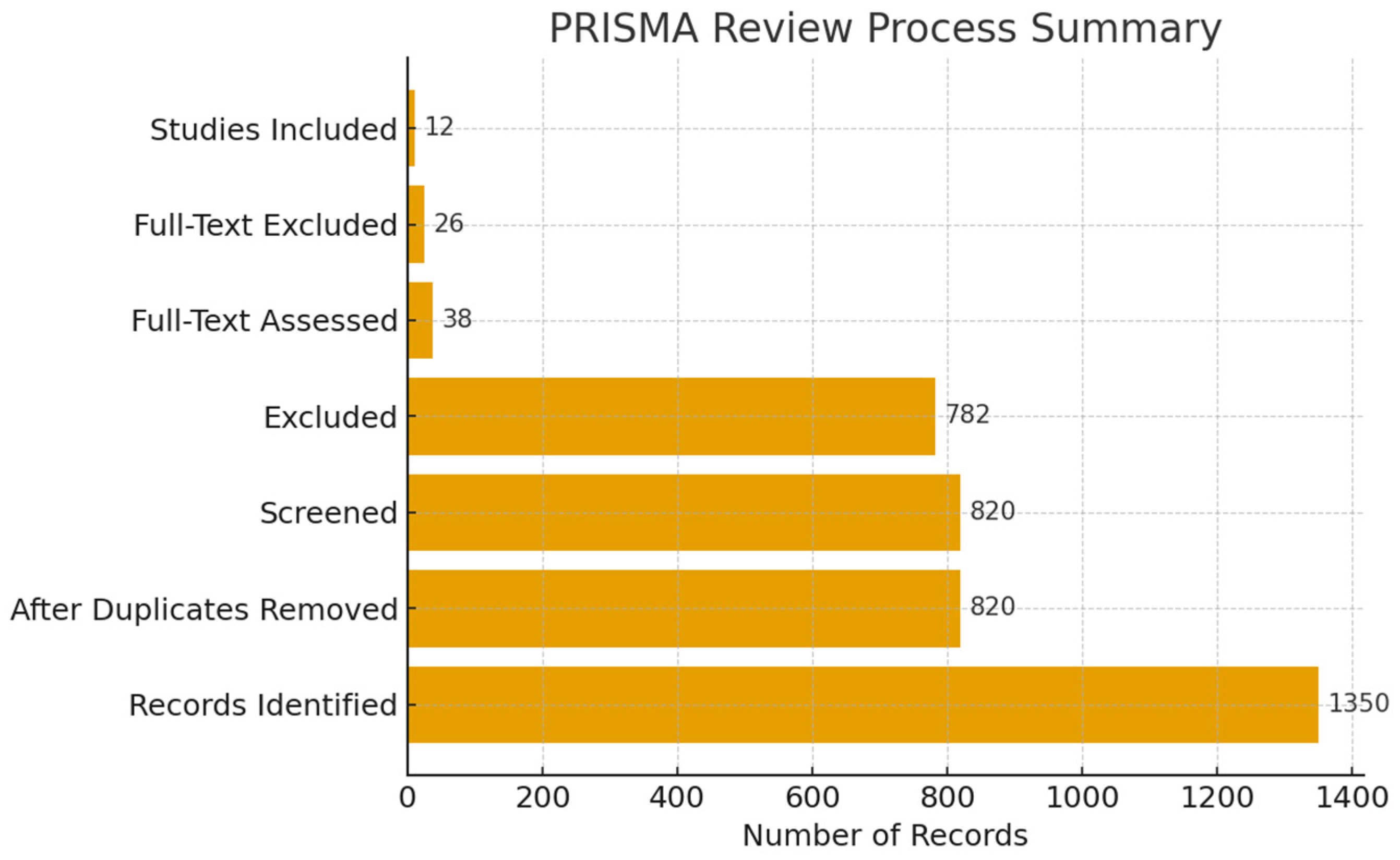
2.1. Search
2.2. Quality Assessment
2.3. Primary and Secondary Outcomes
2.4. Surgery
2.5. Types of IOLs
3. Results
3.1. Satisfaction and Spectacle Independence
3.2. Side Effects
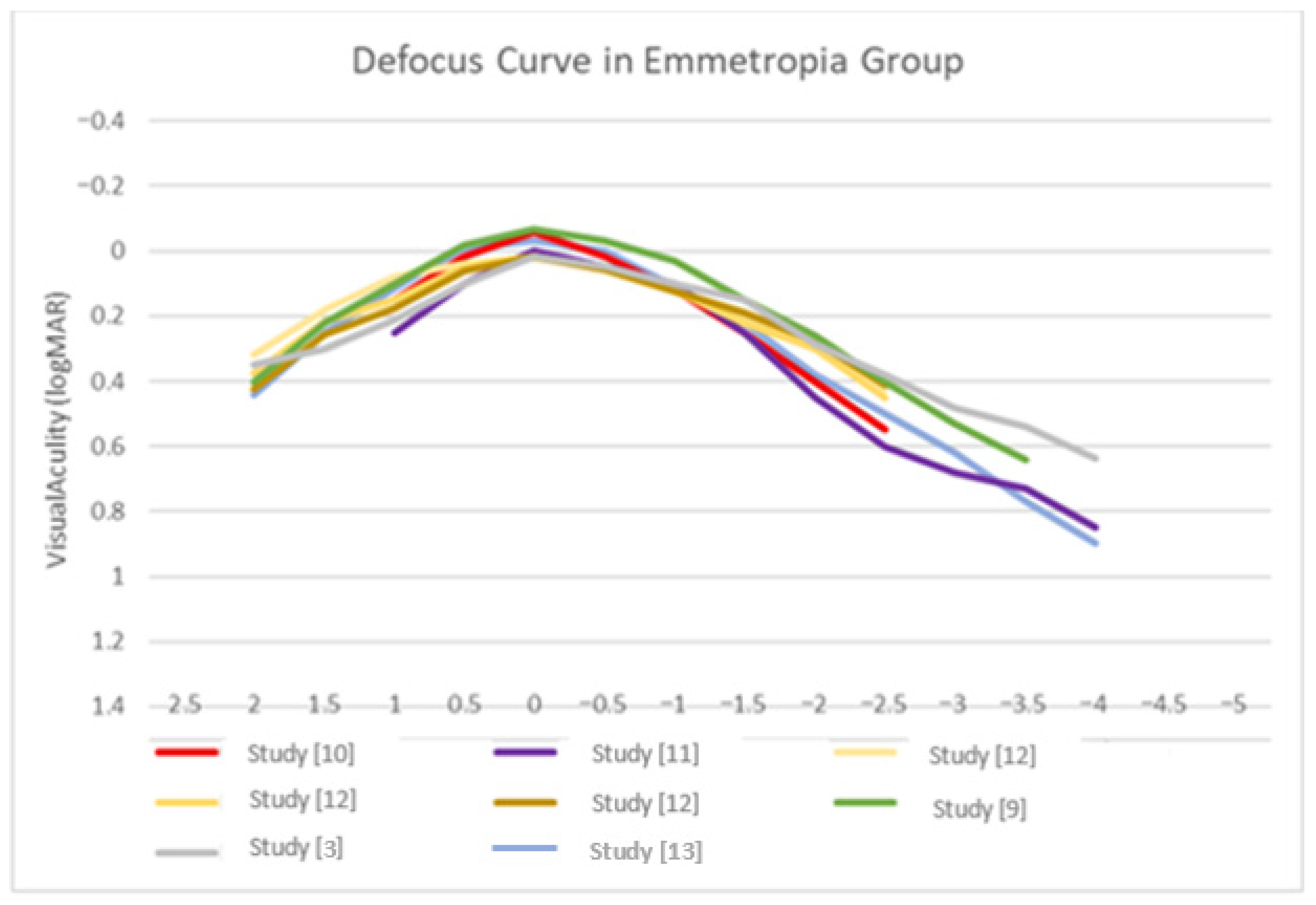
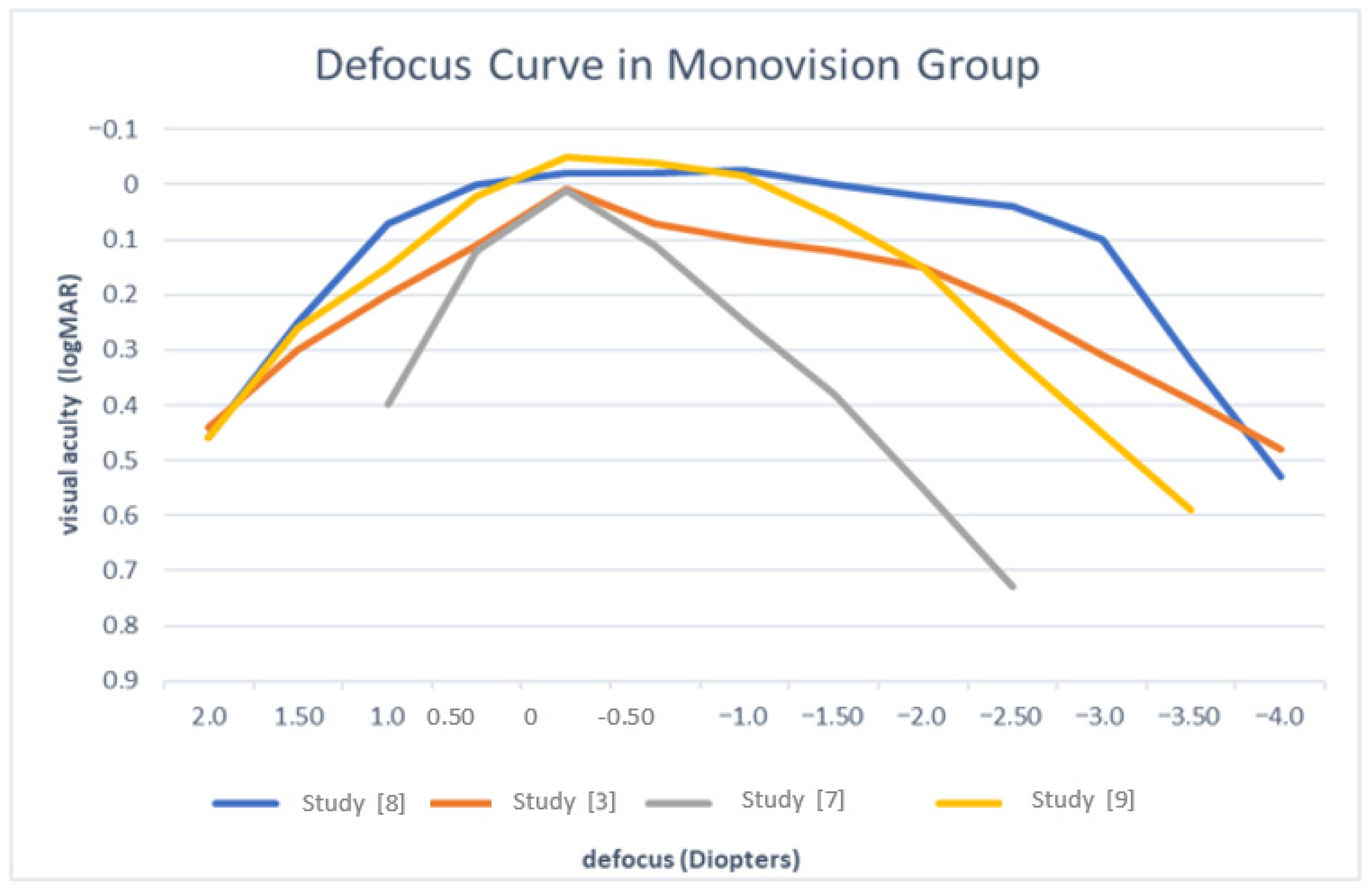
3.3. Defocus Curves
3.4. Femtosecond Laser-Assisted Cataract Surgery (FLACS)
3.5. Contrast Sensitivity and Wavefront Aberrations
3.6. Heterogeneity Analysis
4. Discussion
5. Conclusions
Supplementary Materials
Author Contributions
Funding
Institutional Review Board Statement
Informed Consent Statement
Data Availability Statement
Conflicts of Interest
Abbreviations
| EMV | enhanced monovision |
| IOL | intraocular lens |
| RCT | randomized controlled trial |
| UIVA | uncorrected intermediate visual acuity |
| UDVA | uncorrected distance visual acuity |
| UNVA | uncorrected near visual acuity |
| EDOF | extended depth of focus |
| PRISMA | Preferred Reporting Items for Systematic Review and Meta-Analysis |
| FLACS | femtosecond laser assisted cataract surgery |
| QALY | quality-adjusted life year |
References
- Megiddo-Barnir, E.; Alió, J.L. Latest development in extended depth-of-focus intraocular lenses: An update. Asia Pac. J. Ophthalmol. 2023, 12, 58–79. [Google Scholar] [CrossRef] [PubMed]
- Lin, J.C.; Yang, M.C. Cost-effectiveness comparison between monofocal and multifocal intraocular lens implantation for cataract patients in Taiwan. Clin. Ther. 2014, 36, 1422–1430. [Google Scholar] [CrossRef] [PubMed]
- Park, E.S.; Ahn, H.; Han, S.U.; Jun, I.; Seo, K.Y.; Kim, E.K.; Kim, T.I. Visual outcomes, spectacle independence, and patient satisfaction of pseudophakic mini-monovision using a new monofocal intraocular lens. Sci. Rep. 2022, 12, 21716. [Google Scholar] [CrossRef] [PubMed] [PubMed Central]
- Beltraminelli, T.; Rizzato, A.; Toniolo, K.; Galli, A.; Menghini, M. Comparison of visual performances of enhanced monofocal versus standard monofocal IOLs in a mini-monovision approach. BMC Ophthalmol. 2023, 23, 170. [Google Scholar] [CrossRef] [PubMed]
- Hu, J.Q.; Sarkar, R.; Sella, R.; Murphy, J.D.; Afshari, N.A. Cost-effectiveness analysis of multifocal intraocular lenses compared to monofocal intraocular lenses in cataract surgery. Am. J. Ophthalmol. 2019, 208, 305–312. [Google Scholar] [CrossRef] [PubMed]
- Dell, S.J.; Hannan, S.J.; Venter, J.A.; Teenan, D.; Hannan, N.C.; Raju, D.; Berry, C.W.; Kiss, H.J.; Schallhorn, J.M. Comparative analysis of clinical and patient-reported outcomes of a new enhanced monofocal IOL and a conventional monofocal IOL. Clin. Ophthalmol. 2024, 18, 1157–1169. [Google Scholar] [CrossRef] [PubMed] [PubMed Central]
- Scarfone, H.A.; Rodríguez, E.C.; Riera, J.; Rufiner, M.; Charles, M. Visual performance after bilateral implantation of a new enhanced monofocal hydrophobic acrylic intraocular lens targeted for mini-monovision. Life 2025, 15, 64. [Google Scholar] [CrossRef] [PubMed] [PubMed Central]
- Can, İ.; Bayhan, H.A. Clinical Outcomes of Enhanced Monofocal (Mono-EDOF) Intraocular Lenses with the Mini-Monovision Technique versus Trifocal Intraocular Lenses: A Comparative Study. Turk. J. Ophthalmol. 2024, 54, 190–197. [Google Scholar] [CrossRef] [PubMed] [PubMed Central]
- Sandoval, H.P.; Potvin, R.; Solomon, K.D. Comparing visual performance and subjective outcomes with an enhanced monofocal intraocular lens when targeted for emmetropia or monovision. Clin. Ophthalmol. 2023, 17, 3693–3702. [Google Scholar] [CrossRef] [PubMed] [PubMed Central]
- García-Bella, J.; Burgos-Blasco, B.; Vidal-Villegas, B.; Garzón, N.; Villanueva, C.; García-Feijoo, J. Visual and refractive outcomes after bilateral implantation of an enhanced monofocal intraocular lens: Prospective study. J. Cataract Refract. Surg. 2024, 50, 585–590. [Google Scholar] [CrossRef] [PubMed] [PubMed Central]
- Donoso, R.; Torres, A.; Klagges, J.; Mercado, Y.; Gonzalez, T.; Astudillo, M.; Norambuena, H.; Medina, E. Enhanced vs conventional monofocal intraocular lens clinical results in patients with cataract: Randomized clinical trial. J. Cataract Refract. Surg. 2023, 49, 818–825. [Google Scholar] [CrossRef] [PubMed]
- Mencucci, R.; Morelli, A.; Cennamo, M.; Roszkowska, A.M.; Favuzza, E. Enhanced monofocal intraocular lenses: A retrospective, comparative study between three different models. J. Clin. Med. 2023, 12, 3588. [Google Scholar] [CrossRef] [PubMed] [PubMed Central]
- Giglio, R.; Vinciguerra, A.L.; Presotto, M.; Jonak, K.; Rejdak, R.; Toro, M.D.; Nanavaty, M.A.; Tognetto, D. Visual outcomes and patient satisfaction after bilateral implantation of an enhanced monofocal intraocular lens: A single-masked prospective randomized study. Int. Ophthalmol. 2024, 44, 112. [Google Scholar] [CrossRef] [PubMed] [PubMed Central]
- Raulinajtys-Grzybek, M.; Grabska-Liberek, I.; Opala, A.; Słomka, M.; Chrobot, M. Budget impact analysis of lens material on the posterior capsule opacification (PCO) as a complication after the cataract surgery. Cost Eff. Resour. Alloc. 2020, 18, 19. [Google Scholar] [CrossRef] [PubMed]
- Xiao, J.; Jiang, C.; Zhang, M. Pseudophakic monovision is an important surgical approach to being spectacle-free. Indian J. Ophthalmol. 2011, 59, 481–485. [Google Scholar] [CrossRef] [PubMed]
- Llovet-Rausell, A.; Navalón-Tortosa, J.; Druchkiv, V.; Coloma-Bockos, J.; Moya-Roca, J.; Llovet-Osuna, F. Patient satisfaction and quality of vision after bilateral implantation of enhanced monofocal IOL and mini-monovision: A prospective study. Eye Vis. 2025, 12, 23. [Google Scholar] [CrossRef] [PubMed] [PubMed Central]
- Auffarth, G.U.; Gerl, M.; Tsai, L.; Janakiraman, D.P.; Jackson, B.; Alarcon, A.; Dick, H.B.; Quantum Study Group. Clinical evaluation of a new monofocal IOL with enhanced intermediate function in patients with cataract. J. Cataract Refract. Surg. 2021, 47, 184–191. [Google Scholar] [CrossRef] [PubMed]
- Kanclerz, P.; Pluta, K. The application of the femtosecond laser in cataract surgery. OphthaTherapy 2021, 8, 125–130. [Google Scholar] [CrossRef]
- Monowizja w Różnych Metodach Korekcji Prezbiopii. Available online: https://przegladokulistyczny.pl/2024/07/03/monowizja-w-roznych-metodach-korekcji-prezbiopii (accessed on 28 October 2025).



| Study (First Author, Year) | Study Design Type |
|---|---|
| Park et al., 2022 [3] | Retrospective study |
| Beltraminelli et al., 2023 [4] | Retrospective study |
| Dell et al., 2024 [6] | Retrospective study |
| Scarfone et al., 2025 [7] | Single-center, prospective study, nonrandomized study |
| Can and Bayhan, 2024 [8] | Retrospective observational study |
| Sandoval et al., 2023 [9] | Prospective Randomized Clinical Trial (RCT) |
| García-Bella et al., 2024 [10] | Prospective, monocentric, noncomparative study |
| Donoso et al., 2023 [11] | Prospective Randomized Clinical Trial (RCT) |
| Mencucci et al., 2023 [12] | Retrospective comparative study |
| Llovet-Rausell et al., 2025 [16] | Prospective, non-comparative |
| Auffarth et al., 2021 [17] | Prospective Randomized Clinical Trial (RCT) |
| Giglio et al., 2024 [13] | Prospective randomized controlled study (single-masked) |
| (a) Studies Including Patients with IOLs Implanted for Monovision. | |||
| No. | Study/Author | Patients n | IOL Type |
| 1 | Park et al. [3] | 25 | Tecnis Eyhance ICB00 |
| 2 | Beltraminelli et al. [4] | 37 | Tecnis Eyhance ICB00 |
| 3 | Dell et al. [6] | 58 | Tecnis Eyhance ICB00 |
| 4 | Scarfone et al. [7] | 30 | Alcon Clareon SY60WF |
| 5 | Can and Bayhan [8] | 12 | Rayner RayOne EMV |
| 6 | Sandoval, Potvin and Solomon [9] | 37 | Tecnis Eyhance ICB00 |
| 7 | Llovet-Rausell at al [16] | 51 | Rayner RayOne EMV |
| Total = 250 | |||
| (b) Studies including patients with IOLs implanted for emmetropia. | |||
| No. | Study/Author | Patients n | IOL Type |
| 1 | García-Bella et al. [10] | 25 | Rayner RayOne EMV |
| 2 | Donoso et al. [11] | 29 | Tecnis Eyhance ICB00 |
| 3 | Mencucci et al. [12] | 12 | Tecnis Eyhance ICB00 |
| 12 | Hoya Vivinex Impress | ||
| 12 | PhysIOL IsoPure | ||
| 4 | Sandoval, Potvin and Solomon [9] | 34 | Tecnis Eyhance ICB00 |
| 5 | Giglio et al. [13] | 30 | Tecnis Eyhance ICB00 |
| 6 | Dell et al. [6] (replication) | 118 | Tecnis Eyhance ICB00 |
| 7 | Park et al. [3] (rep.) | 25 | Tecnis Eyhance ICB00 |
| 8 | Auffarth et al. [17] | 67 | Tecnis Eyhance ICB00 |
| Total = 364 | |||
| Lens Name | Material | Asphericity | UV/Blue Light Filter | Positioning | Optic Diameter | Overall Diameter | Optic Shape |
|---|---|---|---|---|---|---|---|
| RAYONE® EMV | Single-piece Rayacryl hydrophilic acrylic | Anterior aspheric surface, posterior surface aspheric or spheric depending on dioptric power. | Benzophenone UV absorbing agent | Bag | 6.00 mm | 12.50 mm | Biconvex (positive powers) |
| TECNIS Eyhance IOL model ICB00 | Hydrophobic acrylic | Spherical posterior surface and a modified aspheric anterior surface. | UV/Blue light filter | Bag | 6.00 mm | 13.00 mm | Biconvex |
| AcrySof® IQ Vivity | Hydrophobic acrylic | Aspheric anterior surface with the wavefronting technology and spherical posteriori surface. | UV and Blue light filtering hydrophobic Copolymer | Bag | 6.00 mm | 13.00 mm | Biconvex |
| Vivinex™ IOLs | Hydrophobic acrylic | Aspheric design with square, thin and textured optic edge. | UV filter (Model XC1-SP), UV and blue light filter (Model XY1-SP) | Bag | 6.00 mm | 13.00 mm | Biconvex |
| PhysIOL® ISOPURE | GFY Hydrophobic Acrylic | Anterior and posterior aspheric surfaces with high-order aspheric terms | UV and blue light filter | Bag | 10 D to 24.5 D: 6.00 mm—25 D to 30 D: 5.75 mm | 10 D to 24.5 D: 11.00 mm—25 D to 30 D: 10.75 mm | Aspheric biconvex surface |
| Study/Author | Patients n | Age | Binocular UDVA | Binocular UIVA | Binocular UNVA | Duration (Months) | Refractive Aim (NDE) | |
|---|---|---|---|---|---|---|---|---|
| 1 | Ella SeoYeon Park [3] | 25 | 71.92 ± 9.98 | 0.10 ± 0.11 | 0.12 ± 0.09 | 0.06 ± 0.06 | 3 | −0.95 ± 0.19 |
| 2 | Tim Beltraminelli [4] | 37 | 73.24 ± 11.3 | 0.10 | 0.10 | 0.35 | 3 | −0.85 ± 0.08 |
| 3 | Steven Dell [6] | 58 | 60.07 ± 8.39 | 0.03 ± 0.08 | 0.09 ± 0.12 | 0.32 ± 0.16 | 1 | −0.69 ± 0.22 |
| 4 | Hugo A. Scarfone [7] | 30 | 67.3 ± 7.25 | 0.01 ± 0.05 | 0.20 ± 0.06 | - | 3 | −0.87 ± 0.25 |
| 5 | Izzet Can [8] | 12 | 65.75 ± 9.98 | 0.004 ± 0.03 | 0.00 ± 0.02 | 0.01 ± 0.02 | 6 | −0.70 D |
| 6 | Sandoval et al. [9] | 37 | 70 ± 4 | 0.00 ± 0.05 | 0.03 ± 0.06 | 0.20 ± 0.06 | 3 | −0.76 ± 0.10 D |
| 7 | Llovet-Rausell et al. [16] | 51 | 72.7 | 0.06 ± 0.09 | 0.25 ± 0.12 | 0.30 ± 0.11 | 3 | –0.86 ± 0.33 D |
| Study/Author | Patients n | Age | Binocular UDVA | Binocular UIVA | Binocular UNVA | Duration | |
|---|---|---|---|---|---|---|---|
| 1 | Javier García-Bella [10] | 25 | 69.2 ± 8.1 | 0.01 ± 0.08 | 0.13 ± 0.07 | - | 3 months |
| 2 | Donoso, Rodrigo MD [11] | 29 | 71 ± 6 | 0.06 ± 0.11 | 0.37 ± 0.12 | 0.58 ± 0.15 | 3 months |
| 3 | Rosa Giglio [13] | 30 | 75.10 ± 3.26 | − 0.03 ± 0.07 | 0.17 ± 0.12 | DCNVA | 3 months |
| 4 | Dell (replication) [6] | 118 | 60.07 ± 8.39 | –0.08 ± 0.06 | 0.18 ± 0.16 | 0.43 ± 0.18 | 1 month |
| 5 | Ella SeoYeon Park [3] (replication) | 25 | 72.2 ± 5.43 | 0.07 ± 0.11 | 0.15 ± 0.09 | 0.33 ± 0.13 | 3 months |
| 6 | Mencucci [12] | ||||||
| → | 12 | 79.38 | 0.03 ± 0.04 | 0.142 ± 0.065 | 0.337 ± 0.042 | 3 months | |
| → | 12 | 78.04 | 0.02 ± 0.04 | 0.133 ± 0.048 | 0.363 ± 0.071 | 3 months | |
| → | 12 | 78.04 | 0.03 ± 0.07 | 0.158 ± 0.097 | 0.354 ± 0.072 | 3 months | |
| 7 | Sandoval et al. [9] | 34 | 70 ± 6 | 00.3 ± 0.05 | 0.15 ± 0.06 | 0.40 ± 0.08 | 3 months |
| 8 | Auffarth et al. [17] | 67 | 69.3 ± 8.7 | 0.03 ± 0.12 | 0.07 ± 0.12 | - | 6 months |
| Group | Patients n | Mean Age (Years) | Mean UDVA | Mean UIVA | Mean UNVA |
|---|---|---|---|---|---|
| Emmetropia | 364 | 72.23 | 0.017 logMAR | 0.165 logMAR | 0.399 logMAR (in 272 patients) |
| Monovision | 250 | 68.79 | 0.0557 logMAR | 0.1271 logMAR | 0.1943 logMAR (in 220 patients) |
| Study | IOL(s) Studied | Reported Side Effects | Frequency/Details | Key Conclusions |
|---|---|---|---|---|
| Park et al. [3] | Tecnis Eyhance (mini-monovision vs. emmetropia) | Halos | 8% (4/50) reported discomfort at 3 months | No glare or starbursts; overall low dysphotopsia |
| Dell et al. [6] | Tecnis Eyhance ICB00 vs. Tecnis Monofocal ZCB00 | Glare | 14.4% moderate; 1.6% significant | No statistical difference vs. monofocal |
| Halos | 7.6% moderate; 1.8% significant | - | ||
| Starbursts | 10.4% moderate; 0.8% significant | - | ||
| Ghosting/diplopia | 4.4% moderate; 0.8% significant | Rare; lowest reported phenomenon | ||
| Sandoval et al. [9] | Tecnis Eyhance (emmetropia vs. monovision) | Halos, light sensitivity | Mostly “never” or “rarely” bothersome | Symptoms were mild, not impactful |
| Scarfone et al. [7] | Clareon Vivity (enhanced monofocal/EDOF-like) | None significant | Low complication rate overall | No dysphotopsias described |
| Can et al. [8] | RayOne EMV (mini-monovision) | Glare | 4.1% (1 eye of 24) at 3–6 months | Mild, infrequent glare |
| Anisometropia symptoms | 1 patient uncomfortable with −1.00 D target | Monovision sometimes symptomatic | ||
| Spectacle dependence | 16.7% required glasses | Spectacle independence: 83.3% | ||
| García-Bella et al. [10] | RayOne EMV | Cystoid macular edema (CME) | 3 non-serious cases; 2 resolved quickly | No data on glare/halos |
| Donoso et al. [11] | Tecnis Eyhance ICB00 vs. ZCB00 | Glare, halos, star flashes | >80% reported occasional symptoms, >90% reported mild intensity | No difference between IOL types |
| Mencucci et al. [12] | Tecnis Eyhance, Vivinex Impress, IsoPure | None reported | Complete absence of halos/glare at 3 months | All three enhanced monofocals performed extremely well |
| Giglio et al. [13] | Tecnis Eyhance vs. Clareon Vivity | Brief mention of halos/glare only | Not quantified; not primary endpoint | Not enough data for comparison |
| Llovet-Rausell et al. [16] | RayOne EMV | None reported | - | No asthenopia symptoms were reported and contrast sensitivity was maintained |
| Study/Year | IOL Types Compared | Aberrations Measured | Main Findings on Aberrations | Overall Interpretation |
|---|---|---|---|---|
| Mencucci et al., 2023 [12] (J. Clin. Med.) | Tecnis Eyhance, Vivinex Impress, IsoPure | Total aberrations, HOAs, LOAs, spherical aberration, coma, trefoil, OSI, PSF | No significant differences across the three enhanced monofocal IOLs. HOAs and spherical aberration remained low. OSI/PSF indicated high optical quality. | Enhanced monofocals do not introduce clinically meaningful aberrations. |
| Park et al., 2022 [3] (Sci. Rep.) | Enhanced monofocal mini-monovision | Not measured | High patient satisfaction + maintained contrast sensitivity → indirectly suggests low levels of HOAs. | Optical quality preserved; aberrations likely similar to monofocals. |
| Beltraminelli et al., 2023 [4] (BMC Ophthalmol.) | Enhanced vs. standard monofocal (mini-monovision) | Not measured | No deterioration in contrast sensitivity → indicates minimal induced aberrations. | Enhanced monofocal preserves monofocal-like aberration profile. |
| Dell et al., 2024 [6] (Clin. Ophthalmol.) | Enhanced vs. standard monofocal | Not measured | Equivalent contrast sensitivity; no increase in dysphotopsias. | Supports no increase in HOAs or SA. |
| Sandoval et al., 2023 [9] (Clin. Ophthalmol.) | Enhanced monofocal (emmetropia vs. monovision) | Not measured | No loss of optical quality; stable contrast sensitivity. | Aberrations likely unchanged between targets. |
| García-Bella et al., 2024 [10] (JCRS) | Bilateral enhanced monofocal IOL | Not measured | Smooth defocus curve without photic effects. | Consistent with low spherical aberration and HOAs. |
| Donoso et al., 2023 [11] (JCRS) | Enhanced vs. standard monofocal | Not measured | No contrast sensitivity penalty; similar dysphotopsia profile. | Suggests similar internal aberrations. |
| Can and Bayhan, 2024 [8] (Turk. J. Ophthalmol.) | Enhanced mono-EDOF vs. trifocal | Not measured | Trifocal had slightly reduced optical quality; enhanced monofocal maintained clean PSF clinically. | EM lenses have much lower HOAs than multifocals. |
| Scarfone et al., 2025 [7] (Life) | New enhanced monofocal targeted for mini-monovision | Not measured | Maintained contrast and image quality. | Aberration profile remains monofocal-like. |
| Llovet-Rausell et al. [16] | Enhanced monofocal targeted for mini-monovision | Not measured | Contrast sensitivity maintained, satisfaction with night vision. | Optical quality was evaluated only indirectly. |
| Outcome | k (Arms) | Pooled Mean (logMAR) | 95% CI | Cochran’s Q | I2 (%) |
|---|---|---|---|---|---|
| UDVA (Uncorrected Distance VA) | 10 | 0.016 | −0.022 to 0.054 | 236.3 | 96.2% |
| UIVA (Uncorrected Intermediate VA) | 10 | 0.164 | 0.125 to 0.203 | 136.0 | 93.4% |
| UNVA (Uncorrected Near VA) | 7 | 0.397 | 0.348 to 0.446 | 81.0 | 92.6% |
Disclaimer/Publisher’s Note: The statements, opinions and data contained in all publications are solely those of the individual author(s) and contributor(s) and not of MDPI and/or the editor(s). MDPI and/or the editor(s) disclaim responsibility for any injury to people or property resulting from any ideas, methods, instructions or products referred to in the content. |
© 2025 by the authors. Licensee MDPI, Basel, Switzerland. This article is an open access article distributed under the terms and conditions of the Creative Commons Attribution (CC BY) license.
Share and Cite
Trusiak, Z.H.; Leoniuk, A.; Tomaszuk, A.; Sawicki, M.; Konopińska, J. Enhanced Monovision Intraocular Lenses: Current Status and Future Perspectives—Systematic Review. Biomedicines 2026, 14, 74. https://doi.org/10.3390/biomedicines14010074
Trusiak ZH, Leoniuk A, Tomaszuk A, Sawicki M, Konopińska J. Enhanced Monovision Intraocular Lenses: Current Status and Future Perspectives—Systematic Review. Biomedicines. 2026; 14(1):74. https://doi.org/10.3390/biomedicines14010074
Chicago/Turabian StyleTrusiak, Zofia Honorata, Aleksandra Leoniuk, Aleksandra Tomaszuk, Michał Sawicki, and Joanna Konopińska. 2026. "Enhanced Monovision Intraocular Lenses: Current Status and Future Perspectives—Systematic Review" Biomedicines 14, no. 1: 74. https://doi.org/10.3390/biomedicines14010074
APA StyleTrusiak, Z. H., Leoniuk, A., Tomaszuk, A., Sawicki, M., & Konopińska, J. (2026). Enhanced Monovision Intraocular Lenses: Current Status and Future Perspectives—Systematic Review. Biomedicines, 14(1), 74. https://doi.org/10.3390/biomedicines14010074