Associations of Transforming Growth Factor-β (TGF-β) with Chronic Kidney Disease Progression in Patients Attending a Tertiary Hospital in Johannesburg, South Africa

 , , , , and
Abstract
1. Introduction
2. Methods
2.1. Study Design, Population and Settings
2.2. Data Collection and Laboratory Procedures
2.3. Measurement of Serum and Urine TGF-β Isoforms
2.4. Data Analysis
3. Results
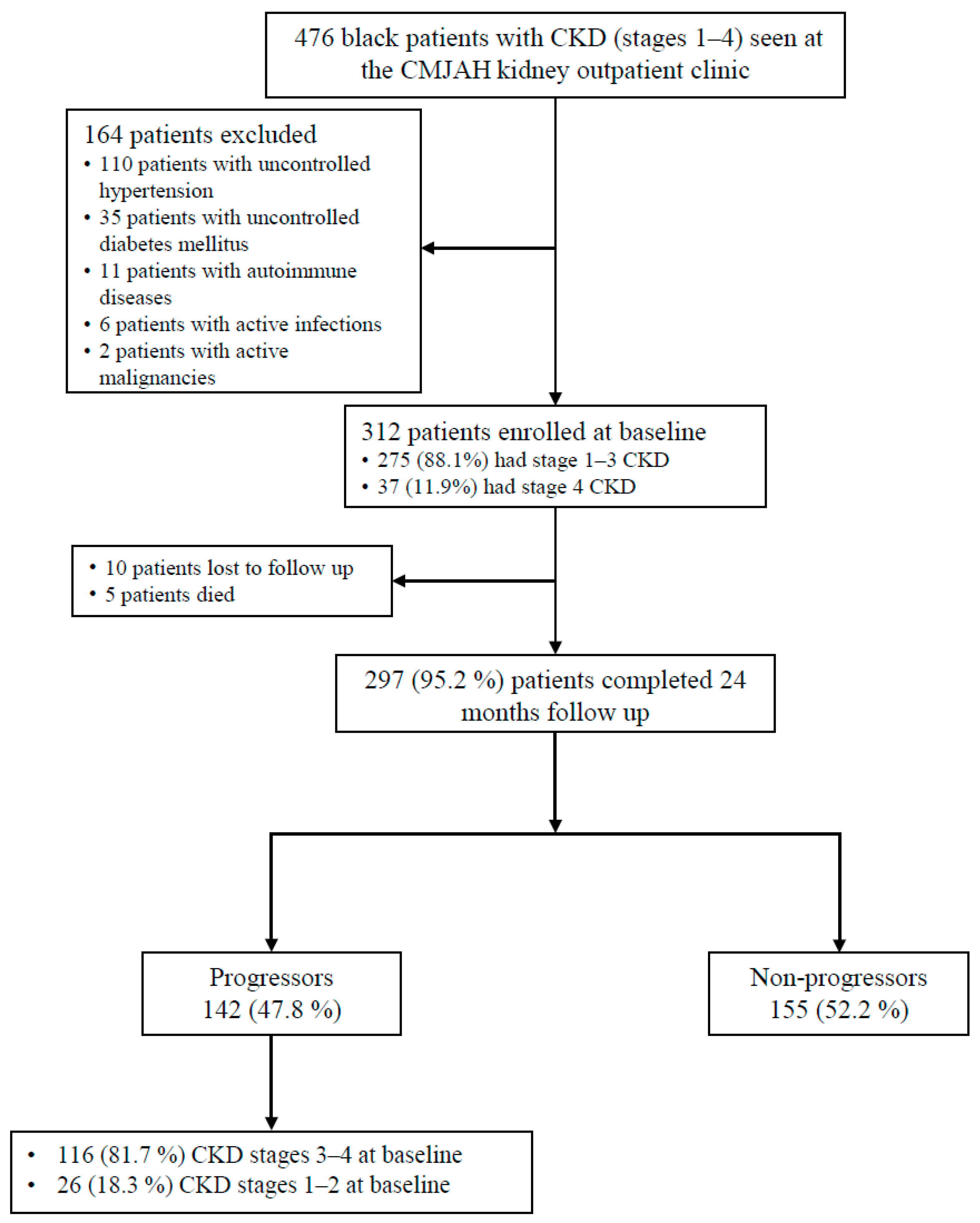
3.1. Study Participants
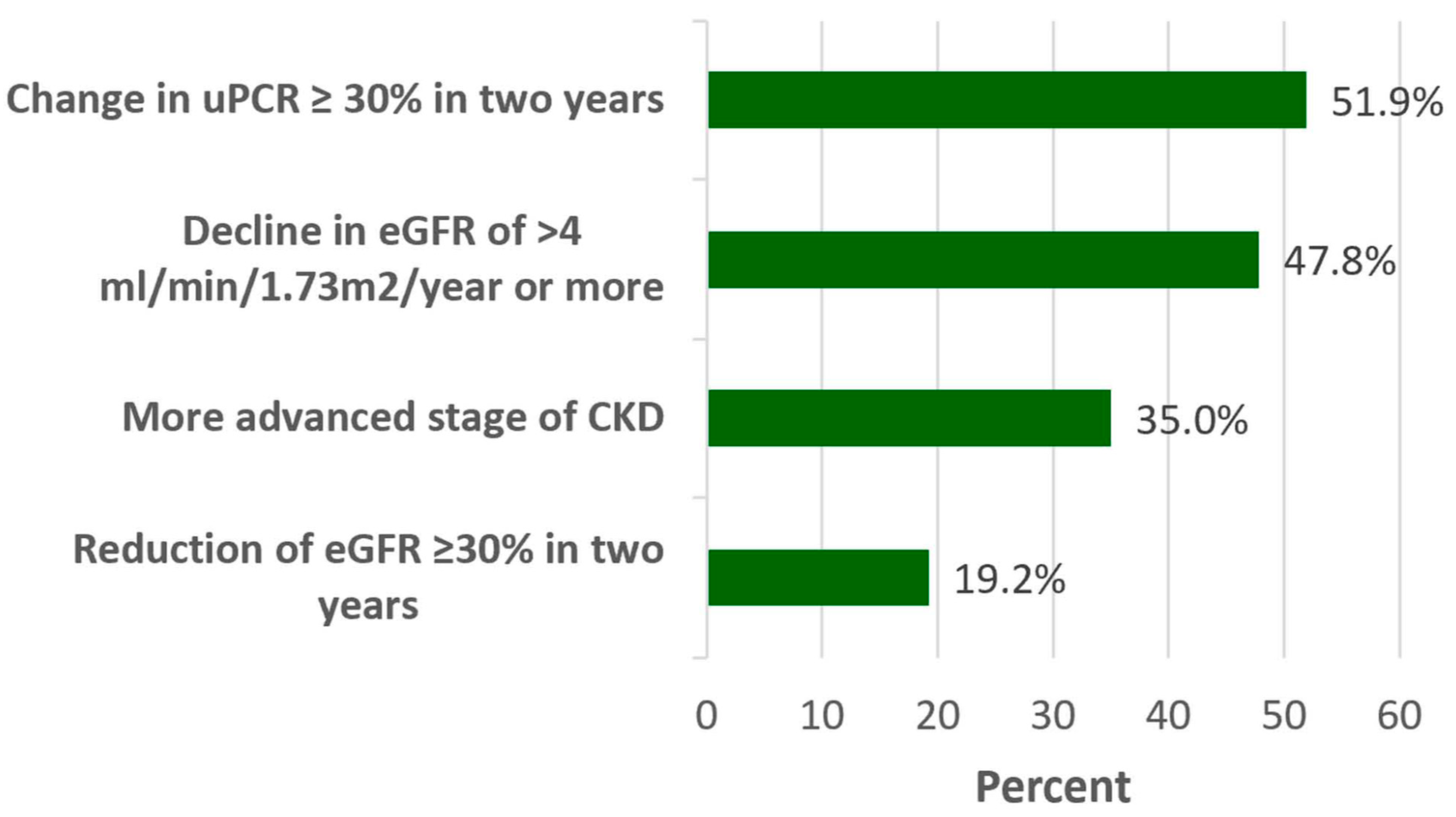
3.2. Prevalence of CKD Progression Using Clinical Biomarkers
3.3. Demographic and Clinical Characteristics of CKD Progressors and Non-Progressors
3.4. Association of Baseline TGF-β Concentrations with CKD Progression
4. Discussion
5. Conclusions
Supplementary Materials
Author Contributions
Funding
Institutional Review Board Statement
Informed Consent Statement
Data Availability Statement
Acknowledgments
Conflicts of Interest
Abbreviations
| ACEIs | Angiotensin Converting Enzyme inhibitors |
| ARBs | Aldosterone Receptors Blockers |
| CKD | Chronic Kidney Diseases |
| CMJAH | Charlotte Maxeke Johannesburg Academic Hospital |
| CKD-EPI | Chronic Kidney Disease Epidemiology Collaboration |
| ESKD | End-Stage Kidney Disease |
| T2DM | Type 2 Diabetes Mellitus |
| TGF-β | Transforming Growth Factor-β |
| eGFR | Estimated Glomerular Filtration Rate |
| IDMS | Isotope Dilution Mass Spectroscopy |
| uPCR | Urine Protein Creatinine Ratio |
| CCBs | Calcium Channel Blockers |
| KDIGO | Kidney Disease Improving Global Outcomes |
| NCDs | Non-Communicable Diseases |
References
- Deng, L.; Guo, S.; Liu, Y.; Zhou, Y.; Liu, Y.; Zheng, X.; Yu, X.; Shuai, P. Global, regional, and national burden of chronic kidney disease and its underlying etiologies from 1990 to 2021: A systematic analysis for the Global Burden of Disease Study 2021. BMC Public Health 2025, 25, 636. [Google Scholar] [CrossRef]
- Bello, A.K.; Okpechi, I.G.; Levin, A.; Ye, F.; Damster, S.; Arruebo, S.; Donner, J.-A.; Caskey, F.J.; Cho, Y.; Davids, M.R.; et al. An update on the global disparities in kidney disease burden and care across world countries and regions. Lancet Glob. Health 2024, 12, e382–e395. [Google Scholar] [CrossRef]
- Hariparshad, S.; Bhimma, R.; Nandlal, L.; Jembere, E.; Naicker, S.; Assounga, A. The prevalence of chronic kidney disease in South Africa—Limitations of studies comparing prevalence with sub-Saharan Africa, Africa, and globally. BMC Nephrol. 2023, 24, 62. [Google Scholar] [CrossRef]
- Ayalew, B.D.; Alemayehu, Z.G.; Tamrie, Y.G.; Admasu, B.A.; Keraga, A.S.; Nida, H.W.; Sharew, T.M.; Sime, B.L.; Zewdie, Y.A.; Tiruneh, Y.M.; et al. The public health impacts of chronic kidney disease in Sub-Saharan Africa: A call for action. J. Med. Surg. Public Health 2025, 7, 100209. [Google Scholar] [CrossRef]
- Urade, Y.; Cassimjee, Z.; Dayal, C.; Chiba, S.; Ajayi, A.; Davies, M. Epidemiology and referral patterns of patients living with chronic kidney disease in Johannesburg, South Africa: A single centre experience. PLOS Global Public Health 2024, 4, e0003119. [Google Scholar] [CrossRef] [PubMed]
- Carney, E.F. The impact of chronic kidney disease on global health. Nat. Rev. Nephrol. 2020, 16, 251. [Google Scholar] [CrossRef]
- Evans, M.; Lewis, R.D.; Morgan, A.R.; Whyte, M.B.; Hanif, W.; Bain, S.C.; Davies, S.; Dashora, U.; Yousef, Z.; Patel, D.C.; et al. A Narrative Review of Chronic Kidney Disease in Clinical Practice: Current Challenges and Future Perspectives. Adv. Ther. 2022, 39, 33–43. [Google Scholar] [CrossRef]
- Reichel, H.; Zee, J.; Tu, C.; Young, E.; Pisoni, R.L.; Stengel, B.; Duttlinger, J.; Lonnemann, G.; Robinson, B.M.; Pecoits-Filho, R.; et al. Chronic kidney disease progression and mortality risk profiles in Germany: Results from the Chronic Kidney Disease Outcomes and Practice Patterns Study. Nephrol. Dial. Transplant. 2020, 35, 803–810. [Google Scholar] [CrossRef] [PubMed]
- Torreggiani, M.; Chatrenet, A.; Fois, A.; Coindre, J.P.; Crochette, R.; Sigogne, M.; Wacrenier, S.; Seret, G.; Mazé, B.; Lecointre, L.; et al. Unmet needs for CKD care: From the general population to the CKD clinics-how many patients are we missing? Clin. Kidney J. 2021, 14, 2246–2254. [Google Scholar] [CrossRef]
- da Veiga, G.L.; da Costa Aguiar Alves, B.; Perez, M.M.; Raimundo, J.R.; de Araújo Encinas, J.F.; Murad, N.; Fonseca, F.L.A. Kidney Diseases: The Age of Molecular Markers. Adv. Exp. Med. Biol. 2021, 1306, 13–27. [Google Scholar] [PubMed]
- Yan, Z.; Wang, G.; Shi, X. Advances in the Progression and Prognosis Biomarkers of Chronic Kidney Disease. Front. Pharmacol. 2021, 12, 785375. [Google Scholar] [CrossRef]
- Alobaidi, S. Emerging Biomarkers and Advanced Diagnostics in Chronic Kidney Disease: Early Detection Through Multi-Omics and AI. Diagnostics 2025, 15, 1225. [Google Scholar] [CrossRef]
- Pradeep, U.; Chiwhane, A.; Acharya, S.; Daiya, V.; Kasat, P.R.; Sachani, P.; Mapari, S.A.; Bedi, G.N. A Comprehensive Review of Advanced Biomarkers for Chronic Kidney Disease in Older Adults: Current Insights and Future Directions. Cureus 2024, 16, e70413. [Google Scholar] [CrossRef]
- George, J.A.; Gounden, V. Novel glomerular filtration markers. Adv. Clin. Chem. 2019, 88, 91–119. [Google Scholar] [PubMed]
- Sandokji, I.; Greenberg, J.H. Plasma and Urine Biomarkers of CKD: A Review of Findings in the CKiD Study. Semin. Nephrol. 2021, 41, 416–426. [Google Scholar] [CrossRef]
- Assani, M.Z.; Novac, M.B.; Dijmărescu, A.L.; Stroe-Ionescu, A.; Boldeanu, M.V.; Siloși, I.; Boldeanu, L. Intersecting Pathways of Inflammation, Oxidative Stress, and Atherogenesis in the Evaluation of CKD: Emerging Biomarkers PCSK9, EPHX2, AOPPs, and TBARSs. Life 2025, 15, 1287. [Google Scholar] [CrossRef]
- Gu, Y.Y.; Liu, X.S.; Huang, X.R.; Yu, X.Q.; Lan, H.Y. Diverse Role of TGF-β in Kidney Disease. Front. Cell Dev. Biol. 2020, 8, 123. [Google Scholar] [CrossRef] [PubMed]
- Gu, Y.Y.; Liu, X.S.; Huang, X.R.; Yu, X.Q.; Lan, H.Y. TGF-β in renal fibrosis: Triumphs and challenges. Future Med. Chem. 2020, 12, 853–866. [Google Scholar] [CrossRef]
- Tang, P.M.; Zhang, Y.Y.; Mak, T.S.; Tang, P.C.; Huang, X.R.; Lan, H.Y. Transforming growth factor-β signalling in renal fibrosis: From Smads to non-coding RNAs. J. Physiol. 2018, 596, 3493–3503. [Google Scholar] [CrossRef]
- Bikbov, B.; Purcell, C.A.; Levey, A.S.; Smith, M.; Abdoli, A.; Abebe, M.; Adebayo, O.M.; Afarideh, M.; Agarwal, S.K.; Agudelo-Botero, M.; et al. Global, regional, and national burden of chronic kidney disease, 1990–2017: A systematic analysis for the Global Burden of Disease Study 2017. Lancet 2020, 395, 709–733. [Google Scholar] [CrossRef] [PubMed]
- Hassan, M.O.; Duarte, R.; Dix-Peek, T.; Dickens, C.; Naidoo, S.; Vachiat, A.; Grinter, S.; Manga, P.; Naicker, S. Transforming Growth Factor-β Protects against Inflammation-Related Atherosclerosis in South African CKD Patients. Int. J. Nephrol. 2018, 2018, 8702372. [Google Scholar] [CrossRef]
- Frangogiannis, N.G. The role of transforming growth factor (TGF)-β in the infarcted myocardium. J. Thorac. Dis. 2017, 9 (Suppl. 1), S52–S63. [Google Scholar] [CrossRef] [PubMed]
- Sun, J.; Hao, L.; Shi, H. Associations between the concentrations of CD68, TGF-β1, renal injury index and prognosis in glomerular diseases. Exp. Ther. Med. 2020, 20, 56. [Google Scholar] [CrossRef]
- Chalkia, A.; Gakiopoulou, H.; Theohari, I.; Foukas, P.G.; Vassilopoulos, D.; Petras, D. Transforming Growth Factor-β1/Smad Signaling in Glomerulonephritis and Its Association with Progression to Chronic Kidney Disease. Am. J. Nephrol. 2021, 52, 653–665. [Google Scholar] [CrossRef]
- Ekrikpo, U.E.; Okuku, C.N.; Ajayi, S.O.; Ayodele, O.E.; Bello, A.K.; Wonkam, A.; Dandara, C.; Kengne, A.-P.; Okpechi, I. Urinary Transforming Growth Factor-Beta 1 (uTGF-β1) and Prevalent CKD Risk in HIV-Positive Patients in West Africa. Kidney Int. Rep. 2019, 4, 1698–1704. [Google Scholar] [CrossRef]
- Theron, A.J.; Anderson, R.; Rossouw, T.M.; Steel, H.C. The Role of Transforming Growth Factor Beta-1 in the Progression of HIV/AIDS and Development of Non-AIDS-Defining Fibrotic Disorders. Front. Immunol. 2017, 8, 1461. [Google Scholar] [CrossRef]
- Naicker, S.; Dix-Peek, T.; Klar, R.M.; Kalunga, G.; Mosiane, P.; Dickens, C.; Duarte, R. Profiling Biomarkers in HIV Glomerular Disease—Potential for the Non-Invasive Diagnosis of HIVAN? Int. J. Nephrol. Renov. Dis. 2021, 14, 427–440. [Google Scholar] [CrossRef]
- García-Sánchez, O.; López-Hernández, F.J.; López-Novoa, J.M. An integrative view on the role of TGF-β in the progressive tubular deletion associated with chronic kidney disease. Kidney Int. 2010, 77, 950–955. [Google Scholar] [CrossRef] [PubMed]
- Seystahl, K.; Papachristodoulou, A.; Burghardt, I.; Schneider, H.; Hasenbach, K.; Janicot, M.; Roth, P.; Weller, M. Biological Role and Therapeutic Targeting of TGF-beta3 in Glioblastoma. Mol. Cancer Ther. 2017, 16, 1177–1186. [Google Scholar] [CrossRef]
- Komai, T.; Okamura, T.; Inoue, M.; Yamamoto, K.; Fujio, K. Reevaluation of Pluripotent Cytokine TGF-β3 in Immunity. Int. J. Mol. Sci. 2018, 19, 2261. [Google Scholar] [CrossRef] [PubMed]
- Nelson, M.L.; Buchanan-Peart, K.R.; Oribhabor, G.I.; Khokale, R.V.; Cancarevic, I. Survival of the Fittest: Addressing the Disparities in the Burden of Chronic Kidney Disease. Cureus 2020, 12, e9499. [Google Scholar] [CrossRef]
- Chu, C.D.; Powe, N.R.; McCulloch, C.E.; Crews, D.C.; Han, Y.; Bragg-Gresham, J.L.; Saran, R.; Koyama, A.; Burrows, N.R.; Tuot, D.S.; et al. Trends in Chronic Kidney Disease Care in the US by Race and Ethnicity, 2012–2019. JAMA Netw. Open 2021, 4, e2127014. [Google Scholar] [CrossRef]
- Bukhari, S.A.R. Sample Size Determination Using Krejcie and Morgan Table. ResearchGate 2021. [Google Scholar] [CrossRef]
- Go, A.S.; Yang, J.; Tan, T.C.; Cabrera, C.S.; Stefansson, B.V.; Greasley, P.J.; Ordonez, J.D. Contemporary rates and predictors of fast progression of chronic kidney disease in adults with and without diabetes mellitus. BMC Nephrol. 2018, 19, 146. [Google Scholar] [CrossRef] [PubMed]
- Thewes, B.; Rietjens, J.A.C.; van den Berg, S.W.; Compen, F.R.; Abrahams, H.; Poort, H.; van de Wal, M.; Schellekens, M.P.; Peters, M.E.; Speckens, A.E.; et al. One way or another: The opportunities and pitfalls of self-referral and consecutive sampling as recruitment strategies for psycho-oncology intervention trials. Psycho-Oncology 2018, 27, 2056–2059. [Google Scholar] [CrossRef]
- Katsoulis, M.; Lai, A.G.; Diaz-Ordaz, K.; Gomes, M.; Pasea, L.; Banerjee, A.; Denaxas, S.; Tsilidis, K.; Lagiou, P.; Misirli, G.; et al. Identifying adults at high-risk for change in weight and BMI in England: A longitudinal, large-scale, population-based cohort study using electronic health records. Lancet Diabetes Endocrinol. 2021, 9, 681–694. [Google Scholar] [CrossRef]
- Babitt, J.L.; Eisenga, M.F.; Haase, V.H.; Kshirsagar, A.V.; Levin, A.; Locatelli, F.; Małyszko, J.; Swinkels, D.W.; Tarng, D.-C.; Cheung, M.; et al. Controversies in optimal anemia management: Conclusions from a Kidney Disease: Improving Global Outcomes (KDIGO) Conference. Kidney Int. 2021, 99, 1280–1295. [Google Scholar] [CrossRef]
- Levey, A.S.; Titan, S.M.; Powe, N.R.; Coresh, J.; Inker, L.A. Kidney Disease, Race, and GFR Estimation. Clin. J. Am. Soc. Nephrol. 2020, 15, 1203–1212. [Google Scholar] [CrossRef]
- Chen, T.K.; Knicely, D.H.; Grams, M.E. Chronic Kidney Disease Diagnosis and Management: A Review. JAMA 2019, 322, 1294–1304. [Google Scholar] [CrossRef] [PubMed]
- Coresh, J.; Turin, T.C.; Matsushita, K.; Sang, Y.; Ballew, S.H.; Appel, L.J.; Arima, H.; Chadban, S.J.; Cirillo, M.; Djurdjev, O.; et al. Decline in estimated glomerular filtration rate and subsequent risk of end-stage renal disease and mortality. JAMA 2014, 311, 2518–2531. [Google Scholar] [CrossRef]
- Chen, C.H.; Wu, H.Y.; Wang, C.L.; Yang, F.J.; Wu, P.C.; Hung, S.C.; Kan, W.C.; Yang, C.W.; Chiang, C.K.; Huang, J.W.; et al. Proteinuria as a Therapeutic Target in Advanced Chronic Kidney Disease: A Retrospective Multicenter Cohort Study. Sci. Rep. 2016, 6, 26539. [Google Scholar] [CrossRef]
- Harris, P.A.; Taylor, R.; Minor, B.L.; Elliott, V.; Fernandez, M.; O’Neal, L.; McLeod, L.; Delacqua, G.; Delacqua, F.; Kirby, J.; et al. The REDCap consortium: Building an international community of software platform partners. J. Biomed. Inform. 2019, 95, 103208. [Google Scholar] [CrossRef]
- Harris, P.A.; Taylor, R.; Thielke, R.; Payne, J.; Gonzalez, N.; Conde, J.G. Research electronic data capture (REDCap)--a metadata-driven methodology and workflow process for providing translational research informatics support. J. Biomed. Inform. 2009, 42, 377–381. [Google Scholar] [CrossRef] [PubMed]
- Gu, Y.-Y.; Dou, J.-Y.; Huang, X.-R.; Liu, X.-S.; Lan, H.-Y. Transforming Growth Factor-β and Long Non-coding RNA in Renal Inflammation and Fibrosis. Front. Physiol. 2021, 12, 684236. [Google Scholar] [CrossRef] [PubMed]
- Zhou, T.; Li, H.Y.; Zhong, H.; Zhong, Z. Relationship between transforming growth factor-β1 and type 2 diabetic nephropathy risk in Chinese population. BMC Med. Genet. 2018, 19, 201. [Google Scholar] [CrossRef] [PubMed]
- Mehta, T.; Buzkova, P.; Kizer, J.R.; Djousse, L.; Chonchol, M.; Mukamal, K.J.; Shlipak, M.; Ix, J.H.; Jalal, D. Higher plasma transforming growth factor (TGF)-β is associated with kidney disease in older community dwelling adults. BMC Nephrol. 2017, 18, 98. [Google Scholar] [CrossRef]
- Ali, I.; Chinnadurai, R.; Ibrahim, S.T.; Green, D.; Kalra, P.A. Predictive factors of rapid linear renal progression and mortality in patients with chronic kidney disease. BMC Nephrol. 2020, 21, 345. [Google Scholar] [CrossRef]
- Ying, T.; Clayton, P.; Naresh, C.; Chadban, S. Predictive value of spot versus 24-h measures of proteinuria for death, end-stage kidney disease or chronic kidney disease progression. BMC Nephrol. 2018, 19, 55. [Google Scholar] [CrossRef]
- Qin, X.; Hu, H.; Cen, J.; Wang, X.; Wan, Q.; Wei, Z. Association Between Urinary Protein-to-Creatinine Ratio and Chronic Kidney Disease Progression: A Secondary Analysis of a Prospective Cohort Study. Front. Med. 2022, 9, 854300. [Google Scholar] [CrossRef]
- Clark-Cutaia, M.N.; Rivera, E.; Iroegbu, C.; Squires, A. Disparities in chronic kidney disease-the state of the evidence. Curr. Opin. Nephrol. Hypertens. 2021, 30, 208–214. [Google Scholar] [CrossRef]
- Diamantidis, C.J.; Zepel, L.; Wang, V.; Smith, V.A.; Hudson Scholle, S.; Tamayo, L.; Maciejewski, M.L. Disparities in Chronic Kidney Disease Progression by Medicare Advantage Enrollees. Am. J. Nephrol. 2021, 52, 949–957. [Google Scholar] [CrossRef] [PubMed]
- Ramirez-Gonzalez, J.B.; Morales-BuenRostro, L.E.; Garcia-Covarrubias, L.; Pacheco-Domínguez, R.L.; Durazo-Arvizu, R.; Cuevas-Medina, E.N.; Furuzawa-Carballeda, J.; Osorio-Juárez, R.A.; Correa-Rotter, R.; Rincón-Pedrero, R.; et al. Assessment of the Relationship Between Inflammation and Glomerular Filtration Rate. Can. J. Kidney Health Dis. 2023, 10, 20543581221132748. [Google Scholar] [CrossRef] [PubMed]
- Piyarungsri, K.; Chuammitri, P.; Pringproa, K.; Pila, P.; Srivorakul, S.; Sornpet, B.; Pusoonthornthum, R. Decreased circulating transforming growth factor-beta (TGF-β) and kidney TGF-β immunoreactivity predict renal disease in cats with naturally occurring chronic kidney disease. J. Feline Med. Surg. 2023, 25, 1098612x231208937. [Google Scholar] [CrossRef]
- Ueda, S.; Tominaga, T.; Ochi, A.; Sakurai, A.; Nishimura, K.; Shibata, E.; Pusoonthornthum, R. TGF-β1 is involved in senescence-related pathways in glomerular endothelial cells via p16 translocation and p21 induction. Sci. Rep. 2021, 11, 21643. [Google Scholar] [CrossRef]
- Tsakas, S.; Goumenos, D.S. Accurate measurement and clinical significance of urinary transforming growth factor-beta1. Am. J. Nephrol. 2006, 26, 186–193. [Google Scholar] [CrossRef]
- Chen, L.; Yang, T.; Lu, D.-W.; Zhao, H.; Feng, Y.-L.; Chen, H.; Chen, D.-Q.; Vaziri, N.D.; Zhao, Y.-Y. Central role of dysregulation of TGF-β/Smad in CKD progression and potential targets of its treatment. Biomed. Pharmacother. 2018, 101, 670–681. [Google Scholar] [CrossRef]
- Isaka, Y. Targeting TGF-β Signaling in Kidney Fibrosis. Int. J. Mol. Sci. 2018, 19, 2532. [Google Scholar] [CrossRef]
- Spurlin, J.W., 3rd; Garis, M.R.; Lwigale, P.Y. BMP3 inhibits TGFβ2-mediated myofibroblast differentiation during wound healing of the embryonic cornea. NPJ Regen. Med. 2022, 7, 36. [Google Scholar] [CrossRef]
- Kuppe, C.; Ibrahim, M.M.; Kranz, J.; Zhang, X.; Ziegler, S.; Perales-Patón, J.; Jansen, J.; Reimer, K.C.; Smith, J.R.; Dobie, R.; et al. Decoding myofibroblast origins in human kidney fibrosis. Nature 2021, 589, 281–286. [Google Scholar] [CrossRef] [PubMed]
- Frangogiannis, N.G. Transforming growth factor–β in tissue fibrosis. J. Exp. Med. 2020, 217, e20190103. [Google Scholar] [CrossRef]
- Ou, M.Y.; Tan, P.C.; Xie, Y.; Liu, K.; Gao, Y.M.; Yang, X.S.; Zhou, S.B.; Li, Q.F. Dedifferentiated Schwann cell-derived TGF-β3 is essential for the neural system to promote wound healing. Theranostics 2022, 12, 5470. [Google Scholar] [CrossRef]
- Escasany, E.; Lanzón, B.; García-Carrasco, A.; Izquierdo-Lahuerta, A.; Torres, L.; Corrales, P.; Rodríguez, A.E.R.; Luis-Lima, S.; Álvarez, C.M.; Ruperez, F.J.; et al. Transforming growth factor β3 deficiency promotes defective lipid metabolism and fibrosis in murine kidney. Dis. Models Mech. 2021, 14, dmm048249. [Google Scholar] [CrossRef]
- Sauriasari, R.; Pratiwi, M.Y. Urinary TGF-β1 was not independently associated with renal function in diabetes mellitus. Diabetes Metab. Syndr. Obes. Targets Ther. 2018, 11, 597–602. [Google Scholar] [CrossRef]
- Butterworth, M.B. Role of microRNAs in aldosterone signaling. Curr. Opin. Nephrol. Hypertens. 2018, 27, 390–394. [Google Scholar] [CrossRef] [PubMed]
- Sumida, K.; Nadkarni, G.N.; Grams, M.E.; Sang, Y.; Ballew, S.H.; Coresh, J.; Matsushita, K.; Surapaneni, A.; Brunskill, N.; Chadban, S.J.; et al. Conversion of Urine Protein-Creatinine Ratio or Urine Dipstick Protein to Urine Albumin-Creatinine Ratio for Use in Chronic Kidney Disease Screening and Prognosis: An Individual Participant-Based Meta-analysis. Ann. Intern. Med. 2020, 173, 426–435. [Google Scholar] [CrossRef] [PubMed]
- Cheng, Y.-C.; Lu, C.-L.; Hsu, C.-Y.; Sheu, M.-L.; Lee, I.T. Urinary non-albumin protein-creatinine ratio is an independent predictor of mortality in patients with type 2 diabetes: A retrospective cohort study. Sci. Rep. 2024, 14, 10526. [Google Scholar] [CrossRef] [PubMed]



| Characteristic | CKD Progression (n = 142) | No CKD Progression (n = 155) | p-Value |
|---|---|---|---|
| Proportion (%) or Median (IQR) | Proportion (%) or Median (IQR) | ||
| Demographics: | |||
| Age (years) | 59 (46–67) | 56 (45–66) | 0.249 |
| Sex Male Female | 78 (54.9%) 64 (45.1%) | 78 (50.3%) 77 (49.7%) | 0.427 |
| Marital status Single Married Widow/Widower Separated/Divorced | 38 (26.8%) 77 (54.2%) 18 (12.7%) 9 (6.3%) | 51 (32.9%) 77 (49.7%) 19 (12.3%) 8 (5.2%) | 0.701 |
| Highest level of education No formal education Primary Secondary Tertiary | 18 (12.7%) 30 (21.1%) 51 (35.9%) 43 (30.3%) | 16 (10.3%) 37 (23.9%) 44 (28.4%) 58 (37.4%) | 0.387 |
| Occupation Unemployed Domestic workers Self employed Public/Private servant Retired | 22 (15.5%) 25 (17.6%) 32 (22.5%) 51 (35.9%) 12 (8.5%) | 22 (14.2%) 31 (20.0%) 33 (21.3%) 56 (36.1%) 13 (8.4%) | 0.985 |
| Clinical Variables: | |||
| BMI (kg/m2) | 30.6 (26.8–35.7) | 29.7 (26.0–33.4) | 0.268 |
| SBP (mmHg) DBP (mmHg) | 140 (132–140) 83 (74–90) | 140 (125–140) 82 (73–90) | 0.070 0.334 |
| Creatinine (umol/L) | 147.5 (118–183) | 134 (105–162) | 0.004 |
| eGFR (mL/min/1.72 m2) | 37 (32–51) | 44 (34–61) | 0.005 |
| uPCR (g/mmol) | 0.039 (0.015–0.085) | 0.016 (0.008–0.032) | <0.001 |
| FBG (mmol/L) | 4.5 (4.2–5.0) | 4.4 (4.2–4.9) | 0.364 |
| HbA1c (%) | 7.0 (6.9–7.0) | 7.0 (6.6–7.0) | 0.355 |
| Hemoglobin (g/dL) | 13.0 (11.7–14.2) | 13.7 (12.2–15.3) | 0.011 |
| WBC (×109 cells/L) | 6.10 (5.07–7.84) | 6.47 (4.81–7.74) | 0.918 |
| Platelets (×109 cells/L) | 251 (211–320) | 269 (218–323) | 0.475 |
| Uric acid (mmol/L) | 0.42 (0.35–0.51) | 0.40 (0.31–0.48) | 0.020 |
| HDL cholesterol (mmol/L) | 1.16 (1.00–1.43) | 1.25 (1.01–1.56) | 0.153 |
| Calcium (mmol/L) | 2.30 (2.23–2.39) | 2.34 (2.25–2.42) | 0.004 |
| Phosphate (mmol/L) | 1.12 (0.93–1.27) | 1.02 (0.88–1.16) | 0.007 |
| Sodium (mmol/L) | 141 (139–143) | 141 (138–143) | 0.758 |
| Potassium (mmol/L) | 4.3 (4.0–4.7) | 4.2 (3.8–4.5) | 0.054 |
| Bicarbonate (mmol/L) | 22 (20–24) | 22 (20–24) | 0.787 |
| Calcium phosphate product (mmol2/L2) | 2.50 (2.12–2.89) | 2.41 (2.03–2.70) | 0.092 |
| Medications: | |||
| Diuretics | 90 (63.4%) | 63 (40.7%) | 0.001 |
| ACEIs/ARBs | 33 (23.2%) | 27 (17.4%) | 0.212 |
| Aldactone | 6 (4.2%) | 5 (3.2%) | 0.649 |
| Calcium channel blockers | 121 (85.2%) | 117 (75.5%) | 0.036 |
| Statins | 81 (57.0%) | 70 (45.2%) | 0.041 |
| Oral Hypoglycemic | 14 (9.9%) | 22 (14.2%) | 0.253 |
| Insulin | 45 (31.7%) | 23 (14.8%) | 0.001 |
| Allopurinol | 15 (10.6%) | 19 (12.3%) | 0.647 |
| Junior ASA | 41 (28.9%) | 28 (18.1%) | 0.028 |
| Beta blockers | 79 (55.6%) | 63 (40.7%) | 0.010 |
| Aldomet | 35 (24.7%) | 34 (21.9%) | 0.580 |
| Hydralazine | 11 (7.8%) | 8 (5.2%) | 0.363 |
| Nitrates (ISMN/ISDN) | 4 (2.8%) | 3 (1.9%) | 0.617 |
| Doxazosin | 64 (45.1%) | 70 (45.2%) | 0.987 |
| Others | 45 (31.7%) | 54 (34.8%) | 0.565 |
| eGFR Decline > 4 mL/min/1.73 m2/year or More | Changed to a More Advanced Stage of CKD | >30% Reduction in eGFR in 2 Years | >30% Increase in uPCR in 2 Years | |||||||||
|---|---|---|---|---|---|---|---|---|---|---|---|---|
| Baseline Characteristic | CKD Progression (n = 142) Median (IQR) | No CKD Progression (n = 155) Median (IQR) | p-Value | CKD Progression (n = 104) Median (IQR) | No CKD Progression (n = 193) Median (IQR) | p-Value | CKD Progression (n = 57) Median (IQR) | No CKD Progression (n = 240) Median (IQR) | p-Value | CKD Progression (n = 154) Median (IQR) | No CKD Progression (n = 143) Median (IQR) | p-Value |
| Serum TGF-β1 (ng/L) | 21,210 (15,915–25,745) | 24,200 (17,570–29,560) | 0.004 | 20,370 (15,100–24,650) | 23,740 (17,470–29,505) | 0.001 | 20,425 (15,380–23,630) | 23,320 (17,150–29,310) | 0.015 | 22,330 (16,780–29,060) | 22,080 (17,150–28,270) | 0.767 |
| Serum TGF-β2 (ng/L) | 66.0 (34.8–89.2) | 68.2 (36.7–100.2) | 0.303 | 60.8 (30.6–89.3) | 69.1 (38.5–94.7) | 0.113 | 55.9 (29.9–77.8) | 69.3 (37.7–94.7) | 0.062 | 73.0 (42.4–100.5) | 59.5 (30.9–88.9) | 0.053 |
| Serum TGF-β3 (ng/L) | 13.9 (6.3–27.2) | 14.8 (8.0–39.1) | 0.506 | 13.0 (6.3–27.8) | 14.9 (8.0–37.4) | 0.512 | 13.5 (6.3–26.3) | 14.8 (7.6–39.2) | 0.421 | 11.8 (6.6–30.4) | 16.1 (9.3–36.8) | 0.286 |
| Urine TGF-β1 (ng/L) | 5.3 (2.0–14.4) | 6.9 (2.8–29.7) | 0.357 | 4.9 (1.6–14.7) | 6.9 (2.9–25.1) | 0.231 | 5.4 (1.9–29.8) | 6.8 (2.8–21.1) | 0.817 | 11.1 (3.9–29.7) | 6.2 (1.6–14.8) | 0.054 |
| Urine TGF-β2 (ng/L) | 11.6 (4.6–17.3) | 7.8 (3.8–16.1) | 0.585 | 9.4 (4.1–13.9) | 8.3 (4.0–21.0) | 0.545 | 10.7 (5.0–15.4) | 8.3 (4.0–17.1) | 0.979 | 10.4 (3.3–21.6) | 6.8 (4.4–13.1) | 0.255 |
| Urine TGF-β3 (ng/L) | 17.5 (5.4–76.2) | 2.8 (1.8–15.3) | 0.017 | 7.9 (3.1–35.8) | 5.9 (1.8–42.3) | 0.663 | 10.4 (6.9–45.0) | 5.9 (1.8–34.4) | 0.184 | 4.9 (1.8–32.2) | 10.4 (2.9–42.3) | 0.402 |
| eGFR Decline > 4 mL/min/1.73 m2/year or More | Changed to a More Advanced Stage of CKD | >30% Reduction in eGFR in 2 Years | >30% Increase in uPCR in 2 Years | ||||||||||||||
|---|---|---|---|---|---|---|---|---|---|---|---|---|---|---|---|---|---|
| Unadjusted | Adjusted * | Unadjusted | Adjusted * | Unadjusted | Adjusted * | Unadjusted | Adjusted * | ||||||||||
| Baseline Biomarker | No. of Patients | OR (95% CI) | p-Value | OR (95% CI) | p-Value | OR (95% CI) | p-Value | OR (95% CI) | p-Value | OR (95% CI) | p-Value | OR (95% CI) | p-Value | OR (95% CI) | p-Value | OR (95% CI) | p-Value |
| Serum TGF-β1 (ng/L) | 289 | 1.00 (1.00–1.00) | 0.074 | 1.00 (1.00–1.00) | 0.194 | 1.00 (1.00–1.00) | 0.042 | 1.00 (1.00–1.00) | 0.158 | 1.00 (1.00–1.00) | 0.046 | 1.00 (1.00–1.00) | 0.223 | 1.00 (1.00–1.00) | 0.933 | 1.00 (1.00–1.00) | 0.989 |
| Serum TGF-β2 (ng/L) | 245 | 1.00 (0.99–1.00) | 0.187 | 1.00 (0.99–1.00) | 0.165 | 1.00 (0.99–1.00) | 0.206 | 1.00 (0.99–1.00) | 0.181 | 0.99 (0.99–1.00) | 0.130 | 0.99 (0.99–1.00) | 0.178 | 1.01 (1.00–1.01) | 0.038 | 1.01 (1.00–1.01) | 0.052 |
| Serum TGF-β3 (ng/L) | 174 | 1.00 (1.00–1.00) | 0.814 | 1.00 (1.00–1.00) | 0.786 | 1.00 (1.00–1.00) | 0.699 | 1.00 (1.00–1.00) | 0.851 | 1.00 (1.00–1.00) | 0.646 | 1.00 (1.00–1.00) | 0.538 | 1.00 (1.00–1.00) | 0.797 | 1.00 (1.00–1.00) | 0.893 |
| Urine TGF-β1 (ng/L) | 89 | 0.99 (0.98–1.00) | 0.174 | 0.99 (0.98–1.00) | 0.195 | 0.99 (0.98–1.01) | 0.312 | 0.99 (0.98–1.01) | 0.368 | 1.00 (0.99–1.01) | 0.611 | 1.00 (0.99–1.01) | 0.673 | 1.00 (1.00–1.01) | 0.412 | 1.00 (1.00–1.01) | 0.402 |
| Urine TGF-β2 (ng/L) | 52 | 0.99 (0.97–1.02) | 0.481 | 1.00 (0.97–1.03) | 0.846 | 0.97 (0.91–1.02) | 0.231 | 0.97 (0.92–1.03) | 0.376 | 0.98 (0.92–1.04) | 0.513 | 1.01 (0.95–1.08) | 0.744 | 1.02 (0.98–1.07) | 0.267 | 1.02 (0.98–1.06) | 0.359 |
| Urine TGF-β3 (ng/L) | 53 | 1.01 (1.00–1.02) | 0.131 | 1.01 (1.00–1.02) | 0.046 | 1.00 (0.99–1.01) | 0.472 | 1.00 (0.99–1.01) | 0.662 | 1.00 (0.99–1.01) | 0.808 | 1.01 (0.99–1.02) | 0.315 | 1.00 (0.99–1.01) | 0.683 | 1.00 (1.00–1.01) | 0.416 |
Disclaimer/Publisher’s Note: The statements, opinions and data contained in all publications are solely those of the individual author(s) and contributor(s) and not of MDPI and/or the editor(s). MDPI and/or the editor(s) disclaim responsibility for any injury to people or property resulting from any ideas, methods, instructions or products referred to in the content. |
© 2026 by the authors. Licensee MDPI, Basel, Switzerland. This article is an open access article distributed under the terms and conditions of the Creative Commons Attribution (CC BY) license.
Share and Cite
Meremo, A.; Duarte, R.; Dickens, C.; Dix-Peek, T.; Bintabara, D.; Paget, G.; Naicker, S. Associations of Transforming Growth Factor-β (TGF-β) with Chronic Kidney Disease Progression in Patients Attending a Tertiary Hospital in Johannesburg, South Africa. Biomedicines 2026, 14, 236. https://doi.org/10.3390/biomedicines14010236
Meremo A, Duarte R, Dickens C, Dix-Peek T, Bintabara D, Paget G, Naicker S. Associations of Transforming Growth Factor-β (TGF-β) with Chronic Kidney Disease Progression in Patients Attending a Tertiary Hospital in Johannesburg, South Africa. Biomedicines. 2026; 14(1):236. https://doi.org/10.3390/biomedicines14010236
Chicago/Turabian StyleMeremo, Alfred, Raquel Duarte, Caroline Dickens, Therese Dix-Peek, Deogratius Bintabara, Graham Paget, and Saraladevi Naicker. 2026. "Associations of Transforming Growth Factor-β (TGF-β) with Chronic Kidney Disease Progression in Patients Attending a Tertiary Hospital in Johannesburg, South Africa" Biomedicines 14, no. 1: 236. https://doi.org/10.3390/biomedicines14010236
APA StyleMeremo, A., Duarte, R., Dickens, C., Dix-Peek, T., Bintabara, D., Paget, G., & Naicker, S. (2026). Associations of Transforming Growth Factor-β (TGF-β) with Chronic Kidney Disease Progression in Patients Attending a Tertiary Hospital in Johannesburg, South Africa. Biomedicines, 14(1), 236. https://doi.org/10.3390/biomedicines14010236