Malignant Melanoma: Landscape of Molecular Markers
 and
and
Abstract
1. Introduction
2. Materials and Methods
2.1. Collective of Patients/Inclusion and Exclusion Criteria
- ➢
- Minimum tumor content of 15%;
- ➢
- Histology: malignant melanoma of the skin.
- ➢
- Samples with tumor content below the threshold were excluded (n = 0);
- ➢
- Insufficient sequencing parameters as described below (n = 5);
- ➢
- Uveal melanoma were excluded (n = 4).
2.2. Pre-Analytical Quality Control of Tissue Samples
- % Q30 bases: >95%;
- Total number of reads: >50,000,000;
- Aligned reads: >95%;
- Coverage 500x: >95%.
2.3. CVI (Curated Variant Information) Scores for Predictive Biomarkers
- (a)
- it predicted drug efficacy in at least one large cohort study (response), (corresponding to AMP/ASCO/CAP Tier IB).
- (b)
- it is associated with drug inefficacy based on a retrospective study and/or cumulative evidence (resistance), (corresponding to AMP/ASCO/CAP Tier IB).
- (c)
- the biomarker has been approved by FDA, EMA and/or other regulatory agency for a different cancer entity (corresponding to AMP/ASCO/CAP Tier IIC).
2.4. Ethics
3. Results
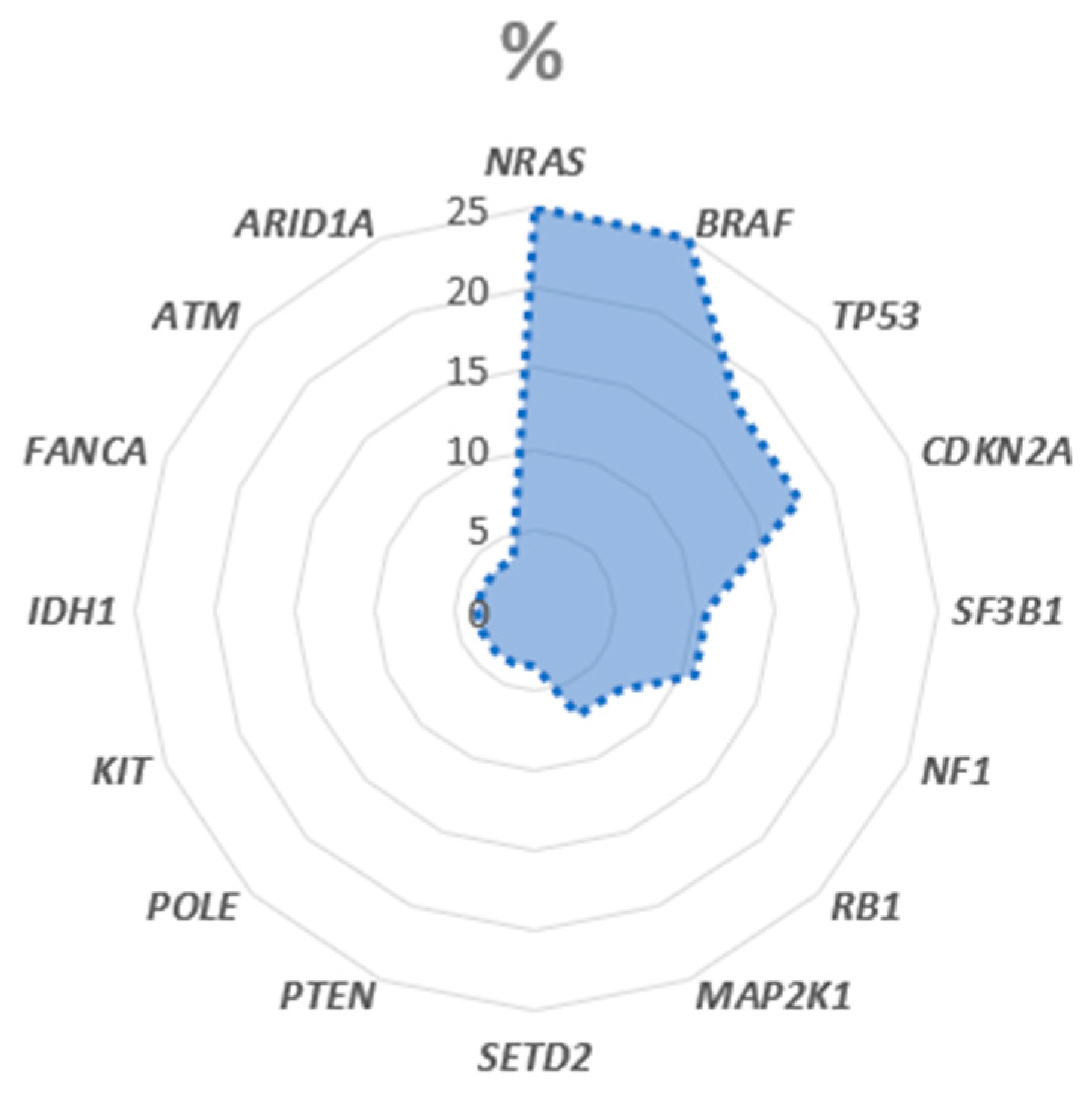
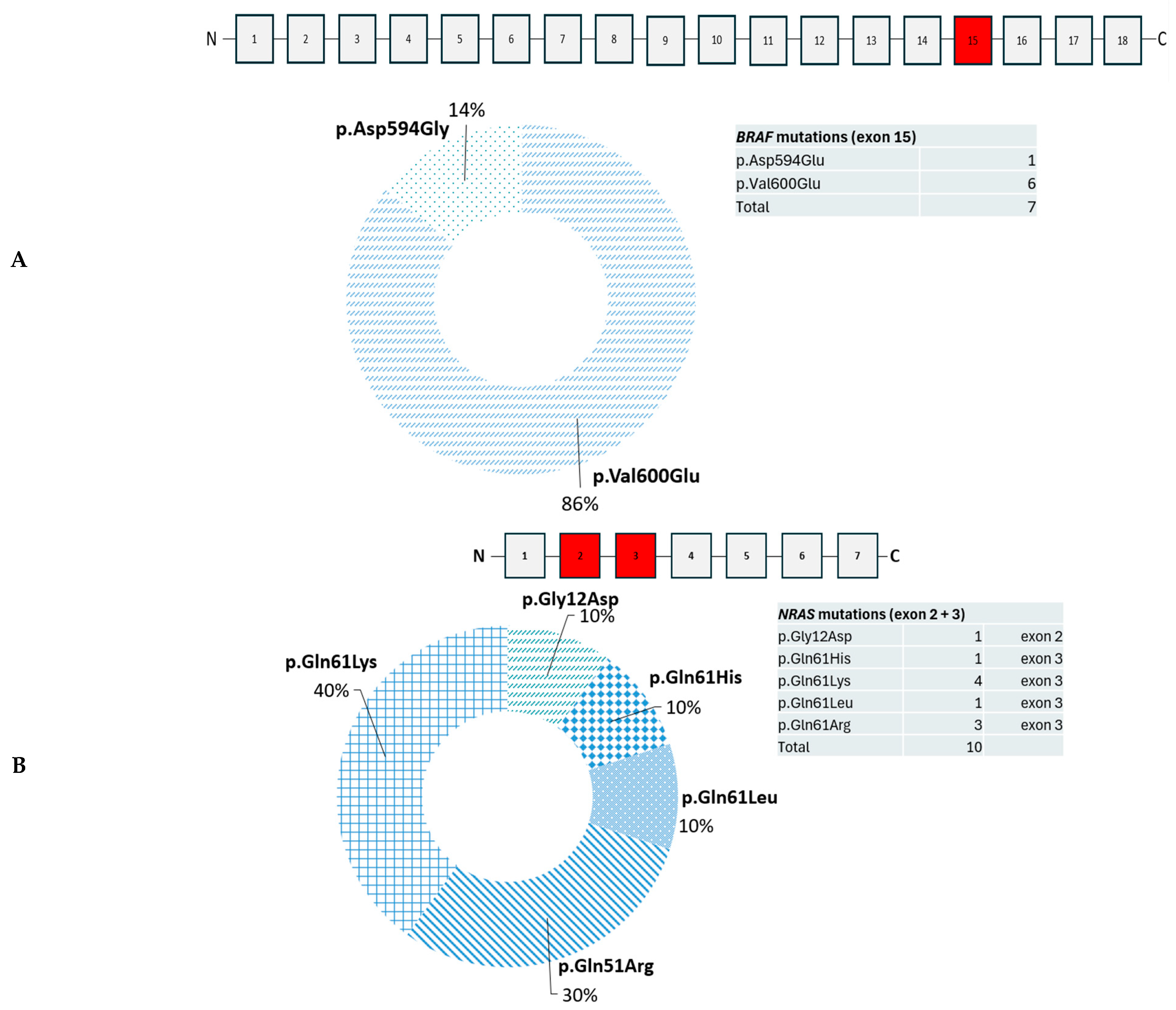
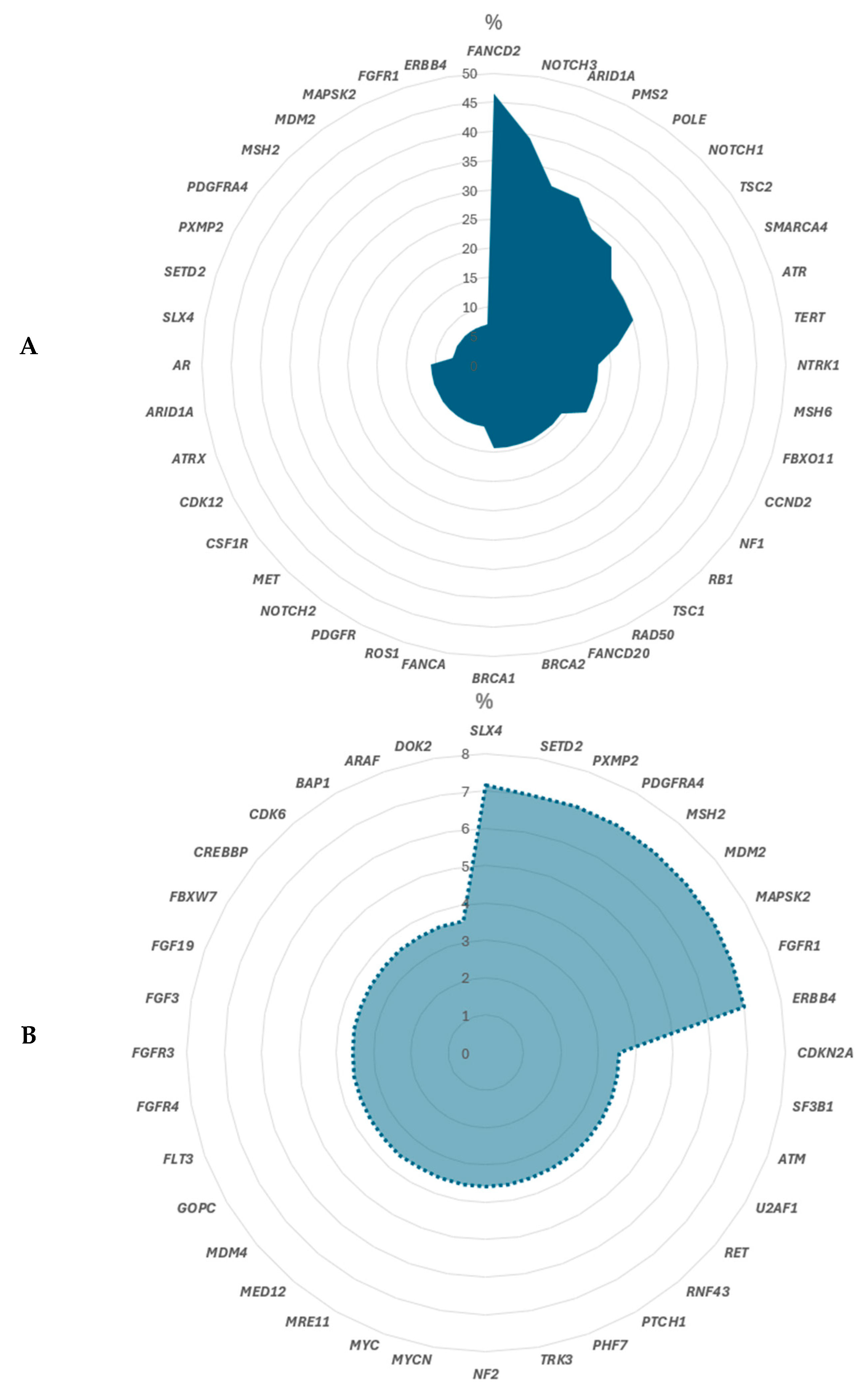
Molecular Landscape of Detected Class 3–5 Variants
4. Discussion
Study Limitation
5. Conclusions
Author Contributions
Funding
Institutional Review Board Statement
Informed Consent Statement
Data Availability Statement
Conflicts of Interest
References
- Ahmed, B.; Qadir, M.I.; Ghafoor, S. Malignant Melanoma: Skin Cancer-Diagnosis, Prevention, and Treatment. Crit. Rev. Eukaryot. Gene Expr. 2020, 30, 291–297. [Google Scholar] [CrossRef] [Scilit]
- Ohnishi, Y.; Watanabe, M.; Fujii, T.; Sunada, N.; Yoshimoto, H.; Kubo, H.; Wato, M.; Kakudo, K. A rare case of amelanotic malignant melanoma in the oral region: Clinical investigation and immunohistochemical study. Oncol. Lett. 2015, 10, 3761–3764. [Google Scholar] [CrossRef] [Scilit] [PubMed]
- Voiculescu, V.-M.; Popescu, A.-I.; Costache, M. Immunohistochemistry for Skin Cancers: New Insights into Diagnosis and Treatment of Melanoma. Cancers 2025, 17, 1769. [Google Scholar] [CrossRef] [Scilit]
- Willis, B.C.; Johnson, G.; Wang, J.; Cohen, C. SOX10. Appl. Immunohistochem. Mol. Morphol. 2015, 23, 109–112. [Google Scholar] [CrossRef] [Scilit] [PubMed]
- Abbas, O.; Miller, D.D.; Bhawan, J. Cutaneous Malignant Melanoma. Am. J. Dermatopathol. 2014, 36, 363–379. [Google Scholar] [CrossRef] [Scilit]
- Venzel, R.; Campos, M.C.P.; de Oliveira, L.P.; Lins, R.V.D.; Siena, Á.D.D.; Mesquita, K.T.; dos Santos, T.P.M.; Nohata, N.; Arruda, L.C.M.; Sales-Campos, H.; et al. Clinical and molecular overview of immunotherapeutic approaches for malignant skin melanoma: Past, present and future. Crit. Rev. Oncol. 2023, 186, 103988. [Google Scholar] [CrossRef] [Scilit]
- Mirek, J.; Bal, W.; Olbryt, M. Melanoma genomics—Will we go beyond BRAF in clinics? J. Cancer Res. Clin. Oncol. 2024, 150, 433. [Google Scholar] [CrossRef] [Scilit] [PubMed]
- Samlowski, W. The Effect of Non-Overlapping Somatic Mutations in BRAF, NRAS, NF1, or CKIT on the Incidence and Outcome of Brain Metastases during Immune Checkpoint Inhibitor Therapy of Metastatic Melanoma. Cancers 2024, 16, 594. [Google Scholar] [CrossRef] [Scilit]
- Manganelli, M.; Stabile, G.; Scharf, C.; Brunetti, A.P.; Paolino, G.; Giuffrida, R.; Bigotto, G.D.; Damiano, G.; Mercuri, S.R.; Sallustio, F.; et al. Skin Photodamage and Melanomagenesis: A Comprehensive Review. Cancers 2025, 17, 1784. [Google Scholar] [CrossRef] [Scilit]
- Lázár, V. Characterization of genetic alterations in primary human melanomas carrying BRAF or NRAS mutation. Magy. Onkol. 2013, 57, 96–99. (In Hungarian) [Google Scholar] [PubMed]
- Ryška, A.; Horký, O.; Berkovcová, J.; Tichá, I.; Kalinová, M.; Matějčková, M.; Bóday, A.; Drábek, J.; Martínek, P.; Šimová, J.; et al. Malignant Melanoma—from Classical Histology towards Molecular Genetic Testing. Klin. Onkol. 2017, 30, 182–189. [Google Scholar] [CrossRef] [Scilit]
- Lodde, G.; Zimmer, L.; Livingstone, E.; Schadendorf, D.; Ugurel, S. Malignant melanoma. Der Hautarzt 2020, 71, 63–75. [Google Scholar] [CrossRef] [Scilit]
- Amaral, T.; Ottaviano, M.; Arance, A.; Blank, C.; Chiarion-Sileni, V.; Donia, M.; Dummer, R.; Garbe, C.; Gershenwald, J.; Gogas, H.; et al. Cutaneous melanoma: ESMO Clinical Practice Guideline for diagnosis, treatment and follow-up. Ann. Oncol. 2025, 36, 10–30. [Google Scholar] [CrossRef] [Scilit] [PubMed]
- Swetter, S.M.; Johnson, D.; Albertini, M.R.; Barker, C.A.; Bateni, S.; Baumgartner, J.; Bhatia, S.; Bichakjian, C.; Boland, G.; Chandra, S.; et al. NCCN Guidelines® Insights: Melanoma: Cutaneous, Version 2.2024. J. Natl. Compr. Cancer Netw. 2024, 22, 290–298. [Google Scholar] [CrossRef] [Scilit]
- Deutsche Dermatologische Gesellschaft (DDG). S3-Leitlinie „Diagnostik, Therapie und Nachsorge des Melanoms”, Version 2.0, 2020. Available online: https://www.awmf.org/leitlinien/detail/ll/032-022.html (accessed on 31 July 2025).
- Onkopedia Leitlinien: Melanom. Available online: https://www.onkopedia.com/de/onkopedia/guidelines/melanom/@@guideline/html/index.html (accessed on 31 July 2025).
- Forschner, A.; Forchhammer, S.; Bonzheim, I. NTRK gene fusions in melanoma: Detection, prevalence and potential therapeutic implications. JDDG J. Dtsch. Dermatol. Ges. 2020, 18, 1387–1392. [Google Scholar] [CrossRef] [Scilit]
- Fisher Scientific—InvitrogenTM QubitTM 4 Fluorometer. Available online: https://www.fishersci.de/shop/products/qubit-4-fluorometer/15723679 (accessed on 11 January 2023).
- Seraseq® Tumor Mutation DNA Mix v2 AF 10 HC. Seracare. Available online: https://www.seracare.com/Seraseq-Tumor-Mutation-DNA-Mix-v2-AF10-HC-0710-0094/ (accessed on 30 May 2024).
- Ion Chef Instrument. ThermoFisher Scientific. Available online: https://www.thermofisher.com/order/catalog/product/4484177 (accessed on 24 May 2024).
- Ion GeneStudioTM S5 Prime System. ThermoFisher Scientifc. Available online: https://www.thermofisher.com/order/catalog/product/A38196?SID=srch-srp-A38196 (accessed on 24 May 2024).
- Harrison, S.M.; Biesecker, L.G.; Rehm, H.L. Overview of Specifications to the ACMG/AMP Variant Interpretation Guidelines. Curr. Protoc. Hum. Genet. 2019, 103, e93. [Google Scholar] [CrossRef] [Scilit]
- Soldatos, T.G.; Kaduthanam, S.; Jackson, D.B. Precision Oncology—The Quest for Evidence. J. Pers. Med. 2019, 9, 43. [Google Scholar] [CrossRef] [Scilit] [PubMed]
- Landrum, M.J.; Chitipiralla, S.; Brown, G.R.; Chen, C.; Gu, B.; Hart, J.; Hoffman, D.; Jang, W.; Kaur, K.; Liu, C.; et al. ClinVar: Improvements to accessing data. Nucleic Acids Res. 2020, 48, D835–D844. [Google Scholar] [CrossRef] [Scilit] [PubMed]
- Sondka, Z.; Dhir, N.B.; Carvalho-Silva, D.; Jupe, S.; Madhumita; McLaren, K.; Starkey, M.; Ward, S.; Wilding, J.; Ahmed, M.; et al. COSMIC: A curated database of somatic variants and clinical data for cancer. Nucleic Acids Res. 2024, 52, D1210–D1217. [Google Scholar] [CrossRef] [Scilit]
- Chen, S.; Francioli, L.C.; Goodrich, J.K.; Collins, R.L.; Kanai, M.; Wang, Q.; Alföldi, J.; Watts, N.A.; Vittal, C.; Gauthier, L.D.; et al. A genomic mutational constraint map using variation in 76,156 human genomes. Nature 2024, 625, 92–100. [Google Scholar] [CrossRef] [Scilit] [PubMed]
- Suehnholz, S.P.; Nissan, M.H.; Zhang, H.; Kundra, R.; Nandakumar, S.; Lu, C.; Carrero, S.; Dhaneshwar, A.; Fernandez, N.; Xu, B.W.; et al. Quantifying the Expanding Landscape of Clinical Actionability for Patients with Cancer. Cancer Discov. 2024, 14, 49–65. [Google Scholar] [CrossRef] [Scilit]
- Kitts, A.; Sherry, S. The Single Nucleotide Polymorphism Database (dbSNP) of Nucleotide Sequence Variation. In The NCBI Handbook; McEntyre, J., Ostell, J., Eds.; National Center for Biotechnology Information (US): Bethesda, MD, USA, 2002. Available online: https://www.ncbi.nlm.nih.gov/books/NBK21088/ (accessed on 31 July 2025).
- Cerami, E.; Gao, J.; Dogrusoz, U.; Gross, B.E.; Sumer, S.O.; Aksoy, B.A.; Jacobsen, A.; Byrne, C.J.; Heuer, M.L.; Larsson, E.; et al. The cBio cancer genomics portal: An open platform for exploring multidimensional cancer genomics data. Cancer Discov. 2012, 2, 401–404, Erratum in Cancer Discov. 2012, 2, 960. [Google Scholar] [CrossRef] [Scilit] [PubMed]
- den Dunnen, J.T.; Dalgleish, R.; Maglott, D.R.; Hart, R.K.; Greenblatt, M.S.; McGowan-Jordan, J.; Roux, A.-F.; Smith, T.; Antonarakis, S.E.; Taschner, P.E.; et al. HGVS Recommendations for the Description of Sequence Variants: 2016 Update. Hum. Mutat. 2016, 37, 564–569. [Google Scholar] [CrossRef] [Scilit]
- Li, M.M.; Datto, M.; Duncavage, E.J.; Kulkarni, S.; Lindeman, N.I.; Roy, S.; Tsimberidou, A.M.; Vnencak-Jones, C.L.; Wolff, D.J.; Younes, A.; et al. Standards and Guidelines for the Interpretation and Reporting of Sequence Variants in Cancer: A Joint Consensus Recommendation of the Association for Molecular Pathology, American Society of Clinical Oncology, and College of American Pathologists. J. Mol. Diagn. 2017, 19, 4–23. [Google Scholar] [CrossRef] [Scilit] [PubMed]
- Mateo, J.; Chakravarty, D.; Dienstmann, R.; Jezdic, S.; Gonzalez-Perez, A.; Lopez-Bigas, N.; Ng, C.K.Y.; Bedard, P.L.; Tortora, G.; Douillard, J.Y.; et al. A framework to rank genomic alterations as targets for cancer precision medicine: The ESMO Scale for Clinical Actionability of molecular Targets (ESCAT). Ann. Oncol. 2018, 29, 1895–1902. [Google Scholar] [CrossRef] [Scilit] [PubMed] [PubMed Central]
- Leichsenring, J.; Horak, P.; Kreutzfeldt, S.; Heining, C.; Christopoulos, P.; Volckmar, A.L.; Neumann, O.; Kirchner, M.; Ploeger, C.; Budczies, J.; et al. Variant classification in precision oncology. Int. J. Cancer 2019, 145, 2996–3010. [Google Scholar] [CrossRef] [Scilit] [PubMed]
- Johner Institut; Qualitätsmanagement & ISO 13485. Available online: https://www.johner-institut.de/blog/category/qualitaetsmanagement-iso-13485/ (accessed on 31 July 2025).
- van Not, O.J.; Blokx, W.A.; Eertwegh, A.J.v.D.; de Meza, M.M.; Haanen, J.B.; Blank, C.U.; Aarts, M.J.; Berkmortel, F.W.v.D.; de Groot, J.W.B.; Hospers, G.A.; et al. BRAF and NRAS Mutation Status and Response to Checkpoint Inhibition in Advanced Melanoma. JCO Precis. Oncol. 2022, 6, e2200018. [Google Scholar] [CrossRef] [Scilit]
- Chapman, P.B.; Hauschild, A.; Robert, C.; Haanen, J.B.; Ascierto, P.; Larkin, J.; Dummer, R.; Garbe, C.; Testori, A.; Maio, M.; et al. Improved survival with vemurafenib in melanoma with BRAF V600E mutation. N. Engl. J. Med. 2011, 364, 2507–2516. [Google Scholar] [CrossRef] [Scilit]
- Spain, L.; Julve, M.; Larkin, J. Combination dabrafenib and trametinib in the management of advanced melanoma with BRAFV600 mutations. Expert. Opin. Pharmacother. 2016, 17, 1031–1038. [Google Scholar] [CrossRef] [Scilit] [PubMed]
- Bai, J.; Wan, Z.; Zhou, W.; Wang, L.; Lou, W.; Zhang, Y.; Jin, H. Global trends and emerging insights in BRAF and MEK inhibitor resistance in melanoma: A bibliometric analysis. Front. Mol. Biosci. 2025, 12, 1538743. [Google Scholar] [CrossRef] [Scilit]
- Larkin, J.; Ascierto, P.A.; Dréno, B.; Atkinson, V.; Liszkay, G.; Maio, M.; Mandalà, M.; Demidov, L.; Stroyakovskiy, D.; Thomas, L.; et al. Combined Vemurafenib and Cobimetinib in BRAF-Mutated Melanoma. N. Engl. J. Med. 2014, 371, 1867–1876. [Google Scholar] [CrossRef] [Scilit] [PubMed]
- Heppt, M.V.; Siepmann, T.; Engel, J.; Schubert-Fritschle, G.; Eckel, R.; Mirlach, L.; Kirchner, T.; Jung, A.; Gesierich, A.; Ruzicka, T.; et al. Prognostic significance of BRAF and NRAS mutations in melanoma: A German study from routine care. BMC Cancer 2017, 17, 536. [Google Scholar] [CrossRef] [Scilit]
- Quaglino, P.; Fava, P.; Tonella, L.; Rubatto, M.; Ribero, S.; Ferro, M.T. Treatment of Advanced Metastatic Melanoma. Dermatol. Pract. Concept. 2021, 11, 2021164S. [Google Scholar] [CrossRef] [Scilit]
- DeLeon, T.T.; Almquist, D.R.; Kipp, B.R.; Langlais, B.T.; Mangold, A.; Winters, J.L.; Kosiorek, H.E.; Joseph, R.W.; Dronca, R.S.; Block, M.S.; et al. Assessment of clinical outcomes with immune checkpoint inhibitor therapy in melanoma patients with CDKN2A and TP53 pathogenic mutations. PLoS ONE 2020, 15, e0230306. [Google Scholar] [CrossRef] [Scilit]
- Handolias, D.; Hamilton, A.L.; Salemi, R.; Tan, A.; Moodie, K.; Kerr, L.; Dobrovic, A.; AMcArthur, G. Clinical responses observed with imatinib or sorafenib in melanoma patients expressing mutations in KIT. Br. J. Cancer 2010, 102, 1219–1223. [Google Scholar] [CrossRef] [Scilit]
- Hintzsche, J.D.; Gorden, N.T.; Amato, C.M.; Kim, J.; Wuensch, K.E.; Robinson, S.E.; Applegate, A.J.; Couts, K.L.; Medina, T.M.; Wells, K.R.; et al. Whole-exome sequencing identifies recurrent SF3B1 R625 mutation and comutation of NF1 and KIT in mucosal melanoma. Melanoma Res. 2017, 27, 189–199. [Google Scholar] [CrossRef] [Scilit]
- Louveau, B.; Delyon, J.; De Moura, C.R.; Battistella, M.; Jouenne, F.; Golmard, L.; Sadoux, A.; Podgorniak, M.-P.; Chami, I.; Marco, O.; et al. A targeted genomic alteration analysis predicts survival of melanoma patients under BRAF inhibitors. Oncotarget 2019, 10, 1669–1687. [Google Scholar] [CrossRef] [Scilit] [PubMed]
- Van Allen, E.M.; Wagle, N.; Sucker, A.; Treacy, D.J.; Johannessen, C.M.; Goetz, E.M.; Place, C.S.; Taylor-Weiner, A.; Whittaker, S.; Kryukov, G.V.; et al. The Genetic Landscape of Clinical Resistance to RAF Inhibition in Metastatic Melanoma. Cancer Discov. 2014, 4, 94–109. [Google Scholar] [CrossRef] [Scilit]
- Czarnecka, A.M.; Bartnik, E.; Fiedorowicz, M.; Rutkowski, P. Targeted Therapy in Melanoma and Mechanisms of Resistance. Int. J. Mol. Sci. 2020, 21, 4576. [Google Scholar] [CrossRef] [Scilit] [PubMed]



| Marker | Frequency | Function | Therapeutic Implication |
|---|---|---|---|
| BRAF V600E | ~40–60% | Activates MAPK/ERK pathway | BRAF ± MEK inhibitors (e.g., vemurafenib, dabrafenib) |
| NRAS | ~15–20% | Activates MAPK and PI3K/AKT pathways | MEK inhibitors (off-label use) |
| KIT | <5% (mucosal/acral) | RTK mutations/amplifications | KIT inhibitors (e.g., imatinib, nilotinib) |
| PTEN | Loss in ~10–20% | Tumor suppressor, regulates PI3K/AKT | Associated with resistance to therapy |
| TP53 | ~15% | Tumor suppressor gene | Poor prognosis indicator |
| CDKN2A | Familial melanoma (20–40%), ~2% in melanoma cases without a clear family history | Cell cycle regulation | Risk prediction; limited therapy role |
| PD-L1 | Variable, varying PD-L1 expression, with some studies reporting rates around 38–62% | Immune evasion via T-cell inhibition | Predictor for immunotherapy response (e.g., Pembrolizumab, Nivolumab) |
| Hotspot Genes (87), SNVs | Copy Number Variants (43), CNVs | ||||
|---|---|---|---|---|---|
| AKT1 AKT2 AKT3 ALK AR ARAF AXL BRAF BTK CBL CCND1 CDK4 CDK6 CHEK2 CSF1R CTNNB1 DDR2 EGFR ERBB2 ERBB3 ERBB4 ERCC2 | ESR1 EZH2 FGFR1 FGFR2 FGFR3 FGFR4 FLT3 FOXL2 GATA2 GNA11 GNAQ GNAS H3F3A HIST1H3B HNF1A HRAS IDH1 IDH2 JAK1 JAK2 JAK3 KDR | KIT KNSTRN KRAS MAGOH MAP2K1 MAP2K2 MAP2K4 MAPK1 MAX MDM4 MED12 MET MTOR MYC MYCN MYD88 NFE2L2 NRAS NTRK1 NTRK2 NTRK3 PDGFRA | PDGFRB PIK3CA PIK3CB PPP2R1A PTPN11 RAC1 RAF1 RET RHEB RHOA ROS1 SF3B1 SMAD4 SMO SPOP SRC STAT3 TERT * TOP1 U2AF1 XPO1 | AKT1 AKT2 AKT3 ALK AR AXL BRAF CCND1 CCND2 CCND3 CCNE1 CDK2 CDK4 CDK6 EGFR ERBB2 ESR1 FGF19 FGF3 FGFR1 FGFR2 FGFR3 | FGFR4 FLT3 IGF1R KIT KRAS MDM2 MDM4 MET MYC MYCL MYCN NTRK1 NTRK2 NTRK3 PDGFRA PDGFRB PIK3CA PIK3CB PPARG RICTOR TERT |
| Sample ID | Age | Sex | Localization | Histopathological Diagnosis | TCC [%] |
|---|---|---|---|---|---|
| MM1 | 70 | m | Right axillary lymph node | Metastatic malignant melanoma | 80 |
| MM2 | 85 | f | Anal canal | Malignant melanoma | 80 |
| MM3 | 67 | f | Anal canal | Malignant melanoma | 90 |
| MM5 | 53 | f | Right axillary lymph node | Malignant melanoma | 90 |
| MM7 | 29 | f | Left knee | Metastasis of a malignant melanoma | 60 |
| MM13 | 61 | f | Possibly skeletal lesion of the thoracic spine | Nodular malignant melanoma | 60 |
| MM14 | 58 | m | Pretibial, left | Nodular melanoma (DD: nodular basal cell carcinoma) | 80 |
| MM16 | 66 | f | Upper lumbar spine | Malignant melanoma | 70 |
| MM18 | 38 | f | n.s. | Nodular malignant melanoma | 20 |
| MM19 | 71 | f | Left thigh, ventral | Nodular malignant melanoma | 80 |
| MM20 | 67 | m | Dermal, cervical left | Nodular malignant melanoma | 80 |
| MM21 | 79 | f | Left forearm | Melanoma metastasis | 70 |
| MM22 | 83 | f | Left ankle | Malignant melanoma | 80 |
| MM23 | 81 | f | Left inguinal lymph node (history of breast carcinoma) | Nodal metastasis of a malignant melanoma | 95 |
| MM24 | 46 | m | Right cheek | Malignant melanoma | 80 |
| MM25 | 53 | f | Hard palate | Malignant melanoma | 95 |
| MM26 | 42 | m | Left knee | Malignant melanoma | 80 |
| MM27 | 68 | m | Thoracic spine | Malignant melanoma | 80 |
| MM28 | 34 | m | Left flank | Malignant melanoma | 85 |
| MM30 | 83 | m | Left inferior nasal turbinate | Malignant melanoma | 70 |
| MM32 | 57 | f | Supra-anal | Amelanotic epithelioid malignant melanoma | 80 |
| MM33 | 73 | f | Anal | Recurrent anal melanoma | 80 |
| MM34 | 34 | m | Lumbar spine | Nodular superficially spreading malignant melanoma | 50 |
| MM36 | 23 | m | Right thoracic back | Malignant melanoma | 60 |
| MM37 | 61 | f | Melanoma of the trunk | Malignant melanoma | 70 |
| MM38 | 64 | f | n.s. | Malignant melanoma | 90 |
| MM39 | 53 | f | Cervical portio | Malignant melanoma | 60 |
| MM40 | 82 | m | Urinary bladder | Malignant melanoma | 40 |
| CVI Score | Patient Cohort Malignant Melanoma (n = 28) |
|---|---|
| CVI = 7 (Clinically approved) | 6 |
| CVI = 6 (Treatable alterations) | 4 |
| CVI < 6 (No treatable alterations) | 18 |
| Gene Symbol | Variant Symbol | Impact | Treatment | CVI Score | AMP Score |
|---|---|---|---|---|---|
| BRAF | p.V600E | Effective | Binimetinib (On Label) and Encorafenib (On Label) | 7 | IA |
| BRAF | p.V600E | Effective | Cobimetinib (On Label) and Atezolizumab (Off Label)&Vemurafenib (On Label) | 7 | IA |
| BRAF | p.V600E | Effective | Cobimetinib (On Label) and Vemurafenib (On Label) | 7 | IA |
| BRAF | p.V600E | Effective | Dabrafenib (On Label) | 7 | IA |
| BRAF | p.V600E | Effective | Trametinib (On Label) | 7 | IA |
| BRAF | p.V600E | Effective | Trametinib (On Label) and Dabrafenib (On Label) | 7 | IA |
| BRAF | p.V600E | Effective | Vemurafenib (On Label) | 7 | IA |
Disclaimer/Publisher’s Note: The statements, opinions and data contained in all publications are solely those of the individual author(s) and contributor(s) and not of MDPI and/or the editor(s). MDPI and/or the editor(s) disclaim responsibility for any injury to people or property resulting from any ideas, methods, instructions or products referred to in the content. |
© 2026 by the authors. Licensee MDPI, Basel, Switzerland. This article is an open access article distributed under the terms and conditions of the Creative Commons Attribution (CC BY) license.
Share and Cite
Winter, M.; Ebner, S.; Baum, V.; Kiil, K.; Rauschendorf, M.-A.; Wild, P.J. Malignant Melanoma: Landscape of Molecular Markers. Biomedicines 2026, 14, 157. https://doi.org/10.3390/biomedicines14010157
Winter M, Ebner S, Baum V, Kiil K, Rauschendorf M-A, Wild PJ. Malignant Melanoma: Landscape of Molecular Markers. Biomedicines. 2026; 14(1):157. https://doi.org/10.3390/biomedicines14010157
Chicago/Turabian StyleWinter, Melanie, Silvana Ebner, Viola Baum, Kati Kiil, Marc-Alexander Rauschendorf, and Peter J. Wild. 2026. "Malignant Melanoma: Landscape of Molecular Markers" Biomedicines 14, no. 1: 157. https://doi.org/10.3390/biomedicines14010157
APA StyleWinter, M., Ebner, S., Baum, V., Kiil, K., Rauschendorf, M.-A., & Wild, P. J. (2026). Malignant Melanoma: Landscape of Molecular Markers. Biomedicines, 14(1), 157. https://doi.org/10.3390/biomedicines14010157