Article

Clinical Implications of Bacteremia Caused by Non-baumannii Acinetobacter Compared with Those of Acinetobacter baumannii Bacteremia

1
Department of Infectious Diseases, Kyung Hee University Hospital at Gangdong, Kyung Hee University College of Medicine, Seoul 05278, Republic of Korea
2
Division of Pulmonary, Allergy and Critical Care Medicine, Department of Internal Medicine, Chuncheon Sacred Heart Hospital, Hallym University Medical Center, Chuncheon-si 24252, Republic of Korea
3
Department of Laboratory Medicine, Korea University College of Medicine, Seoul 02841, Republic of Korea
4
Department of Laboratory Medicine, Sheikh Khalifa Specialty Hospital, Ras Al Khaimah 6365, United Arab Emirates
5
PureLab, Ras Al Khaimah 6365, United Arab Emirates
6
International Vaccine Institute, SNU Research Park, Seoul 08826, Republic of Korea
*
Author to whom correspondence should be addressed.
These authors contributed equally to this work and share first authorship.
Biomedicines 2025, 13(9), 2304; https://doi.org/10.3390/biomedicines13092304

Submission received: 14 August 2025 / Revised: 15 September 2025 / Accepted: 18 September 2025 / Published: 20 September 2025

Abstract

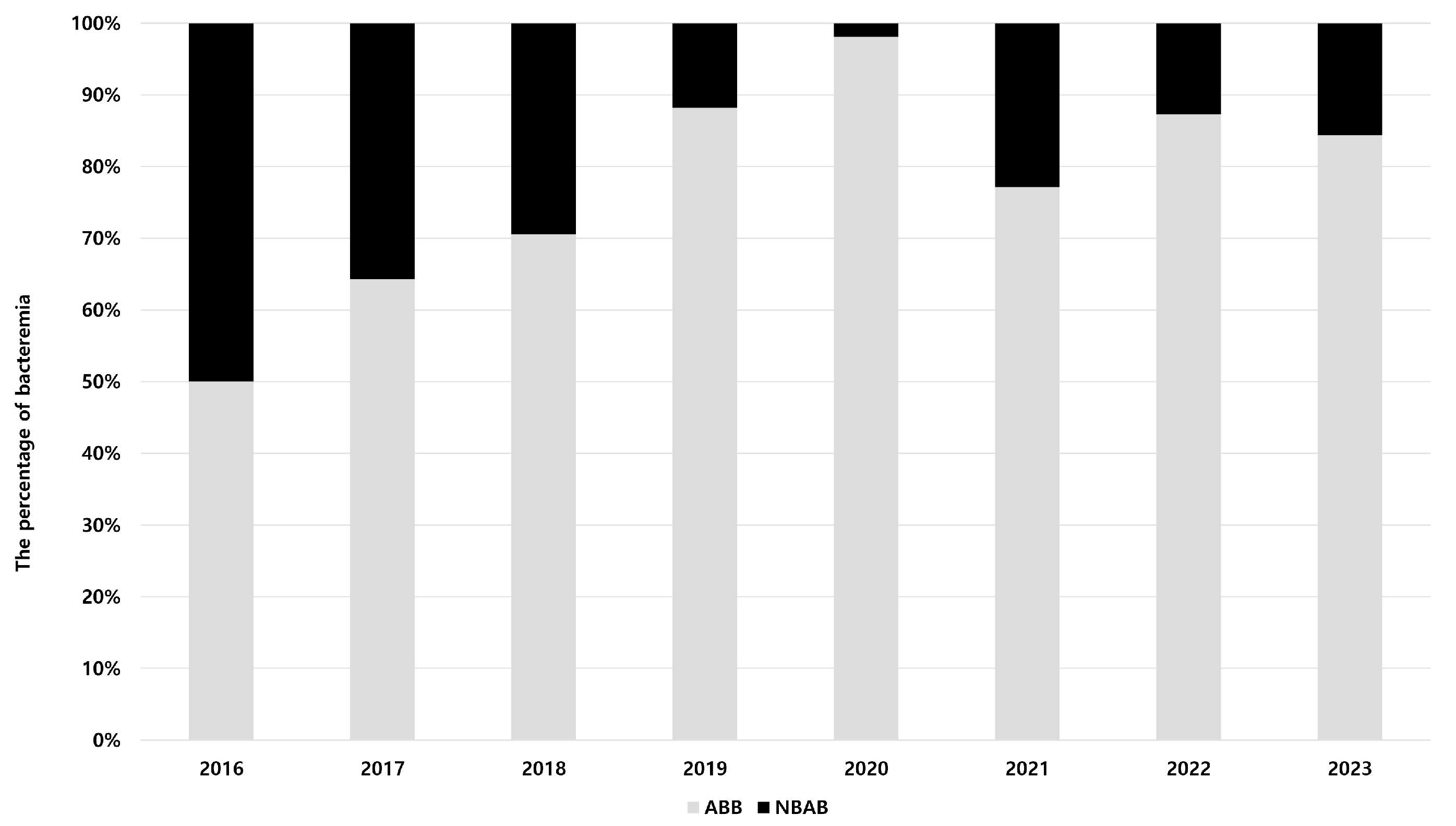
Objectives: This study aimed to compare clinical characteristics, antimicrobial susceptibility, and 28-day mortality between patients with Acinetobacter baumannii bacteremia (ABB) and non-baumannii Acinetobacter bacteremia (NBAB) after rapid matrix-assisted laser desorption ionization time-of-flight (MALDI-TOF) mass spectrometry (MS) species identification. Methods: We retrospectively reviewed the clinical data of adult ABB and NBAB patients over >7 years. Multivariate logistic regression was used to identify the risk factors for 28-day mortality. Results: Of 273 episodes of Acinetobacter species bacteremia, 224 (82.1%) were ABB and 49 (17.9%) were NBAB. NBA isolates were predominantly A. nosocomialis (49%), with smaller proportions of A. bereziniae, A. junii, A. ursingii, and others. The primary sites of infection in NBAB cases were the intra-abdomen, urinary tract, intravascular catheters, and lungs. While only 4.0% of A. baumannii isolates were susceptible to carbapenem, 87.8% of non-baumannii Acinetobacter isolates were susceptible. Multivariate analysis revealed that low carbapenem resistance was independently associated with NBAB. Additionally, a higher Pitt bacteremia score, septic shock, continuous renal replacement therapy, inappropriate empirical antibiotic therapy, and thrombocytopenia were independent risk factors for the 28-day mortality in patients with ABB. Conclusions: Although less common than ABB, NBAB cases are increasing and exhibit lower carbapenem resistance. Rapid MALDI-TOF MS identification enables timely and appropriate antibiotic treatment. The key factors driving the 28-day mortality include illness severity, septic shock, renal replacement therapy, inappropriate antibiotics, and thrombocytopenia, highlighting the need for early risk assessments and tailored management. Ongoing surveillance and species-specific strategies are essential for combating resistant Acinetobacter infections.
Keywords: non-baumannii Acinetobacter; A. baumannii; bacteremia; association factor; 28-day mortality non-baumannii Acinetobacter; A. baumannii; bacteremia; association factor; 28-day mortality