Article

Automatic Detection and Classification of Epileptic Seizures from EEG Data: Finding Optimal Acquisition Settings and Testing Interpretable Machine Learning Approach


by
Yauhen Statsenko
1,2,3,*,†,
Vladimir Babushkin
1,†,
Tatsiana Talako
1,4,
Tetiana Kurbatova
1,
Darya Smetanina
1,
Gillian Lylian Simiyu
1,
Tetiana Habuza
3,5,
Fatima Ismail
6,
Taleb M. Almansoori
1,
Klaus N.-V. Gorkom
1,
Miklós Szólics
7,8,
Ali Hassan
7 and
Milos Ljubisavljevic
9,10
1
Radiology Department, College of Medicine and Health Sciences, United Arab Emirates University, Al Ain P.O. Box 15551, United Arab Emirates
2
Medical Imaging Platform, ASPIRE Precision Medicine Research Institute Abu Dhabi, Al Ain P.O. Box 15551, United Arab Emirates
3
Big Data Analytics Center, United Arab Emirates University, Al Ain P.O. Box 15551, United Arab Emirates
4
Department of Oncohematology, Minsk Scientific and Practical Center for Surgery, Transplantology and Hematology, 220089 Minsk, Belarus
5
Department of Computer Science and Software Engineering, College of Information Technology, United Arab Emirates University, Al Ain P.O. Box 15551, United Arab Emirates
6
Pediatric Department, College of Medicine and Health Sciences, United Arab Emirates University, Al Ain P.O. Box 15551, United Arab Emirates
7
Neurology Division, Medicine Department, Tawam Hospital, Al Ain P.O. Box 15258, United Arab Emirates
8
Internal Medicine Department, College of Medicine and Health Sciences, United Arab Emirates University, Al Ain P.O. Box 15551, United Arab Emirates
9
Physiology Department, College of Medicine and Health Sciences, United Arab Emirates University, Al Ain P.O. Box 15551, United Arab Emirates
10
Neuroscience Platform, ASPIRE Precision Medicine Research Institute Abu Dhabi, Al Ain P.O. Box 15551, United Arab Emirates
*
Author to whom correspondence should be addressed.
These authors contributed equally to this work.
Biomedicines 2023, 11(9), 2370; https://doi.org/10.3390/biomedicines11092370

Submission received: 5 June 2023 / Revised: 13 July 2023 / Accepted: 21 July 2023 / Published: 24 August 2023
(This article belongs to the Section Neurobiology and Clinical Neuroscience)

Abstract

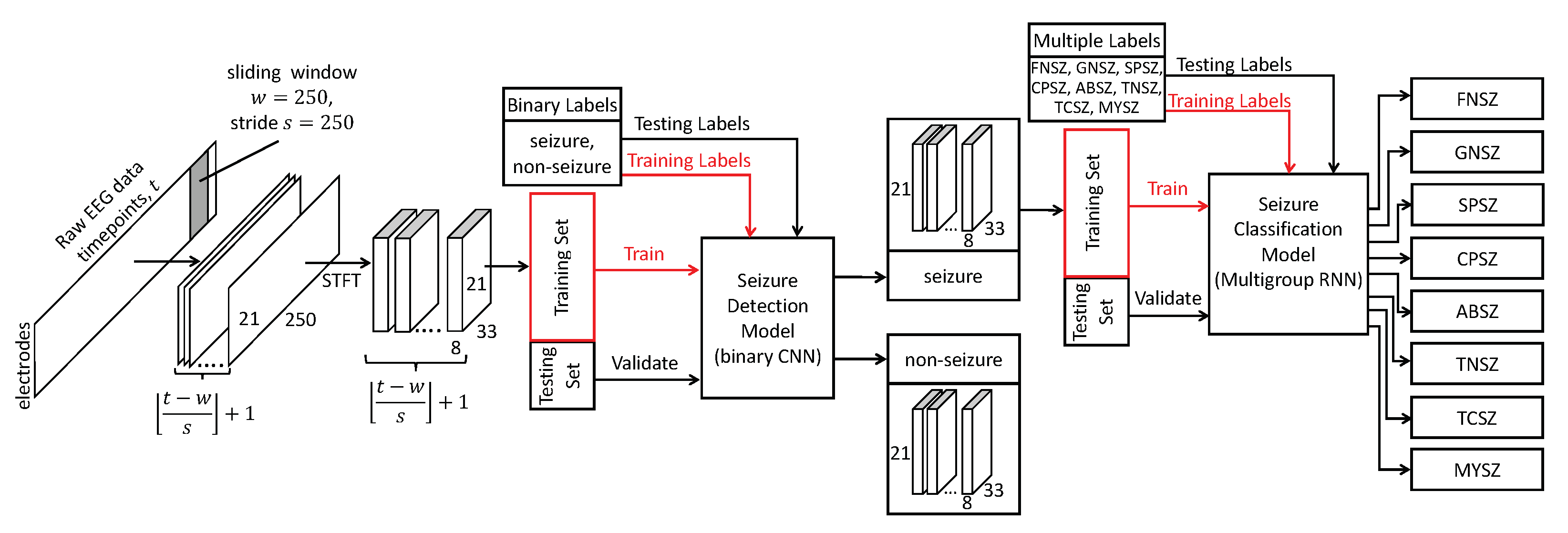
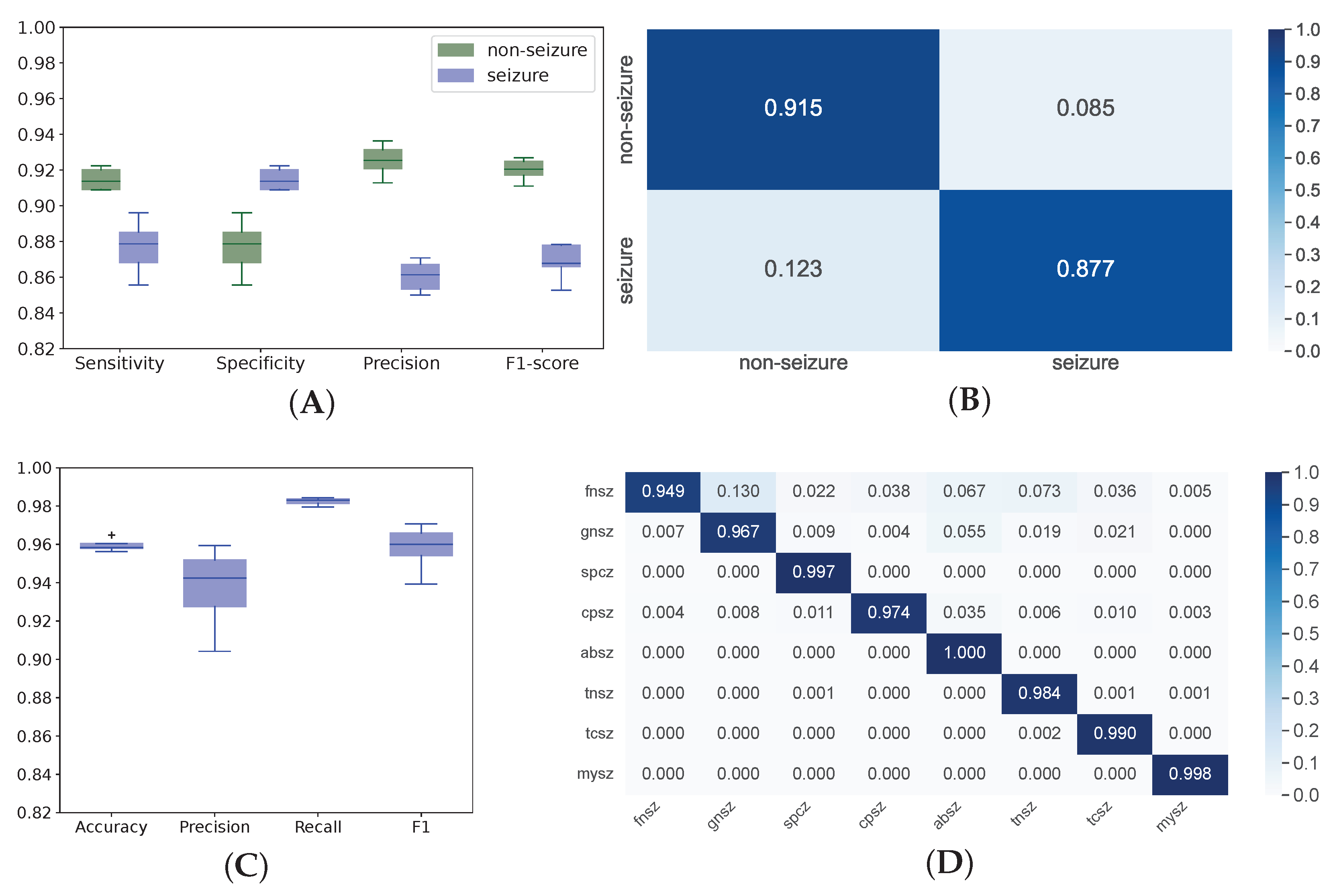
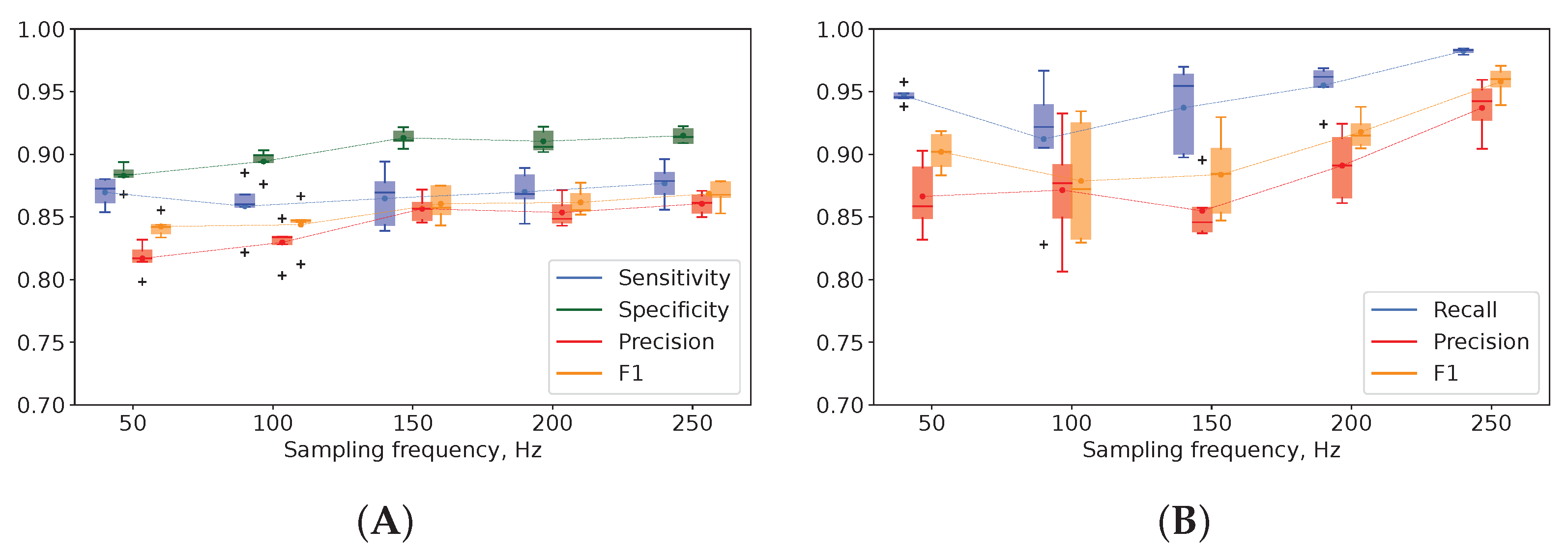
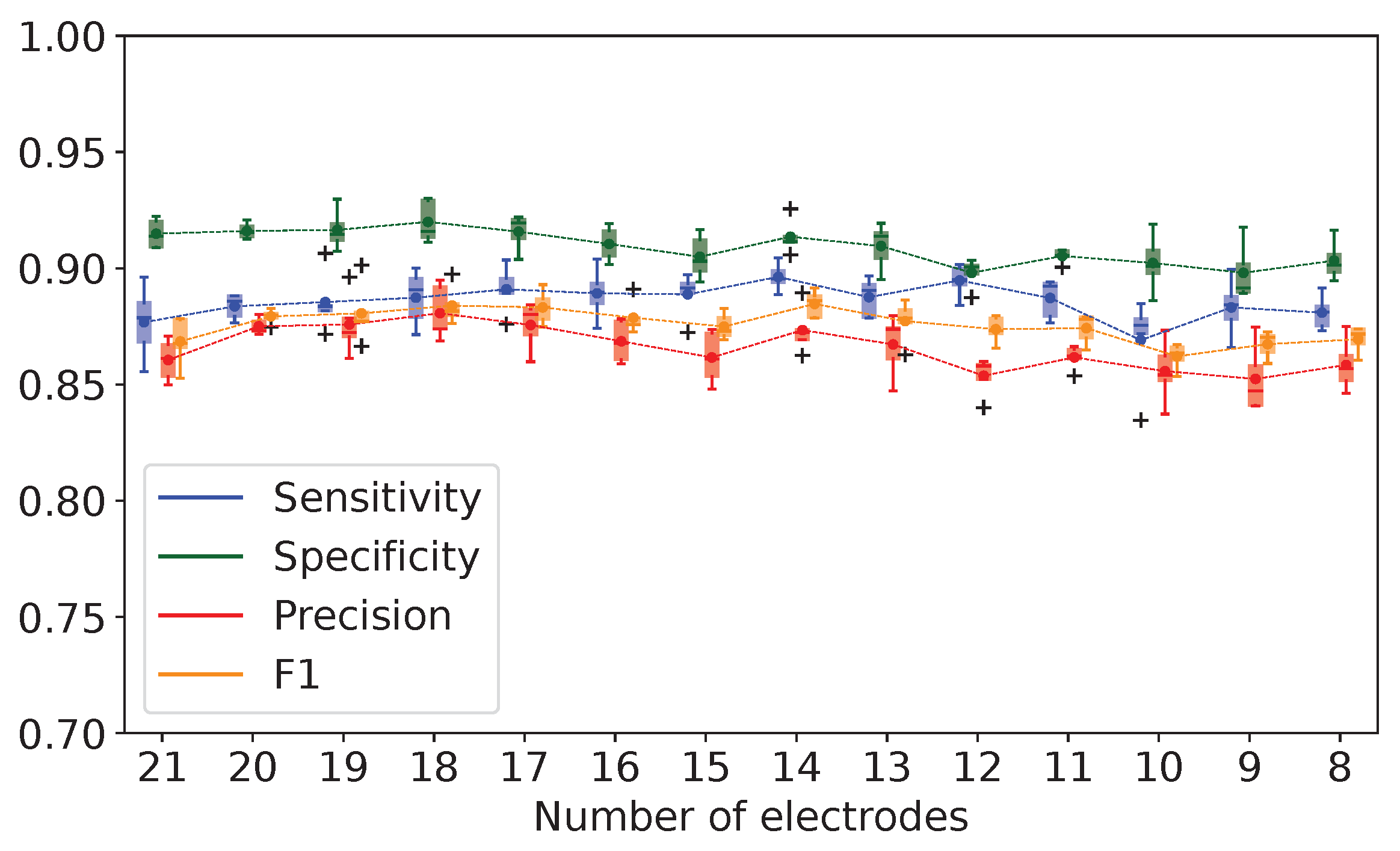
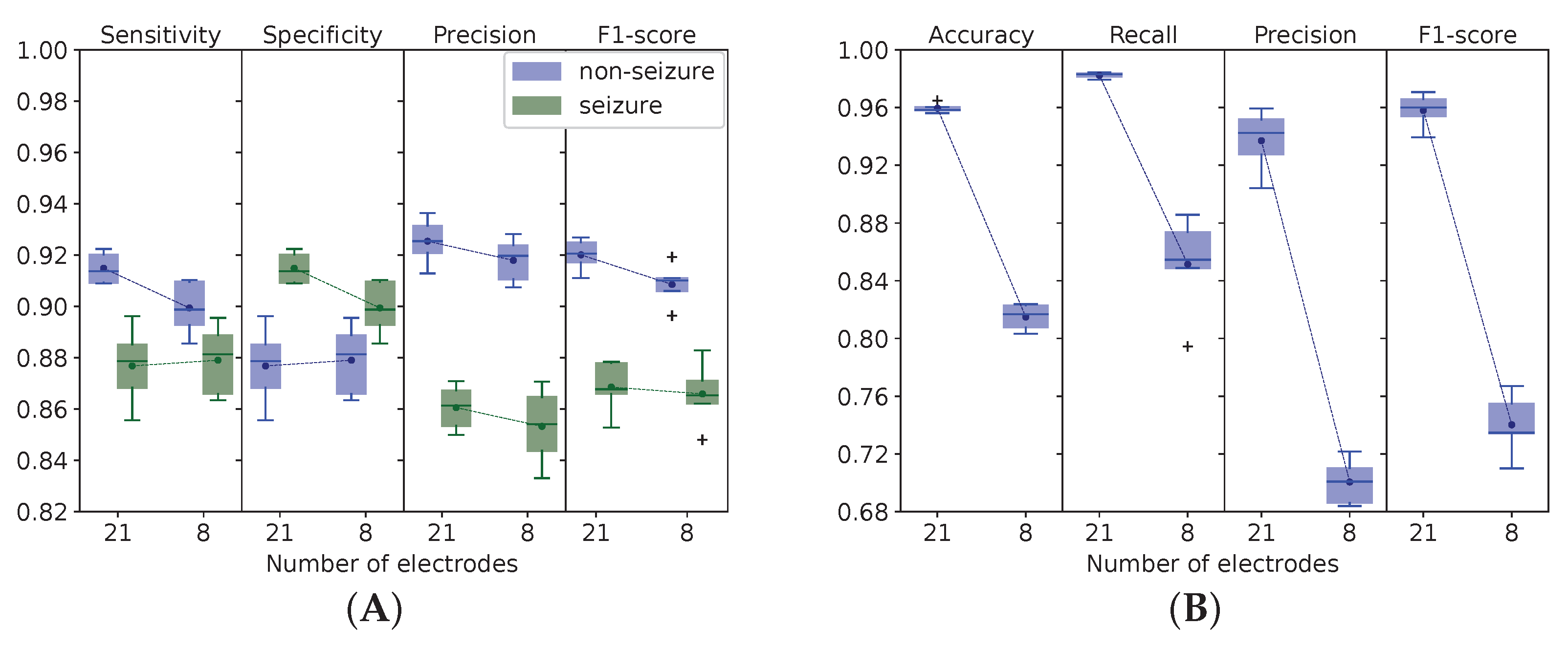
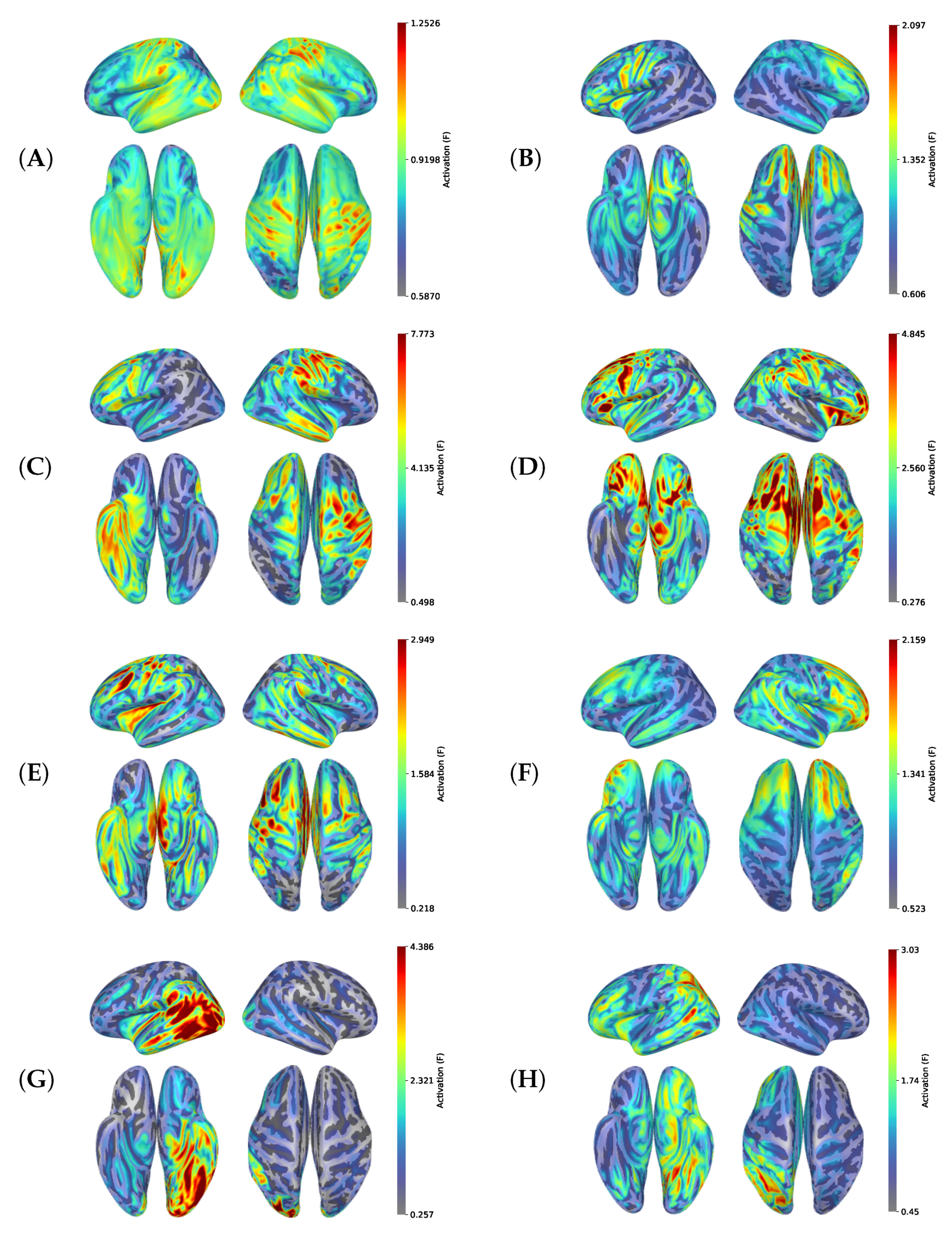
Deep learning (DL) is emerging as a successful technique for automatic detection and differentiation of spontaneous seizures that may otherwise be missed or misclassified. Herein, we propose a system architecture based on top-performing DL models for binary and multigroup classifications with the non-overlapping window technique, which we tested on the TUSZ dataset. The system accurately detects seizure episodes (87.7% Sn, 91.16% Sp) and carefully distinguishes eight seizure types (95–100% Acc). An increase in EEG sampling rate from 50 to 250 Hz boosted model performance: the precision of seizure detection rose by 5%, and seizure differentiation by 7%. A low sampling rate is a reasonable solution for training reliable models with EEG data. Decreasing the number of EEG electrodes from 21 to 8 did not affect seizure detection but worsened seizure differentiation significantly: 98.24 ± 0.17 vs. 85.14 ± 3.14% recall. In detecting epileptic episodes, all electrodes provided equally informative input, but in seizure differentiation, their informative value varied. We improved model explainability with interpretable ML. Activation maximization highlighted the presence of EEG patterns specific to eight seizure types. Cortical projection of epileptic sources depicted differences between generalized and focal seizures. Interpretable ML techniques confirmed that our system recognizes biologically meaningful features as indicators of epileptic activity in EEG.
Keywords: deep learning; interpretable machine learning; activation maximization; epileptic seizure; EEG; acquisition settings; source reconstruction deep learning; interpretable machine learning; activation maximization; epileptic seizure; EEG; acquisition settings; source reconstruction