Review

A Comprehensive Review of Algorithms for Drift Compensation in Metal Oxide Semiconductor Gas Sensor Arrays


1
The State and Local Joint Engineering Laboratory of Perception Mine, China University of Mining and Technology, Xuzhou 221116, China
2
School of Information and Control Engineering, China University of Mining and Technology, Xuzhou 221116, China
3
Tiandi Changzhou Automat Co., Ltd., Changzhou 213000, China
4
China Coal Technology & Engineering Group Changzhou Research Institute, Changzhou 213000, China
5
State Key Laboratory of Intelligent Coal Mining and Strata Control, Changzhou 213000, China
*
Author to whom correspondence should be addressed.
Chemosensors 2026, 14(6), 143; https://doi.org/10.3390/chemosensors14060143
Submission received: 10 May 2026 / Revised: 7 June 2026 / Accepted: 15 June 2026 / Published: 18 June 2026
(This article belongs to the Section Applied Chemical Sensors)

Abstract

Metal oxide semiconductor (MOS) gas sensors are an important part of electronic nose technology because they are sensitive, cheap, and work well with microfabrication for system integration. But sensor drift makes them less useful for long-term, continuous gas monitoring. Changes in how sensors respond over time make pattern recognition models that were trained at first less accurate. This review looks at new ways to deal with sensor drift, with a focus on transfer learning and deep learning methods that have been developing continuously in the last five years. It emphasizes the shift from conventional recalibration and component correction to sophisticated methodologies, including deep domain adaptation, contrastive representation learning, and attention-based models. The review does not just list these methods; it also analyzes their pros and downsides, especially in situations where there is not much labeled data, drift is hard to anticipate, or the computational resources are limited, which is often the case with edge sensors.

1. Introduction

Metal oxide semiconductor (MOS) gas sensors have been widely employed in many fields such as environmental monitoring, safety warning, etc. They are inexpensive, sensitive to a wide variety of volatile chemicals, and rugged enough to withstand harsh industrial settings [1,2,3,4]. They are in principle the perfect building block for an electronic nose. In practice, they have an inherent drift problem, which causes mistakes and substantially shortens the valid lifetime of MOS gas sensors. Vergara et al. show that the classification accuracy of a 16-sensor MOS array has dropped from 95% to less than 60% after 36 months without any adjustment [5]. More recent work has revealed similar degradation in practically all MOS gas sensors, irrespective of the oxide material or array shape [6,7]. The practical result of this is that E-nose systems based on MOS arrays need to be recalibrated periodically, which interrupts continuous monitoring. So, it is often not practical to use in field deployments. In the early days, research in the area of drift compensation has gained increased attention during the past five years, in particular, driven by breakthroughs in transfer learning and deep neural networks, originating from the field of computer vision and natural language processing. In 2018, methods such as adversarial domain adaptation, contrastive self-supervised learning, and Transformer architectures were unusual, but now they are frequently used to sensor data [8,9,10,11,12,13,14,15,16,17]. Meanwhile, the practical community has objected, saying that computationally intensive deep models are not well-suited for the resource-constrained microcontrollers on which most MOS sensor nodes actually operate [18,19,20,21,22].
The ultimate objective of drift compensation is not merely to correct sensor response variations, but to maintain the reliability of downstream sensing tasks as well. In MOS gas sensor arrays, drift compensation algorithms are primarily designed to preserve the performance of gas classification, concentration estimation, mixture analysis, and anomaly detection models under long-term deployment conditions. Depending on the application scenario, the target task may involve identifying a specific gas in the presence of interfering species, estimating gas concentrations, monitoring food freshness through volatile compounds, detecting environmental pollutants, or analyzing human breath biomarkers. Sensor drift introduces distribution shifts that gradually degrade the discriminative and quantitative capabilities of these models. Therefore, modern drift compensation methods should be viewed as task-oriented adaptation strategies that aim to maintain sensitivity, selectivity, and predictive accuracy throughout the operational lifetime of the sensing system [23,24,25,26].
This review tries to work through that tension. Our focus is on MOS-based gas sensor arrays, which have been the most studied subject in E-nose drift research, and we chronologically structure the discussion into three learning paradigms: early traditional approaches, machine learning methods, and deep learning methods. For each paradigm, we consider what has been proposed recently, what has been shown on realistic benchmarks, and what is still open. We do not try to cover all papers released at this time. Instead, we have chosen exemplary and prominent books demonstrating important methodological tendencies, and we aim to give an honest account of their strengths and flaws. Alongside a complete library, we want to give a key reference for researchers new to the area, or to search for the right approaches for certain deployment scenarios. But MOS sensors are not the same as conducting polymers, quartz crystal microbalances, and electrochemical cells, and lumping them together hides critical differences. The drift mechanisms of MOS sensors are specific to the sensors and include grain coarsening at high operating temperatures, surface poisoning by sulfur compounds and silicones, and humidity-dependent baseline shifts, which lead to characteristic drift signatures that are quite different from those observed in, e.g., polymer-based arrays [27]. Methods that work well for one sensor technology may not transfer to another. By restricting our scope to MOS arrays, we can discuss drift mechanisms, compensation strategies, and experimental results with focus.
The rest of this article is structured as follows. Section 2 discusses the physicochemical origin of MOS sensor drift and introduces the benchmark data set for evaluation. Section 3 reviews the early traditional drift compensation methods. Section 4 introduces machine-learning-based drift compensation methods. Section 5 summarizes and analyzes the deep-learning-based drift compensation method in detail, focusing on domain adaptation and self-supervised learning. Section 6 gives a summary and future prospects.

2. Basics and Origins of Drift in MOS Gas Sensors

2.1. The MOS Sensing Mechanism

A MOS gas sensor consists of a metal oxide semiconducting film—most commonly SnO2, but also ZnO, WO3, TiO2, In2O3, or doped variants [28,29,30,31]. These materials belong primarily to the n-type metal oxide semiconductor family, whereas representative p-type MOS materials include CuO, NiO, and Cr2O3 [32,33]. The film is deposited on a substrate with interdigitated electrodes and heated to an operating temperature typically between 200 °C and 500 °C [28]. At these temperatures, atmospheric oxygen adsorbs on the surface and traps electrons from the conduction band, creating a depletion layer at grain boundaries that increases baseline resistance. When a reducing gas (ethanol, CO, acetone, ammonia) reaches the surface, it reacts with the adsorbed oxygen, releasing electrons back into the conduction band and lowering the resistance. Oxidizing gases (NO2, O3) have the opposite effect. How much the resistance changes relies on the type of gas, how much of it there is, the temperature at which the sensor is used, and the film’s microstructural properties [34]. Usually, an E-nose is made up of 4–16 MOS sensors that work at different temperatures or have different oxide compositions. These sensors work together to make a chemical fingerprint, which is a multivariate response pattern that can tell the difference between different gases or gas mixtures [35].
Recent commercial MOS sensing platforms have also adopted multi-sensor architectures combined with embedded digital compensation algorithms. For example, the SGP41 sensor (Sensirion AG, Stafa, Switzerland) integrates multiple sensing elements and on-chip signal-processing functions for volatile organic compound (VOC) and NOx monitoring. Similarly, the ENS16x (ScioSense B.V., Eindhoven, The Netherlands) digital metal-oxide gas sensor family incorporates environmental compensation and algorithm-assisted signal processing to improve measurement stability under varying operating conditions. These developments demonstrate that drift compensation is no longer solely an academic research topic but has become an essential component of practical industrial gas-sensing systems.

2.2. Origins of MOS Sensors Drift

The stability problem in MOS sensors has been widely explored, and presently, various factors are well understood [36]:
(1)
Microstructure evolution. The high operating temperatures that make MOS sensors reactive also cause irreversible alterations in the sensing film. Grain growth (Ostwald ripening) decreases the specific surface area and modifies the grain-boundary density, which directly affects the baseline resistance and sensitivity to target gases. This is a slow but accumulative process, leading to the monotonic drift patterns over months and years [37].
(2)
Structure and phase transformations. Prolonged heating can cause phase transformations of the oxide (e.g., amorphous to crystalline SnO2), interdiffusion of the sensing layer and the electrode material, and sintering of catalytic dopant nanoparticles (Pt, Pd, Au). In each of these steps, the surface chemical reactivity is altered in ways not easy to anticipate from fundamental principles [38].
(3)
Surface toxicity. Some volatile species (notably sulfur compounds H2S, SO2, silicone vapors from sealants and lubricants, and aerosols of heavy metals) are irreversibly adsorbed on the oxide surface, permanently inhibiting active sites. This is usually the main cause of long-term loss of sensitivity in industrial settings [39].
(4)
Humidity interference. Water vapor competes with target analytes for adsorption sites and alters the surface hydroxyl population, resulting in substantial and typically nonlinear shifts in baseline resistance. Because ambient humidity fluctuates from hour to season, these effects are layered onto the gradual material degradation trends, resulting in complex multi-timescale drift patterns [40].
(5)
Fluctuations in temperature. Modern MOS sensors are typically equipped with integrated microheaters that maintain a stable operating temperature, thereby minimizing the influence of minor ambient temperature variations. However, under long-term deployment or in environments with substantial temperature fluctuations, changes in reaction kinetics and charge transport processes may still affect sensor responses and contribute to additional drift components [41].
The complexity of drift is a result of the nonlinear interactions and simultaneous operation of these mechanisms. The drift trajectory of a specific sensor is not a straightforward additive offset or multiplicative scaling; rather, it is a complex, time-varying, and partially stochastic transformation of the entire response characteristic. Furthermore, the multivariate pattern on which the classification model is predicated may be distorted by the varying rates and directions at which sensors within the same array drift.

2.3. Benchmark Dataset

2.3.1. The UCI Gas Sensor Array Drift Dataset

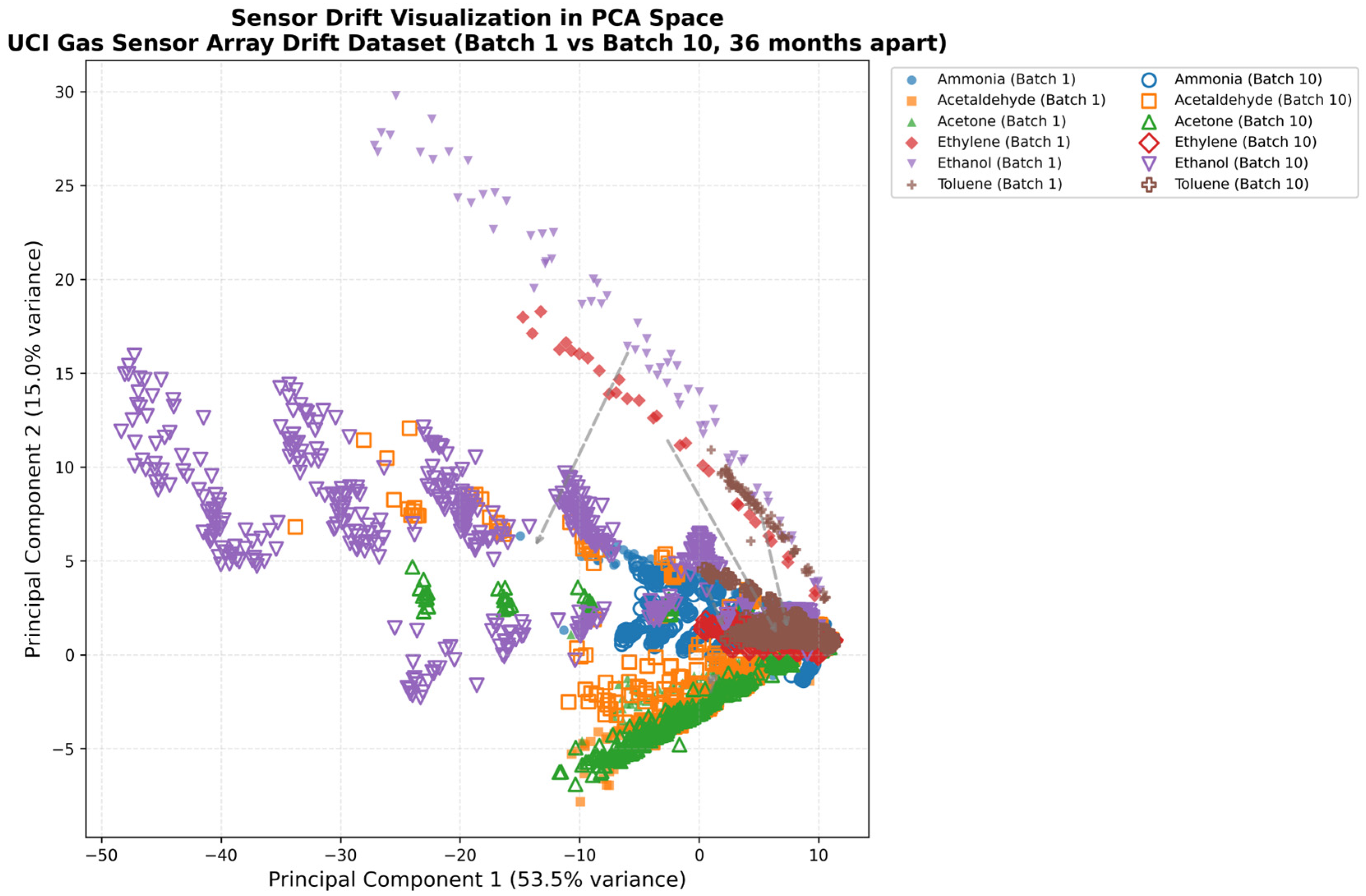
The overwhelming majority of recent drift compensation studies use the University of California, Irvine (UCI) Gas Sensor Array Drift Dataset, which contains 13,910 measurements from 16 chemical sensors [5]. The dataset is used in simulations to compensate for drift in a discrimination task involving six gases at various concentrations. The dataset was collected from January 2007 to February 2011 (36 months) at a gas delivery platform facility located at the ChemoSignals Laboratory at the BioCircuits Institute, University of California, San Diego. Eight features were extracted from each sensor, and accordingly, each observation was a 128-dimensional (16 × 8) vector. In particular, two types of features were considered: steady-state features (the amplitude of the resistance change and its normalized value) and six transient features reflecting the dynamic sensor response. The dataset was then divided into 10 batches by month, based on the collected time series. The resulting dataset comprises recordings of six distinct pure gaseous substances, namely ammonia, acetaldehyde, acetone, ethylene, ethanol, and toluene, each dosed at a wide range of concentrations from 5 to 1000 ppm, as shown in Figure 1. The dataset has become the de facto standard for benchmarking drift compensation methods. The primary purpose of providing this dataset is to make it freely accessible online to the chemo-sensor research community and artificial intelligence to develop strategies to cope with sensor/concept drift. Its widespread adoption has the advantage of enabling direct comparison between methods but also carries the risk of overfitting the community’s algorithmic efforts to a single, somewhat constrained experimental scenario.
Despite its value, the UCI Gas Sensor Array Drift Dataset has limitations, notably the lack of robust statistical validation in prior studies. These studies reported promising drift compensation results but risk overcompensation by suppressing class-discriminative variance. The six analytes are relatively easy to distinguish even without drift compensation at many concentration levels, and the concentrations were carefully controlled in a laboratory setting. Real-world applications—food spoilage detection, environmental monitoring, breath analysis—involve far more complex and variable gas mixtures. Limitations of the dataset include its collection on a single device under controlled lab settings, and it does not allow examination of cross-device transfer or environmental variability. Furthermore, the community uses non-standardized evaluation techniques, with many studies based on single trials and lacking statistical rigor. Dennler et al. pointed out concentration-dependent confounds that could lead to an overestimation of classification performance, whereas Chang et al. emphasized the importance of disentangling true drift effects from batch-level concentration imbalances. Results obtained on the UCI dataset should thus be considered as required, but not a sufficient condition for practical feasibility.
An extended version of the dataset, the UCI Gas Sensor Array Drift Dataset at Different Concentrations [42], contains the same 13,910 measurements from 16 chemical sensors exposed to six different gases at various concentration levels, with explicit concentration labels appended. This extension is particularly valuable for studies that address drift compensation in the context of quantitative concentration estimation (regression) rather than purely qualitative gas classification.

2.3.2. The Gas Sensor Array Under Dynamic Gas Mixtures Dataset

Fonollosa et al. published a dataset on continuous exposure to dynamic binary gas mixtures, which is also hosted at the UCI Machine Learning Repository [43]. The data set contains recordings from 16 chemical sensors exposed to two dynamic gas mixtures at varying concentrations; for each mixture, signals were acquired continuously for 12 h. In particular, two gas mixtures were generated: ethylene and methane in air, and ethylene and CO in air. Each measurement was constructed by continuously acquiring signals from the 16-sensor array for about 12 h without interruption. The sensor array included 16 chemical sensors (Figaro Inc., Rolling Meadows, IL, USA) of four different types: TGS-2600, TGS-2602, TGS-2610, TGS-2620 (four units of each type). The concentration transitions were set at random times and at random concentration levels, and the experiment was designed to ensure that all possible transitions (increasing, decreasing, or setting one volatile to zero while the other remains constant) were represented. The primary purpose of making this data set freely accessible online is to provide extensive, continuous time series data acquired from chemical sensors to the sensor and artificial intelligence research communities. In particular, the data set may be useful for developing algorithms for continuous monitoring or improving the response time of sensory systems. While this dataset was not specifically designed for long-term drift studies, it is valuable for evaluating temporal modeling approaches (e.g., Gated Recurrent Unit (GRU), Long-Short Time Memory (LSTM), and Transformer-based architectures) in the context of rapidly changing gas environments—a scenario that is complementary to the slow, month-scale drift captured by the UCI drift dataset.

2.3.3. The Gas Sensor Array Exposed to Turbulent Gas Mixtures Dataset

A related but distinct dataset was published by Fonollosa et al. [44], in which a chemical detection platform composed of eight chemo-resistive gas sensors was exposed to turbulent gas mixtures generated naturally in a wind tunnel. The experimental setup was designed to test gas sensors in realistic environments. Traditionally, chemical detection systems based on chemo-resistive sensors include a gas chamber to control sample airflow and minimize turbulence. Instead, Vergara et al. utilized a wind tunnel with two independent gas sources that generate two gas plumes [45]. The plumes naturally mix in turbulent flow and reproduce the gas concentration fluctuations observed in natural environments. The sensing platform included 72 metal-oxide gas sensors positioned at six locations in the wind tunnel. At each location, 10 distinct chemical gases were released in the wind tunnel; the sensors were evaluated at five different operating temperatures, and three different wind speeds were generated to induce varying levels of turbulence. Moreover, each configuration was repeated 20 times, yielding a dataset of 18,000 measurements. The dataset was collected over a period of 16 months [45]. This dataset is especially useful for testing drift compensation methods in realistic open-sampling conditions, where turbulence, advection, and diffusion result in extremely varied and noisy sensor responses. The 16-month collecting period also adds significant temporal drift, making it an ideal testbed for algorithms that must deal with both environmental variability and sensor aging.

2.3.4. The Electronic Nose Long-Term Drift Behavior Dataset

A notable recent contribution is the long-term drift behavior dataset published by Wörner et al. in 2025 [46]. This motivated the authors to introduce a new long-term drift dataset. It has been collected for over 12 months using a commercial electronic nose, which is based on 62 metal-oxide sensors. The measurements were conducted under controlled experimental conditions with three analytes (diacetyl, 2-phenylethanol, and ethanol) in different concentrations. The dataset consists of 700 time-series recordings, for which both the raw data and a set of pre-extracted features are provided. While ongoing research focuses on effective correction methods, the evaluation of these methods requires reliable and well-documented datasets. However, only a few drift datasets are available, and some lack sufficient experimental detail or are outdated. This dataset represents a significant step forward in several respects. The use of 62 sensors (compared to 16 in the UCI dataset) provides a much higher-dimensional feature space; the inclusion of raw time-series data enables research on feature extraction and temporal modeling; and the analytes (particularly diacetyl and 2-phenylethanol) are more representative of practical E-nose applications, such as beverage quality monitoring. The data can support the development, evaluation, and comparison of methods for feature extraction and selection, as well as drift detection and compensation. The dataset is publicly available through Zenodo.

2.3.5. Proprietary and Application-Specific Datasets

In addition to benchmarks that are available to the public, several groups have also reported results from their own datasets that capture drift in certain application areas. Recently, secret datasets have been used for a wide range of tasks, from finding industrial waste [47] to figuring out mixed gas regression under drifting. An important new study used a H2S–SO2 mixed gas drift dataset to test regression-based drift adjustment. This differs from the UCI dataset [48], which only considered classification problems. The authors tested their method on a mixed gas drift dataset that they gathered themselves. They focused on the new and difficult task of regression-based drift compensation. Although these private datasets often show more realistic and difficult conditions than public standards, the fact that they are not open to the public makes it much harder to reproduce and compare results with different methods.

2.3.6. Summary and Critical Assessment

Table 1 provides an overview of the major benchmark datasets used in E-nose drift compensation research.
Several critical observations emerge from this overview:
  • Excessive reliance on one benchmark. The UCI Gas Sensor Array Drift Dataset is so widely used in the literature that algorithmic success may actually represent overfitting to the dataset’s unique characteristics, rather than true progress in drift robustness. It has six well-separated analytes, controlled laboratory conditions, and pre-extracted features that do not reflect the complexity of real-world deployment in an adequate manner.
  • Lack of standardized evaluation protocols. Even when using the same dataset, studies differ substantially in how they partition batches into source and target domains, whether they use leave-one-batch-out or cumulative training protocols, and which metrics they report. This inconsistency makes cross-method comparisons unreliable. As recent work has emphasized, statistical significance should be tested with multiple random test set partitions to systematically and statistically validate a method’s robust performance under various sensor drift conditions.
  • Few regression standards. Many real-world situations need concentration estimates, but most public datasets are organized around classification tasks. Adding concentration names to the UCI dataset is a good step forward, but there are still not many datasets that show how drift affects regression accuracy across a wide range of concentrations. There is also excessive reliance on one benchmark. The UCI Gas Sensor Array Drift Dataset is so widely used in the literature that algorithmic success may actually represent overfitting to the dataset’s unique characteristics, rather than true progress in drift robustness. It has six well- separated analytes, controlled laboratory conditions, and pre-extracted features which do not reflect the complexity of real-world deployment in an adequate manner.
  • There are no complex, multi-factor drift cases. In the real world, drift is caused by material aging, changes in humidity and temperature, and surface poisoning (as we discussed in Section 2.2). Most of these factors are taken into account in existing datasets, but they only show temporal drift, not the multi-factor, non-stationary drift trends that happen in the field. The turbulent gas mixtures dataset starts to look at how the environment can change, but there are still no purpose-built datasets that combine temporal drift with actual changes in the environment.
  • Welcome, but still insufficient new contributions. Although electronic nose technology has been studied for years, drift effects remain a major challenge. While ongoing research focuses on effective correction methods, the evaluation of these methods requires reliable and well-documented datasets. However, only a few drift datasets are available, and some lack sufficient experimental detail or are outdated. This motivated the introduction of new long-term drift datasets. The 2025 dataset by Wörner et al. represents a promising step, but additional datasets covering diverse sensor platforms, environmental conditions, and application domains are needed to advance the field beyond single-benchmark validation.

2.4. Relationship Between Dataset Features and Sensor Performance Metrics

Most drift compensation algorithms operate on features extracted from sensor responses rather than directly on physical sensing parameters. Typical features include baseline resistance, response amplitude, normalized response, response and recovery rates, transient slopes, principal components, and learned latent representations. These features are closely associated with the three fundamental performance indicators of MOS gas sensors: sensitivity, selectivity, and stability.
Sensitivity reflects the magnitude of sensor response to changes in gas concentration and is commonly represented by response amplitude-related features. Selectivity refers to the ability of a sensor array to discriminate among different gases or gas mixtures and is often characterized through multivariate feature distributions and class separability in feature space. Stability describes the consistency of sensor responses over time and is directly affected by drift-induced changes in feature distributions.
From a machine-learning perspective, drift compensation algorithms aim to preserve the discriminative information associated with sensitivity and selectivity while minimizing temporal variations that reduce stability. Consequently, many modern methods attempt to learn drift-invariant representations that maintain class-related information while suppressing aging-related, environmental, or device-dependent variations.

3. Early Traditional Drift Compensation Methods

In the early stage of electronic nose research, sensor drift was commonly regarded as an interference that could be mitigated through signal processing or statistical modeling. Consequently, existing studies mainly focus on preprocessing raw sensor responses, multivariate statistical correction, and early projection-based strategies. The aim of these approaches is to mitigate the effect of drift on classification tasks by modifying, deconstructing, or projecting the sensor data, without materially changing the following recognition models. In general, the approaches at this stage mostly focus on suppressing drift at the signal level, instead of explicitly describing it as a distribution shift between the source and target domains.
Classical drift correction methods are mostly based on signal pre-processing. These methods consider drift as a baseline shift, noise interference, or slowly varying components that are added to sensor outputs and aim to reduce their effects by applying simple mathematical operations. Common techniques include baseline correction, normalizing, filtering, and wavelet processing. Baseline correction assumes that drift is a general change in the sensor response and corrects it by removing the initial baseline value. Normalization is used to rescale sensor responses so that samples become more similar. Filtering and Wavelet analysis are used to remove high-frequency noise and unstable components. The first multivariate signal-processing approach for gas sensor drift correction was proposed by Artursson et al. [49]. They proposed to treat the drift as an additional disturbance in the sensor data. These methods are basic, computationally inexpensive, and commonly used in preliminary research ahead of more advanced drift compensation methods.
The emergence of chemometrics and multivariate statistical analysis has led scholars to model drift from a statistical-structure approach. Rudnitskaya and Legin [50] further summarized calibration-update and drift-correction strategies for electronic noses and electronic tongues, highlighting that drift could be modeled and separated from analytical information through multivariate statistical techniques. Typical methods are orthogonal signal correction (OSC), principal component analysis (PCA), independent component analysis (ICA) [51], and common principal component analysis (CPCA) [52]. Instead of treating drift as a noise that can be filtered out, these approaches view drift as a separable direction of variation or a latent statistical component in the data. ICA decomposes the sensor response into independent components, and the components associated with drift can be separated; CPCA separates the main directions common to all classes to increase robustness; and OSC removes variations that are not relevant to the target variable to increase discriminative power. This is a crucial step in the evolution of the notion of drift, from a purely random, noisy event to a structured, systematic variation that can be modeled using statistical decomposition and projection techniques.
In the later stages of traditional approaches, some works started to show the early notion of projection-based representation learning, where drift-related directions are reduced by mapping data into a more suitable feature space. While these approaches were not yet formal domain adaptation frameworks, they mark a conceptual move from simple preprocessing to learning stable representations in changed areas. CPCA implies the concept of shared representations, and early works based on manifold preservation, low-rank representation, or structural constraints try to preserve class-relevant information in the projected spaces. These works are still in the classic domain of drift compensation but give a significant conceptual basis for future subspace learning, transfer learning, and domain adaptation methods.
Benchmark studies based on long-term sensor-array datasets have demonstrated that conventional preprocessing and statistical correction methods often struggle to maintain robustness under severe temporal drift and changing environmental conditions [53]. Traditional drift compensating methods have played an important role in the early development of electronic nose systems. They are simple, easy to read, computationally cheap, and work well with small datasets or with minor drift. But there are definite limitations too. Most techniques are based on linear or simplified statistical assumptions, and hence cannot reflect the nonlinear, multifactor, and dynamic aspects of drift in long-term complex contexts. Moreover, they mainly focus on signal-level correction rather than the distribution mismatch between training and testing data. Furthermore, traditional approaches do not have the capacity to continuously update and adapt, which restricts their usefulness in long-term deployments. With the development of machine learning techniques, researchers have increasingly moved to data-driven approaches to improve resilience under drift situations. The subsequent part presents an in-depth study of machine learning-based approaches for drift compensation.

4. Machine Learning-Based Drift Compensation Methods

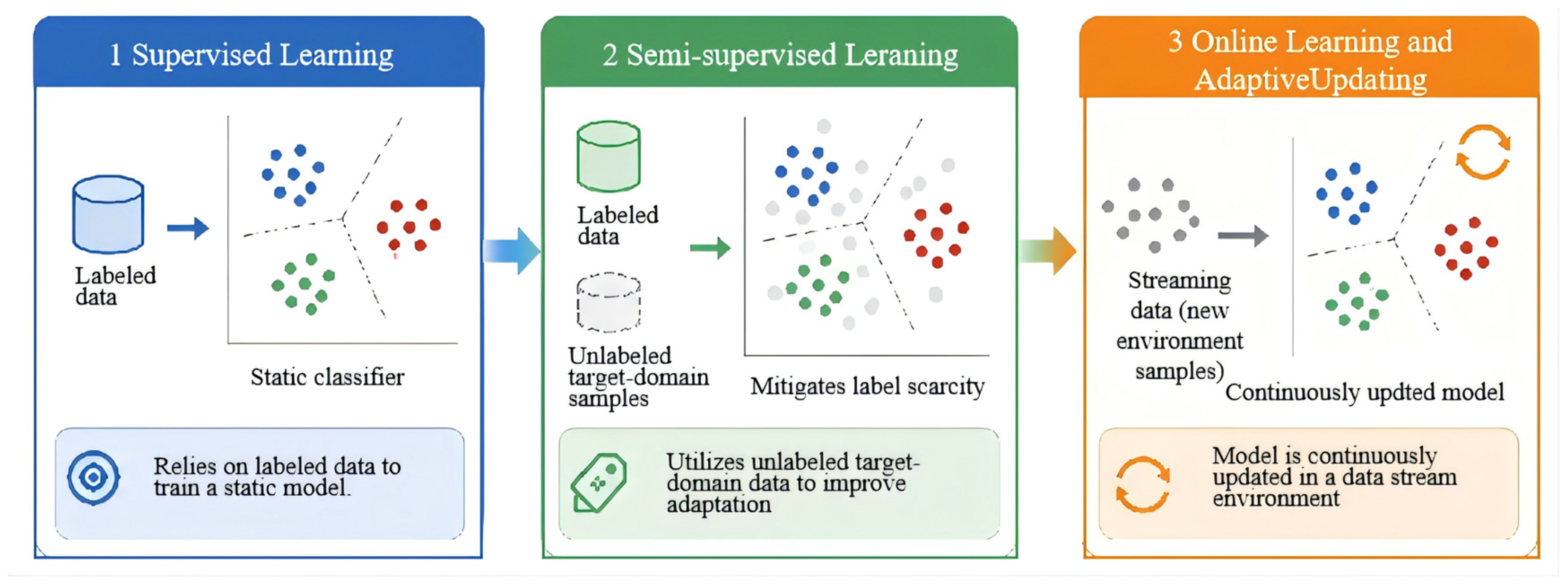
With the rapid development of machine learning, researchers have gradually shifted from classic signal preprocessing and statistical projection approaches to data-driven methods to construct drift compensation models. Compared to existing methods that try to remove the drift components from raw data, machine learning methods allow models to keep the discriminative power under the drift with classification models, incremental updates, and low-label learning procedures. This step developmentally is a key bridge between the classic statistical correction methods and the later domain adaptation and deep learning approaches. Supervised learning extends traditional pattern recognition models, and semi-supervised learning and adaptive updating processes are employed to handle the restricted availability of labeled data in the target domain. So, basically, it is the movement from passive rectification of signals towards active adaptation of models. In Figure 2, the progress of machine learning-based drift compensation from supervised learning to semi-supervised learning and ultimately online adaptive updating is shown, indicating the reduced label dependency and better dynamic adaptability.

4.1. Supervised Learning-Based Methods

Supervised learning is one of the first and most used data-driven approaches for recognizing patterns in the electrical signals. In the framework of supervised learning, models learn to map sensor response attributes to gas categories using labeled training samples. This enables the identification of gases or the estimation of their concentration. Some of the popular methods are support vector machine (SVM), artificial neural network (ANN), random forest (RF), extreme learning machine (ELM), and ensemble classifiers. These methods employ unambiguous model structures and sophisticated implementation methodologies. They often do a good job when the training and test data sets are similar. In the first phase of research on electronic nose drift compensation, a lot of effort was spent on developing more robust supervised classifiers to improve model stability under drift conditions. Thus, in the first phase of research on the compensation of electronic nose drift, a large part of the effort was dedicated to strengthening the stability of the model under drift situations by designing more robust supervised classifiers.
Current research indicates that the impact of drift can be reduced through the nonlinear modeling ability of classifiers and the robustness of decision boundaries, which are the basic elements on which supervised learning methods depend. SVM has been frequently used in gas identification jobs owing to its great generalization capacity and non-linear discriminant capability. Robustness is improved via ensemble approaches, such as random forest, that combine many weak classifiers and thus increase tolerance to noise and outliers. The ANN and ELM may learn complicated feature representations through the hidden-layer mappings. It may help to relieve the performance decrease caused by the drift. In addition, some studies have attempted to further enhance model stability by introducing multi-classifier architectures, feature selection strategies, or drift-aware training schemes. For example, Manna et al. [54] proposed a multi-classifier system for drift compensation, while Rehman et al. [55] improved recognition performance under long-term drift by exploiting transient features and classifier tree structures. These studies suggest that, in the absence of explicit transfer mechanisms, enhancing the expressive power and robustness of supervised models was a key strategy in early machine learning-based approaches. Recent studies have continued this line of research by incorporating PCA–ANN-based pattern recognition, automated model selection, ensemble optimization, and lightweight machine-learning frameworks, further improving the robustness and practical applicability of supervised classifiers in gas-sensor-array systems [56,57,58].
Nonetheless, drift compensation techniques predicated on supervised learning also demonstrate significant limitations. The main problem is that they need a lot of labeled data to set stable decision boundaries. When electronic nose systems are used for a long time, the target-domain data often shows big changes in distribution compared to the training data. In these situations, even classifiers that are very good at telling the difference between things have a hard time adapting directly to new drift conditions. To maintain performance, they usually need to collect and label many new samples. In real life, this process of recalibrating is expensive and hard to do often. So, depending only on supervised learning is not enough to fix model mismatches when there is long-term drift. Researchers are increasingly using semi-supervised learning methods that use unlabeled data to reduce the need for manual annotation.

4.2. Semi-Supervised Learning-Based Methods

To reduce the need for large amounts of labeled data in supervised learning, semi-supervised learning has been gradually incorporated into electronic nose drift adjustment. The main idea behind semi-supervised learning is to train a model using both a small number of labeled examples and a large number of unlabeled data points. This makes the model better at adapting to new data distributions when there are not many labels available. This model is very useful for electronic nose drift situations, where it is often possible to collect target-domain samples continuously over a long period, but obtaining their labels is expensive. Consequently, the proper utilization of unlabeled data is essential to sustaining model performance.
De Vito et al. [59] were among the first to systematically introduce semi-supervised learning into drift compensation for electronic noses. They argued that drift should not be seen as an unwanted disturbance that should be removed, but as an evolutionary process of distribution over time, to which models should gradually adapt by incorporating data from unlabeled samples. This work represents a conceptual shift, changing the focus from “eliminating drift” to “learning alongside drift evolution”. Liu et al. [60] expanded on this theory by combining semi-supervised learning with domain adaptation concepts. They said that drift compensation should go beyond typical static categorization frameworks. Instead, unlabeled samples from the target domain can be used to address distributional differences between the source and target domains. This enables information transfer even when there are few or no labels in the target domain. This is the start of a link between semi-supervised learning and subsequent transfer learning and domain adaptation.
Semi-supervised drift compensation methods commonly use self-training, pseudo-labeling, co-training, or a limited set of reference samples. These methods basically involve training a model on labeled source-domain data, which is subsequently used to predict labels for unlabeled target-domain samples. High-confidence predictions are selected as pseudo-labeled, and the model is retrained iteratively to adapt to the new domain. The main advantage of this strategy is its ability to adapt to drifting data without incurring additional manual labeling costs. Recent studies have improved performance by integrating semi-supervised learning with feature-space alignment, discriminative representation learning, or reference-sample matching. Recent international studies have further expanded semi-supervised drift compensation by combining pseudo-label learning with deep feature extraction, multi-source adaptation, and probabilistic drift modeling. These approaches improve the utilization of unlabeled target-domain samples and enhance model robustness under complex and continuously evolving drift scenarios [61,62]. In short, semi-supervised learning extends classification-based modeling and provides a foundation for domain adaptation and deep transfer learning in electronic nose drift adjustment.
However, there are some problems with semi-supervised learning as well. First, these methods depend a lot on how good the fake labels are. If the initial model makes biased predictions in the target area, wrong pseudo-labels may build up during iterative training, which will lower performance. Second, semi-supervised learning cuts down on the need for manual annotation, but it still depends on samples from the target area, and the degree of distribution shift has a big effect on how well it works. When there is a lot of drift, complicated class distributions, or big changes in the world, semi-supervised learning by itself is not always enough to keep long-term performance stable. As a result, academics have been focusing more and more on creating online learning and adaptive updating methods to allow models to be maintained continuously when data is flowing.

4.3. Online Learning and Adaptive Updating Methods

In real-world applications, electronic nose systems usually have to run continuously for long periods, which causes sensor drift to build up and change over time. Even if they perform well at first, static models trained offline frequently find it difficult to sustain steady performance over time in such circumstances. To address this issue, online learning and adaptive updating strategies have been proposed, which enable models to continuously update their parameters and decision bounds as new data become available. This work is interested in enhancing the model’s ability to adapt dynamically during continuous operation, as opposed to the preceding two categories, which aim at improving the model’s accuracy at a certain time point.
Online learning and adaptive updating methodologies often include techniques such as incremental learning, sample selection, active labeling, and recursive updating to maintain the performance of the model. One key line of work is to identify the most useful samples from the freshly arriving data for model updating and to reduce the manual labeling cost. For example, Liu et al. [63] presented the Active Learning based Adaptive Confidence Rule (AL-ACR) method that integrates active learning into the electronic nasal drift compensation by selecting representative samples to be manually labeled in an online fashion. This considerably speeds up updates when the drift happens over a long period. Then, Liu et al. [64] proposed Active Learning-Dynamic Clustering (AL-DC) approach, which solves the problem of unbalanced class coverage while selecting samples by dynamic clustering and active learning. Liu et al. [65] also developed the Dual-Rule Sampling (DRS) approach that uses a dual-rule sampling mechanism to correct class imbalance in active learning. This increases the chance of selecting samples from the minority class and makes the calibration dataset more representative and balanced.
Besides sample selection, researchers have also looked at calibration dataset construction and the robustness of online updating schemes. Classifier-State Sampling (CSS) technique proposed by Liu et al. [66] shifts the focus from constructing classifiers to generating more balanced and informative calibration sample sets in online settings. This provides a more robust training background for eventual compensation models. Liang et al. [67] proposed the When-Which-How problem-based semi-supervised online (WWH-SSO) method for online drift compensation, which systematically addressed the following questions: when to update, which samples to select, and how to update, all of which are important for practical applications. Cao et al. [68] researched the topic of annotation errors in live updates. They proposed the Mislabel Probability Estimation method based on the Gaussian Mixture Model (MPEGMM) technique to validate and improve the dependability of the labels using a Gaussian mixture model, which is resilient for real-world use. Recently, Bastos et al. [69] proposed a probabilistic drift compensation framework that continuously updates sensor response distributions and enables real-time compensation without requiring additional labeled samples. In addition, Chakravarthy et al. [70] developed a machine learning-enhanced calibration framework integrating online learning and anomaly-driven recalibration to improve long-term adaptability. Related adaptive calibration studies have also introduced parallel Bayesian calibrators to monitor model residuals and key sensing variables, thereby improving sensor reliability under extreme events and changing operating conditions [71]. The results indicate that online drift compensation is no longer considered a simple classification problem. Instead, it has evolved into a whole system including sample selection, label quality checks, and continuous model update.
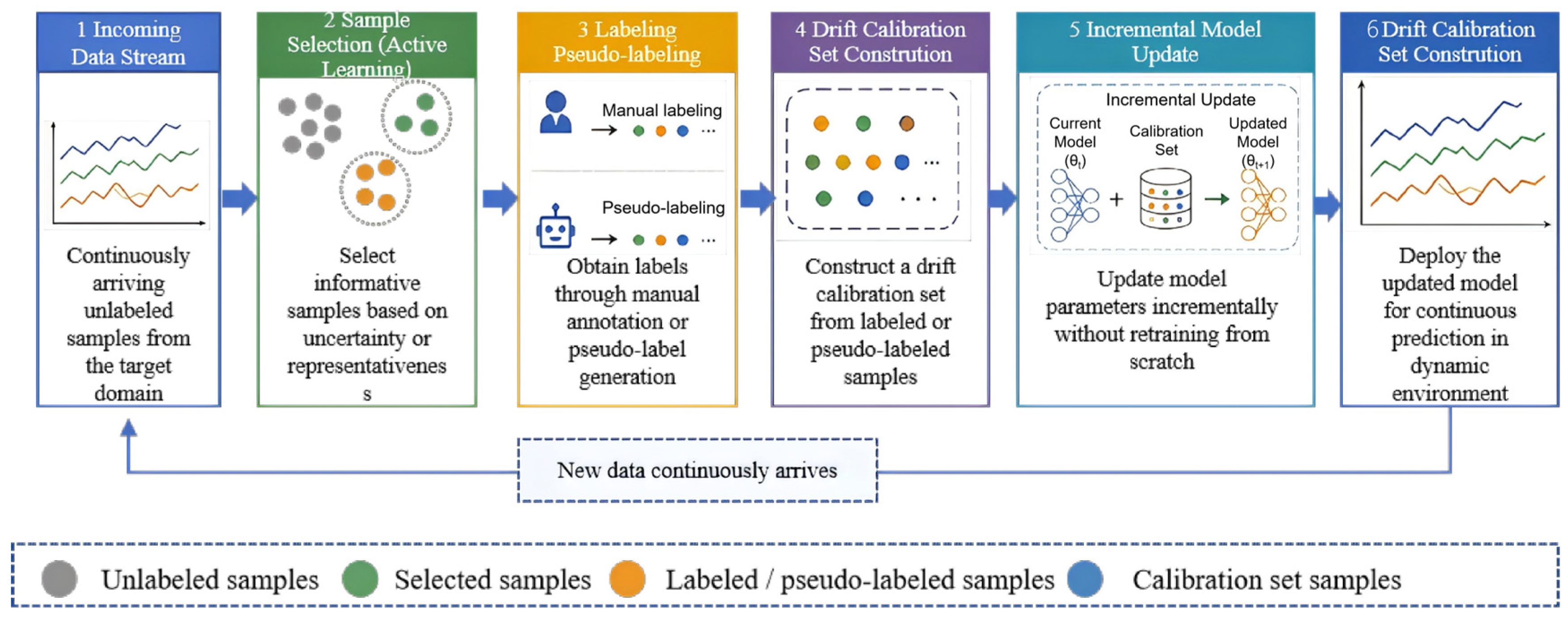
In many circumstances, electronic noses can be far more flexible if utilized over a long period of time with online learning and adaptive updating methods. These methods are more suitable for real-world challenges compared to static supervised or semi-supervised methods, which keep models performing well with continuous changes in data drift and minimize labeling costs through active learning and sample selection. But there are also a lot of hurdles for them. The performance is sensitive to the choice of sample selection tactics, updating time, and pseudo-label quality. In contrast, poor updating strategies may lead to error propagation or class imbalance. Furthermore, online learning is iterative in nature, processes streaming data, and as such, requires better system performance and processing resources. Although these challenges exist, this line of research is of great significance, as it marks a transition from offline static modeling towards continuous evolving learning for electronic nose drift compensation and provides a practical basis for subsequent domain adaptation and deep learning-based approaches. As illustrated in Figure 3, online learning and adaptive updating strategies for electronic nose drift compensation are typically implemented in a sequential pipeline, including incoming data acquisition, sample selection, labeling or pseudo-label generation, drift calibration set construction, incremental model updating, and online prediction.

4.4. Summary

Overall, machine learning-based drift compensation methods represent a critical transitional stage in the evolution of electronic nose drift research. A detailed comparison can be seen in Table 2. Recent advances in signal processing have evolved away from merely removing drift components from sensor data to a more adaptive approach to drift situations based on model learning and constant updating. Supervised learning increases robustness to drift by improving the discriminability of a classifier. Semi-supervised learning exploits unlabeled data to reduce the dependence on manual labeling. Online learning targets continuous updates of models in streaming data, although it is still limited by the sample selection and update process. On the one hand, supervised and semi-supervised approaches still inherently rely on target-domain samples or label quality, and their ability to handle severe drift and large distribution shifts is limited. On the other hand, although online updating methods are more aligned with practical applications, their performance is highly dependent on sample selection strategies, update mechanisms, and label reliability, and they still struggle to fundamentally address complex cross-domain discrepancies. Consequently, as the understanding of drift continues to deepen, electronic nose drift compensation research has gradually evolved from a model-updating problem to a cross-domain knowledge-transfer problem, which in turn has driven the development of domain adaptation and deep learning-based approaches. The next section provides a comprehensive review of these methods.

5. Deep Learning Method

As electronic nose devices are gradually moving out of laboratories, they are widely adopted in long-term online detection, cross-device deployment, and different open real-world scenarios. Here, the sensor drift is no longer a simple problem of signal noise, but a complex problem of cross-domain distribution deviation. Although traditional methods of drift correction and general machine learning techniques can improve the anti-drift ability of electronic nose systems to some degree, they are incapable of solving complex nonlinear drift, cross-device data migration, and few-labeled sample situations.
In recent years, domain adaptation technology and deep learning algorithms have become mainstream research hotspots for solving electronic nose drift problems. Relying on powerful feature mining, data distribution fitting, and stable feature expression learning, these innovative methods bring new solutions to drift correction. Different from traditional ideas, such technologies do not regard sensor drift as simple signal interference or model-matching errors. Instead, they define drift as the data distribution difference between the source domain and the target domain. Through cross-domain knowledge sharing, in-depth feature optimization, and dynamic model construction, these advanced learning strategies greatly strengthen the generalization performance of detection models under severe and variable drift conditions.
It is worth pointing out that most newly developed drift correction techniques present obvious hybrid integration features. In practical research, numerous anti-drift models tend to combine multiple technical strategies, such as data distribution calibration, adversarial learning, pseudo-label refinement, feature optimization, and time-series correlation modeling. For this reason, simply classifying these existing solutions only by supervised learning rules cannot fully summarize their core technical features. To address this issue, this chapter divides current mainstream studies into three major research branches in a systematic way. The three categories cover subspace mapping and domain-matching algorithms, adversarial transfer learning alongside domain-stable feature extraction methods, as well as deep feature refinement and dynamic data modeling strategies. Based on this classification standard, the paper further compares and discusses the technical traits and future evolution trends of each method. The analysis is performed along three main dimensions: capacity of drift-pattern modeling, performance of high-quality feature representation, and environmental adaptability of genuine industrial deployment.

5.1. Subspace Projection and Alignment Methods

Development of subspace projection and alignment methods is not a straightforward linear process but has grown via a continual search for the key problem: how to guarantee simultaneous domain consistency, class discriminability, and structural preservation in shared subspaces. Early works, such as Domain Regularized Component Analysis (DRCA) [72], mostly addressed the discrepancies in distributions between the source and target domains resulting from drift, and alleviated the domain shift in unsupervised settings by learning a shared subspace to minimize mean distribution differences. However, the DRCA tends to match the global distribution without specific class information, and consequently, samples from various classes typically overlap in the projection space. To circumvent this constraint, Yi and Li [73] introduce source-domain label information into Discriminative Domain Regularized Component Analysis (D-DRCA), which enhances the discriminability of the shared subspace by increasing intra-class compactness and inter-class separability, thus overcoming the class aliasing problem of pure distribution-matching methods.
Then the researchers progressively recognized that alignment based on the global statistical distribution and category divergence alone was still not enough to characterize the common multimodal distributions and local geometric structures in the electronic nose drift data. Based on D-DRCA, Local Discriminant Subspace Projection (LDSP) [74] further introduces local discriminative notions to simultaneously retain intra-class compactness and inter-class separability, which enables the model to better adapt to multimodal drift data. Correspondingly, Local Manifold Embedding Cross-Domain Subspace Learning (LME-CDSL) [75] extends classical subspace methods from the viewpoint of manifold preservation. It takes into account the statistical distribution consistency of the source and target domains and preserves the local geometric structures of undrifting samples by local linear manifold learning. It improves the expressive ability and robustness of the projection subspace for complex data structures.
“Structure preservation” has grown into “feature validity” and “cross-domain transfer mechanisms” with advances in subspace approaches, building upon this basis. Maximizing label feature Dependency and Minimizing feature Redundancy (DMDMR) [65] illustrates that classical subspace approaches can reduce inter-domain deviations, but the retrieved features may be less relevant to classification and more redundant. To overcome this challenge, our technique enhances the representation of the feature space. It improves the correlation between characteristics and sample labels. It also trims down redundant and unnecessary data material. Another important argument is made by the Domain Adaptive Subspace Transfer (DAST) model [76]. It states that it is not enough to make two kinds of data distributions identical. This simple technique cannot completely understand the hidden relations between distinct data fields. Thus, the model introduces a new sparse reconstruction rule. The rule is valid in the common feature space of the complete system. This allows for the explicit enhancement of cross-domain knowledge transfer by reconstructing target domain samples from valuable source domain examples. Furthermore, Label Disentangling Subspace Learning (LDSL) [77] solves a major challenge of data transmission. Hidden label information inside features may stop the model from working well across different data fields. First, this method separates the link between features and label data. It weakens the hidden connection that labels form with original features. After this step, the model carries out combined domain adjustment training. Finally, it gains more basic and easy-to-use features for cross-domain tasks. Beyond latent subspace learning, recent studies have further extended subspace alignment concepts to calibration transfer scenarios. Lotesoriere et al. [78] demonstrated that Direct Standardization (DS) can effectively align sensor responses between nominally identical electronic noses using only a limited number of transfer samples. Similarly, Muppidathi et al. [79] showed that standardization-based transfer methods, such as DS and PLS-based Direct Standardization (PLS-DS), provide robust calibration transfer performance under sensor variability and drift, highlighting the practical value of feature-space standardization and alignment for cross-device adaptation.
Overall, subspace projection and alignment methods have evolved from early approaches that relied solely on shared subspaces for distribution matching to comprehensive modeling frameworks that integrate discriminative enhancement, local structure preservation, feature-constraint optimization, and reinforcement of cross-domain knowledge transfer. This evolution demonstrates that such methodologies do not merely repeat the cycle of “learning a subspace,” but consistently address the same core question: how to design shared subspaces that effectively reduce inter-domain differences while retaining sufficient category-discrimination information and data-structure characteristics. Representative subspace alignment methods and their key improvements are summarized in Table 3.

5.2. Adversarial Transfer and Domain-Invariant Representation Learning Methods

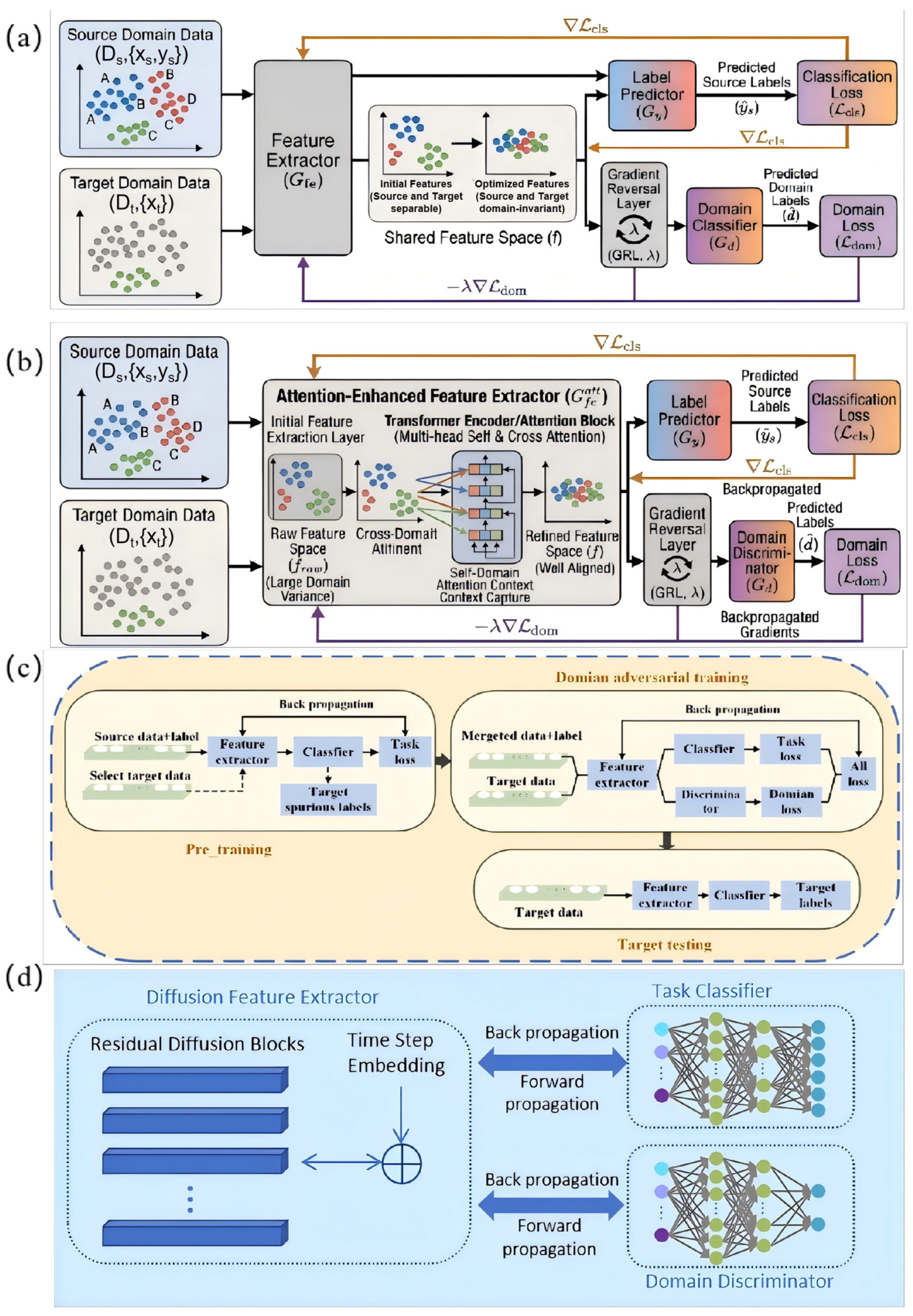
Subspace projection and alignment methods have demonstrated effective performance in electronic nose drift compensation. However, most of these methods adopt simple mapping rules and basic statistical limits. They cannot fully describe the non-linear data changes. Such complex data changes often occur when serious signal drift appears. Deep transfer learning has developed rapidly in recent years. Researchers now treat electronic nose drift correction as a cross-domain learning task. They hope to learn general feature information through an all-around training method. The final shared features can tell different data types apart. They also stay stable when facing data from different working environments. Traditional subspace methods need people to design mapping matrices by hand. These new learning methods no longer rely on manually designed projection matrices. Instead, they employ deep neural networks to automatically extract high-level transferable representations while simultaneously reducing domain discrepancies through adversarial learning, distribution alignment, and pseudo-label optimization strategies. As illustrated in Figure 4a, a standard adversarial domain adaptation framework generally consists of three core modules: a feature extractor, a task classifier, and a domain discriminator. Through adversarial optimization between the feature extractor and the domain discriminator, the model learns domain-invariant representations that remain discriminative for gas classification tasks under drift conditions. To further enhance feature robustness, researchers have gradually incorporated additional modules such as attention mechanisms, pseudo-label filtering, and structural feature constraints into the adversarial adaptation framework, as shown in Figure 4b–d. These designs enable models to better capture stable drift-resistant features and improve generalization performance under long-term drift, batch variation, and cross-device scenarios.
Recent studies have made new progress in this research field. They no longer focus only on basic and fixed domain adaptation tasks. Instead, they solve more difficult data transfer problems. These common challenges include mixed unknown data types, insufficient target data samples, and total or partial missing samples. Traditional closed-set research assumes different data fields have the same data categories. Common models will mismatch unknown samples with existing known gas types under this assumption. This error causes the models to learn invalid and harmful transfer features. To tackle this issue, Liu et al. [80] introduced open-set domain adaptation concepts into electronic nose drift compensation, achieving simultaneous known-category alignment and unknown-category separation within shared feature spaces. Building on this idea, Yao et al. [81] designed new open-set adversarial matching methods. These methods use unknown boundary limits and adversarial transfer strategies. They reduce the disturbance brought by unfamiliar data types during data matching. Similar open-set adversarial adaptation strategies have also been reported in the broader domain adaptation literature. Saito et al. [82] proposed Open Set Domain Adaptation by Backpropagation (OSBP), in which a feature generator and a classifier are trained adversarially to either align known target samples with source classes or reject unknown target samples. Shermin et al. [83] further incorporated a multi-classifier weighting mechanism into the open-set adversarial framework to reduce negative transfer and improve the separation between known and unknown target samples.
At the same time, recent studies have further advanced adversarial transfer methods through multi-mechanism integration and task expansion. Huang et al. [84], for example, came up with Domain Adaptation with Temporal convolutional networks and multi-head self-Attention Long short-term memory (DATAL) to deal with the spatial drift that happens when instrument and gas source locations change in open spaces. A dual-branch temporal feature extractor based on Temporal Convolutional Network (TCN) and multi-head self-attention LSTM is used together with unsupervised hostile domain adaptation to make the source and target data more consistent. This leads to better cross-location gas recognition. Cui et al. [48] suggested Progressive dual-stream Temporal network with Attention for Domain Adaptation (PTADA), which blends adversarial domain adaptation with temporal feature modeling, as well as multi-kernel maximum mean discrepancy constraints and a loss design that takes imbalance into account. In this model, the drift compensation of the electronic nose is used for more than just standard classification. It is also used to look at how gas mixture concentrations change over time. Heng et al. [85] also came up with Semi-Supervised Adversarial Domain Adaptive Convolutional Neural Network (SAD-CNN), which combines adversarial frameworks with semi-supervised learning and pseudo-label filtering. Diffusion feature integrated Pseudo-label based Semi-supervised Adversarial Domain adaptation (DP-SAD) was created by Li et al. [86]. It uses generative representations and uncertainty constraints to make using unnamed target-domain samples more reliable. It does this by combining diffusion-based representation learning, semi-supervised pseudo-label refinement, and adversarial domain adaptation. Some methods that are not limited to a single target domain have also been created to get more accurate cross-domain representations during training. This is done to get around the problem of not being able to access the target-domain data during rollout [87,88]. The development of adversarial transfer and stable feature learning algorithms can be seen in these new findings. These technical tools can be used for more than just basic data alignment between fields. They are focused more and more on making models that can be used in difficult situations.
Figure 4. Representative frameworks for adversarial transfer and domain-invariant representation learning in electronic nose drift compensation. (a) A standard adversarial domain adaptation framework that achieves domain-invariant feature learning through feature extractors, classifiers, and domain discriminators; (b) an adversarial adaptation framework incorporating Transformer/attention mechanisms; (c) a semi-supervised adversarial transfer framework integrating pseudo-labeling and target sample filtering strategies [85]; (d) an advanced adversarial framework incorporating expressive feature extractors (e.g., diffusion-based models) to enhance representation learning and robustness under complex drift conditions [86].
Chemosensors 14 00143 g004
Besides the traditional domain adversarial paradigm, other studies have injected more expressive constraints on the representation into the electronic nose drift compensation procedures for better stability and transferability of deep features. Pan et al. proposed the framework of a hybrid attention-based Transformer network with domain adversarial learning (HATN-DA) [89], which integrates the attention mechanisms, Transformer architectures, and Wasserstein domain adversarial training to jointly optimize the drift compensation and gas recognition in unlabeled scenarios. Chen et al.’s feature entropy domain adaptation (FEDA) [90] method improves the compactness and discriminative ability of deep representations for cross-domain transfer by adopting nonlinear subspace projection, feature norm restrictions, and joint conditional entropy optimization. Sun et al.’s Prototype-based Unsupervised Domain Adaptation (PUDA) [91] further proposes dynamic Transformer encoders and prototype optimization processes, which enable unsupervised cross-domain semantic transfer using instance-to-proto matching procedures. These progresses show that deep transfer studies on electronic nose drift compensation have developed from a single adversarial alignment approach to an integrated representation learning framework with distribution matching, semantic constraints, and structure optimization.
Adversarial transfer technology and stable feature learning methods have made great progress. They are better than simple, basic data modifications for helping electronic nasal devices fix signal drift. The related technology has evolved to a complete deep learning training mode. Old subspace-based methods were popular in early research. The new skills are significantly superior at dealing with complex nonlinear drift situations. They also show better stable performance on the challenge of long-term drift and cross-batch data. But even so, advanced approaches have several glaring drawbacks. On the one hand, adversarial training procedures are inherently sensitive, with model performance being sensitive to network architecture, hyperparameter settings, and pseudo-label quality. These popular methods need a lot of processing resources and complicated model architecture. This brings lots of issues for actual life use. These are tricky to implement on tiny data sets and devices with low running resources.

5.3. Deep Feature Enhancement and Dynamic Modeling Methods

Some deep transfer methods focus on matching different data fields and extracting stable features. Another type of research takes a different development direction. It improves the model’s ability to resist drift by adjusting network structures. These methods will not set up special domain judging modules or design loss functions for data matching. These methods adopt many different technical means instead. They include multi-scale convolution, feature weight adjustment, and dual data fusion. They also use time-sequence modeling and attention distribution design at the same time. Such measures can strengthen stable features related to gas types. Meanwhile, they will compensate for the negative effect of signal drift and data noise. This work has been based on a simple core idea. The model may automatically select the advanced features that are stable and identifiable from the original signal data. It reduces the unfavorable influence of signal drift on the results of gas recognition. And it can do this work without additional data alignment processes.
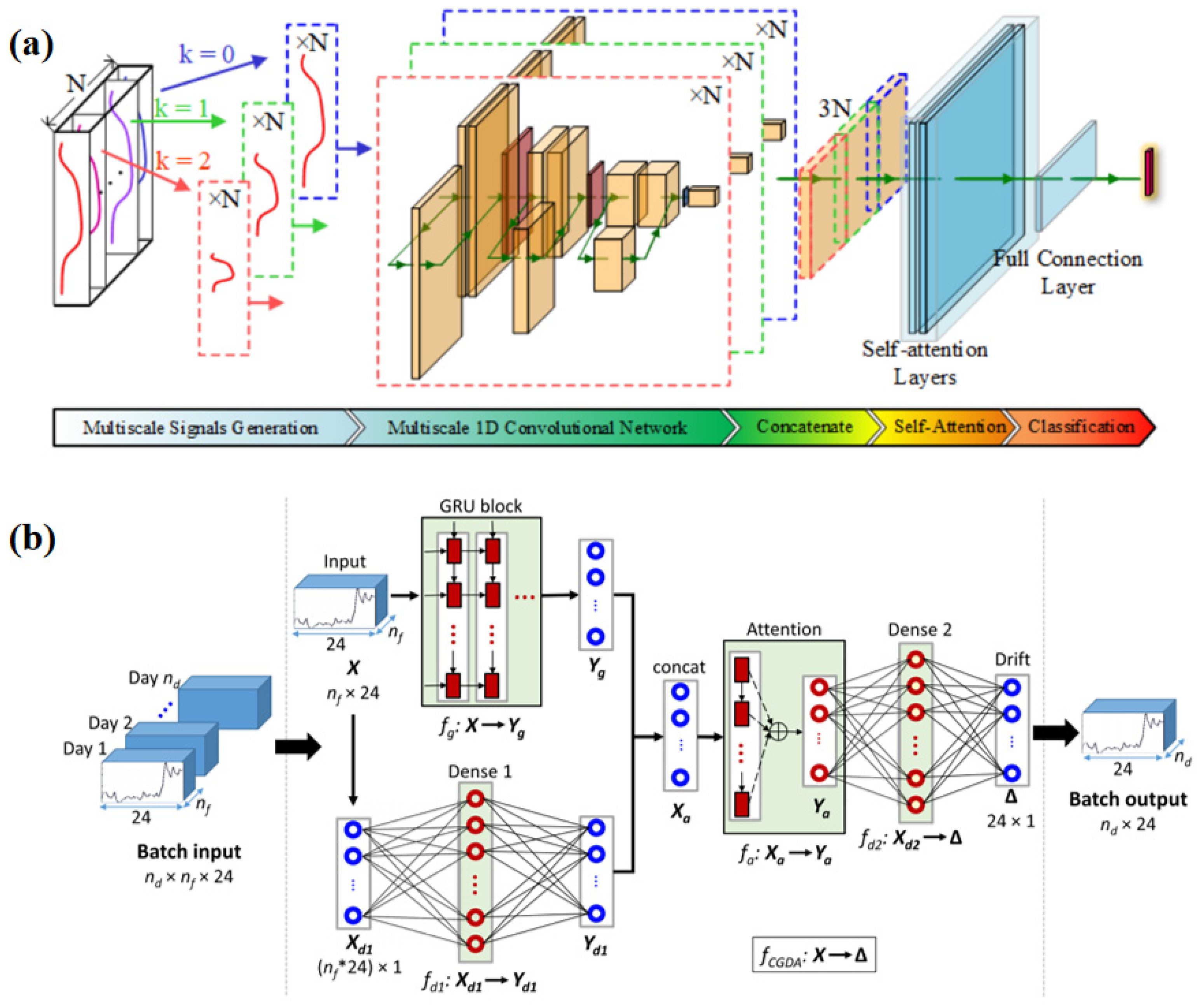
Network structures are adjusted to enable models to capture steady features that resist signal drift. Deep feature improvement methods focus on this as the core subject. Tian’s research group [92] built reliable recognition models of deep belief networks. This method is a preliminary design based on deep feature learning. This approach mitigates the interference of sensor drift. It does not need further domain adaptation modules. Feng’s team constructed the augmented convolutional neural network (ACNN) framework [93]. It combines convolutional feature extraction with incremental compensation units. It significantly improves the long-term prediction stability of electronic nose systems under continual sensor drift. In further work, Pan’s group [94] created the multiscale convolutional neural network with attention (MCNA) model with incorporated lightweight multi-scale convolution and self-attention processes, as shown in Figure 5a. This model is suitable for analyzing time-series response data and sensor connections with a few model parameters. It also enables the model to better adjust for cases of changing environment and signal drift. The integrated dual-channel feature fusion (IDCF) approach was proposed by Wei et al. [95]. This method is based on dual-channel feature fusion and soft threshold suppressing tools. It may actively filter out unnecessary features introduced by signal drifts. The approach allows models to retain crucial information for categorization tasks. Guo et al. [96] used attention techniques and multi-scale convolution fusion in the multiscale convolutional neural network (MCNN) model. The approach provides superior stability and higher detection accuracy for the long-term drift data. Recent studies have further explored representation learning for drift compensation. Kwon et al. [97] introduced a masked autoencoder-based framework that incorporates drift-related calibration features into neural network training, while Ansari et al. [98] combined statistical descriptors with CNN-GRU embeddings to construct a drift-resilient hybrid feature space for robust gas classification.
In addition to static feature augmentation, the current studies have begun to focus on the dynamic information in the response process of electronic nose sensors and to study drift-compensation approaches from the perspective of time-series modeling. Most classical modeling systems utilize either stable or statistical features only. They do not see obvious temporal shifts in the sensors. The alterations occur in the adsorption, reaction, and recovery stages. In actual use, the drift variations are more than mere strength indications. It also determines the response speed, peak values, and dynamic characteristics of each working stage. That is the view of researchers. In Figure 5b, we illustrate a deep-sequence GRU model using the attention processes from Chaudhuri et al. [99]. Gated recurrent units are used to process sequences of responses from sensors. It also employs attention strategies to emphasize significant time intervals. This enhancement results in a better model description for complex drift rules. Liang et al. [100] proposed the multi-branched LSTM-attention integration classification network that can simultaneously extract the multi-scale temporal information and assign adaptive weights to different branches, so as to further improve the discriminative performance in complex drift circumstances. Beyond conventional sequence models, context-aware temporal learning has also emerged as an effective strategy for drift adaptation. Warner et al. [101] proposed a context skill framework that utilizes recurrent networks to encode historical drift information as contextual representations for gas classification. Similarly, Venkatesh et al. [102] developed a Context-Integrated Recurrent Neural Network (CI-RNN) coupled with adaptive filtering to enhance prediction robustness under sensor drift. Liu et al. presented Low-Rank Adaptation with a Temporal Convolutional Network (LoRA-TCN) [103] as an application of low-rank adaptation using a pretraining-fine-tuning paradigm for electronic nose drift compensation. We pre-train TCN on the source domain, and only update low-rank parameters for the target domain, which makes concentration regression with minimal data possible. This approach demonstrates that temporal modeling can be integrated with parameter-efficient transfer for adaptation in the presence of long-term drift.
As research progresses, the objectives of such methods have evolved from merely improving drift resistance on existing datasets to enhancing models’ generalization capabilities for future unknown environments. New research works adopt several new methods. They include domain generalization, drift simulation, and contrastive learning. These ways help models gain more stable feature expression. Meanwhile, models do not need to use data samples from the target domain. Contrastive domain generalization convolution neural network (CDCNN) by Chu et al. [104] combines contrastive learning with domain generalization approaches, enhancing the model’s ability to adapt to unexpected drift scenarios via drift augmentation and feature formation. The related work indicates that deep feature enhancement methods can improve the stability of the model by structural adjustment. These methods also introduce new requirements for model generalization on unknown application situations.
In summary, deep feature augmentation and dynamic modeling are quite different from standard domain alignment methods. These two technical approaches change network architectures and capture dynamic aspects. They give new and practical approaches for solving the drift problem of electronic nose sensors. The main advantage of them is that they can successfully extract multi-level information and temporal dependencies from raw response data, thus improving the adaptivity of the model to complex nonlinear drift patterns. In some actual instances, the sensor signals vary rapidly, and the outside influence is visible. These methods can discover important data rules. Regular basic features models are not good for capturing such intricate information. These approaches, however, rarely tackle the data connections between multiple domains directly. This limitation can impact their ability to deploy the models on multiple devices or in different working contexts. Additionally, temporal modeling architectures and multi-branch attention networks are frequently expensive to train and require strict data integrity and large sample sizes.

5.4. Summary

In general, the development of deep learning-based drift compensation algorithms and domain adaptability has greatly promoted research on electronic nose drift reduction. Old signal processing methods and basic machine learning only correct simple signals or update classifiers in a passive way. These new methods are really different. Many multi-angle methods are used for solving the drift problem. These methods involve cross-domain data matching, deep feature selection, dynamic signal analysis, and adaptation to complex transfer scenarios. Research priorities have evolved slowly over time. Scientists no longer try to simply compensate for the detrimental impacts of sensor drift. Now they focus on learning traits that are stable, transportable, and easy to differentiate. This change helps to better address hard challenges, including long-term drift, batch variances, and model utilization across different devices.
Subspace projection and alignment are technically simple techniques. They are utilized for the identification of common features to alleviate drift problems in electronic nasal devices. These solutions alleviate the data gaps between the original and target fields in the same feature space. They also offer easy adaptive modeling strategies to combat sensor drift. In addition, adversarial transfer and domain-invariant learning are advanced improvement methodologies. These solutions enhance the performance of the model using deep neural networks and novel training methods. They enable the models to adapt to complex nonlinear variations in sensor drift. They also extend the analysis to public datasets and hard model transfer scenarios. Moreover, the deep feature augmentation and dynamic modeling can modify the network topology and collect important temporal information. These strategies can be used to find stable characteristics to combat sensor drift. Such skills also allow models to fit into new work settings considerably more easily. This section illustrates significant improvements in related technology. It also shows that researchers have learned more about the basic reasons for electronic nose drift.
But this kind of approach still has several glaring shortcomings. Firstly, many of these methods perform well on open datasets. However, they rely heavily on target data samples, fake-label quality, and predefined test settings. Their actual ability to adapt to new cases still has to be proved by further tests. Second, deep learning models are, in general, difficult and expensive to train. This means that it is difficult to employ them in devices with few resources. Thirdly, different research has varied rules for data splitting, target field setting, and result judging. In this case, it is difficult to compare the methods with each other. Domain adaptation and deep learning are important research strategies for correcting sensor drift in electronic noses. However, they need a lot of modifications to work steadily in real circumstances. In the next chapter, we will talk about the current issues and development trends in electronic nose drift correction research. It mainly focuses on model adaptability across devices, dependence on labeled data, modeling complex nonlinear sensor drift, model deployment efficiency, and reliable performance in open working contexts.

6. Summary and Future Outlook

Although much progress has been made in compensating for electronic nose drift, there are still numerous important issues from the perspective of practical applications. As electronic nose systems are widely deployed for long-term operation, cross-device deployment, complicated environmental sensing, and edge computing scenarios, the scope of drift compensation is not confined to enhancing classification accuracy on a single dataset. Instead, it is about the more general difficulties of cross-domain generalization, low-label learning, dynamic modeling, model efficiency, and robustness in open environments.
While most drift-compensation methods have been validated on pure gases or controlled mixtures, their practical value is expected to extend to real-world odor-analysis applications, including food quality assessment, beverage authentication, environmental monitoring, and waste management. Take food quality assessment as an example, fruit may release ethylene and ethanol gases at different stages, while meat can release trimethylamine, ammonia, and hydrogen sulfide when the quality decreases. The drift-compensation algorithms reviewed here can be transferred to food quality assessment smoothly.
First, most of the existing research is still performed in homogeneous settings, usually with a single device, a single dataset, or controlled experimental conditions. However, in practical applications, there are large variances among the devices due to the variety of sensor types, manufacturing processes, array configurations, and sampling conditions. In addition, environmental factors such as temperature, humidity, background gases, and sample processes might exacerbate domain shifts. Therefore, enhancing the model’s generalization ability across devices, batches, and circumstances is a key problem for electronic nose drift compensation.
Second, although most of the approaches are designed in the setting of unsupervised or semi-supervised learning, they nevertheless rely on unlabeled samples of the target domain, pseudo-labels, self-training procedures, or sparse manual annotations to sustain performance in practice. That is, some target-domain data are still needed before deployment, which is often impractical for long-term online applications. In addition, pseudo-labeling approaches are sensitive to noise accumulation and negative transfer. Thus, how to design approaches to provide reliable drift compensation with less dependence on target-domain data and labels remains an important research field.
Third, many causes, such as material aging, surface contamination, ambient changes, and device differences, often induce electronic nose drift. Its evolution has substantial nonlinear, multi-scale, and dynamic properties. While recent progress in subspace learning, deep transfer learning, and temporal modeling has enhanced the modeling of complex drift, most existing studies still focus on static distribution discrepancies between batches, with limited attention to temporal evolution and stage-dependent variations. Moreover, many systems are designed for classification accuracy and have no interpretability in terms of the mechanisms underlying the drift generation and transmission.
Fourth, the evolution of data distribution in the domain is closely aligned with the basic properties of the MOS sensors. As time increases, the baseline will drift continuously. This will cause all the response data to move along the resistance axis. The decrease in sensitivity will make the distribution variance smaller and shrink. Material aging will bring more non-linearity in the response and higher cross-sensitivity. More non-linearity will decrease discrimination in the low concentration range. Higher cross-sensitivity will make the boundary between different gases blurred, and features will overlap.
Moreover, the complexity of model architectures has increased as deep learning approaches are being used more widely. While multi-branch networks, attention mechanisms, adversarial training, and prototype optimization can improve the performance of compensation, they also considerably increase the computing cost and the complexity of the model. However, electronic nose systems are commonly employed in embedded or edge platforms, where latency, memory, and energy consumption limits are crucial. Thus, it remains a critical problem to achieve an effective trade-off between performance and efficiency through lightweight and deployable model design. Encouragingly, drift compensation has already begun to move beyond academic research into practical applications. Commercial gas-sensing platforms, such as the Sensirion SGP41, ScioSense ENS160, and Bosch BME688, as well as multisensor electronic-nose systems including Alpha MOS FOX and AIRSENSE PEN3, have incorporated signal-processing and compensation strategies to improve long-term sensing reliability. These developments highlight the growing industrial relevance of drift-aware sensing technologies. In the context of such edge deployment, a notable hardware trend is the increasing use of commercial ‘AI-enhanced’ single metal-oxide (MOS) sensors. While these compact devices offer excellent opportunities for low-cost IoT integration, analyzing them from a complex-array perspective reveals inherent trade-offs. Unlike arrays that utilize spatial redundancy, a single MOS sensor lacks spatial cross-validation. If the sensing material undergoes irreversible aging, purely algorithmic enhancements might struggle to decouple drift from true gas responses. Therefore, future research must balance algorithmic lightweighting with a clear understanding of the physical boundaries of these highly integrated sensors.
Finally, most of the existing drift compensation algorithms are designed based on the closed-set assumption, where the training and testing phases contain the same set of classes, and all the target-domain samples are of known categories. However, in real-world circumstances, electronic nose systems are generally used in open environments, in which unknown gases, unanticipated interferences, or missing class sets could be present. In such cases, conventional approaches frequently misalign unknown samples to known classes and cause negative transfer. Recent research has started to examine open-set domain adaptation and the method for separating unknown classes, but the number of such works is limited, and evaluation protocols are yet to be standardized. Therefore, the recognition reliability and robustness should be enhanced in open-set situations for practical implementation.
In summary, future studies on electronic nose drift compensation are expected to make progress in the cross-device and cross-scenario generalization, low-label and target-domain-independent learning, dynamic process modeling, lightweight and deployable model design, robust perception in open environments, and system-level co-optimization. The purpose is not just to increase the accuracy of recognition on benchmark datasets, but to create consistent, interpretable, and deployable drift compensation in limited labeling, across device variabilities, in open contexts, and throughout long-term operations. Only when drift correction develops from “algorithm effectiveness” to “system-level reliability” can electronic nose systems be broadly and successfully used in real-world applications, including food safety, healthcare, environmental monitoring, and industrial inspection.

Author Contributions

Conceptualization, M.J. and Z.L.; methodology, R.L.; software, J.S.; validation, B.A.K.; formal analysis, B.A.K.; investigation, Y.H.; resources, Y.H.; data curation, R.L. and Z.L.; writing—original draft preparation, R.L.; writing—review and editing, Y.H. and M.J.; visualization, B.A.K. and J.S.; supervision, M.J.; project administration, R.L.; funding acquisition, M.J. All authors have read and agreed to the published version of the manuscript.

Funding

This research was funded by the National Natural Science Foundation of China, grant number 62204260, and the Anhui Provincial Department of Science and Technology, grant number 2022CSJGG0703.

Institutional Review Board Statement

Not applicable.

Informed Consent Statement

Not applicable.

Data Availability Statement

No new data were created or analyzed in this study.

Conflicts of Interest

Author Yaoyi He, Mingzhi Jiao were employed by Tiandi Changzhou Automat Co., Ltd. The remaining authors declare that the research was conducted in the absence of any commercial or financial relationships that could be construed as a potential conflict of interest.

References

  1. He, Y.; Jiao, M. A Mini-Review on Metal Oxide Semiconductor Gas Sensors for Carbon Monoxide Detection at Room Temperature. Chemosensors 2024, 12, 55. [Google Scholar] [CrossRef]
  2. Zhang, Y.; Li, R.; Guo, R.; Jiao, M.; Wang, G.; Zhao, Z. Recent Progress in Low-Power-Consumption Metal Oxide Semiconductor Gas Sensors. Materials 2025, 18, 4864. [Google Scholar] [CrossRef] [PubMed]
  3. Zhang, D.; Yang, Z.; Yu, S.; Mi, Q.; Pan, Q. Diversiform Metal Oxide-Based Hybrid Nanostructures for Gas Sensing with Versatile Prospects. Coord. Chem. Rev. 2020, 413, 213272. [Google Scholar] [CrossRef]
  4. Liu, L.; Wang, Y.; Liu, Y.; Wang, S.; Li, T.; Feng, S.; Qin, S.; Zhang, T. Heteronanostructural Metal Oxide-Based Gas Microsensors. Microsyst. Nanoeng. 2022, 8, 85. [Google Scholar] [CrossRef] [PubMed]
  5. Vergara, A.; Vembu, S.; Ayhan, T.; Ryan, M.A.; Homer, M.L.; Huerta, R. Chemical Gas Sensor Drift Compensation Using Classifier Ensembles. Sens. Actuators B Chem. 2012, 166–167, 320–329. [Google Scholar] [CrossRef]
  6. Korotcenkov, G.; Cho, B.K. Instability of Metal Oxide-Based Conductometric Gas Sensors and Approaches to Stability Improvement (Short Survey). Sens. Actuators B Chem. 2011, 156, 527–538. [Google Scholar] [CrossRef]
  7. Romain, A.C.; Nicolas, J. Long Term Stability of Metal Oxide-Based Gas Sensors for e-Nose Environmental Applications: An Overview. Sens. Actuators B Chem. 2010, 146, 502–506. [Google Scholar] [CrossRef]
  8. Le-Khac, P.H.; Healy, G.; Smeaton, A.F. Contrastive Representation Learning: A Framework and Review. IEEE Access 2020, 8, 193907–193934. [Google Scholar] [CrossRef]
  9. Li, M.; Zhou, T.; Huang, Z.; Yang, J.; Yang, J.; Gong, C. Dynamic Weighted Adversarial Learning for Semi-Supervised Classification under Intersectional Class Mismatch. ACM Trans. Multimed. Comput. Commun. Appl. 2024, 20, 1–24. [Google Scholar] [CrossRef]
  10. Li, Z.; Kang, S.; Feng, N.; Yin, C.; Shi, Y. PSCFormer: A Lightweight Hybrid Network for Gas Identification in Electronic Nose System. Pattern Recognit. 2024, 145, 109912. [Google Scholar] [CrossRef]
  11. Liu, T.; Zhu, X. Weighted Domain Adaptation on Unlabeled Electronic-Nose Drift and Interference Data. IEEE Trans. Instrum. Meas. 2024, 73, 2501613. [Google Scholar] [CrossRef]
  12. Liu, X.; Zhang, F.; Hou, Z.; Mian, L.; Wang, Z.; Zhang, J.; Tang, J. Self-Supervised Learning: Generative or Contrastive. IEEE Trans. Knowl. Data Eng. 2021, 35, 857–876. [Google Scholar] [CrossRef]
  13. Rani, V.; Nabi, S.T.; Kumar, M.; Mittal, A.; Kumar, K. Self-Supervised Learning: A Succinct Review. Arch. Comput. Methods Eng. 2023, 30, 2761–2775. [Google Scholar] [CrossRef] [PubMed]
  14. Wilson, G.; Cook, D.J. A Survey of Unsupervised Deep Domain Adaptation. ACM Trans. Intell. Syst. Technol. 2020, 11, 1–46. [Google Scholar] [CrossRef] [PubMed]
  15. Wu, F.; Ma, R.; Li, Y.; Li, F.; Duan, S.; Peng, X. A Novel Electronic Nose Classification Prediction Method Based on TETCN. Sens. Actuators B Chem. 2024, 405, 135272. [Google Scholar] [CrossRef]
  16. Yang, J.; Hu, X.; Feng, L.; Liu, Z.; Murtazt, A.; Qin, W.; Zhou, M.; Liu, J.; Bi, Y.; Qian, J.; et al. AI-Enabled Portable E-Nose Regression Predicting Harmful Molecules in a Gas Mixture. ACS Sens. 2024, 9, 2925–2934. [Google Scholar] [CrossRef] [PubMed]
  17. Zhang, J.; Yang, L.; Sajjadi Mohammadabadi, S.M.; Yan, F. A Survey on Self-Supervised Learning: Recent Advances and Open Problems. Neurocomputing 2025, 655, 131409. [Google Scholar] [CrossRef]
  18. Jiao, M.; Huang, J.; Jia, F.; Bai, B.; Huo, Y. Amplitude-Modulated Virtual Sensing and FPGA-Enabled Accurate Recognition for Multiple Gases Using Electronic Nose. Chemosensors 2026, 14, 59. [Google Scholar] [CrossRef]
  19. Zhang, J.; Jiao, M.; Duan, L.; Zheng, L.; Nguyen, V.; Hung, C.M.; Nguyen, D. Gas Classification System Based on Hybrid Waveform Modulation Technology on FPGA. Sens. Actuators B Chem. 2025, 435, 137637. [Google Scholar] [CrossRef]
  20. Wang, X.; Kang, X.; Chen, X.; Xu, Y.; Ye, P.; Cui, J.; Ai, B. Pocket Electronic Nose Integrating an Ultra-Compact Sensor Array Chip and Spatiotemporal Network Enables Highly Selective Gas Sensing. ACS Sens. 2025, 10, 6887–6896. [Google Scholar] [CrossRef] [PubMed]
  21. Weng, X.; Fu, J.; Ye, J.; Hu, R.; Yin, J.; Zhao, B.; He, R. OdorNet: A Lightweight Odor Recognition Method for TinyML in Handheld Electronic Noses Using Spatiotemporal Pseudo-Images. Sens. Actuators B Chem. 2025, 444, 138393. [Google Scholar] [CrossRef]
  22. Xiao, L.; Han, F.; Zhang, C.; Duan, S.; Wang, L.; Yan, J. Co-Design of Lightweight Neural Network and Low-Power Edge Computing Architecture for Intelligent Electronic Nose System. IEEE Sens. J. 2025, 25, 27288–27300. [Google Scholar] [CrossRef]
  23. Tangtisanon, P.; Grodniyomchai, B. A Portable Electronic Nose for Real-Time Monitoring of Food Spoilage Using Multiple Machine Learning Models. Sens. Mater. 2025, 37, 5373. [Google Scholar] [CrossRef]
  24. Shtepliuk, I.; Domènech-Gil, G.; Almqvist, V.; Kautto, A.H.; Vågsholm, I.; Boqvist, S.; Eriksson, J.; Puglisi, D. Electronic Nose and Machine Learning for Modern Meat Inspection. J. Big Data 2025, 12, 96. [Google Scholar] [CrossRef]
  25. Tayebi, N.; Kollia, V.; Singh, P.S. Metal-Oxide Sensor Array for Selective Gas Detection in Mixtures. arXiv 2021, arXiv:2102.12990. [Google Scholar]
  26. War, M.; Bouchikhi, B.; Zaim, O.; Lagdali, N.; Ajana, F.Z.; El Bari, N. Electronic Nose System Based on Metal Oxide Semiconductor Sensors for the Analysis of Volatile Organic Compounds in Exhaled Breath for the Discrimination of Liver Cirrhosis Patients and Healthy Controls. Chemosensors 2025, 13, 260. [Google Scholar] [CrossRef]
  27. Korotcenkov, G. Gas Response Control through Structural and Chemical Modification of Metal Oxide Films: State of the Art and Approaches. Sens. Actuators B Chem. 2005, 107, 209–232. [Google Scholar] [CrossRef]
  28. Wang, Z.; Li, P.; Feng, B.; Feng, Y.; Cheng, D.; Wei, J. Wireless Gas Sensor Based on the Mesoporous ZnO-SnO2 Heterostructure Enables Ultrasensitive and Rapid Detection of 3-Methylbutyraldehyde. ACS Sens. 2024, 9, 2585. [Google Scholar] [CrossRef] [PubMed]
  29. Kaur, N.; Comini, E. 3D-(p/p/n) NiO/NiWO4/WO3 Heterostructures for the Selective Detection of Ozone. J. Mater. Chem. C 2024, 12, 14893. [Google Scholar] [CrossRef]
  30. Turlybekuly, A.; Sarsembina, M.; Mentbayeva, A.; Bakenov, Z.; Soltabayev, B. CuO/TiO2 Heterostructure-Based Sensors for Conductometric NO2 and N2O Gas Detection at Room Temperature. Sens. Actuators B Chem. 2023, 397, 134635. [Google Scholar] [CrossRef]
  31. Wei, T.; Li, W.; Zhang, J.; Xie, X. Synthesis of Tb2O3/ZnO Composite Nanofibers via Electrospinning as Chemiresistive Gas Sensor for Detecting NO Gas. J. Alloys Compd. 2023, 947, 169651. [Google Scholar] [CrossRef]
  32. Pai, S.H.S.; Pandey, S.K.; Samuel, E.J.J.; Jang, J.U.; Nayak, A.K.; Han, H. Recent Advances in NiO-Based Nanostructures for Energy Storage Device Applications. J. Energy Storage 2024, 76, 109731. [Google Scholar] [CrossRef]
  33. Su, C.; Zhang, L.; Han, Y.; Ren, C.; Zeng, M.; Zhou, Z.; Su, Y.; Hu, N.; Wei, H.; Yang, Z. Controllable Synthesis of Heterostructured CuO-NiO Nanotubes and Their Synergistic Effect for Glycol Gas Sensing. Sens. Actuators B Chem. 2020, 304, 127347. [Google Scholar] [CrossRef]
  34. Barsan, N.; Koziej, D.; Weimar, U. Metal Oxide-Based Gas Sensor Research: How To? Sens. Actuators B Chem. 2007, 121, 18–35. [Google Scholar] [CrossRef]
  35. Zhai, Z.; Liu, Y.; Li, C.; Wang, D.; Wu, H. Electronic Noses: From Gas-Sensitive Components and Practical Applications to Data Processing. Sensors 2024, 24, 4806. [Google Scholar] [CrossRef] [PubMed]
  36. Gao, D.; Yu, Q.; Kebeded, M.A.; Zhuang, Y.; Huang, S.; Jiao, M.; He, X. Advances in Modification of Metal and Noble Metal Nanomaterials for Metal Oxide Gas Sensors: A Review. Rare Met. 2025, 44, 1443–1496. [Google Scholar] [CrossRef]
  37. Wang, C.; Yin, L.; Zhang, L.; Xiang, D.; Gao, R. Metal Oxide Gas Sensors: Sensitivity and Influencing Factors. Sensors 2010, 10, 2088–2106. [Google Scholar] [CrossRef] [PubMed]
  38. Barsan, N.; Weimar, U. Conduction Model of Metal Oxide Gas Sensors. J. Electroceramics 2001, 7, 143–167. [Google Scholar] [CrossRef]
  39. Chai, H.; Zheng, Z.; Liu, K.; Xu, J.; Wu, K.; Luo, Y.; Liao, H.; Debliquy, M.; Zhang, C. Stability of Metal Oxide Semiconductor Gas Sensors: A Review. IEEE Sens. J. 2022, 22, 5470–5481. [Google Scholar] [CrossRef]
  40. Hossein-Babaei, F.; Ghafarinia, V. Compensation for the Drift-like Terms Caused by Environmental Fluctuations in the Responses of Chemoresistive Gas Sensors. Sens. Actuators B Chem. 2010, 143, 641–648. [Google Scholar] [CrossRef]
  41. Aurora, A. Algorithmic Correction of MOS Gas Sensor for Ambient Temperature and Relative Humidity Fluctuations. IEEE Sens. J. 2022, 22, 15054–15061. [Google Scholar] [CrossRef]
  42. Fonollosa, J.; Rodríguez-Luján, I.; Huerta, R. Chemical Gas Sensor Array Dataset. Data Brief. 2015, 3, 85–89. [Google Scholar] [CrossRef] [PubMed]
  43. Fonollosa, J.; Sheik, S.; Huerta, R.; Marco, S. Reservoir Computing Compensates Slow Response of Chemosensor Arrays Exposed to Fast Varying Gas Concentrations in Continuous Monitoring. Sens. Actuators B Chem. 2015, 215, 618–629. [Google Scholar] [CrossRef]
  44. Fonollosa, J.; Rodríguez-Luján, I.; Trincavelli, M.; Huerta, R. Data Set from Chemical Sensor Array Exposed to Turbulent Gas Mixtures. Data Brief. 2015, 3, 216–220. [Google Scholar] [CrossRef] [PubMed]
  45. Vergara, A.; Fonollosa, J.; Mahiques, J.; Trincavelli, M.; Rulkov, N.; Huerta, R. On the Performance of Gas Sensor Arrays in Open Sampling Systems Using Inhibitory Support Vector Machines. Sens. Actuators B Chem. 2013, 185, 462–477. [Google Scholar] [CrossRef]
  46. Wörner, J.; Eimler, J.; Pein-Hackelbusch, M. Long-Term Drift Behavior in Metal Oxide Gas Sensor Arrays: A One-Year Dataset from an Electronic Nose. Sci. Data 2025, 12, 1628. [Google Scholar] [CrossRef] [PubMed]
  47. Yang, S.; Zhang, H.; Li, Z.; Duan, S.; Yan, J. Identification of Industrial Exhaust Based on an Electronic Nose with an Interleaved Grouped Residual Convolutional Compression Network. Sens. Actuators A Phys. 2023, 363, 114692. [Google Scholar] [CrossRef]
  48. Cui, X.; Huang, X.; Zhang, X.; Feng, P.; Wang, L.; Duan, S.; Peng, X. PTADA: An Unsupervised Domain-Adversarial Regression Algorithm for Sensor Drift in Mixed Gas Scenarios. Sens. Actuators B Chem. 2026, 447, 138855. [Google Scholar] [CrossRef]
  49. Artursson, T.; Eklöv, T.; Lundström, I.; Mårtensson, P.; Sjöström, M.; Holmberg, M. Drift Correction for Gas Sensors Using Multivariate Methods. J. Chemom. 2000, 14, 711–723. [Google Scholar] [CrossRef]
  50. Rudnitskaya, A. Calibration Update and Drift Correction for Electronic Noses and Tongues. Front. Chem. 2018, 6, 433. [Google Scholar] [CrossRef] [PubMed]
  51. Kermit, M.; Tomic, O. Independent Component Analysis Applied on Gas Sensor Array Measurement Data. IEEE Sens. J. 2003, 3, 218–228. [Google Scholar] [CrossRef]
  52. Ziyatdinov, A.; Marco, S.; Chaudry, A.; Persaud, K.; Caminal, P.; Perera, A. Drift Compensation of Gas Sensor Array Data by Common Principal Component Analysis. Sens. Actuators B Chem. 2010, 146, 460–465. [Google Scholar] [CrossRef]
  53. Kumar, J.R.R.; Chouksey, P. Gas Sensor Array Drift in an E-Nose System: A Dataset for Machine Learning Applications. Int. J. Recent Innov. Trends Comput. Commun. 2023, 11, 167–171. [Google Scholar] [CrossRef]
  54. Manna, A. Drift Compensation for Electronic Nose by Multiple Classifiers System with Genetic Algorithm Optimized Feature Subset. In Proceedings of the 2020 International Conference on Computer Communication and Informatics (ICCCI), Coimbatore, India, 22–24 January 2020; pp. 1–7. [Google Scholar]
  55. Rehman, A.U.; Belhaouari, S.B.; Ijaz, M.; Bermak, A.; Hamdi, M. Multi-Classifier Tree with Transient Features for Drift Compensation in Electronic Nose. IEEE Sens. J. 2021, 21, 6564–6574. [Google Scholar] [CrossRef]
  56. Park, K.; Choi, S.; Chae, H.Y.; Park, C.S.; Lee, S.; Lim, Y.; Shin, H.; Kim, J.J. An Energy-Efficient Multimode Multichannel Gas-Sensor System with Learning-Based Optimization and Self-Calibration Schemes. IEEE Trans. Ind. Electron. 2020, 67, 2402–2410. [Google Scholar] [CrossRef]
  57. Schaller, M.; Kruse, M.; Ortega, A.; Lindauer, M.; Rosenhahn, B. AutoML for Multi-Class Anomaly Compensation of Sensor Drift. Measurement 2025, 250, 117097. [Google Scholar] [CrossRef]
  58. Krayden, A.; Avraham, M.; Ashkar, H.; Blank, T.; Stolyarova, S.; Nemirovsky, Y. TinyML-Based Real-Time Drift Compensation for Gas Sensors Using Spectral–Temporal Neural Networks. Chemosensors 2025, 13, 223. [Google Scholar] [CrossRef]
  59. De Vito, S.; Fattoruso, G.; Pardo, M.; Tortorella, F.; Di Francia, G. Semi-Supervised Learning Techniques in Artificial Olfaction: A Novel Approach to Classification Problems and Drift Counteraction. IEEE Sens. J. 2012, 12, 3215–3224. [Google Scholar] [CrossRef]
  60. Liu, Q.; Li, X.; Ye, M.; Ge, S.S.; Du, X. Drift Compensation for Electronic Nose by Semi-Supervised Domain Adaption. IEEE Sens. J. 2014, 14, 657–665. [Google Scholar] [CrossRef]
  61. Yang, C.; Bohlin, G.; Oechtering, T. Environmental Variation or Instrumental Drift? A Probabilistic Approach to Gas Sensor Drift Modeling and Evaluation. In Proceedings of the 2024 IEEE Sensors, Kobe, Japan, 20 October 2024; pp. 1–4. [Google Scholar]
  62. Zhang, W.; Hu, S.; Zhang, Z.; Wang, L.; Rigoll, G.; Wang, Q.J.; Lin, Z. Unsupervised Attention-Based Multisource Domain Adaptation Framework for Drift Compensation in Electronic Nose Systems. IEEE Trans. Instrum. Meas. 2025, 74, 1–16. [Google Scholar] [CrossRef]
  63. Liu, T.; Li, D.; Chen, J.; Chen, Y.; Yang, T.; Cao, J. Gas-Sensor Drift Counteraction with Adaptive Active Learning for an Electronic Nose. Sensors 2018, 18, 4028. [Google Scholar] [CrossRef] [PubMed]
  64. Liu, T.; Li, D.; Chen, J.; Chen, Y.; Yang, T.; Cao, J. Active Learning on Dynamic Clustering for Drift Compensation in an Electronic Nose System. Sensors 2019, 19, 3601. [Google Scholar] [CrossRef] [PubMed]
  65. Liu, T.; Cao, J.; Li, D.; Chen, Y.; Yang, T.; Zhu, X. Active Instance Selection for Drift Calibration of an Electronic Nose. Sens. Actuators A Phys. 2020, 312, 112149. [Google Scholar] [CrossRef]
  66. Liu, T.; Li, D.; Chen, J. An Active Method of Online Drift-Calibration-Sample Formation for an Electronic Nose. Measurement 2021, 171, 108748. [Google Scholar] [CrossRef]
  67. Liang, Z.; Zhang, L.; Tian, F.; Wang, C.; Yang, L.; Guo, T.; Xiong, L. A Novel WWH Problem-Based Semi-Supervised Online Method for Sensor Drift Compensation in E-Nose. Sens. Actuators B Chem. 2021, 349, 130727. [Google Scholar] [CrossRef]
  68. Cao, J.; Liu, T.; Chen, J.; Yang, T.; Zhu, X.; Wang, H. Drift Compensation on Massive Online Electronic-Nose Responses. Chemosensors 2021, 9, 78. [Google Scholar] [CrossRef]
  69. Bastos, G.F.A.; Montalvao, J.; Miranda, L. A Probabilistic Approach for Drift Compensation of Gas Sensor Data. IEEE Sens. J. 2026, 26, 6921–6928. [Google Scholar] [CrossRef]
  70. Chakravarthy, V.; Yasaswini, V.; Sanguri, M.; Balraj, S.; Jency, S.; Anandhakrishnan, T. Machine Learning-Enhanced Calibration Algorithm for Drift Compensation in Long-Term Electrochemical Environmental Monitoring Networks. Anal. Lett. 2026, 59, 1–17. [Google Scholar] [CrossRef]
  71. Zaidan, M.A.; Motlagh, N.H.; Fung, P.L.; Khalaf, A.S.; Matsumi, Y.; Ding, A.; Tarkoma, S.; Petaja, T.; Kulmala, M.; Hussein, T. Intelligent Air Pollution Sensors Calibration for Extreme Events and Drifts Monitoring. IEEE Trans. Ind. Inf. 2023, 19, 1366–1379. [Google Scholar] [CrossRef]
  72. Zhang, L. Anti-Drift in E-Nose: A Subspace Projection Approach with Drift Reduction. Sens. Actuators B Chem. 2017, 253, 407–417. [Google Scholar] [CrossRef]
  73. Yi, Z.; Li, C. Anti-Drift in Electronic Nose via Dimensionality Reduction: A Discriminative Subspace Projection Approach. IEEE Access 2019, 7, 170087–170095. [Google Scholar] [CrossRef]
  74. Yi, Z.; Shang, W.; Xu, T.; Guo, S.; Wu, X. Local Discriminant Subspace Learning for Gas Sensor Drift Problem. IEEE Trans. Syst. Man. Cybern. Syst. 2022, 52, 247–259. [Google Scholar] [CrossRef]
  75. Tian, Y.; Yan, J.; Yi, D.; Zhang, Y.; Wang, Z.; Yu, T.; Peng, X.; Duan, S. Local Manifold Embedding Cross-Domain Subspace Learning for Drift Compensation of Electronic Nose Data. IEEE Trans. Instrum. Meas. 2021, 70, 2513312. [Google Scholar] [CrossRef]
  76. Guo, T.; Tan, X.; Yang, L.; Liang, Z.; Zhang, B.; Zhang, L. Domain Adaptive Subspace Transfer Model for Sensor Drift Compensation in Biologically Inspired Electronic Nose. Expert. Syst. Appl. 2022, 208, 118237. [Google Scholar] [CrossRef]
  77. Wang, Z.; Duan, S.; Yan, J. A Novel Label Disentangling Subspace Learning Based on Domain Adaptation for Drift E-Nose Data Classification. IEEE Sens. J. 2023, 23, 23812–23821. [Google Scholar] [CrossRef]
  78. Lotesoriere, B.J.; Viareggi, L.; Bax, C.; Capelli, L. Real-Time Monitoring of Bread Baking in Ovens by Smart Odour Sensors: Focus on Calibration Transfer. In Proceedings of the 2024 IEEE International Symposium on Olfaction and Electronic Nose (ISOEN), Grapevine, TX, USA, 12 May 2024; pp. 1–3. [Google Scholar]
  79. Muppidathi, B.V.; Ngoune, B.B.; Hallil, H.; Subbiah, S.; Lebental, B. Assessment of Ten Standardization-Based Calibration Transfer Techniques for Gas Sensors in a Small Data Context. IEEE Sens. J. 2024, 24, 39243–39251. [Google Scholar] [CrossRef]
  80. Liu, T.; Wang, Y.; Wang, H. Open Set Domain Adaptation for Electronic Nose Drift Compensation on Uncertain Category Data. IEEE Trans. Instrum. Meas. 2024, 73, 2505514. [Google Scholar] [CrossRef]
  81. Yao, Y.; Chen, B.; Liu, C.; Feng, C.; Gao, X.; Gu, Y. Open-Set Adversarial Domain Match for Electronic Nose Drift Compensation and Unknown Gas Recognition. Expert. Syst. Appl. 2024, 250, 123757. [Google Scholar] [CrossRef]
  82. Saito, K.; Yamamoto, S.; Ushiku, Y.; Harada, T. Open Set Domain Adaptation by Backpropagation. In Proceedings of the European Conference on Computer Vision (ECCV), Munich, Germany, 8–14 September 2018. [Google Scholar]
  83. Shermin, T.; Lu, G.; Teng, S.W.; Murshed, M.; Sohel, F. Adversarial Network with Multiple Classifiers for Open Set Domain Adaptation. IEEE Trans. Multimed. 2021, 23, 2732–2744. [Google Scholar] [CrossRef]
  84. Huang, X.; Sun, B.; Gan, W.; Zhang, X.; Feng, P.; Peng, X.; Chu, J. Drift Compensation for Gas Detection in Open Environments Using Electronic Nose via Deep Unsupervised Adversarial Domain Adaptation. Sens. Actuators B Chem. 2026, 454, 139594. [Google Scholar] [CrossRef]
  85. Heng, Y.; Zhou, Y.; Nguyen, D.H.; Nguyen, V.D.; Jiao, M. An Electronic Nose Drift Compensation Algorithm Based on Semi-Supervised Adversarial Domain Adaptive Convolutional Neural Network. Sens. Actuators B Chem. 2025, 422, 136642. [Google Scholar] [CrossRef]
  86. Li, Z.; Jiao, M.; Heng, Y.; Zheng, L.; Nguyen, V.D.; Nguyen, D.H.; Hung, C.M. Diffusion-Enhanced Semi-Supervised Adversarial Domain Adaptation for E-Nose Sensor Drift Compensation. Sens. Actuators B Chem. 2026, 462, 139995. [Google Scholar] [CrossRef]
  87. Zhang, Y.; Xiang, S.; Wang, Z.; Peng, X.; Tian, Y.; Duan, S.; Yan, J. TDACNN: Target-Domain-Free Domain Adaptation Convolutional Neural Network for Drift Compensation in Gas Sensors. Sens. Actuators B Chem. 2022, 361, 131739. [Google Scholar] [CrossRef]
  88. Gupta, V.K.; Bhati, G.S.; Lalwani, S.K. Sunny Target-Domain Data Free Model-Agnostic-Meta-Learning Framework for Time-Varying Drift Correction For E-Nose. IEEE Sens. Lett. 2025, 9, 5502904. [Google Scholar] [CrossRef]
  89. Pan, X.; Chen, J.; Wen, X.; Hao, J.; Xu, W.; Ye, W.; Zhao, X. A Comprehensive Gas Recognition Algorithm with Label-Free Drift Compensation Based on Domain Adversarial Network. Sens. Actuators B Chem. 2023, 387, 133709. [Google Scholar] [CrossRef]
  90. Chen, X.; Yi, L.; Liu, R. FEDA: A Nonlinear Subspace Projection Approach for Electronic Nose Data Classification. IEEE Trans. Instrum. Meas. 2023, 72, 2501211. [Google Scholar] [CrossRef]
  91. Sun, J.; Zheng, H.; Diao, W.; Sun, Z.; Qi, Z.; Wang, X. Prototype-Optimized Unsupervised Domain Adaptation via Dynamic Transformer Encoder for Sensor Drift Compensation in Electronic Nose Systems. Expert. Syst. Appl. 2025, 260, 125444. [Google Scholar] [CrossRef]
  92. Tian, Y.; Yan, J.; Zhang, Y.; Yu, T.; Wang, P.; Shi, D.; Duan, S. A Drift-Compensating Novel Deep Belief Classification Network to Improve Gas Recognition of Electronic Noses. IEEE Access 2020, 8, 121385–121397. [Google Scholar] [CrossRef]
  93. Feng, L.; Dai, H.; Song, X.; Liu, J.; Mei, X. Gas Identification with Drift Counteraction for Electronic Noses Using Augmented Convolutional Neural Network. Sens. Actuators B Chem. 2022, 351, 130986. [Google Scholar] [CrossRef]
  94. Pan, J.; Yang, A.; Wang, D.; Chu, J.; Lei, F.; Wang, X.; Rong, M. Lightweight Neural Network for Gas Identification Based on Semiconductor Sensor. IEEE Trans. Instrum. Meas. 2022, 71, 2500908. [Google Scholar] [CrossRef]
  95. Wei, G.; Xu, Y.; Lv, X.; Jiao, S.; He, A. An Adaptive Drift Compensation Method Based on Integrated Dual-Channel Feature Fusion for Electronic Noses. IEEE Sens. J. 2024, 24, 26814–26824. [Google Scholar] [CrossRef]
  96. Guo, J.; Li, X.; Li, X.; Liang, Z.; Cao, J.; Wei, X. Anti-Drift Gas Detection Algorithm Based on Neural Network. IEEE Trans. Instrum. Meas. 2024, 73, 2536208. [Google Scholar] [CrossRef]
  97. Kwon, S.; Park, J.-H.; Jang, H.-D.; Nam, H.; Chang, D.E. A Sensor Drift Compensation Method with a Masked Autoencoder Module. Appl. Sci. 2024, 14, 2604. [Google Scholar] [CrossRef]
  98. Ansari, G.; Singh, R.; Kumar, S.; Kumar, R. Drift-Resilient Hybrid Feature Learning Framework for Accurate Mixed Industrial Gas Classification Using Chemical Sensor Arrays. IEEE Sens. J. 2026, 26, 15007–15019. [Google Scholar] [CrossRef]
  99. Chaudhuri, T.; Wu, M.; Zhang, Y.; Liu, P.; Li, X. An Attention-Based Deep Sequential GRU Model for Sensor Drift Compensation. IEEE Sens. J. 2021, 21, 7908–7917. [Google Scholar] [CrossRef]
  100. Liang, Z.; Chen, D.; Yang, L.; Chen, Y. A Multibranch LSTM-Attention Ensemble Classification Network for Sensor Drift Compensation. IEEE Sens. J. 2024, 24, 25830–25841. [Google Scholar] [CrossRef]
  101. Warner, J.; Devaraj, A.; Miikkulainen, R. Using Context to Adapt to Sensor Drift. In Proceedings of the 2024 IEEE International Conference on Development and Learning (ICDL), Austin, TX, USA, 20 May 2024; pp. 1–7. [Google Scholar]
  102. Venkatesh, R.P.; Raja, D.S.S.; Rafat, K.M. Enhanced Oxy-Fuel Combustion Monitoring in FCC Regenerators through Deep Learning and Sensor Drift Compensation. Powder Technol. 2026, 474, 122175. [Google Scholar] [CrossRef]
  103. Liu, Z.; Liu, Z.; Feng, R.; Feng, P.; Chu, J.; Peng, X. LoRA-TCN: A Pre-Trained/Fine-Tuning Learning Paradigm for Drift Adaptation. Sens. Actuators B Chem. 2026, 446, 138644. [Google Scholar] [CrossRef]
  104. Chu, J.; Yao, R.; Huang, X.; Yang, A.; Pan, J.; Yuan, H.; Rong, M.; Wang, X. Contrastive Domain Generalization Convolution Neural Network Correcting the Drift of Gas Sensors. Sens. Actuators A Phys. 2024, 372, 115314. [Google Scholar] [CrossRef]
Figure 1. PCA diagram for drift visualization of gas sensor arrays. The dashed arrows denote the drift trajectory of each gas feature cluster from Batch 1 to Batch 10 caused by long-term sensor aging within the 36-month dataset.
Chemosensors 14 00143 g001
Figure 2. Evolution of machine learning-based drift compensation methods. The blue, red and green dot clusters denote three different gas categories, separated by the dashed decision boundary.
Chemosensors 14 00143 g002
Figure 3. Workflow of online learning and adaptive updating strategies for electronic nose drift compensation.
Chemosensors 14 00143 g003
Figure 5. Representative architectures for depth feature enhancement and dynamic modeling methods in electronic nose drift compensation. (a) A depth feature enhancement framework based on multi-scale convolution and self-attention mechanisms, designed to extract more stable and discriminative high-level representations from raw responses [94]; (b) a dynamic modeling framework utilizing GRU and attention mechanisms, aimed at capturing temporal dependencies and critical dynamic segments during sensor response processes [99].
Chemosensors 14 00143 g005
Table 1. Summary of benchmark datasets for E-nose drift compensation studies.
DatasetSensorsAnalytesDurationSamplesFeaturesPrimary
UCI Gas Sensor Array Drift [5]16 MOX (4 types)6 pure gases36 months13,910128 (8 × 16)Long-term drift classification
UCI Drift at Different Concentrations [42]16 MOX (4 types)6 pure gases36 months13,910128 + concentrationDrift regression & classification
Dynamic Gas Mixtures
[43]
16 MOX (4 types)2 binary mixtures12 h × 2~1 M time steps16 channelsContinuous monitoring, temporal modeling
Turbulent Gas Mixtures [45]72 MOX (6 locations)10 gases16 months18,000Time seriesOpen-sampling, turbulence robustness
E-Nose Long-Term Drift [46]62 MOX (commercial)3-Analytes12 months700 Time-seriesRaw + pre-extractedDrift detection & compensation
Various proprietary datasets
[47,48]
VariesVariesVariesVariesVariesApplication-specific
Table 2. Major categories of machine learning-based drift compensation methods for electronic noses.
Method CategoryTarget-Domain Labels/Unlabeled Target Samples/
Online Updating
Core IdeaAdvantagesLimitations
Supervised learning
[54,55]
Yes/No/NoBuild robust supervised classifiers for drift tolerance.Mature structure; simple implementation; good initial performance.Shift-sensitive; recalibration required;
poor long-term drift adaptability.
Semi-supervised learning
[59,60]
Weak dependence/Yes/PartiallyLeverage limited labeled and abundant unlabeled data via self-training or pseudo-labeling for domain adaptation.Cuts labeling cost; enhances target domain adaptability.Sensitive to pseudo-label quality; prone to error accumulation under strong drift.
Online learning and adaptive updating
[64,67]
Partial dependence/Yes/YesMaintain model performance in streaming data environments through active learning, sample selection, and continuous model updating.Closer to real-world scenarios, enables long-term operation, and reduces labeling cost via selective annotation.Sensitive to sample selection and update strategy; high system complexity; error propagation risk.
Table 3. Classic domain adaptive methods for electronic nose drift compensation and their major improvements.
MethodMain Issue AddressedKey ImprovementStrengthLimitation
DRCA [72]Source and target distributions are inconsistent under driftLearns a shared subspace by minimizing the mean distribution discrepancySimple, unsupervised, interpretableIgnores class discrimination
D-DRCA [73]Class overlap may occur in the DRCA subspaceIntroduces source label information to enhance inter-class separabilityBetter discriminative abilityStill weak for multimodal/nonlinear data
LDSP [74]Conventional methods do not handle multimodal structure wellIncorporates local discriminative structure preservationBetter for multimodal drift dataStill mainly shallow linear projection
LME-CDSL [75]Statistical alignment alone ignores geometric structureCombines manifold learning with domain adaptationPreserves local geometry while aligning domainsModel formulation becomes more complex
DMDMR [65]Aligned features may be redundant or weakly related to labelsMaximizes feature-label dependency and minimizes redundancyImproves task-relevant representationLimited under strong nonlinear drift
DAST [76]The cross-domain reconstruction relationship is underusedIntroduces sparse reconstruction in a shared subspaceEnhances knowledge transfer between domainsOptimization is relatively complex
LDSL [77]Implicit label information may hinder transferabilityPerforms label disentanglement before joint domain adaptationImproves transferable representation learningDepends on pseudo-label quality and model design
Disclaimer/Publisher’s Note: The statements, opinions and data contained in all publications are solely those of the individual author(s) and contributor(s) and not of MDPI and/or the editor(s). MDPI and/or the editor(s) disclaim responsibility for any injury to people or property resulting from any ideas, methods, instructions or products referred to in the content.