Experiences of Loss and Grief Among Brazilian Frontline Healthcare Professionals During the COVID-19 Pandemic Crisis: A Grounded Theory Analysis

 ,
,  ,
,  ,
,  ,
,
Abstract
1. Introduction
2. Materials and Methods
2.1. Study Design
2.2. Setting, Participants and Recruitment
2.3. Data Collection
2.4. Data Analysis
2.5. Rigor
2.6. Ethical Considerations
3. Results
3.1. Participants Background
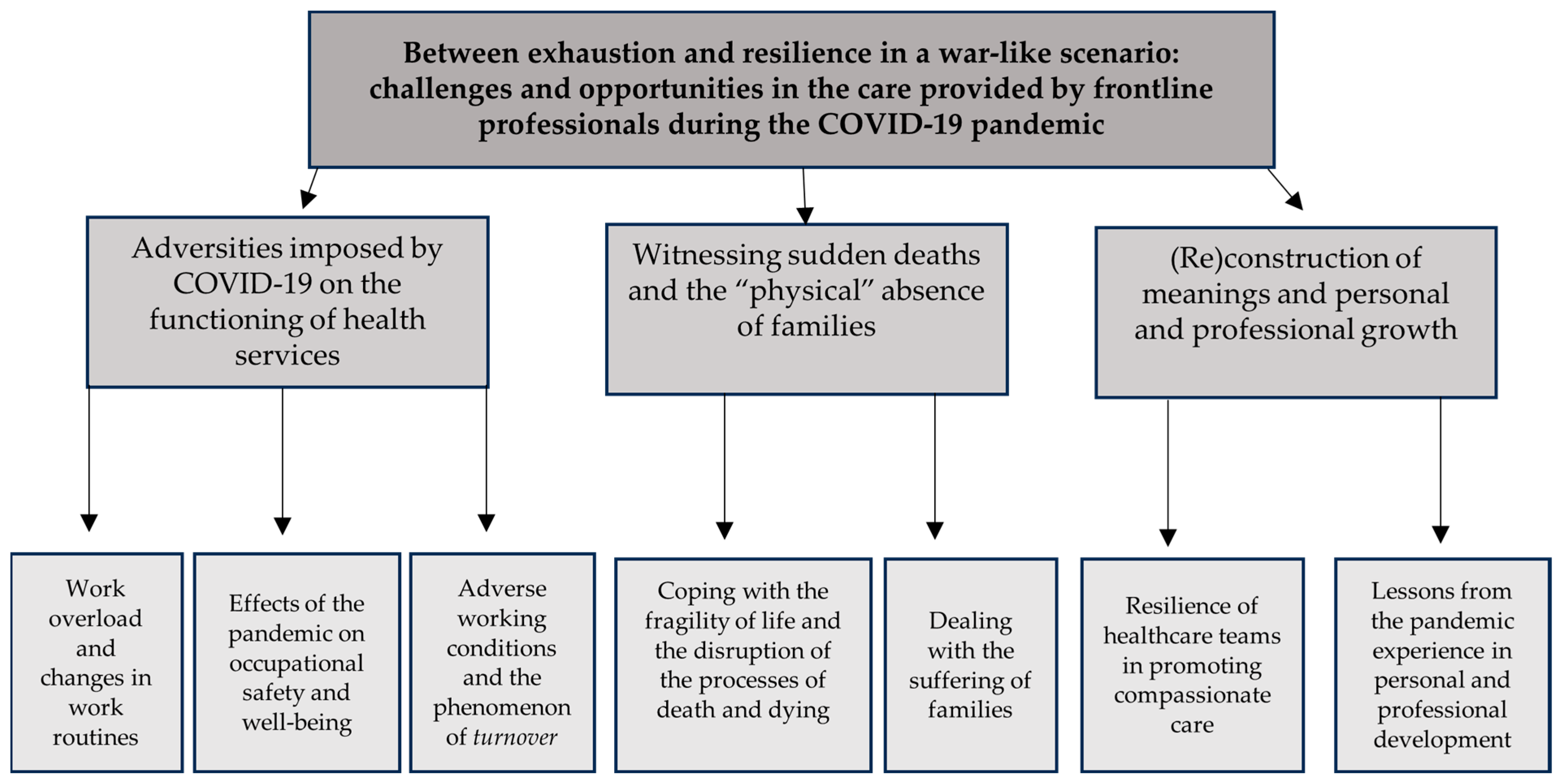
3.2. Findings Overview
3.2.1. Adversities Imposed by COVID-19 on the Functioning of Health Services
[…] In the beginning, everything was very crazy because nobody knew anything, and there was so much despair. There wasn’t much information yet on how to enter the ward, how to treat patients. I saw professionals going crazy, even mistreating the residents, due to the uncertainties(P8, 28 years old).
[…] In the beginning, there wasn’t a protocol for treatment or anything, because until then we didn’t know what it was all about. I didn’t know what to do. Everyone was kind of lost, right? There was no way to cope(P2, 32 years old).
[…] Having people ask for help, in an entire hospital, and us not having enough answers. We had to refuse patients because we couldn’t receive them(P1, 33 years old)
[…] Colleagues also got sick, because there was no way around it, we would get infected, even if we protected ourselves. We worked with a lot of patients, with a reduced team. They were leaving or getting sick(P2, 32 years old).
[…] It was a stage that no healthcare professional will ever forget. Never again, because we worked hard. I would go in at 8 am and leave at 5 pm from the inpatient ward. Then, from 6 pm to midnight, I would go to the COVID Care Center. It was a difficult time for everyone(P22, 48 years old).
[…] In fact, we were used to seriously ill patients, but we started having patients who deteriorated very quickly, and we lost those patients. We were very anxious(P5, 31 years old).
[…] I wasn’t going to see my parents, I was suffering here because I’m an only child, I’m very attached to them, one day I found out they tested positive, I got in the car and went to their city, a two-hour drive, and I stayed five minutes at the gate, just to see them. And I came back home because I was so desperate, but I needed to see, because I just cried, for me that was a death sentence for them, and they were okay, we lost a lot of people in the ICU, it was the worst time, there was no vaccine yet, so it was desperate(P8, 28 years old).
[…] I went months without seeing my family, I only talked on the phone, my mother and my aunt, they would come to my house, leave food for me at the gate, I was on duty, but we didn’t have that kind of contact for a long time(P11, 32 years old).
[…] In the beginning, what happened was that he had no initiative or support, there was no conversation or dialogue. He didn’t even have a cell phone for video calls with family members; the basics no longer existed. It took a long time for the hospital to organize itself around this, let alone support beyond the basics, which would be emotional support, something like that, you know(P21, 29 years old).
[…] I kept going over the PPE I had to put on, so that somehow, it would reassure me that I would at least be protected, you know? And I would go over that mechanism before entering the room so that once inside I would also feel…capable of helping that person. Because if I focused on the risk I was in, I wouldn’t be able to attend to that person in a humanized way(P10, 32 years old).
[…] At the institution where I worked, many people also requested to leave due to the workload overload, which led them to give up the profession because the working conditions were no longer adequate. And we were also able to observe this because many people left nursing, the workload increased, there was no adjustment, and there was also this issue of instability on the part of the hospital institutions(P4, 28 years old).
[…] We had no support, so much so that I got sick at the hospital and ended up quitting. I earned very well at the hospital because we had a salary bonus due to COVID, but there was no psychological support; on the contrary, there was a lot of pressure from management(P12, 25 years old).
[…] We, the healthcare professionals, are much more important than we imagine, especially nurses. It was a time when we worked a lot, but we weren’t recognized enough, and we ended up being forgotten(P6, 32 years old).
3.2.2. Witnessing Sudden Deaths and the “Physical” Absence of Families
[…] I saw people who died on the same day, sometimes young people, without pre-existing illnesses, without comorbidities, without anything, dying. So it was something that messed with my head a lot. After that time, I developed anxiety, it turned into a difficult disease to treat(P4, 28 years old).
[…] It was very impactful, one night six people died, just in my ICU(P7, 54 years old).
[…] And it was always very painful having to communicate with the family and having to call them to identify the body, to have those ten minutes there, which was the time we could spend with them there, right?(P15, 27 years old).
[…] We have to be compassionate, driven by the desire to help people. It is the personal commitment we have to the profession(P21, 29 years old).
[…] What we valued was providing farewells to the family, even if only for brief moments(P15, 27 years old).
[…] What truly made the difference, even if for five minutes, was providing the last goodbye, that last look, that recognition. In this way, the family was able to better process what was happening(P16, 35 years old).
[…] There were many couples who were hospitalized at the same time, so we organized ourselves to keep them together. There was a specific case where they started arguing, each complaining about the other, and we decided to separate them. After the separation, the husband began to worsen, he went to the ICU. The wife stayed in the ward without knowing about her husband, because the children asked us not to tell her. Two days later the wife also worsened, and both ended up passing away, they were left without knowing about each other… these are family stories that mark us(P12, 25 years old).
[…] There was a medical student with COVID, he worsened and we thought he wouldn’t survive. But he survived, he was a miracle, I saw some miracles. And he left, and on the day he left, we lined up and took a picture; it was even published on Globo TV. It was moving to know that we were able to help some people, providing dignity in their care(P7, 54 years old).
3.2.3. (Re)Construction of Meanings and Personal and Professional Growth
[…] At the time, it was one day at a time, trying to survive. We saw so many young people fighting until the last second to live. Only now have I been able to stop, to give myself this opportunity to live too(P8, 28 years old).
[…] I think the first lesson I learned was to take care of myself, to take care of others. The virus changed our entire routine and our way of thinking. We had the chance to give new meaning and completely change our lives(P17, 33 years old).
[…] We learn a lot in life, we learn the value of life. Often, people only work and don’t pay attention to their families, to their young children who need it. We saw so many people dying and leaving their families behind, so much suffering. We ended up becoming more attached to our families, wanting to offer words of comfort to those who lost friends and family. So, it was a huge learning experience(P22, 48 years old).
[…] I think it was one of the greatest experiences I’ve had in my life, right? Even in such a painful, suffering, and chaotic context, it was a time of great learning. We helped set up the new ICU in terms of equipment, bed setup, structure, and protocols(P15, 27 years old).
[…] Having lived through a pandemic brought about the strengthening of interpersonal relationships within the teams(P10, 32 years old).
[…] COVID brought a great deal of experience, above all in the ability to deal with human suffering(P5, 31 years old).
[…] Everyone working together, that was the most beautiful thing about the pandemic. Everyone working together for a moment, the nurses, the doctors, the physiotherapists, the psychologists, it was beautiful to see(P8, 28 years old).
[…] It was a scene of terror, but it was where we saw all the hospitals coming together, everyone uniting. So, that was beautiful to see(P13, 29 years old).
[…] It showed the need to have telecare as well, to develop digital health, we didn’t have any of that(P7, 54 years old).
4. Discussion
4.1. Strengths and Limitations
4.2. Implications for Practice
5. Conclusions
Author Contributions
Funding
Institutional Review Board Statement
Informed Consent Statement
Data Availability Statement
Conflicts of Interest
Appendix A. Semi-Structured Interview Guide
| 1. What was it like for you working on the front lines during the COVID-19 pandemic? |
| 1.1. What were the main challenges encountered? |
| 1.2. What were the facilitating aspects? |
| 2. How did the frequent deaths and illnesses of patients, family members, or colleagues during the pandemic affect their well-being and quality of life? |
| 3. What experiences have most marked and transformed your perspective on patient/family care in the face of visitation restrictions and the impossibility of a final goodbye? |
| 4. What lessons were learned from the COVID-19 pandemic, and what actions would be taken differently today? What would change and why? |
| 5. Is there anything else you’d like to share, or that you consider important? |
References
- World Health Organization (WHO). Coronavirus Disease (COVID-19); World Health Organization: Geneva, Switzerland, 2026; Available online: https://data.who.int/dashboards/covid19/cases?n=o (accessed on 26 January 2026).
- Basem, J.I.; Roth, A.F.; White, R.S.; Tangel, V.E.; Jiang, S.Y.; Choi, J.M.; Hoffman, K.L.; Schenck, E.J.; Turnbull, Z.A.; Pryor, K.O.; et al. Patient care in rapid-expansion intensive care units during the COVID-19 pandemic crisis. BMC Anesthesiol. 2022, 22, 209. [Google Scholar] [CrossRef]
- Bhatla, A.; Ryskina, K.L. Hospital and ICU patient volume per physician at peak of COVID pandemic: State-level estimates. Healthcare 2020, 8, 100489. [Google Scholar] [CrossRef]
- Abad, G.L.; Flores-Martos, J.A.; Cipriano-Crespo, C.; Pulido-Fuentes, M. Strengths and weaknesses of healthcare professionals’ identity during the COVID-19 pandemic: A qualitative study within the Spanish context. Soc. Sci. 2021, 10, 33. [Google Scholar] [CrossRef]
- Dibenigno, J.; Kerrissey, M. Structuring mental health support for frontline caregivers during COVID-19: Lessons from organisational scholarship on unit-aligned support. BMJ Lead. 2020, 4, 124–127. [Google Scholar] [CrossRef]
- Rosted, E.; Thomsen, T.G.; Krogsgaard, M.; Busk, H.; Geisler, A.; Thestrup Hansen, S.; Kjerholt, M.; Mortensen, C.B.; Thomsen, T.H.; Beck, M.; et al. On the frontline treating COVID-19: A pendulum experience—From meaningful to overwhelming—For Danish healthcare professionals. J. Clin. Nurs. 2021, 30, 3448–3455. [Google Scholar] [CrossRef] [PubMed]
- Shun, S.-C. COVID-19 pandemic: The challenges to the professional identity of nurses and nursing education. J. Nurs. Res. 2021, 29, e138. [Google Scholar] [CrossRef] [PubMed]
- Zhang, F.; Zuo, Q.; Cheng, J.; Li, Z.; Zhu, L.; Li, Y.; Xuan, L.; Zhou, Y.; Jiang, X. Professional identity during the COVID-19 pandemic: A cross-sectional survey of nurses in China. Am. J. Crit. Care 2021, 30, 203–211. [Google Scholar] [CrossRef]
- Lewis, S.; Willis, K.; Smallwood, N. The collective experience of moral distress: A qualitative analysis of perspectives of frontline health workers during COVID-19. Philos. Ethics Humanit. Med. 2025, 20, 1. [Google Scholar] [CrossRef]
- Pascoe, A.; Johnson, D.; Putland, M.; Willis, K.; Smallwood, N. Differential impacts of the COVID-19 pandemic on mental health symptoms and working conditions for senior and junior doctors in Australian hospitals. J. Occup. Environ. Med. 2022, 64, e291–e299. [Google Scholar] [CrossRef]
- Filip, R.; Gheorghita Puscaselu, R.; Anchidin-Norocel, L.; Dimian, M.; Savage, W.K. Global Challenges to Public Health Care Systems during the COVID-19 Pandemic: A Review of Pandemic Measures and Problems. J. Pers. Med. 2022, 12, 1295. [Google Scholar] [CrossRef]
- Sun, Y.; Wu, Y.; Fan, S.; Dal Santo, T.; Li, L.; Jiang, X.; Li, K.; Wang, Y.; Tasleem, A.; Krishnan, A.; et al. Comparison of mental health symptoms before and during the COVID-19 pandemic: Evidence from a systematic review and meta-analysis of 134 cohorts. BMJ 2023, 380, e074224. [Google Scholar] [CrossRef] [PubMed]
- Vittone, S.; Sotomayor, C.R. Moral distress entangled: Patients and providers in the COVID-19 era. HEC Forum 2021, 33, 415–423. [Google Scholar] [CrossRef]
- Lee, B.E.C.; Ling, M.; Boyd, L.; Olsson, C.; Sheen, J. The prevalence of probable mental health disorders among hospital healthcare workers during COVID-19: A systematic review and meta-analysis. J. Affect. Disord. 2023, 330, 329–345. [Google Scholar] [CrossRef]
- De Kock, J.H.; Latham, H.A.; Leslie, S.J.; Grindle, M.; Munoz, S.A.; Ellis, L.; Polson, R.; O’Malley, C.M. A rapid review of the impact of COVID-19 on the mental health of healthcare workers: Implications for supporting psychological well-being. BMC Public Health 2021, 21, 104. [Google Scholar] [CrossRef]
- D’Ettorre, G.; Ceccarelli, G.; Santinelli, L.; Vassalini, P.; Innocenti, G.P.; Alessandri, F.; Koukopoulos, A.E.; Russo, A.; d’Ettorre, G.; Tarsitani, L. Post-traumatic stress symptoms in healthcare workers dealing with the COVID-19 pandemic: A systematic review. Int. J. Environ. Res. Public Health 2021, 18, 601. [Google Scholar] [CrossRef]
- Aymerich, C.; Pedruzo, B.; Pérez, J.L.; Laborda, M.; Herrero, J.; Blanco, J.; Mancebo, G.; Andrés, L.; Estévez, O.; Fernandez, M.; et al. COVID-19 pandemic effects on health workers’ mental health: Systematic review and meta-analysis. Eur. Psychiatry 2022, 65, e10. [Google Scholar] [CrossRef]
- Salyers, M.P.; Bonfils, K.A.; Luther, L.; Firmin, R.L.; White, D.A.; Adams, E.L.; Rollins, A.L. The relationship between professional burnout and quality and safety in healthcare: A meta-analysis. J. Gen. Intern. Med. 2022, 32, 475–482. [Google Scholar] [CrossRef] [PubMed]
- Edge, R.; van der Plaat, D.A.; Parsons, V.; Coggon, D.; van Tongeren, M.; Muiry, R.; Madan, I.; Cullinan, P. Changing patterns of sickness absence among healthcare workers in England during the COVID-19 pandemic. J. Public Health 2022, 44, e42–e50. [Google Scholar] [CrossRef] [PubMed]
- Hou, H.; Pei, Y.; Yang, Y.; Lu, L.; Yan, W.; Gao, X.; Wang, W. Factors associated with turnover intention among healthcare workers during the coronavirus disease 2019 (COVID-19) pandemic in China. Risk Manag. Healthc. Policy 2021, 14, 4953–4965. [Google Scholar] [CrossRef]
- Mercado, M.; Wachter, K.; Schuster, R.C.; Mathis, C.M.; Johnson, E.; Davis, O.I.; Johnson-Agbakwu, C.E. A cross-sectional analysis of factors associated with stress, burnout and turnover intention among healthcare workers during the COVID-19 pandemic in the United States. Health Soc. Care Community 2022, 30, e2690–e2701. [Google Scholar] [CrossRef]
- Falatah, R. The impact of the coronavirus disease (COVID-19) pandemic on nurses’ turnover intention: An integrative review. Nurs. Rep. 2021, 11, 787–810. [Google Scholar] [CrossRef]
- Jo, S.; Kurt, S.; Bennett, J.A.; Mayer, K.; Pituch, K.A.; Simpson, V.; Skibiski, J.; Takagi, E.; Karaaslan, M.M.; Ozluk, B.; et al. Nurses’ resilience in the face of coronavirus (COVID-19): An international view. Nurs. Health Sci. 2021, 23, 646–657. [Google Scholar] [CrossRef]
- Tolksdorf, K.H.; Tischler, U.; Heinrichs, K. Correlates of turnover intention among nursing staff in the COVID-19 pandemic: A systematic review. BMC Nurs. 2022, 21, 174. [Google Scholar] [CrossRef]
- Labrague, L.J. Psychological resilience, coping behaviours and social support among health care workers during the COVID-19 pandemic: A systematic review of quantitative studies. J. Nurs. Manag. 2021, 29, 1893–1905. [Google Scholar] [CrossRef]
- Maunder, R.G.; Heeney, N.D.; Hunter, J.J.; Strudwick, G.; Jeffs, L.P.; Ginty, L.; Johnstone, J.; Kiss, A.; Loftus, C.A.; Wiesenfeld, L.A. Trends in burnout and psychological distress in hospital staff over 12 months of the COVID-19 pandemic: A prospective longitudinal survey. J. Occup. Med. Toxicol. 2022, 17, 11. [Google Scholar] [CrossRef]
- Phiri, P.; Ramakrishnan, R.; Rathod, S.; Elliot, K.; Thayanandan, T.; Sandle, N.; Haque, N.; Chau, S.W.; Wong, O.W.; Chan, S.S.; et al. An evaluation of the mental health impact of SARS-CoV-2 on patients, general public and healthcare professionals: A systematic review and meta-analysis. eClinicalMedicine 2021, 34, 100806. [Google Scholar] [CrossRef] [PubMed]
- Benfante, A.; Di Tella, M.; Romeo, A.; Castelli, L. Traumatic stress in healthcare workers during COVID-19 pandemic: A review of the immediate impact. Front. Psychol. 2020, 11, 2816. [Google Scholar] [CrossRef] [PubMed]
- Betriana Kongsuwan, W. Grief reactions and coping strategies of Muslim nurses coping with death. Nurs. Crit. Care 2020, 25, 277–283. [Google Scholar] [CrossRef]
- Das, S.; Singh, T.; Varma, R.; Arya, Y.K. Death and mourning process in frontline health care professionals and their families during COVID-19. Front. Psychiatry 2021, 12, 624428. [Google Scholar] [CrossRef] [PubMed]
- Rabow, M.W.; Huang, C.H.S.; White-Hammond, G.E.; Tucker, R.O. Witnesses and victims both: Healthcare workers and grief in the time of COVID-19. J. Pain Symptom Manag. 2021, 62, 647–656. [Google Scholar] [CrossRef]
- Chen, C.; Chow, A.; Tang, S. Grieving process of professional caregivers after the death of their patients: A meta-ethnographic synthesis of qualitative studies and an integrated model. Int. J. Nurs. Stud. 2018, 88, 104–113. [Google Scholar] [CrossRef]
- Zhang, Z.; Gao, M.; Fang, Z.; Chen, X.; Shen, Q.; Gao, Y. The coping strategies and cumulative changes in intensive care unit nurses after experiencing professional grief: A hermeneutic phenomenological study. J. Nurs. Manag. 2024, 2024, 3682609. [Google Scholar] [CrossRef]
- Bloomer, M.J.; Ranse, K.; Adams, L.; Brooks, L.; Coventry, A. Time and life is fragile: An integrative review of nurses’ experiences after patient death in adult critical care. Aust. Crit. Care 2023, 36, 872–888. [Google Scholar] [CrossRef]
- Chen, C.; Chow, A.; Xu, K. Bereavement after patient deaths among Chinese physicians and nurses: A qualitative descriptive study. Omega 2023, 86, 788–808. [Google Scholar] [CrossRef]
- Biber, J.; Ranes, B.; Lawrence, S.; Malpani, V.; Trinh, T.T.; Cyders, A.; English, S.; Staub, C.L.; McCausland, K.L.; Kosinski, M.; et al. Mental health impact on healthcare workers due to the COVID-19 pandemic: A US cross-sectional survey study. J. Patient Rep. Outcomes 2022, 6, 63. [Google Scholar] [CrossRef]
- Nashwan, A.J.; Mathew, R.G.; Anil, R.; Allobaney, N.F.; Nair, S.K.; Mohamed, A.S.; Abujaber, A.A.; Balouchi, A.; Fradelos, E.C. The safety, health, and well-being of healthcare workers during COVID-19: A scoping review. AIMS Public Health 2023, 10, 593–609. [Google Scholar] [CrossRef]
- World Health Organization. The Impact of COVID-19 on Health and Care Workers: A Closer Look at Deaths; WHO: Geneva, Switzerland, 2021; Available online: https://www.who.int/publications/i/item/WHO-HWF-WorkingPaper-2021.1 (accessed on 10 January 2026).
- Liu, Q.; Luo, D.; Haase, J.E.; Guo, Q.; Wang, X.Q.; Liu, S.; Xia, L.; Liu, Z.; Yang, J.; Yang, B.X. The experiences of health-care providers during the COVID-19 crisis in China: A qualitative study. Lancet Glob. Health 2020, 8, e790–e798. [Google Scholar] [CrossRef] [PubMed]
- Wu, A.W.; Connors, C.; Everly, G.S., Jr. COVID-19: Peer support and crisis communication strategies to promote institutional resilience. Ann. Intern. Med. 2020, 172, 822–823. [Google Scholar] [CrossRef] [PubMed]
- Ferreira, E.A.L.; Valete, C.O.S.; Santos, A.F.J.; Souza Passarini, J.N.; Silva, A.E.; Miwa, M.U. Health care professionals and end-of-life care during the COVID-19 pandemic. Rev. Assoc. Med. Bras. 2021, 67, 1261–1267. [Google Scholar] [CrossRef]
- Foli, K.J.; Forster, A.; Cheng, C.; Zhang, L.; Chiu, Y.C. Voices from the COVID-19 frontline: Nurses’ trauma and coping. J. Adv. Nurs. 2021, 77, 3853–3866. [Google Scholar] [CrossRef] [PubMed]
- Li, Y.; Scherer, N.; Felix, L.; Kuper, H. Prevalence of depression, anxiety and post-traumatic stress disorder in health care workers during the COVID-19 pandemic: A systematic review and meta-analysis. PLoS ONE 2021, 16, e0246454. [Google Scholar] [CrossRef]
- Pan, S.J.; Qian, W.Y.; Yang, Y.P.; Zhang, M.X.; Hu, X.M.; Chen, H.X.; Tung, T.H. Evaluation of burnout among stay-behind healthcare workers during the Omicron wave of COVID-19 in Taizhou, China. Front. Psychiatry 2022, 13, 1022881. [Google Scholar] [CrossRef]
- Esperandio, M.R.G.; Rosas, L.S.; Xavier, F.T.; Büssing, A. Loss and Grief in the Context of the COVID-19 Pandemic in Brazil: The Role of Spirituality and Religiosity. Religions 2025, 16, 768. [Google Scholar] [CrossRef]
- Rezende, G.; Santos, G.M.X.D.; Gomes-Ferraz, C.A.; Bacon, I.; De-Carlo, M.M.R.D.P. The Unseen Challenges: A Qualitative and Multicentre Study Exploring the Experiences of Palliative Care Professionals During COVID-19 Crisis. Inq. A J. Med. Care Organ. Provis. Financ. 2025, 62, 469580251384540. [Google Scholar] [CrossRef]
- Charmaz, K. Constructing Grounded Theory: A Practical Guide Through Qualitative Analysis, 2nd ed; Sage Publications: New York, NY, USA, 2014. [Google Scholar]
- Creswell, J.W.; Creswell, J.D. Research Design: Qualitative, Quantitative, and Mixed-Method Approaches; Sage Publications: Thousand Oaks, CA, USA, 2017. [Google Scholar]
- Tong, A.; Sainsbury, P.; Craig, J. Consolidated criteria for reporting qualitative research (COREQ): A 32-item checklist for interviews and focus groups. Int. J. Qual. Health Care 2007, 19, 349–357. [Google Scholar] [CrossRef] [PubMed]
- Buus, N.; Perron, A. The quality of quality criteria: Replicating the development of the COREQ. Int. J. Nurs. Stud. 2020, 102, 103452. [Google Scholar] [CrossRef] [PubMed]
- Brasil Ministério da Saúde. Portal Coronavírus; Ministério da Saúde: Brasília, Brazil, 2019. Available online: https://covid.saude.gov.br (accessed on 10 January 2026).
- Fehr, A.V.D.; Solberg, J.; Bruun, J. Validation of networks derived from snowball sampling of municipal science education actors. Int. J. Res. Method Educ. 2016, 41, 38–52. [Google Scholar] [CrossRef]
- Phillips, C.S.; Trainum, K.; Thomas Hebdon, M.C. Hidden in Plain Sight: A Scoping Review of Professional Grief in Healthcare and Charting a Path for Change. Health Serv. Insights 2025, 18, 11786329251344772. [Google Scholar] [CrossRef]
- Feng, H.; Shen, Y.; Li, X. Bereavement coping strategies among healthcare professionals: A qualitative systematic review and meta-synthesis. Palliat. Support. Care 2024, 22, 2194–2206. [Google Scholar] [CrossRef]
- Charmaz, K. Constructivist grounded theory. J. Posit. Psychol. 2017, 12, 299–300. [Google Scholar] [CrossRef]
- Malterud, K.; Siersma, V.D.; Guassora, A.D. Sample size in qualitative interview studies: Guided by information power. Qual. Health Res. 2016, 26, 1753–1760. [Google Scholar] [CrossRef] [PubMed]
- Burm, S.; MacDonald, S.; Melro, C.; Kennedy, E.; Tran-Roop, P.; Kilbertus, F.; MacLeod, A.; Robinson, S.; Phinney, J. The burden of grief: A scoping review of nurses’ and physicians’ experiences throughout the COVID-19 pandemic. Death Stud. 2024, 49, 101–110. [Google Scholar] [CrossRef]
- Nohesara, S.; Saeidi, M.; Mosavari, H.; Ghalichi, L.; Alebouyeh, M.R. Grief experience among ICU staff with loss of family members during COVID-19 outbreak in Iran: A qualitative study. Front. Psychiatry 2022, 13, 904760. [Google Scholar] [CrossRef]
- Voultsos, P.; Tsompanian, A.; Deligianni, M.; Tsamadou, E.; Tsaroucha, A.K. A qualitative study of nursing practitioners’ experiences with COVID-19 patients dying alone in Greece. Front. Public Health 2022, 10, 981780. [Google Scholar] [CrossRef]
- Rädiker, S.; Kuckartz, U. Analyse Qualitativer Daten mit MAXQDA; Springer Fachmedien: Wiesbaden, Germany, 2019. [Google Scholar] [CrossRef]
- Charmaz, K.; Thornberg, R. The pursuit of quality in grounded theory. Qual. Res. Psychol. 2020, 18, 305–327. [Google Scholar] [CrossRef]
- Meltzer, K. Grief in a pandemic. N. Engl. J. Med. 2022, 387, 201–203. [Google Scholar] [CrossRef] [PubMed]
- Dall’Ora, C.; Ball, J.; Reinius, M.; Griffiths, P. Burnout in nursing: A theoretical review. Hum. Resour. Health 2020, 18, 41. [Google Scholar] [CrossRef] [PubMed]
- Morris, S.E.; Nayak, M.M.; Block, S.D. Insights from bereaved family members on end-of-life care and bereavement. J. Palliat. Med. 2020, 23, 1030–1037. [Google Scholar] [CrossRef]
- Vázquez-Sánchez, M.Á.; Ayllón-Pérez, V.; Gutiérrez-Sánchez, D.; Valero-Cantero, I.; Fernandez-Ordoñez, E.; García-Gámez, M.; Casals, C. Professional grief among nurses in Spanish public health centers after caring for COVID-19 patients. J. Nurs. Scholarsh. 2022, 55, 56–66. [Google Scholar] [CrossRef]
- Lima, P.K.G.C.d.; Laranjeira, C.; Carreira, L.; Baldissera, V.D.A.; Meireles, V.C.; Baccon, W.C.; Dias, L.E.; Ali, A.M.; Mello, F.F.; Tostes, M.F.d.P.; et al. Loss and grief among bereaved family members during COVID-19 in Brazil: A grounded theory analysis. Behav. Sci. 2025, 15, 829. [Google Scholar] [CrossRef]
- Liang, H.F.; Wu, Y.C.; Wu, C.Y. Experiences of professional nurses’ care delivery during the COVID-19 pandemic in Taiwan: A qualitative study. Int. J. Ment. Health Nurs. 2021, 30, 1684–1692. [Google Scholar] [CrossRef] [PubMed]
- Gázquez Linares, J.J.; Molero Jurado, M.; Martos Martínez, Á.; Jiménez-Rodríguez, D.; Pérez-Fuentes, M. The repercussions of the perceived threat of COVID-19 on the mental health of actively employed nurses. Int. J. Ment. Health Nurs. 2021, 30, 724–732. [Google Scholar] [CrossRef]
- Labrague, L.J.; De los Santos, J. Fear of COVID-19, psychological distress, job satisfaction, and turnover intention among frontline nurses. J. Nurs. Manag. 2021, 29, 395–403. [Google Scholar] [CrossRef]
- Crocker, R.M.; Reineke, R.C.; Tovar, M.E.R. Ambiguous loss and embodied grief related to Mexican migrant disappearances. Med. Anthropol. 2021, 40, 598–611. [Google Scholar] [CrossRef]
- Missouridou, E.; Mangoulia, P.; Pavlou, V.; Kritsotakis, E.; Stefanou, E.; Bibou, P.; Kelesi, M.; Fradelos, E.C. Wounded healers during the COVID-19 syndemic: Compassion fatigue and compassion satisfaction among nursing care providers in Greece. Psychiatr. Care 2021, 58, 1421–1432. [Google Scholar] [CrossRef] [PubMed]
- Burlacu, A.; Crisan-Dabija, R.; Covic, A.; Raiu, C.; Mavrichi, I.; Popa, I.V.; Lillo-Crespo, M. Pandemic lockdown, healthcare policies and human rights: Integrating opposed views on COVID-19 public health mitigation measures. Rev. Cardiovasc. Med. 2020, 21, 509–516. [Google Scholar] [CrossRef]
- Watson, C.E.; Bernabeu-Tamayo, M.D.; Giménez-Díez, D.; Lillo-Crespo, M.; Leyva-Moral, J.M. Factors contributing to nurses’ intention to leave the profession: A qualitative study in Catalonia, Spain following the latest waves of COVID-19. J. Nurs. Manag. 2024, 2024, 7971020. [Google Scholar] [CrossRef] [PubMed]
- Lillo-Crespo, M. Lessons learned by health professionals and good practices in relation with population well-being across Europe. In The Unequal Costs of COVID-19 on Well-Being in Europe; Dalingwater, L., Boullet, V., Costantini, I., Gibbs, P., Eds.; Springer: Berlin/Heidelberg, Germany, 2022. [Google Scholar] [CrossRef]
- Bennet, C. When loss and sadness knock on your door. N. M. Nurse 2021, 66, 10. [Google Scholar]
- Evered, J.A.; Castellanos, M.E.P.; Dowrick, A.; Camargo Goncalves Germani, A.C.; Rai, T.; Navarro de Souza, A.; Qureshi, K.; Gandolfo Conceição, M.I.; Cabral, I.; Grob, R. Talking about inequities: A comparative analysis of COVID-19 narratives in the UK, US, and Brazil. SSM Qual. Res. Health 2023, 3, 100277. [Google Scholar] [CrossRef]
- Granek, L.; Nakash, O. Oncology healthcare and professionals’ mental health during the COVID-19 pandemic. Curr. Oncol. 2022, 29, 4054–4067. [Google Scholar] [CrossRef]
- Leo, C.G.; Sabina, S.; Tumolo, M.R.; Bodini, A.; Ponzini, G.; Sabato, E.; Mincarone, P. Burnout Among Healthcare Workers in the COVID 19 Era: A Review of the Existing Literature. Front. Public Health 2021, 9, 750529. [Google Scholar] [CrossRef] [PubMed]
- Laranjeira, C.; Dixe, M.A.; Querido, A.; Stritch, J.M. Death cafés as a strategy to foster compassionate communities: Contributions for death and grief literacy. Front. Psychol. 2022, 13, 986031. [Google Scholar] [CrossRef]
- Papadatou, D. A proposed model of the grieving process of health professionals. Omega 2000, 41, 59–77. [Google Scholar] [CrossRef]
- Laranjeira, C.; Moura, D.; Salci, M.A.; Carreira, L.; Covre, E.; Jaques, A.; Cuman, R.N.; Marcon, S.; Querido, A. A Scoping Review of Interventions for Family Bereavement Care during the COVID-19 Pandemic. Behav. Sci. 2022, 12, 155. [Google Scholar] [CrossRef] [PubMed]
- Laranjeira, C.; Moura, D.; Marcon, S.; Jaques, A.; Salci, M.A.; Carreira, L.; Cuman, R.; Querido, A. Family bereavement care interventions during the COVID-19 pandemic: A scoping review protocol. BMJ Open 2022, 12, e057767. [Google Scholar] [CrossRef] [PubMed]
- Monette, D.L.; Macias-Konstantopoulos, W.L.; Brown, D.F.M.; Raja, A.S.; Takayesu, J.K. A video-based information program to support the well-being of emergency medicine clinicians during the COVID-19 pandemic. West. J. Emerg. Med. 2020, 21, 88–92. [Google Scholar] [CrossRef]
- Muller, A.E.; Hafstad, E.V.; Himmels, J.P.W.; Smedslund, G.; Flottorp, S.; Stensland, S.Ø.; Stroobants, S.; Van de Velde, S.; Vist, G.E. The impact of the COVID-19 pandemic on the mental health of health workers and interventions to help them: A rapid systematic review. Psychiatry Res. 2020, 293, 113441. [Google Scholar] [CrossRef]


| Profession | Age | Gender | Ethnicity | Work Context |
|---|---|---|---|---|
| 1. Nurse | 33 | Female | White | Inpatient unit |
| 2. Nurse | 32 | Female | White | Inpatient unit |
| 3. Psychologist | 30 | Male | White | Inpatient unit |
| 4. Nurse | 28 | Male | White | Inpatient unit |
| 5. Nurse | 31 | Female | White | Intensive Care Unit |
| 6. Nurse | 32 | Female | White | Primary Health Care Unit |
| 7. Nurse | 54 | Male | White | Intensive Care Unit |
| 8. Nurse | 28 | Female | White | Intensive Care Unit |
| 9. Psychologist | 27 | Male | White | Primary Health Care Unit |
| 10. Psychologist | 32 | Female | White | Intensive Care Unit |
| 11. Nurse | 32 | Female | White | Intensive Care Unit |
| 12. Nurse | 25 | Female | White | Inpatient unit |
| 13. Nurse | 29 | Female | White | Inpatient unit |
| 14. Nurse | 28 | Male | White | Intensive Care Unit |
| 15. Nurse | 27 | Male | White | Intensive Care Unit |
| 16. Psychologist | 35 | Female | White | Primary Health Care Unit |
| 17. Nurse | 33 | Female | White | Primary Health Care Unit |
| 18. Physician | 45 | Male | White | Inpatient unit |
| 19. Physician | 59 | Male | Non-white | Intensive Care Unit |
| 20. Physician | 44 | Male | White | Intensive Care Unit |
| 21. Psychologist | 29 | Female | White | Intensive Care Unit |
| 22. Psychologist | 48 | Female | White | Inpatient unit |
| 23. Nurse | 31 | Male | Non-white | Inpatient unit |
| 24. Physician | 44 | Female | White | Inpatient unit |
Disclaimer/Publisher’s Note: The statements, opinions and data contained in all publications are solely those of the individual author(s) and contributor(s) and not of MDPI and/or the editor(s). MDPI and/or the editor(s) disclaim responsibility for any injury to people or property resulting from any ideas, methods, instructions or products referred to in the content. |
© 2026 by the authors. Licensee MDPI, Basel, Switzerland. This article is an open access article distributed under the terms and conditions of the Creative Commons Attribution (CC BY) license.
Share and Cite
Lima, P.K.G.C.d.; Laranjeira, C.; Ali, A.M.; Fekih-Romdhane, F.; Yıldırım, M.; Carreira, L.; Salci, M.A. Experiences of Loss and Grief Among Brazilian Frontline Healthcare Professionals During the COVID-19 Pandemic Crisis: A Grounded Theory Analysis. Healthcare 2026, 14, 1230. https://doi.org/10.3390/healthcare14091230
Lima PKGCd, Laranjeira C, Ali AM, Fekih-Romdhane F, Yıldırım M, Carreira L, Salci MA. Experiences of Loss and Grief Among Brazilian Frontline Healthcare Professionals During the COVID-19 Pandemic Crisis: A Grounded Theory Analysis. Healthcare. 2026; 14(9):1230. https://doi.org/10.3390/healthcare14091230
Chicago/Turabian StyleLima, Paola Kallyanna Guarneri Carvalho de, Carlos Laranjeira, Amira Mohammed Ali, Feten Fekih-Romdhane, Murat Yıldırım, Lígia Carreira, and Maria Aparecida Salci. 2026. "Experiences of Loss and Grief Among Brazilian Frontline Healthcare Professionals During the COVID-19 Pandemic Crisis: A Grounded Theory Analysis" Healthcare 14, no. 9: 1230. https://doi.org/10.3390/healthcare14091230
APA StyleLima, P. K. G. C. d., Laranjeira, C., Ali, A. M., Fekih-Romdhane, F., Yıldırım, M., Carreira, L., & Salci, M. A. (2026). Experiences of Loss and Grief Among Brazilian Frontline Healthcare Professionals During the COVID-19 Pandemic Crisis: A Grounded Theory Analysis. Healthcare, 14(9), 1230. https://doi.org/10.3390/healthcare14091230