Intelligent Patient Appointment Schedules


Abstract
1. Introduction
2. Literature Review
3. Methodology
- Random Forest on structured features only (demographics, vitals, and basic symptoms);
- Standard BERT classifier (BERT-base) fine-tuned on the same text inputs.
- Optionally, a simpler BiLSTM with randomly initialized embeddings.
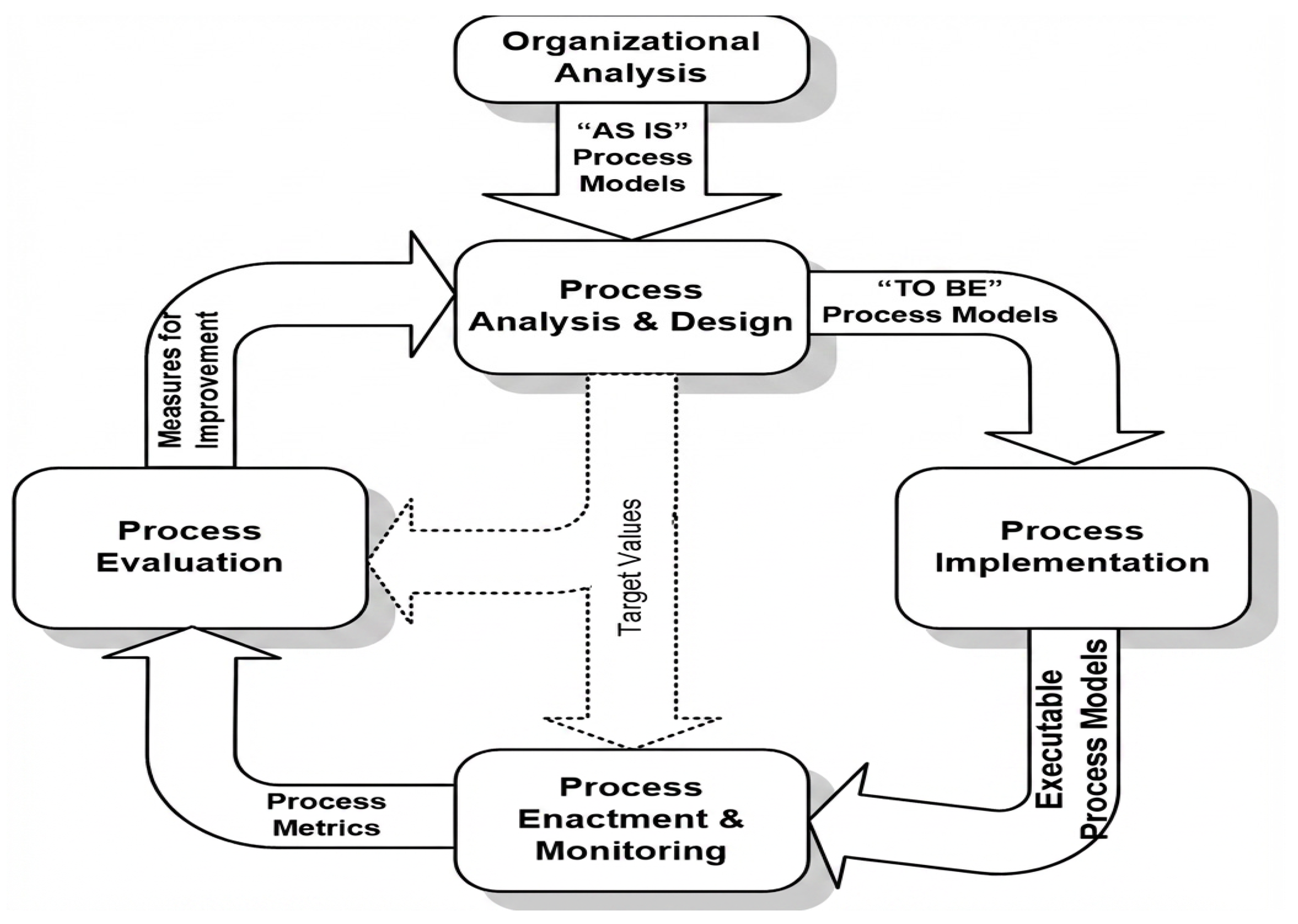
3.1. Design
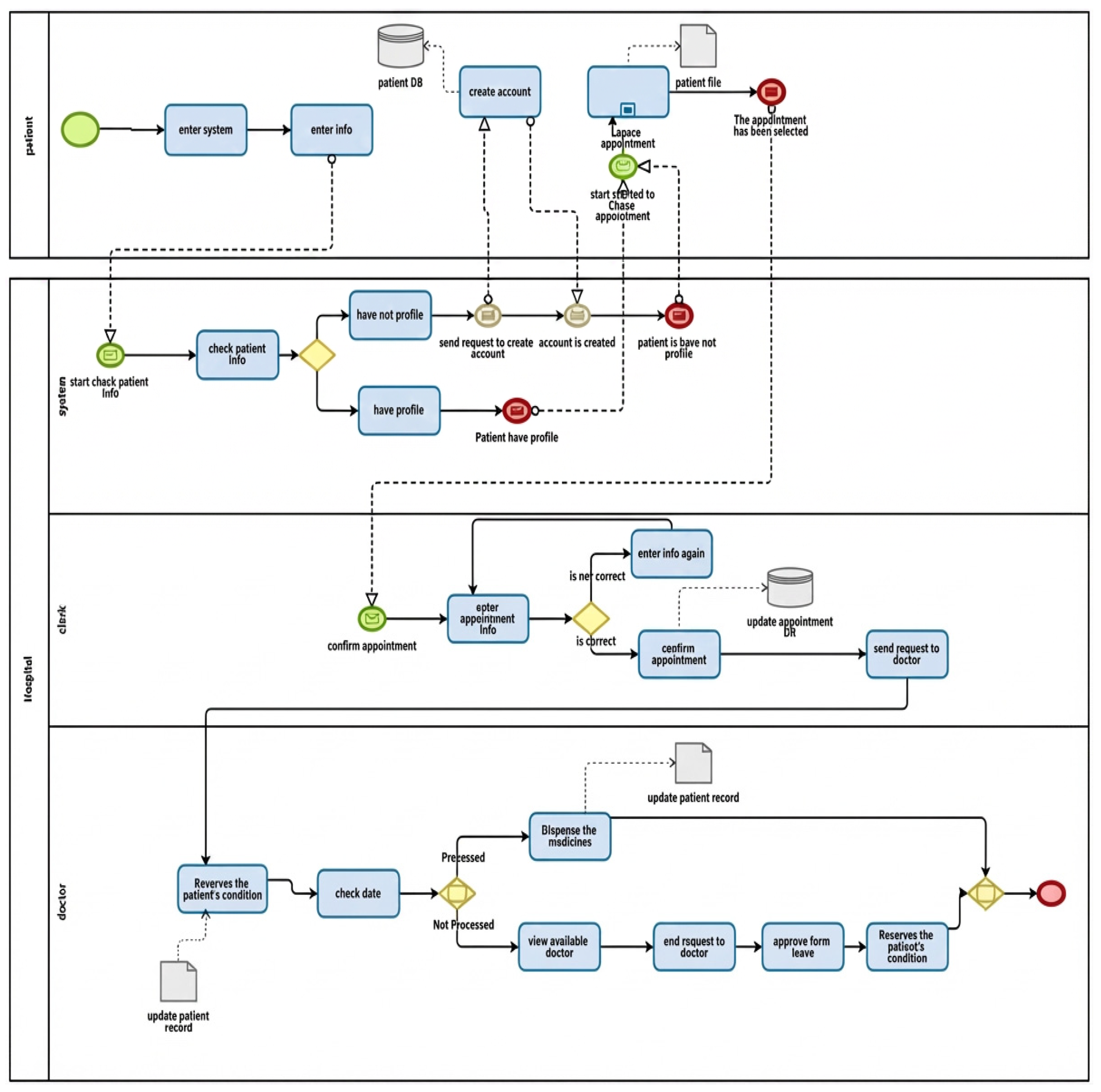
As-Is Model
3.2. Analysis
SWOT Analysis
- The system combines AI with machine learning (ML) and NLP to perform automated triage and appointment scheduling, which enhances medical diagnosis precision and decreases human involvement in administrative tasks.
- The system allows patients to book appointments instantly while it determines their treatment priority to reduce their waiting time and maximize doctor availability.
- The system uses data analytics, which incorporates medical history and laboratory results to enhance treatment precision.
- The Bizagi simulation system, together with BPMN modeling, enables organizations to obtain quantifiable performance data before deploying their solution.
- The system needs access to high-quality medical data, which exists in a single format, because different hospital environments with diverse systems reduce model precision.
- The process of system integration with existing hospital systems leads to delays during the initial deployment phase.
- The use of AI models in clinical decision support systems creates problems with explaining and making system decisions transparent to users.
- The system faces challenges in user acceptance because older patients and those who lack digital skills may struggle to use the system.
- The system has the potential to link with IoT devices and Electronic Health Records (EHRs) for scheduling appointments based on continuous patient monitoring.
- The system uses cloud-based infrastructure to expand its reach across healthcare networks and remote clinics.
- The system implements predictive and prescriptive analytics to support emergency triage and dynamic resource allocation.
- The system benefits from increased digital transformation interest in healthcare worldwide, which boosts its chances of market adoption.
- Healthcare organizations face two main security threats because of GDPR and HIPAA regulations, which protect patient data privacy.
- Medical staff members show resistance to workflow modifications because they worry about automation taking over their work.
- The high expenses for system deployment and upkeep create challenges for hospitals with limited resources.
- The system faces a risk of developing discriminatory algorithms which could lead to unfair treatment of patients during scheduling and medical service delivery.
3.3. Total Quality Management (TQM)
3.3.1. Customer Focus
3.3.2. Continuous Improvement
3.3.3. Leadership and Collaboration
3.3.4. Process Management
3.3.5. Employee Involvement and Training
Six Sigma
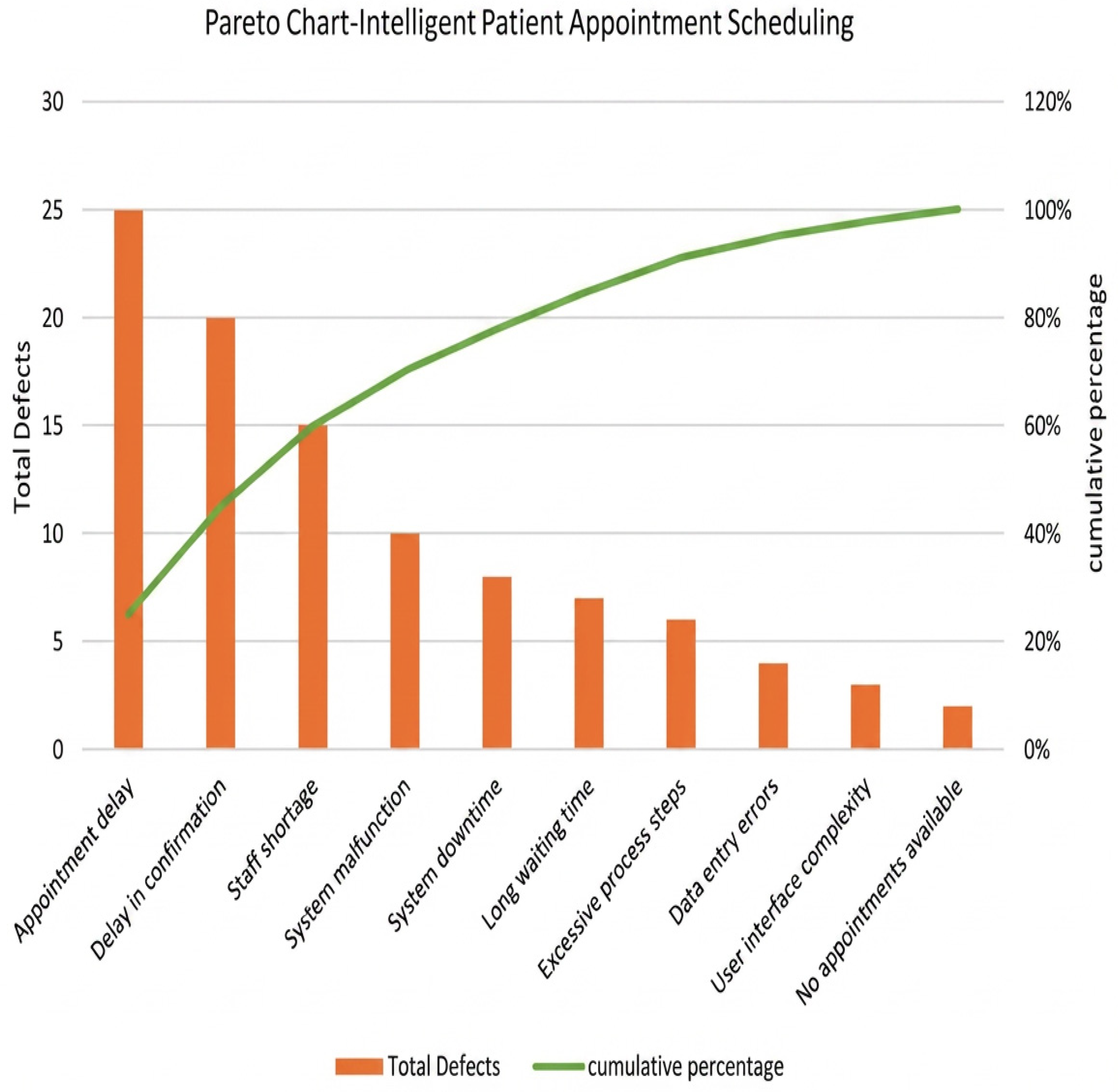
Pareto Chart
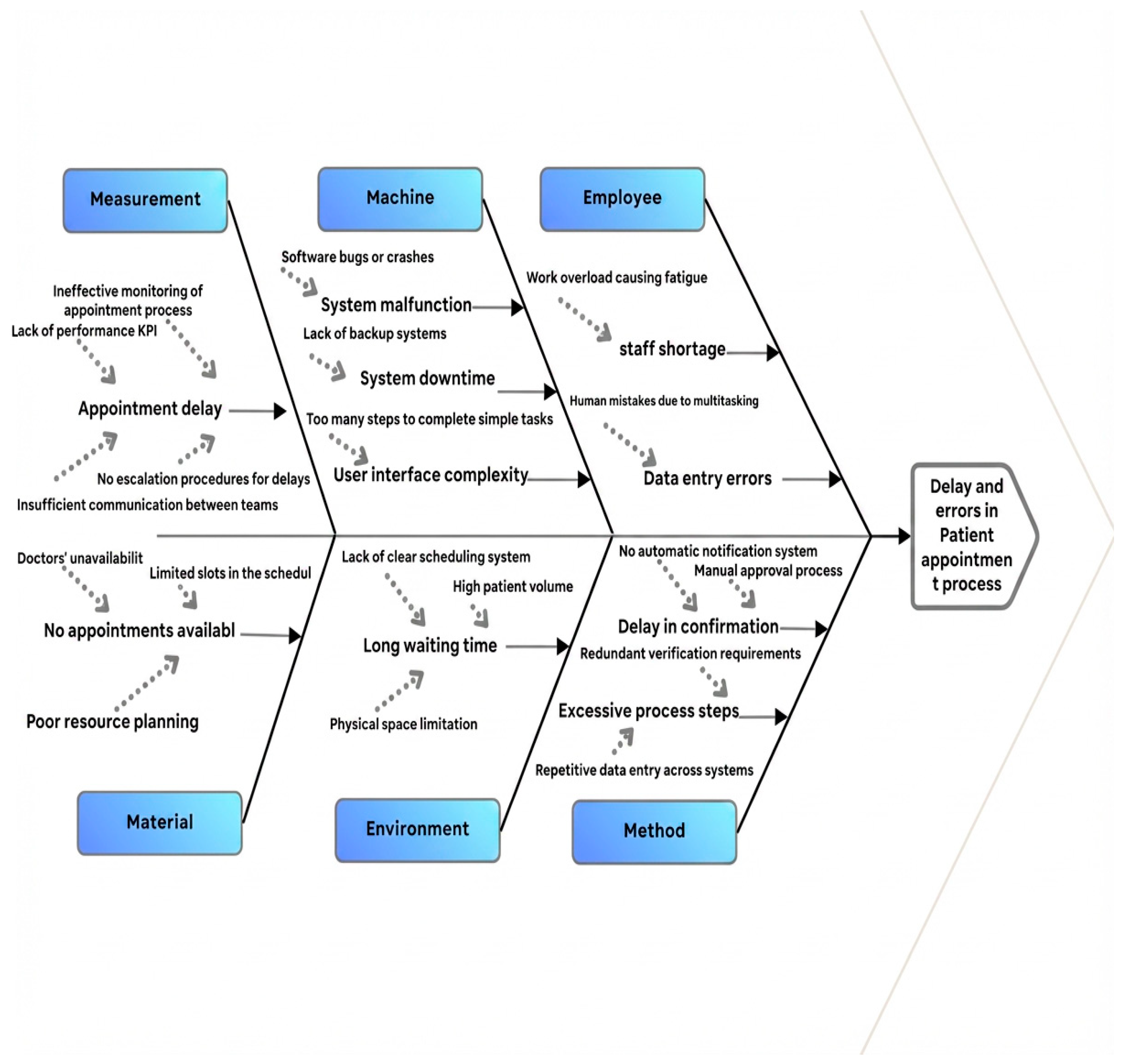
Fishbone
3.4. KPI Chart
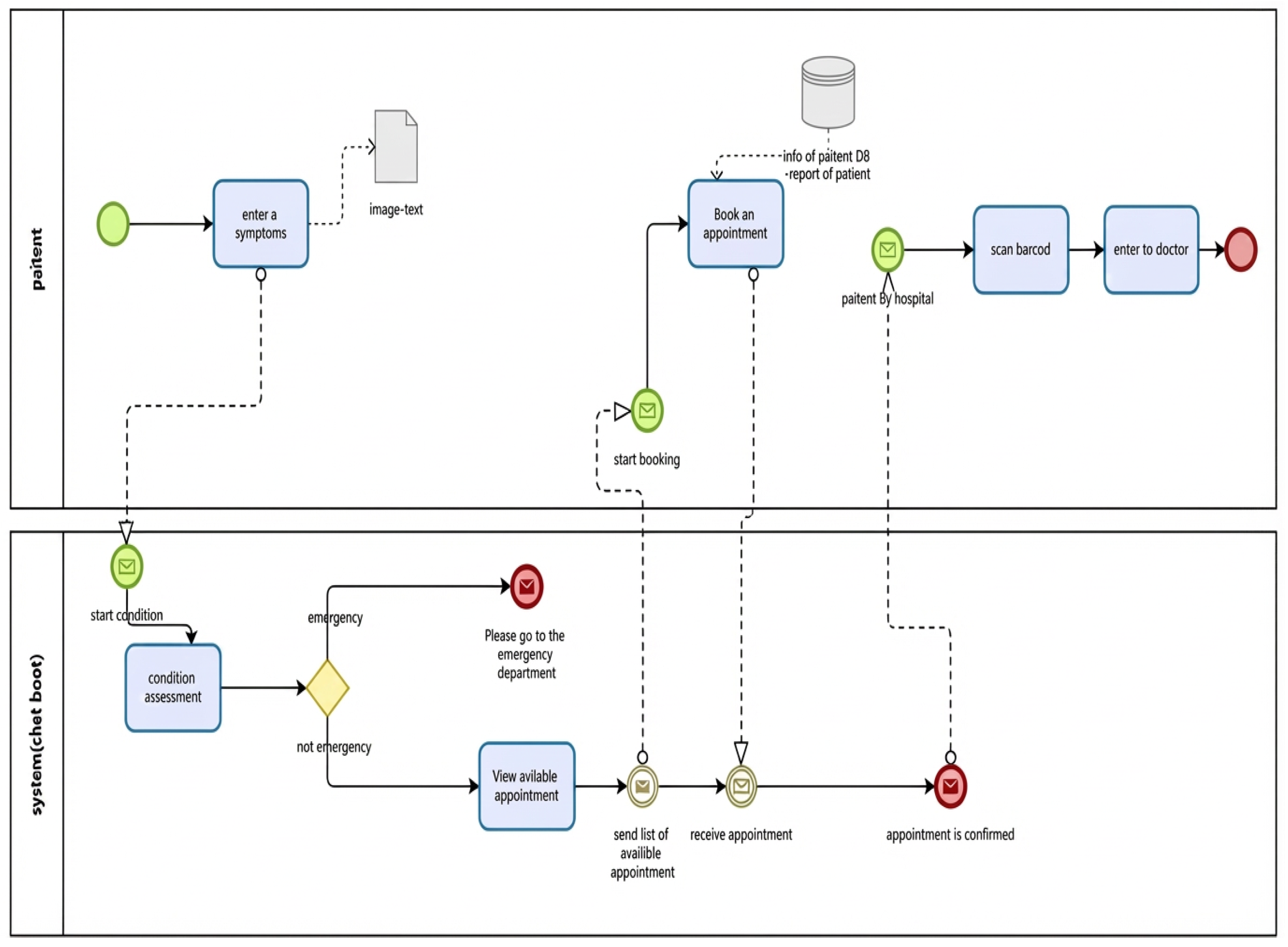
- Development of an intelligent chatbot linked to the hospital’s database (Figure 5).
- It analyzes symptoms submitted by the patient (text or image).
- It categorizes the condition (dermatological, orthopedic, psychological, etc.) and instantly displays the appropriate doctors.
- It automatically books appointments without human intervention.
- It sends alerts to both the doctor and the patient.


3.5. V. Redesign
4. Result
5. Conclusions
6. Future Work
Author Contributions
Funding
Institutional Review Board Statement
Informed Consent Statement
Data Availability Statement
Acknowledgments
Conflicts of Interest
References
- Han, Y.; Johnson, M.E.; Shan, X.; Khasawneh, M. A multi-appointment patient scheduling system with machine learning and optimization. Decis. Anal. J. 2024, 10, 100392. [Google Scholar] [CrossRef]
- Akinode, J.L.; Oloruntoba, S.A. Design and Implementation of a Patient Appointment and Scheduling System. Int. Adv. Res. J. Sci. Eng. Technol. 2017, 4, 16–23. [Google Scholar] [CrossRef]
- Niu, T.; Lei, B.; Guo, L.; Fang, S.; Li, Q.; Gao, B.; Yang, L.; Gao, K. A Review of Optimization Studies for System Appointment Scheduling. Axioms 2024, 13, 16. [Google Scholar] [CrossRef]
- Zhao, P.; Yoo, I.; Lavoie, J.; Lavoie, B.J.; Simões, E. Web-Based Medical Appointment Systems: A Systematic Review. J. Med. Internet Res. 2017, 19, e134. [Google Scholar] [CrossRef]
- Kammrath Betancor, P.; Boehringer, D.; Jordan, J.; Lüchtenberg, C.; Lambeck, M.; Ketterer, M.C.; Reinhard, T.; Reich, M. Efficient patient care in the digital age: Impact of online appointment scheduling in a medical practice and a university hospital on the ‘no-show’-rate. Front. Digit. Health 2025, 7, 1345678. [Google Scholar] [CrossRef] [PubMed]
- Li, N.; Li, X.; Zhang, C.; Kong, N. Integrated optimization of appointment allocation and access prioritization in patient-centred outpatient scheduling. Comput. Ind. Eng. 2021, 154, 107125. [Google Scholar] [CrossRef]
- Knight, R.T.D.; Aakre, C.A.; Anstine, C.V.; Munipalli, B.; Biazar, P.; Mitri, G.; Valery, J.R.; Brigham, T.; Niazi, S.K.; Perlman, A.I.; et al. Artificial intelligence for patient scheduling in the real-world health care setting: A metanarrative review. Health Policy Technol. 2023, 12, 100824. [Google Scholar] [CrossRef]
- Saad, G.; Harb, H.; Abouaissa, A.; Idoumghar, L.; Charara, N. A sensing-based patient classification framework for efficient patient-nurse scheduling. Sustain. Comput. Inform. Syst. 2023, 38, 100855. [Google Scholar] [CrossRef]
- Zhou, S.; Li, D.; Yin, Y. Coordinated appointment scheduling with multiple providers and patient-and-physician matching cost in specialty care. Omega 2021, 101, 102285. [Google Scholar] [CrossRef]
- Caldwell, K.E.; Kushner, B.S.; Donald, C.; Wise, P.E. Implementation of flexible days off improves surgical resident attendance of personal health appointments, perceived wellbeing, and sense of control. J. Surg. Educ. 2024, 81, 1522–1528. [Google Scholar] [CrossRef] [PubMed]
- Yousefi, N.; Hasankhani, F.; Kiani, M.; Yousefi, N. Appointment scheduling model in healthcare using clustering algorithms. arXiv 2023, arXiv:1905.03083. [Google Scholar] [CrossRef]
- Faridimehr, S.; Venkatachalam, S.; Chinnam, R.B. Managing access to primary care clinics using robust scheduling templates. arXiv 2019, arXiv:1911.05129. [Google Scholar] [CrossRef]
- Zhang, Y.; Zhang, Z. Joint Optimization of Service Routing and Scheduling in Home Health Care; Technical Report; Tongji University: Shanghai, China; Columbia University: New York, NY, USA, 2025. [Google Scholar]
- Zhang, H.; Wang, Y.; Jia, Y.-H.; Mei, Y. Genetic programming with model-driven dimension repair for learning interpretable appointment scheduling rules. IEEE Trans. Evol. Comput. 2026; early access. [CrossRef]
- Gao, Y.; Zhang, Q.; Lau, C.K.; Ram, B. Robust appointment scheduling in healthcare. Mathematics 2022, 10, 4317. [Google Scholar] [CrossRef]
- Valenzuela-Núñez, C.; Latorre-Núñez, G.; Troncoso-Espinosa, F. Smart medical appointment scheduling: Optimization, machine learning, and overbooking to enhance resource utilization. IEEE Access 2024, 12, 7551–7562. [Google Scholar] [CrossRef]
- AlSerkal, Y.M.; Ibrahim, N.M.; Alsereidi, A.S.; Ibrahim, M.; Kurakula, S.; Naqvi, S.A.; Khan, Y.; Oottumadathil, N.P. Real-time analytics and AI for managing no-show appointments in primary health care in the United Arab Emirates: Before-and-after study. JMIR Form. Res. 2025, 9, e64936. [Google Scholar] [CrossRef] [PubMed]
- Laan, C.; van de Vrugt, M.; Olsman, J.; Boucherie, R.J. Static and dynamic appointment scheduling to improve patient access time. Health Syst. 2018, 7, 148–159. [Google Scholar] [CrossRef] [PubMed]
- Zuo, J.; Jin, Y.; Liu, W. Outpatient scheduling problem in smart hospital with two-agent deep reinforcement learning algorithm. Law. Probab. Risk 2024, 27, 45–67. [Google Scholar] [CrossRef]
- Yang, Y.; Madanian, S.; Parry, D. Enhancing health equity by predicting missed appointments in health care: Machine learning study. JMIR Med. Inform. 2024, 12, e48273. [Google Scholar] [CrossRef] [PubMed]



| Index | Before Improvement | After Improvement | Improvement Ratio |
|---|---|---|---|
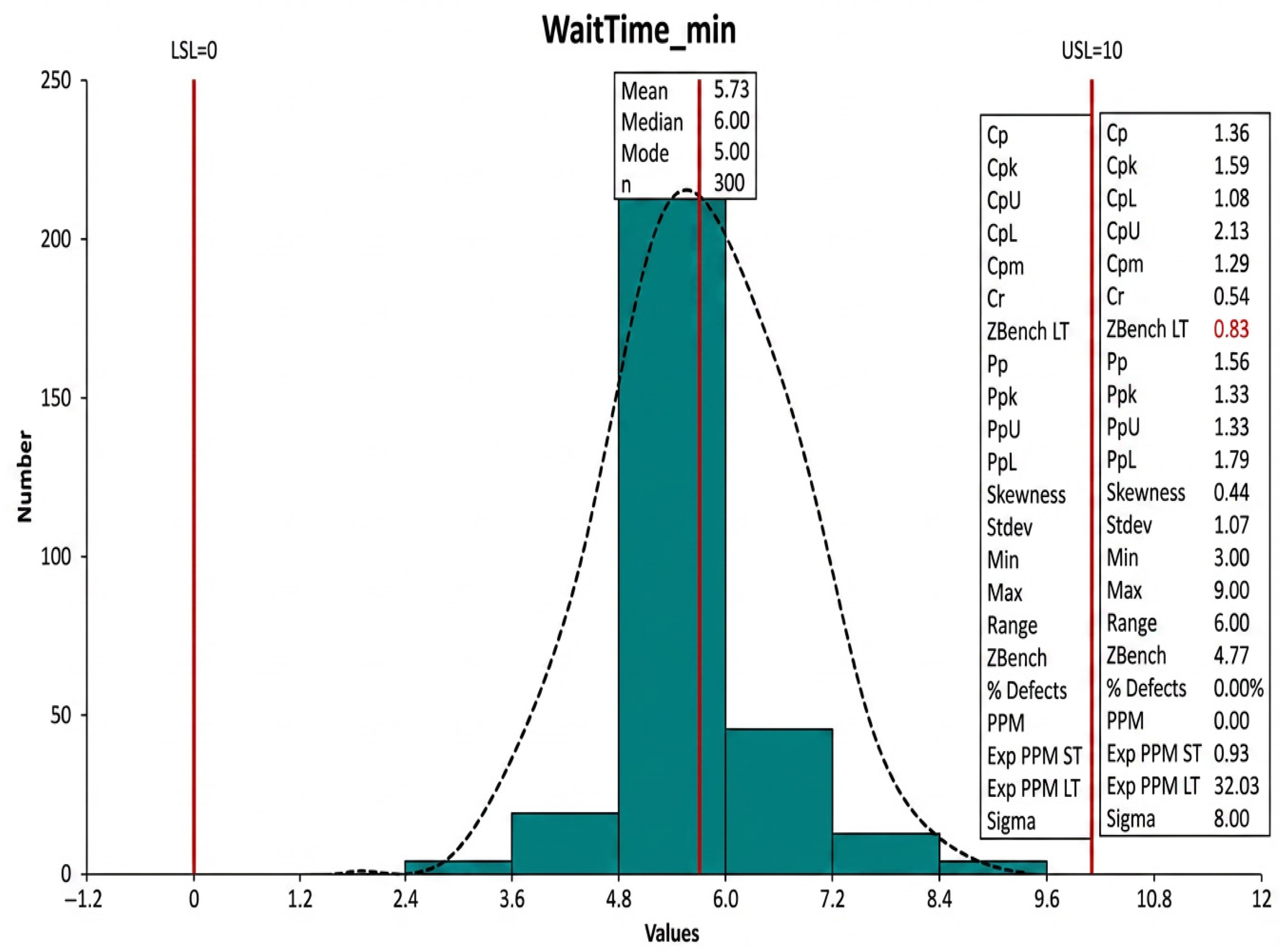
| Full booking time | 1 h | 5.73 min | 80% |
| Human intervention | High | Very limited | 64% |
| Patient satisfaction | Middle | High | +60% |
Disclaimer/Publisher’s Note: The statements, opinions and data contained in all publications are solely those of the individual author(s) and contributor(s) and not of MDPI and/or the editor(s). MDPI and/or the editor(s) disclaim responsibility for any injury to people or property resulting from any ideas, methods, instructions or products referred to in the content. |
© 2026 by the authors. Licensee MDPI, Basel, Switzerland. This article is an open access article distributed under the terms and conditions of the Creative Commons Attribution (CC BY) license.
Share and Cite
Elhag, S.; Althagafi, L.; Almouabdi, S. Intelligent Patient Appointment Schedules. Healthcare 2026, 14, 1195. https://doi.org/10.3390/healthcare14091195
Elhag S, Althagafi L, Almouabdi S. Intelligent Patient Appointment Schedules. Healthcare. 2026; 14(9):1195. https://doi.org/10.3390/healthcare14091195
Chicago/Turabian StyleElhag, Salma, Lama Althagafi, and Shroog Almouabdi. 2026. "Intelligent Patient Appointment Schedules" Healthcare 14, no. 9: 1195. https://doi.org/10.3390/healthcare14091195
APA StyleElhag, S., Althagafi, L., & Almouabdi, S. (2026). Intelligent Patient Appointment Schedules. Healthcare, 14(9), 1195. https://doi.org/10.3390/healthcare14091195