“I Just Have to Go and Heal”: A Qualitative Study on the Acceptability of the Belgian Sexual Assault Care Centres for Victims of Recent Sexual Assault

 , , , ,
Highlights
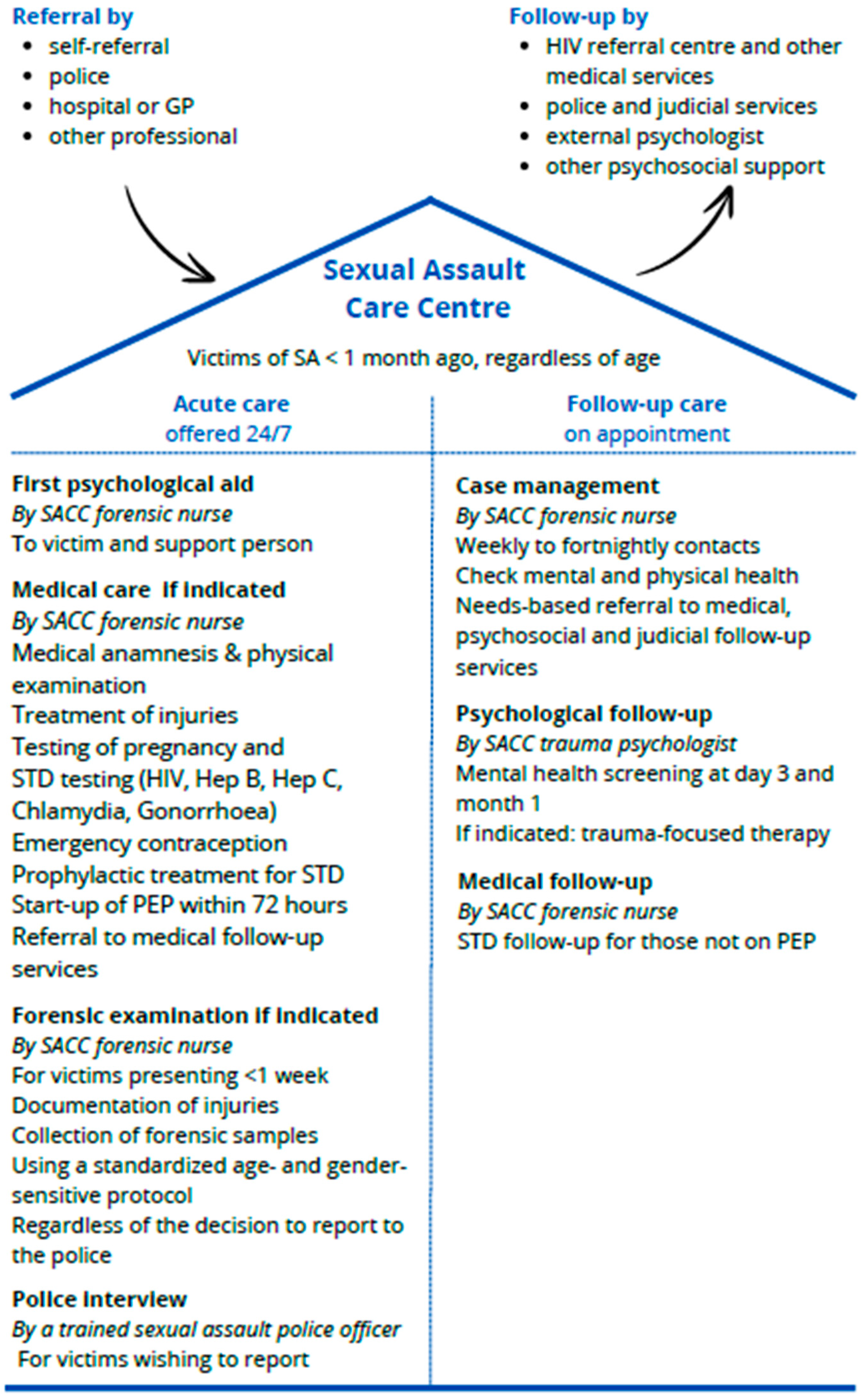
- Victims and support persons considered the Belgian Sexual Assault Care Centres’ model (SACC)—providing integrated medical and psychological care, forensic examination and the option to report to the police for victims of recent sexual assault—to be highly acceptable, valuing its holistic, accessible, and long-term approach to post-assault care.
- Key innovative components—embedded psychological support, forensic examination without mandatory reporting, and the option to report to police within the SACC—were viewed as beneficial.
- Strengthening coordination between SACCs and other criminal justice actors is needed to ensure continuity of support after acute care.
- Core features of the SACC model may inform the development or refinement of specialised sexual assault services in other countries.
Abstract
1. Introduction
2. Materials and Methods
2.1. Study Design and Setting
2.2. Study Participants
2.3. Data Collection
2.4. Data Analysis
3. Results
3.1. Participant Characteristics
3.2. Overview of Themes
3.3. Affective Attitude
It was an extraordinary help. Otherwise, you’d be completely lost.(Victim 18)
I felt good here [at the SACC] despite the seriousness of it [the sexual violence] all.(Victim 7)
The nurses were perfect!(Victim 19)
Honestly, I really found it [the SACC] very good. I was totally convinced, which is why I wanted to give my time [for this interview]. It was because of that, because I think it needs to continue and that it’s worth it.(Victim 2)
3.4. Ethicality
3.4.1. Being Empathic
People who are immediately there to listen […] and who come towards you and try their best to help you and make you feel somewhat comfortable after what happened. […] I dealt with people who were really very nice and understanding. )(Victim 5)
Yes, they approached it [the forensic exam] in a very gentle way, and they also said: ‘I’m going to do this, is that okay?’. And there was constant checking to see if everything was alright, and then again afterwards they asked if it was okay or not. So yes, they do take into account that it’s actually something unpleasant.(Victim 15)
Yes, they [the police inspectors] were also very professional and calm, and yes, that was also very good, you know. Yes, and friendly, yeah.(Victim 13)
I found it very, very cold, with very little empathy. […] I thought their attitude was… Well, like police officers, actually. It doesn’t surprise me. […] But then, he can’t be like: “How are you? Are you okay?” They can’t act like that either. I think that’s normal.(Victim 4)
I had called the police, and yeah… what time was it? Half past ten [PM]. And he [the police officer] just bluntly told me, ‘You shouldn’t come with that now, come back tomorrow during the day.’ I said, ‘Are you serious? Is what happened not serious enough? Isn’t it important?’ ‘No,’ they said, ‘there’s no one here anymore’, and so on… And meanwhile, the police chief overheard the conversation, took over the phone and said, ‘Come here right away’.(Support person 9)
3.4.2. Giving Clear Information
The explanation was really thorough. Before we started [the forensic exam]—I think they gave me a good half an hour- they explained everything to me: “There will be this, there will be that…” He explained that the samples would be kept for a certain period of time, um… that if I decided not to file a complaint, they couldn’t force me to. Well, everything….(Victim 19)
We received a lot of little brochures like that. And it was good because, again, when they explain everything to us, it is impossible to remember it all. Especially since I hadn’t slept for hours, I was tired […], and with everything that had happened…(Support person 3)
The fact that they leave you in the dark about your own investigation. And, um, it would be appreciated, for example, to be kept informed about even the progress.(Victim 1)
3.4.3. Offering Choices
It’s not: ‘Boom! We’re doing this, we’re doing that [during acute care].’ … It’s: ‘If you want.’ One always has the right to say no, to say: ‘Stop.’ It’s not an obligation, there’s a lot of respect.(Victim 18)
But she was already reassured, because the person I spoke to at the [SACC] centre told me that she would not be pressured to file a complaint, […] that she would be free [to decide what she wants].(Support person 11)
3.4.4. Specialised Professionals
I think the care is precious, and completely different than when you would show up at the emergency department, with doctors who may be very nice but don’t necessarily do this all the time. And there [at the SACC], you really felt a willingness and a certain expertise from the nurse. She knew how to choose her words, she knew how to ask the difficult questions correctly as well.(Victim 17)
Because the nurse told me that they are specialised police officers dealing with sexual offences who work exclusively with the [SACC] centre. And that it’s not like going to the police station.(Victim 8)
The person told me that he [psychologist] was actually specialised in everything related to trauma. That’s when I understood that he wasn’t just a psychologist. Because it [SA] requires a different kind of knowledge, a specialisation.(Victim 7)
3.4.5. Gender Sensitivity
[It were] all women at the SACC. Yes, I think that’s also a good thing, after sexual violence. Because yeah, if a guy then comes to take care of you… I don’t think that’s going to work out. […] Yeah, I wouldn’t have wanted that. […] Especially when they do those tests in your intimate zones.(Victim 14)
There was… a man and a woman [police officers]. And uh, I think the man had a daughter around my age. And he was a bit, uh… affected, and you could see it in his attitude. So he was very understanding with me, a bit protective, and uh… it’s more pleasant like that.(Victim 6)
3.5. Burden and Opportunity Cost
3.5.1. Nearby Services
[I drove her by car] because taking the train wasn’t really manageable for her. Especially since we had been clearly told over the phone that we needed to bring everything, like sheets, tissues, her clothes, and that she shouldn’t wash herself… […] I feel like it wasn’t ideal for her to deal with public transport because it was quite a long trip, and, it’s silly, but [she] doesn’t always have 4G to look at Google Maps. So, if she had had to go there alone, I’m not sure it would have happened either.(Support person 11)
And we’re also from [another city], so it’s always a thirty-minute drive to get here, which is also an obstacle to participating [in the psychological support].(Support person 9)
3.5.2. Available Services
She didn’t have to wait x amount of time, make an appointment, and then… It happened right away, you see. It’s important that it’s in the moment, not two months later when we can, uh… […] Yeah, it’s in the very moment that we need to immediately put words to it and see someone.(Support person 10)
In the evening, I had anxiety attacks. But here [at the SACC], we can call 24/7. So that helps too. So, when you don’t feel well all of a sudden… Hop, I can talk to someone.(Victim 8)
It was quite complicated to see a psychologist here at the SACC who would agree to schedule an appointment at 6 or 6:30 PM, after my work. […] Now I have made an appointment with another [psychologist. There] it’s open until 8 PM.(Victim 19)
In the sense that I know, for example, if one day it comes back to me… a day when I cry, or a day when I’m not feeling well… I know I can call someone here [at SACC] to make another appointment with a psychologist, or to explain or to talk. […] And I think that is something really reassuring.(Victim 4)
3.5.3. Lengthy Procedures
Actually, it’s really the time, and then all these emotions… You see, you’re assaulted, and then the police patrol comes to get you, you get treated here [at the SACC] where they ask you questions, you fill out documents, … And then you do the same thing with the police… And all of that takes hours and hours, and… […] I could think it would have been easier if we had done this or that. But in the end, I don’t really know, and I think that um…for the investigation and for a person’s health, it’s better to do everything as quickly as possible.(Victim 6)
3.5.4. Affordable Services
I’m a student, it’s not like I have a lot of… money to, um… you know. So that was also something that held me back from talking about it, because I thought, ‘Yeah, I’m not going to spend that much money on it,’ and then… then she [my friend] found [the SACC], so that… was a good option.(Victim 10)
Personally… maybe it wouldn’t have been the reason that I would say “I’m not going”. But, I don’t know, it would make it seem a little bit more complicated, and in a way unfair. Because this [SA] is something that someone didn’t choose. So,… I think I don’t deserve to have to pay. You’re already paying with all kinds of pay and everything.(Victim 3)
3.6. Intervention Coherence
3.6.1. Understanding of SACC Services
So yes, they took blood samples, and then they took, like, a sample, probably to check if I didn’t have any diseases, and well, I don’t really remember everything they did. Um. […] They did all of that [samples to find traces of the perpetrator] too.(Victim 1)
3.6.2. Understanding of Services Intervening Post-SACC
After the SACC, I didn’t really know how… what I was supposed to do legally. Or if I had to do anything. […] On day three or so [after the SA], I was thinking, ‘Should I actually do something? Because I’ve now filed the complaint, can I follow up on it, can I… yeah, I don’t know?’(Victim 12)
3.7. Perceived Effectiveness
3.7.1. Perceived Outcomes
- Feeling recognised as a victim of SA:
I think at least it helped her realize that something had happened and that she was legitimate, too. Because, in a way, I think that if we hadn’t gone through the centre and there hadn’t been any samples taken, for example, I’m not sure she would have filed a complaint…(Support person 11)
So, for the first time, I felt like I was in a legitimate victim position and no longer… Because [after the 1st SA for which victim did not go to a SACC] they made me feel like it was practically my fault and that I was bothering by asking for help.(Victim 7)
- Emotional support:
They [the nurses] helped me a lot, voilà… It wasn’t a big deal, but they made me understand that it was normal if I wasn’t feeling well or if I had strange reactions, etc. They reassured me a lot and comforted me too, so…(Victim 7)
Because I didn’t dare to talk about it with anyone else… and that there [with the nurse on the phone] I could… I could say that it didn’t go well… that something was wrong, or…(Victim 11)
- Dealing with trauma of the SA:
I was actually treated there as well, you know. […] Yes, it [psychological support] pushed me to face it directly, and it has been tough months to process that. But otherwise, maybe it would have been buried for years.(Victim 15)
I think it’s important for me to… to keep seeing [psychologist’s name] for now. […] Because I still am not sleeping, and all that, you know…. But at the same time, I’m now again able to leave the door open. […] So, I find that… I have to keep getting this help, because it’s really a step-by-step thing.(Victim 3)
- Reassurance about their health:
Because it [the SACC] removes medical anxiety, clearly. So at least we feel calm about that. Even if we had picked up something, it might have been caught in time.(Victim 17)
- Facilitate access to the criminal justice system:
I think it’s good to do it [the forensic exam], it’s important to do it. And as they say… as I explained to you, it allows us to think about whether we want to start a [criminal justice] procedure or not.(Victim 5, did not report)
Since I didn’t have to leave [the SACC], that they [SA police officers] were coming, that I had time to rest in the meantime… Yes, I think that played a role too. If you had told me, ‘You need to go to the police station to file a complaint,’ I would have said no. I would have gone home, I would have slept, and I wouldn’t have filed a complaint right away.(Victim 4)
3.7.2. Effective Care Pathways
- Centralised holistic care:
You know, when they sit you and they tell you, ‘We have the police here and we have the psychologist, and there is us, the nurses, and you also get to see the doctor. And everything is covered. You just have to come.’… It just makes you feel like ‘OK, I just have to go and heal.’(Victim 3)
They asked me [on the phone] what kind of support I wanted, what support I would need. So, at that time, it was just psychological. But they said, ‘Well, in any case, just come… the nurse will talk to you, and we’ll see what… what you need. Because we think you need more than just a psychological evaluation, like also a gynaecological examination… you need all’.(Victim 19)
You can only speak to the police at the clinic on the first day [of admission…] Like… It shouldn’t be just only for those who present within] the first week [after the SA], you know? Because I know there was a certain point [later on] I was thinking, ‘OK, I think I want to speak to the police now’. But then, I would start thinking ‘Oo, I have to go to the police station, and…’. So, it would stop me again.(Victim 3)
Yes, I find that it’s missing… a legal liaison, let’s say, of what to do afterwards… Because we have medical support, psychological support, etc. But we are left on our own with all the legal procedures afterwards, on what we need to do to defend our rights…(Support person 1)
- Long-term follow-up:
The fact that they really accompany us, even afterwards. You know, there are many places where it could be like that [during acute care]. And once we leave it’s over, they don’t get involved in our stories anymore. But here [at the SACC], no…they really get involved in our story and in our ordeal.(Victim 6)
I saw the psychologist once, but pfff… I’m already seeing a psychiatrist for other things. And that’s it. I’m someone independent. I fight my battles on my own.(Victim 18)
- Proactive support:
I bury my head in the sand, so I prefer not to say anything anymore, not to talk about it anymore… And so, if they [SACC nurses] hadn’t called me, I wouldn’t have called… Maybe I wouldn’t have even gone to get the other medications, uh… […] So it’s good that they do that.(Victim 6)
Well, I think there was, well, the timing wasn’t great… in the sense that it’s a bit complicated I think, uh… Well, especially when we haven’t talked to our surroundings etc. and well, we’re not always… even able to respond, to discuss these things…(Victim 5)
You know which doctor you need to see. They immediately make an appointment for you, so it’s well followed up, really. […] Imagine if you had to do everything yourself after seeing the doctor, the gynaecologist, and all the tests… […] And if you have to repeat your story every time about what happened, with each doctor, you don’t feel like doing that, right? So now that’s basically all taken out of your hands.(Support person 15)
- Continuity of care:
But for me it was difficult, because you kept seeing different people instead of the ones who had cared for you [during acute care]. So…yeah, that was a bit irritating. Because you open up to one person, and you want to see them again, um […] But it wasn’t too bothersome or anything. The others were also very friendly and helpful, but yeah…(Victim 1)
He gave me someone else’s number [a psychologist]. But I won’t contact them. Um, I don’t want to explain everything again. I don’t know if that person will be a good fit for me or not.(Victim 7)
- Safe space:
It’s almost like…. it’s out of this harsh reality. It’s almost like an escape, a place where you will feel much better. It’s worth it to like struggle to go.(Victim 3)
3.8. Self-Efficacy
But in her mind, it wasn’t framed as rape or sexual assault. She found it “strange”. She knew that it wasn’t normal. But I believe the process and the time it would have taken her to reach that conclusion would have, in some way, worked against her.(Support person 11)
I was still in shock, and it was her [my friend] who clearly said to me, ‘Listen, I think you need to go. Don’t wait too long. I know it’s not easy, but I think you need to go quickly.’ So she acted, because she felt I wasn’t ready to do so yet, and that by the time I was ready, it might have been too late for medical care. So it was she who had heard about it, who did some research, and found out there was one [SACC] here and that it wasn’t too far.(Victim 17)
At first, there was denial. So I didn’t want to acknowledge what had happened. And after that…after two days, I thought, ‘No, something did happen, you need to realise that and get the necessary care’.(Victim 19)
Because you are examined completely, and those are things that bring a lot of pain and shame. Because… since that [SA] happened, you feel a constant shame. And then you have to show it to someone. That is… that is basically the naked truth, literally and figuratively, that you lay yourself bare. That was very difficult.(Victim 16)
So at that moment [the first weeks after the SA] you think, ‘Yeah, I’m doing fine, it’s okay…’. Plus, you also get phone calls [from the SACC], and when you’re constantly confronted with that… It [not answering the calls] was maybe a bit of a way to avoid thinking about it for a while or…(Victim 15)
But I actually didn’t go [to my first consultation with the SACC psychologist], because yeah… I don’t really like talking. […] But I’ve come to realise now [months later] that… I think… I long for a psychologist who is specialised in this, and I should really go there to be able to close that chapter.(Victim 1)
4. Discussion
4.1. Summary of Main Findings
4.2. Reflections on the Application of the TFA in Specialised SA Care
4.3. Study Limitations and Strengths
4.4. Implications for Policy and Practice
4.5. Implications for Research
5. Conclusions
Supplementary Materials
Author Contributions
Funding
Institutional Review Board Statement
Informed Consent Statement
Data Availability Statement
Acknowledgments
Conflicts of Interest
Abbreviations
| GP | General practitioner |
| Hep | Hepatitis |
| HIV | Human Immunodeficiency Virus |
| IDI | In-depth interview |
| PEP | Post-exposure prophylaxis |
| PTSD | Posttraumatic stress disorder |
| SA | Sexual assault |
| SACC | Sexual Assault Care Centre (BE) |
| SANE | Sexual Assault Nurse Examiner programme (US) |
| SARC | Sexual Assault Referral Centre (UK) |
| SOP | Standard Operating Procedure |
| STI | Sexually Transmitted Infections |
| TFA | Theoretical Framework of Acceptability |
| UK | United Kingdom |
| US | United States of America |
References
- WHO. Violence Against Women Prevalence Estimates, 2018: Global, Regional and National Prevalence Estimates for Intimate Partner Violence Against Women and Global and Regional Prevalence Estimates for Non-Partner Sexual Violence Against Women; Report No.: 9240022252; World Health Organization: Geneva, Switzerland, 2021. [Google Scholar]
- Sardinha, L.; Maheu-Giroux, M.; Stöckl, H.; Meyer, S.R.; García-Moreno, C. Global, regional, and national prevalence estimates of physical or sexual, or both, intimate partner violence against women in 2018. Lancet 2022, 399, 803–813. [Google Scholar] [CrossRef]
- Sardinha, L.; Stöckl, H.; Maheu-Giroux, M.; Meyer, S.R.; García-Moreno, C. Global prevalence of non-partner sexual violence against women. Bull. World Health Organ. 2024, 102, 582–587. [Google Scholar] [CrossRef]
- Schapansky, E.; Depraetere, J.; Keygnaert, I.; Vandeviver, C. Prevalence and associated factors of sexual victimization: Findings from a national representative sample of Belgian adults aged 16–69. Int. J. Environ. Res. Public Health 2021, 18, 7360. [Google Scholar] [CrossRef]
- Jina, R.; Thomas, L.S. Health consequences of sexual violence against women. Best Pract. Res. Clin. Obstet. Gynaecol. 2013, 27, 15–26. [Google Scholar] [CrossRef] [PubMed]
- Dworkin, E.R. Risk for Mental Disorders Associated with Sexual Assault: A Meta-Analysis. Trauma Violence Abus. 2020, 21, 1011–1028. [Google Scholar] [CrossRef] [PubMed]
- Dworkin, E.R.; Menon, S.V.; Bystrynski, J.; Allen, N.E. Sexual assault victimization and psychopathology: A review and meta-analysis. Clin. Psychol. Rev. 2017, 56, 65–81. [Google Scholar] [CrossRef] [PubMed]
- Sabina, C.; Ho, L.Y. Campus and college victim responses to sexual assault and dating violence: Disclosure, service utilization, and service provision. Trauma Violence Abus. 2014, 15, 201–226. [Google Scholar] [CrossRef]
- Hutschemaekers, G.J.M.; Zijlstra, E.; de Bree, C.; Lo Fo Wong, S.; Lagro-Janssen, A. Similar yet unique: The victim’s journey after acute sexual assault and the importance of continuity of care. Scand. J. Caring Sci. 2019, 33, 949–958. [Google Scholar] [CrossRef]
- Campbell, R. The psychological impact of rape victims’ experiences with the legal, medical, and mental health systems. Am. Psychol. 2008, 63, 702–717. [Google Scholar] [CrossRef]
- Stefanidou, T.; Hughes, E.; Kester, K.; Edmondson, A.; Majeed-Ariss, R.; Smith, C.; Ariss, S.; Brooker, C.; Gilchrist, G.; Kendal, S.; et al. The identification and treatment of mental health and substance misuse problems in sexual assault services: A systematic review. PLoS ONE 2020, 15, e0231260. [Google Scholar] [CrossRef]
- Lechner, M.; Bell, K.; Short, N.A.; Martin, S.L.; Black, J.; Buchanan, J.A.; Reese, R.; Ho, J.F.D.; Reed, G.D.; Platt, M.; et al. Perceived Care Quality among Women Receiving Sexual Assault Nurse Examiner Care: Results from a 1-Week Postexamination Survey in a Large Multisite Prospective Study. J. Emerg. Nurs. 2021, 47, 449–458. [Google Scholar] [CrossRef]
- Henninger, A.L.; Iwasaki, M.; Carlucci, M.E.; Lating, J.M. Reporting Sexual Assault: Survivors’ Satisfaction with Sexual Assault Response Personnel. Violence Against Women 2020, 26, 1362–1382. [Google Scholar] [CrossRef]
- Majeed-Ariss, R.; Walker, T.; Lee, P.; White, C. The experiences of sexually assaulted people attending Saint Mary’s Sexual Assault Referral Centre for a forensic medical examination. J. Forensic Leg. Med. 2019, 66, 33–37. [Google Scholar] [CrossRef] [PubMed]
- Campbell, R.; Greeson, M.R.; Fehler-Cabral, G. With care and compassion: Adolescent sexual assault victims’ experiences in Sexual Assault Nurse Examiner programs. J. Forensic Nurs. 2013, 9, 68–75. [Google Scholar] [CrossRef]
- Fehler-Cabral, G.; Campbell, R.; Patterson, D. Adult sexual assault survivors’ experiences with sexual assault nurse examiners (SANEs). J. Interpers. Violence 2011, 26, 3618–3639. [Google Scholar] [CrossRef] [PubMed]
- Walker, T.; Majeed-Ariss, R.; Riley, R.; White, C. Women’s experiences of attending an English sexual assault referral centre: An exploratory study. J. Forensic Psychiatry Psychol. 2020, 31, 123–136. [Google Scholar] [CrossRef]
- Birdi, G.; Caswell, R.J.; Ross, J.D.; Pattison, H.; Ayinde, O.; Lorimer, K. An exploration of patient satisfaction with and experience of a sexual abuse survivors clinic. Int. J. STD AIDS 2022, 33, 180–185. [Google Scholar] [CrossRef]
- Caswell, R.J.; Ross, J.D.; Lorimer, K. Measuring experience and outcomes in patients reporting sexual violence who attend a healthcare setting: A systematic review. Sex. Transm. Infect. 2019, 95, 419–427. [Google Scholar] [CrossRef] [PubMed]
- Keygnaert, I.; Van Impe, M.; Van Braeckel, D. Naar een Holistische Aanpak van Seksueel Geweld in België: Eindrapport Haalbaarheidsstudie Centra Seksueel Geweld; Universiteit Gent-ICRH: Gent, Belgium, 2016. [Google Scholar]
- Peeters, L.; Vandenberghe, A.; Hendriks, B.; Gilles, C.; Roelens, K.; Keygnaert, I. Current care for victims of sexual violence and future sexual assault care centres in Belgium: The perspective of victims. BMC Int. Health Hum. Rights 2019, 19, 21. [Google Scholar] [CrossRef]
- Baert, S.; Gilles, C.; Van Belle, S.; Bicanic, I.; Roelens, K.; Keygnaert, I. Piloting Sexual Assault Care Centres in Belgium: Who do they reach and what care is offered? Eur. J. Psychotraumatol. 2021, 12, 1935592. [Google Scholar] [CrossRef]
- Klaic, M.; Kapp, S.; Hudson, P.; Chapman, W.; Denehy, L.; Story, D.; Francis, J.J. Implementability of healthcare interventions: An overview of reviews and development of a conceptual framework. Implement. Sci. 2022, 17, 10. [Google Scholar] [CrossRef]
- Sekhon, M.; Cartwright, M.; Francis, J.J. Acceptability of healthcare interventions: An overview of reviews and development of a theoretical framework. BMC Health Serv. Res. 2017, 17, 88. [Google Scholar] [CrossRef] [PubMed]
- Baert, S.; Keygnaert, I. Wetenschappelijk Evaluatierapport Pilootproject Zorgcentra na Seksueel Geweld; Universiteit Gent, Vakgroep Volksgezondheid en Eerstelijnszorg, International Centre for Reproductive Health: Gent, Belgium, 2019. [Google Scholar]
- NICE. Post-Traumatic Stress Disorder: NICE Guideline; National Institute of Health and Care Excellence: London, UK, 2018. [Google Scholar]
- Teddlie, C.; Yu, F. Mixed Methods Sampling: A Typology with Examples. J. Mix. Methods Res. 2007, 1, 77–100. [Google Scholar] [CrossRef]
- Morse, J.M.; Barrett, M.; Mayan, M.; Olson, K.; Spiers, J. Verification Strategies for Establishing Reliability and Validity in Qualitative Research. Int. J. Qual. Methods 2002, 1, 13–22. [Google Scholar] [CrossRef]
- Braun, V.; Clarke, V. Using thematic analysis in psychology. Qual. Res. Psychol. 2006, 3, 77–101. [Google Scholar] [CrossRef]
- Dworkin, E.R.; Schumacher, J.A. Preventing Posttraumatic Stress Related to Sexual Assault Through Early Intervention: A Systematic Review. Trauma Violence Abus. 2016, 19, 459–472. [Google Scholar] [CrossRef]
- Dworkin, E.R.; Brill, C.D.; Ullman, S.E. Social reactions to disclosure of interpersonal violence and psychopathology: A systematic review and meta-analysis. Clin. Psychol. Rev. 2019, 72, 101750. [Google Scholar] [CrossRef]
- Baert, S.; Fomenko, E.; Machiels, A.; Bicanic, I.; Van Belle, S.; Gemmel, P.; Gilles, C.; Roelens, K.; Keygnaert, I. Mental health of sexual assault victims and predictors of their use of support from in-house psychologists at Belgian sexual assault care centres. Eur. J. Psychotraumatol. 2023, 14, 2263312. [Google Scholar] [CrossRef]
- Baert, S.; De Buyser, S.; Van Belle, S.; Gemmel, P.; Rousseau, C.; Roelens, K.; Keygnaert, I. Factors Related to Police Reporting in Sexual Assault Care Centers: Are We Underestimating the Role of Support Persons? Violence Against Women 2024, 30, 3943–3969. [Google Scholar] [CrossRef]
- Dagger, T.S.; Sweeney, J.C.; Johnson, L.W. A Hierarchical Model of Health Service Quality: Scale Development and Investigation of an Integrated Model. J. Serv. Res. 2007, 10, 123–142. [Google Scholar] [CrossRef]
- Keygnaert, I.; Baert, S. Nationale criteria en standaardprocedures voor Zorgcentra na Seksueel Geweld in België. In Zorgcentra na Seksueel Geweld in België: Het ZSG-Model, 2024th ed.; IGVM: Brussel, Belgium, 2020. [Google Scholar]


| Construct | Description |
|---|---|
| Affective attitude | How an individual feels about the intervention |
| Burden | The perceived amount of effort that is required to participate in the intervention |
| Ethicality | The extent to which the intervention has good fit with an individual’s value system |
| Intervention coherence | The extent to which the participant understands the intervention and how it works |
| Opportunity cost | The extent to which benefits, profits and values must be given up to engage in the intervention |
| Perceived effectiveness | The extent to which the intervention is perceived as likely to achieve its purpose |
| Self-efficacy | The participant’s confidence that they can perform the behaviours required to participate in the intervention |
| Participated in Person n (%) | Represented by a Support Person n (%) | Total n (%) | SACC Population During the Pilot Year (n = 931) c (%) | |
|---|---|---|---|---|
| Gender | ||||
| Male | 1 (5) | 2 (14) | 3 (9) | 88 (9) |
| Female | 18 (95) | 12 (86) | 30 (91) | 843 (91) |
| Age | ||||
| Minor | 1 (5) | 8 (57) | 9 (27) | 268 (29) |
| Adult | 18 (95) | 6 (43) | 24 (73) | 663 (71) |
| Service characteristics | ||||
| Medical care | 15 (79) | 12 (86) | 27 (82) | 695 (75) |
| Forensic exam | 16 (84) | 12 (86) | 28 (85) | 564 (61) |
| Reporting to police | 12 (63) | 13 (93) | 25 (76) | 640 (69) |
| Case management a | 18 (95) | 13 (93) | 31 (94) | 772 (91) |
| Psychological care b | 16 (84) | 8 (57) | 24 (73) | 426 (50) |
| SACC site | ||||
| Brussels | 8 (42) | 5 (36) | 13 (39) | 462 (50) |
| Ghent | 8 (42) | 7 (50) | 15 (46) | 250 (27) |
| Liège | 3 (16) | 2 (14) | 5 (15) | 219 (24) |
| Total | 19 | 14 | 33 | |
| Main Theme | Subtheme | |
|---|---|---|
| Affective attitude | ||
| Ethicality | Being empathic Giving clear information Offering choices Specialised professionals Gender sensitivity | |
| Burden and opportunity cost | Nearby services Available services Lengthy procedures Affordable services | |
| Intervention coherence | Understanding of SACC services Understanding of services intervening post-SACC | |
| Perceived effectiveness | Perceived outcomes Effective care pathways | Feeling recognised as a victim of SA Emotional support Dealing with the trauma of the SA Reassurance about their health Facilitate access to the criminal justice system Centralised holistic care Long-term follow-up Pro-active support Continuity of care Safe space |
| Self-efficacy | ||
Disclaimer/Publisher’s Note: The statements, opinions and data contained in all publications are solely those of the individual author(s) and contributor(s) and not of MDPI and/or the editor(s). MDPI and/or the editor(s) disclaim responsibility for any injury to people or property resulting from any ideas, methods, instructions or products referred to in the content. |
© 2026 by the authors. Licensee MDPI, Basel, Switzerland. This article is an open access article distributed under the terms and conditions of the Creative Commons Attribution (CC BY) license.
Share and Cite
Baert, S.; Meersschaut, M.; Roelens, K.; Van Belle, S.; Gemmel, P.; Bicanic, I.; Keygnaert, I. “I Just Have to Go and Heal”: A Qualitative Study on the Acceptability of the Belgian Sexual Assault Care Centres for Victims of Recent Sexual Assault. Healthcare 2026, 14, 1133. https://doi.org/10.3390/healthcare14091133
Baert S, Meersschaut M, Roelens K, Van Belle S, Gemmel P, Bicanic I, Keygnaert I. “I Just Have to Go and Heal”: A Qualitative Study on the Acceptability of the Belgian Sexual Assault Care Centres for Victims of Recent Sexual Assault. Healthcare. 2026; 14(9):1133. https://doi.org/10.3390/healthcare14091133
Chicago/Turabian StyleBaert, Saar, Mariska Meersschaut, Kristien Roelens, Sara Van Belle, Paul Gemmel, Iva Bicanic, and Ines Keygnaert. 2026. "“I Just Have to Go and Heal”: A Qualitative Study on the Acceptability of the Belgian Sexual Assault Care Centres for Victims of Recent Sexual Assault" Healthcare 14, no. 9: 1133. https://doi.org/10.3390/healthcare14091133
APA StyleBaert, S., Meersschaut, M., Roelens, K., Van Belle, S., Gemmel, P., Bicanic, I., & Keygnaert, I. (2026). “I Just Have to Go and Heal”: A Qualitative Study on the Acceptability of the Belgian Sexual Assault Care Centres for Victims of Recent Sexual Assault. Healthcare, 14(9), 1133. https://doi.org/10.3390/healthcare14091133