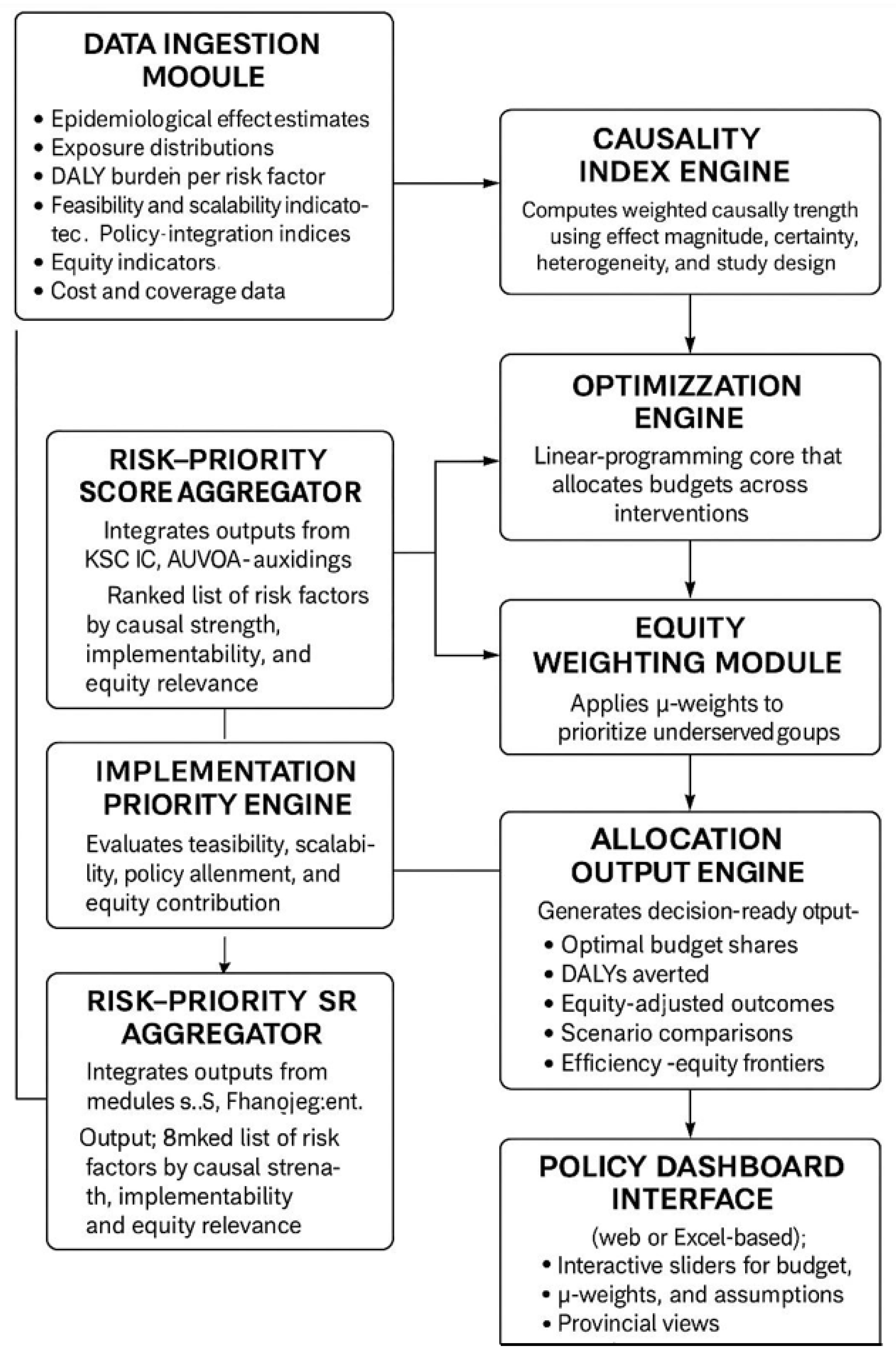
Integrated Model for Evidence-Based Risk Factor Prioritisation and Dynamic Resource Allocation in Hypertension Prevention and Control: A Study Protocol


Highlights
- This study introduces a Risk Priority Score that merges three independent dimensions, namely causality strength, implementation readiness, and contextual feasibility rather than relying only on burden or cost-effectiveness estimates as seen in GBD and WHO-CHOICE.
- The Causality Index advances current approaches by weighting the effect size, certainty of evidence, study design, and heterogeneity, creating a structured measure that resolves the limitations of single-point relative risks used in existing models.
- The Translation Readiness Index brings implementation maturity into the prioritisation process, which is absent in GBD and not formally incorporated in WHO-CHOICE modelling.
- The Implementation Priority Scale adds four nationally relevant dimensions—feasibility, scalability, policy integration, and equity—providing a context-specific layer that is not captured in global models.
- The composite Risk Priority Score offers a transparent and reproducible mechanism for ranking risk factors, improving on prior systems that rely on burden-only or cost-only metrics.
- The resource allocation model introduces an equity-weighted optimisation structure that adjusts DALY gains according to underserved population groups, addressing a major gap in standard WHO-CHOICE cost-effectiveness tools which treat all beneficiaries identically.
- The integration of prioritisation and optimisation into a single workflow creates a decision-support mechanism that allows policymakers to test scenarios and see how priorities shift under different budget and equity conditions.
- The model is designed for national and provincial application, making it the first South African hypertension model that connects local epidemiological evidence with dynamic resource allocation decisions.
Abstract
1. Introduction
2. Materials and Methods
2.1. Study Design
- Phase 1 develops and validates a Risk Factor Prioritisation Model (RPF) for hypertension based on meta-analytic and contextual indicators.
- Phase 2 constructs and tests a Dynamic Resource Allocation Model (DRAM) that converts these priority scores into optimal funding distributions across interventions to maximise Disability-Adjusted Life Years (DALYs) averted while promoting equity.
2.2. Study Setting
- Population/unit of analysis
2.3. Data Items and Sources
2.4. Analytical Procedure
- Computation of the Causality Index (CI)
- -
- s_m = scaled magnitude term, calculated as with OR_anchor set to 3.0;
- -
- I2_r = heterogeneity statistic (0–100);
- -
- w_c = certainty weight (1.0 for high, 0.75 for moderate, 0.5 for low, and 0.25 for very low certainty);
- -
- w_q = design/temporality weight (1.0 for cohort/RCT, 0.75 for case–control and 0.5 for cross-sectional).
- First-class (CI ≥ 7): strong, consistent evidence of causality;
- Second-class (CI = 5–6): moderate evidence;
- Third-class (CI ≤ 4): weak or inconsistent evidence.
- Computation of the Translation Readiness Index (TRI)
- 0 = experimental/limited evidence;
- 1 = pilot or local implementation;
- 2 = implemented nationally or included in policy.
- Computation of the Implementation Priority Scale (IPS)
- Feasibility: availability of infrastructure, human resources, and supply chains;
- Scalability: ability to expand intervention coverage at reasonable cost;
- Policy Integration: alignment with national strategies and legislative support;
- Equity: capacity to reduce exposure or disease burden among vulnerable groups.
- Computation of the Composite Risk Priority Score (RPS)
- Illustrative Example for CI and RPS Computation
- Step 1: Compute the Causality Index (CI)
- Pooled OR = 2.0;
- Certainty of evidence = moderate;
- Study design mix includes cohort and case-control studies;
- Heterogeneity (I2) = 40%.
- Magnitude term (sm)
- 2.
- Certainty weight (w_c)
- 3.
- Design/temporality weight (w_q)
- 4.
- Heterogeneity penalty
- Step 2: Compute the Translation Readiness Index (TRI)
- Step 3: Compute the Implementation Priority Scale (IPS)
- Feasibility = 2;
- Scalability = 1;
- Policy integration = 1;
- Equity contribution = 2.
- Step 4: Combine CI, TRI, and IPS into the RPS
- Validation and Sensitivity Analyses
- Handling of Missing and Outdated Data
- Phase 2: Dynamic Resource Allocation Model (DRAM)
- Model Structure
- RPS_r: Risk Priority Score for factor r (from Phase 1);
- DALY_r: DALYs averted per coverage unit;
- Cost_r: unit intervention cost;
- x_r: allocation share;
- B: total hypertension budget.
2.5. Parameter Estimation
- Implementation and Software
- Optimal allocation percentages by risk factor;
- DALYs averted under efficiency-only and equity-weighted conditions;
- Marginal returns and frontier curves;
- Scenario comparisons across budget bands.
- Validation and Sensitivity Testing
- External Validation and Stakeholder Input
2.6. Ethical Considerations
3. Results
4. Discussion
5. Conclusions
Author Contributions
Funding
Institutional Review Board Statement
Informed Consent Statement
Data Availability Statement
Acknowledgments
Conflicts of Interest
References
- GBD 2019 Risk Factors Collaborators. Global burden of 87 risk factors in 204 countries and territories, 1990–2019: A systematic analysis for the Global Burden of Disease Study 2019. Lancet 2020, 396, 1223–1249. [CrossRef] [Scilit] [PubMed]
- Whelton, P.K.; Carey, R.M.; Aronow, W.S.; Casey, D.E., Jr.; Collins, K.J.; Dennison Himmelfarb, C.; DePalma, S.M.; Gidding, S.; Jamerson, K.A.; Jones, D.W.; et al. 2017 ACC/AHA/AAPA/ABC/ACPM/AGS/APhA/ASH/ASPC/NMA/PCNA guideline for the prevention, detection, evaluation, and management of high blood pressure in adults. Hypertension 2018, 71, e13–e115. [Google Scholar] [PubMed]
- Williams, B.; Mancia, G.; Spiering, W.; Agabiti Rosei, E.; Azizi, M.; Burnier, M.; Clement, D.L.; Coca, A.; de Simone, G.; Dominiczak, A.; et al. 2018 ESC/ESH Guidelines for the management of arterial hypertension. Eur. Heart J. 2018, 39, 3021–3104. [Google Scholar] [CrossRef] [Scilit] [PubMed]
- World Health Organization (WHO). World Health Statistics 2023: Monitoring Health for the SDGs; WHO: Geneva, Switzerland, 2023. [Google Scholar]
- Mills, K.T.; Stefanescu, A.; He, J. The global epidemiology of hypertension. Nat. Rev. Nephrol. 2020, 16, 223–237. [Google Scholar] [CrossRef] [Scilit]
- Lewington, S.; Clarke, R.; Qizilbash, N.; Peto, R.; Collins, R. Prospective Studies Collaboration. Age-specific relevance of usual blood pressure to vascular mortality: A meta-analysis of individual data for one million adults in 61 prospective studies. Lancet 2002, 360, 1903–1913. [Google Scholar]
- Zhou, B.; Carrillo-Larco, R.M.; Danaei, G.; Riley, L.M.; Paciorek, C.J.; Stevens, G.A.; Gregg, E.W.; Bennett, J.E.; Solomon, B.; Singleton, R.K. Worldwide trends in hypertension prevalence and progress in treatment and control from 1990 to 2019: A pooled analysis of 1201 population-representative studies. Lancet 2021, 398, 957–980. [Google Scholar] [CrossRef] [Scilit]
- Geldsetzer, P.; Manne-Goehler, J.; Marcus, M.; Ebert, C.; Zhumadilov, Z.; Wesseh, C.S.; Tsabedze, L.; Supiyev, A.; Sturua, L.; Bahendeka, S.K.; et al. The state of hypertension care in 44 low-income and middle-income countries: A cross-sectional study of nationally representative individual-level data from 1.1 million adults. Lancet 2019, 394, 652–662. [Google Scholar] [CrossRef] [Scilit]
- Berry, K.M.; Parker, W.A.; Mchiza, Z.J.; Sewpaul, R.; Labadarios, D.; Rosen, S.; Stokes, A. Quantifying unmet need for hypertension care in South Africa through a care cascade: Evidence from the SANHANES, 2011–2012. BMJ Glob. Health 2022, 7, e007804. [Google Scholar] [CrossRef] [Scilit]
- Gómez-Olivé, F.X.; Ali, S.A.; Made, F.; Kyobutungi, C.; Nonterah, E.; Micklesfield, L.; Alberts, M.; Boua, R.; Hazelhurst, S.; Debpuur, C.; et al. Regional and sex differences in the prevalence, awareness, treatment and control of hypertension in South Africa: The H3Africa AWI-Gen study. Glob. Heart 2017, 12, 81–90. [Google Scholar] [CrossRef] [Scilit]
- Ataklte, F.; Erqou, S.; Kaptoge, S.; Taye, B.; Echouffo-Tcheugui, J.B.; Kengne, A.P. Burden of undiagnosed hypertension in sub-Saharan Africa: A systematic review and meta-analysis. Hypertension 2015, 65, 291–298. [Google Scholar] [CrossRef] [Scilit]
- Mayosi, B.M.; Benatar, S.R. Health and health care in South Africa—20 years after Mandela. N. Engl. J. Med. 2014, 371, 1344–1353. [Google Scholar] [CrossRef] [Scilit] [PubMed]
- Addo, J.; Smeeth, L.; Leon, D.A. Hypertension in sub-Saharan Africa: A systematic review. Hypertension 2007, 50, 1012–1018. [Google Scholar] [CrossRef] [Scilit] [PubMed]
- Dzudie, A.; Rayner, B.; Ojji, D.; Schutte, A.E.; Twagirumukiza, M.; Damasceno, A.; Ba, S.A.; Kane, A.; Kramoh, E.; Anzouan Kacou, J.B.; et al. Roadmap to achieve 25% hypertension control in Africa by 2025. Cardiovasc. J. Afr. 2017, 28, 262–272. [Google Scholar] [CrossRef] [Scilit] [PubMed]
- Schutte, A.E.; Srinivasapura Venkateshmurthy, N.; Mohan, S.; Prabhakaran, D. Hypertension in South Africa: Prevalence, risk factors, and control. Cardiovasc. J. Afr. 2012, 23, 67–72. [Google Scholar]
- Seedat, Y.K. Hypertension in South Africa: An overview of epidemiology and control. S. Afr. Med. J. 2012, 102, 44–46. [Google Scholar]
- Maimela, E.; Alberts, M.; Modjadji, S.E.; Choma, S.R.; Dikotope, S.A.; Ntuli, T.S.; Van Geertruyden, M.C.; Klipstein-Grobusch, K.B.; Degrève, G.; Gichuhi, W.J.O.; et al. Prevalence and determinants of hypertension awareness, treatment, and control among adults in South Africa: Evidence from the SANHANES-1 survey. BMC Public Health 2016, 16, 1219. [Google Scholar]
- Kayima, J.; Wanyenze, R.K.; Katamba, A.; Leontsini, E.; Nuwaha, F. Hypertension awareness, treatment and control in Africa: A systematic review. BMC Cardiovasc. Disord. 2013, 13, 54. [Google Scholar] [CrossRef] [Scilit]
- Hogan, D.R.; Baltussen, R.; Hayashi, C.; Prasad, P.; Lofgren, K.T.; Blom, P.B.; H.E.M. Achieving the global target for hypertension reduction: What will it take? Lancet Glob. Health 2023, 11, e20–e28. [Google Scholar]
- World Health Organization (WHO). Making Choices in Health: WHO Guide to Cost-Effectiveness Analysis; WHO: Geneva, Switzerland, 2014. [Google Scholar]
- Ettehad, D.; Emdin, C.A.; Kiran, A.; Anderson, S.G.; Callender, T.; Emberson, J.; Chalmers, J.; Rodgers, A.; Rahimi, K. Blood pressure lowering for prevention of cardiovascular disease and death: A systematic review and meta-analysis. Lancet 2016, 387, 957–967. [Google Scholar] [CrossRef] [Scilit]
- Appel, L.J.; Brands, M.W.; Daniels, S.R.; Karanja, N.; Elmer, P.J.; Sacks, F.M. Dietary approaches to prevent and treat hypertension. Hypertension 2011, 47, 296–308. [Google Scholar] [CrossRef] [Scilit]
- Ioannidis, J.P.A. Why most clinical research is not useful. PLoS Med. 2016, 13, e1002049. [Google Scholar] [CrossRef] [Scilit]
- Page, M.J.; McKenzie, J.E.; Bossuyt, P.M.; Boutron, I.; Hoffmann, T.C.; Mulrow, C.D.; Tetzlaff, J.M.; Akl, E.A.; Brennan, S.E.; Glanville, J.; et al. PRISMA 2020 statement: An updated guideline for reporting systematic reviews. BMJ 2021, 372, n71. [Google Scholar] [CrossRef] [Scilit] [PubMed]
- Grimshaw, J.M.; Eccles, M.P.; Lavis, J.N.; Hill, S.J.; Squires, J.E. Knowledge translation of research findings. Implement. Sci. 2012, 7, 50. [Google Scholar] [CrossRef] [Scilit] [PubMed]
- Peters, D.H.; Adam, T.; Alonge, O.; Agyepong, I.A.; Tran, N. Implementation research: What it is and how to do it. BMJ 2013, 347, f6753. [Google Scholar] [PubMed]
- Ezzati, M.; Lopez, A.D.; Rodgers, A.; Vander Hoorn, S.; Murray, C.J.L. Selected major risk factors and global and regional burden of disease. Lancet 2002, 360, 1347–1360. [Google Scholar] [CrossRef] [Scilit]
- GBD 2021 Risk Factors Collaborators. Global burden of 87 risk factors in 204 countries and territories, 1990–2021. Lancet 2022, 400, 1213–1249.
- Poznyak, V.; Mendis, S.; Jaacks, L.M.; Nargis, A.M.; Gaina, C.N.R.; Strong, K.; Wood, D.; Beaglehole, R. WHO Technical Package for Cardiovascular Disease Prevention: Implementation and Monitoring Guidance; WHO: Geneva, Switzerland, 2020. [Google Scholar]
- Maredza, M.; Hofman, K.J. A hidden menace: Cardiovascular disease in South Africa and the costs of inaction. SA Heart J. 2011, 8, 48–57. [Google Scholar]
- Rampal, S.; Rampal, L.; Azhar, M.Z.; Rahman, A.R. Urbanisation and non-communicable diseases in Southeast Asia. Med. J. Malaysia 2018, 73, 1–4. [Google Scholar]
- Musinguzi, G.; Nuwaha, F. Prevalence, awareness and control of hypertension in Uganda. PLoS ONE 2013, 8, e62236. [Google Scholar] [CrossRef] [Scilit]
- Nweke, M.; Ibeneme, S.; Pillay, J.D.; Mshunqane, N. Characterization and risk stratification of coronary artery disease in people living with HIV: A global systematic review. Front. Cardiovasc. Med. 2025, 12, 1586019. [Google Scholar] [CrossRef] [Scilit]
- National Department of Health; Stats SA; SAMRC; ICF. South African Demographic and Health Survey 2016; Pretoria and Rockville: Gauteng, South Africa, 2019. [Google Scholar]
- Shisana, O.; Labadarios, D.; Rehle, T.; Simbayi, L.; Zuma, K.; Dhansay, A.; Reddy, P.; Parker, W.; Hoosain, E.; Naidoo, P.; et al. SANHANES-1: South African National Health and Nutrition Examination Survey, 2013; HSRC Press: Cape Town, South Africa, 2013. [Google Scholar]
- Health Systems Trust. District Health Barometer 2021/2022; HST: Durban, South Africa, 2022. [Google Scholar]
- Knipe, P.; Omoruyi, A.J.; Durojaye, E. National Strategic Plan for the Prevention and Control of NCDs 2022–2027; National Department of Health: Pretoria, South Africa, 2022. [Google Scholar]
- National Department of Health. National Hypertension Guideline 2023; National Department of Health: Pretoria, South Africa, 2023. [Google Scholar]
- Statistics South Africa. Consumer Price Index: Health Subseries 2024; Stats SA: Pretoria, South Africa, 2024. [Google Scholar]
- Hutubessy, R.C.W.; Chisholm, D.; Edejer, T.T.T. Generalized cost-effectiveness analysis for national-level priority setting. Cost. Eff. Resour. Alloc. 2003, 1, 8. [Google Scholar] [CrossRef] [Scilit]
- National Department of Health. Annual Financial Report 2023; National Department of Health: Pretoria, South Africa, 2023. [Google Scholar]
- Bradshaw, D. South African National Burden of Disease Study 2019; SAMRC: Cape Town, South Africa, 2019. [Google Scholar]
- WHO. Global Report on Noncommunicable Diseases 2023: Addressing NCDs Through Stronger Health Financing and Integrated Care; WHO: Geneva, Switzerland, 2023. [Google Scholar]
- World Health Organization. Best Buys and Other Recommended Interventions for NCD Prevention and Control (2023 Update); WHO: Geneva, Switzerland, 2023. [Google Scholar]
- Gardiner, H.M.; Boyle, M.H.; Collins, S.E.; Gaebel, M.S.; Morgan, C.J. Integrating equity into cost-effectiveness analysis: A framework and review. Soc. Sci. Med. 2018, 199, 27–35. [Google Scholar]
- Edejer, T.T.T.; Baltussen, R.; Adam, T.; Hutubessy, R.; Acharya, A.; Evans, D.B.; Murray, C.J.L. WHO Guide to Cost-Effectiveness Analysis; WHO: Geneva, Switzerland, 2003. [Google Scholar]
- Hauck, K.; Morton, A.; Chalkidou, K.; Shah, K.; Liu, L.; Vellakkal, S. Equity in economic evaluation: Practical guidance and examples. Health Policy 2017, 121, 1031–1039. [Google Scholar]
- Asaria, M.; Griffin, S.; Cookson, R.; Whyte, S.; Tappenden, P. Distributional cost-effectiveness analysis: A tutorial. Med. Decis. Making 2016, 36, 8–19. [Google Scholar] [CrossRef] [Scilit]
- Dakin, H.A.; Devlin, N.J.; Feng, Y.; Rice, N.; O’Neill, P.; Parkin, D. The Influence of Cost-Effectiveness and Other Factors on NICE Decisions. Health Econ. 2015, 24, 1256–1271. [Google Scholar] [CrossRef] [Scilit]
- Nweke, M.; Govender, N.; Mshunqane, N.; Pillay, J. A global framework for systematic reviews of disease risk factors. 2025; under review.
- Briggs, A.H.; Weinstein, M.C.; Fenwick, E.A.; Karnon, J.; Sculpher, M.J.; Paltiel, A.D.; ISPOR-SMDM Modeling Good Research Practices Task Force. Model parameter estimation and uncertainty. Value Health 2012, 15, 835–842. [Google Scholar] [CrossRef] [Scilit]


| Data Item | Purpose/Variable Captured | Source | Type of Data |
|---|---|---|---|
| 1. Effect estimates (RR/OR) | Quantify strength of association between each modifiable exposure and hypertension (for Causality Index—CI) | Peer-reviewed epidemiological studies indexed in PubMed, Scopus, Web of Science, Academic Search Complete, and African Journals Online | Secondary quantitative |
| 2. Exposure distribution by risk factor | National prevalence of obesity, high sodium intake, alcohol use, tobacco use, physical inactivity, and low fruit and vegetable intake | GBD 2019 country-level exposure dataset for South Africa [1] | Secondary quantitative |
| 3. DALYs attributable to each risk factor | Measure of health loss (used for validation against RPS order) | GBD 2019 Risk Factors Collaborators dataset and GBD Results Tool [1] | Secondary quantitative |
| 4. Feasibility indicators | Availability of interventions, delivery infrastructure, and implementation challenges | South African Demographic and Health Survey 2016 [34]; SANHANES-1 2013 [35]; District Health Barometer 2022 [36] | Survey/programme data |
| 5. Scalability indicators | Geographic coverage and cost efficiency of intervention delivery | Health Systems Trust reports [36]; National Department of Health Annual Performance Plans 2018–2024 [41] | Administrative reports |
| 6. Policy integration evidence | Presence of the risk factor or intervention in national policies or guidelines | National Strategic Plan for NCDs 2022–2027 [37]; National Hypertension Guidelines 2023 update [38] | Policy documents |
| 7. Equity parameters | Disparities in exposure and intervention coverage by province, sex, and income quintile | Stats SA General Household Survey 2022 [39]; SANHANES-1 2013 [35]; GBD 2019 subnational estimates [1] | Survey/population |
| 8. Implementation maturity (TRI) | Stage of intervention development or integration into national programming | WHO “Best Buys” and Recommended Interventions 2014 edition and 2023 update [41,42,43,44]; National NCD Programme reports [37] | Global and national policy data |
| 9. Cost and coverage data | Inputs for feasibility and for later linkage with allocation model | Health Systems Trust cost databases; WHO-CHOICE regional cost effectiveness data | Economic/programme |
| 10. Quality and heterogeneity metrics | Weighting of meta-analytic evidence in CI calculation | GRADE; I2 statistics from meta-analyses | Secondary review data |
Disclaimer/Publisher’s Note: The statements, opinions and data contained in all publications are solely those of the individual author(s) and contributor(s) and not of MDPI and/or the editor(s). MDPI and/or the editor(s) disclaim responsibility for any injury to people or property resulting from any ideas, methods, instructions or products referred to in the content. |
© 2026 by the authors. Licensee MDPI, Basel, Switzerland. This article is an open access article distributed under the terms and conditions of the Creative Commons Attribution (CC BY) license.
Share and Cite
Nweke, M.; Pillay, J. Integrated Model for Evidence-Based Risk Factor Prioritisation and Dynamic Resource Allocation in Hypertension Prevention and Control: A Study Protocol. Healthcare 2026, 14, 988. https://doi.org/10.3390/healthcare14080988
Nweke M, Pillay J. Integrated Model for Evidence-Based Risk Factor Prioritisation and Dynamic Resource Allocation in Hypertension Prevention and Control: A Study Protocol. Healthcare. 2026; 14(8):988. https://doi.org/10.3390/healthcare14080988
Chicago/Turabian StyleNweke, Martins, and Julian Pillay. 2026. "Integrated Model for Evidence-Based Risk Factor Prioritisation and Dynamic Resource Allocation in Hypertension Prevention and Control: A Study Protocol" Healthcare 14, no. 8: 988. https://doi.org/10.3390/healthcare14080988
APA StyleNweke, M., & Pillay, J. (2026). Integrated Model for Evidence-Based Risk Factor Prioritisation and Dynamic Resource Allocation in Hypertension Prevention and Control: A Study Protocol. Healthcare, 14(8), 988. https://doi.org/10.3390/healthcare14080988