Development of a Web-Based Multimedia Patient Decision Aid for Rheumatoid Arthritis: A User-Centered Design


Abstract
1. Introduction
2. Materials and Methods
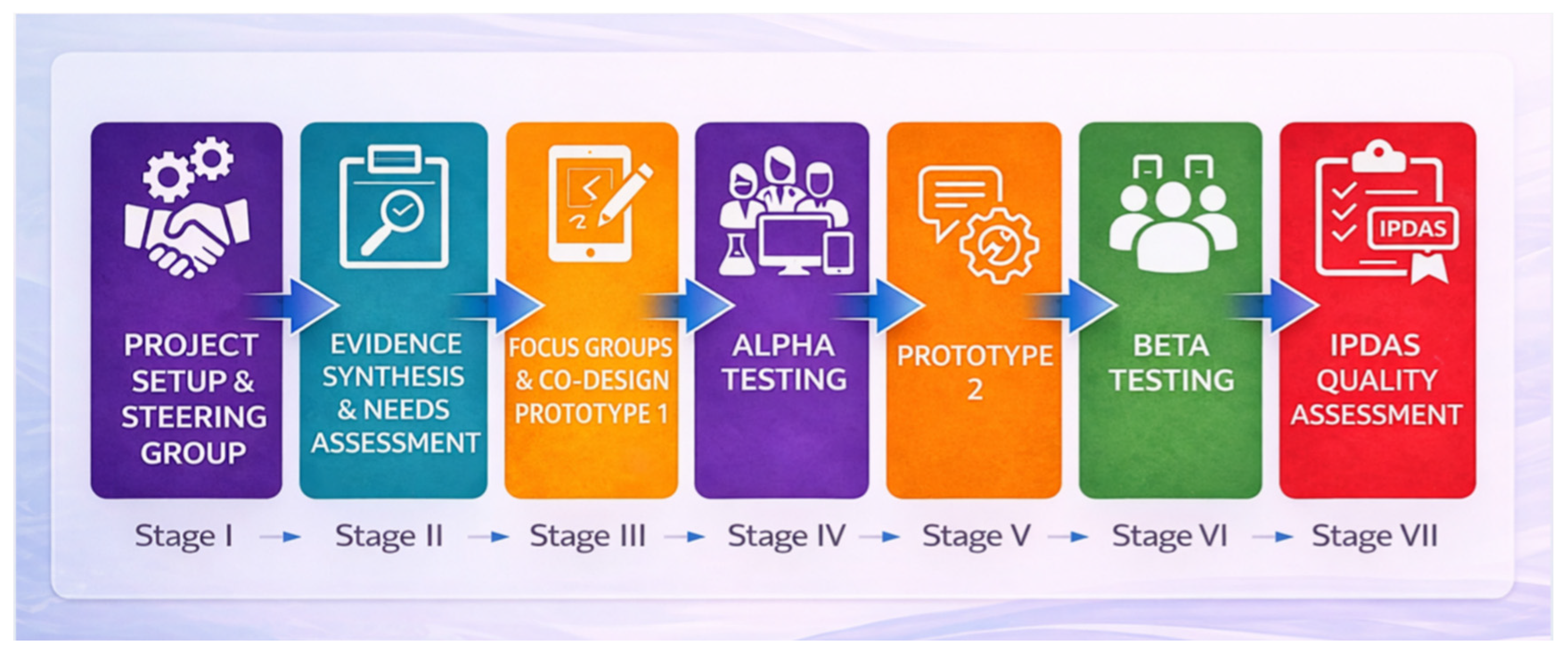
2.1. Study Design and Conceptual Framework
2.2. Project Setup, Scope and Steering Group
2.3. Literature Review
2.4. Focus Groups
2.5. Prototype Design, Content Development, and Web Design
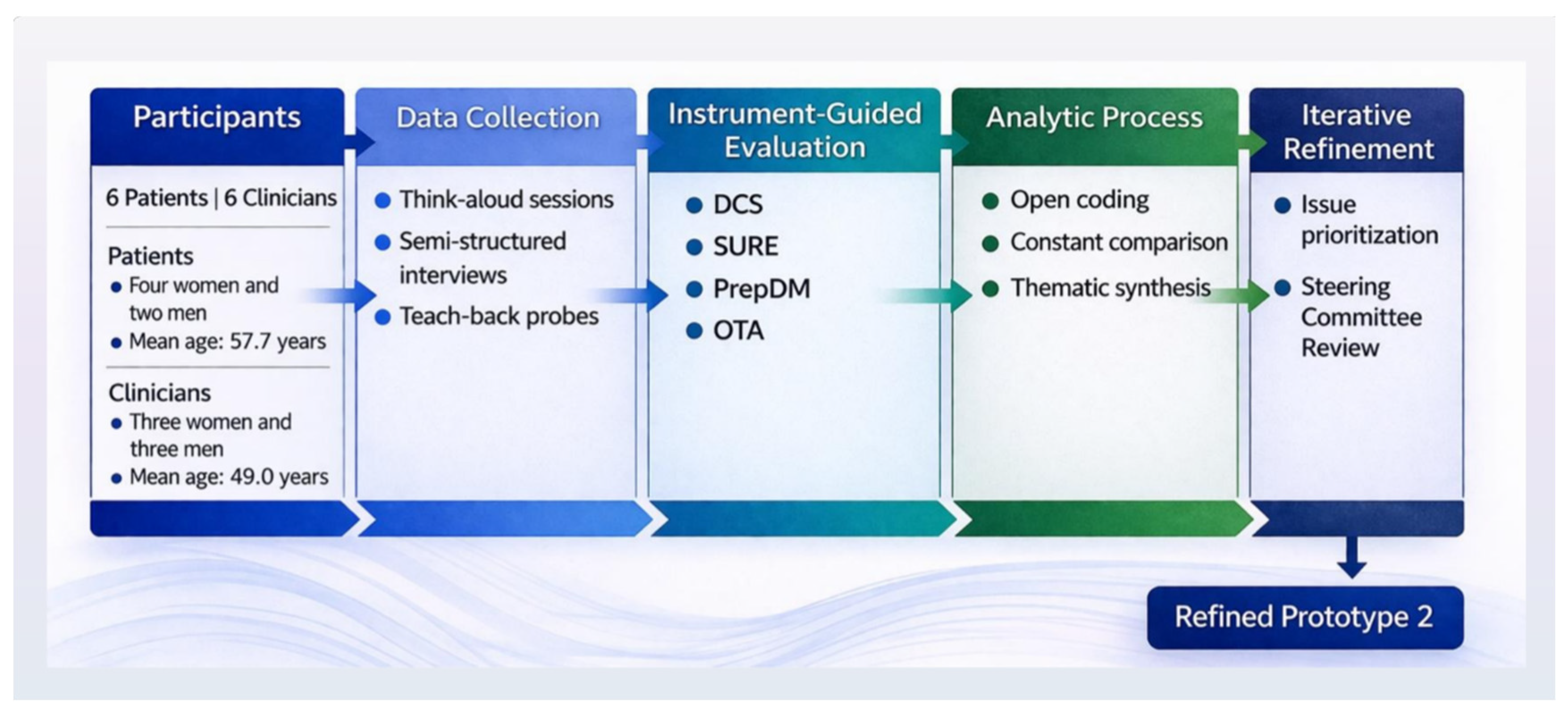
2.6. Alpha Testing
2.7. Beta Testing
2.8. Quality Assessment of the PtDA
3. Results
3.1. Alpha Testing and Prototype 2 Refinement with User Feedback
3.1.1. Patients Assessment
3.1.2. Clinician’s Assessment
3.1.3. Prototype 2 Refinement with User Feedback
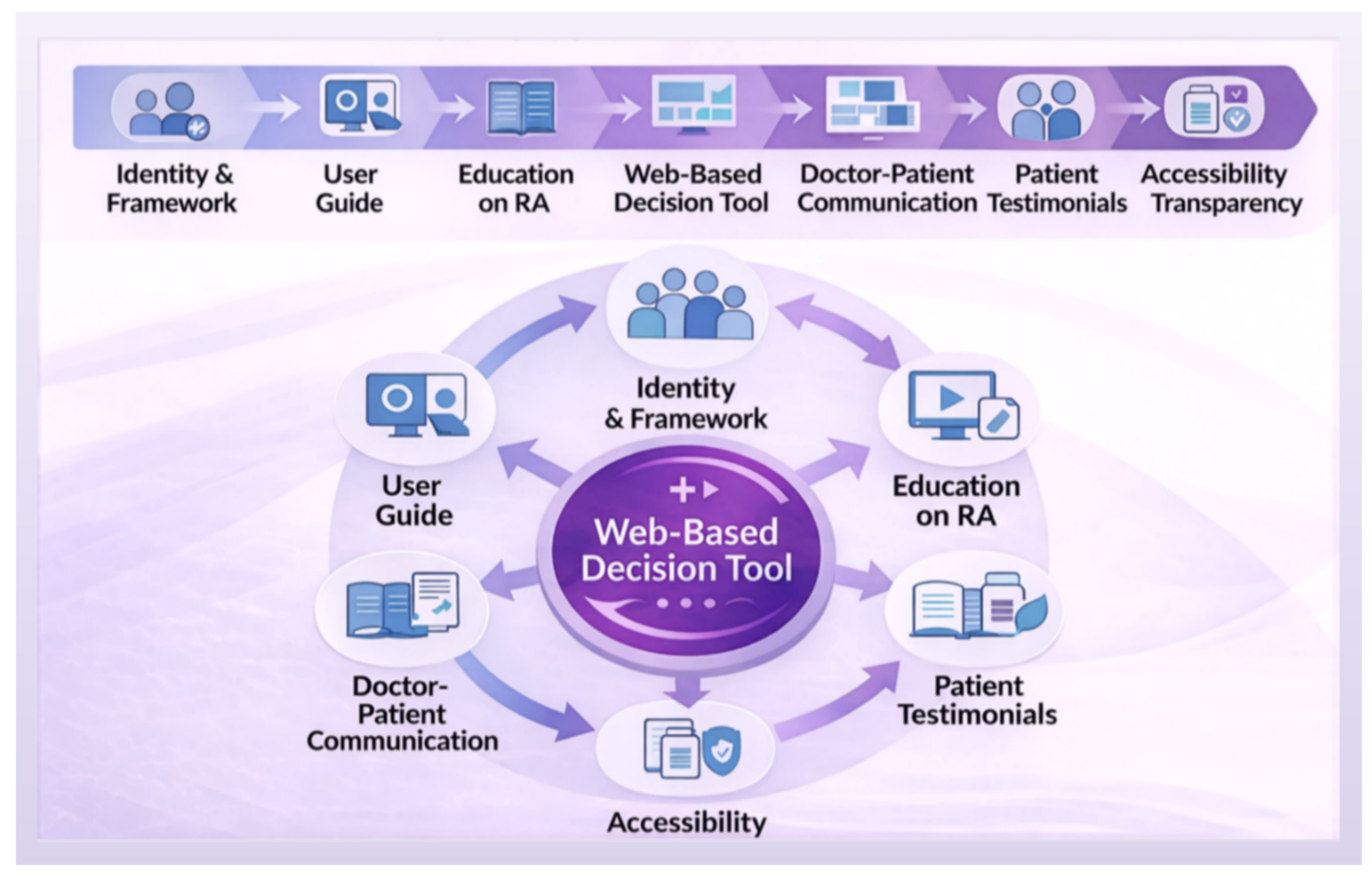
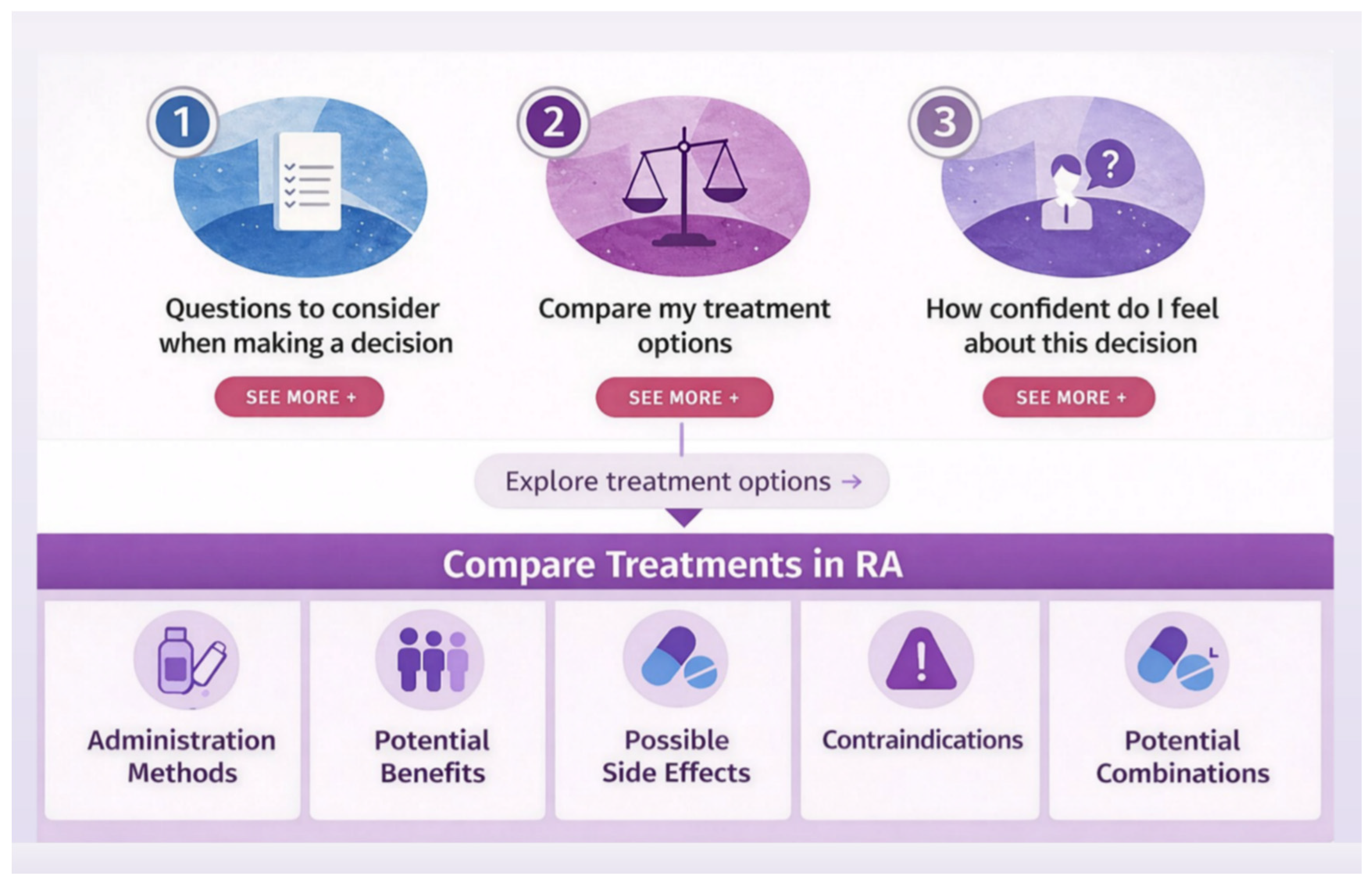
3.2. Content of Final PtDA
3.3. Beta Testing
3.4. Quality Assessment and User-Centered Design Reporting
3.4.1. IPDASi v3 Quality Assessment
3.4.2. User-Centered Assessment
4. Discussion
4.1. Usability Assessment
4.2. Quality Assessment
4.3. Methodological and Conceptual Contributions
4.4. Limitations
5. Conclusions
Supplementary Materials
Author Contributions
Funding
Institutional Review Board Statement
Informed Consent Statement
Data Availability Statement
Acknowledgments
Conflicts of Interest
Abbreviations
| EHR | Electronic Health Record |
| SDM | Shared Decision Making |
| PtDA | Patient Decision Aid |
| RA | Rheumatoid Arthritis |
| IPDAS | International Patient Decision Aid Standards |
| IPDASi | International Patient Decision Aid Standards instrument |
| UCD | User-Centered Design |
| SUS | System Usability Scale |
| DCS | Decisional Conflict Scale |
| PrepDM | Preparation for Decision Making scale |
| OAT | Ottawa Acceptability Tool |
| ODSF | Ottawa Decision Support Framework |
| csDMARDs | Conventional Synthetic Disease-Modifying Anti-Rheumatic Drugs |
| bDMARDs | Biologic Disease-Modifying Anti-Rheumatic Drugs |
| tsDMARDs | Targeted Synthetic Disease-Modifying Anti-Rheumatic Drugs |
| JAK | Janus Kinase |
| GDPR | General Data Protection Regulation |
References
- Charles, C.; Gafni, A.; Whelan, T. Decision-Making in the Physician–Patient Encounter: Revisiting the Shared Treatment Decision-Making Model. Soc. Sci. Med. 1999, 49, 651–661. [Google Scholar] [CrossRef]
- Makoul, G.; Clayman, M. An Integrative Model of Shared Decision Making in Medical Encounters. Patient Educ. Couns. 2006, 60, 301–312. [Google Scholar] [CrossRef]
- Elwyn, G.; Durand, M.A.; Song, J.; Aarts, J.; Barr, P.J.; Berger, Z.; Cochran, N.; Frosch, D.; Galasiński, D.; Gulbrandsen, P.; et al. A Three-Talk Model for Shared Decision Making: Multistage Consultation Process. BMJ 2017, 359, j4891. [Google Scholar] [CrossRef] [PubMed]
- Montori, V.M.; Ruissen, M.M.; Hargraves, I.G.; Brito, J.P.; Kunneman, M. Shared Decision-Making as a Method of Care. BMJ Evid.-Based Med. 2023, 28, 213–217. [Google Scholar] [CrossRef]
- Shay, L.A.; Lafata, J.E. Where Is the Evidence? A Systematic Review of Shared Decision Making and Patient Outcomes. Med. Decis. Mak. 2015, 35, 114–131. [Google Scholar] [CrossRef]
- Légaré, F.; Ratté, S.; Gravel, K.; Graham, I.D. Barriers and Facilitators to Implementing Shared Decision-Making in Clinical Practice: Update of a Systematic Review of Health Professionals’ Perceptions. Patient Educ. Couns. 2008, 73, 526–535. [Google Scholar] [CrossRef] [PubMed]
- Hughes, T.M.; Merath, K.; Chen, Q.; Sun, S.; Palmer, E.; Idrees, J.J.; Okunrintemi, V.; Squires, M.; Beal, E.W.; Pawlik, T.M. Association of Shared Decision-Making on Patient-Reported Health Outcomes and Healthcare Utilization. Am. J. Surg. 2018, 216, 7–12. [Google Scholar] [CrossRef] [PubMed]
- Joseph-Williams, N.; Elwyn, G.; Edwards, A. Knowledge Is Not Power for Patients: A Systematic Review and Thematic Synthesis of Patient-Reported Barriers and Facilitators to Shared Decision Making. Patient Educ. Couns. 2014, 94, 291–309. [Google Scholar] [CrossRef]
- Boland, L.; Graham, I.D.; Légaré, F.; Lewis, K.; Jull, J.; Shephard, A.; Lawson, M.L.; Davis, A.; Yameogo, A.; Stacey, D. Barriers and Facilitators of Pediatric Shared Decision-Making: A Systematic Review. Implement. Sci. 2019, 14, 7. [Google Scholar] [CrossRef]
- Waddell, A.; Lennox, A.; Spassova, G.; Bragge, P. Barriers and Facilitators to Shared Decision-Making in Hospitals from Policy to Practice: A Systematic Review. Implement. Sci. 2021, 16, 74. [Google Scholar] [CrossRef]
- Stacey, D.; Légaré, F.; Lewis, K.; Barry, M.J.; Bennett, C.L.; Eden, K.B.; Holmes-Rovner, M.; Llewellyn-Thomas, H.; Lyddiatt, A.; Thomson, R.; et al. Decision Aids for People Facing Health Treatment or Screening Decisions. Cochrane Database Syst. Rev. 2017, 4, CD001431. [Google Scholar] [CrossRef]
- Stacey, D.; Lewis, K.B.; Smith, M.; Carley, M.; Volk, R.; Douglas, E.E.; Pacheco-Brousseau, L.; Finderup, J.; Gunderson, J.; Barry, M.J.; et al. Decision Aids for People Facing Health Treatment or Screening Decisions. Cochrane Database Syst. Rev. 2024, 1, CD001431. [Google Scholar] [CrossRef]
- Knudsen, M.; Søndergaard, S.R.; Carley, M.; Steffensen, K.D.; Stacey, D. Effects of patient decision aids used pre-consult or in-consult on patient-clinician communication—Secondary analysis of a systematic review with meta-analysis. BMC Med. Inform. Decis. Mak. 2026, 26, 17. [Google Scholar] [CrossRef]
- Joseph-Williams, N.; Abhyankar, P.; Boland, L.; Bravo, P.; Brenner, A.T.; Brodney, S.; Coulter, A.; Giguère, A.; Hoffman, A.; Körner, M.; et al. What Works in Implementing Patient Decision Aids in Routine Clinical Settings? A Rapid Realist Review and Update from the International Patient Decision Aid Standards Collaboration. Med. Decis. Mak. 2021, 41, 907–937. [Google Scholar] [CrossRef] [PubMed]
- Elwyn, G.; O’Connor, A.; Stacey, D.; Volk, R.; Edwards, A.; Coulter, A.; Thomson, R.; Barratt, A.; Barry, M.; Bernstein, S.; et al. Developing a Quality Criteria Framework for Patient Decision Aids: Online International Delphi Consensus Process. BMJ 2006, 333, 417. [Google Scholar] [CrossRef]
- Coulter, A.; Stilwell, D.; Kryworuchko, J.; Mullen, P.D.; Ng, C.J.; van der Weijden, T. A Systematic Development Process for Patient Decision Aids. BMC Med. Inform. Decis. Mak. 2013, 13, S2. [Google Scholar] [CrossRef] [PubMed]
- Volk, R.J.; Llewellyn-Thomas, H.; Stacey, D.; Elwyn, G. Ten Years of the International Patient Decision Aid Standards Collaboration: Evolution of the Core Dimensions for Assessing the Quality of Patient Decision Aids. BMC Med. Inform. Decis. Mak. 2013, 13, S1. [Google Scholar] [CrossRef]
- Stacey, D.; Légaré, F.; Boland, L.; Lewis, K.B.; Loiselle, M.-C.; Hoefel, L.; Garvelink, M.; O’connor, A. 20th Anniversary Ottawa Decision Support Framework: Part 3 Overview of Systematic Reviews and Updated Framework. Med. Decis. Mak. 2020, 40, 379–398. [Google Scholar] [CrossRef] [PubMed]
- Witteman, H.O.; Maki, K.G.; Vaisson, G.; Finderup, J.; Lewis, K.B.; Dahl Steffensen, K.; Beaudoin, C.; Comeau, S.; Volk, R.J. Systematic Development of Patient Decision Aids: An Update from the IPDAS Collaboration. Med. Decis. Mak. 2021, 41, 736–754. [Google Scholar] [CrossRef]
- Sanders, E.B.-N.; Stappers, P.J. Co-Creation and the New Landscapes of Design. CoDesign 2008, 4, 5–18. [Google Scholar] [CrossRef]
- Vaisson, G.; Provencher, T.; Dugas, M.; Trottier, M.-E.; Chipenda Dansokho, S.; Colquhoun, H.; Fagerlin, A.; Giguere, A.M.C.; Hakim, H.; Haslett, L.; et al. User Involvement in the Design and Development of Patient Decision Aids and Other Personal Health Tools: A Systematic Review. Med. Decis. Mak. 2021, 41, 261–274. [Google Scholar] [CrossRef]
- Witteman, H.O.; Vaisson, G.; Provencher, T.; Chipenda Dansokho, S.; Colquhoun, H.; Dugas, M.; Fagerlin, A.; Giguere, A.M.; Haslett, L.; Hoffman, A.; et al. An 11-Item Measure of User- and Human-Centered Design for Personal Health Tools (UCD-11): Development and Validation. J. Med. Internet Res. 2021, 23, e15032. [Google Scholar] [CrossRef]
- Syrowatka, A.; Krömker, D.; Meguerditchian, A.N.; Tamblyn, R. Features of Computer-Based Decision Aids: Systematic Review, Thematic Synthesis, and Meta-Analyses. J. Med. Internet Res. 2016, 18, e20. [Google Scholar] [CrossRef] [PubMed]
- Yu, L.; Li, P.; Yang, S.; Guo, P.; Zhang, X.; Liu, N.; Wang, J.; Zhang, W. Web-Based Decision Aids to Support Breast Cancer Screening Decisions: Systematic Review and Meta-Analysis. J. Comp. Eff. Res. 2020, 9, 985–1002. [Google Scholar] [CrossRef]
- Smolen, J.S.; Landewé, R.B.M.; Bijlsma, J.W.J.; Burmester, G.R.; Dougados, M.; Kerschbaumer, A.; McInnes, I.B.; Sepriano, A.; van Vollenhoven, R.F.; de Wit, M.; et al. EULAR Recommendations for the Management of Rheumatoid Arthritis with Synthetic and Biological Disease-Modifying Antirheumatic Drugs: 2019 Update. Ann. Rheum. Dis. 2020, 79, 685–699. [Google Scholar] [CrossRef]
- Smolen, J.S.; Breedveld, F.C.; Burmester, G.R.; Bykerk, V.; Dougados, M.; Emery, P.; Kvien, T.K.; Navarro-Compán, M.V.; Stamm, T.A.; Stoffer, M.; et al. Treating Rheumatoid Arthritis to Target: 2014 Update of the Recommendations of an International Task Force. Ann. Rheum. Dis. 2016, 75, 3–15. [Google Scholar] [CrossRef]
- Fraenkel, L.; Bathon, J.M.; England, B.R.; St Clair, E.W.; Arayssi, T.; Carandang, K.; Deane, K.D.; Genovese, M.; Huston, K.K.; Kerr, G.; et al. American College of Rheumatology Guideline for the Treatment of Rheumatoid Arthritis. Arthritis Rheumatol. 2021, 73, 1108–1123. [Google Scholar] [CrossRef] [PubMed]
- Barton, J.L.; Décary, S. New Galaxies in the Universe of Shared Decision Making and Rheumatoid Arthritis. Curr. Opin. Rheumatol. 2020, 32, 273–278. [Google Scholar] [CrossRef] [PubMed]
- Mathijssen, E.G.E.; van den Bemt, B.J.F.; van den Hoogen, F.H.J.; Popa, C.D.; Vriezekolk, J.E. Interventions to Support Shared Decision Making for Medication Therapy in Long Term Conditions: A Systematic Review. Patient Educ. Couns. 2020, 103, 254–265. [Google Scholar] [CrossRef]
- Morrison, T.; Foster, E.; Dougherty, J.; Barton, J. Shared Decision Making in Rheumatology: A Scoping Review. Semin. Arthritis Rheum. 2022, 56, 152041. [Google Scholar] [CrossRef]
- Aref, H.A.T.; Turk, T.; Dhanani, R.; Xiao, A.; Olson, J.; Paul, P.; Dennett, L.; Yacyshyn, E.; Sadowski, C.A. Development and Evaluation of Shared Decision-Making Tools in Rheumatology: A Scoping Review. Semin. Arthritis Rheum. 2024, 66, 152432. [Google Scholar] [CrossRef]
- Ottawa Hospital Research Institute. Ottawa Decision Support Framework (ODSF). Available online: https://decisionaid.ohri.ca/models.html (accessed on 17 February 2026).
- International Patient Decision Aid Standards (IPDAS). Available online: http://ipdas.ohri.ca/ (accessed on 17 February 2026).
- Stewart, D.W.; Shamdasani, P.N.; Rook, D.W. Focus Groups: Theory and Practice, 2nd ed.; SAGE Publications: Thousand Oaks, CA, USA, 2011. [Google Scholar] [CrossRef]
- DeJonckheere, M.; Vaughn, L.M. Semistructured Interviewing in Primary Care Research: A Balance of Relationship and Rigour. Fam. Med. Community Health 2019, 7, e000057. [Google Scholar] [CrossRef]
- Lundgrén-Laine, H.; Salanterä, S. Think-Aloud Technique and Protocol Analysis in Clinical Decision-Making Research. Qual. Health Res. 2010, 20, 565–575. [Google Scholar] [CrossRef]
- Ayre, J.; McCaffery, K. Research Note: Thematic Analysis in Qualitative Research. J. Physiother. 2022, 68, 76–79. [Google Scholar] [CrossRef]
- Braun, V.; Clarke, V. Toward Good Practice in Thematic Analysis: Avoiding Common Problems and Be(com)ing a Knowing Researcher. Int. J. Transgend. Health 2022, 24, 1–6. [Google Scholar] [CrossRef]
- Moser, A.; Korstjens, I. Series: Practical guidance to qualitative research. Part 3: Sampling, data collection and analysis. Eur. J. Gen. Pract. 2018, 24, 9–18. [Google Scholar] [CrossRef] [PubMed]
- Ottawa Hospital Research Institute, Patient Decision Aids Research Group. A to Z Inventory of Patient Decision Aids; Ottawa Hospital Research Institute: Ottawa, ON, Canada, 2025; Available online: https://decisionaid.ohri.ca/AZlist.html (accessed on 17 February 2026).
- Li, L.C.; Adam, P.M.; Backman, C.L.; Lineker, S.; Jones, C.A.; Lacaille, D.; Townsend, A.F.; Yacyshyn, E.; Yousefi, C.; Tugwell, P.; et al. Proof-of-concept study of a web-based methotrexate decision aid for patients with rheumatoid arthritis. Arthritis Care Res. 2014, 66, 1472–1481. [Google Scholar] [CrossRef] [PubMed]
- Pablos, J.L.; Jover, J.A.; Roman-Ivorra, J.A.; Inciarte-Mundo, J.; Dilla, T.; Sacristan, J.A.; Comellas, M.; Lizán, L. Patient Decision Aid (PDA) for Patients with Rheumatoid Arthritis Reduces Decisional Conflict and Improves Readiness for Treatment Decision Making. Patient 2020, 13, 57–69. [Google Scholar] [CrossRef] [PubMed]
- Fraenkel, L.; Matzko, C.K.; Webb, D.E.; Oppermann, B.; Charpentier, P.; Peters, E.; Reyna, V.; Newman, E.D. Decision Support Improves Knowledge, Value Clarification and Informed Choice in Patients with Rheumatoid Arthritis. Arthritis Care Res. 2015, 67, 1496–1502. [Google Scholar] [CrossRef]
- Barton, J.L.; Koenig, C.J.; Evans-Young, G.; Trupin, L.; Anderson, J.; Ragouzeos, D.; Breslin, M.; Morse, T.; Schillinger, D.; Montori, V.M.; et al. The Design of a Low Literacy Decision Aid About Rheumatoid Arthritis Medications Developed in Three Languages for Use During the Clinical Encounter. BMC Med. Inform. Decis. Mak. 2014, 14, 104. [Google Scholar] [CrossRef]
- Meulenkamp, B.; Brillinger, J.; Fergusson, D.; Stacey, D.; Graham, I.D. Development and Field Testing of a Patient Decision Aid for Management of Acute Achilles Tendon Rupture: A Study Protocol. BMC Med. Inform. Decis. Mak. 2021, 21, 225. [Google Scholar] [CrossRef]
- Cortini, M.; Galanti, T.; Fantinelli, S. Focus Group Discussion: How Many Participants in a Group? Encyclopaideia 2019, 23, 29–43. [Google Scholar] [CrossRef]
- Malterud, K.; Siersma, V.D.; Guassora, A.D. Sample Size in Qualitative Interview Studies: Guided by Information Power. Qual. Health Res. 2016, 26, 1753–1760. [Google Scholar] [CrossRef]
- Shaffer, V.A.; Brodney, S.; Bekker, H.L.; Gavaruzzi, T.; Zisman-Ilani, Y.; Munro, S.; Smith, S.K.; Thomas, E.; Valentine, K.D.; Bekker, H.L. Do Personal Stories Make Patient Decision Aids More Effective? An Update from the International Patient Decision Aids Standards. Med. Decis. Mak. 2021, 41, 897–906. [Google Scholar] [CrossRef]
- Brock, T.P.; Smith, S.R. Using Digital Videos Displayed on Personal Digital Assistants (PDAs) to Enhance Patient Education in Clinical Settings. Int. J. Med. Inform. 2007, 76, 829–835. [Google Scholar] [CrossRef]
- Melnik, S.; Decker, S. A Layered Approach to Information Modeling and Interoperability on the Web. In Proceedings of the International Workshop on the World Wide Web and Databases (WebDB 2000), Dallas, TX, USA, 18–19 May 2000. [Google Scholar]
- Covey, J. A Meta-Analysis of the Effects of Presenting Treatment Benefits in Different Formats. Med. Decis. Mak. 2007, 27, 638–654. [Google Scholar] [CrossRef] [PubMed]
- Stone, E.R.; Bruine de Bruin, W.; Wilkins, A.M.; Boker, E.M.; MacDonald Gibson, J. Designing Graphs to Communicate Risks: Understanding How the Choice of Graphical Format Influences Decision Making. Risk Anal. 2016, 36, 2395–2411. [Google Scholar] [CrossRef] [PubMed]
- Guest, G.; Bunce, A.; Johnson, L. How Many Interviews Are Enough? An Experiment with Data Saturation and Variability. Field Methods 2006, 18, 59–82. [Google Scholar] [CrossRef]
- Yen, P.H.; Leasure, A.R. Use and Effectiveness of the Teach-Back Method in Patient Education and Health Outcomes. Fed. Pract. 2019, 36, 284–289. [Google Scholar] [PubMed]
- Ottawa Hospital Research Institute. Acceptability Scale; Ottawa Hospital Research Institute: Ottawa, ON, Canada, 2025. [Google Scholar]
- Ottawa Hospital Research Institute. Decision Conflict Scale (DCS); Ottawa Hospital Research Institute: Ottawa, ON, Canada, 2025; Available online: https://decisionaid.ohri.ca/eval_dcs.html (accessed on 17 February 2026).
- Ottawa Hospital Research Institute. Preparation for Decision Making (PrepDM) Scale; Ottawa Hospital Research Institute: Ottawa, ON, Canada, 2025. [Google Scholar]
- Légaré, F.; Kearing, S.; Clay, K.; Gagnon, S.; D’Amours, D.; Rousseau, M.; O’Connor, A. Are You SURE? Assessing Patient Decisional Conflict with a 4-Item Screening Test. Can. Fam. Physician 2010, 56, e308–e314. [Google Scholar]
- Saunders, B.; Sim, J.; Kingstone, T.; Baker, S.; Waterfield, J.; Bartlam, B.; Burroughs, H.; Jinks, C. Saturation in qualitative research: Exploring its conceptualization and operationalization. Qual. Quant. 2018, 52, 1893–1907. [Google Scholar] [CrossRef]
- Brooke, J. SUS: A “Quick and Dirty” Usability Scale. In Usability Evaluation in Industry; Jordan, P.W., Thomas, B., McClelland, I.L., Weerdmeester, B., Eds.; Taylor & Francis: London, UK, 1996; pp. 189–194. [Google Scholar]
- Bangor, A.; Kortum, P.; Miller, J. An Empirical Evaluation of the System Usability Scale. Int. J. Hum.-Comput. Interact. 2008, 24, 574–594. [Google Scholar] [CrossRef]
- Lewis, J.R. The System Usability Scale: Past, Present, and Future. Int. J. Hum.-Comput. Interact. 2018, 34, 577–590. [Google Scholar] [CrossRef]
- Faulkner, L. Beyond the five-user assumption: Benefits of increased sample sizes in usability testing. Behav. Res. Methods Instrum. Comput. 2003, 35, 379–383. [Google Scholar] [CrossRef]
- Elwyn, G.; O’Connor, A.M.; Bennett, C.; Newcombe, R.G.; Politi, M.; Durand, M.A.; Drake, E.; Joseph-Williams, N.; Khangura, S.; Saarimaki, A.; et al. Assessing the Quality of Decision Support Technologies Using the International Patient Decision Aid Standards Instrument (IPDASi). PLoS ONE 2009, 4, e4705. [Google Scholar] [CrossRef]
- Tichler, A.; Hertroijs, D.F.L.; Ruwaard, D.; Brouwers, M.C.G.J.; Elissen, A.M.J. Development of a Patient Decision Aid for Type 2 Diabetes Mellitus: A Patient-Centered Approach. BMC Prim. Care 2025, 26, 81. [Google Scholar] [CrossRef] [PubMed]
- European Parliament and Council of the European Union. Regulation (EU) 2016/679 (General Data Protection Regulation). Off. J. Eur. Union 2016, 119, 1–88. [Google Scholar]
- Kahneman, D.; Tversky, A. Prospect Theory: An Analysis of Decision under Risk. Econometrica 1979, 47, 263–292. [Google Scholar] [CrossRef]
- Tversky, A.; Kahneman, D. The Framing of Decisions and the Psychology of Choice. Science 1981, 211, 453–458. [Google Scholar] [CrossRef]
- Berry, D.C.; Knapp, P.; Raynor, D.K. Provision of Information about Drug Side-Effects to Patients. Lancet 2002, 359, 853–854. [Google Scholar] [CrossRef]
- Williams, D.J.; Noyes, J.M. How Does Our Perception of Risk Influence Decision-Making? Implications for the Design of Risk Information. Theor. Issues Ergon. Sci. 2007, 8, 1–35. [Google Scholar] [CrossRef]
- Richter, R.; Jansen, J.; Bongaerts, I.; Damman, O.; Rademakers, J.; van der Weijden, T. Communication of Benefits and Harms in Shared Decision Making with Patients with Limited Health Literacy: A Systematic Review of Risk Communication Strategies. Patient Educ. Couns. 2023, 116, 107944. [Google Scholar] [CrossRef] [PubMed]
- Hild, S.; Teigné, D.; Fairier, D.; Ruelle, Y.; Aubin-Auger, I.; Sidorkiewicz, S.; Citrini, M.; Gocko, X.; Cerisey, C.; Ferrat, E.; et al. Development and Evaluation of a Decision Aid for Women Eligible for Organized Breast Cancer Screening According to International Standards: A Multi-Method Study. Breast 2024, 73, 103613. [Google Scholar] [CrossRef] [PubMed]



| Domain | Alpha Testing Feedback | Prototype 2 Revisions |
|---|---|---|
| Content Clarity | Patients: Clear structure and highly informative; however, complex terminology and dense statistical risk information increased cognitive burden. Clinicians: Clear structure and clinically accurate content. |
|
| Risk & Benefit Presentation | Patients: Transparency was valued; however, extensive lists of side effects were perceived as overwhelming. Clinicians: Greater prominence was needed for the route of administration and expected treatment benefits, while excessive detail on rare side effects was considered likely to provoke unnecessary anxiety. |
|
| Values Clarification | Patients: Supported reflection; however, some difficulty was reported in linking abstract values to concrete treatment trade-offs. Clinicians: The structured clarification of preferences enhanced the focus and efficiency of clinical consultations. |
|
| Decision Confidence & Uncertainty | Patients: Improved clarity and reassurance, while maintaining an appropriate level of residual uncertainty. Clinicians: Perceived potential to reduce decisional conflict while preserving patient autonomy. |
|
| Audiovisual Support | Patients: Videos were perceived as reassuring and easier to process compared to text-heavy sections. Clinicians: Considered particularly beneficial for individuals with lower health literacy. |
|
| Usability & Navigation | Patients: Navigation was clear and user-friendly; however, some users reported minor difficulty when revisiting their responses. Clinicians: Preferred use prior to consultation and emphasized the importance of a printable output. |
|
| Workflow & Accessibility | Patients: Preferred completing the tool at home and explicitly requested a printable version. Clinicians: Highlighted that a printable format supports integration into routine care. |
|
| Item | SUS Item Wording | Patients (Mean ± SD) | Clinicians (Mean ± SD) | Overall (Mean ± SD) |
|---|---|---|---|---|
| Q1 | I think that I would like to use this system frequently | 3.90 ± 0.74 | 4.10 ± 0.69 | 3.98 ± 0.72 |
| Q2 | I found the system unnecessarily complex | 1.90 ± 0.57 | 2.20 ± 0.63 | 2.02 ± 0.59 |
| Q3 | I thought the system was easy to use | 3.90 ± 0.70 | 4.00 ± 0.65 | 3.94 ± 0.68 |
| Q4 | I think that I would need the support of a technical person | 2.00 ± 0.63 | 2.10 ± 0.60 | 2.04 ± 0.61 |
| Q5 | I found the various functions were well integrated | 4.60 ± 0.52 | 4.10 ± 0.74 | 4.39 ± 0.66 |
| Q6 | I thought there was too much inconsistency | 2.00 ± 0.67 | 2.40 ± 0.70 | 2.16 ± 0.69 |
| Q7 | I imagine people would learn to use it very quickly | 4.40 ± 0.52 | 4.00 ± 0.63 | 4.24 ± 0.58 |
| Q8 | I found the system very cumbersome to use | 2.10 ± 0.57 | 2.00 ± 0.63 | 2.06 ± 0.60 |
| Q9 | I felt very confident using the system | 4.00 ± 0.67 | 4.10 ± 0.60 | 4.04 ± 0.64 |
| Q10 | I needed to learn a lot of things before I could get going | 1.90 ± 0.57 | 2.00 ± 0.63 | 1.94 ± 0.60 |
| Item No. | Criterion | Score (1/0) | Methodological Implementation |
|---|---|---|---|
| 1 | Users involved in understanding needs and context | 1 | Four focus groups explored decisional needs, contextual barriers, values, adherence concerns, and workflow realities prior to prototype development. |
| 2 | Users involved in designing/developing/refining prototype | 1 | Patients and clinicians contributed to content priorities and structural design prior to and during early prototype development. |
| 3 | Users involved in evaluating prototypes | 1 | Six patients and six clinicians participated in alpha testing of the web-based prototype. |
| 4 | Users asked for their opinions on the tool | 1 | Semi-structured interviews were conducted. |
| 5 | Users observed using the tool | 1 | Think-aloud protocols and teach-back techniques were utilized during alpha testing to capture real-time interaction and comprehension challenges. |
| 6 | >3 iterative cycles | 1 | Iterative “analyze–revise–retest” cycles occurred following focus groups, Prototype 1 development, and alpha testing refinements in preparation for beta testing. |
| 7 | Changes between cycles explicitly reported | 1 | Iteration-specific revisions were documented and linked to thematic findings. |
| 8 | Health professionals asked for their opinion | 1 | Clinicians reviewed clinical accuracy, neutrality, risk framing, and workflow feasibility during both development and alpha testing phases. |
| 9 | Health professionals consulted before first prototype | 1 | Clinicians participated in early focus group discussions to define the treatment comparison framework and content scope prior to initial design. |
| 10 | Health professionals consulted between initial and final prototypes | 1 | Clinician feedback during alpha testing informed critical refinements to comparison tables, safety framing, and workflow integration. |
| 11 | Expert panel involved | 1 | A multidisciplinary steering committee (rheumatologists, patient representatives, health communication expert) oversaw all development and revisions. |
Disclaimer/Publisher’s Note: The statements, opinions and data contained in all publications are solely those of the individual author(s) and contributor(s) and not of MDPI and/or the editor(s). MDPI and/or the editor(s) disclaim responsibility for any injury to people or property resulting from any ideas, methods, instructions or products referred to in the content. |
© 2026 by the authors. Licensee MDPI, Basel, Switzerland. This article is an open access article distributed under the terms and conditions of the Creative Commons Attribution (CC BY) license.
Share and Cite
Simou, E.; Tseronis, D.; Zoupidou, K.; Boumpas, D. Development of a Web-Based Multimedia Patient Decision Aid for Rheumatoid Arthritis: A User-Centered Design. Healthcare 2026, 14, 983. https://doi.org/10.3390/healthcare14080983
Simou E, Tseronis D, Zoupidou K, Boumpas D. Development of a Web-Based Multimedia Patient Decision Aid for Rheumatoid Arthritis: A User-Centered Design. Healthcare. 2026; 14(8):983. https://doi.org/10.3390/healthcare14080983
Chicago/Turabian StyleSimou, Effie, Dimitrios Tseronis, Konstantina Zoupidou, and Dimitrios Boumpas. 2026. "Development of a Web-Based Multimedia Patient Decision Aid for Rheumatoid Arthritis: A User-Centered Design" Healthcare 14, no. 8: 983. https://doi.org/10.3390/healthcare14080983
APA StyleSimou, E., Tseronis, D., Zoupidou, K., & Boumpas, D. (2026). Development of a Web-Based Multimedia Patient Decision Aid for Rheumatoid Arthritis: A User-Centered Design. Healthcare, 14(8), 983. https://doi.org/10.3390/healthcare14080983