_MD__MPH_PhD.png)
Integrative Review of Family Health Nursing Support for Single-Parent Families: Evidence Gaps and Implications for a Relational Empowerment Model

Highlights
- Single-parent families are a prevalent and vulnerable family structure, yet nursing interventions tailored to their needs remain underexplored.
- Effective interventions included psychosocial support, empowerment-focused care, telehealth, and the use of family nursing models such as the Calgary framework, the Family Resiliency Model, and Family Health Conversations.
- Practice: Nurses should design care pathways that integrate empowerment strategies and adapt to single-parent contexts. Policy: Health systems should allocate resources to targeted support for single-parent families.
- Research: More studies are required to assess effectiveness of interventions across cultures. Education: Nursing curricula should emphasize capacity-building in family-focused interventions for single-parent families.
Abstract
1. Introduction
2. Methods
2.1. Design
2.2. Data Sources
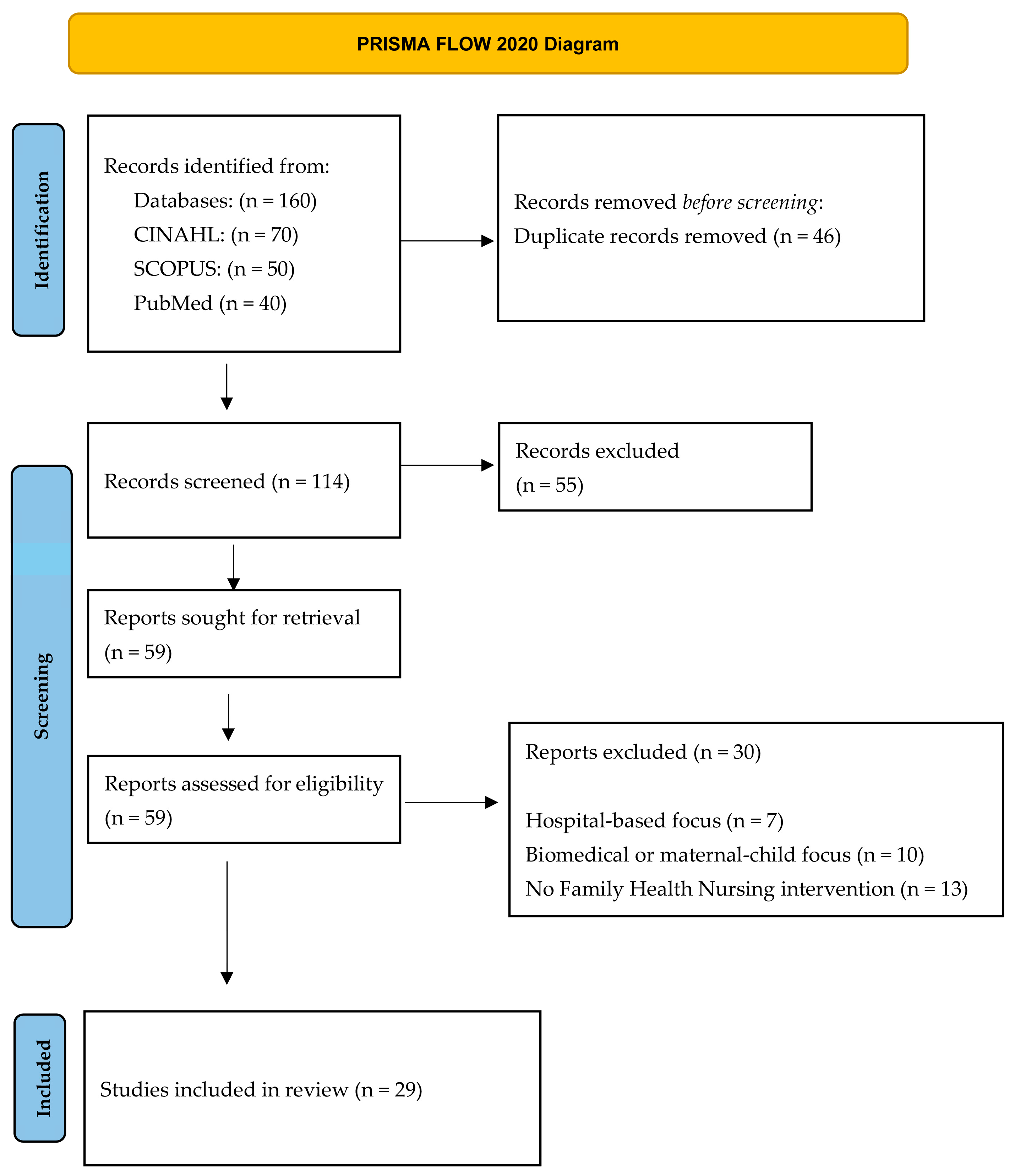
2.3. Review Methods
- Identification of the research problem.
- Definition of inclusion and exclusion criteria.
- Systematic literature search and selection.
- Critical appraisal and data extraction.
- Analysis and synthesis of results.
- Studies focus on hospital-based or institutional care settings (e.g., intensive care units, inpatient hospitalization, long-term residential care), without a community or primary health care perspective.
- Studies centred exclusively on biomedical, maternal, or pediatric clinical outcomes, without a Family Health Nursing or relational caregiving focus.
- Absence of family-focused nursing interventions or relational support components.
- Studies addressing general population health issues without specific reference to family caregiving or family nursing practice.
- Opinion papers, editorials, commentaries, or theoretical reflections lacking empirical or review methodology.
- Articles not available in full text.
- Publications in languages outside the predefined inclusion criteria (English, Portuguese, Spanish).
3. Results
- Caregiver Burden
- Socioeconomic vulnerability
- Social isolation and lack of support networks
- Intra- and extra-family communication challenges
Nursing Interventions
4. Discussion
4.1. Expanded Needs of the Sole Caregiver
4.2. Empowerment as an Outcome
4.3. Single-Parent-Specific Findings
4.4. Evidence Gap in Family Health Nursing Support for Single-Parent Families
4.5. The Relational Empowerment Model

4.6. Suggestions for Practice and Research
5. Conclusions
Supplementary Materials
Funding
Institutional Review Board Statement
Informed Consent Statement
Data Availability Statement
Acknowledgments
Conflicts of Interest
References
- Thompson, K.; Lee, R. Single-parent health challenges: A scoping review. Public Health Nurs. 2021, 38, 234–242. [Google Scholar]
- Beckmeyer, J.J.; Russell, L.T. Family structure diversity and youth health care access and interactions with health care providers. J. Fam. Nurs. 2022, 28, 308–320. [Google Scholar] [CrossRef]
- Karpa, J.; Chernomas, W.; Roger, K.; Heinonen, T. Families’ experiences living with acquired brain injury: “Thinking family”—A nursing pathway for family-centered care. Nurs. Res. Pract. 2020, 2020, 8866534. [Google Scholar] [CrossRef]
- Piil, K.; Skovhus, S.L.; Tolver, A.; Jarden, M. Neuro-oncological symptoms: A longitudinal quantitative study of family function, perceived support, and caregiver burden. Nurs. Res. Pract. 2020, 2020, 8826943. [Google Scholar] [CrossRef]
- Fitryasari, R.; Yusuf, A.; Nursalam, N.; Hargono, R.; Lin, E.C.-L.; Tristiana, R.D. Development of a family resiliency model to care for patients with schizophrenia. Scand. J. Caring Sci. 2021, 35, 642–649. [Google Scholar] [CrossRef]
- Fuglsang, C.M.B.; Dieperink, K.B.; Johnsen, E.M.W. How nurses can support families where a person with serious illness is living at home: A scoping review. Health Soc. Care Community 2023, 2023, 9595254. [Google Scholar] [CrossRef]
- González, R.; Martínez, A. Parenting alone: Single-parent families and health equity. J. Fam. Soc. Work 2023, 26, 44–58. [Google Scholar]
- Knafl, K.A.; Deatrick, J.A.; Gallo, A.M.; Skelton, B. Tracing the use of the Family Management Framework and Measure: A scoping review. J. Fam. Nurs. 2021, 27, 87–106. [Google Scholar] [CrossRef]
- Castro, E.; Almeida, J. Empowerment and parenting in single-parent families. Rev. Enferm. Fam. Comun. 2021, 5, 89–95. (In Portuguese) [Google Scholar]
- Cruz, R.; Matos, T. Nursing follow-up of vulnerable families: An integrative review. Enferm. Glob. 2023, 22, 149–161. (In Portuguese) [Google Scholar]
- Eustace, R.W. A theory of family health: A Neuman’s systems perspective. Nurs. Sci. Q. 2022, 35, 101–110. [Google Scholar] [CrossRef] [PubMed]
- Heydari, F.; Nikfarid, L.; Oujian, P.; Nasiri, M.; Motefakker, S. Predictors of perceived family sense of coherence in parents of children with cancer. Indian J. Palliat. Care 2023, 29, 54–60. [Google Scholar] [CrossRef] [PubMed]
- Silva, R.; Mendonça, C. Psychosocial care in single-parent families: The nurse’s role. Cuidarte 2024, 15, 22–30. (In Portuguese) [Google Scholar]
- Sousa, F.; Pinto, M. Social determinants of health in single-parent families. Rev. Enferm. Ref. 2020, 5, 51–60. (In Portuguese) [Google Scholar]
- Dinis, A.; Antunes, M. Changing family configurations: Challenges for health. Rev. Port. Saúde Pública 2022, 40, 215–222. (In Portuguese) [Google Scholar]
- Wright, L.M.; Leahey, M. Nurses and Families: A Guide to Family Assessment and Intervention, 7th ed.; F.A. Davis: Philadelphia, PA, USA, 2013. [Google Scholar]
- Meleis, A.I.; Sawyer, L.M.; Im, E.O.; Messias, D.K.; Schumacher, K. Experiencing transitions: An emerging middle-range theory. Adv. Nurs. Sci. 2020, 43, 96–112. [Google Scholar] [CrossRef]
- Luz, E.; Bastos, F.; Vieira, M.; Mesquita, E. Empowerment in chronic illness: Development and validation of a scale. Rev. Enferm. Ref. 2020, 5, e20075. (In Portuguese) [Google Scholar]
- García-López, C.; Torres, J. Collaborative practices in Family Health Nursing: A critical analysis. J. Adv. Nurs. 2023, 79, 88–97. (In Portuguese) [Google Scholar]
- Hagedoorn, E.I.; Paans, W.; Jaarsma, T.; Keers, J.C.; van der Schans, C.P.; Luttik, M.L.A. The importance of families in nursing care: Attitudes of nurses in the Netherlands. Scand. J. Caring Sci. 2021, 35, 1207–1215. [Google Scholar] [CrossRef]
- Whittemore, R.; Knafl, K. The integrative review: Updated methodology. J. Adv. Nurs. 2005, 52, 546–553. [Google Scholar] [CrossRef]
- Souza, M.T.; Silva, M.D.; Carvalho, R. Integrative review: What it is and how to do it. Einstein 2010, 8, 102–106. (In Portuguese) [Google Scholar] [CrossRef] [PubMed]
- Mendes, K.D.S.; Silveira, R.C.C.P.; Galvão, C.M. Integrative review: A research method for incorporating evidence into health and nursing. Texto Contexto Enferm. 2008, 17, 758–764. (In Portuguese) [Google Scholar] [CrossRef]
- Esandi, N.; Nolan, M.; Canga-Armayor, N.; Pardavila-Belio, M.I.; Canga-Armayor, A. Family dynamics and the Alzheimer’s disease experience. J. Fam. Nurs. 2021, 27, 124–135. [Google Scholar] [CrossRef]
- Broekema, S.; Paans, W.; Roodbol, P.F.; Luttik, M.L.A. Nurses’ application of the components of family nursing conversations in home health care: A qualitative content analysis. Scand. J. Caring Sci. 2020, 34, 322–331. [Google Scholar] [CrossRef]
- Andrade, F.M.R.; Figueiredo, A.S.; Charepe, Z.; Deodato, S.; Capelas, M.L. Experiences of homeless families in parenthood: A systematic review and synthesis of qualitative evidence. Int. J. Environ. Res. Public Health 2023, 20, 2712. [Google Scholar] [CrossRef]
- Goldberg, A.E.; Allen, K.R. “Failed” matches, child removals, and disrupted placements: Devastating and invisible losses during the family-building journey for LGBTQ adoptive parents. J. Fam. Nurs. 2022, 28, 368–380. [Google Scholar] [CrossRef]
- Ahlberg, M.; Hollman Frisman, G.; Berterö, C.; Ågren, S. Family health conversations create awareness of family functioning. Nurs. Crit. Care 2020, 25, 102–108. [Google Scholar] [CrossRef]
- Bonakdar Tehrani, M.; Baird, K.; Kemp, L. Sustained nurse home-visiting with culturally and linguistically diverse families: Australian nurses’ perspectives. Public Health Nurs. 2021, 38, 822–831. [Google Scholar] [CrossRef]
- Elliott, E.; Bogard, S.; Kohlhoff, J. “Sustaining NSW Families” as a hybrid face-to-face/virtual program: Experiences of clients and clinicians. Public Health Nurs. 2023; in press. [CrossRef]
- Petursdottir, A.B.; Rayens, M.K.; Sigurdardottir, V.; Svavarsdottir, E.K. Long-term effect of receiving a family strengths-oriented intervention on family cancer caregiver stress, anxiety, and depression symptoms. J. Fam. Nurs. 2021, 27, 114–123. [Google Scholar] [CrossRef] [PubMed]
- Rothausen, C.S.; Clausen, A.M.; Voltelen, B.; Dieperink, K.B. Protective buffering: Nurses facilitating communication between adults with cancer and their adult family caregivers. J. Fam. Nurs. 2023, 29, 417–436. [Google Scholar] [CrossRef] [PubMed]


| No. | Transition Category (Meleis) | Family Life Cycle Stage (Calgary) | Challenges Identified | Reported Nursing Interventions | Theoretical Approach/Model Used | Single-Parent Specificity/Evidence Type |
|---|---|---|---|---|---|---|
| 1 | Health–Illness Transition | Family with an affected adult member | Adaptation to acquired brain injury; role reorganization | Family-centered care; emotional support | Family-Centered Care Pathway | transferable |
| 2 | Health–Illness Transition | Family with member in oncology treatment | High caregiver burden; caregiver anxiety and depression | Caregiver support interventions | Quantitative Longitudinal Study | transferable |
| 3 | Health–Illness Transition | Family with member with schizophrenia | Social stigma; weakened family resilience | Development of family resiliency model | Family Resiliency Model | transferable |
| 4 | Organizational Transition/New Family Role | Family managing a child’s chronic condition | Care coordination; lack of standardized measures | Use of Family Management Framework; review of family management measures | Family Management Framework | transferable |
| 5 | Theoretical Development Transition | Theoretical evaluation | – | Formulation of family health theory | Neuman’s Systems Model | transferable |
| 6 | Health–Illness Transition | Family with member in oncology treatment | Caregiver stress, anxiety, and depression | Strengths-oriented family intervention; reinforcement of internal resources | Strengths Oriented Intervention | transferable |
| 7 | Health–Illness Transition | Family with member with Alzheimer’s disease | Mental and physical overload; social isolation | Support strategies in family meetings; family education | Calgary Family Assessment Model | transferable |
| 8 | Role Transition/Parenting | Grandparents raising grandchildren | Task overload; lack of preparation for new roles | Emotional and practical support to grandparents; care education | Family Nursing Support | Transferable (non-parental caregiving) |
| 9 | Instrumental Assessment Transition | Family functioning evaluation | – | Cross-cultural validation of ICE EFFQ instrument | Psychometric Validation (ICE EFFQ) | Not transferable |
| 10 | Health–Illness/Adaptation Transition | Family with individual with Down syndrome | Adaptation to genetic condition; need for specialized support | Recommendations for family nursing practices | Scoping Review | transferable |
| 11 | Health–Illness Transition | Family with member with dementia | Communication conflicts; family anxiety | Structured family meetings; facilitated dialogue | Family Meetings Integrative Review | transferable |
| 12 | Methodological Transition | Evaluation of family typologies | Identification of family profiles for research | Latent Class Analysis to map typologies | Latent Class Analysis | transferable |
| 13 | Health–Illness Transition | Family of adults with cancer | Dysfunctional communication; overprotection | Communication mediation; training for open dialogue | Protective Buffering Integrative Review | transferable |
| 14 | Health–Illness Transition | Continued home care | Nurse insecurity in conducting family conversations | Training and supervision in family nursing conversations | Calgary Family Conversations | transferable |
| 15 | Family Formation Transition | LGBTQ adoptive families | Invisible losses; unacknowledged grief | Emotional support post-loss; grief therapy | Grief & Loss Framework | transferable |
| 16 | Health–Illness/End-of-Life Transition | Family in palliative care | Intense emotional distress; need for comprehensive care | Family-centered nursing actions at end-of-life | Family Focused Palliative Nursing | transferable |
| 17 | Sudden Loss Transition | Family after adolescent suicide | Trauma and family reorganization after sudden loss | Support groups and counseling; resilience strategies | Grounded Theory of Family Transformation | transferable |
| 18 | Health–Illness Transition | Family with member with neuromuscular disease | Daily management challenges; physical and emotional burden | Functional-focused interventions; practical counseling | Functional Assessment Tools | transferable |
| 19 | Structural Transition | Family with youth members | Barriers to access; institutional prejudice | Awareness programs; health professional training | Health Equity Framework | transferable |
| 20 | Health–Illness Transition | Family in home care for severe illness | Unmet emotional and practical needs | Review of home-visiting support practices | Scoping Review of Home-Based Support | transferable |
| 21 | Social Transition | Homeless families | Lack of resources; housing insecurity | Referral protocols; community support groups | Systematic Review of Homeless Families | transferable |
| 22 | Service Transition | Families in hybrid in-person/virtual program | Barriers to in-person access; social isolation | Hybrid care model; telehealth nursing | Hybrid Program Evaluation | transferable |
| 23 | Developmental Transition | Families with children in special needs schools | Need for specialized educational support; family stress | Emotional and physical support; educational guidance | Family Functioning Theory | transferable |
| 24 | Health–Illness Transition | Family caregivers of oncology patients | High caregiver burden; lack of social support | Stress management interventions; psychosocial support | Cross-Sectional Burden & Support Study | transferable |
| 25 | Social/Pandemic Transition | Families during COVID-19 | Psychological impacts; mobility restrictions; isolation | Nurses’ perceptions and recommendations; adapted care guidelines | Descriptive Nursing Study | transferable |
| 26 | Service Transition | Culturally diverse families in home visiting | Language and cultural barriers; institutional mistrust | Sustained nurse home visiting; cultural competence training | Cultural Competence Framework | transferable |
| 27 | Health–Illness Transition | African American families caring for dementia | Specific emotional and economic challenges | Culturally sensitive support; community resources | Cultural Sensitivity in Family Care | transferable |
| 28 | Awareness Transition | General families | Need to resolve conflicts and improve cohesion | Regular Family Health Conversations | Family Health Conversations Model | transferable |
| 29 | Professional Role Transition | Families in all life cycle stages | Variable nurse attitudes; lack of preparation | Family attitude training programs; workshops | Survey of Nurse Attitudes | transferable |
Disclaimer/Publisher’s Note: The statements, opinions and data contained in all publications are solely those of the individual author(s) and contributor(s) and not of MDPI and/or the editor(s). MDPI and/or the editor(s) disclaim responsibility for any injury to people or property resulting from any ideas, methods, instructions or products referred to in the content. |
© 2026 by the author. Licensee MDPI, Basel, Switzerland. This article is an open access article distributed under the terms and conditions of the Creative Commons Attribution (CC BY) license.
Share and Cite
da Luz, E. Integrative Review of Family Health Nursing Support for Single-Parent Families: Evidence Gaps and Implications for a Relational Empowerment Model. Healthcare 2026, 14, 1088. https://doi.org/10.3390/healthcare14081088
da Luz E. Integrative Review of Family Health Nursing Support for Single-Parent Families: Evidence Gaps and Implications for a Relational Empowerment Model. Healthcare. 2026; 14(8):1088. https://doi.org/10.3390/healthcare14081088
Chicago/Turabian Styleda Luz, Elisabete. 2026. "Integrative Review of Family Health Nursing Support for Single-Parent Families: Evidence Gaps and Implications for a Relational Empowerment Model" Healthcare 14, no. 8: 1088. https://doi.org/10.3390/healthcare14081088
APA Styleda Luz, E. (2026). Integrative Review of Family Health Nursing Support for Single-Parent Families: Evidence Gaps and Implications for a Relational Empowerment Model. Healthcare, 14(8), 1088. https://doi.org/10.3390/healthcare14081088