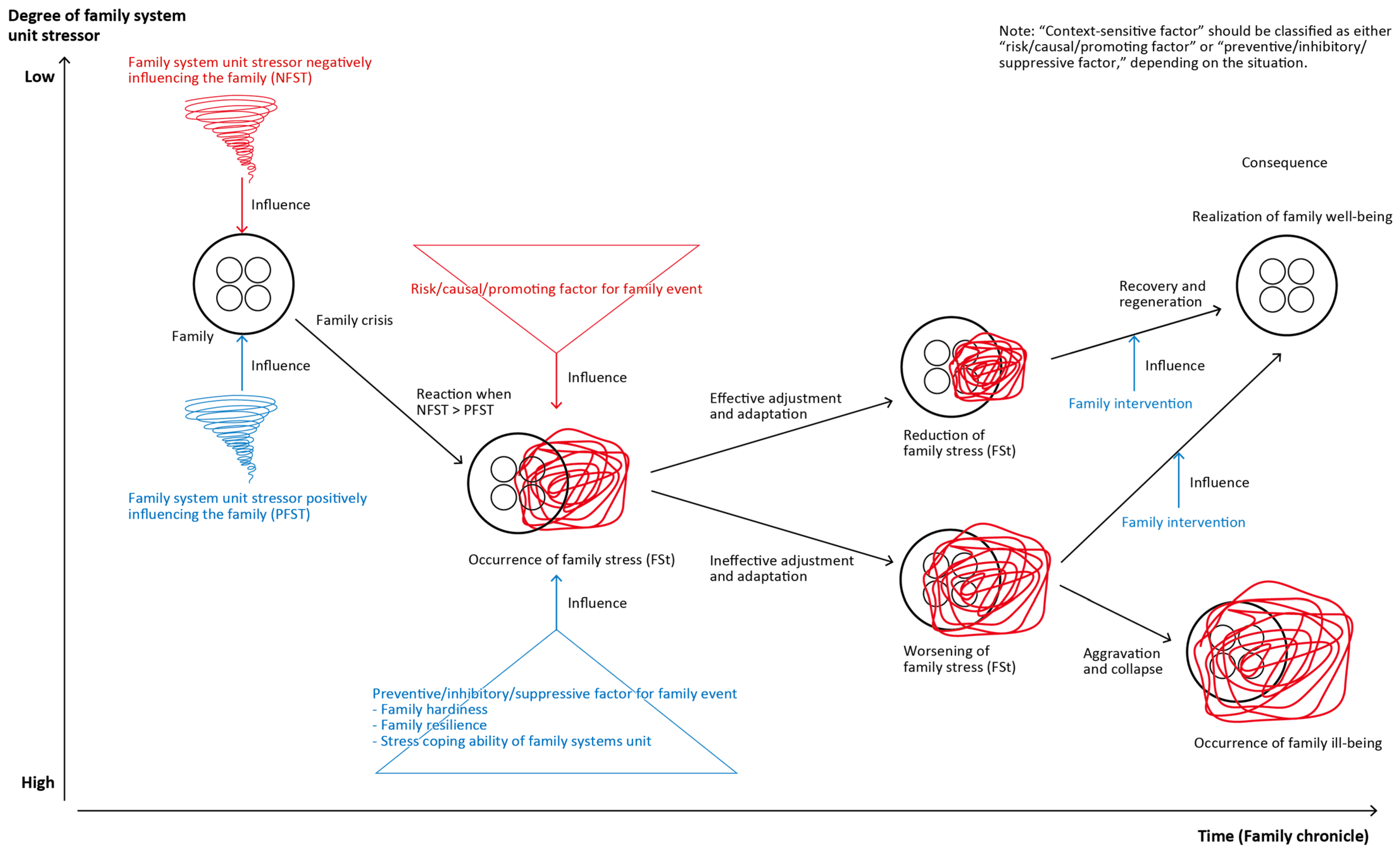
Factors Influencing Stress in Families of Individuals with Illness or Disability: A Qualitative Study Based on Family System Unit Stress Theory



Highlights
- Qualitative interview surveys indicated factors influencing stress occurring in families with young/adult children with illnesses or disabilities.
- Using Family System Unit Stress Theory as the theoretical framework, both positive and negative factors influencing family stress were systematically classified.
- Factors influencing family stress occurring in families with young/adult children with illnesses or disabilities accumulate as the family grows and develops, transforming family stress over time.
- To promote effective adaptation to family stress, an integrated approach to influencing factors should be taken, reducing risk/causal/promoting factors and strengthening preventive/inhibitory/suppressive factors.
Abstract
1. Introduction
2. Methods
2.1. Operational Definition of Terms
- The term “family system unit” is used as an alternative expression for “family” to emphasize that the family is conceptualized simultaneously as a system and as a unit [1].
- “Risk/causal/promoting factors” are defined as factors that predispose the family system unit to the emergence of stress, precipitate the onset of family system unit stress, or intensify the severity of stress once it has emerged [1].
- “Preventive/inhibitory/suppressive factors” are defined as factors that protect the family system unit from the emergence of stress, impede the development of family system unit stress, or attenuate the severity of stress once it has occurred [1].
2.2. Study Design
2.3. Participants
2.4. Theoretical Framework
2.5. Procedure
2.6. Data Analysis and Rigor
2.7. Ethical Considerations
3. Results
3.1. Sociodemographic Characteristics of the Participants and Their Young/Adult Children
3.2. Categories and Subcategories of Risk/Causal/Promoting Factors
3.2.1. Presence of Symptoms or Condition-Related Characteristics in the Young/Adult Child
She would cry intensely, run around and try to escape, and even when we went to the park, she would often try to leave almost immediately. I was constantly in a state of confusion, worrying that she might run into the road.(ID 7)
3.2.2. Difficulties in the Young/Adult Child’s Interactions with Others
My son absolutely refuses to leave the house and doesn’t want to go to the support center. Once he decides he doesn’t want to go, he won’t listen to anything I say, and I can’t force him to go.(ID 10)
3.2.3. Difficulties in Parenting and Supporting a Young/Adult Child with Illness or Disability
I feel that by trying to force my son into what is considered “normal,” I have gradually taken away the happy, lively side of him that was truly his. That inner conflict has become a major source of stress for me.(ID 5)
3.2.4. Accumulation of Unshared Burdens Within the Family Leading to Role Overload
My husband would leave early in the morning and not come home until around 10 p.m. I was the one bathing our daughters, feeding them, and putting them to bed—I was raising them on my own the entire time. I felt cut off from society, as if I were being left behind, and that was very painful.(ID 9)
3.2.5. Insufficient Support for the Family
We have no way of knowing what kinds of support are actually available to us, yet the local government and administrative agencies do not provide any information. They should be aware of individuals like my daughter who have illnesses or disabilities, but there is virtually no outreach or information provided to families like ours.(ID 8)
3.2.6. Concerns About the Future of the Young/Adult Child
My daughter is kind, so she would never say that taking care of her younger sister is a burden. But she is married, and I feel that I shouldn’t impose on her. She lives far away, and in a way, I think it’s better that we can’t easily rely on her.(ID 4)
3.3. Categories and Subcategories of Preventive/Inhibitory/Suppressive Factors
3.3.1. Receiving a Diagnosis of the Young/Adult Child’s Illness or Disability
I couldn’t easily accept that my daughter had an illness, but at the same time, I felt relieved to finally understand the cause of her difficulties. During the year and a half after we began going to the hospital, I was constantly anxious, but I gradually came to understand that her struggles were caused by the illness.(ID 8)
3.3.2. Parental Engagement with the Young/Adult Child Based on an Understanding of Their Characteristics
Ever since she underwent developmental testing, I’ve strongly felt that I can’t support her forever. No matter what path she chooses, I believe she needs to become independent and be able to take care of at least some aspects of her daily life on her own, and that’s the mindset I have when I interact with her.(ID 6)
3.3.3. Family Maintaining a Positive Attitude
I often think about how to help others see the fun and unique sides of my daughter. I want everyone to enjoy watching her grow together, so I make a point of telling her teachers about all of her good qualities.(ID 9)
3.3.4. Adequate Support for the Family
Through receiving support, my daughter has become better able to put her feelings into words. In the past, she could only say things like, “I’m just irritated,” but recently, she has gradually begun to think through, step by step, how she can deal with those feelings.(ID 6)
3.3.5. Availability of an Environment in Which the Family Can Consult Others
Even the worries that no one had understood before were accepted when I went to the mothers’ group. There, I found people I could talk to and rely on. Since joining the group, I’ve been able to approach parenting with much more emotional breathing room.(ID 5)
4. Discussion
4.1. Overall Picture
4.2. Risk/Causal/Promoting Factors
4.3. Preventive/Inhibitory/Suppressive Factors
4.4. Significance of Using FSUST as a Theoretical Framework and Its Implications for Family Nursing
4.5. Limitations and Future Directions
5. Conclusions
Author Contributions
Funding
Institutional Review Board Statement
Informed Consent Statement
Data Availability Statement
Acknowledgments
Conflicts of Interest
References
- Hohashi, N. Understanding Family Health Care Nursing Through Applicable Terminology: Family Event Theory (Ver. 2.2) and Family System Unit Stress Theory (Ver. 2.2); Editex: Kawasaki, Japan, 2023. [Google Scholar]
- Brik, A.B.; Wang, Y. Exploring the factors contributing to parent stress symptoms during the COVID-19 pandemic in Europe: An ABC-X model approach. Fam. Process 2025, 64, e13063. [Google Scholar] [CrossRef]
- Shen, Z.; Fang, Y.; Li, C.; Luo, X.; Cui, J.; Liu, Y.; Hong, J. Family resilience and its influencing factors among patients with lung cancer based on double ABC-X theoretical framework. Cancer Med. 2025, 14, e70868. [Google Scholar] [CrossRef] [PubMed]
- Yuan, L.; Du, Y.; Gao, Y.; Wang, W.; Wang, J.; Wang, Y.; Yang, J.; Wang, X.; Li, H. The role of parenting stress and perceived social support in affecting family function among families of patients with cleft lip and/or palate: A path analysis based on the family adjustment and adaptation response model. BMC Oral Health 2025, 25, 454. [Google Scholar] [CrossRef]
- Xue, J.; Ooh, J.; Magiati, I. Family functioning in Asian families raising children with autism spectrum disorders: The role of capabilities and positive meanings. J. Intellect. Disabil. Res. 2014, 58, 406–420. [Google Scholar] [CrossRef]
- Neugebauer, C.; Mastergeorge, A.M. The family stress model in the context of pediatric cancer: A systematic review. J. Child Fam. Stud. 2021, 30, 1099–1122. [Google Scholar] [CrossRef]
- Shahi, S.K.; Wang, P.; Gu, J.; Shrestha, R.M.; Wang, P. Stress and influencing factor among children diagnosed with cancer at hospitals in Nepal: A cross-sectional study. BMC Pediatr. 2025, 25, 480. [Google Scholar] [CrossRef]
- Scheibner, C.; Scheibner, M.; Hornemann, F.; Arélin, M.; Hennig, Y.D.; Kiep, H.; Wurst, U.; Merkenschlager, A.; Gburek-Augustat, J. Parenting stress in families of children with disabilities: Impact of type of disability and assessment of attending paediatricians. Child Care Health Dev. 2024, 50, e13193. [Google Scholar] [CrossRef]
- Soh, X.C.; Hartanto, A.; Ling, N.; Reyes, M.; Sim, L.; Majeed, N.M. Prevalence of depression, anxiety, burden, burnout, and stress in informal caregivers: An umbrella review of meta-analyses. Arch. Gerontol. Geriatr. Plus 2025, 2, e100197. [Google Scholar] [CrossRef]
- Han, K.S.; Yang, Y.; Hong, Y.S. A structural model of family empowerment for families of children with special needs. J. Clin. Nurs. 2018, 27, e833–e844. [Google Scholar] [CrossRef]
- Priego-Ojeda, M.; Rusu, P.P. Emotion regulation, parental stress and family functioning: Families of children with disabilities vs normative families. Res. Dev. Disabil. 2023, 139, 104548. [Google Scholar] [CrossRef] [PubMed]
- John, J.R.; Lam-Cassettari, C.; Dissanayake, C.; Eapen, V. Sociodemographic and clinical indicators associated with quality of life among parents of autistic children. BMC Pediatr. 2025, 25, 326. [Google Scholar] [CrossRef]
- Shalahuddin, I.; Mahardiani, F.; Widianti, E.; Maulana, I. Factors related to the caregiver burden on families caring for clients with schizophrenia: Scoping review. Psychol. Res. Behav. Manag. 2025, 18, 1799–1808. [Google Scholar] [CrossRef]
- Zhang, Y.; Zhou, H.; Bai, Y.; Chen, Z.; Wang, Y.; Hu, Q.; Yang, M.; Wei, W.; Ding, L.; Ma, F. Families under pressure: A qualitative study of stressors in families of children with congenital heart disease. Stress Health 2023, 39, 989–999. [Google Scholar] [CrossRef]
- Kandel, I.; Merrick, J. The child with a disability: Parental acceptance, management and coping. Sci. World J. 2007, 7, 1799–1809. [Google Scholar] [CrossRef]
- Dykens, E.M. Family adjustment and interventions in neurodevelopmental disorders. Curr. Opin. Psych. 2015, 28, 121–126. [Google Scholar] [CrossRef]
- Sandelowski, M. Whatever happened to qualitative description? Res. Nurs. Health 2000, 23, 334–340. [Google Scholar] [CrossRef] [PubMed]
- Graneheim, U.H.; Lundman, B. Qualitative content analysis in nursing research: Concepts, procedures and measures to achieve trustworthiness. Nurs. Educ. Today 2004, 24, 105–112. [Google Scholar] [CrossRef] [PubMed]
- Luborsky, M.R.; Rubinstein, R.L. Sampling in qualitative research: Rationale, issues, and methods. Res. Aging 1995, 17, 89–113. [Google Scholar] [CrossRef]
- Schwandt, T.A.; Lincoln, Y.S.; Guba, E.G. Judging interpretations: But is it rigorous? Trustworthiness and authenticity in naturalistic evaluation. New Dir. Eval. 2007, 114, 11–25. [Google Scholar] [CrossRef]
- Hennink, M.M.; Kaiser, B.N.; Marconi, V.C. Code saturation versus meaning saturation: How many interviews are enough? Qual. Health Res. 2017, 27, 591–608. [Google Scholar] [CrossRef]
- Hohashi, N.; Honda, J. Development of the concentric sphere family environment model and companion tools for culturally congruent family assessment. J. Transcult. Nurs. 2011, 22, 350–361. [Google Scholar] [CrossRef]
- Marcinechová, D.; Záhorcová, L.; Lohazerová, K. Self-forgiveness, guilt, shame, and parental stress among parents of children with autism spectrum disorder. Curr. Psychol. 2024, 43, 2277–2292. [Google Scholar] [CrossRef]
- Mello, C.; Rivard, M.; Morin, D.; Patel, S.; Morin, M. Symptom severity, internalized and externalized behavioral and emotional problems: Links with parenting stress in mothers of children recently diagnosed with autism. J. Autism Dev. Disord. 2022, 52, 2400–2413. [Google Scholar] [CrossRef] [PubMed]
- Dembo, R.S.; Hong, J.; DaWalt, L.S.; Mailick, M.R. Age-related trajectories of health and cognition in mothers of children with developmental disabilities: Longitudinal findings from two independent studies. Soc. Sci. Med. 2025, 372, 117912. [Google Scholar] [CrossRef] [PubMed]
- Özsavran, M.; Karakaya, C.; Bahadır, Ö. ‘I can’t take my eyes off her’ problems and difficulties experienced by mothers caring for their intellectually disabled children at home: A qualitative research. Int. J. Dev. Disabil. 2024, 71, 610–625. [Google Scholar] [CrossRef]
- Yang, V.J.H.; Bergman, K.N.; Cummings, E.M. Testing a family conflict intervention for parents and typically developing adolescent siblings of individuals with intellectual and/or developmental disabilities. Int. J. Environ. Res. Public Health 2024, 21, 1666. [Google Scholar] [CrossRef]
- Kramer, A.C.; Neubauer, A.B.; Scott, S.B.; Schmiedek, F.; Sliwinski, M.J.; Smyth, J.M. Stressor anticipation and subsequent affective well-being: A link potentially explained by perseverative cognitions. Emotion 2022, 22, 1787–1800. [Google Scholar] [CrossRef]
- Gutowska, A. The care of adults with intellectual disabilities: Informal (family) caregivers’ perspectives. Int. J. Environ. Res. Public Health 2022, 19, 15622. [Google Scholar] [CrossRef]
- Basualto, P.; Senevirathna, A.M.; Seth, A.; Dimitropoulos, G.; Zwicker, J.D. Improving equitable access to disability services and support for children with neurodevelopmental disabilities: Service provider and decision-maker perspectives. Child Care Health Dev. 2026, 52, e70213. [Google Scholar] [CrossRef] [PubMed]
- Rizzo, A.; Sorrenti, L.; Commendatore, M.; Mautone, A.; Caparello, C.; Maggio, M.G.; Özaslan, A.; Karaman, H.; Yıldırım, M.; Filippello, P. Caregivers of children with autism spectrum disorders: The role of guilt sensitivity and support. J. Clin. Med. 2024, 13, 4249. [Google Scholar] [CrossRef]
- Kim, H.S.; Sherman, D.K.; Taylor, S.E. Culture and social support. Am. Psychol. 2008, 63, 518–526. [Google Scholar] [CrossRef] [PubMed]
- Kamono, E.; Tanaka, M.; Tamori, H.; Takai, M.; Honda, K.; Ogawa, K.; Ujino, Y.; Seino, M.; Shiroiwa, T.; Hoshino, E. Conceptual framework for caregivers’ quality of life and well-being supporting children with special health and medical needs in East Asia: A systematic review and narrative synthesis. Qual. Life Res. 2025, 34, 3471–3484. [Google Scholar] [CrossRef]
- McKechanie, A.G.; Moffat, V.J.; Johnstone, E.C.; Fletcher-Watson, S. Links between autism spectrum disorder diagnostic status and family quality of life. Children 2017, 4, 23. [Google Scholar] [CrossRef]
- Papadopoulos, A.; Siafaka, V.; Tsapara, A.; Tafiadis, D.; Kotsis, K.; Skapinakis, P.; Tzoufi, M. Measuring parental stress, illness perceptions, coping and quality of life in families of children newly diagnosed with autism spectrum disorder. BJPsych Open 2023, 9, e84. [Google Scholar] [CrossRef]
- Hoffmann, T.M.; Friedrich, B.; Lewis, C. “I don’t grieve as much as I used to”: A qualitative study on parents of children with rare and undiagnosed conditions navigating grief in the context of uncertainty. J. Genet. Couns. 2025, 34, e70149. [Google Scholar] [CrossRef]
- Lutz, H.R.; Patterson, B.J.; Klein, J. Coping with autism: A journey toward adaptation. J. Pediatr. Nurs. 2012, 27, 206–213. [Google Scholar] [CrossRef]
- Syed, I.U. Clearing the smoke screen: Smoking, alcohol consumption, and stress management techniques among Canadian long-term care workers. Int. J. Environ. Res. Public Health 2020, 17, 6027. [Google Scholar] [CrossRef] [PubMed]
- Xu, T.; Zhang, Y. Different supports, different effects: Social support moderates the impact of parenting stress on the mental health of parents of individuals with intellectual and developmental disabilities. Eur. J. Investig. Health Psychol. Educ. 2025, 15, 248. [Google Scholar] [CrossRef] [PubMed]
- Bray, L.; Carter, B.; Sanders, C.; Blake, L.; Keegan, K. Parent-to-parent peer support for parents of children with a disability: A mixed method study. Patient Educ. Couns. 2017, 100, 1537–1543. [Google Scholar] [CrossRef]
- Ellingsen, R.; Baker, B.L.; Blacher, J.; Crnic, K. Resilient parenting of preschool children at developmental risk. J. Intellect. Disabil. Res. 2014, 58, 664–678. [Google Scholar] [CrossRef]
- Hennink, M.; Kaiser, B.N. Sample sizes for saturation in qualitative research: A systematic review of empirical tests. Soc. Sci. Med. 2022, 292, 114523. [Google Scholar] [CrossRef] [PubMed]
- Fink, R.M.; Valenti, K.G.; Kline, D.M.; Fischer, S.M. Reality of family caregiving for Hispanics with Alzheimer’s disease and related dementias: A qualitative analysis. J. Palliat. Med. 2023, 26, 1618–1626. [Google Scholar] [CrossRef]
- Matérne, M.; Holmefur, M. Relatives’ experiences of quality of healthcare services for adults with profound intellectual and multiple disabilities in Sweden. J. Intellect. Dev. Disabil. 2024, 49, 452–461. [Google Scholar] [CrossRef] [PubMed]
- Young, D.S.; Casey, E.A. An examination of the sufficiency of small qualitative samples. Soc. Work Res. 2019, 43, 53–58. [Google Scholar] [CrossRef]


| ID | Participant | |||||||
|---|---|---|---|---|---|---|---|---|
| Age | Sex | Civil Status | Relationship to Young/Adult Children | Primary Caregiver | Family Size | Employment | Domicile | |
| 1 | 31 | Female | Married | Mother | Yes | 4 | Homemaker | Rural |
| 2 | 75 | Female | Married | Mother | Yes | 4 | Retired | Urban |
| 3 | 66 | Female | Married | Mother | Yes | 4 | Retired | Urban |
| 4 | 65 | Female | Married | Mother | Yes | 5 | Retired | Urban |
| 5 | 39 | Female | Married | Mother | Yes | 4 | Self-employed | Urban |
| 6 | 36 | Female | Divorced | Mother | Yes | 3 | Employed full-time | Rural |
| 7 | 38 | Female | Married | Mother | Yes | 4 | Homemaker | Urban |
| 8 | 53 | Male | Married | Father | No | 5 | Employed full-time | Urban |
| 9 | 40 | Female | Married | Mother | Yes | 5 | Homemaker | Urban |
| 10 | 52 | Female | Married | Mother | Yes | 3 | Homemaker | Urban |
| ID | Young/Adult Children with Illnesses or Disabilities | ||
|---|---|---|---|
| Age | Sex | Main Diagnosis | |
| 1 | 6 | Male | Developmental delay |
| 2 | 32 | Female | Intellectual disability |
| 3 | 40 38 | Female Male | Mild intellectual disability, mild paresis Mild intellectual disability, cerebral palsy, depression |
| 4 | 30 | Female | Schizophrenia |
| 5 | 12 | Male | Developmental disorder |
| 6 | 9 | Female | Developmental disorder |
| 7 | 5 | Female | Autism |
| 8 | 12 | Female | Rett syndrome |
| 9 | 12 6 | Female Female | Prader–Willi syndrome Autism |
| 10 | 20 | Male | Intellectual disability |
| Category | Subcategory | Code | Related Interviews (ID Number in Table 1) |
|---|---|---|---|
| Presence of symptoms or condition-related characteristics in the young/adult child | Feelings of parenting difficulty associated with the young/adult child’s characteristics | Feeling frustrated about the sudden actions of young/adult child Feeling of parenting difficulty caused by young/adult child’s tantrums Feeling drained by young/adult child repeating the same things over and over Worrying that young/adult child is not developing good habits | 1, 5, 6, 7, 9, 10 |
| Family burden owing to symptom exacerbation in the young/adult child | Worrying about deterioration in young/adult child’s symptoms of depression The mental symptoms of young/adult child becoming a burden on the family Feeling fatigued from dealing with the positive symptoms of young/adult child | 3, 4 | |
| Sibling frustration related to the young/adult child’s symptoms or characteristics | Sibling becoming frustrated by the behavior of young/adult child Sibling feeling frustrated because his or her parents take out their frustrations on him or her after becoming exhausted from dealing with their young/adult child Sibling feeling unhappy that young/adult child always receives priority treatment | 5, 6, 8 | |
| Difficulties in the young/adult child’s interactions with others | Difficulties in the young/adult child’s communication with others | Young/adult child having difficulty communicating with people outside the family Young/adult child not speaking and being unable to express his or her own thoughts | 2, 5, 6, 8, 10 |
| Difficulty for the young/adult child in maintaining interpersonal relationships | Young/adult child’s inability to build relationships at support facilities Young/adult child’s relationships with support staff deteriorate and he or she stops going to the facility Young/adult child being unable to maintain friendships and becoming alienated Young/adult child has difficulty in building personal relationships and withdraws into his or her home | 4, 5 | |
| Refusal of support from others by the young/adult child | Young/adult child refuses to go to support facilities and stays at home Young/adult child shows resentment towards support from others Young/adult child refuses to be examined by a doctor | 4, 10 | |
| Difficulties in parenting and supporting a young/adult child with illness or disability | Parenting and supporting the young/adult child amid uncertainty prior to diagnosis | Parents’ unawareness of the disability and worrying about the clumsiness of their young/adult child Parents’ unawareness of the disability and harshly scolding their young/adult child for his or her dysfunctional condition Families attempting to manage the symptoms of their young/adult child on their own before obtaining a diagnosis | 1, 3, 4, 5, 6, 7 |
| Difficulty in understanding the young/adult child’s thoughts or perspectives | Not knowing what their young/adult child is worried about Difficulty in understanding the reasons behind their young/adult child’s thoughts and actions Parents concerned when their young/adult child says, “You don’t understand me” | 3, 4, 7 | |
| Parental conflict arising from difficulty empathizing with the young/adult child | Parents regretting not being able to support their young/adult child in overcoming his or her difficulties Parents struggling to force their young/adult child into a “normal” mold Parents struggling to adjust their family to the characteristics of their young/adult child | 1, 3, 4, 5, 6, 7 | |
| Accumulation of unshared burdens within the family leading to role overload | Parental guilt regarding the young/adult child’s illness or disability | Parents feeling guilty about their young/adult child having disabilities Parents feeling responsible for matters concerning their young/adult child living on their own Parents feeling pressured over having a child with a disability | 1, 3, 5, 8, 9 |
| Difficulty communicating parental concerns to others and receiving understanding | Parents finding it difficult to communicate their struggles to others Parents finding it difficult to get friends to understand the challenges they face in parenting and support The lack of knowledge and understanding of disabilities and support from those around them | 2, 3, 4, 5, 6, 7, 9 | |
| Insufficient father involvement in caregiving and support | Fathers being too busy with work to assist adequately with parenting and support Fathers failing to understand parenting and support for young/adult child Insufficient father participation, leaving mothers to shoulder the burden of childcare alone | 2, 3, 4, 6, 7, 9, 10 | |
| Insufficient support for the family | Absence of relatives who can provide support | Relatives living far away and unable to assist with childcare Relatives who could be relied upon have moved far away, making it no longer possible to receive support | 4, 7 |
| Limited options for support services and future pathways | Young/adult child has mild disabilities, resulting in limited availability of support Scant support is available in the area of residence, making it difficult to receive adequate assistance Options for further education and employment in the area of residence are limited | 3, 5, 6, 9 | |
| Insufficient information provided by health care professionals and governmental agencies | Insufficient information obtainable from medical professionals The government does not provide sufficient information to families The local government’s consultation system is not well-established, making it difficult to obtain information about support | 8, 9 | |
| Concerns about the future of the young/adult child | Concerns about the young/adult child’s life after the parents’ death | Anxieties about the future lives of young/adult child Hesitation to discuss issues with the family about what will happen after the parents are deceased Worries about young/adult child’s reluctance to become independent | 2, 4, 5, 6, 8, 10 |
| Concerns about future burden on siblings | Worries about a burden falling on siblings after the parents are deceased Desire that siblings be able to live their own lives Wishing that siblings think seriously about their future | 4, 5, 8 |
| Category | Subcategory | Code | Related Interviews (ID Number in Table 1) |
|---|---|---|---|
| Receiving a diagnosis of the young/adult child’s illness or disability | Family understanding of the causes of the young/adult child’s difficulties | With the diagnosis, family can understand and accept the cause of young/adult child’s difficulties Family feels relieved that young/adult child’s symptoms were correctly diagnosed and treated | 3, 8 |
| Family acceptance of the reasons underlying parenting difficulties related to the young/adult child | Family feels relieved that the diagnosis explains the reasons for the difficulties in parenting young/adult child Family accepts that young/adult child’s clumsiness is “normal,” once the disability has been identified | 3, 6, 7 | |
| Parental engagement with the young/adult child based on an understanding of their characteristics | Parents adapting their interactions to the young/adult child’s characteristics | Family adapts the family communication to the characteristics of young/adult child Parents understand their young/adult child’s characteristics and increase opportunities to converse with him or her Parents learn about disabilities or characteristics and improve how they interact with their young/adult child | 3, 4, 7 |
| Parenting and support oriented toward the young/adult child’s future independence | Parents always keep in mind their young/adult child’s independence and raise them slightly strictly Parents help their young/adult child develop good habits to enable his or her independence Parents give repeated explanations about sex and hygiene to their young/adult child so they can understand Parents foster self-esteem in young/adult child for his or her future | 6, 7, 9 | |
| Family maintaining a positive attitude | Positive reframing within the family | Family focuses on the future rather than regretting the past Family focuses on the present rather than worrying about the future Family reframes to utilize support rather than imposing drastic changes on their lives | 1, 3, 6, 7, 9 |
| Family emphasis on the young/adult child’s happiness and well-being | Family approaches young/adult child in ways that will make him or her well-liked by supporters Family wants to support young/adult child so that he or she can grow up happily Family gives optimal priority to the happiness of young/adult child Family wishes for young/adult child’s well-being in his or her future lives | 3, 6, 9 | |
| Active family engagement with the surrounding community | Family places value on the interactions with people who have worked with young/adult child Family actively communicates with teachers and support providers Family proactively engages with and builds connections within the surrounding community | 3, 9 | |
| Father’s proactive engagement in caregiving and support | Father actively participates in the care of young/adult child Father adjusts his or her work schedules to participate in childcare and support Father and mother repeatedly discuss supporting their young/adult child | 1, 3, 4, 9 | |
| Adequate support for the family | Availability of caregiving support from relatives | Relatives actively cooperating in the raising of young/adult child Relatives respecting the approach to supporting young/adult child | 3, 6 |
| Proactive engagement by supporters with the family | Supporters actively provide information concerning support Supporters create an environment where family feels comfortable relying on them Supporters engage in activities that foster the strengths of young/adult child Supporters maintain regular contact with the family | 1, 3, 6, 9 | |
| Increased functional abilities of the young/adult child resulting from support | Young/adult child learns to think in a logical order through support Young/adult child learns to control his or her emotions through the supporters’ involvement Young/adult child matures to be able to challenge new endeavors by attending support facilities | 1, 6 | |
| Availability of an environment in which the family can consult others | Parents’ proactive consultation with supporters | Parents actively seek advice from supporters about childcare and support Parents make an effort to consult with supporters even about minor concerns Parents actively participate in childcare and developmental consultations | 1, 3, 4, 6, 9, 10 |
| Parents’ connection with families with similar experiences | Parents participate in parent support groups and gaining information from families with similar experiences Parents interact with families with similar experiences and share their concerns | 3, 5, 9 |
Disclaimer/Publisher’s Note: The statements, opinions and data contained in all publications are solely those of the individual author(s) and contributor(s) and not of MDPI and/or the editor(s). MDPI and/or the editor(s) disclaim responsibility for any injury to people or property resulting from any ideas, methods, instructions or products referred to in the content. |
© 2026 by the authors. Licensee MDPI, Basel, Switzerland. This article is an open access article distributed under the terms and conditions of the Creative Commons Attribution (CC BY) license.
Share and Cite
Kadono, A.; Hohashi, N. Factors Influencing Stress in Families of Individuals with Illness or Disability: A Qualitative Study Based on Family System Unit Stress Theory. Healthcare 2026, 14, 1081. https://doi.org/10.3390/healthcare14081081
Kadono A, Hohashi N. Factors Influencing Stress in Families of Individuals with Illness or Disability: A Qualitative Study Based on Family System Unit Stress Theory. Healthcare. 2026; 14(8):1081. https://doi.org/10.3390/healthcare14081081
Chicago/Turabian StyleKadono, Aoba, and Naohiro Hohashi. 2026. "Factors Influencing Stress in Families of Individuals with Illness or Disability: A Qualitative Study Based on Family System Unit Stress Theory" Healthcare 14, no. 8: 1081. https://doi.org/10.3390/healthcare14081081
APA StyleKadono, A., & Hohashi, N. (2026). Factors Influencing Stress in Families of Individuals with Illness or Disability: A Qualitative Study Based on Family System Unit Stress Theory. Healthcare, 14(8), 1081. https://doi.org/10.3390/healthcare14081081