Validation of the Family Caregiver Relationship Quality Scale in Long-Term Care Facilities in Taiwan

 , , , ,
Abstract
1. Introduction
2. Methods/Methodology
2.1. Study Design
2.2. Setting and Participants
- Aged 20 years or older.
- Identified as the principal decision-maker or individual responsible for the resident’s daily or medical care.
- Able to communicate in Mandarin Chinese.
- Provided informed written consent.
2.3. Instrument Development and Adaptation
2.4. Data Collection Procedures
2.5. Statistical Analysis
- Internal consistency was evaluated using Cronbach’s alpha and composite reliability. In general, values in the range of approximately 0.80–0.90 are often considered indicative of good internal consistency, although interpretation should take scale purpose and item characteristics into account [32,33].
- Composite reliability (CR) and average variance extracted (AVE): CR ≥ 0.70 and AVE ≥ 0.50 indicated good convergent validity [33].
- CFA: evaluated using standardized factor loadings and multiple model-fit indices. Standardized loadings of at least 0.60 were considered acceptable. For model fit, values approaching or exceeding 0.95 for CFI, TLI, and GFI, together with SRMR and RMSEA values below 0.08, were considered supportive of adequate model fit [34,35].
- Discriminant validity: assessed using the Fornell–Larcker criterion, where AVE for each construct exceeded the squared correlations between constructs [33].
3. Results
3.1. Participant Characteristics
3.2. Reliability and Validity of the Relationship Quality (RQ) Scale
3.3. Model Fit Indices
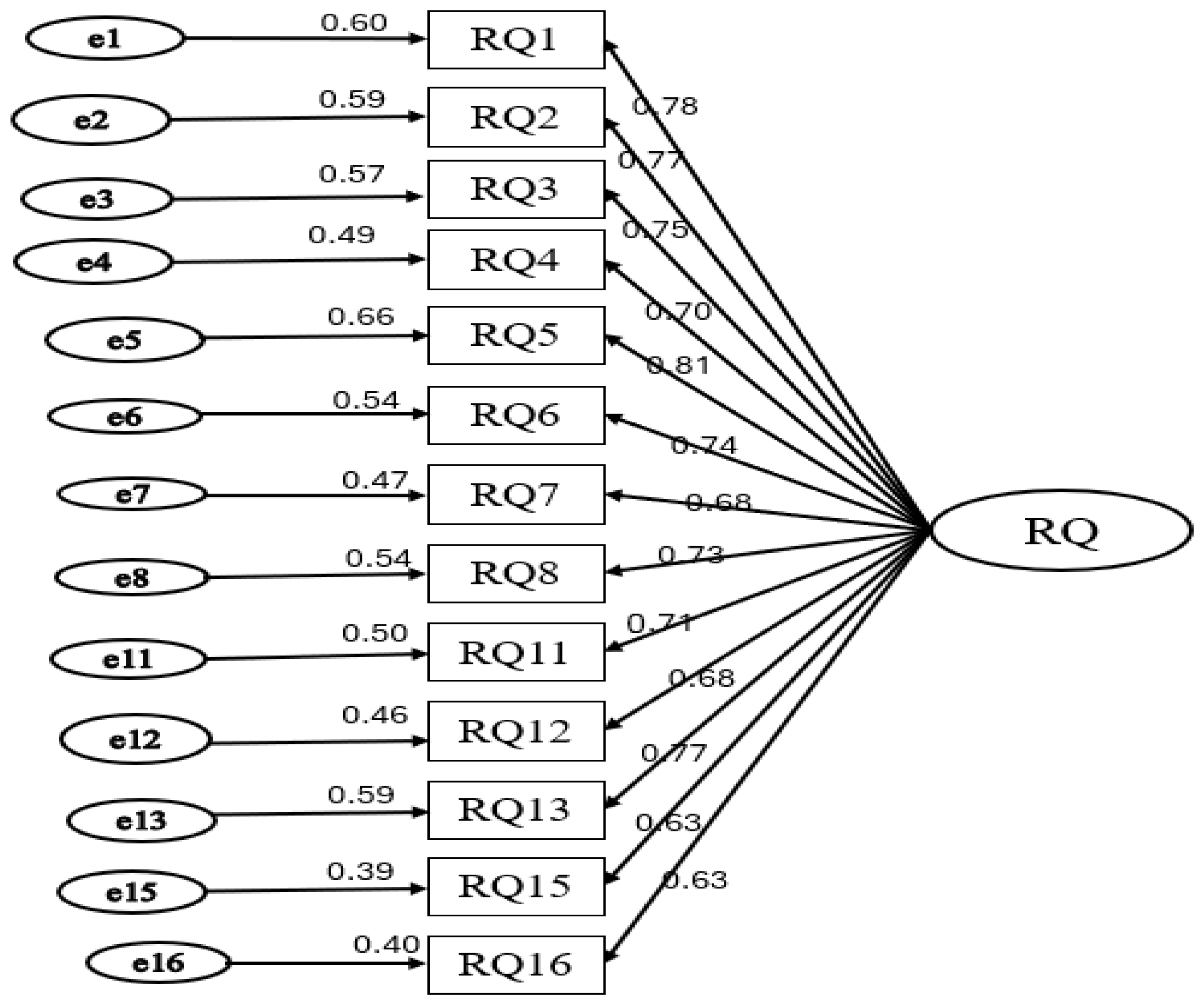
3.4. Confirmatory Factor Structure
3.5. Summary of Results
4. Discussion
4.1. Principal Findings
4.2. Cultural Context and Theoretical Implications
4.3. Practical Implications for Nursing and Policy
4.4. Comparison with Previous Research
4.5. Methodological Considerations
4.6. Limitations and Future Directions
5. Conclusions
Author Contributions
Funding
Institutional Review Board Statement
Informed Consent Statement
Data Availability Statement
Acknowledgments
Conflicts of Interest
References
- United Nations, Department of Economic and Social Affairs. World Population Ageing 2020 Highlights; United Nations: New York, NY, USA, 2020. [Google Scholar]
- Beard, J.R.; Officer, A.M.; de Carvalho, I.A.; Sadana, R.; Pot, A.M.; Michel, J.-P.; Lloyd-Sherlock, P.; Epping-Jordan, J.E.; Peeters, G.M.E.E.G.; Mahanani, W.R.; et al. The World report on ageing and health: A policy framework for healthy ageing. Lancet 2016, 387, 2145–2154. [Google Scholar] [CrossRef]
- Liu, W.J.; Lin, L.F.; Chiang, S.L.; Lu, L.-H.; Chen, C.-Y.; Lin, C.-H. Impacts of Stroke on Muscle Perceptions and Relationships with the Motor and Functional Performance of the Lower Extremities. Sensors 2021, 21, 4740. [Google Scholar] [CrossRef]
- Madruga, M.; Gozalo, M.; Prieto, J.; Domínguez, P.R.; Gusi, N. Effects of a home-based exercise program on mental health for caregivers of relatives with dementia: A randomized controlled trial. Int. Psychogeriatr. 2021, 33, 359–372. [Google Scholar] [CrossRef]
- Kim, H.S.; Kim, S.; Kim, H. Factors influencing caregiver burden in family caregivers of elderly patients with dementia in Korea. Int. J. Environ. Res. Public Health 2021, 18, 6981. [Google Scholar]
- Chen, B.A.; Chien, H.H.; Chen, C.C.; Chen, H.-T.; Jeng, C. Patient Transfer Decision Difficulty Scale: Development and psychometric testing of emergency department visits by long-term care residents. PLoS ONE 2019, 14, e0210946. [Google Scholar] [CrossRef]
- Hshieh, T.T.; Inouye, S.K.; Oh, E.S. Delirium in the elderly. Psychiatr. Clin. N. Am. 2021, 44, 507–522. [Google Scholar]
- Wu, T.Y.; Chen, C.T.; Huang, Y.J.; Hou, W.-H.; Wang, J.-D.S.; Hsieh, C.-L. Rasch analysis of the 9-item shared decision-making questionnaire in women with breast cancer. Cancer Nurs. 2019, 42, E34–E42. [Google Scholar] [CrossRef]
- Elwyn, G.; Durand, M.A.; Song, J.; Aarts, J.; Barr, P.J.; Berger, Z.; Cochran, N.; Frosch, D.; Galasiński, D.; Gulbrandsen, P.; et al. A three-talk model for shared decision-making: Multistage consultation process. BMJ 2017, 359, J4891. [Google Scholar] [CrossRef]
- Charles, C.; Gafni, A.; Whelan, T. Shared decision-making in the medical encounter: What does it mean? Soc. Sci. Med. 1997, 44, 681–692. [Google Scholar] [CrossRef]
- Siyam, T.; Shahid, A.; Perram, M.; Zuna, I.; Haque, F.; Archundia-Herrera, M.C.; Vohra, S.; Olson, K. A scoping review of interventions to promote SDM among health care professionals. Patient Educ. Couns. 2019, 102, 1057–1066. [Google Scholar] [CrossRef]
- Sepucha, K.R.; Scholl, I. Measuring shared decision making: A review of constructs, measures, and opportunities for cardiovascular care. Circ. Cardiovasc. Qual. Outcomes 2014, 7, 620–626. [Google Scholar] [CrossRef]
- Ismail, M.A.; Midin, M. Shared decision-making and role preference among patients with schizophrenia in Malaysia. Front. Psychiatry 2021, 12, 680800. [Google Scholar] [CrossRef]
- De Las Cuevas, C.; Peñate, W. Validity of the Control Preferences Scale in patients with emotional disorders. Patient Prefer Adherence 2016, 10, 2351–2356. [Google Scholar] [CrossRef]
- Baicus, C.; Balanescu, P.; Gurghean, A.; Badea, C.G.; Padureanu, V.; Rezus, C.; Mitu, F.; Jurcut, R.; Balanescu, A.R.; Daha, I.; et al. Romanian version of SDM-Q-9 validation in internal medicine and cardiology: A multicentric cross-sectional study. Rom. J. Intern. Med. 2019, 57, 195–200. [Google Scholar] [CrossRef]
- Linder, S.K.; Swank, P.R.; Vernon, S.W.; Mullen, P.D.; Morgan, R.O.; Volk, R.J. Validity of a low literacy version of the Decisional Conflict Scale. Patient Educ. Couns. 2011, 85, 521–524. [Google Scholar] [CrossRef]
- Chung, Y.P. Research on the Quality of Medical Relationship and Patient Behavioral Intention Through the Effectiveness of Shared Decision Making: A Study of Breast Cancer Rehabilitation in a Medical Center. Master’s Thesis, National Kaohsiung University of Applied Sciences, Kaohsiung, Taiwan, 2018. Available online: http://ndltd.ncl.edu.tw/handle/73kyf7 (accessed on 3 April 2026).
- Engelbrecht, M.C. Construct validity and reliability of the perceived stress scale for nursing students in South Africa. Curationis 2022, 45, e1–e7. [Google Scholar] [CrossRef]
- Martinho, M.J.C.M.; Martins, M.M.F.P.S.; Angelo, M. Decision Making Satisfaction in Health Scale: Instrument Adapted and Validated to Portuguese. Rev. Bras. Enferm. 2014, 67, 891–897. [Google Scholar] [CrossRef]
- Boateng, G.O.; Neilands, T.B.; Frongillo, E.A.; Melgar-Quiñonez, H.R.; Young, S.L. Best practices for developing and validating scales for health, social, and behavioral research: A primer. Front. Public Health 2018, 6, 149. [Google Scholar] [CrossRef]
- Morgan, R.M.; Hunt, S.D. The commitment–trust theory of relationship marketing. J. Mark. 1994, 58, 20–38. [Google Scholar] [CrossRef]
- Hinkin, T.R. A review of scale development practices in the study of organizations. J. Manag. 1995, 21, 967–988. [Google Scholar] [CrossRef]
- Nunnally, J.C.; Bernstein, I.H. Psychometric Theory, 3rd ed.; McGraw-Hill: New York, NY, USA, 1994. [Google Scholar]
- DeVellis, R.F. Scale Development: Theory and Applications, 4th ed.; Sage: Thousand Oaks, CA, USA, 2016. [Google Scholar]
- Kline, R.B. Principles and Practice of Structural Equation Modeling, 5th ed.; Guilford Press: New York, NY, USA, 2023. [Google Scholar]
- Berry, L.L.; Parish, J.T.; Janakiraman, R.; Ogburn-Russell, L.; Couchman, G.R.; Rayburn, W.L.; Grisel, J. Patients’ Commitment to Their Primary Physician and Why It Matters. Ann. Fam. Med. 2008, 6, 6–13. [Google Scholar] [CrossRef]
- Jang, H.Y. Development and Validation of the Scale for Staff-Family Partnership in Long-term Care. Int. J. Older People Nurs. 2022, 17, e12450. [Google Scholar] [CrossRef]
- Majerovitz, S.D.; Mollott, R.J.; Rudder, C. We’re on the Same Side: Improving Communication Between Nursing Home and Family. Health Commun. 2009, 24, 12–20. [Google Scholar] [CrossRef]
- Polit, D.F.; Beck, C.T. Nursing Research: Generating and Assessing Evidence for Nursing Practice, 11th ed.; Wolters Kluwer: Philadelphia, PA, USA, 2020. [Google Scholar]
- Tavakol, M.; Dennick, R. Making sense of Cronbach’s alpha. Int. J. Med. Educ. 2011, 2, 53–55. [Google Scholar] [CrossRef]
- Worthington, R.L.; Whittaker, T.A. Scale development research: A content analysis and recommendations for best practices. Couns. Psychol. 2006, 34, 806–838. [Google Scholar] [CrossRef]
- Fornell, C.; Larcker, D.F. Evaluating structural equation models with unobservable variables and measurement error. J. Mark. Res. 1981, 18, 39–50. [Google Scholar] [CrossRef]
- Hair, J.F.; Hult, G.T.M.; Ringle, C.M.; Sarstedt, M. A Primer on Partial Least Squares Structural Equation Modeling (PLS-SEM), 3rd ed.; Sage: Thousand Oaks, CA, USA, 2022. [Google Scholar]
- Hu, L.T.; Bentler, P.M. Cutoff criteria for fit indexes in covariance structure analysis: Conventional criteria versus new alternatives. Struct. Equ. Model. 1999, 6, 1–55. [Google Scholar] [CrossRef]
- Schreiber, J.B.; Nora, A.; Stage, F.K.; Barlow, E.A.; King, J. Reporting structural equation modeling and confirmatory factor analysis results: A review. J. Educ. Res. 2006, 99, 323–338. [Google Scholar] [CrossRef]
- Byrne, B.M. Structural Equation Modeling with AMOS: Basic Concepts, Applications, and Programming, 3rd ed.; Routledge: New York, NY, USA, 2016. [Google Scholar]
- Kline, R.B. Principles and Practice of Structural Equation Modeling, 3rd ed.; Guilford Press: New York, NY, USA, 2011. [Google Scholar]
- West, S.G.; Finch, J.F.; Curran, P.J. Structural equation models with nonnormal variables: Problems and remedies. In Structural Equation Modeling: Concepts, Issues, and Applications; Hoyle, R.H., Ed.; Sage: Thousand Oaks, CA, USA, 1995; pp. 56–75. [Google Scholar]
- Bollen, K.A.; Stine, R.A. Bootstrapping goodness-of-fit measures in structural equation models. Sociol. Methods Res. 1992, 21, 205–229. [Google Scholar] [CrossRef]
- Curran, P.J.; West, S.G.; Finch, J.F. The robustness of test statistics to nonnormality and specification error in confirmatory factor analysis. Psychol. Methods 1996, 1, 16–29. [Google Scholar] [CrossRef]
- Micceri, T. The unicorn, the normal curve, and other improbable creatures. Psychol. Bull. 1989, 105, 156–166. [Google Scholar] [CrossRef]
- Fornell, C.; Larcker, D.F. Structural Equation Models with Unobservable Variables and Measurement Error: Algebra and Statistics; Sage Publications: Los Angeles, CA, USA, 1981. [Google Scholar]
- Doll, W.J.; Xia, W.; Torkzadeh, G. A confirmatory factor analysis of the end-user computing satisfaction instrument. MIS Q. 1994, 18, 453–461. [Google Scholar] [CrossRef]
- Crosby, L.A.; Evans, K.R.; Cowles, D. Relationship quality in services selling: An interpersonal influence perspective. J. Mark. 1990, 54, 68–81. [Google Scholar] [CrossRef]
- Elwyn, G.; Frosch, D.; Thomson, R.; Joseph-Williams, N.; Lloyd, A.; Kinnersley, P.; Cording, E.; Tomson, D.; Dodd, C.; Rollnick, S.; et al. Shared decision making: A model for clinical practice. J. Gen. Intern. Med. 2012, 27, 1361–1367. [Google Scholar] [CrossRef]
- Barry, M.J.; Edgman-Levitan, S. Shared decision making—The pinnacle of patient-centered care. N. Engl. J. Med. 2012, 366, 780–781. [Google Scholar] [CrossRef]
- Cheng, S.T.; Chan, A.C. Filial piety and psychological well-being in well older Chinese. J. Gerontol. B Psychol. Sci. Soc. Sci. 2006, 61, P262–P269. [Google Scholar] [CrossRef]
- Yeh, K.H.; Bedford, O. Filial Belief and Parent-Child Conflict. Int. J. Psychol. 2004, 39, 132–144. [Google Scholar] [CrossRef]
- Hwang, K.K. Face and favor: The Chinese power game. Am. J. Sociol. 1987, 92, 944–974. [Google Scholar] [CrossRef]
- Ho, D.Y.F. Interpersonal Relationships and Relationship Dominance: An Analysis Based on Methodological Relationalism. Asian J. Soc. Psychol. 1998, 1, 1–16. [Google Scholar] [CrossRef]
- Durmuş, A.; Akbolat, M. The Impact of Patient Satisfaction on Patient Commitment and the Mediating Role of Patient Trust. J. Patient Exp. 2020, 7, 1642–1647. [Google Scholar] [CrossRef]
- Aiken, L.H.; Sloane, D.M.; Ball, J.; Bruyneel, L.; Rafferty, A.M.; Griffiths, P. Patient satisfaction with hospital care and nurses in England: An observational study. BMJ Open 2018, 8, e019189. [Google Scholar] [CrossRef]
- Joseph-Williams, N.; Elwyn, G.; Edwards, A. Knowledge is not power for patients: A systematic review and thematic synthesis of patient-reported barriers and facilitators to shared decision making. Patient Educ. Couns. 2014, 94, 291–309. [Google Scholar] [CrossRef]
- Huang, C.; Lee, Y.; Sun, C. The Effect of Perceived Value, Trust, and Commitment on Patient Loyalty in Taiwan. Inquiry 2021, 58, 469580211004201. [Google Scholar] [CrossRef]
- Thomson, K.; Outram, S.; Gilligan, C.; Levett-Jones, T. Interprofessional Experiences of Recent Healthcare Graduates: A Social Psychology Perspective on the Barriers to Effective Communication, Teamwork, and Patient-Centred Care. J. Interprof. Care 2015, 29, 634–640. [Google Scholar] [CrossRef]
- Hupcey, J.E.; Penrod, J.; Morse, J.M.; Mitcham, C. An Exploration and Advancement of the Concept of Trust. J. Adv. Nurs. 2001, 36, 282–293. [Google Scholar] [CrossRef] [PubMed]


| Variable | Taipei City (n = 112) | Outside Taipei City (n = 93) | Total (N = 205) |
|---|---|---|---|
| Gender | |||
| Men | 55 (49.1) | 36 (38.7) | 91 (44.4) |
| Women | 57 (50.9) | 57 (61.3) | 114 (55.6) |
| Age group (years) | |||
| 20–29 | 16 (14.3) | 19 (20.4) | 35 (17.1) |
| 30–39 | 13 (11.6) | 12 (12.9) | 25 (12.2) |
| 40–49 | 17 (15.2) | 10 (10.8) | 27 (13.2) |
| 50–59 | 16 (14.3) | 14 (15.1) | 30 (14.6) |
| 60–69 | 21 (18.8) | 14 (15.1) | 35 (17.1) |
| 70–79 | 12 (10.7) | 15 (16.1) | 27 (13.2) |
| 80–89 | 17 (15.2) | 9 (9.7) | 26 (12.7) |
| Residents’ identity | |||
| Low income | 19 (17.0) | 20 (21.5) | 39 (19.0) |
| Medium to low income | 5 (4.5) | 0 (0.0) | 5 (2.4) |
| Emergency resettlement | 56 (50.0) | 48 (51.6) | 104 (50.7) |
| Others | 32 (28.6) | 25 (26.9) | 57 (27.8) |
| Education level | |||
| High school or below | 54 (48.2) | 52 (56.0) | 106 (51.7) |
| College/University | 57 (50.9) | 34 (36.6) | 91 (44.4) |
| Graduate school | 1 (0.9) | 7 (7.5) | 8 (3.9) |
| Construct/Item | Standardized Factor Loading |
|---|---|
| Trust | |
| RQ1 The caregivers at this LTCF demonstrate reliability in their daily care duties. | 0.78 |
| RQ2 LTCFs for seniors have earned my confidence. | 0.77 |
| RQ3 I find the caregivers at this facility sincere in their interactions and care relationships. | 0.75 |
| RQ4 The staff at this LTCF exhibit strong moral character. | 0.70 |
| RQ5 Caregivers maintain high standards in their work performance. | 0.81 |
| RQ6 Care providers adhere to strong ethical principles in caregiving. | 0.74 |
| Commitment | |
| RQ7 I am dedicated to maintaining my commitment to this LTCF. | 0.68 |
| RQ8 This LTCF has made a lasting, positive impact on me. | 0.73 |
| RQ11 Ending my relationship with this LTCF would be difficult. | 0.71 |
| RQ12 I consciously chose this LTCF as a trustworthy option. | 0.68 |
| Satisfaction | |
| RQ13 The everyday care provided meets my standards. | 0.77 |
| RQ15 Overall, I am pleased with the care provided. | 0.63 |
| RQ16 My family’s experience exceeded expectations. | 0.63 |
| Cronbach’s α | 0.84 |
| Composite reliability (CR) | 0.93 |
| Average variance extracted (AVE) | 0.52 |
| Fit Index | Ideal Criterion | Model Result |
|---|---|---|
| Bollen–Stine χ2 | Smaller values indicate better fit | 96.56 |
| df | - | 65 |
| χ2/df | 1–3 | 1.49 |
| GFI | ≥0.95 | 0.95 |
| AGFI | ≥0.90 | 0.94 |
| RMSEA | <0.08 | 0.05 |
| SRMR | <0.08 | 0.07 |
| TLI (NNFI) | ≥0.95 | 0.98 |
| CFI | ≥0.95 | 0.98 |
Disclaimer/Publisher’s Note: The statements, opinions and data contained in all publications are solely those of the individual author(s) and contributor(s) and not of MDPI and/or the editor(s). MDPI and/or the editor(s) disclaim responsibility for any injury to people or property resulting from any ideas, methods, instructions or products referred to in the content. |
© 2026 by the authors. Licensee MDPI, Basel, Switzerland. This article is an open access article distributed under the terms and conditions of the Creative Commons Attribution (CC BY) license.
Share and Cite
Chen, P.-Y.; Chao, Y.-H.; Huang, Y.-C.; Huang, S.-H.; Chung, R.-J.; Yu, P.-C.; Wang, B.-L.; Chang, H.-J.; Chang, P.-C.; Huang, S.-M.; et al. Validation of the Family Caregiver Relationship Quality Scale in Long-Term Care Facilities in Taiwan. Healthcare 2026, 14, 1068. https://doi.org/10.3390/healthcare14081068
Chen P-Y, Chao Y-H, Huang Y-C, Huang S-H, Chung R-J, Yu P-C, Wang B-L, Chang H-J, Chang P-C, Huang S-M, et al. Validation of the Family Caregiver Relationship Quality Scale in Long-Term Care Facilities in Taiwan. Healthcare. 2026; 14(8):1068. https://doi.org/10.3390/healthcare14081068
Chicago/Turabian StyleChen, Pai-Yueh, Ying-Hua Chao, Yao-Ching Huang, Shi-Hao Huang, Ren-Jei Chung, Pi-Ching Yu, Bing-Long Wang, Hsiu-Ju Chang, Pi-Chen Chang, Shu-Min Huang, and et al. 2026. "Validation of the Family Caregiver Relationship Quality Scale in Long-Term Care Facilities in Taiwan" Healthcare 14, no. 8: 1068. https://doi.org/10.3390/healthcare14081068
APA StyleChen, P.-Y., Chao, Y.-H., Huang, Y.-C., Huang, S.-H., Chung, R.-J., Yu, P.-C., Wang, B.-L., Chang, H.-J., Chang, P.-C., Huang, S.-M., & Huang, C.-H. (2026). Validation of the Family Caregiver Relationship Quality Scale in Long-Term Care Facilities in Taiwan. Healthcare, 14(8), 1068. https://doi.org/10.3390/healthcare14081068