Objective Pelvic Support and Patient-Reported Outcomes After Non-Ablative Vaginal Er:YAG Laser Therapy in Women with Pelvic Floor Dysfunction: A Prospective Single-Arm Interventional Study in a Real-World Care Setting

 ,
,
Highlights
- This experimental non-ablative Er:YAG laser intervention produced measurable short-term anatomical improvements in pelvic floor support using standardized POP-Q assessment in a real-world clinical setting.
- Anatomical changes occurred without parallel improvement in global sexual function, highlighting a potential dissociation between structural remodeling and early functional outcomes.
- These results contribute objective data to the ongoing debate on energy-based interventions, supporting their evaluation as minimally invasive outpatient options for selected women with pelvic floor dysfunction.
- The study underscores the need for controlled trials to determine whether anatomical remodeling translates into sustained functional benefit and improved patient-centered outcomes.
Abstract
1. Introduction
2. Materials and Methods
3. Results
3.1. Vaginal Hiatus and Vaginal Length
3.2. Sexual Function
3.3. Pelvic Floor Strength and Prolapse Staging
3.4. Association Between Energy Delivery and Anatomical/Functional Outcomes
4. Discussion
5. Conclusions
Author Contributions
Funding
Institutional Review Board Statement
Informed Consent Statement
Data Availability Statement
Acknowledgments
Conflicts of Interest
Abbreviations
| BE | Baseline Evaluation |
| BMI | Body Mass Index |
| FSFI | Female Sexual Function Index |
| FU1 | First Follow-up |
| FU2 | Second Follow-up |
| PFD | Pelvic Floor Dysfunction |
| POP-Q | Pelvic Organ Prolapse Quantification |
| SD | Standard Deviation |
| SUI | Stress Urinary Incontinence |
References
- Kenne, K.A.; Wendt, L.; Brooks Jackson, J. Prevalence of pelvic floor disorders in adult women being seen in a primary care setting and associated risk factors. Sci. Rep. 2022, 12, 9878. [Google Scholar] [CrossRef]
- González-Timoneda, A.; Valles-Murcia, N.; Muñoz Esteban, P.; Torres López, M.S.; Turrión Martínez, E.; Errandonea Garcia, P.; Raya, L.S.; Alfonso, F.N. Prevalence and impact of pelvic floor dysfunctions on quality of life in women 5-10 years after their first vaginal or caesarian delivery. Heliyon 2025, 11, e42018. [Google Scholar] [CrossRef]
- Chen, W.; Gong, J.; Liu, M.; Cai, Y.C. Long-term health outcomes and quality of life in women with untreated pelvic floor dysfunction: A single-center cohort study. Front. Public Health 2024, 12, 1495679. [Google Scholar] [CrossRef]
- Peinado Molina, R.A.; Martínez Vázquez, S.; Martínez Galiano, J.M.; Rivera Izquierdo, M.; Khan, K.S.; Cano-Ibáñez, N. Prevalence of depression and anxiety in women with pelvic floor dysfunctions: A systematic review and meta-analysis. Int. J. Gynecol. Obstet. 2024, 167, 507–528. [Google Scholar]
- Peinado-Molina, R.A.; Hernández-Martínez, A.; Martínez-Vázquez, S.; Rodríguez-Almagro, J.; Martínez-Galiano, J.M. Pelvic floor dysfunction: Prevalence and associated factors. BMC Public Health 2023, 23, 2005. [Google Scholar] [CrossRef] [PubMed]
- Beketie, E.D.; Tafese, W.T.; Assefa, Z.M.; Berriea, F.W.; Tilahun, G.A.; Shiferaw, B.Z.; Teke, N.E. Symptomatic pelvic floor disorders and its associated factors in South-Central Ethiopia. PLoS ONE 2021, 16, e0254050. [Google Scholar] [CrossRef] [PubMed]
- Torosis, M.; Carey, E.; Christensen, K.; Kaufman, M.R.; Kenton, K.; Kotarinos, R.; Lai, H.H.; Lee, U.; Lowder, J.L.M.; Meister, M.; et al. A Treatment Algorithm for High-Tone Pelvic Floor Dysfunction. Obstet. Gynecol. 2024, 143, 595–602. [Google Scholar] [CrossRef]
- Tunn, R.; Baessler, K.; Knüpfer, S.; Hampel, C. Urinary Incontinence and Pelvic Organ Prolapse in Women. Dtsch. Ärzteblatt Int. 2023, 120, 71–80. [Google Scholar] [CrossRef]
- Salvatore, S.; Ruffolo, A.F.; Phillips, C.; Athanasiou, S.; Cardozo, L.; Serati, M.; The EUGA Working Group. Vaginal laser therapy for GSM/VVA: Where we stand now—A review by the EUGA Working Group on Laser. Climacteric 2023, 26, 336–352. [Google Scholar] [CrossRef]
- Lauterbach, R.; Gutzeit, O.; Matanes, E.; Linder, R.; Mick, I.; Aharoni, S.; Gruenwald, I.; Wiener, Z.; Lowenstein, L. Vaginal Fractional Carbon Dioxide Laser Treatment and Changes in Vaginal Biomechanical Parameters. Lasers Surg. Med. 2021, 53, 1146–1151. [Google Scholar] [CrossRef]
- Alexiades, M. Device-based treatment for vaginal wellness. Semin. Cutan. Med. Surg. 2018, 37, 226–232. [Google Scholar] [CrossRef] [PubMed]
- Hillard, T.C. Lasers in the era of evidence-based medicine. Climacteric 2020, 23, S6–S10. [Google Scholar] [CrossRef]
- Committee on Gynecologic Practice. Elective Female Genital Cosmetic Surgery: ACOG Committee Opinion, Number 795. Obstet. Gynecol. 2020, 135, e36–e42. [Google Scholar]
- Neijenhuijs, K.I.; Hooghiemstra, N.; Holtmaat, K.; Aaronson, N.K.; Groenvold, M.; Holzner, B.; Terwee, C.B.; Cuijpers, P.; Leeuw, I.M.V.-D. The Female Sexual Function Index (FSFI)-A Systematic Review of Measurement Properties. J. Sex. Med. 2019, 16, 640–660. [Google Scholar]
- Haylen, B.T.; de Ridder, D.; Freeman, R.M.; Swift, S.E.; Berghmans, B.; Lee, J.; Monga, A.; Petri, E.; Rizk, D.E.; Sand, P.K.; et al. An International Urogynecological Association (IUGA)/International Continence Society (ICS) joint report on the terminology for female pelvic floor dysfunction. Int. Urogynecol. J. 2010, 21, 5–26. [Google Scholar] [CrossRef] [PubMed]
- Madhu, C.; Swift, S.; Moloney-Geany, S.; Drake, M.J. How to use the Pelvic Organ Prolapse Quantification (POP-Q) system? Neurourol. Urodyn. 2018, 37, S39–S43. [Google Scholar] [PubMed]
- Bump, R.C.; Mattiasson, A.; Bø, K.; Brubaker, L.P.; DeLancey, J.O.; Klarskov, P.; Shull, B.L.; Smith, A.R. The standardization of terminology of female pelvic organ prolapse and pelvic floor dysfunction. Am. J. Obstet. Gynecol. 1996, 175, 10–17. [Google Scholar] [CrossRef]
- Long, C.Y.; Wu, P.C.; Chen, H.S.; Lin, K.L.; Loo, Z.; Liu, Y.; Wu, C.H. Changes in sexual function and vaginal topography using transperineal ultrasound after vaginal laser treatment for women with stress urinary incontinence. Sci. Rep. 2022, 12, 3435. [Google Scholar] [CrossRef]
- Blaganje, M.; Šćepanović, D.; Žgur, L.; Verdenik, I.; Pajk, F.; Lukanović, A. Non-ablative Er:YAG laser therapy effect on stress urinary incontinence related to quality of life and sexual function: A randomized controlled trial. Eur. J. Obstet. Gynecol. Reprod. Biol. 2018, 224, 153–158. [Google Scholar]
- Lin, K.L.; Chou, S.H.; Long, C.Y. Effect of Er:YAG Laser for Women with Stress Urinary Incontinence. BioMed Res. Int. 2019, 2019, 7915813. [Google Scholar] [CrossRef]
- Tien, Y.W.; Hsiao, S.M.; Lee, C.N.; Lin, H.H. Effects of laser procedure for female urodynamic stress incontinence on pad weight, urodynamics, and sexual function. Int. Urogynecol. J. 2017, 28, 469–476. [Google Scholar] [CrossRef] [PubMed]
- Gaspar, A.; Koron, N.; Silva, J.; Brandi, H. Vaginal erbium laser for treatment of stress urinary incontinence: Optimization of treatment regimen for a sustained long-term effect. Lasers Med. Sci. 2022, 37, 2157–2164. [Google Scholar] [CrossRef] [PubMed]
- Kuszka, A.; Gamper, M.; Walser, C.; Kociszewski, J.; Viereck, V. Erbium:YAG laser treatment of female stress urinary incontinence: Midterm data. Int. Urogynecol. J. 2020, 31, 1859–1866. [Google Scholar] [CrossRef]
- Shao, F.X.; He, P.; Mao, Y.J.; Liu, H.R.; Wan, S.; Qin, S.; Luo, W.; Cheng, J.; Ren, M.; Hua, X. Association of pre-pregnancy body mass index and gestational weight gain on postpartum pelvic floor muscle morphology and function in Chinese primiparous women: A retrospective cohort study. Int. J. Gynecol. Obstet. 2025, 168, 680–692. [Google Scholar] [CrossRef]
- Larsudd-Kåverud, J.; Gyhagen, J.; Åkervall, S.; Molin, M.; Milsom, I.; Wagg, A.; Gyhagen, M. The influence of pregnancy, parity, and mode of delivery on urinary incontinence and prolapse surgery-a national register study. Am. J. Obstet. Gynecol. 2023, 228, 61.e1–61.e13. [Google Scholar] [CrossRef] [PubMed]
- de Sam Lazaro, S.; Nardos, R.; Caughey, A.B. Obesity and Pelvic Floor Dysfunction: Battling the Bulge. Obstet. Gynecol. Surv. 2016, 71, 114–125. [Google Scholar] [CrossRef]
- Berger, M.B.; Kolenic, G.E.; Fenner, D.E.; Morgan, D.M.; DeLancey, J.O.L. Structural, functional, and symptomatic differences between women with rectocele versus cystocele and normal support. Am. J. Obstet. Gynecol. 2018, 218, 510.e1–510.e8. [Google Scholar] [CrossRef]
- Karjalainen, P.K.; Mattsson, N.K.; Nieminen, K.; Tolppanen, A.M.; Jalkanen, J.T. The relationship of defecation symptoms and posterior vaginal wall prolapse in women undergoing pelvic organ prolapse surgery. Am. J. Obstet. Gynecol. 2019, 221, 480.e1–480.e10. [Google Scholar] [CrossRef]
- Sikora, M.; Gamper, M.; Zivanovic, I.; Münst, J.; Bischofberger, H.; Kociszewski, J.; Viereck, V. Current Treatment of Stress Urinary Incontinence by Bulking Agents and Laser Therapy-An Update. J. Clin. Med. 2024, 13, 1377. [Google Scholar] [CrossRef]



| Pulse Energy (Joules) | First Session | Second Session | ||
|---|---|---|---|---|
| Mean | SD | Mean | SD | |
| Anterior | 3827.66 | 2417 | 3454.87 | 1469.59 |
| Posterior | 1747.04 | 326.66 | 1602.88 | 511.17 |
| 360° | 1092.83 | 348.09 | 1085.6 | 580.42 |
| Vulvar region | 15,902.12 | 7563.96 | 14,748.55 | 6436.17 |
| n | % | |
|---|---|---|
| Age * | 46.86 | 8.89 |
| Full-term births | ||
| 1–2 | 127 | 82.47 |
| 3–4 | 20 | 12.99 |
| Preterm births | 1 | 0.65 |
| Miscarriages | 30 | 19.48 |
| Body Mass Index * | 22.83 | 4.35 |
| Urinary incontinence 1 | ||
| Yes | 91 | 55.83 |
| No | 72 | 44.17 |
| Prolapse | ||
| Yes | 133 | 81.60 |
| No | 30 | 18.40 |
| Type of prolapse | ||
| Cystocele | 131 | 80.37 |
| Uterine prolapse | 40 | 24.54 |
| Rectocele | 111 | 68.10 |
| Laser applied | ||
| IncontiLase | 32 | 20.00 |
| IntimaLase | 35 | 21.88 |
| Both | 93 | 58.13 |
| Total | 163 | 100.00 |
| BE | FU1 | FU2 | BE vs. FU1 | BE vs. FU2 | FU1 vs. FU2 | |||||||||
|---|---|---|---|---|---|---|---|---|---|---|---|---|---|---|
| Med [p25–p75] | Med [p25–p75] | Med [p25–p75] | Global † | W | Δ (95% CI) | r | p * | Δ (95% CI) | r | p * | Δ (95% CI) | r | p * | |
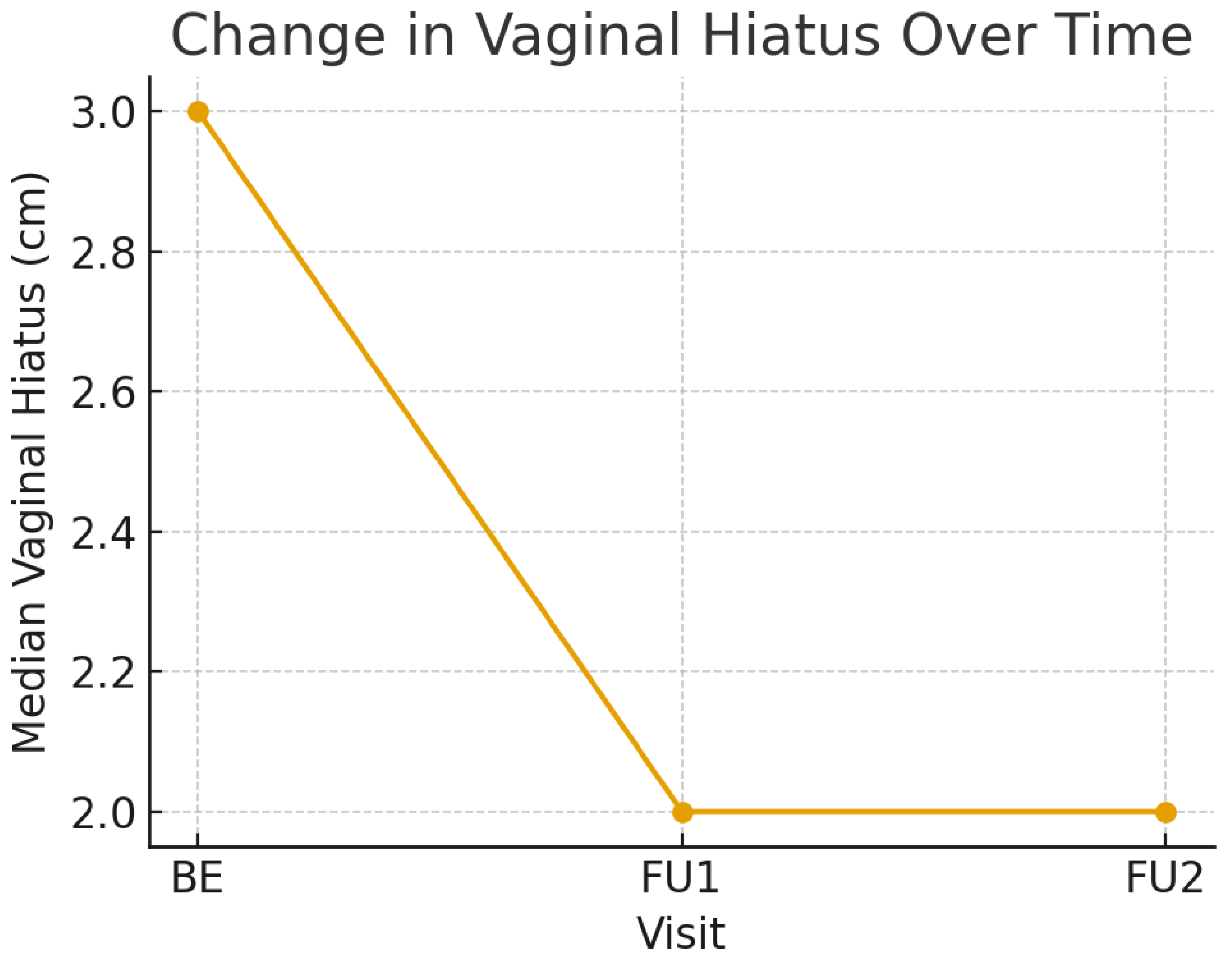
| Vaginal hiatus (cm) | 3 [2–4] | 2 [1–3] | 2 [1–3] | <0.001 | 0.533 | −0.75 (−0.5; −0.75) | 0.773 | 0.003 | −0.5 (−0.5; −0.75) | 0.727 | 0.003 | None | 0.002 | 0.783 |
| Vaginal length (cm) | 9 [9,10] | 9 [9,10] | 9 [9,10] | 0.007 | 0.031 | None | 0.221 | 0.063 | None | 0.156 | 0.282 | None | 0.290 | 0.726 |
| Female Sexual Function Index | BE | FU1 | FU2 | Global † | W | BE vs. FU1 | BE vs. FU2 | FU1 vs. FU2 | |||||||||
|---|---|---|---|---|---|---|---|---|---|---|---|---|---|---|---|---|---|
| Med [p25–p75] | Med [p25–p75] | Med [p25–p75] | Δ (95% CI) | r | p * | Δ (95% CI) | r | p * | Δ (95% CI) | r | p * | ||||||
| Total score | 17.3 | [14.5–19.8] | 17.6 | [15.65–19.15] | 17.2 | [15.8–19] | 0.628 | 0.008 | 0.3 (1.05; −0.4) | 0.097 | 0.777 | None | 0.004 | 0.985 | −0.3 (NR) | 0.120 | 0.777 |
| Desire | 2.4 | [1.8–3.6] | 2.4 | [1.2–3.6] | 2.4 | [1.2–2.4] | 0.005 | 0.092 | −0.3 (0; −0.3) | 0.102 | 0.059 | −0.3 (NR) | 0.307 | 0.009 | −0.3 (NR) | 0.334 | 0.024 |
| Arousal | 2.4 | [1.8–3.6] | 2.1 | [1.8–3.3] | 2.1 | [1.5–2.7] | 0.062 | 0.049 | −0.15 (0; −0.3) | 0.063 | 0.236 | −0.15 (NR) | 0.191 | 0.094 | −0.3 (NR) | 0.308 | 0.060 |
| Lubrication | 3.6 | [3–3.6] | 3.6 | [3.3–3.9] | 3.6 | [3.3–3.6] | 0.510 | 0.012 | 0.15 (0.3; 0) | 0.233 | 0.081 | 0.15 (NR) | 0.215 | 0.400 | None | 0.120 | 0.400 |
| Orgasm | 3.2 | [2.8–3.6] | 2.8 | [2.8–3.6] | 3.2 | [2.8–3.6] | 0.794 | 0.004 | −0.2 (0; −0.2) | 0.294 | 0.021 | None | 0.222 | 0.548 | None | 0.016 | 0.907 |
| Satisfaction | 1.6 | [0.8–2.8] | 1.2 | [0.8–2.4] | 1.6 | [1.2–2] | 0.259 | 0.024 | None | 0.190 | 0.423 | None | 0.125 | 1.000 | None | 0.109 | 1.000 |
| Pain | 5.2 | [3.2–6] | 5.2 | [3.6–6] | 5.6 | [4.8–6] | 0.117 | 0.038 | 0 (0.2; 0) | 0.022 | 0.755 | 0.4 (NR) | 0.242 | 0.045 | 0.2 (NR) | 0.251 | 0.082 |
| BE | FU1 | FU2 | BE vs. FU1 | BE vs. FU2 | FU1 vs. FU2 | |||||||||
|---|---|---|---|---|---|---|---|---|---|---|---|---|---|---|
| n | % | n | % | n | % | Global † | W | r | p * | r | p * | r | p * | |
| Oxford Scale | (n = 133) | (n = 109) | (n = 42) | 0.135 | 0.048 | 0.097 | 0.472 | 0.218 | 0.315 | 0.218 | 0.313 | |||
| None | 25 | 18.80 | 19 | 17.43 | 5 | 11.90 | ||||||||
| Flickers | 36 | 27.07 | 29 | 26.61 | 17 | 40.48 | ||||||||
| Weak | 51 | 38.35 | 39 | 35.78 | 14 | 33.33 | ||||||||
| Moderate | 19 | 14.29 | 19 | 17.43 | 6 | 14.29 | ||||||||
| Good | 1 | 0.75 | 2 | 1.83 | 0 | 0.00 | ||||||||
| Strong | 1 | 0.75 | 1 | 0.92 | 0 | 0.00 | ||||||||
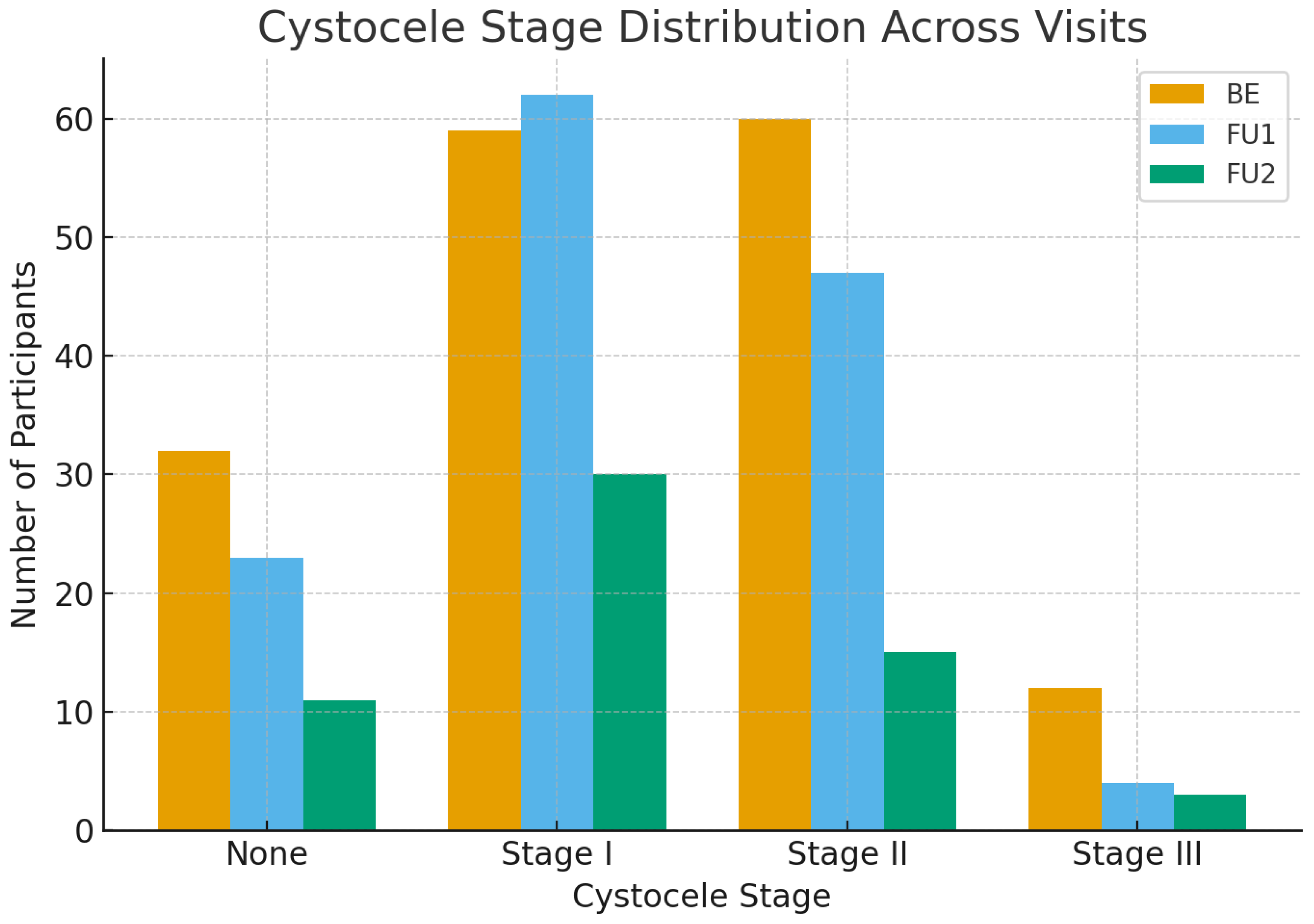
| Cystocele | <0.001 | 0.164 | 0.375 | <0.001 | 0.447 | 0.001 | 0.323 | 0.013 | ||||||
| None | 32 | 19.63 | 23 | 16.91 | 11 | 18.64 | ||||||||
| Stage I | 59 | 36.20 | 62 | 45.59 | 30 | 50.85 | ||||||||
| Stage II | 60 | 36.81 | 47 | 34.56 | 15 | 25.42 | ||||||||
| Stage III | 12 | 7.36 | 4 | 2.94 | 3 | 5.08 | ||||||||
| Uterine prolapse | 0.115 | 0.037 | 0.210 | 0.043 | 0.213 | 0.205 | 0.175 | 0.205 | ||||||
| None | 123 | 75.46 | 104 | 76.47 | 46 | 77.97 | ||||||||
| Stage I | 33 | 20.25 | 26 | 19.12 | 10 | 16.95 | ||||||||
| Stage II | 7 | 4.29 | 6 | 4.41 | 3 | 5.08 | ||||||||
| Rectocele | <0.001 | 0.166 | 0.329 | <0.001 | 0.456 | 0.001 | 0.247 | 0.058 | ||||||
| None | 52 | 31.90 | 43 | 31.62 | 23 | 38.98 | ||||||||
| Stage I | 80 | 49.08 | 78 | 57.35 | 30 | 50.85 | ||||||||
| Stage II | 29 | 17.79 | 14 | 10.29 | 5 | 8.47 | ||||||||
| Stage III | 2 | 1.23 | 1 | 0.74 | 1 | 1.69 | ||||||||
| Pulse Energy (J) at First Session | Pulse Energy (J) at Second Session | |||||||
|---|---|---|---|---|---|---|---|---|
| Anterior | Posterior | 360° | Vulvar Region | Anterior | Posterior | 360° | Vulvar Region | |
| FSFI (Total score) | ||||||||
| r | 0.101 | 0.200 | −0.076 | −0.036 | 0.171 | - | −0.124 | 0.228 |
| p | 0.289 | 0.800 | 0.383 | 0.702 | 0.240 | - | 0.354 | 0.115 |
| Vaginal hiatus (cm) | ||||||||
| r | 0.410 | 0.671 | 0.092 | 0.137 | 0.260 | 0.527 | 0.095 | 0.063 |
| p | <0.001 | 0.215 | 0.247 | 0.109 | 0.005 | 0.361 | 0.262 | 0.490 |
| Vaginal length (cm) | ||||||||
| r | −0.126 | 0.224 | 0.205 | 0.158 | −0.114 | 0.224 | 0.224 | 0.264 |
| p | 0.145 | 0.718 | 0.009 | 0.063 | 0.223 | 0.718 | 0.008 | 0.003 |
Disclaimer/Publisher’s Note: The statements, opinions and data contained in all publications are solely those of the individual author(s) and contributor(s) and not of MDPI and/or the editor(s). MDPI and/or the editor(s) disclaim responsibility for any injury to people or property resulting from any ideas, methods, instructions or products referred to in the content. |
© 2026 by the authors. Licensee MDPI, Basel, Switzerland. This article is an open access article distributed under the terms and conditions of the Creative Commons Attribution (CC BY) license.
Share and Cite
Blanco-Ratto, L.; Farrés, M.G.; Naranjo Ortiz, C.; Kauffmann, S.; Rodríguez, M.D.C.; Ramírez-García, I. Objective Pelvic Support and Patient-Reported Outcomes After Non-Ablative Vaginal Er:YAG Laser Therapy in Women with Pelvic Floor Dysfunction: A Prospective Single-Arm Interventional Study in a Real-World Care Setting. Healthcare 2026, 14, 1021. https://doi.org/10.3390/healthcare14081021
Blanco-Ratto L, Farrés MG, Naranjo Ortiz C, Kauffmann S, Rodríguez MDC, Ramírez-García I. Objective Pelvic Support and Patient-Reported Outcomes After Non-Ablative Vaginal Er:YAG Laser Therapy in Women with Pelvic Floor Dysfunction: A Prospective Single-Arm Interventional Study in a Real-World Care Setting. Healthcare. 2026; 14(8):1021. https://doi.org/10.3390/healthcare14081021
Chicago/Turabian StyleBlanco-Ratto, Laia, Montserrat Girabent Farrés, Cristina Naranjo Ortiz, Stephanie Kauffmann, Manuel Del Campo Rodríguez, and Inés Ramírez-García. 2026. "Objective Pelvic Support and Patient-Reported Outcomes After Non-Ablative Vaginal Er:YAG Laser Therapy in Women with Pelvic Floor Dysfunction: A Prospective Single-Arm Interventional Study in a Real-World Care Setting" Healthcare 14, no. 8: 1021. https://doi.org/10.3390/healthcare14081021
APA StyleBlanco-Ratto, L., Farrés, M. G., Naranjo Ortiz, C., Kauffmann, S., Rodríguez, M. D. C., & Ramírez-García, I. (2026). Objective Pelvic Support and Patient-Reported Outcomes After Non-Ablative Vaginal Er:YAG Laser Therapy in Women with Pelvic Floor Dysfunction: A Prospective Single-Arm Interventional Study in a Real-World Care Setting. Healthcare, 14(8), 1021. https://doi.org/10.3390/healthcare14081021