Patient Education Deficits and Medication Knowledge Gaps Among Post-Percutaneous Coronary Intervention Patients: A Cross-Sectional Study of Communication Quality and Adherence in Saudi Cardiac Care

 , and
, and
Abstract
1. Introduction
- Communication quality: Information provided by healthcare providers about medications (purpose, dosing, side effects).
- Medication knowledge: Patients’ understanding and recall of their medications.
- Health literacy: The ability to access, understand, and apply health information across contexts.
- Medication adherence: The extent to which patients follow prescribed medication regimens.
2. Materials and Methods
- Inclusion: Saudi adults aged ≥18 years who had undergone PCI within the preceding 12 months and were prescribed antiplatelet therapy (aspirin, clopidogrel, ticagrelor, or prasugrel, alone or in combination).
- Exclusion: Patients with documented cognitive impairment (as noted in medical records), severe psychiatric illness precluding informed consent, inability to provide informed consent in either Arabic or English (interpreters were not available).
- Demographic and Clinical Profile: Items assessed age, sex, marital status, educational attainment, employment status, monthly household income, comorbidities (diabetes mellitus, hypertension, hyperlipidaemia), time since heart disease diagnosis, time since most recent PCI (categorized as ≤3 months, 4–6 months, 7–12 months), PCI indication (elective vs. acute coronary syndrome [ACS]/emergency), and current antiplatelet regimen (DAPT vs. single antiplatelet therapy).
- Communication Quality Assessment: Six investigator-developed items were created based on a literature review of medication communication domains and expert consultation with three cardiologists and two cardiac nurses. Content validity review: Items underwent formal content validity review by a panel of 5 experts (cardiologists, n = 3; cardiac nurses, n = 2; health educator, n = 1) who rated relevance (1–4 scale) for measuring medication communication quality; all items achieved CVI (content validity index) ≥ 0.80, indicating excellent relevance. Translation and piloting: The Arabic version was produced via forward–backward translation by two independent bilingual researchers, reconciled by consensus, and pilot-tested with 20 post-PCI patients (not included in main sample) for clarity and comprehension; minor wording adjustments were made based on pilot feedback. Reliability: Internal consistency: Cronbach’s α = 0.72. Analytical rationale: Items were analyzed both as Likert-ordered responses (Never/Sometimes/Usually/Always) and dichotomized (Never vs. any information) to isolate patients receiving zero education versus any education, as this distinction has the highest clinical relevance for identifying education gaps. Ordinal analyses examining all four frequency levels are presented in Supplementary Materials (Supplementary Table S3): “Thinking about your care since your heart procedure, how often did healthcare providers…” followed by:
- (a)
- “…give you clear explanations about your medications during your hospital stay?”
- (b)
- “…tell you the purpose of any new medications?”
- (c)
- “…explain possible side effects of your medications?”
- (d)
- “…make sure you understood your medication instructions before leaving the hospital?”
- (e)
- “…ask whether you have someone at home to help you take your medications?”
- (f)
- “…ensure you see the same cardiac specialist at your follow-up visits?”
- Medication Knowledge: Patients were asked: “What is the name of the antiplatelet (blood-thinning) medication you are currently taking to protect your heart stent?” Responses were categorized as: correct identification (named at least one prescribed antiplatelet correctly, verified against medical records), incorrect identification, or “don’t know.”
- Morisky Medication Adherence Scale-8 (MMAS-8): This validated 8-item instrument measured self-reported adherence to antiplatelet therapy [18]. We used the Arabic MMAS-8 version validated in Saudi cardiovascular populations (permission obtained from MMAS Research LLC, license agreement dated 15 November 2022). The MMAS-8 is based on self-report, which may overestimate adherence due to social desirability bias; however, it remains the most widely used instrument in cardiac populations, enabling international comparison. Scoring classified participants as: high adherence (score = 8), medium adherence (score 6 to <8), or low adherence (score < 6). Internal consistency in this sample was Cronbach’s α = 0.68.
3. Results
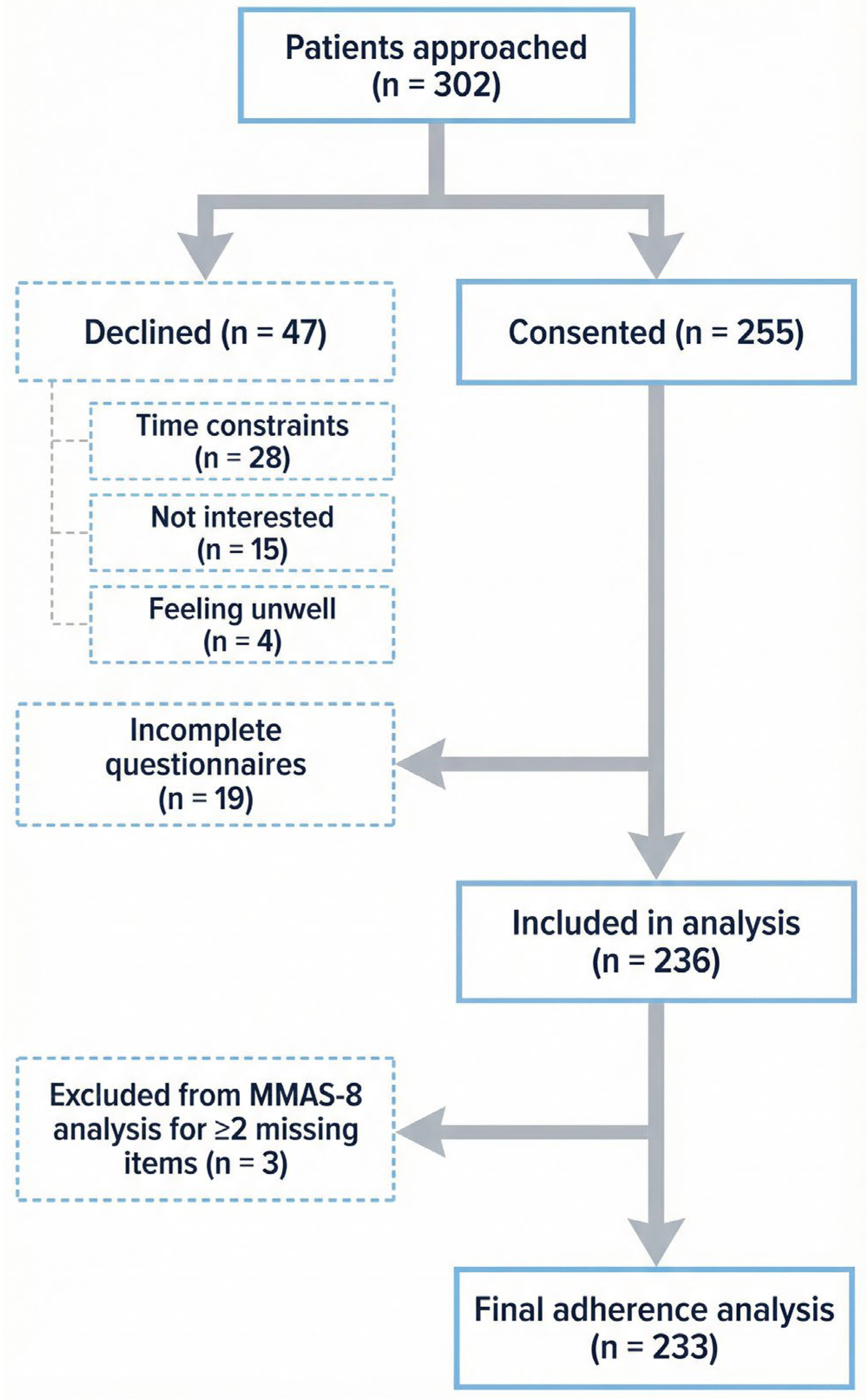
3.1. Participant Flow
3.2. Sample Characteristics
3.3. Medication-Related Communication Quality
3.4. Medication Knowledge
3.5. Continuity of Care
3.6. Social Support for Medication Management
3.7. Medication Adherence Outcomes
3.8. Bivariate Associations Between Communication Quality and Adherence
3.9. Multivariable Logistic Regression
3.10. Sensitivity Analyses
4. Discussion
4.1. Key Findings in Context
4.2. Strengths and Limitations
4.3. Implications for Practice and Research
5. Conclusions
Supplementary Materials
Author Contributions
Funding
Institutional Review Board Statement
Informed Consent Statement
Data Availability Statement
Acknowledgments
Conflicts of Interest
References
- Di Cesare, M.; Perel, P.; Taylor, S.; Kabudula, C.; Bixby, H.; Gaziano, T.A.; McGhie, D.V.; Mwangi, J.; Pervan, B.; Narula, J.; et al. The Heart of the World. Glob. Heart 2024, 19, 11. [Google Scholar] [CrossRef] [Scilit]
- Sharma, R.; Kumar, P.; Prashanth, S.P.; Belagali, Y. Dual Antiplatelet Therapy in Coronary Artery Disease. Cardiol Ther. 2020, 9, 349–361. [Google Scholar] [CrossRef] [Scilit]
- Laudani, C.; Giacoppo, D.; Greco, A.; Ortega-Paz, L.; El Khoury, G.; Capodanno, D.; Angiolillo, D.J. Antiplatelet Monotherapies for Long-Term Secondary Prevention Following Percutaneous Coronary Intervention. J. Clin. Med. 2025, 14, 5536. [Google Scholar] [CrossRef] [Scilit]
- Mori, Y.; Friede, T.; Hattori, S.; Yamaji, K.; Fukuma, S. Impact of Nonadherence to Any Antiplatelet Therapy After PCI with Drug-Eluting Stents on Critical Outcomes. JACC Asia 2025, 5, 758–768. [Google Scholar] [CrossRef] [Scilit]
- Berkman, N.D.; Sheridan, S.L.; Donahue, K.E.; Halpern, D.J.; Viera, A.; Crotty, K.; Holland, A.; Brasure, M.; Lohr, K.N.; Harden, E.; et al. Health literacy interventions and outcomes: An updated systematic review. Evid. Rep./Technol. Assess. 2011, 1–941. [Google Scholar]
- Gellad, W.F.; Grenard, J.L.; Marcum, Z.A. A Systematic Review of Barriers to Medication Adherence in the Elderly: Looking Beyond Cost and Regimen Complexity. Am. J. Geriatr. Pharmacother. 2011, 9, 11–23. [Google Scholar] [CrossRef] [Scilit] [PubMed]
- Kardas, P.; Lewek, P.; Matyjaszczyk, M. Determinants of patient adherence: A review of systematic reviews. Front. Pharmacol. 2013, 4, 91. [Google Scholar] [CrossRef] [Scilit]
- Dragomir, A.; Côté, R.; Roy, L.; Blais, L.; Lalonde, L.; Bérard, A.; Perreault, S. Impact of Adherence to Antihypertensive Agents on Clinical Outcomes and Hospitalization Costs. Med. Care 2010, 48, 418–425. [Google Scholar] [CrossRef] [Scilit] [PubMed]
- Bahit, M.C.; Korjian, S.; Daaboul, Y.; Baron, S.; Bhatt, D.L.; Kalayci, A.; Chi, G.; Nara, P.; Shaunik, A.; Gibson, C.M. Patient Adherence to Secondary Prevention Therapies after an Acute Coronary Syndrome: A Scoping Review. Clin. Ther. 2023, 45, 1119–1126. [Google Scholar] [CrossRef] [Scilit]
- Alhomoud, F.; Alwohaibi, L.; Aljarrash, K.; Alhomoud, F.; Alamer, K.; Alsultan, M.; Alqarni, Y.; Alotaibi, N.; Alsaad, A.K.; Alqahtani, A.D.; et al. Evaluating Strategies for En-hancing Medication Adherence in the Kingdom of Saudi Arabia (KSA): A Cross-Sectional Study. Patient Prefer. Adherence 2024, 18, 2469–2480. [Google Scholar] [CrossRef] [Scilit]
- Alhomoud, F.; Alsaeed, W.; Alzainaldain, F.; Alelq, K.; Alhomoud, F.; Alamer, K.; Alsultan, M.M.; Alqarni, Y.S.; Alshehail, B.; Alhifany, A. Think Before You Take: Under-standing Adult Medication Literacy in Saudi Arabia. Patient Prefer. Adherence 2025, 19, 1973–1990. [Google Scholar] [CrossRef] [Scilit]
- Alfaqeeh, M.; Abdullah, R.; Zakiyah, N.; Suwantika, A.A.; Postma, M.J.; Rahmawati, F.; Widayanti, A.W.; Ibrahim, B. Medication Adherence and Contributing Factors in Patients with Heart Failure Within the Middle East: A Systematic Review. Glob. Heart 2025, 20, 47. [Google Scholar] [CrossRef] [Scilit] [PubMed]
- Tash, A.A.; Al-Bawardy, R.F. Cardiovascular Disease in Saudi Arabia: Facts and the way forward. J. Saudi Heart Assoc. 2023, 35, 148–162. [Google Scholar] [CrossRef] [Scilit]
- Md Yahya, N.S.; Mohd Akib, M.M. Understanding the Concept of Fate as Islamic Psychotherapy. Int. J. Acad. Res. Bus. Soc. Sci. 2024, 14, 2617–2630. [Google Scholar] [CrossRef] [Scilit] [PubMed]
- Onda, M.; Inoue, M.; Zouchi, K.; Shoji, M.; Maeda, H. Understanding the burden and influencing factors in family caregivers’ medication assistance for patients with dementia: A survey study. BMC Geriatr. 2024, 24, 975. [Google Scholar] [CrossRef] [Scilit]
- Berardinelli, D.; Conti, A.; Hasnaoui, A.; Casabona, E.; Martin, B.; Campagna, S.; Dimonte, V. Nurse-Led Interventions for Improving Medication Adherence in Chronic Diseases: A Systematic Review. Healthcare 2024, 12, 2337. [Google Scholar] [CrossRef] [Scilit]
- Sedgwick, P. Cross sectional studies: Advantages and disadvantages. BMJ 2014, 348, g2276. [Google Scholar] [CrossRef] [Scilit]
- Al-Qazaz, H.K.; Hassali, M.A.; Shafie, A.A.; Sulaiman, S.A.; Sundram, S.; Morisky, D.E. The eight-item Morisky Medication Adherence Scale MMAS: Translation and validation of the Malaysian version. Diabetes Res. Clin. Pract. 2010, 90, 216–221. [Google Scholar] [CrossRef] [Scilit]
- Shin, S.; Song, H.; Oh, S.-K.; Choi, K.E.; Kim, H.; Jang, S. Effect of antihypertensive medication adherence on hospitalization for cardiovascular disease and mortality in hypertensive patients. Hypertens. Res. 2013, 36, 1000–1005. [Google Scholar] [CrossRef] [Scilit] [PubMed]
- Ho, P.M.; Bryson, C.L.; Rumsfeld, J.S. Medication Adherence: Its Importance in Cardiovascular Outcomes. Circulation 2009, 119, 3028–3035. [Google Scholar] [CrossRef] [Scilit]
- Naderi, S.H.; Bestwick, J.P.; Wald, D.S. Adherence to Drugs That Prevent Cardiovascular Disease: Meta-analysis on 376,162 Patients. Am. J. Med. 2012, 125, 882–887.E1. [Google Scholar] [CrossRef] [Scilit] [PubMed]
- Osterberg, L.; Blaschke, T. Adherence to Medication. N. Engl. J. Med. 2005, 353, 487–497. [Google Scholar] [CrossRef] [Scilit] [PubMed]
- Czarny, M.J.; Nathan, A.S.; Yeh, R.W.; Mauri, L. Adherence to Dual Antiplatelet Therapy After Coronary Stenting: A Systematic Review. Clin. Cardiol. 2014, 37, 505–513. [Google Scholar] [CrossRef] [Scilit]
- Mansurova, J.A.; Orekhov, A.; Zhunuspekova, A.S.; Kassymova, A.A.; Karazhanova, L.K. The Impact of Patient Adherence to Dual Antiplatelet Medication Following Percutaneous Coronary Intervention on the Occurrence of Adverse Cardiovascular Events. Patient Prefer. Adherence 2024, 18, 425–434. [Google Scholar] [CrossRef] [Scilit]
- Khawagi, W.Y.; Baali, F.H.; Alnefaie, N.M.; Albishi, S.A.; Al-swat, A.H.; Alshahrani, D.A.; Alshemaimri, R.A.; Alshehri, A.A. A Cross-Sectional Survey on the Management of Medication Adherence Among Healthcare Professionals in Saudi Arabia. Healthcare 2025, 13, 347. [Google Scholar] [CrossRef] [Scilit]
- Gallant, M.P. The Influence of Social Support on Chronic Illness Self-Management: A Review and Directions for Research. Health Educ. Behav. 2003, 30, 170–195. [Google Scholar] [CrossRef] [Scilit] [PubMed]


| Characteristic | n (%) or Mean ± SD |
|---|---|
| Age (years) | 58.4 ± 11.2 |
| Sex | |
| Male | 174 (73.7) |
| Female | 62 (26.3) |
| Marital status | |
| Married | 191 (80.9) |
| Single | 18 (7.6) |
| Divorced | 12 (5.1) |
| Widowed | 15 (6.4) |
| Educational attainment | |
| No formal schooling | 78 (33.1) |
| General education | 107 (45.3) |
| Higher education | 51 (21.6) |
| Employment status | |
| Employed | 89 (37.7) |
| Unemployed | 62 (26.3) |
| Retired | 85 (36.0) |
| Monthly household income (SAR) | |
| <5000 | 68 (28.8) |
| 5000–10,000 | 102 (43.2) |
| >10,000 | 66 (28.0) |
| Time since PCI | |
| ≤3 months | 72 (30.5) |
| 4–6 months | 89 (37.7) |
| 7–12 months | 75 (31.8) |
| PCI indication | |
| Elective | 94 (39.8) |
| Acute coronary syndrome (ACS)/Emergency | 142 (60.2) |
| Current antiplatelet regimen | |
| Dual antiplatelet therapy (DAPT: aspirin + P2Y12 inhibitor) | 198 (83.9) |
| Single antiplatelet therapy | 38 (16.1) |
| Pre-existing heart disease | 164 (69.5) |
| Comorbidities | |
| Hypertension | 121 (51.3) |
| Diabetes mellitus | 106 (45.0) |
| Hyperlipidaemia | 89 (37.7) |
| Communication Domain | Never n (%) | Sometimes n (%) | Usually n (%) | Always n (%) |
|---|---|---|---|---|
| Clear explanation during hospital stay | 16 (6.8) | 69 (29.2) | 56 (23.7) | 95 (40.3) |
| Informed about purpose of new medication | 26 (11.0) | 61 (25.8) | 56 (23.7) | 93 (39.4) |
| Informed about side effects | 62 (26.3) | 66 (28.0) | 46 (19.5) | 62 (26.3) |
| Understood medication instructions | 33 (14.0) | 94 (39.8) | 45 (19.1) | 64 (27.1) |
| Someone at home helps with medication | 71 (30.1) | 24 (10.2) | 27 (11.4) | 114 (48.3) |
| Sees the same cardiac specialist regularly | 44 (18.6) | 54 (22.9) | 46 (19.5) | 92 (39.0) |
| Adherence Level | n | % |
|---|---|---|
| High (score = 8) | 23 | 9.9 |
| Medium (score 6 to <8) | 82 | 35.2 |
| Low (score < 6) | 128 | 54.9 |
| Total | 233 | 100.0 |
| Communication Indicator | Low Adherence n (%) | Medium/High Adherence n (%) | χ2 | p | Cramér’s V |
|---|---|---|---|---|---|
| Informed about side effects | 8.42 | 0.004 | 0.19 | ||
| Never | 44 (71.0) | 18 (29.0) | |||
| Sometimes/Usually/Always | 84 (49.1) | 87 (50.9) | |||
| Understood medication instructions | 6.18 | 0.013 | 0.16 | ||
| Never | 24 (75.0) | 8 (25.0) | |||
| Sometimes/Usually/Always | 104 (51.7) | 97 (48.3) | |||
| Home support available | 4.92 | 0.027 | 0.15 | ||
| Never | 47 (67.1) | 23 (32.9) | |||
| Sometimes/Usually/Always | 81 (49.7) | 82 (50.3) | |||
| Sees same specialist | 3.21 | 0.073 | 0.12 | ||
| Never/Sometimes | 59 (60.8) | 38 (39.2) | |||
| Usually/Always | 69 (50.7) | 67 (49.3) |
| Variable | Adjusted OR | 95% CI | p-Value |
|---|---|---|---|
| Never informed about side effects (vs. sometimes/usually/always) | 2.14 | 1.18–3.89 | 0.012 |
| Never understood instructions (vs. sometimes/usually/always) | 1.89 | 0.91–3.93 | 0.087 |
| No home support (vs. any support) | 1.72 | 1.01–2.94 | 0.046 |
| Age (per 10-year increase) | 0.92 | 0.78–1.09 | 0.34 |
| Female sex (vs. male) | 1.18 | 0.64–2.17 | 0.59 |
| No formal schooling (vs. higher education) | 1.56 | 0.79–3.08 | 0.20 |
| General education (vs. higher education) | 1.21 | 0.65–2.26 | 0.55 |
| Time since PCI 7–12 months (vs. ≤3 months) | 1.44 | 0.81–2.56 | 0.21 |
| Diabetes mellitus | 1.38 | 0.84–2.27 | 0.21 |
| Hypertension | 1.12 | 0.68–1.85 | 0.66 |
Disclaimer/Publisher’s Note: The statements, opinions and data contained in all publications are solely those of the individual author(s) and contributor(s) and not of MDPI and/or the editor(s). MDPI and/or the editor(s) disclaim responsibility for any injury to people or property resulting from any ideas, methods, instructions or products referred to in the content. |
© 2026 by the authors. Licensee MDPI, Basel, Switzerland. This article is an open access article distributed under the terms and conditions of the Creative Commons Attribution (CC BY) license.
Share and Cite
Aljuhani, M.; Almutairi, A.S.; Almutairi, R.R.; Alodhailah, A.M. Patient Education Deficits and Medication Knowledge Gaps Among Post-Percutaneous Coronary Intervention Patients: A Cross-Sectional Study of Communication Quality and Adherence in Saudi Cardiac Care. Healthcare 2026, 14, 891. https://doi.org/10.3390/healthcare14070891
Aljuhani M, Almutairi AS, Almutairi RR, Alodhailah AM. Patient Education Deficits and Medication Knowledge Gaps Among Post-Percutaneous Coronary Intervention Patients: A Cross-Sectional Study of Communication Quality and Adherence in Saudi Cardiac Care. Healthcare. 2026; 14(7):891. https://doi.org/10.3390/healthcare14070891
Chicago/Turabian StyleAljuhani, Muteb, Asrar S. Almutairi, Rayhanah R. Almutairi, and Abdulaziz M. Alodhailah. 2026. "Patient Education Deficits and Medication Knowledge Gaps Among Post-Percutaneous Coronary Intervention Patients: A Cross-Sectional Study of Communication Quality and Adherence in Saudi Cardiac Care" Healthcare 14, no. 7: 891. https://doi.org/10.3390/healthcare14070891
APA StyleAljuhani, M., Almutairi, A. S., Almutairi, R. R., & Alodhailah, A. M. (2026). Patient Education Deficits and Medication Knowledge Gaps Among Post-Percutaneous Coronary Intervention Patients: A Cross-Sectional Study of Communication Quality and Adherence in Saudi Cardiac Care. Healthcare, 14(7), 891. https://doi.org/10.3390/healthcare14070891