Longitudinal Changes in Kinesiophobia, Psychological Readiness, and Knee Function Across Anterior Cruciate Ligament Reconstruction Rehabilitation Phases


Abstract
1. Introduction
2. Methodology
2.1. Population and Sampling
2.2. Inclusion and Exclusion Criteria
2.3. Outcome Measures
2.4. Data Collection
2.5. Ethical Considerations
2.6. Statistical Analysis
2.7. Sample Size Calculation
3. Results
3.1. Participant Characteristics
3.2. Outcome Score Distribution Across Rehabilitation Phases
3.3. Linear Mixed Model Analysis
4. Discussion
4.1. Kinesiophobia Across Rehabilitation Phases
4.2. Psychological Readiness
4.3. Knee Function
4.4. Theoretical Implications
4.5. Clinical Implications
4.6. Limitations
4.7. Future Directions
5. Conclusions
Supplementary Materials
Author Contributions
Funding
Informed Consent Statement
Data Availability Statement
Acknowledgments
Conflicts of Interest
Abbreviations
| ACL | Anterior Cruciate Ligament |
| ACLR | Anterior Cruciate Ligament Reconstruction |
| ACL-RSI | ACL–Return to Sport after Injury scale |
| BMI | Body Mass Index |
| BTB | Bone–Patellar Tendon–Bone |
| IKDC | International Knee Documentation Committee subjective knee form |
| RTS | Return to Sport |
| TSK-17 | Tampa Scale of Kinesiophobia (17-item version) |
Appendix A


References
- Renström, P.A. Eight clinical conundrums relating to anterior cruciate ligament (ACL) injury in sport: Recent evidence and a personal reflection. Br. J. Sports Med. 2013, 47, 367–372. [Google Scholar] [CrossRef] [PubMed]
- Blagojevic, M.; Jinks, C.; Jeffery, A.; Jordan, K.P. Risk factors for onset of osteoarthritis of the knee in older adults: A systematic review and meta-analysis. Osteoarthr. Cartil. 2010, 18, 24–33. [Google Scholar] [CrossRef] [PubMed]
- Grindem, H.; Snyder-Mackler, L.; Moksnes, H.; Engebretsen, L.; Risberg, M.A. Simple decision rules can reduce reinjury risk by 84% after ACL reconstruction: The Delaware-Oslo ACL cohort study. Br. J. Sports Med. 2016, 50, 804–808. [Google Scholar] [CrossRef] [PubMed]
- Ardern, C.L.; Taylor, N.F.; Feller, J.A.; Webster, K.E. Fifty-five per cent return to competitive sport following anterior cruciate ligament reconstruction surgery: An updated systematic review and meta-analysis including aspects of physical functioning and contextual factors. Br. J. Sports Med. 2014, 48, 1543–1552. [Google Scholar] [CrossRef]
- Ardern, C.L.; Österberg, A.; Tagesson, S.; Gauffin, H.H.; Webster, K.E.; Kvist, J. The impact of psychological readiness to return to sport and recreational activities after anterior cruciate ligament reconstruction. Br. J. Sports Med. 2014, 48, 1613–1619. [Google Scholar] [CrossRef]
- Vlaeyen, J.W.S.; Linton, S.J. Fear-avoidance and its consequences in chronic musculoskeletal pain: A state of the art. Pain 2000, 85, 317–332. [Google Scholar] [CrossRef]
- Webster, K.E.; Feller, J.A.; Lambros, C. Development and preliminary validation of a scale to measure the psychological impact of returning to sport following anterior cruciate ligament reconstruction surgery. Phys. Ther. Sport. 2008, 9, 9–15. [Google Scholar] [CrossRef]
- Lentz, T.A.; Zeppieri, G.; Jr George, S.Z.; Tillman, S.M.; Moser, M.W.; Farmer, K.W.; Chmielewski, T.L. Comparison of physical impairment, functional, and psychosocial measures based on fear of reinjury/lack of confidence and return-to-sport status after ACL reconstruction. Am. J. Sports Med. 2015, 43, 345–353. [Google Scholar] [CrossRef]
- Paterno, M.V.; Flynn, K.; Thomas, S.; Schmitt, L.C. Self-Reported Fear Predicts Functional Performance and Second ACL Injury After ACL Reconstruction and Return to Sport: A Pilot Study. Sports Health 2018, 10, 228–233. [Google Scholar] [CrossRef]
- Nwachukwu, B.U.; Adjei, J.; Rauck, R.C.; Chahla, J.; Okoroha, K.R.; Verma, N.N.; Allen, A.A.; Williams, R.J. How Much Do Psychological Factors Affect Lack of Return to Play After Anterior Cruciate Ligament Reconstruction? A Systematic Review. Orthop. J. Sports Med. 2019, 7, 2325967119845313. [Google Scholar] [CrossRef]
- Engel, G.L. The need for a new medical model: A challenge for biomedicine. Science 1977, 196, 129–136. [Google Scholar] [CrossRef] [PubMed]
- Bandura, A. Self-efficacy: Toward a unifying theory of behavioral change. Psychol. Rev. 1977, 84, 191–215. [Google Scholar] [CrossRef]
- Sonesson, S.; Kvist, J.; Ardern, C.; Österberg, A.; Silbernagel, K.G. Psychological factors are important to return to pre-injury sport activity after anterior cruciate ligament reconstruction: Expect and motivate to satisfy. Knee Surg. Sports Traumatol. Arthrosc. Off. J. ESSKA 2017, 25, 1375–1384. [Google Scholar] [CrossRef]
- Ardern, C.L.; Glasgow, P.; Schneiders, A.; Witvrouw, E.; Clarsen, B.; Cools, A.; Gojanovic, B.; Griffin, S.; Khan, K.M.; Moksnes, H.; et al. 2016 Consensus statement on return to sport from the First World Congress in Sports Physical Therapy, Bern. Br. J. Sports Med. 2016, 50, 853–864. [Google Scholar] [CrossRef]
- Chmielewski, T.L.; Jones, D.; Day, T.; Tillman, S.M.; Lentz, T.A.; George, S.Z. The association of pain and fear of movement/reinjury with function during anterior cruciate ligament reconstruction rehabilitation. J. Orthop. Sports Phys. Ther. 2008, 38, 746–753. [Google Scholar] [CrossRef]
- Everhart, J.S.; Best, T.M.; Flanigan, D.C. Psychological predictors of anterior cruciate ligament reconstruction outcomes: A systematic review. Knee Surg. Sports Traumatol. Arthrosc. Off. J. ESSKA 2015, 23, 752–762. [Google Scholar] [CrossRef]
- Filbay, S.R.; Grindem, H. Evidence-based recommendations for the management of anterior cruciate ligament (ACL) rupture. Best. Pract. Res. Clin. Rheumatol. 2019, 33, 33–47. [Google Scholar] [CrossRef] [PubMed]
- Fältström, A.; Gustafsson, T.; Wärnsberg, N.; Sonesson, S.; Hermansen, A. Athletes’ perspectives on return to sport after anterior cruciate ligament reconstruction and their strategies to reduce reinjury risk: A qualitative interview study. BMC Sports Sci. Med. Rehabil. 2024, 16, 131. [Google Scholar] [CrossRef] [PubMed]
- Legnani, C.; Peretti, G.M.; Del Re, M.; Borgo, E.; Ventura, A. Return to sports and re-rupture rate following anterior cruciate ligament reconstruction in amateur sportsman: Long-term outcomes. J. Sports Med. Phys. Fit. 2019, 59, 1902–1907. [Google Scholar] [CrossRef]
- Kvist, J.; Ek, A.; Sporrstedt, K.; Good, L. Fear of re-injury: A hindrance for returning to sports after anterior cruciate ligament reconstruction. Knee Surg. Sports Traumatol. Arthrosc. 2005, 13, 393–397. [Google Scholar] [CrossRef]
- Kostyun, R.O.; Burland, J.P.; Kostyun, K.J.; Milewski, M.D.; Nissen, C.W. Male and female adolescent athletes’ readiness to return to sport after anterior cruciate ligament injury and reconstruction. Clin. J. Sport. Med. 2021, 31, 383–387. [Google Scholar] [CrossRef]
- Carter, H.M.; Lewis, G.N.; Smith, B.E. Preoperative predictors for return to physical activity following anterior cruciate ligament reconstruction (ACLR): A systematic review. BMC Musculoskelet. Disord. 2023, 24, 471. [Google Scholar] [CrossRef]
- Almalki, H. Functional Recovery at Discharge from Rehabilitation Following Anterior Cruciate Ligament Reconstruction. 2019. Available online: https://salford-repository.worktribe.com/output/1361023/functional-recovery-at-discharge-from-rehabilitation-following-anterior-cruciate-ligament-reconstruction (accessed on 19 April 2021).
- Almalki, H.; Herrington, L.; Jones, R. Arabic version of the anterior cruciate ligament return to sport index: Translation and cross-cultural adaptation. Saudi J. Sports Med. 2022, 22, 9. [Google Scholar] [CrossRef]
- Almalki, H.; Herrington, L.; Jones, R. Arabic version of the International Knee Documentation Committee Subjective Knee Form (IKDC): Translation and validation. J. Back. Musculoskelet. Rehabil. 2022, 35, 659–665. [Google Scholar] [CrossRef] [PubMed]
- Vlaeyen, J.W.S.; Kole-Snijders, A.M.J.; Boeren, R.G.B.; van Eek, H. Fear of movement/(re)injury in chronic low back pain and its relation to behavioral performance. Pain 1995, 62, 363–372. [Google Scholar] [CrossRef] [PubMed]
- Juweid, M.; Farah, K.; Hawamdeh, Z.; Alqudah, A.; Nowlin, L.; Vlaeyen, J. Fear of Movement/[Re]Injury Among Arabic Low Back Pain Patients: Establishing the Validity of the Tampa Scale of Kinesiophobia–Arabic Version. Myopain 2017, 23, 134–142. [Google Scholar] [CrossRef]
- Irrgang, J.J.; Anderson, A.F.; Boland, A.L.; Harner, C.D.; Kurosaka, M.; Neyret, P.; Richmond, J.C.; Shelborne, K.D. Development and Validation of the International Knee Documentation Committee Subjective Knee Form. Am. J. Sports Med. 2001, 29, 600–613. [Google Scholar] [CrossRef]
- Agel, J.; LaPrade, R.F. Assessment of differences between the modified Cincinnati and International Knee Documentation Committee patient outcome scores: A prospective study. Am. J. Sports Med. 2009, 37, 2151–2157. [Google Scholar] [CrossRef]
- Huang, H.; Nagao, M.; Arita, H.; Shiozawa, J.; Nishio, H.; Kobayashi, Y.; Kaneko, H.; Nagayama, M.; Saita, Y.; Ishijima, M.; et al. Reproducibility, responsiveness and validation of the Tampa Scale for Kinesiophobia in patients with ACL injuries. Health Qual. Life Outcomes 2019, 17, 150. [Google Scholar] [CrossRef]
- Ardern, C.L. Anterior Cruciate Ligament Reconstruction—Not Exactly a One-Way Ticket Back to the Preinjury Level: A Review of Contextual Factors Affecting Return to Sport After Surgery. Sports Health 2015, 7, 224–230. [Google Scholar] [CrossRef]
- Feller, J.; Webster, K.E. Return to sport following anterior cruciate ligament reconstruction. Int. Orthop. 2013, 37, 285–290. [Google Scholar] [CrossRef] [PubMed]
- Aizawa, J.; Hirohata, K.; Ohji, S.; Ohmi, T.; Mitomo, S.; Koga, H.; Yagishita, K. Cross-sectional study on relationships between physical function and psychological readiness to return to sport after anterior cruciate ligament reconstruction. BMC Sports Sci. Med. Rehabil. 2022, 14, 97. [Google Scholar] [CrossRef]
- Legnani, C.; Del Re, M.; Viganò, M.; Peretti, G.M.; Borgo, E.; Ventura, A. Relationships Between Jumping Performance and Psychological Readiness to Return to Sport 6 Months Following Anterior Cruciate Ligament Reconstruction: A Cross-Sectional Study. J. Clin. Med. 2023, 12, 626. [Google Scholar] [CrossRef]
- McAleese, T.; Welch, N.; King, E.; Roshan, D.; Keane, N.; Moran, K.A.; Jackson, M.; Withers, D.; Moran, R.; Devitt, B.M. Primary anterior cruciate ligament reconstruction in level 1 athletes: Factors associated with return to play, reinjury, and knee function at 5 years of follow-up. Am. J. Sports Med. 2025, 53, 777–790. [Google Scholar] [CrossRef]
- Moksnes, H.; Risberg, M.A. Performance-based functional evaluation of non-operative and operative treatment after anterior cruciate ligament injury. Scand. J. Med. Sci. Sports 2009, 19, 345–355. [Google Scholar] [CrossRef] [PubMed]
- Gokeler, A.; Welling, W.; Zaffagnini, S.; Seil, R.; Padua, D. Development of a test battery to enhance safe return to sports after anterior cruciate ligament reconstruction. Knee Surg. Sports Traumatol. Arthrosc. Off. J. ESSKA 2017, 25, 192–199. [Google Scholar] [CrossRef] [PubMed]



| Variable | Category | n | % | Mean (SD) | Min | Max | 95% CI |
|---|---|---|---|---|---|---|---|
| Continuous Variables | |||||||
| Age (years) | — | 27.1 (6.9) | 18 | 40 | 25.1–29.2 | ||
| BMI (kg/m2) | — | 25.8 (4.9) | 18 | 35 | 24.3–27.2 | ||
| Categorical Variables | |||||||
| Sex | Male | 37 | 82.2 | — | — | — | — |
| Female | 8 | 17.8 | — | — | — | — | |
| Injured Knee | Left | 31 | 68.9 | — | — | — | — |
| Right | 14 | 31.1 | — | — | — | — | |
| Graft Type | Hamstring autograft | 21 | 46.7 | — | — | — | — |
| Quadriceps tendon autograft | 14 | 31.1 | — | — | — | — | |
| BTB | 10 | 22.2 | — | — | — | — | |
| Primary Sport | Gym | 15 | 33.3 | — | — | — | — |
| Football | 9 | 20.0 | — | — | — | — | |
| Recreational | 9 | 20.0 | — | — | — | — | |
| Running | 9 | 20.0 | — | — | — | — | |
| Basketball | 3 | 6.7 | — | — | — | — | |
| RTS Status at 9 Months | RTS | 36 | 80.0 | — | — | — | — |
| Non-RTS | 9 | 20.0 | — | — | — | — | |
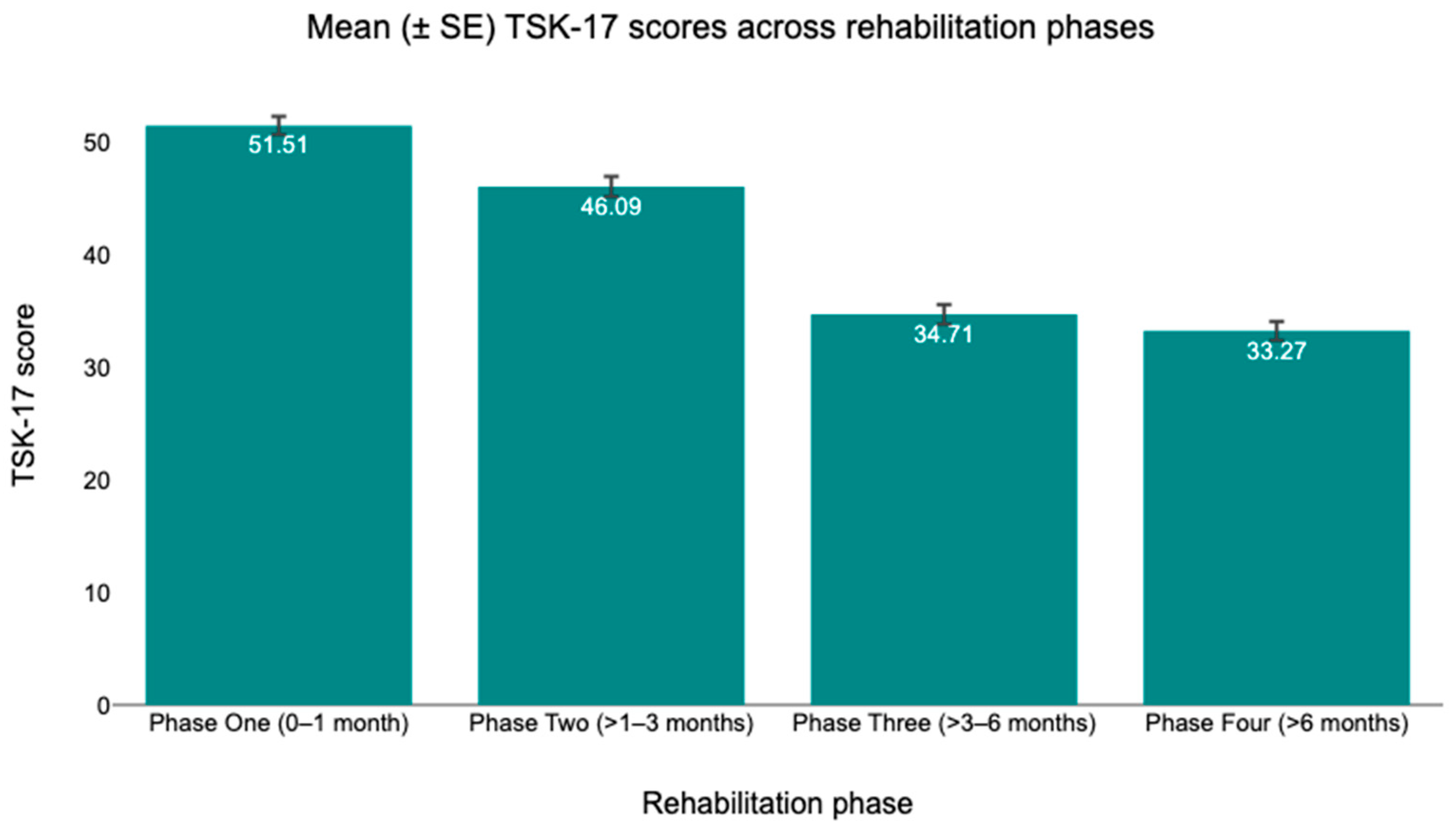
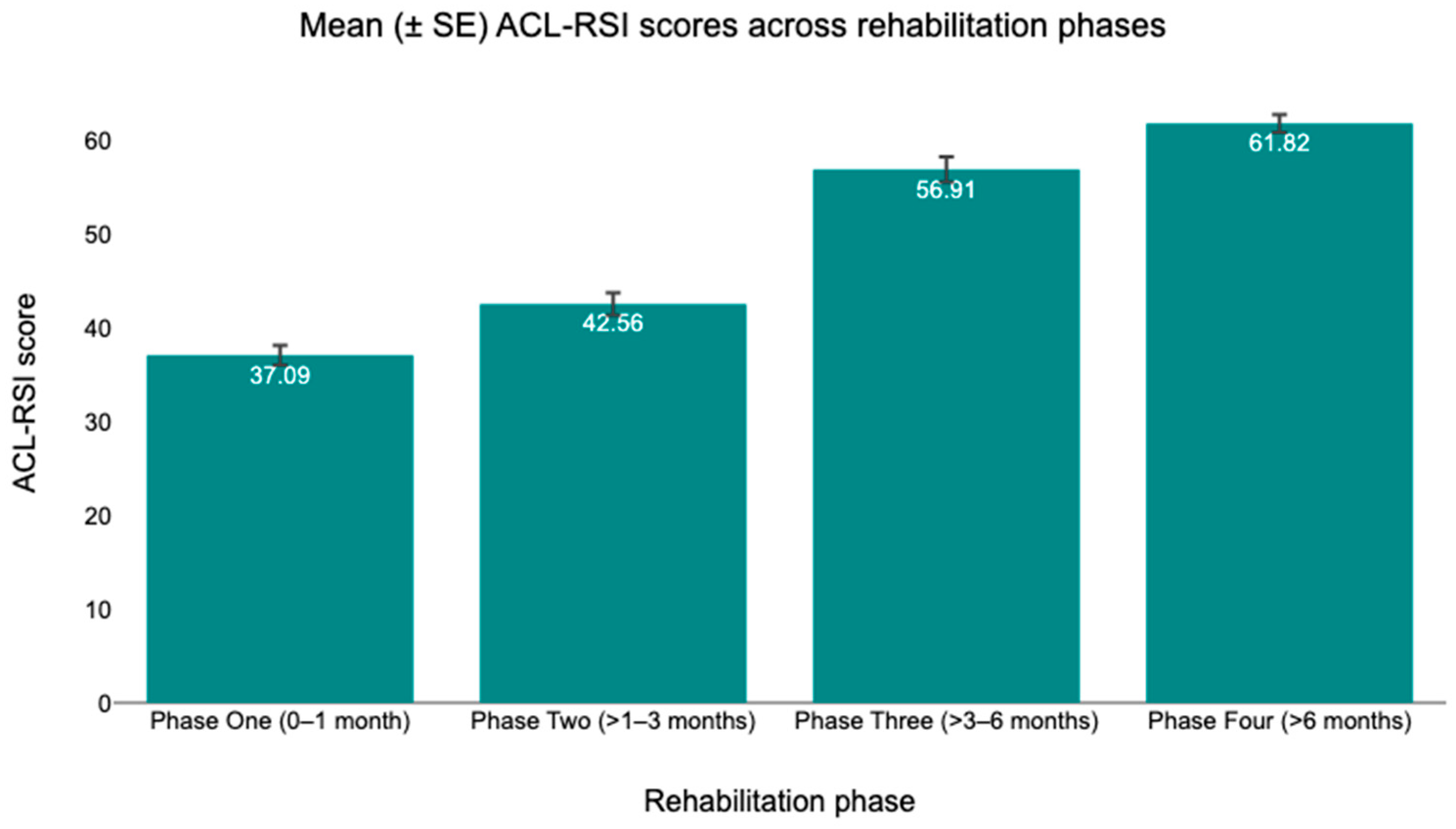
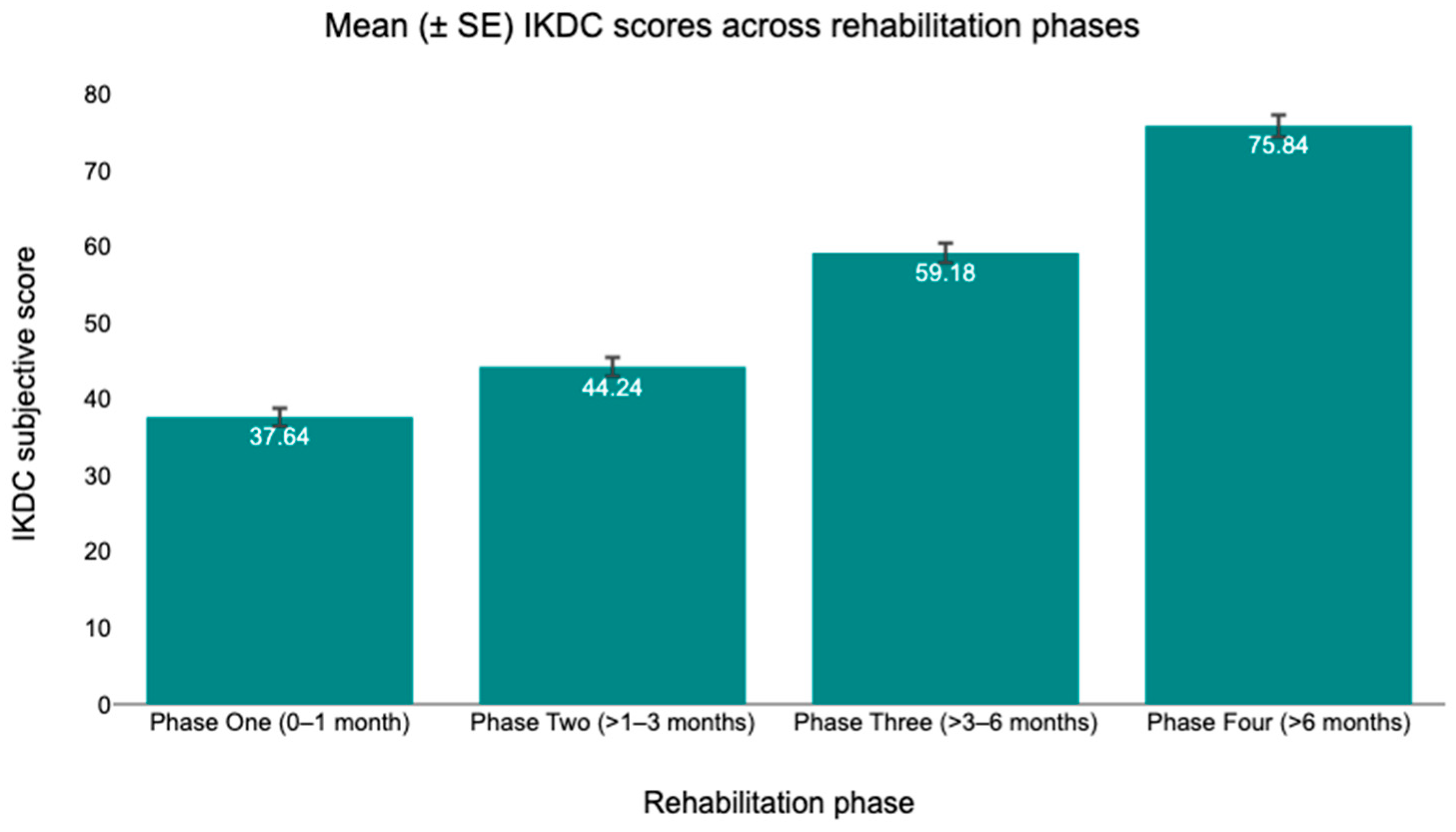
| Time Point | TSK-17 | ACL-RSI | IKDC | |||
|---|---|---|---|---|---|---|
| Mean (SD) | 95% CI | Mean (SD) | 95% CI | Mean (SD) | 95% CI | |
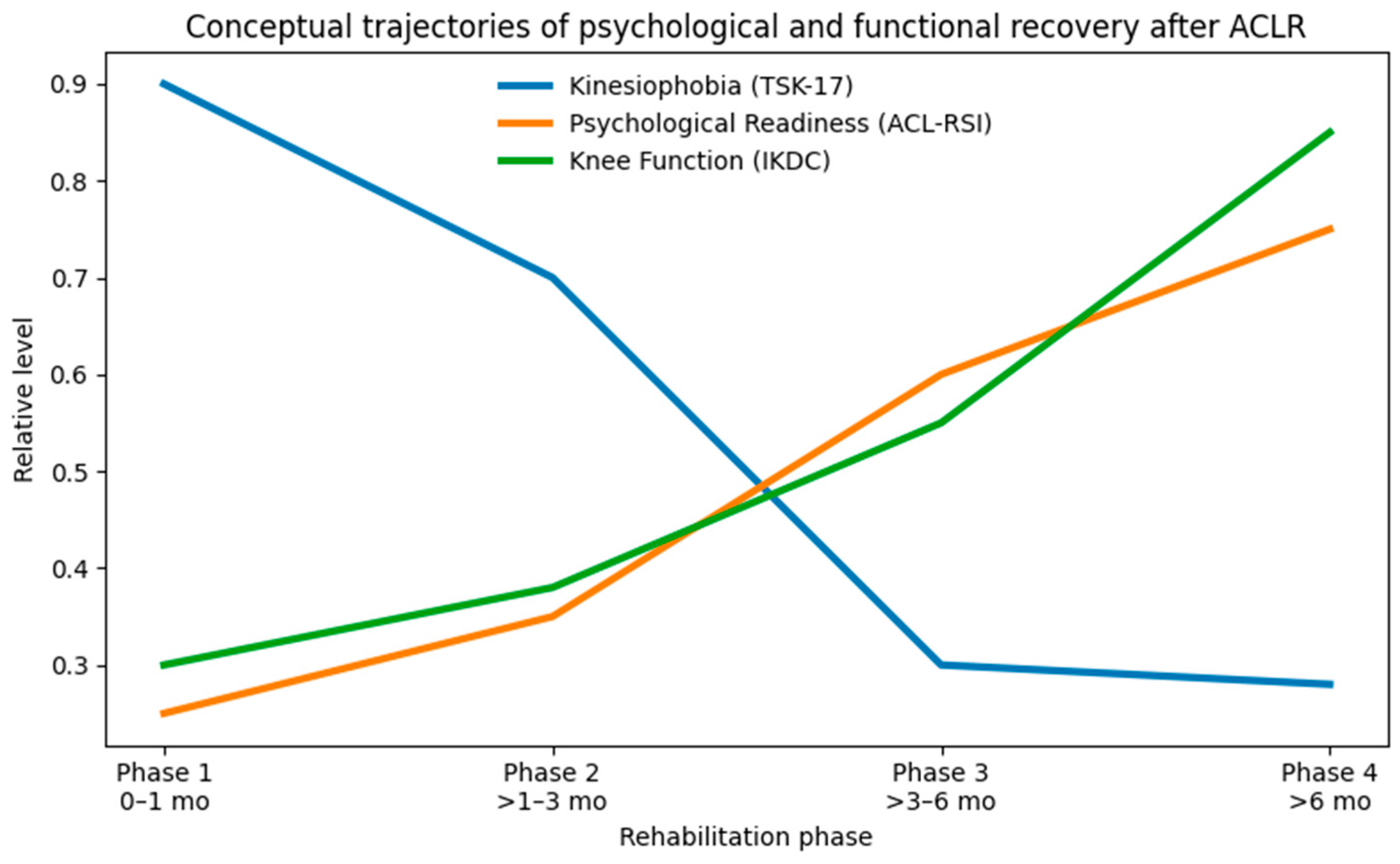
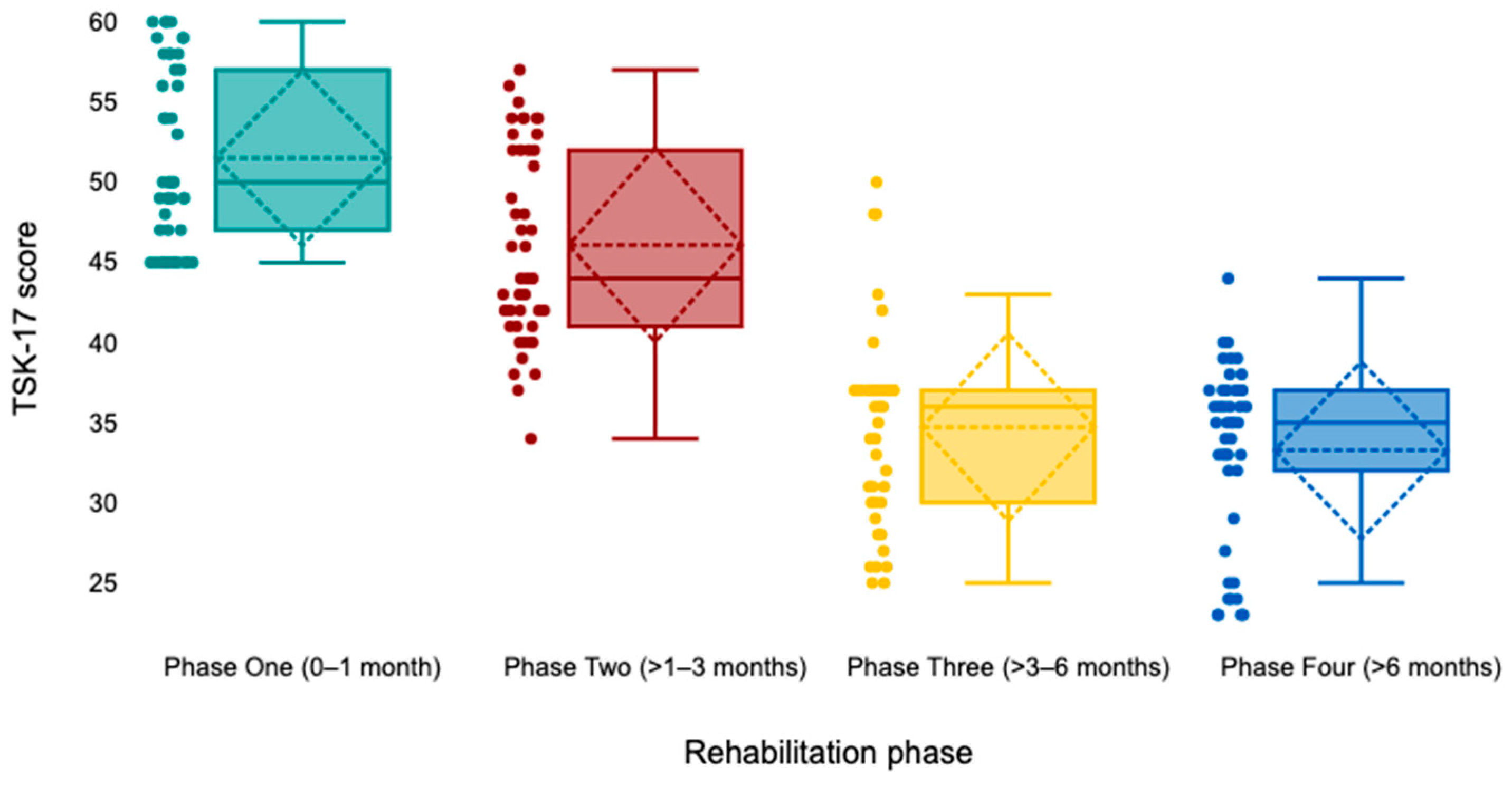
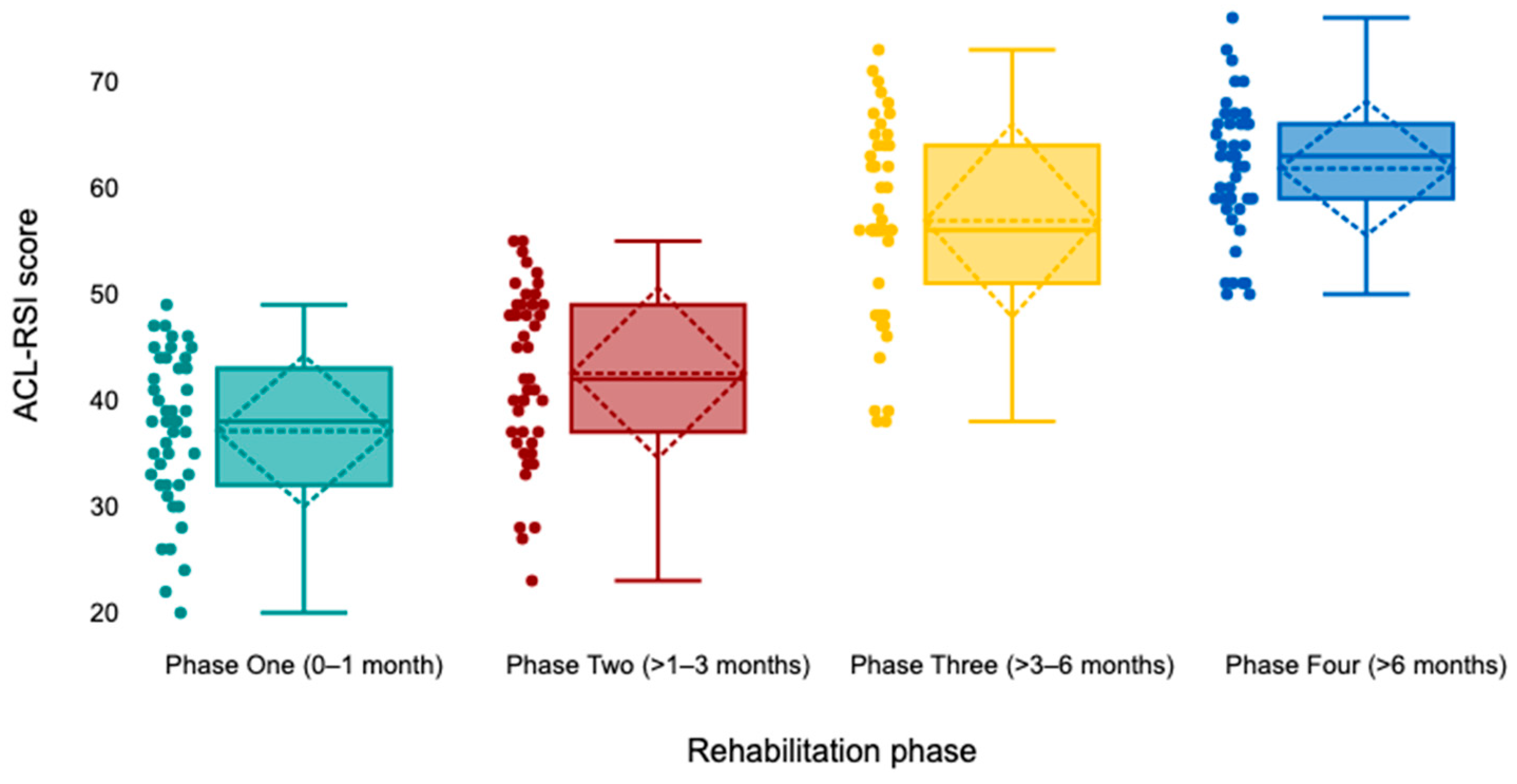
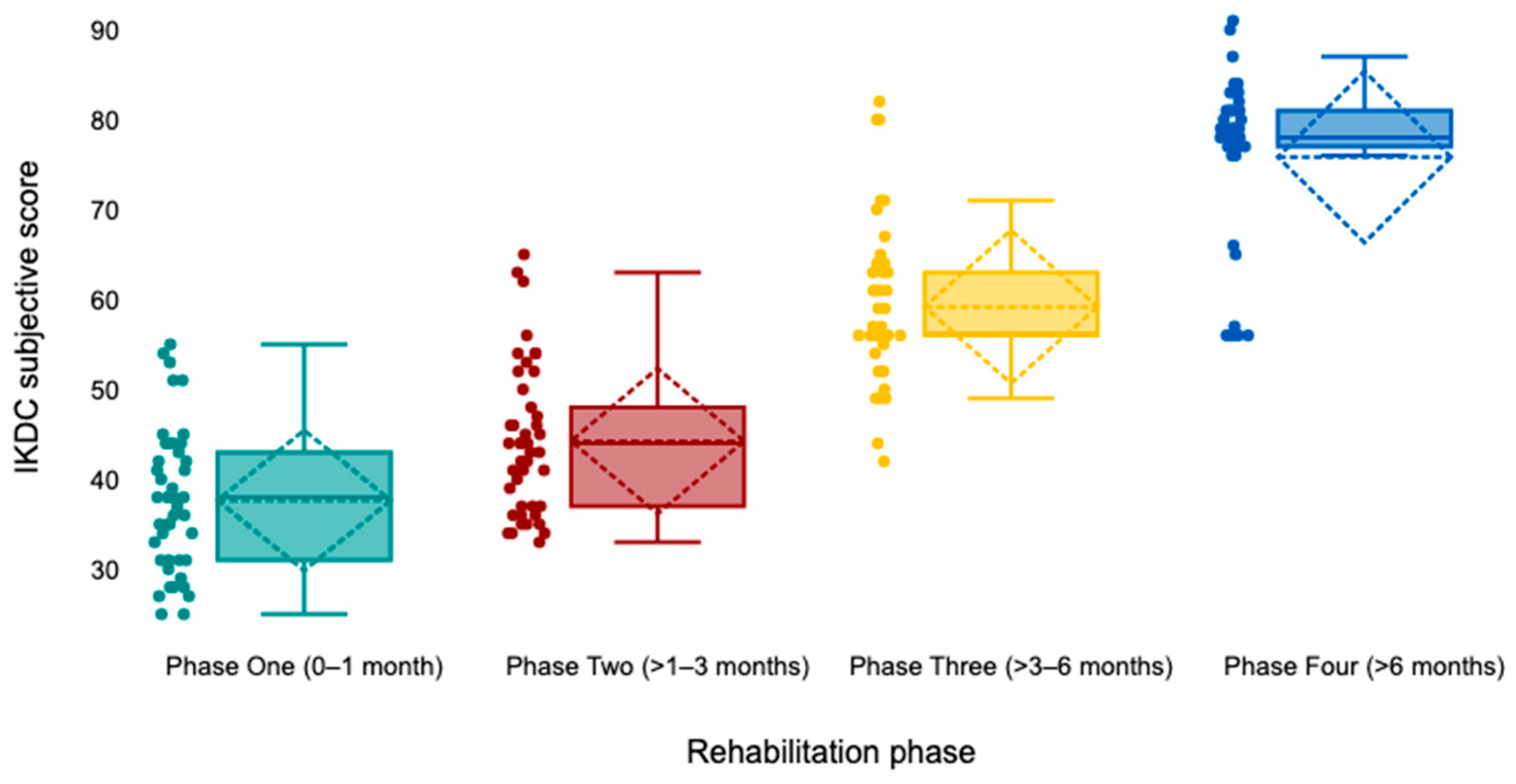
| Phase One | 51.5 (5.5) | 49.9–53.2 | 37.1 (7.2) | 34.9–39.3 | 37.6 (7.9) | 35.3–40.0 |
| Phase Two | 46.1 (6.1) | 44.2–47.9 | 42.6 (8.1) | 40.1–44.9 | 44.2 (8.2) | 41.8–46.7 |
| Phase Three | 34.7 (5.9) | 32.9–36.5 | 56.9 (9.2) | 54.2–59.7 | 59.2 (8.6) | 56.6–61.8 |
| Phase Four | 33.3 (5.6) | 31.6–34.9 | 61.8 (6.3) | 59.9–63.7 | 75.8 (9.6) | 72.9–78.7 |
| Outcome | F (df1, df2) | p |
|---|---|---|
| TSK-17 | 216.4 (3, 44) | <0.001 |
| ACL-RSI | 233.8 (3, 44) | <0.001 |
| IKDC | 348.4 (3, 44) | <0.001 |
| Outcome | Phase Comparison | Mean Difference (I–J) | 95% CI | p (Adjusted) | Cohen’s d |
|---|---|---|---|---|---|
| TSK-17 | Phase 1 vs. Phase 2 | 5.42 | 4.56–6.29 | <0.001 | 0.94 |
| Phase 1 vs. Phase 3 | 16.80 | 14.80–18.80 | <0.001 | 2.90 | |
| Phase 1 vs. Phase 4 | 18.24 | 15.71–20.78 | <0.001 | 3.15 | |
| Phase 2 vs. Phase 3 | 11.38 | 9.50–13.26 | <0.001 | 1.97 | |
| Phase 2 vs. Phase 4 | 12.82 | 10.39–15.25 | <0.001 | 2.22 | |
| Phase 3 vs. Phase 4 | 1.44 | −0.36–3.25 | 0.193 | 0.25 | |
| ACL-RSI | Phase 1 vs. Phase 2 | −5.47 | −6.60–−4.34 | <0.001 | 0.72 |
| Phase 1 vs. Phase 3 | −19.82 | −22.40–−17.25 | <0.001 | 2.40 | |
| Phase 1 vs. Phase 4 | −24.73 | −27.71–−21.75 | <0.001 | 3.65 | |
| Phase 2 vs. Phase 3 | −14.36 | −16.76–−11.95 | <0.001 | 1.66 | |
| Phase 2 vs. Phase 4 | −19.27 | −22.38–−16.15 | <0.001 | 2.65 | |
| Phase 3 vs. Phase 4 | −4.91 | −7.55–−2.27 | <0.001 | 0.62 | |
| IKDC | Phase 1 vs. Phase 2 | −6.60 | −7.51–−5.69 | <0.001 | 0.82 |
| Phase 1 vs. Phase 3 | −21.53 | −23.57–−19.49 | <0.001 | 2.61 | |
| Phase 1 vs. Phase 4 | −38.20 | −42.34–−34.07 | <0.001 | 4.34 | |
| Phase 2 vs. Phase 3 | −14.93 | −16.76–−13.10 | <0.001 | 1.78 | |
| Phase 2 vs. Phase 4 | −31.60 | −35.74–−27.46 | <0.001 | 3.54 | |
| Phase 3 vs. Phase 4 | −16.67 | −19.92–−13.41 | <0.001 | 1.83 |
Disclaimer/Publisher’s Note: The statements, opinions and data contained in all publications are solely those of the individual author(s) and contributor(s) and not of MDPI and/or the editor(s). MDPI and/or the editor(s) disclaim responsibility for any injury to people or property resulting from any ideas, methods, instructions or products referred to in the content. |
© 2026 by the authors. Licensee MDPI, Basel, Switzerland. This article is an open access article distributed under the terms and conditions of the Creative Commons Attribution (CC BY) license.
Share and Cite
AlMuhaya, A.H.; Aldera, M.; Alimam, D.M. Longitudinal Changes in Kinesiophobia, Psychological Readiness, and Knee Function Across Anterior Cruciate Ligament Reconstruction Rehabilitation Phases. Healthcare 2026, 14, 879. https://doi.org/10.3390/healthcare14070879
AlMuhaya AH, Aldera M, Alimam DM. Longitudinal Changes in Kinesiophobia, Psychological Readiness, and Knee Function Across Anterior Cruciate Ligament Reconstruction Rehabilitation Phases. Healthcare. 2026; 14(7):879. https://doi.org/10.3390/healthcare14070879
Chicago/Turabian StyleAlMuhaya, Abdullah H., Mai Aldera, and Dalia M. Alimam. 2026. "Longitudinal Changes in Kinesiophobia, Psychological Readiness, and Knee Function Across Anterior Cruciate Ligament Reconstruction Rehabilitation Phases" Healthcare 14, no. 7: 879. https://doi.org/10.3390/healthcare14070879
APA StyleAlMuhaya, A. H., Aldera, M., & Alimam, D. M. (2026). Longitudinal Changes in Kinesiophobia, Psychological Readiness, and Knee Function Across Anterior Cruciate Ligament Reconstruction Rehabilitation Phases. Healthcare, 14(7), 879. https://doi.org/10.3390/healthcare14070879