Review

Manual Therapy, Core Training, and Pilates Method Interventions in Dance Rehabilitation: A Scoping Review


by
Ioannis Tsartsapakis
1,* and
Aglaia Zafeiroudi
2
1
Department of Physical Education and Sport Sciences at Serres, Aristotle University of Thessaloniki, 62100 Serres, Greece
2
Department Physical Education and Sport Science, University of Thessaly, 42100 Trikala, Greece
*
Author to whom correspondence should be addressed.
Healthcare 2026, 14(7), 872; https://doi.org/10.3390/healthcare14070872
Submission received: 5 February 2026 / Revised: 25 March 2026 / Accepted: 27 March 2026 / Published: 28 March 2026
(This article belongs to the Special Issue Joint Manipulation for Rehabilitation of Musculoskeletal Disorders)

Highlights

What are the main findings?
  • Manual therapy remains the most frequently documented rehabilitation approach for adult dancers, while core stability and Pilates Method interventions are now actively emerging in the clinical literature, supported by recent studies.
  • Despite this progress, the available evidence remains methodologically heterogeneous and heavily reliant on case reports, though a necessary transition toward randomized controlled trials is currently underway.
What are the implications of the main findings?
  • There is a critical need for rigorous, high-quality, and dancer-specific clinical trials to empirically validate the effectiveness of manual therapy, core stability, and Pilates Method rehabilitation.
  • Developing standardized, evidence-driven clinical protocols and utilizing objective outcome measures will guide clinical decision-making, safely facilitate return to performance, and improve long-term injury outcomes in dance medicine.

Abstract

Objectives: To map and synthesize the available evidence regarding the use of manual therapy, core stability training, and Pilates Method exercises in the rehabilitation of musculoskeletal conditions in adult dancers. Methods: A scoping review was conducted in accordance with the PRISMA-ScR guidelines. A systematic search across six electronic databases (PubMed, Scopus, Web of Science, SPORTDiscus, CINAHL, and PEDro) was performed. Study eligibility was strictly guided by the Population–Concept–Context (PCC) framework. Two independent reviewers screened the literature and extracted data. Results: A total of 16 studies met the inclusion criteria, encompassing randomized controlled trials, intervention studies, and case-level reports or series. Interventions primarily addressed chronic ankle instability, low back pain, and post-surgical rehabilitation. Results indicate that while individualized manual therapy and Pilates Method protocols are widely utilized in dance medicine, high-level evidence remains limited. Conclusions: Integrated rehabilitation approaches combining manual therapy with motor control exercises (such as the Pilates Method and core training) appear to have potential utility in supporting the safe return of dancers to performance. However, the current literature is heavily reliant on observational and case-driven evidence, highlighting the need for robust clinical trials to establish standardized, dance-specific rehabilitation guidelines.

1. Introduction

1.1. Musculoskeletal Disorders in Dancers and the Need for Targeted Rehabilitation

Musculoskeletal disorders (MSDs) represent one of the most significant causes of pain, disability, and functional limitation, affecting an estimated 1.69 billion individuals worldwide [1]. These conditions encompass a broad spectrum of inflammatory, degenerative, and mechanical pathologies involving muscles, tendons, ligaments, joints, and related soft tissues. Common musculoskeletal disorders include low back pain, osteoarthritis, rheumatoid arthritis, tendinopathies, sprains, strains, and overuse injuries [2,3]. In performing artists and dancers, MSDs are particularly prevalent due to the high physical demands, repetitive loading, extreme ranges of motion, and aesthetic requirements of dance performance. Epidemiological studies consistently show that dancers experience high rates of hip pain, low back pain, tendinopathy, and stress-related injuries, often exceeding those observed in many athletic populations [4,5].
The rehabilitation needs of dancers are unique because their injuries frequently arise from complex biomechanical patterns, technique-specific demands, and prolonged training exposure. Effective management requires early diagnosis, individualized treatment planning, and interventions tailored to the stage of tissue healing and the functional requirements of dance [6,7]. Multidisciplinary and multimodal rehabilitation programs have demonstrated effectiveness in improving pain, function, and return-to-activity outcomes in MSDs, highlighting the importance of integrating physical therapy, manual therapy, exercise-based interventions, and psychosocial support [8,9]. For dancers, rehabilitation must also address movement quality, neuromuscular control, proprioception, and the restoration of technique-specific motor patterns [10,11].

1.2. Key Rehabilitation Concepts: Manual Therapy and Pilates Method Interventions

Within the specialized field of dance medicine, non-pharmacological interventions form the cornerstone of conservative management. At the forefront of these modalities are manual therapy and Pilates. In the context of this review, manual therapy is defined as a specialized area of physical therapy that utilizes skilled, hands-on techniques to treat musculoskeletal pain and dysfunction. This includes joint mobilization, joint manipulation, soft tissue techniques, and neural mobilization, which are commonly used in the management of MSDs such as low back pain and osteoarthritis [12,13]. Evidence suggests that manual therapy may improve pain, range of motion, and function in selected conditions [14], and cost-effectiveness analyses indicate it may be more economical than usual general practitioner care for some musculoskeletal conditions [15,16]. In dance medicine, manual therapy is widely used by practitioners to address joint restrictions and movement impairments [17]; however, the literature specifically examining its use in dancers remains sparse [17,18].
Similarly, Pilates Method rehabilitation refers to the clinical application of Joseph Pilates’ method, emphasizing core control, spinal alignment, and functional breathing. Its emphasis on core stability, controlled movement, flexibility, and mind–body integration aligns closely with the biomechanical and aesthetic demands of dance [19,20]. Historically, the biomechanical rationale for utilizing Pilates apparatuses in dance-specific movements has been well-documented; for instance, early kinematic analyses of the demi-plié on the Reformer provided a physiological foundation for its use as a highly specific functional conditioning and rehabilitation tool [21]. The method is grounded in six key principles—centering, concentration, control, precision, flow, and breath, which collectively aim to enhance neuromuscular efficiency and optimize movement quality [22,23]. Evidence indicates that core strengthening using the Pilates Method improves multiple components of physical fitness relevant to dancers, including trunk strength, muscular endurance, balance, and proprioception [24,25]. Pilates is also widely used in rehabilitation settings for dancers recovering from overuse injuries, offering options that can be progressively tailored to the dancer’s tolerance and functional goals [19,26].

1.3. Context of Rehabilitation in Dance Medicine

Rehabilitation for MSDs in dancers traditionally encompasses a wide range of interventions, from progressive loading protocols for tendinopathies [27] to pharmacological management and, in severe cases, surgical intervention [28]. While emerging technological innovations, such as AI-assisted systems and robotic rehabilitation, are showing promise in general clinical settings [29], their practical application in the dance community remains limited and largely unexplored. This review focuses specifically on manual therapy, core-stability training, and Pilates, as these modalities are deeply integrated into dance culture and clinical practice, yet they lack a systematic mapping of their evidence base within this high-demand population.

1.4. Rationale and Objectives

Despite the widespread clinical use of manual therapy and Pilates in dance rehabilitation, the conceptual distinctions between general performance enhancement, injury prevention, and targeted clinical rehabilitation are often blurred in the literature. Furthermore, existing studies tend to focus on isolated interventions, small samples, or non-dancer populations.
A scoping review methodology was therefore chosen over a systematic review, as it allows for the comprehensive mapping of a diverse and heterogeneous body of literature to identify existing knowledge gaps. Guided by the Population–Concept–Context (PCC) framework, the primary objective of this scoping review is to systematically identify, categorize, and synthesize the existing evidence regarding joint manipulation, mobilization, core-focused training, and interventions grounded in the Pilates Method in adult dancers with musculoskeletal disorders. By integrating evidence from dance medicine and rehabilitation science, this review aims to provide a comprehensive overview of current approaches and support evidence-informed rehabilitation strategies.

2. Materials and Methods

2.1. Study Design

This scoping review was conducted following the methodological framework originally proposed by Arksey and O’Malley [30] and subsequently refined by Levac et al. [31]. The reporting of the review adheres to the Preferred Reporting Items for Systematic Reviews and Meta-Analyses extension for Scoping Reviews (PRISMA-ScR) [32]. The protocol for this scoping review was preregistered on the Open Science Framework (OSF) on 24 January 2026 (https://doi.org/10.17605/OSF.IO/J4NRS). A scoping review methodology was deliberately chosen over a systematic review because the primary objective was to map a broad, diverse, and heterogeneous body of literature regarding musculoskeletal rehabilitation in dancers. Identifying knowledge gaps and mapping key concepts across various dance styles and intervention types was deemed more appropriate at this stage than answering a single clinical question on efficacy.
No deviations from the preregistered protocol occurred during the conduct of this scoping review.

2.2. Eligibility Criteria (PCC Framework)

Eligibility criteria were strictly guided by the Population–Concept–Context (PCC) framework [33] to ensure a transparent approach for defining the scope of the review.
In dance medicine, the boundary between late-stage rehabilitation and secondary injury prevention is inherently blurred. Interventions focusing on neuromuscular efficiency, biomechanical correction, and specific conditioning are essential components of the rehabilitation continuum to prevent injury recurrence. Therefore, studies addressing secondary prevention and biomechanical correction in dancers were considered aligned with the PCC framework’s context of musculoskeletal disorder management.
The detailed inclusion and exclusion criteria applied during the screening process are systematically summarized in Table 1.
Peer-reviewed primary research studies of any design (Randomized Controlled Trials, intervention studies) were included. The deliberate inclusion of lower-level evidence, such as case reports and case series, was deemed necessary and is explicitly justified due to the nascent state of specific dance medicine research. In high-demand populations like dancers, highly individualized clinical protocols are frequently first documented in case studies before being tested in larger trials.

2.3. Search Strategy

To ensure high reproducibility and comprehensive coverage, a systematic search was conducted across six major electronic databases: PubMed, Scopus, Web of Science, SPORTDiscus, CINAHL, and PEDro, covering the literature from database inception up to February 2026. Only English-language peer-reviewed studies were considered. The full database-specific search strategies used for each electronic database are provided in Appendix A. The exact Boolean string applied across all databases was: (“manual therapy” OR “manipulative therapy” OR mobilization OR “soft tissue therapy” OR “core training” OR “core stability” OR “core-based exercise” OR “core strengthening” OR Pilates OR “Pilates method”) AND (“musculoskeletal disorder” OR “musculoskeletal pain” OR “overuse injur*” OR injury OR rehabilitation) AND (dancer* OR “dance student*” OR “professional dance” OR ballet OR “contemporary dance”).

2.4. Study Selection

All records identified through the database searches were imported into a reference management system, where duplicates were automatically and manually removed. To minimize selection bias, the screening process was conducted blindly. Two independent reviewers screened the titles and abstracts of all unique records against the predefined PCC criteria. Studies that appeared relevant were advanced to full-text review, which was independently assessed by the same two reviewers. Any disagreements regarding study inclusion were resolved through comprehensive discussion until a consensus was reached; when necessary, a third senior reviewer was consulted.

2.5. Data Extraction and Synthesis

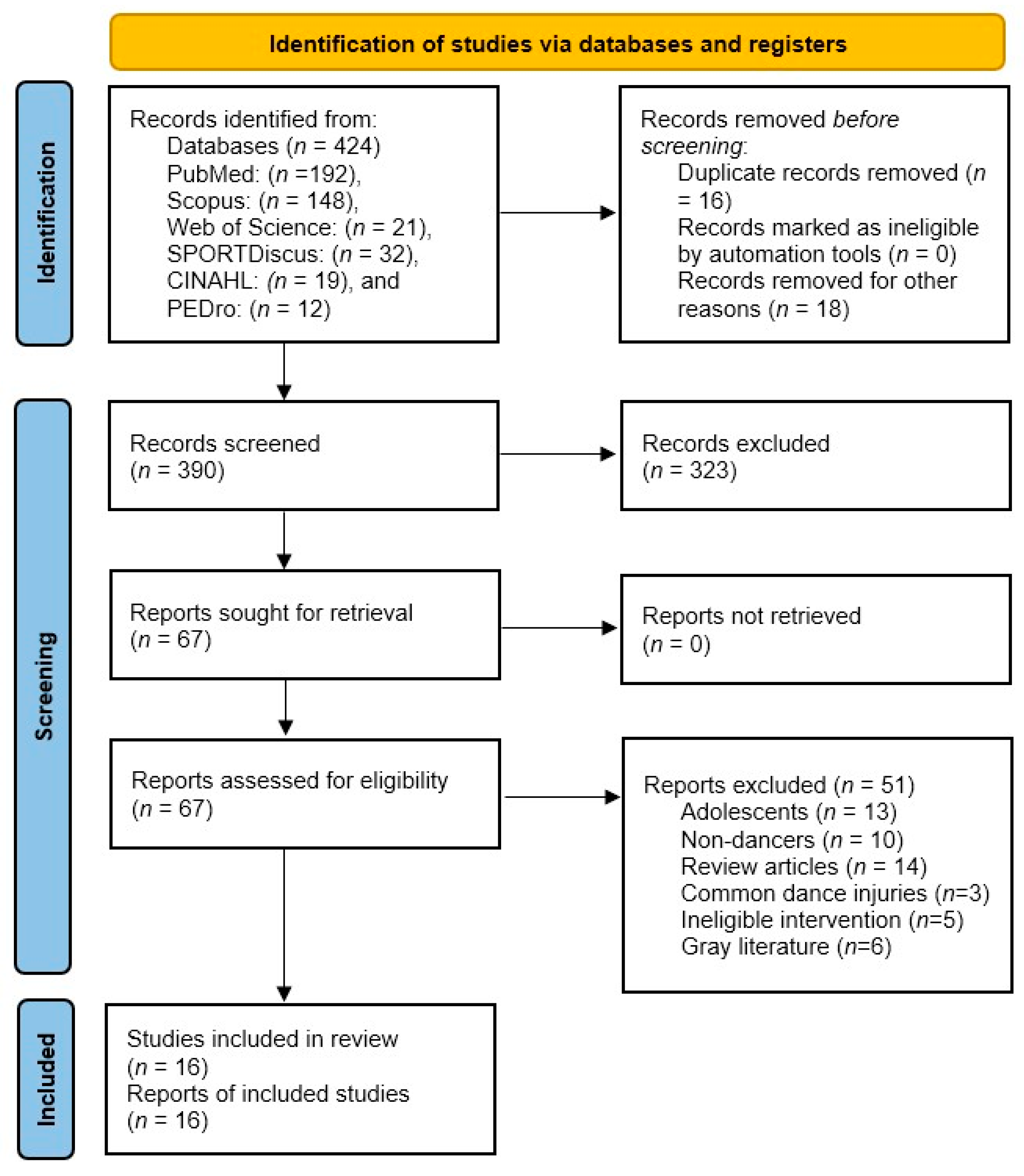
Data extraction was performed independently by two reviewers using a standardized and piloted form. Extracted data included author(s), year of publication, study design, participant demographics (dance genre and performance level), musculoskeletal condition, specific intervention details (e.g., techniques, dosage), and main clinical outcomes. Consistent with the scoping review methodology described by Peters et al. [34] and the PRISMA-ScR guidelines, a formal critical appraisal (risk-of-bias assessment) of the included studies is not mandatory, as the aim is to map the extent of evidence regardless of methodological quality. However, major methodological limitations of the literature are addressed in the discussion. Extracted data were synthesized descriptively and presented both narratively and in tabular form. The entire study selection process, from initial identification to final inclusion, is visually summarized in the PRISMA-ScR flow diagram (Figure 1).

3. Results

A total of 16 studies met the eligibility criteria and were included in the final synthesis. All studies involved adult, professional, or pre-professional dancers presenting with musculoskeletal conditions requiring rehabilitative intervention or targeted injury management. The included studies comprised a diverse range of evidence levels: one randomized controlled trial (RCT), three intervention studies, three case series, and nine case reports.
The musculoskeletal conditions mapped across the literature were highly heterogeneous, including sacroiliac joint pain, chronic ankle instability, flexor hallucis longus (FHL) stenosing tenosynovitis, acetabular labral tears, post-surgical hip and ankle dysfunction, low back pain, chronic cervicalgia, patellofemoral pain syndrome, and post-acute sequelae of SARS-CoV-2. The documented interventions were categorized into three broad modalities: manual therapy and joint manipulation, core stability/motor control training, and rehabilitation grounded in the Pilates Method.
The main characteristics of the included studies, detailing study design, participant demographics (dance style and performance level), musculoskeletal condition, intervention type, and reported outcomes—are systematically summarized in Table 2.

3.1. Manual Therapy and Joint Manipulation Approaches

Manual therapy was the most frequently mapped intervention category, represented in over half of the included studies. These studies described the clinical application of hands-on therapeutic techniques to address pain, joint dysfunction, and movement impairments in dancers. Mulligan Mobilizations with Movement were applied in dancers with sacroiliac joint pain and lower-limb overuse symptoms, with studies reporting reductions in pain intensity and improvements in functional movement patterns. Multimodal manual therapy approaches, typically including joint mobilization, soft tissue techniques, and postural retraining, were employed for spinal conditions such as chronic cervicalgia and thoracic spine pain.
More recent literature mapped the use of manual therapy in specialized post-surgical and severe injury rehabilitation contexts. Curley et al. [48] documented a structured manual therapy protocol following hip arthroscopy, observing restoration of range of motion and return to dance progression. Similarly, Khoo-Summers & Bloom [50] mapped the conservative management of acetabular labral tears using joint mobilizations. Furthermore, innovative manual techniques were identified in the literature, such as Instrument-Assisted Soft Tissue Mobilization (IASTM) combined with blood flow restriction training, which was applied to international standard dancers with chronic ankle instability [45]. Across these diverse conditions, manual therapy was frequently described as a supportive component for restoring dance-specific functional capacity.

3.2. Core Stability and Motor Control Interventions

Core-focused interventions, emphasizing the stabilization of deep trunk musculature and motor control training, were mapped across several study designs, including high-level evidence. One randomized controlled trial (RCT) was identified in this domain. Vera et al. [46] investigated a comprehensive, core-inclusive injury prevention and management program in professional ballet dancers, documenting a significant reduction in injury incidence and severity.
In lower-level evidence studies, stabilization exercises and movement reeducation were mapped in the management of focal degenerative joint disease of the spine in an adult dancer [35], while targeted core strength training was utilized for low back pain in pre-professional dancers. Interventions such as dynamic sling systems and targeted home-based core exercises reported improvements in trunk stability and pain reduction [43]. These findings highlight the critical role of core-focused rehabilitation strategies in addressing lumbo-pelvic dysfunction and optimizing the kinetic chain in dance populations.

3.3. Pilates-Based Interventions

A distinct subset of the mapped literature specifically investigated rehabilitation grounded in the Pilates Method, aligning closely with the biomechanical demands of dance. The application of specialized Pilates apparatus was documented by Che et al. [47], who investigated a 12-week Pilates Reformer training program in Latin dancers, reporting enhanced biomechanical control and improved technical execution of complex movements. Additionally, Panhan et al. [49] mapped the neuromuscular effects of Pilates Mat exercises in ballet, reporting improved neuromuscular efficiency of the multifidus and internal oblique muscles. While less frequently represented as standalone clinical interventions compared to manual therapy, these studies illustrate the emerging integration of Pilates as a therapeutic tool for neuromuscular retraining and injury management in dancers.

3.4. Summary of Patterns Across Studies

The overall pattern of findings indicates that manual therapy and core training approaches (including Pilates) are deeply embedded in the clinical management of MSDs in dancers. Notably, the evidence base appears to be transitioning. While the historical literature is heavily dominated by isolated case reports and case series, more recent publications map the introduction of a randomized controlled trial (RCT) and structured intervention studies. Across the entire body of evidence, studies consistently reported positive clinical outcomes, including reductions in pain, improvements in joint mobility, and enhanced return-to-performance metrics. However, from a scoping perspective, considerable variability remains in study designs, specific intervention dosages, and outcome measures. The lack of standardized reporting protocols across dance genres limits direct comparability, underscoring a persistent gap in universally established clinical guidelines for dance rehabilitation.

3.5. Methodological Quality Summary

In accordance with scoping review methodology, a formal risk-of-bias assessment was not performed; however, a structured qualitative appraisal of the evidence base was conducted to provide transparency regarding the strength of the findings. The majority of the included studies (n = 12, 75%) consisted of case reports and case series (Level 4 evidence). While these studies offer high clinical granularity and detail highly individualized dance-specific protocols, they are inherently limited by the absence of control groups and the inability to establish causality.
The emerging body of higher-level evidence, including one Randomized Controlled Trial (RCT) and three intervention studies, demonstrates a positive shift toward more rigorous experimental designs in dance rehabilitation. However, common methodological limitations across the literature include small sample sizes, lack of long-term follow-up, and the use of diverse, non-standardized outcome measures, which limit the ability to perform a meta-analysis. Despite these limitations, the evidence base provides a comprehensive “map” of current clinical practices, effectively highlighting the practical integration of manual therapy and the Pilates Method in the dance community.

4. Discussion

Manual therapy remains the most frequently documented approach, with a relatively broad range of techniques described. In contrast, core-focused and Pilates Method rehabilitation, despite their widespread use in clinical and professional dance settings, are transitioning from a state of being virtually absent in the literature to emerging concepts supported by recent empirical studies and a randomized controlled trial (RCT). Collectively, these findings indicate that while rehabilitation practices in dance medicine are diverse and clinically rich, the scientific evidence base is currently undergoing a necessary shift from purely descriptive accounts to structured clinical investigations.

4.1. The Established Role of Manual Therapy

Manual therapy represents one of the most established and widely utilized rehabilitation approaches in dance medicine. The literature describes a broad spectrum of hands-on techniques, including spinal manipulation, joint mobilization, soft tissue mobilization, myofascial release, massage, and manual traction, all of which aim to address soft tissue dysfunction, joint restrictions, pain, and impaired movement patterns. These techniques are frequently applied in the management of dance-related injuries due to the high physical demands placed on dancers and the prevalence of overuse conditions affecting the spine, hip, foot, and ankle. Manual therapy is used to improve tissue extensibility, increase joint range of motion, modulate pain, reduce swelling, and restore functional movement patterns essential for dance performance [51,52,53].
Spinal manipulation and mobilization are commonly described in the literature as effective methods for restoring segmental mobility and reducing pain in dancers with spinal or pelvic dysfunction. These techniques involve either high-velocity, low-amplitude thrusts or low-velocity oscillatory movements applied within the joint’s passive range, with the goal of improving joint mechanics and neuromuscular control [54,55,56]. Soft tissue techniques, including massage and myofascial release, are frequently used to address muscular tightness, fascial restrictions, and edema, which are common in dancers due to repetitive loading and high training volume [51,57,58]. Other approaches, such as manual lymphatic drainage, traction, and muscle energy techniques, are applied depending on the stage of injury and the specific tissues involved [59,60,61].
The mechanisms underlying manual therapy are multifactorial. Mechanical effects include increased tissue extensibility and improved joint mobility, while neurological effects involve modulation of proprioceptive and nociceptive input, influencing both peripheral and central pain processing [54,62,63]. Manual therapy may also restore functional movement patterns by addressing compensatory strategies that develop after injury, thereby reducing the risk of recurrence [11]. In acute injury management, manual therapy is often applied away from the injury site to control pain and maintain mobility without disrupting tissue healing. In chronic or recurrent injuries, it is used to address persistent stiffness, pain, and maladaptive movement patterns that predispose dancers to reinjury [54,64].
The recent literature has expanded this scope by mapping structured manual therapy protocols in specialized post-surgical contexts, such as hip arthroscopy [48], as well as conservative management of labral tears [50]. Furthermore, innovative integrations, such as Instrument-Assisted Soft Tissue Mobilization (IASTM) combined with blood flow restriction training [45], demonstrate the modernization of manual interventions. However, while evidence suggests that manual therapy can reduce pain and improve function, many studies rely on extrapolation from athletic or general musculoskeletal research [65,66]. The literature emphasizes that manual therapy is most effective when integrated into a comprehensive rehabilitation program that includes active exercise, neuromuscular retraining, and technique modification [67,68]. Safety considerations include avoiding aggressive soft tissue release in the presence of joint instability and ensuring that practitioners have specialized training in dance medicine [11,69]. Further research is still needed to evaluate its effectiveness in specific dance-related injuries [18,19].

4.2. Core Training and Pilates Method Interventions: An Emerging Evidence Base

Core-based and Pilates Method rehabilitation is widely used in dance medicine, particularly for improving neuromuscular control, postural alignment, and movement efficiency. Historically, its use in dance rehabilitation was based primarily on clinical experience and theoretical alignment with dance biomechanics, rather than empirical evidence, with concepts often extrapolated from non-dance populations [70,71,72,73]. The principles of Pilates align with the biomechanical demands of dance, emphasizing trunk-pelvis control and efficient force transfer.
Our review indicates that Pilates Method rehabilitation is emerging but is still dominated by low-level evidence and case studies. However, the introduction of the recent literature marks a pivotal shift. Specifically, the utilization of Pilates apparatus has been documented to enhance the biomechanical control of movement in Latin dancers [47], while Pilates Mat interventions have demonstrated improvements in the neuromuscular efficiency of stabilizing musculature [49].
Similarly, the evidence surrounding broader core stability training has recently been elevated by the inclusion of high-quality designs. A randomized controlled trial by Vera et al. [46] provides critical empirical support, demonstrating that comprehensive, core-inclusive injury prevention and motor control program significantly reduces musculoskeletal complaints and injury severity in professional and student dancers. Despite this progress, the literature traditionally relied on studies from non-dance populations [74,75,76,77], and access to specialized Pilates Method rehabilitation resources varies widely, with larger dance companies more likely to offer multidisciplinary care compared to smaller organizations [70]. Comparisons with broader clinical literature reveal that Pilates demonstrates benefits in non-dance populations [78,79,80,81,82], but the unique biomechanical demands of dance necessitate further dancer-specific controlled trials [19].

4.3. Methodological Considerations and Heterogeneity

A primary observation of this review is the significant heterogeneity regarding dance genres, injury types, and intervention protocols. The physical demands of classical ballet differ fundamentally from contemporary, modern, or Latin dance, yet the literature often treats ‘dancers’ as a monolithic group. This lack of stratification, combined with the absence of standardized core-training and Pilates protocols, complicates the synthesis of results and limits their generalizability. Detailed reporting of intervention dosages and dancer-specific adaptations remains inconsistent across the mapped literature.

4.4. The Role of Case Reports and Emerging RCTs in Elite Populations

The predominance of case reports and case series (12 out of 16 studies) reflects a known challenge in dance medicine: the difficulty of recruiting large, homogenous samples of elite performers for adequately powered clinical trials. While case reports offer lower-level evidence, they provide granular, clinical insights into highly individualized treatment pathways, a necessity in professional dance where ‘one-size-fits-all’ rehabilitation is often ineffective. Historically, this created a ‘circular’ lack of evidence where valuable clinical expertise remained undocumented in high-level trials. However, the recent emergence of an RCT [46] and structured intervention studies indicates that the field is maturing, bridging the gap between clinical practice and rigorous scientific methodology.

4.5. Implications for Future Research

For clinicians, the current evidence suggests that while Manual Therapy and Pilates are staples in the studio, their application should be guided by specific biomechanical analysis rather than tradition alone. Future research must continue to move beyond descriptive case studies. We propose the development of standardized reporting checklists for core and Pilates Method interventions and the implementation of N-of-1 trials or multi-center RCTs that account for the artistic and mechanical specificities of different dance styles. Longitudinal studies examining return-to-dance outcomes, recurrence rates, and objective biomechanical assessments (such as motion analysis and electromyography) would provide valuable insights into the long-term effectiveness of these interventions.

4.6. Limitations

This review has several limitations. While improving, the limited number of high-level studies on core-focused and Pilates Method rehabilitation in dancers restricts the breadth of evidence that could be synthesized. The heterogeneity of study designs, outcome measures, and reporting quality further restricts the ability to draw definitive conclusions. The exclusion of non-injured dancers and performance-enhancement studies, while necessary to maintain conceptual clarity (PCC framework), reduced the number of eligible studies. Finally, the reliance on published peer-reviewed literature may have excluded unpublished protocols used in professional dance settings, suggesting that the true extent of rehabilitation practices in dance medicine may be underrepresented.

5. Conclusions

This scoping review synthesized the available evidence on manual therapy, core-based training, and interventions grounded in the Pilates Method for adult dancers with musculoskeletal injuries. Manual therapy emerged as the most frequently described intervention, reflecting its long-standing role in addressing pain, joint restrictions, and soft-tissue dysfunction in dance populations. However, while its clinical utility is evident, the supporting evidence remains heavily reliant on case reports, case series, or extrapolation from broader musculoskeletal research.
Core-based and Pilates Method rehabilitation approaches, previously applied primarily in conditioning rather than rehabilitation contexts, are now emerging within the clinical literature. Specifically supported by a recent randomized controlled trial and targeted intervention studies, these modalities demonstrate potential benefits for lumbo-pelvic dysfunction, neuromuscular efficiency, and biomechanical control. Nevertheless, the overall evidence base remains narrow, methodologically heterogeneous, and constrained by small sample sizes.
Overall, the findings indicate that while rehabilitation practices in dance medicine remain heavily shaped by clinical expertise and tradition, the field is beginning a necessary transition toward empirical validation. Advancing the field will require well-designed clinical studies, detailed reporting of intervention parameters, and objective assessments tailored to the specific biomechanical and technical demands of different dance genres. Strengthening the evidence base for manual therapy, core-based training, and the emerging clinical application of Pilates will support the development of standardized, dancer-specific protocols, ultimately improving injury outcomes and supporting the long-term health and performance of dancers.

Author Contributions

Conceptualization, I.T. and A.Z.; methodology, I.T. and A.Z.; software, I.T. and A.Z.; validation, I.T. and A.Z.; formal analysis, I.T. and A.Z.; resources, I.T. and A.Z.; data curation, I.T. and A.Z.; writing—original draft preparation, I.T. writing—review and editing, I.T. and A.Z.; supervision, I.T. and A.Z.; project administration, I.T. and A.Z. All authors have read and agreed to the published version of the manuscript.

Funding

This research received no external funding.

Institutional Review Board Statement

Not applicable for scoping reviews.

Informed Consent Statement

Not applicable.

Data Availability Statement

No new data were created or analyzed in this study.

Acknowledgments

The authors acknowledge the valuable contributions of the editorial and peer-review teams for their constructive feedback, which helped improve the quality of this manuscript.

Conflicts of Interest

The authors declare no conflicts of interest.

Abbreviations

The following abbreviations are used in this manuscript:
MSDsMusculoskeletal Disorders
PRISMA-ScRPreferred Reporting Items for Systematic Reviews and Meta-Analyses extension for Scoping Reviews
OSFOpen Science Framework
PCCPopulation–Concept–Context (framework of the Joanna Briggs Institute)
PTPhysical Therapy/Physical Therapist (Table 1: “Multimodal PT”)
SIJSacroiliac Joint
FHLFlexor Hallucis Longus
MTPMetatarsophalangeal
RCTRandomized Control Trial
IASTMInstrument-Assisted Soft Tissue Mobilization

Appendix A. Full Database-Specific Search Strategies

  • PubMed (MEDLINE): (“manual therapy”[MeSH] OR “manipulative therapy” OR “mobilization” OR “soft tissue therapy” OR “core training” OR “core stability” OR “Pilates”[MeSH] OR “Pilates method”) AND (“musculoskeletal diseases”[MeSH] OR “musculoskeletal pain” OR “overuse injury” OR “rehabilitation”[MeSH]) AND (“dancing”[MeSH] OR “dancer*” OR “ballet”)
  • Scopus: TITLE-ABS-KEY (“manual therapy” OR “manipulative therapy” OR mobilization OR “soft tissue therapy” OR “core training” OR “core stability” OR “core-based exercise” OR “core strengthening” OR Pilates OR “Pilates method”) AND TITLE-ABS-KEY (“musculoskeletal disorder” OR “musculoskeletal pain” OR “overuse injur*” OR injury OR rehabilitation) AND TITLE-ABS-KEY (dancer* OR “dance student*” OR “professional dance” OR ballet OR “contemporary dance”)
  • Web of Science (Core Collection): TS = (“manual therapy” OR “manipulative therapy” OR mobilization* OR “soft tissue therapy” OR “core training” OR “core stability” OR “Pilates” OR “Pilates method”) AND TS = (“musculoskeletal disease*” OR “musculoskeletal pain” OR “overuse injur*” OR rehabilitation) AND TS = (dancer* OR ballet OR “dance student*”)
  • SPORTDiscus (EBSCOhost): TX (“manual therapy” OR “manipulative therapy” OR mobilization* OR “soft tissue therapy” OR “core training” OR “core stability” OR “Pilates”) AND TX (“musculoskeletal disease*” OR “musculoskeletal pain” OR “overuse injur*” OR rehabilitation) AND TX (dancer* OR ballet OR “dance student*”)
  • CINAHL (EBSCOhost): (MH “Manual Therapy” OR “manipulative therapy” OR mobilization* OR “core training” OR “core stability” OR MH “Pilates”) AND (MH “Musculoskeletal Diseases” OR “musculoskeletal pain” OR “overuse injury” OR MH “Rehabilitation”) AND (MH “Dancing” OR dancer* OR ballet)
  • PEDro: Note: Due to PEDro’s character limits and restricted search interface, a simplified keyword strategy was utilized in the Abstract & Title field: (dance* OR ballet) AND (Pilates OR “manual therapy” OR mobilization OR core)

References

  1. Zhou, J.; Xie, S.; Xu, S.; Zhang, Y.; Li, Y.; Sun, Q.; Zhang, J.; Zhao, T. From Pain to Progress: Comprehensive Analysis of Musculoskeletal Disorders Worldwide. J. Pain Res. 2024, 17, 3455–3472. [Google Scholar] [CrossRef] [PubMed]
  2. Woolf, A.D.; Brooks, P.; Åkesson, K.; Mody, G.M. Prevention of Musculoskeletal Conditions in the Developing World. Best Pract. Res. Clin. Rheumatol. 2008, 22, 759–772. [Google Scholar] [CrossRef]
  3. El-Tallawy, S.N.; Nalamasu, R.; Salem, G.I.; LeQuang, J.A.K.; Pergolizzi, J.V.; Christo, P.J. Management of Musculoskeletal Pain: An Update with Emphasis on Chronic Musculoskeletal Pain. Pain Ther. 2021, 10, 181–209. [Google Scholar] [CrossRef]
  4. Rinonapoli, G.; Graziani, M.; Ceccarini, P.; Razzano, C.; Manfreda, F.; Caraffa, A. Epidemiology of Injuries Connected with Dance: A Critical Review on Epidemiology. Med. Glas. 2020, 17, 256–264. [Google Scholar] [CrossRef]
  5. Henn, E.D.; Smith, T.; Ambegaonkar, J.P.; Wyon, M. Low Back Pain and Injury in Ballet, Modern, and Hip-Hop Dancers: A Systematic Review. Int. J. Sports Phys. Ther. 2020, 15, 671–687. [Google Scholar] [CrossRef]
  6. Liederbach, M. General Considerations for Guiding Dance Injury Rehabilitation. J. Dance Med. Sci. 2000, 4, 54–65. [Google Scholar] [CrossRef]
  7. Sabo, M. Physical Therapy Rehabilitation Strategies for Dancers. J. Dance Med. Sci. 2013, 17, 11–17. [Google Scholar] [CrossRef]
  8. Sennehed, C.P.; Stigmar, K.; Grahn, B.; Fischer, M.R.; Forsbrand, M.; Nyberg, A.; Petersson, I.F.; Holmberg, S. Evaluation of a Multimodal Pain Rehabilitation Programme in Primary Care Based on Clinical Register Data: A Feasibility Study. Prim. Health Care Res. Dev. 2020, 21, e2. [Google Scholar] [CrossRef] [PubMed]
  9. Sakalauskienė, G.; Obelienius, V.; Pilvinienė, R.; Jauniškienė, D. Evaluation of Daily Outpatient Multidisciplinary Rehabilitative Treatment of Patients with Musculoskeletal, Neurological and Traumatic Disorders in a Municipality Outpatient Setting. Medicina 2016, 52, 61–68. [Google Scholar] [CrossRef] [PubMed]
  10. Kadel, N. Foot and Ankle Problems in Dancers. Phys. Med. Rehabil. Clin. N. Am. 2014, 25, 829–844. [Google Scholar] [CrossRef]
  11. Hrubes, M.; Janowski, J. Rehabilitation of the Dancer. Phys. Med. Rehabil. Clin. N. Am. 2021, 32, 1–20. [Google Scholar] [CrossRef]
  12. Meroni, R.; Piscitelli, D.; Ravasio, C.; Vanti, C.; Bertozzi, L.; De Vito, G.; Perin, C.; Guccione, A.A.; Cerri, C.G.; Pillastrini, P. Evidence for Managing Chronic Low Back Pain in Primary Care: A Review of Recommendations from High-Quality Clinical Practice Guidelines. Disabil. Rehabil. 2021, 43, 1029–1043. [Google Scholar] [CrossRef]
  13. Pinto, D.; Robertson, M.C.; Abbott, J.H.; Hansen, P.; Campbell, A.J. Manual Therapy, Exercise Therapy, or Both, in Addition to Usual Care, for Osteoarthritis of the Hip or Knee. 2: Economic Evaluation alongside a Randomized Controlled Trial. Osteoarthr. Cartil. 2013, 21, 1504–1513. [Google Scholar] [CrossRef]
  14. Guzmán-Pavón, M.J.; Cavero-Redondo, I.; Martínez-Vizcaíno, V.; Torres-Costoso, A.I.; Reina-Gutiérrez, S.; Álvarez-Bueno, C. Effect of Manual Therapy Interventions on Range of Motion Among Individuals with Myofascial Trigger Points: A Systematic Review and Meta-Analysis. Pain Med. 2022, 23, 137–143. [Google Scholar] [CrossRef]
  15. Tsertsvadze, A.; Clar, C.; Court, R.; Clarke, A.; Mistry, H.; Sutcliffe, P. Cost-Effectiveness of Manual Therapy for the Management of Musculoskeletal Conditions: A Systematic Review and Narrative Synthesis of Evidence from Randomized Controlled Trials. J. Manip. Physiol. Ther. 2014, 37, 343–362. [Google Scholar] [CrossRef]
  16. Lilje, S.; van Tulder, M.; Wykman, A.; Aboagye, E.; Persson, U. Cost-Effectiveness of Specialised Manual Therapy versus Orthopaedic Care for Musculoskeletal Disorders: Long-Term Follow-up and Health Economic Model. Ther. Adv. Musculoskelet. Dis. 2023, 15, 1759720X221147751. [Google Scholar] [CrossRef]
  17. McKay, J.; Frantzen, K.; Vercruyssen, N.; Hafsi, K.; Opitz, T.; Davis, A.; Murrell, W. Rehabilitation Following Regenerative Medicine Treatment for Knee Osteoarthritis-Current Concept Review. J. Clin. Orthop. Trauma 2019, 10, 59–66. [Google Scholar] [CrossRef] [PubMed]
  18. Bronner, S.; McBride, C.; Gill, A. Musculoskeletal Injuries in Professional Modern Dancers: A Prospective Cohort Study of 15 Years. J. Sports Sci. 2018, 36, 1880–1888. [Google Scholar] [CrossRef]
  19. Koutedakis, Y.; Jamurtas, A. The Dancer as a Performing Athlete. Sport. Med. 2004, 34, 651–661. [Google Scholar] [CrossRef] [PubMed]
  20. Ahearn, E.L.; Greene, A.; Lasner, A. Some Effects of Supplemental Pilates Training on the Posture, Strength, and Flexibility of Dancers 17 to 22 Years of Age. J. Dance Med. Sci. 2018, 22, 192–202. [Google Scholar] [CrossRef] [PubMed]
  21. Self, B.P.; Bagley, A.M.; Triplett, T.L.; Paulos, L.E. Functional Biomechanical Analysis of the Pilates-Based Reformer during Demi-Plié Movements. J. Appl. Biomech. 1996, 12, 326–337. [Google Scholar] [CrossRef]
  22. Latey, P. The Pilates Method: History and Philosophy. J. Bodyw. Mov. Ther. 2001, 5, 275–282. [Google Scholar] [CrossRef]
  23. Kloubec, J.A. Pilates for Improvement of Muscle Endurance, Flexibility, Balance, and Posture. J. Strength Cond. Res. 2010, 24, 661–667. [Google Scholar] [CrossRef]
  24. Cruz-Ferreira, A.; Fernandes, J.; Gomes, D.; Bernardo, L.M.; Kirkcaldy, B.D.; Barbosa, T.M.; Silva, A. Effects of Pilates-Based Exercise on Life Satisfaction, Physical Self-Concept and Health Status in Adult Women. Women Health 2011, 51, 240–255. [Google Scholar] [CrossRef]
  25. Wang, Y.-T.; Lin, P.-C.; Huang, C.-F.; Liang, L.-C.; Lee, A.J.Y. The Effects of Eight-Week Pilates Training on Limits of Stability and Abdominal Muscle Strength in Young Dancers. World Acad. Sci. Eng. Technol. 2012, 6, 716–719. [Google Scholar]
  26. Wells, C.; Kolt, G.S.; Marshall, P.; Bialocerkowski, A. The Definition and Application of Pilates Exercise to Treat People with Chronic Low Back Pain: A Delphi Survey of Australian Physical Therapists. Phys. Ther. 2014, 94, 792–805. [Google Scholar] [CrossRef] [PubMed]
  27. Rio, E.; Kidgell, D.; Purdam, C.; Gaida, J.; Moseley, G.L.; Pearce, A.J.; Cook, J. Isometric Exercise Induces Analgesia and Reduces Inhibition in Patellar Tendinopathy. Br. J. Sports Med. 2015, 49, 1277–1283. [Google Scholar] [CrossRef]
  28. Khan, K.M.; Scott, A. Mechanotherapy: How Physical Therapists’ Prescription of Exercise Promotes Tissue Repair. Br. J. Sports Med. 2009, 43, 247–252. [Google Scholar] [CrossRef]
  29. Sumner, J.; Lim, H.W.; Chong, L.S.; Bundele, A.; Mukhopadhyay, A.; Kayambu, G. Artificial Intelligence in Physical Rehabilitation: A Systematic Review. Artif. Intell. Med. 2023, 146, 102693. [Google Scholar] [CrossRef]
  30. Arksey, H.; O’Malley, L. Scoping Studies: Towards a Methodological Framework. Int. J. Soc. Res. Methodol. 2005, 8, 19–32. [Google Scholar] [CrossRef]
  31. Levac, D.; Colquhoun, H.; O’Brien, K.K. Scoping Studies: Advancing the Methodology. Implement. Sci. 2010, 5, 69. [Google Scholar] [CrossRef]
  32. Tricco, A.C.; Lillie, E.; Zarin, W.; O’Brien, K.; Colquhoun, H.; Kastner, M.; Levac, D.; Ng, C.; Sharpe, J.P.; Wilson, K.; et al. A Scoping Review on the Conduct and Reporting of Scoping Reviews. BMC Med. Res. Methodol. 2016, 16, 15. [Google Scholar] [CrossRef]
  33. Pollock, D.; Peters, M.D.J.; Khalil, H.; McInerney, P.; Alexander, L.; Tricco, A.C.; Evans, C.; de Moraes, É.B.; Godfrey, C.M.; Pieper, D.; et al. Recommendations for the Extraction, Analysis, and Presentation of Results in Scoping Reviews. JBI Evid. Synth. 2023, 21, 520–532. [Google Scholar] [CrossRef] [PubMed]
  34. Peters, M.D.J.; Marnie, C.; Tricco, A.C.; Pollock, D.; Munn, Z.; Alexander, L.; McInerney, P.; Godfrey, C.M.; Khalil, H. Updated Methodological Guidance for the Conduct of Scoping Reviews. JBI Evid. Implement. 2021, 19, 3–10. [Google Scholar] [CrossRef] [PubMed]
  35. Hagins, M. The Use of Stabilization Exercises and Movement Reeducation to Manage Pain and Improve Function in a Dancer with Focal Degenerative Joint Disease of the Spine. J. Dance Med. Sci. 2011, 15, 136–142. [Google Scholar] [CrossRef]
  36. Krzyzanowicz, R.; Baker, R.; Nasypany, A.; Gargano, F.; Seegmiller, J. Patient Outcomes Utilizing the Selective Functional Movement Assessment and Mulligan Mobilizations with Movement on Recreational Dancers with Sacroiliac Joint Pain: A Case Series. Int. J. Athl. Ther. Train. 2015, 20, 31–37. [Google Scholar] [CrossRef]
  37. Wentzell, M. Conservative Management of a Chronic Recurrent Flexor Hallucis Longus Stenosing Tenosynovitis in a Pre-Professional Ballet Dancer: A Case Report. J. Can. Chiropr. Assoc. 2018, 62, 111. [Google Scholar]
  38. Masaracchio, M.; Kirker, K.; Collins, C.K.; Hanney, W.; Liu, X. AN INTERVENTION-BASED CLINICAL REASONING FRAMEWORK TO GUIDE THE MANAGEMENT OF THORACIC PAIN IN A DANCER: A CASE REPORT. Int. J. Sports Phys. Ther. 2016, 11, 1135–1149. [Google Scholar] [PubMed]
  39. Aguiar, L.L.; Dos Santos Araújo, V.A.; De Andrade Mesquita, L.S. Effects of Mulligan Concept in Classical Ballet Dancers with Pain in the Lower Limbs. Man. Ther. Posturology Rehabil. J. 2020, 18, 1–6. [Google Scholar] [CrossRef]
  40. Brown, S.; Disney, H. Multi-Modal Physical Therapy for a Dancer with Chronic Cervicalgia. J. Physiatry Rehabil. Stud. 2020, 1, 102. [Google Scholar]
  41. Ojofeitimi, S.; Bronner, S.; Becica, L. Conservative Management of Second Metatarsophalangeal Joint Instability in a Professional Dancer: A Case Report. J. Orthop. Sports Phys. Ther. 2016, 46, 114–123. [Google Scholar] [CrossRef]
  42. Schaeffer, M.; Jennie, H. Treating Post-Acute Sequelae of SARS-CoV-2 in a Professional Modern Dancer Using Manual Therapy: A Case Report. Orthop. Phys. Ther. Pract. 2024, 36, 29–32. [Google Scholar]
  43. Kline, J.B.; Krauss, J.R.; Maher, S.F.; Qu, X. Core Strength Training Using a Combination of Home Exercises and a Dynamic Sling System for the Management of Low Back Pain in Pre-Professional Ballet Dancers. J. Dance Med. Sci. 2013, 17, 24–33. [Google Scholar] [CrossRef]
  44. Welsh, C.; Hanney, W.J.; Podschun, L.; Kolber, M.J. Rehabilitation of a Female Dancer with Patellofemoral Pain Syndrome: Applying Concepts of Regional Interdependence in Practice. N. Am. J. Sports Phys. Ther. 2010, 5, 85–97. [Google Scholar]
  45. Liu, Y.; Wang, Y. Effect of 6-Week BFRT Combined with IASTAM Therapy on International Standard Dancers with Chronic Ankle Instability. Front. Physiol. 2024, 15, 1417544. [Google Scholar] [CrossRef]
  46. Vera, A.M.; Barrera, B.D.; Peterson, L.E.; Yetter, T.R.; Dong, D.; Delgado, D.A.; McCulloch, P.C.; Varner, K.E.; Harris, J.D. An Injury Prevention Program for Professional Ballet: A Randomized Controlled Investigation. Orthop. J. Sports Med. 2020, 8, 2325967120937643. [Google Scholar] [CrossRef] [PubMed]
  47. Che, L.; Zhou, Y.; Wang, Y. Effects of 12-Week Pilates Reformer Training on the Biomechanics of Latin Dance Cha-Cha Circle Chasing Technique. Front. Physiol. 2025, 16, 1549389. [Google Scholar] [CrossRef]
  48. Curley, A.J.; Stack, M.J.; Ruh, E.; Gibson, B.; Anderson, K.A.; Vyas, D. Return to Ballet Progression for Dancers After Hip Arthroscopy for Instability or Femoroacetabular Impingement Syndrome. Clin. J. Sport Med. 2023, 33, 458–466. [Google Scholar] [CrossRef] [PubMed]
  49. Panhan, A.C.; Gonçalves, M.; Eltz, G.D.; Villalba, M.M.; Cardozo, A.C.; Bérzin, F. Effect of Pilates Mat Exercises on Neuromuscular Efficiency of the Multifidus and Internal Oblique Muscles in a Healthy Ballerina. J. Dance Med. Sci. 2019, 23, 80–83. [Google Scholar] [CrossRef] [PubMed]
  50. Khoo-Summers, L.; Bloom, N.J. Examination and Treatment of a Professional Ballet Dancer with a Suspected Acetabular Labral Tear: A Case Report. Man. Ther. 2015, 20, 623–629. [Google Scholar] [CrossRef]
  51. McDevitt, A.W.; Young, J.L.; Cleland, J.A.; Hiefield, P.; Snodgrass, S.J. Physical Therapy Interventions Used to Treat Individuals with Biceps Tendinopathy: A Scoping Review. Brazilian J. Phys. Ther. 2024, 28, 100586. [Google Scholar] [CrossRef]
  52. Gorgos, K.S.; Wasylyk, N.T.; Van Lunen, B.L.; Hoch, M.C. Inter-Clinician and Intra-Clinician Reliability of Force Application during Joint Mobilization: A Systematic Review. Man. Ther. 2014, 19, 90–96. [Google Scholar] [CrossRef]
  53. Tsai, F.C.; Alvarez, L.X. Outcome of Eight Working Dogs with Fibrotic Myopathy Following Extracorporeal Shockwave and Rehabilitation Therapy: A Case Series. Front. Vet. Sci. 2024, 10, 1258319. [Google Scholar] [CrossRef] [PubMed]
  54. Haussler, K.K. Equine Manual Therapies in Sport Horse Practice. Vet. Clin. N. Am. Equine Pract. 2018, 34, 375–389. [Google Scholar] [CrossRef] [PubMed]
  55. Thavarajasingam, S.G.; Ramsay, D.S.C.; Namireddy, S.R.; Kamath, A.G.; Kanakala, S.; Zaidi, H.; Parikh, R.; Peerbhai, A.; Ponniah, H.S.; Arif, A.; et al. Exercise, Manipulation and Traction Physiotherapy in the Conservative Management of Lumbar Disc Herniation: A Systematic Review and Meta-Analysis. Brain Spine 2025, 5, 105632. [Google Scholar] [CrossRef] [PubMed]
  56. Funabashi, M.; Gorrell, L.M.; Pohlman, K.A.; Bergna, A.; Heneghan, N.R. Defining and Classifying Adverse Events Following Joint Manipulation and Mobilization: An International e-Delphi Study and Focus Groups. PLoS ONE 2025, 20, e0334151. [Google Scholar] [CrossRef]
  57. Dunning, D.; Halling, K.B.; Ehrhart, N. Rehabilitation of Medical and Acute Care Patients. Vet. Clin. N. Am. Small Anim. Pract. 2005, 35, 1411–1426. [Google Scholar] [CrossRef]
  58. Shoup, D. An Osteopathic Approach to Performing Arts Medicine. Phys. Med. Rehabil. Clin. N. Am. 2006, 17, 853–864. [Google Scholar] [CrossRef]
  59. Li, H.-Y.; Cheng, F.-C.; Chiang, C.-P. The Manual Lymphatic Drainage of Physical Therapy for Care of the Facial Swelling and Pain after Oral and Maxillofacial Surgery. J. Dent. Sci. 2025, 20, 1934–1936. [Google Scholar] [CrossRef]
  60. Hammond, K.E.; Kneer, L.; Cicinelli, P. Rehabilitation of Soft Tissue Injuries of the Hip and Pelvis. Clin. Sports Med. 2021, 40, 409–428. [Google Scholar] [CrossRef]
  61. Dantas, L.O.; Salvini, T.d.F.; McAlindon, T.E. Knee Osteoarthritis: Key Treatments and Implications for Physical Therapy. Braz. J. Phys. Ther. 2021, 25, 135–146. [Google Scholar] [CrossRef]
  62. Carvalho, G.F.; Adamczyk, W.M.; Ludes, C.S.; Scharbach, R.; Jung, A.; Karstens, S.; Luedtke, K.; Szikszay, T.M. Perceptions and Beliefs of Physical Therapists Regarding the Mechanisms of Manual Therapy. Braz. J. Phys. Ther. 2025, 29, 101231. [Google Scholar] [CrossRef]
  63. Harris-Hayes, M.; Zorn, P.; Steger-May, K.; Burgess, M.M.; DeMargel, R.D.; Kuebler, S.; Clohisy, J.; Haroutounian, S. Comparison of Joint Mobilization and Movement Pattern Training for Patients with Hip-Related Groin Pain: A Pilot Randomized Clinical Trial. Phys. Ther. 2023, 103, pzad111. [Google Scholar] [CrossRef]
  64. Fryer, G. Integrating Osteopathic Approaches Based on Biopsychosocial Therapeutic Mechanisms. Part 2: Clinical Approach. Int. J. Osteopath. Med. 2017, 26, 36–43. [Google Scholar] [CrossRef]
  65. Skwiot, M.; Śliwiński, Z.; Żurawski, A.; Śliwiński, G. Effectiveness of Physiotherapy Interventions for Injury in Ballet Dancers: A Systematic Review. PLoS ONE 2021, 16, e0253437. [Google Scholar] [CrossRef] [PubMed]
  66. Santana, S.D.F.; Gava, V.; de Oliveira, V.M.A.; dos Santos, G.A.; Lima, T.A.S.; Kamonseki, D.H. Does Manual Therapy Improve Pain, Disability, and Glenohumeral Motion in Overhead Athletes? Systematic Review and Meta-Analysis. Int. J. Osteopath. Med. 2025, 55, 100747. [Google Scholar] [CrossRef]
  67. Pakkir Mohamed, S.H.; Albalawi, H.F.; Nambi, G.; Shalabi, K.M.; Albalawi, M.O. Effectiveness of Manual Therapy vs Conventional Physical Therapy with Neuromuscular Training in the Management of Knee Osteoarthritis: A Randomized Clinical Controlled Trial. Int. J. Osteopath. Med. 2025, 58, 100787. [Google Scholar] [CrossRef]
  68. Mathieu, J.; Daneau, C.; Lemeunier, N.; Doyon, A.; Marchand, A.-A.; Descarreaux, M. Conservative Interventions and Clinical Outcome Measures Used in the Perioperative Rehabilitation of Breast Cancer Patients Undergoing Mastectomy: A Scoping Review. BMC Women’s Health 2022, 22, 343. [Google Scholar] [CrossRef]
  69. Haussler, K.K. The Role of Manual Therapies in Equine Pain Management. Vet. Clin. N. Am. Equine Pract. 2010, 26, 579–601. [Google Scholar] [CrossRef] [PubMed]
  70. Motta-Valencia, K. Dance-Related Injury. Phys. Med. Rehabil. Clin. N. Am. 2006, 17, 697–723. [Google Scholar] [CrossRef]
  71. Guo, X.; Lan, Q.; Ding, J.; Tang, L.; Yang, M. Effects of Different Types of Core Training on Pain and Functional Status in Patients with Chronic Nonspecific Low Back Pain: A Systematic Review and Meta-Analysis. Front. Physiol. 2025, 16, 1672010. [Google Scholar] [CrossRef]
  72. Luo, S.; Soh, K.G.; Soh, K.L.; Sun, H.; Nasiruddin, N.J.M.; Du, C.; Zhai, X. Effect of Core Training on Skill Performance Among Athletes: A Systematic Review. Front. Physiol. 2022, 13, 915259. [Google Scholar] [CrossRef]
  73. Miller, C. Dance Medicine: Current Concepts. Phys. Med. Rehabil. Clin. N. Am. 2006, 17, 803–811. [Google Scholar] [CrossRef]
  74. Arik, M.I.; Kiloatar, H.; Saracoglu, I. Do Pilates Exercises Improve Balance in Patients with Multiple Sclerosis? A Systematic Review and Meta-Analysis. Mult. Scler. Relat. Disord. 2022, 57, 103410. [Google Scholar] [CrossRef]
  75. Meikis, L.; Wicker, P.; Donath, L. Effects of Pilates Training on Physiological and Psychological Health Parameters in Healthy Older Adults and in Older Adults with Clinical Conditions over 55 Years: A Meta-Analytical Review. Front. Neurol. 2021, 12, 724218. [Google Scholar] [CrossRef]
  76. Currey, J.; Sheng, D.; Neph Speciale, A.; Cinquini, C.; Cuza, J.; Waite, B.L. Performing Arts Medicine. Phys. Med. Rehabil. Clin. N. Am. 2020, 31, 609–632. [Google Scholar] [CrossRef]
  77. Panhan, A.C.; Gonçalves, M.; Cardozo, A.C. Effect of Pilates Intervention on the Physical Conditioning of a Ballet Dancer: A Single Case Study. J. Chiropr. Med. 2024, 23, 64–69. [Google Scholar] [CrossRef] [PubMed]
  78. Huang, K.; Cai, H. The Interplay between Osteoarthritis and Osteoporosis: Mechanisms, Implications, and Treatment Considerations—A Narrative Review. Exp. Gerontol. 2024, 197, 112614. [Google Scholar] [CrossRef] [PubMed]
  79. Xu, M.; Tian, C.; Wang, Y.; Liang, S.; Wang, Y.; Li, X.; Yang, K. Pilates and Multiple Health Outcomes: An Umbrella Review. J. Sci. Med. Sport 2023, 26, 232–240. [Google Scholar] [CrossRef]
  80. Ghazel, N.; Souissi, A.; Salhi, I.; Dergaa, I.; Martins-Costa, H.C.; Musa, S.; Ben saad, H.; Ben Abderrahman, A. Effects of Eight Weeks of Mat Pilates Training on Selected Hematological Parameters and Plasma Volume Variations in Healthy Active Women. PLoS ONE 2022, 17, e0267437. [Google Scholar] [CrossRef] [PubMed]
  81. Hodgkins, C.W.; Kennedy, J.G.; O’Loughlin, P.F. Tendon Injuries in Dance. Clin. Sports Med. 2008, 27, 279–288. [Google Scholar] [CrossRef] [PubMed]
  82. Bower, K.; Nasrallah, C.M.; Barrera, B.; Varner, K.E.; Han, A.Y. On-Site Clinical Care for Professional Dance Companies. Phys. Med. Rehabil. Clin. N. Am. 2021, 32, 137–153. [Google Scholar] [CrossRef] [PubMed]
Figure 1. PRISMA-ScR flow diagram illustrating the study selection process. A total of 424 records were identified through database searching (PubMed: 192, Scopus: 148, Web of Science: 21, SPORTDiscus: 32, CINAHL: 19, and PEDro: 12) After removing duplicates and screening records, full-text eligibility was assessed. Ultimately, 16 studies met the inclusion criteria and were incorporated into the final synthesis.
Healthcare 14 00872 g001
Table 1. Inclusion and exclusion criteria based on the Population–Concept–Context (PCC) framework.
FrameworkInclusion CriteriaExclusion Criteria
Population (P)Adult dancers (aged ≥ 18 years) of any skill level (professional, pre-professional, amateur) across all dance genres (e.g., ballet, contemporary, modern, Latin).Studies focusing exclusively on children/adolescents (under 18) or non-dancer populations (unless dancer-specific data are reported separately).
Concept (C)Rehabilitation interventions specifically involving Manual Therapy techniques (e.g., joint mobilization, manipulation, IASTM), Core-stability, or the Pilates Method.Interventions used solely for general fitness, aesthetic performance enhancement without an injury context, or modalities completely unrelated to manual/core/Pilates.
Context (C)Clinical, sports, performing arts, or educational environments focused on injury management, post-surgical rehabilitation, or rehabilitation of musculoskeletal disorders (MSDs).Literature without a clinical or rehabilitative focus; grey literature, dissertations, theses, conference abstracts, non-peer-reviewed sources, and non-English studies.
Table 2. Summary of included studies mapping study design, dancer population, specific condition, rehabilitative intervention, and reported outcomes.
StudyStudy DesignPopulation and ConditionInterventionMain Outcomes
Hagins [35]Case reportAdult dancer with focal degenerative joint disease of the spineType: Stabilization exercises
Components: Movement reeducation
  • Observed pain reduction
  • Improved spinal function
Krzyzanowicz et al. [36]Case seriesRecreational adult dancers with sacroiliac joint painType: Mulligan Concept
Components: Mobilizations with Movement
  • Observed decreased SIJ pain
  • Improved function
Wentzell [37]Case reportPre-professional ballet dancer with chronic recurrent FHL stenosing tenosynovitisType: Conservative management
Components: Manual therapy and exercise
  • Observed symptom reduction
  • Restored pointe work
Masaracchio et al. [38]Case reportAdult dancer with thoracic spine painType: Multimodal PT
Components: Manual therapy and movement training
  • Observed pain reduction
  • Improved thoracic mobility
Aguiar et al. [39]Intervention studyClassical ballet dancers with lower-limb painType: Manual therapy
Components: Mulligan Concept mobilizations
  • Observed reduced pain
  • Improved ROM
Brown & Disney [40]Case reportAdult dancer with chronic cervicalgiaType: Multimodal physical therapy
  • Observed decreased neck pain
  • Improved cervical function
Ojofeitimi [41]Case reportProfessional dancer with second MTP joint instabilityType: Conservative management
Components: Manual therapy and taping
  • Observed improved joint stability
  • Return to performance
Schaeffer & Harary [42]Case reportProfessional modern dancer with post-acute sequelae of SARS-CoV-2Type: Manual therapy-based rehabilitation
  • Observed improved endurance
  • Enhanced functional capacity
Kline and Kraus [43]Case seriesPre-professional ballet dancers with low back painType: Core strength training
Components: Home exercises and sling system
  • Observed reduced low back pain
  • Improved core function
Welsh et al. [44]Case reportAdult female dancer with patellofemoral pain syndromeType: Regional interdependence-based rehab
Components: Manual therapy
  • Observed pain reduction
  • Improved functional capacity
Liu & Wang [45]Intervention studyInternational standard dancers with Chronic Ankle Instability (CAI)Type: IASTM
Components: Combined with Blood Flow Restriction Training (BFRT)
  • Observed improved ankle stability
  • Improved strength and proprioception
Vera et al. [46]RCTProfessional ballet dancers (Injury prevention/management)Type: Comprehensive Injury Prevention Program
Components: Core and functional training
  • Associated with a reduction in injury incidence and severity
Che et al. [47]Intervention studyLatin dancers (Biomechanical technique dysfunction)Type: Pilates Reformer training
Duration: 12 weeks
  • Observed enhanced biomechanical control of movement
Curley et al. [48]Case seriesProfessional ballet dancers post-Hip ArthroscopyType: Post-surgical rehab protocol
Components: Joint mobilizations, manual therapy and progressive loading
  • Observed successful return to ballet progression
  • Return to performance
Panhan et al. [49]Case reportBallet dancer (Neuromuscular efficiency/Injury prevention focus)Type: Pilates Method
Components: Mat exercises
  • Observed improved neuromuscular efficiency of multifidus/obliques
Khoo-Summers & Bloom [50]Case reportProfessional ballet dancer with acetabular labral tearType: Manual therapy and neuromuscular retraining
Components: Joint mobilizations
  • Associated with avoidance of surgery
  • Pain resolution
  • Full return to performance
Note: SIJ = sacroiliac joint; FHL = flexor hallucis longus; PT = physical therapy; ROM = range of motion; MTP = metatarsophalangeal; RCT = Randomized Controlled Trial; IASTM = Instrument-Assisted Soft Tissue Mobilization. Bold text highlights the categorization of interventions into ‘Type’ (general approach) and ‘Components’ (specific methods used).
Disclaimer/Publisher’s Note: The statements, opinions and data contained in all publications are solely those of the individual author(s) and contributor(s) and not of MDPI and/or the editor(s). MDPI and/or the editor(s) disclaim responsibility for any injury to people or property resulting from any ideas, methods, instructions or products referred to in the content.