Public Knowledge and Perceptions of Fentanyl Test Strips: A National Cross-Sectional Survey Informed by the Health Belief Model

 , ,
, ,
Abstract
1. Introduction
2. Materials and Methods
2.1. Study Design and Participant Recruitment
2.2. Data Collection and Measures
2.3. Data Analysis
3. Results
3.1. Participant Characteristics
3.2. Knowledge
3.3. Perceived Susceptibility
3.4. Perceived Severity
3.5. Perceived Benefits
3.6. Perceived Barriers
3.7. Comfort
3.8. Confidence
3.9. Intentions
4. Discussion
Limitations
5. Conclusions
Supplementary Materials
Author Contributions
Funding
Institutional Review Board Statement
Informed Consent Statement
Data Availability Statement
Acknowledgments
Conflicts of Interest
Abbreviations
| CDC | Centers for Disease Control and Prevention |
| DEA | Drug Enforcement Administration |
| FTS | Fentanyl test strips |
| PWUD | People who use drugs |
| SD | Standard deviation |
| SAMHSA | Substance Abuse and Mental Health Services Administration |
| U.S. | United States |
References
- Reed, M.K.; Salcedo, V.J.; Guth, A.; Rising, K.L. “If I had them, I would use them every time”: Perspectives on fentanyl test strip use from people who use drugs. J. Subst. Abuse Treat. 2022, 140, 108790. [Google Scholar] [CrossRef]
- National Institute on Drug Abuse. Fentanyl. Available online: https://www.ncbi.nlm.nih.gov/pubmed/ (accessed on 25 July 2025).
- Palamar, J.J.; Cottler, L.B.; Goldberger, B.A.; Severtson, S.G.; Grundy, D.J.; Iwanicki, J.L.; Ciccarone, D. Trends in characteristics of fentanyl-related poisonings in the United States, 2015–2021. Am. J. Drug Alcohol Abus. 2022, 48, 471–480. [Google Scholar] [CrossRef]
- Centers for Disease Control and Prevention (CDC). What You Can Do to Test for Fentanyl. Available online: https://www.cdc.gov/stop-overdose/safety/index.html (accessed on 10 July 2025).
- Allen, S.T.; O’Rourke, A.; White, R.H.; Sherman, S.G.; Grieb, S.M. Perspectives on fentanyl test strip use among people who inject drugs in rural Appalachia. Subst. Use Misuse 2020, 55, 1594–1600. [Google Scholar] [CrossRef] [PubMed]
- Krieger, M.S.; Goedel, W.C.; Buxton, J.A.; Lysyshyn, M.; Bernstein, E.; Sherman, S.G.; Rich, J.D.; Hadland, S.E.; Green, T.C.; Marshall, B.D. Use of rapid fentanyl test strips among young adults who use drugs. Int. J. Drug Policy 2018, 61, 52–58. [Google Scholar] [CrossRef] [PubMed]
- Barrolle, A.A.; Gable, K.N.; Dell, N. A pilot study assessing client understanding and use of fentanyl test strips for harm reduction. J. Am. Pharm. Assoc. 2023, 63, 295–300. [Google Scholar] [CrossRef]
- Peiper, N.C.; Clarke, S.D.; Vincent, L.B.; Ciccarone, D.; Kral, A.H.; Zibbell, J.E. Fentanyl test strips as an opioid overdose prevention strategy: Findings from a syringe services program in the Southeastern United States. Int. J. Drug Policy 2019, 63, 122–128. [Google Scholar] [CrossRef]
- Goldman, J.E.; Waye, K.M.; Periera, K.A.; Krieger, M.S.; Yedinak, J.L.; Marshall, B.D. Perspectives on rapid fentanyl test strips as a harm reduction practice among young adults who use drugs: A qualitative study. Harm Reduct. J. 2019, 16, 3. [Google Scholar] [CrossRef] [PubMed]
- Park, J.N.; Frankel, S.; Morris, M.; Dieni, O.; Fahey-Morrison, L.; Luta, M.; Hunt, D.; Long, J.; Sherman, S.G. Evaluation of fentanyl test strip distribution in two Mid-Atlantic syringe services programs. Int. J. Drug Policy 2021, 94, 103196. [Google Scholar] [CrossRef]
- Woods, S.; Blythe, E.; Valle-Ramos, G.; Richardson, J.; Pham, K.; Diggs, K.; Harris, K.; Zhao, Y.; Hohmann, L. Alabama community pharmacists’ knowledge and perceptions regarding fentanyl test strips: A cross-sectional survey. J. Am. Pharm. Assoc. 2025, 65, 102148. [Google Scholar] [CrossRef]
- Marley, G.T.; Ostrach, B.; Carpenter, D. North Carolina pharmacists’ willingness to sell fentanyl test strips: A survey study. Harm Reduct. J. 2023, 20, 10. [Google Scholar] [CrossRef]
- Blanco, C.; Wiley, T.R.A.; Lloyd, J.J.; Lopez, M.F.; Volkow, N.D. America’s opioid crisis: The need for an integrated public health approach. Transl. Psychiatry 2020, 10, 167. [Google Scholar] [CrossRef]
- Paolacci, G.; Chandler, J. Inside the Turk: Understanding Mechanical Turk as a participant pool. Curr. Dir. Psychol. Sci. 2014, 23, 184–188. [Google Scholar] [CrossRef]
- Burnham, M.J.; Le, Y.K.; Piedmont, R.L. Who is Mturk? Personal characteristics and sample consistency of these online workers. Ment. Health Relig. Cult. 2018, 21, 934–944. [Google Scholar] [CrossRef]
- Peer, E.; Vosgerau, J.; Acquisti, A. Reputation as a sufficient condition for data quality on Amazon Mechanical Turk. Behav. Res. Methods 2014, 46, 1023–1031. [Google Scholar] [CrossRef]
- Universität Düsseldorf. G*Power: Statistical Power Analyses. Available online: https://www.psychologie.hhu.de/arbeitsgruppen/allgemeine-psychologie-und-arbeitspsychologie/gpower (accessed on 8 March 2022).
- Faul, F.; Erdfelder, E.; Buchner, A.; Lang, A.-G. Statistical power analyses using G* Power 3.1: Tests for correlation and regression analyses. Behav. Res. Methods 2009, 41, 1149–1160. [Google Scholar] [CrossRef]
- Heinrich Heine Universitat. G*Power Manual. Available online: https://www.psychologie.hhu.de/fileadmin/redaktion/Fakultaeten/Mathematisch-Naturwissenschaftliche_Fakultaet/Psychologie/AAP/gpower/GPowerManual.pdf (accessed on 20 January 2023).
- Rosenstock, I.M.; Strecher, V.J.; Becker, M.H. Social learning theory and the health belief model. Health Educ. Behav. 1988, 15, 175–183. [Google Scholar] [CrossRef]
- Drug Enforcement Administration (DEA). Facts About Fentanyl. Available online: https://www.dea.gov/resources/facts-about-fentanyl (accessed on 10 July 2025).
- Drug Enforcement Administration (DEA). DEA Warns of Brightly-Colored Fentanyl Used to Target Young Americans. Available online: https://www.dea.gov/press-releases/2022/08/30/dea-warns-brightly-colored-fentanyl-used-target-young-americans (accessed on 10 July 2025).
- Substance Abuse and Mental Health Services Administration (SAMHSA). Fentanyl and Xylazine Test Strips. Available online: https://www.samhsa.gov/substance-use/treatment/overdose-prevention/fentanyl-xylazine-test-strips (accessed on 10 July 2025).
- Virginia Department of Health. Harm Reduction. Available online: https://www.vdh.virginia.gov/blue-ridge/community-health-programs-resources/opioids/ (accessed on 10 July 2025).
- Eerie County Department of Health. How to Use Fentanyl Test Strips. Available online: https://www.youtube.com/watch?v=3cekcttnXoI (accessed on 10 July 2025).
- Ramos-Matos, C.F.; Bistas, K.G.; Lopez-Ojeda, W. Fentanyl. Available online: https://www.ncbi.nlm.nih.gov/books/NBK459275/ (accessed on 10 July 2025).
- Amazon. Emnce Fentanyl Test Strips Home Drug Testing Kit. Available online: https://www.amazon.com/Emnce-Company-FYL-Testing-Strips/dp/B0B9W5GJT7?th=1 (accessed on 10 July 2025).
- Office of Justice Programs. Harm Reduction Laws in the United States. Available online: https://www.ojp.gov/library/publications/harm-reduction-laws-united-states (accessed on 10 July 2025).
- Idaho State Legislature. HOUSE BILL 441. Available online: https://legislature.idaho.gov/sessioninfo/2024/legislation/H0441/ (accessed on 10 July 2025).
- Legislative Analysis and Public Policy Association. Fentanyl Test Strips. Available online: https://legislativeanalysis.org/wp-content/uploads/2021/05/Fentanyl-Teststrips-FINAL-1.pdf (accessed on 14 December 2023).
- Tilford, S. The Life-Saving Drug That No One Knows About: Naloxone Education and the Health Belief Model. Bachelor’s Thesis, University of San Diego, San Diego, CA, USA, 2020. [Google Scholar] [CrossRef]
- Reed, M.K.; Roth, A.M.; Tabb, L.P.; Groves, A.K.; Lankenau, S.E. “I probably got a minute”: Perceptions of fentanyl test strip use among people who use stimulants. Int. J. Drug Policy 2021, 92, 103147. [Google Scholar] [CrossRef] [PubMed]
- Bonar, E.E.; Rosenberg, H. Using the health belief model to predict injecting drug users’ intentions to employ harm reduction strategies. Addict. Behav. 2011, 36, 1038–1044. [Google Scholar] [CrossRef] [PubMed]
- United States Department of Agriculture (USDA). 2010 Rural-Urban Commuting Area (RUCA) Codes. Available online: https://www.ers.usda.gov/data-products/rural-urban-commuting-area-codes/documentation/ (accessed on 24 March 2020).
- University of Chicago School of Medicine: Primary Care-Behavioral Health Integration Program. DAST-10. Available online: https://bpb-us-w2.wpmucdn.com/voices.uchicago.edu/dist/9/2662/files/2024/11/DAST-10.pdf (accessed on 10 July 2025).
- Skinner, H.A. The drug abuse screening test. Addict. Behav. 1982, 7, 363–371. [Google Scholar] [CrossRef]
- United States Census Bureau. US Census Bureau Quickfacts: United States. Available online: https://www.census.gov/quickfacts/fact/table/US/PST045224#PST045224 (accessed on 4 May 2025).
- United States Census Bureau. America is Getting Older. Available online: https://www.census.gov/newsroom/press-releases/2023/population-estimates-characteristics.html (accessed on 14 September 2023).
- Mistler, C.; Rosen, A.; Eger, W.; Copenhaver, M.; Shrestha, R. Fentanyl test strip use and overdose history among individuals on medication for opioid use disorder. Austin J. Public Health Epidemiol. 2021, 8, 1117. Available online: https://pubmed.ncbi.nlm.nih.gov/35782633/ (accessed on 10 July 2025). [PubMed]
- Moallef, S.; Nosova, E.; Milloy, M.; DeBeck, K.; Fairbairn, N.; Wood, E.; Kerr, T.; Hayashi, K. Knowledge of fentanyl and perceived risk of overdose among persons who use drugs in Vancouver, Canada. Public Health Rep. 2019, 134, 423–431. [Google Scholar] [CrossRef] [PubMed]
- Balla, J.; Hagger, M.S. Protection motivation theory and health behaviour: Conceptual review, discussion of limitations, and recommendations for best practice and future research. Health Psychol. Rev. 2024, 19, 145–171. [Google Scholar] [CrossRef] [PubMed]
- Parry, R.A.; Zule, W.A.; Hurt, C.B.; Evon, D.M.; Rhea, S.K.; Carpenter, D.M. Pharmacist attitudes and provision of harm reduction services in North Carolina: An exploratory study. Harm Reduct. J. 2021, 18, 70. [Google Scholar] [CrossRef]
- Odongo, M. Health communication campaigns and their impact on public health behaviors. J. Commun. 2024, 5, 55–69. [Google Scholar] [CrossRef]
- White, S.A.; Lee, R.; Kennedy-Hendricks, A.; Sherman, S.G.; McGinty, E.E. Perspectives of US harm reduction advocates on persuasive message strategies. Harm Reduct. J. 2023, 20, 112. [Google Scholar] [CrossRef]
- Bandara, S.; Byrne, L.; Berman, V.; Hurst, A.; King, D.; Gibbons, J.B.; Sugarman, O.K.; Livingston, A.; Kerins, L.; Hulsey, E.G. Harm Reduction and Treatment Among People at High Risk of Overdose. JAMA Netw. Open 2024, 7, e2427241. [Google Scholar] [CrossRef] [PubMed]
- Rosenstock, I.M. Historical origins of the health belief model. Health Educ. Monogr. 1974, 2, 328–335. [Google Scholar] [CrossRef]
- Hagemeier, N.E.; Alamian, A.; Murawski, M.M.; Pack, R.P. Factors associated with provision of addiction treatment information by community pharmacists. J. Subst. Abuse Treat. 2015, 52, 67–72. [Google Scholar] [CrossRef]
- Piatkowski, T.; Benn, S.; Ayurzana, L.; King, M.; McMillan, S.; Hattingh, L. Exploring the role of community pharmacies as a harm reduction environment for anabolic–androgenic steroid consumers: Triangulating the perspectives of consumers and pharmacists. Harm Reduct. J. 2024, 21, 59. [Google Scholar] [CrossRef]


| Demographics | n (%) a |
|---|---|
| Gender Male Female | 115 (55.8%) 89 (43.2%) |
| Race White Black or African American Asian Native American or Alaska Native Multiracial | 171 (83.0%) 19 (9.2%) 10 (4.9%) 1 (0.5%) 4 (1.9%) |
| Ethnicity Hispanic Non-Hispanic | 9 (4.4%) 197 (95.6%) |
| Highest level of education High school diploma, GED, or equivalent Some college Associate degree Bachelor’s degree Graduate degree | 29 (14.1%) 44 (21.4%) 24 (11.7%) 84 (40.8%) 25 (12.1%) |
| Current living situation Own home Rent home/apartment Living with family/friends | 106 (51.5%) 70 (34.0%) 29 (14.1%) |
| Employment status Employed full-time Employed part-time Unemployed Retired Other | 144 (69.9%) 36 (17.5%) 10 (4.9%) 10 (4.9%) 3 (1.5%) |
| Primary mode of transportation Personal vehicle Public transportation Bicycle Walking Other | 176 (85.4%) 10 (4.9%) 1 (0.5%) 12 (5.8%) 5 (2.4%) |
| Do you have health insurance? Yes No | 173 (84.0%) 28 (13.6%) |
| Geographic Setting Rural Urban | 38 (18.5) 167 (81.5) |
| Aware of FTS Yes No | 66 (33.3) 132 (66.7) |
| FTS Usage History Yes No | 3 (1.5%) 202 (98.1) |
| Recreational Drug Use History Yes No | 120 (58.3) 85 (41.5) |
| Age in years, Mean (SD) | 46.39 (11.24) Median: 44.5 |
| (a) Objective Knowledge | Mean (SD) |
|---|---|
| % of Objective Knowledge Questions Answered Correctly | 52.73 (25.69) |
| Objective Knowledge Items | n (%) a |
| Fentanyl is an opioid. Correct response: True | 156 (75.7) |
| Fentanyl is 50–100 times stronger than morphine. Correct response: True | 150 (72.8) |
| Fentanyl is only used illegally and has no legitimate medical use. Correct response: False | 153 (74.3) |
| Exposure to even a small amount of fentanyl can be fatal. Correct response: True | 161 (78.2) |
| FTS can detect the presence of fentanyl in other drugs. Correct response: True | 133 (64.6) |
| FTS are an effective harm reduction tool that can help prevent overdoses. Correct response: True | 140 (68) |
| FTS can be used to test substances in which form(s)? Correct Response: All of the above (Powder, Pill, & Liquid) | 98 (47.6) |
| What is the legal status of FTS in the United States? Correct response: FTS are legal to own and use in some states | 23 (11.2) |
| Which substances can FTS detect? Correct response: Fentanyl and most fentanyl analogs | 99 (48.1) |
| How quickly do FTS provide results? Correct response: Within 2 to 5 min | 86 (41.7) |
| How often should you test a drug batch with FTS, even if previous batches were negative? Correct response: Every batch should be tested | 113 (54.9) |
| What can FTS tell you about the amount of fentanyl in a drug? Correct response: They cannot measure the amount | 65 (31.1) |
| FTS costs about $1.00 per test strip. Correct response: True | 37 (18.0) |
| (b) Subjective Knowledge | Mean (SD) |
| Self-Rated Knowledge Average Scale Score | 2.47 (0.80) |
| Subjective Knowledge Items | n (%) |
| I need more education on fentanyl. Strongly disagree Disagree Neutral Agree Strongly agree | 12 (5.9) 15 (7.4) 26 (12.7) 111 (54.4) 40 (19.6) |
| I am aware of the side effects of using fentanyl. Strongly disagree Disagree Neutral Agree Strongly agree | 25 (12.3) 57 (27.9) 30 (14.7) 60 (29.4) 32 (15.7) |
| I know what a fentanyl overdose looks like. Strongly disagree Disagree Neutral Agree Strongly agree | 47 (22.9) 94 (45.9) 21 (10.2) 34 (16.6) 9 (4.4) |
| I need more knowledge about how to use FTS. Strongly disagree Disagree Neutral Agree Strongly agree | 18 (8.8) 22 (10.7) 26 (12.7) 86 (42) 53 (25.9) |
| I need more training on where to obtain FTS. Strongly disagree Disagree Neutral Agree Strongly agree | 21 (10.3) 38 (18.6) 30 (14.7) 75 (36.8) 40 (19.6) |
| I already have enough knowledge about FTS. Strongly disagree Disagree Neutral Agree Strongly agree | 53 (26.4) 93 (46.3) 32 (15.9) 16 (8) 7 (3.5) |
| (a) Usage History | |||||||||||||
|---|---|---|---|---|---|---|---|---|---|---|---|---|---|
| Measures | Mean (SD) | ||||||||||||
| Overall | FTS Awareness | FTS Usage | Recreational Drug Use History | ||||||||||
| Yes | No | p-Value a | Yes | No | p-Value a | Yes | No | p-Value a | |||||
| Objective Knowledge, % | 52.73 (25.69) | 65.04 (18.71) | 47.32 (26.64) | <0.001 * | 84.62 (13.32) | 52.40 (25.57) | 0.025 * | 55.26 (23.85) | 49.86 (27.47) | 0.201 | |||
| Subjective Knowledge | 2.47 (8.0) | 2.66 (0.83) | 2.38 (0.77) | 0.012 * | 4.07 (1.00) | 2.44 (0.77) | 0.012 * | 2.49 (0.77) | 2.45 (0.84) | 0.614 | |||
| Susceptibility | 1.93 (0.57) | 2.09 (0.60) | 1.84 (0.54) | 0.003 * | 3.47 (0.52) | 1.91 (0.54) | 0.004 * | 2.07 (0.62) | 1.75 (0.43) | <0.001 * | |||
| Severity | 4.63 (0.38) | 4.65 (0.39) | 4.64 (0.37) | 0.587 | 4.50 (0.62) | 4.63 (0.38) | 0.773 | 4.63 (0.38) | 4.63 (0.39) | 0.861 | |||
| Benefits | 4.15 (0.84) | 4.25 (0.59) | 4.15 (0.62) | 0.281 | 4.30 (0.61) | 4.17 (0.62) | 0.850 | 4.17 (0.58) | 4.19 (0.66) | 0.556 | |||
| Barriers | 2.53 (1.14) | 2.73 (0.74) | 2.64 (0.79) | 0.350 | 2.92 (0.60) | 2.67 (0.78) | 0.559 | 2.70 (0.75) | 2.66 (0.81) | 0.611 | |||
| Comfort | 3.55 (0.87) | 3.71 (0.82) | 3.48 (0.90) | 0.139 | 3.00 (0.47) | 3.56 (0.88) | 0.190 | 3.60 (0.85) | 3.50 (0.89) | 0.553 | |||
| Confidence | 3.67 (0.69) | 3.84 (0.70) | 3.60 (0.68) | 0.010 * | 4.39 (0.73) | 3.67 (0.68) | 0.097 | 3.75 (0.62) | 3.57 (0.77) | 0.182 | |||
| Intention | 2.78 (0.94) | 2.84 (0.89) | 2.72 (0.98) | 0.473 | 3.28 (0.35) | 2.77 (0.94) | 0.353 | 2.90 (0.91) | 2.61 (0.97) | 0.041 * | |||
| (b) Sociodemographics | |||||||||||||
| Measures | Mean (SD) | ||||||||||||
| Overall | Geographic Setting | Sex | Race | Age | |||||||||
| Urban | Rural | p-Value a | Male | Female | p-Value a | White | All Other Races b | p-Value a | ≤Median 44.5 | >Median 44.5 | p-Value a | ||
| Objective Knowledge, % | 52.73 (25.69) | 52.97 (25.70) | 52.83 (25.62) | 0.988 | 52.11 (26.49) | 53.50 (25.03) | 0.663 | 53.44 (25.56) | 49.45 (26.47) | 0.417 | 55.12 (26.36) | 50.41 (24.91) | 0.184 |
| Subjective Knowledge | 2.47 (8.0) | 2.48 (0.78) | 2.42 (0.86) | 0.528 | 2.52 (0.75) | 2.41 (0.86) | 0.285 | 2.45 (0.80) | 2.58 (0.80) | 0.508 | 2.57 (0.83) | 2.37 (0.76) | 0.053 |
| Susceptibility | 1.93 (0.57) | 1.92 (0.55) | 1.98 (0.67) | 0.839 | 1.89 (0.56) | 2.00 (0.59) | 0.149 | 1.91 (0.58) | 2.06 (0.54) | 0.034 * | 1.99 (0.59) | 1.88 (0.56) | 0.206 |
| Severity | 4.63 (0.38) | 4.61 (0.41) | 4.74 (0.23) | 0.230 | 4.16 (0.56) | 4.62 (0.41) | 0.932 | 4.64 (0.36) | 4.60 (0.47) | 0.958 | 4.65 (0.38) | 4.62 (0.39) | 0.572 |
| Benefits | 4.15 (0.84) | 4.19 (0.62) | 4.13 (0.57) | 0.463 | 4.16 (0.56) | 4.17 (0.68) | 0.647 | 4.20 (0.59) | 3.99 (0.70) | 0.079 | 4.20 (0.62) | 4.14 (0.62) | 0.410 |
| Barriers | 2.53 (1.14) | 2.67 (0.78) | 2.80 (0.73) | 0.605 | 2.58 (0.69) | 2.80 (0.85) | 0.070 | 2.69 (0.78) | 2.63 (0.78) | 0.981 | 2.64 (0.76) | 2.71 (0.80) | 0.508 |
| Comfort | 3.55 (0.87) | 3.61 (0.86) | 3.29 (0.92) | 0.048 * | 3.59 (0.82) | 3.48 (0.94) | 0.424 | 3.58 (0.87) | 3.42 (0.86) | 0.286 | 3.62 (0.79) | 3.48 (0.94) | 0.368 |
| Confidence | 3.67 (0.69) | 3.69 (0.70) | 3.59 (0.68) | 0.193 | 3.71 (0.69) | 3.61 (0.69) | 0.327 | 3.69 (0.67) | 3.59 (0.77) | 0.526 | 3.75 (0.73) | 3.60 (0.64) | 0.048 * |
| Intention | 2.78 (0.94) | 2.84 (0.91) | 2.56 (1.03) | 0.090 | 2.74 (0.89) | 2.81 (1.00) | 0.554 | 2.80 (0.94) | 2.68 (0.94) | 0.586 | 2.82 (0.92) | 2.74 (0.96) | 0.530 |
| Perceived Barriers | Mean (SD) |
|---|---|
| Overall Perceived Barriers Score | 2.53 (1.14) |
| Perceived Barriers Items | n (%) a |
| Concerns about judgment from others if I buy FTS Strongly disagree Disagree Neutral Agree Strongly agree | 49 (24.4) 61 (30.3) 26 (12.9) 56 (27.9) 9 (4.5) |
| It is too difficult to use FTS Strongly disagree Disagree Neutral Agree Strongly agree | 62 (33.2) 77 (41.2) 29 (15.5) 16 (8.6) 3 (1.6) |
| Using FTS would take too much time Strongly disagree Disagree Neutral Agree Strongly agree | 77 (39.9) 80 (41.5) 17 (8.8) 14 (7.3) 5 (2.6) |
| FTS is too expensive Strongly disagree Disagree Neutral Agree Strongly agree | 88 (44.0) 73 (36.5) 10 (5.0) 19 (9.5) 10 (5.0) |
| Lack of a space where FTS could be conveniently used Strongly disagree Disagree Neutral Agree Strongly agree | 74 (38.1) 62 (33.0) 33 (17.0) 20 (10.3) 3 (1.5) |
| It is difficult to obtain FTS Strongly disagree Disagree Neutral Agree Strongly agree | 20 (11.1) 48 (26.7) 54 (30.0) 45 (25.0) 13 (7.2) |
| FTS is not readily available in stores or pharmacies Strongly disagree Disagree Neutral Agree Strongly agree | 15 (8.3) 25 (13.9) 48 (26.7) 67 (37.2) 25 (13.9) |
| FTS purchased online might not be reliable Strongly disagree Disagree Neutral Agree Strongly agree | 15 (7.9) 28 (14.7) 45 (23.7) 73 (38.4) 29 (15.3) |
| Lack of knowledge about how to use FTS Strongly disagree Disagree Neutral Agree Strongly agree | 18 (9.0) 23 (11.5) 30 (15.0) 100 (50.0) 29 (14.5) |
| Healthcare providers do not support using FTS Strongly disagree Disagree Neutral Agree Strongly agree | 36 (20.7) 54 (31.0) 51 (29.3) 26 (14.9) 7 (4.0) |
| Instructions on how to use FTS are unclear Strongly disagree Disagree Neutral Agree Strongly agree | 24 (13.3) 57 (31.7) 54 (30.0) 34 (18.9) 11 (6.1) |
| Concerns about legality of FTS Strongly disagree Disagree Neutral Agree Strongly agree | 32 (16.5) 46 (23.7) 32 (16.5) 60 (30.9) 24 (12.4) |
| Concerns about being stopped by the police when carrying FTS Strongly disagree Disagree Neutral Agree Strongly agree | 36 (18.5) 44 (22.6) 28 (14.4) 60 (30.8) 27 (13.8) |
| Predictors | β | Standardized β | 95% CI | p-Value |
|---|---|---|---|---|
| Model 1 (R2 = 0.414, F(df) 19.569 (7), p < 0.001) a | ||||
| Objective Knowledge | 0.001 | 0.035 | −0.003, 0.006 | 0.567 |
| Susceptibility | 0.456 | 0.279 | 0.274, 0.637 | <0.001 * |
| Severity | −0.130 | −0.053 | −0.414, 0.154 | 0.369 |
| Benefits | 0.269 | 0.176 | 0.065, 0.472 | 0.010 * |
| Barriers | −0.013 | −0.011 | −0.163, 0.136 | 0.861 |
| Comfort | 0.467 | 0.422 | 0.316, 0.617 | <0.001 * |
| Confidence | 0.055 | 0.039 | −0.153, 0.264 | 0.600 |
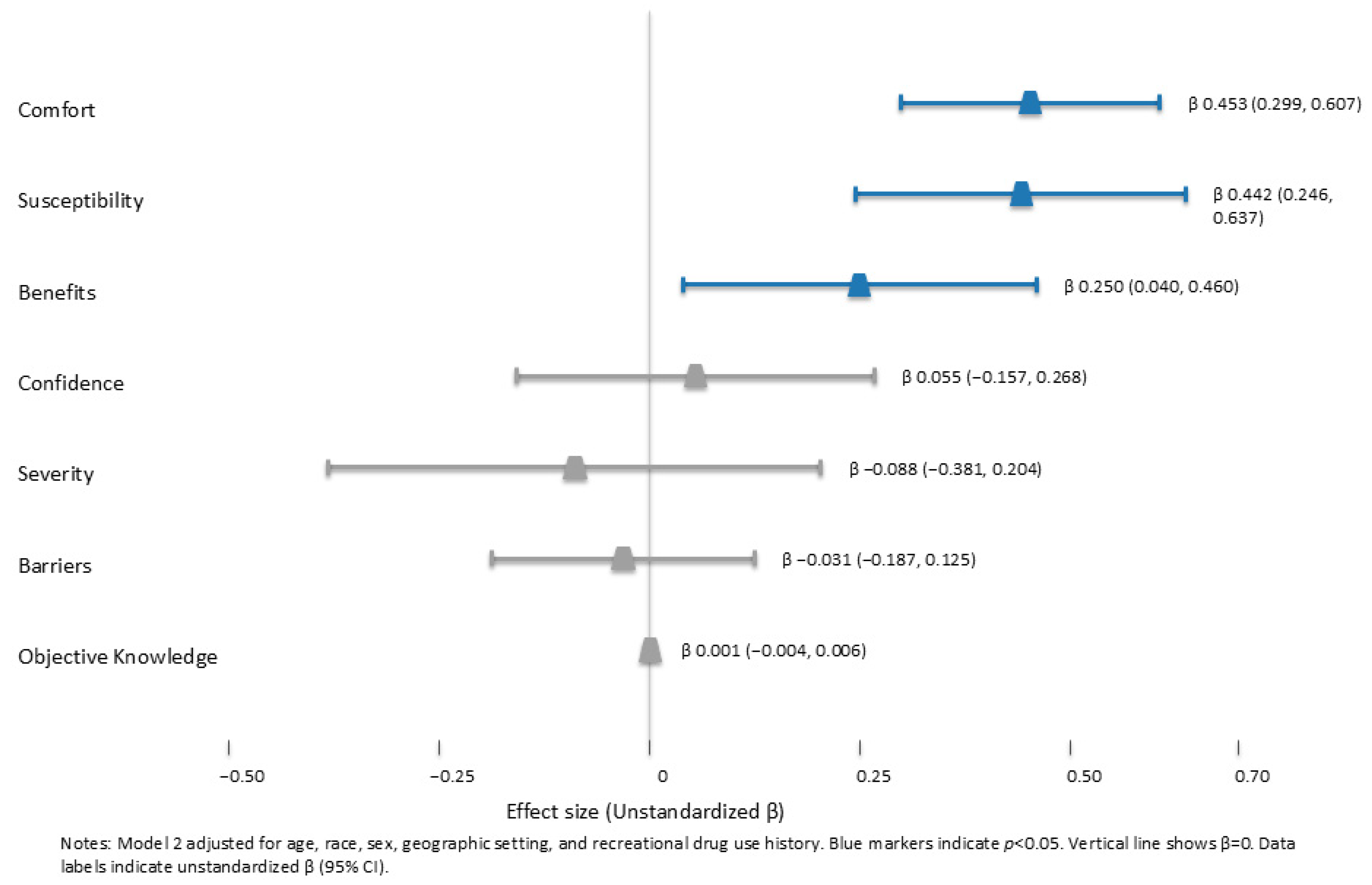
| Model 2 (R2 = 0.417, F(df) 11.076 (12), p < 0.001) b | ||||
| Objective Knowledge | 0.001 | 0.028 | −0.004, 0.006 | 0.660 |
| Susceptibility | 0.442 | 0.273 | 0.246, 0.637 | <0.001 * |
| Severity | −0.088 | −0.036 | −0.381, 0.204 | 0.551 |
| Benefits | 0.250 | 0.162 | 0.040, 0.460 | 0.020 * |
| Barriers | −0.031 | −0.025 | −0.187, 0.125 | 0.695 |
| Comfort | 0.453 | 0.412 | 0.299, 0.607 | <0.001 * |
| Confidence | 0.055 | 0.039 | −0.157, 0.268 | 0.609 |
Disclaimer/Publisher’s Note: The statements, opinions and data contained in all publications are solely those of the individual author(s) and contributor(s) and not of MDPI and/or the editor(s). MDPI and/or the editor(s) disclaim responsibility for any injury to people or property resulting from any ideas, methods, instructions or products referred to in the content. |
© 2026 by the authors. Licensee MDPI, Basel, Switzerland. This article is an open access article distributed under the terms and conditions of the Creative Commons Attribution (CC BY) license.
Share and Cite
Hohmann, L.; Aeilts, M.; Johnson, C.; Rajic, G.; Sorvillo, A.; Davis, B.; Taylor, A. Public Knowledge and Perceptions of Fentanyl Test Strips: A National Cross-Sectional Survey Informed by the Health Belief Model. Healthcare 2026, 14, 833. https://doi.org/10.3390/healthcare14070833
Hohmann L, Aeilts M, Johnson C, Rajic G, Sorvillo A, Davis B, Taylor A. Public Knowledge and Perceptions of Fentanyl Test Strips: A National Cross-Sectional Survey Informed by the Health Belief Model. Healthcare. 2026; 14(7):833. https://doi.org/10.3390/healthcare14070833
Chicago/Turabian StyleHohmann, Lindsey, Madelynn Aeilts, Caitlyn Johnson, Gabriela Rajic, Annarose Sorvillo, Brandy Davis, and Anne Taylor. 2026. "Public Knowledge and Perceptions of Fentanyl Test Strips: A National Cross-Sectional Survey Informed by the Health Belief Model" Healthcare 14, no. 7: 833. https://doi.org/10.3390/healthcare14070833
APA StyleHohmann, L., Aeilts, M., Johnson, C., Rajic, G., Sorvillo, A., Davis, B., & Taylor, A. (2026). Public Knowledge and Perceptions of Fentanyl Test Strips: A National Cross-Sectional Survey Informed by the Health Belief Model. Healthcare, 14(7), 833. https://doi.org/10.3390/healthcare14070833