Article

Healthcare Providers’ Perspectives on Generative Artificial Intelligence (GenAI) Adoption, Adaptation, Assimilation, and Use in the United States

1
Department of Health Sciences, School of Public Health and Health Sciences, California State University, Carson, CA 90747, USA
2
Center for Family Health Initiative (CFHI), Orange, CA 92865, USA
3
Department of Public Health, College of Nursing and Health Sciences, Azusa Pacific University, Azusa, CA 91702, USA
4
Department of Internal Medicine, Yale School of Medicine, New Haven, CT 06520, USA
5
Department of Surgery and Cancer, St Mary’s Hospital Campus, Imperial College London, London W2 1NY, UK
*
Author to whom correspondence should be addressed.
Healthcare 2026, 14(6), 775; https://doi.org/10.3390/healthcare14060775
Submission received: 10 February 2026 / Revised: 12 March 2026 / Accepted: 17 March 2026 / Published: 19 March 2026
(This article belongs to the Section Artificial Intelligence in Healthcare)

Highlights

What are the main findings?
  • Most U.S. clinicians in the study perceive GenAI as useful in patient care, with confidence increasing over time, indicating strong momentum for adoption.
  • Formal GenAI training and organizational adoption remain limited, creating a misalignment between clinician interest and system-level preparedness.
  • Clinicians primarily value GenAI for documentation efficiency and error reduction, while barriers center on limited AI literacy and workforce displacement fears.
What are the implications of the main findings?
  • Healthcare organizations must prioritize standardized, role-specific training to convert positive sentiment into safe and effective use.
  • Successful integration will require transparent governance, clinician oversight, and clear accountability to address ethical and trust concerns.
  • Healthcare administrators should intentionally reinvest productivity gains into strengthening patient–provider relationships, improving work–life balance, and reducing clinician burnout.

Abstract

Background: Generative artificial intelligence (GenAI) is rapidly permeating healthcare; yet, U.S. clinicians still report mixed feelings about its reliability, impact on workflow, and ethical implications. Current data on provider sentiment are needed to guide safe, patient-centered AI implementation in healthcare. Objective: This study aimed to assess U.S. healthcare providers’ perceptions of generative AI adoption, perceived usefulness, training needs, barriers, and strategies for safe integration. Methods: A nationwide, IRB-approved, cross-sectional survey was administered to healthcare professionals using Qualtrics. A convenience sample of clinicians was recruited via professional listservs and e-mail invitations. The 20-page questionnaire captured demographics, GenAI exposure, organizational adoption status, perceived usefulness (5-point scale), barriers, and mitigation strategies. SPSS v27 and Microsoft Excel were used for statistical analysis. Results: Of 130 respondents, 109 completed the core survey (completion rate 83.8%). Participants were 38.5% physicians, 16.5% nurses, 12.8% allied professionals, and 32.2% other providers; 54.2% were women, and 64.8% were ≥50 years. Overall, 86.9% agreed that GenAI is useful in current patient care, rising to 92.9% when asked about future usefulness. Only 42.4% had received formal GenAI training, and just 23.2% reported that their organization had begun adopting AI. The top perceived benefits were improved documentation/clerking (57.0%) and error reduction (49.4%). Dominant barriers included limited AI knowledge (24.7%) and fear of job loss (16.9%). Despite concerns, 72% expressed willingness to support broader GenAI adoption, favoring human oversight (67.1%) and staff training (60.8%) as key safeguards. There were statistically significant findings in perceived AI usefulness by gender (χ2 = 29.2; p < 0.001); organizational adoption of AI (χ2 = 31.6.2; p = 0.047) and where AI is most useful (χ2 = 101.1; p < 0.001) by qualifications; and support for AI adoption by age (χ2 = 18.0; p = 0.02). Conclusions: U.S. clinicians in our survey viewed GenAI as useful but reported limited training and organizational infrastructure needed for confident use while also expressing concerns regarding data privacy and ethical risk. Education programs and transparent, provider-led implementation strategies may accelerate responsible GenAI assimilation while addressing ethical and workforce concerns. Also, health administrators should use the efficiency gains to improve provider–patient relationships and clinicians’ work–life balance while reducing clinician burnout rates.

1. Introduction

Generative Artificial Intelligence (GenAI) has rapidly emerged as a transformative tool in healthcare practice, offering potential advancements in diagnostic accuracy, treatment personalization, operational efficiency, and patient outcomes. GenAI applications now span various areas, including radiology, oncology, cardiology, pathology, and general practice, each utilizing unique AI-driven approaches to improve patient care [1,2,3,4,5,6].
For example, in radiology, AI-powered tools have shown significant utility in image analysis, including evidence of an AI system outperforming radiologists in detecting breast cancer from mammograms, showcasing the potential of AI to enhance diagnostic precision [7]. In oncology, AI algorithms have been developed to predict patient response to specific therapies, optimizing treatment plans [2]. Additionally, in the field of oncology, within the last decade, researchers have found that AI could detect skin cancer with an accuracy comparable to that of dermatologists [8].
In other medical fields, such as cardiology, AI tools have been shown to accurately identify left ventricular dysfunction, which is often challenging for human interpretation, thus aiding in early intervention and patient management [9].
In general practice, AI is increasingly used for tasks such as clinical decision support, patient reports, predictive analytics, and patient monitoring. By analyzing vast datasets from electronic health records (EHRs), GenAI aids clinicians in identifying high-risk patients and guiding treatment decisions, which has become especially relevant in managing chronic diseases like diabetes and hypertension [10].
Despite these advancements, physicians and other healthcare providers often express mixed sentiments about GenAI adoption, citing concerns over reliability, data privacy, and the potential for diminished patient–physician relationships [11]. In 2024 an American Medical Association (AMA) study highlighted that while 36% of physicians felt more excited than concerned about AI; despite a growing majority of physicians recognizing the benefits of AI, with 68% in 2024 reporting at least some advantage in patient care (up from 63% in 2023), our recent global study found AI adoption in healthcare in the United States to be lower than that of Europe [11,12].
Although AI has been widely studied for clinical performance, few studies have investigated U.S. healthcare providers’ perspectives on generative AI adoption, particularly regarding training, workflow integration, and ethical considerations. Understanding and addressing US healthcare providers’ viewpoints can ensure AI tools are designed to support, rather than supplant, the role of providers. This study aimed to describe U.S. healthcare providers’ perceptions of generative AI adoption, including perceived usefulness, training needs, barriers, ethical concerns, and factors influencing willingness to support broader implementation in clinical practice

2. Materials and Methods

We conducted a nationwide cross-sectional survey in line with the STROBE checklist for cross-sectional studies (Table S1) using a self-administered questionnaire developed with the Qualtrics electronic data collection tool (https://www.qualtrics.com/) to capture perspectives, beliefs, and opinions on the use of AI in the healthcare sector.
Study Population: The study focused on US healthcare providers such as physicians, nurses, pharmacists, and laboratory scientists. Only healthcare providers currently in practice and working in the United States were eligible and included in the study.
Data Collection Tool: A pretested self-administered questionnaire was used. The pretest was conducted among five (5) providers to validate construct clarity, reduce measurement errors, assess flow and cognitive load, test operational feasibility, evaluate cultural and contextual appropriateness, and improve reliability of the questionnaire. Feedback from participants was used to revise the initial survey tool before its finalization. The questionnaire included sections on AI adoption, deployment, use, benefits, and barriers to AI adoption, as well as basic, anonymized demographic information of the participants. We piloted and reviewed the questionnaire to ensure completeness, accuracy, acceptability, cultural sensitivity, and relevance. Individuals who participated in the pilot were not included in the final study population. The questionnaire and subsequent data analysis complied with relevant protocols and checklists [13].
Sample Size: Sample size estimation followed Cochran’s formula for proportions. Because no robust prevalence figure for GenAI adoption among U.S. clinicians existed when the study was designed, we applied the conservative assumption of p = 0.50, a 95% confidence level (Z = 1.96), and a ±5% margin of error, yielding n = 385. Allowing 4% for incomplete surveys produced a target of 402 respondents [14]. A supplementary calculation using the 23% adoption rate [15] indicated a minimum number of 273 participants, confirming that our conservative target of 402 remained adequate.
Sampling and Data Collection Technique: Healthcare providers were identified through a convenience sampling technique of US-based professional organizations, social media platforms, and US member professional networks. The closed, non-randomized survey was sent to 300 healthcare professionals, using personalized emails as well as to their professional network pages. A link to the questionnaire was provided in the email, which required a “one-time only” access to prevent multiple completions of the questionnaire by individual participants.
Data collection occurred over 12 weeks from 1 December 2024 to 28 February 2025. Reminder emails were sent out monthly to prospective participants. The questionnaire was formatted over 20 pages with one to two questions per page and hosted on the Qualtrics website for the duration of the study. Participants were able to check for completeness and could review their answers using a “back button”. If participants were unsure or unwilling to disclose their responses, options including “not sure”, “not applicable”, or “prefer not to say” were available.
Data Analysis: We analyzed data on submitted questionnaires using IBM SPSS version 27 and Microsoft Excel. Analyses use the available-case denominator for each question. Data were uploaded automatically by Qualtrics for analysis. We performed univariate and bivariate analyses. Frequencies, percentages, Chi-square (χ2), p-value, and degrees of freedom were documented. Comparative analysis was done according to professional role, gender, age, and qualification of the participants. A p-value of < 0.05 was deemed to be statistically significant.
Ethical approval was received from the California State University, Dominguez Hills (CSUDH) Institutional Review Board (IRB #: CSUDH IRB-FY2025-98 on 26 November 2024). Participation was voluntary, and no incentives were offered. Written informed consent was obtained from all the subjects prior to study initiation.

3. Results

A total of 130 individuals accessed the survey, of whom 109 completed the core and demographic items (completion rate: 83.8%). Among respondents, physicians and nurses represented the largest professional groups. The majority of respondents were aged 50 years or older, held graduate diplomas, and had worked in the health industry for 20 years or more. Participants were primarily Black/African American (38%) and Caucasian (33.8%). The largest proportions of respondents were from California (16.7%) and New York (15.3%). Approximately one quarter were public health specialists (23.6%), and a similar proportion worked in the private sector (23.9%) (Table 1).

3.1. Attitude to AI Usefulness in Patient Care and Management

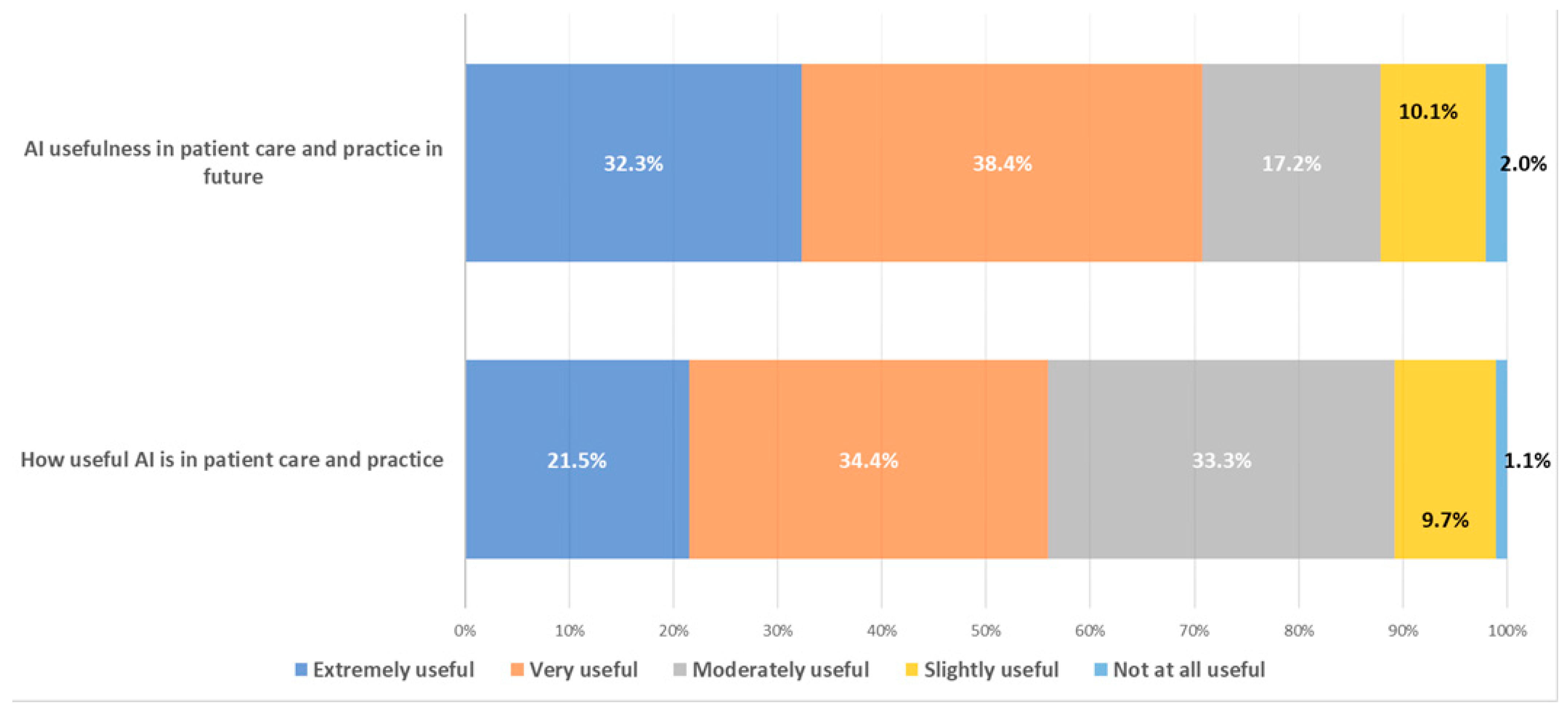
Overall, 86.9% of respondents (93/107) believed that AI is useful in patient care and management. Nearly all participants considered AI useful both currently (98.9%) and in the future (98.0%). However, a greater proportion believed AI would be very to extremely useful in the future compared with the present (70.7% vs. 55.9%) (Figure 1). Conversely, more respondents rated AI as moderately useful at present than in the future (33.3% vs. 17.2%). Only a small minority believed AI was not useful in either the present (1.1%) or the future (2.0%).
Male participants were significantly more likely to believe that AI has a role in patient care and management (χ2 = 29.2, p < 0.001) (Table 2). No statistically significant differences were observed by professional role, age, or qualifications

3.2. Training and Adoption of AI

Less than half of respondents have had formal exposures or training on AI (42.4%)), and this was a basic orientation to AI (83.3%), AI use in patient care (31%, 13/42), or technical aspects of AI (33.3%, 14/42). While 23.2% of respondents’ organizations have officially adopted AI, 38.4% (38/99) have trained staff on AI. Most adoption processes are led by top-level/executive leadership (32.8%, 20/61), although 24.6% (15/61) of participants were unaware of who was leading the adoption process (Table 3). Organizations of participants holding doctorate degrees were statistically more likely to adopt AI when compared with participants with other qualifications (χ2 = 31.6; p = 0.047) (Table 2). However, there were no statistically significant differences by professional roles, gender or age of participants.

3.3. AI Use in Patient Care and Management

AI was mostly used in report writing (43.1%, 28/65), research (27.7%, 18/65), patient care (26.2%, 17/65), and diagnosis (24.6%, 16/65). AI was also used in leadership and management (21.5%, 14/65). However, in patient care, AI was mostly useful in time management and documentation activities (34.2%, 25/73), and to improve patient registration processes and research (20.5%, 15/73) (Table 4). Participants holding a doctorate degree were statistically more likely to identify patient diagnosis and report writing as areas where AI was most useful when compared to participants with other qualifications (χ2 = 101.1; p < 0.001).

3.4. Challenges and Barriers to AI Adoption and Use

While poor knowledge of AI (24.7%, 19/77) and fear of job loss (16.9%, 13/77) were the leading barriers to AI adoption and use, 72.2% (57/79) of providers were willing to support AI adoption in clinical care. Other identified barriers included cost of acquisition of AI, staff skills and capacities, staff resistance to change, leadership and management issues, inadequate technology and equipment, and limited interest and or negative attitude of staff. Key patient care practice challenges included lack of human oversight (58.2%, 46/79), bias in AI algorithms and overdependence on AI (54.4%, 43/79). Others were unintended consequences and ethical/legal challenges (48.1% [38/79] and 41.8% [33/79], respectively) (Table 5). Participants who were less than 50 years of age were statistically more likely to support AI adoption and embedding in organizations (χ2 = 18.0; p = 0.02). However, there were no statistically significant differences by professional roles, gender or qualifications of participants.
However, strategies identified by participants to mitigate challenges of AI in healthcare include (but are not limited to) the absence of human oversight (67.1%, 53/79), poor staff training 60.8%, 48/79, and lack of provider involvement in design and development of AI tools and resources (57.0%, 45/79) (Table 5).

3.5. Core Benefits and Ethical Issues Relating to AI in Healthcare

In practice, participants believed that the most important benefit of AI was in patients’ documentation and clerking (57.0%, 45/79), as it minimizes errors and mistakes (49.4%, 39/79). Privacy and surveillance issues (63.3%, 50/79) and security risks (55.7%, 44/79) were identified as the most important ethical issues associated with the use of AI in healthcare (Table 6).

3.6. Impact of AI Adoption Integration on Clinicians’ Workload

While 17.1% (13/76) of respondents were willing to support an increase in providers’ patient load due to AI efficiency gains, the rest were either against it (38.2%, 29/76) or undecided (maybe, 44.7%, 34/76).

4. Discussion

Our survey of healthcare professionals practicing in the United States found that healthcare professionals perceive AI as useful in patient care and management, despite fewer than half having received formal training in AI. Several barriers to AI adoption were identified, including limited knowledge of AI and concerns about job displacement. Nevertheless, most respondents indicated a willingness to support AI integration in clinical care, suggesting that targeted education and capacity-building initiatives may help address existing concerns. Participants also emphasized the importance of human oversight, improved staff training, and greater provider involvement in the design and development of AI tools to ensure safe and effective implementation. Ethical concerns related to privacy, surveillance, and data security were noted.
Recent studies have shown a significant uptake in the use of GenAI in clinical practice among physicians and other providers. The AMA Augmented Intelligence Research involving 1183 physicians revealed that a growing majority of physicians are beginning to recognize the benefits of AI, especially the advantages in in patient care [11]. On the heels of this finding, our study reveals that between 87% (current) and 93% (future) of healthcare providers who participated in the study believe that GenAI is at least moderately useful in patient care in the present and in the future. This is a massive acceptance rate, showing that AI may have come to stay in healthcare and patient management. The substantial growth in physician use of AI in practice, with the usage of AI nearly doubling from 2023 to 2024 and a dramatic drop in non-users in just one year in the AMA study, supports this assertion. Furthermore, the very high rate of AI acceptance in our study in less than a year after the AMA study shows a continued improvement in providers’ acceptance and use of AI in clinical care. However, providers still have their doubts, issues, and fears regarding AI that could be minimized by proper training, formal exposure, and continued top management support and use of AI. These fears are similar to recent findings in another global study including US providers [12].
Providers have significant faith in GenAI, understand where AI is most useful and some current barriers/concerns. However, less than half have been formally trained or exposed to AI, and less than a quarter of participants’ organizations have adopted AI. To advance GenAI in healthcare, training for providers is imperative. Formal training of healthcare leaders will also help them to become advocates for AI adoption and embedding in healthcare systems as it will expose them to the benefits of AI in healthcare systems. With proper guidance and a better understanding of human-in-the-loop AI development and deployment strategies, providers will better accept human-supervised GenAI as safe, reproducible, reliable and significantly accurate, and understand that AI is not positioned to take over their jobs. This will motivate more providers to venture into GenAI-supported patient care and health management.
Like the AMA study findings where 68% of physicians believed that AI has some or definite advantages in patient care, our study revealed that GenAI has significant advantages in patient care, especially in patient documentation and report writing. Also, our findings revealed that significantly more providers are currently using AI for patient documentation processes and report writing, discharge summaries and care plans, and medical research and standard of care summaries, similar to AMA findings [11]. The current increase in clinicians’ use may be attributed to accelerated AI adoption in healthcare during the COVID-19 pandemic, which may have influenced clinicians’ perception by highlighting AI’s practical utility in crisis response [16,17,18]. Also, AI’s perceived usefulness and clinical value with evidence of performance, improved transparency and explainability, perceived ease of use, regulation and governance systems, improved data quality and security, organizational and social influence, and specialty and task fits may all have contributed directly or otherwise to improved adoption and use by clinicians [19,20,21,22,23,24,25,26,27]. Also, the current sociocultural and economic contexts, including large-scale investments in AI technology and increasing public awareness of AI, could partly account for the external factors shaping healthcare workers’ attitudes to AI in health [28,29,30,31,32].
However, the integration of GenAI in healthcare comes with both opportunities and challenges, as AI adoption in healthcare has significantly improved diagnostic accuracy, streamlined workflow processes, and enhanced patient care, including personalized treatment [33]. Despite major advances in AI research for healthcare, the deployment and adoption of AI technologies remain limited in clinical practice, thus the need for more formal training, on the job mentoring, and clarity on their use [34,35]. The increased use of AI in health and the expanding science around AI in clinical medicine have not eliminated the concerns people have, requiring that developers and users prioritize patient-relevant outcomes to fully understand AI’s true effects and limitations in healthcare [36]. Also, providers should play a significant role in AI design, development and deployment through in and out innovation approaches [12,37,38]
Our study outcomes support previously identified findings that challenges such as ethical and legal concerns, patient privacy, and data security remain prominent obstacles hindering providers’ adoption of AI [12,37,38,39] as the continued use of GenAI tools and resources increases the risk of unauthorized data breaches. Beyond data-breach risks, 63% of clinicians expressed unease about GenAI-enabled surveillance and the continuous algorithmic monitoring of both patients and providers, which they felt could erode autonomy and trust, unless strict transparency, opt-in consent, and usage boundary safeguards are put into place. This calls for better data security and improved use of firewalls and relevant tools to protect against patient data breaches. To minimize these concerns, providers and healthcare organizations must promote a culture of transparency, accountability, and openness as to the capacity, potential and use of GenAI, and ensure vigilance over patient data security. While waiting for relevant policies and guidelines, there is an urgent need for developers and users alike to address these ethical, technical, and security challenges that GenAI brings. Ensuring that due attention is paid to the ETHICS (environmental concerns, transparency and explainability, hallucinations, inclusiveness and inconsistencies, cost and clinical workflow integration, and safety and security of data) of AI, and that appropriate policies govern all adoption initiatives, will greatly minimize these concerns [39].
Additionally, approximately 39.2% of participants identified algorithmic transparency (the “Black Box” problem) as a key challenge in adopting generative AI. Incorporating explainable AI (XAI) approaches, which provide interpretable outputs and reasoning behind model predictions, could help increase provider trust and facilitate clinical integration. Future work should explore how XAI tools can be implemented in healthcare workflows to address transparency concerns.
Therefore, to effectively navigate the path forward to realize the potential of GenAI in healthcare and health, there is an urgent need to ensure appropriate skill generation; model testing, implementation, and monitoring; resources and infrastructure; and standardized oversight and guidelines [40]. Additional large-scale multiple-site studies that will explore in depth the findings of this study are needed using a deliberate proactive strategy [41]. Additionally, the fact that 16.9% are afraid of losing their jobs, but only 17.1% would be willing to accept an increased patient load because of the AI productivity gain calls for a qualitative study that will look into the issues of providers’ burnout and the willingness of healthcare managers to reinvest the saved time in advancing better patient–provider relationships.


5. Limitations

We could not achieve our calculated sample size due to providers’ inability to allocate the time needed to complete the questionnaires. With 130 completed responses, the survey achieved a 95% confidence interval of ±8.6% around a 50% proportion, wider than the ±5% originally planned. The reduced sample size likely decreased the statistical power of the study and increased the risk of Type II error, particularly for analyses using the Chi-square test to examine associations between categorical variables. The convenience sampling approach resulted in an overrepresentation of providers from California and New York, as well as certain racial demographic groups. Because attitudes toward emerging technologies may vary across geographic and demographic contexts, these concentrations could have influenced the relatively high acceptance rates of AI observed in this sample. Therefore, the generalizability of our findings is not guaranteed for other demographics and regions of the country. Also, we do not have complete data on some participants who started the process but did not fully complete the questionnaire. Their experiences and views may be different from those who completed the questionnaire. The study is also subject to the challenges of online surveys, including selection bias as only providers within the authors’ personal and professional networks were invited to participate in the survey. Because recruitment relied on authors’ networks and listservs, the sample is not probabilistic, and over-represents providers from California and New York, as well as Black/African Americans. Findings should therefore be interpreted as hypothesis-generating, rather than nationally representative. Future research should examine AI adoption using larger and more nationally representative samples of U.S. healthcare providers, as well as longitudinal designs to better understand how perceptions and use of generative AI evolve over time. Additional work is also needed to identify effective strategies for addressing data privacy concerns, strengthening governance frameworks, and improving training and workforce preparedness for AI integration in healthcare.

6. Conclusions

Healthcare providers have a high GenAI acceptance rate, and there is poor formal training for providers and other users. There is an urgent need to develop an AI-In-Service training curriculum and expose US providers formally to GenAI. This shortfall in formal instruction is reflected in our data, as ‘limited knowledge of AI’ was the single most cited barrier, indicating that structured, hands-on training could directly mitigate clinicians’ knowledge gaps and increase adoption readiness. Also, healthcare managers should be more transparent and communicative on their GenAI adoption initiatives and share the process, experiences, challenges, and successes with their teams.

Supplementary Materials

The following supporting information can be downloaded at: https://www.mdpi.com/article/10.3390/healthcare14060775/s1, Table S1: Strobe Checklist; File S1: Survey questions.

Author Contributions

Conceptualization, O.O.O.; Methodology, O.O.O., M.B. and S.D.T.-R.; Software, O.O.O.; Validation, M.B. and S.D.T.-R.; Formal analysis, O.O.O., M.B. and S.D.T.-R.; Investigation, M.B.; Resources, O.O.O.; Data curation, O.O.O.; Writing—original draft, O.O.O.; Writing—review and editing, O.O.O., M.B., A.T., R.I. and S.D.T.-R.; Visualization, O.O.O.; Supervision, A.T., R.I. and S.D.T.-R.; Project administration, O.O.O. All authors have read and agreed to the published version of the manuscript.

Funding

This research received no external funding.

Institutional Review Board Statement

The study was conducted in accordance with the Declaration of Helsinki, and approved by the California State University, Dominguez Hills (CSUDH) Institutional Review Board (IRB #: CSUDH IRB-FY2025-98 on 26 November 2024).

Informed Consent Statement

Informed consent was obtained from all subjects involved in the study.

Data Availability Statement

Data supporting the reported results can be obtained upon request from the first author.

Acknowledgments

O.O.O. and R.I. are grateful to Anupuma Joshi, Judy Aguirre, and Mi-Sook Kim for their guidance, and to the College of Health, Human Services, and Nursing, California State University, Dominguez Hills, Carson, California for institutional support. We thank Marsha Morgan from University College London for helpful comments. S.D.T.-R. was supported by the Wellcome Trust Institutional Strategic Support Fund at Imperial College London, London, United Kingdom. All authors acknowledge the United Kingdom National Institute for Healthcare Research Biomedical Facility at Imperial College London for infrastructural support. The views and opinions of the authors expressed herein do not necessarily state or reflect those of CSUDH and other supporting institutions.

Conflicts of Interest

The authors declare no conflicts of interest.

Abbreviations

The following abbreviations are used in this manuscript:
AIArtificial Intelligence
AMAAmerican Medical Association
EHRElectronic Health Records
GenAIGenerative Artificial Intelligence
SPSSStatistical Package for Social Sciences

References

  1. Najjar, R. Redefining radiology: A review of artificial intelligence integration in medical imaging. Diagnostics 2023, 13, 2760. [Google Scholar] [CrossRef]
  2. Kawamura, M.; Kamomae, T.; Yanagawa, M.; Kamagata, K.; Fujita, S.; Ueda, D.; Matsui, Y.; Fushimi, Y.; Fujioka, T.; Nozaki, T.; et al. Revolutionizing radiation therapy: The role of AI in clinical practice. J. Radiat. Res. 2024, 65, 1–9. [Google Scholar] [CrossRef]
  3. Miranda, I.; Luz, J.M.; Pereira, A.R.; Augusto, J.B. Artificial Intelligence in Cardiovascular Imaging Algorithms—What Is Used in Clinical Routine? European Society of Cardiology. 2024. Available online: https://www.escardio.org/Councils/Council-for-Cardiology-Practice-(CCP)/Cardiopractice/artificial-intelligence-in-cardiovascular-imaging-algorithms-what-is-used-in-c (accessed on 25 February 2025).
  4. Goldenberg, S.L.; Nir, G.; Salcudean, S.E. A new era: Artificial intelligence and machine learning in prostate cancer. Nat. Rev. Urol. 2019, 16, 391–403. [Google Scholar] [CrossRef]
  5. Riaz, I.B.; Harmon, S.; Chen, Z.; Naqvi, S.A.; Cheng, L. Applications of artificial intelligence in prostate cancer care: A path to enhanced efficiency and outcomes. Am. Soc. Clin. Oncol. Educ. Book 2024, 44, e438516. [Google Scholar] [CrossRef]
  6. Tătaru, O.S.; Vartolomei, M.D.; Rassweiler, J.J.; Virgil, O.; Lucarelli, G.; Porpiglia, F.; Amparore, D.; Manfredi, M.; Carrieri, G.; Falagario, U.; et al. Artificial intelligence and machine learning in prostate cancer patient management—Current trends and future perspectives. Diagnostics 2021, 11, 354. [Google Scholar] [CrossRef]
  7. McKinney, S.M.; Sieniek, M.; Godbole, V.; Godwin, J.; Antropova, N.; Ashrafian, H.; Back, T.; Chesus, M.; Corrado, G.S.; Darzi, A.; et al. International evaluation of an AI system for breast cancer screening. Nature 2020, 577, 89–94. [Google Scholar] [CrossRef] [PubMed]
  8. Esteva, A.; Kuprel, B.; Novoa, R.A.; Ko, J.; Swetter, S.M.; Blau, H.M.; Thrun, S. Dermatologist-level classification of skin cancer with deep neural networks. Nature 2017, 542, 115–118. [Google Scholar] [CrossRef]
  9. Attia, Z.I.; Noseworthy, P.A.; Lopez-Jimenez, F.; Asirvatham, S.J.; Deshmukh, A.J.; Gersh, B.J.; Carter, R.E.; Yao, X.; Rabinstein, A.A.; Erickson, B.J.; et al. An artificial intelligence-enabled ECG algorithm for the identification of patients with atrial fibrillation during sinus rhythm: A retrospective analysis of outcome prediction. Lancet 2019, 394, 861–867. [Google Scholar] [CrossRef] [PubMed]
  10. Rajpurkar, P.; Irvin, J.; Ball, R.L.; Zhu, K.; Yang, B.; Mehta, H.; Duan, T.; Ding, D.; Bagul, A.; Langlotz, C.P.; et al. Deep learning for chest radiograph diagnosis: A retrospective comparison of the CheXNeXt algorithm to practicing radiologists. PLoS Med. 2018, 15, e1002686. [Google Scholar] [CrossRef]
  11. American Medical Association. AMA Augmented Intelligence Research. Physician Sentiments Around the Use of AI in Health Care: Motivations, Opportunities, Risks, and Use Cases. Shifts from 2023 to 2024; American Medical Association: Chicago, IL, USA, 2025. [Google Scholar]
  12. Oleribe, O.O.; Taylor-Robinson, A.W.; Agala, V.R.; Sobande, O.O.; Izurieta, R.; Taylor-Robinson, S.D. Global Adoption, Promotion, Impact, and Deployment of AI in Patient Care, Health Care Delivery, Management, and Health Care Systems Leadership: Cross-Sectional Survey. J. Med. Internet Res. 2025, 27, e70805. [Google Scholar] [CrossRef] [PubMed]
  13. Eysenbach, G. Improving the Quality of Web Surveys: The Checklist for Reporting Results of Internet E-Surveys (CHERRIES). J. Med. Internet Res. 2004, 6, e34. [Google Scholar] [CrossRef]
  14. Dave, D. The Statistical Landscape of AI Adoption in Healthcare. Radix: Software Development Updated 1 August 2024. Available online: https://radixweb.com/blog/ai-in-healthcare-statistics (accessed on 11 October 2024).
  15. Sample Size Calculators for Designing Clinical Research. Available online: https://sample-size.net/sample-size-conf-interval-proportion/ (accessed on 11 October 2024).
  16. OECD Publishing. Artificial Intelligence and the Health Workforce Perspectives from Medical Associations on AI in Health. OECD Artificial Intelligence Papers, November 2024, No. 28. Available online: https://www.oecd.org/content/dam/oecd/en/publications/reports/2024/11/artificial-intelligence-and-the-health-workforce_c8e4433d/9a31d8af-en.pdf (accessed on 27 October 2025).
  17. Waheed, M.A.; Liu, L. Perceptions of family physicians about applying AI in primary health care: Case study from a premier health care organization. JMIR AI 2024, 3, e40781. [Google Scholar] [CrossRef]
  18. Dongre, A.S.; More, S.D.; Wilson, V.; Singh, R.J. Medical doctor’s perception of artificial intelligence during the COVID-19 era: A mixed methods study. J. Fam. Med. Prim. Care 2024, 13, 1931–1936. [Google Scholar] [CrossRef]
  19. AlQudah, A.A.; Al-Emran, M.; Shaalan, K. Technology acceptance in healthcare: A systematic review. Appl. Sci. 2021, 11, 10537. [Google Scholar] [CrossRef]
  20. Hassan, M.; Kushniruk, A.; Borycki, E. Barriers to and facilitators of artificial intelligence adoption in health care: Scoping review. JMIR Hum. Factors 2024, 11, e48633. [Google Scholar] [CrossRef] [PubMed]
  21. Rosenbacke, R.; Melhus, Å.; McKee, M.; Stuckler, D. How explainable artificial intelligence can increase or decrease clinicians’ trust in AI applications in health care: Systematic review. JMIR AI 2024, 3, e53207. [Google Scholar] [CrossRef]
  22. Scipion, C.E.; Manchester, M.A.; Federman, A.; Wang, Y.; Arias, J.J. Barriers to and facilitators of clinician acceptance and use of artificial intelligence in healthcare settings: A scoping review. BMJ Open 2025, 15, e092624. [Google Scholar] [CrossRef]
  23. Finkelstein, J.; Gabriel, A.; Schmer, S.; Truong, T.T.; Dunn, A. Identifying facilitators and barriers to implementation of AI-assisted clinical decision support in an electronic health record system. J. Med. Syst. 2024, 48, 89. [Google Scholar] [CrossRef] [PubMed]
  24. Tucci, V.; Saary, J.; Doyle, T.E. Factors influencing trust in medical artificial intelligence for healthcare professionals: A narrative review. J. Med. Artif. Intell. 2022, 5, 4. [Google Scholar] [CrossRef]
  25. Roppelt, J.S.; Kanbach, D.K.; Kraus, S. Artificial intelligence in healthcare institutions: A systematic literature review on influencing factors. Technol. Soc. 2024, 76, 102443. [Google Scholar] [CrossRef]
  26. Hou, T.; Li, M.; Tan, Y.; Zhao, H. Physician adoption of AI assistant. Manuf. Serv. Oper. Manag. 2024, 26, 1639–1655. [Google Scholar] [CrossRef]
  27. Bettelheim, A. Majority of Doctors Worry About AI Driving Clinical Decisions, Survey Shows. Axios. 31 October 2023. Available online: https://www.axios.com/2023/10/31/doctors-ai-clinical-decisions-concern (accessed on 27 October 2025).
  28. Sahni, N.; Stein, G.; McKinsey, O.; Zemmel, R.; Cutler, D.M. The Potential Impact of Artificial Intelligence on Healthcare Spending; National Bureau of Economic Research: Cambridge, MA, USA, 2023.
  29. Lambert, S.I.; Madi, M.; Sopka, S.; Lenes, A.; Stange, H.; Buszello, C.P.; Stephan, A. An integrative review on the acceptance of artificial intelligence among healthcare professionals in hospitals. NPJ Digit. Med. 2023, 6, 111. [Google Scholar]
  30. Witkowski, K.; Dougherty, R.B.; Neely, S.R. Public perceptions of artificial intelligence in healthcare: Ethical concerns and opportunities for patient-centered care. BMC Med. Ethics 2024, 25, 74. [Google Scholar]
  31. Dankwa-Mullan, I. Health equity and ethical considerations in using artificial intelligence in public health and medicine. Prev. Chronic Dis. 2024, 21, E64. [Google Scholar] [CrossRef] [PubMed]
  32. Sagona, M.; Dai, T.; Macis, M.; Darden, M. Trust in AI-assisted health systems and AI’s trust in humans. npj Health Syst. 2025, 2, 10. [Google Scholar]
  33. Lainjo, B. Integrating artificial intelligence into healthcare systems: Opportunities and challenges. Acad. Med. 2024, 1, 1–13. [Google Scholar] [CrossRef]
  34. Lekadir, K.; Frangi, A.F.; Porras, A.R.; Glocker, B.; Cintas, C.; Langlotz, C.P.; Weicken, E.; Asselbergs, F.W.; Prior, F.; Collins, G.S.; et al. FUTURE-AI: International consensus guideline for trustworthy and deployable artificial intelligence in healthcare. BMJ 2025, 388, e081554. [Google Scholar]
  35. Ng, J.Y.; Maduranayagam, S.G.; Suthakar, N.; Li, A.; Lokker, C.; Iorio, A.; Haynes, R.B.; Moher, D. Attitudes and perceptions of medical researchers towards the use of artificial intelligence chatbots in the scientific process: An international cross-sectional survey. Lancet Digit. Health 2025, 7, e94–e102. [Google Scholar]
  36. Han, R.; Acosta, J.N.; Shakeri, Z.; Ioannidis, J.P.; Topol, E.J.; Rajpurkar, P. Randomised controlled trials evaluating artificial intelligence in clinical practice: A scoping review. Lancet Digit. Health 2024, 6, e367–e373. [Google Scholar]
  37. Oleribe, O.O.; Taylor-Robinson, S.D. Leveraging Artificial Intelligence Tools and Resources in Leadership Decisions. Am. J. Health Care Strategy 2025, 1, 107–123. [Google Scholar]
  38. Oleribe, O.O. Leveraging and Harnessing Generative Artificial Intelligence to Mitigate the Burden of Neurodevelopmental Disorders (NDDs) in Children. Healthcare 2025, 13, 1898. [Google Scholar] [CrossRef] [PubMed]
  39. Oleribe, O.O.; Taylor-Robinson, A.W.; Chimezie, C.C.; Taylor-Robinson, S.D. ETHICS of AI Adoption and Deployment in Health Care: Progress, Challenges, and Next Steps. JMIR AI 2025, 4, e67626. [Google Scholar] [CrossRef] [PubMed]
  40. National Academy of Medicine. Generative Artificial Intelligence in Health and Medicine: Opportunities and Responsibilities for Transformative Innovation; The National Academies Press: Washington, DC, USA, 2025. [Google Scholar] [CrossRef]
  41. Oleribe, O.O. Leading the next pandemics. Public Health Pract. 2025, 9, 100605. [Google Scholar] [CrossRef] [PubMed]
Figure 1. Perceived Current and future usefulness of GenAI in patient care among U.S. clinicians.
Healthcare 14 00775 g001
Table 1. Demographic information of respondents.
DescriptionFrequencyPercentage
Role in Healthcare (n = 109)
Physician4238.50%
Nurse1816.50%
Allied Healthcare Professional1412.80%
Hospital Administrator32.80%
Other Providers3229.40%
Gender at Birth (n = 72)
Prefer not to say22.80%
Female3954.20%
Male3143.10%
Age of Respondents (n = 71)
60 years and above1926.80%
50–59 years2738.00%
40–49 years912.70%
30–39 years1419.70%
20–29 years22.80%
Highest Education (n = 71)
Doctorate3954.90%
Masters1723.90%
Bachelors1115.50%
High School Diploma/GED22.80%
Others22.80%
Length in Health Industry (n = 71)
25 or more years3346.50%
20–24 years1216.90%
15–19 years45.60%
10–14 years912.70%
5–9 years1014.10%
Less than 5 years34.20%
Current Work location (n = 71)
Private1723.90%
Nonprofit/Public Charity1216.90%
College/University1419.70%
County/Local79.90%
Federal or State1014.10%
Others1115.50%
Current work Section (n = 72)
Public Health and Preventive Medicine1723.60%
Internal Medicine1013.90%
Family Medicine811.10%
Pediatrics79.70%
Pathology34.20%
Psychiatry34.20%
Geriatrics22.80%
Ophthalmology22.80%
Obstetrics and Gynecology22.80%
Surgery11.40%
Race or Ethnicity (n = 71)
Black/African American2738.00%
White/Caucasian2433.80%
Hispanic/Latino/Latinx79.90%
Native American/Alaska Native11.40%
Pacific Island/Hawaii00.00%
East Asian57.00%
South Asian45.60%
Arab/Middle Eastern22.80%
Mixed00.00%
I prefer not to say79.90%
Table 2. Chi-Square (χ2) analysis of participants’ responses to AI use, adoption, and staff training.
DescriptionProfessional RoleGenderAgeQualification
Chi-Square (χ2)p-Value (df)Chi-Square (χ2)p-Value (df)Chi-Square (χ2)p-Value (df)Chi-Square (χ2)p-Value (df)
Artificial Intelligence (AI) has a role or usefulness in patient care and management9.30.32 (8)29.2<0.001 (4)7.70.46 (8)3.50.97 (10)
AI usefulness in the future in patient care and practice14.10.59 (16)7.10.31 (6)12.70.39 (12)11.60.71 (15)
Have had formal exposure or training in AI1.20.99 (8)0.30.99 (4)7.80.45 (8)8.70.57 (10)
The organization has adopted/begun the process of adopting AI18.80.28 (16)6.00.64 (8)23.30.06 (16)31.60.047 (20)
The organization has trained someone in AI use7.20.51 (8)0.90.92 (4)14.80.06 (8)6.30.79 (10)
Where AI is most useful in the healthcare industry32.50.90 (44)22.70.42 (22)28.50.97 (44)101.1<0.001 (55)
Where AI is least useful in the healthcare industry42.50.54 (44)12.90.94 (22)41.40.58 (44)56.30.43 (55)
The most important barrier to AI adoption and implementation in patient care36.40.45 (36)8.60.48 (9)37.20.41 (36)29.60.96 (45)
Will support AI adoption and embedding in the organization8.20.42 (8)6.20.18 (4)18.00.02 (8)11.40.33 (10)
Note: Bild signifies statistical differences.
Table 3. AI adoption and embedding in the organization.
DescriptionFreqPercentage
AI is useful in-patient care and management (n = 107)
Yes9386.90%
Neither true nor false98.40%
No54.70%
How useful AI is in patient care and practice (n = 93)
Extremely useful2021.50%
Very useful3234.40%
Moderately useful3133.30%
Slightly useful99.70%
Not at all useful11.10%
AI usefulness in patient care and practice in the future (n = 99)
Extremely useful3232.30%
Very useful3838.40%
Moderately useful1717.20%
Slightly useful1010.10%
Not at all useful22.00%
Formal exposure or training in AI (n = 99)
Not Sure55.10%
No5252.50%
Yes4242.40%
Training individuals were exposed to (n = 42)
Basic orientation to AI3583.30%
Training on AI use in patient care (diagnosis, treatment, etc.)1331.00%
Training in AI use in management and leadership1126.20%
Training in technical aspects of AI1433.30%
Other forms of AI training1126.20%
Organization has adopted/begun the process of AI adoption (n = 99)
I do not know1111.10%
No, we have not started adopting AI3737.40%
Yes, we are beginning to think about adopting AI2424.20%
Yes, we will adopt AI44.00%
Yes, we have adopted AI2323.20%
Leaders of AI adoption in Organizations (n = 61)
Others (Please specify)46.60%
I do not know1524.60%
Outsourced58.20%
IT Staff813.10%
Administration Staff58.20%
Middle Level/Management Staff46.60%
Top-level/Executive Leadership2032.80%
Organizational training on AI use (n = 99)
I do not know/I am not sure3838.40%
No3638.40%
Yes2538.40%
Table 4. Acceptance and use of AI by healthcare providers.
DescriptionFreqPercentage
Where AI is commonly used (n = 65)
Report writing2843.10%
Research1827.70%
Patient care (e.g., treatment, continuity of care, referral, etc.)1726.20%
Diagnosis (e.g., radiology, pathology, endoscopy, etc.)1624.60%
Leadership and management1421.50%
Strategic management1218.50%
Staff and personnel management913.80%
Resource management812.30%
Precision medicine (e.g., gene therapy, cancer management, etc.)69.20%
I do not want to specify69.20%
Others1421.50%
Aspects of patient care where AI is most useful (n = 73)
Time management2534.20%
Documentation activities2534.20%
Improved patient registration processes1520.50%
Research1520.50%
Diagnosis1317.80%
Team management1115.10%
Patient management and care1013.70%
Errors and mistakes1013.70%
Continuity of care and follow up processes1013.70%
Patient clerking and history taking912.30%
Provider’s personal job satisfaction912.30%
Laboratory processes811.00%
Prescription practices79.60%
Provider burnout of providers56.80%
Work–life balance56.80%
Provider health and wellbeing45.50%
Patient satisfaction34.10%
Others1926.00%
Healthcare activity where AI is very useful (n = 77)
Report writing1924.70%
Diagnosis (e.g., radiology, pathology, endoscopy, etc.)1823.40%
Strategy development79.10%
Patient care (e.g., treatment, continuity of care, referral, etc.)79.10%
None of the above67.80%
Leadership and management56.50%
Precision medicine (e.g., cancer management)45.20%
Resource management33.90%
I do not want to specify22.60%
Financial management22.60%
Staff management11.30%
Others33.90%
Table 5. Barriers to AI use and mitigation strategies.
DescriptionsFreqPercentage
Most important barrier to AI adoption and implementation in patient care (n = 77)
Knowledge of AI1924.70%
Fear of job loss1316.90%
Cost of acquisition810.40%
Staff skills and capacities79.10%
Organization-wide adoption of AI67.80%
Staff resistance to change56.50%
Leadership and management45.20%
Technology and equipment45.20%
Interest and attitude of staff11.30%
Others810.40%
Willingness to support AI adoption and embedding (N = 79)
Not sure1722.50%
No56.30%
Yes5772.20%
Patient care practice challenges (n = 79)
Lack of human oversight4658.20%
Bias in AI algorithms4354.40%
Overdependence on AI4354.40%
Unintended consequences3848.10%
Ethical and legal challenges3746.80%
Data privacy and security concerns3341.80%
Algorithmic opacity (Black Box problems)3139.20%
Job displacement2632.90%
Reduced patient–provider interaction2531.60%
More workload1924.10%
High cost and accessibility issues1721.50%
Strategies to mitigate the challenges of AI in healthcare (N = 79)
Human oversight5367.10%
Staff training4860.80%
Provider involvement in design and development4557.00%
Data protection3949.40%
Enhanced transparency3443.00%
Improved accessibility2531.60%
Early adoption and integration2329.10%
Table 6. Core benefits and ethical issues relating to AI use in healthcare.
DescriptionFreqPercentage
Core benefits of AI in clinical practice (n = 79)
Facilitates patients’ documentation and clerking4557.00%
Minimizes errors and mistakes3949.40%
Opens up time for better provider–patient communication3443.00%
Shortens turnaround time for requests3443.00%
Improves provider–patient relationship1316.50%
Encourages provider–patient relationship1215.20%
Others911.40%
Ethical issues associated with AI use in healthcare (n = 79)
Privacy and surveillance5063.30%
Security risks4455.70%
Misinformation and deepfakes4050.60%
Lack of regulations and polices4050.60%
Bias and fairness3746.80%
Autonomy and decision making3240.50%
Ethical use in education and patient care3038.00%
Ownership and intellectual property3038.00%
Job displacement and economic impact2734.20%
Transparency and accountability2227.80%
Disclaimer/Publisher’s Note: The statements, opinions and data contained in all publications are solely those of the individual author(s) and contributor(s) and not of MDPI and/or the editor(s). MDPI and/or the editor(s) disclaim responsibility for any injury to people or property resulting from any ideas, methods, instructions or products referred to in the content.