Back Muscle Strength Is Associated with Self-Reported Morning-Erection Frequency in Apparently Healthy Japanese Male University Students: A Cross-Sectional Study

 , , , , , , and
Highlights
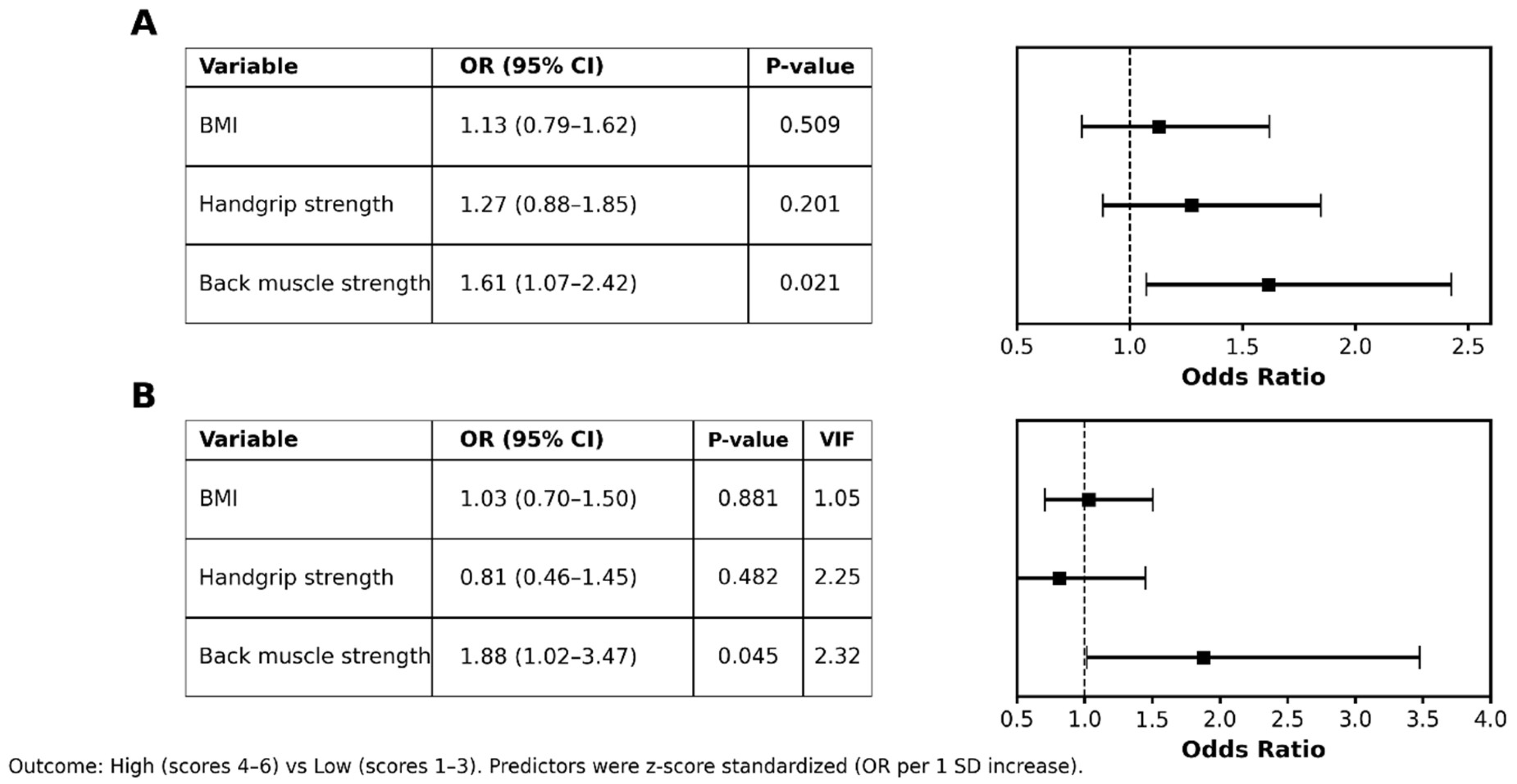
- Back muscle strength, unlike handgrip strength or body mass index, is independently associated with increased morning-erection frequency in apparently healthy young men.
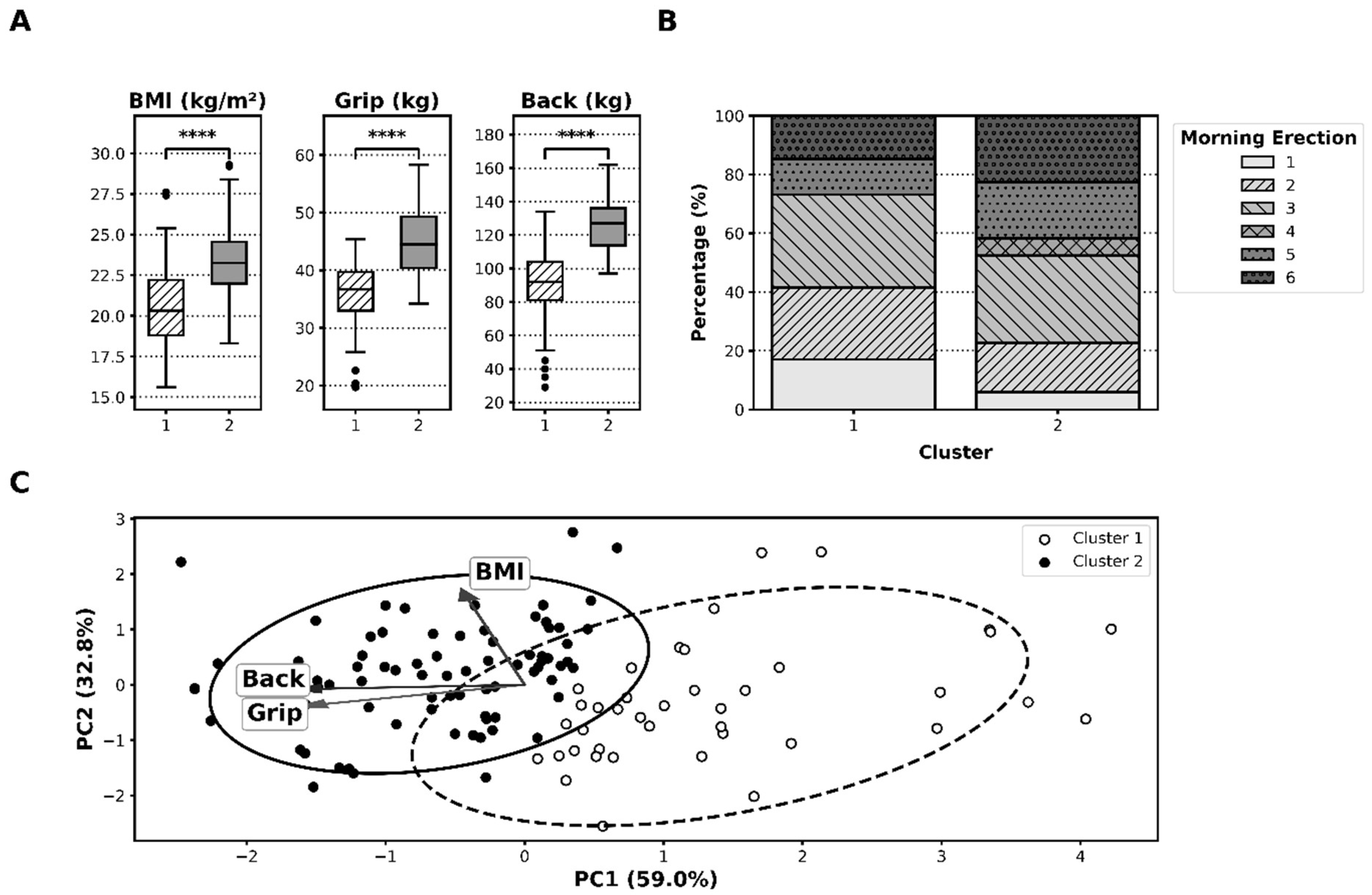
- Over 50% of healthy Japanese male university students report infrequent morning erections, suggesting that low nocturnal erectile indicators may be prevalent even in early adulthood.
- The frequency of morning erections serves as an intercourse-independent, low-burden indicator that could be useful for research and for initiating prevention-oriented conversations in university health services and primary care.
- Because this was a cross-sectional study and utilized a single-item self-reported outcome with modest discrimination, further longitudinal studies are needed before considering any screening or routine assessment applications.
Abstract
1. Introduction
2. Materials and Methods
2.1. Study Design and Setting
2.2. Participants
2.3. Measurements
2.3.1. Sexual Function Assessment
2.3.2. Muscle Strength and Anthropometrics
2.3.3. Lifestyle Variables (Descriptive and Sensitivity Covariates)
2.4. Statistical Analysis
2.5. Ethics
3. Results
3.1. Participant Characteristics
3.2. Correlation Analyses
3.3. Logistic Regression Analyses
3.4. Sensitivity Analyses
3.5. Exploratory PCA and Clustering
4. Discussion
4.1. Principal Findings
4.2. Interpretation in the Context of Prior Work
4.3. Potential Explanatory Pathways and Alternative Explanations
4.4. Characteristics of the Study Population and Generalizability
4.5. Public Health and Primary Care Implications
4.6. Strengths and Limitations
- Causal Inference: The cross-sectional design precludes causal conclusions.
- Sampling: Convenience sampling from a single university limits generalizability. No a priori sample size calculation was performed; some estimates were imprecise, several p-values were close to the conventional threshold, and confidence intervals were wide, suggesting limited power for modest effects. Therefore, findings should be interpreted with caution and require replication.
- Measurement: Morning-erection frequency was assessed via a single self-reported item without specific psychometric validation for this age group, leaving room for potential recall or social desirability biases. Validation studies using established multi-item questionnaires or objective NPT measures (e.g., RigiScan®) in a subset are warranted.
- Data Completeness: Substantial exclusions (26.5%) due to missing data or medical history may introduce selection bias. Additional comparisons suggested that excluded participants were slightly younger, though further analyses were constrained by missing data.
- EHS Ceiling Effect: A ceiling effect was observed in EHSs (94.4% sufficient hardness). As EHS anchors refer to penetration, sexually inexperienced participants likely provided hypothetical ratings, introducing measurement error and limiting the evaluation of strength–rigidity associations.
- Unmeasured Confounders: We did not measure sleep quality, psychological stress (including academic stress), diet, medication/supplements use, objective aerobic fitness, or cardiometabolic/hormonal biomarkers. Reports have suggested a decline in serum testosterone levels among adolescent and young adult men in some settings [55,56], but we did not assess hormones.
- Sensitive Nature of Data: Despite the “prefer not to answer” option, nonresponse to sexual health questions may have been non-random, the bias of which is essentially indeterminate.
- Socioeconomic and Relationship Factors: Socioeconomic and relationship factors, known to influence sexual function [57], were not assessed.
4.7. Future Directions
5. Conclusions
Supplementary Materials
Author Contributions
Funding
Institutional Review Board Statement
Informed Consent Statement
Data Availability Statement
Acknowledgments
Conflicts of Interest
Abbreviations
| AMS | Aging Males’ Symptoms |
| AUC | Area under the receiver operating characteristic curve |
| BMI | Body mass index |
| CI | Confidence interval |
| ED | Erectile dysfunction |
| EHS | Erection Hardness Score |
| EMAS-SFQ | European Male Ageing Study Sexual Function Questionnaire |
| IIEF | International Index of Erectile Function |
| IPAQ-SF | International Physical Activity Questionnaire–Short Form |
| NO | Nitric oxide |
| NPT | Nocturnal penile tumescence |
| MCTQ | Munich Chronotype Questionnaire |
| MET | Metabolic equivalent of task |
| OR | Odds ratio |
| PC1 | First principal component |
| PCA | Principal component analysis |
| SD | Standard deviation |
| VIF | Variance inflation factor |
References
- Gandaglia, G.; Briganti, A.; Jackson, G.; Kloner, R.A.; Montorsi, F.; Montorsi, P.; Vlachopoulos, C. A systematic review of the association between erectile dysfunction and cardiovascular disease. Eur. Urol. 2014, 65, 968–978. [Google Scholar] [CrossRef] [PubMed]
- Miner, M.; Billups, K.L. Erectile dysfunction and dyslipidemia: Relevance and role of phosphodiesterase type-5 inhibitors and statins. J. Sex. Med. 2008, 5, 1066–1078. [Google Scholar] [CrossRef] [PubMed]
- Tsujimura, A.; Fukuhara, S.; Chiba, K.; Yoshizawa, T.; Tomoe, H.; Shirai, M.; Kimura, K.; Kikuchi, E.; Maeda, E.; Sato, Y.; et al. Erectile function and sexual activity are declining in the younger generation: Results from a national survey in Japan. World J. Men’s Health 2025, 43, 239–248. [Google Scholar] [CrossRef] [PubMed] [PubMed Central]
- Takayanagi, A.; Kobayashi, K.; Fukuta, F.; Matsuki, M.; Matsuda, Y.; Mori, M.; Masumori, N. Changes of sexual function and perception in Japanese men: A 15-year cross-sectional community-based study. Int. J. Urol. 2016, 23, 941–945. [Google Scholar] [CrossRef] [PubMed]
- Silva, A.B.; Sousa, N.; Azevedo, L.F.; Martins, C. Physical activity and exercise for erectile dysfunction: Systematic review and meta-analysis. Br. J. Sports Med. 2017, 51, 1419–1424. [Google Scholar] [CrossRef] [PubMed]
- Fergus, K.B.; Gaither, T.W.; Baradaran, N.; Glidden, D.V.; Cohen, A.J.; Breyer, B.N. Exercise Improves Self-Reported Sexual Function Among Physically Active Adults. J. Sex. Med. 2019, 16, 1236–1245. [Google Scholar] [CrossRef] [PubMed]
- Kumagai, H.; Yoshikawa, T.; Myoenzono, K.; Kosaki, K.; Akazawa, N.; Tanahashi, K.; Tagawa, K.; Zempo-Miyaki, A.; Maeda, S. Role of High Physical Fitness in Deterioration of Male Sexual Function in Japanese Adult Men. Am. J. Men’s Health 2019, 13, 1557988319849171. [Google Scholar] [CrossRef] [PubMed] [PubMed Central]
- Kumagai, H.; Myoenzono, K.; Yoshikawa, T.; Tsujimoto, T.; Shimomura, K.; Maeda, S. Regular aerobic exercise improves sexual function assessed by the Aging Males’ Symptoms questionnaire in adult men. Aging Male 2020, 23, 1194–1201. [Google Scholar] [CrossRef] [PubMed]
- Viken, A.F.; Siiak, S.P.; Schlunssen, V.; Thorarinsdottir, E.H.; Skulstad, S.M.; Gyawali, S.; Bertelsen, R.J.; Real, F.G. Muscle strength and male sexual function. J. Clin. Med. 2024, 13, 426. [Google Scholar] [CrossRef] [PubMed] [PubMed Central]
- Duan, M.; Hernandez, B.; Kronstedt, S.; Donato, J.; Saffati, G.; Parikh, N.; Khera, M.; Lyon, G. Exploring the link between muscle quality and erectile dysfunction: Assessing the impact of mass and strength. Sex. Med. Rev. 2025, 13, 643–651. [Google Scholar] [CrossRef] [PubMed]
- Yule, M.; Davison, J.; Brotto, L. The International Index of Erectile Function: A methodological critique and suggestions for improvement. J. Sex. Marital Ther. 2011, 37, 255–269. [Google Scholar] [CrossRef] [PubMed]
- Mao, Z.; Ye, J.; Pang, K.H.; Wang, C.; Zhang, Y. The basis for self-reported sexual dysfunction and the diagnostic value of masturbation-related parameters in men who have not engaged in vaginal intercourse in the past 6 months or have never engaged in it: A comparative study. Sex. Med. 2025, 13, qfaf087. [Google Scholar] [CrossRef] [PubMed] [PubMed Central]
- Shiraishi, K. Evaluation of sexual function after robot-assisted radical prostatectomy: A farewell to IIEF questionnaire. Int. J. Urol. 2023, 30, 959–967. [Google Scholar] [CrossRef] [PubMed]
- Takeuchi, Y.; Otsuka, R.; Kojima, H.; Fetters, M.D. Comparison of self-report and objective measures of male sexual dysfunction in a Japanese primary care setting: A cross-sectional, self-administered mixed methods survey. Fam. Med. Community Health 2021, 9, e000403. [Google Scholar] [CrossRef] [PubMed] [PubMed Central]
- O’Connor, D.B.; Corona, G.; Forti, G.; Tajar, A.; Lee, D.M.; Finn, J.D.; Bartfai, G.; Boonen, S.; Casanueva, F.F.; Giwercman, A.; et al. Assessment of sexual health in aging men in Europe: Development and validation of the European Male Ageing Study sexual function questionnaire. J. Sex. Med. 2008, 5, 1374–1385. [Google Scholar] [CrossRef] [PubMed]
- Kobayashi, K.; Kato, R.; Hashimoto, K.; Hisasue, S.; Yamashita, S.; Tanaka, T.; Maeda, T.; Fukuta, F.; Masumori, N.; Itoh, N.; et al. Factor analysis of the Japanese version of the Aging Males’ Symptoms rating scale. Hinyokika Kiyo 2009, 55, 475–478. [Google Scholar] [PubMed]
- Honda, H.; Hashimoto, N.; Zenibayashi, M.; Takeda, A.; Takeuchi, T.; Yamamoto, A.; Hirota, Y. Validity of the international physical activity questionnaire short form for assessing physical activity in Japanese adults with type 1 diabetes. Diabetol. Int. 2025, 16, 30–38. [Google Scholar] [CrossRef] [PubMed] [PubMed Central]
- Matsumoto, M.; Murakami, K.; Yuan, X.; Oono, F.; Adachi, R.; Tajima, R.; Okada, E.; Nakade, M.; Sasaki, S.; Takimoto, H. A scoping review of dietary assessment questionnaires potentially suitable for assessing habitual dietary intake in the National Health and Nutrition Survey, Japan. J. Nutr. Sci. 2024, 13, e8. [Google Scholar] [CrossRef] [PubMed] [PubMed Central]
- Phoi, Y.Y.; Bonham, M.P.; Rogers, M.; Dorrian, J.; Coates, A.M. Content Validation of a Chrononutrition Questionnaire for the General and Shift Work Populations: A Delphi Study. Nutrients 2021, 13, 4087. [Google Scholar] [CrossRef] [PubMed] [PubMed Central]
- Narumi-Hyakutake, A.; Yamada, K.; Yanagihara, Y. Relationship between Frequency of Meals Comprising Staple Grain, Main, and Side Dishes and Nutritional Adequacy in Japanese Adults: A Cross-Sectional Study. Nutrients 2024, 16, 1628. [Google Scholar] [CrossRef] [PubMed] [PubMed Central]
- Dashti, H.S.; Gomez-Abellan, P.; Qian, J.; Esteban, A.; Morales, E.; Scheer, F.; Garaulet, M. Late eating is associated with cardiometabolic risk traits, obesogenic behaviors, and impaired weight loss. Am. J. Clin. Nutr. 2021, 113, 154–161. [Google Scholar] [CrossRef] [PubMed] [PubMed Central]
- Juda, M.; Vetter, C.; Roenneberg, T. The Munich ChronoType Questionnaire for Shift-Workers (MCTQShift). J. Biol. Rhythm. 2013, 28, 130–140. [Google Scholar] [CrossRef] [PubMed]
- Wittmann, M.; Dinich, J.; Merrow, M.; Roenneberg, T. Social jetlag: Misalignment of biological and social time. Chronobiol. Int. 2006, 23, 497–509. [Google Scholar] [CrossRef] [PubMed]
- Rynja, S.; Bosch, R.; Kok, E.; Wouters, G.; de Kort, L. IIEF-15: Unsuitable for assessing erectile function of young men? J. Sex. Med. 2010, 7, 2825–2830. [Google Scholar] [CrossRef] [PubMed]
- Okamoto, T.; Hatakeyama, S.; Imai, A.; Konishi, S.; Okita, K.; Yamamoto, H.; Tobisawa, Y.; Yoneyama, T.; Mori, K.; Yoneyama, T.; et al. The relationship between gait function and erectile dysfunction: Results from a community-based cross-sectional study in Japan. J. Sex. Med. 2019, 16, 1922–1929. [Google Scholar] [CrossRef] [PubMed]
- Chung, H.S.; Shin, M.H.; Park, K. Association between hand-grip strength and erectile dysfunction in older men. Aging Male 2018, 21, 225–230. [Google Scholar] [CrossRef] [PubMed]
- Fujita, N.; Hatakeyama, S.; Momota, M.; Tobisawa, Y.; Yoneyama, T.; Okamoto, T.; Yamamoto, H.; Yoneyama, T.; Hashimoto, Y.; Yoshikawa, K.; et al. Associations of impaired grip strength and gait function with the severity of erectile dysfunction in men undergoing dialysis: A cross-sectional study. Aging Male 2022, 25, 2016690. [Google Scholar] [CrossRef] [PubMed]
- Meldrum, D.R.; Burnett, A.L.; Dorey, G.; Esposito, K.; Ignarro, L.J. Erectile hydraulics: Maximizing inflow while minimizing outflow. J. Sex. Med. 2014, 11, 1208–1220. [Google Scholar] [CrossRef] [PubMed]
- Lee, W.J.; Peng, L.N.; Chiou, S.T.; Chen, L.K. Relative handgrip strength is a simple indicator of cardiometabolic risk among middle-aged and older people: A nationwide population-based study in Taiwan. PLoS ONE 2016, 11, e0160876. [Google Scholar] [CrossRef] [PubMed] [PubMed Central]
- Jeon, Y.J.; Lee, S.K.; Shin, C. Relative hand grip and back muscle strength, but not mean muscle strength, as risk factors for incident metabolic syndrome and its metabolic components: 16 years of follow-up in a population-based cohort study. Appl. Sci. 2021, 11, 5198. [Google Scholar] [CrossRef]
- Defeudis, G.; Mazzilli, R.; Di Vincenzo, O.; Minnetti, M.; Poggiogalle, E.; Gianfrilli, D.; Isidori, A.M.; Donini, L.M.; Migliaccio, S. Sarcopenia and Its Impact on Sexual Health: A Systematic Review. Diabetes Metab. Res. Rev. 2025, 41, e70067. [Google Scholar] [CrossRef] [PubMed]
- Salonia, A.; Bettocchi, C.; Boeri, L.; Capogrosso, P.; Carvalho, J.; Cilesiz, N.C.; Cocci, A.; Corona, G.; Dimitropoulos, K.; Gul, M.; et al. European Association of Urology Guidelines on Sexual and Reproductive Health-2021 Update: Male Sexual Dysfunction. Eur. Urol. 2021, 80, 333–357. [Google Scholar] [CrossRef] [PubMed]
- Burnett, A.L.; Nehra, A.; Breau, R.H.; Culkin, D.J.; Faraday, M.M.; Hakim, L.S.; Heidelbaugh, J.; Khera, M.; McVary, K.T.; Miner, M.M.; et al. Erectile Dysfunction: AUA Guideline. J. Urol. 2018, 200, 633–641. [Google Scholar] [CrossRef] [PubMed]
- Zachovajeviene, B.; Siupsinskas, L.; Zachovajevas, P.; Venclovas, Z.; Milonas, D. Effect of diaphragm and abdominal muscle training on pelvic floor strength and endurance: Results of a prospective randomized trial. Sci. Rep. 2019, 9, 19192. [Google Scholar] [CrossRef] [PubMed] [PubMed Central]
- Severinsen, M.C.K.; Pedersen, B.K. Muscle-Organ Crosstalk: The Emerging Roles of Myokines. Endocr. Rev. 2020, 41, 594–609. [Google Scholar] [CrossRef] [PubMed] [PubMed Central]
- Chen, J.; Zong, J.; Su, S.; Ji, X.; Wang, L.; Han, X.; Zhao, M. Cardiovascular System is Influenced by Skeletal Muscle-derived Extracellular Vesicles, Myokines and MicroRNAs Based on Interorgan Communication: A Systematic Review. Int. J. Med. Sci. 2025, 22, 2382–2397. [Google Scholar] [CrossRef] [PubMed] [PubMed Central]
- Elhanbly, S.M.; Abdel-Gawad, M.M.; Elkholy, A.A.; State, A.F. Nocturnal penile erections: A retrospective study of the role of RigiScan in predicting the response to sildenafil in erectile dysfunction patients. J. Adv. Res. 2018, 14, 93–96. [Google Scholar] [CrossRef] [PubMed] [PubMed Central]
- Wang, H.; Gao, X.; Shi, Y.; Wu, D.; Li, C.; Wang, W. Effects of trunk posture on cardiovascular and autonomic nervous systems: A pilot study. Front. Physiol. 2022, 13, 1009806. [Google Scholar] [CrossRef] [PubMed] [PubMed Central]
- Dean, R.C.; Lue, T.F. Physiology of penile erection and pathophysiology of erectile dysfunction. Urol. Clin. N. Am. 2005, 32, 379–395. [Google Scholar] [CrossRef] [PubMed] [PubMed Central]
- Granata, A.R.; Rochira, V.; Lerchl, A.; Marrama, P.; Carani, C. Relationship between sleep-related erections and testosterone levels in men. J. Androl. 1997, 18, 522–527. [Google Scholar] [CrossRef] [PubMed]
- Carani, C.; Granata, A.R.; Bancroft, J.; Marrama, P. The effects of testosterone replacement on nocturnal penile tumescence and rigidity and erectile response to visual erotic stimuli in hypogonadal men. Psychoneuroendocrinology 1995, 20, 743–753. [Google Scholar] [CrossRef] [PubMed]
- Folland, J.P.; Mc Cauley, T.M.; Phypers, C.; Hanson, B.; Mastana, S.S. The relationship of testosterone and AR CAG repeat genotype with knee extensor muscle function of young and older men. Exp. Gerontol. 2012, 47, 437–443. [Google Scholar] [CrossRef] [PubMed]
- Zhang, W.; Cui, Z.; Shen, D.; Gao, L.; Li, Q. Testosterone levels positively linked to muscle mass but not strength in adult males aged 20–59 years: A cross-sectional study. Front. Physiol. 2025, 16, 1512268. [Google Scholar] [CrossRef] [PubMed] [PubMed Central]
- Chiu, H.T.; Shih, M.T.; Chen, W.L. Examining the association between grip strength and testosterone. Aging Male 2020, 23, 915–922. [Google Scholar] [CrossRef] [PubMed]
- Gallup, A.C.; White, D.D.; Gallup, G.G. Handgrip strength predicts sexual behavior, body morphology, and aggression in male college students. Evol. Hum. Behav. 2007, 28, 423–429. [Google Scholar] [CrossRef]
- Krasnoff, J.B.; Basaria, S.; Pencina, M.J.; Jasuja, G.K.; Vasan, R.S.; Ulloor, J.; Zhang, A.; Coviello, A.; Kelly-Hayes, M.; D’Agostino, R.B.; et al. Free testosterone levels are associated with mobility limitation and physical performance in community-dwelling men: The Framingham Offspring Study. J. Clin. Endocrinol. Metab. 2010, 95, 2790–2799. [Google Scholar] [CrossRef] [PubMed] [PubMed Central]
- Muflikhah, K.; Mustofa, M.; Maulana, A.F.F. Correlation of Salivary Testosterone Levels with Extroverted Personality in Students of the Faculty of Medicine Jenderal Soedirman University. Mandala Health 2022, 15, 64–74. [Google Scholar] [CrossRef]
- Xu, J.; Chen, Y.; Gu, L.; Liu, X.; Yang, J.; Li, M.; Rao, K.; Dong, X.; Yang, S.; Huang, B.; et al. Hypothalamic-pituitary-adrenal axis activity and its relationship to the autonomic nervous system in patients with psychogenic erectile dysfunction. Front. Endocrinol. 2023, 14, 1103621. [Google Scholar] [CrossRef] [PubMed] [PubMed Central]
- Taeymans, J.; Luijckx, E.; Rogan, S.; Haas, K.; Baur, H. Physical Activity, Nutritional Habits, and Sleeping Behavior in Students and Employees of a Swiss University During the COVID-19 Lockdown Period: Questionnaire Survey Study. JMIR Public Health Surveill. 2021, 7, e26330. [Google Scholar] [CrossRef] [PubMed] [PubMed Central]
- Acar, A.K.; Savcı, S.; Özcan Kahraman, B.; Tanrıverdi, A. Comparison of E-Health Literacy, Digital Health and Physical Activity Levels of University Students in Different Fields. J. Basic Clin. Health Sci. 2024, 8, 380–389. [Google Scholar] [CrossRef]
- Uwamahoro, S.; Ayabagabo, B.; Nyamwasa, G.; Bucyana, E.; Urimubenshi, G. Physical Activity Levels of the Physiotherapy Students in Rwanda during the Coronavirus Disease 2019 Lockdown Period. Rwanda J. Med. Health Sci. 2021, 4, 334–340. [Google Scholar] [CrossRef] [PubMed] [PubMed Central]
- Srivastav, A.K.; Sharma, N.; Samuel, A.J. Impact of Coronavirus disease-19 (COVID-19) lockdown on physical activity and energy expenditure among physiotherapy professionals and students using web-based open E-survey sent through WhatsApp, Facebook and Instagram messengers. Clin. Epidemiol. Glob. Health 2021, 9, 78–84. [Google Scholar] [CrossRef] [PubMed] [PubMed Central]
- Tamura, A.; Shimura, K.; Inoue, Y. A survey of health awareness and physical activity among Japanese undergraduate rehabilitation students. J. Phys. Ther. Sci. 2021, 33, 106–111. [Google Scholar] [CrossRef] [PubMed] [PubMed Central]
- AlZahrani, E.M. Profile of physical activity and sedentary lifestyle in health sciences students: Prevalence and its association with academic performance. Medicine 2025, 104, e46733. [Google Scholar] [CrossRef] [PubMed] [PubMed Central]
- Lokeshwar, S.D.; Patel, P.; Fantus, R.J.; Halpern, J.; Chang, C.; Kargi, A.Y.; Ramasamy, R. Decline in serum testosterone levels among adolescent and young adult men in the USA. Eur. Urol. Focus 2021, 7, 886–889. [Google Scholar] [CrossRef] [PubMed]
- Tanaka, T.; Kojo, K.; Suetomi, T.; Nagumo, Y.; Midorikawa, H.; Matsuda, T.; Nakazono, A.; Shimizu, T.; Fujimoto, S.; Ikeda, A.; et al. Distinct Clusters of Testosterone Levels, Symptoms, and Serum Trace Elements in Young Men: A Cross-Sectional Analysis. Nutrients 2025, 17, 867. [Google Scholar] [CrossRef] [PubMed] [PubMed Central]
- Andresen, J.B.; Graugaard, C.; Andersson, M.; Bahnsen, M.K.; Frisch, M. Sexual inactivity and dysfunction in denmark: A project SEXUS study. Arch. Sex. Behav. 2022, 51, 3669–3688. [Google Scholar] [CrossRef] [PubMed]



| Variable | Total (n = 125) | Low (1–3) (n = 74) | High (4–6) (n = 51) | p-Value |
|---|---|---|---|---|
| Age (years) | 20.09 ± 1.17 | 20.07 ± 1.33 | 20.12 ± 0.91 | 0.206 |
| Body mass index (kg/m2) | 22.33 ± 2.66 | 22.20 ± 2.81 | 22.52 ± 2.44 | 0.542 |
| Handgrip strength (kg) | 41.77 ± 7.61 | 41.05 ± 7.70 | 42.83 ± 7.41 | 0.302 |
| Back muscle strength (kg) | 113.12 ± 26.20 | 108.53 ± 28.49 | 119.78 ± 21.00 | 0.015 |
| Alcohol consumption frequency (days/week) | 0.48 ± 0.87 | 0.45 ± 0.91 | 0.53 ± 0.81 | 0.344 |
| Smoking status, n (%) | 0.421 | |||
| Never smoked | 101 (80.8%) | 60 (81.1%) | 41 (80.4%) | |
| Past smoker | 4 (3.2%) | 1 (1.4%) | 3 (5.9%) | |
| Current smoker | 20 (16.0%) | 13 (17.6%) | 7 (13.7%) | |
| Total physical activity (MET-min/week) | 2308.5 ± 2168.4 | 2285.4 ± 2229.0 | 2342.0 ± 2098.7 | 0.769 |
| Variable/Score | n | % | |
|---|---|---|---|
| Morning-erection frequency | |||
| 1 (Never) | 12 | 9.6 | |
| 2 (Rarely) | 24 | 19.2 | |
| 3 (Occasionally) | 38 | 30.4 | |
| 4 (Every other day) | 5 | 4.0 | |
| 5 (Frequently) | 21 | 16.8 | |
| 6 (Always) | 25 | 20.0 | |
| EHS | |||
| 0 (Not enlarged) | 1 | 0.8 | |
| 1 (Larger but not hard) | 2 | 1.6 | |
| 2 (Hard but not enough for penetration) | 4 | 3.2 | |
| 3 (Hard enough for penetration) | 16 | 12.8 | |
| 4 (Completely hard and fully rigid) | 102 | 81.6 | |
| Characteristic |
Cluster 1
(n = 41) |
Cluster 2
(n = 84) | p-Value |
|---|---|---|---|
| BMI (kg/m2) | 20.62 ± 2.64 | 23.17 ± 2.25 | <0.001 |
| Handgrip strength (kg) | 35 ± 7 | 45 ± 6 | <0.001 |
| Back muscle strength (kg) | 87 ± 25 | 126 ± 16 | <0.001 |
| Morning-erection frequency | 3.10 ± 1.67 | 3.82 ± 1.61 | 0.018 |
| Morning-erection frequency, n (%) | 0.027 | ||
| Low (≤3) | 30 (73%) | 44 (52%) | |
| High (≥4) | 11 (27%) | 40 (48%) |
Disclaimer/Publisher’s Note: The statements, opinions and data contained in all publications are solely those of the individual author(s) and contributor(s) and not of MDPI and/or the editor(s). MDPI and/or the editor(s) disclaim responsibility for any injury to people or property resulting from any ideas, methods, instructions or products referred to in the content. |
© 2026 by the authors. Licensee MDPI, Basel, Switzerland. This article is an open access article distributed under the terms and conditions of the Creative Commons Attribution (CC BY) license.
Share and Cite
Endo, Y.; Tanaka, T.; Kojo, K.; Matsumoto, C.; Kurobe, M.; Nishiyama, H.; Takayama, T.; Miyazaki, J. Back Muscle Strength Is Associated with Self-Reported Morning-Erection Frequency in Apparently Healthy Japanese Male University Students: A Cross-Sectional Study. Healthcare 2026, 14, 759. https://doi.org/10.3390/healthcare14060759
Endo Y, Tanaka T, Kojo K, Matsumoto C, Kurobe M, Nishiyama H, Takayama T, Miyazaki J. Back Muscle Strength Is Associated with Self-Reported Morning-Erection Frequency in Apparently Healthy Japanese Male University Students: A Cross-Sectional Study. Healthcare. 2026; 14(6):759. https://doi.org/10.3390/healthcare14060759
Chicago/Turabian StyleEndo, Yoshiaki, Takazo Tanaka, Kosuke Kojo, Chiaki Matsumoto, Masahiro Kurobe, Hiroyuki Nishiyama, Tatsuya Takayama, and Jun Miyazaki. 2026. "Back Muscle Strength Is Associated with Self-Reported Morning-Erection Frequency in Apparently Healthy Japanese Male University Students: A Cross-Sectional Study" Healthcare 14, no. 6: 759. https://doi.org/10.3390/healthcare14060759
APA StyleEndo, Y., Tanaka, T., Kojo, K., Matsumoto, C., Kurobe, M., Nishiyama, H., Takayama, T., & Miyazaki, J. (2026). Back Muscle Strength Is Associated with Self-Reported Morning-Erection Frequency in Apparently Healthy Japanese Male University Students: A Cross-Sectional Study. Healthcare, 14(6), 759. https://doi.org/10.3390/healthcare14060759