Long-Term Effects of Positive Psychotherapy Compared to Cognitive Behavior Therapy in Clinical Depression: An 18-Month Follow-Up Randomized Controlled Trial

Highlights
- Positive Psychotherapy led to more sustained reductions in depressive symptoms than Cognitive Behavioral Therapy over an 18-month period.
- Long-term improvements in life satisfaction and positive psychological resources were greater in the PPT group.
- Strength-based interventions such as PPT may offer added long-term benefits beyond symptom-focused therapies in the treatment of depression.
- Focusing on well-being and positive resources can contribute to more durable treatment outcomes in depressive disorders.
Abstract
1. Introduction
Aims and Research Questions
2. Materials and Methods
2.1. Design
2.2. Interventions
2.2.1. Positive Psychotherapy (PPT)
2.2.2. Cognitive Behavior Therapy (CBT)
2.3. Participants and Procedure
2.4. Outcome Measures
2.4.1. Primary Outcomes
2.4.2. Secondary Outcomes
2.5. Statistical Analysis
3. Results
3.1. Sample Characteristics
3.2. Primary and Secondary Outcomes
4. Discussion
4.1. Results in Relation to the Literature
4.2. Limitations
5. Conclusions
Author Contributions
Funding
Institutional Review Board Statement
Informed Consent Statement
Data Availability Statement
Acknowledgments
Conflicts of Interest
References
- Kessler, R.C.; Berglund, P.; Demier, O.; Jin, R.; Koretz, D.; Merikangas, K.R.; Rush, A.J.; Walters, E.E.; Wang, P.S. National comorbidity survey replication: The epidemiology of major depressive disorder: Results from the National Comorbidity Survey Replication (NCS-R). J. Am. Med. Assoc. 2003, 289, 3095–3105. [Google Scholar] [CrossRef]
- Hautzinger, M. Kognitive Verhaltenstherapie bei Depressionen [Cognitive Behavioral Therapy of Depression]; Beltz: Weinheim, Germany, 2013. [Google Scholar]
- Steel, Z.; Marnane, C.; Iranpour, C.; Chey, T.; Jackson, J.W.; Patel, V.; Silove, D. The global prevalence of common mental disorders: A systematic review and meta-analysis 1980–2013. Int. J. Epidemiol. 2014, 43, 476–493. [Google Scholar] [CrossRef] [PubMed]
- Cuijpers, P.; Sijbrandij, M.; Koole, S.L.; Andersson, G.; Beekman, A.T.; Reynolds, C.F. The efficacy of psychotherapy and pharmacotherapy in treating depressive and anxiety disorders: A meta-analysis of direct comparisons. World Psychiatry 2013, 12, 137–148. [Google Scholar] [CrossRef] [PubMed]
- Beck, J.S. Cognitive Behavior Therapy: Basics and Beyond, 2nd ed.; The Guilford Press: New York, NY, USA, 2011. [Google Scholar]
- Seligman, M.E.P.; Rashid, T.; Parks, A.C. Positive Psychotherapy. Am. Psychol. 2006, 61, 774–788. [Google Scholar] [CrossRef]
- Sin, N.L.; Lyubomirsky, S. Enhancing well-being and alleviating depressive symptoms with positive psychology interventions: A practice-friendly meta-analysis. J. Clin. Psychol. 2009, 65, 467–487. [Google Scholar] [CrossRef]
- Seligman, M.E.P. Flourish: A Visionary New Understanding of Happiness and Well-Being; Simon & Schuster: New York, NY, USA, 2011. [Google Scholar]
- Rashid, T.; Seligman, M.E.P. Positive Psychotherapy—Clinical Manual; Oxford University Press: Oxford, UK, 2018. [Google Scholar]
- Carr, A.; Finnegan, L.; Griffin, E.; Cotter, P.M.; Hyland, A. A randomized controlled trial of the Say Yes to Life (SYTL) Positive Psychology Group Psychotherapy Program for Depression: An Interim Report. J. Contemp. Psychother. 2017, 47, 153–161. [Google Scholar] [CrossRef]
- Carr, A.; Cullen, K.; Keeney, C.; Canning, C.; Mooney, O.; Chinseallaigh, E.; O’Dowd, A. Effectiveness of positive psychology interventions: A systematic review and meta-analysis. J. Posit. Psychol. 2021, 16, 749–769. [Google Scholar] [CrossRef]
- Ochoa, C.; Casellas-Grau, J.; Vives, A.; Font, A.; Borràs, J.M. Positive psychotherapy for distressed cancer survivors: Posttraumatic growth facilitation reduces posttraumatic stress. Int. J. Clin. Health Psychol. 2017, 17, 28–37. [Google Scholar] [CrossRef]
- Hoppen, T.H.; Morina, N. Efficacy of positive psychotherapy in reducing negative and enhancing positive psychological outcomes: A meta-analysis of randomised controlled trials. BMJ Open 2021, 11, e046017. [Google Scholar] [CrossRef]
- Parks-Sheiner, A.C. Positive psychotherapy: Building a model of empirically supported self-help. Diss. Abstr. Int. Sect. B Sci. Eng. 2009, 70, 3792. [Google Scholar]
- Lü, W.; Wang, Z.; Liu, Y. A pilot study on changes of cardiac vagal tone in individuals with low trait positive affect: The effect of positive psychotherapy. Int. J. Psychophysiol. 2013, 88, 213–217. [Google Scholar] [CrossRef]
- Shoshani, A.; Steinmetz, S. Positive psychology at school: A school-based intervention to promote adolescents’ mental health and well-being. J. Happiness Stud. 2014, 15, 1289–1311. [Google Scholar] [CrossRef]
- Furchtlehner, L.M.; Schuster, R.; Laireiter, A.R. A comparative study of the efficacy of group positive psychotherapy and group cognitive behavioral therapy in the treatment of depressive disorders: A randomized controlled trial. J. Posit. Psychol. 2020, 15, 832–845. [Google Scholar] [CrossRef]
- Schaub, A.; Roth, E.; Goldmann, U. Kognitive-Psychoedukative Therapie zur Bewältigung von Depressionen. Ein Therapiemanual [Cognitive-Psychoeducational Therapy for Coping with Depression. A Therapy Manual]; Hogrefe: Göttingen, Germany, 2006. [Google Scholar]
- Rosendahl, J.; Alldredge, C.T.; Burlingame, G.M.; Strauss, B. Recent developments in group psychotherapy research. Am. J. Psychother. 2021, 74, 52–59. [Google Scholar] [CrossRef] [PubMed]
- David, D.; Cristea, I.; Hofmann, S.G. Why cognitive behavioral therapy is the current gold standard of psychotherapy. Front. Psychiatry 2018, 9, 4. [Google Scholar] [CrossRef]
- Furchtlehner, L.M.; Fischer, E.; Schuster, R.; Laireiter, A.R. A comparative study on the efficacy of group positive psychotherapy and group cognitive behavioral therapy on flourishing, happiness and satisfaction with life: A randomized controlled trial. J. Happiness Stud. 2024, 25, 104. [Google Scholar] [CrossRef]
- Seligman, M.E.P.; Steen, T.A.; Park, N.; Peterson, C. Positive psychology progress: Empirical validation of interventions. Am. Psychol. 2005, 60, 410–421. [Google Scholar] [CrossRef]
- Kaluza, G. Stressbewältigung—Trainingsmanual zur Psychologischen Gesundheitsförderung, 3. Aufl. [Coping—Manual for Psychological Health Promotion (3rd ed.)]; Springer: Berlin/Heidelberg, Germany, 2015. [Google Scholar]
- Lutz, R. Genusstherapie [Savouring therapy]. In Verhaltenstherapiemanual [Behavior Therapy Manual], 7th ed.; Linden, M., Hautzinger, M., Eds.; Springer: Berlin/Heidelberg, Germany, 2011; pp. 389–391. [Google Scholar]
- Faul, F.; Erdfeler, E.; Lang, A.G.; Buchner, A. G*Power: A flexible statistical power analyses program for the social, behavioral, and biomedical sciences. Behav. Res. Methods 2007, 39, 175–191. [Google Scholar] [CrossRef]
- Wittchen, H.U.; Zaudig, M.; Fydrich, T. SKID: Strukturiertes Klinisches Interview für DSM-IV [SCID: Structured Clinical Interview for DSM-IV]; Hogrefe: Göttingen, Germany, 1997. [Google Scholar]
- Rashid, T. Positive Psychotherapy Inventory; Unpublished manuscript; University of Pennsylvania: Pennsylvania, PA, USA, 2005. [Google Scholar]
- Esch, T.; Jose, G.; Gimpel, C.; Von Scheidt, C.; Michalsen, A. Die Flourishing Scale (FS) von Diener et al. liegt jetzt in einer autorisierten deutschen Fassung (FS-D) vor: Einsatz bei einer Mind-Bodymedizinischen Fragestellung [German validation (FS-D) of the Flourishing Scale (FS) by Diener et al.: A mind-body medical question]. Forsch. Komplementärmedizin 2013, 20, 267–275. [Google Scholar] [CrossRef]
- Diener, E.; Wirtz, D.; Tov, W.; Kim-Prieto, C.; Choi, D.-W.; Oishi, S.; Biswas-Diener, R. New well-being measures: Short scales to assess flourishing and positive and negative feelings. Soc. Indic. Res. 2010, 97, 143–156. [Google Scholar] [CrossRef]
- Diener, E.; Emmons, R.A.; Larsen, R.J.; Griffin, S. The Satisfaction with Life Scale. J. Personal. Assess. 1985, 49, 71–75. [Google Scholar] [CrossRef]
- Glaesmer, H.; Grande, G.; Brähler, E.; Roth, M. The German version of the Satisfaction with Life Scale (SWLS): Psychometric properties, validity, and population-based norms. Eur. J. Psychol. Assess. 2011, 27, 127–132. [Google Scholar] [CrossRef]
- Beck, A.T.; Steer, R.A.; Brown, G.K. BDI-II. In Beck Depression Inventory: Manual, 2nd ed.; Harcourt Brace: Orlando, FL, USA, 1996. [Google Scholar]
- Hautzinger, M.; Keller, F.; Kühner, C. BDI-II—Beck-Depressions-Inventar—Revision. Manual [Beck Depression Inventory—Revision. Manual]; Pearson Assessment: San Antonio, TX, USA, 2006. [Google Scholar]
- McGreal, R.; Joseph, S. The Depression-Happiness Scale. Psychol. Rep. 1993, 73, 1279–1282. [Google Scholar] [CrossRef] [PubMed]
- Montgomery, S.A.; Asberg, M. A new depression scale designed to be sensitive to change. Br. J. Psychiatry 1979, 134, 382–389. [Google Scholar] [CrossRef]
- Schmidtke, A.; Fleckenstein, P.; Moises, W.; Beckmann, H. Studies of the reliability and validity of the German version of the Montgomery-Asberg Depression Rating Scale (MADRS). Schweiz. Arch. Fur Neurol. Und Psychiatr. (Zur. Switz. 1985) 1988, 139, 51–65. [Google Scholar]
- Franke, G.H. Brief Symptom Inventory; Beltz: Weinheim, Germany, 2000. [Google Scholar]
- RStudio Team. Rsoftware, version 2023.3.0.386; RStudio Team: Vienna, Austria, 2023.
- Kuznetsova, A.; Brockhoff, P.B.; Christensen, R.H.B. lmerTest: Tests in Linear Mixed Effects Models [R Package]. 2016. Available online: https://CRAN.R-project.org/package=lmerTest (accessed on 24 December 2025).
- Lüdecke, D.; Bartel, A.; Schwemmer, C.; Powell, C.; Djalovski, A.; Titz, J. sjPlot: Data Visualization for Statistics in Social Science [R Package]. 2025. Available online: https://cran.r-project.org/web/packages/sjPlot/index.html (accessed on 24 December 2025).
- Cohen, J. Statistical Power Analysis for the Behavioral Sciences, 2nd ed.; Lawrence Erlbaum Associates: Mahwah, NJ, USA, 1988. [Google Scholar]
- Lim, W.L.; Tierney, S. The effectiveness of positive psychology interventions for promoting well-being of adults experiencing depression compared to other active psychological treatments: A systematic review and meta-analysis. J. Happiness Stud. 2022, 24, 249–273. [Google Scholar] [CrossRef] [PubMed]


| Session | Content |
|---|---|
| 1. Orientation | Topic: The absence of positive resources in maintaining depression HW: Clients introduce themselves through a story in which they share a real-life event depicting them at their best |
| 2. Character Strengths | Topic: Defining character strengths and discussion about their role in problem solving HW: Clients complete an online task (SSQ; Signature Strengths Questionnaire) |
| 3. Signature Strengths | Topic: Computing Signature Strengths; discussion about goal setting to target specific problems or to cultivate more engagement HW: Clients frame specific goals into a concrete Signature Strengths Action Plan (SSAP) |
| 4. Good & Bad Memories | Topic: Bad and bitter memories and how they perpetuate psychological distress; discussion about positive cognitive reappraisal strategies HW: Clients write about three bad memories and reflect on their impact in maintaining depression |
| 5. Forgiveness | Topic: Forgiveness as a potential option to transform feelings of anger and bitterness HW: forgiveness letter |
| 6. Gratitude | Topic: Gratitude as an enduring thankfulness; discussion about good and bad memories with an emphasis on gratitude. HW: gratitude letter |
| 7. Mid-Therapy-Feedback Session | Topic: Signature Strengths Action Plan; follow-up of the forgiveness and gratitude assignments; necessary changes are made |
| 8. Satisficing vs. Maximizing | Topic: Concepts of satisficing & maximizing and discussion about one’s own level HW: Clients identify and plan areas where they can benefit from satisficing |
| 9. Hope, Optimism & Posttraumatic Growth | Topic: Optimism and hope in detail (clients think and write about times when important things were lost but other opportunities opened); potential growth from trauma is also explored and specific strategies are discussed to explore optimism in everyday life HW: Specific strategies to exercise optimism in everyday life |
| 10. Positive Relationships | Topic: The role and importance of positive relationships in well-being Clients practise Active–Constructive Responding (ACR)—a strategy to foster positive relationship communication HW: Clients self-monitor for active–constructive opportunities |
| 11. Signature Strengths of Others | Topic: Identification of character strengths of other family members HW: Clients ask family members to complete the SSQ online task and draw a family tree of strengths; discussion about family member’s signature strengths |
| 12. Savoring | Topic: Savoring and its types and techniques with a savoring exercise; strategies to safeguard against adaption HW: Clients plan a savoring activity using specific techniques |
| 13. Altruism | Topic: The therapeutic benefits of helping others HW: Clients plan to give a gift of time to someone using their signature strengths |
| 14. The Full Life | Topic: Integration: The Full Life as the integration of positive emotions, engagement, positive relationship, meaning and accomplishment; discussion about therapeutic gains and experiences and ways to sustain positive changes are devised |
| Topic | Session | Description |
|---|---|---|
| Psychoeducation | 1 |
|
| 2 |
| |
| 3 |
| |
| Behavioral activation | 4 |
|
| 5 | Positive activities and how to plan them | |
| 6 |
| |
| Cognitive therapy | 7 |
|
| 8 |
| |
| 9 |
| |
| 10 |
| |
| Relapse prevention | 11 |
|
| 12 |
| |
| Extra session 1 | 13 |
|
| Extra session 2 | 14 |
|
| Treatment Group (PPT) (n = 46) | Control Group (CBT) (n = 46) | Total (n = 92) | Statistics | |
|---|---|---|---|---|
| Demographic characteristics | ||||
| Gender: n (%) | Female: 31 (67.4) | Female: 28 (60.9) | Female: 59 (64.1) | χ2 (1, n = 92) = 0.43, p = 0.43, η2 = 0.005 |
| Age: Mean (SD) | 39.78 (11.53) | 41.46 (13.35) | 40.66 (12.4) | t (90) = −0.61, p = 0.54, η2ₚ = 0.004 |
| Education: ≥ 9 years: n (%) | 15 (32.6) | 17 (36.9) | 32 (34.8) | χ2 (3, n = 92) = 3.07, p = 0.038, η2 = 0.033 |
| ≥ 12 years: n (%) | 21 (45.7) | 16 (34.8) | 37 (40.2) | |
| ≥ 16 years n (%) | 10 (21.7) | 13 (28.3) | 23 (25.0) | |
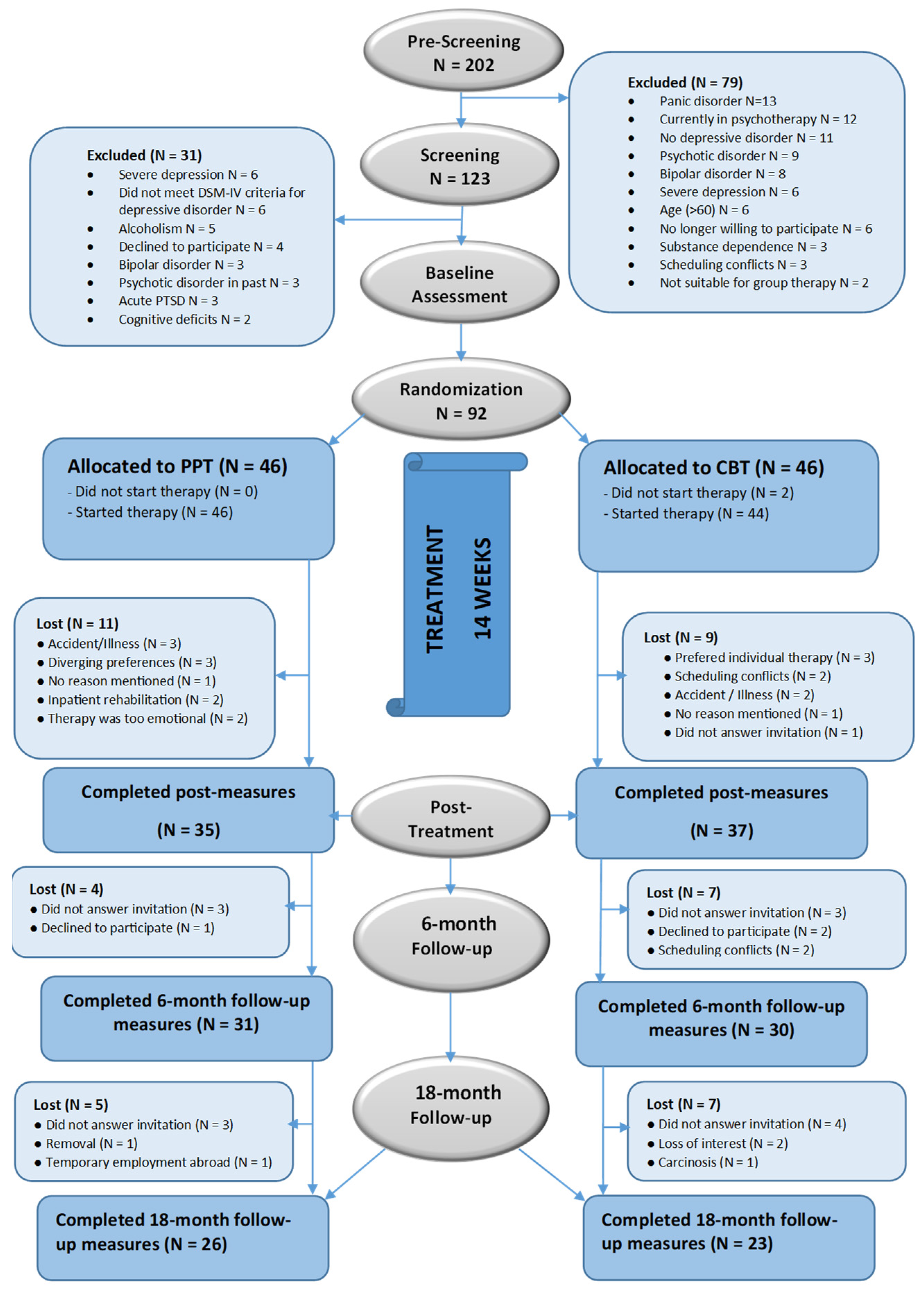
| Drop Out (Pre to post) | n = 11 | n = 9 | n = 20 | χ2 (1, n = 92) = 0.26, p = 0.61, η2 = 0.003 |
| Drop Out (Pre to 6-month follow-up) | n = 15 | n = 16 | n = 31 | χ2 (1, n = 92) = 0.05, p = 0.83, η2 = 0.000 |
| Drop Out (Pre to 18-month follow-up) | n = 20 | n = 23 | n = 43 | χ2 (1, n = 92) = 0.39, p = 0.53, η2 = 0.004 |
| Clinical characteristics of Diagnosis by SCID-I | χ2 (7, n = 92) = 5.57, p = 0.59, η2 = 0.057 | |||
| Single Episode of Major depression | ||||
| mild: n (%) | 1 (2.2) | 2 (4.3) | 3 (3.3) | |
| moderate: n (%) | 10 (21.7) | 6 (13.0) | 16 (17.4) | |
| partial in remission: n (%) | 1 (2.2) | 3 (6.5) | 4 (4.3) | |
| Recurrent Major depression | ||||
| currently mild: n (%) | 1 (2.2) | 4 (8.7) | 5 (5.4) | |
| currently moderate: n (%) | 24 (52.2) | 23 (50.0) | 47 (51.1) | |
| currently partial in remission: n (%) | 1 (2.2) | 0 (0.0) | 1 (1.1) | |
| Dysthymia | ||||
| with double depression: n (%) | 6 (13) | 7 (15.2) | 13 (14.1) | |
| without double depression: n (%) | 2 (4.3) | 1 (2.2) | 3 (3.3) | |
| Severity of depression | ||||
| partial in remission: n (%) | 2 (5.2) | 3 (7.8) | 5 (5.4) | |
| mild: n (%) | 2 (5.2) | 6 (15.8) | 8 (8.7) | |
| moderate: n (%) | 34 (89.5) | 29 (76.3) | 63 (68.5) |
| Applied Instruments | Preintervention | 18-Month Follow-Up | Statistics at Baseline (Test of Between-Subjects Effects Between PPT and CBT) | ||
|---|---|---|---|---|---|
| PPT | CBT | PPT | CBT | ||
| M (SE) | M (SE) | M (SE) | M (SE) | ||
| SWLS | 17.4 (0.67) | 17.3 (0.67) | 23.0 (0.72) a,b | 18.3 (0.72) | F (1, 90) = 0.00, p = 0.95, η2p = 0.000 |
| FS | 34.6 (0.93) | 34.3 (0.93) | 41.3 (1.00) a,b | 37.1 (1.01) | F (1, 90) = 0.89, p = 0.35, η2p = 0.010 |
| PPTI_total | 77.9 (1.48) | 77.4 (1.49) | 89.2 (1.60) a,b | 82.1 (1.60) | F (1, 90) = 0.60, p = 0.44, η2p = 0.007 |
| PPTI_P | 13.9 (0.42) | 13.6 (0.42) | 17.5 (0.45) a,b | 14.9 (0.45) | F (1, 90) = 3.38, p = 0.07, η2p = 0.036 |
| PPTI_E | 16.6 (0.40) | 16.6 (0.40) | 19.3 (0.43) a,b | 17.5 (0.43) | F (1, 90) = 0.00, p = 1.00, η2p = 0.000 |
| PPTI_R | 17.5 (0.40) | 17.5 (0.40) | 19.1 (0.44) b | 18.1 (0.44) | F (1, 90) = 0.08, p = 0.78, η2p =0.001 |
| PPTI_M | 13.9 (0.36) | 13.7 (0.36) | 15.6 (0.38) a,b | 14.5 (0.39) | F (1, 90) = 1.39, p = 0.24, η2p = 0.015 |
| PPTI_A | 15.9 (0.38) | 15.9 (0.38) | 17.6 (0.41) b | 17.1 (0.41) b | F (1, 90) = 0.13, p = 0.72, η2p = 0.001 |
| DHS | 32.9 (1.90) | 32.7 (1.91) | 47.8 (2.05) a,b | 35.0 (2.06) | F (1, 90) = 0.05, p = 0.83, η2p = 0.001 |
| MADRS | 21.3 (1.07) | 22.01 (1.10) | 9.10 (1.15) a,b | 13.95 (1.19) b | F (1, 90) = 0.85, p = 0.36, η2p = 0.010 |
| BDI-II | 24.85 (1.33) | 25.18 (1.33) | 9.99 (1.43) a,b | 21.48 (1.43) | F (1, 90) = 0.24, p = 0.62, η2p = 0.003 |
| BSI | 1.14 (0.06) | 1.16 (0.06) | 0.60 (0.07) a,b | 1.11 (0.07) | F (1, 90) = 0.58, p = 0.45, η2p = 0.006 |
| Fixed Effects (Intercepts, Slopes) | Est | SE | t | p | 95% CI LL | 95% CI UL | Partial η2 |
|---|---|---|---|---|---|---|---|
| SWLS | |||||||
| Intercept | 2.55 | 2.31 | 1.10 | 0.271 | −1.98 | 7.09 | 0.00 |
| Treatment | 0.12 | 1.20 | 0.10 | 0.923 | −2.23 | 2.46 | 0.00 |
| Time | 2.91 | 0.70 | 4.15 | <0.001 | 1.54 | 4.28 | 0.07 |
| Site | −0.42 | 0.75 | −0.56 | 0.575 | −1.88 | 1.04 | 0.00 |
| SWLS_T1 | 0.86 | 0.06 | 15.16 | <0.001 | 0.75 | 0.97 | 0.72 |
| Treatment × Time | −1.19 | 0.45 | −2.66 | 0.008 | −2.07 | −0.31 | 0.03 |
| FS | |||||||
| Intercept | 8.77 | 3.51 | 2.50 | 0.013 | 1.90 | 15.64 | 0.03 |
| Treatment | −1.04 | 1.66 | −0.63 | 0.530 | −4.30 | 2.21 | 0.00 |
| Time | 2.35 | 0.97 | 2.44 | 0.016 | 0.46 | 4.25 | 0.03 |
| Site | −0.78 | 1.03 | −0.76 | 0.451 | −2.80 | 1.24 | 0.00 |
| FS_T1 | 0.80 | 0.06 | 14.06 | <0.001 | 0.69 | 0.91 | 0.69 |
| Treatment × Time | −0.34 | 0.62 | −0.56 | 0.579 | −1.56 | 0.87 | 0.00 |
| PPTI_total | |||||||
| Intercept | 14.82 | 6.24 | 2.37 | 0.019 | 2.58 | 27.06 | 0.03 |
| Treatment | −1.54 | 2.65 | −0.58 | 0.563 | −6.74 | 3.66 | 0.00 |
| Time | 4.03 | 1.54 | 2.62 | 0.009 | 1.01 | 7.05 | 0.03 |
| Site | 0.06 | 1.64 | 0.04 | 0.967 | −3.15 | 3.29 | 0.00 |
| PPTI_total_T1 | 0.82 | 0.05 | 15.28 | <0.001 | 0.72 | 0.93 | 0.72 |
| Treatment × Time | −0.80 | 0.99 | −0.81 | 0.416 | −2.73 | 1.13 | 0.00 |
| PPTI_P | |||||||
| Intercept | 4.21 | 1.56 | 2.69 | 0.008 | 1.14 | 7.27 | 0.03 |
| Treatment | −0.88 | 0.77 | −1.14 | 0.253 | −2.38 | 0.62 | 0.00 |
| Time | 1.13 | 0.46 | 2.44 | 0.015 | 0.22 | 2.03 | 0.03 |
| Site | −0.41 | 0.42 | −0.98 | 0.330 | −1.24 | 0.41 | 0.01 |
| PPTI_P_T1 | 0.81 | 0.06 | 14.43 | <0.001 | 0.70 | 0.92 | 0.69 |
| Treatment × Time | −0.12 | 0.30 | −0.40 | 0.693 | −0.70 | 0.46 | 0.00 |
| PPTI_E | |||||||
| Intercept | 4.08 | 1.55 | 2.64 | 0.009 | 1.05 | 7.12 | 0.04 |
| Treatment | −0.18 | 0.70 | −0.26 | 0.792 | −1.55 | 1.19 | 0.00 |
| Time | 1.26 | 0.40 | 3.14 | 0.002 | 0.47 | 2.04 | 0.04 |
| Site | 0.59 | 0.47 | 1.26 | 0.210 | −0.32 | 1.50 | 0.02 |
| PPTI_E_T1 | 0.69 | 0.06 | 10.76 | <0.001 | 0.57 | 0.82 | 0.55 |
| Treatment × Time | −0.35 | 0.26 | −1.36 | 0.174 | −0.85 | 0.15 | 0.00 |
| PPTI_R | |||||||
| Intercept | 3.61 | 1.53 | 2.37 | 0.019 | 0.62 | 6.60 | 0.03 |
| Treatment | 0.14 | 0.71 | 0.19 | 0.846 | −1.26 | 1.53 | 0.00 |
| Time | 0.77 | 0.42 | 1.85 | 0.065 | −0.04 | 1.59 | 0.01 |
| Site | 0.21 | 0.42 | 0.50 | 0.616 | −0.61 | 1.03 | 0.00 |
| PPTI_R_T1 | 0.75 | 0.04 | 17.09 | <0.001 | 0.67 | 0.84 | 0.77 |
| Treatment × Time | −0.26 | 0.27 | −0.96 | 0.338 | −0.78 | 0.27 | 0.00 |
| PPTI_M | |||||||
| Intercept | 3.67 | 1.33 | 2.75 | 0.007 | 1.05 | 6.28 | 0.04 |
| Treatment | −0.51 | 0.63 | −0.80 | 0.424 | −1.74 | 0.73 | 0.00 |
| Time | 0.39 | 0.37 | 1.06 | 0.292 | −0.34 | 1.12 | 0.00 |
| Site | −0.17 | 0.37 | −0.47 | 0.637 | −0.89 | 0.54 | 0.00 |
| PPTI_M_T1 | 0.80 | 0.05 | 16.98 | <0.001 | 0.70 | 0.89 | 0.77 |
| Treatment × Time | 0.00 | 0.24 | 0.02 | 0.988 | −0.46 | 0.47 | 0.00 |
| PPTI_A | |||||||
| Intercept | 3.88 | 1.48 | 2.63 | 0.009 | 0.99 | 6.77 | 0.04 |
| Treatment | −0.11 | 0.67 | −0.17 | 0.869 | −1.41 | 1.19 | 0.00 |
| Time | 0.52 | 0.38 | 1.37 | 0.172 | −0.22 | 1.26 | 0.00 |
| Site | 0.32 | 0.43 | 0.74 | 0.460 | −0.52 | 1.16 | 0.00 |
| PPTI_A_T1 | 0.74 | 0.06 | 13.20 | <0.001 | 0.63 | 0.84 | 0.64 |
| Treatment × Time | −0.12 | 0.24 | −0.49 | 0.623 | −0.59 | 0.35 | 0.00 |
| DHS | |||||||
| Intercept | 5.52 | 6.42 | 0.86 | 0.391 | −7.07 | 18.10 | 0.00 |
| Treatment | −0.49 | 3.41 | −0.14 | 0.886 | −7.16 | 6.19 | 0.00 |
| Time | 8.40 | 2.00 | 4.19 | <0.001 | 4.47 | 12.33 | 0.07 |
| Site | 2.11 | 2.05 | 1.03 | 0.305 | −1.90 | 6.12 | 0.01 |
| DHS_T1 | 0.69 | 0.06 | 10.96 | <0.001 | 0.57 | 0.81 | 0.56 |
| Treatment × Time | −3.06 | 1.28 | −2.39 | 0.018 | −5.58 | −0.55 | 0.02 |
| MADRS | |||||||
| Intercept | 5.68 | 4.46 | 1.27 | 0.200 | −3.05 | 14.42 | 0.00 |
| Treatment | 0.54 | 2.08 | 0.26 | 0.790 | −3.54 | 4.62 | 0.00 |
| Time | −5.07 | 1.25 | −4.04 | <0.001 | −7.52 | −2.61 | 0.07 |
| Site | 1.90 | 1.28 | 1.49 | 0.140 | −0.60 | 4.40 | 0.02 |
| MADS_T1 | 0.60 | 0.07 | 8.52 | <0.001 | 0.46 | 0.74 | 0.45 |
| Treatment × Time | 1.26 | 0.80 | 1.56 | 0.120 | −0.32 | 2.84 | 0.01 |
| BDI | |||||||
| Intercept | 7.62 | 5.31 | 1.43 | 0.153 | −2.80 | 18.03 | 0.01 |
| Treatment | 1.41 | 2.47 | 0.57 | 0.568 | −3.43 | 6.26 | 0.00 |
| Time | −6.55 | 1.46 | −4.48 | <0.001 | −9.41 | −3.69 | 0.08 |
| Site | −0.53 | 1.58 | −0.33 | 0.739 | −3.63 | 2.57 | 0.00 |
| BDI_T1 | 0.70 | 0.07 | 10.00 | <0.001 | 0.56 | 0.83 | 0.53 |
| Treatment × Time | 1.97 | 0.94 | 2.11 | 0.036 | 0.14 | 3.80 | 0.02 |
| BSI | |||||||
| Intercept | 0.15 | 0.24 | 0.63 | 0.530 | −0.32 | 0.62 | 0.00 |
| Treatment | 0.09 | 0.11 | 0.75 | 0.452 | −0.14 | 0.31 | 0.00 |
| Time | −0.25 | 0.07 | −3.73 | <0.001 | −0.39 | −0.12 | 0.06 |
| Site | 0.04 | 0.07 | 0.59 | 0.556 | −0.10 | 0.19 | 0.00 |
| BSI_T1 | 0.75 | 0.06 | 13.01 | <.001 | 0.64 | 0.86 | 0.65 |
| Treatment × Time | 0.09 | 0.04 | 2.06 | 0.041 | 0.00 | 0.17 | 0.02 |
Disclaimer/Publisher’s Note: The statements, opinions and data contained in all publications are solely those of the individual author(s) and contributor(s) and not of MDPI and/or the editor(s). MDPI and/or the editor(s) disclaim responsibility for any injury to people or property resulting from any ideas, methods, instructions or products referred to in the content. |
© 2026 by the authors. Licensee MDPI, Basel, Switzerland. This article is an open access article distributed under the terms and conditions of the Creative Commons Attribution (CC BY) license.
Share and Cite
Fischer, E.; Furchtlehner, L.M.; Schuster, R.; Laireiter, A.-R. Long-Term Effects of Positive Psychotherapy Compared to Cognitive Behavior Therapy in Clinical Depression: An 18-Month Follow-Up Randomized Controlled Trial. Healthcare 2026, 14, 692. https://doi.org/10.3390/healthcare14050692
Fischer E, Furchtlehner LM, Schuster R, Laireiter A-R. Long-Term Effects of Positive Psychotherapy Compared to Cognitive Behavior Therapy in Clinical Depression: An 18-Month Follow-Up Randomized Controlled Trial. Healthcare. 2026; 14(5):692. https://doi.org/10.3390/healthcare14050692
Chicago/Turabian StyleFischer, Elena, Linda Maria Furchtlehner, Raphael Schuster, and Anton-Rupert Laireiter. 2026. "Long-Term Effects of Positive Psychotherapy Compared to Cognitive Behavior Therapy in Clinical Depression: An 18-Month Follow-Up Randomized Controlled Trial" Healthcare 14, no. 5: 692. https://doi.org/10.3390/healthcare14050692
APA StyleFischer, E., Furchtlehner, L. M., Schuster, R., & Laireiter, A.-R. (2026). Long-Term Effects of Positive Psychotherapy Compared to Cognitive Behavior Therapy in Clinical Depression: An 18-Month Follow-Up Randomized Controlled Trial. Healthcare, 14(5), 692. https://doi.org/10.3390/healthcare14050692