Response Facilitation in Dementia Care: Exploring Engagement Through Social Contexts: A Qualitative Study in Dutch Nursing Homes

Highlights
- Group-based recreational activities seem to provide the strongest conditions for response facilitation, leading to more behavioural and physiological signs of engagement among residents with dementia.
- Observational and physiological data frequently diverge, showing that residents may display cognitive or emotional engagement even when not outwardly participating.
- The heightened attention seen in group activities suggests a need to understand why these settings seem to be more effective and to translate their social, spatial, and facilitative elements into everyday care contexts to invite broader engagement.
- Reliance on behavioural observation alone may underestimate residents’ internal engagement; care practices and evaluations could incorporate multimodal indicators to better understand and support meaningful participation.
Abstract
1. Introduction
2. Theoretical Framework
2.1. Social Cognitive Theory and Incentive Motivation
2.2. Response Facilitation as a Specific Form of Incentive Motivation Relevant for People with Dementia
- How do recreational activities naturally occur in psychogeriatric nursing homes?
- Do non-participating residents display observable behavioural and/or physiological signs of engagement when observing individual activities, dyadic activities, or group activities?
- How do observational and physiological indicators of engagement differ or align across the three social contexts?
3. Materials and Methods
3.1. Case Studies
3.2. Participants
- residence on one of the participating psychogeriatric wards;
- a documented diagnosis of dementia with moderate to advanced severity according to the nursing home geriatrician;
- ability to move independently through the communal living area (with or without mobility aids such as a walker or self-propelled wheelchair), so that potential engagement with ongoing activities in the shared spaces could be observed;
- informal caregiver consent for participation and data collection (observations and physiological measurements);
- absence of clear and persistent objection by the resident during day-to-day interactions with researchers (ongoing assent).
- being bedbound or fully dependent on staff for transfers and mobility, such that the resident could not independently move through or remain in the communal living spaces;
- severe sensory or motor impairments that would preclude meaningful observation of responses to activities in shared spaces;
- acute medical instability or superimposed delirium, as judged by the clinical team;
- refusal of informal caregivers or clear/repeated refusal by the resident to be observed and/or to wear sensors.
3.3. Methods Step 1: Mapping Daily Activities
3.4. Methods Step 2: Narratives for Constructing the Scenario
3.5. Methods Step 3: Scenarios
- Individual Activity: One resident engaging in an activity independently, observed by others (i.e., one or more participants in the study).
- Dyadic Activity: A resident performing an activity alongside/with a caregiver or volunteer, offering additional social cues for engagement, again observed by others (participants).
- Group Activity: A structured group setting where multiple residents participated in an activity led by a caregiver or volunteer facilitator, observed by others (participants of the study).
3.6. Ethical Considerations
4. Results
4.1. Fly-on-the-Wall Observations and Narratives
It’s a quiet afternoon in the living room after lunch. Douglas sits at the table, flipping through the morning newspaper, although not reacting physically or verbally to what he ‘reads’. Edward sits next to him and occasionally glances over to Douglas, sometimes craning his neck to glance at the paper too. After a few minutes, Edward asks, ‘Can I see the paper?’ Douglas pauses briefly before folding it and sliding it across the table. Douglas now sits at his spot, not doing anything, just glancing around the room. Edward spends the next 15 min bent over the paper in silence. Whether he’s reading or dozing off is unclear, he is completely bent over the newspaper, his nose almost touching the paper. Eventually, he straightens and he neatly folds it, places it back on the table, and pushes himself slightly from the table with his wheelchair.
It’s a quiet mid-morning in the living room of the nursing home. Annie strolls in with her walker and in the basket in the front, she brings some knitting supplies. She sits down by the window, knitting quietly as sunlight streams in. A couple of staff members pass by, greeting Annie warmly: ‘Good morning.’ She looks up briefly, smiles, and returns to her knitting. Three other residents acknowledge her with nods or brief hellos but don’t comment on her work. Annie’s focus is interrupted when Ben enters. He walks straight to her, bypassing the dining table without a word. ‘You want to go for a walk?’ he says. Annie hesitates, holding up her knitting as if to explain that she’s busy. Ben waits silently, showing no reaction to her reluctance, but just says again: ‘I think we should go for a walk?’. After a moment, Annie begins carefully packing up her supplies. Once ready, Annie joins Ben, with the knitting again in the basket of her walker: ‘I have to put this in my room first! Let’s just go that way now first’.
Edward is sitting quietly in the living room, as he often does. A volunteer enters and begins chatting with another resident nearby before turning her attention to Edward. ‘[comment on enjoying sitting in the living room] You do need to move more, Edward’ she says with a friendly smile. Edward nods in agreement: ‘Perhaps’. No one else in the room reacts to their interaction as Edward adjusts himself in his wheelchair and follows her out. In the hallway, the volunteer remains focused on Edward, engaging him in light conversation as they pass others. They exchange brief greetings with residents and staff along the way, but remain in conversation during the activity. When they are standing at the window looking outside, a resident from another group joins them silently. When Edward and the volunteer leave that spot, the other resident stays looking intently out the window.
Byron sits in the living room with today’s newspaper lying in front of him. Earlier, he flipped through it, but now he’s simply staring around the room. A care professional approaches him and asks, ‘What’s in the paper today?’ Byron shrugs and replies, ‘I don’t know.’ The professional sits beside him, opens the paper to the front page, and they begin reading together. When they reach a story about the royals, Byron shakes his head. ‘Not my thing,’ he says plainly. ‘I’d rather read other stories.’ As they continue, two residents pause behind them, curiously glancing over their shoulders at what they’re doing but not engaging directly. The care professional doesn’t notice as she remains focused on Byron, chatting amicably about what’s in the paper while others move around the room.
The living area is calm after breakfast, with residents scattered in quiet activity. Bernice sits at the central dining room table with her coffee when two staff members enter and announce: ‘Time for bingo!’ They approach specific residents, including Bernice, inviting them personally to join. Not all people are asked, just the ones who are on the schedule. Bernice smiles and agrees, rising to join two others who were also invited. The remaining residents watch this unfold without comment. Bernice and the small group are led to a separate activity room arranged specifically for bingo. The atmosphere is lively and structured, with care professionals warmly welcoming participants and guiding them to their seats. As the game begins, care professionals help residents find numbers on their cards and share small jokes about their luck. Not all residents seem to grasp the goal of the activity (they do not stamp any of the called numbers), but they are smiling and looking at other residents, clapping when someone has a bingo. Bernice also claps enthusiastically, smiling despite not winning herself.
4.2. Constructing Scenarios
4.3. Observational Outcomes of Scenarios for Response Facilitation
4.4. Combining Physiological and Observational Data of Scenarios for Response Facilitation
5. Discussion
5.1. Summary of Main Findings
5.2. Narratives: Recreational Activities and Contexts in Everyday Practice
5.3. Scenarios: Behavioural and Physiological Indicators of Engagement Across Social Contexts
5.4. Conditions That May Influence Response Facilitation
5.4.1. The Role of Social Interaction: Content, Participants, and Accessibility
5.4.2. The Influence of Activity Type and Facilitation
5.5. Methodological Considerations and Implications for Future Research
6. Conclusions
Supplementary Materials
Author Contributions
Funding
Institutional Review Board Statement
Informed Consent Statement
Data Availability Statement
Acknowledgments
Conflicts of Interest
Abbreviations
| SCT | Social Cognitive Theory |
| VD | Vascular Dementia |
| FTD | Frontotemporal Dementia |
| AD | Alzheimer’s Disease |
| LBD | Lewy Body Dementia |
| PDD | Parkinson’s Disease Dementia |
| OERS | Observed Emotion Rating Scale |
| HR | Heart Rate |
| HRV | Heart Rate Variability |
| PR | Pulse Rate |
| PRV | Pulse Rate Variability |
| SCL | Skin Conductance Level |
References
- Hammink, J.H.W.; van Buuren, L.P.G.; Moor, J.A.; Derks, D.A.; Mohammadi, M. Evolving Dementia Care: An Explorative Study on the Lived Experience of Older Adults Living with Dementia in Nursing Homes Using Observational and Biometric Sensor Data. Dementia 2024, 24, 456–479. [Google Scholar] [CrossRef]
- Cooper, C.; Mukadam, N.; Katona, C.; Lyketsos, C.G.; Ames, D.; Rabins, P.; Engedal, K.; de Mendonça Lima, C.; Blazer, D.; Teri, L.; et al. Systematic Review of the Effectiveness of Non-Pharmacological Interventions to Improve Quality of Life of People with Dementia. Int. Psychogeriatr. 2012, 24, 856–870. [Google Scholar] [CrossRef] [PubMed]
- Hulme, C.; Wright, J.; Crocker, T.; Oluboyede, Y.; House, A. Non-Pharmacological Approaches for Dementia That Informal Carers Might Try or Access: A Systematic Review. Int. J. Geriatr. Psychiatry 2009, 25, 756–763. [Google Scholar] [CrossRef]
- Woods, B.; Aguirre, E.; Spector, A.E.; Orrell, M. Cognitive Stimulation to Improve Cognitive Functioning in People with Dementia. Cochrane Database Syst. Rev. 2023, CD005562. [Google Scholar] [CrossRef]
- Sommerlad, A.; Huntley, J.D.; Liu, K.Y.; Gonzalez, S.C.; Selbaek, G.; Alladi, S.; Ames, D.; Banerjee, S.; Burns, A.; Brayne, C.; et al. Interventions for People Living with Dementia: Updates from 2024 Lancet Commission. Alzheimers Dement. 2025, 20, e085068. [Google Scholar] [CrossRef]
- Smit, D. Predictors of Activity Involvement in Dementia Care Homes: A Cross-Sectional Study. BMC Geriatr. 2017, 17, 175. [Google Scholar] [CrossRef]
- McAuliffe, L.; Fetherstonhaugh, D.; Rayner, J.-A.; Clune, S. Having to ‘Go beyond’: Staff Perspectives on Activity Programs for Older People Living in Nursing Homes. J. Aging Stud. 2024, 71, 101279. [Google Scholar] [CrossRef]
- Erlandsson, S.; Knutsson, O.; Schön, U.-K. Perceptions of Participation: How Nursing Home Staff and Managers Perceive and Strive for Participation of Older Residents. Eur. J. Social. Work. 2023, 26, 815–827. [Google Scholar] [CrossRef]
- Costa, E. Examining the Effectiveness of Interventions to Reduce Discriminatory Behavior at Work: An Attitude Dimension Consistency Perspective. J. Appl. Psychol. 2024, 109, 1669–1692. [Google Scholar] [CrossRef]
- Zhang, A.L.; Liu, S.; White, B.X.; Liu, X.C.; Durantini, M.; Chan, M.-P.S.; Dai, W.; Zhou, Y.; Leung, M.; Ye, Q.; et al. Health-Promotion Interventions Targeting Multiple Behaviors: A Meta-Analytic Review of General and Behavior-Specific Processes of Change. Psychol. Bull. 2024, 150, 798–838. [Google Scholar] [CrossRef]
- Michie, S.; van Stralen, M.M.; West, R. The Behaviour Change Wheel: A New Method for Characterising and Designing Behaviour Change Interventions. Implement. Sci. 2011, 6, 42. [Google Scholar] [CrossRef]
- Glanz, K.; Rimer, B.K.; Viswanath, K. (Eds.) Health Behavior and Health Education: Theory, Research, and Practice, 4th ed.; Jossey-Bass: San Francisco, CA, USA, 2008; ISBN 978-0-7879-9614-7. [Google Scholar]
- Glanz, K.; Bishop, D.B. The Role of Behavioral Science Theory in Development and Implementation of Public Health Interventions. Annu. Rev. Public Health 2010, 31, 399–418. [Google Scholar] [CrossRef]
- Painter, J.E.; Borba, C.P.C.; Hynes, M.; Mays, D.; Glanz, K. The Use of Theory in Health Behavior Research from 2000 to 2005: A Systematic Review. Ann. Behav. Med. 2008, 35, 358–362. [Google Scholar] [CrossRef]
- Bandura, A. Social Foundations of Thought and Action: A Social Cognitive Theory; Prentice-Hall, Inc.: Englewood Cliffs, NJ, USA, 1986. [Google Scholar]
- Bandura, A. Social Cognitive Theory: An Agentic Perspective. Annu. Rev. Psychol. 2001, 52, 1–26. [Google Scholar] [CrossRef]
- Di Lorito, C.; Bosco, A.; Pollock, K.; Harwood, R.H.; das Nair, R.; Logan, P.; Goldberg, S.; Booth, V.; Vedhara, K.; Godfrey, M.; et al. External Validation of the ‘PHYT in Dementia’, a Theoretical Model Promoting Physical Activity in People with Dementia. Int. J. Environ. Res. Public Health 2020, 17, 1544. [Google Scholar] [CrossRef]
- Hammink, J.H.W.; Moor, J.A.; Mohammadi, M. Influencing Health Behaviour Using Smart Building Interventions for People with Dementia and Mild Cognitive Impairment: Expert Interviews and a Systematic Literature Review. Disabil. Rehabil. Assist. Technol. 2023, 18, 1175–1191. [Google Scholar] [CrossRef] [PubMed]
- Schunk, D.H.; Usher, E.L. Social Cognitive Theory and Motivation. In The Oxford Handbook of Human Motivation; Oxford University Press: New York, NY, USA, 2012; pp. 13–27. [Google Scholar]
- Bandura, A. Human Agency in Social Cognitive Theory. Am. Psychol. 1989, 44, 1175. [Google Scholar] [CrossRef] [PubMed]
- Jonker, C.; Slaets, J.P.J.; Verhey, F.R.J. Handboek Dementie: Laatste Inzichten in Diagnostiek En Behandeling; Bohn Stafleu van Loghum: Houten, The Netherlands, 2009; ISBN 978-90-313-8061-9. [Google Scholar]
- Schunk, D.H.; DiBenedetto, M.K. Motivation and Social Cognitive Theory. Contemp. Educ. Psychol. 2020, 60, 101832. [Google Scholar] [CrossRef]
- Jao, Y.-L.; Algase, D.L.; Specht, J.K.; Williams, K. Developing the Person–Environment Apathy Rating for Persons with Dementia. Aging Ment. Health 2016, 20, 861–870. [Google Scholar] [CrossRef]
- Jao, Y.-L.; Liu, W.; Williams, K.; Chaudhury, H.; Parajuli, J. Association between Environmental Stimulation and Apathy in Nursing Home Residents with Dementia. Int. Psychogeriatr. 2019, 31, 1109–1120. [Google Scholar] [CrossRef] [PubMed]
- Trahan, M.A.; Kuo, J.; Carlson, M.C.; Gitlin, L.N. A Systematic Review of Strategies to Foster Activity Engagement in Persons With Dementia. Health Educ. Behav. 2014, 41, 70S–83S. [Google Scholar] [CrossRef]
- Cooper, L.D.; Rigrodsky, S. Verbal Training to Improve Explanations of Conservation with Aphasic Adults. J. Speech Lang. Hear. Res. 1979, 22, 818–828. [Google Scholar] [CrossRef]
- Clare, L.; Jones, R.S.P. Errorless Learning in the Rehabilitation of Memory Impairment: A Critical Review. Neuropsychol. Rev. 2008, 18, 1–23. [Google Scholar] [CrossRef] [PubMed]
- Dijksterhuis, A.; Bargh, J.A. The Perception-Behavior Expressway: Automatic Effects of Social Perception on Social Behavior. In Advances in Experimental Social Psychology; Elsevier: Amsterdam, The Netherlands, 2001; Volume 33, pp. 1–40. ISBN 978-0-12-015233-9. [Google Scholar]
- Brass, M.; Derrfuss, J.; Matthes-von Cramon, G.; Von Cramon, D.Y. Imitative Response Tendencies in Patients with Frontal Brain Lesions. Neuropsychology 2003, 17, 265–271. [Google Scholar] [CrossRef] [PubMed]
- Galik, E.M.; Resnick, B.; Pretzer-Aboff, I. ‘Knowing What Makes Them Tick’: Motivating Cognitively Impaired Older Adults to Participate in Restorative Care. Int. J. Nurs. Pract. 2009, 15, 48–55. [Google Scholar] [CrossRef] [PubMed]
- Galik, E.M.; Resnick, B. Restorative Care With Cognitively Impaired Older Adults: Moving Beyond Behavior. Top. Geriatr. Rehabil. 2007, 23, 114–125. [Google Scholar] [CrossRef]
- Heacock, P.R.; Beck, C.M.; Souder, E.; Mercer, S. Assessing Dressing Ability in Dementia. Geriatr. Nurs. 1997, 18, 107–111. [Google Scholar] [CrossRef]
- Ries, J.D. A Framework for Rehabilitation for Older Adults Living with Dementia. Arch. Physiother. 2022, 12, 9. [Google Scholar] [CrossRef]
- Tsai, P.-F.; Kitch, S.; Beck, C.; Jakobs, T.; Rettiganti, M.; Jordan, K.; Jakobs, E.; Adair, S. Using an Interactive Video Simulator to Improve Certified Nursing Assistants’ Dressing Assistance and Nursing Home Residents’ Dressing Performance: A Pilot Study. Comput. Inform. Nurs. 2018, 36, 183–192. [Google Scholar] [CrossRef]
- Turner, J.; Mathews, R.M. Behavioral Gerontology. In APA Handbook of Behavior Analysis, Vol. 2: Translating Principles Into Practice; Madden, G.J., Dube, W.V., Hackenberg, T.D., Hanley, G.P., Lattal, K.A., Eds.; American Psychological Association: Washington, DC, USA, 2013; pp. 545–562. ISBN 978-1-4338-1113-5. [Google Scholar]
- Barrick, A.L.; Rader, J.; Hoeffer, B.; Sloane, P.D.; Biddle, S. (Eds.) Bathing Without a Battle: Person-Directed Care of Individuals with Dementia, 2nd ed.; Springer Publishing Company: Berlin/Heidelberg, Germany, 2008; ISBN 978-0-8261-0125-9. [Google Scholar]
- Beck, C.; Heacock, P.; Mercer, S.O.; Walls, R.C.; Rapp, C.G.; Vogelpohl, T.S. Improving Dressing Behavior in Cognitively Impaired Nursing Home Residents. Nurs. Res. 1997, 46, 126. [Google Scholar] [CrossRef]
- Cruz, J.; Marques, A.; Barbosa, A.L.; Figueiredo, D.; Sousa, L. Effects of a Motor and Multisensory-Based Approach on Residents with Moderate-to-Severe Dementia. Am. J. Alzheimers Dis. Other Dement. 2011, 26, 282–289. [Google Scholar] [CrossRef]
- Downs, A.F.D.; Rosenthal, T.L.; Lichstein, K.L. Modeling Therapies Reduce Avoidance of Bath-Time by the Institutionalized Elderly. Behav. Ther. 1988, 19, 359–368. [Google Scholar] [CrossRef]
- Boothby, E.J.; Clark, M.S.; Bargh, J.A. Shared Experiences Are Amplified. Psychol. Sci. 2014, 25, 2209–2216. [Google Scholar] [CrossRef]
- Cohen-Mansfield, J.; Thein, K.; Dakheel-Ali, M.; Marx, M.S. Engaging Nursing Home Residents with Dementia in Activities: The Effects of Modeling, Presentation Order, Time of Day, and Setting Characteristics. Aging Ment. Health 2010, 14, 471–480. [Google Scholar] [CrossRef]
- Nakata, R.; Kawai, N. The “Social” Facilitation of Eating without the Presence of Others: Self-Reflection on Eating Makes Food Taste Better and People Eat More. Physiol. Behav. 2017, 179, 23–29. [Google Scholar] [CrossRef]
- Aalten, P.; Verhey, F.R.; Boziki, M.; Bullock, R.; Byrne, E.J.; Camus, V.; Caputo, M.; Collins, D.; De Deyn, P.P.; Elina, K.; et al. Neuropsychiatric Syndromes in Dementia. Results from the European Alzheimer Disease Consortium: Part I. Dement. Geriatr. Cogn. Disord. 2007, 24, 457–463. [Google Scholar] [CrossRef] [PubMed]
- Akyol, M.A.; Kucukguclu, O.; Yener, G. Investigation of Factors Affecting Apathy in Three Major Types of Dementia. Arch. Neuropsychiatry 2018, 58, 120. [Google Scholar] [CrossRef] [PubMed]
- Ballard, C.; Gauthier, S.; Corbett, A.; Brayne, C.; Aarsland, D.; Jones, E. Alzheimer’s Disease. Lancet 2011, 377, 1019–1031. [Google Scholar] [CrossRef]
- Halek, M.; Reuther, S.; Müller-Widmer, R.; Trutschel, D.; Holle, D. Dealing with the Behaviour of Residents with Dementia That Challenges: A Stepped-Wedge Cluster Randomized Trial of Two Types of Dementia-Specific Case Conferences in Nursing Homes (FallDem). Int. J. Nurs. Stud. 2020, 104, 103435. [Google Scholar] [CrossRef]
- Regier, N.G.; Hodgson, N.A.; Gitlin, L.N. Characteristics of Activities for Persons With Dementia at the Mild, Moderate, and Severe Stages. Gerontologist 2017, 57, 987–997. [Google Scholar] [CrossRef]
- Roberts, E. A Conversation About the Ethics of Past and Future Memory Care Models: Perspectives from the First Two European Dementia Villages. Inquiry 2023, 60, 00469580221150565. [Google Scholar] [CrossRef]
- Connelly, F.M.; Clandinin, D.J. Stories of Experience and Narrative Inquiry. Educ. Res. 1990, 19, 2–14. [Google Scholar] [CrossRef]
- Grimaldi, S.; Fokkinga, S.; Ocnarescu, I. Narratives in Design: A Study of the Types, Applications and Functions of Narratives in Design Practice. In Proceedings of the 6th International Conference on Designing Pleasurable Products and Interfaces—DPPI ’13, Newcastle upon Tyne, UK, 3–5 September 2013; ACM Press: Newcastle upon Tyne, UK, 2013; p. 201. [Google Scholar]
- Mohammadi, M.; Dominicus, M.; van Buuren, L.; Hamers, K.; Hammink, C.; Yegenoglu, H. The Evolution of Housing Typologies for Older Adults in The Netherlands From 1945 to 2016: An Analysis in the Context of Policy, Societal, and Technological Developments. J. Hous. Elder. 2019, 33, 205–226. [Google Scholar] [CrossRef]
- Emrani, S.; Lamar, M.; Price, C.C.; Wasserman, V.; Matusz, E.F.; Au, R.; Swenson, R.; Nagele, R.G.; Heilman, K.M.; Libon, D.J. Alzheimer’s/Vascular Spectrum Dementia: Classification in Addition to Diagnosis. J. Alzheimer’s Dis. 2019, 73, 63–71. [Google Scholar] [CrossRef] [PubMed]
- den Ouden, M.; Bleijlevens, M.H.C.; Meijers, J.M.M.; Zwakhalen, S.M.G.; Braun, S.M.; Tan, F.E.S.; Hamers, J.P.H. Daily (In)Activities of Nursing Home Residents in Their Wards: An Observation Study. J. Am. Med. Dir. Assoc. 2015, 16, 963–968. [Google Scholar] [CrossRef]
- Shephard, R.J. Limits to the Measurement of Habitual Physical Activity by Questionnaires * Commentary. Br. J. Sports Med. 2003, 37, 197–206. [Google Scholar] [CrossRef]
- Zeisel, J. Inquiry by Design: Tools for Environment-Behaviour Research; Reprint.; Cambridge University Press: Cambridge, UK, 1993; ISBN 978-0-521-31971-3. [Google Scholar]
- van Buuren, L.; Hammink, C.; Mohammadi, M.; Derks, D.; Moor, N. Constructing the Lived Experience of Older Adults with Dementia: Lessons Learned from an Explorative Mixed Method Approach. In Proceedings of the SHE2024 International Scientific Conference, Maastricht, The Netherlands, 14–16 May 2024; pp. 44–58. [Google Scholar]
- van Buuren, L.P.G. Slim Wonen Ontzorgt: Ontwerpprincipes En Randvoorwaarden Voor Een Slimme Intramurale Woonzorgomgeving. PDEng Thesis, Technische Universiteit Eindhoven, Eindhoven, The Netherlands, 2019. (finished PDEng Thesis). [Google Scholar]
- Driessen, A. A Good Life with Dementia: Ethnographic Articulations of Everyday Life and Care in Dutch Nursing Homes; Universiteit van Amsterdam: Amsterdam, The Netherlands, 2019. [Google Scholar]
- Hirschauer, S. Puttings Things into Words. Ethnographic Description and the Silence of the Social. Human. Stud. 2006, 29, 413–441. [Google Scholar] [CrossRef]
- de Boer, B.; Beerens, H.C.; Zwakhalen, S.M.G.; Tan, F.E.S.; Hamers, J.P.H.; Verbeek, H. Daily Lives of Residents with Dementia in Nursing Homes: Development of the Maastricht Electronic Daily Life Observation Tool. Int. Psychogeriatr. 2016, 28, 1333–1343. [Google Scholar] [CrossRef]
- Leone, E.; Deudon, A.; Piano, J.; Robert, P.; Dechamps, A. Are Dementia Patient’s Engagement Using Tailored Stimuli the Same? The Apathy Dilemma in Nursing Home Residents. Curr. Gerontol. Geriatr. Res. 2012, 2012, 942640. [Google Scholar] [CrossRef][Green Version]
- Rosenthal, T.; Bandura, A.; Garfield, S.; Bergin, A. Handbook of Psychotherapy and Behavior Change; Wiley: New York, NY, USA, 1978. [Google Scholar]
- Luszczynska, A.; Schwarzer, R. Social Cognitive Theory. Predict. Health Behav. 2005, 2, 127–169. [Google Scholar]
- Vollet, J.W.; Kindermann, T.A.; Skinner, E.A. In Peer Matters, Teachers Matter: Peer Group Influences on Students’ Engagement Depend on Teacher Involvement. J. Educ. Psychol. 2017, 109, 635–652. [Google Scholar] [CrossRef]
- Shteynberg, G.; Hirsh, J.B.; Bentley, R.A.; Garthoff, J. Shared Worlds and Shared Minds: A Theory of Collective Learning and a Psychology of Common Knowledge. Psychol. Rev. 2020, 127, 918–931. [Google Scholar] [CrossRef]
- Kraatz, E.; Nagpal, M.; Lin, T.-J.; Hsieh, M.-Y.; Ha, S.Y.; Kim, S.; Shin, S. Teacher Scaffolding of Social and Intellectual Collaboration in Small Groups: A Comparative Case Study. Front. Psychol. 2020, 11, 587058. [Google Scholar] [CrossRef] [PubMed]
- Steinert, L.; Putze, F.; Küster, D.; Schultz, T. Predicting Activation Liking of People With Dementia. Front. Comput. Sci. 2022, 3, 770492. [Google Scholar] [CrossRef]
- Zantige, G.; van Rijn, S.; Stockmann, L.; Swaab, H. Concordance between Physiological Arousal and Emotion Expression during Fear in Young Children with Autism Spectrum Disorders. Autism 2019, 23, 629–638. [Google Scholar] [CrossRef] [PubMed]
- Healey, R.; Goldsworthy, M.; Salomoni, S.; Weber, S.; Kemp, S.; Hinder, M.R.; St George, R.J. Impaired Motor Inhibition during Perceptual Inhibition in Older, but Not Younger Adults: A Psychophysiological Study. Sci. Rep. 2024, 14, 2023. [Google Scholar] [CrossRef]
- Persad, C.C.; Abeles, N.; Zacks, R.T.; Denburg, N.L. Inhibitory Changes After Age 60 and Their Relationship to Measures of Attention and Memory. J. Gerontol. B Psychol. Sci. Soc. Sci. 2002, 57, P223–P232. [Google Scholar] [CrossRef]
- Cohen-Mansfield, J. The Impact of Group Activities and Their Content on Persons with Dementia Attending Them. Alzheimers Res. Ther. 2018, 10, 37. [Google Scholar] [CrossRef] [PubMed]
- Jesdale, B.M.; Bova, C.A.; Mbrah, A.K.; Lapane, K.L. Group Activity Participation in Relation to Contextual Isolation of United States Nursing Home Residents Living with Alzheimer’s Disease and Related Dementias. J. Nurs. Home Res. Sci. 2021, 7, 38–46. [Google Scholar] [CrossRef]
- Wong, S.; Wei, G.; Husain, M.; Hodges, J.R.; Piguet, O.; Irish, M.; Kumfor, F. Altered Reward Processing Underpins Emotional Apathy in Dementia. Cogn. Affect. Behav. Neurosci. 2023, 23, 354–370. [Google Scholar] [CrossRef]
- Attaallah, B.; Toniolo, S.; Maio, M.R.; Husain, M. Apathy and Effort-based Decision-making in Alzheimer’s Disease and Subjective Cognitive Impairment. Alzheimer’s Dement. Diagn. Assess. Dis. Monit. 2024, 16, e70013. [Google Scholar] [CrossRef]
- Coleman, D.J.; Asiri, N.A.S. A Person-Centred Communication Approach to Working with Older People Who Have Dementia. Br. J. Healthc. Assist. 2020, 14, 575–579. [Google Scholar] [CrossRef]
- Williams, K.N.; Perkhounkova, Y.; Herman, R.; Bossen, A. A Communication Intervention to Reduce Resistiveness in Dementia Care: A Cluster Randomized Controlled Trial. Gerontologist 2017, 57, 707–718. [Google Scholar] [CrossRef]
- Manz, C.C.; Sims, H.P. Vicarious Learning: The Influence of Modeling on Organizational Behavior. Acad. Manag. Rev. 1981, 6, 105–113. [Google Scholar] [CrossRef]
- McCabe, L.; Robertson, J.; Kelly, F. Scaffolding and Working Together: A Qualitative Exploration of Strategies for Everyday Life with Dementia. Age Ageing 2018, 47, 303–310. [Google Scholar] [CrossRef]
- Kolanowski, A.; Buettner, L.; Litaker, M.; Yu, F. Factors That Relate to Activity Engagement in Nursing Home Residents. Am. J. Alzheimers Dis. Other Dement. 2006, 21, 15–22. [Google Scholar] [CrossRef] [PubMed]
- Tak, S.H.; Kedia, S.; Tongumpun, T.M.; Hong, S.H. Activity Engagement: Perspectives from Nursing Home Residents with Dementia. Educ. Gerontol. 2015, 41, 182–192. [Google Scholar] [CrossRef] [PubMed]
- Majlesi, A.R.; Ekström, A.; Hydén, L.-C. Spatiotemporal Arrangement of Objects in Activities with People with Dementia. Logop. Phoniatr. Vocol 2019, 44, 31–40. [Google Scholar] [CrossRef]



| Research Step | Data Collection | Data Analysis | Goal | |
|---|---|---|---|---|
| 1 | Mapping daily activities (Section 3.3) | Fly-on-the-wall observation, unstructured interviews | Observation list, topic list | Insights into who is doing what with whom, in what relationship, in what context, and where. Including background knowledge on residents (3.3) |
| 2 | Formulating narratives per case study (Section 3.4) | Results of research step 1 | Thematic and Interaction Analysis | Identifying common themes of ‘daily living’ i.r.t. facilitation strategies, to inform scenario development (step 3). |
| 3 | Constructing and executing scenarios | Fly-on-the-wall observation and videotaping | Observation list | Insights into behavioural actions during scenario execution. |
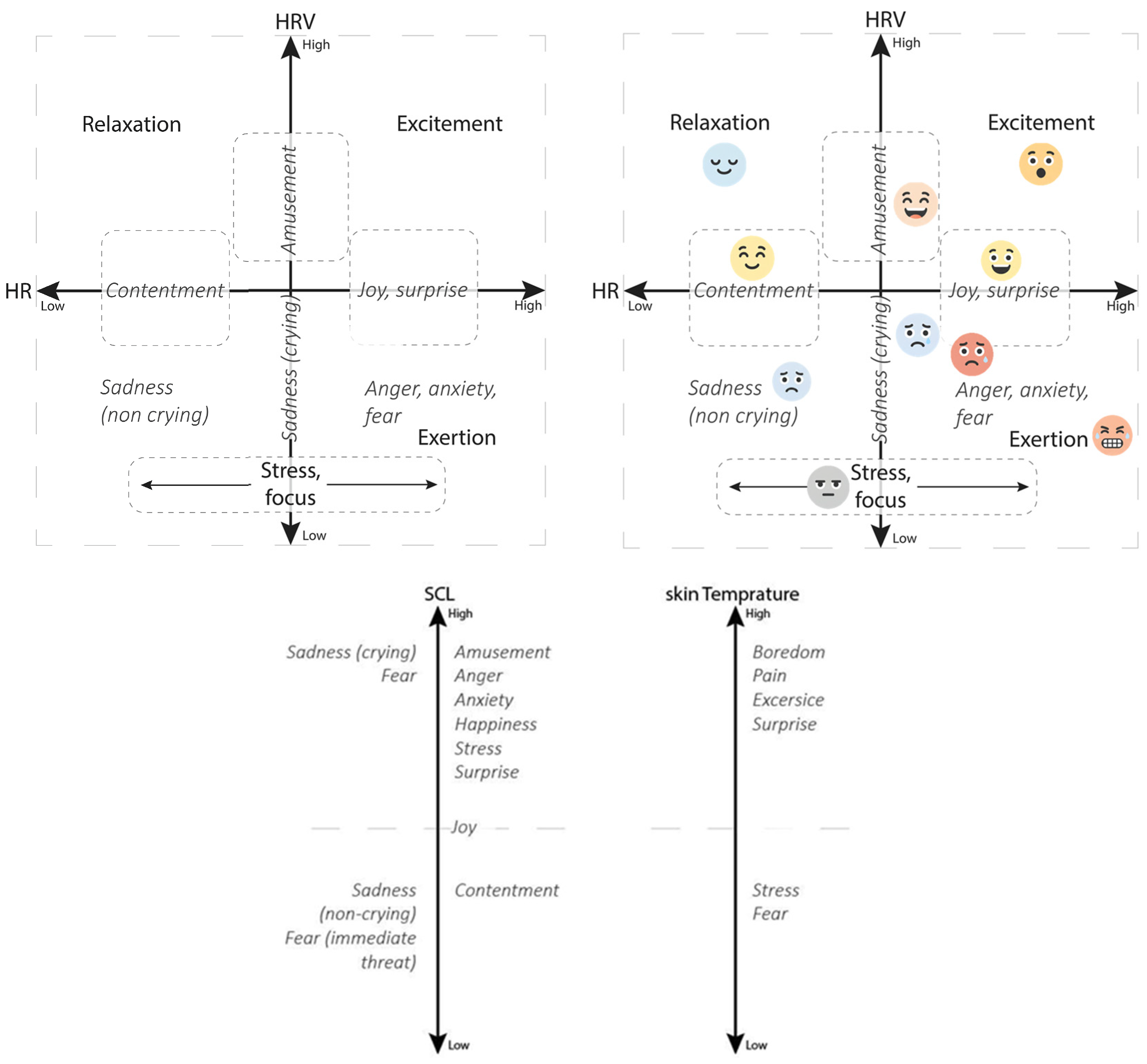
| while measuring the affective response (Section 3.5) | Observational scales, physiological sensors | MEDLO, OERS, HR, and HRV levels | Insights into affective responses. | |
| Pseudonym | Type of Dementia | Severity | Symptoms | Sensory Issues | Mobility | |
|---|---|---|---|---|---|---|
| Case Study 1 | Alice | AD | Moderate-Severe | Moderate Apathy, Memory and Orientation Problems | glasses | walker |
| Bernice | AD | Moderate-Severe | Moderate Apathy, Memory and Orientation Problems | n/a | walker | |
| Caroline | Mix | Moderate | Apathy, Memory and Orientation Problems, Wandering, Emotional Instability | glasses | unaided | |
| Douglas * | AD | Moderate-Severe | Severe Apathy, Memory and Orientation Problems | glasses | walker | |
| Edward | Mix | Moderate | Apathy, Memory Problems | glasses | wheelchair | |
| Case Study 2 | Ada * | AD + VD | Moderate | Apathy, Memory and Orientation Problems | n/a | unaided |
| Byron | Mix | Moderate | Severe Apathy, Memory and Orientation Problems, Wandering, Aggressiveness | n/a | unaided | |
| Charlotte | AD | Moderate | Apathy, Memory and Orientation Problems, Paranoia | n/a | walker | |
| Daisy | AD | Severe | Severe Apathy, Memory and Orientation Problems, Wandering, Impaired communication | n/a | unaided | |
| Elise | Mix | Severe | Severe Apathy, Memory and Orientation Problems, Severely impaired communication | n/a | wheelchair | |
| Case Study 3 | Annie | AD + VD | Moderate-Severe | Severe Apathy, Memory and Orientation Problems, Wandering | glasses | walker |
| Ben | AD | Severe | Apathy, Memory and Orientation Problems, Wandering, Aggressiveness | n/a | unaided | |
| Clara * | AD | Moderate-Severe | Apathy, Memory Problems | glasses | walker | |
| Dora | AD | Moderate | Apathy, Memory Problems | n/a | unaided | |
| Edith | VD | Moderate-Severe | Severe Apathy, Memory and Orientation Problems, Hearing Problems | glasses/auditory | walker | |
| Frank | LB | Severe | Apathy, Memory Problems, Wandering, Impaired communication, Hallucinations | n/a | unaided | |
| Case Study 4 | Audrey | AD | Moderate-Severe | Apathy, Memory Problems | glasses | unaided |
| Blanche * | AD | Severe | Severe Apathy, Memory and Orientation Problems, Wandering | n/a | unaided | |
| Constance * | AD | Moderate-severe | Apathy, Memory Problems, Paranoia | n/a | wheelchair | |
| Delilah * | FTD | Moderate-Severe | Apathy, Memory Problems | glasses | walker | |
| Eleanor | AD | Moderate-Severe | Severe Apathy, Memory, and Orientation Problems | n/a | unaided |
| Narrative | Dementia | Stage | Activity Setting | With Whom? | Physical Context | Activity | Time | Initiative |
|---|---|---|---|---|---|---|---|---|
| Douglas | AD | moderate-severe | Individual | n/a | Living room | Reading | 14.30 | yes |
| Annie | AD + VD | moderate-severe | Individual | n/a | Living room | Knitting | 9.30 | yes |
| Edward | mix | moderate | Dyadic | volunteer | Living room | Walking | 10.00 | no |
| Byron | mix | moderate | Dyadic | caregiver | Living room | Reading | 10.45 | no |
| Bernice | AD | moderate-severe | Group | caregiver | Activity room | Bingo | 10.00 | no |
| Resident | Dementia Type | Stage | Involved in Activity | Potential Respondent to Scenario | Observed Behaviour | Observed Mood 1 | Physiological Measurements |
|---|---|---|---|---|---|---|---|
| Alice | AD | Moderate-Severe | n/a | individual | none | contentment/interest | Concentration during small conversation; relaxation and amusement during the rest of the scenario |
| Bernice | AD | Moderate-Severe | n/a | individual | none | interest/pleasure; no agitation | Concentration observed just before and after conversation with Alice (amusement during) and while watching Caroline fold laundry; relaxation followed after Caroline left. |
| dyadic | verbal | interest/pleasure; no agitation | Excitement and pleasure during conversation and while observing the game; concentration noted when verbally engaging, followed by amusement after the game has ended. | ||||
| Caroline | Mix | Moderate | individual | dyadic | verbal | sad/interest; mild agitation | No physiological response to the game; concentration during observation of social interaction, as well as when leaving the room. |
| Douglas | AD | Moderate-Severe | dyadic | individual | none | contentment/no agitation | ** |
| Edward | Mix | Moderate | n/a | individual | physical | contentment | Excitement during conversation; relaxation while watching Caroline; mild exertion during folding, followed by post-activity relaxation. |
| dyadic | none | contentment; no agitation | Excitement when starting dozing, looking at game show focused but calm concentration; pleasure after. | ||||
| Ada | AD + VD | Moderate | n/a | individual | none | contentment/no agitation | * |
| dyadic- reading | none | contentment/no agitation | * | ||||
| dyadic- garden | none | contentment/no agitation | * | ||||
| Byron | Mix | Moderate | individual | dyadic- puzzle | none | contentment/interest; no agitation | Focus during newspaper reading; amusement when observing the lively puzzle interaction, repeating with the visitor’s arrival, and a chat. |
| dyadic- garden | none | contentment/interest; no agitation | Relaxation during rest and sitting; concentration when looking at laughter between Charlotte and the volunteer, and when talking. | ||||
| dyadic- reading | none | contentment/interest; no agitation | Excitement when looking around the table, followed by amusement. | ||||
| Charlotte | AD | Moderate | dyadic- garden | individual | none | sadness/contentment; no agitation | * |
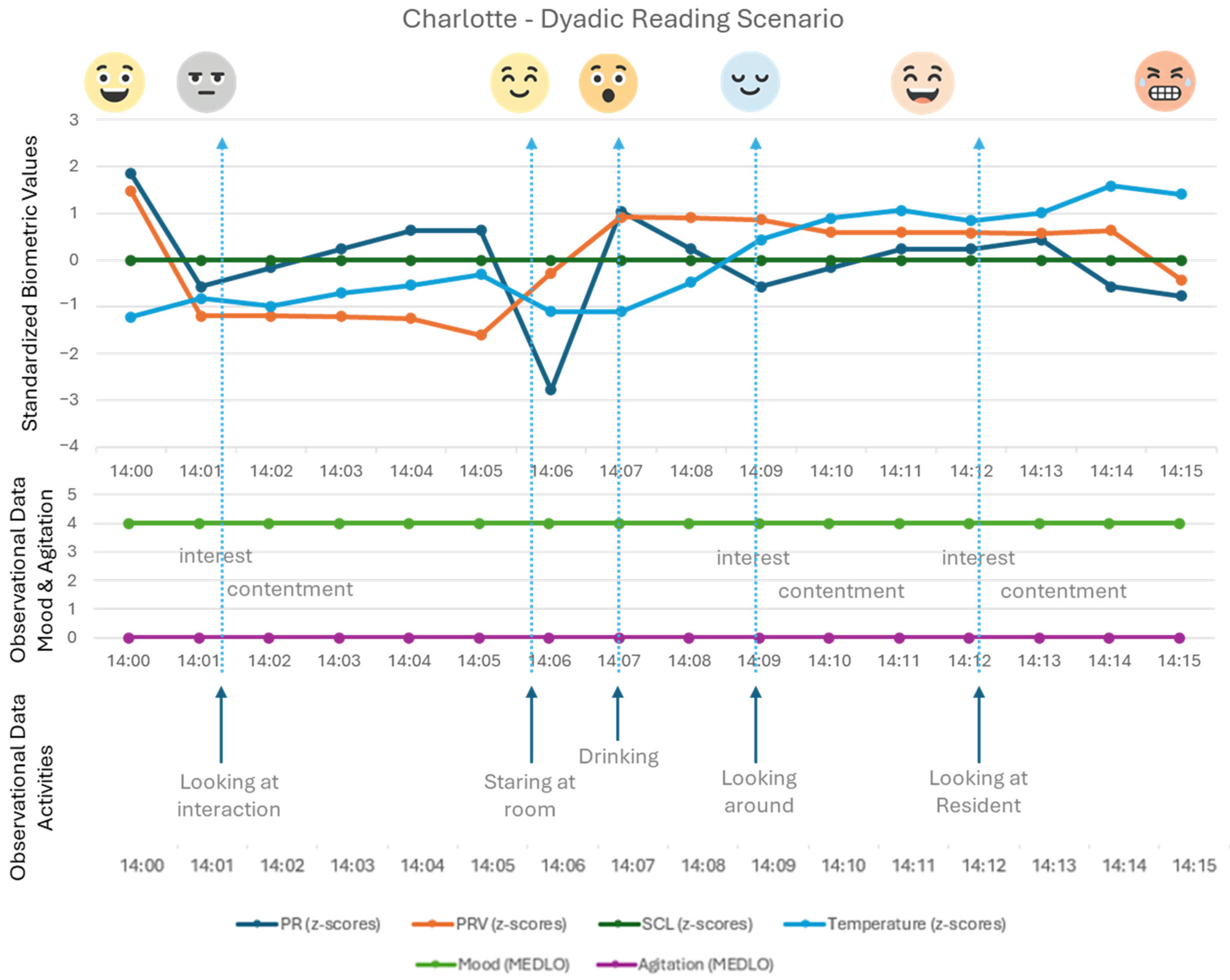
| dyadic- reading | none | contentment/interest; no agitation | The physiological data show concentration and mental engagement when observing the dyadic social interaction, with contentment and relaxation when passively viewing other residents. | ||||
| Daisy | AD | Severe | n/a | individual | physical and verbal | pleasure/contentment; no agitation | * |
| dyadic- puzzle | none | pleasure/contentment; no agitation | ** | ||||
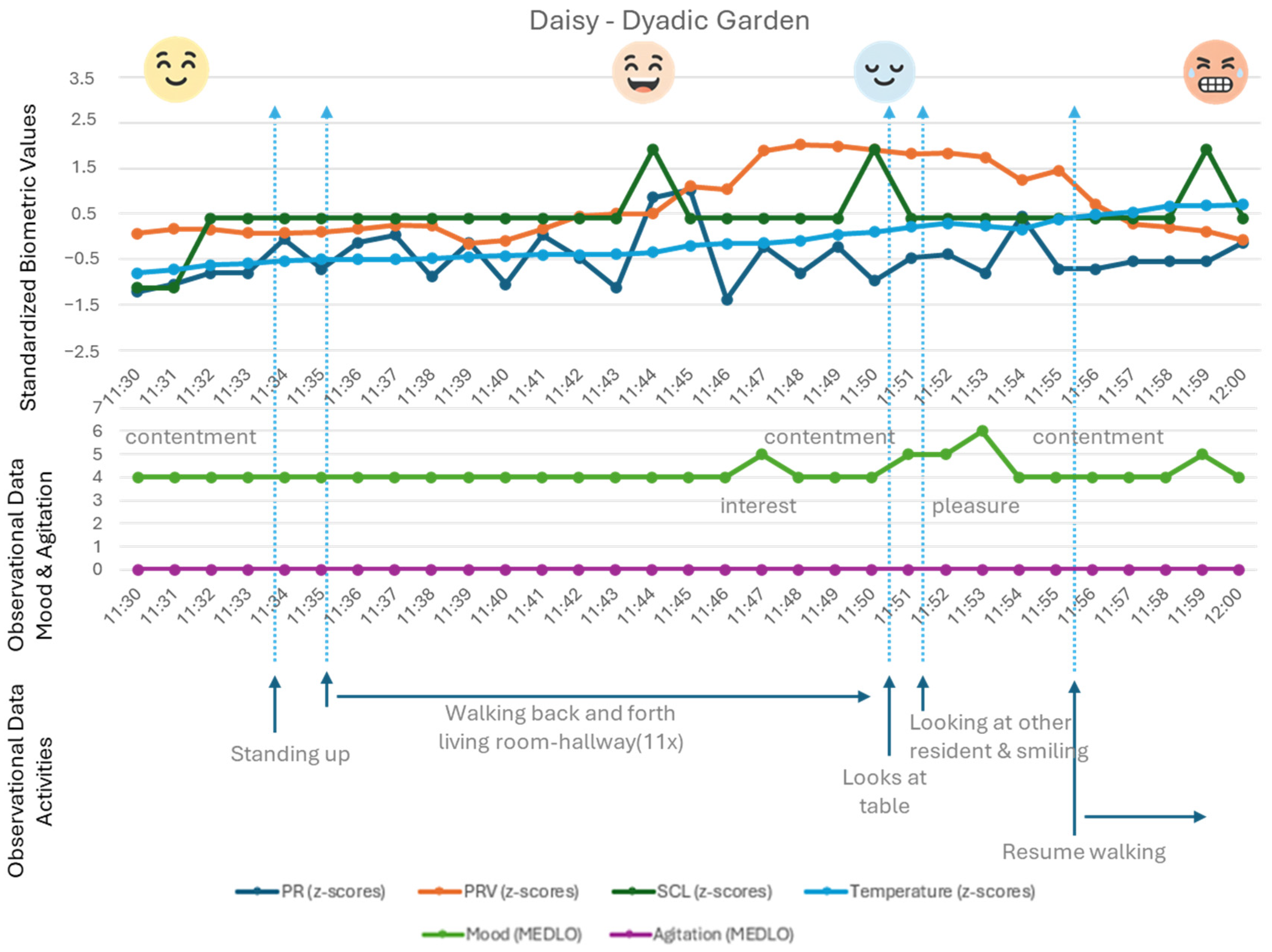
| dyadic- garden | none | pleasure/contentment; no agitation | Data show relaxation and amusement during observation of the gardening activity, with no indicators of exertion despite continuous walking and wandering, suggesting engagement with little cognitive activation. | ||||
| Elise | Mix | Severe | n/a | dyadic- reading | none | pleasure/no agitation | ** |
| group | physical | contentment/pleasure; no agitation | Physiological data shows excitement throughout the activity. | ||||
| Annie | AD + VD | Moderate-Severe | group- game | individual | none | contentment/no agitation | ** |
| dyadic | none | contentment/no agitation | ** | ||||
| group-ball | physical and verbal | contentment/interest/pleasure; some agitation | Initially shows amusement, even when refusing to join the game, followed by contentment during participation. | ||||
| Ben | AD | Severe | n/a | dyadic | none | contentment/interest; no agitation | * |
| group-game | none | contentment/interest; no agitation | Ben’s data show mild physical activity during walking, and relaxation plus positive emotion when seated on his walker, watching the game. | ||||
| group-ball | physical and verbal | anxiety/contentment/interest/pleasure; no agitation | * | ||||
| Clara | AD | Moderate-Severe | group-game | dyadic | none | contentment/interest/pleasure; no agitation | ** |
| group-ball | |||||||
| Dora | AD | Moderate | group-game | individual | verbal | interest/contentment; no agitation | * |
| group-ball | dyadic | verbal | contentment; no agitation | Initially, the resident shows no reaction to the Christmas card materials. Positive emotion and excitement occur while walking around. Later, amusement during observing verbal interaction is seen. | |||
| Edith | VD | Moderate-Severe | group-ball | dyadic | physical and verbal | contentment/interest/pleasure; no agitation | Edith shows cognitive engagement when looking to be dozing/observing other residents with the activity. Relaxation and excitement alternate when looking around and laughing. Amusement during fidgeting with the materials. Cognitive engagement occurs just before and during cleaning up the materials. |
| individual | |||||||
| Frank | LB | Severe | n/a | dyadic | none | contentment; no agitation | Physiological data indicate first excitement when entering the room and then moderate physical exertion throughout the activity, with no change when walking past the table. |
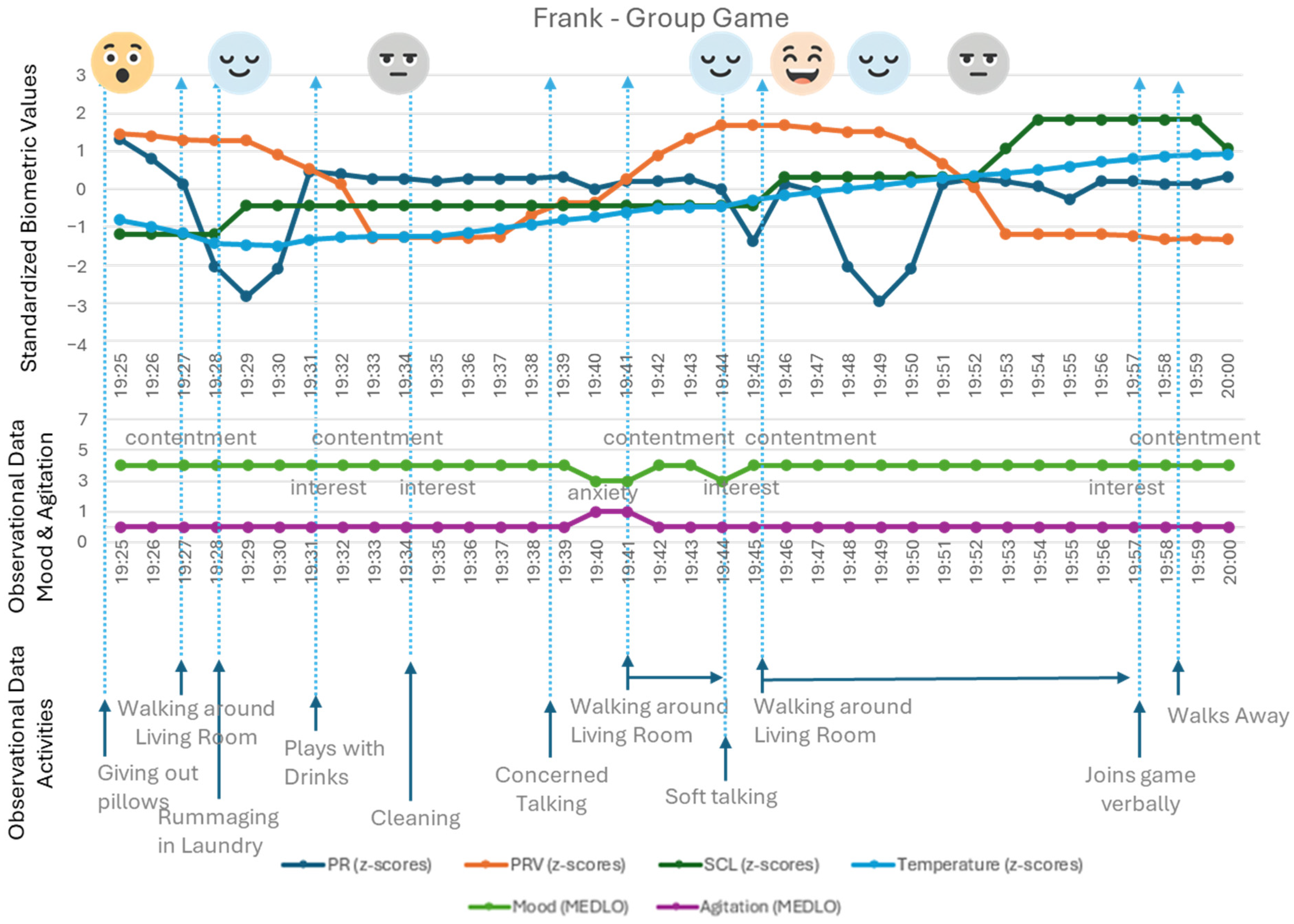
| group- game | physical and verbal | contentment/anxiety; mild agitation | Data show excitement during preparatory activities (tidying pillows), followed by cognitive engagement approximately five minutes before verbal participation in the game, diverging from observed signs of anxiety. | ||||
| Audrey | AD | Moderate-Severe | group | individual | none | contentment; no agitation | Audrey shows no specific reaction to Delilah’s individual activity. Values show pleasure, excitement, amusement, and relaxation. Cognitive engagement is only seen during singing. |
| dyadic | none | contentment/pleasure; no agitation | Shows concentration during a phone conversation of Eleanor with her daughter, followed by relaxation during lunch | ||||
| Blanche | AD | Severe | group | individual | none | contentment; no agitation | ** |
| Constance | AD | Moderate-severe | n/a | dyadic | none | contentment; no agitation | * |
| group | verbal | contentment; no agitation | * | ||||
| Delilah | FTD | Moderate-Severe | individual | group | none | contentment; no agitation | ** |
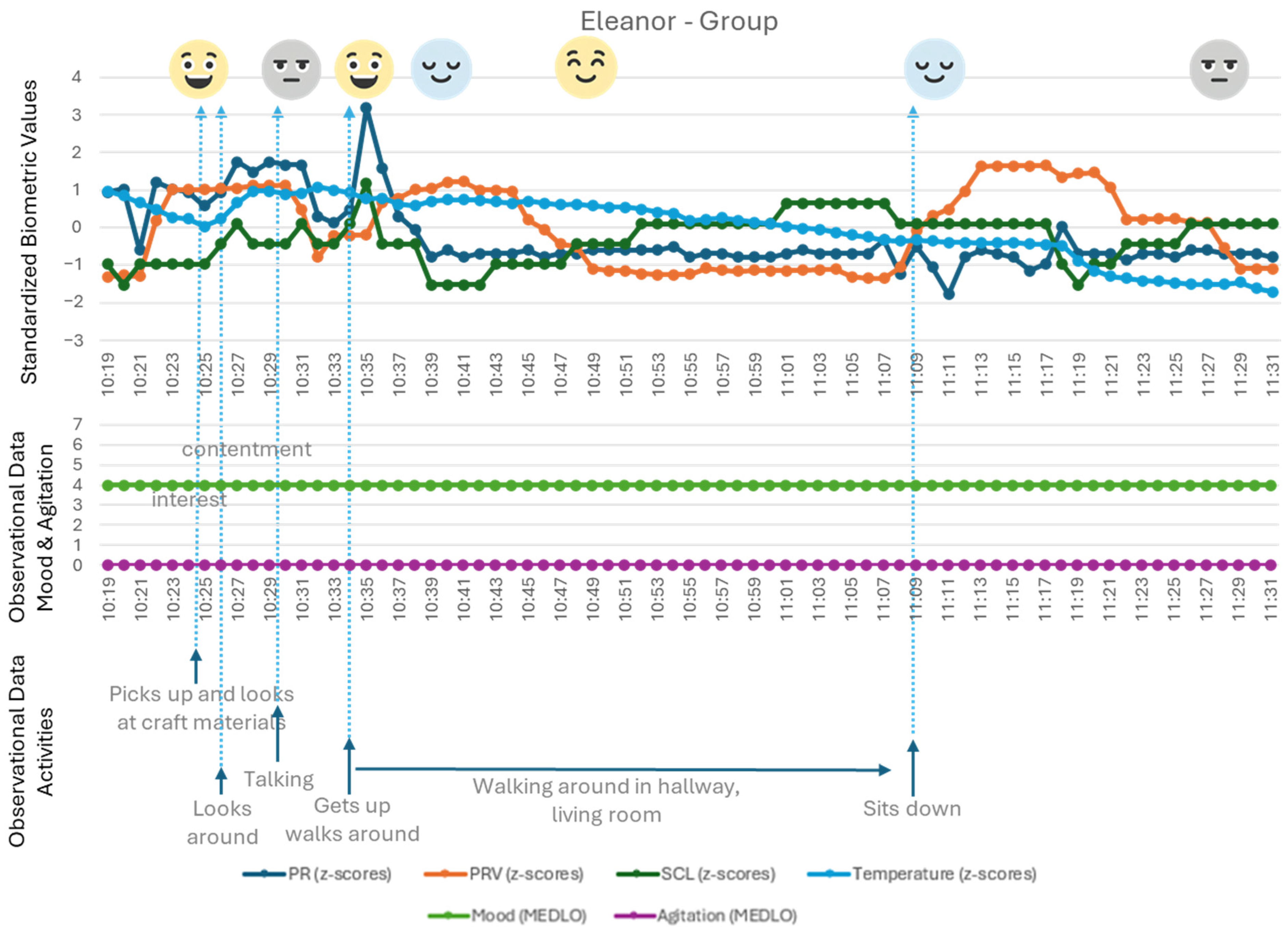
| Eleanor | AD | Moderate-Severe | dyadic | group | verbal | interest/contentment; no agitation | The physiological data show amusement and positive emotional engagement throughout the card-making activity, persisting during negative verbal expressions, indicating incongruence between stated disinterest and physiological markers of pleasure. |
Disclaimer/Publisher’s Note: The statements, opinions and data contained in all publications are solely those of the individual author(s) and contributor(s) and not of MDPI and/or the editor(s). MDPI and/or the editor(s) disclaim responsibility for any injury to people or property resulting from any ideas, methods, instructions or products referred to in the content. |
© 2026 by the authors. Licensee MDPI, Basel, Switzerland. This article is an open access article distributed under the terms and conditions of the Creative Commons Attribution (CC BY) license.
Share and Cite
Hammink, C.; Moor, N.; Mohammadi, M. Response Facilitation in Dementia Care: Exploring Engagement Through Social Contexts: A Qualitative Study in Dutch Nursing Homes. Healthcare 2026, 14, 539. https://doi.org/10.3390/healthcare14040539
Hammink C, Moor N, Mohammadi M. Response Facilitation in Dementia Care: Exploring Engagement Through Social Contexts: A Qualitative Study in Dutch Nursing Homes. Healthcare. 2026; 14(4):539. https://doi.org/10.3390/healthcare14040539
Chicago/Turabian StyleHammink, Coosje, Nienke Moor, and Masi Mohammadi. 2026. "Response Facilitation in Dementia Care: Exploring Engagement Through Social Contexts: A Qualitative Study in Dutch Nursing Homes" Healthcare 14, no. 4: 539. https://doi.org/10.3390/healthcare14040539
APA StyleHammink, C., Moor, N., & Mohammadi, M. (2026). Response Facilitation in Dementia Care: Exploring Engagement Through Social Contexts: A Qualitative Study in Dutch Nursing Homes. Healthcare, 14(4), 539. https://doi.org/10.3390/healthcare14040539