Frailty Trajectories and Their Predictors in Chinese Empty-Nest Older Adults: An 8-Year Longitudinal Study
Abstract
1. Introduction
2. Materials and Methods
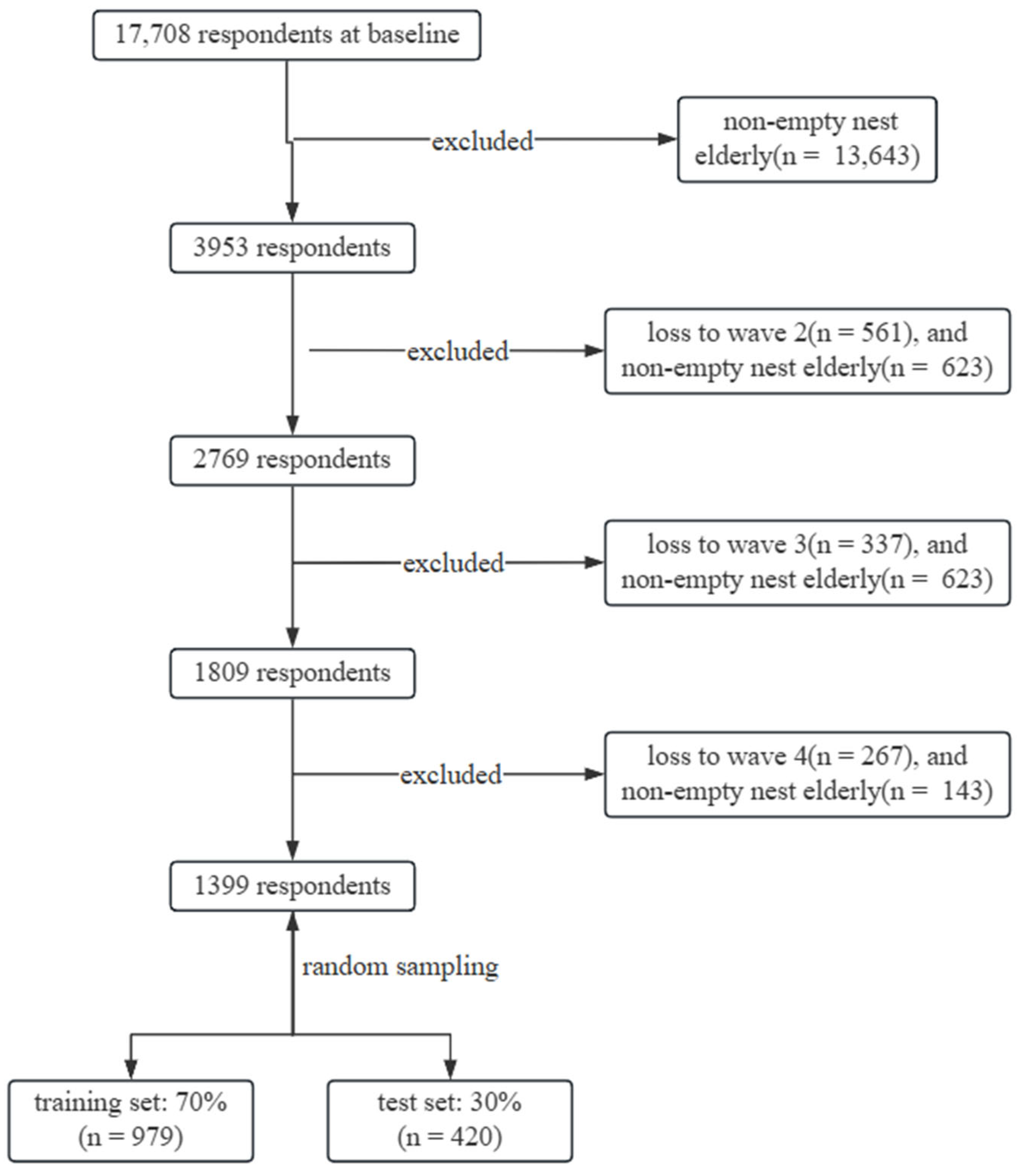
2.1. Study Design and Participants
2.2. Assessment of Frailty
2.3. Covariates
2.4. Statistical Analysis
3. Results
3.1. Characteristics of the Study Population
3.2. Determination of the Optimal GMM
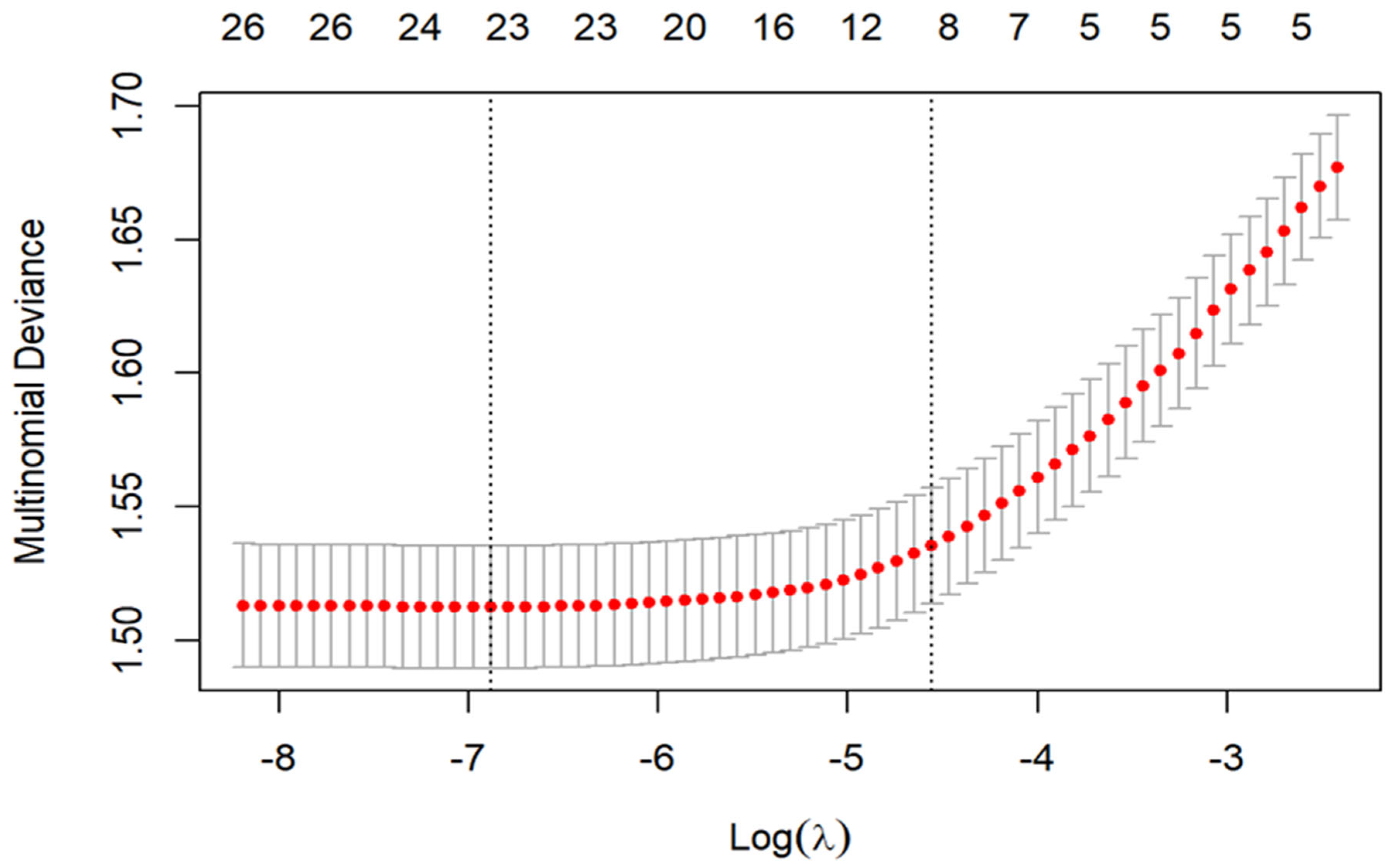
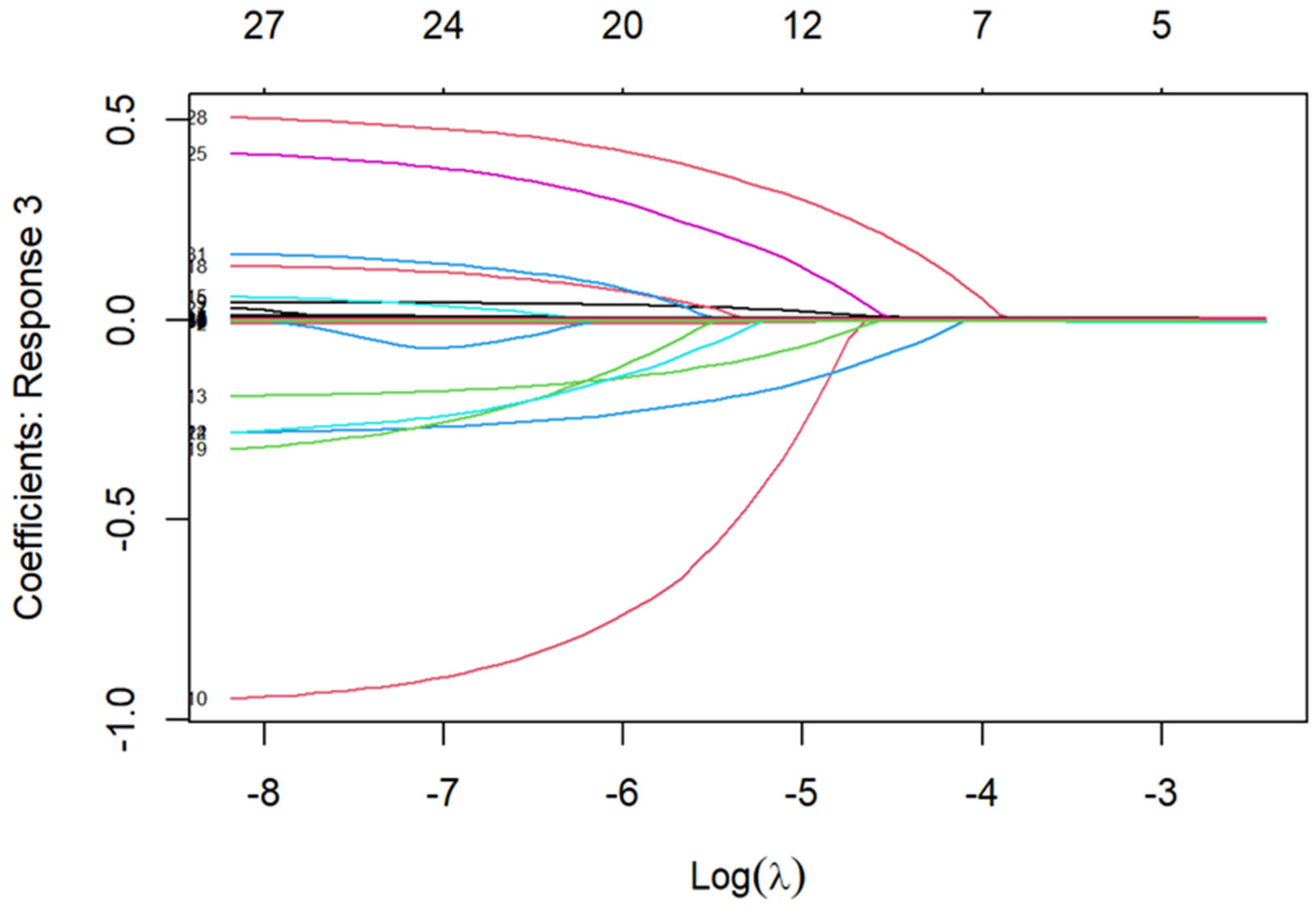
3.3. Variable Selection
3.4. Determinants of Trajectory Membership
4. Discussion
5. Conclusions
Supplementary Materials
Author Contributions
Funding
Institutional Review Board Statement
Data Availability Statement
Acknowledgments
Conflicts of Interest
Abbreviations
| GMM | Growth Mixture Modeling |
| CHARLS | the China Health and Retirement Longitudinal Study |
| FI | Frailty Index |
| BMI | body mass index |
| CRP | C-reactive protein |
| HbA1c | glycated hemoglobin |
| TC | total cholesterol |
| HDL-C | high-density lipoprotein cholesterol |
| LDL-C | low-density lipoprotein cholesterol |
| BUN | blood urea nitrogen |
| UA | uric acid |
| AIC | Akaike Information Criterion |
| BIC | Bayesian Information Criterion |
| aBIC | adjusted BIC |
| LMRT | Lo-Mendell-Rubin test |
| BLRT | Bootstrap Likelihood Ratio Test |
| OR | odds ratio |
| CI | confidence intervals |
References
- Wu, Y.; Zhang, Q.; Huang, Y.; Qiu, S. Seeking Medical Services among Rural Empty-Nest Elderly in China: A Qualitative Study. BMC Geriatr. 2022, 22, 202. [Google Scholar] [CrossRef]
- Uchino, B.N. Social Support and Health: A Review of Physiological Processes Potentially Underlying Links to Disease Outcomes. J. Behav. Med. 2006, 29, 377–387. [Google Scholar] [CrossRef]
- Álvarez-Bustos, A.; Carnicero-Carreño, J.A.; Sanchez-Sanchez, J.L.; Garcia-Garcia, F.J.; Alonso-Bouzón, C.; Rodríguez-Mañas, L. Associations between Frailty Trajectories and Frailty Status and Adverse Outcomes in Community-Dwelling Older Adults. J. Cachexia Sarcopenia Muscle 2022, 13, 230–239. [Google Scholar] [CrossRef]
- Yang, F.; Chen, Q.-W. Evaluation of Frailty and Influencing Factors in Old People in Hospital Institution: Evidence for a Phenotype of Frailty. Medicine 2018, 97, e9634. [Google Scholar] [CrossRef]
- Sun, L.; Huo, X.; Jia, S.; Chen, X. The Association between Circadian Syndrome and Frailty in US Adults: A Cross-Sectional Study of NHANES Data from 2007 to 2018. Aging Clin. Exp. Res. 2024, 36, 105. [Google Scholar] [CrossRef]
- Cohen, C.I.; Benyaminov, R.; Rahman, M.; Ngu, D.; Reinhardt, M. Frailty: A Multidimensional Biopsychosocial Syndrome. Med. Clin. N. Am. 2023, 107, 183–197. [Google Scholar] [CrossRef]
- Chehrehgosha, M.; Sharifi, A.; Meftah, A.M.; Maleki, H.; Sajjadi-Jazi, S.M.; Baharifar, H.; Khoshnevisan, K.; Sharifi, F. Demographic and Biological Factors in Interrelationships between Physical, Cognitive, Psychological, and Social Frailty in Community-Dwelling Older Adults: Data from the Birjand Longitudinal Aging Study (BLAS). Maturitas 2024, 181, 107905. [Google Scholar] [CrossRef]
- Hu, S.; Li, X. An Analysis of Influencing Factors of Oral Frailty in the Elderly in the Community. BMC Oral Health 2024, 24, 260. [Google Scholar] [CrossRef]
- Tang, M.; Zhao, R.; Lv, Q. Status and Influencing Factors of Frailty in Hospitalized Patients with Chronic Heart Failure: A Cross-Sectional Study. J. Clin. Nurs. 2025, 34, 194–203. [Google Scholar] [CrossRef]
- Zheng, F.; Zhao, Y.; Ren, X.; Lan, X.; Peng, W. Prevalence and Associated Factors of Cognitive Frailty in Older Patients with Lung Cancer Undergoing Chemotherapy: A Cross-Sectional Study. Support. Care Cancer 2025, 33, 762. [Google Scholar] [CrossRef]
- Kim, E.; Sok, S.R.; Won, C.W. Factors Affecting Frailty among Community-Dwelling Older Adults: A Multi-Group Path Analysis According to Nutritional Status. Int. J. Nurs. Stud. 2021, 115, 103850. [Google Scholar] [CrossRef]
- Fustinoni, S.; Santos-Eggimann, B.; Henchoz, Y. Trajectories of Phenotypical Frailty over a Decade in Young-Old Community-Dwelling Adults: Results from the Lc65+ Study. J. Epidemiol. Community Health 2022, 76, 216–222. [Google Scholar] [CrossRef]
- Chamberlain, A.M.; Finney Rutten, L.J.; Manemann, S.M.; Yawn, B.P.; Jacobson, D.J.; Fan, C.; Grossardt, B.R.; Roger, V.L.; St Sauver, J.L. Frailty Trajectories in an Elderly Population-Based Cohort. J. Am. Geriatr. Soc. 2016, 64, 285–292. [Google Scholar] [CrossRef]
- Cipolli, G.C.; de Assumpção, D.; Aprahamian, I.; Alzahrani, M.K.; Corona, L.P.; de Oliveira Duarte, Y.A.; Yassuda, M.S.; Xue, Q.-L. Frailty Trajectories and Mortality Risk in Community-Dwelling Older Adults: A 9-Year Follow-up Study. Eur. Geriatr. Med. 2025, 16, 1025–1035. [Google Scholar] [CrossRef]
- Du, J.; Zhang, M.; Zeng, J.; Han, J.; Duan, T.; Song, Q.; Yang, J.; Wu, Y. Frailty Trajectories and Determinants in Chinese Older Adults: A Longitudinal Study. Geriatr. Nurs. 2024, 59, 131–138. [Google Scholar] [CrossRef]
- Lim, A.J.-M.; Cheung, M.W.-L. Evaluating FIML and Multiple Imputation in Joint Ordinal-Continuous Measurements Models with Missing Data. Behav. Res. Methods 2022, 54, 1063–1077. [Google Scholar] [CrossRef]
- Zhao, Y.; John, S.; Chen, X.; Wang, Y.; Gong, J.; Meng, Q.; Wang, G.; Wang, H. China Health and Retirement Longitudinal Study Wave 4 User’s Guide; National School of Development, Peking University: Beijing, China, 2020. [Google Scholar]
- Mitnitski, A.B.; Mogilner, A.J.; Rockwood, K. Accumulation of Deficits as a Proxy Measure of Aging. Sci. World J. 2001, 1, 323–336. [Google Scholar] [CrossRef]
- Searle, S.D.; Mitnitski, A.; Gahbauer, E.A.; Gill, T.M.; Rockwood, K. A Standard Procedure for Creating a Frailty Index. BMC Geriatr. 2008, 8, 24. [Google Scholar] [CrossRef]
- Theou, O.; Brothers, T.D.; Mitnitski, A.; Rockwood, K. Operationalization of Frailty Using Eight Commonly Used Scales and Comparison of Their Ability to Predict All-Cause Mortality. J. Am. Geriatr. Soc. 2013, 61, 1537–1551. [Google Scholar] [CrossRef]
- He, D.; Qiu, Y.; Yan, M.; Zhou, T.; Cheng, Z.; Li, J.; Wu, Q.; Liu, Z.; Zhu, Y. Associations of Metabolic Heterogeneity of Obesity with Frailty Progression: Results from Two Prospective Cohorts. J. Cachexia Sarcopenia Muscle 2023, 14, 632–641. [Google Scholar] [CrossRef]
- Guo, Y.; Ng, N.; Hassler, S.; Wu, F.; Miao Jonasson, J. Frailty Trajectories in Chinese Older Adults: Evidence From the China Health and Retirement Longitudinal Study. Innov. Aging 2024, 8, igad131. [Google Scholar] [CrossRef]
- Aguayo, G.A.; Hulman, A.; Vaillant, M.T.; Donneau, A.-F.; Schritz, A.; Stranges, S.; Malisoux, L.; Huiart, L.; Guillaume, M.; Sabia, S.; et al. Prospective Association Among Diabetes Diagnosis, HbA1c, Glycemia, and Frailty Trajectories in an Elderly Population. Diabetes Care 2019, 42, 1903–1911. [Google Scholar] [CrossRef]
- Suprawesta, L.; Hwang, H.-F.; Chen, S.-J.; Yu, W.-Y.; Lin, M.-R. Specific Cognitive Domains and Frailty Trajectories among Older Taiwanese Adults. Aging Ment. Health 2023, 27, 1488–1495. [Google Scholar] [CrossRef]
- Gajic-Veljanoski, O.; Papaioannou, A.; Kennedy, C.; Ioannidis, G.; Berger, C.; Wong, A.K.O.; Rockwood, K.; Kirkland, S.; Raina, P.; Thabane, L.; et al. Osteoporotic Fractures and Obesity Affect Frailty Progression: A Longitudinal Analysis of the Canadian Multicentre Osteoporosis Study. BMC Geriatr. 2018, 18, 4. [Google Scholar] [CrossRef]
- Wu, Y.; Jia, M.; Xiang, C.; Fang, Y. Latent Trajectories of Frailty and Risk Prediction Models among Geriatric Community Dwellers: An Interpretable Machine Learning Perspective. BMC Geriatr. 2022, 22, 900. [Google Scholar] [CrossRef]
- Taniguchi, Y.; Kitamura, A.; Hata, T.; Fujita, K.; Abe, T.; Nofuji, Y.; Seino, S.; Yokoyama, Y.; Shinkai, S.; Fujiwara, Y. Frailty Trajectories and Its Associated Factors in Japanese Older Adults. J. Frailty Aging 2024, 13, 233–239. [Google Scholar] [CrossRef]
- Welstead, M.; Jenkins, N.D.; Russ, T.C.; Luciano, M.; Muniz-Terrera, G. A Systematic Review of Frailty Trajectories: Their Shape and Influencing Factors. Gerontologist 2021, 61, e463–e475. [Google Scholar] [CrossRef]
- Cesari, M.; Gambassi, G.; van Kan, G.A.; Vellas, B. The Frailty Phenotype and the Frailty Index: Different Instruments for Different Purposes. Age Ageing 2014, 43, 10–12. [Google Scholar] [CrossRef]
- Rogers, N.T.; Fancourt, D. Cultural Engagement Is a Risk-Reducing Factor for Frailty Incidence and Progression. J. Gerontol. B Psychol. Sci. Soc. Sci. 2020, 75, 571–576. [Google Scholar] [CrossRef]
- Stolz, E.; Mayerl, H.; Waxenegger, A.; Rásky, É.; Freidl, W. Impact of Socioeconomic Position on Frailty Trajectories in 10 European Countries: Evidence from the Survey of Health, Ageing and Retirement in Europe (2004–2013). J. Epidemiol. Community Health 2017, 71, 73–80. [Google Scholar] [CrossRef]
- Vaishya, R.; Misra, A.; Vaish, A.; Ursino, N.; D’Ambrosi, R. Hand Grip Strength as a Proposed New Vital Sign of Health: A Narrative Review of Evidences. J. Health Popul. Nutr. 2024, 43, 7. [Google Scholar] [CrossRef]
- Fujii, K.; Harada, K.; Kurita, S.; Morikawa, M.; Nishijima, C.; Kakita, D.; Shimada, H. Life Satisfaction as a Protective Factor against Frailty among Japanese Adults Aged 60 and Older: A Cohort Study. Maturitas 2025, 197, 108256. [Google Scholar] [CrossRef]
- LeBlanc, M.; McGaughey, T.; Peters, P.A. Characteristics of High-Resource Health System Users in Rural and Remote Regions: A Scoping Review. Int. J. Environ. Res. Public Health 2023, 20, 5385. [Google Scholar] [CrossRef]
- Ao, Y.; Feng, Q.; Zhou, Z.; Chen, Y.; Wang, T. Resource Allocation Equity in the China’s Rural Three-Tier Healthcare System. Int. J. Environ. Res. Public Health 2022, 19, 6589. [Google Scholar] [CrossRef]
- Smolderen, K.G.; Burg, M.M. A Broken Heart after Child Loss. Eur. Heart J. 2021, 42, 1496–1498. [Google Scholar] [CrossRef]
- Yan, Y.; Cai, L.; Lu, N. Childhood experiences and frailty trajectory among middle-aged and older adults in China. Eur. J. Ageing 2022, 19, 1601–1615. [Google Scholar] [CrossRef]
- Van Der Linden, B.W.A.; Sieber, S.; Cheval, B.; Orsholits, D.; Guessous, I.; Gabriel, R.; Von Arx, M.; Kelly-Irving, M.; Aartsen, M.; Blane, D.; et al. Life-Course Circumstances and Frailty in Old Age Within Different European Welfare Regimes: A Longitudinal Study With SHARE. J. Gerontol. B Psychol. Sci. Soc. Sci. 2020, 75, 1326–1335. [Google Scholar] [CrossRef]
- Mehrabi, F.; Béland, F. Effects of Social Isolation, Loneliness and Frailty on Health Outcomes and Their Possible Mediators and Moderators in Community-Dwelling Older Adults: A Scoping Review. Arch. Gerontol. Geriatr. 2020, 90, 104119. [Google Scholar] [CrossRef]
- Gardiner, P.A.; Mishra, G.D.; Dobson, A.J. The Effect of Socioeconomic Status Across Adulthood on Trajectories of Frailty in Older Women. J. Am. Med. Dir. Assoc. 2016, 17, 372.e1–372.e3. [Google Scholar] [CrossRef]



| Classes | N (%) | Intercept | P | Slope | P | Quadratic | P |
|---|---|---|---|---|---|---|---|
| Class 1 | 948 (0.68) | 10.045 | <0.001 | 0.688 | 0.056 | 0.370 | 0.002 |
| Class 2 | 294 (0.21) | 25.675 | <0.001 | −10.861 | <0.001 | 5.369 | <0.001 |
| Class 3 | 157 (0.11) | 26.331 | <0.001 | 15.193 | <0.001 | −3.160 | 0.002 |
| Variables | OR (95% CI) [“Low-Increasing” as Reference] | |
|---|---|---|
| High-Fluctuating | Elevated-Stable | |
| Age | 1.06 (1.03–1.09) *** | 1.07 (1.03–1.10) *** |
| Education (Lower secondary as reference) | ||
| Other | 0.65 (0.32–1.34) | 0.51 (0.17–1.56) |
| Residence (Urban as reference) | ||
| Rural | 1.95 (1.27–3.00) ** | 2.34 (1.37–3.98) ** |
| BMI (18.5 to 22.9 as reference) | ||
| 0 to 18.4 | 1.37 (0.82–2.31) | 1.09 (0.52–2.25) |
| 23 to 24.9 | 0.84 (0.55–1.30) | 0.73 (0.39–1.36) |
| 25 to 100 | 1.41 (0.90–2.19) | 1.46 (0.80–2.66) |
| Grip strength | 0.97 (0.95–0.98) *** | 0.95 (0.93–0.98) *** |
| Waist | 1.01 (0.99–1.03) | 1.01 (0.99–1.03) |
| HbA1c | 1.06 (0.86–1.32) | 1.11 (0.79–1.55) |
| TC | 1.00 (1.00–1.01) | 1.00 (1.00–1.01) |
| Glucose | 1.00 (1.00–1.01) | 1.00 (0.99–1.01) |
| BUN | 1.00 (0.96–1.05) | 1.05 (0.99–1.10) |
| Creatinine | 0.88 (0.34–2.29) | 0.31 (0.09–1.10) |
| UA | 0.88 (0.76–1.02) | 0.97 (0.80–1.17) |
| Work status (Non-agricultural as reference) | ||
| Agricultural | 1.14 (0.67–1.92) | 0.97 (0.46–2.03) |
| Workless | 1.55 (0.89–2.68) | 2.23 (1.08–4.64) * |
| Smoking (No as reference) | ||
| Yes | 1.51 (1.08–2.12) * | 1.46 (0.93–2.27) |
| Drinking (No as reference) | ||
| Yes | 1.14 (0.83–1.58) | 1.66 (1.09–2.53) * |
| Childhood health | 1.17 (1.01–1.35) * | 1.09 (0.90–1.33) |
| Death of children (No as reference) | ||
| Yes | 1.98 (1.37–2.86) *** | 1.63 (1.00–2.67) * |
| Life satisfaction | 0.73 (0.58–0.92) ** | 0.56 (0.41–0.75) *** |
Disclaimer/Publisher’s Note: The statements, opinions and data contained in all publications are solely those of the individual author(s) and contributor(s) and not of MDPI and/or the editor(s). MDPI and/or the editor(s) disclaim responsibility for any injury to people or property resulting from any ideas, methods, instructions or products referred to in the content. |
© 2026 by the authors. Licensee MDPI, Basel, Switzerland. This article is an open access article distributed under the terms and conditions of the Creative Commons Attribution (CC BY) license.
Share and Cite
Zhou, M.; Zhang, H. Frailty Trajectories and Their Predictors in Chinese Empty-Nest Older Adults: An 8-Year Longitudinal Study. Healthcare 2026, 14, 537. https://doi.org/10.3390/healthcare14040537
Zhou M, Zhang H. Frailty Trajectories and Their Predictors in Chinese Empty-Nest Older Adults: An 8-Year Longitudinal Study. Healthcare. 2026; 14(4):537. https://doi.org/10.3390/healthcare14040537
Chicago/Turabian StyleZhou, Mingyue, and Huijun Zhang. 2026. "Frailty Trajectories and Their Predictors in Chinese Empty-Nest Older Adults: An 8-Year Longitudinal Study" Healthcare 14, no. 4: 537. https://doi.org/10.3390/healthcare14040537
APA StyleZhou, M., & Zhang, H. (2026). Frailty Trajectories and Their Predictors in Chinese Empty-Nest Older Adults: An 8-Year Longitudinal Study. Healthcare, 14(4), 537. https://doi.org/10.3390/healthcare14040537