Constructing Wholeness in LGBTQ+ Healthcare Access: A Grounded Theory Model
 , , , , , and
Highlights
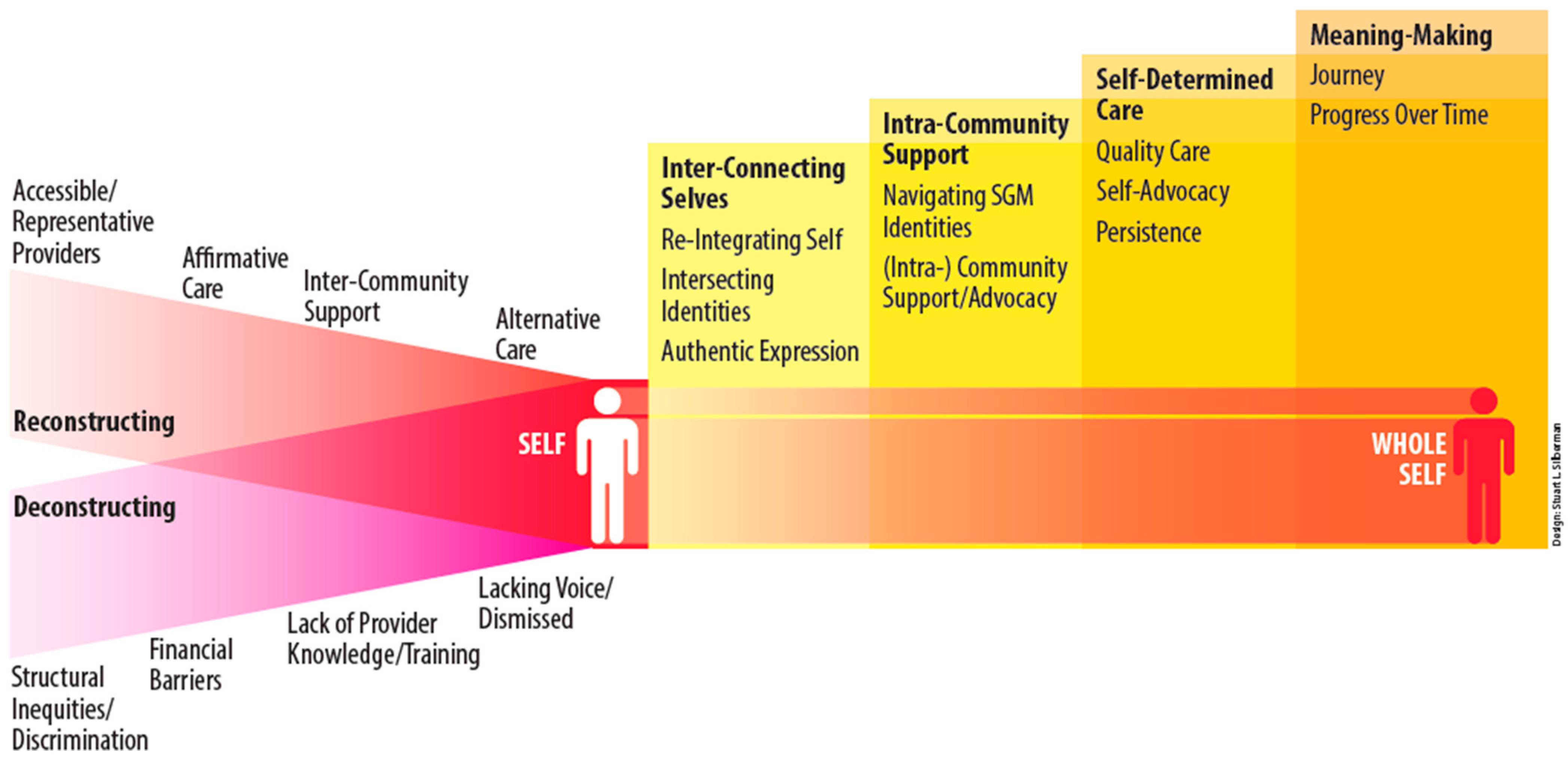
- LGBTQ+ individuals’ engagement with healthcare across the life course is shaped by a dynamic process of reconstructing and deconstructing forces, wherein affirming care, accessible providers, and community support promote wholeness, while discrimination, structural barriers, and dismissal fragment identity and well-being.
- Despite diverse identities and life stages, participants described a shared, non-linear process of moving toward wholeness through four interconnected internal mechanisms: interconnecting selves (identity integration and authenticity), intra-community support, self-determined care (advocacy, persistence, and pursuit of quality care), and meaning-finding.
- Healthcare systems and providers must move beyond deficit-based or purely biomedical approaches and instead adopt wholeness-oriented, affirming models of care that recognize the interconnected social, emotional, cultural, and identity-based dimensions shaping LGBTQ+ health experiences.
- Strengthening LGBTQ+ community infrastructures and peer-based knowledge exchange is critical, as intra-community support functions as a key mechanism for navigating healthcare, mitigating harm, and fostering resilience—particularly in contexts where formal healthcare systems remain inequitable or unresponsive.
Abstract
1. Introduction
2. Background and Theoretical Framework
2.1. Connection with Healthcare
2.2. Disconnection with Healthcare
2.3. Theoretical Frameworks
2.4. Study Aim and Research Questions
- What is it like for LGBTQ+ individuals and stakeholders to connect with healthcare systems across the life course?
- What is it like for LGBTQ+ individuals and stakeholders to disconnect from healthcare systems across the life course?
3. Methods
3.1. Sample and Recruitment
3.2. Data Collection
3.3. Analysis
4. Results
Reconstructing
- Deconstructing
- Wholeness in Connecting to Healthcare
- Interconnecting Selves
- Integrating (or Re-integrating) Self
“But the assumption is that it’s [alignment with gender identity] not important. It’s not needed. It’s just completely voluntary, and not only was it important for me to align my appearance with how I see myself. But honestly, having that surgery is important for me for a lot of reasons. It improves my survivability because I’m not getting clocked [recognized as trans] everywhere I go.”
- Intersecting Identities
“I think about immigrant identity and undocumented people. I have family members who are undocumented. They have never gone to a doctor because of the fear alone. How invisible are they? Right? If this is the level of oppression that we face as queer people, and then as an additional layer, BIPOC queer people. Do you imagine the level of shit…that there is and just accessing something basic that should be available to anybody as a human, for folks that are refugees or immigrants or you know whatever they are, because of these, this f**** up immigration system that we live in.”
- Authentic Expression
“We are living our authentic best lives. Something about us glows. Something about us shines. Something about us gets respect. Because we are living our best life. People see this. They understand it. They detect it. The knee-jerk response of any human being that receives love with open hands is to respond with love. I don’t care how hardened you are. Something in your heart [softens].”
- Intra-community Support
- Navigating Identities
“…I never knew I was gay. I came back to [city], and I started going to the gay bars and clubs. Within a year, I met my [partner]. And we’ve been together now 58 years.”
- Community Support/Advocacy
“Yeah, those were individuals who cared about me, and I cared about them; moreover, through the time when I gather these people, groups, A.A. [Alcoholics Anonymous], whatever group I’m in,… makes me blossom. …And I feel real good that I’ve got that support.”
- Self-Determined Care
- Quality Care
“I see what happens to older Black women, you know? (laughs) I’m just like ‘f***, this is not going to be easy.’ I’m watching it with my mom who just had a stroke two months ago. And so, I’m there [at the doctor] because I’m wanting to make sure that I take my care in my own hands. That I follow what I think are standard protocols around prevention. And then they are talking to me, and I’m feeling good, because I’m in a conversation with the doctor that I like.”
- Self-Advocacy
“Just like when I was at the emergency room the other last week. I had to let that doctor know, ‘Hey, I’m trans.’ She sitting here giving me a pregnancy test. I’m like, ‘Girl, I’m here for an abscess on my boob. I’m not here because I got knocked up and I’m pregnant or not.’ You know that could be fine for some trans people because they didn’t clock me, you know. But I’m coming here for real medical help. And I need you to look at me and make sure I’m okay. Not looking at me as a woman and that I’m pregnant. I can’t even get pregnant.”
- Persistence
“I was living in the mountains of [location], and I, at the time, was diagnosed with full-blown AIDS, and there was very little health care in the mountains. And we literally had to drive an hour to two hours down off the mountain to get health care and then drive back up the mountain. So, that facilitated my move back to [location] because, well, who doesn’t have better health care than [city’s name]? And I’m alive today to tell that story.”
- Meaning-finding
- Journey
“Too many things have happened to me in my life. Moreover, like I say, ‘Dear God, I know I’m here for an exact reason. There’s a reason why I’m here. Too many things have happened.’ And I believe that each one of us who are in the trans community needs to stand up and live our best life and be shiny little diamonds out there. And people will see us, love us, and respect us. Because what we have to do is put a little love in our hearts and let it flow through us. Let our love literally roar.”
- Progress Over Time
“But at a certain age… I think about how I was in my 20’s, I think about how I was in my 30’s. And now, at 50, it’s like all my problems, like you say, have to come from love. But see, I can’t love you, or [name] or [name] or, I can’t love none of them if I can’t love myself.”
5. Discussion
Implications for Clinical Practice, Health Policy, and Medical Education
- Limitations
6. Conclusions
Author Contributions
Funding
Institutional Review Board Statement
Informed Consent Statement
Data Availability Statement
Conflicts of Interest
References
- Hsieh, N.; Liu, H. Social relationships and loneliness in late adulthood: Disparities by sexual orientation. J. Marriage Fam. 2021, 83, 57–74. [Google Scholar] [CrossRef]
- Lick, D.J.; Durso, L.E.; Johnson, K.L. Minority stress and physical health among sexual minorities. Perspect. Psychol. Sci. 2013, 8, 521–548. [Google Scholar] [CrossRef]
- Pinnamaneni, M.; Payne, L.; Jackson, J.; Cheng, C.I.; Cascio, M.A. Disparities in chronic physical health conditions in sexual and gender minority people using the United States Behavioral Risk Factor Surveillance System. Prev. Med. Rep. 2022, 28, 101881. [Google Scholar] [CrossRef]
- Saewyc, E.M. Research on adolescent sexual orientation: Development, health disparities, stigma, and resilience. J. Res. Adolesc. 2011, 21, 256–272. [Google Scholar] [CrossRef]
- Correro, A.N.; Nielson, K.A. A review of minority stress as a risk factor for cognitive decline in lesbian, gay, bisexual, and transgender elders. J. Gay Lesbian Ment. Health 2020, 24, 2–19. [Google Scholar] [CrossRef]
- Hendricks, M.L.; Testa, R.J. A conceptual framework for clinical work with transgender and gender nonconforming clients: An adaptation of the minority stress model. Prof. Psychol. Res. Pract. 2012, 43, 460–467. [Google Scholar] [CrossRef]
- Javier, N.M.; Oswald, A.G. Health for the lesbian, gay, bisexual, transgender, and queer (LGBTQ) older adults. Curr. Geriatr. Rep. 2019, 8, 107–116. [Google Scholar] [CrossRef]
- Meyer, I.H.; Frost, D.M. Minority stress and the health of sexual minorities. In Handbook of Psychology and Sexual Orientation; Patterson, C.J., D’Augelli, A.R., Eds.; Oxford University Press: New York, NY, USA, 2013; pp. 252–266. [Google Scholar]
- Meyer, I.H. Prejudice, social stress, and mental health in lesbian, gay, and bisexual populations: Conceptual issues and research evidence. Psychol. Bull. 2003, 129, 674–697. [Google Scholar] [CrossRef]
- Valentine, S.E.; Shipherd, J.C. A systematic review of social stress and mental health among transgender and gender non-conforming people in the United States. Clin. Psychol. Rev. 2018, 66, 24–38. [Google Scholar] [CrossRef]
- Ayhan Balik, C.H.; Bilgin, H. Experiences of minority stress and intimate partner violence among homosexual women in Turkey. J. Interpers. Violence 2021, 36, 8984–9007. [Google Scholar] [CrossRef]
- Wilson, C.K.; West, L.; Stepleman, L.; Villarosa, M.; Ange, B.; Decker, M.; Waller, J.L. Attitudes toward LGBT patients among students in the health professions. LGBT Health 2014, 1, 204–211. [Google Scholar] [CrossRef]
- Institute of Medicine. The Health of Lesbian, Gay, Bisexual, and Transgender People: Building a Foundation for Better Understanding; National Academies Press: Washington, DC, USA, 2011. [Google Scholar] [CrossRef]
- Sherman, A.D.F.; Clark, K.D.; Robinson, K.; Noorani, T.; Poteat, T. Trans* community connection, health, and wellbeing: A systematic review. LGBT Health 2020, 7, 1–14. [Google Scholar] [CrossRef]
- Asakura, K. It takes a village: Applying a social ecological framework of resilience in working with LGBTQ youth. Fam. Soc. 2016, 97, 15–22. [Google Scholar] [CrossRef]
- Snapp, S.D.; Watson, R.J.; Russell, S.T.; Diaz, R.M.; Ryan, C. Social support networks for LGBT young adults: Low-cost strategies for positive adjustment. Fam. Relat. 2015, 64, 420–430. [Google Scholar] [CrossRef]
- Van Deusen, T. Sexual and gender minorities transitional-age youth (TAY): Proclaiming integrity, legitimacy, and certainty in the 2020s. In Transition-Age Youth Mental Health Care; Chan, V., Derenne, J., Eds.; Springer: Cham, Switzerland, 2021; pp. 287–302. [Google Scholar]
- Wagner, T. Health literacy and health equity: Community and digital opportunities for improved LGBTQ+ health. In Handbook on Gender and Digital Media; Edward Elgar Publishing: Cheltenham, UK, 2025; pp. 83–97. [Google Scholar]
- Burton, C.W.; Lee, J.-A.; Waalen, A.; Gibbs, L.M. “Things are different now, but”: Older LGBT adults’ experiences and unmet needs in health care. J. Transcult. Nurs. 2020, 31, 492–501. [Google Scholar] [CrossRef]
- Wang, M.; Raza, A.; Narusyte, J.; Silventoinen, K.; Böckerman, P.; Svedberg, P.; Ropponen, A. Life events as predictors of unsustainable working life trajectories from a life course perspective. Eur. J. Public Health 2022, 32. [Google Scholar] [CrossRef]
- Elder, G.H., Jr. Time human agency social change: Perspectives on the life course. Soc. Psychol. Q. 1994, 57, 4–15. [Google Scholar] [CrossRef]
- Hovmand, P.S. Introduction to community-based system dynamics. In Community Based System Dynamics; Springer: New York, NY, USA, 2014; pp. 1–16. [Google Scholar] [CrossRef]
- Hogg, M.A. Social identity theory. In Understanding Peace and Conflict Through Social Identity Theory; McKeown, S., Haji, R., Ferguson, N., Eds.; Springer: Cham, Switzerland, 2016; pp. 3–17. [Google Scholar]
- Scheepers, D.; Ellemers, N. Social identity theory. In Social Psychology in Action; Sassenberg, K., Vliek, M.L.W., Eds.; Springer: Cham, Switzerland, 2019; pp. 129–143. [Google Scholar]
- Frost, D.M.; Lehavot, K.; Meyer, I.H. Minority stress and physical health among sexual minority individuals. J. Behav. Med. 2015, 38, 1–8. [Google Scholar] [CrossRef]
- Ghabrial, M.A. “Trying to figure out where we belong”: Narratives of racialized sexual minorities on community, identity, discrimination, and health. Sex. Res. Soc. Policy 2017, 14, 42–55. [Google Scholar] [CrossRef]
- Hailey, J.; Burton, W.; Arscott, J. We are family: Chosen and created families as a protective factor against racialized trauma and anti-LGBTQ oppression among African American sexual and gender minority youth. J. GLBT Fam. Stud. 2020, 16, 176–191. [Google Scholar] [CrossRef]
- Alba, B.; Lyons, A.; Waling, A.; Minichiello, V.; Hughes, M.; Barrett, C.; Fredriksen-Goldsen, K.; Edmonds, S. Health, well-being, and social support in older Australian lesbian and gay caregivers. Health Soc. Care Community 2020, 28, 204–215. [Google Scholar] [CrossRef]
- Croghan, C.F.; Moone, R.P.; Olson, A.M. Working with LGBT baby boomers and older adults: Factors that signal a welcoming service environment. J. Gerontol. Soc. Work 2015, 58, 637–651. [Google Scholar] [CrossRef]
- Stinchcombe, A.; Smallbone, J.; Wilson, K.; Kortes-Miller, K. Healthcare and end-of-life needs of LGBT older adults: A scoping review. Geriatrics 2017, 2, 13. [Google Scholar] [CrossRef]
- Sevelius, J.M. Gender Affirmation: A Framework for Conceptualizing Risk Behavior Among Transgender Women of Color. Sex Roles 2013, 68, 675–689. [Google Scholar] [CrossRef]
- Schilder, A.J.; Kennedy, C.; Goldstone, I.L.; Ogden, R.D.; Hogg, R.S.; O’Shaughnessy, M.V. “Being dealt with as a whole person”: Care seeking and adherence: The benefits of culturally competent care. Soc. Sci. Med. 2001, 52, 1643–1659. [Google Scholar] [CrossRef]
- Marshall, S.A.; Stewart, M.K.; Barham, C.; Ounpraseuth, S.; Curran, G. Facilitators and barriers to providing affirming care for transgender patients in primary care practices in Arkansas. J. Rural Health 2023, 39, 251–261. [Google Scholar] [CrossRef]
- Moolchaem, P.; Liamputtong, P.; O’Halloran, P.; Muhamad, R. The lived experiences of transgender persons: A meta-synthesis. J. Gay Lesbian Soc. Serv. 2015, 27, 143–171. [Google Scholar] [CrossRef]
- Fredriksen-Goldsen, K.I.; Hoy-Ellis, C.P.; Goldsen, J.; Emlet, C.A.; Hooyman, N.R. Creating a vision for the future: Key competencies and strategies for culturally competent practice with LGBT older adults. J. Gerontol. Soc. Work 2014, 57, 80–107. [Google Scholar] [CrossRef]
- Radix, A.; Maingi, S. LGBT cultural competence and interventions to help oncology nurses and other health care providers. Semin. Oncol. Nurs. 2018, 34, 80–89. [Google Scholar] [CrossRef]
- Lerner, J.E.; Robles, G. Perceived barriers and facilitators to health care utilization in the United States for transgender people: A review of recent literature. J. Health Care Poor Underserved 2017, 28, 127–152. [Google Scholar] [CrossRef]
- Cruz, T.M. Assessing access to care for transgender and gender nonconforming people: A consideration of diversity in combating discrimination. Soc. Sci. Med. 2014, 110, 65–73. [Google Scholar] [CrossRef]
- Davidson, S. Gender inequality: Nonbinary transgender people in the workplace. Cogent Soc. Sci. 2016, 2, 1236511. [Google Scholar] [CrossRef]
- Coker, T.R.; Austin, S.B.; Schuster, M.A. The health and health care of lesbian, gay, and bisexual adolescents. Annu. Rev. Public Health 2010, 31, 457–477. [Google Scholar] [CrossRef] [PubMed]
- Chong, L.S.H.; Kerklaan, J.; Clarke, S.; Kohn, M.; Baumgart, A.; Guha, C.; Tunnicliffe, D.J.; Hanson, C.S.; Craig, J.C.; Tong, A. Experiences and perspectives of transgender youths in accessing health care: A systematic review. JAMA Pediatr. 2021, 175, 1159–1168. [Google Scholar] [CrossRef]
- Ginsburg, K.R.; Winn, R.J.; Rudy, B.J.; Crawford, J.; Zhao, H.; Schwarz, D.F. How to reach sexual minority youth in the health care setting: The teens offer guidance. J. Adolesc. Health 2002, 31, 407–416. [Google Scholar] [CrossRef]
- Handlovsky, I.; Bungay, V.; Oliffe, J.; Johnson, J. Developing resilience: Gay men’s response to systemic discrimination. Am. J. Mens Health 2018, 12, 1473–1485. [Google Scholar] [CrossRef] [PubMed]
- Handlovsky, I.; Bungay, V.; Johnson, J.; Oliffe, J. Overcoming adversity: A grounded theory of health management among middle-aged and older gay men. Sociol. Health Illn. 2020, 42, 1566–1580. [Google Scholar] [CrossRef] [PubMed]
- Flatt, J.D.; Johnson, J.K.; Karpiak, S.E.; Seidel, L.; Larson, B.; Brennan-Ing, M. Correlates of subjective cognitive decline in lesbian, gay, bisexual, and transgender older adults. J. Alzheimer’s Dis. 2018, 64, 91–102. [Google Scholar] [CrossRef]
- Cottrell, D.B. Considering the needs of older sexual and gender minority people. J. Nurse Pract. 2020, 16, 146–150. [Google Scholar] [CrossRef]
- De Bellis, A. Opinion piece: Australian residential aged care and the quality of nursing care provision. Contemp. Nurse 2010, 35, 100–113. [Google Scholar] [CrossRef]
- Fredriksen-Goldsen, K.I.; Kim, H.-J.; Emlet, C.A.; Muraco, A.; Erosheva, E.A.; Hoy-Ellis, C.P.; Goldsen, J.; Petry, H. The Aging and Health Report: Disparities and Resilience Among Lesbian, Gay, Bisexual, and Transgender Older Adults; Institute for Multigenerational Health: Seattle, WA, USA, 2011. [Google Scholar]
- McDonald, L.; Beaulieu, M.; Harbison, J.; Hirst, S.; Lowenstein, A.; Podnieks, E.; Wahl, J. Institutional abuse of older adults: What we know, what we need to know. J. Elder Abus. Negl. 2012, 24, 138–160. [Google Scholar] [CrossRef]
- Fredriksen-Goldsen, K.I.; Kim, H.-J.; Barkan, S.E.; Muraco, A.; Hoy-Ellis, C.P. Health disparities among lesbian, gay, and bisexual older adults: Results from a population-based study. Am. J. Public Health 2013, 103, 1802–1809. [Google Scholar] [CrossRef]
- Morales, M.J.; King, M.D.; Hiler, H.; Coopwood, M.S.; Wayland, S. The Greater St. Louis LGBT health and human services needs assessment: An examination of the silent and baby boom generations. J. Homosex. 2014, 61, 103–128. [Google Scholar] [CrossRef] [PubMed]
- Putney, J.M.; Keary, S.; Hebert, N.; Krinsky, L.; Halmo, R. “Fear runs deep”: The anticipated needs of LGBT older adults in long-term care. J. Gerontol. Soc. Work 2018, 61, 887–907. [Google Scholar] [CrossRef] [PubMed]
- Hughes, M. Older lesbians and gays accessing health and aged care services. Aust. Soc. Work 2007, 60, 197–209. [Google Scholar] [CrossRef]
- King, S.; Dabelko-Schoeny, H. “Quite frankly, I have doubts about remaining”: Aging-in-place and health care access for rural midlife and older lesbian, gay, and bisexual individuals. J. LGBT Health Res. 2009, 5, 10–21. [Google Scholar] [CrossRef]
- Swank, E.; Fahs, B.; Frost, D.M. Region, social identities, and disclosure practices as predictors of heterosexist discrimination against sexual minorities in the United States. Sociol. Inq. 2013, 83, 238–258. [Google Scholar] [CrossRef]
- Hughes, T.L. Advancing gerontological health research with sexual and gender minorities across the globe. J. Gerontol. Nurs. 2022, 48, 13–20. [Google Scholar] [CrossRef]
- Poteat, V.P.; Aragon, S.R.; Espelage, D.L.; Koenig, B.W. Psychosocial concerns of sexual minority youth: Complexity and caution in group differences. J. Consult. Clin. Psychol. 2009, 77, 196. [Google Scholar] [CrossRef]
- Warner, D.M.; Mehta, A.H. Identifying and addressing barriers to transgender healthcare: Where we are and what we need to do about it. J. Gen. Intern. Med. 2021, 36, 3559–3561. [Google Scholar] [CrossRef]
- Streed, C.G.; McCarthy, E.P.; Haas, J.S. Self-reported physical and mental health of gender nonconforming transgender adults in the United States. LGBT Health 2018, 5, 443–448. [Google Scholar] [CrossRef]
- Shuster, S.M. Passing as experts in transgender medicine. In The Unfinished Queer Agenda After Marriage Equality; Patterson, M.J., D’Augelli, A.R., Eds.; Routledge: New York, NY, USA, 2018; pp. 74–87. [Google Scholar]
- Clark, B.A.; Veale, J.F.; Townsend, M.; Frohard-Dourlent, H.; Saewyc, E. Non-binary youth: Access to gender-affirming primary health care. Int. J. Transgend. 2018, 19, 158–169. [Google Scholar] [CrossRef]
- Rodriguez-Wallberg, K.A.; Obedin-Maliver, J.; Taylor, B.; Van Mello, N.; Tilleman, K.; Nahata, L. Reproductive health in transgender and gender diverse individuals: A narrative review. Int. J. Transgend. Health 2023, 24, 7–25. [Google Scholar] [CrossRef] [PubMed]
- Medina-Martínez, J.; Saus-Ortega, C.; Sánchez-Lorente, M.M.; Sosa-Palanca, E.M.; García-Martínez, P.; Mármol-López, M.I. Health inequities in LGBT people and nursing interventions to reduce them: A systematic review. Int. J. Environ. Res. Public Health 2021, 18, 11801. [Google Scholar] [CrossRef]
- Robinson, B.A. Transamorous misogyny: Masculinity, heterosexuality, and cis men’s sexist desires for trans women. Men Masc. 2022, 25, 940–963. [Google Scholar] [CrossRef]
- Everett, B.G.; Limburg, A.; Charlton, B.M.; Downing, J.M.; Matthews, P.A. Sexual identity and birth outcomes: A focus on the moderating role of race-ethnicity. J. Health Soc. Behav. 2021, 62, 183–201. [Google Scholar] [CrossRef]
- Tucker, C.M.; Wippold, G.M.; Roncoroni, J.; Henry, M.A.; Klein, K.G.; Garrepy, M.; Ateyah, W.; Burwell, A.; Walker, H.; Clements, L.; et al. Impact of the Health-Smart Holistic Health Program: A CBPR approach to improve health and prevent adverse outcomes for Black older adults. J. Prev. Health Promot. 2022, 3, 589–607. [Google Scholar] [CrossRef]
- McGlynn, N.; Browne, K.; Sherriff, N.; Zeeman, L.; Mirandola, M.; Gios, L.; Hugendubel, K. Healthcare professionals’ assumptions as barriers to LGBTI healthcare. Cult. Health Sex. 2020, 22, 954–970. [Google Scholar] [CrossRef]
- Cruciani, G.; Quintigliano, M.; Mezzalira, S.; Scandurra, C.; Carone, N. How Epistemic Stances Shape Quality of Life Through Healthcare Barriers in LGBTQ+ populations: A Comparison between Cisgender and Transgender, Nonbinary, and Questioning Individuals. Sex. Res. Soc. Policy 2026, 1–21. [Google Scholar] [CrossRef]
- Mezzalira, S.; Cruciani, G.; Quintigliano, M.; Bochicchio, V.; Carone, N.; Scandurra, C. Perceived Stigma and Quality of Life in Binary and Nonbinary/Queer Transgender Individuals in Italy: The Mediating Roles of Patient–Provider Relationship Quality and Barriers to Care. Eur. J. Investig. Health Psychol. Educ. 2025, 15, 113. [Google Scholar] [CrossRef] [PubMed]
- Goulding, R.; Goodwin, J.; O’Donovan, A.; Saab, M.M. Transgender and gender diverse youths’ experiences of healthcare: A systematic review of qualitative studies. J. Child Health Care 2025, 29, 523–545. [Google Scholar] [CrossRef]
- Baiocco, R.; Pezzella, A.; Pistella, J.; Kouta, C.; Rousou, E.; Rocamora-Perez, P.; López-Liria, R.; Dudau, V.; Doru, A.M.; Kuckert-Wöstheinrich, A.; et al. LGBT + training needs for health and social care professionals: A cross-cultural comparison among seven European countries. Sex. Res. Soc. Policy 2021, 19, 22–36. [Google Scholar] [CrossRef]
- Ito, S.; Jans, L.K.; Rosenfeld, E.A.; Shen, J.; Vilkin, E.; Gonzalez, A.; Vivian, D. Mental healthcare experiences and preferences among lesbian, gay, bisexual, transgender, and/or queer/people of color: A scoping review of qualitative research and recommendations for provider training. Clin. Psychol. Sci. Pract. 2024, 32, 105–121. [Google Scholar] [CrossRef]
- Mezzalira, S.; Quintigliano, M.; Cruciani, G.; Lorusso, M.M.; Bochicchio, V.; Carone, N.; Scandurra, C. Health-promoting and adverse pathways in the healthcare experiences of LGBTQIA+ individuals: A qualitative investigation. Psychol. Sex. 2025, 1–25. [Google Scholar] [CrossRef]
- Frost, D.M.; Meyer, I.H. Minority stress theory: Application, critique, and continued relevance. Curr. Opin. Psychol. 2023, 51, 101579. [Google Scholar] [CrossRef]
- Myers, J.E.; Sweeney, T.J. The indivisible self: An evidence-based model of wellness. J. Individ. Psychol. 2004, 60, 234–245. [Google Scholar]
- Crenshaw, K.W. Mapping the margins: Intersectionality, identity politics, and violence against women of color. In The Public Nature of Private Violence; Fineman, M.A., Mykitiuk, R., Eds.; Routledge: New York, NY, USA, 2013; pp. 93–118. [Google Scholar]
- Hoy-Ellis, C.P. Minority stress and mental health: A review of the literature. J. Homosex. 2023, 70, 806–830. [Google Scholar] [CrossRef] [PubMed]
- Feinstein, B.A. The Rejection Sensitivity Model as a Framework for Understanding Sexual Minority Mental Health. Arch. Sex. Behav. 2020, 49, 2247–2258. [Google Scholar] [CrossRef]
- Lewis, R.J.; Ehlke, S.J.; Shappie, A.T.; Braitman, A.L.; Heron, K.E. Health disparities among exclusively lesbian, mostly lesbian, and bisexual young women. LGBT Health 2019, 6, 400–408. [Google Scholar] [CrossRef]
- Sweeney, T.J.; Witmer, J.M. Beyond social interest: Striving toward optimum health and wellness. Individ. Psychol. 1991, 47, 527–540. [Google Scholar]
- Witmer, J.M.; Sweeney, T.J. A holistic model for wellness and prevention over the lifespan. J. Couns. Dev. 1992, 71, 140–148. [Google Scholar] [CrossRef]
- Myers, J.E.; Bechtel, A. Stress, wellness, and mattering among cadets at West Point. Mil. Med. 2004, 169, 475–482. [Google Scholar] [CrossRef]
- Adler, A. Understanding Human Nature; Fawcett: New York, NY, USA, 1954. [Google Scholar]
- Jung, C.G. The concept of the collective unconscious. In The Archetypes and the Collective Unconscious; Princeton University Press: Princeton, NJ, USA, 1959; pp. 42–53. [Google Scholar]
- Talero, E. Wholeness and organization: A Wittgensteinian approach. Phenomenal. Mind 2017, 12, 123–132. [Google Scholar]
- Hauke, C. Fragmentation and narcissism: A revaluation. J. Anal. Psychol. 1995, 40, 497–522. [Google Scholar] [CrossRef]
- Zepinic, V. The sense of self and suicidal behaviour: A case-study. Int. J. Health Sci. 2009, 2, 1–12. [Google Scholar]
- Wortham, S.; Ha, S.; Alexander, J. Wholeness as a developmental goal. Mind Cult. Act. 2021, 28, 254–267. [Google Scholar] [CrossRef]
- Ching, T.H.W.; Lee, S.Y.; Chen, J.; So, R.P.; Williams, M.T. A model of intersectional stress and trauma in Asian American sexual and gender minorities. Psychol. Violence 2018, 8, 657–668. [Google Scholar] [CrossRef]
- Mills, P.J.; Bushell, W.C. Returning wholeness to health. Glob. Adv. Health Med. 2022, 11, 1–9. [Google Scholar] [CrossRef]
- Conyers, H.; Wu, D.; Kpokiri, E.; Zhang, Q.; Hinchliff, S.; Shakespeare, T.; Tucker, J. Barriers and facilitators to accessing sexual health services for older LGBTQIA+ adults. Sex. Health 2023, 20, 9–19. [Google Scholar] [CrossRef]
- Charmaz, K. Constructing Grounded Theory: A Practical Guide Through Qualitative Analysis; Sage: Thousand Oaks, CA, USA, 2006. [Google Scholar]
- Strauss, A.; Corbin, J. Basics of Qualitative Research: Techniques and Procedures for Developing Grounded Theory, 2nd ed.; Sage: Thousand Oaks, CA, USA, 1998. [Google Scholar]
- Charmaz, K. Grounded theory methods in social justice research. In The SAGE Handbook of Qualitative Research, 4th ed.; Sage: Thousand Oaks, CA, USA, 2011; pp. 359–380. [Google Scholar]
- Sebastian, K. Distinguishing between the types of grounded theory. J. Soc. Thought 2019, 3, 1–9. [Google Scholar]
- Charmaz, K.; Paterniti, D. Health, Illness, and Healing: Society, Social Context, and Self; Roxbury: Los Angeles, CA, USA, 1999. [Google Scholar]
- Saldaña, J. The Coding Manual for Qualitative Researchers, 3rd ed.; Sage: Thousand Oaks, CA, USA, 2016. [Google Scholar]
- Lincoln, Y.S.; Guba, E.G. Naturalistic Inquiry; Sage: Beverly Hills, CA, USA, 1985. [Google Scholar]
- Shenton, A.K. Strategies for ensuring trustworthiness in qualitative research projects. Educ. Inf. 2004, 22, 63–75. [Google Scholar] [CrossRef]
- Creswell, J.W. Qualitative Inquiry and Research Design: Choosing Among Five Approaches, 3rd ed.; Sage: Thousand Oaks, CA, USA, 2013. [Google Scholar]
- Charmaz, K. Constructing Grounded Theory, 2nd ed.; Sage: Thousand Oaks, CA, USA, 2014. [Google Scholar]
- Long-Sutehall, T.; Sque, M.; Addington-Hall, J. Secondary analysis of qualitative data: A valuable method for exploring sensitive issues with an elusive population? J. Res. Nurs. 2010, 16, 335–344. [Google Scholar] [CrossRef]
- Alba, B.; Lyons, A.; Waling, A.; Minichiello, V.; Hughes, M.; Barrett, C.; Fredriksen-Goldsen, K.; Edmonds, S. Older lesbian and gay adults’ perceptions of barriers and facilitators to accessing health and aged care services in Australia. Health Soc. Care Community 2021, 29, 918–927. [Google Scholar] [CrossRef]
- Fish, J.; Moody, R.; Grossman, A.; Russell, S. LGBTQ youth-serving community-based organizations: Who participates and what difference does it make? J. Youth Adolesc. 2019, 48, 2418–2431. [Google Scholar] [CrossRef]
- Ramirez-Valles, J. “I don’t fit anywhere”: How race and sexuality shape Latino gay and bisexual men’s health. In The Health of Sexual Minorities: Public Health Perspectives on Lesbian, Gay, Bisexual and Transgender Populations; Springer: Boston, MA, USA, 2007; pp. 301–319. [Google Scholar]
- Ramirez-Valles, J. Queer Aging: The Gayby Boomers and a New Frontier for Gerontology; Oxford University Press: Oxford, UK, 2016. [Google Scholar]
- Gates, G.J. How Many People Are Lesbian, Gay, Bisexual, and Transgender? The Williams Institute: Los Angeles, CA, USA, 2011. [Google Scholar]
- Grant, J.M.; Mottet, L.A.; Tanis, J.; Herman, J.L.; Harrison, J.; Keisling, M. National Transgender Discrimination Survey Report on Health and Health Care; National Center for Transgender Equality and National Gay and Lesbian Task Force: Washington, DC, USA, 2010. [Google Scholar]
- Winter, S.; Diamond, M.; Green, J.; Karasic, D.; Reed, T.; Whittle, S.; Wylie, K. Transgender people: Health at the margins of society. Lancet 2016, 388, 390–400. [Google Scholar] [CrossRef] [PubMed]
- Snow, A.; Cerel, J.; Loeffler, D.N.; Flaherty, C. Barriers to mental health care for transgender and gender-nonconforming adults: A systematic literature review. Health Soc. Work 2019, 44, 149–155. [Google Scholar] [CrossRef] [PubMed]
- Johnson, A.H.; Hill, I.; Beach-Ferrara, J.; Rogers, B.A.; Bradford, A. Common barriers to healthcare for transgender people in the US Southeast. Int. J. Transgend. Health 2020, 21, 70–78. [Google Scholar] [CrossRef] [PubMed]
- van Heesewijk, J.; Kent, A.; van de Grift, T.C.; Harleman, A.; Muntinga, M. Transgender health content in medical education: A theory-guided systematic review of current training practices and implementation barriers. Adv. Health Sci. Educ. 2022, 27, 817–846. [Google Scholar] [CrossRef]
- Yu, H.; Flores, D.D.; Bonett, S.; Bauermeister, J.A. LGBTQ+ cultural competency training for health professionals: A systematic review. BMC Med. Educ. 2023, 23, 558. [Google Scholar] [CrossRef]
- Mitchell, M.; O’Neill, T.; Redd, C. Queering crime reporting: Representing anti-queer violence in LGBTQ news media. Br. J. Criminol. 2025, 65, 898–916. [Google Scholar] [CrossRef]


| Demographics | N | % |
|---|---|---|
| Gender identity | ||
| Trans woman | 6 | 21.4 |
| Genderqueer/ Non Binary | 4 | 14.3 |
| Trans man | 4 | 14.3 |
| Cis woman | 8 | 28.6 |
| Cis man | 4 | 14.2 |
| Sexual orientation | ||
| Gay/Lesbian | 11 | 39.2 |
| Queer | 3 | 10.7 |
| Heterosexual | 6 | 25 |
| Pansexual | 3 | 10.7 |
| Bisexual | 2 | 7.15 |
| Questioning | 1 | 3.5 |
| Race/Ethnicity | ||
| White | 16 | 59.3 |
| Others | 6 | 22.2 |
| Figure Domain | Construct | Illustrative Quote |
|---|---|---|
| External—Reconstructing | Accessible/Representative Providers | “They asked my pronouns right away and didn’t make it a big deal, which told me I wasn’t going to be judged.” |
| External—Reconstructing | Affirmative Care | “When I felt safe, I could actually focus on my health instead of worrying about being judged.” |
| External—Reconstructing | Inter-Community Support | “I didn’t know where to go until someone in the community told me, ‘This is the doctor you can trust.’” |
| External—Deconstructing | Structural Inequities/Discrimination | “It felt like I had to prove myself over and over just to get basic care.” |
| External—Deconstructing | Lack of Provider Knowledge/Training | “I was misgendered the entire appointment, and by the end, I just stopped correcting them.” |
| External—Deconstructing | Lacking Voice/Dismissed | “I kept trying to explain what I was experiencing, but it felt like they had already decided before I spoke.” |
| Internal—Inter-Connecting Selves | Re-Integrating Self | “Being able to bring my whole self into healthcare instead of splitting parts of myself off was huge for me.” |
| Internal—Self-Determined Care | Self-Advocacy | “I learned pretty quickly that I had to speak up for myself, because if I didn’t, things just wouldn’t happen.” |
| Internal—Meaning-Making | Journey | “Making meaning out of those experiences gave me a sense of control that the system had taken away.” |
| Outcome of Deconstructing Forces | Avoidance/Delayed Care | “I put off going even when I knew I needed care because I didn’t want to be hurt again.” |
| Internal Process | Subcategory | Model-Consistent Definition |
|---|---|---|
| Inter-Connecting Selves | Re-Integrating Self | A process through which individuals reconnect fragmented aspects of self that have been disrupted by discrimination, stigma, or invalidation, restoring coherence between identity, embodiment, and self-worth. |
| Intersecting Identities | Ongoing navigation and integration of multiple intersecting identities (e.g., gender, sexuality, race, age) as they shape healthcare experiences, vulnerability, and visibility. | |
| Authentic Expression | The capacity to express one’s identity openly and congruently in healthcare settings without concealment, justification, or fear of reprisal, enabling trust and relational safety. | |
| Intra-Community Support | Navigating SGM Identities | Collective identity development through shared narratives, peer modeling, and exposure to diverse sexual and gender minority experiences within community spaces. |
| (Intra-)Community Support/Advocacy | Emotional, informational, and instrumental support accessed through LGBTQ+ networks that facilitate healthcare navigation, buffer harm, and promote collective advocacy. | |
| Self-Determined Care | Quality Care | The pursuit of healthcare that is responsive, affirming, and aligned with one’s lived needs and identities, informed by experiential and community-based knowledge. |
| Self-Advocacy | Intentional efforts to assert needs, disclose relevant identities, and challenge provider assumptions to secure appropriate and respectful care. | |
| Persistence | Sustained engagement with healthcare systems despite prior harm or barriers, including boundary-setting, provider-switching, and continued care-seeking. | |
| Meaning-Making (Integrative Process) | Journey | Reflexive interpretation of one’s healthcare and life experiences as part of a broader narrative of survival, purpose, and identity development. |
| Progress Over Time | Recognition of growth, learning, and increased self-coherence across the life course, allowing past harm to be integrated into a developing sense of wholeness. |
Disclaimer/Publisher’s Note: The statements, opinions and data contained in all publications are solely those of the individual author(s) and contributor(s) and not of MDPI and/or the editor(s). MDPI and/or the editor(s) disclaim responsibility for any injury to people or property resulting from any ideas, methods, instructions or products referred to in the content. |
© 2026 by the authors. Licensee MDPI, Basel, Switzerland. This article is an open access article distributed under the terms and conditions of the Creative Commons Attribution (CC BY) license.
Share and Cite
Gillani, B.; Moxie, J.; Ray-Novak, M.; Diamant-Wilson, R.; Prince, D.M.; Mintz, L.J.; Moore, S.E. Constructing Wholeness in LGBTQ+ Healthcare Access: A Grounded Theory Model. Healthcare 2026, 14, 536. https://doi.org/10.3390/healthcare14040536
Gillani B, Moxie J, Ray-Novak M, Diamant-Wilson R, Prince DM, Mintz LJ, Moore SE. Constructing Wholeness in LGBTQ+ Healthcare Access: A Grounded Theory Model. Healthcare. 2026; 14(4):536. https://doi.org/10.3390/healthcare14040536
Chicago/Turabian StyleGillani, Braveheart, Jessamyn Moxie, Meagan Ray-Novak, Roni Diamant-Wilson, Dana M. Prince, Laura J. Mintz, and Scott Emory Moore. 2026. "Constructing Wholeness in LGBTQ+ Healthcare Access: A Grounded Theory Model" Healthcare 14, no. 4: 536. https://doi.org/10.3390/healthcare14040536
APA StyleGillani, B., Moxie, J., Ray-Novak, M., Diamant-Wilson, R., Prince, D. M., Mintz, L. J., & Moore, S. E. (2026). Constructing Wholeness in LGBTQ+ Healthcare Access: A Grounded Theory Model. Healthcare, 14(4), 536. https://doi.org/10.3390/healthcare14040536