Impact of Body Weight on Sedation-Related Outcomes in Complex Electrophysiological Interventions

 ,
,
Abstract
1. Introduction
2. Materials and Methods
2.1. Study Design and Population
2.2. Monitoring Setup and Sedation
2.3. Primary and Secondary Endpoints
2.4. Statistical Analysis
3. Results
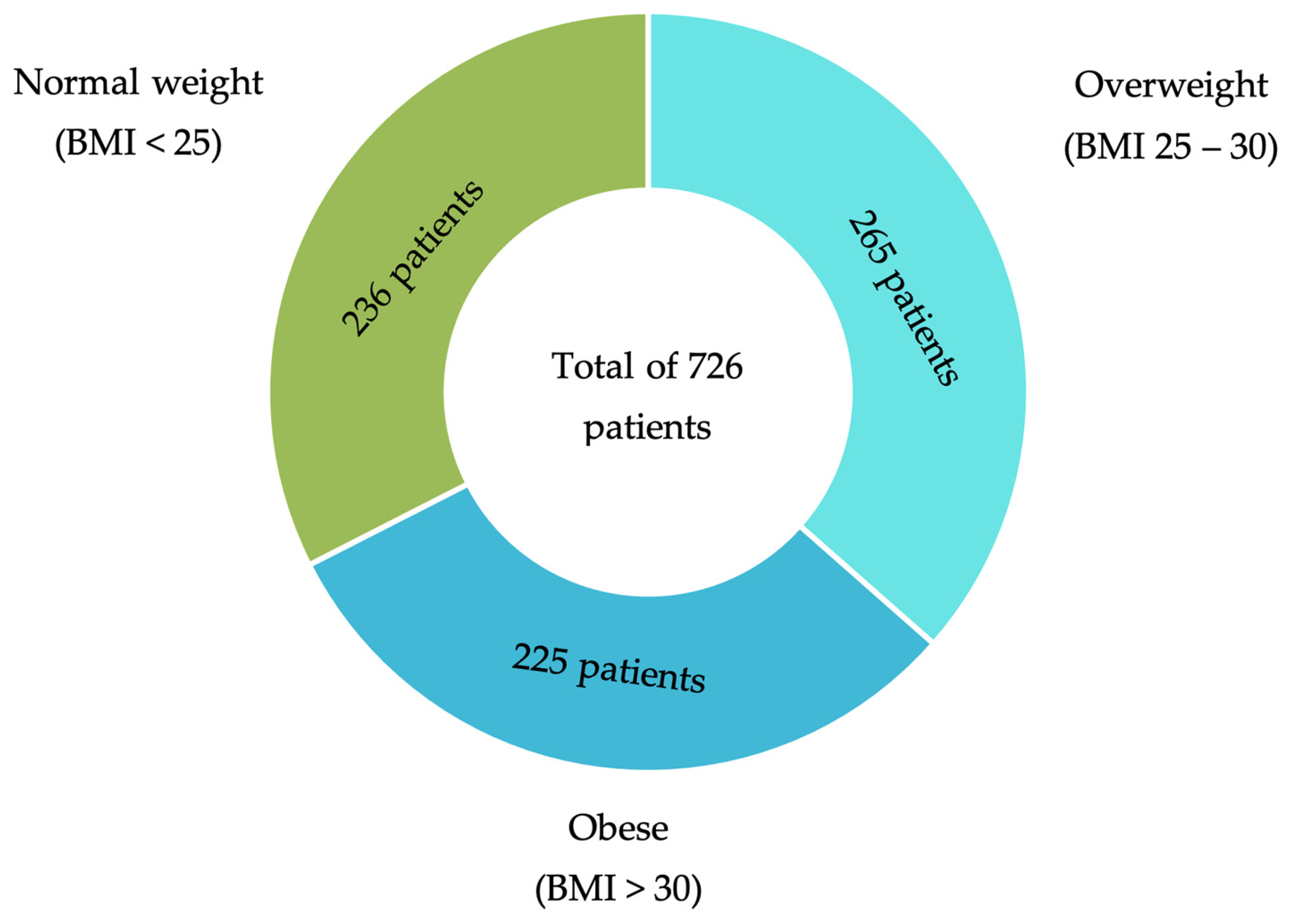
3.1. Patients’ Characteristics
3.2. Treatment Characteristics
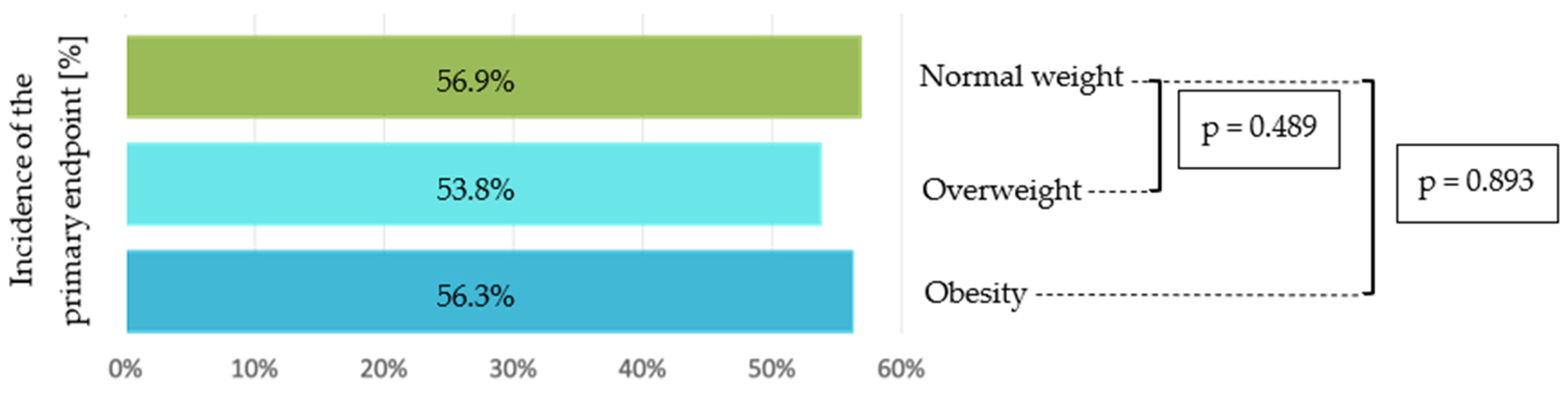
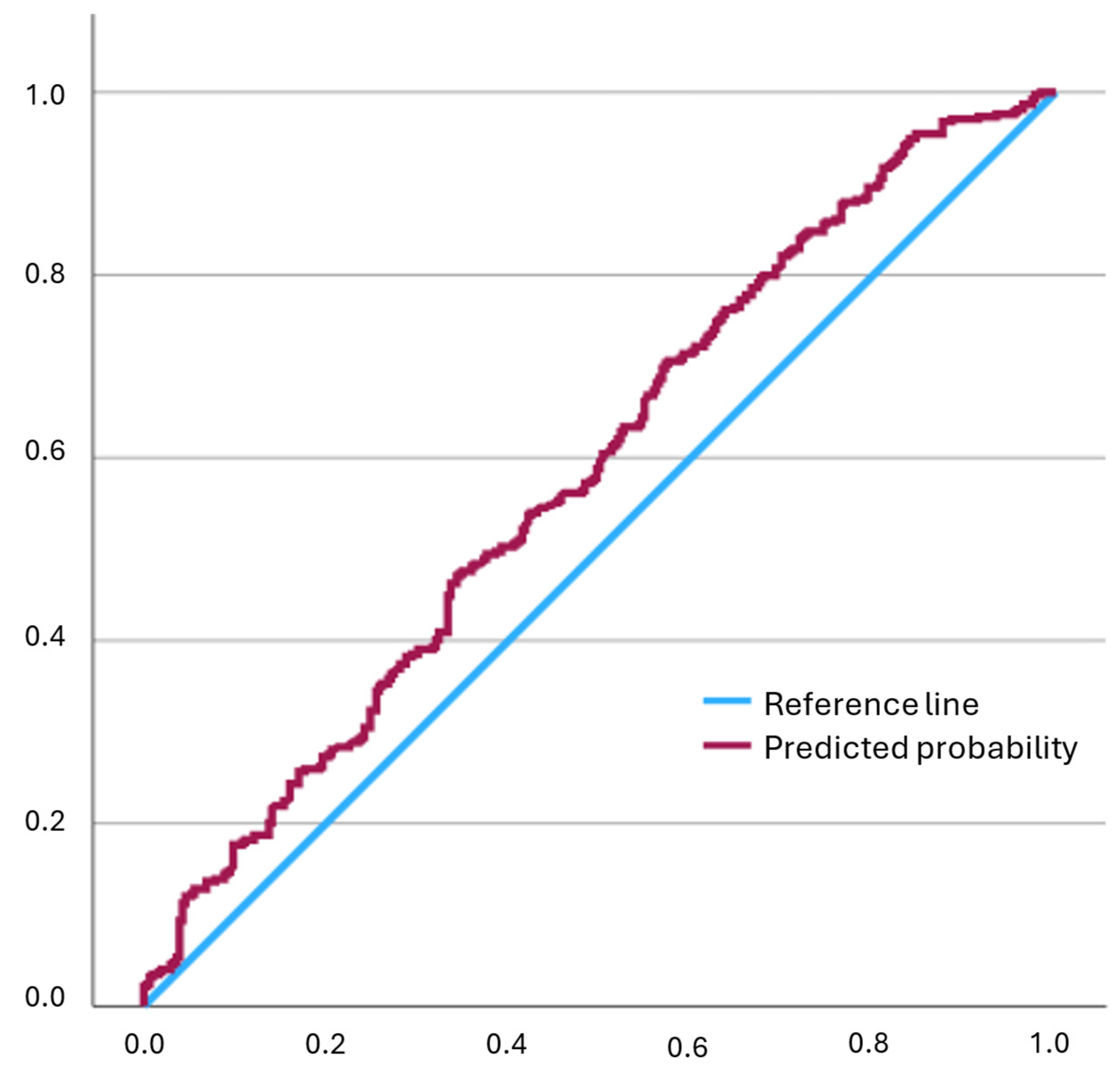
3.3. Primary Composite Endpoint
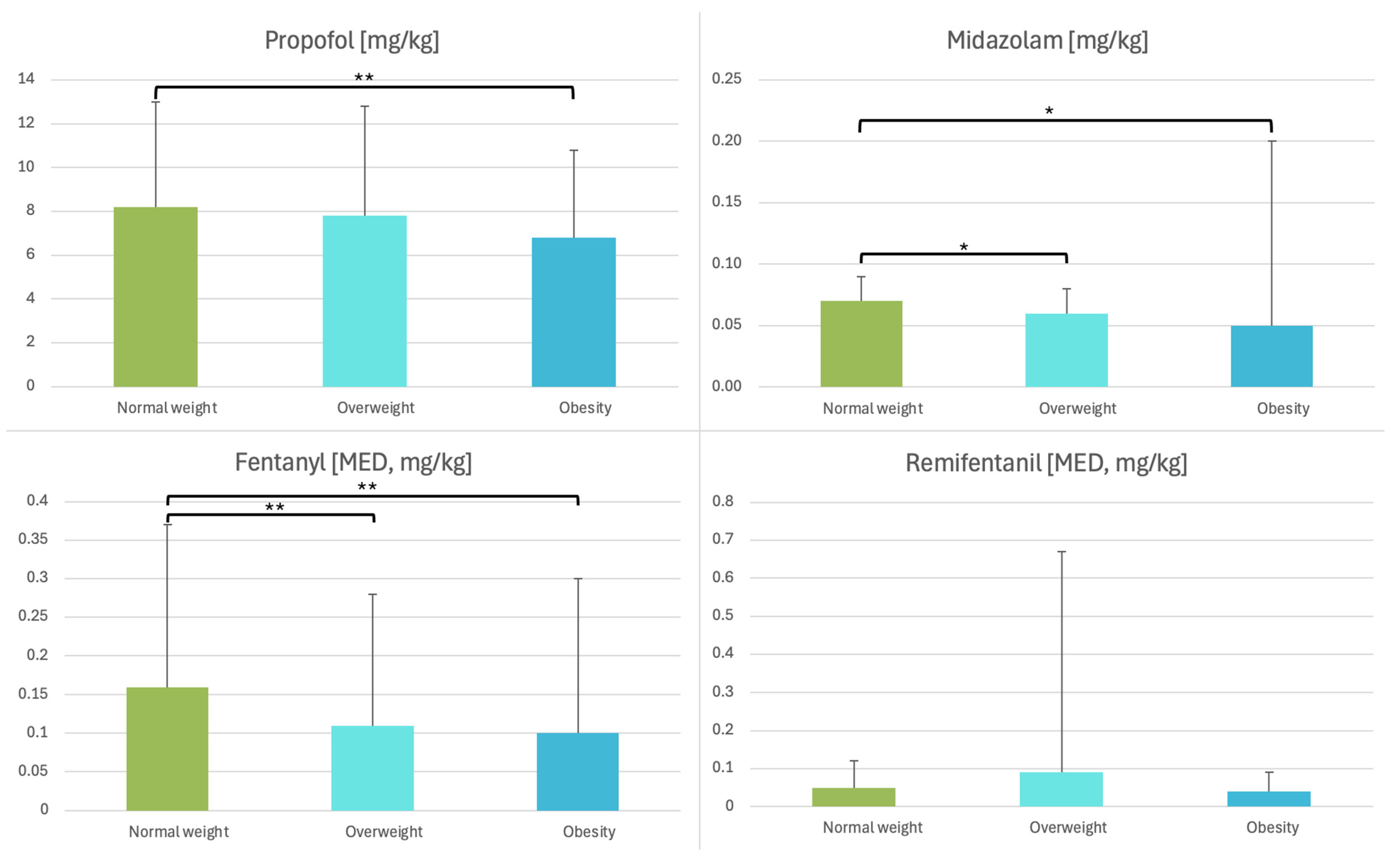
3.4. Secondary Endpoints
4. Discussion
Limitations
5. Conclusions
Supplementary Materials
Author Contributions
Funding
Institutional Review Board Statement
Informed Consent Statement
Data Availability Statement
Conflicts of Interest
Abbreviations
| BMI | Body mass index |
| BP | Blood pressure |
| BPM | Beats per minute |
| CAD | Coronary artery disease |
| CEP | Complex electrophysiological procedure |
| CI | Confidence interval |
| CO2 | Carbon dioxide |
| COPD | Chronic obstructive pulmonary disease |
| Df | Degrees of freedom |
| I.v. | Intravenous |
| IQR | Interquartile range |
| KG | Kilogram of body weight |
| LVEF | Left ventricular ejection fraction |
| MED | Morphine equivalent dose |
| Mg | Milligram |
| Min. | Minutes |
| OSAS | Obstructive sleep apnea syndrome |
| PCE | Primary composite endpoint |
| PvCO2 | Partial pressure of venous carbon dioxide |
| pH | Potential of hydrogen |
| pO2 | Partial pressure of oxygen |
| ROC | Receiver operating characteristic |
| SD | Standard deviation |
| SpO2 | Peripheral oxygen saturation |
| TCM | Transcutaneous CO2 monitoring |
References
- Van Gelder, I.C.; Rienstra, M.; Bunting, K.V.; Casado-Arroyo, R.; Caso, V.; Crijns, H.J.G.M.; De Potter, T.J.R.; Dwight, J.; Guasti, L.; Hanke, T.; et al. 2024 ESC Guidelines for the Management of Atrial Fibrillation Developed in Collaboration with the European Association for Cardio-Thoracic Surgery (EACTS): Developed by the Task Force for the Management of Atrial Fibrillation of the European Society of Cardiology (ESC), with the Special Contribution of the European Heart Rhythm Association (EHRA) of the ESC. Endorsed by the European Stroke Organisation (ESO). Eur. Heart J. 2024, 45, 3314–3414. [Google Scholar] [CrossRef]
- Management of Ventricular Tachycardias: Insights on Centre Settings, Procedural Workflow, Endpoints, and Implementation of Guidelines—Results from an EHRA Survey | EP Europace | Oxford Academic. Available online: https://academic.oup.com/europace/article/26/2/euae030/7607829 (accessed on 5 February 2025).
- Tilz, R.R.; Busch, S.; Chun, K.R.J.; Frerker, C.; Gaede, L.; Steven, D.; Tiefenbacher, C.; Eckardt, L.; Sander, M.; Zwißler, B.; et al. Analgosedierung in der Kardiologie: Konsensuspapier der DGK und DGAI 2024. 2024, pp. 137–150. Available online: https://www.ai-online.info/archiv/2024/03-2024/analgosedierung-in-der-kardiologie-konsensuspapier-der-dgk-und-dgai-2024.html (accessed on 10 February 2025).
- Sairaku, A.; Yoshida, Y.; Hirayama, H.; Nakano, Y.; Kondo, N.; Kihara, Y. Don’t Move during Ablation of Atrial Fibrillation! Int. J. Cardiol. 2014, 171, 78–81. [Google Scholar] [CrossRef]
- Huschak, G.; Busch, T.; Kaisers, U.X. Obesity in Anesthesia and Intensive Care. Best Pract. Res. Clin. Endocrinol. Metab. 2013, 27, 247–260. [Google Scholar] [CrossRef] [PubMed]
- Boutari, C.; Mantzoros, C.S. A 2022 Update on the Epidemiology of Obesity and a Call to Action: As Its Twin COVID-19 Pandemic Appears to Be Receding, the Obesity and Dysmetabolism Pandemic Continues to Rage On. Metabolism 2022, 133, 155217. [Google Scholar] [CrossRef] [PubMed]
- Nalliah, C.J.; Sanders, P.; Kottkamp, H.; Kalman, J.M. The Role of Obesity in Atrial Fibrillation. Eur. Heart J. 2016, 37, 1565–1572. [Google Scholar] [CrossRef] [PubMed]
- Kim, T.K. Obesity and Anesthetic Pharmacology: Simulation of Target-Controlled Infusion Models of Propofol and Remifentanil. Korean J. Anesthesiol. 2021, 74, 478–487. [Google Scholar] [CrossRef]
- Benson, M.; Hubers, J.; Caldis, M.; Gopal, D.; Pfau, P. Safety and Efficacy of Moderate Sedation in Super Obese Patients Undergoing Lower and Upper GI Endoscopy: A Case-Control Study. Obes. Surg. 2020, 30, 3466–3471. [Google Scholar] [CrossRef]
- Vargo, J.J. Procedural Sedation and Obesity: Waters Left Uncharted. Gastrointest. Endosc. 2009, 70, 980–984. [Google Scholar] [CrossRef]
- Wani, S.; Azar, R.; Hovis, C.E.; Hovis, R.M.; Cote, G.A.; Hall, M.; Waldbaum, L.; Kushnir, V.; Early, D.; Mullady, D.K.; et al. Obesity as a Risk Factor for Sedation-Related Complications during Propofol-Mediated Sedation for Advanced Endoscopic Procedures. Gastrointest. Endosc. 2011, 74, 1238–1247. [Google Scholar] [CrossRef]
- Park, J.H.; Choi, S.M.; Park, J.H.; Lee, K.H.; Yun, H.J.; Lee, E.K.; Choi, B.M.; Noh, G.J. Population Pharmacokinetic Analysis of Propofol in Underweight Patients under General Anaesthesia. Br. J. Anaesth. 2018, 121, 559–566. [Google Scholar] [CrossRef]
- Zhu, Q.; Cui, L.; Li, X.; Li, Q.; Wang, Y. Young, Healthy, Underweight Women Require Higher Effective Doses of Propofol for Successful Gastroscope Insertion: A Dose-Finding Study Using Dixon’s Up-and-Down Method. Drug Des. Dev. Ther. 2025, 19, 3017–3028. [Google Scholar] [CrossRef]
- Bautista, A.; Hrushka, L.; Lenhardt, R. Procedural Sedation in the Morbidly Obese: Implications, Complications, and Management. Int. Anesthesiol. Clin. 2020, 58, 41. [Google Scholar] [CrossRef] [PubMed]
- Sundararaman, L.; Goudra, B. Sedation for GI Endoscopy in the Morbidly Obese: Challenges and Possible Solutions. J. Clin. Med. 2024, 13, 4635. [Google Scholar] [CrossRef]
- Practice Guidelines for Moderate Procedural Sedation and Analgesia 2018: A Report by the American Society of Anesthesiologists Task Force on Moderate Procedural Sedation and Analgesia, the American Association of Oral and Maxillofacial Surgeons, American College of Radiology, American Dental Association, American Society of Dentist Anesthesiologists, and Society of Interventional Radiology*. Anesthesiology 2018, 128, 437–479. [CrossRef]
- Teumer, Y.; Buss, A.; Diofano, F.; Aktolga, D.; Katov, L.; Bothner, C.; Dahme, T.; Öchsner, W.; Mayer, B.; Rottbauer, W.; et al. Prospective Randomized Evaluation of Transcutaneous Carbon Dioxide Monitoring during Complex Electrophysiological Procedures under Deep Sedation: The TRACES Trial. Clin. Res. Cardiol. 2024, 1–9. [Google Scholar] [CrossRef]
- Kilic, E.T.; Sayar, S.; Kahraman, R.; Ozdil, K. The Effects of Obesity on Sedation-Related Outcomes of Advanced Endoscopic Procedures. North. Clin. Istanb. 2019, 6, 321–326. [Google Scholar] [CrossRef] [PubMed]
- Khan, I.; Chatterjee, A.B.; Bellinger, C.R.; Haponik, E. Sedation for Bronchoscopy and Complications in Obese Patients. Respiration 2016, 92, 158–165. [Google Scholar] [CrossRef]
- Phelps, N.H.; Singleton, R.K.; Zhou, B.; Heap, R.A.; Mishra, A.; Bennett, J.E.; Paciorek, C.J.; Lhoste, V.P.; Carrillo-Larco, R.M.; Stevens, G.A.; et al. Worldwide Trends in Underweight and Obesity from 1990 to 2022: A Pooled Analysis of 3663 Population-Representative Studies with 222 Million Children, Adolescents, and Adults. Lancet 2024, 403, 1027–1050. [Google Scholar] [CrossRef]
- Ahrens, M.; Rosenthal, O.; Bau, T.; Magerfleisch, P.; Moser, F.; Frank, D.; Maslova, V.; Lian, E. Hemodynamic and Respiratory Stability in Obese vs. Non-Obese Patients during de Novo Pulmonary Vein Isolation under Conscious Sedation. Europace 2025, 27, euaf085.460. [Google Scholar] [CrossRef]
- Scheurlen, C.; van den Bruck, J.-H.; Filipovic, K.; Wörmann, J.; Arica, Z.; Erlhöfer, S.; Dittrich, S.; Heijman, J.; Lüker, J.; Steven, D.; et al. Procedural and Outcome Impact of Obesity in Cryoballoon versus Radiofrequency Pulmonary Vein Isolation in Atrial Fibrillation Patients. J. Interv. Card. Electrophysiol. 2022, 65, 403–410. [Google Scholar] [CrossRef]
- Von Thaer, S.; McVey, J.; Shelton, J.; Johnson, Q. Obesity and Anesthesia: Challenges in the Perioperative Period. Mo Med. 2024, 121, 156–163. [Google Scholar] [PubMed]
- Littleton, S.W. Impact of Obesity on Respiratory Function. Respirology 2012, 17, 43–49. [Google Scholar] [CrossRef] [PubMed]
- Maslova, V.; Ahrens, M.; Rosenthal, O.; Bau, T.; Magerfleisch, P.; Moser, F.; Zaman, A.; Saad, M.; Spehlmann, M.; Frank, D.; et al. De Novo Pulmonary Vein Isolation in Obese vs. Nonobese Patients under Deep Sedation: Does Obesity Increase Procedure Complexity? Heart Rhythm O2 2025, 6, 1524–1535. [Google Scholar] [CrossRef] [PubMed]
- Tabaja, C.; Younis, A.; Santageli, P.; Farwati, M.; Braghieri, L.; Nakagawa, H.; Saliba, W.I.; Madden, R.; Bouscher, P.; Kanj, M.; et al. Impact of Obesity on Catheter Ablation of Atrial Fibrillation: Patient Characteristics, Procedural Complications, Outcomes, and Quality of Life. J. Cardiovasc. Electrophysiol. 2023, 34, 1648–1657. [Google Scholar] [CrossRef]
- Ingrande, J.; Lemmens, H.J.M. Dose Adjustment of Anaesthetics in the Morbidly Obese. Br. J. Anaesth. 2010, 105, i16–i23. [Google Scholar] [CrossRef]
- Abernethy, D.R.; Greenblatt, D.J. Pharmacokinetics of Drugs in Obesity. Clin. Pharmacokinet. 1982, 7, 108–124. [Google Scholar] [CrossRef]
- Hanley, M.J.; Abernethy, D.R.; Greenblatt, D.J. Effect of Obesity on the Pharmacokinetics of Drugs in Humans. Clin. Pharmacokinet. 2010, 49, 71–87. [Google Scholar] [CrossRef]
- Cortínez, L.I.; Anderson, B.J.; Penna, A.; Olivares, L.; Muñoz, H.R.; Holford, N.H.G.; Struys, M.M.R.F.; Sepulveda, P. Influence of Obesity on Propofol Pharmacokinetics: Derivation of a Pharmacokinetic Model. Br. J. Anaesth. 2010, 105, 448–456. [Google Scholar] [CrossRef]
- Hoymork, S.C.; Raeder, J. Why Do Women Wake up Faster than Men from Propofol Anaesthesia? Br. J. Anaesth. 2005, 95, 627–633. [Google Scholar] [CrossRef]
- Wasilczuk, A.Z.; Rinehart, C.; Aggarwal, A.; Stone, M.E.; Mashour, G.A.; Avidan, M.S.; Kelz, M.B.; Proekt, A. Hormonal Basis of Sex Differences in Anesthetic Sensitivity. Proc. Natl. Acad. Sci. USA 2024, 121, e2312913120. [Google Scholar] [CrossRef]
- Katov, L.; Huggle, W.; Teumer, Y.; Buss, A.; Diofano, F.; Bothner, C.; Öchsner, W.; Rottbauer, W.; Weinmann-Emhardt, K. Gender-Specific Differences in Sedation-Associated Outcomes During Complex Electrophysiological Procedures. Healthcare 2025, 13, 844. [Google Scholar] [CrossRef]



| Total (n = 726) | Normal (n = 236) | Overweight (n = 265) | Obesity (n = 225) | p-Value (Between Groups) | |
|---|---|---|---|---|---|
| Age [years], median (IQR) [mean ± SD] | 68.0 (61.0; 76.0) [67.0 ± 11.5] | 72.0 (63.0; 78.0) [69.2 ± 12.7] | 68.0 (59.0; 75.0) [66.4 ± 11.5] | 66.0 (58.2; 73.0) [65.7 ± 9.9] | <0.001 |
| Body Mass Index, median (IQR) [mean ± SD] | 27.5 (24.5; 31.1) [28.5 ± 5.6] | 23.3 (22.1; 24.2) [23.0 ± 2.3] | 27.4 (26.2; 28.4) [27.4 ± 1.3] | 33.3 (31.4; 37.1) [35.0 ± 4.9] | <0.001 |
| Female, n (%) | 299 (41.2) | 103 (43.6) | 96 (36.2) | 100 (44.4) | 0.033 |
| Arterial hypertension, n (%) | 523 (72.0) | 145 (61.4) | 188 (70.9) | 190 (84.4) | <0.001 |
| Hyperlipoproteinemia, n (%) | 434 (59.8) | 123 (52.1) | 166 (62.6) | 145 (64.4) | 0.239 |
| Diabetes mellitus, n (%) | 117 (16.1) | 21 (8.9) | 32 (12.1) | 64 (28.4) | <0.001 |
| (Former) Smoker, n (%) | 190 (26.2) | 51 (21.6) | 76 (28.7) | 63 (28.0) | 0.418 |
| Coronary artery disease, n (%) | 257 (35.4) | 83 (35.2) | 94 (35.5) | 80 (35.6) | 0.784 |
| Reduced LVEF, n (%) | 304 (41.9) | 84 (35.6) | 120 (45.3) | 100 (44.4) | 0.265 |
| COPD, n (%) | 41 (5.6) | 12 (5.1) | 14 (5.3) | 15 (6.7) | 0.791 |
| Asthma, n (%) | 22 (3.0) | 5 (2.1) | 8 (3.0) | 9 (4.0) | 0.587 |
| OSAS, n (%) | 50 (6.9) | 6 (2.5) | 13 (4.9) | 31 (13.8) | <0.001 |
| Pulmonary hypertension, n (%) | 21 (2.9) | 7 (3.0) | 7 (2.6) | 7 (3.1) | 0.922 |
| Total (n = 726) | Normal (n = 236) | Overweight (n = 265) | Obesity (n = 225) | p-Value (Between Groups) | |
|---|---|---|---|---|---|
| Procedure duration (min), median (IQR) [mean ± SD] | 150.0 (110.0; 205.7) [165.6 ± 76.9] | 134.0 (107.0; 204.0) [162.0 ± 79.5] | 150.5 (111.0; 210.0) [166.3 ± 74.4] | 156.0 (118.0; 207.0) [168.3 ± 77.6] | 0.295 |
| Intraprocedural cardioversion, n (%) | 331.0 (45.6) | 100 (42.4) | 123.0 (46.4) | 108.0 (48.0) | 0.987 |
| Initial oxygen flow (L/min), median (IQR) [mean ± SD] | 8.0 (4.0; 8.0) [6.3 ± 2.5] | 8.0 (3.0; 8.0) [6.1 ± 2.6] | 8.0 (4.0; 8.0) [6.2 ± 2.5] | 8.0 (6.0; 8.0) [6.8 ± 2.3] | 0.007 |
| Baseline oxygen saturation (%),median (IQR) [mean ± SD] | 98.0 (97.0; 99.0) [97.6 ± 2.8] | 99.0 (97.0; 100.0) [97.8 ± 3.2] | 98.0 (97.0; 99.0) [97.7 ± 2.3] | 98.0 (97.0; 99.0) [97.4 ± 2.8] | 0.050 |
| Baseline heart rate (bpm), median (IQR) [mean ± SD] | 77.0 (62.0; 94.0) [81.6 ± 26.4] | 77.0 (63.5; 94.0) [82.1 ± 25.7] | 77.0 (63.0; 92.0) [81.9 ± 27.5] | 76.0 (61.0; 96.0) [80.8 ± 25.8] | 0.922 |
| Baseline systolic blood pressure (mmHg), median (IQR) [mean ± SD] | 115.0 (101.5; 129.0) [116.2 ± 22.3] | 113.0 (100.2; 128.0) [114.9 ± 23.3] | 118.0 (103.0; 130.0) [117.4 ± 21.0] | 114.0 (99.7; 128.0) [116.2 ± 22.7] | 0.400 |
| Baseline mean blood pressure (mmHg), median (IQR) [mean ± SD] | 86.0 (76.0; 96.0) [87.8 ± 28.3] | 86.0 (76.0; 97.7) [86.5 ± 16.5] | 88.0 (78.0; 96.0) [88.1 ± 15.0] | 84.0 (73.0; 93.2) [88.6 ± 44.5] | 0.181 |
| Regression Coefficient B | Standard Error | Wald | df | p-Value | Odds Ratio (95%CI) | |
|---|---|---|---|---|---|---|
| Overweight | −0.035 | 0.193 | 0.033 | 1 | 0.855 | 0.965 (0.661–1.410) |
| Obesity | 0.058 | 0.212 | 0.075 | 1 | 0.784 | 1.060 (0.700–1.604) |
| Female gender | 0.344 | 0.172 | 3.988 | 1 | 0.046 | 1.411 (1.006–1.977) |
| Age | −0.004 | 0.008 | 0.290 | 1 | 0.590 | 0.996 (0.980–1.012) |
| Single-vessel CAD | 0.047 | 0.256 | 0.034 | 1 | 0.854 | 1.048 (0.634–1.733) |
| Two-vessel CAD | −0.430 | 0.318 | 1.834 | 1 | 0.176 | 0.650 (0.349–1.212) |
| Three-vessel CAD | 0.360 | 0.253 | 2.021 | 1 | 0.155 | 1.434 (0.872–2.355) |
| Mildly reduced LVEF | −0.010 | 0.251 | 0.002 | 1 | 0.968 | 0.990 (0.606–1.618) |
| Moderately reduced LVEF | −0.213 | 0.263 | 0.657 | 1 | 0.418 | 0.808 (0.482–1.353) |
| Severely reduced LVEF | 0.269 | 0.226 | 1.419 | 1 | 0.233 | 1.309 (0.841–2.037) |
| Arterial hypertension | −0.096 | 0.201 | 0.230 | 1 | 0.632 | 0.908 (0.612–1.347) |
| Hyperlipoproteinemia | −0.241 | 0.172 | 1.961 | 1 | 0.161 | 0.786 (0.561–1.101) |
| Diabetes mellitus | 0.407 | 0.225 | 3.283 | 1 | 0.070 | 1.502 (0.967–2.334) |
| COPD | 0.212 | 0.358 | 0.352 | 1 | 0.553 | 1.237 (0.613–2.493) |
| Smoker | 0.325 | 0.289 | 1.268 | 1 | 0.260 | 1.384 (0.786–2.437) |
| Former Smoker | −0.173 | 0.223 | 0.603 | 1 | 0.438 | 0.841 (0.543–1.302) |
| Total (n = 726) | Normal (n = 236) | Overweight (n = 265) | Obesity (n = 225) | p-Value (Between Groups) | |
|---|---|---|---|---|---|
| Oxygen saturation <90%, n (%) | 308.0 (42.4) | 103.0 (43.6) | 110.0 (41.5) | 95.0 (42.2) | 0.575 |
| Hypoxia, n (%) | 278.0 (38.3) | 95.0 (40.3) | 96.0 (36.2) | 87.0 (38.7) | 0.406 |
| PvCO2 > 70 mmHg, n (%) | 29.0 (4.0) | 10.0 (4.2) | 10.0 (3.8) | 9.0 (4.0) | 0.878 |
| PvCO2 > 30% from baseline, n (%) | 125.0 (17.2) | 39.0 (16.5) | 48.0 (18.1) | 38.0 (16.9) | 0.956 |
| Venous pH < 7.25, n (%) | 125.0 (17.2) | 40.0 (16.9) | 44.0 (16.6) | 41.0 (18.2) | 0.774 |
| Systolic blood pressure < 80 mmHg, n (%) | 278.0 (38.3) | 90.0 (38.1) | 100.0 (37.7) | 88.0 (39.1) | 0.809 |
| Mean blood pressure < 65 mmHg, n (%) | 372.0 (52.1) | 122.0 (51.7) | 132.0 (49.8) | 118.0 (52.4) | 0.504 |
| Midazolam dose (mg), median (IQR) [mean ± SD] | 5.0 (5.0; 5.0) [4.9 ± 1.2] | 5.0 (5.0; 5.0) [5.0 ± 1.0] | 5.0 (5.0; 5.0) [4.7 ± 1.3] | 5.0 (5.0; 5.0) [4.9 ± 1.4] | 0.309 |
| Midazolam dose (mg/KG), median (IQR) [mean ± SD] | 0.06 (0.05; 0.07) [0.06 ± 0.02] | 0.07 (0.06; 0.08) [0.07 ± 0.02] | 0.06 (0.05; 0.06) [0.06 ± 0.02] | 0.05 (0.04; 0.05) [0.05 ± 0.15] | <0.001 |
| Propofol dose (mg), median (IQR) [mean ± SD] | 570.0 (360.0; 800.0) [640.5 ± 422.2] | 500.0 (333.5; 750.0) [564.0 ± 351.0] | 570.0 (380.0; 825.0) [658.6 ± 439.1] | 600.0 (390.0; 850.0) [693.0 ± 454.7] | 0.002 |
| Propofol dose (mg/KG), median (IQR) [mean ± SD] | 6.8 (4.5; 9.6) [7.6 ± 4.7] | 7.4 (5.0; 10.5) [8.2 ± 4.8] | 6.8 (4.5; 10.0) [7.8 ± 5.0] | 6.3 (4.1; 8.8) [6.8 ± 4.0] | 0.008 |
| MED Fentanyl i.v. total (mg), median (IQR) [mean ± SD] | 0 (0; 16.5) [10.3 ± 15.5] | 0 (0; 16.5) [11.2 ± 14.4] | 0 (0; 16.5) [9.4 ± 13.9] | 0 (0; 16.5) [10.4 ± 18.2] | 0.219 |
| MED Fentanyl i.v. (mg/KG), median (IQR) [mean ± SD] | 0 (0; 0.2) [0.13 ± 0.20] | 0 (0; 0.3) [0.16 ± 0.21] | 0 (0; 0.2) [0.11 ± 0.17] | 0 (0; 0.2) [0.10 ± 0.20] | 0.004 |
| MED Remifentanil i.v. total (mg), median (IQR) [mean ± SD] | 3.1 (0; 6.9) [5.5 ± 35.1] | 1.6 (0; 6.6) [3.8 ± 5.3] | 3.3 (0; 7.3) [7.9 ± 56.9] | 3.5 (0; 7.3) [4.3 ± 5.0] | 0.423 |
| MED Remifentanil i.v. (mg/KG), median (IQR) [mean ± SD] | 0.03 (0; 0.09) [0.06 ± 0.36] | 0.02 (0; 0.10) [0.05 ± 0.07] | 0.04 (0; 0.09) [0.09 ±0.58] | 0.03 (0; 0.07) [0.04 ± 0.05] | 0.353 |
Disclaimer/Publisher’s Note: The statements, opinions and data contained in all publications are solely those of the individual author(s) and contributor(s) and not of MDPI and/or the editor(s). MDPI and/or the editor(s) disclaim responsibility for any injury to people or property resulting from any ideas, methods, instructions or products referred to in the content. |
© 2026 by the authors. Licensee MDPI, Basel, Switzerland. This article is an open access article distributed under the terms and conditions of the Creative Commons Attribution (CC BY) license.
Share and Cite
Katov, L.; Dupree, C.; Teumer, Y.; Buss, A.; Diofano, F.; Bothner, C.; Öchsner, W.; Rottbauer, W.; Weinmann-Emhardt, K. Impact of Body Weight on Sedation-Related Outcomes in Complex Electrophysiological Interventions. Healthcare 2026, 14, 517. https://doi.org/10.3390/healthcare14040517
Katov L, Dupree C, Teumer Y, Buss A, Diofano F, Bothner C, Öchsner W, Rottbauer W, Weinmann-Emhardt K. Impact of Body Weight on Sedation-Related Outcomes in Complex Electrophysiological Interventions. Healthcare. 2026; 14(4):517. https://doi.org/10.3390/healthcare14040517
Chicago/Turabian StyleKatov, Lyuboslav, Celine Dupree, Yannick Teumer, Alexandra Buss, Federica Diofano, Carlo Bothner, Wolfgang Öchsner, Wolfgang Rottbauer, and Karolina Weinmann-Emhardt. 2026. "Impact of Body Weight on Sedation-Related Outcomes in Complex Electrophysiological Interventions" Healthcare 14, no. 4: 517. https://doi.org/10.3390/healthcare14040517
APA StyleKatov, L., Dupree, C., Teumer, Y., Buss, A., Diofano, F., Bothner, C., Öchsner, W., Rottbauer, W., & Weinmann-Emhardt, K. (2026). Impact of Body Weight on Sedation-Related Outcomes in Complex Electrophysiological Interventions. Healthcare, 14(4), 517. https://doi.org/10.3390/healthcare14040517